




Home Corner
A shopping list to take to the shop.

Your Custom Text Here
Home › Areas of Learning Menu › Literacy
Explore marks. Share ideas. Write with a purpose.
Find printable resources for drawing, mark making and meaningful early writing in nurseries, preschools, Reception classes and childminding settings, with selected resources suitable for KS1.
Support a welcoming writing area and the moments that happen across your provision: a shopping list in the home corner, a map beside a model, a message for a friend or a record of something discovered outdoors.
Choose a few useful resources to offer alongside familiar tools, materials and plain paper. Children’s own ideas give the marks their purpose.

Please note that both Editable (docx file) and non-editable (pdf file) versions are available for ‘Mark Making/Drawing/Writing’ resources. (Editable files require Microsoft Word to work at optimum level and PDF files require a pdf viewer.)
Explore these samples with a Free Access account. Each offers a simple starting point for drawing, mark making and sharing ideas.
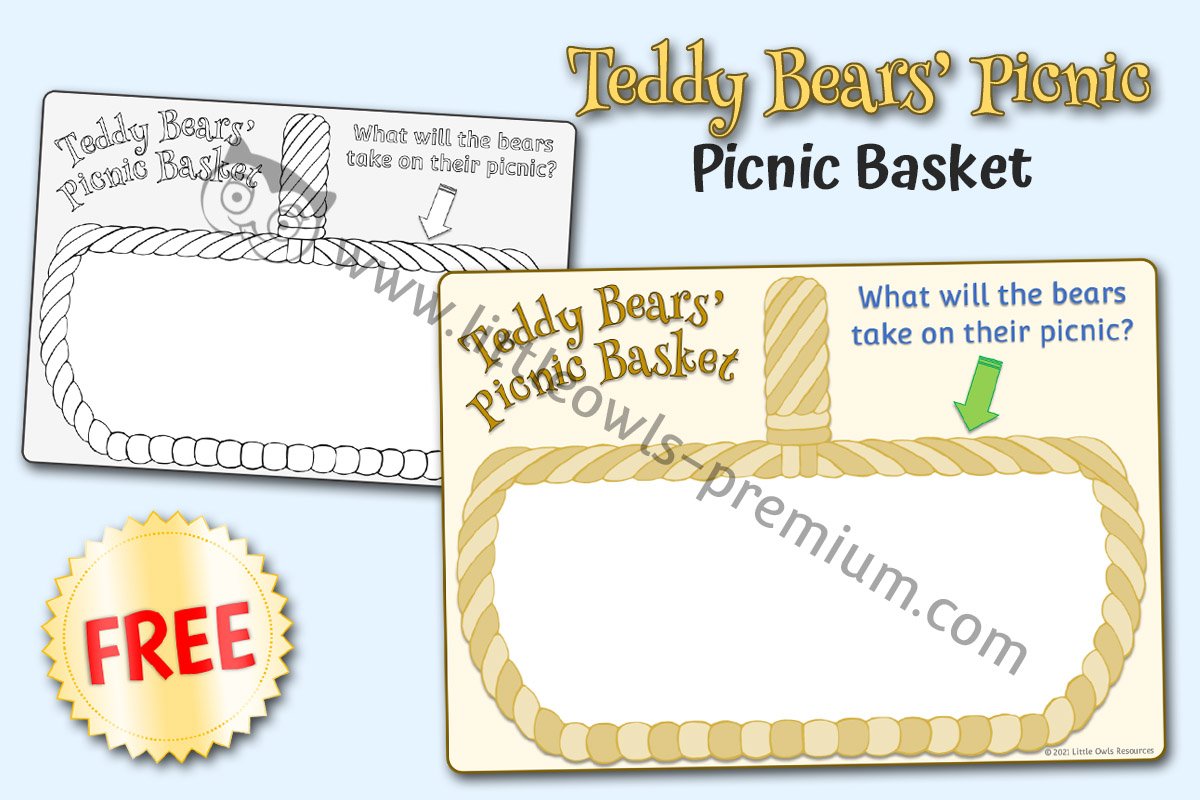
What will the bears take on their picnic?
These sheets can be used in the following ways:
Group Prompts to inspire discussion / communication and language skills and subsequent children’s art & craft work.
Printed for individual artwork use.
Laminated to be used repeatedly with whiteboard pens or as playdough mats.
Original artwork drawn by Sara Murphy and final digital resources created by Stuart Murphy. COPYRIGHT ON ALL OF THE RESOURCES HOUSED ON THIS WEBSITE IS HELD BY ‘LITTLE OWLS RESOURCES’. OUR RESOURCES (INCLUDING THE IMAGES WITHIN THEM), CANNOT BE SHARED OR SOLD COMMERCIALLY.
DOWNLOAD EDITABLE (DOCX)
DOWNLOAD NON-EDITABLE (PDF)
DOWNLOAD NON-EDITABLE (Zipped JPEGs)
<<-BACK TO ‘TEDDY BEARS’ PICNIC’ MENU
What would your bears take on a picnic? Invite children to fill the basket with their own drawings, marks, labels or collage, then share their ideas. It can also be used as a reusable playdough mat.
These sheets are designed to encourage children to think about their families. The sheets can be used as simply a prompt for discussion or as a stimulus for children to draw and write about their own family.
Original artwork drawn by Sara Murphy and final digital resources created by Stuart Murphy. COPYRIGHT ON ALL OF THE RESOURCES HOUSED ON THIS WEBSITE IS HELD BY ‘LITTLE OWLS RESOURCES’. OUR RESOURCES (INCLUDING THE IMAGES WITHIN THEM), CANNOT BE SHARED OR SOLD COMMERCIALLY.
DOWNLOAD EDITABLE (DOCX)
DOWNLOAD NON-EDITABLE (PDF)
DOWNLOAD NON-EDITABLE (Zipped JPEGs)
Invite children to talk about the people important to them and choose how to represent their family through drawing, marks or writing.
Build a familiar collection children can find, choose from and revisit. Keep tools and paper accessible, model their use when helpful and add a printable when it supports what a child wants to do.
Printable Provision · Included with All Access Membership.
Make room for experimenting. Offer a manageable choice of tools and surfaces, and time to discover what happens when children move, press, sweep or change direction. Drawing and mark making can be enjoyed for their own sake.
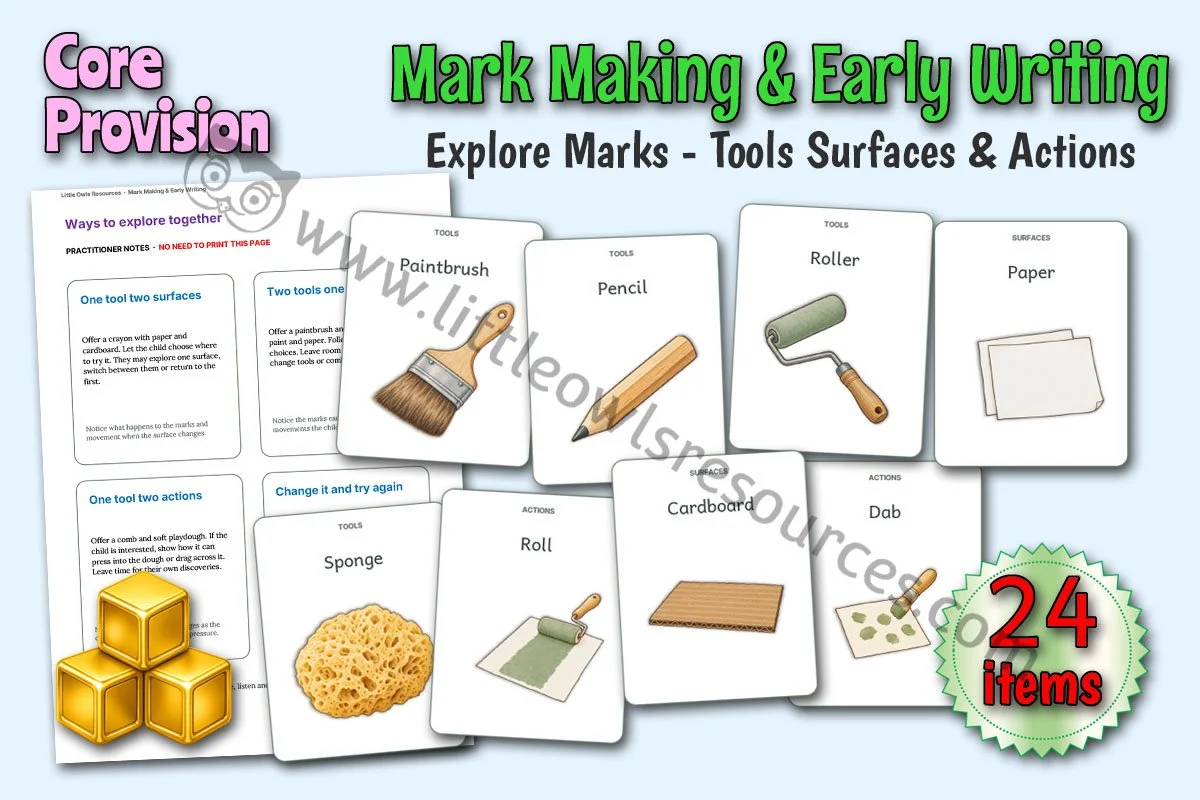
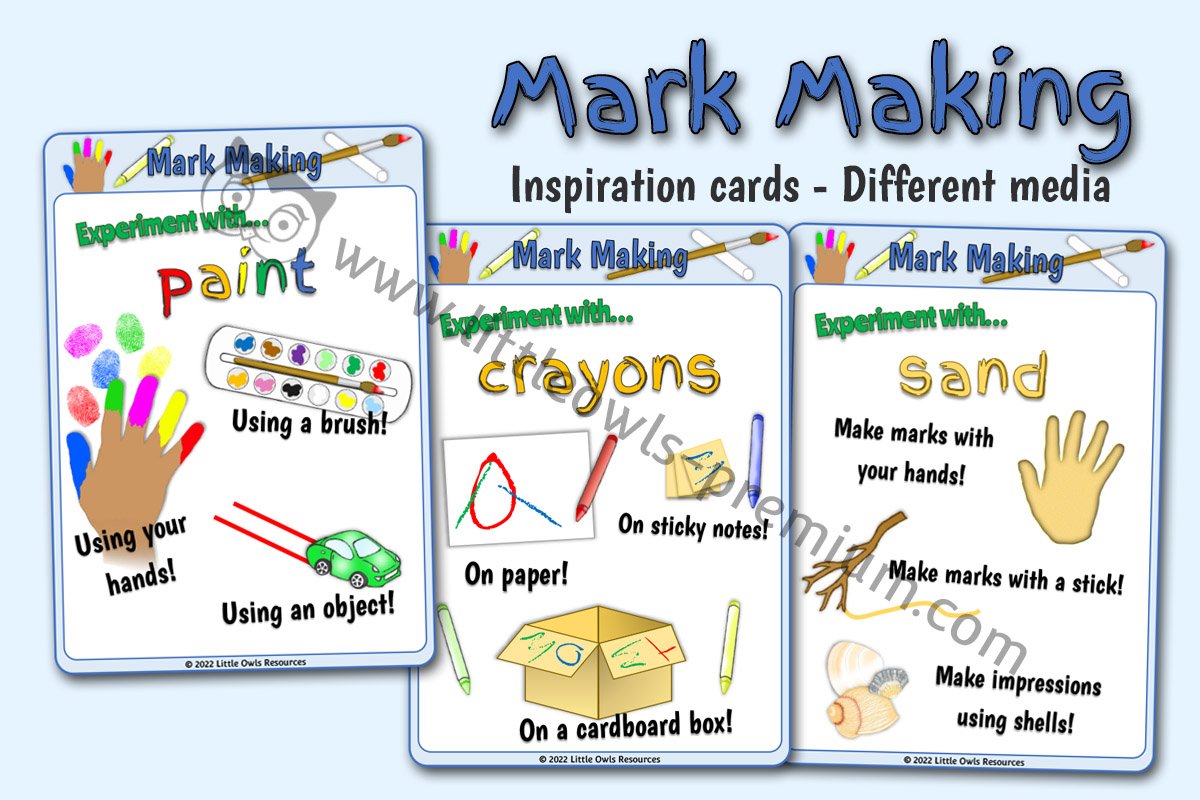
Offer familiar tools and varied surfaces for children to explore the marks they can make. These cards offer choices of tools, surfaces and movements, with space for children’s own ideas. Keep the real objects available alongside the pictures.
Offer choices and time to explore
Put out a few compatible choices. Children can choose a card, combine ideas, return to a favourite or ignore the cards. They do not need one card from every group. Dab, drag, roll, press, sweep and swirl are possibilities to explore, not instructions to complete.
DOWNLOAD (DOCX) 📝
DOWNLOAD (PDF) 📄
DOWNLOAD (Zipped JPEGs) 📂
Preschool & Reception
Help children choose what to use, where to make marks and how to move. Share a few picture cards alongside real materials, with freedom to combine ideas and revisit favourite actions.
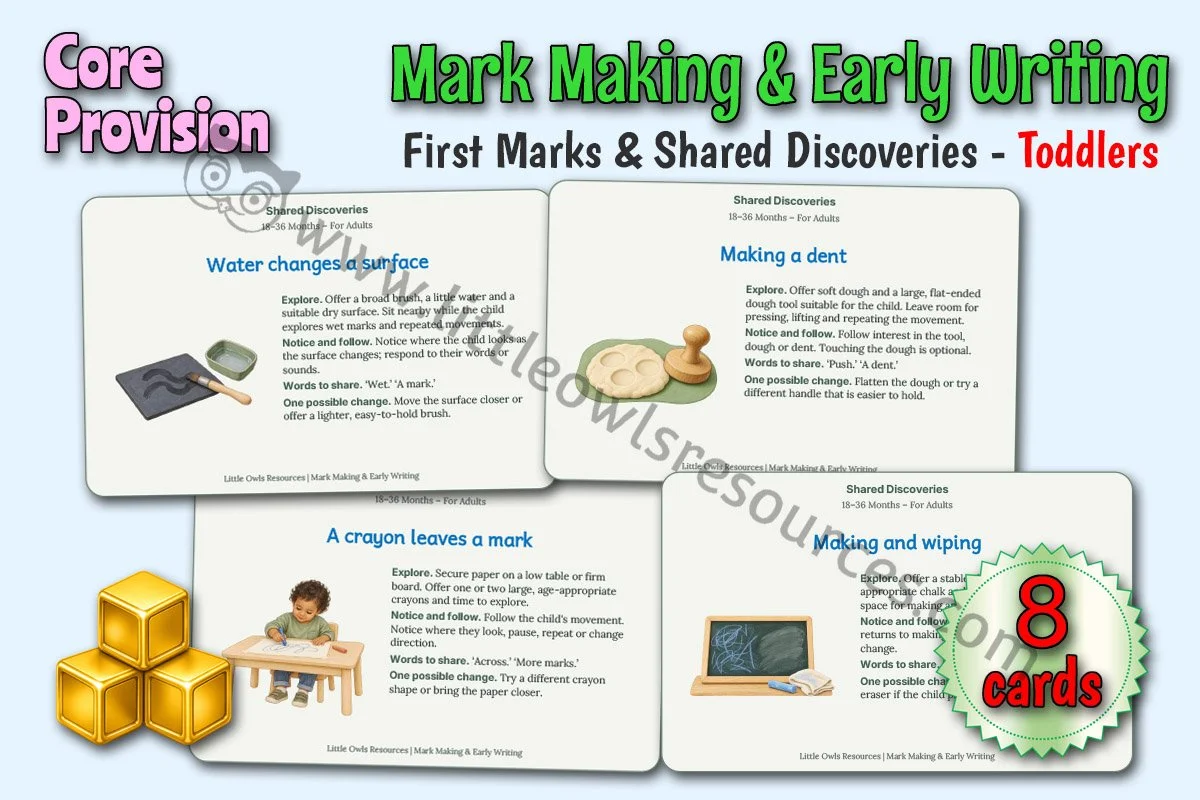
Toddlers 18–36 months · For adults
These invitations focus on what a toddler notices, repeats and shares while exploring marks. A mark may be a line, a patch of water, an impression or a track. Enjoyment may come from the movement itself or from a change in a surface. Use the ideas with familiar resources indoors or outdoors, wherever the child is comfortable.
Begin with something familiar
Offer one simple setup and time to explore. Watch what draws the child's attention. They may touch a tool, move it, watch you, revisit one action or leave. Use the cards in any order and return to the same invitation while it remains interesting. The age range is a guide to the intended audience, not a sequence of expected achievements.
DOWNLOAD (DOCX) 📝
DOWNLOAD (PDF) 📄
DOWNLOAD (Zipped JPEGs) 📂
Toddlers 18–36 months · For adults
Illustrated invitations for adults sharing early mark-making discoveries with toddlers. Follow familiar actions, notice what holds a child’s interest and find simple ways to join in, talk and explore together.
These cards are to help inspire children in their mark making as they decide which medium to use. It is hoped that the visual nature of the cards will help children who may have a language or communication barrier. 13 cards included in the pack.
Original artwork drawn by Sara Murphy and final digital resources created by Stuart Murphy. COPYRIGHT ON ALL OF THE RESOURCES HOUSED ON THIS WEBSITE IS HELD BY ‘LITTLE OWLS RESOURCES’. OUR RESOURCES (INCLUDING THE IMAGES WITHIN THEM), CANNOT BE SHARED OR SOLD COMMERCIALLY.
DOWNLOAD EDITABLE (DOCX)
DOWNLOAD NON-EDITABLE (PDF)
DOWNLOAD NON-EDITABLE (Zipped JPEGs)
<<-BACK TO ‘NON-TOPIC LITERACY’ MENU
Preschool & Reception
Visual prompts to help children choose materials for their own mark making. Offer a few cards alongside the tools available in your setting.
Give children space to draw what interests them, invent a story or gather their ideas into a book. Offer open paper and simple starting points, with time to talk, revisit a drawing or add another page. Children decide what their work means and whether they want to share it.
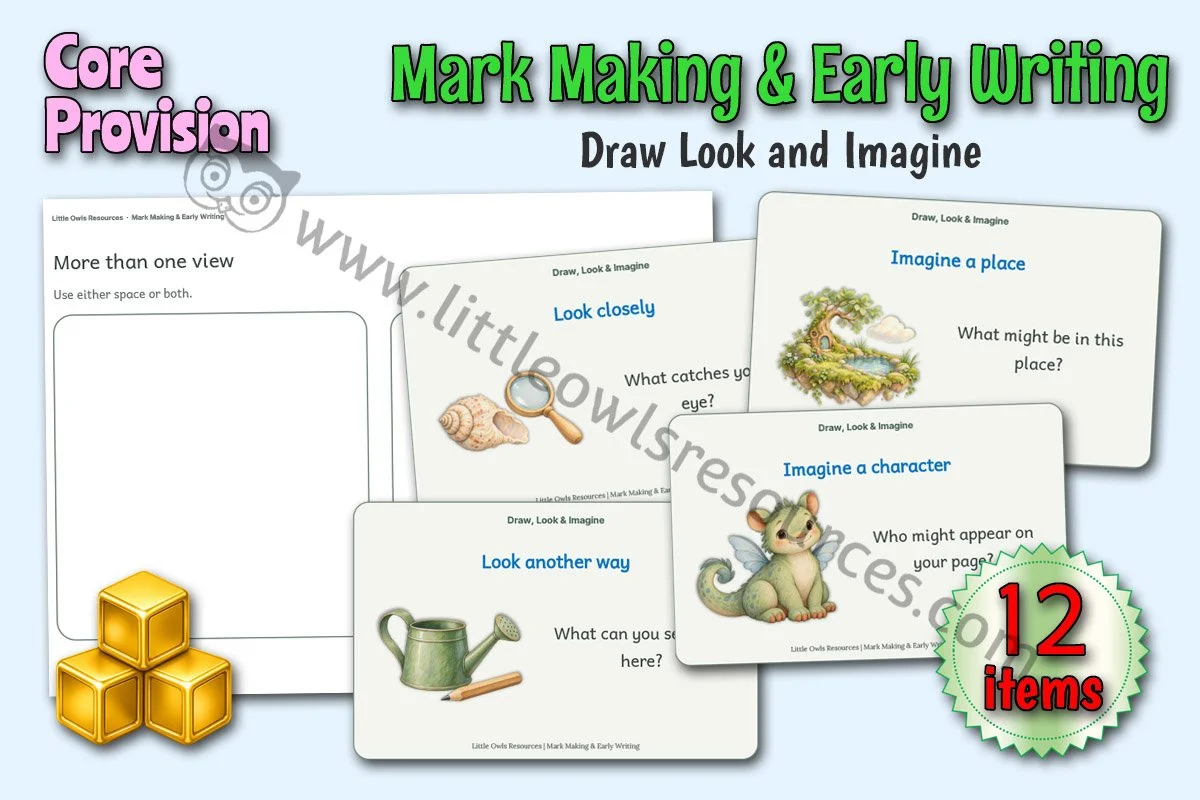
Drawing can help children explore something they notice, remember or imagine. These invitations offer starting points for their own ideas. A drawing may develop through marks, shapes, colour, words or conversation, and its meaning may change as the child works.
Offer a possibility
Choose a card when it connects with a child’s interest. Offer familiar drawing materials and open paper. Children can use the idea, adapt it, return to it later or continue in another way. Looking, remembering and imagining can overlap; the cards do not form a sequence.
DOWNLOAD (DOCX) 📝
DOWNLOAD (PDF) 📄
DOWNLOAD (Zipped JPEGs) 📂
Preschool & Reception
Invite children to draw something they notice, remember or imagine. Share an illustrated starting point and open drawing space, welcoming their own ideas and the meanings they give their marks.
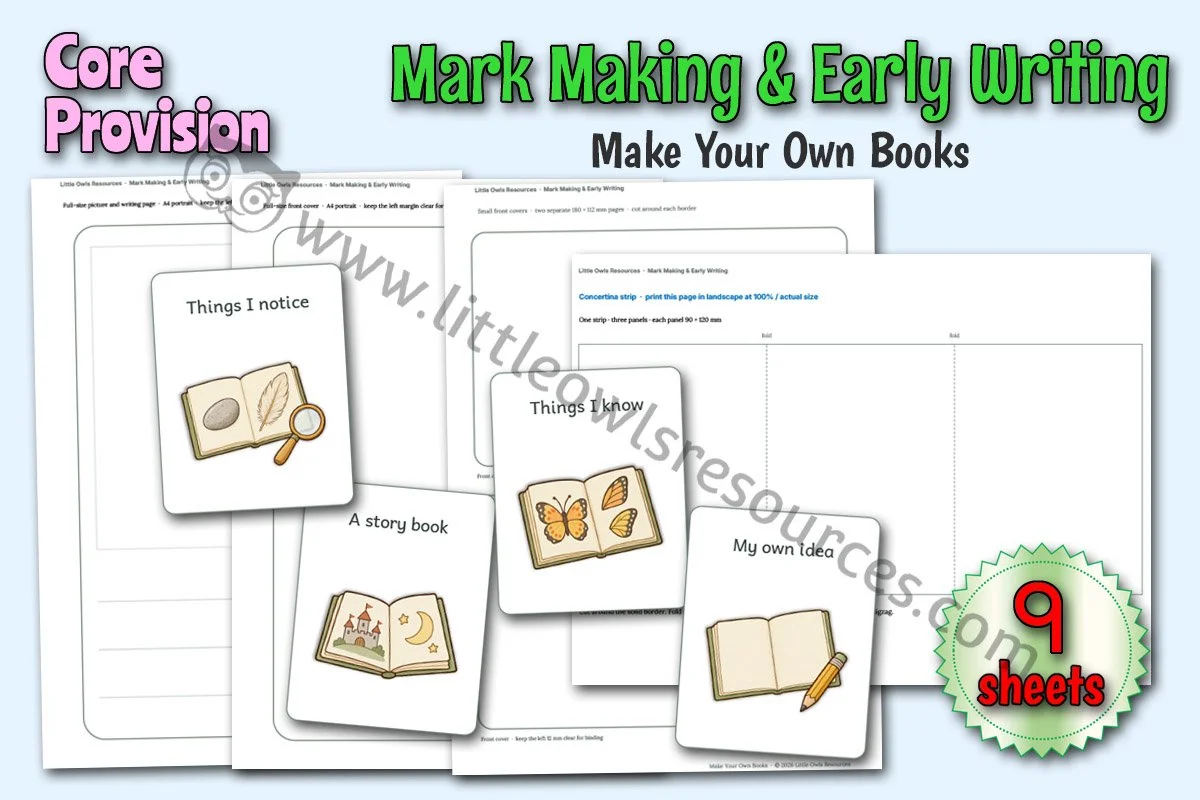
Children can make books from drawings, marks, words, photographs, collage or things they want to share. Offer a few paper choices and help them put pages together when they are ready. A book can begin with a single page.
Start with a reason
A book might hold an invented story, something a child knows, a memory, noticed details or an idea of their own. Keep the four idea cards nearby only if they help. Children may choose a different subject or start making before they know what their book will become.
DOWNLOAD (DOCX) 📝
DOWNLOAD (PDF) 📄
DOWNLOAD (Zipped JPEGs) 📂
Preschool, Reception & selected KS1 use
Help children turn their pictures, stories, discoveries or memories into books to keep and share. Offer simple page choices and support with putting them together, while children decide what their book will contain.
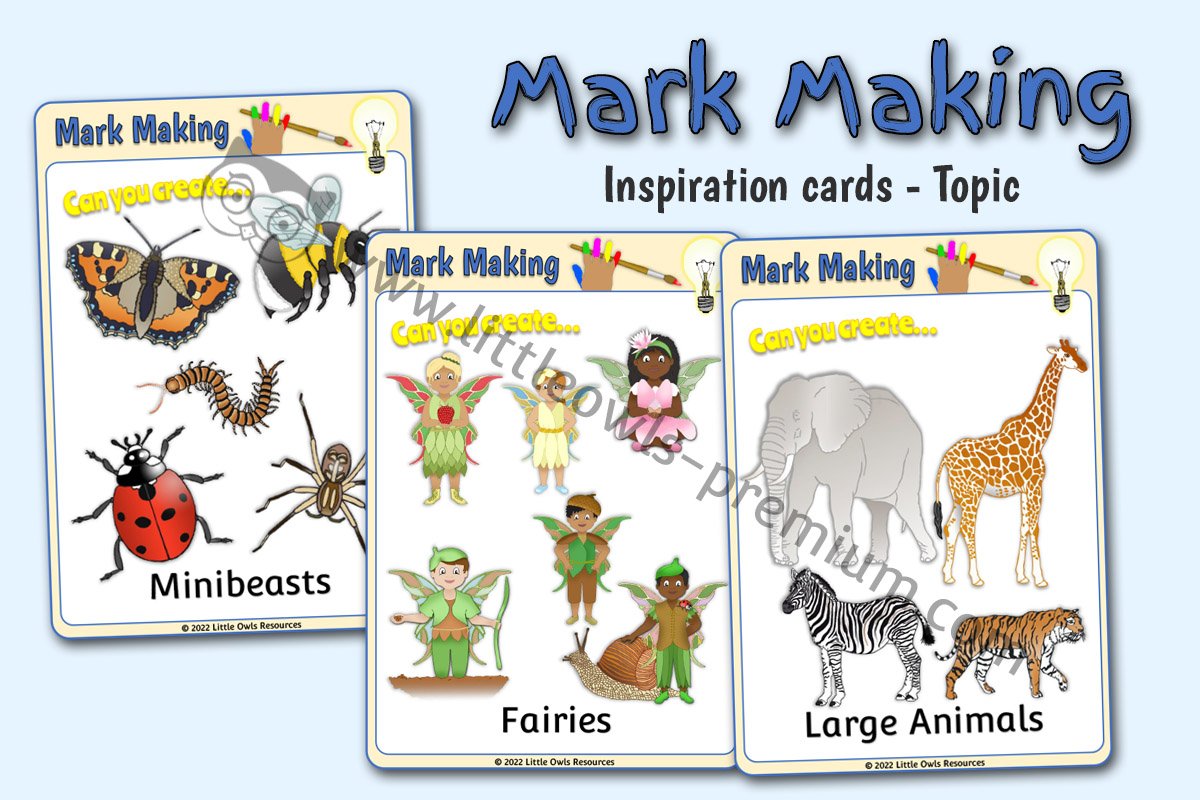
These cards are to help inspire children in their mark making, giving them ideas of what they might like to create.
It is hoped that the visual nature of the cards will help children who may have a language or communication barrier. 40 cards included in the pack.
Original artwork drawn by Sara Murphy and final digital resources created by Stuart Murphy. COPYRIGHT ON ALL OF THE RESOURCES HOUSED ON THIS WEBSITE IS HELD BY ‘LITTLE OWLS RESOURCES’. OUR RESOURCES (INCLUDING THE IMAGES WITHIN THEM), CANNOT BE SHARED OR SOLD COMMERCIALLY.
DOWNLOAD EDITABLE (DOCX)
DOWNLOAD NON-EDITABLE (PDF)
DOWNLOAD NON-EDITABLE (Zipped JPEGs)
<<-BACK TO ‘NON-TOPIC LITERACY’ MENU
Preschool & Reception
Picture prompts for children who would like a starting point for drawing or creating. Follow their interpretation and welcome ideas beyond the cards.
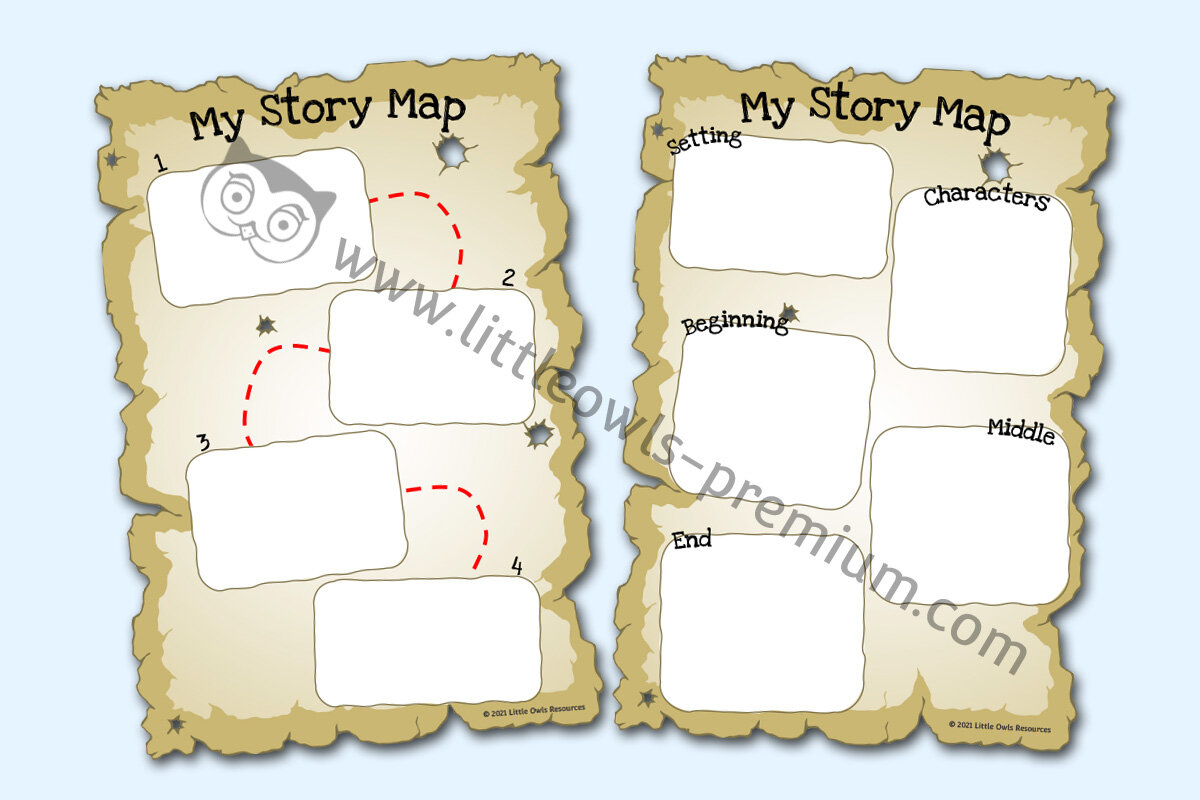
Two ‘My Story Map’ templates.
Original artwork drawn by Sara Murphy and final digital resources created by Stuart Murphy. COPYRIGHT ON ALL OF THE RESOURCES HOUSED ON THIS WEBSITE IS HELD BY ‘LITTLE OWLS RESOURCES’. OUR RESOURCES (INCLUDING THE IMAGES WITHIN THEM), CANNOT BE SHARED OR SOLD COMMERCIALLY.
DOWNLOAD EDITABLE (DOCX)
DOWNLOAD NON-EDITABLE (PDF)
DOWNLOAD NON-EDITABLE (Zipped JPEGs)
<<-BACK TO ‘NATIONAL STORYTELLING WEEK’ MENU
<<-BACK TO ‘TRADITIONAL TALES’ MENU
Preschool & Reception
Two open story-map templates for representing and sharing a story. Children can use drawings, marks, symbols and words, with adult support when useful.
Keep paper where children have a reason to use it. A shopping list can travel to the home corner; a message can be delivered to a friend; a sign can help someone find the way. Plain paper belongs alongside printable formats.
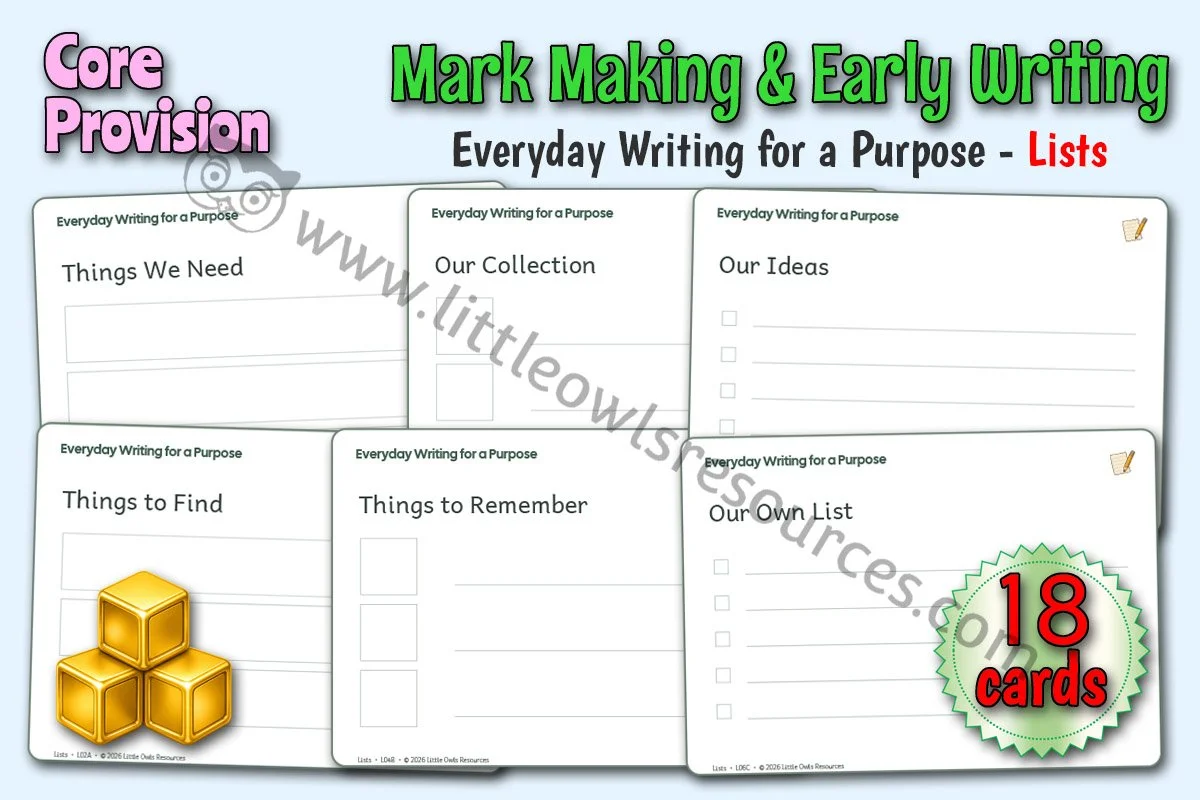
Keep a few lists beside plain paper and familiar tools. Children might gather building materials, plan a shared search, record a collection, save a reminder or share ideas for their play. Offer a list when it helps with something they want to do.
Choose a layout together
A offers open spaces for drawing and marks. B pairs picture spaces with writing room. C offers more writing lines. These are choices of paper, not ability groups or steps to complete. Children can choose any layout, switch between them, dictate or combine pictures, symbols, letters and words.
DOWNLOAD (DOCX) 📝
DOWNLOAD (PDF) 📄
DOWNLOAD (Zipped JPEGs) 📂
Preschool, Reception & selected KS1 use
Gather materials for a model, remember things to find or save ideas for play. Choose from open, mixed and lined layouts for drawing, marks, dictated words or independent writing.
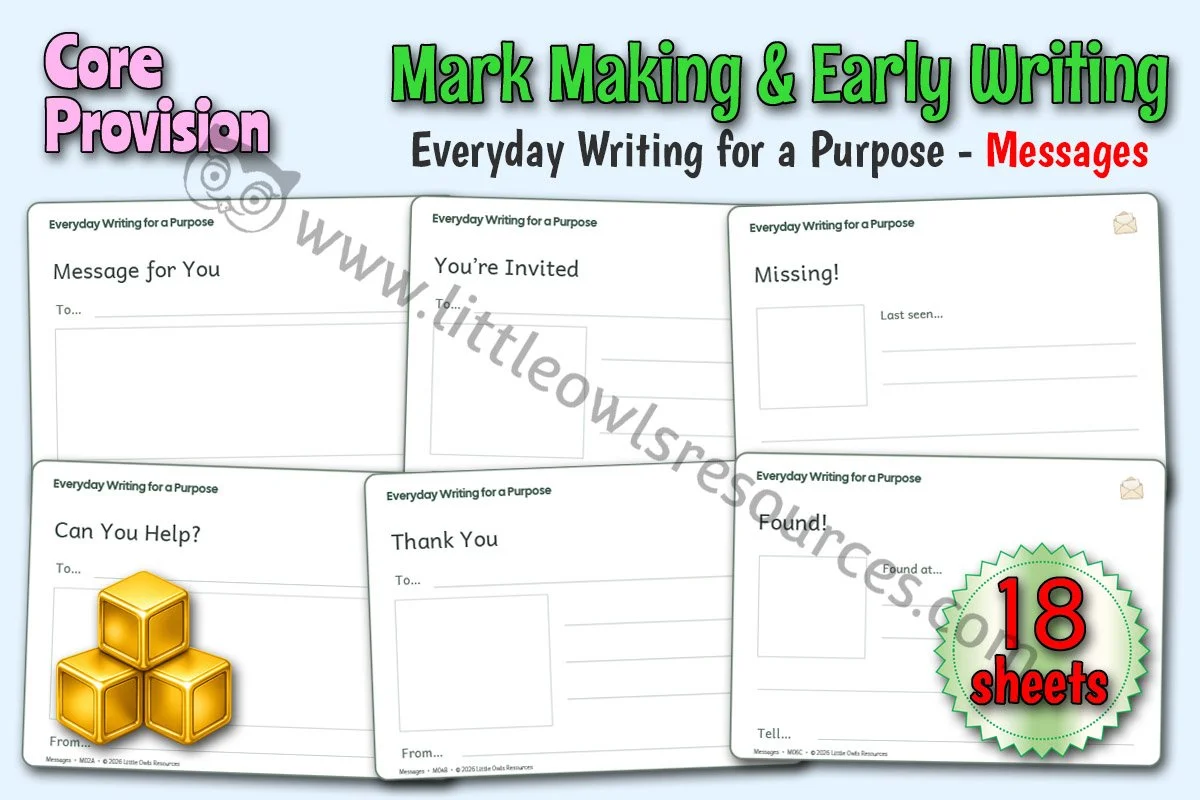
Keep message paper near places where children have something to communicate: a home corner, construction site, small-world home or outdoor meeting place. They can share news, ask for help, invite someone or say thank you. Missing and Found are notices about play objects or story characters.
Choose a layout together
A offers space for drawing and marks. B combines a picture space with writing room. C offers more writing lines. These are choices of paper, not ability groups or steps to complete. Children can choose any layout, switch between them, dictate or combine pictures, symbols, letters and words.
DOWNLOAD (DOCX) 📝
DOWNLOAD (PDF) 📄
DOWNLOAD (Zipped JPEGs) 📂
Preschool, Reception & selected KS1 use
Give a note: invite a friend, pass on news or send a request in play. Flexible paper choices welcome children’s drawings, symbols and words.
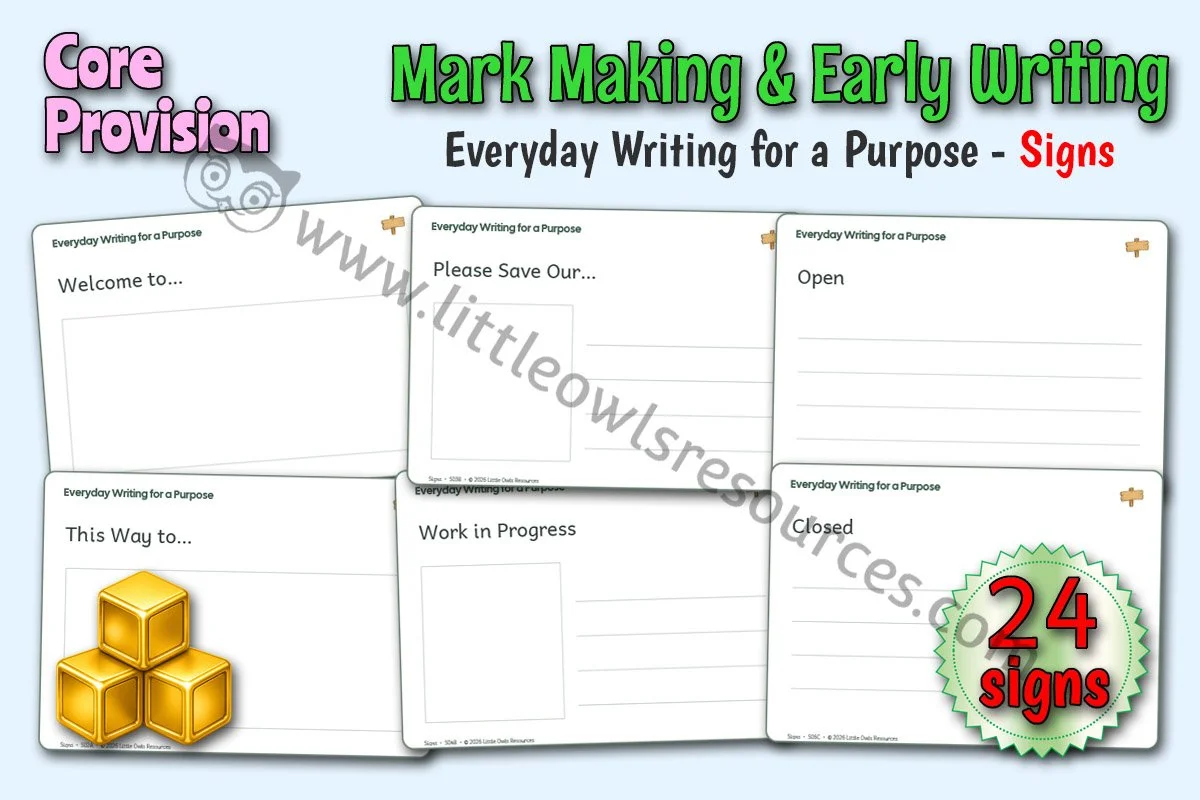
Offer a sign when it helps children communicate in their play: welcome visitors, show a route, save an unfinished model or make a request. Children decide the place, picture and message. Put the finished sign where its reader will need it.
Choose a layout together
A offers open space for drawing and marks. B pairs a picture space with writing room. C offers more writing lines. These are choices of paper, not ability groups or steps to complete. Children can choose any layout, switch between them, dictate or combine pictures, symbols, letters and words.
DOWNLOAD (DOCX) 📝
DOWNLOAD (PDF) 📄
DOWNLOAD (Zipped JPEGs) 📂
Preschool, Reception & selected KS1 use
Make a sign to welcome visitors, give directions or protect something still being built. Children choose their message and a suitable layout, then place it where someone can use it.
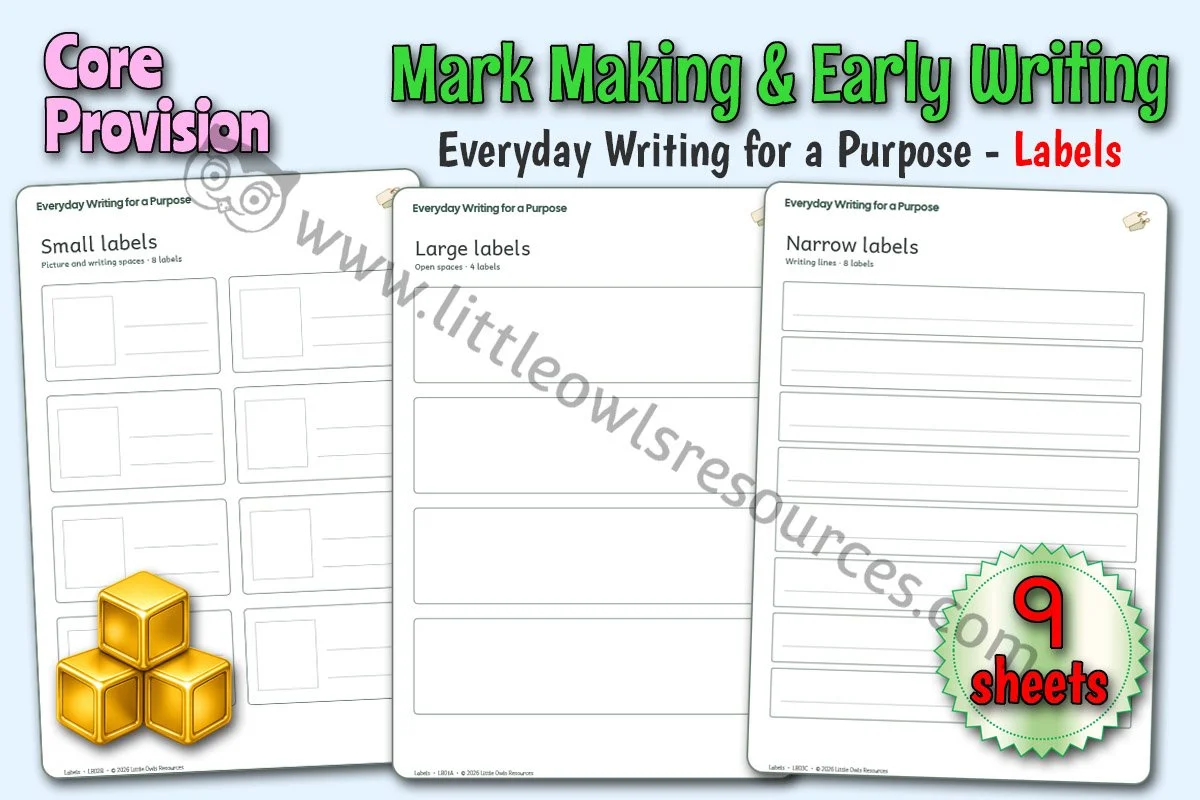
Offer a label when children want to name a model, identify an object, explain a collection or help someone find a place. Keep labels beside plain paper and familiar tools. The spaces are untitled so children can choose what their labels mean and where to use them.
Choose a layout together
A offers open space for drawing and marks. B pairs a picture space with writing room. C offers writing lines. These are choices of paper, not ability groups or steps to complete. Children can choose any layout, dictate or combine pictures, symbols, letters and words. Choose a larger label when more space will help.
DOWNLOAD (DOCX) 📝
DOWNLOAD (PDF) 📄
DOWNLOAD (Zipped JPEGs) 📂
Preschool, Reception & selected KS1 use
Name a model, identify a collection or explain something children have made. Untitled label spaces leave room for their own pictures, marks and words, with different layouts and sizes to choose from.
Pack of 'Home Corner' mark making/writing/drawing template sheets. Various designs included.
Have fun!
Original artwork drawn by Sara Murphy and final digital resources created by Stuart Murphy. COPYRIGHT ON ALL OF THE RESOURCES HOUSED ON THIS WEBSITE IS HELD BY ‘LITTLE OWLS RESOURCES’. OUR RESOURCES (INCLUDING THE IMAGES WITHIN THEM), CANNOT BE SHARED OR SOLD COMMERCIALLY.
DOWNLOAD EDITABLE (DOCX)
DOWNLOAD NON-EDITABLE (PDF)
DOWNLOAD NON-EDITABLE (Zipped JPEGs)
<<-BACK TO ‘HOUSES AND HOMES’ MENU
Preschool & Reception
Choose drawing and writing formats to support the everyday events children recreate in their play. Make space for their own meanings and messages.
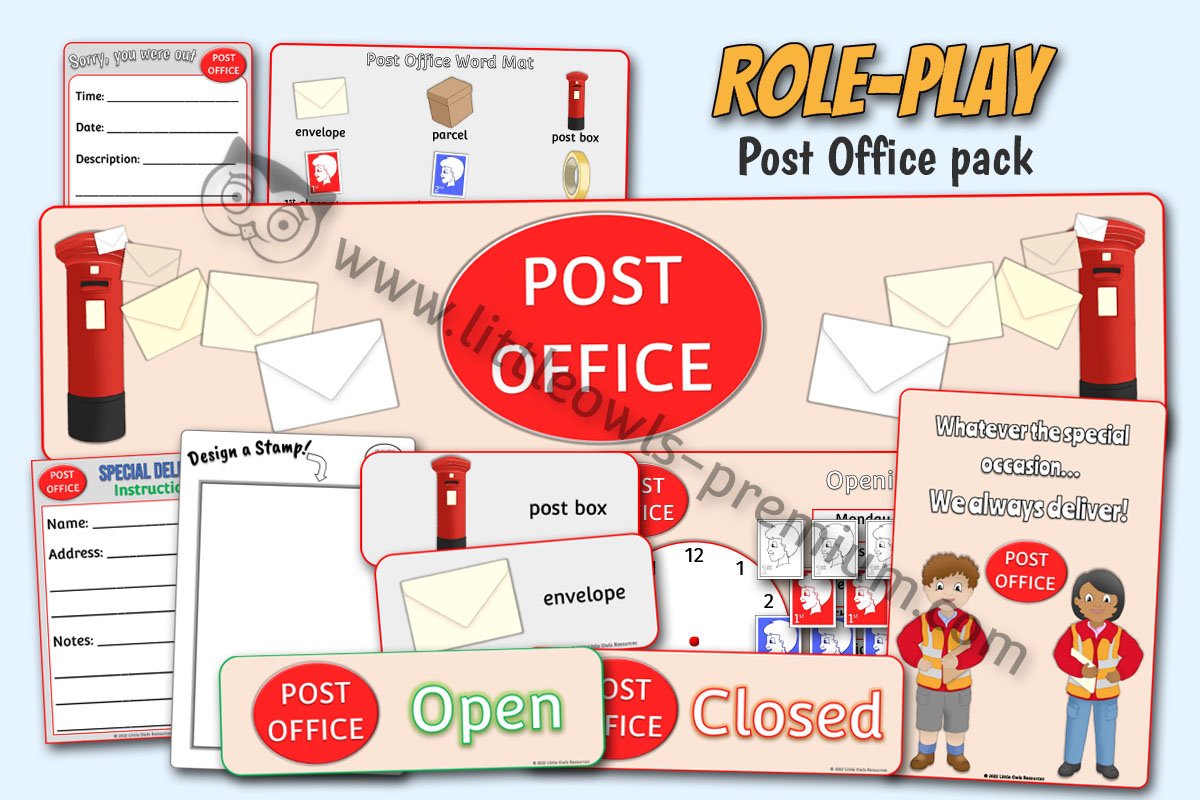
'Post Office' role play pack.
Pack includes:
banner
post box prop/display image across 2 A4 pages
name badges - Name Writing
opening times sign (with clock template to draw hands)
open and closed signs
various mark making sheets: ‘Special delivery instructions’ and ‘Sorry, you were out’ notes
1st and 2nd class stamp sheets (full colour & colouring versions)
various small signs & labels for items available for purchase with space for price tags
A4 sized posters/signs for display
Post office word mat & word cards
General post office mark making sheets
‘Design a stamp’ sheets
Have fun!
Alongside this role-play you may like to read: Dear Zoo, The Jolly Postman, Dragon Post or Paddington’s Post.
Keywords: post office, role play/role-play pack, postal worker, postal workers, postwoman, postman, postie, sending letters/parcels/presents/gifts/deliveries
Original artwork drawn by Sara Murphy and final digital resources created by Stuart Murphy. COPYRIGHT ON ALL OF THE RESOURCES HOUSED ON THIS WEBSITE IS HELD BY ‘LITTLE OWLS RESOURCES’. OUR RESOURCES (INCLUDING THE IMAGES WITHIN THEM), CANNOT BE SHARED OR SOLD COMMERCIALLY.
DOWNLOAD EDITABLE (DOCX)
DOWNLOAD NON-EDITABLE (PDF)
DOWNLOAD NON-EDITABLE (Zipped JPEGs)
Preschool, Reception & selected KS1 use
Select delivery notes and other writing materials from this wider role-play pack. Give messages somewhere to go and someone to receive them.
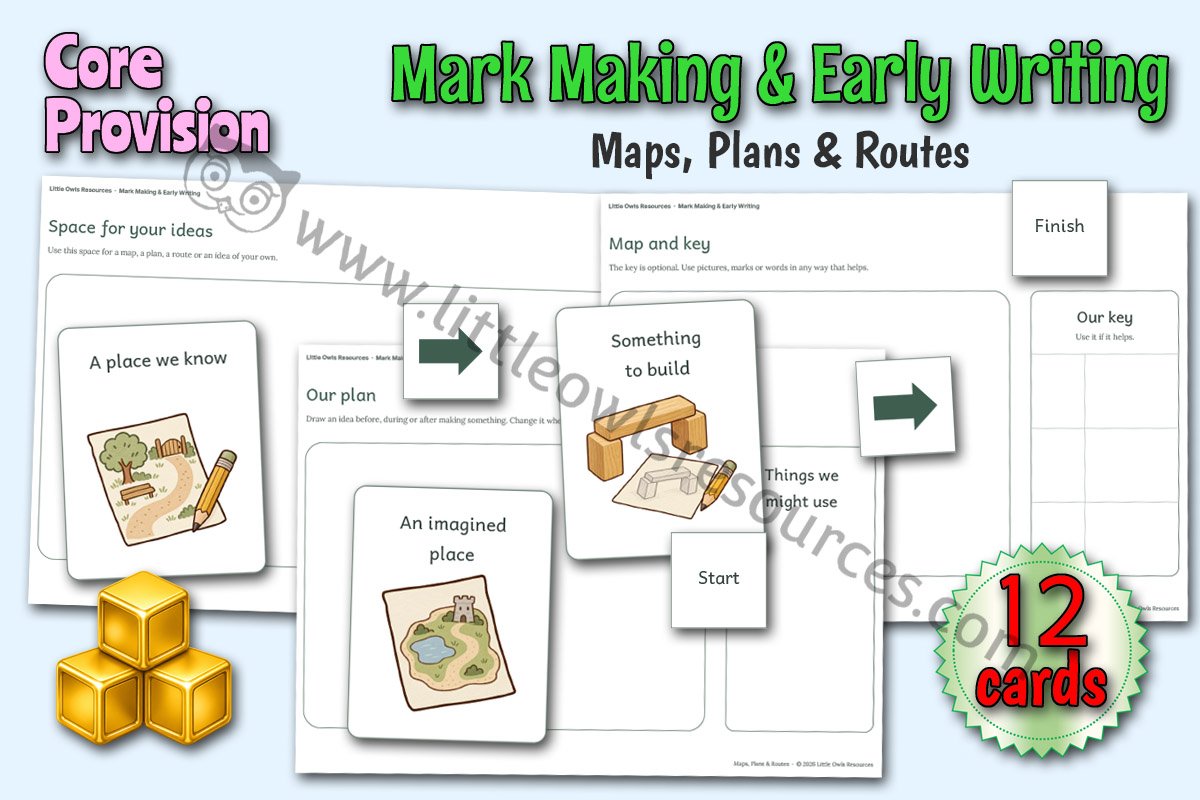
A map can help someone find a place; a plan can hold an idea for building; a record can preserve something worth remembering. Keep paper and drawing tools close to the play, and offer a format when children have something they want to show, explain or revisit.
Children can use drawings, marks, symbols, words and objects to show places, explore ideas and share ways to go. Maps can show where things are; plans can help children think about something they want to make or arrange; routes can show a journey. Their representations may combine all three.
Begin with the play
Offer paper when children have something they want to communicate or remember. The six invitation cards suggest possibilities. Children can use an open sheet, choose a template or work directly with objects. A plan can begin before, during or after making something.
DOWNLOAD (DOCX) 📝
DOWNLOAD (PDF) 📄
DOWNLOAD (Zipped JPEGs) 📂
Preschool, Reception & selected KS1 use
Use drawings, symbols and writing to show a place, develop a building idea or explain a journey. Invitations and flexible templates help children record plans that can change as their play develops.
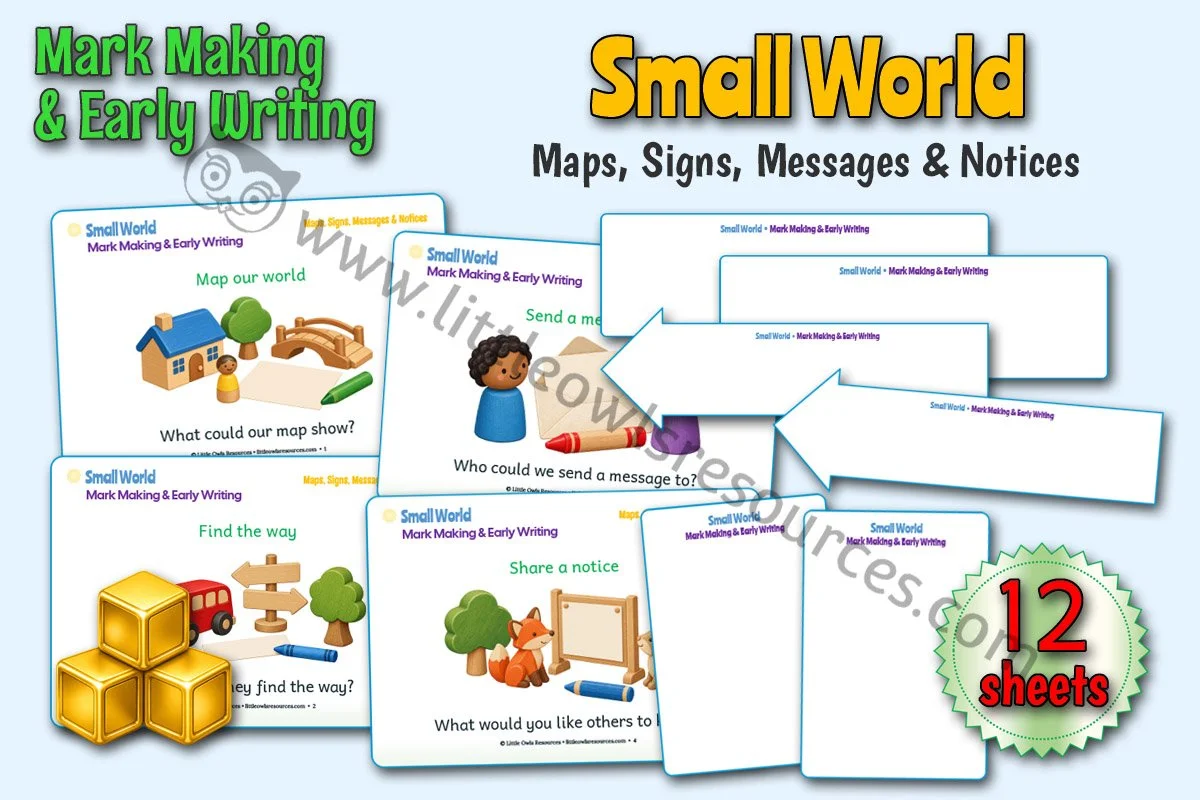
Small World | Mark Making & Early Writing
A shared pack of ten invitations and reusable papers for children’s maps, signs, messages and notices. Use them when children want to show a place, share an idea or communicate with someone in their small world play.
Begin with the play
Keep familiar people, animals, vehicles and building materials available. Offer one relevant card or a piece of paper when it connects with what children are doing. Children can use the idea, change it or continue playing in another way. Read a prompt aloud if helpful; it is not a reading task or a sequence to complete.
DOWNLOAD (DOCX) 📝
DOWNLOAD (PDF) 📄
DOWNLOAD (Zipped JPEGs) 📂
Preschool & Reception
Add a map for a journey, a sign for a building or a message for a character. Ten invitations and reusable papers bring purposeful drawing and writing into children’s own small world stories.
These maps have blank centres for children to draw the sand tray and mark where they have hidden their treasure.
They can then challenge a friend to find the treasure using the map to guide them!
You may also like o encourage the use of positional language such as next to, under, on top, beside, left, right, behind, etc.
Original artwork drawn by Sara Murphy and final digital resources created by Stuart Murphy. COPYRIGHT ON ALL OF THE RESOURCES HOUSED ON THIS WEBSITE IS HELD BY ‘LITTLE OWLS RESOURCES’. OUR RESOURCES (INCLUDING THE IMAGES WITHIN THEM), CANNOT BE SHARED OR SOLD COMMERCIALLY.
DOWNLOAD EDITABLE (DOCX)
DOWNLOAD NON-EDITABLE (PDF)
DOWNLOAD NON-EDITABLE (Zipped JPEGs)
Preschool & Reception
Draw the sand-play space and show where treasure is hidden. Revisit the map together to explain a route or help someone search.
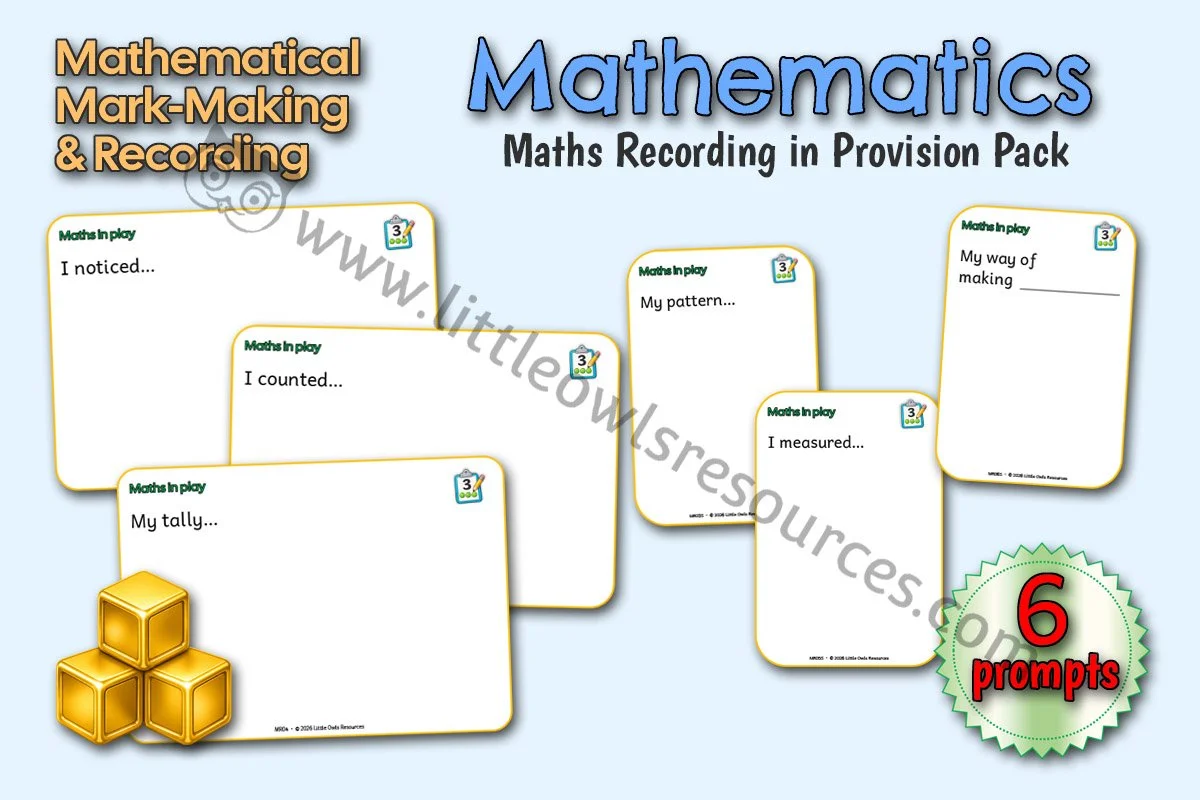
Six open-ended recording prompts for children to capture maths that matters in their play. Use alongside real objects, games and investigations, particularly in Reception. Children choose what to record and how to show it.
Offer a reason to record
A child may want to remember a collection, keep a score, save a pattern before tidying up or share a discovery. Offer a slip at that moment: “Would you like a way to remember this?” Put a few choices beside pencils and clipboards. Children can also choose plain paper or continue their play without recording.
Welcome children’s own marks
Drawings, dots, lines, symbols, numerals and words can all carry mathematical meaning. Ask the child what their marks mean before interpreting them. Read the heading aloud if needed. Offer numeral references when useful, while keeping attention on the mathematical idea rather than neatness or correct formation.
DOWNLOAD (DOCX)📝
DOWNLOAD (PDF)📄
DOWNLOAD (Zipped JPEGs)📂
← Back to ‘Maths Continuous Provision & Play’ Area
← Back to ‘Mathematics’ Menu (Areas of Learning)
Especially Reception
Flexible recording prompts for quantities, scores, patterns and discoveries. Offer a format when it helps children remember or communicate an idea.
In Reception, use provision to help children apply phonics and letter movements they have been explicitly taught. Keep familiar supports within reach when children want to write a label, note or message. Match the support to your setting’s phonics programme and handwriting approach.
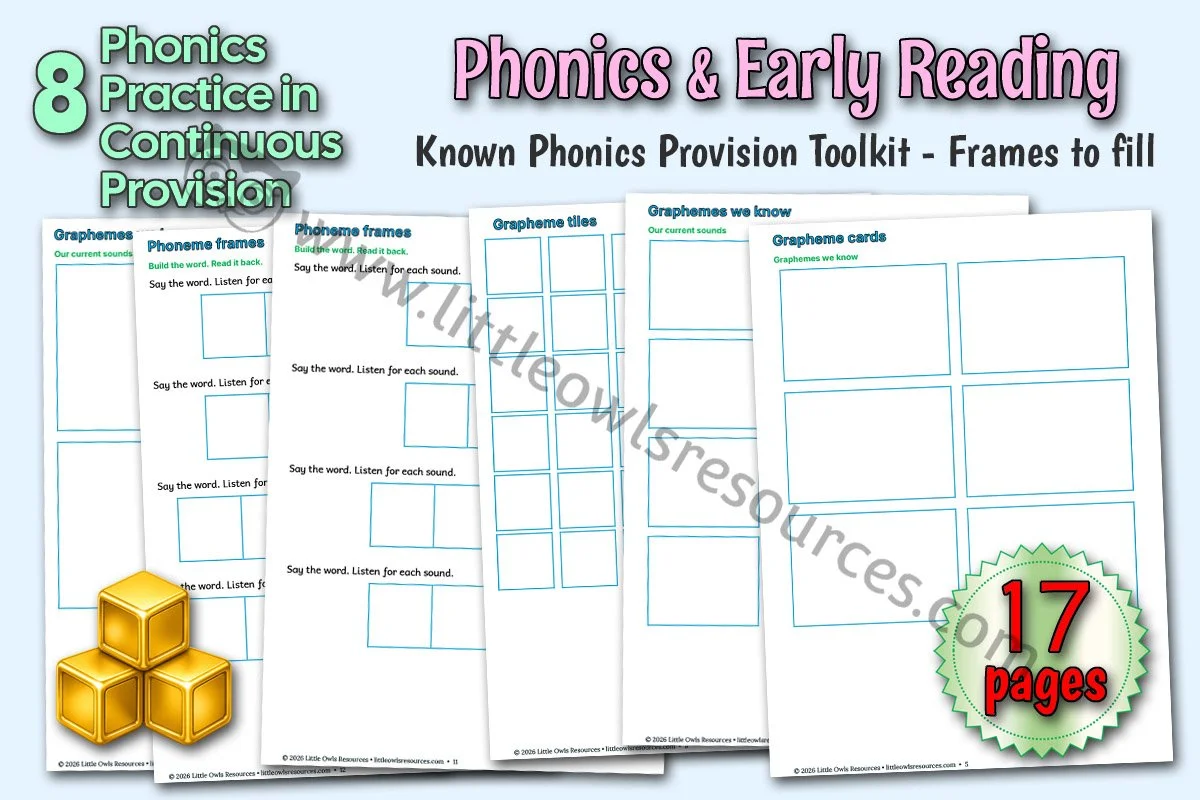
A portable, editable set for using taught phonics during purposeful reading and writing. Add the graphemes and words suitable for the children using it, then take the same familiar toolkit into provision when it is useful.
What is in the toolkit
Known-GPC cards, current GPC mats, grapheme tiles, phoneme frames, current word cards, common-exception-word slots, and separate Words We Can Read and Words We Can Spell mats. All entry spaces are blank so you can follow your setting’s systematic synthetic phonics (SSP) programme.
Who it is for
For Reception and other children receiving explicit phonics teaching, including older learners revisiting taught content. Select for the individual or group rather than age alone. For younger children, continue responsive talk, listening, oral sound play and meaningful mark making.
DOWNLOAD (DOCX) 📝
DOWNLOAD (PDF) 📄
DOWNLOAD (Zipped JPEGs) 📂
Reception & other learners using taught phonics
Fill the editable frames with taught graphemes and words, then take these familiar supports into the places where children are reading and writing.
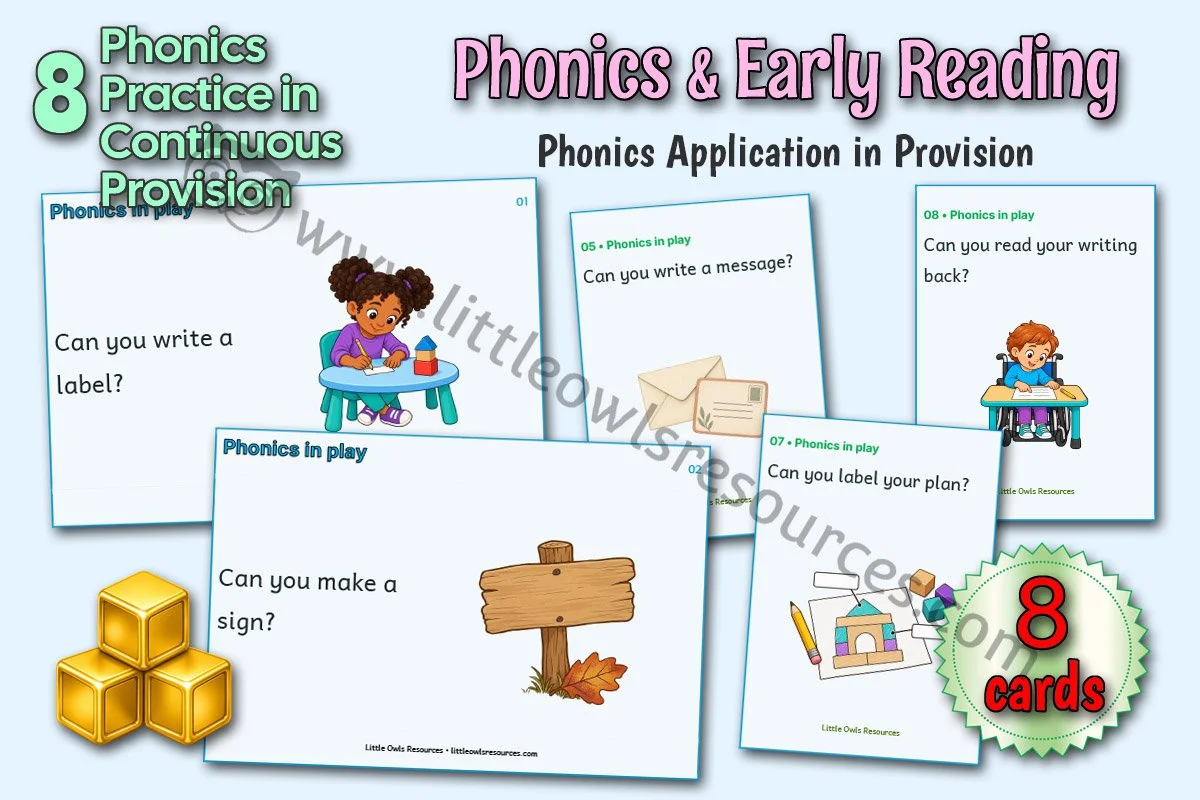
Eight illustrated invitations for using taught phonics during meaningful play. Offer a card when it supports something a child wants to do, and let the child choose the content, materials and purpose. The same cards can travel between provision areas with the Known Phonics Provision Toolkit.
Read the invitation together
Read the prompt aloud and use the picture to explain its meaning. Children are not expected to decode the card text independently. Show one or two relevant cards rather than displaying all eight as tasks to complete. A child may accept, adapt or decline an invitation; allow sustained play to continue.
Use pictures to clarify the purpose
The illustrations show labelling, signs, writing, reading, messages, lists and plans. They are examples, not instructions to copy the pictured activity or use particular vocabulary. Blank labels and simple marks in the pictures are not reading material or handwriting models. Use the child’s real object, idea or writing alongside the card.
DOWNLOAD (DOCX) 📝
DOWNLOAD (PDF) 📄
DOWNLOAD (Zipped JPEGs) 📂
Reception & other learners using taught phonics
Eight illustrated invitations for meaningful reading and writing in play. Share a relevant prompt aloud and let children choose the purpose, content and materials.
For children exploring names and learning to form letters
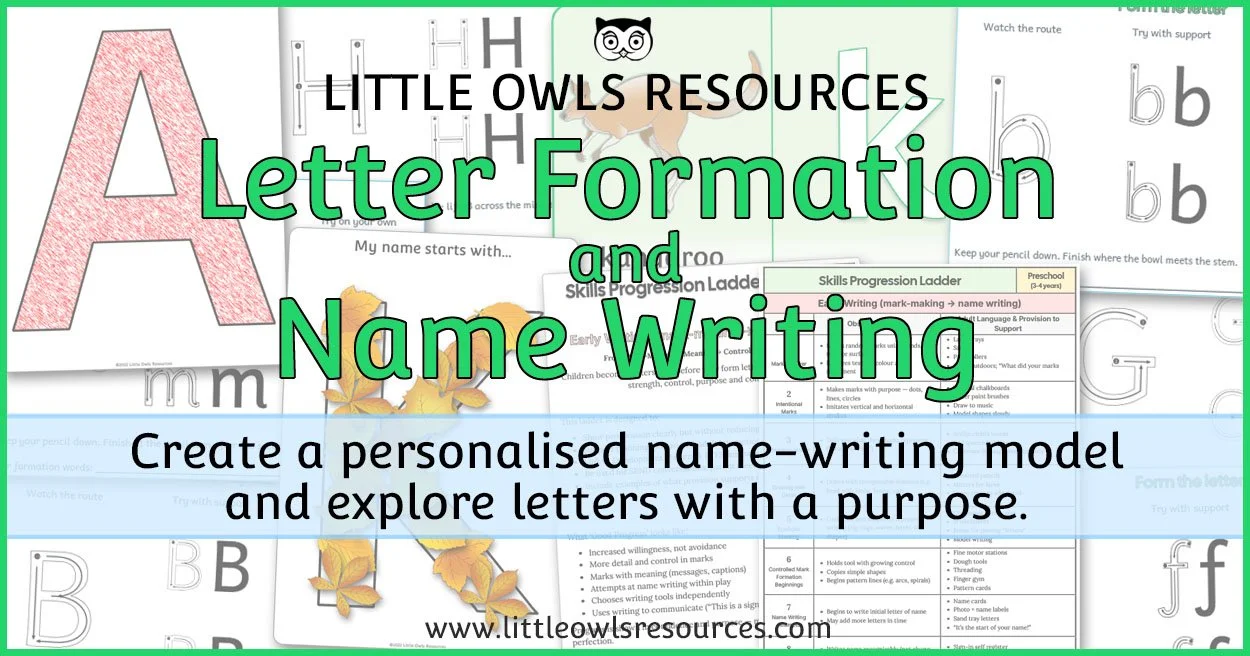
Letter Formation & Name Writing
Create a personalised name model, explore familiar letters and give name writing a purpose in everyday play. Browse letter-formation cards, practical activities and ideas for signing pictures, making cards and adding names to role play. Choose resources that fit the child’s interests and your setting’s handwriting approach.
Includes a free name-writing generator — no membership needed.
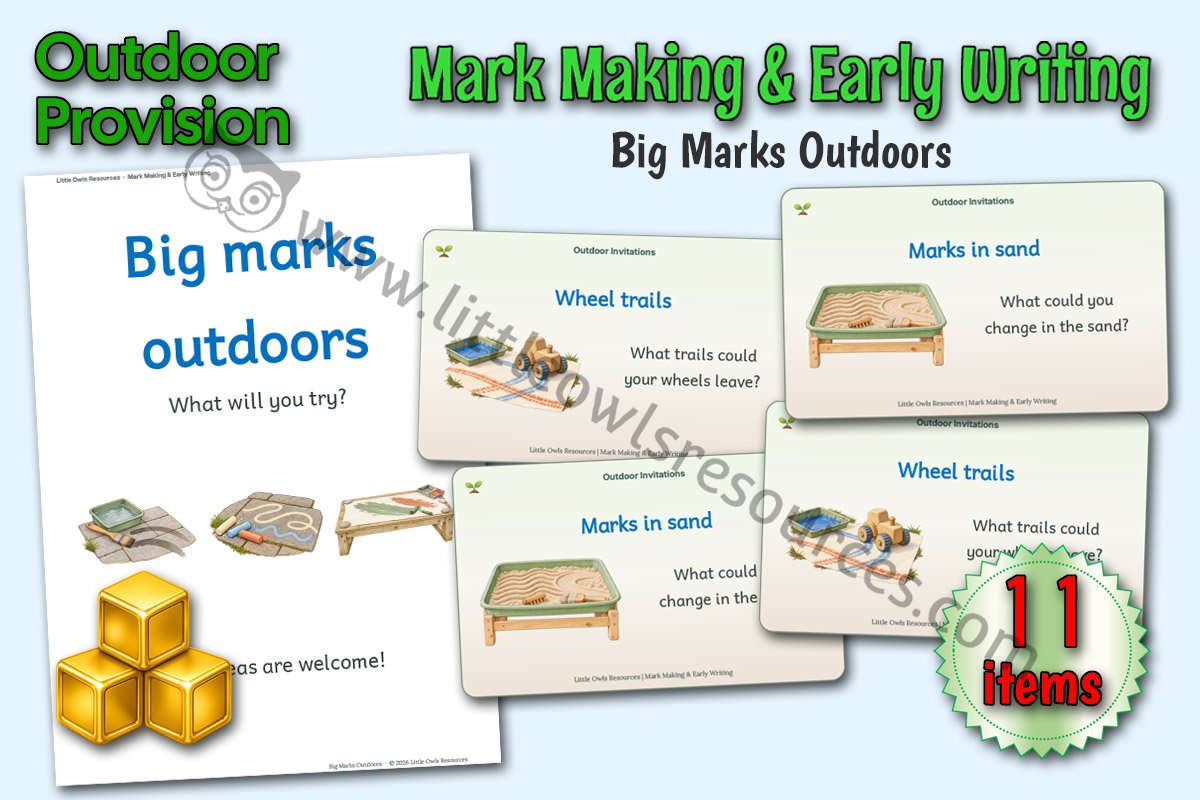
Offer opportunities for big movements, water marks, chalk drawings and portable writing. Clipboards and paper can accompany a discovery, a construction project or a mud-kitchen recipe. Choose a printable when it adds something useful to the play.
Offer space to explore movement, tools and marks outdoors. Children may repeat an action, change direction, make something they recognise or enjoy the marks themselves. These eight invitations support everyday provision and can be revisited throughout the year.
Begin with a manageable choice
Put out one or two suitable tools in a familiar outdoor space. Keep useful materials available for children to return to. Display an invitation only when it helps; children can follow their own ideas, watch, join in or return later.
DOWNLOAD (DOCX) 📝
DOWNLOAD (PDF) 📄
DOWNLOAD (Zipped JPEGs) 📂
Preschool & Reception
Eight illustrated invitations for exploring marks through outdoor movement and familiar materials. Make space for repeated actions, changing directions and children’s own ideas, with prompts to revisit throughout the year.
These ‘Ingredients Lists’ are designed to be printed for single use or laminated for multiple uses to enhance learning through play in your mud kitchen area.
Ingredients can be written and/or drawn onto each proforma by either an adult or child.
Original artwork drawn by Sara Murphy and final digital resources created by Stuart Murphy. COPYRIGHT ON ALL OF THE RESOURCES HOUSED ON THIS WEBSITE IS HELD BY ‘LITTLE OWLS RESOURCES’. OUR RESOURCES (INCLUDING THE IMAGES WITHIN THEM), CANNOT BE SHARED OR SOLD COMMERCIALLY.
DOWNLOAD EDITABLE (DOCX)
DOWNLOAD NON-EDITABLE (PDF)
DOWNLOAD NON-EDITABLE (Zipped JPEGs)
Preschool & Reception
Draw or write ingredients to gather, remember or share. Let the list follow the mixture children are making and the ideas they want to revisit.
This ‘My Mud Kitchen Recipe Book’ proforma is designed to be printed for single use or laminated for multiple uses to enhance learning through play in your mud kitchen area.
Once children have experimented with creating their own mud kitchen dish, why not encourage them to make marks/draw and/or write about their recipe using the sheets within this book?
Original artwork drawn by Sara Murphy and final digital resources created by Stuart Murphy. COPYRIGHT ON ALL OF THE RESOURCES HOUSED ON THIS WEBSITE IS HELD BY ‘LITTLE OWLS RESOURCES’. OUR RESOURCES (INCLUDING THE IMAGES WITHIN THEM), CANNOT BE SHARED OR SOLD COMMERCIALLY.
DOWNLOAD EDITABLE (DOCX)
DOWNLOAD NON-EDITABLE (PDF)
DOWNLOAD NON-EDITABLE (Zipped JPEGs)
Preschool, Reception & selected KS1 use
Help children record and share their invented recipes through drawings, marks and writing. Add to the book when there is something they want to remember.
Follow the purpose, then offer the resource. These everyday possibilities can help you decide where paper and writing tools will be useful.
A shopping list to take to the shop.
A plan or sign for a building.
A map, message or name for a place.
A way to remember a score or quantity.
A drawing or note about a discovery.
A route, recipe or notice to share.
Children can keep playing without recording. Offer the possibility when it is useful, and respect a child’s choice to use it, adapt it or carry on.
Choose a resource to see its cover and description on this page.
Everyday Writing — Lists — make a shopping list or remember something needed.
Home Corner Mark Making Pack — offer drawing and writing materials for the everyday events children recreate.
Maps, Plans & Routes — draw a building idea, arrange a space or explain a route.
Everyday Writing — Signs — welcome visitors, give directions or protect an unfinished model.
Small World — Maps, Signs, Messages & Notices — create useful maps and messages as children’s stories unfold.
Everyday Writing — Labels — name a place or explain something in the small world.
Maths Recording in Provision — remember a score, quantity, pattern or mathematical discovery.
Draw, Look & Imagine — look closely and draw something noticed.
Everyday Writing — Labels — identify objects or explain a collection to someone else.
Big Marks Outdoors — explore movement, tools and marks in an outdoor space.
My Mud Kitchen Recipe Book — record an invented recipe through drawings, marks and writing.
Find a useful starting point for the children you support. Select a resource below to see its cover and description on this page, then decide whether to explore the pack.
Age ranges are a guide. Choose materials and adult support for children’s interests, movements, communication and experience.
Begin with shared attention, movement and sensory discovery. Follow what your baby notices and enjoys, with suitable materials and close adult support. There is no expectation to produce a picture or use printable sheets.
You can begin without printing anything: look together at something interesting, respond to a repeated movement, or notice a change the baby has made while exploring.
Related resources for adults supporting babies
An adult companion for shared experiences
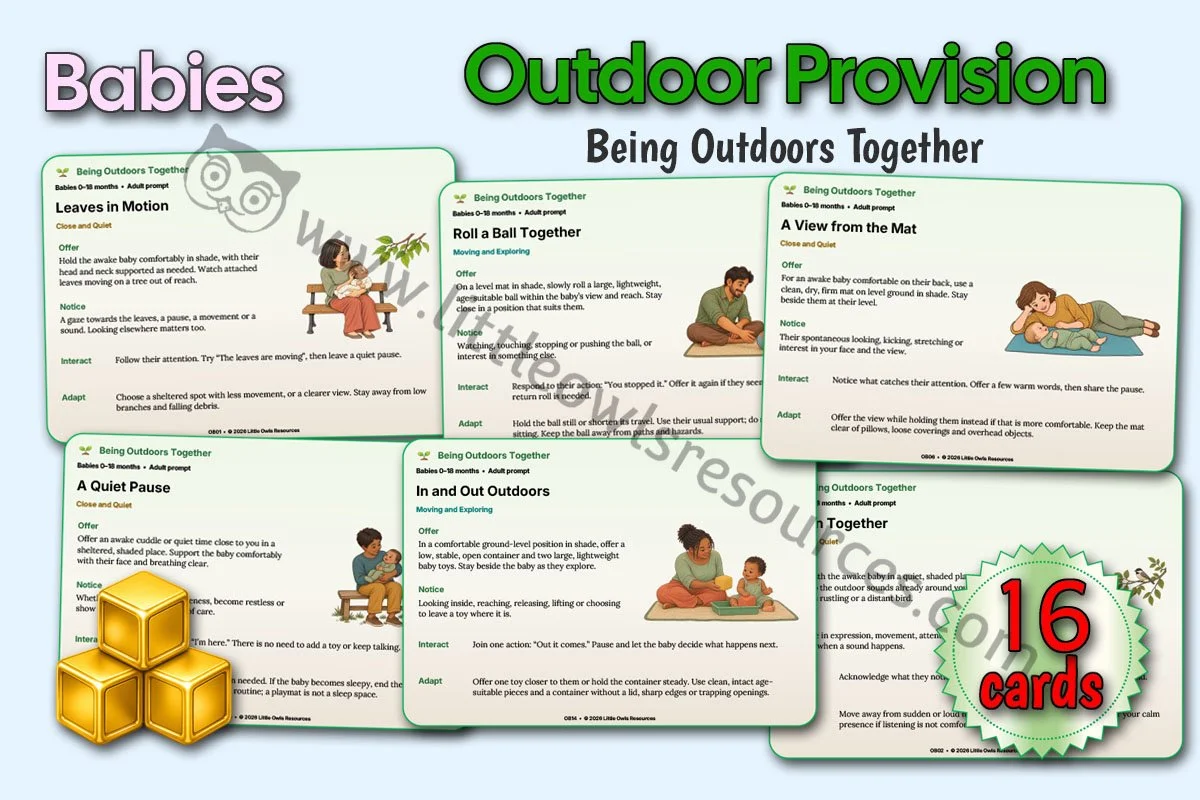
These cards offer small moments of being outdoors with a familiar adult: watching leaves, listening, sharing a view, enjoying a quiet pause and exploring through movement and touch. The relationship and the baby’s comfort guide what happens. There is no activity to finish, response to produce or sequence to work through.
Choose for this baby today
Birth to eighteen months includes many different ways of moving, communicating and taking part. Select an experience for the baby’s current interests, available movements and care needs. The pictures show possibilities, not required positions or actions. Use familiar home-language words and the baby’s usual communication and positioning support. Agree individual adaptations with families and relevant professionals.
Two groups of possibilities
Close and Quiet offers supported, slower experiences. Moving and Exploring includes opportunities for babies using their own reaching, turning, crawling or walking movements. The groups are not age bands or steps in development. A baby may enjoy experiences from either group, return to a quiet moment after moving, or prefer simply being with you.
DOWNLOAD (DOCX) 📝
DOWNLOAD (PDF) 📄
DOWNLOAD (Zipped JPEGs) 📂
Being Outdoors Together — Babies
Shared outdoor experiences involving looking, listening, movement and touch.
Premium & Professional
In-the-Moment Prompt Cards — Babies
Support for noticing babies’ cues and responding during everyday care, play and exploration.
Professional guidance
Start with familiar tools, accessible surfaces and time to repeat favourite actions. These resources offer ideas for adults to select and share; children can explore in their own way.
First Marks & Shared Discoveries — Toddlers — our age-specific starting point for sharing and responding to toddlers’ discoveries.
Explore Marks — Tools, Surfaces & Actions — select a few suitable tools and surfaces, using the real materials alongside any pictures.
Big Marks Outdoors — choose and adapt simple outdoor ideas to suit the toddler’s movements, interests and support needs.
Offer opportunities to explore marks, draw, pretend to write and share ideas. Choose a resource when it adds something useful to children’s play.
Explore Marks — Tools, Surfaces & Actions — investigate different ways of making marks.
Draw, Look & Imagine — draw something noticed, remembered or imagined.
Make Your Own Books — bring pictures, marks and ideas together in a book.
Everyday Writing — Lists — gather materials or remember something needed in play.
Everyday Writing — Messages — make a note for someone to receive.
Small World — Maps, Signs, Messages & Notices — add meaningful marks and messages to an unfolding story.
Big Marks Outdoors — explore movement and marks in an outdoor space.
Give children reasons to compose, draw and write across their play. Support them to use phonics and letter movements they have been taught, while keeping their ideas and intended reader in mind.
Make Your Own Books — create a story, information book or collection of ideas.
Maps, Plans & Routes — explain a place, journey or building idea.
Everyday Writing — Messages — compose a message and give it to its reader.
Everyday Writing — Signs — welcome, explain, request or give directions.
Everyday Writing — Labels — name and explain models, objects or collections.
Maths Recording in Provision — remember a quantity, score, pattern or discovery.
Known Phonics Provision Toolkit — keep taught graphemes and words available when needed.
Phonics Application in Provision — offer a relevant invitation to use taught phonics during play.
Keep a portable collection of paper and familiar tools that can travel with the play. Choose different materials and levels of support for each child.
First Marks & Shared Discoveries — Toddlers — support younger children’s exploration.
Explore Marks — Tools, Surfaces & Actions — offer manageable choices using materials you have.
Everyday Writing — Lists — make a list for an everyday routine or shared project.
Make Your Own Books — collect children’s individual stories and interests.
Maps, Plans & Routes — represent a familiar place or plan something together.
Small World — Maps, Signs, Messages & Notices — take drawing and writing into small world play.
Big Marks Outdoors — select outdoor possibilities for the children taking part.
Use selected open formats to give children purposeful opportunities to apply their teaching. Adapt the vocabulary, support and depth of writing to your learning focus.
Make Your Own Books — develop stories or information for a chosen reader.
Maps, Plans & Routes — add labels, directions or explanations to a plan.
Everyday Writing — Messages — communicate clearly with a particular recipient.
Everyday Writing — Signs — choose wording that suits the purpose and reader.
Everyday Writing — Labels — identify and explain a model, collection or display.
Maths Recording in Provision — use selected formats to record and explain mathematical thinking.
Add a small invitation, context or material when it connects with children’s interests, experiences or something they are learning. Keep familiar tools available so children can continue their own ideas.
You do not need a new theme every week. A useful enhancement may be revisited, changed or kept for as long as it supports the play.
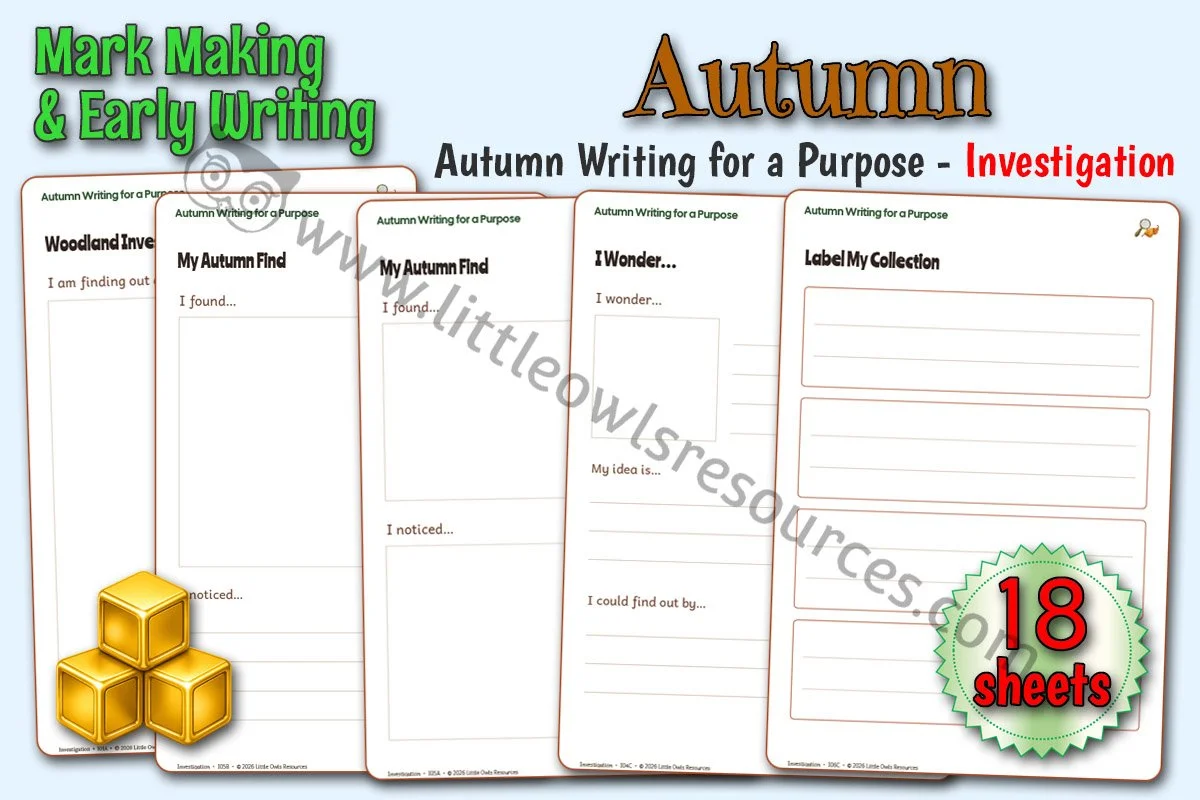
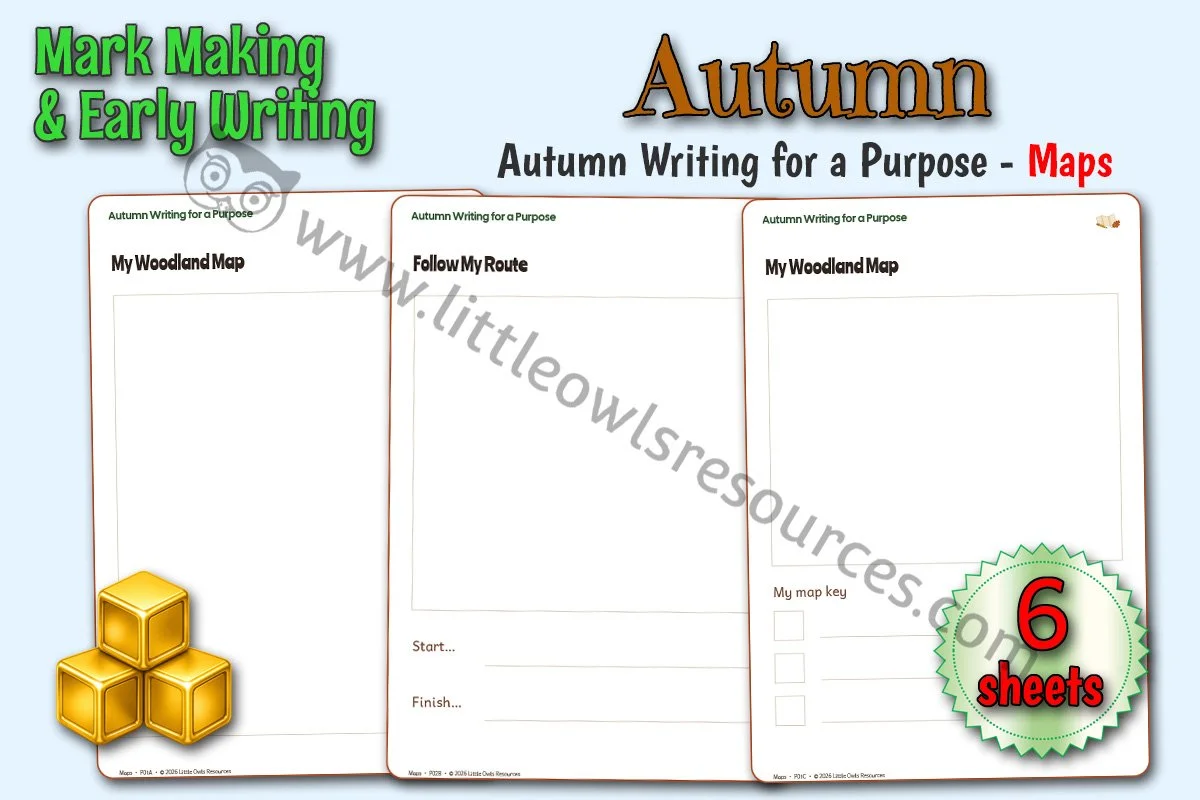
Offer a list, sign, message or recording sheet alongside an Autumn discovery or woodland story. Choose the layout together: drawings, marks, symbols, dictated words and independent writing can all help children communicate.
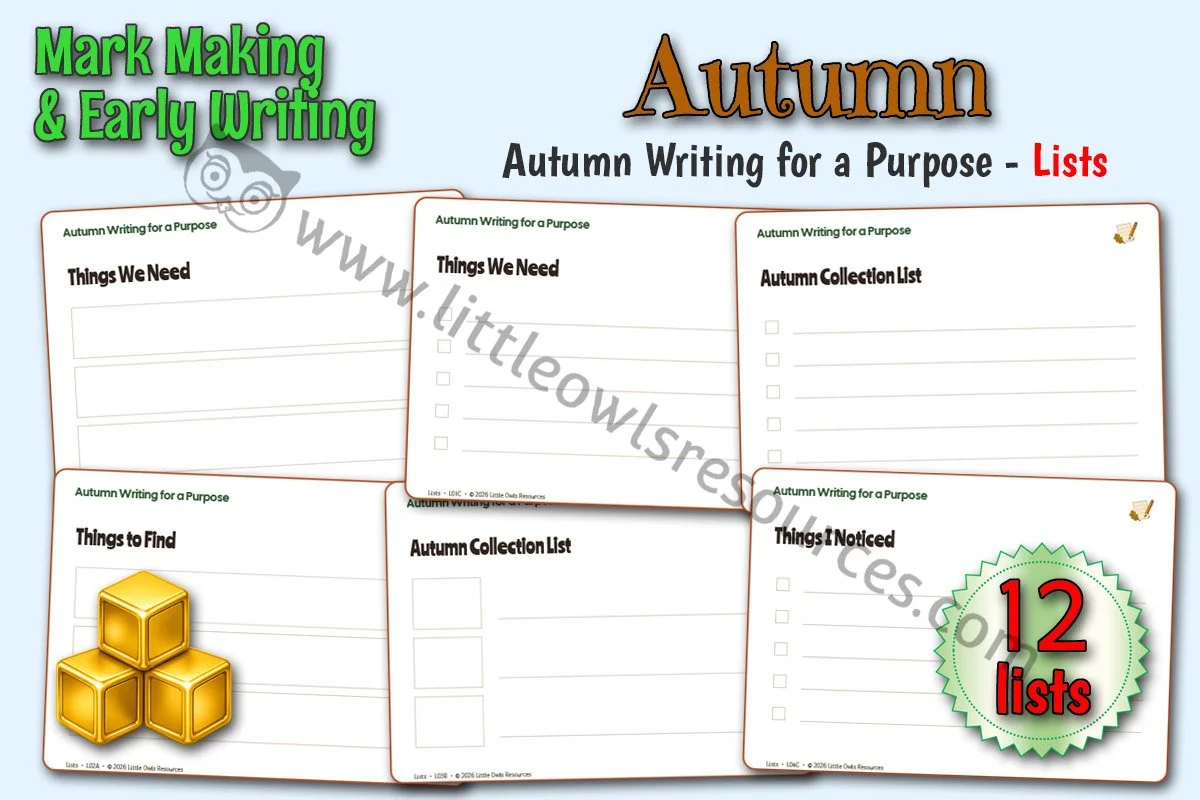
Place a list beside a construction plan, a collection basket or a woodland small world. Use Things We Need to gather materials, Things to Find for a shared search, Autumn Collection List as a record of a chosen collection and Things I Noticed to remember observations.
Choose a layout together
A offers space for drawing and marks. B combines drawing with emergent writing. C offers more room for independent writing. These are choices of paper, not ability groups or a sequence to complete. Children can choose any version, switch between them, dictate to an adult or combine pictures, symbols, letters and words. The small footer code is only for finding a version.
DOWNLOAD (DOCX) 📝
DOWNLOAD (PDF) 📄
DOWNLOAD (Zipped JPEGs) 📂
Preschool, Reception & selected KS1 use
Gather materials for a woodland model, plan a collection or remember something noticed on a walk. Choose a paper layout that suits the child’s purpose.
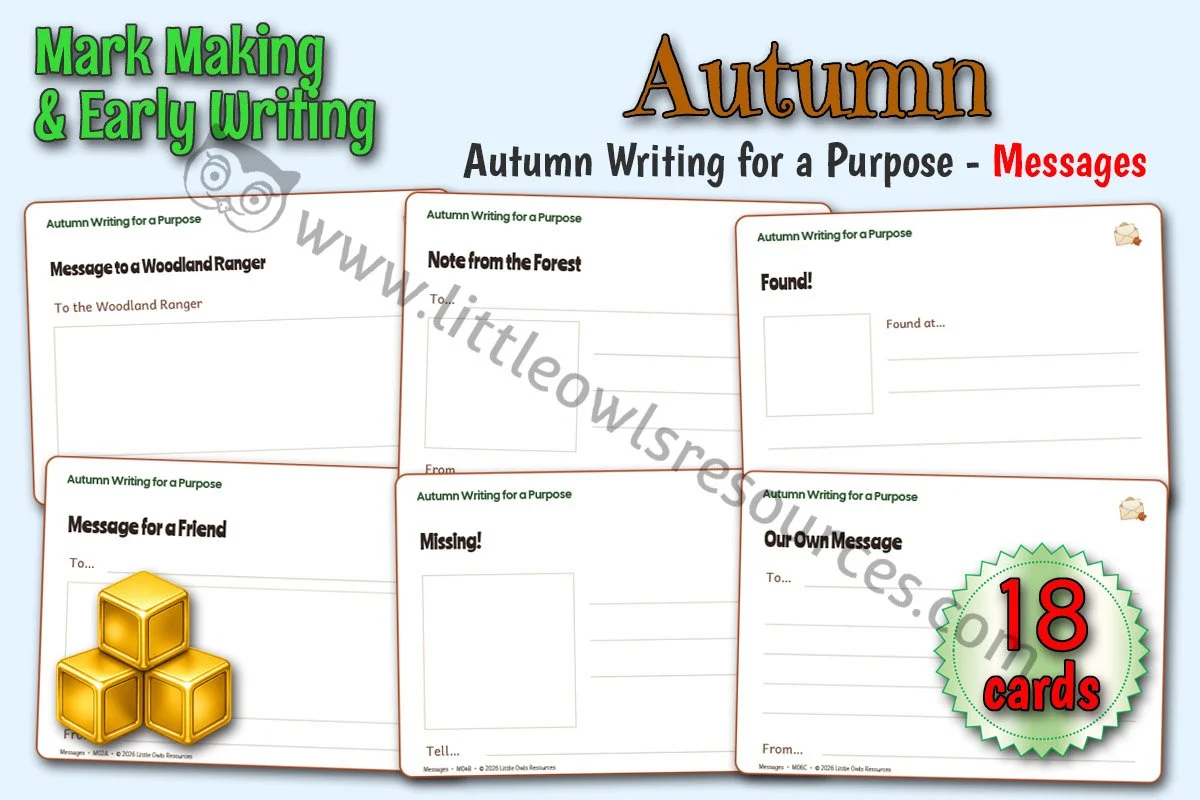
Offer paper where messages can be delivered: a pretend ranger station, a woodland postbox or a small-world home. Children can ask for help, share news, invite a friend or leave a note in a story. Missing and Found are notices about a play object or story character.
Choose a layout together
A offers space for drawing and marks. B combines drawing with emergent writing. C offers more room for independent writing. These are choices of paper, not ability groups or a sequence to complete. Children can choose any version, switch between them, dictate to an adult or combine pictures, symbols, letters and words. The small footer code is only for finding a version.
DOWNLOAD (DOCX) 📝
DOWNLOAD (PDF) 📄
DOWNLOAD (Zipped JPEGs) 📂
Preschool, Reception & selected KS1 use
Leave a note at a woodland home, share news or ask for help in a story. Offer a message when there is a reason to send it.
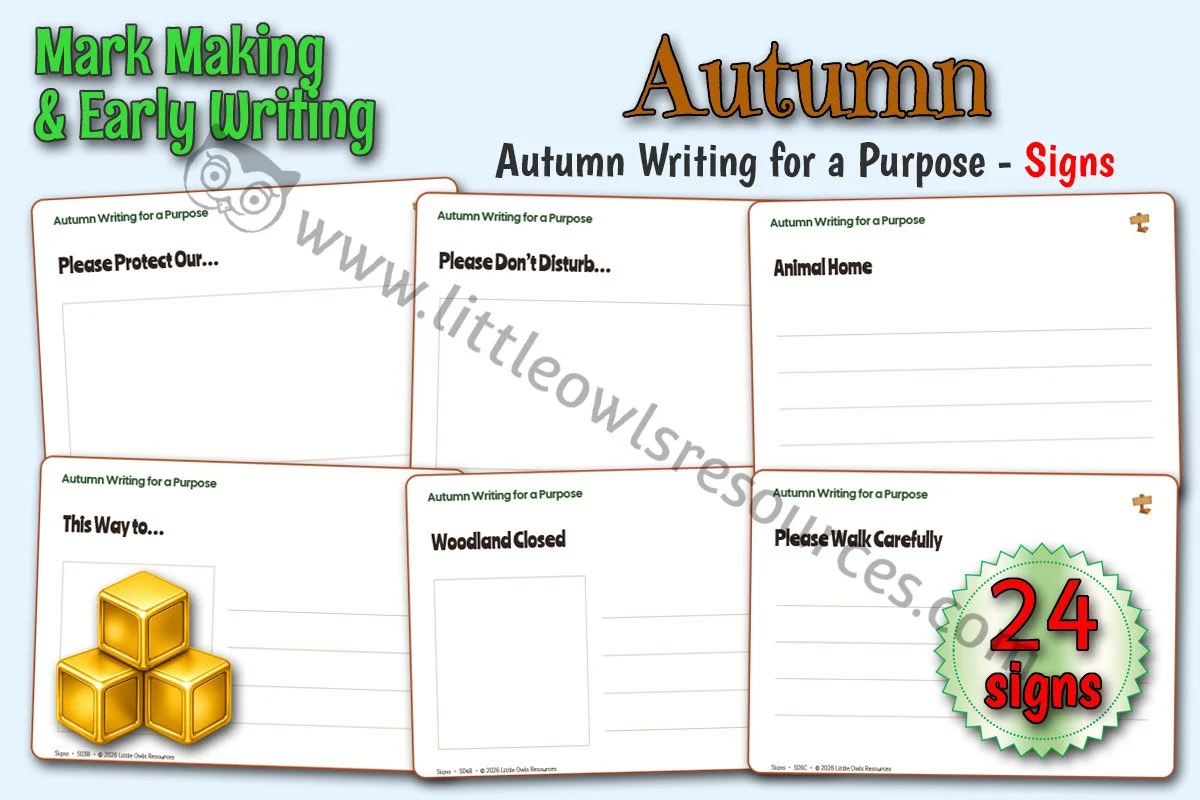
Offer a sign when there is a reason in the play: a model habitat needs protecting, visitors need directions or an entrance needs a welcome. Children decide the place, symbol and message. Display the finished sign where its reader will need it.
Choose a layout together
A offers space for drawing and marks. B combines drawing with emergent writing. C offers more room for independent writing. These are choices of paper, not ability groups or a sequence to complete. Children can choose any version, switch between them, dictate to an adult or combine pictures, symbols, letters and words. The small footer code is only for finding a version.
DOWNLOAD (DOCX) 📝
DOWNLOAD (PDF) 📄
DOWNLOAD (Zipped JPEGs) 📂
Preschool, Reception & selected KS1 use
Make a welcome, direction or notice for a place in children’s play. Children choose the message and put the sign where it can be used.
Keep these sheets beside a small-world woodland, an investigation tray or a clipboard. Children can record an observation to show a friend, save a question for later or label a collection so visitors know what it contains. Woodland Investigation is an extra open investigation record alongside the five more specific purposes.
Choose a layout together
A offers space for drawing and marks. B combines drawing with emergent writing. C offers more room for independent writing. These are choices of paper, not ability groups or a sequence to complete. Children can choose any version, switch between them, dictate to an adult or combine pictures, symbols, letters and words. The small footer code is only for finding a version.
DOWNLOAD (DOCX) 📝
DOWNLOAD (PDF) 📄
DOWNLOAD (Zipped JPEGs) 📂
Preschool, Reception & selected KS1 use
Offer a place to draw or write about an Autumn discovery. Support children to record what interests them, using marks, pictures or words.
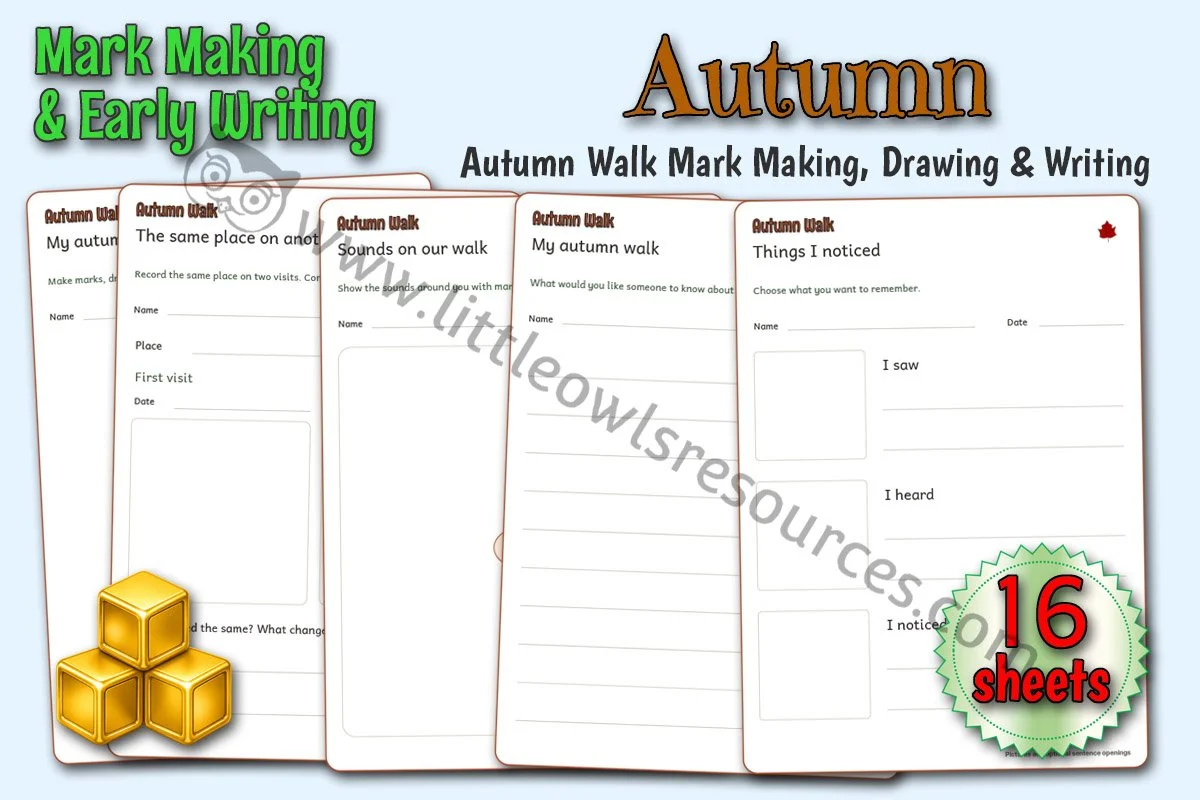
These writing prompts will help encourage mark-making and writing after the children have been on an autumn walk with all the interesting sights, sounds and smells that entails. The sheets cover an ability range from first mark-making up to full sentence writing.
DOWNLOAD (DOCX) 📝
DOWNLOAD (PDF) 📄
Take a small selection of recording materials on a walk or offer them beside an interesting object. Leave room for children’s own questions, drawings and observations.
Everything you need to set up a veterinary surgery role-play area!
Pack includes:
(Please note that words, etc. can be altered within the editable docx file version.)
‘Veterinary Surgery’ banner
Paw print decorative signs
Vet identity cards - Name Writing
Posters ‘Thank-you for waiting’, ‘After handling animals…wash you hands’
Social distancing signs & floormats
‘Please wait’ footprint floormats
Animal word cards
‘Put medicine bottles here’ & ‘Put bandages here’ activity signs
‘Open’ & ‘Closed’ signs
‘Vet Opening Times’ Poster - Space to draw hands on clock and write times
‘Opens at…o’ clock’ and ‘Closes at…o’ clock’ signs - spaces for emergent writing
Templates for emergent writing (ideally laminated) - ‘Medicine Prescription’, ‘Appointments’ & ‘Pet Details’ forms
‘For Sale’ Menu sign - Space to write prices by items
Items for sale prop cards
Animal fact cards
Original artwork drawn by Sara Murphy and final digital resources created by Stuart Murphy. COPYRIGHT ON ALL OF THE RESOURCES HOUSED ON THIS WEBSITE IS HELD BY ‘LITTLE OWLS RESOURCES’. OUR RESOURCES (INCLUDING THE IMAGES WITHIN THEM), CANNOT BE SHARED OR SOLD COMMERCIALLY.
DOWNLOAD EDITABLE (DOCX)
DOWNLOAD NON-EDITABLE (PDF)
DOWNLOAD NON-EDITABLE (Zipped JPEGs)
Add writing materials when they help a story continue: an appointment for a pet, an order for a shop or a note for a character. Let children decide what needs to be said.
This activity is intended to encourage the children to really think about their friend or family member’s likes.
Each of these cards has the same ‘Happy Birthday!’ message across the front but is accompanied by a different image. The children must think about which card they think their friend or family member will like best before decorating/colouring it for them. 15 templates included.
You may also like to use these templates for the children within your setting when there is a birthday. The card could be from you and the other children.
N.B. The final page has a card with no image for the children to draw their own.
Original artwork drawn by Sara Murphy and final digital resources created by Stuart Murphy. COPYRIGHT ON ALL OF THE RESOURCES HOUSED ON THIS WEBSITE IS HELD BY ‘LITTLE OWLS RESOURCES’. OUR RESOURCES (INCLUDING THE IMAGES WITHIN THEM), CANNOT BE SHARED OR SOLD COMMERCIALLY.
DOWNLOAD EDITABLE (DOCX)
DOWNLOAD NON-EDITABLE (PDF)
DOWNLOAD NON-EDITABLE (Zipped JPEGs)
Make a card for someone important, write an invitation or share a thank-you. Encourage children to think about the recipient and choose their own picture or message.
Browse wider collections for a particular season or interest. Select the resources that fit your children and the opportunities already available in your setting.
Offer different tools, paper sizes, working positions and ways to communicate. A child might draw, choose a picture, dictate a message, use familiar communication support or write independently.
Keep established communication books or devices available. Welcome home languages, read prompts aloud when helpful and ask before adding adult writing to a child’s work. Aim to make the experience accessible while keeping the child’s idea central.
Looking for support with progression, adult interaction or planning the environment? Explore the relevant documents in our EYFS Curriculum & Pedagogy Suite.
Professional membership required for the guidance below.
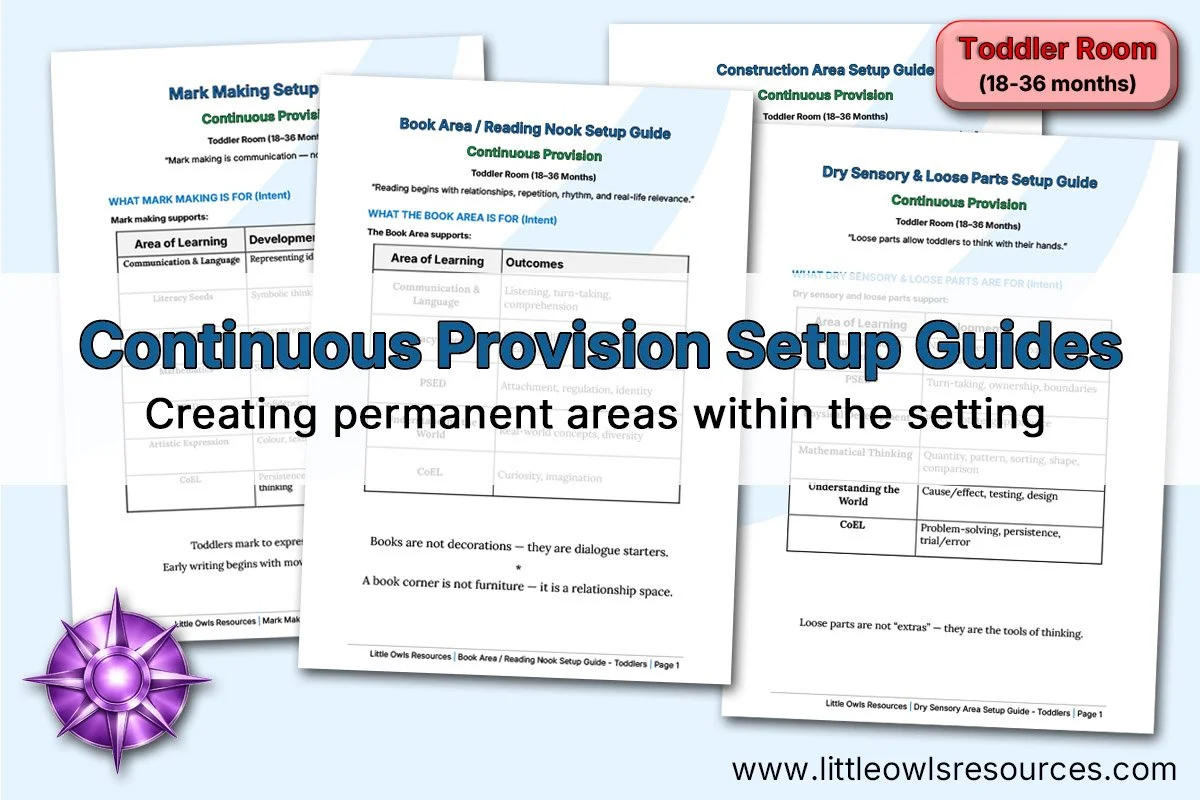
Explore early meaning-making and practical support for the toddler environment.
A parent-facing guidance page explaining early writing foundations in toddlerhood (18–36 months)
Foundations for early reading, writing, sound and meaning through play. A practitioner-facing literacy resource designed to support the earliest foundations of reading, writing and communication — before formal phonics, letter instruction or written outcomes.
Practical, pedagogy-led guidance for designing environments that support how toddlers learn.
Connect purposeful writing, physical development and everyday provision.
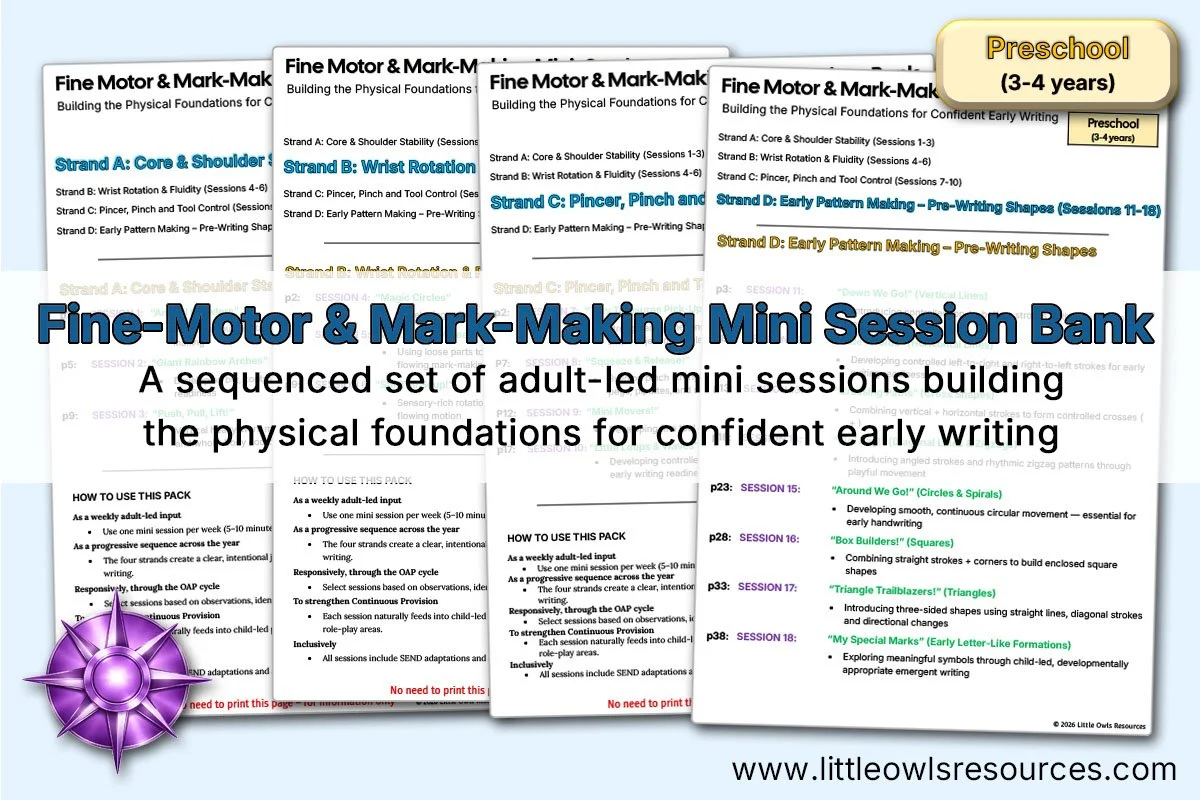
A sequenced set of adult-led mini sessions building the physical foundations for confident early writing.
The pack provides detailed guidance for every core Preschool learning zone, including:
~ Construction ~ Small World ~ Role-Play ~ Writing & Mark-Making ~ Maths ~ Creative / Art ~ Investigation / STEM ~ Book Corner / Reading Den ~ Fine Motor Station ~ Water and Sand ~ Outdoor Core Zones (physical play, nature, maths, mark-making, mud kitchen) ~ Snack Area / Independence Station ~
A developmentally grounded progression tool supporting early writing from mark-making to name writing.
Connect explicit teaching with meaningful writing opportunities across the classroom.
A professional guidance document supporting confident, developmentally appropriate physical development and early writing practice in Reception.
A professional guidance pack supporting developmentally appropriate early writing through purpose-led modelling, phonics application and play-based follow-through in continuous provision.
A comprehensive set of professional guidance documents supporting high-quality, purposeful continuous provision across all key areas of the Reception environment.
An accessible writing area can help children find familiar resources. Also offer suitable tools and paper where children are playing, building, investigating or recreating everyday events. A portable basket can work well in a smaller setting.
Begin with a manageable selection of familiar tools and paper. Introduce a card, format or material when it supports an idea, and give children time to revisit it. You do not need to display every page of a pack.
No. Children can explore marks, draw, experiment and express themselves without an expectation to form letters or produce words. Meaningful writing opportunities can sit alongside these experiences.
Use them to support phonics children have already been taught. Match editable resources to your setting’s programme, model their use and offer help with unfamiliar content. Provision complements explicit teaching.
Selected open formats and role-play resources can support Year 1 and Year 2 writing. Choose a meaningful purpose and adapt the language, support and expected depth to the children and your curriculum.
No. Read an idea on screen, use plain paper or print only the parts that will be useful. Check individual resource pages for available editable and PDF versions.
Explore selected free resources and our Special Dates Calendars.
Access the full EYFS & KS1 Printable Provision library, including the practical printable resources featured here.
Access everything in Premium plus the EYFS Curriculum & Pedagogy Suite for planning and professional guidance.
You are browsing: A–D
(Scroll through using arrows on the right to browse within topics)
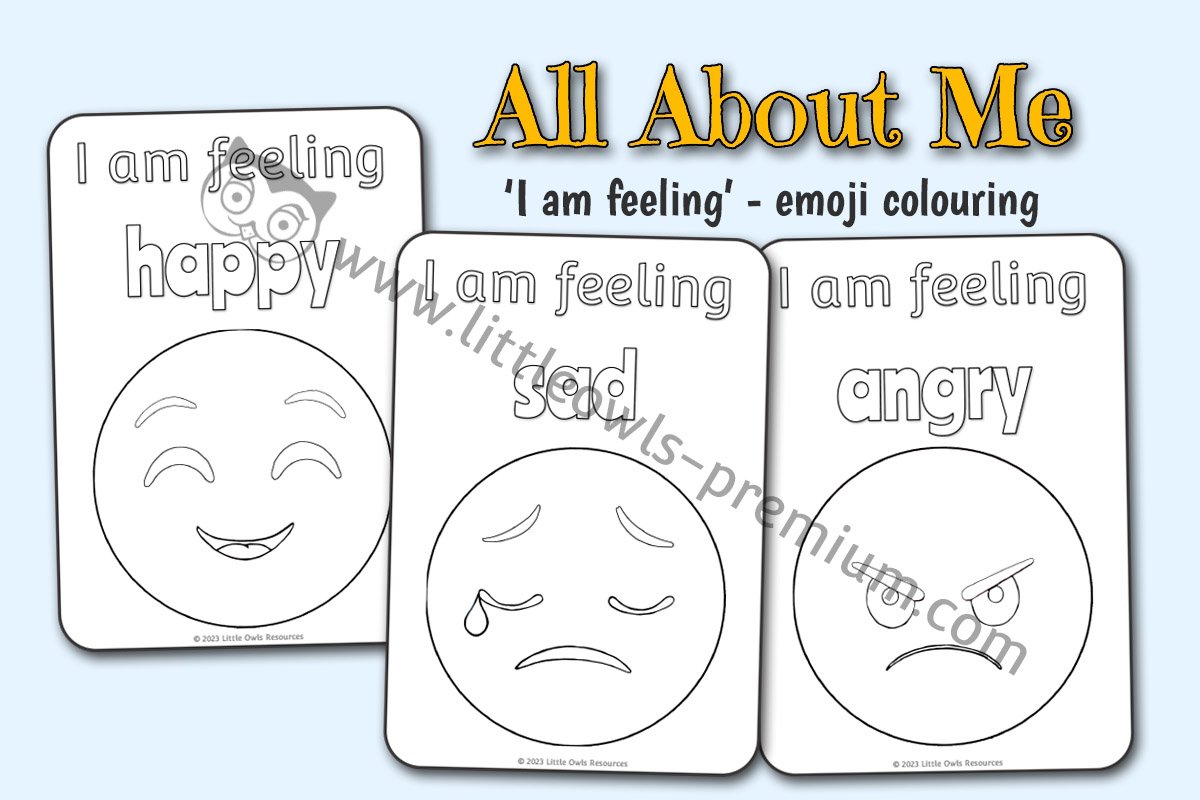
Set of 12 A5 ‘I am feeling’ colouring cards. Useful for any individuals who need support in identifying and expressing their feelings.
Feelings include: happy, confused, excited, sad, scared, worried, love, sleepy, fine, angry, bored and frustrated.
Keywords: picture/visual communication aids, feeling, feelings, emotions, emotion/emotional regulation/dysregulation/self-regulation, autism, autistic, non verbal, non-verbal, mental health, wellness, colouring page/pages/sheet/sheets, mindfulness
Original artwork drawn by Sara Murphy and final digital resources created by Stuart Murphy. COPYRIGHT ON ALL OF THE RESOURCES HOUSED ON THIS WEBSITE IS HELD BY ‘LITTLE OWLS RESOURCES’. OUR RESOURCES (INCLUDING THE IMAGES WITHIN THEM), CANNOT BE SHARED OR SOLD COMMERCIALLY.
DOWNLOAD EDITABLE (DOCX)
DOWNLOAD NON-EDITABLE (PDF)
DOWNLOAD NON-EDITABLE (Zipped JPEGs)
<<-BACK TO ‘ALL ABOUT ME’ MENU
<<-BACK TO ‘MENTAL HEALTH’ MENU
<<-BACK TO ‘SEND’ MENU (Coming soon!)
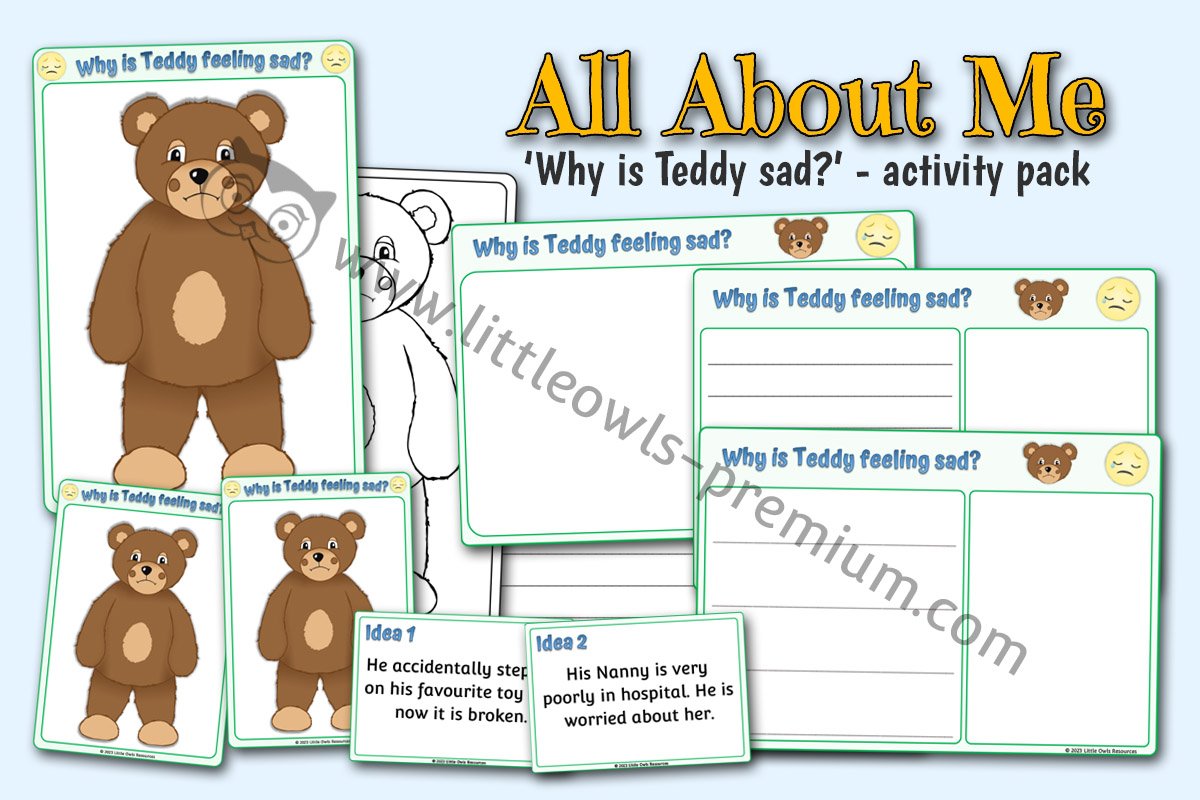
We created this ‘Why is Teddy sad?’ pack in order for you to be able to explore with children how sometimes something may feel wrong inside when there are no obvious cuts, bruises, etc.
As well as investigating the feeling of ‘sadness’ by talking about what might cause us to feel sad and what it actually feels like, this pack could also be a doorway to talking about mental health. It also aids in the mindfulness practice of recognising emotions.
Keywords: feeling, feelings, emotions, emotion/emotional regulation/dysregulation/self-regulation, autism, autistic, mental health, wellness, colouring page/pages/sheet/sheets, empathy, role play, role-play, mindfulness
Original artwork drawn by Sara Murphy and final digital resources created by Stuart Murphy. COPYRIGHT ON ALL OF THE RESOURCES HOUSED ON THIS WEBSITE IS HELD BY ‘LITTLE OWLS RESOURCES’. OUR RESOURCES (INCLUDING THE IMAGES WITHIN THEM), CANNOT BE SHARED OR SOLD COMMERCIALLY.
DOWNLOAD EDITABLE (DOCX)
DOWNLOAD NON-EDITABLE (PDF)
DOWNLOAD NON-EDITABLE (Zipped JPEGs)
<<-BACK TO ‘ALL ABOUT ME’ MENU
We created this ‘Why is Teddy happy?’ pack in conjunction with our ‘Why is Teddy sad?’ pack in order for you to be able to explore emotions, empathy and mental health with children.
As well as investigating the feeling of ‘happiness’ by talking about what might cause us to feel happy and what it actually feels like, this pack could also be a doorway to talking about mental health. In addition, it aids in the mindfulness practice of recognising emotions.
Keywords: feeling, feelings, emotions, emotion/emotional regulation/dysregulation/self-regulation, autism, autistic, mental health, wellness, colouring page/pages/sheet/sheets, empathy, role play, role-play, mindfulness
Original artwork drawn by Sara Murphy and final digital resources created by Stuart Murphy. COPYRIGHT ON ALL OF THE RESOURCES HOUSED ON THIS WEBSITE IS HELD BY ‘LITTLE OWLS RESOURCES’. OUR RESOURCES (INCLUDING THE IMAGES WITHIN THEM), CANNOT BE SHARED OR SOLD COMMERCIALLY.
DOWNLOAD EDITABLE (DOCX)
DOWNLOAD NON-EDITABLE (PDF)
DOWNLOAD NON-EDITABLE (Zipped JPEGs)
<<-BACK TO ‘ALL ABOUT ME’ MENU
All About Me themed ‘Make it’ challenge cards pack. Designed to inspire children to make representations of some of the things which help to define them as people. 14 cards included in the pack.
So get out your old cereal boxes or whatever making materials you have to hand and allow yourselves to be inspired! have fun!
Keywords: art, junk modelling, artwork, art and craft, ourselves
Original artwork drawn by Sara Murphy and final digital resources created by Stuart Murphy. COPYRIGHT ON ALL OF THE RESOURCES HOUSED ON THIS WEBSITE IS HELD BY ‘LITTLE OWLS RESOURCES’. OUR RESOURCES (INCLUDING THE IMAGES WITHIN THEM), CANNOT BE SHARED OR SOLD COMMERCIALLY.
DOWNLOAD EDITABLE (DOCX)
DOWNLOAD NON-EDITABLE (PDF)
DOWNLOAD NON-EDITABLE (Zipped JPEGs)
These letter sheets are intended to aid young children in their familiarity with their initial letter.
Included are all the letters of the alphabet in capitals. These could be used for basic colouring or as the starting point for some collage work.
Have fun!
Keywords: art, letter, alphabet, capital, initial sounds, artwork, art and craft, ourselves, collage, loose parts, colouring, mark making, cutting, glue, sticking, scissor skills
Original artwork drawn by Sara Murphy and final digital resources created by Stuart Murphy. COPYRIGHT ON ALL OF THE RESOURCES HOUSED ON THIS WEBSITE IS HELD BY ‘LITTLE OWLS RESOURCES’. OUR RESOURCES (INCLUDING THE IMAGES WITHIN THEM), CANNOT BE SHARED OR SOLD COMMERCIALLY.
DOWNLOAD EDITABLE (DOCX)
DOWNLOAD NON-EDITABLE (PDF)
DOWNLOAD NON-EDITABLE (Zipped JPEGs)
As well as part of an ‘All About Me’ topic, this sheet could be used at the start of a child’s time at a particular setting. It can then be referred to with the child at a later time to show them how much they have improved in writing their name, drawing themselves or even how much bigger their hand is!
Keywords: handprint, hand print, progress, grow, growth, bodies, body, ourselves, name writing, learning journey/journal
Original artwork drawn by Sara Murphy and final digital resources created by Stuart Murphy. COPYRIGHT ON ALL OF THE RESOURCES HOUSED ON THIS WEBSITE IS HELD BY ‘LITTLE OWLS RESOURCES’. OUR RESOURCES (INCLUDING THE IMAGES WITHIN THEM), CANNOT BE SHARED OR SOLD COMMERCIALLY.
DOWNLOAD EDITABLE (DOCX)
DOWNLOAD NON-EDITABLE (PDF)
DOWNLOAD NON-EDITABLE (Zipped JPEGs)
First the children are to make a handprint/footprint on the sheet. Then, they are to use a set of building bricks to see how long their hand/foot is.
If preferred, children can draw around their hand/foot instead.
In addition, this is an activity that could be revisited at a later date to demonstrate change and growth.
Keywords: handprint, hand print, footprint, foot print, progress, grow, growth, bodies, body, ourselves, learning journey/journal, measure, non-standard units of measurement
Original artwork drawn by Sara Murphy and final digital resources created by Stuart Murphy. COPYRIGHT ON ALL OF THE RESOURCES HOUSED ON THIS WEBSITE IS HELD BY ‘LITTLE OWLS RESOURCES’. OUR RESOURCES (INCLUDING THE IMAGES WITHIN THEM), CANNOT BE SHARED OR SOLD COMMERCIALLY.
DOWNLOAD EDITABLE (DOCX)
DOWNLOAD NON-EDITABLE (PDF)
DOWNLOAD NON-EDITABLE (Zipped JPEGs)
These sheets are ideal for drawing, collage or to be laminated for use with playdough.
Original artwork drawn by Sara Murphy and final digital resources created by Stuart Murphy. COPYRIGHT ON ALL OF THE RESOURCES HOUSED ON THIS WEBSITE IS HELD BY ‘LITTLE OWLS RESOURCES’. OUR RESOURCES (INCLUDING THE IMAGES WITHIN THEM), CANNOT BE SHARED OR SOLD COMMERCIALLY.
DOWNLOAD EDITABLE (DOCX)
DOWNLOAD NON-EDITABLE (PDF)
DOWNLOAD NON-EDITABLE (Zipped JPEGs)
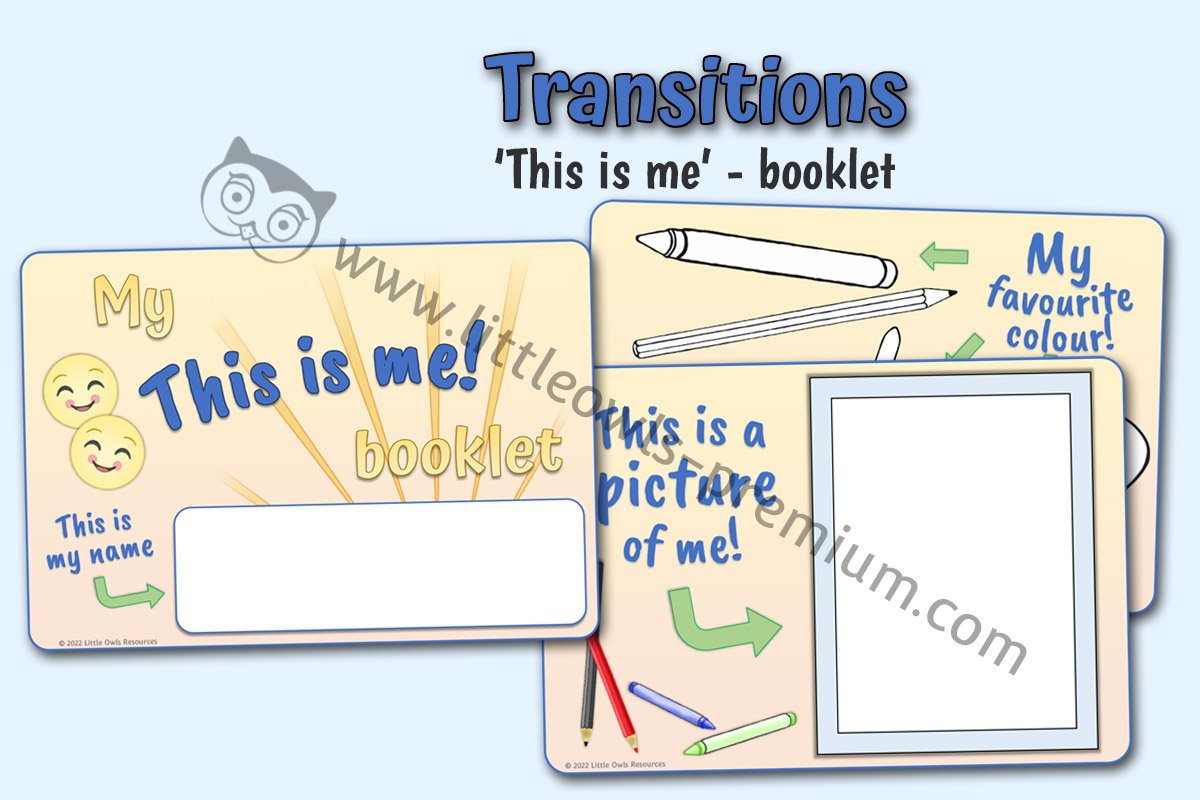
As well as part of an ‘All About Me’ topic to be completed at any time, this booklet is ideal for use during transitions. If you have a child who is moving to another setting or transitioning to school, you may like to fill this in with them to pass on to the next teacher/practitioner.
Equally, if you are a reception teacher about to receive a new cohort, you may like to send this home in advance of your new children starting with you.
In addition, the booklet in full or selected pages from within the booklet are ideal for use at the start of a child’s time at a particular setting/the start of the school year.
Original artwork drawn by Sara Murphy and final digital resources created by Stuart Murphy. COPYRIGHT ON ALL OF THE RESOURCES HOUSED ON THIS WEBSITE IS HELD BY ‘LITTLE OWLS RESOURCES’. OUR RESOURCES (INCLUDING THE IMAGES WITHIN THEM), CANNOT BE SHARED OR SOLD COMMERCIALLY.
DOWNLOAD EDITABLE (DOCX)
DOWNLOAD NON-EDITABLE (PDF)
DOWNLOAD NON-EDITABLE (Zipped JPEGs)
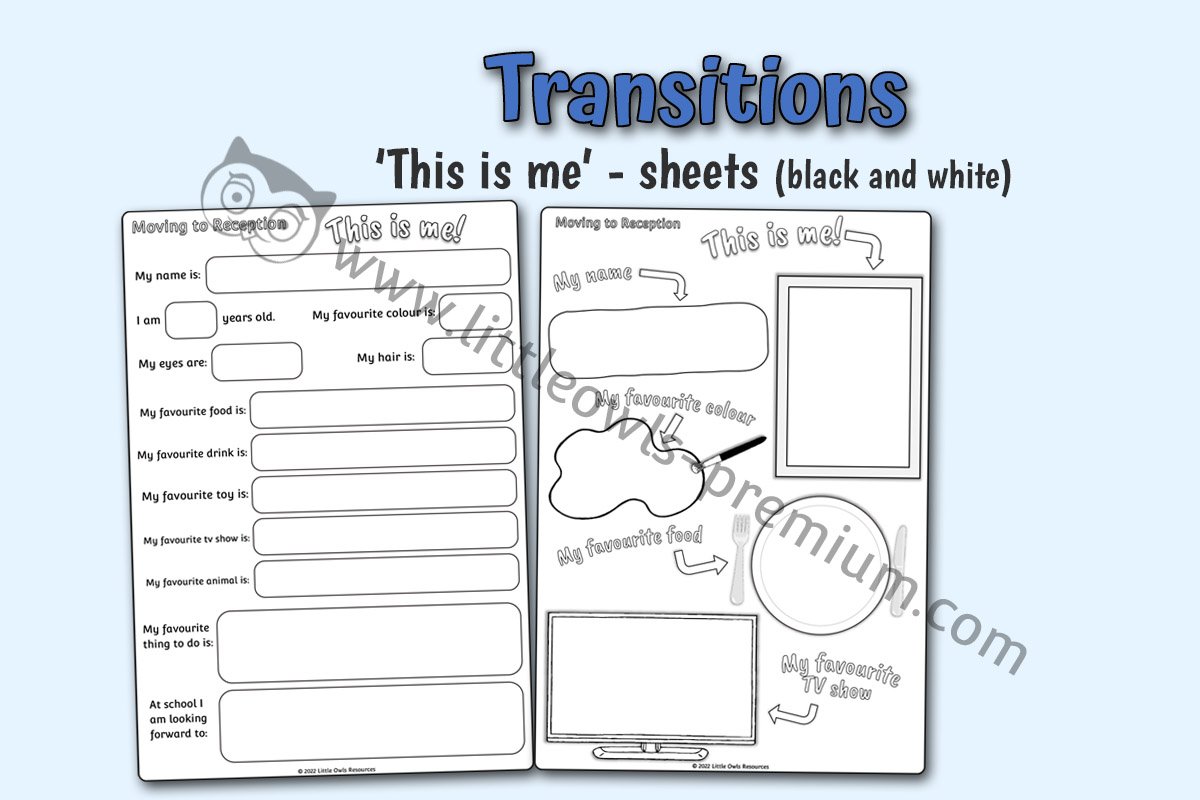
As well as part of an ‘All About Me’ topic to be completed at any time, these sheets are ideal for use during transitions. There are two sheets. The first is ideal to be completed by an adult alongside a child and the second by the child.
If you have a child who is moving to another setting or transitioning to school, you may like to fill this in with them to pass on to the next teacher/practitioner.
Equally, if you are a reception teacher about to receive a new cohort, you may like to send this home in advance of your new children starting with you.
Original artwork drawn by Sara Murphy and final digital resources created by Stuart Murphy. COPYRIGHT ON ALL OF THE RESOURCES HOUSED ON THIS WEBSITE IS HELD BY ‘LITTLE OWLS RESOURCES’. OUR RESOURCES (INCLUDING THE IMAGES WITHIN THEM), CANNOT BE SHARED OR SOLD COMMERCIALLY.
DOWNLOAD EDITABLE (DOCX)
DOWNLOAD NON-EDITABLE (PDF)
DOWNLOAD NON-EDITABLE (Zipped JPEGs)
This booklet is for children to complete as they come to the end of an academic year or their time at a particular setting.
There are prompts on each page to spark ideas as the children think back over their experiences.
This pack makes up a ten-page booklet (including the cover sheet). There are versions for each page with lines for writing and versions with blank boxes. It is intended that you print only the pages you require to make up your booklets. For example you may choose to print only the blank box versions so that children only draw their responses.
Original artwork drawn by Sara Murphy and final digital resources created by Stuart Murphy. COPYRIGHT ON ALL OF THE RESOURCES HOUSED ON THIS WEBSITE IS HELD BY ‘LITTLE OWLS RESOURCES’. OUR RESOURCES (INCLUDING THE IMAGES WITHIN THEM), CANNOT BE SHARED OR SOLD COMMERCIALLY.
DOWNLOAD EDITABLE (DOCX)
DOWNLOAD NON-EDITABLE (PDF)
DOWNLOAD NON-EDITABLE (Zipped JPEGs)
Ideal for use within a classroom or preschool environment (but also adaptable as an individual resource for slightly younger children). Each child can colour in a set of footprints individually and then add their name (or have it added for them). After, the footprints can be placed along a classroom floor for lining up and every day they line up they are looking at their name. The sheets can also be used for younger children as part of developing the ability to recognise their own body parts and their written name.
Original artwork drawn by Sara Murphy and final digital resources created by Stuart Murphy. COPYRIGHT ON ALL OF THE RESOURCES HOUSED ON THIS WEBSITE IS HELD BY ‘LITTLE OWLS RESOURCES’. OUR RESOURCES (INCLUDING THE IMAGES WITHIN THEM), CANNOT BE SHARED OR SOLD COMMERCIALLY.
DOWNLOAD EDITABLE (DOCX)
DOWNLOAD NON-EDITABLE (PDF)
Children can choose the colour outline they would like to use, then draw a self-portrait that can be used to create a larger display of them all!
Original artwork drawn by Sara Murphy and final digital resources created by Stuart Murphy. COPYRIGHT ON ALL OF THE RESOURCES HOUSED ON THIS WEBSITE IS HELD BY ‘LITTLE OWLS RESOURCES’. OUR RESOURCES (INCLUDING THE IMAGES WITHIN THEM), CANNOT BE SHARED OR SOLD COMMERCIALLY.
DOWNLOAD EDITABLE (DOCX)
DOWNLOAD NON-EDITABLE (PDF)
DOWNLOAD NON-EDITABLE (Zipped JPEGs)
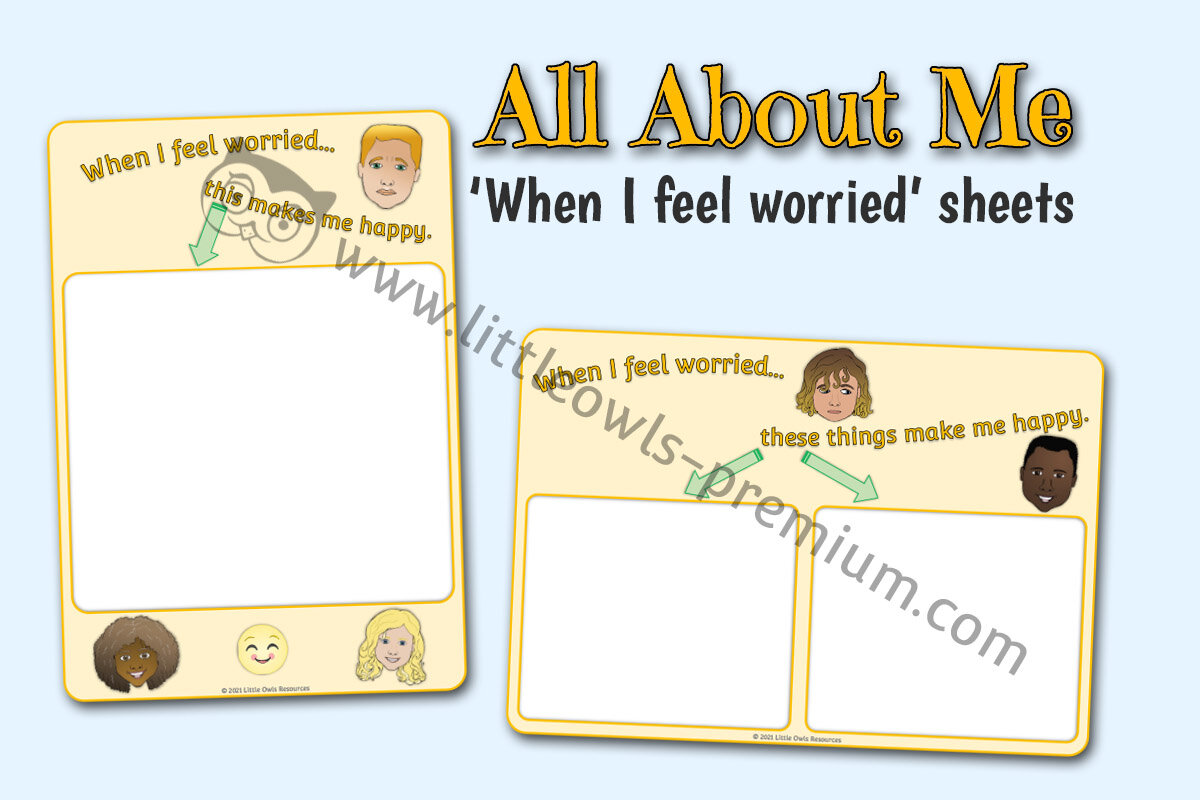
It can often be difficult for children (and anyone) to deal with feelings of worry and anxiety. Once these feelings become overwhelmingly strong, it can be difficult to get passed them.
These 2 sheets are designed for children and adults to discuss what helps a particular child to feel happy when they are worried. This could be things like cuddling a particular soft toy, colouring, playing Lego, reading a book, etc. Once strategies have been decided, the child could make marks in the box(es) that will remind them of this strategy when they need to use it. Alternatively, adults may create picture prompts to place in the box(es).
Original artwork drawn by Sara Murphy and final digital resources created by Stuart Murphy. COPYRIGHT ON ALL OF THE RESOURCES HOUSED ON THIS WEBSITE IS HELD BY ‘LITTLE OWLS RESOURCES’. OUR RESOURCES (INCLUDING THE IMAGES WITHIN THEM), CANNOT BE SHARED OR SOLD COMMERCIALLY.
DOWNLOAD EDITABLE (DOCX)
DOWNLOAD NON-EDITABLE (PDF)
DOWNLOAD NON-EDITABLE (Zipped JPEGs)
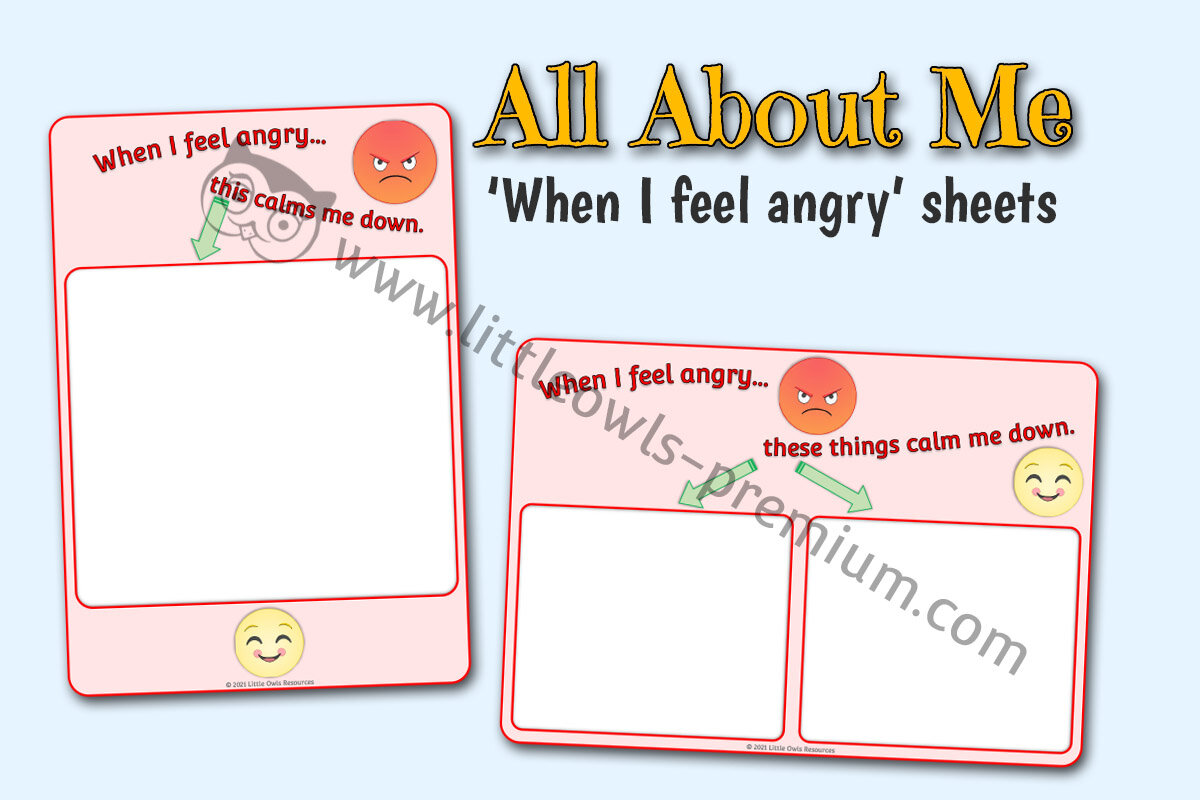
It can often be difficult for children (and anyone) to make good choices when they have an overwhelming feeling of anger or frustration. In order to talk about problems and express thoughts effectively it is often necessary to return to a calm state first.
These 2 sheets are designed for children and adults to discuss what helps a particular child to feel happy/calm again. This could be things like cuddling a particular soft toy, colouring, playing Lego, sitting in the reading corner, etc. Once strategies have been decided, the child could make marks in the boxes that will remind them of this strategy when they need to use it. Alternatively, adults may create picture prompts to place in the box(es).
Original artwork drawn by Sara Murphy and final digital resources created by Stuart Murphy. COPYRIGHT ON ALL OF THE RESOURCES HOUSED ON THIS WEBSITE IS HELD BY ‘LITTLE OWLS RESOURCES’. OUR RESOURCES (INCLUDING THE IMAGES WITHIN THEM), CANNOT BE SHARED OR SOLD COMMERCIALLY.
DOWNLOAD EDITABLE (DOCX)
DOWNLOAD NON-EDITABLE (PDF)
DOWNLOAD NON-EDITABLE (Zipped JPEGs)
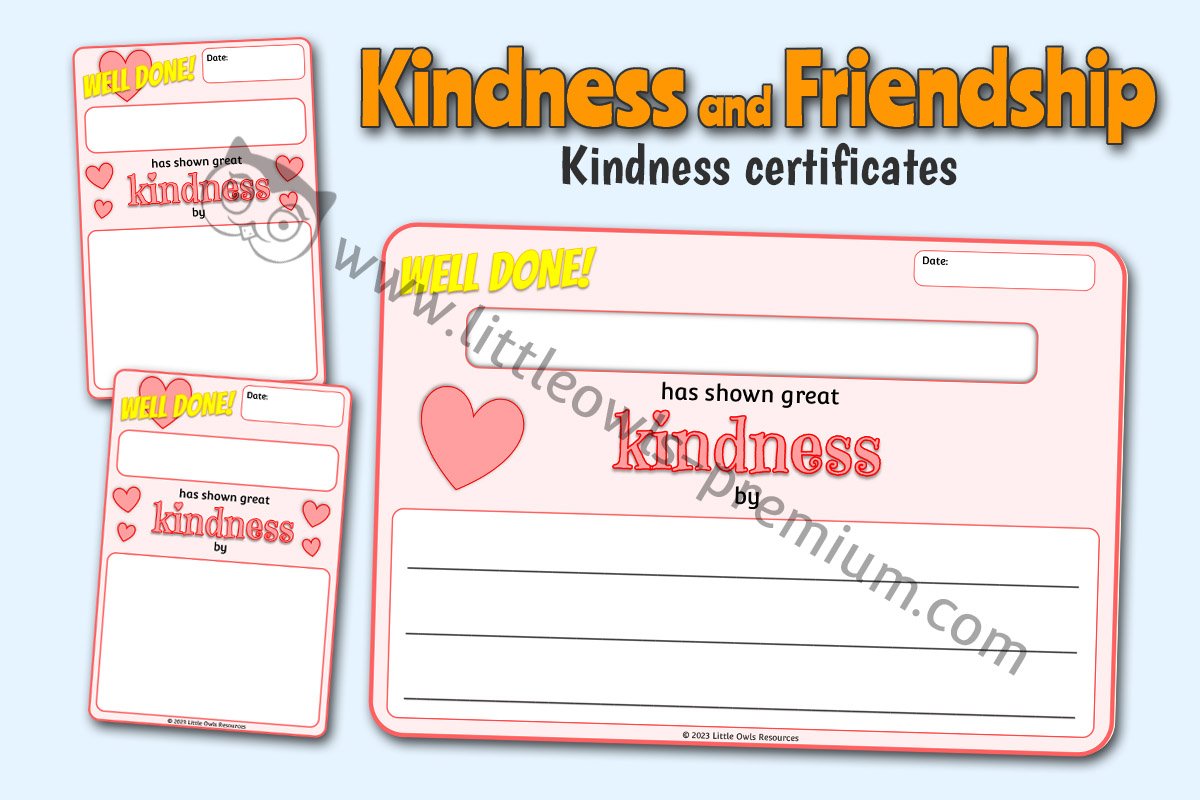
Heart themed ‘Kindness’ certificates/notes. These certificate and note sheets are intended either for use by an adult/teacher or by a child.
Original artwork drawn by Sara Murphy and final digital resources created by Stuart Murphy. COPYRIGHT ON ALL OF THE RESOURCES HOUSED ON THIS WEBSITE IS HELD BY ‘LITTLE OWLS RESOURCES’. OUR RESOURCES (INCLUDING THE IMAGES WITHIN THEM), CANNOT BE SHARED OR SOLD COMMERCIALLY.
DOWNLOAD EDITABLE (DOCX)
DOWNLOAD NON-EDITABLE (PDF)
DOWNLOAD NON-EDITABLE (Zipped JPEGs)
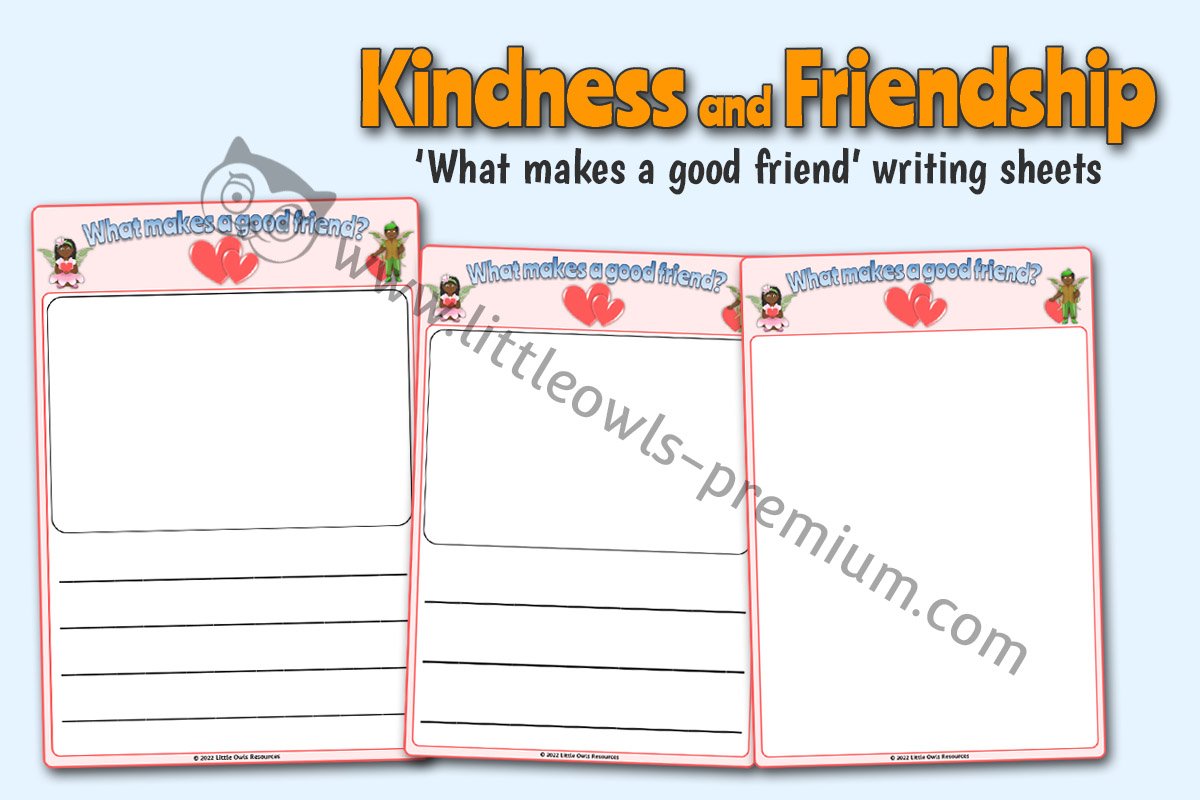
Following a discussion about things that make someone a good friend, children can draw and write about their thoughts and experiences on these sheets.
Original artwork drawn by Sara Murphy and final digital resources created by Stuart Murphy. COPYRIGHT ON ALL OF THE RESOURCES HOUSED ON THIS WEBSITE IS HELD BY ‘LITTLE OWLS RESOURCES’. OUR RESOURCES (INCLUDING THE IMAGES WITHIN THEM), CANNOT BE SHARED OR SOLD COMMERCIALLY.
DOWNLOAD EDITABLE (DOCX)
DOWNLOAD NON-EDITABLE (PDF)
DOWNLOAD NON-EDITABLE (Zipped JPEGs)
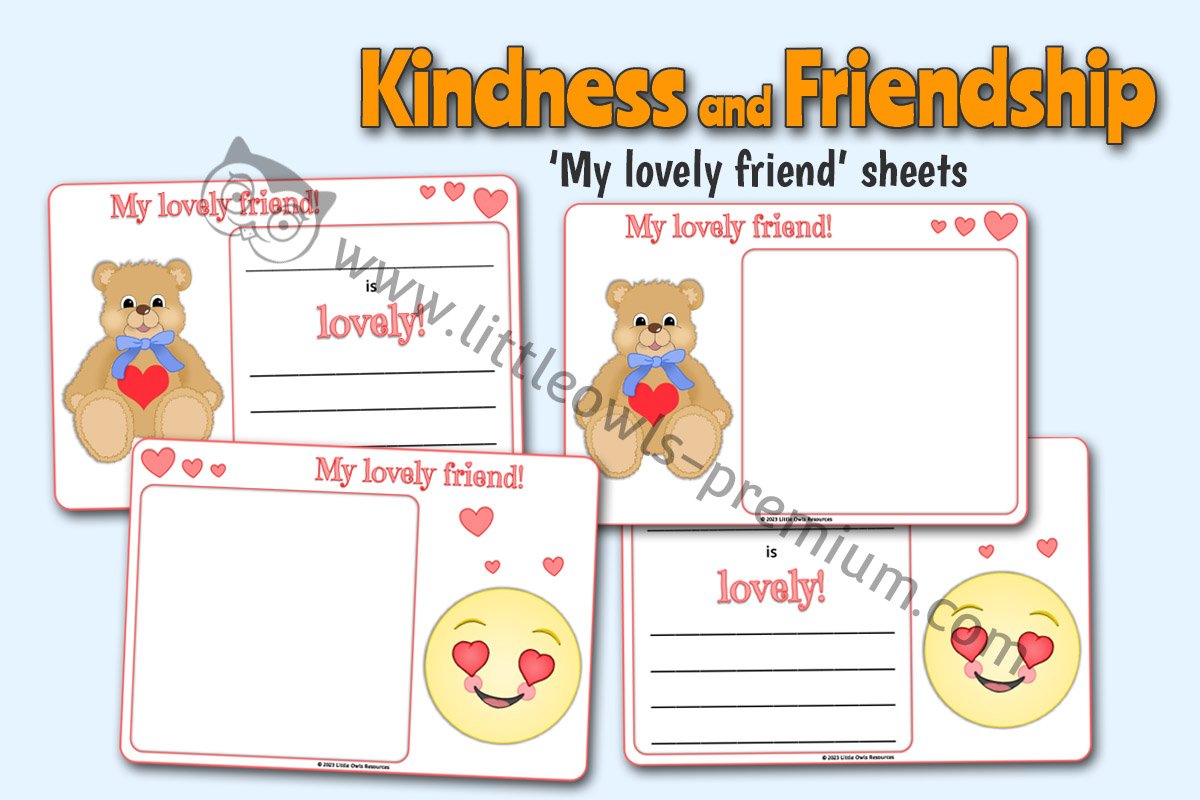
Following a discussion about things that make someone a good friend, children can draw and/or write their thoughts and experiences about a particular friend on these sheets.
Alternatively the sheets could be made available for children to use when they feel someone has been particularly kind to them!
Original artwork drawn by Sara Murphy and final digital resources created by Stuart Murphy. COPYRIGHT ON ALL OF THE RESOURCES HOUSED ON THIS WEBSITE IS HELD BY ‘LITTLE OWLS RESOURCES’. OUR RESOURCES (INCLUDING THE IMAGES WITHIN THEM), CANNOT BE SHARED OR SOLD COMMERCIALLY.
DOWNLOAD EDITABLE (DOCX)
DOWNLOAD NON-EDITABLE (PDF)
DOWNLOAD NON-EDITABLE (Zipped JPEGs)
Pack includes 11 different ‘Patchwork Person’ templates. Great to support teaching and learning surrounding individuality and diversity.
You may like to read ‘Elmer (the patchwork elephant)’ alongside this resource.
Original artwork drawn by Sara Murphy and final digital resources created by Stuart Murphy. COPYRIGHT ON ALL OF THE RESOURCES HOUSED ON THIS WEBSITE IS HELD BY ‘LITTLE OWLS RESOURCES’. OUR RESOURCES (INCLUDING THE IMAGES WITHIN THEM), CANNOT BE SHARED OR SOLD COMMERCIALLY.
DOWNLOAD EDITABLE (DOCX)
DOWNLOAD NON-EDITABLE (PDF)
DOWNLOAD NON-EDITABLE (Zipped JPEGs)
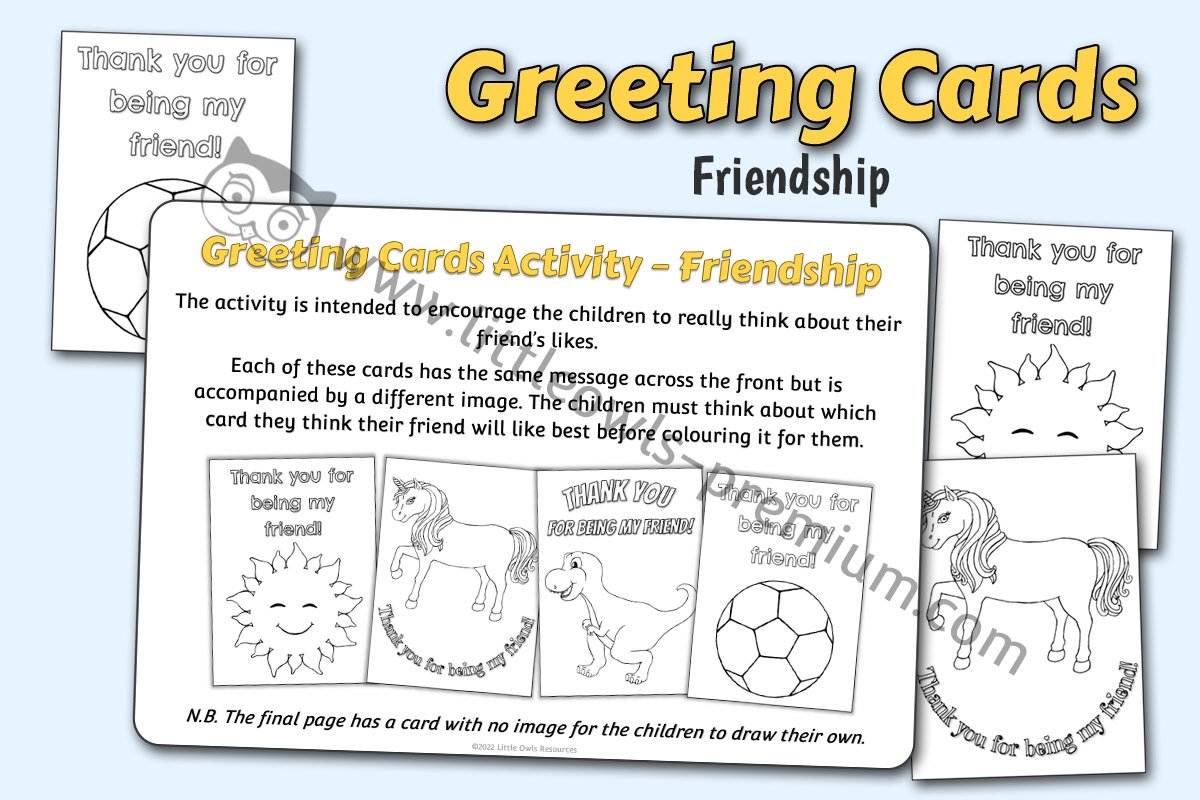
This activity is intended to encourage the children to really think about their friend’s likes.
Each of these cards has the same message across the front but is accompanied by a different image. The children must think about which card they think their friend will like best before colouring it for them. 15 templates included.
N.B. The final page has a card with no image for the children to draw their own.
Original artwork drawn by Sara Murphy and final digital resources created by Stuart Murphy. COPYRIGHT ON ALL OF THE RESOURCES HOUSED ON THIS WEBSITE IS HELD BY ‘LITTLE OWLS RESOURCES’. OUR RESOURCES (INCLUDING THE IMAGES WITHIN THEM), CANNOT BE SHARED OR SOLD COMMERCIALLY.
DOWNLOAD EDITABLE (DOCX)
DOWNLOAD NON-EDITABLE (PDF)
DOWNLOAD NON-EDITABLE (Zipped JPEGs)
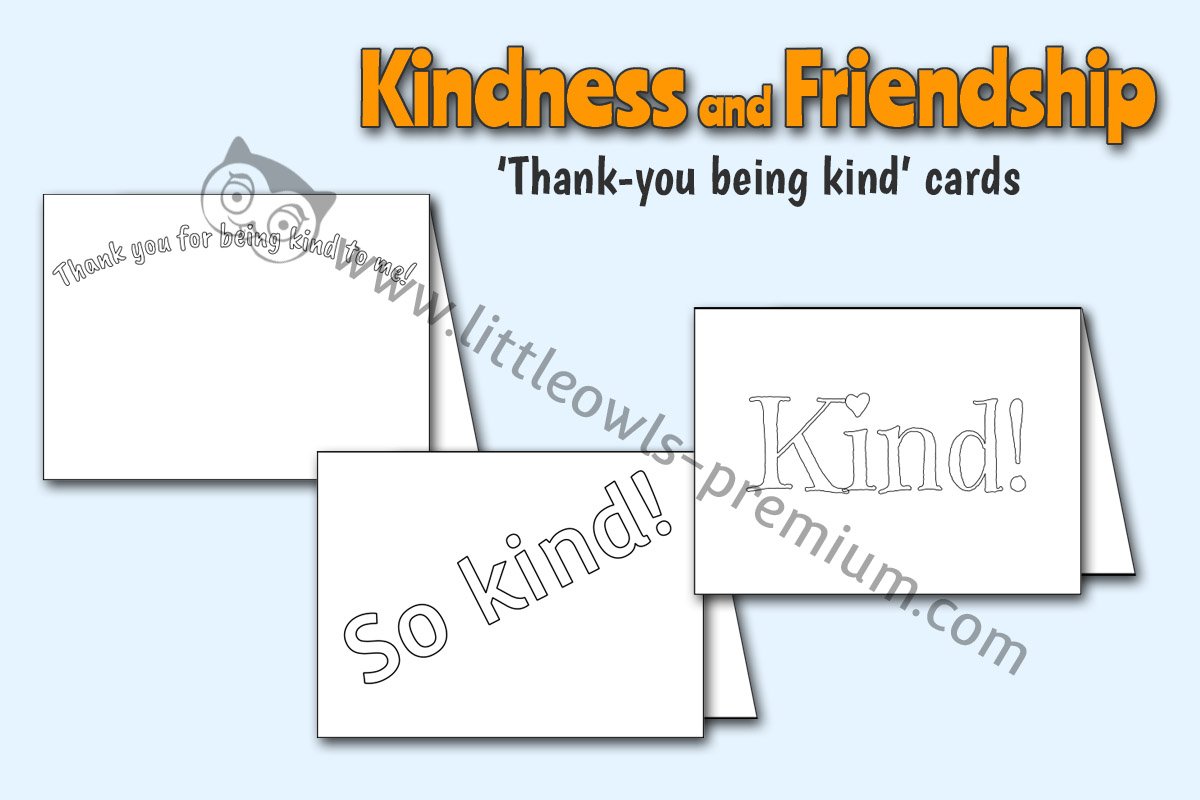
A selection of 8 ‘Thank-you for being kind!’ cards. Children may design, decorate and colour one of these cards and give it to someone when they would like to show their appreciation for someone’s kindness.
Original artwork drawn by Sara Murphy and final digital resources created by Stuart Murphy. COPYRIGHT ON ALL OF THE RESOURCES HOUSED ON THIS WEBSITE IS HELD BY ‘LITTLE OWLS RESOURCES’. OUR RESOURCES (INCLUDING THE IMAGES WITHIN THEM), CANNOT BE SHARED OR SOLD COMMERCIALLY.
DOWNLOAD EDITABLE (DOCX)
DOWNLOAD NON-EDITABLE (PDF)
DOWNLOAD NON-EDITABLE (Zipped JPEGs)
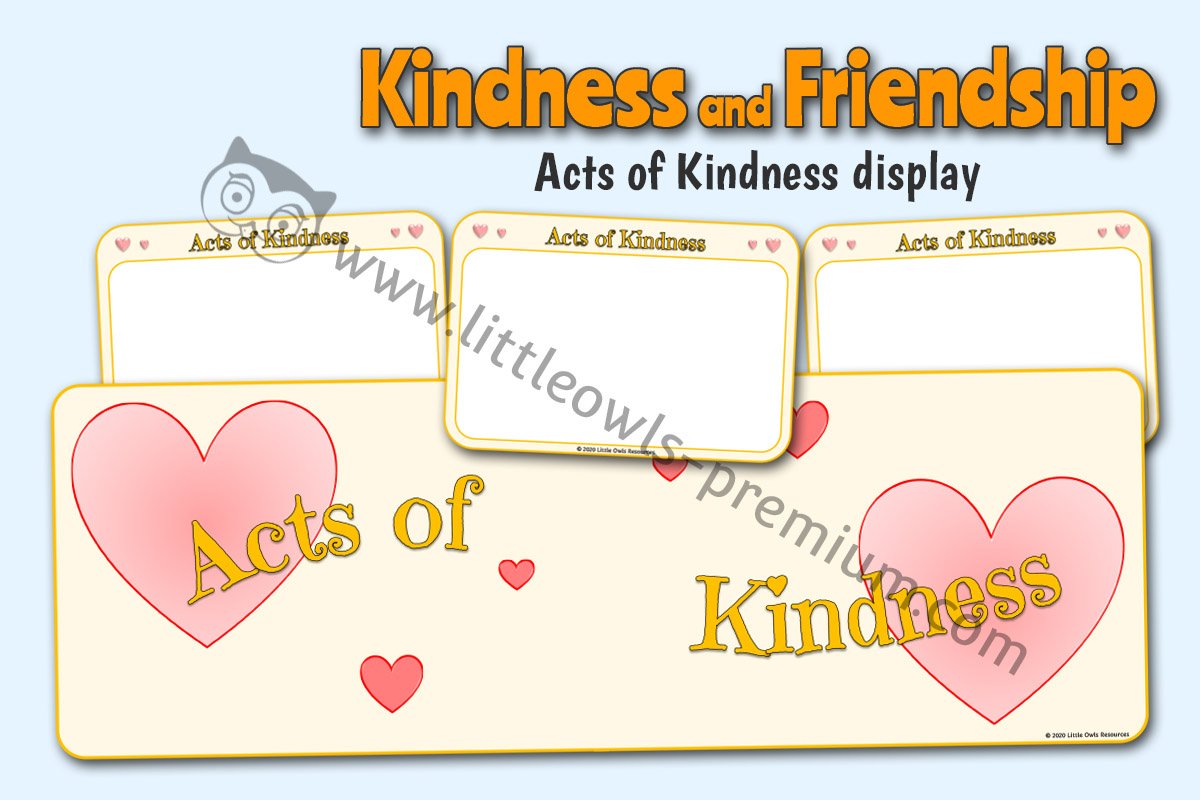
Banner for an ‘Acts of Kindness’ Display together with note sheets for recording the children’s kind deeds which can then be added to the display.
Original artwork drawn by Sara Murphy and final digital resources created by Stuart Murphy. COPYRIGHT ON ALL OF THE RESOURCES HOUSED ON THIS WEBSITE IS HELD BY ‘LITTLE OWLS RESOURCES’. OUR RESOURCES (INCLUDING THE IMAGES WITHIN THEM), CANNOT BE SHARED OR SOLD COMMERCIALLY.
DOWNLOAD EDITABLE (DOCX)
DOWNLOAD NON-EDITABLE (PDF)
Following a discussion about kind deeds children can draw and write about their experiences on these sheets.
Original artwork drawn by Sara Murphy and final digital resources created by Stuart Murphy. COPYRIGHT ON ALL OF THE RESOURCES HOUSED ON THIS WEBSITE IS HELD BY ‘LITTLE OWLS RESOURCES’. OUR RESOURCES (INCLUDING THE IMAGES WITHIN THEM), CANNOT BE SHARED OR SOLD COMMERCIALLY.
DOWNLOAD EDITABLE (DOCX)
DOWNLOAD NON-EDITABLE (PDF)
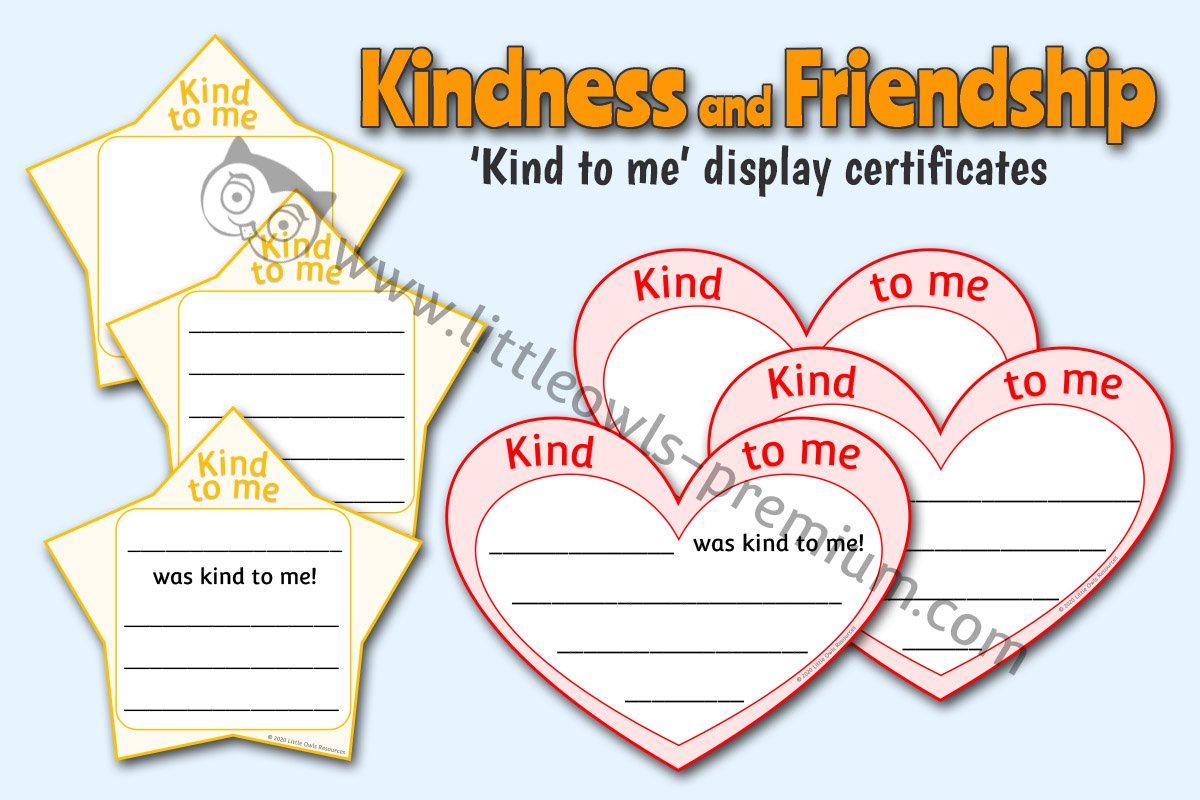
Heart and Star shaped ‘Kind to me’ certificates/notes. Children may be encouraged to think (for example on a Friday) about who has been kind to them during that week. Children can then draw or write about how that person was kind to them and can give the certificate they have made to that person. This can either then be taken home by the child who did the act of kindness or put on the wall as part of a setting/class display.
Original artwork drawn by Sara Murphy and final digital resources created by Stuart Murphy. COPYRIGHT ON ALL OF THE RESOURCES HOUSED ON THIS WEBSITE IS HELD BY ‘LITTLE OWLS RESOURCES’. OUR RESOURCES (INCLUDING THE IMAGES WITHIN THEM), CANNOT BE SHARED OR SOLD COMMERCIALLY.
DOWNLOAD EDITABLE (DOCX)
DOWNLOAD NON-EDITABLE (PDF)
DOWNLOAD NON-EDITABLE (Zipped JPEGs)
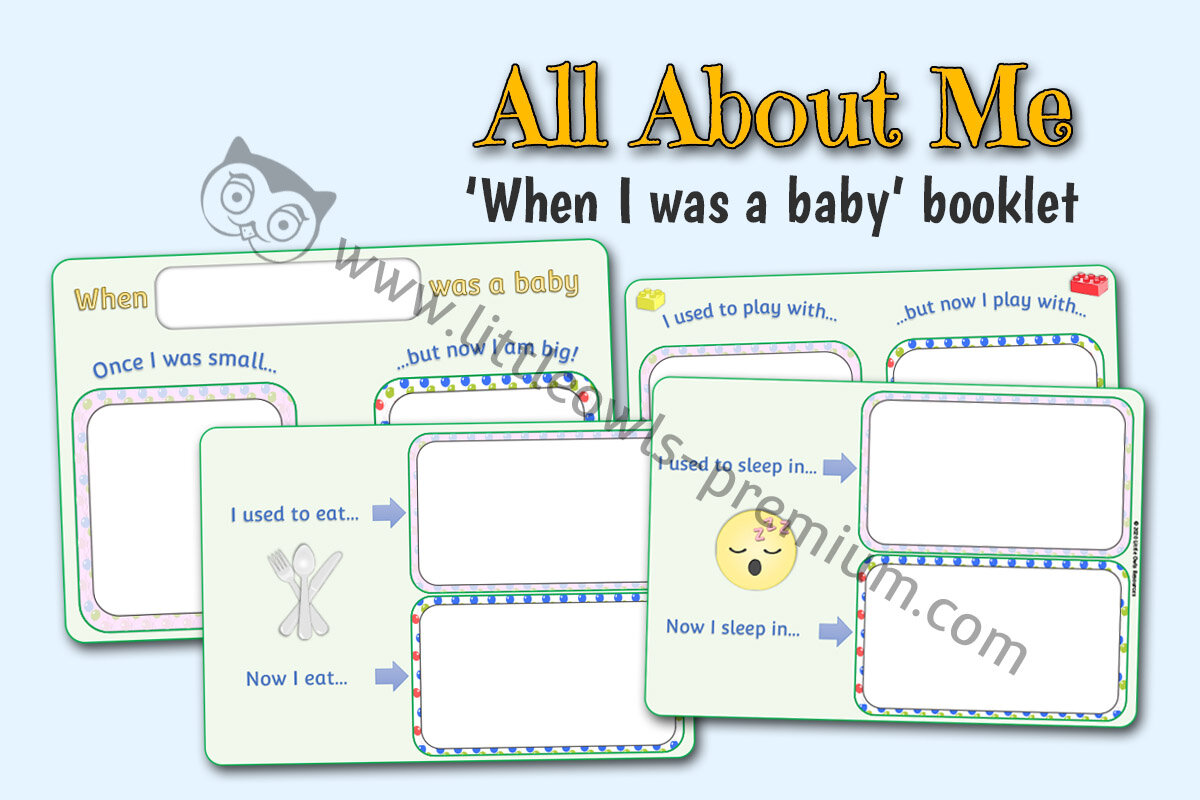
Four sheets which can either be used separately or put together as a booklet. Each sheet compares an aspect of life when an individual was a baby and now to demonstrate how we all change as we grow. The spaces on the sheets are intended for drawings, however photographs or writing may also be used. On the first/front cover sheet there is space for a child’s name and 2 separate boxes for a drawing/photo of them when they were a baby and now. The subsequent sheets have spaces to compare toys, food and where they sleep/used to sleep. Tasks can be completed within settings/school or given to children as a home learning challenge.
Original artwork drawn by Sara Murphy and final digital resources created by Stuart Murphy. COPYRIGHT ON ALL OF THE RESOURCES HOUSED ON THIS WEBSITE IS HELD BY ‘LITTLE OWLS RESOURCES’. OUR RESOURCES (INCLUDING THE IMAGES WITHIN THEM), CANNOT BE SHARED OR SOLD COMMERCIALLY.
DOWNLOAD EDITABLE (DOCX)
DOWNLOAD NON-EDITABLE (PDF)
The pages of this pack give some general information about barn owls and some fun and engaging activities to foster and develop children’s interest in them.
Pack includes:
• Fact posters x3 (Could be used as stimuli for a lesson input)
• Number slice activity (1-10) (Can be pre-cut for a pure number ordering activity or left to be cut by child to add scissor practice)
• Number slice activity - colouring version (1-10) (As above but to be coloured before cutting)
• Description sheet (Can be used as an independent writing activity or with an adult scribing the ideas of a younger child)
• A4 poster
• A4 poster - colouring version
• ‘Body Parts’ x3 (fully labelled, initial sounds only, blank)
• Draw and write sheets x3 (blank sheet, wide lines and narrow lines)
• 1x 4-piece puzzle
• Multimats x2 (for Colouring/Art & Craft/Loose Parts/Playdough)
Keywords: puzzles, activity, activities, facts, information, endangered, non-fiction, nonfiction, non fiction, problem solving, barn owl, woodland, owl, owls, birds
Original artwork drawn by Sara Murphy and final digital resources created by Stuart Murphy. COPYRIGHT ON ALL OF THE RESOURCES HOUSED ON THIS WEBSITE IS HELD BY ‘LITTLE OWLS RESOURCES’. OUR RESOURCES (INCLUDING THE IMAGES WITHIN THEM), CANNOT BE SHARED OR SOLD COMMERCIALLY.
DOWNLOAD EDITABLE (DOCX)
DOWNLOAD NON-EDITABLE (PDF)
DOWNLOAD NON-EDITABLE (Zipped JPEGs)
The pages of this pack give some general information about bats and some fun and engaging activities to foster and develop children’s interest in them.
Pack includes:
• Fact posters x3 (Could be used as stimuli for a lesson input)
• Number slice activity (1-10) (Can be pre-cut for a pure number ordering activity or left to be cut by child to add scissor practice)
• Number slice activity - colouring version (1-10) (As above but to be coloured before cutting)
• Description sheet (Can be used as an independent writing activity or with an adult scribing the ideas of a younger child)
• A4 poster
• A4 poster - colouring version
• ‘Body Parts’ x3 (fully labelled, initial sounds only, blank)
• Draw and write sheets x3 (blank sheet, wide lines and narrow lines)
• 1x 4-piece puzzle
• Multimats x2 (for Colouring/Art & Craft/Loose Parts/Playdough)
Keywords: puzzles, activity, activities, facts, information, endangered, non-fiction, nonfiction, non fiction, problem solving, bat, mammals
Original artwork drawn by Sara Murphy and final digital resources created by Stuart Murphy. COPYRIGHT ON ALL OF THE RESOURCES HOUSED ON THIS WEBSITE IS HELD BY ‘LITTLE OWLS RESOURCES’. OUR RESOURCES (INCLUDING THE IMAGES WITHIN THEM), CANNOT BE SHARED OR SOLD COMMERCIALLY.
DOWNLOAD EDITABLE (DOCX)
DOWNLOAD NON-EDITABLE (PDF)
DOWNLOAD NON-EDITABLE (Zipped JPEGs)
The pages of this pack give some general information about black rhinos and some fun and engaging activities to foster and develop children’s interest in them.
Pack includes:
• Fact posters x3 (Could be used as stimuli for a lesson input)
• Number slice activity (1-10) (Can be pre-cut for a pure number ordering activity or left to be cut by child to add scissor practice)
• Number slice activity - colouring version (1-10) (As above but to be coloured before cutting)
• Description sheet (Can be used as an independent writing activity or with an adult scribing the ideas of a younger child)
• A4 poster
• A4 poster - colouring version
• ‘Body Parts’ x3 (fully labelled, initial sounds only, blank)
• Draw and write sheets x3 (blank sheet, wide lines and narrow lines)
• 1x 4-piece puzzle
• Multimats x4 (for Colouring/Art & Craft/Loose Parts/Playdough)
Keywords: puzzles, activity, activities, facts, information, endangered, non-fiction, nonfiction, non fiction, problem solving, rhino, rhinoceros, mammals
Original artwork drawn by Sara Murphy and final digital resources created by Stuart Murphy. COPYRIGHT ON ALL OF THE RESOURCES HOUSED ON THIS WEBSITE IS HELD BY ‘LITTLE OWLS RESOURCES’. OUR RESOURCES (INCLUDING THE IMAGES WITHIN THEM), CANNOT BE SHARED OR SOLD COMMERCIALLY.
DOWNLOAD EDITABLE (DOCX)
DOWNLOAD NON-EDITABLE (PDF)
DOWNLOAD NON-EDITABLE (Zipped JPEGs)
The pages of this pack give some general information about bumblebees and some fun and engaging activities to foster and develop children’s interest in them.
Pack includes:
• Fact posters x3 (Could be used as stimuli for a lesson input)
• Number slice activity (1-10) (Can be pre-cut for a pure number ordering activity or left to be cut by child to add scissor practice)
• Number slice activity - colouring version (1-10) (As above but to be coloured before cutting)
• Description sheet (Can be used as an independent writing activity or with an adult scribing the ideas of a younger child)
• A4 poster
• A4 poster - colouring version
• ‘Body Parts’ x3 (fully labelled, initial sounds only, blank)
• Draw and write sheets x3 (blank sheet, wide lines and narrow lines)
• 1x 4-piece puzzle
• Multimats x3 (for Colouring/Art & Craft/Loose Parts/Playdough)
Fine Motor, Mark Making/Drawing/Writing, Pencil Control, Drawing, Take Home, Puzzles, Games, Activity, Animal body parts, Discussion Prompts, Print Carries Meaning, Problem Solving, Observational Skills, Posters/Displays, Using Shapes for Task, Number Recognition and Ordering, Bumblebee, Minibeasts, Endangered Animal Packs, Art and Craft, Invertebrate, Bee
Original artwork drawn by Sara Murphy and final digital resources created by Stuart Murphy. COPYRIGHT ON ALL OF THE RESOURCES HOUSED ON THIS WEBSITE IS HELD BY ‘LITTLE OWLS RESOURCES’. OUR RESOURCES (INCLUDING THE IMAGES WITHIN THEM), CANNOT BE SHARED OR SOLD COMMERCIALLY.
DOWNLOAD EDITABLE (DOCX)
DOWNLOAD NON-EDITABLE (PDF)
DOWNLOAD NON-EDITABLE (Zipped JPEGs)
<<-BACK TO ‘ENDANGERED ANIMALS’ MENU
The pages of this pack give some general information about chimps and some fun and engaging activities to foster and develop children’s interest in them.
Pack includes:
• Fact posters x3 (Could be used as stimuli for a lesson input)
• Number slice activity (1-10) (Can be pre-cut for a pure number ordering activity or left to be cut by child to add scissor practice)
• Number slice activity - colouring version (1-10) (As above but to be coloured before cutting)
• Description sheet (Can be used as an independent writing activity or with an adult scribing the ideas of a younger child)
• A4 poster
• A4 poster - colouring version
• ‘Body Parts’ x3 (fully labelled, initial sounds only, blank)
• Draw and write sheets x3 (blank sheet, wide lines and narrow lines)
• 1x 4-piece puzzle
• Multimats x2 (for Colouring/Art & Craft/Loose Parts/Playdough)
Fine Motor, Mark Making/Drawing/Writing, Pencil Control, Drawing, Take Home, Zoo, Puzzles, Games, Activity, Animal body parts, Discussion Prompts, Print Carries Meaning, Problem Solving, Observational Skills, Posters/Displays, Using Shapes for Task, Number Recognition and Ordering, Chimpanzee, Endangered Animal Packs, Art and Craft, Mammals
Original artwork drawn by Sara Murphy and final digital resources created by Stuart Murphy. COPYRIGHT ON ALL OF THE RESOURCES HOUSED ON THIS WEBSITE IS HELD BY ‘LITTLE OWLS RESOURCES’. OUR RESOURCES (INCLUDING THE IMAGES WITHIN THEM), CANNOT BE SHARED OR SOLD COMMERCIALLY.
DOWNLOAD EDITABLE (DOCX)
DOWNLOAD NON-EDITABLE (PDF)
DOWNLOAD NON-EDITABLE (Zipped JPEGs)
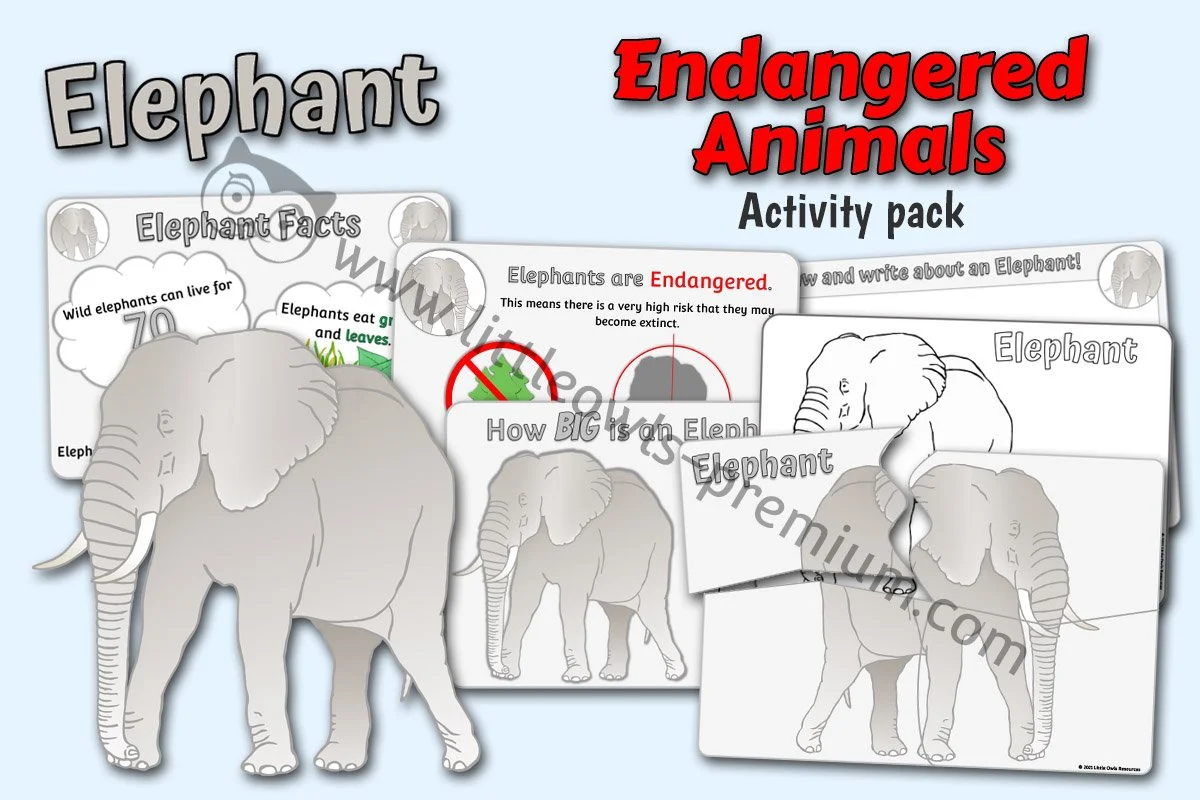
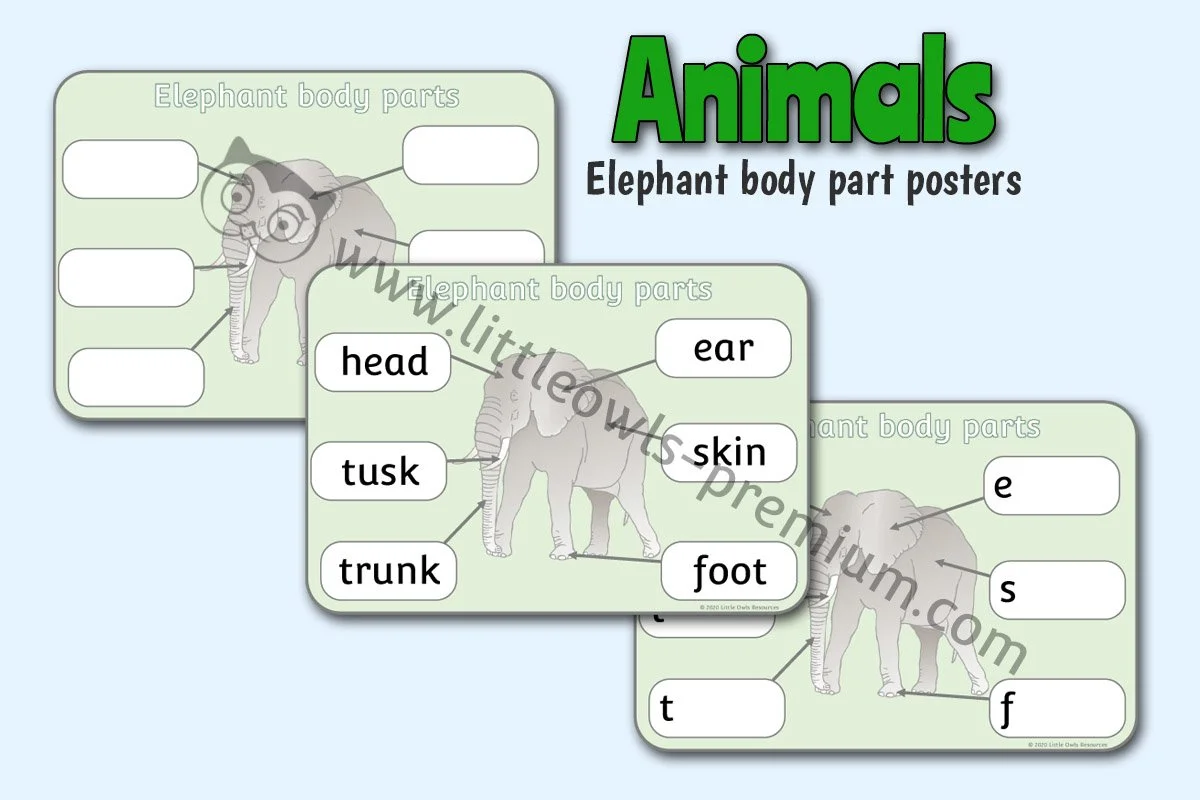
The pages of this pack give some general information about elephants and some fun and engaging activities to foster and develop children’s interest in them.
Pack includes:
• Fact posters x3 (Could be used as stimuli for a lesson input)
• Number slice activity (1-10) (Can be pre-cut for a pure number ordering activity or left to be cut by child to add scissor practice)
• Number slice activity - colouring version (1-10) (As above but to be coloured before cutting)
• Description sheet (Can be used as an independent writing activity or with an adult scribing the ideas of a younger child)
• A4 poster
• A4 poster - colouring version
• ‘Body Parts’ x3 (fully labelled, initial sounds only, blank)
• Draw and write sheets x3 (blank sheet, wide lines and narrow lines)
• 1x 4-piece puzzle
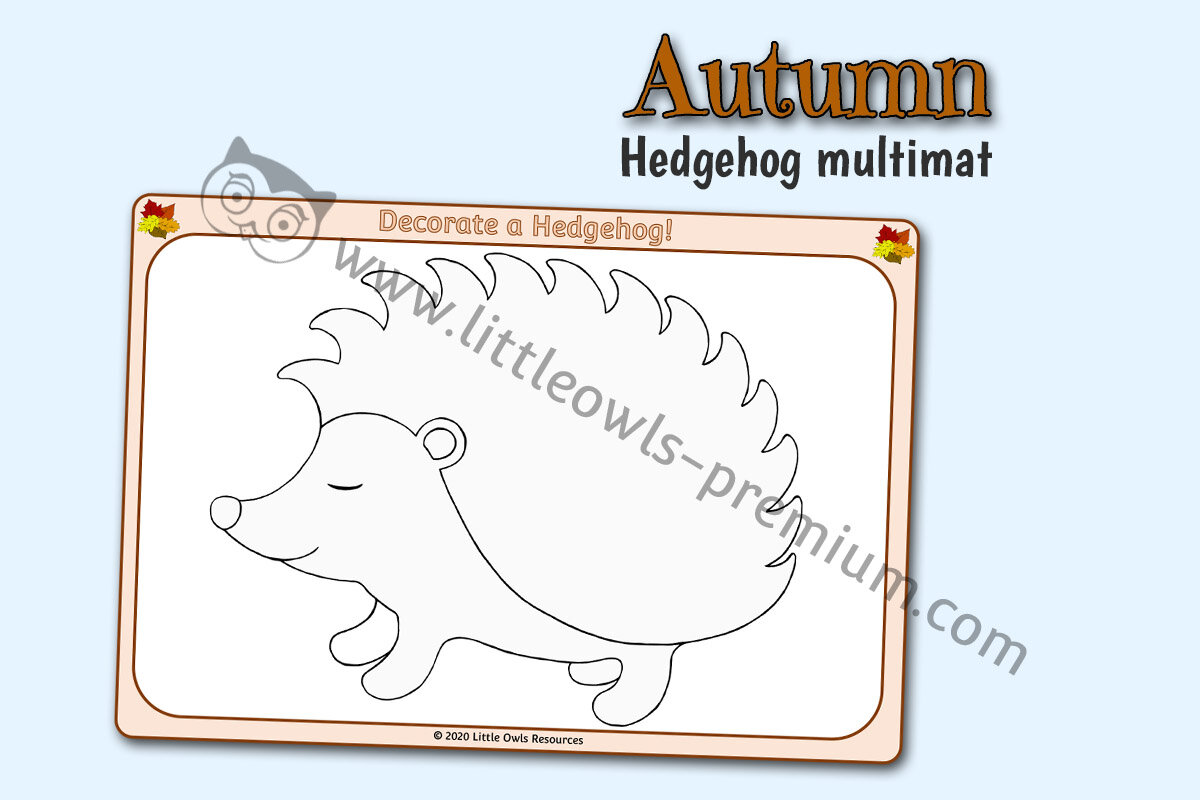
• Multimats x4 (for Colouring/Art & Craft/Loose Parts/Playdough)
Fine Motor, Mark Making/Drawing/Writing, Pencil Control, Drawing, Take Home, Zoo, Puzzles, Games, Activity, Animal body parts, Discussion Prompts, Print Carries Meaning, Problem Solving, Observational Skills, Posters/Displays, Using Shapes for Task, Number Recognition and Ordering, Endangered Animal Packs, Elephant, Grassland, Art and Craft, Mammals
Original artwork drawn by Sara Murphy and final digital resources created by Stuart Murphy. COPYRIGHT ON ALL OF THE RESOURCES HOUSED ON THIS WEBSITE IS HELD BY ‘LITTLE OWLS RESOURCES’. OUR RESOURCES (INCLUDING THE IMAGES WITHIN THEM), CANNOT BE SHARED OR SOLD COMMERCIALLY.
DOWNLOAD EDITABLE (DOCX)
DOWNLOAD NON-EDITABLE (PDF)
DOWNLOAD NON-EDITABLE (Zipped JPEGs)
The pages of this pack give some general information about gorillas and some fun and engaging activities to foster and develop children’s interest in them.
Pack includes:
• Fact posters x3 (Could be used as stimuli for a lesson input)
• Number slice activity (1-10) (Can be pre-cut for a pure number ordering activity or left to be cut by child to add scissor practice)
• Number slice activity - colouring version (1-10) (As above but to be coloured before cutting)
• Description sheet (Can be used as an independent writing activity or with an adult scribing the ideas of a younger child)
• A4 poster
• A4 poster - colouring version
• ‘Body Parts’ x3 (fully labelled, initial sounds only, blank)
• Draw and write sheets x3 (blank sheet, wide lines and narrow lines)
• 1x 4-piece puzzle
• Multimats x3 (for Colouring/Art & Craft/Loose Parts/Playdough)
Fine Motor, Mark Making/Drawing/Writing, Pencil Control, Drawing, Take Home, Zoo, Puzzles, Games, Activity, Animal body parts, Discussion Prompts, Print Carries Meaning, Problem Solving, Observational Skills, Posters/Displays, Using Shapes for Task, Number Recognition and Ordering, Gorilla, Endangered Animal Packs, Art and Craft, Mammals
Original artwork drawn by Sara Murphy and final digital resources created by Stuart Murphy. COPYRIGHT ON ALL OF THE RESOURCES HOUSED ON THIS WEBSITE IS HELD BY ‘LITTLE OWLS RESOURCES’. OUR RESOURCES (INCLUDING THE IMAGES WITHIN THEM), CANNOT BE SHARED OR SOLD COMMERCIALLY.
DOWNLOAD EDITABLE (DOCX)
DOWNLOAD NON-EDITABLE (PDF)
DOWNLOAD NON-EDITABLE (Zipped JPEGs)
The pages of this pack give some general information about lions and some fun and engaging activities to foster and develop children’s interest in them.
Pack includes:
• Fact posters x3 (Could be used as stimuli for a lesson input)
• Number slice activity (1-10) (Can be pre-cut for a pure number ordering activity or left to be cut by child to add scissor practice)
• Number slice activity - colouring version (1-10) (As above but to be coloured before cutting)
• Description sheet (Can be used as an independent writing activity or with an adult scribing the ideas of a younger child)
• A4 poster
• A4 poster - colouring version
• ‘Body Parts’ x3 (fully labelled, initial sounds only, blank)
• Draw and write sheets x3 (blank sheet, wide lines and narrow lines)
• 1x 4-piece puzzle
• Multimats x4 (for Colouring/Art & Craft/Loose Parts/Playdough)
Fine Motor, Mark Making/Drawing/Writing, Pencil Control, Drawing, Take Home, Zoo, Puzzles, Games, Activity, Animal body parts, Discussion Prompts, Print Carries Meaning, Problem Solving, Observational Skills, Posters/Displays, Using Shapes for Task, Number Recognition and Ordering, Endangered Animal Packs, Lion, Grassland, Art and Craft, Mammals
Original artwork drawn by Sara Murphy and final digital resources created by Stuart Murphy. COPYRIGHT ON ALL OF THE RESOURCES HOUSED ON THIS WEBSITE IS HELD BY ‘LITTLE OWLS RESOURCES’. OUR RESOURCES (INCLUDING THE IMAGES WITHIN THEM), CANNOT BE SHARED OR SOLD COMMERCIALLY.
DOWNLOAD EDITABLE (DOCX)
DOWNLOAD NON-EDITABLE (PDF)
DOWNLOAD NON-EDITABLE (Zipped JPEGs)
The pages of this pack give some general information about orangutans and some fun and engaging activities to foster and develop children’s interest in them.
Pack includes:
• Fact posters x3 (Could be used as stimuli for a lesson input)
• Number slice activity (1-10) (Can be pre-cut for a pure number ordering activity or left to be cut by child to add scissor practice)
• Number slice activity - colouring version (1-10) (As above but to be coloured before cutting)
• Description sheet (Can be used as an independent writing activity or with an adult scribing the ideas of a younger child)
• A4 poster
• A4 poster - colouring version
• ‘Body Parts’ x3 (fully labelled, initial sounds only, blank)
• Draw and write sheets x3 (blank sheet, wide lines and narrow lines)
• 1x 4-piece puzzle
• Multimats x2 (for Colouring/Art & Craft/Loose Parts/Playdough)
Fine Motor, Mark Making/Drawing/Writing, Pencil Control, Drawing, Take Home, Zoo, Puzzles, Games, Activity, Animal body parts, Discussion Prompts, Print Carries Meaning, Problem Solving, Observational Skills, Posters/Displays, Using Shapes for Task, Number Recognition and Ordering, Endangered Animal Packs, Art and Craft, Orangutan, Mammals
Original artwork drawn by Sara Murphy and final digital resources created by Stuart Murphy. COPYRIGHT ON ALL OF THE RESOURCES HOUSED ON THIS WEBSITE IS HELD BY ‘LITTLE OWLS RESOURCES’. OUR RESOURCES (INCLUDING THE IMAGES WITHIN THEM), CANNOT BE SHARED OR SOLD COMMERCIALLY.
DOWNLOAD EDITABLE (DOCX)
DOWNLOAD NON-EDITABLE (PDF)
DOWNLOAD NON-EDITABLE (Zipped JPEGs)
The pages of this pack give some general information about sea lions and some fun and engaging activities to foster and develop children’s interest in them.
Pack includes:
• Fact posters x3 (Could be used as stimuli for a lesson input)
• Number slice activity (1-10) (Can be pre-cut for a pure number ordering activity or left to be cut by child to add scissor practice)
• Number slice activity - colouring version (1-10) (As above but to be coloured before cutting)
• Description sheet (Can be used as an independent writing activity or with an adult scribing the ideas of a younger child)
• A4 poster
• A4 poster - colouring version
• ‘Body Parts’ x3 (fully labelled, initial sounds only, blank)
• Draw and write sheets x3 (blank sheet, wide lines and narrow lines)
• 1x 4-piece puzzle
• Multimats x2 (for Colouring/Art & Craft/Loose Parts/Playdough)
Fine Motor, Mark Making/Drawing/Writing, Pencil Control, Drawing, Take Home, Zoo, Puzzles, Games, Activity, Animal body parts, Discussion Prompts, Print Carries Meaning, Problem Solving, Observational Skills, Posters/Displays, Using Shapes for Task, Number Recognition and Ordering, Sea Lion, Ocean, Endangered Animal Packs, Art and Craft, Mammals
Original artwork drawn by Sara Murphy and final digital resources created by Stuart Murphy. COPYRIGHT ON ALL OF THE RESOURCES HOUSED ON THIS WEBSITE IS HELD BY ‘LITTLE OWLS RESOURCES’. OUR RESOURCES (INCLUDING THE IMAGES WITHIN THEM), CANNOT BE SHARED OR SOLD COMMERCIALLY.
DOWNLOAD EDITABLE (DOCX)
DOWNLOAD NON-EDITABLE (PDF)
DOWNLOAD NON-EDITABLE (Zipped JPEGs)
The pages of this pack give some general information about sea turtles and some fun and engaging activities to foster and develop children’s interest in them.
Pack includes:
• Fact posters x3 (Could be used as stimuli for a lesson input)
• Number slice activity (1-10) (Can be pre-cut for a pure number ordering activity or left to be cut by child to add scissor practice)
• Number slice activity - colouring version (1-10) (As above but to be coloured before cutting)
• Description sheet (Can be used as an independent writing activity or with an adult scribing the ideas of a younger child)
• A4 poster
• A4 poster - colouring version
• ‘Body Parts’ x3 (fully labelled, initial sounds only, blank)
• Draw and write sheets x3 (blank sheet, wide lines and narrow lines)
• 1x 4-piece puzzle
• Multimats x2 (for Colouring/Art & Craft/Loose Parts/Playdough)
Fine Motor, Mark Making/Drawing/Writing, Pencil Control, Drawing, Take Home, Zoo, Puzzles, Games, Activity, Animal body parts, Discussion Prompts, Print Carries Meaning, Problem Solving, Observational Skills, Posters/Displays, Using Shapes for Task, Number Recognition and Ordering, Sea Turtle, Ocean, Endangered Animal Packs, Art and Craft, Turtle, Reptiles
Original artwork drawn by Sara Murphy and final digital resources created by Stuart Murphy. COPYRIGHT ON ALL OF THE RESOURCES HOUSED ON THIS WEBSITE IS HELD BY ‘LITTLE OWLS RESOURCES’. OUR RESOURCES (INCLUDING THE IMAGES WITHIN THEM), CANNOT BE SHARED OR SOLD COMMERCIALLY.
DOWNLOAD EDITABLE (DOCX)
DOWNLOAD NON-EDITABLE (PDF)
DOWNLOAD NON-EDITABLE (Zipped JPEGs)
The pages of this pack give some general information about tigers and some fun and engaging activities to foster and develop children’s interest in them.
Pack includes:
• Fact posters x3 (Could be used as stimuli for a lesson input)
• Number slice activity (1-10) (Can be pre-cut for a pure number ordering activity or left to be cut by child to add scissor practice)
• Number slice activity - colouring version (1-10) (As above but to be coloured before cutting)
• Description sheet (Can be used as an independent writing activity or with an adult scribing the ideas of a younger child)
• A4 poster
• A4 poster - colouring version
• ‘Body Parts’ x3 (fully labelled, initial sounds only, blank)
• Draw and write sheets x3 (blank sheet, wide lines and narrow lines)
• 1x 4-piece puzzle
• Multimats x4 (for Colouring/Art & Craft/Loose Parts/Playdough)
Fine Motor, Mark Making/Drawing/Writing, Pencil Control, Drawing, Take Home, Zoo, Tiger, Puzzles, Games, Activity, Animal body parts, Discussion Prompts, Print Carries Meaning, Problem Solving, Observational Skills, Posters/Displays, Using Shapes for Task, Number Recognition and Ordering, Endangered Animal Packs, Art and Craft, Mammals
Original artwork drawn by Sara Murphy and final digital resources created by Stuart Murphy. COPYRIGHT ON ALL OF THE RESOURCES HOUSED ON THIS WEBSITE IS HELD BY ‘LITTLE OWLS RESOURCES’. OUR RESOURCES (INCLUDING THE IMAGES WITHIN THEM), CANNOT BE SHARED OR SOLD COMMERCIALLY.
DOWNLOAD EDITABLE (DOCX)
DOWNLOAD NON-EDITABLE (PDF)
DOWNLOAD NON-EDITABLE (Zipped JPEGs)
<<-BACK TO ‘ENDANGERED ANIMALS’ MENU
The pages of this pack give some general information about vaquitas and some fun and engaging activities to foster and develop children’s interest in them.
Pack includes:
• Fact posters x3 (Could be used as stimuli for a lesson input)
• Number slice activity (1-10) (Can be pre-cut for a pure number ordering activity or left to be cut by child to add scissor practice)
• Number slice activity - colouring version (1-10) (As above but to be coloured before cutting)
• Description sheet (Can be used as an independent writing activity or with an adult scribing the ideas of a younger child)
• A4 poster
• A4 poster - colouring version
• ‘Body Parts’ x3 (fully labelled, initial sounds only, blank)
• Draw and write sheets x3 (blank sheet, wide lines and narrow lines)
• 1x 4-piece puzzle
• Multimats x3 (for Colouring/Art & Craft/Loose Parts/Playdough)
Fine Motor, Mark Making/Drawing/Writing, Pencil Control, Drawing, Take Home, Puzzles, Games, Activity, Animal body parts, Discussion Prompts, Print Carries Meaning, Problem Solving, Observational Skills, Posters/Displays, Using Shapes for Task, Number Recognition and Ordering, Ocean, Vaquita, Endangered Animal Packs, Art and Craft, Mammals
Original artwork drawn by Sara Murphy and final digital resources created by Stuart Murphy. COPYRIGHT ON ALL OF THE RESOURCES HOUSED ON THIS WEBSITE IS HELD BY ‘LITTLE OWLS RESOURCES’. OUR RESOURCES (INCLUDING THE IMAGES WITHIN THEM), CANNOT BE SHARED OR SOLD COMMERCIALLY.
DOWNLOAD EDITABLE (DOCX)
DOWNLOAD NON-EDITABLE (PDF)
DOWNLOAD NON-EDITABLE (Zipped JPEGs)
The pages of this pack give some general information about whale sharks and some fun and engaging activities to foster and develop children’s interest in them.
Pack includes:
• Fact posters x3 (Could be used as stimuli for a lesson input)
• Number slice activity (1-10) (Can be pre-cut for a pure number ordering activity or left to be cut by child to add scissor practice)
• Number slice activity - colouring version (1-10) (As above but to be coloured before cutting)
• Description sheet (Can be used as an independent writing activity or with an adult scribing the ideas of a younger child)
• A4 poster
• A4 poster - colouring version
• ‘Body Parts’ x3 (fully labelled, initial sounds only, blank)
• Draw and write sheets x3 (blank sheet, wide lines and narrow lines)
• 1x 4-piece puzzle
• Multimats x2 (for Colouring/Art & Craft/Loose Parts/Playdough)
Fine Motor, Mark Making/Drawing/Writing, Pencil Control, Drawing, Take Home, Puzzles, Games, Activity, Animal body parts, Discussion Prompts, Print Carries Meaning, Problem Solving, Observational Skills, Posters/Displays, Using Shapes for Task, Number Recognition and Ordering, Ocean, Whale Shark, Endangered Animal Packs, Art and Craft, Sharks, Fish
Original artwork drawn by Sara Murphy and final digital resources created by Stuart Murphy. COPYRIGHT ON ALL OF THE RESOURCES HOUSED ON THIS WEBSITE IS HELD BY ‘LITTLE OWLS RESOURCES’. OUR RESOURCES (INCLUDING THE IMAGES WITHIN THEM), CANNOT BE SHARED OR SOLD COMMERCIALLY.
DOWNLOAD EDITABLE (DOCX)
DOWNLOAD NON-EDITABLE (PDF)
DOWNLOAD NON-EDITABLE (Zipped JPEGs)
Pack of 2 lion colouring sheets. Great for mindfulness practise!
Fine Motor, Mark Making/Drawing/Writing, Pencil Control, Take Home, Zoo, Endangered Animals, Activity, Print Carries Meaning, Observational Skills, Colouring, Grassland, Lion, Art and Craft, Mammals
Original artwork drawn by Sara Murphy and final digital resources created by Stuart Murphy. COPYRIGHT ON ALL OF THE RESOURCES HOUSED ON THIS WEBSITE IS HELD BY ‘LITTLE OWLS RESOURCES’. OUR RESOURCES (INCLUDING THE IMAGES WITHIN THEM), CANNOT BE SHARED OR SOLD COMMERCIALLY.
DOWNLOAD EDITABLE (DOCX)
DOWNLOAD NON-EDITABLE (PDF)
DOWNLOAD NON-EDITABLE (Zipped JPEGs)
Pack of 2 elephant colouring sheets. Great for mindfulness practise!
Fine Motor, Mark Making/Drawing/Writing, Pencil Control, Take Home, Zoo, Endangered Animals, Activity, Print Carries Meaning, Observational Skills, Colouring, Elephant, Grassland, Art and Craft, Mammals
Original artwork drawn by Sara Murphy and final digital resources created by Stuart Murphy. COPYRIGHT ON ALL OF THE RESOURCES HOUSED ON THIS WEBSITE IS HELD BY ‘LITTLE OWLS RESOURCES’. OUR RESOURCES (INCLUDING THE IMAGES WITHIN THEM), CANNOT BE SHARED OR SOLD COMMERCIALLY.
DOWNLOAD EDITABLE (DOCX)
DOWNLOAD NON-EDITABLE (PDF)
DOWNLOAD NON-EDITABLE (Zipped JPEGs)
Pack of 2 tiger colouring sheets. Great for mindfulness practise!
Fine Motor, Mark Making/Drawing/Writing, Pencil Control, Take Home, Zoo, Endangered Animals, Tiger, Activity, Print Carries Meaning, Observational Skills, Colouring, Art and Craft, Mammals
Original artwork drawn by Sara Murphy and final digital resources created by Stuart Murphy. COPYRIGHT ON ALL OF THE RESOURCES HOUSED ON THIS WEBSITE IS HELD BY ‘LITTLE OWLS RESOURCES’. OUR RESOURCES (INCLUDING THE IMAGES WITHIN THEM), CANNOT BE SHARED OR SOLD COMMERCIALLY.
DOWNLOAD EDITABLE (DOCX)
DOWNLOAD NON-EDITABLE (PDF)
DOWNLOAD NON-EDITABLE (Zipped JPEGs)
<<-BACK TO ‘ENDANGERED ANIMALS’ MENU
Versatile sheets for children to create tiger stripes.
Individual use with pencils/crayons or art and craft cut and stick/collage materials.
Laminate for repeated use with whiteboard pens, playdough (roll playdough into cylindrical strips to make stripes) or loose parts.
Fine Motor, Mark Making/Drawing/Writing, Pencil Control, Take Home, Zoo, Endangered Animals, Tiger, Activity, Observational Skills, Playdough/Loose Part Mats, Laminate to use with w/b pens, Art and Craft, Mammals
Original artwork drawn by Sara Murphy and final digital resources created by Stuart Murphy. COPYRIGHT ON ALL OF THE RESOURCES HOUSED ON THIS WEBSITE IS HELD BY ‘LITTLE OWLS RESOURCES’. OUR RESOURCES (INCLUDING THE IMAGES WITHIN THEM), CANNOT BE SHARED OR SOLD COMMERCIALLY.
DOWNLOAD EDITABLE (DOCX)
DOWNLOAD NON-EDITABLE (PDF)
DOWNLOAD NON-EDITABLE (Zipped JPEGs)
<<-BACK TO ‘ENDANGERED ANIMALS’ MENU
Pack of 2 bat colouring sheets. Great for mindfulness practise!
Fine Motor, Mark Making/Drawing/Writing, Pencil Control, Take Home, Endangered Animals, Activity, Print Carries Meaning, Observational Skills, Colouring, Art and Craft, Bat, Mammals
Original artwork drawn by Sara Murphy and final digital resources created by Stuart Murphy. COPYRIGHT ON ALL OF THE RESOURCES HOUSED ON THIS WEBSITE IS HELD BY ‘LITTLE OWLS RESOURCES’. OUR RESOURCES (INCLUDING THE IMAGES WITHIN THEM), CANNOT BE SHARED OR SOLD COMMERCIALLY.
DOWNLOAD EDITABLE (DOCX)
DOWNLOAD NON-EDITABLE (PDF)
DOWNLOAD NON-EDITABLE (Zipped JPEGs)
The pages of this pack give some general information about rabbits and some fun and engaging activities to foster and develop children’s interest in them.
Pack includes:
• Fact posters x2 (Could be used as stimuli for a lesson input)
• Pompom mat (Can be used for matching colours. Moving soft pompoms also promotes fine motor skills)
• Number slice activity (1-10) (Can be pre-cut for a pure number ordering activity or left to be cut by child to add scissor practice)
• Number slice activity - colouring version (1-10) (As above but to be coloured before cutting)
• Descriptive words poster (Could be used as stimuli for a lesson input)
• Descriptive words writing sheet (Can be used as an independent writing activity or with an adult scribing the ideas of a younger child)
• A4 poster
• A4 poster - colouring version
• ‘Body Parts’ x3 (fully labelled, initial sounds only, blank)
• Follow lines sheets – large (x4) (ideally pre-laminated to be used with a whiteboard pen)
• Follow lines sheets – large (x2) (ideally pre-laminated to be used with a whiteboard pen)
• Draw and write sheets x4 (blank sheet, wide lines, narrow lines, only lines)
• 1 x 4-piece puzzle
• 2 x 2-piece puzzle
• Rabbits Multimat (for Colouring/Art & Craft/Loose Parts/Playdough)
Fine Motor, Mark Making/Drawing/Writing, Pencil Control, Drawing, Take Home, Puzzles, Games, Activity, Animal body parts, Discussion Prompts, Print Carries Meaning, Problem Solving, Observational Skills, Posters/Displays, Using Shapes for Task, Number Recognition and Ordering, Art and Craft, Rabbit, Animal Activity Packs, Mammals, Woodland, Herbivores
Original artwork drawn by Sara Murphy and final digital resources created by Stuart Murphy. COPYRIGHT ON ALL OF THE RESOURCES HOUSED ON THIS WEBSITE IS HELD BY ‘LITTLE OWLS RESOURCES’. OUR RESOURCES (INCLUDING THE IMAGES WITHIN THEM), CANNOT BE SHARED OR SOLD COMMERCIALLY.
DOWNLOAD EDITABLE (DOCX)
DOWNLOAD NON-EDITABLE (PDF)
DOWNLOAD NON-EDITABLE (Zipped JPEGs)
Mega pack of Animal colouring pictures…49 sheets of individual animals to colour including their names.
Great for fine motor, observational skills, colour choice and becoming aware that text has meaning.
Colouring, Fine Motor, Mark Making/Drawing/Writing, Pencil Control, Take Home, Activity, Discussion Prompts, Print Carries Meaning, Cow, Donkey, Deer, Goat, Goose, Chicken, Duck, Dog, Pig, Sheep, Horse, Anteater, Yak, Vulture, Umbrella Bird, Quail, Octopus, Narwhal, Kangaroo, Jellyfish, Iguana, Penguin, Banded Penguin, Sea Lion, Zebra, Wolf, Rhinos, Lion, Meerkat, Komodo Dragon, Giraffe, Flamingo, Elephant, Chimpanzee, Frog, Fox, Robin, Tiger, Rabbit, Cat, Ox, Cockerel, Hen, Swallow, Squirrel, Dormouse, Hedgehog, Bat, Mouse, Badger, Slow Worm, Mammals, Birds, Amphibians, Reptiles, Invertebrate
Original artwork drawn by Sara Murphy and final digital resources created by Stuart Murphy. COPYRIGHT ON ALL OF THE RESOURCES HOUSED ON THIS WEBSITE IS HELD BY ‘LITTLE OWLS RESOURCES’. OUR RESOURCES (INCLUDING THE IMAGES WITHIN THEM), CANNOT BE SHARED OR SOLD COMMERCIALLY.
DOWNLOAD EDITABLE (DOCX)
DOWNLOAD NON-EDITABLE (PDF)
Pack includes 3 pages: poster for display and modelling, version with blank labels for writing, plus a writing template with initial sounds for labels.
Posters/Displays, Mark Making/Drawing/Writing, Fine Motor, Pencil Control, Observational Skills, Problem Solving, Activity, Take Home, Laminate to use with w/b pens, Animal body parts, Reptiles, Zoo, Iguana
Original artwork drawn by Sara Murphy and final digital resources created by Stuart Murphy. COPYRIGHT ON ALL OF THE RESOURCES HOUSED ON THIS WEBSITE IS HELD BY ‘LITTLE OWLS RESOURCES’. OUR RESOURCES (INCLUDING THE IMAGES WITHIN THEM), CANNOT BE SHARED OR SOLD COMMERCIALLY.
DOWNLOAD EDITABLE (DOCX)
DOWNLOAD NON-EDITABLE (PDF)
<<-BACK TO ANIMALS OF THE WORLD MENU
Use these fine motor koi fish sheets once for pencil control practise or laminate and encourage children to take it in turns with whiteboard pens to practise making the different shapes.
Fine Motor, Mark Making/Drawing/Writing, Pencil Control, Laminate to use with w/b pens, Activity, Shapes, Zoo, Wetland, Fish, Koi Carp
Original artwork drawn by Sara Murphy and final digital resources created by Stuart Murphy. COPYRIGHT ON ALL OF THE RESOURCES HOUSED ON THIS WEBSITE IS HELD BY ‘LITTLE OWLS RESOURCES’. OUR RESOURCES (INCLUDING THE IMAGES WITHIN THEM), CANNOT BE SHARED OR SOLD COMMERCIALLY.
DOWNLOAD EDITABLE (DOCX)
DOWNLOAD NON-EDITABLE (PDF)
Ideal to be used in conjunction with the ‘Animal Height Chart’ resource pack. Children will love to compare themselves to the heights of animals. Blank pages with a heading are intended for children to draw themselves next to animals for comparison.
Measures - Height, Colouring, Mark Making/Drawing/Writing, Drawing, Pencil Control, Fine Motor, Take Home, Activity, Zoo, Wolf, Pig, Flamingo, Tiger, Vulture, Lion, Cow, Mammals, Birds
Original artwork drawn by Sara Murphy and final digital resources created by Stuart Murphy. COPYRIGHT ON ALL OF THE RESOURCES HOUSED ON THIS WEBSITE IS HELD BY ‘LITTLE OWLS RESOURCES’. OUR RESOURCES (INCLUDING THE IMAGES WITHIN THEM), CANNOT BE SHARED OR SOLD COMMERCIALLY.
DOWNLOAD EDITABLE (DOCX)
DOWNLOAD NON-EDITABLE (PDF)
Pack includes 3 pages: poster for display and modelling, version with blank labels for writing, plus a writing template with initial sounds for labels.
Posters/Displays, Mark Making/Drawing/Writing, Fine Motor, Pencil Control, Observational Skills, Problem Solving, Activity, Take Home, Laminate to use with w/b pens, Animal body parts, Ocean, Dolphin, Mammals
Original artwork drawn by Sara Murphy and final digital resources created by Stuart Murphy. COPYRIGHT ON ALL OF THE RESOURCES HOUSED ON THIS WEBSITE IS HELD BY ‘LITTLE OWLS RESOURCES’. OUR RESOURCES (INCLUDING THE IMAGES WITHIN THEM), CANNOT BE SHARED OR SOLD COMMERCIALLY.
DOWNLOAD EDITABLE (DOCX)
DOWNLOAD NON-EDITABLE (PDF)
<<-BACK TO ANIMALS OF THE WORLD MENU
Pack includes 3 pages: poster for display and modelling, version with blank labels for writing, plus a writing template with initial sounds for labels.
Posters/Displays, Mark Making/Drawing/Writing, Fine Motor, Pencil Control, Observational Skills, Problem Solving, Activity, Take Home, Laminate to use with w/b pens, Animal body parts, Zoo, Grassland, Endangered Animals, Elephant, Mammals
Original artwork drawn by Sara Murphy and final digital resources created by Stuart Murphy. COPYRIGHT ON ALL OF THE RESOURCES HOUSED ON THIS WEBSITE IS HELD BY ‘LITTLE OWLS RESOURCES’. OUR RESOURCES (INCLUDING THE IMAGES WITHIN THEM), CANNOT BE SHARED OR SOLD COMMERCIALLY.
DOWNLOAD EDITABLE (DOCX)
DOWNLOAD NON-EDITABLE (PDF)
<<-BACK TO ANIMALS OF THE WORLD MENU
Pack includes 3 pages: poster for display and modelling, version with blank labels for writing, plus a writing template with initial sounds for labels.
Posters/Displays, Mark Making/Drawing/Writing, Fine Motor, Pencil Control, Observational Skills, Problem Solving, Activity, Take Home, Laminate to use with w/b pens, Animal body parts, Zoo, Grassland, Endangered Animals, Lion, Mammals
Original artwork drawn by Sara Murphy and final digital resources created by Stuart Murphy. COPYRIGHT ON ALL OF THE RESOURCES HOUSED ON THIS WEBSITE IS HELD BY ‘LITTLE OWLS RESOURCES’. OUR RESOURCES (INCLUDING THE IMAGES WITHIN THEM), CANNOT BE SHARED OR SOLD COMMERCIALLY.
DOWNLOAD EDITABLE (DOCX)
DOWNLOAD NON-EDITABLE (PDF)
<<-BACK TO ANIMALS OF THE WORLD MENU
Pack includes 3 pages: poster for display and modelling, version with blank labels for writing, plus a writing template with initial sounds for labels.
Posters/Displays, Mark Making/Drawing/Writing, Fine Motor, Pencil Control, Observational Skills, Problem Solving, Activity, Take Home, Laminate to use with w/b pens, Animal body parts, Zoo, Ocean, Octopus, Invertebrate
Original artwork drawn by Sara Murphy and final digital resources created by Stuart Murphy. COPYRIGHT ON ALL OF THE RESOURCES HOUSED ON THIS WEBSITE IS HELD BY ‘LITTLE OWLS RESOURCES’. OUR RESOURCES (INCLUDING THE IMAGES WITHIN THEM), CANNOT BE SHARED OR SOLD COMMERCIALLY.
DOWNLOAD EDITABLE (DOCX)
DOWNLOAD NON-EDITABLE (PDF)
<<-BACK TO ANIMALS OF THE WORLD MENU
Pack includes 3 pages: poster for display and modelling, version with blank labels for writing, plus a writing template with initial sounds for labels.
Posters/Displays, Mark Making/Drawing/Writing, Fine Motor, Pencil Control, Observational Skills, Problem Solving, Activity, Take Home, Laminate to use with w/b pens, Animal body parts, Zoo, Ocean, Banded Penguin, Penguin, Birds
Original artwork drawn by Sara Murphy and final digital resources created by Stuart Murphy. COPYRIGHT ON ALL OF THE RESOURCES HOUSED ON THIS WEBSITE IS HELD BY ‘LITTLE OWLS RESOURCES’. OUR RESOURCES (INCLUDING THE IMAGES WITHIN THEM), CANNOT BE SHARED OR SOLD COMMERCIALLY.
DOWNLOAD EDITABLE (DOCX)
DOWNLOAD NON-EDITABLE (PDF)
<<-BACK TO ANIMALS OF THE WORLD MENU
Pack includes 3 pages: poster for display and modelling, version with blank labels for writing, plus a writing template with initial sounds for labels.
Posters/Displays, Mark Making/Drawing/Writing, Fine Motor, Pencil Control, Observational Skills, Problem Solving, Activity, Take Home, Laminate to use with w/b pens, Animal body parts, Reptiles, Zoo, Ocean, Endangered Animals, Turtle
Original artwork drawn by Sara Murphy and final digital resources created by Stuart Murphy. COPYRIGHT ON ALL OF THE RESOURCES HOUSED ON THIS WEBSITE IS HELD BY ‘LITTLE OWLS RESOURCES’. OUR RESOURCES (INCLUDING THE IMAGES WITHIN THEM), CANNOT BE SHARED OR SOLD COMMERCIALLY.
DOWNLOAD EDITABLE (DOCX)
DOWNLOAD NON-EDITABLE (PDF)
<<-BACK TO ANIMALS OF THE WORLD MENU
Autumn animal masks pack. Ideal for autumn themed role play and art and craft!
Pack includes 8 masks: badger, hedgehog, fox, deer, barn owl, red squirrel, grey squirrel and deer with antlers.
Keywords: owl, owls, badger, badgers, hedgehog, hedgehogs, fox, foxes, deer, deer, barn owls, red squirrels, grey squirrels, deer with antlers, owl babies, owl baby
Original artwork drawn by Sara Murphy and final digital resources created by Stuart Murphy. COPYRIGHT ON ALL OF THE RESOURCES HOUSED ON THIS WEBSITE IS HELD BY ‘LITTLE OWLS RESOURCES’. OUR RESOURCES (INCLUDING THE IMAGES WITHIN THEM), CANNOT BE SHARED OR SOLD COMMERCIALLY.
DOWNLOAD(DOCX) 📝
DOWNLOAD (PDF) 📄
DOWNLOAD (Zipped JPEGs) 📂
Keep these sheets beside a small-world woodland, an investigation tray or a clipboard. Children can record an observation to show a friend, save a question for later or label a collection so visitors know what it contains. Woodland Investigation is an extra open investigation record alongside the five more specific purposes.
Choose a layout together
A offers space for drawing and marks. B combines drawing with emergent writing. C offers more room for independent writing. These are choices of paper, not ability groups or a sequence to complete. Children can choose any version, switch between them, dictate to an adult or combine pictures, symbols, letters and words. The small footer code is only for finding a version.
DOWNLOAD (DOCX) 📝
DOWNLOAD (PDF) 📄
DOWNLOAD (Zipped JPEGs) 📂
Place a list beside a construction plan, a collection basket or a woodland small world. Use Things We Need to gather materials, Things to Find for a shared search, Autumn Collection List as a record of a chosen collection and Things I Noticed to remember observations.
Choose a layout together
A offers space for drawing and marks. B combines drawing with emergent writing. C offers more room for independent writing. These are choices of paper, not ability groups or a sequence to complete. Children can choose any version, switch between them, dictate to an adult or combine pictures, symbols, letters and words. The small footer code is only for finding a version.
DOWNLOAD (DOCX) 📝
DOWNLOAD (PDF) 📄
DOWNLOAD (Zipped JPEGs) 📂
Offer a sign when there is a reason in the play: a model habitat needs protecting, visitors need directions or an entrance needs a welcome. Children decide the place, symbol and message. Display the finished sign where its reader will need it.
Choose a layout together
A offers space for drawing and marks. B combines drawing with emergent writing. C offers more room for independent writing. These are choices of paper, not ability groups or a sequence to complete. Children can choose any version, switch between them, dictate to an adult or combine pictures, symbols, letters and words. The small footer code is only for finding a version.
DOWNLOAD (DOCX) 📝
DOWNLOAD (PDF) 📄
DOWNLOAD (Zipped JPEGs) 📂
Use a map to help someone find a place in a small world, reach an imagined animal home or follow a route around an agreed play space. Keep the map area blank so children can invent the places, landmarks and connections that matter to them.
Choose a layout together
A offers space for drawing and marks. B combines drawing with emergent writing. C offers more room for independent writing. These are choices of paper, not ability groups or a sequence to complete. Children can choose any version, switch between them, dictate to an adult or combine pictures, symbols, letters and words. The small footer code is only for finding a version.
DOWNLOAD (DOCX) 📝
DOWNLOAD (PDF) 📄
DOWNLOAD (Zipped JPEGs) 📂
Offer paper where messages can be delivered: a pretend ranger station, a woodland postbox or a small-world home. Children can ask for help, share news, invite a friend or leave a note in a story. Missing and Found are notices about a play object or story character.
Choose a layout together
A offers space for drawing and marks. B combines drawing with emergent writing. C offers more room for independent writing. These are choices of paper, not ability groups or a sequence to complete. Children can choose any version, switch between them, dictate to an adult or combine pictures, symbols, letters and words. The small footer code is only for finding a version.
DOWNLOAD (DOCX) 📝
DOWNLOAD (PDF) 📄
DOWNLOAD (Zipped JPEGs) 📂
These writing prompts will help encourage mark-making and writing after the children have been on an autumn walk with all the interesting sights, sounds and smells that entails. The sheets cover an ability range from first mark-making up to full sentence writing.
DOWNLOAD (DOCX) 📝
DOWNLOAD (PDF) 📄
Original artwork drawn by Sara Murphy and final digital resources created by Stuart Murphy. COPYRIGHT ON ALL OF THE RESOURCES HOUSED ON THIS WEBSITE IS HELD BY ‘LITTLE OWLS RESOURCES’. OUR RESOURCES (INCLUDING THE IMAGES WITHIN THEM), CANNOT BE SHARED OR SOLD COMMERCIALLY.
DOWNLOAD EDITABLE (DOCX)
DOWNLOAD NON-EDITABLE (PDF)
DOWNLOAD NON-EDITABLE (Zipped JPEGs)
These prompts are intended to encourage discussion and thinking about our senses during the autumn.
Together with each mini-banner there are small note sheets for children to mark-make/write/draw their thoughts and experiences.
Original artwork drawn by Sara Murphy and final digital resources created by Stuart Murphy. COPYRIGHT ON ALL OF THE RESOURCES HOUSED ON THIS WEBSITE IS HELD BY ‘LITTLE OWLS RESOURCES’. OUR RESOURCES (INCLUDING THE IMAGES WITHIN THEM), CANNOT BE SHARED OR SOLD COMMERCIALLY.
DOWNLOAD EDITABLE (DOCX)
DOWNLOAD NON-EDITABLE (PDF)
DOWNLOAD NON-EDITABLE (Zipped JPEGs)
These leaves can be used by the children to draw and/or write on with the goal of creating a group display.
For example, a kindness display could be created by the children drawing/writing on their leaves about kind things others have done for them, or that they have done for others.
The cutting out of the leaves also helps as fine motor practice.
Original artwork drawn by Sara Murphy and final digital resources created by Stuart Murphy. COPYRIGHT ON ALL OF THE RESOURCES HOUSED ON THIS WEBSITE IS HELD BY ‘LITTLE OWLS RESOURCES’. OUR RESOURCES (INCLUDING THE IMAGES WITHIN THEM), CANNOT BE SHARED OR SOLD COMMERCIALLY.
DOWNLOAD EDITABLE (DOCX)
DOWNLOAD NON-EDITABLE (PDF)
DOWNLOAD NON-EDITABLE (Zipped JPEGs)
Download this one stop 'Farm Shop' role play pack. Ideal role play area for the Autumn Harvest term. Pack includes banner, menu with prices, blank proforma menu for children to fill in, picture cards of various things to be sold in the role-play shop (to ideally cut out and laminate), food signs, open/closed signs, advert posters, shopping list templates, opening times poster (including days of the week) and product price signs (pre-written versions and those to be filled in by children).
Original artwork drawn by Sara Murphy and final digital resources created by Stuart Murphy. COPYRIGHT ON ALL OF THE RESOURCES HOUSED ON THIS WEBSITE IS HELD BY ‘LITTLE OWLS RESOURCES’. OUR RESOURCES (INCLUDING THE IMAGES WITHIN THEM), CANNOT BE SHARED OR SOLD COMMERCIALLY.
DOWNLOAD EDITABLE (DOCX)
DOWNLOAD NON-EDITABLE (PDF)
DOWNLOAD NON-EDITABLE (Zipped JPEGs)
How many acorns does your squirrel need to store away for Winter? Fun number recognition and counting activity combined with a little messy play! Why not also use whatever art and craft materials you have on hand to also create little acorn hats to place on the tops of the finger print acorns? (E.g. scrunched up pieces of tissue paper, crepe paper/card/coloured paper cut to the right shape, or simply draw little hats once the prints are dry.)
Original artwork drawn by Sara Murphy and final digital resources created by Stuart Murphy. COPYRIGHT ON ALL OF THE RESOURCES HOUSED ON THIS WEBSITE IS HELD BY ‘LITTLE OWLS RESOURCES’. OUR RESOURCES (INCLUDING THE IMAGES WITHIN THEM), CANNOT BE SHARED OR SOLD COMMERCIALLY.
DOWNLOAD EDITABLE (DOCX)
DOWNLOAD NON-EDITABLE (PDF)
These mark making prompt sheets will help encourage your children to draw and/or write about their senses…perhaps after the children have been on an autumn walk! The sheets can be used separately or joined together to form a senses booklet.
Original artwork drawn by Sara Murphy and final digital resources created by Stuart Murphy. COPYRIGHT ON ALL OF THE RESOURCES HOUSED ON THIS WEBSITE IS HELD BY ‘LITTLE OWLS RESOURCES’. OUR RESOURCES (INCLUDING THE IMAGES WITHIN THEM), CANNOT BE SHARED OR SOLD COMMERCIALLY.
DOWNLOAD EDITABLE (DOCX)
DOWNLOAD NON-EDITABLE (PDF)
Autumn themed check lists. What will you find on your Autumn walk? Your children will love to use this as part of an out and about hunt activity searching for the various natural Autumn sights. (Versions with and without words provided.)
Original artwork drawn by Sara Murphy and final digital resources created by Stuart Murphy. COPYRIGHT ON ALL OF THE RESOURCES HOUSED ON THIS WEBSITE IS HELD BY ‘LITTLE OWLS RESOURCES’. OUR RESOURCES (INCLUDING THE IMAGES WITHIN THEM), CANNOT BE SHARED OR SOLD COMMERCIALLY.
DOWNLOAD EDITABLE (DOCX)
DOWNLOAD NON-EDITABLE (PDF)
Have great messy fun decorating your own tree with Autumn leaf fingerprints! Why not use this opportunity to reinforce with children that leaves grow on the tree, start to turn a different colour and eventually fall to the ground leaving the tree bare?
Original artwork drawn by Sara Murphy and final digital resources created by Stuart Murphy. COPYRIGHT ON ALL OF THE RESOURCES HOUSED ON THIS WEBSITE IS HELD BY ‘LITTLE OWLS RESOURCES’. OUR RESOURCES (INCLUDING THE IMAGES WITHIN THEM), CANNOT BE SHARED OR SOLD COMMERCIALLY.
DOWNLOAD EDITABLE (DOCX)
DOWNLOAD NON-EDITABLE (PDF)
Ideal template for Autumn art and craft work! Why not go on an autumn walk adventure to collect leaves and other natural autumnal items? Then encourage your children to use the items that have been collected to create their own pet hedgehogs to take home or to be displayed in your class or setting! Have fun!
Original artwork drawn by Sara Murphy and final digital resources created by Stuart Murphy. COPYRIGHT ON ALL OF THE RESOURCES HOUSED ON THIS WEBSITE IS HELD BY ‘LITTLE OWLS RESOURCES’. OUR RESOURCES (INCLUDING THE IMAGES WITHIN THEM), CANNOT BE SHARED OR SOLD COMMERCIALLY.
DOWNLOAD EDITABLE (DOCX)
DOWNLOAD NON-EDITABLE (PDF)
Once laminated this ‘Hedgehog Multimat’ is ideal to be used as a reusable playdough or loose parts mat. Alternatively, use it in conjunction with whiteboard pens. Without lamination this sheet could also be used with mark making tools or art and craft materials.
Original artwork drawn by Sara Murphy and final digital resources created by Stuart Murphy. COPYRIGHT ON ALL OF THE RESOURCES HOUSED ON THIS WEBSITE IS HELD BY ‘LITTLE OWLS RESOURCES’. OUR RESOURCES (INCLUDING THE IMAGES WITHIN THEM), CANNOT BE SHARED OR SOLD COMMERCIALLY.
DOWNLOAD EDITABLE (DOCX)
DOWNLOAD NON-EDITABLE (PDF)
Once laminated these ‘Badger Multimats’ are ideal to be used as reusable playdough or loose part mats. Alternatively, use them in conjunction with whiteboard pens. Without lamination these sheets could also be used with mark making tools or art and craft materials.
Original artwork drawn by Sara Murphy and final digital resources created by Stuart Murphy. COPYRIGHT ON ALL OF THE RESOURCES HOUSED ON THIS WEBSITE IS HELD BY ‘LITTLE OWLS RESOURCES’. OUR RESOURCES (INCLUDING THE IMAGES WITHIN THEM), CANNOT BE SHARED OR SOLD COMMERCIALLY.
DOWNLOAD EDITABLE (DOCX)
DOWNLOAD NON-EDITABLE (PDF)
Once laminated these ‘Autumn Leaf Multimats’ are ideal to be used as reusable playdough or loose parts mats. Alternatively, use them in conjunction with whiteboard pens. Without lamination these sheets could also be used with mark making tools or art and craft materials.
Original artwork drawn by Sara Murphy and final digital resources created by Stuart Murphy. COPYRIGHT ON ALL OF THE RESOURCES HOUSED ON THIS WEBSITE IS HELD BY ‘LITTLE OWLS RESOURCES’. OUR RESOURCES (INCLUDING THE IMAGES WITHIN THEM), CANNOT BE SHARED OR SOLD COMMERCIALLY.
DOWNLOAD EDITABLE (DOCX)
DOWNLOAD NON-EDITABLE (PDF)
Use these fine motor leaves once for pencil control practise or laminate and encourage children to take it in turns with whiteboard pens to practise making the different shapes.
Original artwork drawn by Sara Murphy and final digital resources created by Stuart Murphy. COPYRIGHT ON ALL OF THE RESOURCES HOUSED ON THIS WEBSITE IS HELD BY ‘LITTLE OWLS RESOURCES’. OUR RESOURCES (INCLUDING THE IMAGES WITHIN THEM), CANNOT BE SHARED OR SOLD COMMERCIALLY.
DOWNLOAD EDITABLE (DOCX)
DOWNLOAD NON-EDITABLE (PDF)
These ‘Signs of Autumn’ colouring cards may be used in the same way as our ‘Signs of Autumn’ display poster cards with the added bonus that your children may colour them in.
Original artwork drawn by Sara Murphy and final digital resources created by Stuart Murphy. COPYRIGHT ON ALL OF THE RESOURCES HOUSED ON THIS WEBSITE IS HELD BY ‘LITTLE OWLS RESOURCES’. OUR RESOURCES (INCLUDING THE IMAGES WITHIN THEM), CANNOT BE SHARED OR SOLD COMMERCIALLY.
DOWNLOAD EDITABLE (DOCX)
DOWNLOAD NON-EDITABLE (PDF)
A selection of Autumn themed colouring pages.
Original artwork drawn by Sara Murphy and final digital resources created by Stuart Murphy. COPYRIGHT ON ALL OF THE RESOURCES HOUSED ON THIS WEBSITE IS HELD BY ‘LITTLE OWLS RESOURCES’. OUR RESOURCES (INCLUDING THE IMAGES WITHIN THEM), CANNOT BE SHARED OR SOLD COMMERCIALLY.
DOWNLOAD EDITABLE (DOCX)
DOWNLOAD NON-EDITABLE (PDF)
DOWNLOAD NON-EDITABLE (Zipped JPEGs)
Autumn themed ‘Big’ and ‘Small’ concept colouring sheets. Ideal for provoking communication and language alongside physical development.
Original artwork drawn by Sara Murphy and final digital resources created by Stuart Murphy. COPYRIGHT ON ALL OF THE RESOURCES HOUSED ON THIS WEBSITE IS HELD BY ‘LITTLE OWLS RESOURCES’. OUR RESOURCES (INCLUDING THE IMAGES WITHIN THEM), CANNOT BE SHARED OR SOLD COMMERCIALLY.
DOWNLOAD EDITABLE (DOCX)
DOWNLOAD NON-EDITABLE (PDF)
How many acorns does your squirrel need to store away for Winter? Fun number recognition and counting activity combined with a little messy play! Why not also use whatever art and craft materials you have on hand to also create little acorn hats to place on the tops of the finger print acorns? (E.g. scrunched up pieces of tissue paper, crepe paper/card/coloured paper cut to the right shape, or simply draw little hats once the prints are dry.)
Original artwork drawn by Sara Murphy and final digital resources created by Stuart Murphy. COPYRIGHT ON ALL OF THE RESOURCES HOUSED ON THIS WEBSITE IS HELD BY ‘LITTLE OWLS RESOURCES’. OUR RESOURCES (INCLUDING THE IMAGES WITHIN THEM), CANNOT BE SHARED OR SOLD COMMERCIALLY.
DOWNLOAD EDITABLE (DOCX)
DOWNLOAD NON-EDITABLE (PDF)
Versatile ‘Autumn’ border paper. File includes colour and black and white versions.
Original artwork drawn by Sara Murphy and final digital resources created by Stuart Murphy. COPYRIGHT ON ALL OF THE RESOURCES HOUSED ON THIS WEBSITE IS HELD BY ‘LITTLE OWLS RESOURCES’. OUR RESOURCES (INCLUDING THE IMAGES WITHIN THEM), CANNOT BE SHARED OR SOLD COMMERCIALLY.
DOWNLOAD EDITABLE (DOCX)
DOWNLOAD NON-EDITABLE (PDF)
Autumn Counting sheets which can be used in all the same ways as the full colour posters, with the added bonus that children may colour them. Perhaps your child may like to create their own number line display for their bedroom or play room wall?
Original artwork drawn by Sara Murphy and final digital resources created by Stuart Murphy. COPYRIGHT ON ALL OF THE RESOURCES HOUSED ON THIS WEBSITE IS HELD BY ‘LITTLE OWLS RESOURCES’. OUR RESOURCES (INCLUDING THE IMAGES WITHIN THEM), CANNOT BE SHARED OR SOLD COMMERCIALLY.
DOWNLOAD EDITABLE (DOCX)
DOWNLOAD NON-EDITABLE (PDF)
Ideal as part of 'Autumn' topic. This 'Draw what you see' sheet can be laminated and used in conjunction with whiteboard pens (perhaps placed near a window overlooking your outdoor area/garden) for children to use over and over again to practise drawing what they see. Alternatively you could print out individual copies for the children to draw their own animals to take home. To be used in setting or during out and about adventures!
Original artwork drawn by Sara Murphy and final digital resources created by Stuart Murphy. COPYRIGHT ON ALL OF THE RESOURCES HOUSED ON THIS WEBSITE IS HELD BY ‘LITTLE OWLS RESOURCES’. OUR RESOURCES (INCLUDING THE IMAGES WITHIN THEM), CANNOT BE SHARED OR SOLD COMMERCIALLY.
DOWNLOAD EDITABLE (DOCX)
DOWNLOAD NON-EDITABLE (PDF)
Ideal sheet to use as a basis for your leaf rubbings this Autumn!
Original artwork drawn by Sara Murphy and final digital resources created by Stuart Murphy. COPYRIGHT ON ALL OF THE RESOURCES HOUSED ON THIS WEBSITE IS HELD BY ‘LITTLE OWLS RESOURCES’. OUR RESOURCES (INCLUDING THE IMAGES WITHIN THEM), CANNOT BE SHARED OR SOLD COMMERCIALLY.
DOWNLOAD EDITABLE (DOCX)
DOWNLOAD NON-EDITABLE (PDF)
Two autumn themed sheets, one lined and one blank. For drawing, writing and mark-making during an activity or within role-play.
Original artwork drawn by Sara Murphy and final digital resources created by Stuart Murphy. COPYRIGHT ON ALL OF THE RESOURCES HOUSED ON THIS WEBSITE IS HELD BY ‘LITTLE OWLS RESOURCES’. OUR RESOURCES (INCLUDING THE IMAGES WITHIN THEM), CANNOT BE SHARED OR SOLD COMMERCIALLY.
DOWNLOAD EDITABLE (DOCX)
DOWNLOAD NON-EDITABLE (PDF)
Writing and/or drawing sheets in an autumn leaf outline to prompt independent and emergent writing.
Original artwork drawn by Sara Murphy and final digital resources created by Stuart Murphy. COPYRIGHT ON ALL OF THE RESOURCES HOUSED ON THIS WEBSITE IS HELD BY ‘LITTLE OWLS RESOURCES’. OUR RESOURCES (INCLUDING THE IMAGES WITHIN THEM), CANNOT BE SHARED OR SOLD COMMERCIALLY.
DOWNLOAD EDITABLE (DOCX)
DOWNLOAD NON-EDITABLE (PDF)
These checklists are to promote mindfulness and awareness of surroundings when in a beach setting. This activity is intended to help children engage their senses to better notice and appreciate the environment around them.
Keywords: mindfulness, awareness of surroundings, checklist, scavenger hunt, senses, environment, can you find, beach, rockpool, bird, seaweed, minibeast, stone, pebble, shell, sea animal, wave
Original artwork drawn by Sara Murphy and final digital resources created by Stuart Murphy. COPYRIGHT ON ALL OF THE RESOURCES HOUSED ON THIS WEBSITE IS HELD BY ‘LITTLE OWLS RESOURCES’. OUR RESOURCES (INCLUDING THE IMAGES WITHIN THEM), CANNOT BE SHARED OR SOLD COMMERCIALLY.
DOWNLOAD EDITABLE (DOCX)
DOWNLOAD NON-EDITABLE (PDF)
DOWNLOAD NON-EDITABLE (Zipped JPEGs)
<<-BACK TO ‘BEACH SCHOOL’ MENU
<<-BACK TO ‘AT THE SEASIDE’ MENU
These cards can be laminated for repeated use. Each of the six beach habitat creatures has a dotted line card and a card with a blank space.
Use the laminated cards with whiteboard pens or alternatively use the first card as stimulus e.g. using your finger or stick on the beach in the sand or at home in your sand tray.
Keywords: mark making, make marks, activities, activity, beach animal, dotted line, pencil control, fine motor, edible crab, hermit crab, blenny fish, sea slater, seagull, whelk
Original artwork drawn by Sara Murphy and final digital resources created by Stuart Murphy. COPYRIGHT ON ALL OF THE RESOURCES HOUSED ON THIS WEBSITE IS HELD BY ‘LITTLE OWLS RESOURCES’. OUR RESOURCES (INCLUDING THE IMAGES WITHIN THEM), CANNOT BE SHARED OR SOLD COMMERCIALLY.
DOWNLOAD EDITABLE (DOCX)
DOWNLOAD NON-EDITABLE (PDF)
DOWNLOAD NON-EDITABLE (Zipped JPEGs)
<<-BACK TO ‘BEACH SCHOOL’ MENU
<<-BACK TO ‘AT THE SEASIDE’ MENU
These ‘Follow the Snail’s Trail’ pencil control sheets/mats are perfect for the development of fine motor control using mark making tools or even just a tracing finger! Smooth and spiky patterns included.
Ideal for both individual use to ‘take home’ or laminated for multiple uses with whiteboard pens.
You may like to read ‘The Snail and the Whale’ alongside this resource.
Keywords: mark making, make marks, activities, activity, beach animal, dotted line, pencil control, fine motor, whelk, snail, finger tracing, smooth/curved lines, spiky/pointy lines
Original artwork drawn by Sara Murphy and final digital resources created by Stuart Murphy. COPYRIGHT ON ALL OF THE RESOURCES HOUSED ON THIS WEBSITE IS HELD BY ‘LITTLE OWLS RESOURCES’. OUR RESOURCES (INCLUDING THE IMAGES WITHIN THEM), CANNOT BE SHARED OR SOLD COMMERCIALLY.
DOWNLOAD EDITABLE (DOCX)
DOWNLOAD NON-EDITABLE (PDF)
DOWNLOAD NON-EDITABLE (Zipped JPEGs)
<<-BACK TO ‘BEACH SCHOOL’ MENU
<<-BACK TO ‘AT THE SEASIDE’ MENU
These ‘Follow the Snail’s Trail’ pencil control mats are perfect for the development of fine motor control using mark making tools or even just a tracing finger! Smooth and spiky patterns included.
Ideal for multiple uses with whiteboard pens/a tracing finger once laminated. Mats could also be used with playdough or loose parts!
You may like to read ‘The Snail and the Whale’ alongside this resource.
Keywords: mark making, make marks, activities, activity, beach animal, dotted line, pencil control, fine motor, whelk, snail, finger tracing, smooth/curved lines, spiky/pointy lines
Original artwork drawn by Sara Murphy and final digital resources created by Stuart Murphy. COPYRIGHT ON ALL OF THE RESOURCES HOUSED ON THIS WEBSITE IS HELD BY ‘LITTLE OWLS RESOURCES’. OUR RESOURCES (INCLUDING THE IMAGES WITHIN THEM), CANNOT BE SHARED OR SOLD COMMERCIALLY.
DOWNLOAD EDITABLE (DOCX)
DOWNLOAD NON-EDITABLE (PDF)
DOWNLOAD NON-EDITABLE (Zipped JPEGs)
<<-BACK TO ‘BEACH SCHOOL’ MENU
<<-BACK TO ‘AT THE SEASIDE’ MENU
These prompts are intended to encourage discussion and thinking about our senses whilst at the beach.
Together with each mini-banner there are small note sheets for children to mark-make/write/draw their thoughts and experiences.
Keywords: beach, sense, senses, discussion, communication, smell, see, banner, mark making, hear, feel, taste, touch, activity, activities, display
Original artwork drawn by Sara Murphy and final digital resources created by Stuart Murphy. COPYRIGHT ON ALL OF THE RESOURCES HOUSED ON THIS WEBSITE IS HELD BY ‘LITTLE OWLS RESOURCES’. OUR RESOURCES (INCLUDING THE IMAGES WITHIN THEM), CANNOT BE SHARED OR SOLD COMMERCIALLY.
DOWNLOAD EDITABLE (DOCX)
DOWNLOAD NON-EDITABLE (PDF)
DOWNLOAD NON-EDITABLE (Zipped JPEGs)
<<-BACK TO ‘BEACH SCHOOL’ MENU
<<-BACK TO ‘AT THE SEASIDE’ MENU
These mark making prompt sheets will help encourage your children to draw and/or write about their senses…perhaps after the children have been on a trip to the beach! The sheets can be used separately or joined together to form a senses booklet.
Keywords: beach, sense, senses, discussion, communication, smell, see, mark making, draw, drawing, hear, feel, taste, touch, activity, activities, display, booklet
Original artwork drawn by Sara Murphy and final digital resources created by Stuart Murphy. COPYRIGHT ON ALL OF THE RESOURCES HOUSED ON THIS WEBSITE IS HELD BY ‘LITTLE OWLS RESOURCES’. OUR RESOURCES (INCLUDING THE IMAGES WITHIN THEM), CANNOT BE SHARED OR SOLD COMMERCIALLY.
DOWNLOAD EDITABLE (DOCX)
DOWNLOAD NON-EDITABLE (PDF)
DOWNLOAD NON-EDITABLE (Zipped JPEGs)
<<-BACK TO ‘BEACH SCHOOL’ MENU
<<-BACK TO ‘AT THE SEASIDE’ MENU
16 colouring pages include: crab, hermit carb, limpets and barnacles, sea slater, mermaid’s purse, anemone, seagull, seaweed, periwinkle, shells, rockpool, blenny/shanny fish, whelk, fossils and starfish.
Original artwork drawn by Sara Murphy and final digital resources created by Stuart Murphy. COPYRIGHT ON ALL OF THE RESOURCES HOUSED ON THIS WEBSITE IS HELD BY ‘LITTLE OWLS RESOURCES’. OUR RESOURCES (INCLUDING THE IMAGES WITHIN THEM), CANNOT BE SHARED OR SOLD COMMERCIALLY.
DOWNLOAD EDITABLE (DOCX)
DOWNLOAD NON-EDITABLE (PDF)
DOWNLOAD NON-EDITABLE (Zipped JPEGs)
<<-BACK TO ‘BEACH SCHOOL’ MENU
<<-BACK TO ‘AT THE SEASIDE’ MENU
These sheets are intended to encourage children to record their expectations and/or observations of their beach visit. They are differentiated by amounts of expected writing.
Keywords: beach, trip, mark making, make marks, writing, drawing, seaside, beach school
Original artwork drawn by Sara Murphy and final digital resources created by Stuart Murphy. COPYRIGHT ON ALL OF THE RESOURCES HOUSED ON THIS WEBSITE IS HELD BY ‘LITTLE OWLS RESOURCES’. OUR RESOURCES (INCLUDING THE IMAGES WITHIN THEM), CANNOT BE SHARED OR SOLD COMMERCIALLY.
DOWNLOAD EDITABLE (DOCX)
DOWNLOAD NON-EDITABLE (PDF)
DOWNLOAD NON-EDITABLE (Zipped JPEGs)
<<-BACK TO ‘BEACH SCHOOL’ MENU
<<-BACK TO ‘AT THE SEASIDE’ MENU
Once laminated these Beach Shell Multimats are ideal to be used as reusable playdough or loose part mats. Alternatively, use them in conjunction with whiteboard pens. Without lamination these sheets may also be used with mark making tools or art and craft materials.
Keywords: template, seaside, beach school, shells
Original artwork drawn by Sara Murphy and final digital resources created by Stuart Murphy. COPYRIGHT ON ALL OF THE RESOURCES HOUSED ON THIS WEBSITE IS HELD BY ‘LITTLE OWLS RESOURCES’. OUR RESOURCES (INCLUDING THE IMAGES WITHIN THEM), CANNOT BE SHARED OR SOLD COMMERCIALLY.
DOWNLOAD EDITABLE (DOCX)
DOWNLOAD NON-EDITABLE (PDF)
DOWNLOAD NON-EDITABLE (Zipped JPEGs)
<<-BACK TO ‘BEACH SCHOOL’ MENU
<<-BACK TO ‘AT THE SEASIDE’ MENU
Our ‘birds’ colour and count posters include 20 different birds to making counting fun!
Birds featured include: penguin, duck, seagull, umbrella bird, flamingo, barn owl, quail, chicken, vulture, pigeon, magpie, goose, nightingale, buzzard, canary, blue tit, blackbird, sparrow, robin and swallow.
Observation, Posters/Displays, Magpie, Robin, Buzzard, Seagull, Swallow, Penguins, Emperor Penguin, Flamingo, Owl, General Birds Topic, Pigeon, Blackbird, Duck, Chicken, Goose, Puzzles, Games, Fine Motor, Shape, Umbrella Bird, Quail, Vulture, Nightingale, Canary, Blue Tit, Sparrow, Counting, Number Recognition and Ordering, Colouring, Mark Making/Drawing/Writing
Original artwork drawn by Sara Murphy and final digital resources created by Stuart Murphy. COPYRIGHT ON ALL OF THE RESOURCES HOUSED ON THIS WEBSITE IS HELD BY ‘LITTLE OWLS RESOURCES’. OUR RESOURCES (INCLUDING THE IMAGES WITHIN THEM), CANNOT BE SHARED OR SOLD COMMERCIALLY.
DOWNLOAD EDITABLE (DOCX)
DOWNLOAD NON-EDITABLE (PDF)
DOWNLOAD NON-EDITABLE (Zipped JPEGs)
Garden Birdwatch Checklists featuring 5 UK garden birds. We have decided to focus on the most iconic and distinct looking birds you may see in a UK Garden in order to encourage young children to look closely at clear similarities and differences between a handful of birds, rather than confuse them with too many. Ideal for 1-6 year olds. Perfect for use in outdoor areas (perhaps laminated for multiple uses), but also for out and about exploration. Includes Magpie, Blackbird, Robin, Blue Tit and Pigeon.
Observation, UK Birds, Posters/Displays, Problem Solving, Mark Making/Drawing/Writing, Pencil Control, Laminate to use with w/b pens, Take Home, Counting, Blue Tit, Blackbird, Magpie, Pigeon, Robin
Original artwork drawn by Sara Murphy and final digital resources created by Stuart Murphy. COPYRIGHT ON ALL OF THE RESOURCES HOUSED ON THIS WEBSITE IS HELD BY ‘LITTLE OWLS RESOURCES’. OUR RESOURCES (INCLUDING THE IMAGES WITHIN THEM), CANNOT BE SHARED OR SOLD COMMERCIALLY.
DOWNLOAD EDITABLE (DOCX)
DOWNLOAD NON-EDITABLE (PDF)
DOWNLOAD NON-EDITABLE (Zipped JPEGs)
<<-BACK TO ‘BIG GARDEN BIRDWATCH (UK)’ MENU
UK GARDEN BIRDS COLOURING
Observation, Fine Motor, Activities, UK Birds, Colouring, Take Home, Pencil Control, Mark Making/Drawing/Writing, Blackbird, Blue Tit, Magpie, Pigeon, Robin
Original artwork drawn by Sara Murphy and final digital resources created by Stuart Murphy. COPYRIGHT ON ALL OF THE RESOURCES HOUSED ON THIS WEBSITE IS HELD BY ‘LITTLE OWLS RESOURCES’. OUR RESOURCES (INCLUDING THE IMAGES WITHIN THEM), CANNOT BE SHARED OR SOLD COMMERCIALLY.
DOWNLOAD EDITABLE (DOCX)
DOWNLOAD NON-EDITABLE (PDF)
DOWNLOAD NON-EDITABLE (Zipped JPEGs)
<<-BACK TO ‘BIG GARDEN BIRDWATCH (UK)’ MENU
Ideal as part of a 'Birdwatching' topic. This 'Draw what you see' sheet can be laminated and used in conjunction with whiteboard pens (perhaps placed near a window overlooking your outdoor area/garden) for children to use over and over again to practise drawing what they see. Alternatively you could print out individual copies for the children to draw their own birds to take home. To be used in setting/outdoor area or during out and about adventures!
Observation, Fine Motor, Activities, UK Birds, Take Home, Pencil Control, Laminate to use with w/b pens, Mark Making/Drawing/Writing, Drawing, Blue Tit, Blackbird, Magpie
Original artwork drawn by Sara Murphy and final digital resources created by Stuart Murphy. COPYRIGHT ON ALL OF THE RESOURCES HOUSED ON THIS WEBSITE IS HELD BY ‘LITTLE OWLS RESOURCES’. OUR RESOURCES (INCLUDING THE IMAGES WITHIN THEM), CANNOT BE SHARED OR SOLD COMMERCIALLY.
DOWNLOAD EDITABLE (DOCX)
DOWNLOAD NON-EDITABLE (PDF)
DOWNLOAD NON-EDITABLE (Zipped JPEGs)
<<-BACK TO ‘BIG GARDEN BIRDWATCH (UK)’ MENU
Pack includes 3 pages: poster for display and modelling, version with blank labels for writing, plus a writing template with initial sounds for labels.
Observation, Fine Motor, Activities, UK Birds, Mark Making/Drawing/Writing, Take Home, Laminate to use with w/b pens, Blackbird, Body Parts, Woodland
Original artwork drawn by Sara Murphy and final digital resources created by Stuart Murphy. COPYRIGHT ON ALL OF THE RESOURCES HOUSED ON THIS WEBSITE IS HELD BY ‘LITTLE OWLS RESOURCES’. OUR RESOURCES (INCLUDING THE IMAGES WITHIN THEM), CANNOT BE SHARED OR SOLD COMMERCIALLY.
DOWNLOAD EDITABLE (DOCX)
DOWNLOAD NON-EDITABLE (PDF)
DOWNLOAD NON-EDITABLE (Zipped JPEGs)
<<-BACK TO ‘BIG GARDEN BIRDWATCH (UK)’ MENU
Pack includes 3 pages: poster for display and modelling, version with blank labels for writing, plus a writing template with initial sounds for labels.
Observation, Fine Motor, Activities, UK Birds, Mark Making/Drawing/Writing, Take Home, Laminate to use with w/b pens, Blue Tit, Body Parts, Woodland
Original artwork drawn by Sara Murphy and final digital resources created by Stuart Murphy. COPYRIGHT ON ALL OF THE RESOURCES HOUSED ON THIS WEBSITE IS HELD BY ‘LITTLE OWLS RESOURCES’. OUR RESOURCES (INCLUDING THE IMAGES WITHIN THEM), CANNOT BE SHARED OR SOLD COMMERCIALLY.
DOWNLOAD EDITABLE (DOCX)
DOWNLOAD NON-EDITABLE (PDF)
DOWNLOAD NON-EDITABLE (Zipped JPEGs)
<<-BACK TO ‘BIG GARDEN BIRDWATCH (UK)’ MENU
Pack includes 3 pages: poster for display and modelling, version with blank labels for writing, plus a writing template with initial sounds for labels.
Observation, Fine Motor, Activities, UK Birds, Mark Making/Drawing/Writing, Take Home, Laminate to use with w/b pens, Pigeon, Body Parts, Woodland
Original artwork drawn by Sara Murphy and final digital resources created by Stuart Murphy. COPYRIGHT ON ALL OF THE RESOURCES HOUSED ON THIS WEBSITE IS HELD BY ‘LITTLE OWLS RESOURCES’. OUR RESOURCES (INCLUDING THE IMAGES WITHIN THEM), CANNOT BE SHARED OR SOLD COMMERCIALLY.
DOWNLOAD EDITABLE (DOCX)
DOWNLOAD NON-EDITABLE (PDF)
DOWNLOAD NON-EDITABLE (Zipped JPEGs)
<<-BACK TO ‘BIG GARDEN BIRDWATCH (UK)’ MENU
Pack includes 3 pages: poster for display and modelling, version with blank labels for writing, plus a writing template with initial sounds for labels.
Observation, Fine Motor, Activities, UK Birds, Mark Making/Drawing/Writing, Take Home, Laminate to use with w/b pens, Magpie, Body Parts, Woodland
Original artwork drawn by Sara Murphy and final digital resources created by Stuart Murphy. COPYRIGHT ON ALL OF THE RESOURCES HOUSED ON THIS WEBSITE IS HELD BY ‘LITTLE OWLS RESOURCES’. OUR RESOURCES (INCLUDING THE IMAGES WITHIN THEM), CANNOT BE SHARED OR SOLD COMMERCIALLY.
DOWNLOAD EDITABLE (DOCX)
DOWNLOAD NON-EDITABLE (PDF)
DOWNLOAD NON-EDITABLE (Zipped JPEGs)
<<-BACK TO ‘BIG GARDEN BIRDWATCH (UK)’ MENU
Pack includes 3 pages: poster for display and modelling, version with blank labels for writing, plus a writing template with initial sounds for labels.
Observation, Fine Motor, Activities, UK Birds, Mark Making/Drawing/Writing, Take Home, Laminate to use with w/b pens, Robin, Body Parts, Woodland
Original artwork drawn by Sara Murphy and final digital resources created by Stuart Murphy. COPYRIGHT ON ALL OF THE RESOURCES HOUSED ON THIS WEBSITE IS HELD BY ‘LITTLE OWLS RESOURCES’. OUR RESOURCES (INCLUDING THE IMAGES WITHIN THEM), CANNOT BE SHARED OR SOLD COMMERCIALLY.
DOWNLOAD EDITABLE (DOCX)
DOWNLOAD NON-EDITABLE (PDF)
DOWNLOAD NON-EDITABLE (Zipped JPEGs)
<<-BACK TO ‘BIG GARDEN BIRDWATCH (UK)’ MENU
Can your children draw the missing parts to these garden birds? Or challenge your children to design their own birds with these ‘missing parts’ garden bird sheets (x5) and final ‘design your own garden bird’ sheet.
Observation, Fine Motor, Activities, UK Birds, Take Home, Pencil Control, Laminate to use with w/b pens, Mark Making/Drawing/Writing, Problem Solving, Drawing, Blue Tit, Blackbird, Pigeon, Robin, Magpie
Original artwork drawn by Sara Murphy and final digital resources created by Stuart Murphy. COPYRIGHT ON ALL OF THE RESOURCES HOUSED ON THIS WEBSITE IS HELD BY ‘LITTLE OWLS RESOURCES’. OUR RESOURCES (INCLUDING THE IMAGES WITHIN THEM), CANNOT BE SHARED OR SOLD COMMERCIALLY.
DOWNLOAD EDITABLE (DOCX)
DOWNLOAD NON-EDITABLE (PDF)
DOWNLOAD NON-EDITABLE (Zipped JPEGs)
<<-BACK TO ‘BIG GARDEN BIRDWATCH (UK)’ MENU
Ideal as part of a 'Birdwatching' topic. This 'Draw what you see' sheet can be laminated and used in conjunction with whiteboard pens (perhaps placed near a window overlooking your outdoor area/garden) for children to use over and over again to practise drawing what they see. Alternatively you could print out individual copies for the children to draw their own birds to take home. To be used in setting/outdoor area or during out and about adventures!
Observation, Fine Motor, Activities, UK Birds, Take Home, Pencil Control, Laminate to use with w/b pens, Mark Making/Drawing/Writing, Drawing, Woodland
Original artwork drawn by Sara Murphy and final digital resources created by Stuart Murphy. COPYRIGHT ON ALL OF THE RESOURCES HOUSED ON THIS WEBSITE IS HELD BY ‘LITTLE OWLS RESOURCES’. OUR RESOURCES (INCLUDING THE IMAGES WITHIN THEM), CANNOT BE SHARED OR SOLD COMMERCIALLY.
DOWNLOAD EDITABLE (DOCX)
DOWNLOAD NON-EDITABLE (PDF)
DOWNLOAD NON-EDITABLE (Zipped JPEGs)
<<-BACK TO ‘BIG GARDEN BIRDWATCH (UK)’ MENU
'My Favourite Garden Bird’ Writing/Drawing/Mark Making Sheets.
Observation, Fine Motor, Activities, UK Birds, Mark Making/Drawing/Writing, Personal Opinion/Feelings, Take Home, Laminate to use with w/b pens, Drawing, Magpie, Blue Tit, Blackbird
Original artwork drawn by Sara Murphy and final digital resources created by Stuart Murphy. COPYRIGHT ON ALL OF THE RESOURCES HOUSED ON THIS WEBSITE IS HELD BY ‘LITTLE OWLS RESOURCES’. OUR RESOURCES (INCLUDING THE IMAGES WITHIN THEM), CANNOT BE SHARED OR SOLD COMMERCIALLY.
DOWNLOAD EDITABLE (DOCX)
DOWNLOAD NON-EDITABLE (PDF)
DOWNLOAD NON-EDITABLE (Zipped JPEGs)
<<-BACK TO ‘BIG GARDEN BIRDWATCH (UK)’ MENU
Pack includes 3 pages: poster for display and modelling, version with blank labels for writing, plus a writing template with initial sounds for labels.
Posters/Displays, Activities, Mark Making/Drawing/Writing, Fine Motor, Observation, Problem Solving, Penguins, Body Parts, Zoo, Polar, Emperor Penguin, Birds Around the World
Original artwork drawn by Sara Murphy and final digital resources created by Stuart Murphy. COPYRIGHT ON ALL OF THE RESOURCES HOUSED ON THIS WEBSITE IS HELD BY ‘LITTLE OWLS RESOURCES’. OUR RESOURCES (INCLUDING THE IMAGES WITHIN THEM), CANNOT BE SHARED OR SOLD COMMERCIALLY.
DOWNLOAD EDITABLE (DOCX)
DOWNLOAD NON-EDITABLE (PDF)
DOWNLOAD NON-EDITABLE (Zipped JPEGs)
<<-BACK TO ‘PENGUIN AWARENESS DAY’ MENU
Pack includes 3 pages: poster for display and modelling, version with blank labels for writing, plus a writing template with initial sounds for labels.
Observation, Fine Motor, Activities, UK Birds, Mark Making/Drawing/Writing, Take Home, Laminate to use with w/b pens, Body Parts, Sparrow, Woodland
Original artwork drawn by Sara Murphy and final digital resources created by Stuart Murphy. COPYRIGHT ON ALL OF THE RESOURCES HOUSED ON THIS WEBSITE IS HELD BY ‘LITTLE OWLS RESOURCES’. OUR RESOURCES (INCLUDING THE IMAGES WITHIN THEM), CANNOT BE SHARED OR SOLD COMMERCIALLY.
DOWNLOAD EDITABLE (DOCX)
DOWNLOAD NON-EDITABLE (PDF)
DOWNLOAD NON-EDITABLE (Zipped JPEGs)
<<-BACK TO ‘BIG GARDEN BIRDWATCH (UK)’ MENU
Designed as part of the ‘UK Urban birds’ set, this pack of pencil control activity sheets can be used for multiple learning intentions. For example…
Learning about sparrows and what they eat
Learning that birds and small animals can be helped during the difficult winter months
Development of fine motor control using mark making tools
Refining observational skills
Improving concentration
Communication and Language development
Ideal for both individual use to ‘take home’ or laminated for multiple uses with whiteboard pens.
Observation, Fine Motor, Activities, UK Birds, Mark Making/Drawing/Writing, Take Home, Laminate to use with w/b pens, Sparrow, Pencil Control
Original artwork drawn by Sara Murphy and final digital resources created by Stuart Murphy. COPYRIGHT ON ALL OF THE RESOURCES HOUSED ON THIS WEBSITE IS HELD BY ‘LITTLE OWLS RESOURCES’. OUR RESOURCES (INCLUDING THE IMAGES WITHIN THEM), CANNOT BE SHARED OR SOLD COMMERCIALLY.
DOWNLOAD EDITABLE (DOCX)
DOWNLOAD NON-EDITABLE (PDF)
DOWNLOAD NON-EDITABLE (Zipped JPEGs)
<<-BACK TO ‘BIG GARDEN BIRDWATCH (UK)’ MENU
Designed as part of the ‘UK Urban birds’ set, this pack of pencil control activity sheets can be used for multiple learning intentions. For example…
Learning about sparrows and what they eat
Learning that birds and small animals can be helped during the difficult winter months
Development of fine motor control using mark making tools
Refining observational skills
Improving concentration
Communication and Language development
Ideal for multiple uses with whiteboard pens after lamination.
Observation, Fine Motor, Activities, UK Birds, Mark Making/Drawing/Writing, Take Home, Laminate to use with w/b pens, Sparrow, Pencil Control
Original artwork drawn by Sara Murphy and final digital resources created by Stuart Murphy. COPYRIGHT ON ALL OF THE RESOURCES HOUSED ON THIS WEBSITE IS HELD BY ‘LITTLE OWLS RESOURCES’. OUR RESOURCES (INCLUDING THE IMAGES WITHIN THEM), CANNOT BE SHARED OR SOLD COMMERCIALLY.
DOWNLOAD EDITABLE (DOCX)
DOWNLOAD NON-EDITABLE (PDF)
DOWNLOAD NON-EDITABLE (Zipped JPEGs)
<<-BACK TO ‘BIG GARDEN BIRDWATCH (UK)’ MENU
These ‘Mummy Owl and Owlets‘ pencil control sheets/mats are perfect for the development of fine motor control using mark making tools or even just a tracing finger! Smooth and spiky patterns included.
Ideal for both individual use to ‘take home’ or laminated for multiple uses with whiteboard pens.
You may like to read ‘Owl Babies’ alongside this resource.
Keywords: mark making, make marks, activities, activity, woodlands, trees, forest, animal, dotted line, pencil control, fine motor, owl, barn owl, owlets, owl babies, finger tracing, smooth/curved lines, spiky/pointy lines
Original artwork drawn by Sara Murphy and final digital resources created by Stuart Murphy. COPYRIGHT ON ALL OF THE RESOURCES HOUSED ON THIS WEBSITE IS HELD BY ‘LITTLE OWLS RESOURCES’. OUR RESOURCES (INCLUDING THE IMAGES WITHIN THEM), CANNOT BE SHARED OR SOLD COMMERCIALLY.
DOWNLOAD EDITABLE (DOCX)
DOWNLOAD NON-EDITABLE (PDF)
DOWNLOAD NON-EDITABLE (Zipped JPEGs)
<<-BACK TO ‘BIG GARDEN BIRDWATCH (UK)’ MENU
These ‘Mummy Owl and Owlets’ pencil control mats are perfect for the development of fine motor control using mark making tools or even just a tracing finger! Smooth and spiky patterns included.
Ideal for multiple uses with whiteboard pens/a tracing finger once laminated. Mats could also be used with playdough or loose parts!
You may like to read ‘Owl Babies’ alongside this resource.
Keywords: mark making, make marks, activities, activity, woodlands, trees, forest, animal, dotted line, pencil control, fine motor, owl, barn owl, owlets, owl babies, finger tracing, smooth/curved lines, spiky/pointy lines
Original artwork drawn by Sara Murphy and final digital resources created by Stuart Murphy. COPYRIGHT ON ALL OF THE RESOURCES HOUSED ON THIS WEBSITE IS HELD BY ‘LITTLE OWLS RESOURCES’. OUR RESOURCES (INCLUDING THE IMAGES WITHIN THEM), CANNOT BE SHARED OR SOLD COMMERCIALLY.
DOWNLOAD EDITABLE (DOCX)
DOWNLOAD NON-EDITABLE (PDF)
DOWNLOAD NON-EDITABLE (Zipped JPEGs)
<<-BACK TO ‘BIG GARDEN BIRDWATCH (UK)’ MENU
This activity is intended to encourage the children to really think about their friend or family member’s likes.
Each of these cards has the same ‘Happy Birthday!’ message across the front but is accompanied by a different image. The children must think about which card they think their friend or family member will like best before decorating/colouring it for them. 15 templates included.
You may also like to use these templates for the children within your setting when there is a birthday. The card could be from you and the other children.
N.B. The final page has a card with no image for the children to draw their own.
Original artwork drawn by Sara Murphy and final digital resources created by Stuart Murphy. COPYRIGHT ON ALL OF THE RESOURCES HOUSED ON THIS WEBSITE IS HELD BY ‘LITTLE OWLS RESOURCES’. OUR RESOURCES (INCLUDING THE IMAGES WITHIN THEM), CANNOT BE SHARED OR SOLD COMMERCIALLY.
DOWNLOAD EDITABLE (DOCX)
DOWNLOAD NON-EDITABLE (PDF)
DOWNLOAD NON-EDITABLE (Zipped JPEGs)
A selection pack of lined and blank ‘On My Birthday’ mark making sheets.
Original artwork drawn by Sara Murphy and final digital resources created by Stuart Murphy. COPYRIGHT ON ALL OF THE RESOURCES HOUSED ON THIS WEBSITE IS HELD BY ‘LITTLE OWLS RESOURCES’. OUR RESOURCES (INCLUDING THE IMAGES WITHIN THEM), CANNOT BE SHARED OR SOLD COMMERCIALLY.
DOWNLOAD EDITABLE (DOCX)
DOWNLOAD NON-EDITABLE (PDF)
DOWNLOAD NON-EDITABLE (Zipped JPEGs)
Choose appropriate sheets from the selection below to create a ‘My Birthday Booklet’ mark making activity for your child(ren).
File includes the following pages:
My Birthday Booklet (front cover)
My birthday party
My birthday food
My birthday presents
My birthday clothes
My birthday cake
Blank mark making sheet
Original artwork drawn by Sara Murphy and final digital resources created by Stuart Murphy. COPYRIGHT ON ALL OF THE RESOURCES HOUSED ON THIS WEBSITE IS HELD BY ‘LITTLE OWLS RESOURCES’. OUR RESOURCES (INCLUDING THE IMAGES WITHIN THEM), CANNOT BE SHARED OR SOLD COMMERCIALLY.
DOWNLOAD EDITABLE (DOCX)
DOWNLOAD NON-EDITABLE (PDF)
DOWNLOAD NON-EDITABLE (Zipped JPEGs)
Full colour and black and white versions available within pack. Sheets can be used in conjunction with various mark making materials in order for children to design their own birthday cake. Laminate to use multiple times with whiteboard pens or to create a playdough mat.
Original artwork drawn by Sara Murphy and final digital resources created by Stuart Murphy. COPYRIGHT ON ALL OF THE RESOURCES HOUSED ON THIS WEBSITE IS HELD BY ‘LITTLE OWLS RESOURCES’. OUR RESOURCES (INCLUDING THE IMAGES WITHIN THEM), CANNOT BE SHARED OR SOLD COMMERCIALLY.
DOWNLOAD EDITABLE (DOCX)
DOWNLOAD NON-EDITABLE (PDF)
DOWNLOAD NON-EDITABLE (Zipped JPEGs)
Full colour and black and white versions available within pack. Sheets can be used in conjunction with various mark making materials in order for children to design their own birthday meal. Laminate to use multiple times with whiteboard pens or to create a playdough mat.
Original artwork drawn by Sara Murphy and final digital resources created by Stuart Murphy. COPYRIGHT ON ALL OF THE RESOURCES HOUSED ON THIS WEBSITE IS HELD BY ‘LITTLE OWLS RESOURCES’. OUR RESOURCES (INCLUDING THE IMAGES WITHIN THEM), CANNOT BE SHARED OR SOLD COMMERCIALLY.
DOWNLOAD EDITABLE (DOCX)
DOWNLOAD NON-EDITABLE (PDF)
DOWNLOAD NON-EDITABLE (Zipped JPEGs)
Versatile ‘How many animals can you fit in the house?’ sheet/mat. Great for use alongside reading ‘A Squash and a Squeeze’!
Here are some ideas:
Place small world animals into the house. Practice 1:1 correspondence counting.
Laminate and use as a playdough mat. Have fun creating playdough animals.
Draw/make marks to represent animals inside the house.
Original artwork drawn by Sara Murphy and final digital resources created by Stuart Murphy. COPYRIGHT ON ALL OF THE RESOURCES HOUSED ON THIS WEBSITE IS HELD BY ‘LITTLE OWLS RESOURCES’. OUR RESOURCES (INCLUDING THE IMAGES WITHIN THEM), CANNOT BE SHARED OR SOLD COMMERCIALLY.
DOWNLOAD EDITABLE (DOCX)
DOWNLOAD NON-EDITABLE (PDF)
DOWNLOAD NON-EDITABLE (Zipped JPEGs)
Various templates included for children to draw and/or write about a book they have enjoyed.
Original artwork drawn by Sara Murphy and final digital resources created by Stuart Murphy. COPYRIGHT ON ALL OF THE RESOURCES HOUSED ON THIS WEBSITE IS HELD BY ‘LITTLE OWLS RESOURCES’. OUR RESOURCES (INCLUDING THE IMAGES WITHIN THEM), CANNOT BE SHARED OR SOLD COMMERCIALLY.
DOWNLOAD EDITABLE (DOCX)
DOWNLOAD NON-EDITABLE (PDF)
DOWNLOAD NON-EDITABLE (Zipped JPEGs)
Various templates included for children to draw and write about a book character.
Original artwork drawn by Sara Murphy and final digital resources created by Stuart Murphy. COPYRIGHT ON ALL OF THE RESOURCES HOUSED ON THIS WEBSITE IS HELD BY ‘LITTLE OWLS RESOURCES’. OUR RESOURCES (INCLUDING THE IMAGES WITHIN THEM), CANNOT BE SHARED OR SOLD COMMERCIALLY.
DOWNLOAD EDITABLE (DOCX)
DOWNLOAD NON-EDITABLE (PDF)
DOWNLOAD NON-EDITABLE (Zipped JPEGs)
Two different templates included for children to draw and write about a character.
The character could be one they know from an existing story or your child(ren) could make up their own character(s).
On each sheet there is space for children to draw a character and write something they might say.
Original artwork drawn by Sara Murphy and final digital resources created by Stuart Murphy. COPYRIGHT ON ALL OF THE RESOURCES HOUSED ON THIS WEBSITE IS HELD BY ‘LITTLE OWLS RESOURCES’. OUR RESOURCES (INCLUDING THE IMAGES WITHIN THEM), CANNOT BE SHARED OR SOLD COMMERCIALLY.
DOWNLOAD EDITABLE (DOCX)
DOWNLOAD NON-EDITABLE (PDF)
DOWNLOAD NON-EDITABLE (Zipped JPEGs)
Differentiated templates (4 included) which provide a space for children to express thoughts about a book that they enjoy. (UK spelling of ‘favourite’.)
You may like to present your very youngest children with a few books you know they enjoy reading. They can look at them and perhaps gravitate towards the one they enjoy the most. As children get older, you may feel you can talk to them about what they like about the book, e.g. the characters or that it is funny, or it makes them smile at the end when everyone is happy, etc. The oldest children may be able to discuss in more detail characters, objects, settings and plot points that they enjoy.
After discussion (or during), children may like to make marks/drawings on an appropriate sheet or even write some key words. You may like to write down some of the things that the child has said during your chat. The youngest children may for example make a mark on the paper and say e.g. ‘bee’ indicating that is what they have drawn from the book. The oldest children may draw a picture showing some elements of the book and attempt sounding out and writing a sentence e.g. ‘It is fun’ or ‘I like the frog’.
Original artwork drawn by Sara Murphy and final digital resources created by Stuart Murphy. COPYRIGHT ON ALL OF THE RESOURCES HOUSED ON THIS WEBSITE IS HELD BY ‘LITTLE OWLS RESOURCES’. OUR RESOURCES (INCLUDING THE IMAGES WITHIN THEM), CANNOT BE SHARED OR SOLD COMMERCIALLY.
DOWNLOAD EDITABLE (DOCX)
DOWNLOAD NON-EDITABLE (PDF)
DOWNLOAD NON-EDITABLE (Zipped JPEGs)
Differentiated templates (4 included) which provide a space for children to express thoughts about a book that they enjoy. (US spelling of ‘favorite’.)
You may like to present your very youngest children with a few books you know they enjoy reading. They can look at them and perhaps gravitate towards the one they enjoy the most. As children get older, you may feel you can talk to them about what they like about the book, e.g. the characters or that it is funny, or it makes them smile at the end when everyone is happy, etc. The oldest children may be able to discuss in more detail characters, objects, settings and plot points that they enjoy.
After discussion (or during), children may like to make marks/drawings on an appropriate sheet or even write some key words. You may like to write down some of the things that the child has said during your chat. The youngest children may for example make a mark on the paper and say e.g. ‘bee’ indicating that is what they have drawn from the book. The oldest children may draw a picture showing some elements of the book and attempt sounding out and writing a sentence e.g. ‘It is fun’ or ‘I like the frog’.
Original artwork drawn by Sara Murphy and final digital resources created by Stuart Murphy. COPYRIGHT ON ALL OF THE RESOURCES HOUSED ON THIS WEBSITE IS HELD BY ‘LITTLE OWLS RESOURCES’. OUR RESOURCES (INCLUDING THE IMAGES WITHIN THEM), CANNOT BE SHARED OR SOLD COMMERCIALLY.
DOWNLOAD EDITABLE (DOCX)
DOWNLOAD NON-EDITABLE (PDF)
DOWNLOAD NON-EDITABLE (Zipped JPEGs)
Have great fun building your own stories! Simply select 1 of the 3 differentiated template sheets. Then select a character (6 to choose from), a setting (6 to choose from) and an object (6 to choose from). Stick them into the appropriate boxes at the top of the sheet and let your imaginations run wild!
How much input is required from an adult will depend on the child. The ideas vocalised by a child could range from simply telling you what the items in the boxes are to a fragment of an idea about what might happen with the character and the object in the setting, to a fully fledged story with a beginning, middle and end.
A child’s thoughts can be scribed by an adult or drawn/written by the child. Ideal prompt for story ideas/ writing/ mark making.
Why not use in conjunction with our ‘Lollipop Puppet Set’ or ‘Character Building Pack’?
Original artwork drawn by Sara Murphy and final digital resources created by Stuart Murphy. COPYRIGHT ON ALL OF THE RESOURCES HOUSED ON THIS WEBSITE IS HELD BY ‘LITTLE OWLS RESOURCES’. OUR RESOURCES (INCLUDING THE IMAGES WITHIN THEM), CANNOT BE SHARED OR SOLD COMMERCIALLY.
DOWNLOAD EDITABLE (DOCX)
DOWNLOAD NON-EDITABLE (PDF)
DOWNLOAD NON-EDITABLE (Zipped JPEGs)
These sheets are designed to help children to build up a character in preparation for story writing (oral and/or written). Children can write/draw their own descriptions or an adult can scribe for them. This pack includes 6 different character sheets and a sheet at the end with a blank character box in order that children may make up their own characters!
Why not use in conjunction with our ‘Lollipop Puppet Set’ or ‘Story Building Pack’?
Original artwork drawn by Sara Murphy and final digital resources created by Stuart Murphy. COPYRIGHT ON ALL OF THE RESOURCES HOUSED ON THIS WEBSITE IS HELD BY ‘LITTLE OWLS RESOURCES’. OUR RESOURCES (INCLUDING THE IMAGES WITHIN THEM), CANNOT BE SHARED OR SOLD COMMERCIALLY.
DOWNLOAD EDITABLE (DOCX)
DOWNLOAD NON-EDITABLE (PDF)
DOWNLOAD NON-EDITABLE (Zipped JPEGs)
Place a selection of these pages together to create a book! (Blue version) Differentiated pages for you to choose from to best suit your child’s developmental stage.
Pages range from a sheet with one box for mark making/drawing a part of the story on, to space included for an adult to write down what the child has said (scribing), to enough space for the child to draw a picture and a few words or a full sentence.
The first page included is designed to be the front cover of the book: Title in the top box, a picture in the middle and who the book was created by at the bottom.
Original artwork drawn by Sara Murphy and final digital resources created by Stuart Murphy. COPYRIGHT ON ALL OF THE RESOURCES HOUSED ON THIS WEBSITE IS HELD BY ‘LITTLE OWLS RESOURCES’. OUR RESOURCES (INCLUDING THE IMAGES WITHIN THEM), CANNOT BE SHARED OR SOLD COMMERCIALLY.
DOWNLOAD EDITABLE (DOCX)
DOWNLOAD NON-EDITABLE (PDF)
DOWNLOAD NON-EDITABLE (Zipped JPEGs)
Place a selection of these pages together to create a book! (Purple version) Differentiated pages for you to choose from to best suit your child’s developmental stage.
Pages range from a sheet with one box for mark making/drawing a part of the story on, to space included for an adult to write down what the child has said (scribing), to enough space for the child to draw a picture and a few words or a full sentence.
The first page included is designed to be the front cover of the book: Title in the top box, a picture in the middle and who the book was created by at the bottom.
Original artwork drawn by Sara Murphy and final digital resources created by Stuart Murphy. COPYRIGHT ON ALL OF THE RESOURCES HOUSED ON THIS WEBSITE IS HELD BY ‘LITTLE OWLS RESOURCES’. OUR RESOURCES (INCLUDING THE IMAGES WITHIN THEM), CANNOT BE SHARED OR SOLD COMMERCIALLY.
DOWNLOAD EDITABLE (DOCX)
DOWNLOAD NON-EDITABLE (PDF)
DOWNLOAD NON-EDITABLE (Zipped JPEGs)
Chinese restaurant role-play pack includes banner, order forms for mark making/pre-writing, open/closed signs, posters (one of which includes opening times), two versions of a basic menu (one with prices and one without for children to practise writing numbers) and a set of corresponding food cards to stock your restaurant.
Original artwork drawn by Sara Murphy and final digital resources created by Stuart Murphy. COPYRIGHT ON ALL OF THE RESOURCES HOUSED ON THIS WEBSITE IS HELD BY ‘LITTLE OWLS RESOURCES’. OUR RESOURCES (INCLUDING THE IMAGES WITHIN THEM), CANNOT BE SHARED OR SOLD COMMERCIALLY.
DOWNLOAD EDITABLE (DOCX)
DOWNLOAD NON-EDITABLE (PDF)
DOWNLOAD NON-EDITABLE (Zipped JPEGs)
Once laminated this ‘Chinese Lantern Multimat’ is ideal to be used as a reusable playdough or loose parts mat. Alternatively, use in conjunction with whiteboard pens.
Without lamination this sheet could also be used with mark making tools or art and craft materials such as collage.
Original artwork drawn by Sara Murphy and final digital resources created by Stuart Murphy. COPYRIGHT ON ALL OF THE RESOURCES HOUSED ON THIS WEBSITE IS HELD BY ‘LITTLE OWLS RESOURCES’. OUR RESOURCES (INCLUDING THE IMAGES WITHIN THEM), CANNOT BE SHARED OR SOLD COMMERCIALLY.
DOWNLOAD EDITABLE (DOCX)
DOWNLOAD NON-EDITABLE (PDF)
DOWNLOAD NON-EDITABLE (Zipped JPEGs)
Pack of 12 ‘I was born in the year of the…’ Animal Zodiac Colouring Sheets.
Original artwork drawn by Sara Murphy and final digital resources created by Stuart Murphy. COPYRIGHT ON ALL OF THE RESOURCES HOUSED ON THIS WEBSITE IS HELD BY ‘LITTLE OWLS RESOURCES’. OUR RESOURCES (INCLUDING THE IMAGES WITHIN THEM), CANNOT BE SHARED OR SOLD COMMERCIALLY.
DOWNLOAD EDITABLE (DOCX)
DOWNLOAD NON-EDITABLE (PDF)
DOWNLOAD NON-EDITABLE (Zipped JPEGs)
Number Slice Puzzle Activities - Colouring versions. Puzzles available for 1-5 and 1-10 sequencing. Colour the pictures, cut along the vertical lines and then put the pieces back together in numerical order. Stick to a new sheet of card or paper once complete! Great for number recognition and ordering, observational skills and motor control. All of the Zodiac Animals are also framed within a circle, so great for shape knowledge consolidation. Picture and number combination enables child self checking.
Original artwork drawn by Sara Murphy and final digital resources created by Stuart Murphy. COPYRIGHT ON ALL OF THE RESOURCES HOUSED ON THIS WEBSITE IS HELD BY ‘LITTLE OWLS RESOURCES’. OUR RESOURCES (INCLUDING THE IMAGES WITHIN THEM), CANNOT BE SHARED OR SOLD COMMERCIALLY.
DOWNLOAD EDITABLE (DOCX)
DOWNLOAD NON-EDITABLE (PDF)
DOWNLOAD NON-EDITABLE (Zipped JPEGs)
Either use art and craft materials to decorate your Chinese dragon before assembling or simply use the pre-coloured version. We used red and yellow straws for the handles, but you could also use lolly sticks!
Original artwork drawn by Sara Murphy and final digital resources created by Stuart Murphy. COPYRIGHT ON ALL OF THE RESOURCES HOUSED ON THIS WEBSITE IS HELD BY ‘LITTLE OWLS RESOURCES’. OUR RESOURCES (INCLUDING THE IMAGES WITHIN THEM), CANNOT BE SHARED OR SOLD COMMERCIALLY.
DOWNLOAD EDITABLE (DOCX)
DOWNLOAD NON-EDITABLE (PDF)
DOWNLOAD NON-EDITABLE (Zipped JPEGs)
Pack of 12 Animal Zodiac Cards for colouring. Perhaps children would be interested to know which animal year they were born in and colour the corresponding card to take home?
Original artwork drawn by Sara Murphy and final digital resources created by Stuart Murphy. COPYRIGHT ON ALL OF THE RESOURCES HOUSED ON THIS WEBSITE IS HELD BY ‘LITTLE OWLS RESOURCES’. OUR RESOURCES (INCLUDING THE IMAGES WITHIN THEM), CANNOT BE SHARED OR SOLD COMMERCIALLY.
DOWNLOAD EDITABLE (DOCX)
DOWNLOAD NON-EDITABLE (PDF)
DOWNLOAD NON-EDITABLE (Zipped JPEGs)
Chinese/Lunar New Year colouring sheets. 14 pages, including various New Year posters, pictures of the 12 zodiac animals, Chinese numbers 1-10 and Chinese food to colour. In conjunction with developing fine motor skills and expressive arts and design elements (e.g. the choice of colours), these colouring sheets can also be used as a great stimulus for communication and language. When offered as part of an invitation to play children may initiate communication to you or other children about the images in a child led fashion. Alternatively, adult led interaction could include closed or open ended questioning. Younger children may point to familiar objects when prompted e.g. ‘Where’s the horse?’ and learn new words as you describe to them what is in the picture. As children progress, more ground may be covered such as ‘What colours have you used?’, ‘How many animals are there in this picture?’, ‘Which is your favourite picture?’, ‘Why do you like this picture the best?’, ‘Have you seen any Chinese/Lunar New Year decorations?’, ‘Where?’, ‘When?’, ‘Who were you with?’, ‘Shall we make some of our own?’ If children take their pictures home, further consolidation of new vocabulary may arise through additional communication with those at home.
Original artwork drawn by Sara Murphy and final digital resources created by Stuart Murphy. COPYRIGHT ON ALL OF THE RESOURCES HOUSED ON THIS WEBSITE IS HELD BY ‘LITTLE OWLS RESOURCES’. OUR RESOURCES (INCLUDING THE IMAGES WITHIN THEM), CANNOT BE SHARED OR SOLD COMMERCIALLY.
DOWNLOAD EDITABLE (DOCX)
DOWNLOAD NON-EDITABLE (PDF)
DOWNLOAD NON-EDITABLE (Zipped JPEGs)
Bordered sheet with a Chinese/Lunar New Year animal theme. Colour and Black & White.
Original artwork drawn by Sara Murphy and final digital resources created by Stuart Murphy. COPYRIGHT ON ALL OF THE RESOURCES HOUSED ON THIS WEBSITE IS HELD BY ‘LITTLE OWLS RESOURCES’. OUR RESOURCES (INCLUDING THE IMAGES WITHIN THEM), CANNOT BE SHARED OR SOLD COMMERCIALLY.
DOWNLOAD EDITABLE (DOCX)
DOWNLOAD NON-EDITABLE (PDF)
DOWNLOAD NON-EDITABLE (Zipped JPEGs)
This pack includes horizontal Happy Chinese/Lunar New Year Card Templates for 2026. Each design is intended to be coloured and includes space for children to add their own individualisation.
Pack comprises 10 pages, each with a different Chinese or Lunar New Year (2026) card design.
Original artwork drawn by Sara Murphy and final digital resources created by Stuart Murphy. COPYRIGHT ON ALL OF THE RESOURCES HOUSED ON THIS WEBSITE IS HELD BY ‘LITTLE OWLS RESOURCES’. OUR RESOURCES (INCLUDING THE IMAGES WITHIN THEM), CANNOT BE SHARED OR SOLD COMMERCIALLY.
DOWNLOAD EDITABLE (DOCX)
DOWNLOAD NON-EDITABLE (PDF)
DOWNLOAD NON-EDITABLE (Zipped JPEGs)
This pack includes vertical Happy Chinese/Lunar New Year Card Templates for 2026. Each design is intended to be coloured and includes space for children to add their own individualisation.
Pack comprises 10 pages, each with a different Chinese or Lunar New Year (2026) card design.
Original artwork drawn by Sara Murphy and final digital resources created by Stuart Murphy. COPYRIGHT ON ALL OF THE RESOURCES HOUSED ON THIS WEBSITE IS HELD BY ‘LITTLE OWLS RESOURCES’. OUR RESOURCES (INCLUDING THE IMAGES WITHIN THEM), CANNOT BE SHARED OR SOLD COMMERCIALLY.
DOWNLOAD EDITABLE (DOCX)
DOWNLOAD NON-EDITABLE (PDF)
DOWNLOAD NON-EDITABLE (Zipped JPEGs)
Pack includes:
(Number in brackets shows how many A4 pages)
• Themed bunting (12)
• Blank bunting (1)
• Christmas posters (2)
• Themed colouring placemats (6)
• Blank placemat (1)
• Themed targets for beanbag throwing game (4)
• Colouring ‘Christmas’ cards (10)
• Colouring party tickets (1)
• Blank party tickets (1)
• Paper Chains (2)
• Christmas colouring masks (6)
• Themed party invitation writing templates (3)
• Themed party time drawing sheet (1)
Original artwork drawn by Sara Murphy and final digital resources created by Stuart Murphy. COPYRIGHT ON ALL OF THE RESOURCES HOUSED ON THIS WEBSITE IS HELD BY ‘LITTLE OWLS RESOURCES’. OUR RESOURCES (INCLUDING THE IMAGES WITHIN THEM), CANNOT BE SHARED OR SOLD COMMERCIALLY.
DOWNLOAD EDITABLE (DOCX)
DOWNLOAD NON-EDITABLE (PDF)
DOWNLOAD NON-EDITABLE (Zipped JPEGs)
Christmas 'Pantomime Theatre' role play pack.
Pack includes:
Banners x 2
Hi my name is…how can I help you? Name badges
Usher badges
Ticket templates
Open/Closed signs
Timetable for opening times (including blank clock face for children to draw on their own hands)
Various signs, e.g. box office, exit, stage door, actors this way
Seat number signs
Name writing activity - Character image posters with writing ‘Played by…’ with space for children to write their name underneath. Blank version also available for additional characters.
Pantomime call out posters, e.g. ‘He’s behind you!’ and ‘Oh no it isn’t!’
Pantomime advert posters - full colour, colouring in and design your own versions: Goldilocks and the Three Bears, Jack and the Beanstalk and Little Red Riding Hood.
Mark making border sheets
Character masks x 14
Mark making ‘Starring…’ sheets
Original artwork drawn by Sara Murphy and final digital resources created by Stuart Murphy. COPYRIGHT ON ALL OF THE RESOURCES HOUSED ON THIS WEBSITE IS HELD BY ‘LITTLE OWLS RESOURCES’. OUR RESOURCES (INCLUDING THE IMAGES WITHIN THEM), CANNOT BE SHARED OR SOLD COMMERCIALLY.
DOWNLOAD EDITABLE (DOCX)
DOWNLOAD NON-EDITABLE (PDF)
DOWNLOAD NON-EDITABLE (Zipped JPEGs)
<<-BACK TO ‘ROLE PLAY AREA’ MENU
Numbers 1-10 (and corresponding number of spots/buttons for 1:1 correspondence counting) on gingerbread men. Full colour version available here.
Ideas…
Create a gingerbread number line.
Place appropriate number gingerbread men for your child(ren) in a tuff spot along with Christmas themed loose parts. Can children count out the correct number of loose parts to give their gingerbread man?
Play an ordering game…Can you place the gingerbread men in the right order? Or perhaps play which gingerbread man is missing? After placing the gingerbread men in order, take one away. Can your child(ren) work out which one is missing?
Original artwork drawn by Sara Murphy and final digital resources created by Stuart Murphy. COPYRIGHT ON ALL OF THE RESOURCES HOUSED ON THIS WEBSITE IS HELD BY ‘LITTLE OWLS RESOURCES’. OUR RESOURCES (INCLUDING THE IMAGES WITHIN THEM), CANNOT BE SHARED OR SOLD COMMERCIALLY.
DOWNLOAD EDITABLE (DOCX)
DOWNLOAD NON-EDITABLE (PDF)
DOWNLOAD NON-EDITABLE (Zipped JPEGs)
'Christmas Post Office' role play pack.
Pack includes:
banner
post box prop/display image across 2 A4 pages
name badges
opening times sign (with clock template to draw hands)
open and closed signs
various mark making sheets: ‘Special delivery instructions’ and ‘Sorry, you were out’ notes
1st and 2nd class stamp sheets (full colour & colouring versions)
various small signs & labels for items available for purchase with space for price tags
A4 sized posters/signs for display
Post office word mat & word cards
General post office mark making sheets
‘Design a stamp’ sheets
Have fun!
Original artwork drawn by Sara Murphy and final digital resources created by Stuart Murphy. COPYRIGHT ON ALL OF THE RESOURCES HOUSED ON THIS WEBSITE IS HELD BY ‘LITTLE OWLS RESOURCES’. OUR RESOURCES (INCLUDING THE IMAGES WITHIN THEM), CANNOT BE SHARED OR SOLD COMMERCIALLY.
DOWNLOAD EDITABLE (DOCX)
DOWNLOAD NON-EDITABLE (PDF)
DOWNLOAD NON-EDITABLE (Zipped JPEGs)
'Santa’s Workshop' role play pack.
Pack includes:
banner
windows
character masks
present props
various signs
A4 sized elves
gift tags, present request forms and a name list scroll for mark making and emergent writing.
Perhaps the name list could be displayed in the role-play area and every child who enters writes their own name on the list (at varying levels).
Original artwork drawn by Sara Murphy and final digital resources created by Stuart Murphy. COPYRIGHT ON ALL OF THE RESOURCES HOUSED ON THIS WEBSITE IS HELD BY ‘LITTLE OWLS RESOURCES’. OUR RESOURCES (INCLUDING THE IMAGES WITHIN THEM), CANNOT BE SHARED OR SOLD COMMERCIALLY.
DOWNLOAD EDITABLE (DOCX)
DOWNLOAD NON-EDITABLE (PDF)
DOWNLOAD NON-EDITABLE (Zipped JPEGs)
<<-BACK TO ‘ROLE PLAY AREA’ MENU
'Santa Express' role play pack.
Pack includes:
banner
train tickets (colour, black and white for colouring and blank for emergent writing)
train windows (one blank for children to design their own)
Christmas wish list templates (colour plus black and white)
Christmas food order forms (colour plus black and white)
‘North Pole’ and ‘Santa’s Workshop’ signs (colour plus black and white)
luggage tags for mark making
posters (1 blank template for children to think of their own)
2 x mark making activity sheets
role play prop cards
masks
Original artwork drawn by Sara Murphy and final digital resources created by Stuart Murphy. COPYRIGHT ON ALL OF THE RESOURCES HOUSED ON THIS WEBSITE IS HELD BY ‘LITTLE OWLS RESOURCES’. OUR RESOURCES (INCLUDING THE IMAGES WITHIN THEM), CANNOT BE SHARED OR SOLD COMMERCIALLY.
DOWNLOAD EDITABLE (DOCX)
DOWNLOAD NON-EDITABLE (PDF)
DOWNLOAD NON-EDITABLE (Zipped JPEGs)
<<-BACK TO ‘ROLE PLAY AREA’ MENU
These card templates (9 different designs) have basic outlines of festive shapes to be used as a starting point for an art activity.
The cards could be coloured, painted, or collaged to create an individual card design to be given to a child’s loved one.
Designs: Gingerbread Man, Christmas Tree, Candle, Bauble, Christmas Jumper, Santa/Father Christmas Hat and Beard, Rudolf Reindeer, Robin, Snowman
Original artwork drawn by Sara Murphy and final digital resources created by Stuart Murphy. COPYRIGHT ON ALL OF THE RESOURCES HOUSED ON THIS WEBSITE IS HELD BY ‘LITTLE OWLS RESOURCES’. OUR RESOURCES (INCLUDING THE IMAGES WITHIN THEM), CANNOT BE SHARED OR SOLD COMMERCIALLY.
DOWNLOAD EDITABLE (DOCX)
DOWNLOAD NON-EDITABLE (PDF)
DOWNLOAD NON-EDITABLE (Zipped JPEGs)
These card templates (9 different designs) have detailed outlines of festive shapes to be used as a starting point for an art activity.
The cards could be coloured, painted, or collaged to create an individual card design to be given to a child’s loved one.
Designs: Gingerbread Man, Christmas Tree, Candle, Bauble, Christmas Jumper, Santa/Father Christmas, Rudolf Reindeer, Robin, Snowman
Original artwork drawn by Sara Murphy and final digital resources created by Stuart Murphy. COPYRIGHT ON ALL OF THE RESOURCES HOUSED ON THIS WEBSITE IS HELD BY ‘LITTLE OWLS RESOURCES’. OUR RESOURCES (INCLUDING THE IMAGES WITHIN THEM), CANNOT BE SHARED OR SOLD COMMERCIALLY.
DOWNLOAD EDITABLE (DOCX)
DOWNLOAD NON-EDITABLE (PDF)
DOWNLOAD NON-EDITABLE (Zipped JPEGs)
A selection of 20 Christmas/Holiday themed activity pages. An additional front cover page is also included.
Original artwork drawn by Sara Murphy and final digital resources created by Stuart Murphy. COPYRIGHT ON ALL OF THE RESOURCES HOUSED ON THIS WEBSITE IS HELD BY ‘LITTLE OWLS RESOURCES’. OUR RESOURCES (INCLUDING THE IMAGES WITHIN THEM), CANNOT BE SHARED OR SOLD COMMERCIALLY.
DOWNLOAD EDITABLE (DOCX)
DOWNLOAD NON-EDITABLE (PDF)
DOWNLOAD NON-EDITABLE (Zipped JPEGs)
A name-writing exercise in a Christmas Ticket theme.
Original artwork drawn by Sara Murphy and final digital resources created by Stuart Murphy. COPYRIGHT ON ALL OF THE RESOURCES HOUSED ON THIS WEBSITE IS HELD BY ‘LITTLE OWLS RESOURCES’. OUR RESOURCES (INCLUDING THE IMAGES WITHIN THEM), CANNOT BE SHARED OR SOLD COMMERCIALLY.
DOWNLOAD EDITABLE (DOCX)
DOWNLOAD NON-EDITABLE (PDF)
DOWNLOAD NON-EDITABLE (Zipped JPEGs)
These templates (9 designs included) have basic outlines of festive shapes to be used as a starting point for an art activity.
The outlines can be coloured, painted, or collaged to create an individual poster design to be given to a child’s loved one.
Equally, the entire poster (or elements from within it) could be cut and glued onto a folded piece of A3 card in order to make a large greetings card.
Designs: Gingerbread Man, Christmas Tree, Candle, Bauble, Christmas Jumper, Santa/Father Christmas Hat and Beard, Rudolf Reindeer, Robin, Snowman
Original artwork drawn by Sara Murphy and final digital resources created by Stuart Murphy. COPYRIGHT ON ALL OF THE RESOURCES HOUSED ON THIS WEBSITE IS HELD BY ‘LITTLE OWLS RESOURCES’. OUR RESOURCES (INCLUDING THE IMAGES WITHIN THEM), CANNOT BE SHARED OR SOLD COMMERCIALLY.
DOWNLOAD EDITABLE (DOCX)
DOWNLOAD NON-EDITABLE (PDF)
DOWNLOAD NON-EDITABLE (Zipped JPEGs)
These templates (9 designs included) have detailed outlines of festive shapes to be used as a starting point for an art activity.
The outlines can be coloured, painted, or collaged to create an individual poster design to be given to a child’s loved one.
Equally, the entire poster (or elements from within it) could be cut and glued onto a folded piece of A3 card in order to make a large greetings card.
Designs: Gingerbread Man, Christmas Tree, Candle, Bauble, Christmas Jumper, Santa/Father Christmas, Rudolf Reindeer, Robin, Snowman
Original artwork drawn by Sara Murphy and final digital resources created by Stuart Murphy. COPYRIGHT ON ALL OF THE RESOURCES HOUSED ON THIS WEBSITE IS HELD BY ‘LITTLE OWLS RESOURCES’. OUR RESOURCES (INCLUDING THE IMAGES WITHIN THEM), CANNOT BE SHARED OR SOLD COMMERCIALLY.
DOWNLOAD EDITABLE (DOCX)
DOWNLOAD NON-EDITABLE (PDF)
DOWNLOAD NON-EDITABLE (Zipped JPEGs)
These sheets are for creating acrostic poems. This pack is for the word ‘Christmas’. Each line has a letter from this word.
Children to think of words (or a sentence) to add that begin with each letter. Great activity to think about initial sounds. Adults can scribe children’s ideas for them where necessary.
Original artwork drawn by Sara Murphy and final digital resources created by Stuart Murphy. COPYRIGHT ON ALL OF THE RESOURCES HOUSED ON THIS WEBSITE IS HELD BY ‘LITTLE OWLS RESOURCES’. OUR RESOURCES (INCLUDING THE IMAGES WITHIN THEM), CANNOT BE SHARED OR SOLD COMMERCIALLY.
DOWNLOAD EDITABLE (DOCX)
DOWNLOAD NON-EDITABLE (PDF)
DOWNLOAD NON-EDITABLE (Zipped JPEGs)
A letter to Father Christmas is a great opportunity to learn about letter writing whilst having festive fun! 4 writing/mark making frames included.
Original artwork drawn by Sara Murphy and final digital resources created by Stuart Murphy. COPYRIGHT ON ALL OF THE RESOURCES HOUSED ON THIS WEBSITE IS HELD BY ‘LITTLE OWLS RESOURCES’. OUR RESOURCES (INCLUDING THE IMAGES WITHIN THEM), CANNOT BE SHARED OR SOLD COMMERCIALLY.
DOWNLOAD EDITABLE (DOCX)
DOWNLOAD NON-EDITABLE (PDF)
DOWNLOAD NON-EDITABLE (Zipped JPEGs)
A letter to Santa is a great opportunity to learn about letter writing whilst having festive fun! 4 writing/mark making frames included.
Original artwork drawn by Sara Murphy and final digital resources created by Stuart Murphy. COPYRIGHT ON ALL OF THE RESOURCES HOUSED ON THIS WEBSITE IS HELD BY ‘LITTLE OWLS RESOURCES’. OUR RESOURCES (INCLUDING THE IMAGES WITHIN THEM), CANNOT BE SHARED OR SOLD COMMERCIALLY.
DOWNLOAD EDITABLE (DOCX)
DOWNLOAD NON-EDITABLE (PDF)
DOWNLOAD NON-EDITABLE (Zipped JPEGs)
Numbers 1-10 (and corresponding number of spots/baubles for 1:1 correspondence counting) on Christmas trees. Full colour version available here.
Ideas…
Create a Christmas tree number line.
Place appropriate number Christmas trees for your child(ren) in a tuff spot along with Christmas themed loose parts. Can children count out the correct number of loose parts to place on their Christmas tree?
Play an ordering game…Can you place the Christmas trees in the right order? Or perhaps play which Christmas tree is missing? After placing the Christmas trees in order, take one away. Can your child(ren) work out which one is missing?
Original artwork drawn by Sara Murphy and final digital resources created by Stuart Murphy. COPYRIGHT ON ALL OF THE RESOURCES HOUSED ON THIS WEBSITE IS HELD BY ‘LITTLE OWLS RESOURCES’. OUR RESOURCES (INCLUDING THE IMAGES WITHIN THEM), CANNOT BE SHARED OR SOLD COMMERCIALLY.
DOWNLOAD EDITABLE (DOCX)
DOWNLOAD NON-EDITABLE (PDF)
DOWNLOAD NON-EDITABLE (Zipped JPEGs)
As an extension to our ‘Present Shape Match Cards’, these cards allow children to not only use their observational skills to match the present with its contents, but also write a label for what they think is inside. (Smaller A5 cards also available.)
20 A4 cards/posters are included in the pack; a toy poster with label, plus a wrapped present child activity card to match with each. 10 presents in total. All are intended to be laminated for multiple uses.
Ideas…
Place the 10 poster cards on display for your child(ren) to see. Give your child/each child one of the 10 activity cards. Encourage them to look at the posters and decide which one they think is inside their wrapped present. Encourage them to experiment with writing the label underneath.
Alternatively challenge your child(ren) to imagine what they think is inside a present by giving them an activity card without letting them see the posters. This allows for a more open ended problem solving task, plus gives more freedom for children to practice the phonics skills they have at their disposal, by allowing them to sound out the word they have in mind without seeing the written answer.
For additional differentiation/variation, we have created the poster cards in such a way that you may decide to separate the image and the label to make 2 separate cards out of each poster. This will enable you to allow your child(ren) to only see one or the other if you wish. For example, you may prefer to let them see the images to give them ideas for what may be inside their present, but would like to allow them to use their phonics skills to write the label independently.
Original artwork drawn by Sara Murphy and final digital resources created by Stuart Murphy. COPYRIGHT ON ALL OF THE RESOURCES HOUSED ON THIS WEBSITE IS HELD BY ‘LITTLE OWLS RESOURCES’. OUR RESOURCES (INCLUDING THE IMAGES WITHIN THEM), CANNOT BE SHARED OR SOLD COMMERCIALLY.
DOWNLOAD EDITABLE (DOCX)
DOWNLOAD NON-EDITABLE (PDF)
DOWNLOAD NON-EDITABLE (Zipped JPEGs)
As an extension to our ‘Present Shape Match Cards’, these cards allow children to not only use their observational skills to match the present with its contents, but also write a label for what they think is inside. (Larger A4 cards also available.)
20 A5 cards/posters are included in the pack; a toy poster with label, plus a wrapped present child activity card to match with each. 10 presents in total. All are intended to be laminated for multiple uses.
Ideas…
Place the 10 poster cards on display for your child(ren) to see. Give your child/each child one of the 10 activity cards. Encourage them to look at the posters and decide which one they think is inside their wrapped present. Encourage them to experiment with writing the label underneath.
Alternatively challenge your child(ren) to imagine what they think is inside a present by giving them an activity card without letting them see the posters. This allows for a more open ended problem solving task, plus gives more freedom for children to practice the phonics skills they have at their disposal, by allowing them to sound out the word they have in mind without seeing the written answer.
For additional differentiation/variation, we have created the poster cards in such a way that you may decide to separate the image and the label to make 2 separate cards out of each poster. This will enable you to allow your child(ren) to only see one or the other if you wish. For example, you may prefer to let them see the images to give them ideas for what may be inside their present, but would like to allow them to use their phonics skills to write the label independently.
Original artwork drawn by Sara Murphy and final digital resources created by Stuart Murphy. COPYRIGHT ON ALL OF THE RESOURCES HOUSED ON THIS WEBSITE IS HELD BY ‘LITTLE OWLS RESOURCES’. OUR RESOURCES (INCLUDING THE IMAGES WITHIN THEM), CANNOT BE SHARED OR SOLD COMMERCIALLY.
DOWNLOAD EDITABLE (DOCX)
DOWNLOAD NON-EDITABLE (PDF)
DOWNLOAD NON-EDITABLE (Zipped JPEGs)
Once laminated this ‘Star of Bethlehem Multimat’ is ideal to be used as a reusable playdough or loose parts mat. Alternatively, use in conjunction with whiteboard pens. Without lamination this sheet could also be used with mark making tools or art and craft materials such as collage.
Original artwork drawn by Sara Murphy and final digital resources created by Stuart Murphy. COPYRIGHT ON ALL OF THE RESOURCES HOUSED ON THIS WEBSITE IS HELD BY ‘LITTLE OWLS RESOURCES’. OUR RESOURCES (INCLUDING THE IMAGES WITHIN THEM), CANNOT BE SHARED OR SOLD COMMERCIALLY.
DOWNLOAD EDITABLE (DOCX)
DOWNLOAD NON-EDITABLE (PDF)
DOWNLOAD NON-EDITABLE (Zipped JPEGs)
Once laminated these ‘Christmas Multimats’ are ideal to be used as reusable playdough or loose part mats. Alternatively, use them in conjunction with whiteboard pens. Without lamination these sheets could also be used with mark making tools or art and craft materials.
Original artwork drawn by Sara Murphy and final digital resources created by Stuart Murphy. COPYRIGHT ON ALL OF THE RESOURCES HOUSED ON THIS WEBSITE IS HELD BY ‘LITTLE OWLS RESOURCES’. OUR RESOURCES (INCLUDING THE IMAGES WITHIN THEM), CANNOT BE SHARED OR SOLD COMMERCIALLY.
DOWNLOAD EDITABLE (DOCX)
DOWNLOAD NON-EDITABLE (PDF)
DOWNLOAD NON-EDITABLE (Zipped JPEGs)
Christmas themed horizontal border paper. A variety of options including 2 types of lined and a blank sheet. Each of these are available within the pack in both full colour and black and white versions for colouring in.
Original artwork drawn by Sara Murphy and final digital resources created by Stuart Murphy. COPYRIGHT ON ALL OF THE RESOURCES HOUSED ON THIS WEBSITE IS HELD BY ‘LITTLE OWLS RESOURCES’. OUR RESOURCES (INCLUDING THE IMAGES WITHIN THEM), CANNOT BE SHARED OR SOLD COMMERCIALLY.
DOWNLOAD EDITABLE (DOCX)
DOWNLOAD NON-EDITABLE (PDF)
DOWNLOAD NON-EDITABLE (Zipped JPEGs)
Christmas themed vertical border paper. A variety of options including 2 types of lined and a blank sheet. Each of these are available within the pack in both full colour and black and white versions for colouring in.
Original artwork drawn by Sara Murphy and final digital resources created by Stuart Murphy. COPYRIGHT ON ALL OF THE RESOURCES HOUSED ON THIS WEBSITE IS HELD BY ‘LITTLE OWLS RESOURCES’. OUR RESOURCES (INCLUDING THE IMAGES WITHIN THEM), CANNOT BE SHARED OR SOLD COMMERCIALLY.
DOWNLOAD EDITABLE (DOCX)
DOWNLOAD NON-EDITABLE (PDF)
DOWNLOAD NON-EDITABLE (Zipped JPEGs)
Christmas Nativity themed horizontal border paper. A variety of options including 2 types of lined and a blank sheet. Each of these are available within the pack in both full colour and black and white versions for colouring in.
Original artwork drawn by Sara Murphy and final digital resources created by Stuart Murphy. COPYRIGHT ON ALL OF THE RESOURCES HOUSED ON THIS WEBSITE IS HELD BY ‘LITTLE OWLS RESOURCES’. OUR RESOURCES (INCLUDING THE IMAGES WITHIN THEM), CANNOT BE SHARED OR SOLD COMMERCIALLY.
DOWNLOAD EDITABLE (DOCX)
DOWNLOAD NON-EDITABLE (PDF)
DOWNLOAD NON-EDITABLE (Zipped JPEGs)
Christmas Nativity themed vertical border paper. A variety of options including 2 types of lined and a blank sheet. Each of these are available within the pack in both full colour and black and white versions for colouring in.
Original artwork drawn by Sara Murphy and final digital resources created by Stuart Murphy. COPYRIGHT ON ALL OF THE RESOURCES HOUSED ON THIS WEBSITE IS HELD BY ‘LITTLE OWLS RESOURCES’. OUR RESOURCES (INCLUDING THE IMAGES WITHIN THEM), CANNOT BE SHARED OR SOLD COMMERCIALLY.
DOWNLOAD EDITABLE (DOCX)
DOWNLOAD NON-EDITABLE (PDF)
DOWNLOAD NON-EDITABLE (Zipped JPEGs)
Once laminated these ‘Christmas Tree Multimats’ are ideal to be used as reusable playdough or loose part mats. Alternatively, use them in conjunction with whiteboard pens. Without lamination these sheets could also be used with mark making tools or art and craft cut and stick materials.
Original artwork drawn by Sara Murphy and final digital resources created by Stuart Murphy. COPYRIGHT ON ALL OF THE RESOURCES HOUSED ON THIS WEBSITE IS HELD BY ‘LITTLE OWLS RESOURCES’. OUR RESOURCES (INCLUDING THE IMAGES WITHIN THEM), CANNOT BE SHARED OR SOLD COMMERCIALLY.
DOWNLOAD EDITABLE (DOCX)
DOWNLOAD NON-EDITABLE (PDF)
DOWNLOAD NON-EDITABLE (Zipped JPEGs)
How will you use this finger painting fairy lights activity? Perhaps children could cut and stick their designs onto the front of Christmas cards for their families…or they could be featured on Holiday/Winter/Christmas display boards (or even be the borders).
Original artwork drawn by Sara Murphy and final digital resources created by Stuart Murphy. COPYRIGHT ON ALL OF THE RESOURCES HOUSED ON THIS WEBSITE IS HELD BY ‘LITTLE OWLS RESOURCES’. OUR RESOURCES (INCLUDING THE IMAGES WITHIN THEM), CANNOT BE SHARED OR SOLD COMMERCIALLY.
DOWNLOAD EDITABLE (DOCX)
DOWNLOAD NON-EDITABLE (PDF)
DOWNLOAD NON-EDITABLE (Zipped JPEGs)
Encourage your children to colour the objects and count them as they go (1 to 20). Ideal sheets to practise 1:1 correspondence counting (where children place their fingers on the objects as they count them). Also great for learning written numbers and knowledge of items within a particular topic. Children may even enjoy using these as posters to create a themed number line on their bedroom or playroom wall!
Original artwork drawn by Sara Murphy and final digital resources created by Stuart Murphy. COPYRIGHT ON ALL OF THE RESOURCES HOUSED ON THIS WEBSITE IS HELD BY ‘LITTLE OWLS RESOURCES’. OUR RESOURCES (INCLUDING THE IMAGES WITHIN THEM), CANNOT BE SHARED OR SOLD COMMERCIALLY.
DOWNLOAD EDITABLE (DOCX)
DOWNLOAD NON-EDITABLE (PDF)
DOWNLOAD NON-EDITABLE (Zipped JPEGs)
A set of versatile A4 black and white Christmas trees with numbers 1-20 at their base. One blank template included without a number. Ideal for finger painting! Ask children to create the correct number of fairy lights on their tree with their fingers. As with our Christmas tree Playdough/Loose Part Mats, these black and white mats could also be used in this fashion. Or perhaps challenge the children to create their own loose parts artwork using the blank template?
Original artwork drawn by Sara Murphy and final digital resources created by Stuart Murphy. COPYRIGHT ON ALL OF THE RESOURCES HOUSED ON THIS WEBSITE IS HELD BY ‘LITTLE OWLS RESOURCES’. OUR RESOURCES (INCLUDING THE IMAGES WITHIN THEM), CANNOT BE SHARED OR SOLD COMMERCIALLY.
DOWNLOAD EDITABLE (DOCX)
DOWNLOAD NON-EDITABLE (PDF)
DOWNLOAD NON-EDITABLE (Zipped JPEGs)
Pack of various cartoon dinosaur 4-piece puzzles for colouring, including: Brachiosaurus, Pachycephalosaurus, Ankylosaurus, Parasaurolophus, Plesiosaurus, Pterodactyl, Stegosaurus, Tyrannosaurus Rex and Triceratops.
Original artwork drawn by Sara Murphy and final digital resources created by Stuart Murphy. COPYRIGHT ON ALL OF THE RESOURCES HOUSED ON THIS WEBSITE IS HELD BY ‘LITTLE OWLS RESOURCES’. OUR RESOURCES (INCLUDING THE IMAGES WITHIN THEM), CANNOT BE SHARED OR SOLD COMMERCIALLY.
DOWNLOAD EDITABLE (DOCX)
DOWNLOAD NON-EDITABLE (PDF)
DOWNLOAD NON-EDITABLE (Zipped JPEGs)
Once laminated these Dinosaur Multimats (cartoon style) are ideal to be used as reusable playdough or loose parts mats. Alternatively, use them in conjunction with whiteboard pens. Without lamination these sheets could also be used with mark making tools or art and craft materials.
Original artwork drawn by Sara Murphy and final digital resources created by Stuart Murphy. COPYRIGHT ON ALL OF THE RESOURCES HOUSED ON THIS WEBSITE IS HELD BY ‘LITTLE OWLS RESOURCES’. OUR RESOURCES (INCLUDING THE IMAGES WITHIN THEM), CANNOT BE SHARED OR SOLD COMMERCIALLY.
DOWNLOAD EDITABLE (DOCX)
DOWNLOAD NON-EDITABLE (PDF)
DOWNLOAD NON-EDITABLE (Zipped JPEGs)
Dinosaur Museum Role Play Pack includes (36 pages): museum banner, curator badges, open/closed signs, opening times poster, tickets, exhibition note sheets for mark making and emergent writing, dinosaur border paper (colour and b/w), direction posters, dinosaur exhibit posters (large dinosaur with comparison to human height picture plus basic facts at the bottom as you may find when walking around a museum), fossil finding equipment poster with various fossil cards to use in order to set up a paleontological dig sand tray in your museum, dinosaur tally and check list sheets and writing/drawing/mark making sheets which could be used as activities whilst at the museum.
Please also see our other paleontological dig site sand tray resources which include: letters, numbers, shapes and phase 2 & 3 keywords on fossils.
Original artwork drawn by Sara Murphy and final digital resources created by Stuart Murphy. COPYRIGHT ON ALL OF THE RESOURCES HOUSED ON THIS WEBSITE IS HELD BY ‘LITTLE OWLS RESOURCES’. OUR RESOURCES (INCLUDING THE IMAGES WITHIN THEM), CANNOT BE SHARED OR SOLD COMMERCIALLY.
DOWNLOAD EDITABLE (DOCX)
DOWNLOAD NON-EDITABLE (PDF)
DOWNLOAD NON-EDITABLE (Zipped JPEGs)
Several activity sheets designed for use during or after a trip to a dinosaur museum. Sheets include: - ‘Dinosaur Checklist’ which features pictures of some typical prehistoric creatures with space underneath each for children to tick the ones they have observed - ‘Dinosaur Tally’ sheet to enable children to begin to make marks which correspond to quantities of things (children may be encouraged to make any mark in the appropriate box when they see the creature, this will develop to tally lines and older children may even count up the tally and write the corresponding number) - ‘What can you see on your museum trip?’ differentiated writing/drawing/mark making sheets with lots of versions to choose from.
Original artwork drawn by Sara Murphy and final digital resources created by Stuart Murphy. COPYRIGHT ON ALL OF THE RESOURCES HOUSED ON THIS WEBSITE IS HELD BY ‘LITTLE OWLS RESOURCES’. OUR RESOURCES (INCLUDING THE IMAGES WITHIN THEM), CANNOT BE SHARED OR SOLD COMMERCIALLY.
DOWNLOAD EDITABLE (DOCX)
DOWNLOAD NON-EDITABLE (PDF)
DOWNLOAD NON-EDITABLE (Zipped JPEGs)
Pack of Dinosaur colouring pictures/pages.
Original artwork drawn by Sara Murphy and final digital resources created by Stuart Murphy. COPYRIGHT ON ALL OF THE RESOURCES HOUSED ON THIS WEBSITE IS HELD BY ‘LITTLE OWLS RESOURCES’. OUR RESOURCES (INCLUDING THE IMAGES WITHIN THEM), CANNOT BE SHARED OR SOLD COMMERCIALLY.
DOWNLOAD EDITABLE (DOCX)
DOWNLOAD NON-EDITABLE (PDF)
DOWNLOAD NON-EDITABLE (Zipped JPEGs)
Pack of Dinosaur themed alphabet cards to colour. Featuring Tyrannosaurus Rex, Brachiosaurus, Stegosaurus, Parasaurolophus, Pterodactyl and Ankylosaurus.
Original artwork drawn by Sara Murphy and final digital resources created by Stuart Murphy. COPYRIGHT ON ALL OF THE RESOURCES HOUSED ON THIS WEBSITE IS HELD BY ‘LITTLE OWLS RESOURCES’. OUR RESOURCES (INCLUDING THE IMAGES WITHIN THEM), CANNOT BE SHARED OR SOLD COMMERCIALLY.
DOWNLOAD EDITABLE (DOCX)
DOWNLOAD NON-EDITABLE (PDF)
DOWNLOAD NON-EDITABLE (Zipped JPEGs)
Once laminated these Dinosaur Multimats (Stegosaurus, Parasaurolophus, Spinosaurus & T-Rex) are ideal to be used as reusable playdough or loose parts mats. Alternatively, use them in conjunction with whiteboard pens. Without lamination these sheets could also be used with mark making tools or art and craft materials.
Original artwork drawn by Sara Murphy and final digital resources created by Stuart Murphy. COPYRIGHT ON ALL OF THE RESOURCES HOUSED ON THIS WEBSITE IS HELD BY ‘LITTLE OWLS RESOURCES’. OUR RESOURCES (INCLUDING THE IMAGES WITHIN THEM), CANNOT BE SHARED OR SOLD COMMERCIALLY.
DOWNLOAD EDITABLE (DOCX)
DOWNLOAD NON-EDITABLE (PDF)
DOWNLOAD NON-EDITABLE (Zipped JPEGs)
Dinosaur themed size ordering pictures colouring pack. Includes Brachiosaurus, Pterodactyl, Tyrannosaurus Rex, Parasaurolophus, Stegosaurus, Pachycephalosaurus, Ankylosaurus & Plesiosaur. This colouring version is intended to be a cut and stick activity (to also strengthen fine motor skills) to encourage children to talk about using words such as ‘small, smaller, smallest, big, bigger, biggest’.
Original artwork drawn by Sara Murphy and final digital resources created by Stuart Murphy. COPYRIGHT ON ALL OF THE RESOURCES HOUSED ON THIS WEBSITE IS HELD BY ‘LITTLE OWLS RESOURCES’. OUR RESOURCES (INCLUDING THE IMAGES WITHIN THEM), CANNOT BE SHARED OR SOLD COMMERCIALLY.
DOWNLOAD EDITABLE (DOCX)
DOWNLOAD NON-EDITABLE (PDF)
DOWNLOAD NON-EDITABLE (Zipped JPEGs)
Dinosaur themed tally chart. Your children will love to use this as part of an out and about hunt activity (for example dinosaurs hidden around your outdoor area) or in conjunction with a 'Dinosaur' themed tuff spot or feely bag. Use as a Tally Chart or Check List. Differentiate expectations for individual children within your care. Some children may simply use it as a visual cue whilst others may begin to make marks resembling tally lines or even numbers. Alternatively ask your children ‘Which is your favourite dinosaur?’ and collect the results as a group. Which dinosaur has the most votes? Perhaps use in conjunction with our ‘Dinosaur Pictogram Chart Activity’.
Original artwork drawn by Sara Murphy and final digital resources created by Stuart Murphy. COPYRIGHT ON ALL OF THE RESOURCES HOUSED ON THIS WEBSITE IS HELD BY ‘LITTLE OWLS RESOURCES’. OUR RESOURCES (INCLUDING THE IMAGES WITHIN THEM), CANNOT BE SHARED OR SOLD COMMERCIALLY.
DOWNLOAD EDITABLE (DOCX)
DOWNLOAD NON-EDITABLE (PDF)
DOWNLOAD NON-EDITABLE (Zipped JPEGs)
'My Favourite/Favorite Dinosaur’ Writing/Drawing/Mark Making Sheets. Both spellings included.
Original artwork drawn by Sara Murphy and final digital resources created by Stuart Murphy. COPYRIGHT ON ALL OF THE RESOURCES HOUSED ON THIS WEBSITE IS HELD BY ‘LITTLE OWLS RESOURCES’. OUR RESOURCES (INCLUDING THE IMAGES WITHIN THEM), CANNOT BE SHARED OR SOLD COMMERCIALLY.
DOWNLOAD EDITABLE (DOCX)
DOWNLOAD NON-EDITABLE (PDF)
DOWNLOAD NON-EDITABLE (Zipped JPEGs)
Versatile dinosaur border paper. File includes colour and black and white, plus blank and lined versions.
Original artwork drawn by Sara Murphy and final digital resources created by Stuart Murphy. COPYRIGHT ON ALL OF THE RESOURCES HOUSED ON THIS WEBSITE IS HELD BY ‘LITTLE OWLS RESOURCES’. OUR RESOURCES (INCLUDING THE IMAGES WITHIN THEM), CANNOT BE SHARED OR SOLD COMMERCIALLY.
DOWNLOAD EDITABLE (DOCX)
DOWNLOAD NON-EDITABLE (PDF)
DOWNLOAD NON-EDITABLE (Zipped JPEGs)
Some of the bones from these dinosaurs have been lost! Can you draw what you think their missing parts may have looked like? Challenge your children to create their own dinosaurs with these ‘missing parts’ dinosaur sheets (x6) and final ‘design your own dinosaur’ sheet.
Original artwork drawn by Sara Murphy and final digital resources created by Stuart Murphy. COPYRIGHT ON ALL OF THE RESOURCES HOUSED ON THIS WEBSITE IS HELD BY ‘LITTLE OWLS RESOURCES’. OUR RESOURCES (INCLUDING THE IMAGES WITHIN THEM), CANNOT BE SHARED OR SOLD COMMERCIALLY.
DOWNLOAD EDITABLE (DOCX)
DOWNLOAD NON-EDITABLE (PDF)
DOWNLOAD NON-EDITABLE (Zipped JPEGs)
Includes two versions of ‘5’ formation. Primarily designed for use as a mat to be laminated and used time and time again with whiteboard pens for children to practise their number formation, this resource has many uses. It could be used by a child once and taken home as a consolidation of their learning. It could be used as part of a Dinosaurs and/or Maths display. Place it in a learning area where children may be writing numbers as a reminder of how to form numbers. Or alternatively use it as a playdough mat.
Original artwork drawn by Sara Murphy and final digital resources created by Stuart Murphy. COPYRIGHT ON ALL OF THE RESOURCES HOUSED ON THIS WEBSITE IS HELD BY ‘LITTLE OWLS RESOURCES’. OUR RESOURCES (INCLUDING THE IMAGES WITHIN THEM), CANNOT BE SHARED OR SOLD COMMERCIALLY.
DOWNLOAD EDITABLE (DOCX)
DOWNLOAD NON-EDITABLE (PDF)
DOWNLOAD NON-EDITABLE (Zipped JPEGs)
What did dinosaur eggs look like? Nobody really knows! Why not encourage your children to speculate about what they think a dinosaur egg may have looked like? You may even like to create different designs for different species of dinosaurs! This template lends itself to all sorts of art and craft materials and also loose part designs.
Original artwork drawn by Sara Murphy and final digital resources created by Stuart Murphy. COPYRIGHT ON ALL OF THE RESOURCES HOUSED ON THIS WEBSITE IS HELD BY ‘LITTLE OWLS RESOURCES’. OUR RESOURCES (INCLUDING THE IMAGES WITHIN THEM), CANNOT BE SHARED OR SOLD COMMERCIALLY.
DOWNLOAD EDITABLE (DOCX)
DOWNLOAD NON-EDITABLE (PDF)
DOWNLOAD NON-EDITABLE (Zipped JPEGs)
Number Slice Puzzle Activities - Colouring versions. Puzzles available for 1-5, 1-10 and 0-20 sequencing. Colour the pictures, cut along the vertical lines and then put the pieces back together in numerical order. Stick to a new sheet of card or paper once complete! Great for number recognition and ordering, observational skills and motor control. Picture and number combination enables child self checking.
Original artwork drawn by Sara Murphy and final digital resources created by Stuart Murphy. COPYRIGHT ON ALL OF THE RESOURCES HOUSED ON THIS WEBSITE IS HELD BY ‘LITTLE OWLS RESOURCES’. OUR RESOURCES (INCLUDING THE IMAGES WITHIN THEM), CANNOT BE SHARED OR SOLD COMMERCIALLY.
DOWNLOAD EDITABLE (DOCX)
DOWNLOAD NON-EDITABLE (PDF)
These prompts are intended to encourage discussion and thinking about our senses during Diwali.
Together with each mini-banner there are small note sheets for children to mark-make/write/draw their thoughts and experiences.
Original artwork drawn by Sara Murphy and final digital resources created by Stuart Murphy. COPYRIGHT ON ALL OF THE RESOURCES HOUSED ON THIS WEBSITE IS HELD BY ‘LITTLE OWLS RESOURCES’. OUR RESOURCES (INCLUDING THE IMAGES WITHIN THEM), CANNOT BE SHARED OR SOLD COMMERCIALLY.
DOWNLOAD EDITABLE (DOCX)
DOWNLOAD NON-EDITABLE (PDF)
DOWNLOAD NON-EDITABLE (Zipped JPEGs)
My Diwali Senses Booklet. Intended to encourage discussion and mark making about our senses during Diwali.
Booklet includes a front cover plus 5 optional pages entitled: ‘During Diwali I can…smell/feel/see/hear/taste’.
Original artwork drawn by Sara Murphy and final digital resources created by Stuart Murphy. COPYRIGHT ON ALL OF THE RESOURCES HOUSED ON THIS WEBSITE IS HELD BY ‘LITTLE OWLS RESOURCES’. OUR RESOURCES (INCLUDING THE IMAGES WITHIN THEM), CANNOT BE SHARED OR SOLD COMMERCIALLY.
DOWNLOAD EDITABLE (DOCX)
DOWNLOAD NON-EDITABLE (PDF)
DOWNLOAD NON-EDITABLE (Zipped JPEGs)
These card templates have detailed outlines to be used as a starting point for an art activity.
The children must think about which card they think their friend/family member will like best before colouring it for them.
The outlines can be coloured, painted, or collaged to create an individual card design.
Original artwork drawn by Sara Murphy and final digital resources created by Stuart Murphy. COPYRIGHT ON ALL OF THE RESOURCES HOUSED ON THIS WEBSITE IS HELD BY ‘LITTLE OWLS RESOURCES’. OUR RESOURCES (INCLUDING THE IMAGES WITHIN THEM), CANNOT BE SHARED OR SOLD COMMERCIALLY.
DOWNLOAD EDITABLE (DOCX)
DOWNLOAD NON-EDITABLE (PDF)
DOWNLOAD NON-EDITABLE (Zipped JPEGs)
These templates have detailed outlines to be used as a starting point for an art activity.
The children must think about which card they think their friend/family member will like best before colouring it for them.
The outlines can be coloured, painted, or collaged to create an individual poster design.
They could be stuck to a folded piece of A3 card to make a large card!
Original artwork drawn by Sara Murphy and final digital resources created by Stuart Murphy. COPYRIGHT ON ALL OF THE RESOURCES HOUSED ON THIS WEBSITE IS HELD BY ‘LITTLE OWLS RESOURCES’. OUR RESOURCES (INCLUDING THE IMAGES WITHIN THEM), CANNOT BE SHARED OR SOLD COMMERCIALLY.
DOWNLOAD EDITABLE (DOCX)
DOWNLOAD NON-EDITABLE (PDF)
DOWNLOAD NON-EDITABLE (Zipped JPEGs)
These sheets are intended to encourage children to record experiences of their Diwali celebrations. They are differentiated by amounts of expected writing/drawing/mark making.
Original artwork drawn by Sara Murphy and final digital resources created by Stuart Murphy. COPYRIGHT ON ALL OF THE RESOURCES HOUSED ON THIS WEBSITE IS HELD BY ‘LITTLE OWLS RESOURCES’. OUR RESOURCES (INCLUDING THE IMAGES WITHIN THEM), CANNOT BE SHARED OR SOLD COMMERCIALLY.
DOWNLOAD EDITABLE (DOCX)
DOWNLOAD NON-EDITABLE (PDF)
DOWNLOAD NON-EDITABLE (Zipped JPEGs)
Set of 10 Diwali pattern puzzles each with 2 parts. Ideal for our youngest children in order for them to begin to spot similarities and differences, recognise patterns and colours and solve problems involving observational skills.
Original artwork drawn by Sara Murphy and final digital resources created by Stuart Murphy. COPYRIGHT ON ALL OF THE RESOURCES HOUSED ON THIS WEBSITE IS HELD BY ‘LITTLE OWLS RESOURCES’. OUR RESOURCES (INCLUDING THE IMAGES WITHIN THEM), CANNOT BE SHARED OR SOLD COMMERCIALLY.
DOWNLOAD EDITABLE (DOCX)
DOWNLOAD NON-EDITABLE (PDF)
DOWNLOAD NON-EDITABLE (Zipped JPEGs)
Diwali themed horizontal border paper. A variety of options including 2 types of lined and a blank sheet. Each of these are available within the pack in both full colour and black and white versions for colouring in.
Original artwork drawn by Sara Murphy and final digital resources created by Stuart Murphy. COPYRIGHT ON ALL OF THE RESOURCES HOUSED ON THIS WEBSITE IS HELD BY ‘LITTLE OWLS RESOURCES’. OUR RESOURCES (INCLUDING THE IMAGES WITHIN THEM), CANNOT BE SHARED OR SOLD COMMERCIALLY.
DOWNLOAD EDITABLE (DOCX)
DOWNLOAD NON-EDITABLE (PDF)
Diwali themed vertical border paper. A variety of options including 2 types of lined and a blank sheet. Each of these are available within the pack in both full colour and black and white versions for colouring in.
Original artwork drawn by Sara Murphy and final digital resources created by Stuart Murphy. COPYRIGHT ON ALL OF THE RESOURCES HOUSED ON THIS WEBSITE IS HELD BY ‘LITTLE OWLS RESOURCES’. OUR RESOURCES (INCLUDING THE IMAGES WITHIN THEM), CANNOT BE SHARED OR SOLD COMMERCIALLY.
DOWNLOAD EDITABLE (DOCX)
DOWNLOAD NON-EDITABLE (PDF)
The main theme of the festival of Diwali is the triumph of light over darkness. This activity is designed to get the children to think about how their own actions can brighten someone’s day. There are three differentiated sheets for children to either draw, draw and write or just write about what they could do to make someone happy…and brighten their day!
Original artwork drawn by Sara Murphy and final digital resources created by Stuart Murphy. COPYRIGHT ON ALL OF THE RESOURCES HOUSED ON THIS WEBSITE IS HELD BY ‘LITTLE OWLS RESOURCES’. OUR RESOURCES (INCLUDING THE IMAGES WITHIN THEM), CANNOT BE SHARED OR SOLD COMMERCIALLY.
DOWNLOAD EDITABLE (DOCX)
DOWNLOAD NON-EDITABLE (PDF)
Our Diwali themed colouring sheets pack includes Diva lamp, Lanterns/lights, Rangoli patterns, Diwali sweets, Fireworks and Mehndi patterns.
Original artwork drawn by Sara Murphy and final digital resources created by Stuart Murphy. COPYRIGHT ON ALL OF THE RESOURCES HOUSED ON THIS WEBSITE IS HELD BY ‘LITTLE OWLS RESOURCES’. OUR RESOURCES (INCLUDING THE IMAGES WITHIN THEM), CANNOT BE SHARED OR SOLD COMMERCIALLY.
DOWNLOAD EDITABLE (DOCX)
DOWNLOAD NON-EDITABLE (PDF)
DOWNLOAD NON-EDITABLE (Zipped JPEGs)
Large A4 blank diva lamp template ideal for decorating with collage materials, loose parts or playdough. Want a smaller template?…Check out our design your own Diva Lamps pack.
Original artwork drawn by Sara Murphy and final digital resources created by Stuart Murphy. COPYRIGHT ON ALL OF THE RESOURCES HOUSED ON THIS WEBSITE IS HELD BY ‘LITTLE OWLS RESOURCES’. OUR RESOURCES (INCLUDING THE IMAGES WITHIN THEM), CANNOT BE SHARED OR SOLD COMMERCIALLY.
DOWNLOAD EDITABLE (DOCX)
DOWNLOAD NON-EDITABLE (PDF)
DOWNLOAD NON-EDITABLE (Zipped JPEGs)
You are browsing: A–D