

Toddler Room Curriculum & Pedagogy | 18–36 Months
Toddler pathway · 18 to 36 months
Purposeful play.
Responsive toddler practice.
Support growing independence, communication and emotional wellbeing through relationships, play and everyday experiences.
Explore guidance, curriculum maps and practical documents for toddler room practitioners, nursery leaders and childminders working with children aged 18–36 months.
Choose what supports your practice now. There is no need to work through the whole suite or use every template.
A clear way into the suite
Where would you like to start?
01Understand the approachThree free documents to begin with. 02Focus on today’s priorityFind a useful starting point for your setting. 03Find a documentExplore the complete 11-section pathway.Included with All Access. One membership gives you access to the Curriculum & Pedagogy Suite and printable provision across Little Owls Resources. How access works →
Start here · Free guidance
Get to know the approach
Begin with these three documents. They introduce relationship-led, sensory-rich toddler practice and help you choose a useful route through the pathway.

How to Use the Toddler Pathway
Find your way around the suite and choose where to begin.
Read free guidance →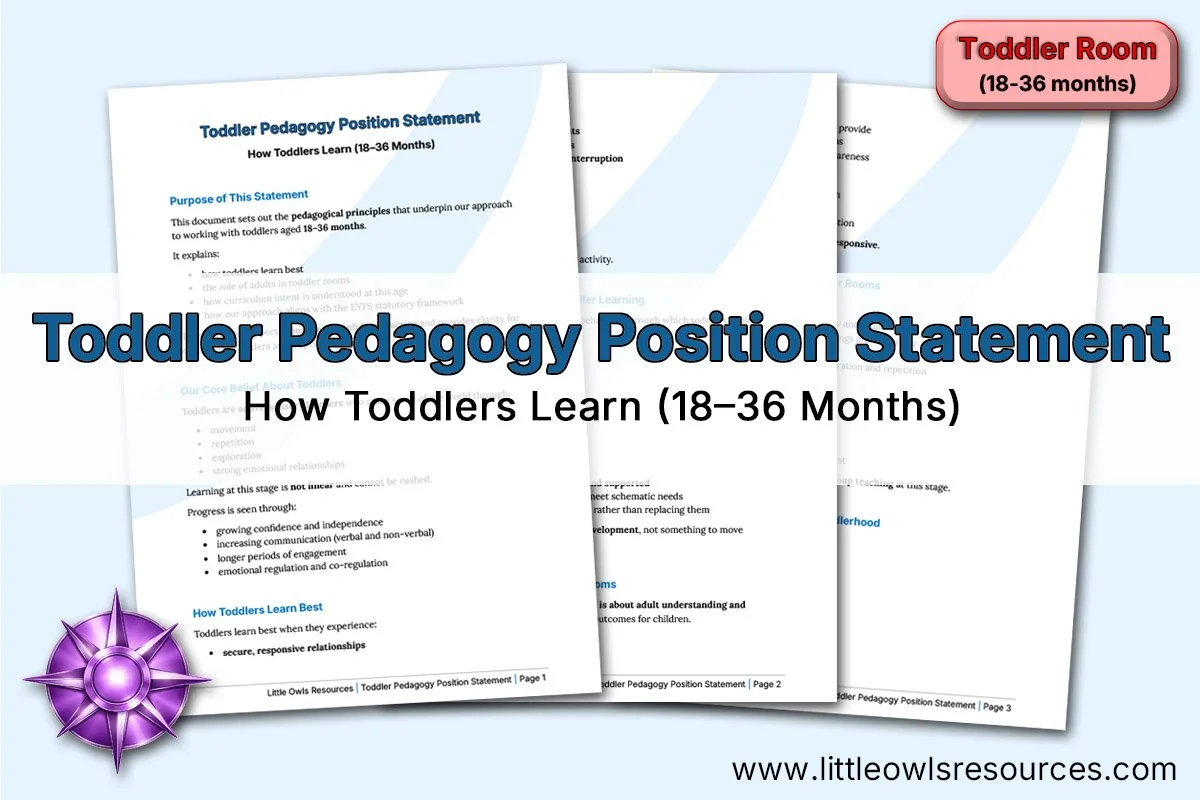
Toddler Pedagogy Position Statement
Explore how toddlers learn and the adult role in supporting their play.
Read free guidance →
Curriculum Overview & Rationale
Understand the purpose of the curriculum for the 18–36 month phase.
Read free guidance →Read first, then choose what helps. Explore the free guidance online and use the download options offered on each document page. The member documents below each have an information page to help you decide what you need.
Find a useful starting point
What would help your practice today?
Choose a priority to open the relevant part of the pathway. Return for another area whenever it becomes useful.
Understand toddler development
Explore age-band maps and guidance for adult understanding.
Development & progression →Review your toddler provision
Think about spaces, resources and everyday opportunities.
Continuous provision →Respond to play and schemas
Connect observation with flexible, in-the-moment planning.
Observation & planning →Take learning outdoors
Explore outdoor provision, movement and sensory experiences.
Outdoor learning →Support language and regulation
Find guidance for everyday interaction and emotional support.
Language & regulation →Include every toddler
Consider adaptations and practical support for individual needs.
SEND & inclusion →The complete toddler pathway
Browse the documents
Open a section and choose View document for its information page and access options. Free guidance is labelled; member downloads are included with All Access. Any availability note is shown beside the relevant entry.
No matching documents. Try a broader word or choose Clear to see the full pathway.
Welcome to the Toddler Room
Understand the approach before choosing the tools you need.
-
How to Use the Toddler Pathway
A free guide to finding your way through the pathway and choosing useful starting points.
-
Toddler Pedagogy Position Statement – How Toddlers Learn (18–36 Months)
How toddlers learn through relationships, sensory experience, repetition and play.
-
Toddler Curriculum Overview & Rationale
Understand the purpose of the toddler curriculum and what makes this phase distinct.
-
How Our Toddler Curriculum Works
See how the toddler curriculum connects with everyday practice.
-
The Role of Schemas in Toddler Practice
Explore repeated patterns of play and how adults can respond to schemas.
-
Curriculum Intent in Toddler Rooms (What It Means — and What It Doesn’t)
Clarify what curriculum intent means in a toddler room.
-
FAQs: Toddler Planning & Pedagogy
Answers to common questions about toddler planning and pedagogy.
Toddler Curriculum & Developmental Progression
Use developmental guidance to deepen adult understanding, with room for each child’s individual journey.
-
Toddler Curriculum Maps
Progression across three age bands: 18–24, 24–30 and 30–36 months. Use as adult reference, with each toddler’s individual development in mind.
-
Intent → Progression Grids (Practitioner Reference)
Practitioner reference grids linking curriculum intent with developmental progression.
-
Area Progression & Adult-Initiated Opportunities — Overview
An overview of area progression and adult-initiated opportunities, with links to the individual area packs.
Observation-Led Practice & In-the-Moment Planning
Let what you notice inform your next response. Choose the documentation that is useful for your setting.
-
In-the-Moment Planning Prompt Sheets (Toddlers)
Prompts to support responsive thinking and planning in the moment.
-
Weekly Planning Template
A weekly planning format to adapt around toddlers’ interests and needs.
-
Toddler Narrative Observation & Analysis Template
A narrative format for noticing, interpreting and responding to learning.
-
Focused Observation Templates
One pack of focused templates covering communication, PSED, physical development, Maths Seeds, effective learning, regulation and schemas.
Continuous Provision in the Toddler Room
Review the spaces, resources and everyday opportunities that support toddler exploration.
-
Continuous Provision Setup Guides | Toddler Room
Setup guidance for nine provision areas, including sensory play, construction, role play, mark making, reading, music and outdoors.
-
Continuous Provision Maps (18–36 Months)
Maps connecting continuous provision with all seven areas of learning, including Maths Seeds and Literacy Seeds.
-
Continuous Provision Audit & Resourcing List
Review the resources and opportunities available in your toddler provision.
-
Continuous Provision Rotation Planner Toolkit
A toolkit for considering how and when to adjust resources in continuous provision.
-
Toddler Visual Support Labelling Pack | 18–36 Months
Visual supports and labels for toddler room organisation.
Outdoor Learning
Support movement, sensory exploration and shared experiences outdoors.
-
Outdoor Continuous Provision Pack
Outdoor setup guidance, seasonal planning, risk–benefit reflection, nature and schemas, mark making and Maths Seeds.
-
Why We Learn Outdoors in All Weathers (Parent Handout)
A parent handout to explain the place of outdoor learning in different weather. Also listed in Parent Partnership.
Projects, Themes & Schema-Responsive Contexts
Use projects as optional contexts. Follow children’s interests, schemas and repeated play rather than a fixed theme timetable.
Project guidance
-
Year-Long Project / Theme Curriculum Map (52 Weeks)
An optional year-long map of project and theme contexts to adapt around your children.
-
How Projects Work in Toddler Rooms
Guidance for using projects responsively in toddler rooms.
-
Schema Coverage & Support Map
Connect repeated patterns of play with supportive provision and contexts.
Main projects · 3–4 weeks
-
All About Me & My World
An optional main project planner, organised around a 3–4 week context and adaptable to toddlers’ interests.
-
People Who Help Us
An optional main project planner, organised around a 3–4 week context and adaptable to toddlers’ interests.
-
Autumn - Senses, Colours & Change
An optional main project planner, organised around a 3–4 week context and adaptable to toddlers’ interests.
-
Light, Dark & Celebrations
An optional main project planner, organised around a 3–4 week context and adaptable to toddlers’ interests.
-
Winter-Weather, Warmth & Cosy Spaces
An optional main project planner, organised around a 3–4 week context and adaptable to toddlers’ interests.
-
Transport & Journeys
An optional main project planner, organised around a 3–4 week context and adaptable to toddlers’ interests.
-
Growing & Changing
An optional main project planner, organised around a 3–4 week context and adaptable to toddlers’ interests.
-
Animals & Their Homes
An optional main project planner, organised around a 3–4 week context and adaptable to toddlers’ interests.
-
Food & Nutrition
An optional main project planner, organised around a 3–4 week context and adaptable to toddlers’ interests.
-
Minibeasts & Nature Explorers
An optional main project planner, organised around a 3–4 week context and adaptable to toddlers’ interests.
-
Summer - Sand, Sea & Sun
An optional main project planner, organised around a 3–4 week context and adaptable to toddlers’ interests.
-
Playful Patterns & Construction
An optional main project planner, organised around a 3–4 week context and adaptable to toddlers’ interests.
Mini-projects · 1 week
-
Big Machines & Building
An optional mini-project planner, organised around a one-week context and adaptable to your setting.
-
Cooking & Food Play
An optional mini-project planner, organised around a one-week context and adaptable to your setting.
-
Teddy Bears’ Picnic
An optional mini-project planner, organised around a one-week context and adaptable to your setting.
-
Colours Everywhere
An optional mini-project planner, organised around a one-week context and adaptable to your setting.
-
Water Play Week
An optional mini-project planner, organised around a one-week context and adaptable to your setting.
-
My Favourite Things
An optional mini-project planner, organised around a one-week context and adaptable to your setting.
-
Rhyme Time Week
An optional mini-project planner, organised around a one-week context and adaptable to your setting.
-
Weather Wonders
An optional mini-project planner, organised around a one-week context and adaptable to your setting.
Adult-Focused Invitations & Activity Resources
Choose responsive invitations and adult-supported experiences that connect with toddlers’ play.
Responsive invitations
-
Activity Cards Pack
Invitations and activity cards to support child-led learning and responsive provision.
Area progression & adult-supported opportunities
-
Communication & Language Activity Invitations Pack
Communication and language progression with adult-focused opportunities across the three toddler age bands.
-
PSED Activity Invitations Pack
Personal, social and emotional development progression with adult-focused opportunities.
-
Physical Development Progression Pack
Physical development progression with adult-focused opportunities.
-
Mathematics Seeds Progression Pack
Early mathematical progression and adult-focused opportunities for Maths Seeds.
-
Literacy Seed Skills Progression Pack
Early literacy progression and adult-focused opportunities for Literacy Seeds.
-
Understanding the World: Curriculum Experience Pack
Understanding the World experience progression across the three toddler age bands.
-
Expressive Arts & Design: Creative Media & Expression Toolkit
Creative media and expression guidance across the three toddler age bands.
Language, Interaction & Emotional Development
Build communication, emotional security and regulation through everyday interaction.
-
Toddler Room Poster – Five Sentence Stems For Toddler Practitioners
A practitioner poster with sentence stems for everyday interaction.
-
Supporting Emotional Regulation Through Language
Explore how language and adult responses can support emotional regulation.
-
Communication and Language-Rich Approaches in Toddler Rooms
Guidance for communication and language-rich everyday toddler practice.
-
Toddler Behaviour & Regulation: A Quick Guide
A quick reference for understanding behaviour and supporting regulation.
Assessment, Statutory Requirements & Leadership
Keep assessment purposeful and use these documents alongside current guidance and your setting’s procedures.
-
Progress Check at Age 2
A progress check report template with practitioner guidance.
-
OFSTED Questions We’re Ready For
Prompts to help practitioners and leaders explain their toddler curriculum and practice.
SEND & Inclusion
Notice needs, adapt provision and work with families to support participation.
-
SEND Inclusion Strategy Pack (18–36 Months)
Six quick-reference strategy sheets for inclusive everyday provision, including communication, sensory needs, anxiety and behaviour. See the document page for current availability.
Transition & Parent Partnership
Build strong home–setting partnerships and support change with continuity and care.
Transition
-
Toddler → Preschool Transition Pack
Support continuity and relationships as children move into preschool.
Home–setting communication
-
Toddler Room Parent Update & Home Learning Sheet
A format for sharing updates and home learning with families.
-
Letter Templates Pack
Adaptable letters to support communication with toddler families.
Parent information pages
-
Why Mark Making Matters (Before Writing)
Parent information about the value of early mark making.
-
Supporting Speech & Language at Home (0–3 Years)
Home communication guidance spanning birth to three years.
-
How To Build Language Through Play
A parent handout on supporting language through play.
-
Why We Learn Outdoors in All Weathers
The outdoor learning parent handout, also listed in Outdoor Learning.
Development is individual. Age bands help adults understand possible pathways; use them responsively rather than as targets or a timetable for toddlers. Choose documentation because it helps you understand and support a child.
The wider picture
Connect your toddler practice with birth–5
Explore the wider curriculum approach and shared setting guidance. The first two documents and the online glossary are free to explore. All Access includes the wider suite.
Curriculum & Pedagogy
-
Little Owls Resources’ Curriculum Intent Statement
A free introduction to the intentions behind the Little Owls birth–5 curriculum.
-
EYFS from Birth to 5: Curriculum Coherence & Pedagogical Throughline
A free overview of how the approach connects across the early years.
-
Whole-Setting Curriculum Map (Birth-5): Curriculum Intent & Progression
Explore curriculum intent and progression across the setting.
-
Pedagogy Guidance Document
Shared pedagogy guidance for birth–5 practice.
-
Speech & Language Development - Setting Statement
A setting statement for speech and language development.
-
EYFS Inspection-Facing Summaries
Summaries to help articulate your curriculum and pedagogy.
Early Years Schemas
-
Early Years Schemas - Practitioner Toolkit | EYFS Birth-5
Schema cards with definitions, behaviours and age-related examples, plus an observation and responsive provision planning template.
EYFS Setting Policies
-
EYFS Group Setting Policies Pack
25 policy documents with sign-off information and a folder contents list.
-
Childminder Setting Policies Pack
25 policy documents, assistant or volunteer sign-off information and a folder contents list.
EYFS Glossary
-
EYFS Glossary
Practitioner-friendly explanations of curriculum and pedagogy terms.
One membership · All Access
Guidance and resources, together.
All Access brings together the EYFS Curriculum & Pedagogy Suite and printable provision across Little Owls Resources, including the other age-group pathways.
Explore a document’s information page, then use its access link to sign in or join and open the available downloads.
Explore All Access membership →Already a member?
Go straight to the document you need. Its information page includes the link to access it; sign in there if prompted.
Find a document ↑Just getting to know us?
Read the free starting documents to explore the approach before you join.
Explore the free guidance ↑Explore another pathway
Use the pathways that reflect the children you care for. All Access includes the whole suite.
Looking for resources for your provision? Explore printable provision → · Return to the Curriculum & Pedagogy hub →