

Baby Room Curriculum & Pedagogy | 0–18 Months
Baby pathway · Birth to 18 months
Thoughtful guidance.
Responsive baby care.
Build your baby curriculum around the relationships, routines and everyday interactions that matter.
Explore guidance, curriculum maps and practical documents for baby room practitioners, nursery leaders and childminders caring for babies from birth to 18 months.
Choose what supports your practice now. There is no need to work through the whole suite or use every template.
A clear way into the suite
Where would you like to start?
01Understand the approachTwo free documents to begin with. 02Focus on today’s priorityFind a useful starting point for your setting. 03Find a documentExplore the complete 11-section pathway.Included with All Access. One membership gives you access to the Curriculum & Pedagogy Suite and printable provision across Little Owls Resources. How access works →
Start here · Free guidance
Get to know the approach
Begin with these two documents. They introduce relationship-led, care-centred baby practice and help you see how the rest of the pathway fits together.
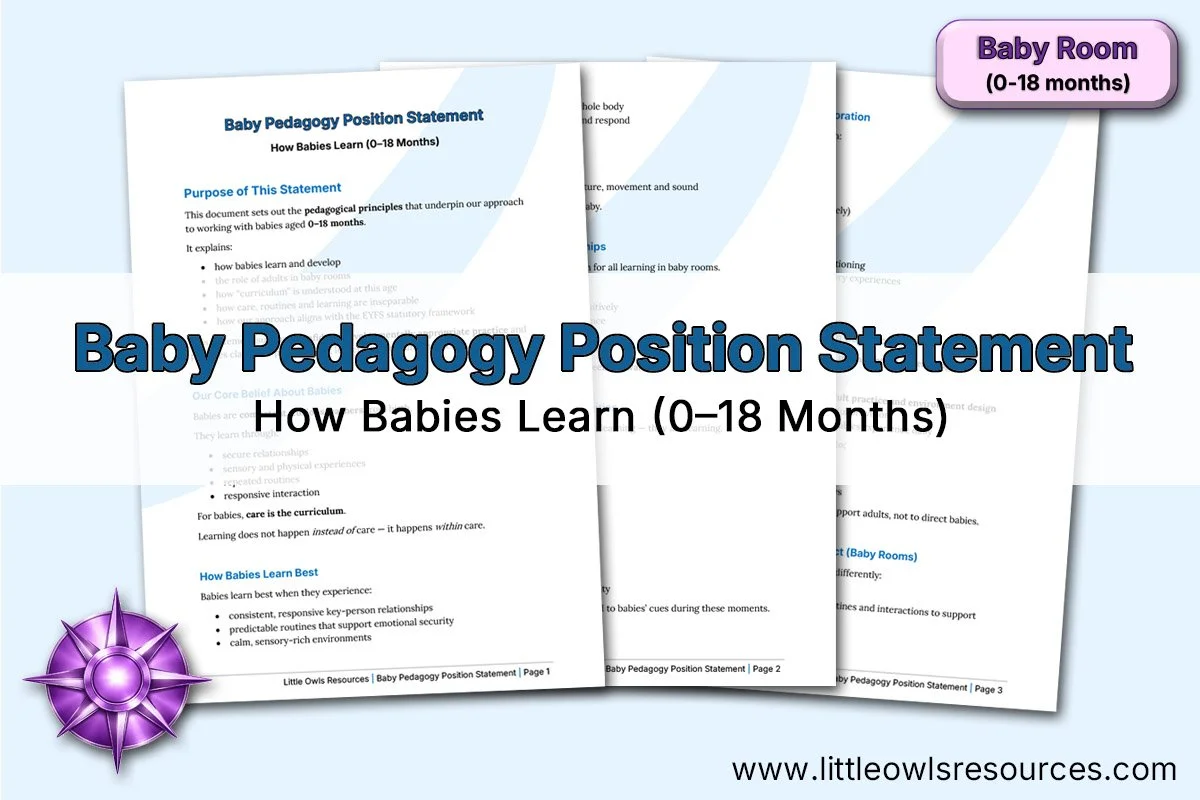
Baby Pedagogy Position Statement
How babies learn, why relationships matter and how adults can support their development.
Read free guidance →
Care as Curriculum
What care as curriculum means in practice, through everyday routines and responsive interactions.
Read free guidance →Read first, then choose what helps. The free starting documents can be read online, with download options on their pages. The member documents below each have an information page to help you decide what you need.
Find a useful starting point
What would help your practice today?
Choose a priority to open the relevant part of the pathway. Return for another area whenever it becomes useful.
Understand baby development
Explore age-band maps and adult reference guidance.
Development & understanding →Review your baby environment
Think about spaces, resources and continuous provision.
Environment & provision →Make observation useful
Choose a simple way to notice, reflect and respond.
Observation & responsive care →Keep planning responsive
Find guidance and templates that support your daily decisions.
Planning & documentation →Support individual needs
Explore early identification and inclusive practice.
SEND & early identification →Work closely with families
Support settling in and communication between home and setting.
Parent partnership →The complete baby pathway
Browse the documents
Open a section and choose View document for its information page and access options. Free guidance is labelled; the remaining documents are included with All Access.
No matching documents. Try a broader word or choose Clear to see the full pathway.
Welcome to the Baby Room
Understand the approach before choosing the tools you need.
-
Baby Pedagogy Position Statement – How Babies Learn (0–18 Months)
How babies learn, the adult role and the principles behind this pathway.
-
Care as Curriculum: What This Means in Practice
Explore the learning within everyday care, routines and relationships.
-
How Our Baby Room Practice Works
Bring the baby room approach together in day-to-day practice.
-
Curriculum Language in Baby Rooms (Intent, Implementation & Impact Explained)
Understand intent, implementation and impact in a baby room context.
Baby Development & Adult Understanding
Use developmental guidance to deepen adult understanding and notice each baby’s individual journey.
-
Baby Curriculum Maps - Developmental progression across age bands
Five age-band maps: 0–3, 3–6, 6–9, 9–12 and 12–18 months. Use as adult reference, with each baby’s individual development in mind.
-
Adult Reference: Developmental Signals & Support
An adult reference for noticing development and considering responsive support.
-
Understanding Early Communication & Regulation
Explore early communication alongside babies’ developing regulation.
Observation-Led Practice & Responsive Care
Choose an observation format that helps you respond meaningfully. You do not need to complete every template.
-
In-The-Moment Narrative Observation Template for Babies
A narrative format for recording a meaningful moment.
-
Micro-Observation Template
A brief checklist-format option for micro-observations.
-
Pocket-Sized Observation Card
A compact observation format to keep close at hand.
-
Using Observation to Respond to Babies’ Needs
Connect what you notice with responsive care and interaction.
-
In-the-Moment Prompt Cards
17 prompts to support responsive adult thinking in the moment.
Environment & Continuous Provision
Review the spaces, resources and opportunities babies experience each day.
-
Baby Room Environment Guide & Resourcing Lists
Guidance and resourcing lists for the baby room environment.
-
Baby Room Continuous Provision Maps
Continuous provision maps for 0–9 and 9–18 months.
-
Labelling Pack | Baby Room (0–18 Months)
Labels to support the organisation of baby room provision.
Routines, Care & Emotional Wellbeing
Keep responsive care, relationships and emotional wellbeing at the centre of practice.
-
Daily Routines as Learning Opportunities
Explore the learning within babies’ everyday care routines.
-
Transition & Sleep Routine Record Pack
Daily transition record, individual sleep routine profile and review template.
-
Supporting Emotional Regulation in Baby Rooms
Guidance for supporting emotional wellbeing and regulation.
Language & Interaction in Baby Rooms
Build communication through attuned, everyday interaction.
-
Five Sentence Stems Every Baby Room Practitioner Should Use (Baby Room Poster)
A practitioner poster to support everyday interaction.
-
Responsive Talk, Narration & Imitation
Guidance for responsive talk, narration and imitation.
-
Supporting Early Communication (Pre-Verbal & Emerging Speech)
Support communication through the pre-verbal and emerging speech stages.
Planning & Documentation
Choose planning tools that help adults respond to babies and keep documentation purposeful.
-
Weekly Care & Learning Planning Template
A template to bring care and learning into responsive weekly planning.
-
Using Baby Room Planning Templates Responsively
Guidance to help adults use planning templates flexibly.
-
‘Intent - Implementation - Impact’ Reference Grids
Reference grids across emotional, communication, physical, sensory, social, problem-solving and independence strands.
-
Responsive Interaction & Provision Notes
Previously listed as Baby Responsive Planning Sheet. Notes to support responses to babies’ interests and needs.
-
When (and When Not) to Plan in Baby Rooms
Consider when written planning is useful and when a responsive interaction is enough.
Assessment, Safeguarding & Statutory Responsibilities
Use these alongside your setting’s current procedures and professional responsibilities.
-
Concerns & Referrals Quick Form
A concise format for recording concerns and considering referrals.
-
Recording and Responding to Safeguarding Concerns
Guidance to support recording and responding alongside your setting’s safeguarding procedures.
-
Progress Check at Age 2
Looking ahead: toddler phase. Report template and practitioner guidance for the later progress check; not an assessment to complete for babies.
SEND & Early Identification
Notice needs, adapt support and work collaboratively with families.
-
SEND Identification & Next Steps Pack | Babies
What to look for, what evidence to collect and practical next steps.
-
SEND & Inclusion Support Pack
A practitioner toolkit with support for inclusion through environment and interaction.
Parent Partnership & Communication
Build continuity between home and setting through warm, useful communication.
-
Daily Diary – Baby Room
A daily diary format for baby room communication.
-
Baby Room Welcome & Settling-In Pack
Support welcoming babies and families and the settling-in process.
-
Supporting Babies at Home (Shared Routines & Communication)
Shared routines and communication to connect home and setting.
-
Supporting Speech & Language at Home (0–3 Years)
Home communication guidance spanning birth to three years.
Transition Beyond the Baby Room
Support continuity, relationships and emotional security as babies move on.
-
Preparing for Transition to Toddler Room
Prepare for the move from the baby room to toddler provision.
-
Sharing Information with Sensitivity
Support thoughtful, sensitive information sharing.
-
Supporting Babies and Families Through Change
Guidance for supporting babies and families through change.
Development is individual. Age bands help adults understand possible pathways; use them responsively rather than as a timetable for babies. Choose documentation because it helps you understand and support a child.
The wider picture
Connect your baby practice with birth–5
Explore the wider curriculum approach and shared setting guidance. The first two documents and the online glossary are free to explore. All Access includes the wider suite.
Curriculum & Pedagogy
-
Little Owls Resources’ Curriculum Intent Statement
A free introduction to the intentions behind the Little Owls birth–5 curriculum.
-
EYFS from Birth to 5: Curriculum Coherence & Pedagogical Throughline
A free overview of how the approach connects across the early years.
-
Whole-Setting Curriculum Map (Birth-5): Curriculum Intent & Progression
Explore curriculum intent and progression across the setting.
-
Pedagogy Guidance Document
Shared pedagogy guidance for birth–5 practice.
-
Speech & Language Development - Setting Statement
A setting statement for speech and language development.
-
EYFS Inspection-Facing Summaries
Summaries to help articulate your curriculum and pedagogy.
Early Years Schemas
-
Early Years Schemas - Practitioner Toolkit | EYFS Birth-5
Schema cards with definitions, behaviours and age-related examples, plus an observation and responsive provision planning template.
EYFS Setting Policies
-
EYFS Group Setting Policies Pack
25 policy documents with sign-off information and a folder contents list.
-
Childminder Setting Policies Pack
25 policy documents, assistant or volunteer sign-off information and a folder contents list.
EYFS Glossary
-
EYFS Glossary
Practitioner-friendly explanations of curriculum and pedagogy terms.
One membership · All Access
Guidance and resources, together.
All Access brings together the EYFS Curriculum & Pedagogy Suite and printable provision across Little Owls Resources, including the other age-group pathways.
Explore a document’s information page, then use its access link to sign in or join and open the available downloads.
Explore All Access membership →Already a member?
Go straight to the document you need. Its information page includes the link to access it; sign in there if prompted.
Find a document ↑Just getting to know us?
Read the free starting documents to explore the approach before you join.
Explore the free guidance ↑Explore another pathway
Use the pathways that reflect the children you care for. All Access includes the whole suite.
Looking for resources for your provision? Explore printable provision → · Return to the Curriculum & Pedagogy hub →