
Minibeasts: Tell Me a Story Picture Prompts | EYFS & KS1 Oral Storytelling Resource 🐞
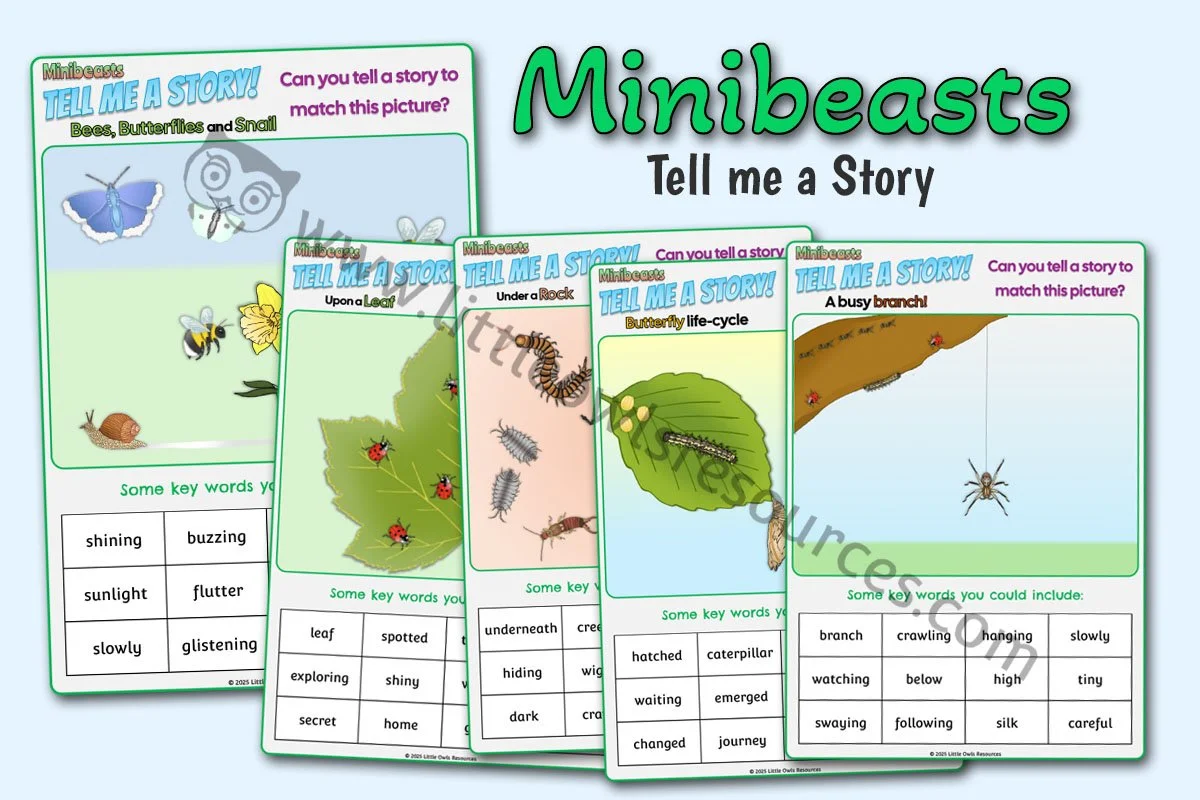
Inspire imagination, vocabulary development and oral storytelling with our wonderful Minibeasts: Tell Me a Story Picture Prompts!
This engaging printable resource has been designed to encourage children to create, tell and rehearse their own stories using carefully illustrated minibeast-themed picture scenes and vocabulary prompts. By encouraging children to talk through their ideas before writing, the resource supports the development of communication, composition and creative thinking skills.
Perfect for Reception, Year 1 and Year 2, these story prompt sheets provide a playful and engaging bridge between spoken language and early writing.
-
This printable pack contains 5 minibeast-themed storytelling prompt sheets:
🐝 Bees, Butterflies and Snail
🍃 Upon a Leaf
🪨 Under a Rock
🦋 Butterfly Life Cycle
🌳 A Busy Branch
Each prompt page includes:
✅ A detailed picture scene to inspire storytelling
✅ A question prompt:
"Can you tell a story to match this picture?"✅ A bank of useful vocabulary to support language development and composition
The sheets are designed to be printed and laminated for repeated use during speaking, storytelling and writing activities.
-
These storytelling prompts can be used in a variety of ways.
Oral Storytelling
Invite children to look closely at the picture and create a story aloud before writing anything down.
Talk Partner Activities
Children can work together to:
discuss what they notice
predict what might happen next
create a shared story
develop character ideas
Vocabulary Development
Use the suggested vocabulary banks to introduce new language and encourage children to include ambitious words within their storytelling.
Story Mapping
Children can retell their story using drawings, symbols or simple story maps before writing.
Writing Inspiration
Older children can use their oral story as the basis for:
captions
sentences
short narratives
story openings
character descriptions
-
Strong writing begins with strong language.
Before children can confidently write stories, they need opportunities to:
develop ideas
organise their thoughts
hear and use rich vocabulary
rehearse sentences aloud
build narrative understanding
These picture prompts encourage children to create meaning from visual information, make predictions, develop story structures and communicate their ideas clearly.
The emphasis is on thinking, talking and storytelling before writing.
-
At Little Owls Resources, we believe that spoken language provides the foundation for literacy.
Children benefit from opportunities to:
tell stories aloud
explore ideas through discussion
rehearse sentences verbally
experiment with language before recording it
These prompts should not be viewed as writing tests or comprehension exercises.
Instead, they provide rich opportunities for:
imaginative thinking
storytelling
vocabulary development
sustained shared conversations
Adults can support learning by modelling language, asking open-ended questions and showing genuine curiosity about children's ideas.
There is no single "correct" story.
-
Preschool (3–4 Years)
Children may:
describe what they can see
name minibeasts
talk about what might be happening
create simple verbal stories
Focus on language development rather than story structure.
Reception (4–5 Years)
Children may:
create simple narratives
explain events in sequence
use descriptive vocabulary
orally compose sentences before writing
Year 1
Children may:
tell complete stories aloud
sequence events logically
expand sentences with detail
use the vocabulary prompts independently
Year 2
Children may:
develop more detailed narratives
explore character motivation
create story openings and endings
improve sentence composition through oral rehearsal
-
Communication & Language
Children develop speaking, listening, vocabulary and storytelling skills through discussion and oral composition.
Literacy
Supports composition, sentence development, storytelling and writing preparation.
Understanding the World
Introduces discussion about minibeasts, habitats and life cycles.
Personal, Social & Emotional Development
Encourages confidence in speaking, sharing ideas and collaborative storytelling.
Expressive Arts & Design
Supports imagination, creativity and narrative development.
-
KS1 English – Composition
Supports opportunities for pupils to:
say out loud what they are going to write about
compose sentences orally before writing
plan and discuss ideas for writing
develop spoken language and vocabulary
These links are intended to support practitioner understanding rather than create assessment targets.
-
This resource works particularly well alongside:
You may also wish to explore resources found within our EYFS Curriculum & Pedagogy Suite:
Communication & Language Progression
Reception Literacy Support
Storytelling & Oracy Resources
Vocabulary Development Guidance
Continuous Provision Literacy Opportunities
Download your Minibeasts: Tell Me a Story Picture Prompts today and help children develop the confidence, vocabulary and imagination needed to become enthusiastic storytellers and writers. 🐞🦋
📌 Related Printable Early Years Resources
You may also enjoy:







For deeper guidance, explore our EYFS Curriculum & Pedagogy Suite:
Communication & Language Progression
Reception Literacy Support
Storytelling & Oracy Resources
Vocabulary Development Guidance
Continuous Provision Literacy Opportunities
Support meaningful learning through our professional planning resources and curriculum pedagogy guidance.
💡 Explore our EYFS Curriculum & Pedagogy Suite for comprehensive planning and guidance (separate pathways for birth-18 months, 18-36 months, 3-4 years & 4-5 years).








EYFS & KS1 themes & topics you may be interested in
Explore more captivating EYFS and KS1 educational activities and printable packs covering various popular themes and topics for your classroom, setting or home learning.










Alternatively, search ‘Little Owls Resources’ for printable educational materials using the menu buttons below…
Please use the following buttons to explore our wealth of teaching and learning resources; perfect for use with your early years (EYFS and KS1) children.


Set sail on an exciting storytelling adventure with our wonderful Pirates: Tell Me a Story Picture Prompts!
This engaging printable resource has been designed to inspire children's imagination, vocabulary development and oral storytelling through a collection of colourful pirate-themed picture…