• Home 🏠
  • About Us
  • Pricing
    • 🌟Printable Resources Hub🌟
    • ↪ Themes
    • ↪ Role Play
    • ↪ Festivals & Celebrations
    • ↪ Special Dates Calendar
    • ↪ Areas of Learning
    • ↪ Organisational Tools
  • EYFS Curriculum & Pedagogy
  • Special Dates Calendar
Menu

Little Owls Resources - Free and Premium Early Years Printables

Street Address
City, State, Zip
Phone Number
Early Years/Preschool/EYFS Printable Activities/Planning/Displays/Paperwork and ideas for Childminders, Preschools, Nursery Practitioners, Teachers and Parents

Your Custom Text Here

Little Owls Resources - Free and Premium Early Years Printables

  • Home 🏠
  • About Us
  • Pricing
  • Printable Resources ⬇
    • 🌟Printable Resources Hub🌟
    • ↪ Themes
    • ↪ Role Play
    • ↪ Festivals & Celebrations
    • ↪ Special Dates Calendar
    • ↪ Areas of Learning
    • ↪ Organisational Tools
  • EYFS Curriculum & Pedagogy
  • Special Dates Calendar

Preschool Skills Progression Ladder - Early Reading (Phase 1 Readiness)

January 18, 2026 Stuart Murphy

Home › EYFS Curriculum & Pedagogy › Preschool Curriculum & Pedagogy › Preschool Skills Progression Ladder: Early Reading (Phase 1 Readiness) (Overview)


Skills Progression Ladder — Early Reading (Phase 1 Readiness)

Preschool (3–4 Years)

A play-based progression tool supporting the foundations for early reading before formal phonics.

Download Document Here:

 
Download DOCX 📝
Download PDF 📄
 

Document Updated: January 2026


Recommended next read Selection
EYFS
Strength-Based Progress Overview | Preschool 3-4 Years (Overview)

A strengths-led overview supporting observation, reflection and meaningful next steps in a play-based EYFS environment.

Read More →
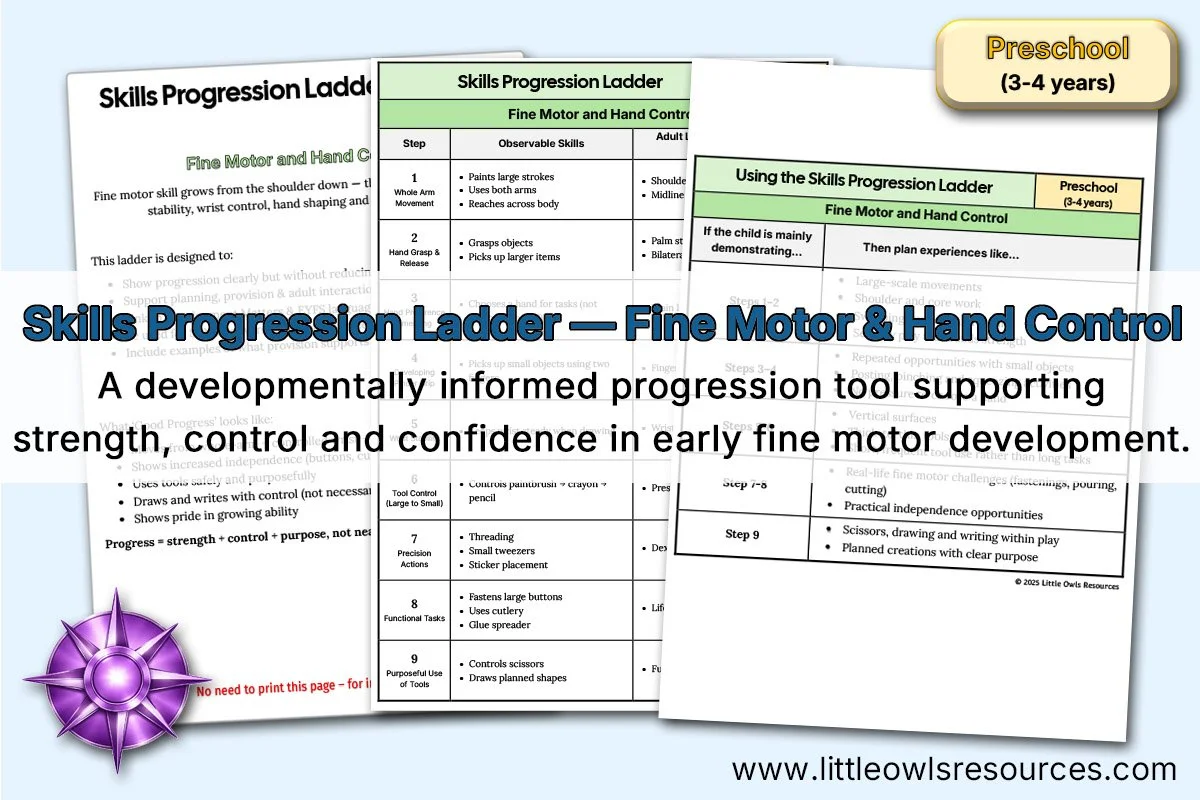
Preschool Skills Progression Ladder: Fine Motor & Hand Control (Overview)

A developmentally informed progression tool supporting strength, control and confidence in early fine motor development.

Read More →
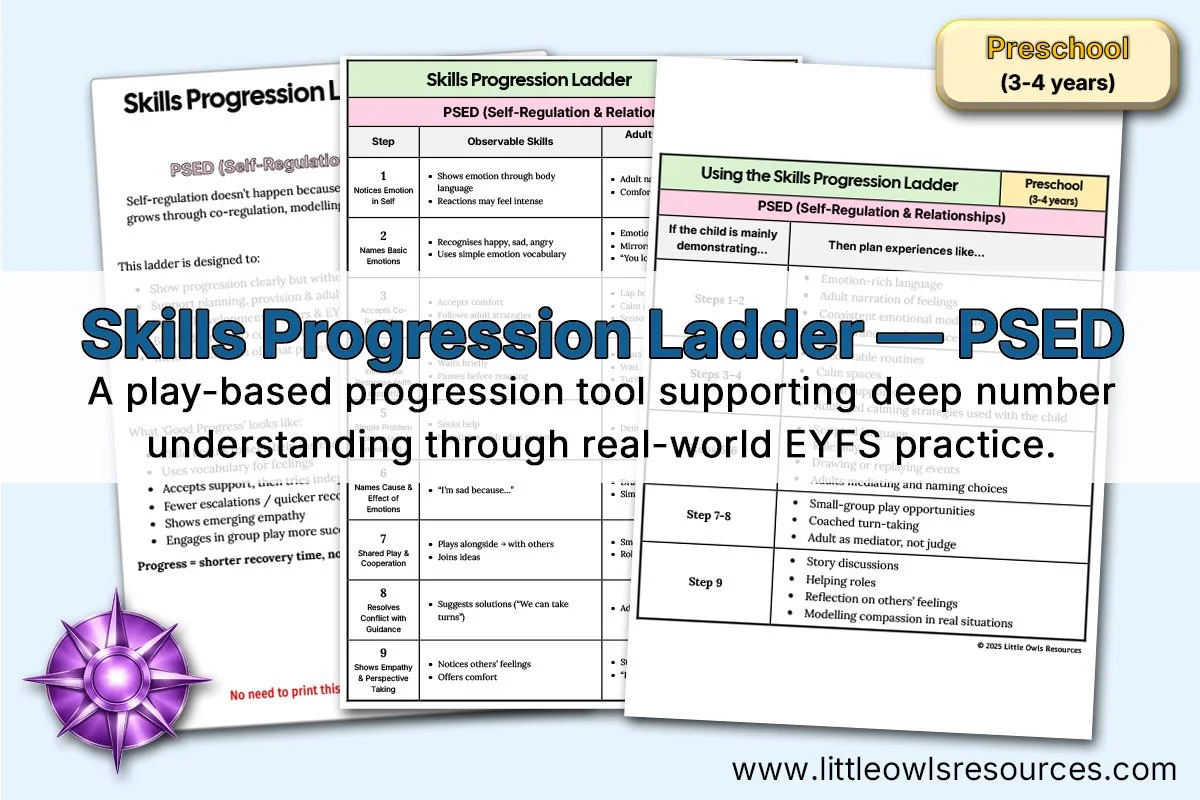
Preschool Skills Progression Ladder: PSED - Self-Regulation & Relationships (Overview)

A play-based progression tool supporting deep number understanding through real-world EYFS practice.

Read More →
Preschool Skills Progression Ladder: Early Maths - Pattern, Shape & Spatial Awareness (Overview)

A play-based progression tool supporting exploration of shape and pattern by building, rotating, navigating, transforming and describing.

Read More →
Preschool Skills Progression Ladder: Early Maths - Subitising, Counting & Comparing (Overview)

A play-based progression tool supporting deep number understanding through real-world EYFS practice.

Read More →
Preschool Skills Progression Ladder: Early Writing (Overview)

A developmentally grounded progression tool supporting early writing from mark-making to name writing.

Read More →
Preschool Skills Progression Ladder: Early Reading (Phase 1 Readiness) (Overview)

A play-based progression tool supporting the foundations for early reading before formal phonics.

Read More →
Preschool Skills Progression Ladder: Communication & Language (Overview)

A practical progression tool supporting listening, understanding, vocabulary and conversation through play-based EYFS practice.

Read More →
Preschool (3–4 Years) Curriculum Map by Term (Overview)

A play-based, language-rich overview of learning priorities across the Preschool year.

Read More →
Preschool Curriculum: Intent, Implementation & Impact | Ofsted Conversation Statement

A clear, inspection-ready articulation of Preschool curriculum design, delivery and impact.

Read More →
 

Additional Documents | Professional Membership Contents (Preschool 3-4 Years)

Navigate our Curriculum & Pedagogy guidance documents here.

Pedagogical identity:
Broad, play-based, theme-led curriculum with purposeful adult input and strong continuous provision.

  • 👉 Pre-planning orientation.

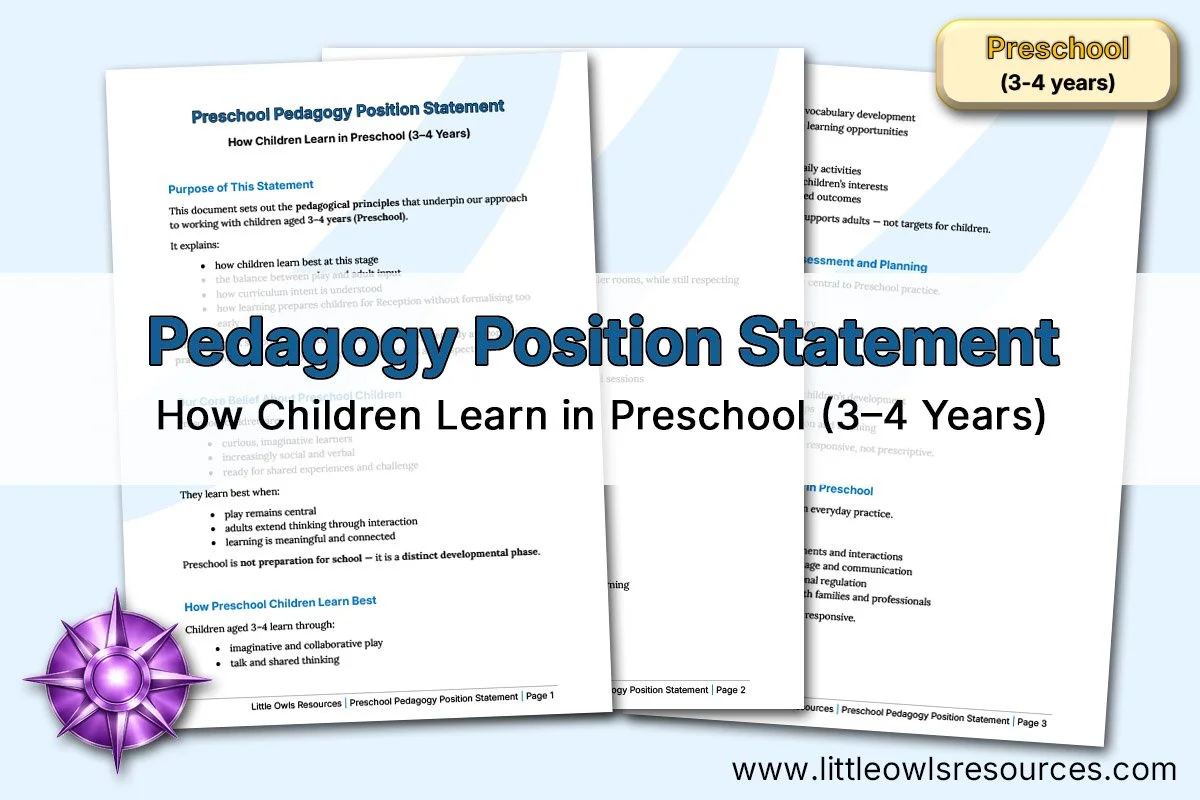
    • Preschool Pedagogy Position Statement

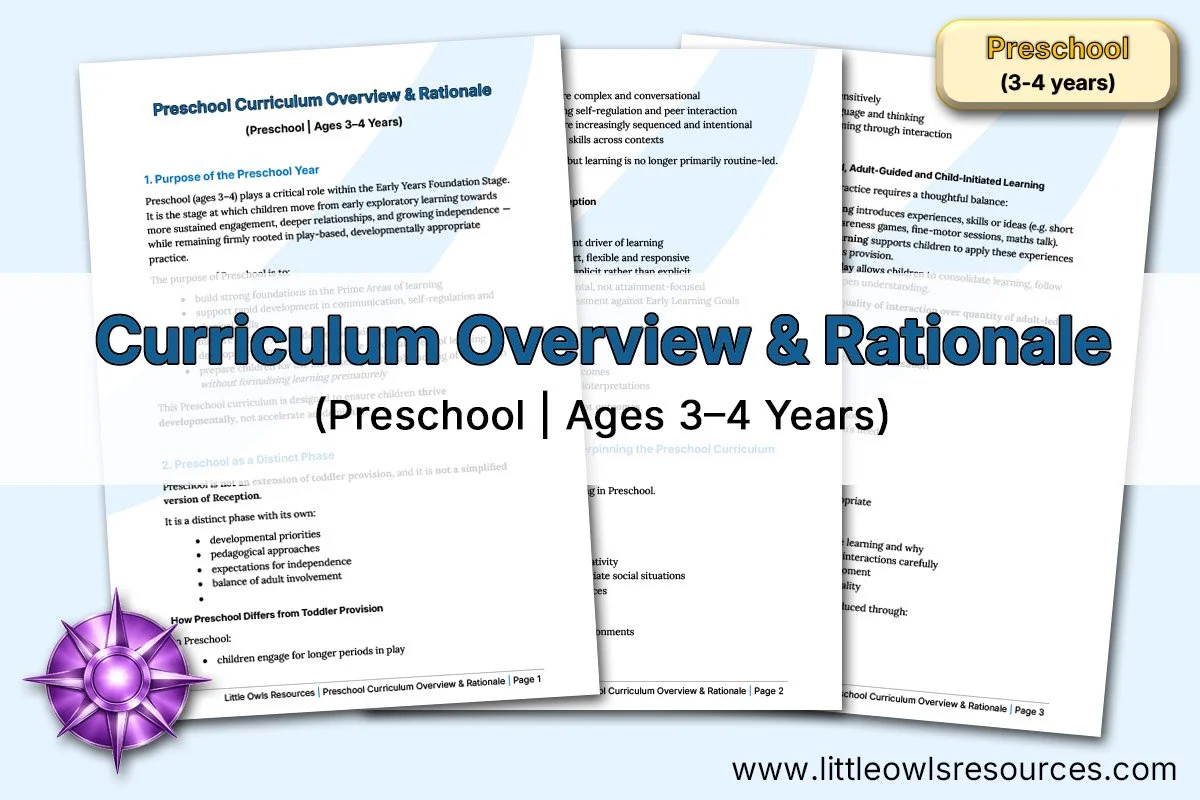
    • Preschool Curriculum Overview & Rationale

    • Curriculum Overview: How Themes Fit Together (6 Main + 8 Mini)

    • What Child-Led Does Not Mean

    • Adult-Led With Purpose in Preschool

  • 👉 Big-picture curriculum intent and progression.

    • Preschool Curriculum Map (By Term)

    • Skills Progression Ladders (3–4 Years) - Including Practitioner Guidance

      ↪ Communication & Language

      ↪ Early Reading (Phase 1 Readiness)

      ↪ Early Writing

      ↪ Early Maths - Subitising, Counting & Comparing

      ↪ Early Maths - Pattern, Shape & Spatial Awareness

      ↪ PSED - Self-Regulation & Relationships

      ↪ Fine Motor & Hand Control

    • Strength-Based Progress Overview

    • Our Preschool Curriculum Intent, Implementation & Impact - OFSTED Conversation Statement

  • 👉 Theme-led planning lives here.

    • Curriculum Overview | How Themes Fit Together

    • Preschool Theme Packs – FAQs

    • How Practitioners Use This Curriculum Daily

    Core Preschool Themes (6 Weeks Each)

    • ‍Autumn 1: This Is Me

    • Autumn 2: Who Helps When…?

    • Spring 1: Journeys & Transport

    • Spring 2: Animals & Habitats

    • Summer 1: Growing & Changing

    • Summer 2: Water World

    Optional Mini-Themes (1–2 Weeks)

    • Space

    • Dinosaurs & the Mystery Egg

    • Pets & Vets

    • Building & Construction

    • Traditional Tales

    • Beaches & Coastlines

    • Healthy Bodies & Wellbeing

    • Celebrations Around the World

  • 👉 The engine room of daily practice.

    • Universal Continuous Provision Packs (Preschool | 3–4 Years)

      • Construction Area

      • Small World Area

      • Role-Play Area

      • Writing / Mark-Making Area

      • Maths Area

      • Creative Area (Art & Making)

      • Investigation / STEM / Discovery Area

      • Book Corner / Reading Den

      • Fine Motor Station

      • Water Area

      • Sand Area

      • Snack Area / Independence Station

      • Outdoor Provision Core Zones

        • Physical play

        • Gross motor skills

        • Nature area

        • Outdoor mark-making

        • Outdoor maths

    • Preschool Environment & Provision Map Audit Pack

    • How Continuous Provision Works in Our Preschool Curriculum

    • Continuous Provision Audit Checklist

    • Continuous Provision FAQs (For Preschool Practitioners)

  • 👉 Purposeful adult input without formalisation.

    Early Reading & Phonics

    • Phonics & Early Reading Pack

    • Phase 1, Vocabulary & Early Comprehension, Curriculum System (24 Sessions)

      • 8 themed sets covering all aspects of Phase 1

      • 24 mini session plans

      • Vocabulary & story-building scaffolds

      • Outdoor phonological play ideas

      • SEND & EAL accessible sessions

      • Theme-linked sessions (Transport, Animals, Growth)

      • Assessment & observation prompts

      • Continuous Provision follow-up suggestions

    • Adult-Led Session Templates

    • Practitioner FAQs

    Maths

    • Maths Small Group Session Bank (24 Sessions)

      • Strand A - Subitising (Sessions 1-4)

      • Strand B - Counting Principles (Sessions 5-8)

      • Strand C - Comparing Quantites (Sessions 9-12)

      • Strand D - Composition of Number (Sessions 13-16)

      • Strand E - Spatial & Shape (Sessions 17-20)

      • Strand F - Measures & Pattern (Sessions 21-24)

    • How To Use Our Maths Session Bank & Strand Overview (A–F)

    • Adult-Led Session Templates

    • Practitioner FAQs

    Writing & Fine Motor

    • Fine Motor & Mark Making Mini Sessions (18)

      • How To Use Our Fine Motor & Mark Making Mini Sessions Bank

      • Strand A - Core & Shoulder Stability (Sessions 1-3)

      • Strand B - Wrist Rotation & Fluidity (Sessions 4-6)

      • Strand C - Pincer, Pinch & Tool Control (Sessions 7-10)

      • Strand D - Early Pattern Making: Pre-Writing Shapes (Sessions 11-18)

    • Early Writing Purpose Mini Sessions (6)

      • How To Use Our Early Writing Purpose Mini Sessions Bank

      • Lists

      • Labels

      • Messages

      • Maps

      • Signs

      • Tickets & Recipes

    • How These Two Session Banks Are Designed To Work Together

  • 👉 High-impact interaction guidance.

    • How We Talk to Children

    • Five Sentence Stems For Preschool Practitioners

    • If Interest Sparks — What Happens Next?

    • Preschool Staff Guidance Posters

  • 👉 Practical planning support.

    • Weekly Planning Templates (2 Versions)

    • How to Use the Preschool Weekly Planning Templates: Guide

    • Adult-Led Session Planning Templates Pack

      • Universal

      • Phonics / Early Language Focus (Listening → Rhyme → Sound Awareness)

      • Maths Focus (Number + Pattern + Shape + Measure)

      • Story & Book Talk Focus (Comprehension → Retell → Vocabulary → Prediction)

      • PSED / Self-Regulation Small Group

  • 👉 Proportionate, non-statutory assessment.

    • Observe–Assess–Plan (OAP) Toolkit - Preschool

    • Assessment Dashboard Pack (3 Versions)

      • Prime Areas Only Dashboard (Communication & Language, PSED, Physical)

      • Full EYFS Areas Dashboard (Prime + Specific)

      • Dashboard with Wellbeing & Involvement Scale (Leuven-inspired 1–5 ratings)

    • Progress Review (3–4 Years)

      • Short & Long Versions

      • Guidance - How To Complete And Share With Families

    • Preschool Report Pack

      • End of Term Template

      • End of Year Template

      • Guidance - How To Write Strength-Based Reports

      • Sentence Starters Bank

  • 👉 Parent Engagement plus Emotional, environmental and communicative transition.

    • Preschool Transition to Reception Pack

      ↪ Child Passport

      ↪ Practitioner-To-Practitioner Handover Summary

      ↪ SEND Transition Sheet

      ↪ Family Transition Summary Sheet

      ↪ Parent Leaflet — “Preparing For Reception”

      ↪ Child Voice Page

      ↪ Guidance Page— “How To Complete & Share Transition Information”

    • Home & Setting Communication

      ↪ Our Preschool Curriculum (Age 3–4) | Parent-Facing Document

      (Additional parent literature within planning documents.)


Additional Whole-Setting Guidance | for Professional Members

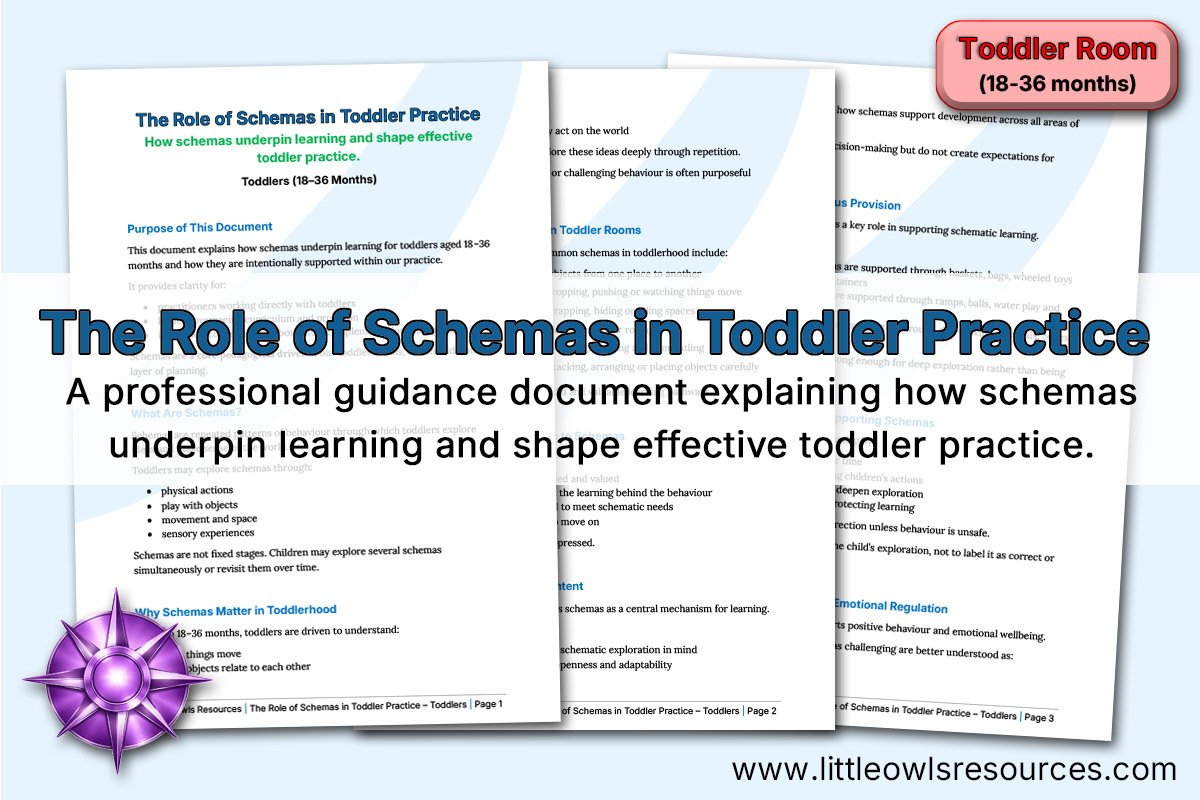
Explore our whole-setting guidance below, including overarching curriculum and pedagogy documents, early years schemas and EYFS setting policies.

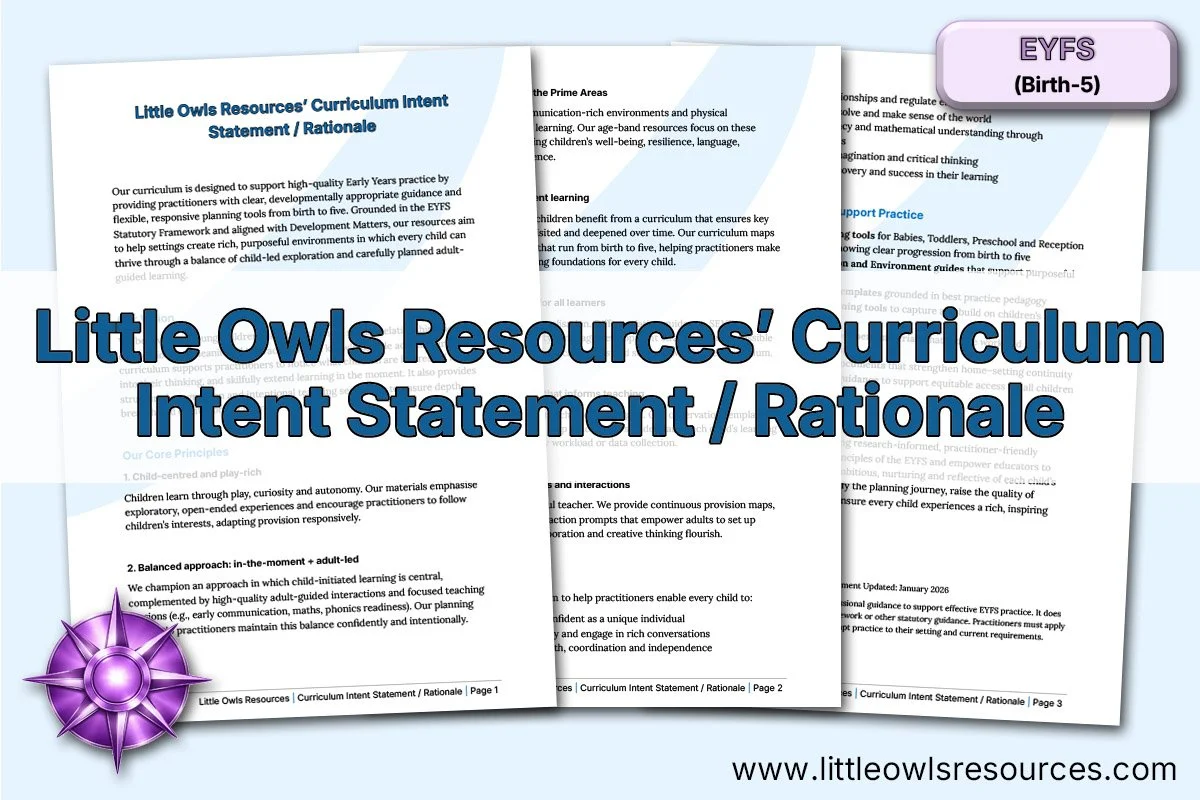
    • Little Owls Resources’ Curriculum Intent Statement

    • EYFS from Birth to 5: Curriculum Coherence & Pedagogical Throughline

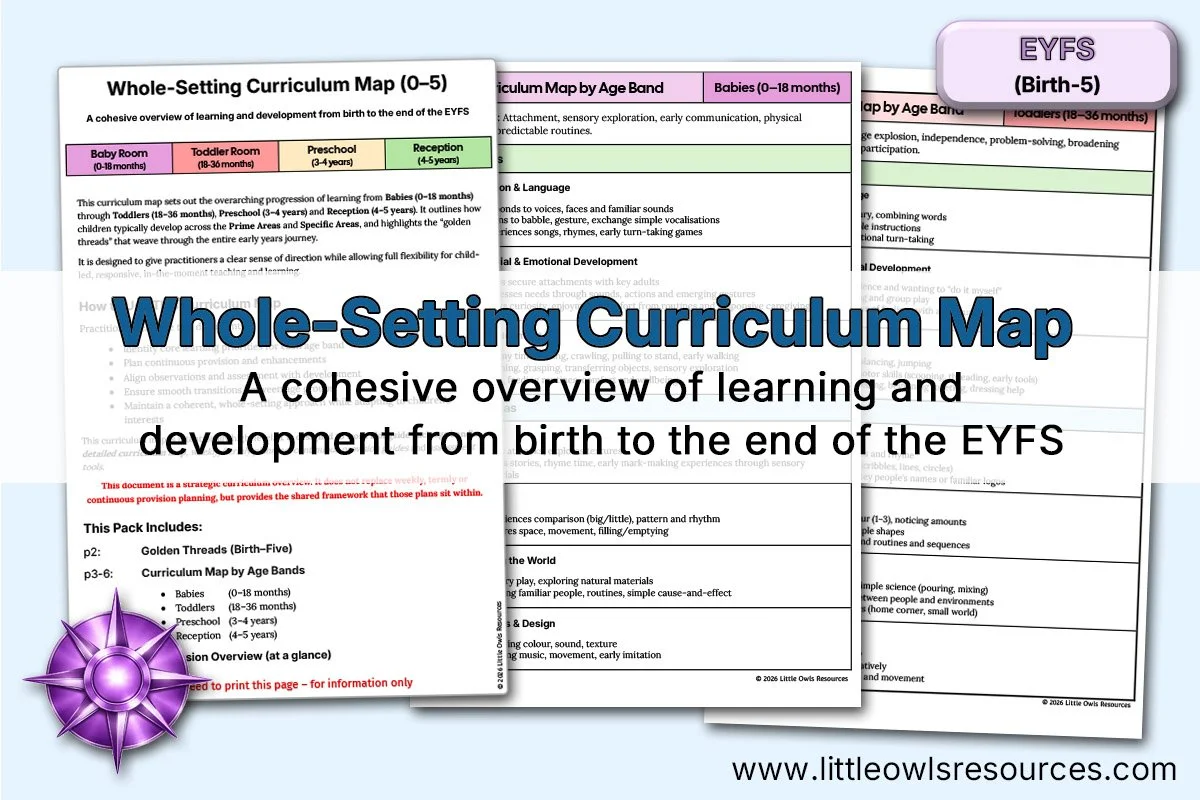
    • Whole-Setting Curriculum Map (Birth-5): Curriculum Intent & Progression

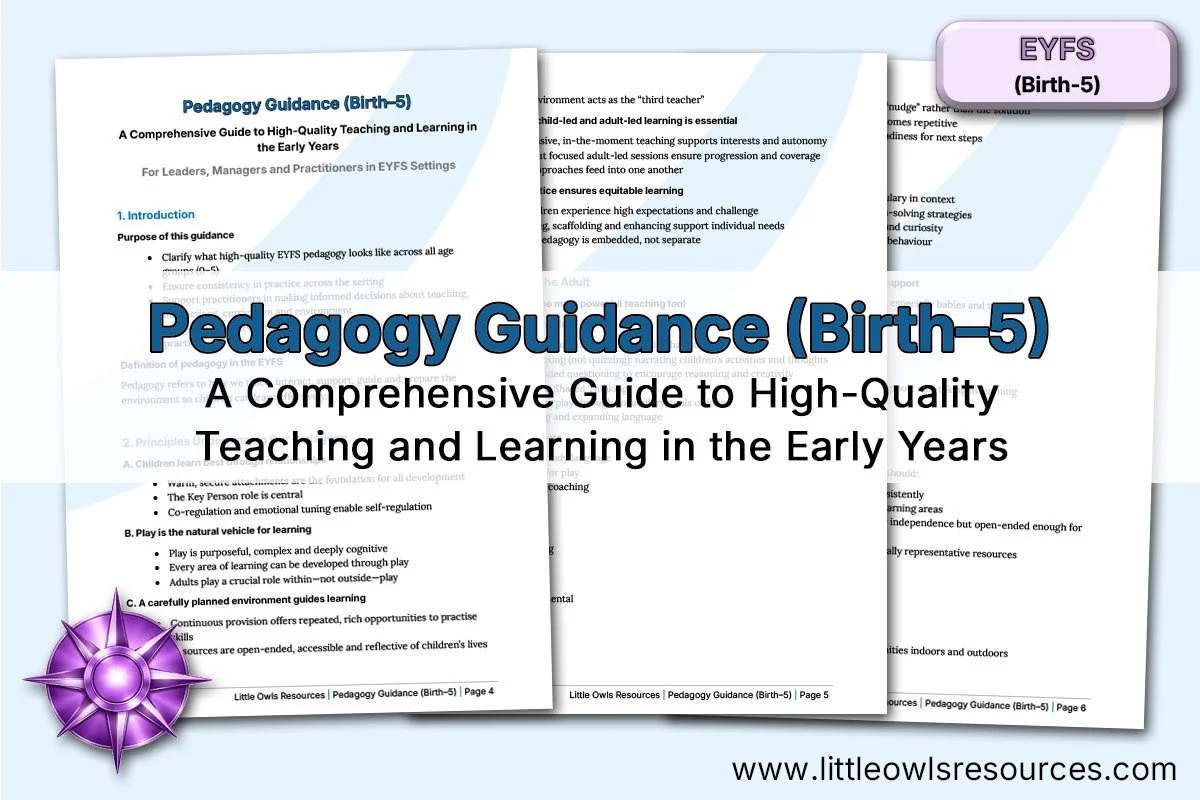
    • Pedagogy Guidance Document

    • Speech & Language Development - Setting Statement

    • EYFS Inspection-Facing Summaries

  • Early Years Schemas - Practitioner Toolkit | EYFS Birth-5

    ↪ Schema Cards (definition, behaviours, age-related examples, enabling resources)

    ↪ Schema Observation & Responsive Provision Planning Template

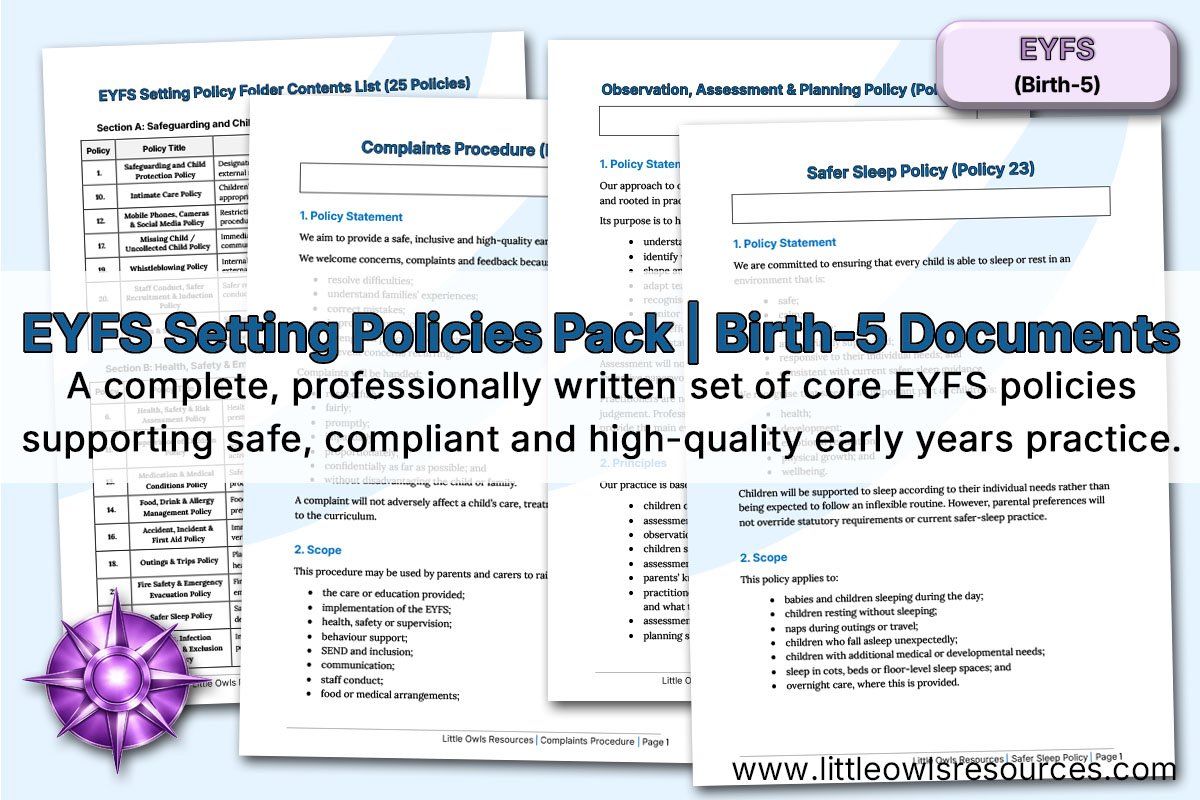
    • EYFS Group Setting Policies Pack

      ↪ x 22 Policy Documents

      ↪ Policy Sign-Off and Confirmation Document

      ↪ EYFS Setting Policy Folder Contents List

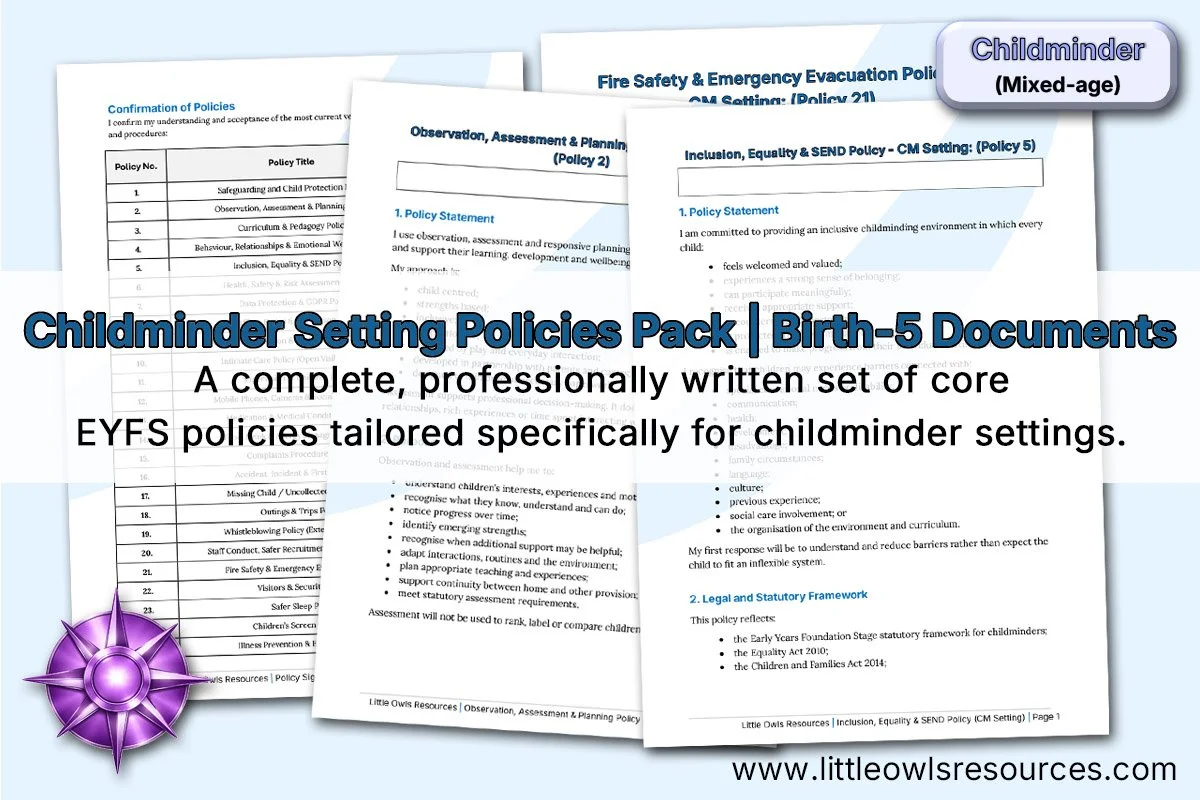
    • Childminder Setting Policies Pack

      ↪ x 22 Policy Documents

      ↪ Childminder Assistant or Volunteer Policy Sign-Off and Confirmation Document

      ↪ Childminder Policy Folder Contents List

  • EYFS Glossary

    ↪ Clear, practitioner-friendly explanations of key curriculum and pedagogy terms used throughout our guidance.


Looking for a different age-group pathway?

Select the pathway that best reflects your role or the age group you work with. You do not need to use everything. (Some practitioners may use more than one pathway.)

Featured
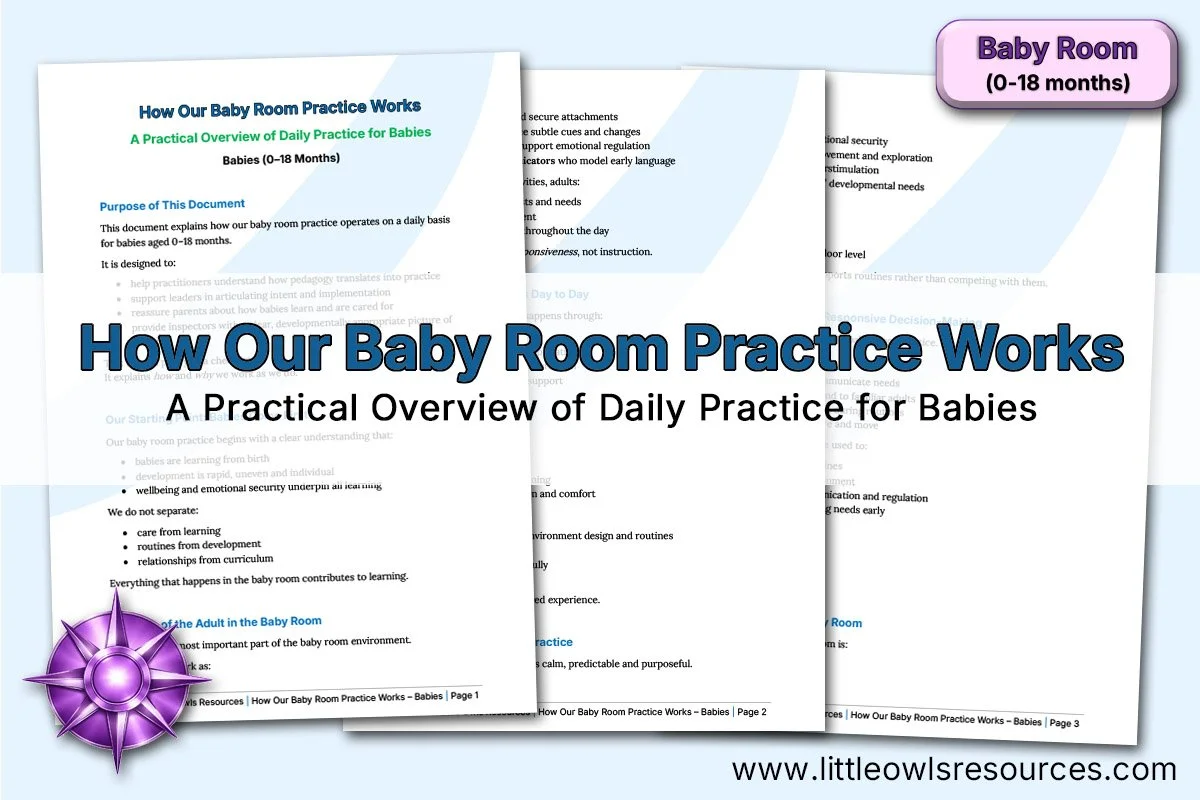
🍼 Babies (0–18 months)

Responsive care, observation and development in the earliest years

🚼 Toddlers (18–36 months)

Development, play and progression in the toddler years

🎨 Preschool (3–4 years)

Curriculum, continuous provision and purposeful teaching

🎓 Reception (4–5 years)

Play-based pedagogy, progression and EYFSP readiness

🏡 Childminders (Birth–5)

Mixed-age pedagogy, planning without overload and inspection confidence


Latest EYFS Articles & Practical Guides | From Our Blog

Stay informed, get expert advice, and find inspiration from our collection of articles and useful external resources, tailored specifically for EYFS practitioners. We regularly publish in-depth articles to support you with current best practices, regulatory changes, and fresh ideas.

EYFS & KS1 Articles
Major UK Curriculum Shake-Up Announced: What EYFS & KS1 Practitioners Need to Know

A major overhaul of the national curriculum in England has been announced following the publication of the independent Curriculum and Assessment Review. For those working in the Early Years Foundation Stage (EYFS) and Key Stage 1 (KS1), the changes signal a renewed focus on practical life skills, digital literacy, and enriching learning experiences…

Read More →
New Education Inspection Framework | What EYFS Settings Need to Know

The world of early years education is constantly evolving, and with it, the frameworks that guide and assess our invaluable work. Come November 2025, a significant shift will occur as the new Education Inspection Framework (EIF) comes into effect, bringing with it some crucial changes…

Read More →
Revised 2025 EYFS Statutory Framework for Group & School-Based Providers | What You Need to Know

With the new 2025 EYFS Statutory Framework for group and school-based providers coming into effect on 1st September 2025, it's essential to understand the updates to ensure your practice remains compliant, effective…

Read More →
DfE Press Release | Parents urged to read more to boost children’s life chances

The Education Secretary is calling on parents to lead by example and make reading a daily habit to help reverse the decline in reading for pleasure, to help give kids the best start in life as part of the…

Read More →
DfE Update | Drowning Prevention Week: what children learn about water safety at school

As we head into summer, it’s especially important that children are prepared with these skills. This year, the Royal Life Saving Society UK's Drowning Prevention Week runs from 14 June to 21…

Read More →
DfE Update | Hot weather and heatwaves: guidance for schools and other education settings

There are several ways that schools can make changes to keep children safe in hot weather, especially as children are more at risk of becoming ill with heat-related issues than adults…

Read More →
 

Are you looking for a specific resource or document for your provision?

Use our 🔍 SEARCH Bar located at the top of every page.


Content within the EYFS Curriculum & Pedagogy Membership is provided as professional guidance and support. It reflects current understanding of the EYFS statutory framework, Development Matters and inspection expectations at the time of writing. Practitioners are responsible for applying professional judgement and ensuring practice aligns with current statutory requirements and their specific context.

Updated: January 2026

 
In Preschool | 3-4 Years, Curriculum, Areas of Learning, AoL-Literacy Tags Preschool Skills Progression Ladder - Early Reading (Phase 1 Readiness), Preschool

Preschool Skills Progression Ladder - Communication & Language

January 18, 2026 Stuart Murphy

Home › EYFS Curriculum & Pedagogy › Preschool Curriculum & Pedagogy › Preschool Skills Progression Ladder: Communication & Language (Overview)


Skills Progression Ladder – Communication & Language

Preschool (3–4 Years)

A practical progression tool supporting listening, understanding, vocabulary and conversation through play-based EYFS practice.

Download Document Here:

 
Download DOCX 📝
Download PDF 📄
 

Document Updated: January 2026


Recommended next read Selection
EYFS
Strength-Based Progress Overview | Preschool 3-4 Years (Overview)

A strengths-led overview supporting observation, reflection and meaningful next steps in a play-based EYFS environment.

Read More →
Preschool Skills Progression Ladder: Fine Motor & Hand Control (Overview)

A developmentally informed progression tool supporting strength, control and confidence in early fine motor development.

Read More →
Preschool Skills Progression Ladder: PSED - Self-Regulation & Relationships (Overview)

A play-based progression tool supporting deep number understanding through real-world EYFS practice.

Read More →
Preschool Skills Progression Ladder: Early Maths - Pattern, Shape & Spatial Awareness (Overview)

A play-based progression tool supporting exploration of shape and pattern by building, rotating, navigating, transforming and describing.

Read More →
Preschool Skills Progression Ladder: Early Maths - Subitising, Counting & Comparing (Overview)

A play-based progression tool supporting deep number understanding through real-world EYFS practice.

Read More →
Preschool Skills Progression Ladder: Early Writing (Overview)

A developmentally grounded progression tool supporting early writing from mark-making to name writing.

Read More →
Preschool Skills Progression Ladder: Early Reading (Phase 1 Readiness) (Overview)

A play-based progression tool supporting the foundations for early reading before formal phonics.

Read More →
Preschool Skills Progression Ladder: Communication & Language (Overview)

A practical progression tool supporting listening, understanding, vocabulary and conversation through play-based EYFS practice.

Read More →
Preschool (3–4 Years) Curriculum Map by Term (Overview)

A play-based, language-rich overview of learning priorities across the Preschool year.

Read More →
Preschool Curriculum: Intent, Implementation & Impact | Ofsted Conversation Statement

A clear, inspection-ready articulation of Preschool curriculum design, delivery and impact.

Read More →
 

Additional Documents | Professional Membership Contents (Preschool 3-4 Years)

Navigate our Curriculum & Pedagogy guidance documents here.

Pedagogical identity:
Broad, play-based, theme-led curriculum with purposeful adult input and strong continuous provision.

  • 👉 Pre-planning orientation.

    • Preschool Pedagogy Position Statement

    • Preschool Curriculum Overview & Rationale

    • Curriculum Overview: How Themes Fit Together (6 Main + 8 Mini)

    • What Child-Led Does Not Mean

    • Adult-Led With Purpose in Preschool

  • 👉 Big-picture curriculum intent and progression.

    • Preschool Curriculum Map (By Term)

    • Skills Progression Ladders (3–4 Years) - Including Practitioner Guidance

      ↪ Communication & Language

      ↪ Early Reading (Phase 1 Readiness)

      ↪ Early Writing

      ↪ Early Maths - Subitising, Counting & Comparing

      ↪ Early Maths - Pattern, Shape & Spatial Awareness

      ↪ PSED - Self-Regulation & Relationships

      ↪ Fine Motor & Hand Control

    • Strength-Based Progress Overview

    • Our Preschool Curriculum Intent, Implementation & Impact - OFSTED Conversation Statement

  • 👉 Theme-led planning lives here.

    • Curriculum Overview | How Themes Fit Together

    • Preschool Theme Packs – FAQs

    • How Practitioners Use This Curriculum Daily

    Core Preschool Themes (6 Weeks Each)

    • ‍Autumn 1: This Is Me

    • Autumn 2: Who Helps When…?

    • Spring 1: Journeys & Transport

    • Spring 2: Animals & Habitats

    • Summer 1: Growing & Changing

    • Summer 2: Water World

    Optional Mini-Themes (1–2 Weeks)

    • Space

    • Dinosaurs & the Mystery Egg

    • Pets & Vets

    • Building & Construction

    • Traditional Tales

    • Beaches & Coastlines

    • Healthy Bodies & Wellbeing

    • Celebrations Around the World

  • 👉 The engine room of daily practice.

    • Universal Continuous Provision Packs (Preschool | 3–4 Years)

      • Construction Area

      • Small World Area

      • Role-Play Area

      • Writing / Mark-Making Area

      • Maths Area

      • Creative Area (Art & Making)

      • Investigation / STEM / Discovery Area

      • Book Corner / Reading Den

      • Fine Motor Station

      • Water Area

      • Sand Area

      • Snack Area / Independence Station

      • Outdoor Provision Core Zones

        • Physical play

        • Gross motor skills

        • Nature area

        • Outdoor mark-making

        • Outdoor maths

    • Preschool Environment & Provision Map Audit Pack

    • How Continuous Provision Works in Our Preschool Curriculum

    • Continuous Provision Audit Checklist

    • Continuous Provision FAQs (For Preschool Practitioners)

  • 👉 Purposeful adult input without formalisation.

    Early Reading & Phonics

    • Phonics & Early Reading Pack

    • Phase 1, Vocabulary & Early Comprehension, Curriculum System (24 Sessions)

      • 8 themed sets covering all aspects of Phase 1

      • 24 mini session plans

      • Vocabulary & story-building scaffolds

      • Outdoor phonological play ideas

      • SEND & EAL accessible sessions

      • Theme-linked sessions (Transport, Animals, Growth)

      • Assessment & observation prompts

      • Continuous Provision follow-up suggestions

    • Adult-Led Session Templates

    • Practitioner FAQs

    Maths

    • Maths Small Group Session Bank (24 Sessions)

      • Strand A - Subitising (Sessions 1-4)

      • Strand B - Counting Principles (Sessions 5-8)

      • Strand C - Comparing Quantites (Sessions 9-12)

      • Strand D - Composition of Number (Sessions 13-16)

      • Strand E - Spatial & Shape (Sessions 17-20)

      • Strand F - Measures & Pattern (Sessions 21-24)

    • How To Use Our Maths Session Bank & Strand Overview (A–F)

    • Adult-Led Session Templates

    • Practitioner FAQs

    Writing & Fine Motor

    • Fine Motor & Mark Making Mini Sessions (18)

      • How To Use Our Fine Motor & Mark Making Mini Sessions Bank

      • Strand A - Core & Shoulder Stability (Sessions 1-3)

      • Strand B - Wrist Rotation & Fluidity (Sessions 4-6)

      • Strand C - Pincer, Pinch & Tool Control (Sessions 7-10)

      • Strand D - Early Pattern Making: Pre-Writing Shapes (Sessions 11-18)

    • Early Writing Purpose Mini Sessions (6)

      • How To Use Our Early Writing Purpose Mini Sessions Bank

      • Lists

      • Labels

      • Messages

      • Maps

      • Signs

      • Tickets & Recipes

    • How These Two Session Banks Are Designed To Work Together

  • 👉 High-impact interaction guidance.

    • How We Talk to Children

    • Five Sentence Stems For Preschool Practitioners

    • If Interest Sparks — What Happens Next?

    • Preschool Staff Guidance Posters

  • 👉 Practical planning support.

    • Weekly Planning Templates (2 Versions)

    • How to Use the Preschool Weekly Planning Templates: Guide

    • Adult-Led Session Planning Templates Pack

      • Universal

      • Phonics / Early Language Focus (Listening → Rhyme → Sound Awareness)

      • Maths Focus (Number + Pattern + Shape + Measure)

      • Story & Book Talk Focus (Comprehension → Retell → Vocabulary → Prediction)

      • PSED / Self-Regulation Small Group

  • 👉 Proportionate, non-statutory assessment.

    • Observe–Assess–Plan (OAP) Toolkit - Preschool

    • Assessment Dashboard Pack (3 Versions)

      • Prime Areas Only Dashboard (Communication & Language, PSED, Physical)

      • Full EYFS Areas Dashboard (Prime + Specific)

      • Dashboard with Wellbeing & Involvement Scale (Leuven-inspired 1–5 ratings)

    • Progress Review (3–4 Years)

      • Short & Long Versions

      • Guidance - How To Complete And Share With Families

    • Preschool Report Pack

      • End of Term Template

      • End of Year Template

      • Guidance - How To Write Strength-Based Reports

      • Sentence Starters Bank

  • 👉 Parent Engagement plus Emotional, environmental and communicative transition.

    • Preschool Transition to Reception Pack

      ↪ Child Passport

      ↪ Practitioner-To-Practitioner Handover Summary

      ↪ SEND Transition Sheet

      ↪ Family Transition Summary Sheet

      ↪ Parent Leaflet — “Preparing For Reception”

      ↪ Child Voice Page

      ↪ Guidance Page— “How To Complete & Share Transition Information”

    • Home & Setting Communication

      ↪ Our Preschool Curriculum (Age 3–4) | Parent-Facing Document

      (Additional parent literature within planning documents.)


Additional Whole-Setting Guidance | for Professional Members

Explore our whole-setting guidance below, including overarching curriculum and pedagogy documents, early years schemas and EYFS setting policies.

    • Little Owls Resources’ Curriculum Intent Statement

    • EYFS from Birth to 5: Curriculum Coherence & Pedagogical Throughline

    • Whole-Setting Curriculum Map (Birth-5): Curriculum Intent & Progression

    • Pedagogy Guidance Document

    • Speech & Language Development - Setting Statement

    • EYFS Inspection-Facing Summaries

  • Early Years Schemas - Practitioner Toolkit | EYFS Birth-5

    ↪ Schema Cards (definition, behaviours, age-related examples, enabling resources)

    ↪ Schema Observation & Responsive Provision Planning Template

    • EYFS Group Setting Policies Pack

      ↪ x 22 Policy Documents

      ↪ Policy Sign-Off and Confirmation Document

      ↪ EYFS Setting Policy Folder Contents List

    • Childminder Setting Policies Pack

      ↪ x 22 Policy Documents

      ↪ Childminder Assistant or Volunteer Policy Sign-Off and Confirmation Document

      ↪ Childminder Policy Folder Contents List

  • EYFS Glossary

    ↪ Clear, practitioner-friendly explanations of key curriculum and pedagogy terms used throughout our guidance.


Looking for a different age-group pathway?

Select the pathway that best reflects your role or the age group you work with. You do not need to use everything. (Some practitioners may use more than one pathway.)

Featured
🍼 Babies (0–18 months)

Responsive care, observation and development in the earliest years

🚼 Toddlers (18–36 months)

Development, play and progression in the toddler years

🎨 Preschool (3–4 years)

Curriculum, continuous provision and purposeful teaching

🎓 Reception (4–5 years)

Play-based pedagogy, progression and EYFSP readiness

🏡 Childminders (Birth–5)

Mixed-age pedagogy, planning without overload and inspection confidence


Latest EYFS Articles & Practical Guides | From Our Blog

Stay informed, get expert advice, and find inspiration from our collection of articles and useful external resources, tailored specifically for EYFS practitioners. We regularly publish in-depth articles to support you with current best practices, regulatory changes, and fresh ideas.

EYFS & KS1 Articles
Major UK Curriculum Shake-Up Announced: What EYFS & KS1 Practitioners Need to Know

A major overhaul of the national curriculum in England has been announced following the publication of the independent Curriculum and Assessment Review. For those working in the Early Years Foundation Stage (EYFS) and Key Stage 1 (KS1), the changes signal a renewed focus on practical life skills, digital literacy, and enriching learning experiences…

Read More →
New Education Inspection Framework | What EYFS Settings Need to Know

The world of early years education is constantly evolving, and with it, the frameworks that guide and assess our invaluable work. Come November 2025, a significant shift will occur as the new Education Inspection Framework (EIF) comes into effect, bringing with it some crucial changes…

Read More →
Revised 2025 EYFS Statutory Framework for Group & School-Based Providers | What You Need to Know

With the new 2025 EYFS Statutory Framework for group and school-based providers coming into effect on 1st September 2025, it's essential to understand the updates to ensure your practice remains compliant, effective…

Read More →
DfE Press Release | Parents urged to read more to boost children’s life chances

The Education Secretary is calling on parents to lead by example and make reading a daily habit to help reverse the decline in reading for pleasure, to help give kids the best start in life as part of the…

Read More →
DfE Update | Drowning Prevention Week: what children learn about water safety at school

As we head into summer, it’s especially important that children are prepared with these skills. This year, the Royal Life Saving Society UK's Drowning Prevention Week runs from 14 June to 21…

Read More →
DfE Update | Hot weather and heatwaves: guidance for schools and other education settings

There are several ways that schools can make changes to keep children safe in hot weather, especially as children are more at risk of becoming ill with heat-related issues than adults…

Read More →
 

Are you looking for a specific resource or document for your provision?

Use our 🔍 SEARCH Bar located at the top of every page.


Content within the EYFS Curriculum & Pedagogy Membership is provided as professional guidance and support. It reflects current understanding of the EYFS statutory framework, Development Matters and inspection expectations at the time of writing. Practitioners are responsible for applying professional judgement and ensuring practice aligns with current statutory requirements and their specific context.

Updated: January 2026

 
In Preschool | 3-4 Years, Curriculum, Areas of Learning, AoL-C&L Tags Preschool Skills Progression Ladder - Communication & Language, Preschool

Our Preschool Curriculum (Age 3–4) | Parent-Facing Document

January 18, 2026 Stuart Murphy

Home › EYFS Curriculum & Pedagogy › Preschool Curriculum & Pedagogy › Our Preschool Curriculum (Age 3–4) | Parent-Facing Document (Overview)


Scroll down to read this web document or download files here: DOCX 📝 | PDF 📄

(This document will be available for download by: March 31st 2026)

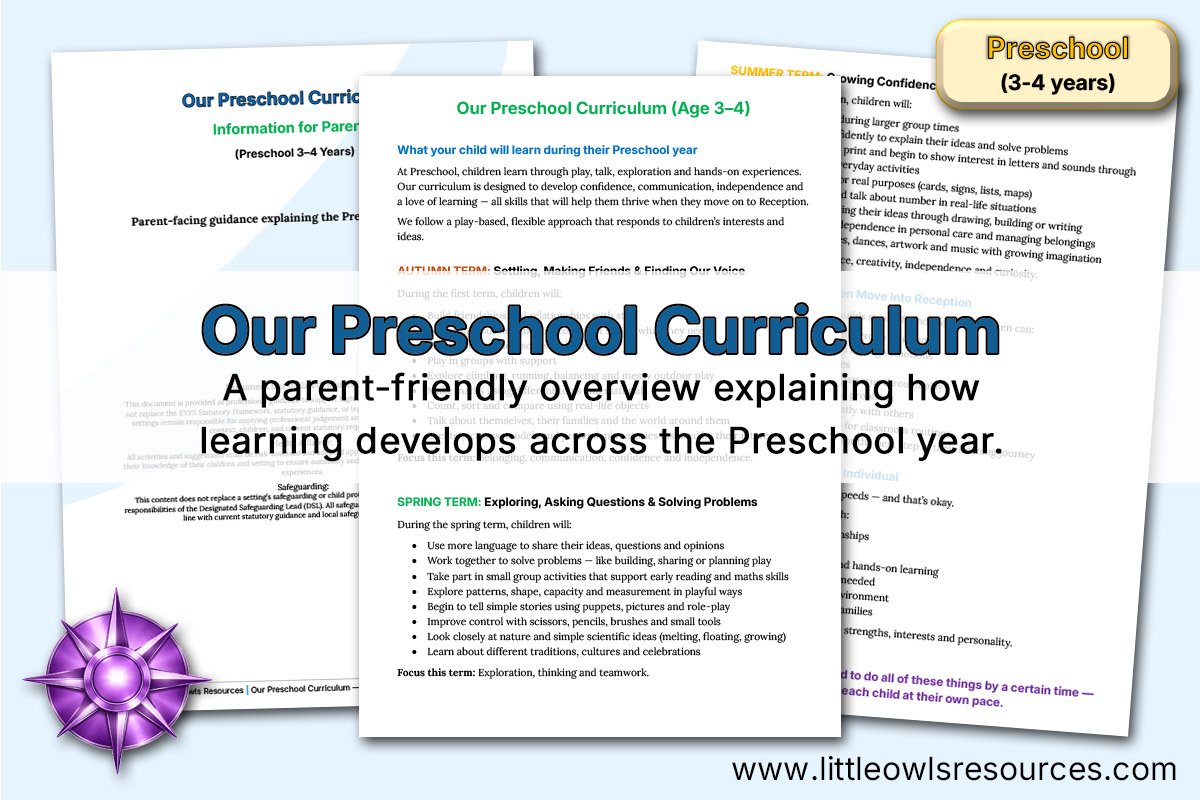
Our Preschool Curriculum (Age 3–4)

What your child will learn during their Preschool year

At Preschool, children learn through play, talk, exploration and hands-on experiences.
Our curriculum is designed to develop confidence, communication, independence and a love of learning — all skills that will help them thrive when they move on to Reception.

We follow a play-based, flexible approach that responds to children’s interests and ideas.

AUTUMN TERM — Settling, Making Friends & Finding Our Voice

During the first term, children will:

  • Build friendships and relationships with staff

  • Learn our routines and feel confident saying what they need

  • Join in with stories, songs and rhymes

  • Play in groups with support

  • Explore climbing, running, balancing and messy outdoor play

  • Make marks using different tools and materials

  • Count, sort and compare using real-life objects

  • Talk about themselves, their families and the world around them

  • Create pictures, models and pretend-play stories inspired by their interests

Focus this term:

Belonging, communication, confidence and independence.

SPRING TERM — Exploring, Asking Questions & Solving Problems

During the spring term, children will:

  • Use more language to share their ideas, questions and opinions

  • Work together to solve problems — like building, sharing or planning play

  • Take part in small group activities that support early reading and maths skills

  • Explore patterns, shape, capacity and measurement in playful ways

  • Begin to tell simple stories using puppets, pictures and role-play

  • Improve control with scissors, pencils, brushes and small tools

  • Look closely at nature and simple scientific ideas (melting, floating, growing)

  • Learn about different traditions, cultures and celebrations

Focus this term:

Exploration, thinking and teamwork.

SUMMER TERM — Growing Confidence & Getting Ready for Reception

During the summer term, children will:

  • Join in and listen during larger group times

  • Use language confidently to explain their ideas and solve problems

  • Recognise familiar print and begin to show interest in letters and sounds through play, stories and everyday activities

  • Use early writing for real purposes (cards, signs, lists, maps)

  • Count, compare and talk about number in real-life situations

  • Have a go at recording their ideas through drawing, building or writing

  • Show increasing independence in personal care and managing belongings

  • Create performances, dances, artwork and music with growing imagination

Focus this term:

Confidence, creativity, independence and curiosity.

How This Helps Children Move Into Reception

Our Preschool curriculum builds strong foundations so children can:

✔ Listen and join in during group learning
✔ Build relationships and manage emotions
✔ Enjoy books and stories
✔ Explore numbers and patterns through play
✔ Make choices and solve problems
✔ Communicate confidently with others
✔ Develop independence for classroom routines
✔ Feel excited and ready for the next step in their learning journey

Every Child’s Progress is Individual

Children develop at different speeds — and that’s okay.

We support every child through:

  • Warm, secure relationships

  • Adapted resources

  • Plenty of repetition and hands-on learning

  • Visual supports when needed

  • A calm, predictable environment

  • Working closely with families

We celebrate each child’s unique strengths, interests and personality.

Children are never expected to do all of these things by a certain time — we support each child at their own pace.

Document Updated: January 2026

Download Document Here:

(This pathway component is currently available to read on the page above and will be available for download by: March 31st 2026)

 
Download DOCX 📝
Download PDF 📄
 

(This document will be available for download by: January 31st 2026)


Recommended next read Selection

EYFS
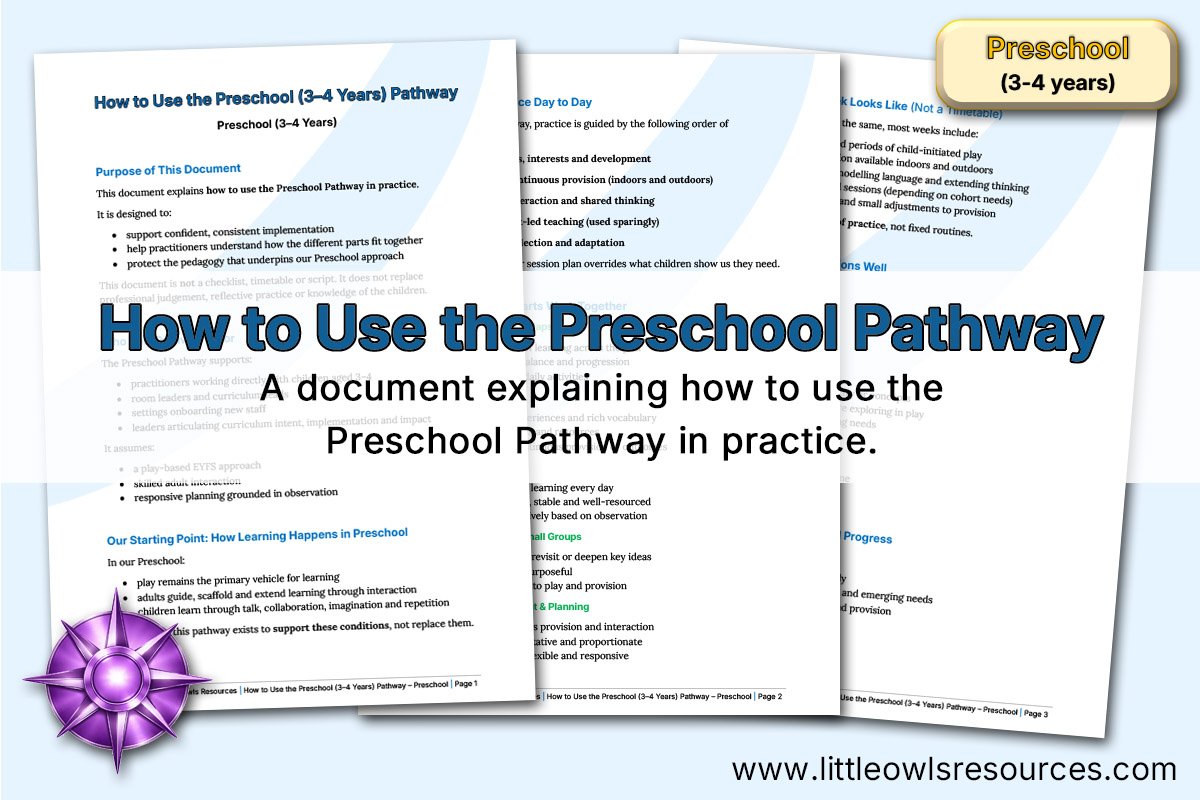
How To Use The Preschool (3-4 Years) Pathway

This document explains how to use the Preschool Pathway in practice.

Read More →
Adult-Led With Purpose Poster | Preschool 3-4 Years

A practitioner guidance poster clarifying intentional, play-based adult-led teaching

Read More →
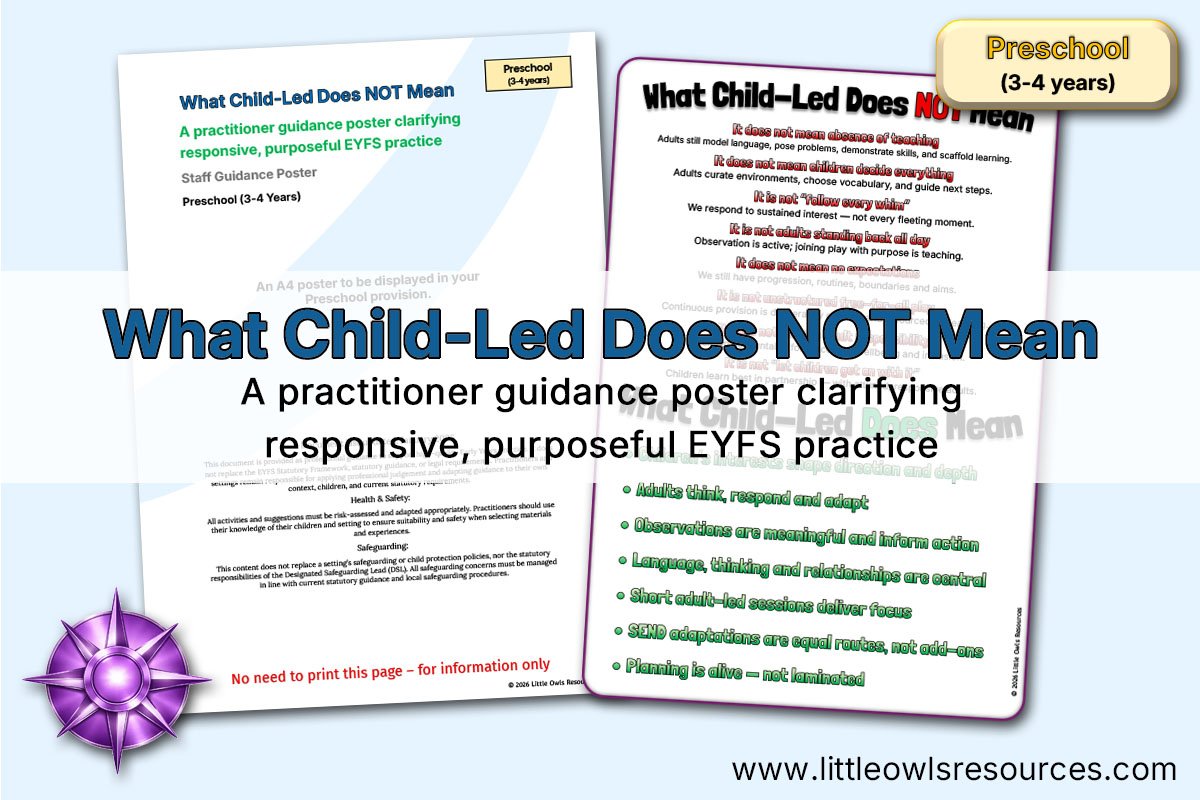
What Child-Led Does NOT Mean Poster | Preschool 3-4 Years

A practitioner guidance poster clarifying responsive, purposeful EYFS practice

Read More →
Strength-Based Progress Overview | Preschool 3-4 Years (Overview)

A strengths-led overview supporting observation, reflection and meaningful next steps in a play-based EYFS environment.

Read More →
Preschool Skills Progression Ladder: Fine Motor & Hand Control (Overview)

A developmentally informed progression tool supporting strength, control and confidence in early fine motor development.

Read More →
Preschool Skills Progression Ladder: PSED - Self-Regulation & Relationships (Overview)

A play-based progression tool supporting deep number understanding through real-world EYFS practice.

Read More →
Preschool Skills Progression Ladder: Early Maths - Pattern, Shape & Spatial Awareness (Overview)

A play-based progression tool supporting exploration of shape and pattern by building, rotating, navigating, transforming and describing.

Read More →
Preschool Skills Progression Ladder: Early Maths - Subitising, Counting & Comparing (Overview)

A play-based progression tool supporting deep number understanding through real-world EYFS practice.

Read More →
Preschool Skills Progression Ladder: Early Writing (Overview)

A developmentally grounded progression tool supporting early writing from mark-making to name writing.

Read More →
Preschool Skills Progression Ladder: Early Reading (Phase 1 Readiness) (Overview)

A play-based progression tool supporting the foundations for early reading before formal phonics.

Read More →
Preschool Skills Progression Ladder: Communication & Language (Overview)

A practical progression tool supporting listening, understanding, vocabulary and conversation through play-based EYFS practice.

Read More →
Preschool (3–4 Years) Curriculum Map by Term (Overview)

A play-based, language-rich overview of learning priorities across the Preschool year.

Read More →
Preschool Curriculum: Intent, Implementation & Impact | Ofsted Conversation Statement

A clear, inspection-ready articulation of Preschool curriculum design, delivery and impact.

Read More →
Preschool (3–4 Years) Curriculum Overview | How Themes Fit Together (Overview)

A full-year, responsive EYFS planning framework

Read More →
Preschool Pedagogy Position Statement | 3-4 Years

How Children Learn in Preschool (3–4 Years)

Read More →
Preschool Curriculum Overview & Rationale | 3-4 Years

(Preschool | Ages 3–4 Years)

Read More →
 

Additional Documents | Professional Membership Contents (Preschool 3-4 Years)

Navigate our Curriculum & Pedagogy guidance documents here.

Pedagogical identity:
Broad, play-based, theme-led curriculum with purposeful adult input and strong continuous provision.

  • 👉 Pre-planning orientation.

    • Preschool Pedagogy Position Statement

    • Preschool Curriculum Overview & Rationale

    • Curriculum Overview: How Themes Fit Together (6 Main + 8 Mini)

    • What Child-Led Does Not Mean

    • Adult-Led With Purpose in Preschool

  • 👉 Big-picture curriculum intent and progression.

    • Preschool Curriculum Map (By Term)

    • Skills Progression Ladders (3–4 Years) - Including Practitioner Guidance

      ↪ Communication & Language

      ↪ Early Reading (Phase 1 Readiness)

      ↪ Early Writing

      ↪ Early Maths - Subitising, Counting & Comparing

      ↪ Early Maths - Pattern, Shape & Spatial Awareness

      ↪ PSED - Self-Regulation & Relationships

      ↪ Fine Motor & Hand Control

    • Strength-Based Progress Overview

    • Our Preschool Curriculum Intent, Implementation & Impact - OFSTED Conversation Statement

  • 👉 Theme-led planning lives here.

    • Curriculum Overview | How Themes Fit Together

    • Preschool Theme Packs – FAQs

    • How Practitioners Use This Curriculum Daily

    Core Preschool Themes (6 Weeks Each)

    • ‍Autumn 1: This Is Me

    • Autumn 2: Who Helps When…?

    • Spring 1: Journeys & Transport

    • Spring 2: Animals & Habitats

    • Summer 1: Growing & Changing

    • Summer 2: Water World

    Optional Mini-Themes (1–2 Weeks)

    • Space

    • Dinosaurs & the Mystery Egg

    • Pets & Vets

    • Building & Construction

    • Traditional Tales

    • Beaches & Coastlines

    • Healthy Bodies & Wellbeing

    • Celebrations Around the World

  • 👉 The engine room of daily practice.

    • Universal Continuous Provision Packs (Preschool | 3–4 Years)

      • Construction Area

      • Small World Area

      • Role-Play Area

      • Writing / Mark-Making Area

      • Maths Area

      • Creative Area (Art & Making)

      • Investigation / STEM / Discovery Area

      • Book Corner / Reading Den

      • Fine Motor Station

      • Water Area

      • Sand Area

      • Snack Area / Independence Station

      • Outdoor Provision Core Zones

        • Physical play

        • Gross motor skills

        • Nature area

        • Outdoor mark-making

        • Outdoor maths

    • Preschool Environment & Provision Map Audit Pack

    • How Continuous Provision Works in Our Preschool Curriculum

    • Continuous Provision Audit Checklist

    • Continuous Provision FAQs (For Preschool Practitioners)

  • 👉 Purposeful adult input without formalisation.

    Early Reading & Phonics

    • Phonics & Early Reading Pack

    • Phase 1, Vocabulary & Early Comprehension, Curriculum System (24 Sessions)

      • 8 themed sets covering all aspects of Phase 1

      • 24 mini session plans

      • Vocabulary & story-building scaffolds

      • Outdoor phonological play ideas

      • SEND & EAL accessible sessions

      • Theme-linked sessions (Transport, Animals, Growth)

      • Assessment & observation prompts

      • Continuous Provision follow-up suggestions

    • Adult-Led Session Templates

    • Practitioner FAQs

    Maths

    • Maths Small Group Session Bank (24 Sessions)

      • Strand A - Subitising (Sessions 1-4)

      • Strand B - Counting Principles (Sessions 5-8)

      • Strand C - Comparing Quantites (Sessions 9-12)

      • Strand D - Composition of Number (Sessions 13-16)

      • Strand E - Spatial & Shape (Sessions 17-20)

      • Strand F - Measures & Pattern (Sessions 21-24)

    • How To Use Our Maths Session Bank & Strand Overview (A–F)

    • Adult-Led Session Templates

    • Practitioner FAQs

    Writing & Fine Motor

    • Fine Motor & Mark Making Mini Sessions (18)

      • How To Use Our Fine Motor & Mark Making Mini Sessions Bank

      • Strand A - Core & Shoulder Stability (Sessions 1-3)

      • Strand B - Wrist Rotation & Fluidity (Sessions 4-6)

      • Strand C - Pincer, Pinch & Tool Control (Sessions 7-10)

      • Strand D - Early Pattern Making: Pre-Writing Shapes (Sessions 11-18)

    • Early Writing Purpose Mini Sessions (6)

      • How To Use Our Early Writing Purpose Mini Sessions Bank

      • Lists

      • Labels

      • Messages

      • Maps

      • Signs

      • Tickets & Recipes

    • How These Two Session Banks Are Designed To Work Together

  • 👉 High-impact interaction guidance.

    • How We Talk to Children

    • Five Sentence Stems For Preschool Practitioners

    • If Interest Sparks — What Happens Next?

    • Preschool Staff Guidance Posters

  • 👉 Practical planning support.

    • Weekly Planning Templates (2 Versions)

    • How to Use the Preschool Weekly Planning Templates: Guide

    • Adult-Led Session Planning Templates Pack

      • Universal

      • Phonics / Early Language Focus (Listening → Rhyme → Sound Awareness)

      • Maths Focus (Number + Pattern + Shape + Measure)

      • Story & Book Talk Focus (Comprehension → Retell → Vocabulary → Prediction)

      • PSED / Self-Regulation Small Group

  • 👉 Proportionate, non-statutory assessment.

    • Observe–Assess–Plan (OAP) Toolkit - Preschool

    • Assessment Dashboard Pack (3 Versions)

      • Prime Areas Only Dashboard (Communication & Language, PSED, Physical)

      • Full EYFS Areas Dashboard (Prime + Specific)

      • Dashboard with Wellbeing & Involvement Scale (Leuven-inspired 1–5 ratings)

    • Progress Review (3–4 Years)

      • Short & Long Versions

      • Guidance - How To Complete And Share With Families

    • Preschool Report Pack

      • End of Term Template

      • End of Year Template

      • Guidance - How To Write Strength-Based Reports

      • Sentence Starters Bank

  • 👉 Parent Engagement plus Emotional, environmental and communicative transition.

    • Preschool Transition to Reception Pack

      ↪ Child Passport

      ↪ Practitioner-To-Practitioner Handover Summary

      ↪ SEND Transition Sheet

      ↪ Family Transition Summary Sheet

      ↪ Parent Leaflet — “Preparing For Reception”

      ↪ Child Voice Page

      ↪ Guidance Page— “How To Complete & Share Transition Information”

    • Home & Setting Communication

      ↪ Our Preschool Curriculum (Age 3–4) | Parent-Facing Document

      (Additional parent literature within planning documents.)


Additional Whole-Setting Guidance | for Professional Members

Explore our whole-setting guidance below, including overarching curriculum and pedagogy documents, early years schemas and EYFS setting policies.

    • Little Owls Resources’ Curriculum Intent Statement

    • EYFS from Birth to 5: Curriculum Coherence & Pedagogical Throughline

    • Whole-Setting Curriculum Map (Birth-5): Curriculum Intent & Progression

    • Pedagogy Guidance Document

    • Speech & Language Development - Setting Statement

    • EYFS Inspection-Facing Summaries

  • Early Years Schemas - Practitioner Toolkit | EYFS Birth-5

    ↪ Schema Cards (definition, behaviours, age-related examples, enabling resources)

    ↪ Schema Observation & Responsive Provision Planning Template

    • EYFS Group Setting Policies Pack

      ↪ x 22 Policy Documents

      ↪ Policy Sign-Off and Confirmation Document

      ↪ EYFS Setting Policy Folder Contents List

    • Childminder Setting Policies Pack

      ↪ x 22 Policy Documents

      ↪ Childminder Assistant or Volunteer Policy Sign-Off and Confirmation Document

      ↪ Childminder Policy Folder Contents List

  • EYFS Glossary

    ↪ Clear, practitioner-friendly explanations of key curriculum and pedagogy terms used throughout our guidance.


Looking for a different age-group pathway?

Select the pathway that best reflects your role or the age group you work with. You do not need to use everything. (Some practitioners may use more than one pathway.)

Featured
🍼 Babies (0–18 months)

Responsive care, observation and development in the earliest years

🚼 Toddlers (18–36 months)

Development, play and progression in the toddler years

🎨 Preschool (3–4 years)

Curriculum, continuous provision and purposeful teaching

🎓 Reception (4–5 years)

Play-based pedagogy, progression and EYFSP readiness

🏡 Childminders (Birth–5)

Mixed-age pedagogy, planning without overload and inspection confidence


Latest EYFS Articles & Practical Guides | From Our Blog

Stay informed, get expert advice, and find inspiration from our collection of articles and useful external resources, tailored specifically for EYFS practitioners. We regularly publish in-depth articles to support you with current best practices, regulatory changes, and fresh ideas.

EYFS & KS1 Articles
Major UK Curriculum Shake-Up Announced: What EYFS & KS1 Practitioners Need to Know

A major overhaul of the national curriculum in England has been announced following the publication of the independent Curriculum and Assessment Review. For those working in the Early Years Foundation Stage (EYFS) and Key Stage 1 (KS1), the changes signal a renewed focus on practical life skills, digital literacy, and enriching learning experiences…

Read More →
New Education Inspection Framework | What EYFS Settings Need to Know

The world of early years education is constantly evolving, and with it, the frameworks that guide and assess our invaluable work. Come November 2025, a significant shift will occur as the new Education Inspection Framework (EIF) comes into effect, bringing with it some crucial changes…

Read More →
Revised 2025 EYFS Statutory Framework for Group & School-Based Providers | What You Need to Know

With the new 2025 EYFS Statutory Framework for group and school-based providers coming into effect on 1st September 2025, it's essential to understand the updates to ensure your practice remains compliant, effective…

Read More →
DfE Press Release | Parents urged to read more to boost children’s life chances

The Education Secretary is calling on parents to lead by example and make reading a daily habit to help reverse the decline in reading for pleasure, to help give kids the best start in life as part of the…

Read More →
DfE Update | Drowning Prevention Week: what children learn about water safety at school

As we head into summer, it’s especially important that children are prepared with these skills. This year, the Royal Life Saving Society UK's Drowning Prevention Week runs from 14 June to 21…

Read More →
DfE Update | Hot weather and heatwaves: guidance for schools and other education settings

There are several ways that schools can make changes to keep children safe in hot weather, especially as children are more at risk of becoming ill with heat-related issues than adults…

Read More →
 

Are you looking for a specific resource or document for your provision?

Use our 🔍 SEARCH Bar located at the top of every page.


Content within the EYFS Curriculum & Pedagogy Membership is provided as professional guidance and support. It reflects current understanding of the EYFS statutory framework, Development Matters and inspection expectations at the time of writing. Practitioners are responsible for applying professional judgement and ensuring practice aligns with current statutory requirements and their specific context.

Updated: January 2026

 
In Preschool | 3-4 Years, Curriculum, Inspection Support Tags Preschool (3–4 Years) Curriculum Map by Term, Preschool

Preschool (3–4 Years) Curriculum Map by Term

January 18, 2026 Stuart Murphy

Home › EYFS Curriculum & Pedagogy › Preschool Curriculum & Pedagogy › Preschool (3–4 Years) Curriculum Map by Term (Overview)


Preschool (3–4 Years) Curriculum Map by Term

A play-based, language-rich overview of learning priorities across the Preschool year.

Download Document Here:

(This pathway component will be available for download by: March 31st 2026)

 
Download DOCX 📝
Download PDF 📄
 

Document Updated: January 2026


Recommended next read Selection
EYFS
How To Use The Preschool (3-4 Years) Pathway

This document explains how to use the Preschool Pathway in practice.

Read More →
Adult-Led With Purpose Poster | Preschool 3-4 Years

A practitioner guidance poster clarifying intentional, play-based adult-led teaching

Read More →
What Child-Led Does NOT Mean Poster | Preschool 3-4 Years

A practitioner guidance poster clarifying responsive, purposeful EYFS practice

Read More →
Strength-Based Progress Overview | Preschool 3-4 Years (Overview)

A strengths-led overview supporting observation, reflection and meaningful next steps in a play-based EYFS environment.

Read More →
Preschool Skills Progression Ladder: Fine Motor & Hand Control (Overview)

A developmentally informed progression tool supporting strength, control and confidence in early fine motor development.

Read More →
Preschool Skills Progression Ladder: PSED - Self-Regulation & Relationships (Overview)

A play-based progression tool supporting deep number understanding through real-world EYFS practice.

Read More →
Preschool Skills Progression Ladder: Early Maths - Pattern, Shape & Spatial Awareness (Overview)

A play-based progression tool supporting exploration of shape and pattern by building, rotating, navigating, transforming and describing.

Read More →
Preschool Skills Progression Ladder: Early Maths - Subitising, Counting & Comparing (Overview)

A play-based progression tool supporting deep number understanding through real-world EYFS practice.

Read More →
Preschool Skills Progression Ladder: Early Writing (Overview)

A developmentally grounded progression tool supporting early writing from mark-making to name writing.

Read More →
Preschool Skills Progression Ladder: Early Reading (Phase 1 Readiness) (Overview)

A play-based progression tool supporting the foundations for early reading before formal phonics.

Read More →
Preschool Skills Progression Ladder: Communication & Language (Overview)

A practical progression tool supporting listening, understanding, vocabulary and conversation through play-based EYFS practice.

Read More →
Preschool (3–4 Years) Curriculum Map by Term (Overview)

A play-based, language-rich overview of learning priorities across the Preschool year.

Read More →
Preschool Curriculum: Intent, Implementation & Impact | Ofsted Conversation Statement

A clear, inspection-ready articulation of Preschool curriculum design, delivery and impact.

Read More →
Preschool (3–4 Years) Curriculum Overview | How Themes Fit Together (Overview)

A full-year, responsive EYFS planning framework

Read More →
Preschool Pedagogy Position Statement | 3-4 Years

How Children Learn in Preschool (3–4 Years)

Read More →
Preschool Curriculum Overview & Rationale | 3-4 Years

(Preschool | Ages 3–4 Years)

Read More →
 

Additional Documents | Professional Membership Contents (Preschool 3-4 Years)

Navigate our Curriculum & Pedagogy guidance documents here.

Pedagogical identity:
Broad, play-based, theme-led curriculum with purposeful adult input and strong continuous provision.

  • 👉 Pre-planning orientation.

    • Preschool Pedagogy Position Statement

    • Preschool Curriculum Overview & Rationale

    • Curriculum Overview: How Themes Fit Together (6 Main + 8 Mini)

    • What Child-Led Does Not Mean

    • Adult-Led With Purpose in Preschool

  • 👉 Big-picture curriculum intent and progression.

    • Preschool Curriculum Map (By Term)

    • Skills Progression Ladders (3–4 Years) - Including Practitioner Guidance

      ↪ Communication & Language

      ↪ Early Reading (Phase 1 Readiness)

      ↪ Early Writing

      ↪ Early Maths - Subitising, Counting & Comparing

      ↪ Early Maths - Pattern, Shape & Spatial Awareness

      ↪ PSED - Self-Regulation & Relationships

      ↪ Fine Motor & Hand Control

    • Strength-Based Progress Overview

    • Our Preschool Curriculum Intent, Implementation & Impact - OFSTED Conversation Statement

  • 👉 Theme-led planning lives here.

    • Curriculum Overview | How Themes Fit Together

    • Preschool Theme Packs – FAQs

    • How Practitioners Use This Curriculum Daily

    Core Preschool Themes (6 Weeks Each)

    • ‍Autumn 1: This Is Me

    • Autumn 2: Who Helps When…?

    • Spring 1: Journeys & Transport

    • Spring 2: Animals & Habitats

    • Summer 1: Growing & Changing

    • Summer 2: Water World

    Optional Mini-Themes (1–2 Weeks)

    • Space

    • Dinosaurs & the Mystery Egg

    • Pets & Vets

    • Building & Construction

    • Traditional Tales

    • Beaches & Coastlines

    • Healthy Bodies & Wellbeing

    • Celebrations Around the World

  • 👉 The engine room of daily practice.

    • Universal Continuous Provision Packs (Preschool | 3–4 Years)

      • Construction Area

      • Small World Area

      • Role-Play Area

      • Writing / Mark-Making Area

      • Maths Area

      • Creative Area (Art & Making)

      • Investigation / STEM / Discovery Area

      • Book Corner / Reading Den

      • Fine Motor Station

      • Water Area

      • Sand Area

      • Snack Area / Independence Station

      • Outdoor Provision Core Zones

        • Physical play

        • Gross motor skills

        • Nature area

        • Outdoor mark-making

        • Outdoor maths

    • Preschool Environment & Provision Map Audit Pack

    • How Continuous Provision Works in Our Preschool Curriculum

    • Continuous Provision Audit Checklist

    • Continuous Provision FAQs (For Preschool Practitioners)

  • 👉 Purposeful adult input without formalisation.

    Early Reading & Phonics

    • Phonics & Early Reading Pack

    • Phase 1, Vocabulary & Early Comprehension, Curriculum System (24 Sessions)

      • 8 themed sets covering all aspects of Phase 1

      • 24 mini session plans

      • Vocabulary & story-building scaffolds

      • Outdoor phonological play ideas

      • SEND & EAL accessible sessions

      • Theme-linked sessions (Transport, Animals, Growth)

      • Assessment & observation prompts

      • Continuous Provision follow-up suggestions

    • Adult-Led Session Templates

    • Practitioner FAQs

    Maths

    • Maths Small Group Session Bank (24 Sessions)

      • Strand A - Subitising (Sessions 1-4)

      • Strand B - Counting Principles (Sessions 5-8)

      • Strand C - Comparing Quantites (Sessions 9-12)

      • Strand D - Composition of Number (Sessions 13-16)

      • Strand E - Spatial & Shape (Sessions 17-20)

      • Strand F - Measures & Pattern (Sessions 21-24)

    • How To Use Our Maths Session Bank & Strand Overview (A–F)

    • Adult-Led Session Templates

    • Practitioner FAQs

    Writing & Fine Motor

    • Fine Motor & Mark Making Mini Sessions (18)

      • How To Use Our Fine Motor & Mark Making Mini Sessions Bank

      • Strand A - Core & Shoulder Stability (Sessions 1-3)

      • Strand B - Wrist Rotation & Fluidity (Sessions 4-6)

      • Strand C - Pincer, Pinch & Tool Control (Sessions 7-10)

      • Strand D - Early Pattern Making: Pre-Writing Shapes (Sessions 11-18)

    • Early Writing Purpose Mini Sessions (6)

      • How To Use Our Early Writing Purpose Mini Sessions Bank

      • Lists

      • Labels

      • Messages

      • Maps

      • Signs

      • Tickets & Recipes

    • How These Two Session Banks Are Designed To Work Together

  • 👉 High-impact interaction guidance.

    • How We Talk to Children

    • Five Sentence Stems For Preschool Practitioners

    • If Interest Sparks — What Happens Next?

    • Preschool Staff Guidance Posters

  • 👉 Practical planning support.

    • Weekly Planning Templates (2 Versions)

    • How to Use the Preschool Weekly Planning Templates: Guide

    • Adult-Led Session Planning Templates Pack

      • Universal

      • Phonics / Early Language Focus (Listening → Rhyme → Sound Awareness)

      • Maths Focus (Number + Pattern + Shape + Measure)

      • Story & Book Talk Focus (Comprehension → Retell → Vocabulary → Prediction)

      • PSED / Self-Regulation Small Group

  • 👉 Proportionate, non-statutory assessment.

    • Observe–Assess–Plan (OAP) Toolkit - Preschool

    • Assessment Dashboard Pack (3 Versions)

      • Prime Areas Only Dashboard (Communication & Language, PSED, Physical)

      • Full EYFS Areas Dashboard (Prime + Specific)

      • Dashboard with Wellbeing & Involvement Scale (Leuven-inspired 1–5 ratings)

    • Progress Review (3–4 Years)

      • Short & Long Versions

      • Guidance - How To Complete And Share With Families

    • Preschool Report Pack

      • End of Term Template

      • End of Year Template

      • Guidance - How To Write Strength-Based Reports

      • Sentence Starters Bank

  • 👉 Parent Engagement plus Emotional, environmental and communicative transition.

    • Preschool Transition to Reception Pack

      ↪ Child Passport

      ↪ Practitioner-To-Practitioner Handover Summary

      ↪ SEND Transition Sheet

      ↪ Family Transition Summary Sheet

      ↪ Parent Leaflet — “Preparing For Reception”

      ↪ Child Voice Page

      ↪ Guidance Page— “How To Complete & Share Transition Information”

    • Home & Setting Communication

      ↪ Our Preschool Curriculum (Age 3–4) | Parent-Facing Document

      (Additional parent literature within planning documents.)


Additional Whole-Setting Guidance | for Professional Members

Explore our whole-setting guidance below, including overarching curriculum and pedagogy documents, early years schemas and EYFS setting policies.

    • Little Owls Resources’ Curriculum Intent Statement

    • EYFS from Birth to 5: Curriculum Coherence & Pedagogical Throughline

    • Whole-Setting Curriculum Map (Birth-5): Curriculum Intent & Progression

    • Pedagogy Guidance Document

    • Speech & Language Development - Setting Statement

    • EYFS Inspection-Facing Summaries

  • Early Years Schemas - Practitioner Toolkit | EYFS Birth-5

    ↪ Schema Cards (definition, behaviours, age-related examples, enabling resources)

    ↪ Schema Observation & Responsive Provision Planning Template

    • EYFS Group Setting Policies Pack

      ↪ x 22 Policy Documents

      ↪ Policy Sign-Off and Confirmation Document

      ↪ EYFS Setting Policy Folder Contents List

    • Childminder Setting Policies Pack

      ↪ x 22 Policy Documents

      ↪ Childminder Assistant or Volunteer Policy Sign-Off and Confirmation Document

      ↪ Childminder Policy Folder Contents List

  • EYFS Glossary

    ↪ Clear, practitioner-friendly explanations of key curriculum and pedagogy terms used throughout our guidance.


Looking for a different age-group pathway?

Select the pathway that best reflects your role or the age group you work with. You do not need to use everything. (Some practitioners may use more than one pathway.)

Featured
🍼 Babies (0–18 months)

Responsive care, observation and development in the earliest years

🚼 Toddlers (18–36 months)

Development, play and progression in the toddler years

🎨 Preschool (3–4 years)

Curriculum, continuous provision and purposeful teaching

🎓 Reception (4–5 years)

Play-based pedagogy, progression and EYFSP readiness

🏡 Childminders (Birth–5)

Mixed-age pedagogy, planning without overload and inspection confidence


Latest EYFS Articles & Practical Guides | From Our Blog

Stay informed, get expert advice, and find inspiration from our collection of articles and useful external resources, tailored specifically for EYFS practitioners. We regularly publish in-depth articles to support you with current best practices, regulatory changes, and fresh ideas.

EYFS & KS1 Articles
Major UK Curriculum Shake-Up Announced: What EYFS & KS1 Practitioners Need to Know

A major overhaul of the national curriculum in England has been announced following the publication of the independent Curriculum and Assessment Review. For those working in the Early Years Foundation Stage (EYFS) and Key Stage 1 (KS1), the changes signal a renewed focus on practical life skills, digital literacy, and enriching learning experiences…

Read More →
New Education Inspection Framework | What EYFS Settings Need to Know

The world of early years education is constantly evolving, and with it, the frameworks that guide and assess our invaluable work. Come November 2025, a significant shift will occur as the new Education Inspection Framework (EIF) comes into effect, bringing with it some crucial changes…

Read More →
Revised 2025 EYFS Statutory Framework for Group & School-Based Providers | What You Need to Know

With the new 2025 EYFS Statutory Framework for group and school-based providers coming into effect on 1st September 2025, it's essential to understand the updates to ensure your practice remains compliant, effective…

Read More →
DfE Press Release | Parents urged to read more to boost children’s life chances

The Education Secretary is calling on parents to lead by example and make reading a daily habit to help reverse the decline in reading for pleasure, to help give kids the best start in life as part of the…

Read More →
DfE Update | Drowning Prevention Week: what children learn about water safety at school

As we head into summer, it’s especially important that children are prepared with these skills. This year, the Royal Life Saving Society UK's Drowning Prevention Week runs from 14 June to 21…

Read More →
DfE Update | Hot weather and heatwaves: guidance for schools and other education settings

There are several ways that schools can make changes to keep children safe in hot weather, especially as children are more at risk of becoming ill with heat-related issues than adults…

Read More →
 

Are you looking for a specific resource or document for your provision?

Use our 🔍 SEARCH Bar located at the top of every page.


Content within the EYFS Curriculum & Pedagogy Membership is provided as professional guidance and support. It reflects current understanding of the EYFS statutory framework, Development Matters and inspection expectations at the time of writing. Practitioners are responsible for applying professional judgement and ensuring practice aligns with current statutory requirements and their specific context.

Updated: January 2026

 
In Preschool | 3-4 Years, Curriculum, Inspection Support Tags Preschool (3–4 Years) Curriculum Map by Term, Preschool

How Practitioners Use This Curriculum Daily | Preschool (3-4 Years) Document

January 18, 2026 Stuart Murphy

Home › EYFS Curriculum & Pedagogy › Preschool Curriculum & Pedagogy › How Practitioners Use This Curriculum Daily | Preschool 3-4 Years (Overview)


How Practitioners Use This Curriculum Daily

Core Themes, Mini Themes & Child-Led Planning (OAP)

Preschool (3–4 Years)

A practical, inspection-ready explanation of how curriculum intent becomes daily EYFS practice.

Download Document Here:

(This pathway component will be available for download by: March 31st 2026)

 
Download DOCX 📝
Download PDF 📄
 

Document Updated: January 2026


Recommended next read Selection

EYFS
How To Use The Preschool (3-4 Years) Pathway

This document explains how to use the Preschool Pathway in practice.

Read More →
Adult-Led With Purpose Poster | Preschool 3-4 Years

A practitioner guidance poster clarifying intentional, play-based adult-led teaching

Read More →
What Child-Led Does NOT Mean Poster | Preschool 3-4 Years

A practitioner guidance poster clarifying responsive, purposeful EYFS practice

Read More →
Preschool (3–4 Years) Curriculum Overview | How Themes Fit Together (Overview)

A full-year, responsive EYFS planning framework

Read More →
Preschool Pedagogy Position Statement | 3-4 Years

How Children Learn in Preschool (3–4 Years)

Read More →
Preschool Curriculum Overview & Rationale | 3-4 Years

(Preschool | Ages 3–4 Years)

Read More →
 

Additional Documents | Professional Membership Contents (Preschool 3-4 Years)

Navigate our Curriculum & Pedagogy guidance documents here.

Pedagogical identity:
Broad, play-based, theme-led curriculum with purposeful adult input and strong continuous provision.

  • 👉 Pre-planning orientation.

    • Preschool Pedagogy Position Statement

    • Preschool Curriculum Overview & Rationale

    • Curriculum Overview: How Themes Fit Together (6 Main + 8 Mini)

    • What Child-Led Does Not Mean

    • Adult-Led With Purpose in Preschool

  • 👉 Big-picture curriculum intent and progression.

    • Preschool Curriculum Map (By Term)

    • Skills Progression Ladders (3–4 Years) - Including Practitioner Guidance

      ↪ Communication & Language

      ↪ Early Reading (Phase 1 Readiness)

      ↪ Early Writing

      ↪ Early Maths - Subitising, Counting & Comparing

      ↪ Early Maths - Pattern, Shape & Spatial Awareness

      ↪ PSED - Self-Regulation & Relationships

      ↪ Fine Motor & Hand Control

    • Strength-Based Progress Overview

    • Our Preschool Curriculum Intent, Implementation & Impact - OFSTED Conversation Statement

  • 👉 Theme-led planning lives here.

    • Curriculum Overview | How Themes Fit Together

    • Preschool Theme Packs – FAQs

    • How Practitioners Use This Curriculum Daily

    Core Preschool Themes (6 Weeks Each)

    • ‍Autumn 1: This Is Me

    • Autumn 2: Who Helps When…?

    • Spring 1: Journeys & Transport

    • Spring 2: Animals & Habitats

    • Summer 1: Growing & Changing

    • Summer 2: Water World

    Optional Mini-Themes (1–2 Weeks)

    • Space

    • Dinosaurs & the Mystery Egg

    • Pets & Vets

    • Building & Construction

    • Traditional Tales

    • Beaches & Coastlines

    • Healthy Bodies & Wellbeing

    • Celebrations Around the World

  • 👉 The engine room of daily practice.

    • Universal Continuous Provision Packs (Preschool | 3–4 Years)

      • Construction Area

      • Small World Area

      • Role-Play Area

      • Writing / Mark-Making Area

      • Maths Area

      • Creative Area (Art & Making)

      • Investigation / STEM / Discovery Area

      • Book Corner / Reading Den

      • Fine Motor Station

      • Water Area

      • Sand Area

      • Snack Area / Independence Station

      • Outdoor Provision Core Zones

        • Physical play

        • Gross motor skills

        • Nature area

        • Outdoor mark-making

        • Outdoor maths

    • Preschool Environment & Provision Map Audit Pack

    • How Continuous Provision Works in Our Preschool Curriculum

    • Continuous Provision Audit Checklist

    • Continuous Provision FAQs (For Preschool Practitioners)

  • 👉 Purposeful adult input without formalisation.

    Early Reading & Phonics

    • Phonics & Early Reading Pack

    • Phase 1, Vocabulary & Early Comprehension, Curriculum System (24 Sessions)

      • 8 themed sets covering all aspects of Phase 1

      • 24 mini session plans

      • Vocabulary & story-building scaffolds

      • Outdoor phonological play ideas

      • SEND & EAL accessible sessions

      • Theme-linked sessions (Transport, Animals, Growth)

      • Assessment & observation prompts

      • Continuous Provision follow-up suggestions

    • Adult-Led Session Templates

    • Practitioner FAQs

    Maths

    • Maths Small Group Session Bank (24 Sessions)

      • Strand A - Subitising (Sessions 1-4)

      • Strand B - Counting Principles (Sessions 5-8)

      • Strand C - Comparing Quantites (Sessions 9-12)

      • Strand D - Composition of Number (Sessions 13-16)

      • Strand E - Spatial & Shape (Sessions 17-20)

      • Strand F - Measures & Pattern (Sessions 21-24)

    • How To Use Our Maths Session Bank & Strand Overview (A–F)

    • Adult-Led Session Templates

    • Practitioner FAQs

    Writing & Fine Motor

    • Fine Motor & Mark Making Mini Sessions (18)

      • How To Use Our Fine Motor & Mark Making Mini Sessions Bank

      • Strand A - Core & Shoulder Stability (Sessions 1-3)

      • Strand B - Wrist Rotation & Fluidity (Sessions 4-6)

      • Strand C - Pincer, Pinch & Tool Control (Sessions 7-10)

      • Strand D - Early Pattern Making: Pre-Writing Shapes (Sessions 11-18)

    • Early Writing Purpose Mini Sessions (6)

      • How To Use Our Early Writing Purpose Mini Sessions Bank

      • Lists

      • Labels

      • Messages

      • Maps

      • Signs

      • Tickets & Recipes

    • How These Two Session Banks Are Designed To Work Together

  • 👉 High-impact interaction guidance.

    • How We Talk to Children

    • Five Sentence Stems For Preschool Practitioners

    • If Interest Sparks — What Happens Next?

    • Preschool Staff Guidance Posters

  • 👉 Practical planning support.

    • Weekly Planning Templates (2 Versions)

    • How to Use the Preschool Weekly Planning Templates: Guide

    • Adult-Led Session Planning Templates Pack

      • Universal

      • Phonics / Early Language Focus (Listening → Rhyme → Sound Awareness)

      • Maths Focus (Number + Pattern + Shape + Measure)

      • Story & Book Talk Focus (Comprehension → Retell → Vocabulary → Prediction)

      • PSED / Self-Regulation Small Group

  • 👉 Proportionate, non-statutory assessment.

    • Observe–Assess–Plan (OAP) Toolkit - Preschool

    • Assessment Dashboard Pack (3 Versions)

      • Prime Areas Only Dashboard (Communication & Language, PSED, Physical)

      • Full EYFS Areas Dashboard (Prime + Specific)

      • Dashboard with Wellbeing & Involvement Scale (Leuven-inspired 1–5 ratings)

    • Progress Review (3–4 Years)

      • Short & Long Versions

      • Guidance - How To Complete And Share With Families

    • Preschool Report Pack

      • End of Term Template

      • End of Year Template

      • Guidance - How To Write Strength-Based Reports

      • Sentence Starters Bank

  • 👉 Parent Engagement plus Emotional, environmental and communicative transition.

    • Preschool Transition to Reception Pack

      ↪ Child Passport

      ↪ Practitioner-To-Practitioner Handover Summary

      ↪ SEND Transition Sheet

      ↪ Family Transition Summary Sheet

      ↪ Parent Leaflet — “Preparing For Reception”

      ↪ Child Voice Page

      ↪ Guidance Page— “How To Complete & Share Transition Information”

    • Home & Setting Communication

      ↪ Our Preschool Curriculum (Age 3–4) | Parent-Facing Document

      (Additional parent literature within planning documents.)


Additional Whole-Setting Guidance | for Professional Members

Explore our whole-setting guidance below, including overarching curriculum and pedagogy documents, early years schemas and EYFS setting policies.

    • Little Owls Resources’ Curriculum Intent Statement

    • EYFS from Birth to 5: Curriculum Coherence & Pedagogical Throughline

    • Whole-Setting Curriculum Map (Birth-5): Curriculum Intent & Progression

    • Pedagogy Guidance Document

    • Speech & Language Development - Setting Statement

    • EYFS Inspection-Facing Summaries

  • Early Years Schemas - Practitioner Toolkit | EYFS Birth-5

    ↪ Schema Cards (definition, behaviours, age-related examples, enabling resources)

    ↪ Schema Observation & Responsive Provision Planning Template

    • EYFS Group Setting Policies Pack

      ↪ x 22 Policy Documents

      ↪ Policy Sign-Off and Confirmation Document

      ↪ EYFS Setting Policy Folder Contents List

    • Childminder Setting Policies Pack

      ↪ x 22 Policy Documents

      ↪ Childminder Assistant or Volunteer Policy Sign-Off and Confirmation Document

      ↪ Childminder Policy Folder Contents List

  • EYFS Glossary

    ↪ Clear, practitioner-friendly explanations of key curriculum and pedagogy terms used throughout our guidance.


Looking for a different age-group pathway?

Select the pathway that best reflects your role or the age group you work with. You do not need to use everything. (Some practitioners may use more than one pathway.)

Featured
🍼 Babies (0–18 months)

Responsive care, observation and development in the earliest years

🚼 Toddlers (18–36 months)

Development, play and progression in the toddler years

🎨 Preschool (3–4 years)

Curriculum, continuous provision and purposeful teaching

🎓 Reception (4–5 years)

Play-based pedagogy, progression and EYFSP readiness

🏡 Childminders (Birth–5)

Mixed-age pedagogy, planning without overload and inspection confidence


Latest EYFS Articles & Practical Guides | From Our Blog

Stay informed, get expert advice, and find inspiration from our collection of articles and useful external resources, tailored specifically for EYFS practitioners. We regularly publish in-depth articles to support you with current best practices, regulatory changes, and fresh ideas.

EYFS & KS1 Articles
Major UK Curriculum Shake-Up Announced: What EYFS & KS1 Practitioners Need to Know

A major overhaul of the national curriculum in England has been announced following the publication of the independent Curriculum and Assessment Review. For those working in the Early Years Foundation Stage (EYFS) and Key Stage 1 (KS1), the changes signal a renewed focus on practical life skills, digital literacy, and enriching learning experiences…

Read More →
New Education Inspection Framework | What EYFS Settings Need to Know

The world of early years education is constantly evolving, and with it, the frameworks that guide and assess our invaluable work. Come November 2025, a significant shift will occur as the new Education Inspection Framework (EIF) comes into effect, bringing with it some crucial changes…

Read More →
Revised 2025 EYFS Statutory Framework for Group & School-Based Providers | What You Need to Know

With the new 2025 EYFS Statutory Framework for group and school-based providers coming into effect on 1st September 2025, it's essential to understand the updates to ensure your practice remains compliant, effective…

Read More →
DfE Press Release | Parents urged to read more to boost children’s life chances

The Education Secretary is calling on parents to lead by example and make reading a daily habit to help reverse the decline in reading for pleasure, to help give kids the best start in life as part of the…

Read More →
DfE Update | Drowning Prevention Week: what children learn about water safety at school

As we head into summer, it’s especially important that children are prepared with these skills. This year, the Royal Life Saving Society UK's Drowning Prevention Week runs from 14 June to 21…

Read More →
DfE Update | Hot weather and heatwaves: guidance for schools and other education settings

There are several ways that schools can make changes to keep children safe in hot weather, especially as children are more at risk of becoming ill with heat-related issues than adults…

Read More →
 

Are you looking for a specific resource or document for your provision?

Use our 🔍 SEARCH Bar located at the top of every page.


Content within the EYFS Curriculum & Pedagogy Membership is provided as professional guidance and support. It reflects current understanding of the EYFS statutory framework, Development Matters and inspection expectations at the time of writing. Practitioners are responsible for applying professional judgement and ensuring practice aligns with current statutory requirements and their specific context.

Updated: January 2026

 
In Preschool | 3-4 Years, Curriculum, Themes, Inspection Support Tags How Practitioners Use This Curriculum Daily | Preschool (3-4 Years) Document, Preschool

Preschool Curriculum: Intent, Implementation & Impact Ofsted Conversation Statement

January 18, 2026 Stuart Murphy

Home › EYFS Curriculum & Pedagogy › Preschool Curriculum & Pedagogy › Preschool Curriculum: Intent, Implementation & Impact | Ofsted Conversation Statement (Overview)


Preschool Curriculum: Intent, Implementation & Impact

Ofsted Conversation Statement (3–4 Years)

A clear, inspection-ready articulation of Preschool curriculum design, delivery and impact.

Download Document Here:

(This pathway component will be available for download by: March 31st 2026)

 
Download DOCX 📝
Download PDF 📄
 

Document Updated: January 2026


Recommended next read Selection

EYFS
How To Use The Preschool (3-4 Years) Pathway

This document explains how to use the Preschool Pathway in practice.

Read More →
Adult-Led With Purpose Poster | Preschool 3-4 Years

A practitioner guidance poster clarifying intentional, play-based adult-led teaching

Read More →
What Child-Led Does NOT Mean Poster | Preschool 3-4 Years

A practitioner guidance poster clarifying responsive, purposeful EYFS practice

Read More →
Preschool (3–4 Years) Curriculum Overview | How Themes Fit Together (Overview)

A full-year, responsive EYFS planning framework

Read More →
Preschool Pedagogy Position Statement | 3-4 Years

How Children Learn in Preschool (3–4 Years)

Read More →
Preschool Curriculum Overview & Rationale | 3-4 Years

(Preschool | Ages 3–4 Years)

Read More →
 

Additional Documents | Professional Membership Contents (Preschool 3-4 Years)

Navigate our Curriculum & Pedagogy guidance documents here.

Pedagogical identity:
Broad, play-based, theme-led curriculum with purposeful adult input and strong continuous provision.

  • 👉 Pre-planning orientation.

    • Preschool Pedagogy Position Statement

    • Preschool Curriculum Overview & Rationale

    • Curriculum Overview: How Themes Fit Together (6 Main + 8 Mini)

    • What Child-Led Does Not Mean

    • Adult-Led With Purpose in Preschool

  • 👉 Big-picture curriculum intent and progression.

    • Preschool Curriculum Map (By Term)

    • Skills Progression Ladders (3–4 Years) - Including Practitioner Guidance

      ↪ Communication & Language

      ↪ Early Reading (Phase 1 Readiness)

      ↪ Early Writing

      ↪ Early Maths - Subitising, Counting & Comparing

      ↪ Early Maths - Pattern, Shape & Spatial Awareness

      ↪ PSED - Self-Regulation & Relationships

      ↪ Fine Motor & Hand Control

    • Strength-Based Progress Overview

    • Our Preschool Curriculum Intent, Implementation & Impact - OFSTED Conversation Statement

  • 👉 Theme-led planning lives here.

    • Curriculum Overview | How Themes Fit Together

    • Preschool Theme Packs – FAQs

    • How Practitioners Use This Curriculum Daily

    Core Preschool Themes (6 Weeks Each)

    • ‍Autumn 1: This Is Me

    • Autumn 2: Who Helps When…?

    • Spring 1: Journeys & Transport

    • Spring 2: Animals & Habitats

    • Summer 1: Growing & Changing

    • Summer 2: Water World

    Optional Mini-Themes (1–2 Weeks)

    • Space

    • Dinosaurs & the Mystery Egg

    • Pets & Vets

    • Building & Construction

    • Traditional Tales

    • Beaches & Coastlines

    • Healthy Bodies & Wellbeing

    • Celebrations Around the World

  • 👉 The engine room of daily practice.

    • Universal Continuous Provision Packs (Preschool | 3–4 Years)

      • Construction Area

      • Small World Area

      • Role-Play Area

      • Writing / Mark-Making Area

      • Maths Area

      • Creative Area (Art & Making)

      • Investigation / STEM / Discovery Area

      • Book Corner / Reading Den

      • Fine Motor Station

      • Water Area

      • Sand Area

      • Snack Area / Independence Station

      • Outdoor Provision Core Zones

        • Physical play

        • Gross motor skills

        • Nature area

        • Outdoor mark-making

        • Outdoor maths

    • Preschool Environment & Provision Map Audit Pack

    • How Continuous Provision Works in Our Preschool Curriculum

    • Continuous Provision Audit Checklist

    • Continuous Provision FAQs (For Preschool Practitioners)

  • 👉 Purposeful adult input without formalisation.

    Early Reading & Phonics

    • Phonics & Early Reading Pack

    • Phase 1, Vocabulary & Early Comprehension, Curriculum System (24 Sessions)

      • 8 themed sets covering all aspects of Phase 1

      • 24 mini session plans

      • Vocabulary & story-building scaffolds

      • Outdoor phonological play ideas

      • SEND & EAL accessible sessions

      • Theme-linked sessions (Transport, Animals, Growth)

      • Assessment & observation prompts

      • Continuous Provision follow-up suggestions

    • Adult-Led Session Templates

    • Practitioner FAQs

    Maths

    • Maths Small Group Session Bank (24 Sessions)

      • Strand A - Subitising (Sessions 1-4)

      • Strand B - Counting Principles (Sessions 5-8)

      • Strand C - Comparing Quantites (Sessions 9-12)

      • Strand D - Composition of Number (Sessions 13-16)

      • Strand E - Spatial & Shape (Sessions 17-20)

      • Strand F - Measures & Pattern (Sessions 21-24)

    • How To Use Our Maths Session Bank & Strand Overview (A–F)

    • Adult-Led Session Templates

    • Practitioner FAQs

    Writing & Fine Motor

    • Fine Motor & Mark Making Mini Sessions (18)

      • How To Use Our Fine Motor & Mark Making Mini Sessions Bank

      • Strand A - Core & Shoulder Stability (Sessions 1-3)

      • Strand B - Wrist Rotation & Fluidity (Sessions 4-6)

      • Strand C - Pincer, Pinch & Tool Control (Sessions 7-10)

      • Strand D - Early Pattern Making: Pre-Writing Shapes (Sessions 11-18)

    • Early Writing Purpose Mini Sessions (6)

      • How To Use Our Early Writing Purpose Mini Sessions Bank

      • Lists

      • Labels

      • Messages

      • Maps

      • Signs

      • Tickets & Recipes

    • How These Two Session Banks Are Designed To Work Together

  • 👉 High-impact interaction guidance.

    • How We Talk to Children

    • Five Sentence Stems For Preschool Practitioners

    • If Interest Sparks — What Happens Next?

    • Preschool Staff Guidance Posters

  • 👉 Practical planning support.

    • Weekly Planning Templates (2 Versions)

    • How to Use the Preschool Weekly Planning Templates: Guide

    • Adult-Led Session Planning Templates Pack

      • Universal

      • Phonics / Early Language Focus (Listening → Rhyme → Sound Awareness)

      • Maths Focus (Number + Pattern + Shape + Measure)

      • Story & Book Talk Focus (Comprehension → Retell → Vocabulary → Prediction)

      • PSED / Self-Regulation Small Group

  • 👉 Proportionate, non-statutory assessment.

    • Observe–Assess–Plan (OAP) Toolkit - Preschool

    • Assessment Dashboard Pack (3 Versions)

      • Prime Areas Only Dashboard (Communication & Language, PSED, Physical)

      • Full EYFS Areas Dashboard (Prime + Specific)

      • Dashboard with Wellbeing & Involvement Scale (Leuven-inspired 1–5 ratings)

    • Progress Review (3–4 Years)

      • Short & Long Versions

      • Guidance - How To Complete And Share With Families

    • Preschool Report Pack

      • End of Term Template

      • End of Year Template

      • Guidance - How To Write Strength-Based Reports

      • Sentence Starters Bank

  • 👉 Parent Engagement plus Emotional, environmental and communicative transition.

    • Preschool Transition to Reception Pack

      ↪ Child Passport

      ↪ Practitioner-To-Practitioner Handover Summary

      ↪ SEND Transition Sheet

      ↪ Family Transition Summary Sheet

      ↪ Parent Leaflet — “Preparing For Reception”

      ↪ Child Voice Page

      ↪ Guidance Page— “How To Complete & Share Transition Information”

    • Home & Setting Communication

      ↪ Our Preschool Curriculum (Age 3–4) | Parent-Facing Document

      (Additional parent literature within planning documents.)


Additional Whole-Setting Guidance | for Professional Members

Explore our whole-setting guidance below, including overarching curriculum and pedagogy documents, early years schemas and EYFS setting policies.

    • Little Owls Resources’ Curriculum Intent Statement

    • EYFS from Birth to 5: Curriculum Coherence & Pedagogical Throughline

    • Whole-Setting Curriculum Map (Birth-5): Curriculum Intent & Progression

    • Pedagogy Guidance Document

    • Speech & Language Development - Setting Statement

    • EYFS Inspection-Facing Summaries

  • Early Years Schemas - Practitioner Toolkit | EYFS Birth-5

    ↪ Schema Cards (definition, behaviours, age-related examples, enabling resources)

    ↪ Schema Observation & Responsive Provision Planning Template

    • EYFS Group Setting Policies Pack

      ↪ x 22 Policy Documents

      ↪ Policy Sign-Off and Confirmation Document

      ↪ EYFS Setting Policy Folder Contents List

    • Childminder Setting Policies Pack

      ↪ x 22 Policy Documents

      ↪ Childminder Assistant or Volunteer Policy Sign-Off and Confirmation Document

      ↪ Childminder Policy Folder Contents List

  • EYFS Glossary

    ↪ Clear, practitioner-friendly explanations of key curriculum and pedagogy terms used throughout our guidance.


Looking for a different age-group pathway?

Select the pathway that best reflects your role or the age group you work with. You do not need to use everything. (Some practitioners may use more than one pathway.)

Featured
🍼 Babies (0–18 months)

Responsive care, observation and development in the earliest years

🚼 Toddlers (18–36 months)

Development, play and progression in the toddler years

🎨 Preschool (3–4 years)

Curriculum, continuous provision and purposeful teaching

🎓 Reception (4–5 years)

Play-based pedagogy, progression and EYFSP readiness

🏡 Childminders (Birth–5)

Mixed-age pedagogy, planning without overload and inspection confidence


Latest EYFS Articles & Practical Guides | From Our Blog

Stay informed, get expert advice, and find inspiration from our collection of articles and useful external resources, tailored specifically for EYFS practitioners. We regularly publish in-depth articles to support you with current best practices, regulatory changes, and fresh ideas.

EYFS & KS1 Articles
Major UK Curriculum Shake-Up Announced: What EYFS & KS1 Practitioners Need to Know

A major overhaul of the national curriculum in England has been announced following the publication of the independent Curriculum and Assessment Review. For those working in the Early Years Foundation Stage (EYFS) and Key Stage 1 (KS1), the changes signal a renewed focus on practical life skills, digital literacy, and enriching learning experiences…

Read More →
New Education Inspection Framework | What EYFS Settings Need to Know

The world of early years education is constantly evolving, and with it, the frameworks that guide and assess our invaluable work. Come November 2025, a significant shift will occur as the new Education Inspection Framework (EIF) comes into effect, bringing with it some crucial changes…

Read More →
Revised 2025 EYFS Statutory Framework for Group & School-Based Providers | What You Need to Know

With the new 2025 EYFS Statutory Framework for group and school-based providers coming into effect on 1st September 2025, it's essential to understand the updates to ensure your practice remains compliant, effective…

Read More →
DfE Press Release | Parents urged to read more to boost children’s life chances

The Education Secretary is calling on parents to lead by example and make reading a daily habit to help reverse the decline in reading for pleasure, to help give kids the best start in life as part of the…

Read More →
DfE Update | Drowning Prevention Week: what children learn about water safety at school

As we head into summer, it’s especially important that children are prepared with these skills. This year, the Royal Life Saving Society UK's Drowning Prevention Week runs from 14 June to 21…

Read More →
DfE Update | Hot weather and heatwaves: guidance for schools and other education settings

There are several ways that schools can make changes to keep children safe in hot weather, especially as children are more at risk of becoming ill with heat-related issues than adults…

Read More →
 

Are you looking for a specific resource or document for your provision?

Use our 🔍 SEARCH Bar located at the top of every page.


Content within the EYFS Curriculum & Pedagogy Membership is provided as professional guidance and support. It reflects current understanding of the EYFS statutory framework, Development Matters and inspection expectations at the time of writing. Practitioners are responsible for applying professional judgement and ensuring practice aligns with current statutory requirements and their specific context.

Updated: January 2026

 
In Preschool | 3-4 Years, Curriculum, Themes, Three III's, Inspection Support Tags Preschool Curriculum: Intent Implementation & Impact Ofsted Conversation Statement, Preschool

Preschool (3–4 Years) Curriculum Overview | How Themes Fit Together

January 18, 2026 Stuart Murphy

Home › EYFS Curriculum & Pedagogy › Preschool Curriculum & Pedagogy › Preschool (3–4 Years) Curriculum Overview | How Themes Fit Together (Overview)


Preschool (3–4 Years) Curriculum Overview | How Themes Fit Together

A full-year, responsive EYFS planning framework

Download Document Here:

(This pathway component will be available for download by: March 31st 2026)

 
Download DOCX 📝
Download PDF 📄
 

Document Updated: January 2026


Recommended next read Selection

EYFS
How To Use The Preschool (3-4 Years) Pathway

This document explains how to use the Preschool Pathway in practice.

Read More →
Adult-Led With Purpose Poster | Preschool 3-4 Years

A practitioner guidance poster clarifying intentional, play-based adult-led teaching

Read More →
What Child-Led Does NOT Mean Poster | Preschool 3-4 Years

A practitioner guidance poster clarifying responsive, purposeful EYFS practice

Read More →
Preschool (3–4 Years) Curriculum Overview | How Themes Fit Together (Overview)

A full-year, responsive EYFS planning framework

Read More →
Preschool Pedagogy Position Statement | 3-4 Years

How Children Learn in Preschool (3–4 Years)

Read More →
Preschool Curriculum Overview & Rationale | 3-4 Years

(Preschool | Ages 3–4 Years)

Read More →
 

Additional Documents | Professional Membership Contents (Preschool 3-4 Years)

Navigate our Curriculum & Pedagogy guidance documents here.

Pedagogical identity:
Broad, play-based, theme-led curriculum with purposeful adult input and strong continuous provision.

  • 👉 Pre-planning orientation.

    • Preschool Pedagogy Position Statement

    • Preschool Curriculum Overview & Rationale

    • Curriculum Overview: How Themes Fit Together (6 Main + 8 Mini)

    • What Child-Led Does Not Mean

    • Adult-Led With Purpose in Preschool

  • 👉 Big-picture curriculum intent and progression.

    • Preschool Curriculum Map (By Term)

    • Skills Progression Ladders (3–4 Years) - Including Practitioner Guidance

      ↪ Communication & Language

      ↪ Early Reading (Phase 1 Readiness)

      ↪ Early Writing

      ↪ Early Maths - Subitising, Counting & Comparing

      ↪ Early Maths - Pattern, Shape & Spatial Awareness

      ↪ PSED - Self-Regulation & Relationships

      ↪ Fine Motor & Hand Control

    • Strength-Based Progress Overview

    • Our Preschool Curriculum Intent, Implementation & Impact - OFSTED Conversation Statement

  • 👉 Theme-led planning lives here.

    • Curriculum Overview | How Themes Fit Together

    • Preschool Theme Packs – FAQs

    • How Practitioners Use This Curriculum Daily

    Core Preschool Themes (6 Weeks Each)

    • ‍Autumn 1: This Is Me

    • Autumn 2: Who Helps When…?

    • Spring 1: Journeys & Transport

    • Spring 2: Animals & Habitats

    • Summer 1: Growing & Changing

    • Summer 2: Water World

    Optional Mini-Themes (1–2 Weeks)

    • Space

    • Dinosaurs & the Mystery Egg

    • Pets & Vets

    • Building & Construction

    • Traditional Tales

    • Beaches & Coastlines

    • Healthy Bodies & Wellbeing

    • Celebrations Around the World

  • 👉 The engine room of daily practice.

    • Universal Continuous Provision Packs (Preschool | 3–4 Years)

      • Construction Area

      • Small World Area

      • Role-Play Area

      • Writing / Mark-Making Area

      • Maths Area

      • Creative Area (Art & Making)

      • Investigation / STEM / Discovery Area

      • Book Corner / Reading Den

      • Fine Motor Station

      • Water Area

      • Sand Area

      • Snack Area / Independence Station

      • Outdoor Provision Core Zones

        • Physical play

        • Gross motor skills

        • Nature area

        • Outdoor mark-making

        • Outdoor maths

    • Preschool Environment & Provision Map Audit Pack

    • How Continuous Provision Works in Our Preschool Curriculum

    • Continuous Provision Audit Checklist

    • Continuous Provision FAQs (For Preschool Practitioners)

  • 👉 Purposeful adult input without formalisation.

    Early Reading & Phonics

    • Phonics & Early Reading Pack

    • Phase 1, Vocabulary & Early Comprehension, Curriculum System (24 Sessions)

      • 8 themed sets covering all aspects of Phase 1

      • 24 mini session plans

      • Vocabulary & story-building scaffolds

      • Outdoor phonological play ideas

      • SEND & EAL accessible sessions

      • Theme-linked sessions (Transport, Animals, Growth)

      • Assessment & observation prompts

      • Continuous Provision follow-up suggestions

    • Adult-Led Session Templates

    • Practitioner FAQs

    Maths

    • Maths Small Group Session Bank (24 Sessions)

      • Strand A - Subitising (Sessions 1-4)

      • Strand B - Counting Principles (Sessions 5-8)

      • Strand C - Comparing Quantites (Sessions 9-12)

      • Strand D - Composition of Number (Sessions 13-16)

      • Strand E - Spatial & Shape (Sessions 17-20)

      • Strand F - Measures & Pattern (Sessions 21-24)

    • How To Use Our Maths Session Bank & Strand Overview (A–F)

    • Adult-Led Session Templates

    • Practitioner FAQs

    Writing & Fine Motor

    • Fine Motor & Mark Making Mini Sessions (18)

      • How To Use Our Fine Motor & Mark Making Mini Sessions Bank

      • Strand A - Core & Shoulder Stability (Sessions 1-3)

      • Strand B - Wrist Rotation & Fluidity (Sessions 4-6)

      • Strand C - Pincer, Pinch & Tool Control (Sessions 7-10)

      • Strand D - Early Pattern Making: Pre-Writing Shapes (Sessions 11-18)

    • Early Writing Purpose Mini Sessions (6)

      • How To Use Our Early Writing Purpose Mini Sessions Bank

      • Lists

      • Labels

      • Messages

      • Maps

      • Signs

      • Tickets & Recipes

    • How These Two Session Banks Are Designed To Work Together

  • 👉 High-impact interaction guidance.

    • How We Talk to Children

    • Five Sentence Stems For Preschool Practitioners

    • If Interest Sparks — What Happens Next?

    • Preschool Staff Guidance Posters

  • 👉 Practical planning support.

    • Weekly Planning Templates (2 Versions)

    • How to Use the Preschool Weekly Planning Templates: Guide

    • Adult-Led Session Planning Templates Pack

      • Universal

      • Phonics / Early Language Focus (Listening → Rhyme → Sound Awareness)

      • Maths Focus (Number + Pattern + Shape + Measure)

      • Story & Book Talk Focus (Comprehension → Retell → Vocabulary → Prediction)

      • PSED / Self-Regulation Small Group

  • 👉 Proportionate, non-statutory assessment.

    • Observe–Assess–Plan (OAP) Toolkit - Preschool

    • Assessment Dashboard Pack (3 Versions)

      • Prime Areas Only Dashboard (Communication & Language, PSED, Physical)

      • Full EYFS Areas Dashboard (Prime + Specific)

      • Dashboard with Wellbeing & Involvement Scale (Leuven-inspired 1–5 ratings)

    • Progress Review (3–4 Years)

      • Short & Long Versions

      • Guidance - How To Complete And Share With Families

    • Preschool Report Pack

      • End of Term Template

      • End of Year Template

      • Guidance - How To Write Strength-Based Reports

      • Sentence Starters Bank

  • 👉 Parent Engagement plus Emotional, environmental and communicative transition.

    • Preschool Transition to Reception Pack

      ↪ Child Passport

      ↪ Practitioner-To-Practitioner Handover Summary

      ↪ SEND Transition Sheet

      ↪ Family Transition Summary Sheet

      ↪ Parent Leaflet — “Preparing For Reception”

      ↪ Child Voice Page

      ↪ Guidance Page— “How To Complete & Share Transition Information”

    • Home & Setting Communication

      ↪ Our Preschool Curriculum (Age 3–4) | Parent-Facing Document

      (Additional parent literature within planning documents.)


Additional Whole-Setting Guidance | for Professional Members

Explore our whole-setting guidance below, including overarching curriculum and pedagogy documents, early years schemas and EYFS setting policies.

    • Little Owls Resources’ Curriculum Intent Statement

    • EYFS from Birth to 5: Curriculum Coherence & Pedagogical Throughline

    • Whole-Setting Curriculum Map (Birth-5): Curriculum Intent & Progression

    • Pedagogy Guidance Document

    • Speech & Language Development - Setting Statement

    • EYFS Inspection-Facing Summaries

  • Early Years Schemas - Practitioner Toolkit | EYFS Birth-5

    ↪ Schema Cards (definition, behaviours, age-related examples, enabling resources)

    ↪ Schema Observation & Responsive Provision Planning Template

    • EYFS Group Setting Policies Pack

      ↪ x 22 Policy Documents

      ↪ Policy Sign-Off and Confirmation Document

      ↪ EYFS Setting Policy Folder Contents List

    • Childminder Setting Policies Pack

      ↪ x 22 Policy Documents

      ↪ Childminder Assistant or Volunteer Policy Sign-Off and Confirmation Document

      ↪ Childminder Policy Folder Contents List

  • EYFS Glossary

    ↪ Clear, practitioner-friendly explanations of key curriculum and pedagogy terms used throughout our guidance.


Looking for a different age-group pathway?

Select the pathway that best reflects your role or the age group you work with. You do not need to use everything. (Some practitioners may use more than one pathway.)

Featured
🍼 Babies (0–18 months)

Responsive care, observation and development in the earliest years

🚼 Toddlers (18–36 months)

Development, play and progression in the toddler years

🎨 Preschool (3–4 years)

Curriculum, continuous provision and purposeful teaching

🎓 Reception (4–5 years)

Play-based pedagogy, progression and EYFSP readiness

🏡 Childminders (Birth–5)

Mixed-age pedagogy, planning without overload and inspection confidence


Latest EYFS Articles & Practical Guides | From Our Blog

Stay informed, get expert advice, and find inspiration from our collection of articles and useful external resources, tailored specifically for EYFS practitioners. We regularly publish in-depth articles to support you with current best practices, regulatory changes, and fresh ideas.

EYFS & KS1 Articles
Major UK Curriculum Shake-Up Announced: What EYFS & KS1 Practitioners Need to Know

A major overhaul of the national curriculum in England has been announced following the publication of the independent Curriculum and Assessment Review. For those working in the Early Years Foundation Stage (EYFS) and Key Stage 1 (KS1), the changes signal a renewed focus on practical life skills, digital literacy, and enriching learning experiences…

Read More →
New Education Inspection Framework | What EYFS Settings Need to Know

The world of early years education is constantly evolving, and with it, the frameworks that guide and assess our invaluable work. Come November 2025, a significant shift will occur as the new Education Inspection Framework (EIF) comes into effect, bringing with it some crucial changes…

Read More →
Revised 2025 EYFS Statutory Framework for Group & School-Based Providers | What You Need to Know

With the new 2025 EYFS Statutory Framework for group and school-based providers coming into effect on 1st September 2025, it's essential to understand the updates to ensure your practice remains compliant, effective…

Read More →
DfE Press Release | Parents urged to read more to boost children’s life chances

The Education Secretary is calling on parents to lead by example and make reading a daily habit to help reverse the decline in reading for pleasure, to help give kids the best start in life as part of the…

Read More →
DfE Update | Drowning Prevention Week: what children learn about water safety at school

As we head into summer, it’s especially important that children are prepared with these skills. This year, the Royal Life Saving Society UK's Drowning Prevention Week runs from 14 June to 21…

Read More →
DfE Update | Hot weather and heatwaves: guidance for schools and other education settings

There are several ways that schools can make changes to keep children safe in hot weather, especially as children are more at risk of becoming ill with heat-related issues than adults…

Read More →
 

Are you looking for a specific resource or document for your provision?

Use our 🔍 SEARCH Bar located at the top of every page.


Content within the EYFS Curriculum & Pedagogy Membership is provided as professional guidance and support. It reflects current understanding of the EYFS statutory framework, Development Matters and inspection expectations at the time of writing. Practitioners are responsible for applying professional judgement and ensuring practice aligns with current statutory requirements and their specific context.

Updated: January 2026

 
In Teacher-Facing, Preschool | 3-4 Years, Curriculum, Themes Tags Preschool (3–4 Years) Curriculum Overview | How Themes Fit Together, Preschool

Whole-Setting Curriculum Map (Birth–5): Curriculum Intent & Progression Document

January 18, 2026 Stuart Murphy

Home › EYFS Curriculum & Pedagogy › Whole-Setting Curriculum Map (Birth–5): Curriculum Intent & Progression (Overview)


Whole-Setting Curriculum Map (Birth–5) | Curriculum Intent & Progression Document

A cohesive, high-level overview of learning and development from birth to the end of the EYFS.


Download Document Here:

 
Download DOCX 📝
Download PDF 📄


Document Updated: January 2026


Recommended next read Selection
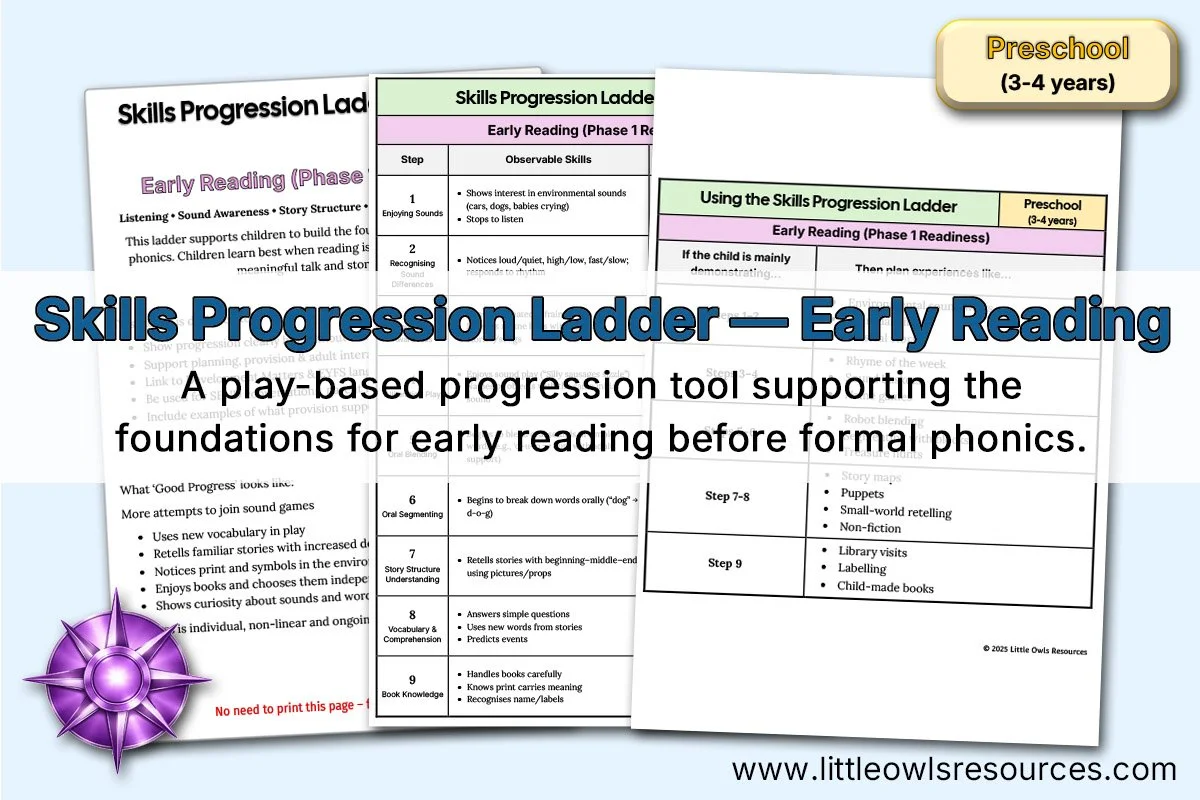
EYFS
Why Themes Are Optional in Reception | 4-5 Years

A professional leadership guidance document explaining the role of themes within a coherent, curriculum-led Reception approach.

Read More →
How to Use the Reception Pathway | 4-5 Years

This document is designed to help practitioners and leaders understand how to navigate and use the Reception Pathway effectively.

Read More →
About Our Reception Curriculum Phase Framework | 4-5 Years

A professional guidance document explaining the rationale and structure behind our phase-based approach to Reception curriculum design.

Read More →
Continuous Provision in a Childminding Setting | Mixed-Age

A professional guidance document supporting confident continuous provision in home-based, mixed-age EYFS settings.

Read More →
The EYFS Curriculum in Mixed-Age Care | Childminder Guidance

A professional guidance document supporting confident EYFS curriculum design in home-based, mixed-age settings.

Read More →
How To Use The Childminder Pathway | Mixed-Age

A Clear Guide for Childminders Using Our EYFS Curriculum & Pedagogy Resources

Read More →
FAQs: Toddler Planning & Pedagogy (18–36 Months)

This page answers frequently asked questions about planning and pedagogy in toddler rooms.

Read More →
Curriculum Intent in Toddler Rooms | Toddlers (18–36 Months)

A professional guidance document clarifying curriculum intent for developmentally appropriate toddler practice.

Read More →
How Our Toddler Curriculum Works (18–36 Months)

A professional guidance document explaining how curriculum intent, implementation and impact operate in toddler rooms.

Read More →
The Role of Schemas in Toddler Practice (18-36 Months)

A professional guidance document explaining how schemas underpin learning and shape effective toddler practice.

Read More →
How To Use The Toddler (18-36 Months) Pathway

This overview explains how to navigate, understand and use the Toddler (18–36 months) Pathway effectively.

Read More →
Curriculum Language in Baby Rooms | Babies (birth-18 months)

Explaining Intent, Implementation & Impact for babies aged 0–18 months

Read More →
How Our Baby Room Practice Works | Babies (birth-18 months)

A professional overview explaining day-to-day EYFS practice for babies aged 0–18 months

Read More →
How To Use The Preschool (3-4 Years) Pathway

This document explains how to use the Preschool Pathway in practice.

Read More →
Adult-Led With Purpose Poster | Preschool 3-4 Years

A practitioner guidance poster clarifying intentional, play-based adult-led teaching

Read More →
What Child-Led Does NOT Mean Poster | Preschool 3-4 Years

A practitioner guidance poster clarifying responsive, purposeful EYFS practice

Read More →
Preschool (3–4 Years) Curriculum Overview | How Themes Fit Together (Overview)

A full-year, responsive EYFS planning framework

Read More →
Whole-Setting Curriculum Map (Birth–5): Curriculum Intent & Progression (Overview)

A cohesive, high-level overview of learning and development from birth to the end of the EYFS.

Read More →
EYFS Inspection-Facing Summaries | Birth-5 Document (Overview)

Clear, age-phase inspection summaries articulating curriculum intent, implementation and impact across the EYFS.

Read More →
Speech & Language Development - Setting Statement | Birth-5 Document (Overview)

Setting Statement for Parents, Inspectors & Website

Read More →
EYFS from Birth to 5 | Curriculum Coherence & Pedagogical Throughline

Curriculum Coherence & Pedagogical Throughline

Read More →
Pedagogy Guidance (Birth–5) | Whole-Setting Document (Overview)

A professional guidance document supporting confident, consistent EYFS pedagogy from birth to five.

Read More →
Little Owls Resources' Curriculum Intent Statement | Birth-5

Our curriculum is designed to support high-quality Early Years practice by providing practitioners with clear, developmentally appropriate guidance and flexible, responsive planning tools from birth to five.

Read More →
Childminder Pedagogy Position Statement | Mixed-Age

EYFS Curriculum & Pedagogy

Read More →
Preschool Pedagogy Position Statement | 3-4 Years

How Children Learn in Preschool (3–4 Years)

Read More →
Preschool Curriculum Overview & Rationale | 3-4 Years

(Preschool | Ages 3–4 Years)

Read More →
Toddler Curriculum Overview & Rationale | 18-36 Months

(Toddlers | Ages 18–36 Months)

Read More →
Toddler Pedagogy Position Statement | 18-36 Months

How Toddlers Learn (18–36 Months)

Read More →
Care as Curriculum: What This Means in Practice | Babies 0-18 Months

What This Means in Practice (Babies 0–18 Months)

Read More →
Reception Curriculum Overview & Rationale | 4-5 Years

Reception Year | Ages 4–5

Read More →
 

Additional Whole-Setting Guidance | for Professional Members

Explore our whole-setting guidance below, including overarching curriculum and pedagogy documents, early years schemas and EYFS setting policies.

    • Little Owls Resources’ Curriculum Intent Statement

    • EYFS from Birth to 5: Curriculum Coherence & Pedagogical Throughline

    • Whole-Setting Curriculum Map (Birth-5): Curriculum Intent & Progression

    • Pedagogy Guidance Document

    • Speech & Language Development - Setting Statement

    • EYFS Inspection-Facing Summaries

  • Early Years Schemas - Practitioner Toolkit | EYFS Birth-5

    ↪ Schema Cards (definition, behaviours, age-related examples, enabling resources)

    ↪ Schema Observation & Responsive Provision Planning Template

    • EYFS Group Setting Policies Pack

      ↪ x 22 Policy Documents

      ↪ Policy Sign-Off and Confirmation Document

      ↪ EYFS Setting Policy Folder Contents List

    • Childminder Setting Policies Pack

      ↪ x 22 Policy Documents

      ↪ Childminder Assistant or Volunteer Policy Sign-Off and Confirmation Document

      ↪ Childminder Policy Folder Contents List

  • EYFS Glossary

    ↪ Clear, practitioner-friendly explanations of key curriculum and pedagogy terms used throughout our guidance.


Looking for age-specific pathway documents?

Select the pathway that best reflects your role or the age group you work with. You do not need to use everything. (Some practitioners may use more than one pathway.)

Featured
🍼 Babies (0–18 months)

Responsive care, observation and development in the earliest years

🚼 Toddlers (18–36 months)

Development, play and progression in the toddler years

🎨 Preschool (3–4 years)

Curriculum, continuous provision and purposeful teaching

🎓 Reception (4–5 years)

Play-based pedagogy, progression and EYFSP readiness

🏡 Childminders (Birth–5)

Mixed-age pedagogy, planning without overload and inspection confidence


Latest EYFS Articles & Practical Guides | From Our Blog

Stay informed, get expert advice, and find inspiration from our collection of articles and useful external resources, tailored specifically for EYFS practitioners. We regularly publish in-depth articles to support you with current best practices, regulatory changes, and fresh ideas.

EYFS & KS1 Articles
Major UK Curriculum Shake-Up Announced: What EYFS & KS1 Practitioners Need to Know

A major overhaul of the national curriculum in England has been announced following the publication of the independent Curriculum and Assessment Review. For those working in the Early Years Foundation Stage (EYFS) and Key Stage 1 (KS1), the changes signal a renewed focus on practical life skills, digital literacy, and enriching learning experiences…

Read More →
New Education Inspection Framework | What EYFS Settings Need to Know

The world of early years education is constantly evolving, and with it, the frameworks that guide and assess our invaluable work. Come November 2025, a significant shift will occur as the new Education Inspection Framework (EIF) comes into effect, bringing with it some crucial changes…

Read More →
Revised 2025 EYFS Statutory Framework for Group & School-Based Providers | What You Need to Know

With the new 2025 EYFS Statutory Framework for group and school-based providers coming into effect on 1st September 2025, it's essential to understand the updates to ensure your practice remains compliant, effective…

Read More →
DfE Press Release | Parents urged to read more to boost children’s life chances

The Education Secretary is calling on parents to lead by example and make reading a daily habit to help reverse the decline in reading for pleasure, to help give kids the best start in life as part of the…

Read More →
DfE Update | Drowning Prevention Week: what children learn about water safety at school

As we head into summer, it’s especially important that children are prepared with these skills. This year, the Royal Life Saving Society UK's Drowning Prevention Week runs from 14 June to 21…

Read More →
DfE Update | Hot weather and heatwaves: guidance for schools and other education settings

There are several ways that schools can make changes to keep children safe in hot weather, especially as children are more at risk of becoming ill with heat-related issues than adults…

Read More →
 

Are you looking for a specific resource or document for your provision?

Use our 🔍 SEARCH Bar located at the top of every page.


Content within the EYFS Curriculum & Pedagogy Membership is provided as professional guidance and support. It reflects current understanding of the EYFS statutory framework, Development Matters and inspection expectations at the time of writing. Practitioners are responsible for applying professional judgement and ensuring practice aligns with current statutory requirements and their specific context.

Updated: January 2026

 
In Whole-Setting | C & P, Birth-5, Pedagogy, Inspection-Facing, Group & School-Based, Childminder, Curriculum Tags Whole-Setting Curriculum Map (Birth–5): Curriculum Intent & Progression Document

Childminder Setting Policies Pack | Birth-5 Documents

January 18, 2026 Stuart Murphy

Home › EYFS Curriculum & Pedagogy › Whole-Setting Curriculum & Pedagogy › Childminder Setting Policies Pack | Birth-5 Documents (Overview)


Childminder Setting Policies Pack | Birth-5 Documents

A complete, professionally written set of core EYFS policies tailored specifically for childminder settings.

Download Childminder Policy Documents Here:

  • 1. Safeguarding & Child Protection ⋙ DOCX 📝 | PDF 📄

  • 2. Observation, Assessment & Planning ⋙ DOCX 📝 | PDF 📄

  • 3. Curriculum & Pedagogy ⋙ DOCX 📝 | PDF 📄

  • 4. Behaviour, Relationships & Emotional Wellbeing ⋙ DOCX 📝 | PDF 📄

  • 5. Inclusion, Equality & SEND ⋙ DOCX 📝 | PDF 📄

  • 6. Health, Safety & Risk Assessment ⋙ DOCX 📝 | PDF 📄

  • 7. Data Protection & GDPR ⋙ DOCX 📝 | PDF 📄

  • 8. Staffing, Ratios & Key Person ⋙ DOCX 📝 | PDF 📄

  • 9. Physical Intervention & Positive Handling ⋙ DOCX 📝 | PDF 📄

  • 10. Intimate Care ⋙ DOCX 📝 | PDF 📄

  • 11. Supervision of Children ⋙ DOCX 📝 | PDF 📄

  • 12. Mobile Phones, Cameras & Social Media ⋙ DOCX 📝 | PDF 📄

  • 13. Medication & Medical Conditions ⋙ DOCX 📝 | PDF 📄

  • 14. Food, Drink & Allergy Management ⋙ DOCX 📝 | PDF 📄

  • 15. Complaints Procedure ⋙ DOCX 📝 | PDF 📄

  • 16. Accident, Incident & First Aid ⋙ DOCX 📝 | PDF 📄

  • 17. Missing Child / Uncollected Child ⋙ DOCX 📝 | PDF 📄

  • 18. Outings & Trips ⋙ DOCX 📝 | PDF 📄

  • 19. Whistleblowing ⋙ DOCX 📝 | PDF 📄

  • 20. Staff Conduct, Safer Recruitment & Induction ⋙ DOCX 📝 | PDF 📄

  • 21. Fire Safety & Emergency Evacuation ⋙ DOCX 📝 | PDF 📄

  • 22. Visitors & Security ⋙ DOCX 📝 | PDF 📄

The pack also includes:

  • Policy Sign-Off and Confirmation Document ⋙ DOCX 📝 | PDF 📄

  • Childminder Setting Policy Folder Contents List ⋙ DOCX 📝 | PDF 📄

Documents Updated: January 2026

Disclaimer Notice

These policies are provided as professionally written guidance to support Childminder settings in meeting their statutory duties and embedding high-quality practice in line with the EYFS Statutory Framework and associated legislation.

While every effort has been made to ensure accuracy and alignment with current requirements at the time of publication, this Policies Pack is intended to be adopted, adapted and implemented in accordance with each setting’s specific context, local authority guidance and regulatory requirements.

It remains the responsibility of the setting’s registered provider, leadership team and designated safeguarding leads to:

  • Ensure policies reflect their individual setting, cohort and operational arrangements

  • Keep policies up to date with changes to legislation, statutory guidance and local procedures

  • Implement policies consistently through staff training, supervision and monitoring

These documents are designed to support professional judgement, not replace statutory guidance, legal advice, or the requirements of regulatory bodies such as Ofsted, local safeguarding partnerships or health authorities.

By using this Policies Pack, settings acknowledge that policies must be reviewed regularly and contextualised to ensure they remain accurate, effective and compliant.


Recommended next read Selection

EYFS
Explaining EYFS to Families | Childminder (Mixed-Age)

Helping Parents Understand Learning Through Play and Care - A professional guidance document supporting clear, reassuring communication with families about EYFS practice in childminding settings.

Read More →
Parent Communication Templates | Childminder (Mixed-Age)

Daily Updates, Transitions and Shared Information - An optional set of professional templates supporting clear, respectful communication with families in childminding settings.

Read More →
Continuous Provision in a Childminding Setting | Mixed-Age

A professional guidance document supporting confident continuous provision in home-based, mixed-age EYFS settings.

Read More →
The EYFS Curriculum in Mixed-Age Care | Childminder Guidance

A professional guidance document supporting confident EYFS curriculum design in home-based, mixed-age settings.

Read More →
How To Use The Childminder Pathway | Mixed-Age

A Clear Guide for Childminders Using Our EYFS Curriculum & Pedagogy Resources

Read More →
Early Years Schemas - Practitioner Toolkit | EYFS Birth-5 (Overview)

A practical, research-informed toolkit for recognising schemas and responding through meaningful, child-led provision.

Read More →
Childminder Pedagogy Position Statement | Mixed-Age

EYFS Curriculum & Pedagogy

Read More →

Additional Whole-Setting Guidance | for Professional Members

Explore our whole-setting guidance below, including overarching curriculum and pedagogy documents, early years schemas and EYFS setting policies.

    • Little Owls Resources’ Curriculum Intent Statement

    • EYFS from Birth to 5: Curriculum Coherence & Pedagogical Throughline

    • Whole-Setting Curriculum Map (Birth-5): Curriculum Intent & Progression

    • Pedagogy Guidance Document

    • Speech & Language Development - Setting Statement

    • EYFS Inspection-Facing Summaries

  • Early Years Schemas - Practitioner Toolkit | EYFS Birth-5

    ↪ Schema Cards (definition, behaviours, age-related examples, enabling resources)

    ↪ Schema Observation & Responsive Provision Planning Template

    • EYFS Group Setting Policies Pack

      ↪ x 22 Policy Documents

      ↪ Policy Sign-Off and Confirmation Document

      ↪ EYFS Setting Policy Folder Contents List

    • Childminder Setting Policies Pack

      ↪ x 22 Policy Documents

      ↪ Childminder Assistant or Volunteer Policy Sign-Off and Confirmation Document

      ↪ Childminder Policy Folder Contents List

  • EYFS Glossary

    ↪ Clear, practitioner-friendly explanations of key curriculum and pedagogy terms used throughout our guidance.

Looking for age-specific pathway documents?

Select the pathway that best reflects your role or the age group you work with. You do not need to use everything. (Some practitioners may use more than one pathway.)

Featured
🍼 Babies (0–18 months)

Responsive care, observation and development in the earliest years

🚼 Toddlers (18–36 months)

Development, play and progression in the toddler years

🎨 Preschool (3–4 years)

Curriculum, continuous provision and purposeful teaching

🎓 Reception (4–5 years)

Play-based pedagogy, progression and EYFSP readiness

🏡 Childminders (Birth–5)

Mixed-age pedagogy, planning without overload and inspection confidence

Latest EYFS Articles & Practical Guides | From Our Blog

Stay informed, get expert advice, and find inspiration from our collection of articles and useful external resources, tailored specifically for EYFS practitioners. We regularly publish in-depth articles to support you with current best practices, regulatory changes, and fresh ideas.

EYFS & KS1 Articles
Major UK Curriculum Shake-Up Announced: What EYFS & KS1 Practitioners Need to Know

A major overhaul of the national curriculum in England has been announced following the publication of the independent Curriculum and Assessment Review. For those working in the Early Years Foundation Stage (EYFS) and Key Stage 1 (KS1), the changes signal a renewed focus on practical life skills, digital literacy, and enriching learning experiences…

Read More →
New Education Inspection Framework | What EYFS Settings Need to Know

The world of early years education is constantly evolving, and with it, the frameworks that guide and assess our invaluable work. Come November 2025, a significant shift will occur as the new Education Inspection Framework (EIF) comes into effect, bringing with it some crucial changes…

Read More →
Revised 2025 EYFS Statutory Framework for Group & School-Based Providers | What You Need to Know

With the new 2025 EYFS Statutory Framework for group and school-based providers coming into effect on 1st September 2025, it's essential to understand the updates to ensure your practice remains compliant, effective…

Read More →
DfE Press Release | Parents urged to read more to boost children’s life chances

The Education Secretary is calling on parents to lead by example and make reading a daily habit to help reverse the decline in reading for pleasure, to help give kids the best start in life as part of the…

Read More →
DfE Update | Drowning Prevention Week: what children learn about water safety at school

As we head into summer, it’s especially important that children are prepared with these skills. This year, the Royal Life Saving Society UK's Drowning Prevention Week runs from 14 June to 21…

Read More →
DfE Update | Hot weather and heatwaves: guidance for schools and other education settings

There are several ways that schools can make changes to keep children safe in hot weather, especially as children are more at risk of becoming ill with heat-related issues than adults…

Read More →
 

Are you looking for a specific resource or document for your provision?

Use our 🔍 SEARCH Bar located at the top of every page.

Content within the EYFS Curriculum & Pedagogy Membership is provided as professional guidance and support. It reflects current understanding of the EYFS statutory framework, Development Matters and inspection expectations at the time of writing. Practitioners are responsible for applying professional judgement and ensuring practice aligns with current statutory requirements and their specific context.

Updated: January 2026

 
In Whole-Setting | C & P, Birth-5, Pedagogy, Inspection-Facing, Parent-Facing, Policies, Childminder Tags Childminder Setting Policies Pack | Birth-5 Documents, Childminder

EYFS Setting Policies Pack | Birth-5 Documents

January 18, 2026 Stuart Murphy

Home › EYFS Curriculum & Pedagogy › EYFS Setting Policies Pack | Birth-5 Documents (Overview)


EYFS Setting Policies Pack | Birth-5 Documents

A complete, professionally written set of core EYFS policies supporting safe, compliant and high-quality early years practice.

Download EYFS Setting Policy Documents Here:

  • 1. Safeguarding & Child Protection ⋙ DOCX 📝 | PDF 📄

  • 2. Observation, Assessment & Planning ⋙ DOCX 📝 | PDF 📄

  • 3. Curriculum & Pedagogy ⋙ DOCX 📝 | PDF 📄

  • 4. Behaviour, Relationships & Emotional Wellbeing ⋙ DOCX 📝 | PDF 📄

  • 5. Inclusion, Equality & SEND ⋙ DOCX 📝 | PDF 📄

  • 6. Health, Safety & Risk Assessment ⋙ DOCX 📝 | PDF 📄

  • 7. Data Protection & GDPR ⋙ DOCX 📝 | PDF 📄

  • 8. Staffing, Ratios & Key Person ⋙ DOCX 📝 | PDF 📄

  • 9. Physical Intervention & Positive Handling ⋙ DOCX 📝 | PDF 📄

  • 10. Intimate Care ⋙ DOCX 📝 | PDF 📄

  • 11. Supervision of Children ⋙ DOCX 📝 | PDF 📄

  • 12. Mobile Phones, Cameras & Social Media ⋙ DOCX 📝 | PDF 📄

  • 13. Medication & Medical Conditions ⋙ DOCX 📝 | PDF 📄

  • 14. Food, Drink & Allergy Management ⋙ DOCX 📝 | PDF 📄

  • 15. Complaints Procedure ⋙ DOCX 📝 | PDF 📄

  • 16. Accident, Incident & First Aid ⋙ DOCX 📝 | PDF 📄

  • 17. Missing Child / Uncollected Child ⋙ DOCX 📝 | PDF 📄

  • 18. Outings & Trips ⋙ DOCX 📝 | PDF 📄

  • 19. Whistleblowing ⋙ DOCX 📝 | PDF 📄

  • 20. Staff Conduct, Safer Recruitment & Induction ⋙ DOCX 📝 | PDF 📄

  • 21. Fire Safety & Emergency Evacuation ⋙ DOCX 📝 | PDF 📄

  • 22. Visitors & Security ⋙ DOCX 📝 | PDF 📄

The pack also includes:

  • Policy Sign-Off and Confirmation Document ⋙ DOCX 📝 | PDF 📄

  • EYFS Setting Policy Folder Contents List ⋙ DOCX 📝 | PDF 📄

Documents Updated: January 2026

Disclaimer Notice

These policies are provided as professionally written guidance to support Early Years settings in meeting their statutory duties and embedding high-quality practice in line with the EYFS Statutory Framework and associated legislation.

While every effort has been made to ensure accuracy and alignment with current requirements at the time of publication, this Policies Pack is intended to be adopted, adapted and implemented in accordance with each setting’s specific context, local authority guidance and regulatory requirements.

It remains the responsibility of the setting’s registered provider, leadership team and designated safeguarding leads to:

  • Ensure policies reflect their individual setting, cohort and operational arrangements

  • Keep policies up to date with changes to legislation, statutory guidance and local procedures

  • Implement policies consistently through staff training, supervision and monitoring

These documents are designed to support professional judgement, not replace statutory guidance, legal advice, or the requirements of regulatory bodies such as Ofsted, local safeguarding partnerships or health authorities.

By using this Policies Pack, settings acknowledge that policies must be reviewed regularly and contextualised to ensure they remain accurate, effective and compliant.


Recommended next read Selection
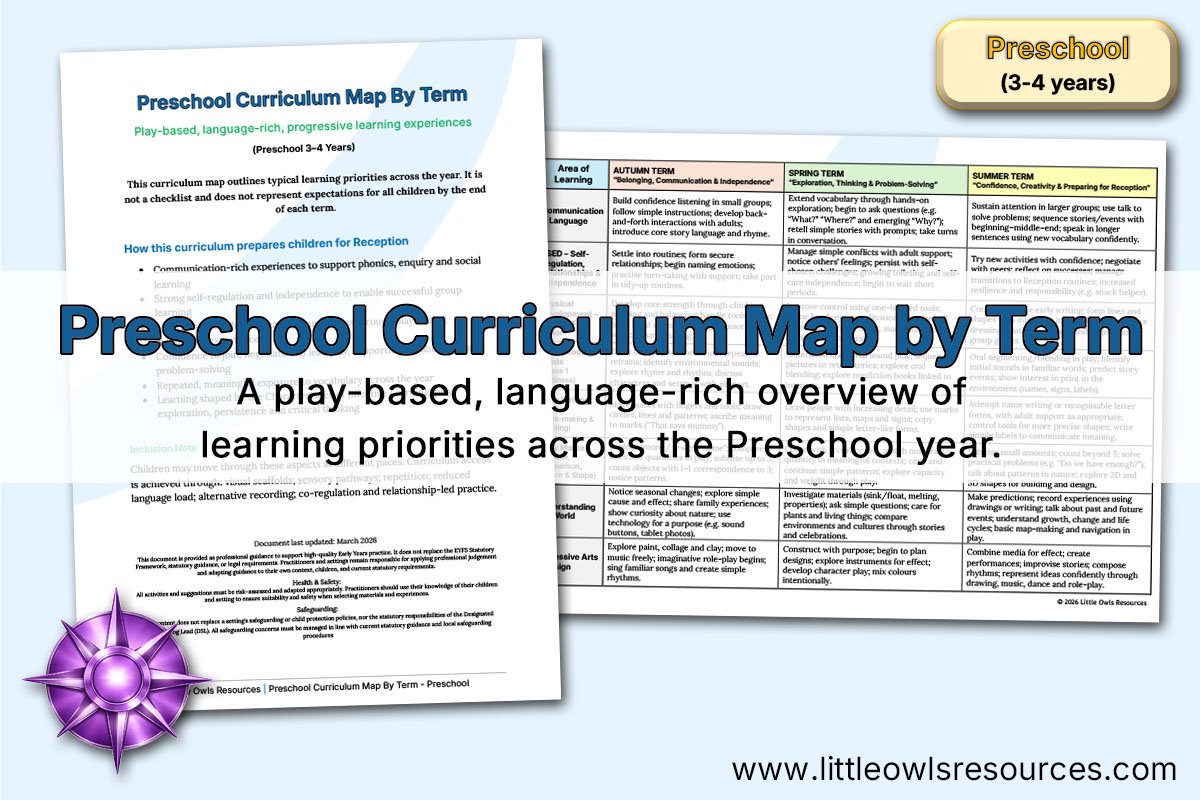
EYFS
Early Years Schemas - Practitioner Toolkit | EYFS Birth-5 (Overview)

A practical, research-informed toolkit for recognising schemas and responding through meaningful, child-led provision.

Read More →
Whole-Setting Curriculum Map (Birth–5): Curriculum Intent & Progression (Overview)

A cohesive, high-level overview of learning and development from birth to the end of the EYFS.

Read More →
Childminder Setting Policies Pack | Birth-5 Documents (Overview)

A complete, professionally written set of core EYFS policies tailored specifically for childminder settings.

Read More →
EYFS Setting Policies Pack | Birth-5 Documents (Overview)

A complete, professionally written set of core EYFS policies supporting safe, compliant and high-quality early years practice.

Read More →
EYFS Inspection-Facing Summaries | Birth-5 Document (Overview)

Clear, age-phase inspection summaries articulating curriculum intent, implementation and impact across the EYFS.

Read More →
Speech & Language Development - Setting Statement | Birth-5 Document (Overview)

Setting Statement for Parents, Inspectors & Website

Read More →
EYFS from Birth to 5 | Curriculum Coherence & Pedagogical Throughline

Curriculum Coherence & Pedagogical Throughline

Read More →
Pedagogy Guidance (Birth–5) | Whole-Setting Document (Overview)

A professional guidance document supporting confident, consistent EYFS pedagogy from birth to five.

Read More →
Little Owls Resources' Curriculum Intent Statement | Birth-5

Our curriculum is designed to support high-quality Early Years practice by providing practitioners with clear, developmentally appropriate guidance and flexible, responsive planning tools from birth to five.

Read More →

Additional Whole-Setting Guidance | for Professional Members

Explore our whole-setting guidance below, including overarching curriculum and pedagogy documents, early years schemas and EYFS setting policies.

    • Little Owls Resources’ Curriculum Intent Statement

    • EYFS from Birth to 5: Curriculum Coherence & Pedagogical Throughline

    • Whole-Setting Curriculum Map (Birth-5): Curriculum Intent & Progression

    • Pedagogy Guidance Document

    • Speech & Language Development - Setting Statement

    • EYFS Inspection-Facing Summaries

  • Early Years Schemas - Practitioner Toolkit | EYFS Birth-5

    ↪ Schema Cards (definition, behaviours, age-related examples, enabling resources)

    ↪ Schema Observation & Responsive Provision Planning Template

    • EYFS Group Setting Policies Pack

      ↪ x 22 Policy Documents

      ↪ Policy Sign-Off and Confirmation Document

      ↪ EYFS Setting Policy Folder Contents List

    • Childminder Setting Policies Pack

      ↪ x 22 Policy Documents

      ↪ Childminder Assistant or Volunteer Policy Sign-Off and Confirmation Document

      ↪ Childminder Policy Folder Contents List

  • EYFS Glossary

    ↪ Clear, practitioner-friendly explanations of key curriculum and pedagogy terms used throughout our guidance.

Looking for age-specific pathway documents?

Select the pathway that best reflects your role or the age group you work with. You do not need to use everything. (Some practitioners may use more than one pathway.)

Featured
🍼 Babies (0–18 months)

Responsive care, observation and development in the earliest years

🚼 Toddlers (18–36 months)

Development, play and progression in the toddler years

🎨 Preschool (3–4 years)

Curriculum, continuous provision and purposeful teaching

🎓 Reception (4–5 years)

Play-based pedagogy, progression and EYFSP readiness

🏡 Childminders (Birth–5)

Mixed-age pedagogy, planning without overload and inspection confidence

Latest EYFS Articles & Practical Guides | From Our Blog

Stay informed, get expert advice, and find inspiration from our collection of articles and useful external resources, tailored specifically for EYFS practitioners. We regularly publish in-depth articles to support you with current best practices, regulatory changes, and fresh ideas.

EYFS & KS1 Articles
Major UK Curriculum Shake-Up Announced: What EYFS & KS1 Practitioners Need to Know

A major overhaul of the national curriculum in England has been announced following the publication of the independent Curriculum and Assessment Review. For those working in the Early Years Foundation Stage (EYFS) and Key Stage 1 (KS1), the changes signal a renewed focus on practical life skills, digital literacy, and enriching learning experiences…

Read More →
New Education Inspection Framework | What EYFS Settings Need to Know

The world of early years education is constantly evolving, and with it, the frameworks that guide and assess our invaluable work. Come November 2025, a significant shift will occur as the new Education Inspection Framework (EIF) comes into effect, bringing with it some crucial changes…

Read More →
Revised 2025 EYFS Statutory Framework for Group & School-Based Providers | What You Need to Know

With the new 2025 EYFS Statutory Framework for group and school-based providers coming into effect on 1st September 2025, it's essential to understand the updates to ensure your practice remains compliant, effective…

Read More →
DfE Press Release | Parents urged to read more to boost children’s life chances

The Education Secretary is calling on parents to lead by example and make reading a daily habit to help reverse the decline in reading for pleasure, to help give kids the best start in life as part of the…

Read More →
DfE Update | Drowning Prevention Week: what children learn about water safety at school

As we head into summer, it’s especially important that children are prepared with these skills. This year, the Royal Life Saving Society UK's Drowning Prevention Week runs from 14 June to 21…

Read More →
DfE Update | Hot weather and heatwaves: guidance for schools and other education settings

There are several ways that schools can make changes to keep children safe in hot weather, especially as children are more at risk of becoming ill with heat-related issues than adults…

Read More →
 

Are you looking for a specific resource or document for your provision?

Use our 🔍 SEARCH Bar located at the top of every page.

Content within the EYFS Curriculum & Pedagogy Membership is provided as professional guidance and support. It reflects current understanding of the EYFS statutory framework, Development Matters and inspection expectations at the time of writing. Practitioners are responsible for applying professional judgement and ensuring practice aligns with current statutory requirements and their specific context.

Updated: January 2026

 
In Whole-Setting | C & P, Birth-5, Pedagogy, Inspection-Facing, Policies, Parent-Facing, Group & School-Based Tags EYFS Setting Policies Pack | Birth-5 Documents

EYFS Inspection-Facing Summaries | Birth to 5 Document

January 18, 2026 Stuart Murphy

Home › EYFS Curriculum & Pedagogy › EYFS Inspection-Facing Summaries | Birth-5 Document (Overview)


Scroll down to read this web document or download files here: DOCX 📝 | PDF 📄

EYFS Inspection-Facing Summaries

Birth to 5

Babies (0–18 Months)

Inspection-Facing Practice Summary

In our baby rooms, care is the curriculum.

For babies aged 0–18 months, learning is rooted in:

  • secure attachments

  • responsive care

  • sensory and physical exploration

  • predictable routines

Babies learn through relationships, movement and repeated experiences.
There are no planned activities or learning outcomes for babies.

Our curriculum intent at this stage describes:

  • how we design calm, sensory-rich environments

  • how adults interact, respond and co-regulate

  • how routines support communication and wellbeing

Implementation is seen in:

  • consistent key-person relationships

  • attuned adult interaction

  • narration, imitation and shared attention

Impact is seen through:

  • babies’ wellbeing and engagement

  • growing curiosity and movement

  • early communication signals

  • secure, trusting relationships

We use observation to understand each baby and respond sensitively.
Assessment is narrative, not data-driven.

This approach aligns fully with the EYFS statutory framework and Development Matters guidance for babies.

Toddlers (18–36 Months)

Inspection-Facing Practice Summary

In our toddler rooms, play, schemas and relationships drive learning.

Toddlers learn through:

  • movement and exploration

  • repetition and schematic play

  • emerging independence

  • language developed through interaction

Our curriculum intent supports adult understanding, not targets for children.

It helps practitioners design environments and interactions that respond to:

  • children’s interests

  • schemas

  • communication and emotional needs

Adults:

  • observe before intervening

  • follow children’s lead in play

  • model language and support regulation

  • use brief, playful adult-led moments when appropriate

Themes or projects are used flexibly as shared contexts and never override child-led exploration.

Impact is seen in:

  • increased confidence and independence

  • longer periods of engagement

  • growing vocabulary and expressive communication

Assessment remains observation-led and proportionate, including the statutory progress check at age two.

This ensures toddlers are not rushed and are supported at the right developmental pace.

Preschool (3–4 Years)

Inspection-Facing Practice Summary

In Preschool, we balance play-based learning with purposeful adult input.

Children aged 3–4 learn best through:

  • imaginative play

  • shared experiences

  • rich language interactions

  • early skill-building in context

Our curriculum uses themes to organise learning experiences, while maintaining:

  • strong continuous provision

  • responsive adult interaction

  • short, focused adult-led sessions

Adult-led teaching supports:

  • early phonological awareness

  • mathematical understanding

  • fine-motor development

  • early writing for purpose

Planning is led by observation and children’s interests, not by fixed outcomes.

Impact is seen through:

  • richer language and play narratives

  • developing reasoning and problem-solving

  • increasing independence and collaboration

Assessment is non-statutory, proportionate and focused on understanding children, not tracking data.

This phase prepares children developmentally, not academically, for Reception.

Reception (4–5 Years)

Inspection-Facing Practice Summary

Reception is a distinct curriculum year with statutory expectations.

In Reception, we deliver the EYFS curriculum through:

  • high-quality adult-led teaching

  • stable, well-resourced continuous provision

  • purposeful application of learning through play

We maintain a strong balance between:

  • child-initiated learning

  • adult-guided interaction

  • systematic teaching (phonics, maths, writing)

Our curriculum intent is clearly sequenced and aligned with:

  • the EYFS statutory framework

  • Development Matters

  • EYFSP expectations

Themes are optional and used only where they support application — they do not drive the curriculum.

Observation, assessment and planning form a continuous cycle, ensuring teaching responds to children’s needs.

Impact is seen in:

  • confident application of taught skills

  • independence and reflective talk

  • readiness for the transition into Year 1

Reception remains play-based and inclusive, without becoming Year 1.

EYFS as a Whole

Inspection-Facing Summary Statement

Across birth to 5, our EYFS curriculum is:

  • developmentally sequenced

  • play-based

  • inclusive

  • coherent

Each age phase is distinct, but connected through:

  • strong relationships

  • observation-led practice

  • high-quality environments

  • thoughtful adult interaction

Children are never rushed.

Expectations increase only when developmentally appropriate.

This ensures children experience a secure, confident and well-supported journey through the EYFS, fully aligned with statutory guidance and best practice.

Document Updated: January 2026


Download DOCX 📝
Download PDF 📄


Recommended next read Selection
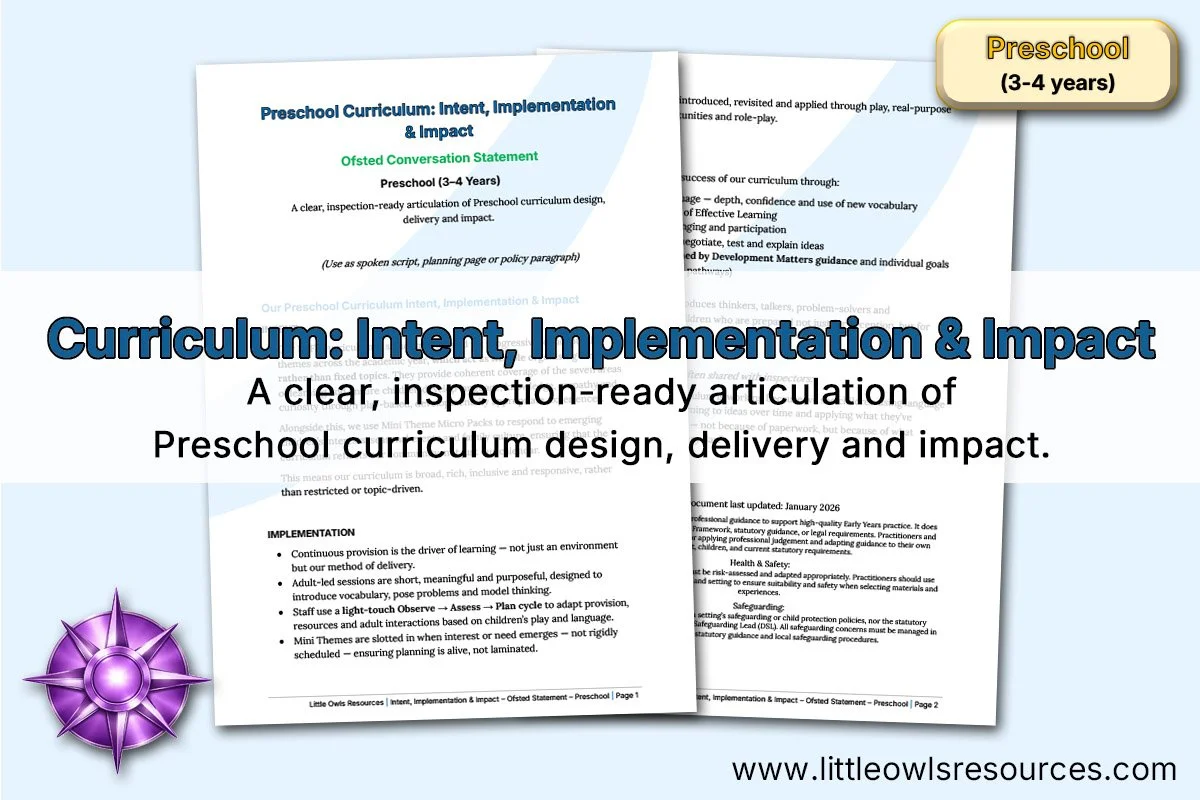
EYFS
Why Themes Are Optional in Reception | 4-5 Years

A professional leadership guidance document explaining the role of themes within a coherent, curriculum-led Reception approach.

Read More →
How to Use the Reception Pathway | 4-5 Years

This document is designed to help practitioners and leaders understand how to navigate and use the Reception Pathway effectively.

Read More →
About Our Reception Curriculum Phase Framework | 4-5 Years

A professional guidance document explaining the rationale and structure behind our phase-based approach to Reception curriculum design.

Read More →
Continuous Provision in a Childminding Setting | Mixed-Age

A professional guidance document supporting confident continuous provision in home-based, mixed-age EYFS settings.

Read More →
The EYFS Curriculum in Mixed-Age Care | Childminder Guidance

A professional guidance document supporting confident EYFS curriculum design in home-based, mixed-age settings.

Read More →
How To Use The Childminder Pathway | Mixed-Age

A Clear Guide for Childminders Using Our EYFS Curriculum & Pedagogy Resources

Read More →
FAQs: Toddler Planning & Pedagogy (18–36 Months)

This page answers frequently asked questions about planning and pedagogy in toddler rooms.

Read More →
Curriculum Intent in Toddler Rooms | Toddlers (18–36 Months)

A professional guidance document clarifying curriculum intent for developmentally appropriate toddler practice.

Read More →
How Our Toddler Curriculum Works (18–36 Months)

A professional guidance document explaining how curriculum intent, implementation and impact operate in toddler rooms.

Read More →
The Role of Schemas in Toddler Practice (18-36 Months)

A professional guidance document explaining how schemas underpin learning and shape effective toddler practice.

Read More →
How To Use The Toddler (18-36 Months) Pathway

This overview explains how to navigate, understand and use the Toddler (18–36 months) Pathway effectively.

Read More →
Curriculum Language in Baby Rooms | Babies (birth-18 months)

Explaining Intent, Implementation & Impact for babies aged 0–18 months

Read More →
How Our Baby Room Practice Works | Babies (birth-18 months)

A professional overview explaining day-to-day EYFS practice for babies aged 0–18 months

Read More →
How To Use The Preschool (3-4 Years) Pathway

This document explains how to use the Preschool Pathway in practice.

Read More →
Adult-Led With Purpose Poster | Preschool 3-4 Years

A practitioner guidance poster clarifying intentional, play-based adult-led teaching

Read More →
What Child-Led Does NOT Mean Poster | Preschool 3-4 Years

A practitioner guidance poster clarifying responsive, purposeful EYFS practice

Read More →
Preschool (3–4 Years) Curriculum Overview | How Themes Fit Together (Overview)

A full-year, responsive EYFS planning framework

Read More →
Whole-Setting Curriculum Map (Birth–5): Curriculum Intent & Progression (Overview)

A cohesive, high-level overview of learning and development from birth to the end of the EYFS.

Read More →
EYFS Inspection-Facing Summaries | Birth-5 Document (Overview)

Clear, age-phase inspection summaries articulating curriculum intent, implementation and impact across the EYFS.

Read More →
Speech & Language Development - Setting Statement | Birth-5 Document (Overview)

Setting Statement for Parents, Inspectors & Website

Read More →
EYFS from Birth to 5 | Curriculum Coherence & Pedagogical Throughline

Curriculum Coherence & Pedagogical Throughline

Read More →
Pedagogy Guidance (Birth–5) | Whole-Setting Document (Overview)

A professional guidance document supporting confident, consistent EYFS pedagogy from birth to five.

Read More →
Little Owls Resources' Curriculum Intent Statement | Birth-5

Our curriculum is designed to support high-quality Early Years practice by providing practitioners with clear, developmentally appropriate guidance and flexible, responsive planning tools from birth to five.

Read More →
Childminder Pedagogy Position Statement | Mixed-Age

EYFS Curriculum & Pedagogy

Read More →
Preschool Pedagogy Position Statement | 3-4 Years

How Children Learn in Preschool (3–4 Years)

Read More →
Preschool Curriculum Overview & Rationale | 3-4 Years

(Preschool | Ages 3–4 Years)

Read More →
Toddler Curriculum Overview & Rationale | 18-36 Months

(Toddlers | Ages 18–36 Months)

Read More →
Toddler Pedagogy Position Statement | 18-36 Months

How Toddlers Learn (18–36 Months)

Read More →
Care as Curriculum: What This Means in Practice | Babies 0-18 Months

What This Means in Practice (Babies 0–18 Months)

Read More →
Reception Curriculum Overview & Rationale | 4-5 Years

Reception Year | Ages 4–5

Read More →
 

Additional Whole-Setting Guidance | for Professional Members

Explore our whole-setting guidance below, including overarching curriculum and pedagogy documents, early years schemas and EYFS setting policies.

    • Little Owls Resources’ Curriculum Intent Statement

    • EYFS from Birth to 5: Curriculum Coherence & Pedagogical Throughline

    • Whole-Setting Curriculum Map (Birth-5): Curriculum Intent & Progression

    • Pedagogy Guidance Document

    • Speech & Language Development - Setting Statement

    • EYFS Inspection-Facing Summaries

  • Early Years Schemas - Practitioner Toolkit | EYFS Birth-5

    ↪ Schema Cards (definition, behaviours, age-related examples, enabling resources)

    ↪ Schema Observation & Responsive Provision Planning Template

    • EYFS Group Setting Policies Pack

      ↪ x 22 Policy Documents

      ↪ Policy Sign-Off and Confirmation Document

      ↪ EYFS Setting Policy Folder Contents List

    • Childminder Setting Policies Pack

      ↪ x 22 Policy Documents

      ↪ Childminder Assistant or Volunteer Policy Sign-Off and Confirmation Document

      ↪ Childminder Policy Folder Contents List

  • EYFS Glossary

    ↪ Clear, practitioner-friendly explanations of key curriculum and pedagogy terms used throughout our guidance.


Looking for age-specific pathway documents?

Select the pathway that best reflects your role or the age group you work with. You do not need to use everything. (Some practitioners may use more than one pathway.)
Featured
🍼 Babies (0–18 months)

Responsive care, observation and development in the earliest years

🚼 Toddlers (18–36 months)

Development, play and progression in the toddler years

🎨 Preschool (3–4 years)

Curriculum, continuous provision and purposeful teaching

🎓 Reception (4–5 years)

Play-based pedagogy, progression and EYFSP readiness

🏡 Childminders (Birth–5)

Mixed-age pedagogy, planning without overload and inspection confidence


Latest EYFS Articles & Practical Guides | From Our Blog

Stay informed, get expert advice, and find inspiration from our collection of articles and useful external resources, tailored specifically for EYFS practitioners. We regularly publish in-depth articles to support you with current best practices, regulatory changes, and fresh ideas.

EYFS & KS1 Articles
Major UK Curriculum Shake-Up Announced: What EYFS & KS1 Practitioners Need to Know

A major overhaul of the national curriculum in England has been announced following the publication of the independent Curriculum and Assessment Review. For those working in the Early Years Foundation Stage (EYFS) and Key Stage 1 (KS1), the changes signal a renewed focus on practical life skills, digital literacy, and enriching learning experiences…

Read More →
New Education Inspection Framework | What EYFS Settings Need to Know

The world of early years education is constantly evolving, and with it, the frameworks that guide and assess our invaluable work. Come November 2025, a significant shift will occur as the new Education Inspection Framework (EIF) comes into effect, bringing with it some crucial changes…

Read More →
Revised 2025 EYFS Statutory Framework for Group & School-Based Providers | What You Need to Know

With the new 2025 EYFS Statutory Framework for group and school-based providers coming into effect on 1st September 2025, it's essential to understand the updates to ensure your practice remains compliant, effective…

Read More →
DfE Press Release | Parents urged to read more to boost children’s life chances

The Education Secretary is calling on parents to lead by example and make reading a daily habit to help reverse the decline in reading for pleasure, to help give kids the best start in life as part of the…

Read More →
DfE Update | Drowning Prevention Week: what children learn about water safety at school

As we head into summer, it’s especially important that children are prepared with these skills. This year, the Royal Life Saving Society UK's Drowning Prevention Week runs from 14 June to 21…

Read More →
DfE Update | Hot weather and heatwaves: guidance for schools and other education settings

There are several ways that schools can make changes to keep children safe in hot weather, especially as children are more at risk of becoming ill with heat-related issues than adults…

Read More →
 

Are you looking for a specific resource or document for your provision?

Use our 🔍 SEARCH Bar located at the top of every page.


Content within the EYFS Curriculum & Pedagogy Membership is provided as professional guidance and support. It reflects current understanding of the EYFS statutory framework, Development Matters and inspection expectations at the time of writing. Practitioners are responsible for applying professional judgement and ensuring practice aligns with current statutory requirements and their specific context.

Updated: January 2026

 
In Whole-Setting | C & P, Birth-5, Pedagogy, Inspection-Facing Tags EYFS Inspection-Facing Summaries | Birth to 5 Document

Speech & Language Development - Setting Statement | Whole-Setting Document

January 18, 2026 Stuart Murphy

Home › EYFS Curriculum & Pedagogy › Speech & Language Development - Setting Statement | Birth-5 Document (Overview)


Scroll down to read this web document or download files here: DOCX 📝 | PDF 📄


Speech & Language Development

Setting Statement For Parents, Inspectors & Website

Our Vision

At our setting, communication is at the heart of learning, wellbeing and relationships.

We believe:

  • Children communicate long before they speak

  • Every child has a voice

  • Adults are partners in talk, not directors

  • Language grows strongest through play, connection, and curiosity

  • We celebrate ALL communication — gestures, signs, sounds, facial expressions, words, silence & laughter

Communication is more than speaking — it is belonging.

Our Approach

We create a communication-rich environment where children:

  • Are listened to without interruption

  • Have time to think, respond and explore ideas

  • Hear a broad range of vocabulary in meaningful contexts

  • Learn language through shared play and everyday routines

  • Experience stories, rhymes and songs every day

  • Develop confidence to express emotions and ideas

Our practitioners respond sensitively, observe carefully and interact purposefully, using strategies supported by current research and the EYFS.

Key Principles of Practice

Approach & What it Looks Like

  • Follow the Child's Lead - Adults join play rather than redirect

  • Commenting > Quizzing - “The water is splashing loudly!”

  • Wait & Pause - Time to think and respond

  • Copy + Extend - “Car.” → “Red car.”

  • Serve & Return - Conversation as turn-taking

  • Sustained Shared Thinking - Wondering and exploring ideas together

  • Rich Vocabulary - Real words rooted in real experience

  • Emotion Coaching - Naming and validating feelings

Language is not added on — It is woven through every interaction.

Staff Training & CPD

All staff receive ongoing support and professional development focused on:

  • Early speech and language development

  • EAL strategies

  • Supporting non-verbal communication

  • Play-based language building

  • Dialogic reading (shared story approaches)

  • Understanding developmental stages

  • Knowing when and how to seek advice

We reflect as a team, share practice, observe each other and commit to being lifelong learners alongside the children.

Partnership with Parents

We recognise parents as children’s first and most important educators.

We:

  • Share ideas for building language at home

  • Celebrate every small communication milestone

  • Offer non-judgemental conversations

  • Provide practical strategies, not pressure

  • Listen to parent insight as part of assessment

Communication thrives when adults work together.

Inclusion and Early Identification

We believe all communication is meaningful.

We ensure:

  • Every child feels heard, valued and responded to

  • Language support is inclusive, not isolating

  • Children developing differently are not compared but understood

  • Concerns are handled sensitively and collaboratively

  • Referrals are timely, evidence-based and partnership-led

We adapt environments, expectations and resources — not the child.

How This Aligns With EYFS & Ofsted Expectations

  • Recognising and supporting early communication
    → EYFS Section 1: 1.6, 1.7

  • Creating language-rich environments
    → Development Matters ‘Communication and Language’

  • Building children’s confidence and self-regulation
    → PSED links

  • Partnership with parents
    → Statutory requirement

  • Early identification of needs
    → SEND Code of Practice

  • Inclusive curriculum delivery
    → Ofsted’s emphasis on Intent–Implementation–Impact

This statement demonstrates a pedagogically robust approach and reflects contemporary best practice.

In summary

We are a communication-focused setting where children learn language through joyful, meaningful interaction. We listen, we model, we extend, and we celebrate every voice.


Document Updated: January 2026


Download DOCX 📝
Download PDF 📄


Recommended next read Selection

EYFS
Why Themes Are Optional in Reception | 4-5 Years

A professional leadership guidance document explaining the role of themes within a coherent, curriculum-led Reception approach.

Read More →
How to Use the Reception Pathway | 4-5 Years

This document is designed to help practitioners and leaders understand how to navigate and use the Reception Pathway effectively.

Read More →
About Our Reception Curriculum Phase Framework | 4-5 Years

A professional guidance document explaining the rationale and structure behind our phase-based approach to Reception curriculum design.

Read More →
Continuous Provision in a Childminding Setting | Mixed-Age

A professional guidance document supporting confident continuous provision in home-based, mixed-age EYFS settings.

Read More →
The EYFS Curriculum in Mixed-Age Care | Childminder Guidance

A professional guidance document supporting confident EYFS curriculum design in home-based, mixed-age settings.

Read More →
How To Use The Childminder Pathway | Mixed-Age

A Clear Guide for Childminders Using Our EYFS Curriculum & Pedagogy Resources

Read More →
FAQs: Toddler Planning & Pedagogy (18–36 Months)

This page answers frequently asked questions about planning and pedagogy in toddler rooms.

Read More →
Curriculum Intent in Toddler Rooms | Toddlers (18–36 Months)

A professional guidance document clarifying curriculum intent for developmentally appropriate toddler practice.

Read More →
How Our Toddler Curriculum Works (18–36 Months)

A professional guidance document explaining how curriculum intent, implementation and impact operate in toddler rooms.

Read More →
The Role of Schemas in Toddler Practice (18-36 Months)

A professional guidance document explaining how schemas underpin learning and shape effective toddler practice.

Read More →
How To Use The Toddler (18-36 Months) Pathway

This overview explains how to navigate, understand and use the Toddler (18–36 months) Pathway effectively.

Read More →
Curriculum Language in Baby Rooms | Babies (birth-18 months)

Explaining Intent, Implementation & Impact for babies aged 0–18 months

Read More →
How Our Baby Room Practice Works | Babies (birth-18 months)

A professional overview explaining day-to-day EYFS practice for babies aged 0–18 months

Read More →
How To Use The Preschool (3-4 Years) Pathway

This document explains how to use the Preschool Pathway in practice.

Read More →
Adult-Led With Purpose Poster | Preschool 3-4 Years

A practitioner guidance poster clarifying intentional, play-based adult-led teaching

Read More →
What Child-Led Does NOT Mean Poster | Preschool 3-4 Years

A practitioner guidance poster clarifying responsive, purposeful EYFS practice

Read More →
Preschool (3–4 Years) Curriculum Overview | How Themes Fit Together (Overview)

A full-year, responsive EYFS planning framework

Read More →
Whole-Setting Curriculum Map (Birth–5): Curriculum Intent & Progression (Overview)

A cohesive, high-level overview of learning and development from birth to the end of the EYFS.

Read More →
EYFS Inspection-Facing Summaries | Birth-5 Document (Overview)

Clear, age-phase inspection summaries articulating curriculum intent, implementation and impact across the EYFS.

Read More →
Speech & Language Development - Setting Statement | Birth-5 Document (Overview)

Setting Statement for Parents, Inspectors & Website

Read More →
EYFS from Birth to 5 | Curriculum Coherence & Pedagogical Throughline

Curriculum Coherence & Pedagogical Throughline

Read More →
Pedagogy Guidance (Birth–5) | Whole-Setting Document (Overview)

A professional guidance document supporting confident, consistent EYFS pedagogy from birth to five.

Read More →
Little Owls Resources' Curriculum Intent Statement | Birth-5

Our curriculum is designed to support high-quality Early Years practice by providing practitioners with clear, developmentally appropriate guidance and flexible, responsive planning tools from birth to five.

Read More →
Childminder Pedagogy Position Statement | Mixed-Age

EYFS Curriculum & Pedagogy

Read More →
Preschool Pedagogy Position Statement | 3-4 Years

How Children Learn in Preschool (3–4 Years)

Read More →
Preschool Curriculum Overview & Rationale | 3-4 Years

(Preschool | Ages 3–4 Years)

Read More →
Toddler Curriculum Overview & Rationale | 18-36 Months

(Toddlers | Ages 18–36 Months)

Read More →
Toddler Pedagogy Position Statement | 18-36 Months

How Toddlers Learn (18–36 Months)

Read More →
Care as Curriculum: What This Means in Practice | Babies 0-18 Months

What This Means in Practice (Babies 0–18 Months)

Read More →
Reception Curriculum Overview & Rationale | 4-5 Years

Reception Year | Ages 4–5

Read More →
 

Additional Whole-Setting Guidance | for Professional Members

Explore our whole-setting guidance below, including overarching curriculum and pedagogy documents, early years schemas and EYFS setting policies.

    • Little Owls Resources’ Curriculum Intent Statement

    • EYFS from Birth to 5: Curriculum Coherence & Pedagogical Throughline

    • Whole-Setting Curriculum Map (Birth-5): Curriculum Intent & Progression

    • Pedagogy Guidance Document

    • Speech & Language Development - Setting Statement

    • EYFS Inspection-Facing Summaries

  • Early Years Schemas - Practitioner Toolkit | EYFS Birth-5

    ↪ Schema Cards (definition, behaviours, age-related examples, enabling resources)

    ↪ Schema Observation & Responsive Provision Planning Template

    • EYFS Group Setting Policies Pack

      ↪ x 22 Policy Documents

      ↪ Policy Sign-Off and Confirmation Document

      ↪ EYFS Setting Policy Folder Contents List

    • Childminder Setting Policies Pack

      ↪ x 22 Policy Documents

      ↪ Childminder Assistant or Volunteer Policy Sign-Off and Confirmation Document

      ↪ Childminder Policy Folder Contents List

  • EYFS Glossary

    ↪ Clear, practitioner-friendly explanations of key curriculum and pedagogy terms used throughout our guidance.


Looking for age-specific pathway documents?

Select the pathway that best reflects your role or the age group you work with. You do not need to use everything. (Some practitioners may use more than one pathway.)
Featured
🍼 Babies (0–18 months)

Responsive care, observation and development in the earliest years

🚼 Toddlers (18–36 months)

Development, play and progression in the toddler years

🎨 Preschool (3–4 years)

Curriculum, continuous provision and purposeful teaching

🎓 Reception (4–5 years)

Play-based pedagogy, progression and EYFSP readiness

🏡 Childminders (Birth–5)

Mixed-age pedagogy, planning without overload and inspection confidence


Latest EYFS Articles & Practical Guides | From Our Blog

Stay informed, get expert advice, and find inspiration from our collection of articles and useful external resources, tailored specifically for EYFS practitioners. We regularly publish in-depth articles to support you with current best practices, regulatory changes, and fresh ideas.

EYFS & KS1 Articles
Major UK Curriculum Shake-Up Announced: What EYFS & KS1 Practitioners Need to Know

A major overhaul of the national curriculum in England has been announced following the publication of the independent Curriculum and Assessment Review. For those working in the Early Years Foundation Stage (EYFS) and Key Stage 1 (KS1), the changes signal a renewed focus on practical life skills, digital literacy, and enriching learning experiences…

Read More →
New Education Inspection Framework | What EYFS Settings Need to Know

The world of early years education is constantly evolving, and with it, the frameworks that guide and assess our invaluable work. Come November 2025, a significant shift will occur as the new Education Inspection Framework (EIF) comes into effect, bringing with it some crucial changes…

Read More →
Revised 2025 EYFS Statutory Framework for Group & School-Based Providers | What You Need to Know

With the new 2025 EYFS Statutory Framework for group and school-based providers coming into effect on 1st September 2025, it's essential to understand the updates to ensure your practice remains compliant, effective…

Read More →
DfE Press Release | Parents urged to read more to boost children’s life chances

The Education Secretary is calling on parents to lead by example and make reading a daily habit to help reverse the decline in reading for pleasure, to help give kids the best start in life as part of the…

Read More →
DfE Update | Drowning Prevention Week: what children learn about water safety at school

As we head into summer, it’s especially important that children are prepared with these skills. This year, the Royal Life Saving Society UK's Drowning Prevention Week runs from 14 June to 21…

Read More →
DfE Update | Hot weather and heatwaves: guidance for schools and other education settings

There are several ways that schools can make changes to keep children safe in hot weather, especially as children are more at risk of becoming ill with heat-related issues than adults…

Read More →
 

Are you looking for a specific resource or document for your provision?

Use our 🔍 SEARCH Bar located at the top of every page.


Content within the EYFS Curriculum & Pedagogy Membership is provided as professional guidance and support. It reflects current understanding of the EYFS statutory framework, Development Matters and inspection expectations at the time of writing. Practitioners are responsible for applying professional judgement and ensuring practice aligns with current statutory requirements and their specific context.

Updated: January 2026

 
In Whole-Setting | C & P, Birth-5, Pedagogy, Speech & Language Tags Speech & Language Development - Setting Statement | Whole-Setting Document

Pedagogy Guidance (Birth–5) | Whole-Setting Document

January 18, 2026 Stuart Murphy

Home › EYFS Curriculum & Pedagogy › Pedagogy Guidance (Birth–5) | Whole-Setting Document (Overview)


Scroll down to read this web document or download files here: DOCX 📝 | PDF 📄

Pedagogy Guidance (Birth–5)

A Comprehensive Guide to High-Quality Teaching and Learning in the Early Years

For Leaders, Managers and Practitioners in EYFS Settings

Document Overview

About This Document

This Pedagogy Guidance has been designed to support early years leaders and practitioners in delivering high-quality, research-informed practice across all age groups from birth to five. It draws on the EYFS Statutory Framework, developmental theory, and established UK best practice to provide a clear, practical and consistent approach to teaching, learning, and environment design in Early Years settings.

Whether your setting is a nursery, preschool, childminding service or school-based EYFS unit, this guide offers a shared language and vision for high-quality pedagogy.

Why This Guidance Is Important

High-quality pedagogy is the foundation of strong outcomes for children. This document helps settings to:

  • Establish a unified approach to teaching and learning across birth–5

  • Ensure consistency in how staff interact, plan, scaffold, observe and respond to children

  • Support new staff and students with clear expectations and professional standards

  • Strengthen language-rich, play-based learning, aligned with current research

  • Ensure equitable, inclusive practice for children with SEND, EAL and diverse backgrounds

  • Promote ambitious curriculum goals while maintaining warm, child-centred care

  • Embed reflective practice and raise the overall quality of provision

What This Guidance Includes

Inside, you will find:

  • The core principles that underpin effective pedagogy in the EYFS

  • Clear descriptions of the adult role, including interactions, modelling and scaffolding

  • Detailed guidance on continuous and enhanced provision

  • Approaches to play pedagogy, schema learning and outdoor learning

  • Expectations for adult-led learning that complement child-led exploration

  • Age-specific pedagogical approaches for babies, toddlers, preschoolers and Reception

  • Strategies for fostering language development, social-emotional wellbeing and independence

  • Guidance on inclusive practice, SEND, EAL and cultural responsiveness

  • Tools for reflection and quality improvement

How to Use This Document in Your Setting

For Leaders & Managers

  • Use as a foundation for your curriculum, environment planning and quality assurance processes

  • Embed into staff induction, appraisals and performance management systems

  • Use sections to support staff meetings, CPD sessions and coaching conversations

For Practitioners

  • Refer to the guidance when planning experiences or evaluating your provision

  • Use it to strengthen interactions, extend children’s learning and refine your teaching style

  • Reflect on your own practice and identify areas for professional development

For Teams

  • Create a shared, consistent approach across rooms and age groups

  • Use selected sections during team meetings, room audits or peer observations

  • Align pedagogy with your setting’s curriculum intent and ethos

Our Pedagogical Promise

By using this resource, your setting is committing to a reflective, child-centred approach that values:

  • Strong relationships

  • Play as the primary mode of learning

  • High expectations for every child

  • An enabling environment

  • Skilled and sensitive adult interactions

  • Equity, inclusion and belonging

  • Continual improvement and professional growth

Together, these values form the foundation for high-quality early years practice that supports children to thrive, learn and flourish.

—————————————————————————————————————————-

DOCUMENT

Pedagogy Guidance (Birth–5)

A Comprehensive Guide to High-Quality Teaching and Learning in the Early Years

For Leaders, Managers and Practitioners in EYFS Settings

1. Introduction

Purpose of this guidance

  • Clarify what high-quality EYFS pedagogy looks like across all age groups (0–5)

  • Ensure consistency in practice across the setting

  • Support practitioners in making informed decisions about teaching, interactions, curriculum and environment

  • Bridge the gap between theory, current research and day-to-day practice

Definition of pedagogy in the EYFS

Pedagogy refers to how we teach, interact, support, guide and prepare the environment so children can learn effectively.

2. Principles Underpinning Our Pedagogy

A. Children learn best through relationships

  • Warm, secure attachments are the foundation for all development

  • The Key Person role is central

  • Co-regulation and emotional tuning enable self-regulation

B. Play is the natural vehicle for learning

  • Play is purposeful, complex and deeply cognitive

  • Every area of learning can be developed through play

  • Adults play a crucial role within—not outside—play

C. A carefully planned environment guides learning

  • Continuous provision offers repeated, rich opportunities to practise skills

  • Resources are open-ended, accessible and reflective of children’s lives

  • The environment acts as the “third teacher”

D. A balance of child-led and adult-led learning is essential

  • Responsive, in-the-moment teaching supports interests and autonomy

  • Brief but focused adult-led sessions ensure progression and coverage

  • Both approaches feed into one another

E. Inclusive practice ensures equitable learning

  • All children experience high expectations and challenge

  • Adapting, scaffolding and enhancing support individual needs

  • SEND pedagogy is embedded, not separate

3. The Role of the Adult

A. Interactions: the most powerful teaching tool

High-quality interactions include:

  • Modelling language, thinking and behaviours

  • Commenting (not quizzing): narrating children’s activities and thoughts

  • Open-ended questioning to encourage reasoning and creativity

  • Sustained Shared Thinking

  • Extending play through vocabulary, tools or ideas

  • Recasting and expanding language

Non-verbal elements

  • Attuned body language

  • Respect for play

  • Emotion coaching

B. Scaffolding

Types of scaffolding

  • Physical

  • Verbal

  • Environmental

  • Social

  • Cognitive

When to scaffold

  • When children need a “nudge” rather than the solution

  • When play stalls or becomes repetitive

  • When a child shows readiness for next steps

C. Modelling

  • Introducing new vocabulary in context

  • Demonstrating problem-solving strategies

  • Showing perseverance and curiosity

  • Modelling collaborative behaviour

D. Co-regulation and Emotional Support

Essential across all age groups but especially babies and toddlers.

Practitioners support:

  • Naming feelings

  • Calming strategies

  • Social problem-solving

  • Secure attachments to support risk-taking in learning

4. The Learning Environment

A. Continuous Provision

High-quality continuous provision should:

  • Be available daily and consistently

  • Offer breadth across all learning areas

  • Be predictable enough for independence but open-ended enough for challenge

  • Include purposeful, culturally representative resources

Features of excellent provision

  • Loose parts

  • Natural materials

  • Real-life objects

  • Open-ended creative media

  • Varied mark-making opportunities indoors and outdoors

  • Books across all areas

B. Enhanced Provision

Enhancements should:

  • Build on observed interests

  • Deepen knowledge in curriculum themes

  • Support specific skill development

  • Be limited in number to avoid overstimulation

C. Outdoor Learning Pedagogy

Outdoor learning is:

  • A full learning environment, not “playtime”

  • Essential for physical development and regulation

  • Rich in STEM, risk-taking and imaginative play

5. Play Pedagogy

A. Types of Play

  • Free play

  • Guided play

  • Role play and socio-dramatic play

  • Heuristic play

  • Schema play

  • Physical play

  • Creative and imaginative play

  • Exploratory play

  • Problem-solving and construction play

B. Recognising and Supporting Schemas

Practitioners identify repeated patterns of behaviour and enhance the environment accordingly.

6. Adult-Led Learning

Adult-led learning ensures progression and coverage while remaining developmentally appropriate.

Principles

  • Brief, purposeful and engaging

  • Tailored to developmental stage

  • Linked to curriculum progression

  • Followed up through continuous provision

  • Delivered in small groups where appropriate

Examples

  • Songs and rhymes

  • Story times with rich book talk

  • Focused fine-motor activities

  • Early maths sequences

  • Communication groups

Reception-specific clarification

In Reception, adult-led learning includes systematic phonics and mathematics teaching delivered in developmentally appropriate ways, without replicating Key Stage 1 structures.

7. Language-Rich Pedagogy

Language development is central to EYFS outcomes.

Key features:

  • Adults speak often but do not dominate play

  • Vocabulary is taught explicitly and embedded

  • Repetition and rephrasing support understanding

  • Storytelling, singing and rhyming are daily routines

  • Dialogic storytime supports comprehension

For EAL learners

  • Home language is valued

  • Visuals and gestures are used

  • Language is modelled without shaming correction

8. Pedagogy for Each Age Group (Birth–5)

A. Babies (0–18 months)

Pedagogy focuses on:

  • Attachment, security and routine

  • Sensory exploration

  • Early communication and turn-taking

  • Real-life objects (treasure baskets)

  • Floor-based, movement-rich experiences

Care as curriculum clarification

For babies, learning is inseparable from care. Routines such as feeding, nappy changing, settling and sleep are intentionally recognised as core learning experiences, supporting development across the prime areas of learning, as outlined in our Care as Curriculum guidance.

B. Toddlers (18–36 months)

Pedagogy focuses on:

  • Heuristic play

  • Language explosion and naming

  • Repetition and schemas

  • Early independence

  • Beginning simple rule-following

  • Emotional co-regulation

C. Preschool (3–4 years)

Pedagogy focuses on:

  • Sustained shared thinking

  • Imaginative and socio-dramatic play

  • Early mathematical reasoning

  • Problem-solving

  • Independence and collaboration

  • Extended projects and inquiry

D. Reception (4–5 years)

Pedagogy blends:

  • Play-based learning

  • Systematic phonics

  • Early writing and maths sequences

  • High challenge supported through modelling and scaffolding

  • Refining self-regulation and executive function

  • Purposeful provision matched to curriculum steps

9. Assessment and Pedagogy

Assessment supports — not dominates — pedagogy.

Assessment informs:

  • Enhancements

  • Adult-led focus sessions

  • Interactions and vocabulary

  • Individualised support

  • SEND adaptations

Professional judgement statement

Practitioner knowledge of the child remains the primary assessment tool, with written evidence used selectively to support reflection, planning and communication.

Avoiding over-assessment

  • Limit unnecessary documentation

  • Capture learning through professional knowledge

  • Use observation sparingly but purposefully

10. Inclusive Pedagogy

SEND

  • Break tasks into manageable steps

  • Offer sensory regulation tools

  • Use visuals, gestures and objects of reference

  • Model social interactions explicitly

  • Provide alternative communication methods

EAL

  • Maintain and value home language

  • Provide bilingual resources where possible

  • Use peer modelling

11. Pedagogy and Family Partnership

Families are children’s first educators.

Practices include:

  • Sharing learning prompts

  • Welcoming parental contributions

  • Cultural responsiveness in resources and curriculum

  • Joint planning for SEND and additional needs

12. Quality Assurance and Reflective Practice

High-quality pedagogy is sustained through reflection.

Tools include:

  • Environment audits

  • Interaction audits

  • Peer observations

  • Learning walks

  • Supervision meetings

  • Practitioner reflection journals

Document Updated: January 2026

 
Download DOCX 📝
Download PDF 📄


Recommended next read Selection

EYFS
Why Themes Are Optional in Reception | 4-5 Years

A professional leadership guidance document explaining the role of themes within a coherent, curriculum-led Reception approach.

Read More →
How to Use the Reception Pathway | 4-5 Years

This document is designed to help practitioners and leaders understand how to navigate and use the Reception Pathway effectively.

Read More →
About Our Reception Curriculum Phase Framework | 4-5 Years

A professional guidance document explaining the rationale and structure behind our phase-based approach to Reception curriculum design.

Read More →
Continuous Provision in a Childminding Setting | Mixed-Age

A professional guidance document supporting confident continuous provision in home-based, mixed-age EYFS settings.

Read More →
The EYFS Curriculum in Mixed-Age Care | Childminder Guidance

A professional guidance document supporting confident EYFS curriculum design in home-based, mixed-age settings.

Read More →
How To Use The Childminder Pathway | Mixed-Age

A Clear Guide for Childminders Using Our EYFS Curriculum & Pedagogy Resources

Read More →
FAQs: Toddler Planning & Pedagogy (18–36 Months)

This page answers frequently asked questions about planning and pedagogy in toddler rooms.

Read More →
Curriculum Intent in Toddler Rooms | Toddlers (18–36 Months)

A professional guidance document clarifying curriculum intent for developmentally appropriate toddler practice.

Read More →
How Our Toddler Curriculum Works (18–36 Months)

A professional guidance document explaining how curriculum intent, implementation and impact operate in toddler rooms.

Read More →
The Role of Schemas in Toddler Practice (18-36 Months)

A professional guidance document explaining how schemas underpin learning and shape effective toddler practice.

Read More →
How To Use The Toddler (18-36 Months) Pathway

This overview explains how to navigate, understand and use the Toddler (18–36 months) Pathway effectively.

Read More →
Curriculum Language in Baby Rooms | Babies (birth-18 months)

Explaining Intent, Implementation & Impact for babies aged 0–18 months

Read More →
How Our Baby Room Practice Works | Babies (birth-18 months)

A professional overview explaining day-to-day EYFS practice for babies aged 0–18 months

Read More →
Whole-Setting Curriculum Map (Birth–5): Curriculum Intent & Progression (Overview)

A cohesive, high-level overview of learning and development from birth to the end of the EYFS.

Read More →
EYFS Inspection-Facing Summaries | Birth-5 Document (Overview)

Clear, age-phase inspection summaries articulating curriculum intent, implementation and impact across the EYFS.

Read More →
Speech & Language Development - Setting Statement | Birth-5 Document (Overview)

Setting Statement for Parents, Inspectors & Website

Read More →
EYFS from Birth to 5 | Curriculum Coherence & Pedagogical Throughline

Curriculum Coherence & Pedagogical Throughline

Read More →
Pedagogy Guidance (Birth–5) | Whole-Setting Document (Overview)

A professional guidance document supporting confident, consistent EYFS pedagogy from birth to five.

Read More →
Little Owls Resources' Curriculum Intent Statement | Birth-5

Our curriculum is designed to support high-quality Early Years practice by providing practitioners with clear, developmentally appropriate guidance and flexible, responsive planning tools from birth to five.

Read More →
Childminder Pedagogy Position Statement | Mixed-Age

EYFS Curriculum & Pedagogy

Read More →
Toddler Curriculum Overview & Rationale | 18-36 Months

(Toddlers | Ages 18–36 Months)

Read More →
Toddler Pedagogy Position Statement | 18-36 Months

How Toddlers Learn (18–36 Months)

Read More →
Care as Curriculum: What This Means in Practice | Babies 0-18 Months

What This Means in Practice (Babies 0–18 Months)

Read More →
Reception Curriculum Overview & Rationale | 4-5 Years

Reception Year | Ages 4–5

Read More →
Reception Pedagogy Position Statement | 4-5 Years

How Children Learn in Reception (4–5 Years)

Read More →
Baby Pedagogy Position Statement | 0-18 Months

This document sets out the pedagogical principles that underpin our approach to working with babies aged 0–18 months.

Read More →
 

Additional Whole-Setting Guidance | for Professional Members

Explore our whole-setting guidance below, including overarching curriculum and pedagogy documents, early years schemas and EYFS setting policies.

    • Little Owls Resources’ Curriculum Intent Statement

    • EYFS from Birth to 5: Curriculum Coherence & Pedagogical Throughline

    • Whole-Setting Curriculum Map (Birth-5): Curriculum Intent & Progression

    • Pedagogy Guidance Document

    • Speech & Language Development - Setting Statement

    • EYFS Inspection-Facing Summaries

  • Early Years Schemas - Practitioner Toolkit | EYFS Birth-5

    ↪ Schema Cards (definition, behaviours, age-related examples, enabling resources)

    ↪ Schema Observation & Responsive Provision Planning Template

    • EYFS Group Setting Policies Pack

      ↪ x 22 Policy Documents

      ↪ Policy Sign-Off and Confirmation Document

      ↪ EYFS Setting Policy Folder Contents List

    • Childminder Setting Policies Pack

      ↪ x 22 Policy Documents

      ↪ Childminder Assistant or Volunteer Policy Sign-Off and Confirmation Document

      ↪ Childminder Policy Folder Contents List

  • EYFS Glossary

    ↪ Clear, practitioner-friendly explanations of key curriculum and pedagogy terms used throughout our guidance.


Looking for age-specific pathway documents?

Select the pathway that best reflects your role or the age group you work with. You do not need to use everything. (Some practitioners may use more than one pathway.)
Featured
🍼 Babies (0–18 months)

Responsive care, observation and development in the earliest years

🚼 Toddlers (18–36 months)

Development, play and progression in the toddler years

🎨 Preschool (3–4 years)

Curriculum, continuous provision and purposeful teaching

🎓 Reception (4–5 years)

Play-based pedagogy, progression and EYFSP readiness

🏡 Childminders (Birth–5)

Mixed-age pedagogy, planning without overload and inspection confidence


Latest EYFS Articles & Practical Guides | From Our Blog

Stay informed, get expert advice, and find inspiration from our collection of articles and useful external resources, tailored specifically for EYFS practitioners. We regularly publish in-depth articles to support you with current best practices, regulatory changes, and fresh ideas.

EYFS & KS1 Articles
Major UK Curriculum Shake-Up Announced: What EYFS & KS1 Practitioners Need to Know

A major overhaul of the national curriculum in England has been announced following the publication of the independent Curriculum and Assessment Review. For those working in the Early Years Foundation Stage (EYFS) and Key Stage 1 (KS1), the changes signal a renewed focus on practical life skills, digital literacy, and enriching learning experiences…

Read More →
New Education Inspection Framework | What EYFS Settings Need to Know

The world of early years education is constantly evolving, and with it, the frameworks that guide and assess our invaluable work. Come November 2025, a significant shift will occur as the new Education Inspection Framework (EIF) comes into effect, bringing with it some crucial changes…

Read More →
Revised 2025 EYFS Statutory Framework for Group & School-Based Providers | What You Need to Know

With the new 2025 EYFS Statutory Framework for group and school-based providers coming into effect on 1st September 2025, it's essential to understand the updates to ensure your practice remains compliant, effective…

Read More →
DfE Press Release | Parents urged to read more to boost children’s life chances

The Education Secretary is calling on parents to lead by example and make reading a daily habit to help reverse the decline in reading for pleasure, to help give kids the best start in life as part of the…

Read More →
DfE Update | Drowning Prevention Week: what children learn about water safety at school

As we head into summer, it’s especially important that children are prepared with these skills. This year, the Royal Life Saving Society UK's Drowning Prevention Week runs from 14 June to 21…

Read More →
DfE Update | Hot weather and heatwaves: guidance for schools and other education settings

There are several ways that schools can make changes to keep children safe in hot weather, especially as children are more at risk of becoming ill with heat-related issues than adults…

Read More →
 

Are you looking for a specific resource or document for your provision?

Use our 🔍 SEARCH Bar located at the top of every page.


Content within the EYFS Curriculum & Pedagogy Membership is provided as professional guidance and support. It reflects current understanding of the EYFS statutory framework, Development Matters and inspection expectations at the time of writing. Practitioners are responsible for applying professional judgement and ensuring practice aligns with current statutory requirements and their specific context.

Updated: January 2026

 
In Whole-Setting | C & P, Birth-5, Pedagogy Tags Pedagogy Guidance (Birth–5) | Whole-Setting Document

Reception Leadership & Inspection Readiness Pack

January 17, 2026 Stuart Murphy

Home › EYFS Curriculum & Pedagogy › Reception Curriculum & Pedagogy › Reception Leadership & Inspection Readiness Pack

Reception Leadership & Inspection Readiness Pack

Reception (4–5 Years)

Strategic guidance for leading high-quality, inspection-secure Reception practice with confidence and integrity

Download Document Here:

(This pathway component will be available for download by: March 31st 2026)

 
Download DOCX 📝
Download PDF 📄
 

Document Updated: January 2026

Recommended next read Selection

EYFS
Reception Leadership & Inspection Readiness Pack

Strategic guidance for leading high-quality, inspection-secure Reception practice with confidence and integrity.

Read More →
Reception SEND & Inclusion Toolkit | 4-5 Years

Extensive SEND & Inclusion pack specifically designed for use within Reception.

Read More →
EYFSP Interpretation & Assessment Toolkit | Reception (4-5 Years)

A professional guidance pack supporting accurate, confident and workload-proportionate EYFSP practice in Reception.

Read More →
Reception Labelling Pack | 4-5 Years

Labelling pack designed specifically for the reception environment.

Read More →
Adult-Guided Learning in Provision | Reception (4-5 Years)

A professional guidance document explaining how intentional adult interaction supports learning, application and inclusion within child-initiated play in Reception.

Read More →
Outdoor Area Continuous Provision | Reception 4–5 Years

A professional guidance document outlining the purpose, structure and pedagogy of outdoor continuous provision in Reception.

Read More →
Universal Continuous Provision Pack | Reception 4–5 Years

A comprehensive set of professional guidance documents supporting high-quality, purposeful continuous provision across all key areas of the Reception environment.

Read More →
Reception Universal Continuous Provision: Structure & Rationale

A professional guidance document outlining how continuous provision is designed, structured and used to support learning, progression and independence in Reception.

Read More →
Why Themes Are Optional in Reception | 4-5 Years

A professional leadership guidance document explaining the role of themes within a coherent, curriculum-led Reception approach.

Read More →
How to Use the Reception Pathway | 4-5 Years

This document is designed to help practitioners and leaders understand how to navigate and use the Reception Pathway effectively.

Read More →
About Our Reception Curriculum Phase Framework | 4-5 Years

A professional guidance document explaining the rationale and structure behind our phase-based approach to Reception curriculum design.

Read More →
Reception Curriculum Overview & Rationale | 4-5 Years

Reception Year | Ages 4–5

Read More →
Reception Pedagogy Position Statement | 4-5 Years

How Children Learn in Reception (4–5 Years)

Read More →

Professional Membership Contents (Reception 4-5 Years)

Below you will find listed the component documents of our ‘Reception Curriculum & Pedagogy Suite’. They are separated into Strands 1-10. You do not need to use everything all at once.

  • 👉 This section is essential for alignment.

    • Reception Curriculum Overview & Rationale [Free Orienting Sample]

    • Reception Pedagogy Position Statement [Free Orienting Sample]

    • About Our Reception Curriculum Phase Framework

    • How To Use The Reception Pathway

    • Why Themes Are Optional in Reception

  • 👉 Curriculum clarity and sequencing.

    • Reception Curriculum Progression Maps (all areas of learning)

      • Guide to Learning Progression: How to Use the Reception Curriculum Progression Maps

      • Progression Maps for:

        • Communication and Language

        • Personal, Social and Emotional Development

        • Physical Development

        • Literacy

        • Mathematics

        • Understanding the World

        • Expressive Arts and Design

    • Reception Curriculum Phase Framework

      • How To Use The Reception Curriculum Phase Pack

      • Phase 1: Settling & Foundations

      • Phase 2: Exploration & Early Application

      • Phase 3: Independence & Depth

      • Phase 4: Consolidation & Transition

  • 👉 OAP as the organising principle.

    • Reception OAP Cycle Guidance

    • Reception Collaborative Planning & Reflective Sheet Pack

    • Self-Regulation & Learning Behaviours in Reception

    • Reception Baseline Assessment (RBA)

    • Characteristics of Effective Learning in Reception

  • 👉 Stable, purposeful provision.

    • Reception Continuous Provision – Structure & Rationale

    • Universal Continuous Provision Pack (Areas listed below)

      • Construction

      • Creative

      • Investigation / Discovery

      • Maths

      • Reading

      • Role Play / Small World

      • Malleable / Sensory

      • Writing

    • Outdoor Continuous Provision (Reception)

    • Adult-Guided Learning in Provision

    • Reception Labelling Pack | 4-5 Years

  • 👉 Light-touch, application-focused.

    • Reception Enhanced Provision Planning Toolkit

    • Reception Optional Themed Enhancements - Idea Banks

  • 👉 Systematic teaching without Year 1 drift.

    Phonics (Scheme-Compatible)

    • Phonics in Reception: Teaching, Application & Inclusion

      • Pedagogy

      • Adult-Led Sessions

      • Phonics in Provision

      • Supporting Children Not Keeping Up

      • Phonics & EYFSP

      • Scheme Compatibility Statement

    Maths

    • Reception Maths Teaching Framework

      • Term by Tem Maths Concept Emphasis Map

      • Maths Adult-Led Mini Session Banks (9 Banks)

      • Maths Across the Curriculum & Provision

      • Maths & EYFSP Guidance

    Writing

    • Reception Early Writing Purpose Pack

      • Writing Adult-Led Mini Session Bank (12 Sessions)

    • Fine Motor & Physical Development

      • Guidance Surrounding Foundations for Writing in Reception (4–5 Years)

  • 👉 Precision language for application.

    • Adult-Guided Learning in Provision

    • Theme-Based High-Impact Question & Vocabulary Banks

      • Leadership Rationale: Why Questions Differ by Age

    • Five Sentence Stems For Reception Practitioners

  • 👉 Statutory confidence with inclusive practice.

    • EYFSP Interpretation & Assessment Toolkit

      • ELG Unpacking

      • Best-Fit Exemplification

      • Moderation Guidance

    • Reception SEND & Inclusion Toolkit

      • The graduated response (Universal → Targeted → Specialist)

      • Adaptations across phonics, maths & writing

      • Visual Communication Pack

      • Language-first strategies for inclusion

      • Observation, assessment and SEND

      • Collaborative working with families and specialists

      • Referral Preparation — for EHCP pathway

      • Reception APDR Template

      • Leadership and inspection readiness

  • 👉 Leadership assurance.

    • Reception Leadership & Inspection Readiness Pack

      • Curriculum Intent & Implementation Guidance

      • Ofsted Conversation Prompts

  • 👉 Clear communication beyond the classroom.

    • Reception Parent Partnership Pack

    • Reception Transition to Year 1 Pack

Additional Whole-Setting Guidance | for Professional Members

Explore our whole-setting guidance below, including overarching curriculum and pedagogy documents, early years schemas and EYFS setting policies.

    • Little Owls Resources’ Curriculum Intent Statement

    • EYFS from Birth to 5: Curriculum Coherence & Pedagogical Throughline

    • Whole-Setting Curriculum Map (Birth-5): Curriculum Intent & Progression

    • Pedagogy Guidance Document

    • Speech & Language Development - Setting Statement

    • EYFS Inspection-Facing Summaries

  • Early Years Schemas - Practitioner Toolkit | EYFS Birth-5

    ↪ Schema Cards (definition, behaviours, age-related examples, enabling resources)

    ↪ Schema Observation & Responsive Provision Planning Template

    • EYFS Group Setting Policies Pack

      ↪ x 22 Policy Documents

      ↪ Policy Sign-Off and Confirmation Document

      ↪ EYFS Setting Policy Folder Contents List

    • Childminder Setting Policies Pack

      ↪ x 22 Policy Documents

      ↪ Childminder Assistant or Volunteer Policy Sign-Off and Confirmation Document

      ↪ Childminder Policy Folder Contents List

  • EYFS Glossary

    ↪ Clear, practitioner-friendly explanations of key curriculum and pedagogy terms used throughout our guidance.

Looking for a different age group pathway?

Select the pathway that best reflects your role or the age group you work with. You do not need to use everything. (Some practitioners may use more than one pathway.)
Featured
🍼 Babies (0–18 months)

Responsive care, observation and development in the earliest years

🚼 Toddlers (18–36 months)

Development, play and progression in the toddler years

🎨 Preschool (3–4 years)

Curriculum, continuous provision and purposeful teaching

🎓 Reception (4–5 years)

Play-based pedagogy, progression and EYFSP readiness

🏡 Childminders (Birth–5)

Mixed-age pedagogy, planning without overload and inspection confidence

Latest EYFS Articles & Practical Guides | From Our Blog

Stay informed, get expert advice, and find inspiration from our collection of articles and useful external resources, tailored specifically for EYFS practitioners. We regularly publish in-depth articles to support you with current best practices, regulatory changes, and fresh ideas.
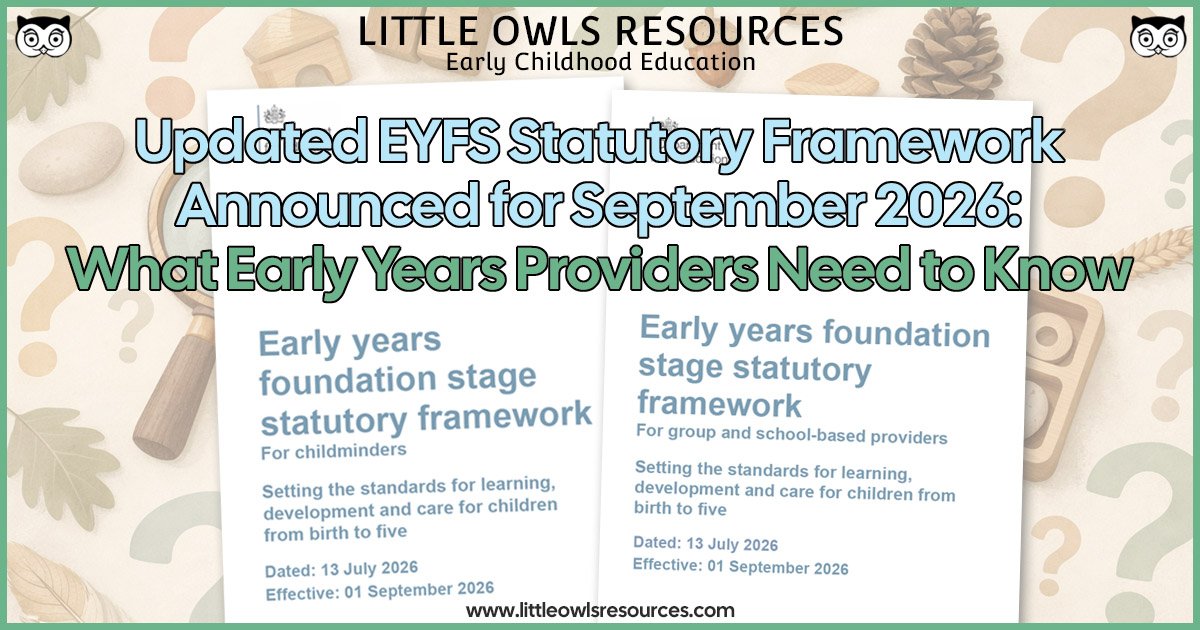
EYFS & KS1 Articles
Major UK Curriculum Shake-Up Announced: What EYFS & KS1 Practitioners Need to Know

A major overhaul of the national curriculum in England has been announced following the publication of the independent Curriculum and Assessment Review. For those working in the Early Years Foundation Stage (EYFS) and Key Stage 1 (KS1), the changes signal a renewed focus on practical life skills, digital literacy, and enriching learning experiences…

Read More →
New Education Inspection Framework | What EYFS Settings Need to Know

The world of early years education is constantly evolving, and with it, the frameworks that guide and assess our invaluable work. Come November 2025, a significant shift will occur as the new Education Inspection Framework (EIF) comes into effect, bringing with it some crucial changes…

Read More →
Revised 2025 EYFS Statutory Framework for Group & School-Based Providers | What You Need to Know

With the new 2025 EYFS Statutory Framework for group and school-based providers coming into effect on 1st September 2025, it's essential to understand the updates to ensure your practice remains compliant, effective…

Read More →
DfE Press Release | Parents urged to read more to boost children’s life chances

The Education Secretary is calling on parents to lead by example and make reading a daily habit to help reverse the decline in reading for pleasure, to help give kids the best start in life as part of the…

Read More →
DfE Update | Drowning Prevention Week: what children learn about water safety at school

As we head into summer, it’s especially important that children are prepared with these skills. This year, the Royal Life Saving Society UK's Drowning Prevention Week runs from 14 June to 21…

Read More →
DfE Update | Hot weather and heatwaves: guidance for schools and other education settings

There are several ways that schools can make changes to keep children safe in hot weather, especially as children are more at risk of becoming ill with heat-related issues than adults…

Read More →

Are you looking for a specific resource or document for your provision?

Use our 🔍 Search Bar located at the top of every page.

___________________________

Content within the EYFS Curriculum & Pedagogy Membership is provided as professional guidance and support. It reflects current understanding of the EYFS statutory framework, Development Matters and inspection expectations at the time of writing. Practitioners are responsible for applying professional judgement and ensuring practice aligns with current statutory requirements and their specific context. All resources, experiences and environment arrangements must be risk assessed by the setting and used in accordance with individual children’s developmental stages, needs and supervision requirements.

Safeguarding content does not replace a setting’s safeguarding and child protection policy or the statutory role of the Designated Safeguarding Lead (DSL). All concerns must be managed in line with current statutory guidance and local safeguarding procedures.

_____________________________

 
In Reception | 4-5 Years, -R9 Tags Reception, Reception Leadership & Inspection Readiness Pack

Reception Parent Partnership Pack | Reception (4–5 Years)

January 17, 2026 Stuart Murphy

Home › EYFS Curriculum & Pedagogy › Reception Curriculum & Pedagogy › Reception Parent Partnership Pack | Reception (4-5 Years)

Reception Parent Partnership Pack

Reception (4–5 Years)

A parent-friendly guidance pack that explains how children learn in Reception (4–5), what to expect day to day, and how families can support learning at home without pressure.

Download Document Here:

(This pathway component will be available for download by: March 31st 2026)

 
Download DOCX 📝
Download PDF 📄
 

Document Updated: January 2026

Recommended next read Selection

EYFS
Reception Leadership & Inspection Readiness Pack

Strategic guidance for leading high-quality, inspection-secure Reception practice with confidence and integrity.

Read More →
Reception SEND & Inclusion Toolkit | 4-5 Years

Extensive SEND & Inclusion pack specifically designed for use within Reception.

Read More →
EYFSP Interpretation & Assessment Toolkit | Reception (4-5 Years)

A professional guidance pack supporting accurate, confident and workload-proportionate EYFSP practice in Reception.

Read More →
Reception Labelling Pack | 4-5 Years

Labelling pack designed specifically for the reception environment.

Read More →
Adult-Guided Learning in Provision | Reception (4-5 Years)

A professional guidance document explaining how intentional adult interaction supports learning, application and inclusion within child-initiated play in Reception.

Read More →
Outdoor Area Continuous Provision | Reception 4–5 Years

A professional guidance document outlining the purpose, structure and pedagogy of outdoor continuous provision in Reception.

Read More →
Universal Continuous Provision Pack | Reception 4–5 Years

A comprehensive set of professional guidance documents supporting high-quality, purposeful continuous provision across all key areas of the Reception environment.

Read More →
Reception Universal Continuous Provision: Structure & Rationale

A professional guidance document outlining how continuous provision is designed, structured and used to support learning, progression and independence in Reception.

Read More →
Why Themes Are Optional in Reception | 4-5 Years

A professional leadership guidance document explaining the role of themes within a coherent, curriculum-led Reception approach.

Read More →
How to Use the Reception Pathway | 4-5 Years

This document is designed to help practitioners and leaders understand how to navigate and use the Reception Pathway effectively.

Read More →
About Our Reception Curriculum Phase Framework | 4-5 Years

A professional guidance document explaining the rationale and structure behind our phase-based approach to Reception curriculum design.

Read More →
Reception Curriculum Overview & Rationale | 4-5 Years

Reception Year | Ages 4–5

Read More →
Reception Pedagogy Position Statement | 4-5 Years

How Children Learn in Reception (4–5 Years)

Read More →
Reception Parent Partnership Pack | Reception (4-5 Years)

A parent-friendly guidance pack that explains how children learn in Reception (4–5), what to expect day to day, and how families can support learning at home without pressure.

Read More →
Reception → Year 1 Transition Pack

A leadership and practice pack that sets out how to plan a developmentally appropriate transition from Reception into Year 1, protecting EYFS pedagogy while building continuity into KS1.

Read More →

Professional Membership Contents (Reception 4-5 Years)

Below you will find listed the component documents of our ‘Reception Curriculum & Pedagogy Suite’. They are separated into Strands 1-10. You do not need to use everything all at once.

  • 👉 This section is essential for alignment.

    • Reception Curriculum Overview & Rationale [Free Orienting Sample]

    • Reception Pedagogy Position Statement [Free Orienting Sample]

    • About Our Reception Curriculum Phase Framework

    • How To Use The Reception Pathway

    • Why Themes Are Optional in Reception

  • 👉 Curriculum clarity and sequencing.

    • Reception Curriculum Progression Maps (all areas of learning)

      • Guide to Learning Progression: How to Use the Reception Curriculum Progression Maps

      • Progression Maps for:

        • Communication and Language

        • Personal, Social and Emotional Development

        • Physical Development

        • Literacy

        • Mathematics

        • Understanding the World

        • Expressive Arts and Design

    • Reception Curriculum Phase Framework

      • How To Use The Reception Curriculum Phase Pack

      • Phase 1: Settling & Foundations

      • Phase 2: Exploration & Early Application

      • Phase 3: Independence & Depth

      • Phase 4: Consolidation & Transition

  • 👉 OAP as the organising principle.

    • Reception OAP Cycle Guidance

    • Reception Collaborative Planning & Reflective Sheet Pack

    • Self-Regulation & Learning Behaviours in Reception

    • Reception Baseline Assessment (RBA)

    • Characteristics of Effective Learning in Reception

  • 👉 Stable, purposeful provision.

    • Reception Continuous Provision – Structure & Rationale

    • Universal Continuous Provision Pack (Areas listed below)

      • Construction

      • Creative

      • Investigation / Discovery

      • Maths

      • Reading

      • Role Play / Small World

      • Malleable / Sensory

      • Writing

    • Outdoor Continuous Provision (Reception)

    • Adult-Guided Learning in Provision

    • Reception Labelling Pack | 4-5 Years

  • 👉 Light-touch, application-focused.

    • Reception Enhanced Provision Planning Toolkit

    • Reception Optional Themed Enhancements - Idea Banks

  • 👉 Systematic teaching without Year 1 drift.

    Phonics (Scheme-Compatible)

    • Phonics in Reception: Teaching, Application & Inclusion

      • Pedagogy

      • Adult-Led Sessions

      • Phonics in Provision

      • Supporting Children Not Keeping Up

      • Phonics & EYFSP

      • Scheme Compatibility Statement

    Maths

    • Reception Maths Teaching Framework

      • Term by Tem Maths Concept Emphasis Map

      • Maths Adult-Led Mini Session Banks (9 Banks)

      • Maths Across the Curriculum & Provision

      • Maths & EYFSP Guidance

    Writing

    • Reception Early Writing Purpose Pack

      • Writing Adult-Led Mini Session Bank (12 Sessions)

    • Fine Motor & Physical Development

      • Guidance Surrounding Foundations for Writing in Reception (4–5 Years)

  • 👉 Precision language for application.

    • Adult-Guided Learning in Provision

    • Theme-Based High-Impact Question & Vocabulary Banks

      • Leadership Rationale: Why Questions Differ by Age

    • Five Sentence Stems For Reception Practitioners

  • 👉 Statutory confidence with inclusive practice.

    • EYFSP Interpretation & Assessment Toolkit

      • ELG Unpacking

      • Best-Fit Exemplification

      • Moderation Guidance

    • Reception SEND & Inclusion Toolkit

      • The graduated response (Universal → Targeted → Specialist)

      • Adaptations across phonics, maths & writing

      • Visual Communication Pack

      • Language-first strategies for inclusion

      • Observation, assessment and SEND

      • Collaborative working with families and specialists

      • Referral Preparation — for EHCP pathway

      • Reception APDR Template

      • Leadership and inspection readiness

  • 👉 Leadership assurance.

    • Reception Leadership & Inspection Readiness Pack

      • Curriculum Intent & Implementation Guidance

      • Ofsted Conversation Prompts

  • 👉 Clear communication beyond the classroom.

    • Reception Parent Partnership Pack

    • Reception Transition to Year 1 Pack

Additional Whole-Setting Guidance | for Professional Members

Explore our whole-setting guidance below, including overarching curriculum and pedagogy documents, early years schemas and EYFS setting policies.

    • Little Owls Resources’ Curriculum Intent Statement

    • EYFS from Birth to 5: Curriculum Coherence & Pedagogical Throughline

    • Whole-Setting Curriculum Map (Birth-5): Curriculum Intent & Progression

    • Pedagogy Guidance Document

    • Speech & Language Development - Setting Statement

    • EYFS Inspection-Facing Summaries

  • Early Years Schemas - Practitioner Toolkit | EYFS Birth-5

    ↪ Schema Cards (definition, behaviours, age-related examples, enabling resources)

    ↪ Schema Observation & Responsive Provision Planning Template

    • EYFS Group Setting Policies Pack

      ↪ x 22 Policy Documents

      ↪ Policy Sign-Off and Confirmation Document

      ↪ EYFS Setting Policy Folder Contents List

    • Childminder Setting Policies Pack

      ↪ x 22 Policy Documents

      ↪ Childminder Assistant or Volunteer Policy Sign-Off and Confirmation Document

      ↪ Childminder Policy Folder Contents List

  • EYFS Glossary

    ↪ Clear, practitioner-friendly explanations of key curriculum and pedagogy terms used throughout our guidance.

Looking for a different age group pathway?

Select the pathway that best reflects your role or the age group you work with. You do not need to use everything. (Some practitioners may use more than one pathway.)

Featured
🍼 Babies (0–18 months)

Responsive care, observation and development in the earliest years

🚼 Toddlers (18–36 months)

Development, play and progression in the toddler years

🎨 Preschool (3–4 years)

Curriculum, continuous provision and purposeful teaching

🎓 Reception (4–5 years)

Play-based pedagogy, progression and EYFSP readiness

🏡 Childminders (Birth–5)

Mixed-age pedagogy, planning without overload and inspection confidence

Latest EYFS Articles & Practical Guides | From Our Blog

Stay informed, get expert advice, and find inspiration from our collection of articles and useful external resources, tailored specifically for EYFS practitioners. We regularly publish in-depth articles to support you with current best practices, regulatory changes, and fresh ideas.
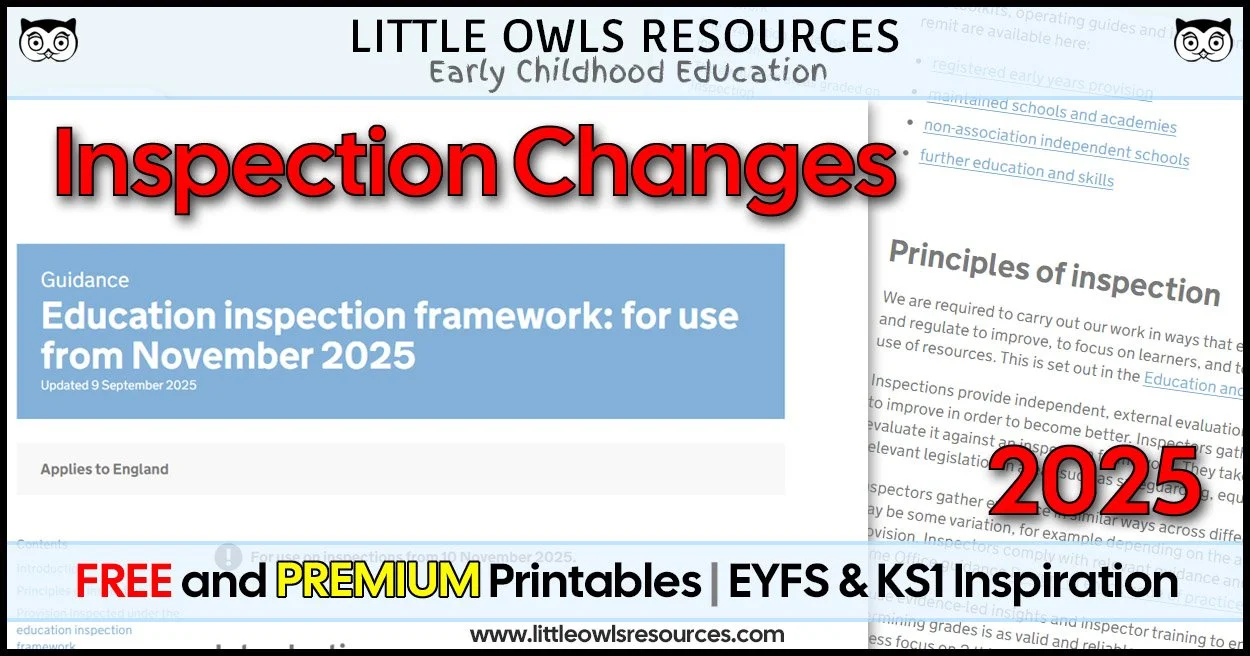
EYFS & KS1 Articles
Major UK Curriculum Shake-Up Announced: What EYFS & KS1 Practitioners Need to Know

A major overhaul of the national curriculum in England has been announced following the publication of the independent Curriculum and Assessment Review. For those working in the Early Years Foundation Stage (EYFS) and Key Stage 1 (KS1), the changes signal a renewed focus on practical life skills, digital literacy, and enriching learning experiences…

Read More →
New Education Inspection Framework | What EYFS Settings Need to Know

The world of early years education is constantly evolving, and with it, the frameworks that guide and assess our invaluable work. Come November 2025, a significant shift will occur as the new Education Inspection Framework (EIF) comes into effect, bringing with it some crucial changes…

Read More →
Revised 2025 EYFS Statutory Framework for Group & School-Based Providers | What You Need to Know

With the new 2025 EYFS Statutory Framework for group and school-based providers coming into effect on 1st September 2025, it's essential to understand the updates to ensure your practice remains compliant, effective…

Read More →
DfE Press Release | Parents urged to read more to boost children’s life chances

The Education Secretary is calling on parents to lead by example and make reading a daily habit to help reverse the decline in reading for pleasure, to help give kids the best start in life as part of the…

Read More →
DfE Update | Drowning Prevention Week: what children learn about water safety at school

As we head into summer, it’s especially important that children are prepared with these skills. This year, the Royal Life Saving Society UK's Drowning Prevention Week runs from 14 June to 21…

Read More →
DfE Update | Hot weather and heatwaves: guidance for schools and other education settings

There are several ways that schools can make changes to keep children safe in hot weather, especially as children are more at risk of becoming ill with heat-related issues than adults…

Read More →

Are you looking for a specific resource or document for your provision?

Use our 🔍 Search Bar located at the top of every page.

___________________________

Content within the EYFS Curriculum & Pedagogy Membership is provided as professional guidance and support. It reflects current understanding of the EYFS statutory framework, Development Matters and inspection expectations at the time of writing. Practitioners are responsible for applying professional judgement and ensuring practice aligns with current statutory requirements and their specific context. All resources, experiences and environment arrangements must be risk assessed by the setting and used in accordance with individual children’s developmental stages, needs and supervision requirements.

Safeguarding content does not replace a setting’s safeguarding and child protection policy or the statutory role of the Designated Safeguarding Lead (DSL). All concerns must be managed in line with current statutory guidance and local safeguarding procedures.

_____________________________

 
In Reception | 4-5 Years, -R10 Tags Reception, Reception Parent Partnership Pack | Reception (4–5 Years)

Reception → Year 1 Transition Pack

January 17, 2026 Stuart Murphy

Home › EYFS Curriculum & Pedagogy › Reception Curriculum & Pedagogy › Reception → Year 1 Transition Pack

Reception → Year 1 Transition Pack

Reception (4–5 Years)

A leadership and practice pack that sets out how to plan a developmentally appropriate transition from Reception into Year 1, protecting EYFS pedagogy while building continuity into KS1.

Download Document Here:

(This pathway component will be available for download by: March 31st 2026)

 
Download DOCX 📝
Download PDF 📄
 

Document Updated: January 2026

Recommended next read Selection

EYFS
Reception Leadership & Inspection Readiness Pack

Strategic guidance for leading high-quality, inspection-secure Reception practice with confidence and integrity.

Read More →
Reception SEND & Inclusion Toolkit | 4-5 Years

Extensive SEND & Inclusion pack specifically designed for use within Reception.

Read More →
EYFSP Interpretation & Assessment Toolkit | Reception (4-5 Years)

A professional guidance pack supporting accurate, confident and workload-proportionate EYFSP practice in Reception.

Read More →
Reception Labelling Pack | 4-5 Years

Labelling pack designed specifically for the reception environment.

Read More →
Adult-Guided Learning in Provision | Reception (4-5 Years)

A professional guidance document explaining how intentional adult interaction supports learning, application and inclusion within child-initiated play in Reception.

Read More →
Outdoor Area Continuous Provision | Reception 4–5 Years

A professional guidance document outlining the purpose, structure and pedagogy of outdoor continuous provision in Reception.

Read More →
Universal Continuous Provision Pack | Reception 4–5 Years

A comprehensive set of professional guidance documents supporting high-quality, purposeful continuous provision across all key areas of the Reception environment.

Read More →
Reception Universal Continuous Provision: Structure & Rationale

A professional guidance document outlining how continuous provision is designed, structured and used to support learning, progression and independence in Reception.

Read More →
Why Themes Are Optional in Reception | 4-5 Years

A professional leadership guidance document explaining the role of themes within a coherent, curriculum-led Reception approach.

Read More →
How to Use the Reception Pathway | 4-5 Years

This document is designed to help practitioners and leaders understand how to navigate and use the Reception Pathway effectively.

Read More →
About Our Reception Curriculum Phase Framework | 4-5 Years

A professional guidance document explaining the rationale and structure behind our phase-based approach to Reception curriculum design.

Read More →
Reception Curriculum Overview & Rationale | 4-5 Years

Reception Year | Ages 4–5

Read More →
Reception Pedagogy Position Statement | 4-5 Years

How Children Learn in Reception (4–5 Years)

Read More →
Reception Parent Partnership Pack | Reception (4-5 Years)

A parent-friendly guidance pack that explains how children learn in Reception (4–5), what to expect day to day, and how families can support learning at home without pressure.

Read More →
Reception → Year 1 Transition Pack

A leadership and practice pack that sets out how to plan a developmentally appropriate transition from Reception into Year 1, protecting EYFS pedagogy while building continuity into KS1.

Read More →

Professional Membership Contents (Reception 4-5 Years)

Below you will find listed the component documents of our ‘Reception Curriculum & Pedagogy Suite’. They are separated into Strands 1-10. You do not need to use everything all at once.

  • 👉 This section is essential for alignment.

    • Reception Curriculum Overview & Rationale [Free Orienting Sample]

    • Reception Pedagogy Position Statement [Free Orienting Sample]

    • About Our Reception Curriculum Phase Framework

    • How To Use The Reception Pathway

    • Why Themes Are Optional in Reception

  • 👉 Curriculum clarity and sequencing.

    • Reception Curriculum Progression Maps (all areas of learning)

      • Guide to Learning Progression: How to Use the Reception Curriculum Progression Maps

      • Progression Maps for:

        • Communication and Language

        • Personal, Social and Emotional Development

        • Physical Development

        • Literacy

        • Mathematics

        • Understanding the World

        • Expressive Arts and Design

    • Reception Curriculum Phase Framework

      • How To Use The Reception Curriculum Phase Pack

      • Phase 1: Settling & Foundations

      • Phase 2: Exploration & Early Application

      • Phase 3: Independence & Depth

      • Phase 4: Consolidation & Transition

  • 👉 OAP as the organising principle.

    • Reception OAP Cycle Guidance

    • Reception Collaborative Planning & Reflective Sheet Pack

    • Self-Regulation & Learning Behaviours in Reception

    • Reception Baseline Assessment (RBA)

    • Characteristics of Effective Learning in Reception

  • 👉 Stable, purposeful provision.

    • Reception Continuous Provision – Structure & Rationale

    • Universal Continuous Provision Pack (Areas listed below)

      • Construction

      • Creative

      • Investigation / Discovery

      • Maths

      • Reading

      • Role Play / Small World

      • Malleable / Sensory

      • Writing

    • Outdoor Continuous Provision (Reception)

    • Adult-Guided Learning in Provision

    • Reception Labelling Pack | 4-5 Years

  • 👉 Light-touch, application-focused.

    • Reception Enhanced Provision Planning Toolkit

    • Reception Optional Themed Enhancements - Idea Banks

  • 👉 Systematic teaching without Year 1 drift.

    Phonics (Scheme-Compatible)

    • Phonics in Reception: Teaching, Application & Inclusion

      • Pedagogy

      • Adult-Led Sessions

      • Phonics in Provision

      • Supporting Children Not Keeping Up

      • Phonics & EYFSP

      • Scheme Compatibility Statement

    Maths

    • Reception Maths Teaching Framework

      • Term by Tem Maths Concept Emphasis Map

      • Maths Adult-Led Mini Session Banks (9 Banks)

      • Maths Across the Curriculum & Provision

      • Maths & EYFSP Guidance

    Writing

    • Reception Early Writing Purpose Pack

      • Writing Adult-Led Mini Session Bank (12 Sessions)

    • Fine Motor & Physical Development

      • Guidance Surrounding Foundations for Writing in Reception (4–5 Years)

  • 👉 Precision language for application.

    • Adult-Guided Learning in Provision

    • Theme-Based High-Impact Question & Vocabulary Banks

      • Leadership Rationale: Why Questions Differ by Age

    • Five Sentence Stems For Reception Practitioners

  • 👉 Statutory confidence with inclusive practice.

    • EYFSP Interpretation & Assessment Toolkit

      • ELG Unpacking

      • Best-Fit Exemplification

      • Moderation Guidance

    • Reception SEND & Inclusion Toolkit

      • The graduated response (Universal → Targeted → Specialist)

      • Adaptations across phonics, maths & writing

      • Visual Communication Pack

      • Language-first strategies for inclusion

      • Observation, assessment and SEND

      • Collaborative working with families and specialists

      • Referral Preparation — for EHCP pathway

      • Reception APDR Template

      • Leadership and inspection readiness

  • 👉 Leadership assurance.

    • Reception Leadership & Inspection Readiness Pack

      • Curriculum Intent & Implementation Guidance

      • Ofsted Conversation Prompts

  • 👉 Clear communication beyond the classroom.

    • Reception Parent Partnership Pack

    • Reception Transition to Year 1 Pack

Additional Whole-Setting Guidance | for Professional Members

Explore our whole-setting guidance below, including overarching curriculum and pedagogy documents, early years schemas and EYFS setting policies.

    • Little Owls Resources’ Curriculum Intent Statement

    • EYFS from Birth to 5: Curriculum Coherence & Pedagogical Throughline

    • Whole-Setting Curriculum Map (Birth-5): Curriculum Intent & Progression

    • Pedagogy Guidance Document

    • Speech & Language Development - Setting Statement

    • EYFS Inspection-Facing Summaries

  • Early Years Schemas - Practitioner Toolkit | EYFS Birth-5

    ↪ Schema Cards (definition, behaviours, age-related examples, enabling resources)

    ↪ Schema Observation & Responsive Provision Planning Template

    • EYFS Group Setting Policies Pack

      ↪ x 22 Policy Documents

      ↪ Policy Sign-Off and Confirmation Document

      ↪ EYFS Setting Policy Folder Contents List

    • Childminder Setting Policies Pack

      ↪ x 22 Policy Documents

      ↪ Childminder Assistant or Volunteer Policy Sign-Off and Confirmation Document

      ↪ Childminder Policy Folder Contents List

  • EYFS Glossary

    ↪ Clear, practitioner-friendly explanations of key curriculum and pedagogy terms used throughout our guidance.

Looking for a different age group pathway?

Select the pathway that best reflects your role or the age group you work with. You do not need to use everything. (Some practitioners may use more than one pathway.)

Featured
🍼 Babies (0–18 months)

Responsive care, observation and development in the earliest years

🚼 Toddlers (18–36 months)

Development, play and progression in the toddler years

🎨 Preschool (3–4 years)

Curriculum, continuous provision and purposeful teaching

🎓 Reception (4–5 years)

Play-based pedagogy, progression and EYFSP readiness

🏡 Childminders (Birth–5)

Mixed-age pedagogy, planning without overload and inspection confidence

Latest EYFS Articles & Practical Guides | From Our Blog

Stay informed, get expert advice, and find inspiration from our collection of articles and useful external resources, tailored specifically for EYFS practitioners. We regularly publish in-depth articles to support you with current best practices, regulatory changes, and fresh ideas.

EYFS & KS1 Articles
Major UK Curriculum Shake-Up Announced: What EYFS & KS1 Practitioners Need to Know

A major overhaul of the national curriculum in England has been announced following the publication of the independent Curriculum and Assessment Review. For those working in the Early Years Foundation Stage (EYFS) and Key Stage 1 (KS1), the changes signal a renewed focus on practical life skills, digital literacy, and enriching learning experiences…

Read More →
New Education Inspection Framework | What EYFS Settings Need to Know

The world of early years education is constantly evolving, and with it, the frameworks that guide and assess our invaluable work. Come November 2025, a significant shift will occur as the new Education Inspection Framework (EIF) comes into effect, bringing with it some crucial changes…

Read More →
Revised 2025 EYFS Statutory Framework for Group & School-Based Providers | What You Need to Know

With the new 2025 EYFS Statutory Framework for group and school-based providers coming into effect on 1st September 2025, it's essential to understand the updates to ensure your practice remains compliant, effective…

Read More →
DfE Press Release | Parents urged to read more to boost children’s life chances

The Education Secretary is calling on parents to lead by example and make reading a daily habit to help reverse the decline in reading for pleasure, to help give kids the best start in life as part of the…

Read More →
DfE Update | Drowning Prevention Week: what children learn about water safety at school

As we head into summer, it’s especially important that children are prepared with these skills. This year, the Royal Life Saving Society UK's Drowning Prevention Week runs from 14 June to 21…

Read More →
DfE Update | Hot weather and heatwaves: guidance for schools and other education settings

There are several ways that schools can make changes to keep children safe in hot weather, especially as children are more at risk of becoming ill with heat-related issues than adults…

Read More →

Are you looking for a specific resource or document for your provision?

Use our 🔍 Search Bar located at the top of every page.

___________________________

Content within the EYFS Curriculum & Pedagogy Membership is provided as professional guidance and support. It reflects current understanding of the EYFS statutory framework, Development Matters and inspection expectations at the time of writing. Practitioners are responsible for applying professional judgement and ensuring practice aligns with current statutory requirements and their specific context. All resources, experiences and environment arrangements must be risk assessed by the setting and used in accordance with individual children’s developmental stages, needs and supervision requirements.

Safeguarding content does not replace a setting’s safeguarding and child protection policy or the statutory role of the Designated Safeguarding Lead (DSL). All concerns must be managed in line with current statutory guidance and local safeguarding procedures.

_____________________________

 
In Reception | 4-5 Years, -R10 Tags Reception, Reception → Year 1 Transition Pack
← Newer Posts

Trusted by over 35,000 members

- early years professionals across nurseries, schools and childminding settings


Contact Little Owls Resources support:

support@littleowlsresources.com

Information

  • About | Testimonials

  • Privacy Policy

  • Cookie Policy

  • Terms & Conditions

  • Help Page

Core Navigation

  • Membership

  • Printable Resources

  • Events Calendar

  • Curriculum & Pedagogy

Thank-you Little Owls Resources members! Our community is growing! 😊


Read our File Format information

Copyright on all of the images, files & resources housed on this website is held by ‘Little Owls Resources’. In downloading any of these resources you are issued a single licence for your own use and the right to grant a limited licence to your students to use the licensed material as part of your teaching and their own use.

Our resources (including the images within them), cannot be shared or sold commercially.

Website powered by Squarespace

Search powered by https://www.sitesearch360.com