

Scroll down to read this web document or download files here: DOCX 📝 | PDF 📄
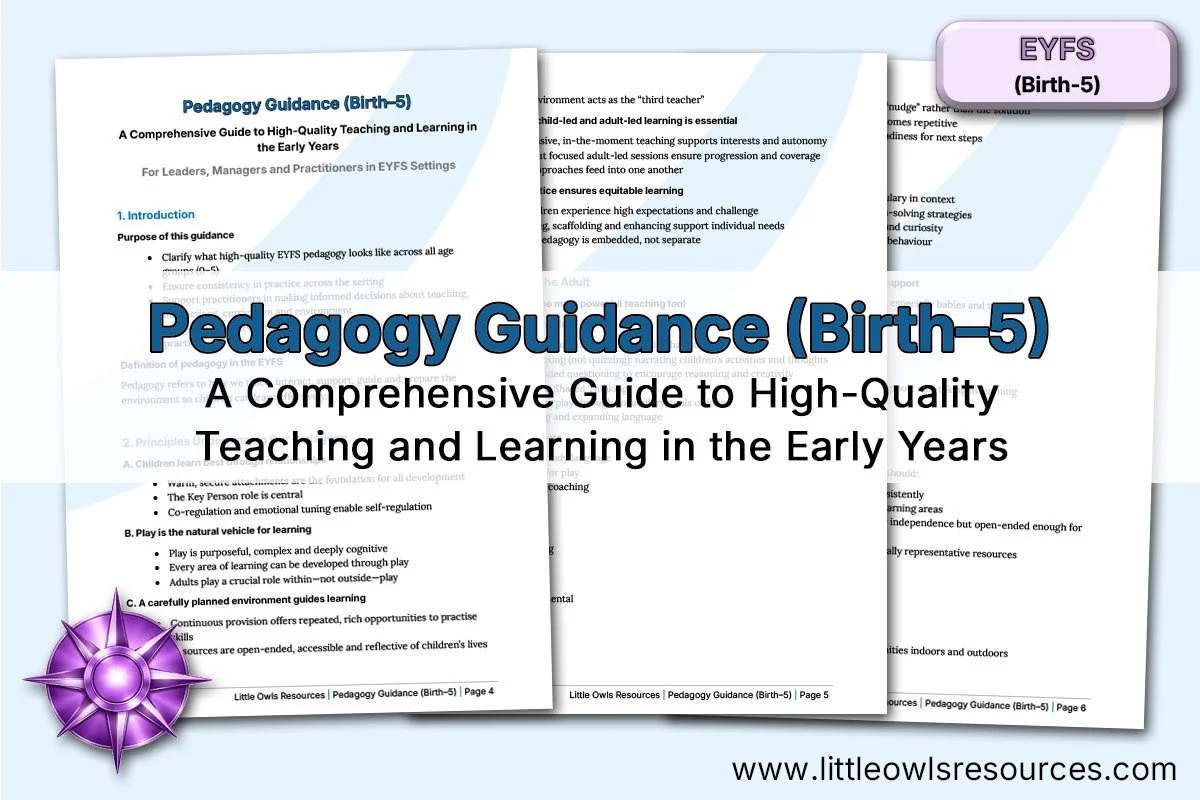
Pedagogy Guidance (Birth–5)
A Comprehensive Guide to High-Quality Teaching and Learning in the Early Years
For Leaders, Managers and Practitioners in EYFS Settings
Document Overview
About This Document
This Pedagogy Guidance has been designed to support early years leaders and practitioners in delivering high-quality, research-informed practice across all age groups from birth to five. It draws on the EYFS Statutory Framework, developmental theory, and established UK best practice to provide a clear, practical and consistent approach to teaching, learning, and environment design in Early Years settings.
Whether your setting is a nursery, preschool, childminding service or school-based EYFS unit, this guide offers a shared language and vision for high-quality pedagogy.
Why This Guidance Is Important
High-quality pedagogy is the foundation of strong outcomes for children. This document helps settings to:
Establish a unified approach to teaching and learning across birth–5
Ensure consistency in how staff interact, plan, scaffold, observe and respond to children
Support new staff and students with clear expectations and professional standards
Strengthen language-rich, play-based learning, aligned with current research
Ensure equitable, inclusive practice for children with SEND, EAL and diverse backgrounds
Promote ambitious curriculum goals while maintaining warm, child-centred care
Embed reflective practice and raise the overall quality of provision
What This Guidance Includes
Inside, you will find:
The core principles that underpin effective pedagogy in the EYFS
Clear descriptions of the adult role, including interactions, modelling and scaffolding
Detailed guidance on continuous and enhanced provision
Approaches to play pedagogy, schema learning and outdoor learning
Expectations for adult-led learning that complement child-led exploration
Age-specific pedagogical approaches for babies, toddlers, preschoolers and Reception
Strategies for fostering language development, social-emotional wellbeing and independence
Guidance on inclusive practice, SEND, EAL and cultural responsiveness
Tools for reflection and quality improvement
How to Use This Document in Your Setting
For Leaders & Managers
Use as a foundation for your curriculum, environment planning and quality assurance processes
Embed into staff induction, appraisals and performance management systems
Use sections to support staff meetings, CPD sessions and coaching conversations
For Practitioners
Refer to the guidance when planning experiences or evaluating your provision
Use it to strengthen interactions, extend children’s learning and refine your teaching style
Reflect on your own practice and identify areas for professional development
For Teams
Create a shared, consistent approach across rooms and age groups
Use selected sections during team meetings, room audits or peer observations
Align pedagogy with your setting’s curriculum intent and ethos
Our Pedagogical Promise
By using this resource, your setting is committing to a reflective, child-centred approach that values:
Strong relationships
Play as the primary mode of learning
High expectations for every child
An enabling environment
Skilled and sensitive adult interactions
Equity, inclusion and belonging
Continual improvement and professional growth
Together, these values form the foundation for high-quality early years practice that supports children to thrive, learn and flourish.
—————————————————————————————————————————-
DOCUMENT
Pedagogy Guidance (Birth–5)
A Comprehensive Guide to High-Quality Teaching and Learning in the Early Years
For Leaders, Managers and Practitioners in EYFS Settings
1. Introduction
Purpose of this guidance
Clarify what high-quality EYFS pedagogy looks like across all age groups (0–5)
Ensure consistency in practice across the setting
Support practitioners in making informed decisions about teaching, interactions, curriculum and environment
Bridge the gap between theory, current research and day-to-day practice
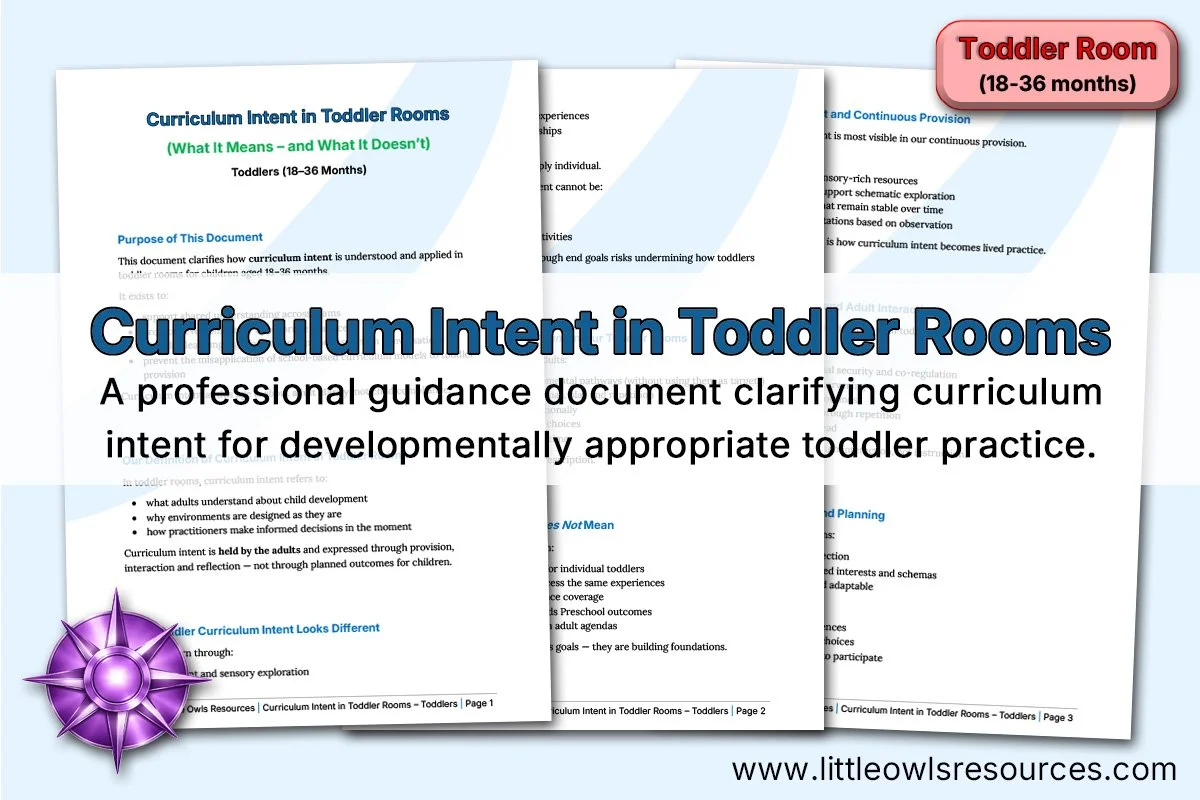
Definition of pedagogy in the EYFS
Pedagogy refers to how we teach, interact, support, guide and prepare the environment so children can learn effectively.
2. Principles Underpinning Our Pedagogy
A. Children learn best through relationships
Warm, secure attachments are the foundation for all development
The Key Person role is central
Co-regulation and emotional tuning enable self-regulation
B. Play is the natural vehicle for learning
Play is purposeful, complex and deeply cognitive
Every area of learning can be developed through play
Adults play a crucial role within—not outside—play
C. A carefully planned environment guides learning
Continuous provision offers repeated, rich opportunities to practise skills
Resources are open-ended, accessible and reflective of children’s lives
The environment acts as the “third teacher”
D. A balance of child-led and adult-led learning is essential
Responsive, in-the-moment teaching supports interests and autonomy
Brief but focused adult-led sessions ensure progression and coverage
Both approaches feed into one another
E. Inclusive practice ensures equitable learning
All children experience high expectations and challenge
Adapting, scaffolding and enhancing support individual needs
SEND pedagogy is embedded, not separate
3. The Role of the Adult
A. Interactions: the most powerful teaching tool
High-quality interactions include:
Modelling language, thinking and behaviours
Commenting (not quizzing): narrating children’s activities and thoughts
Open-ended questioning to encourage reasoning and creativity
Sustained Shared Thinking
Extending play through vocabulary, tools or ideas
Recasting and expanding language
Non-verbal elements
Attuned body language
Respect for play
Emotion coaching
B. Scaffolding
Types of scaffolding
Physical
Verbal
Environmental
Social
Cognitive
When to scaffold
When children need a “nudge” rather than the solution
When play stalls or becomes repetitive
When a child shows readiness for next steps
C. Modelling
Introducing new vocabulary in context
Demonstrating problem-solving strategies
Showing perseverance and curiosity
Modelling collaborative behaviour
D. Co-regulation and Emotional Support
Essential across all age groups but especially babies and toddlers.
Practitioners support:
Naming feelings
Calming strategies
Social problem-solving
Secure attachments to support risk-taking in learning
4. The Learning Environment
A. Continuous Provision
High-quality continuous provision should:
Be available daily and consistently
Offer breadth across all learning areas
Be predictable enough for independence but open-ended enough for challenge
Include purposeful, culturally representative resources
Features of excellent provision
Loose parts
Natural materials
Real-life objects
Open-ended creative media
Varied mark-making opportunities indoors and outdoors
Books across all areas
B. Enhanced Provision
Enhancements should:
Build on observed interests
Deepen knowledge in curriculum themes
Support specific skill development
Be limited in number to avoid overstimulation
C. Outdoor Learning Pedagogy
Outdoor learning is:
A full learning environment, not “playtime”
Essential for physical development and regulation
Rich in STEM, risk-taking and imaginative play
5. Play Pedagogy
A. Types of Play
Free play
Guided play
Role play and socio-dramatic play
Heuristic play
Schema play
Physical play
Creative and imaginative play
Exploratory play
Problem-solving and construction play
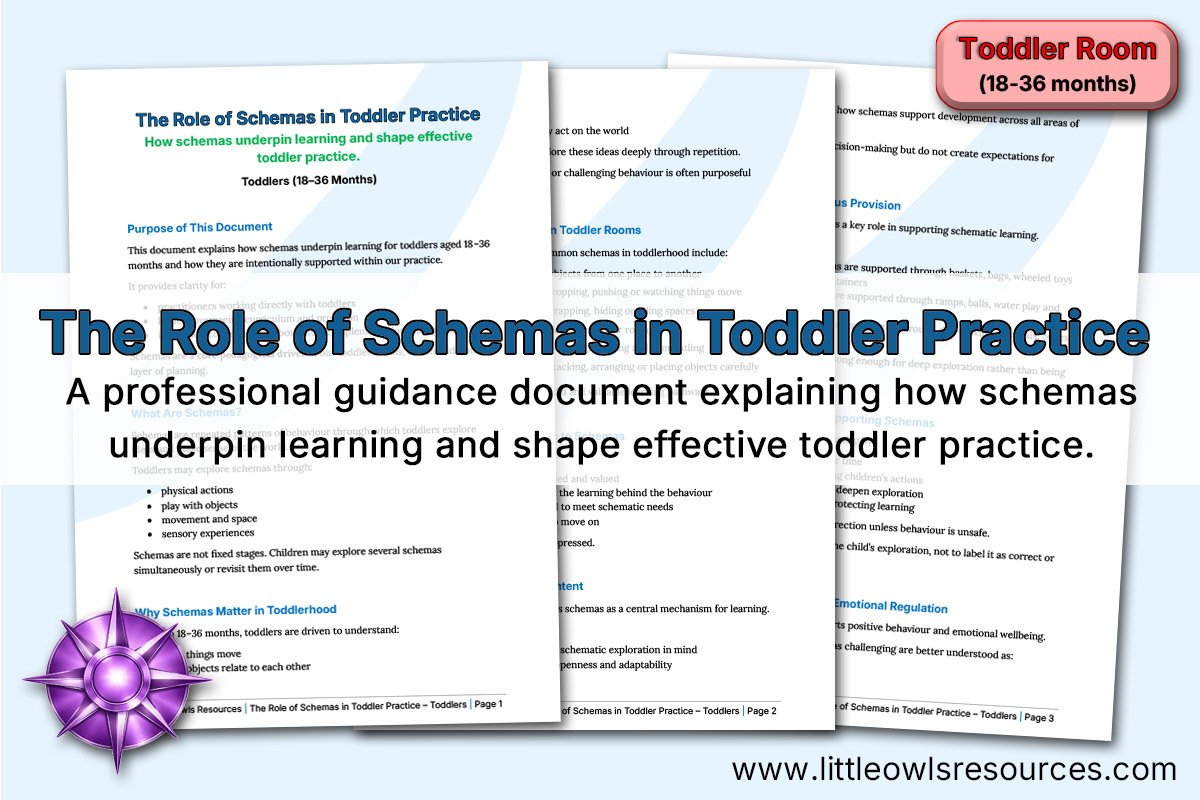
B. Recognising and Supporting Schemas
Practitioners identify repeated patterns of behaviour and enhance the environment accordingly.
6. Adult-Led Learning
Adult-led learning ensures progression and coverage while remaining developmentally appropriate.
Principles
Brief, purposeful and engaging
Tailored to developmental stage
Linked to curriculum progression
Followed up through continuous provision
Delivered in small groups where appropriate
Examples
Songs and rhymes
Story times with rich book talk
Focused fine-motor activities
Early maths sequences
Communication groups
Reception-specific clarification
In Reception, adult-led learning includes systematic phonics and mathematics teaching delivered in developmentally appropriate ways, without replicating Key Stage 1 structures.
7. Language-Rich Pedagogy
Language development is central to EYFS outcomes.
Key features:
Adults speak often but do not dominate play
Vocabulary is taught explicitly and embedded
Repetition and rephrasing support understanding
Storytelling, singing and rhyming are daily routines
Dialogic storytime supports comprehension
For EAL learners
Home language is valued
Visuals and gestures are used
Language is modelled without shaming correction
8. Pedagogy for Each Age Group (Birth–5)
A. Babies (0–18 months)
Pedagogy focuses on:
Attachment, security and routine
Sensory exploration
Early communication and turn-taking
Real-life objects (treasure baskets)
Floor-based, movement-rich experiences
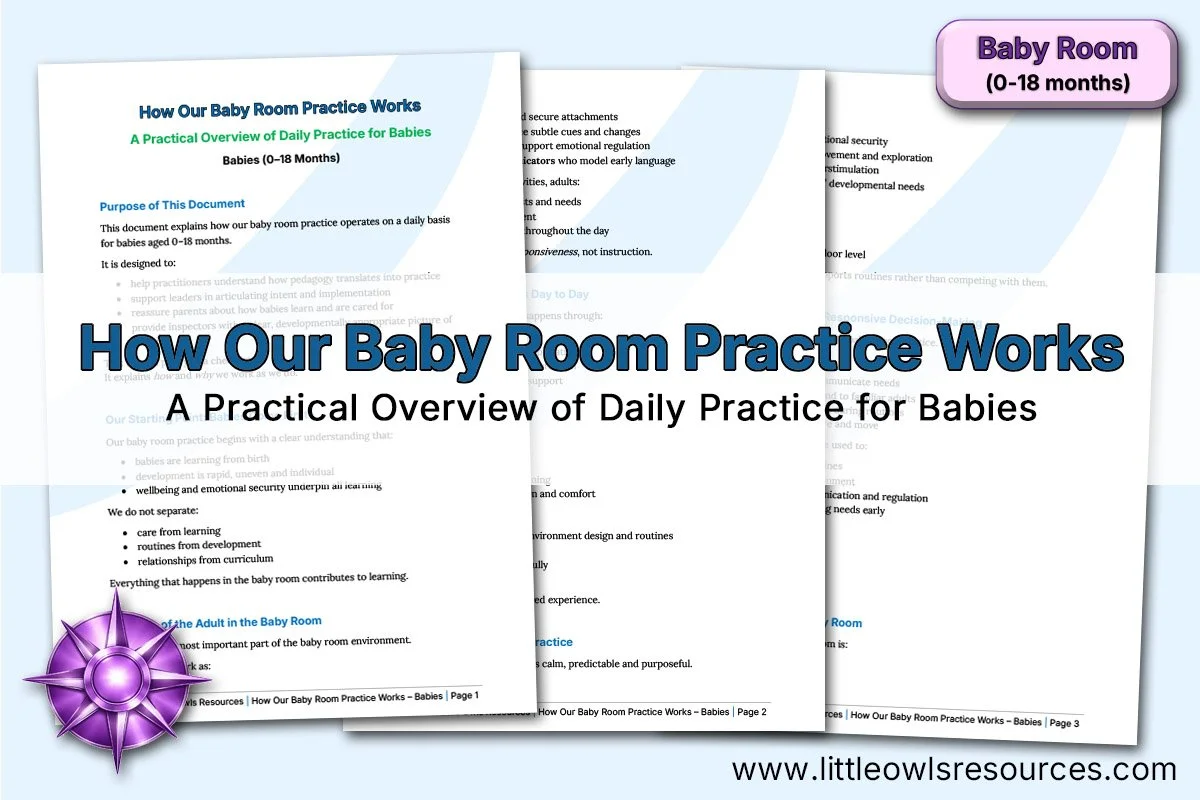
Care as curriculum clarification
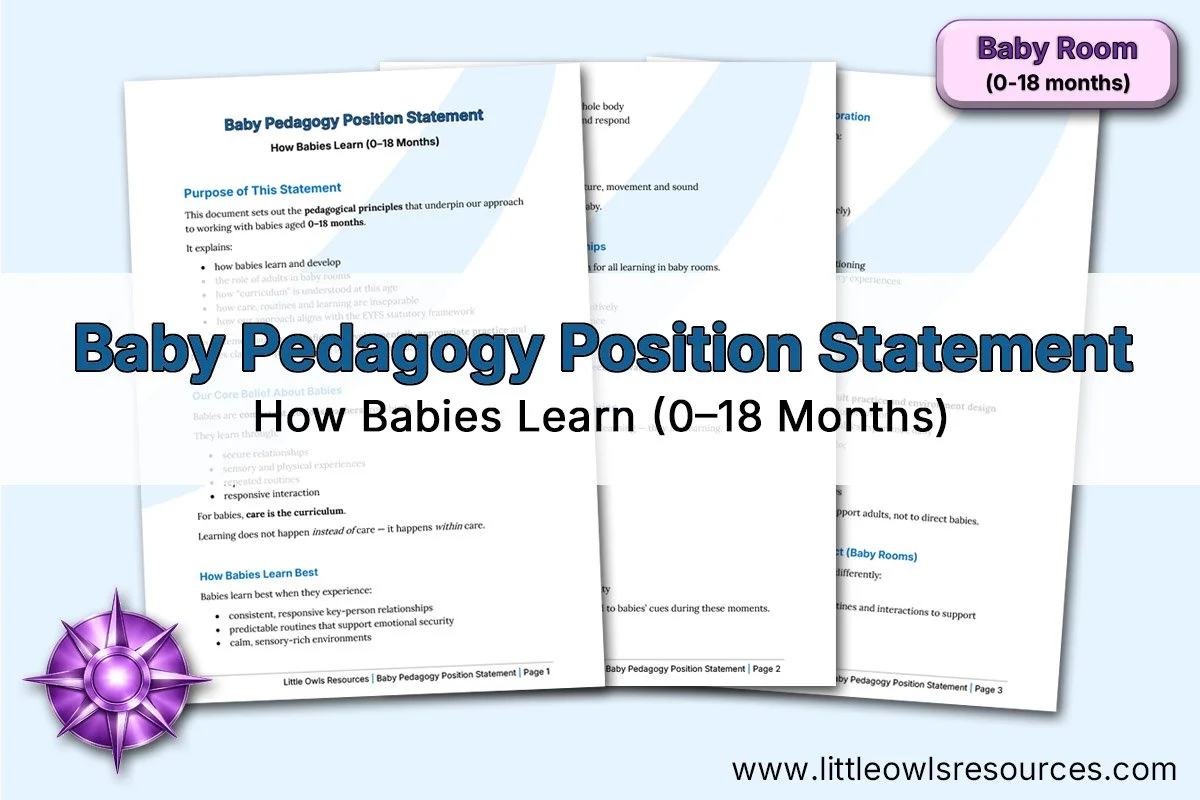
For babies, learning is inseparable from care. Routines such as feeding, nappy changing, settling and sleep are intentionally recognised as core learning experiences, supporting development across the prime areas of learning, as outlined in our Care as Curriculum guidance.
B. Toddlers (18–36 months)
Pedagogy focuses on:
Heuristic play
Language explosion and naming
Repetition and schemas
Early independence
Beginning simple rule-following
Emotional co-regulation
C. Preschool (3–4 years)
Pedagogy focuses on:
Sustained shared thinking
Imaginative and socio-dramatic play
Early mathematical reasoning
Problem-solving
Independence and collaboration
Extended projects and inquiry
D. Reception (4–5 years)
Pedagogy blends:
Play-based learning
Systematic phonics
Early writing and maths sequences
High challenge supported through modelling and scaffolding
Refining self-regulation and executive function
Purposeful provision matched to curriculum steps
9. Assessment and Pedagogy
Assessment supports — not dominates — pedagogy.
Assessment informs:
Enhancements
Adult-led focus sessions
Interactions and vocabulary
Individualised support
SEND adaptations
Professional judgement statement
Practitioner knowledge of the child remains the primary assessment tool, with written evidence used selectively to support reflection, planning and communication.
Avoiding over-assessment
Limit unnecessary documentation
Capture learning through professional knowledge
Use observation sparingly but purposefully
10. Inclusive Pedagogy
SEND
Break tasks into manageable steps
Offer sensory regulation tools
Use visuals, gestures and objects of reference
Model social interactions explicitly
Provide alternative communication methods
EAL
Maintain and value home language
Provide bilingual resources where possible
Use peer modelling
11. Pedagogy and Family Partnership
Families are children’s first educators.
Practices include:
Sharing learning prompts
Welcoming parental contributions
Cultural responsiveness in resources and curriculum
Joint planning for SEND and additional needs
12. Quality Assurance and Reflective Practice
High-quality pedagogy is sustained through reflection.
Tools include:
Environment audits
Interaction audits
Peer observations
Learning walks
Supervision meetings
Practitioner reflection journals
Document Updated: January 2026
Recommended next read selection





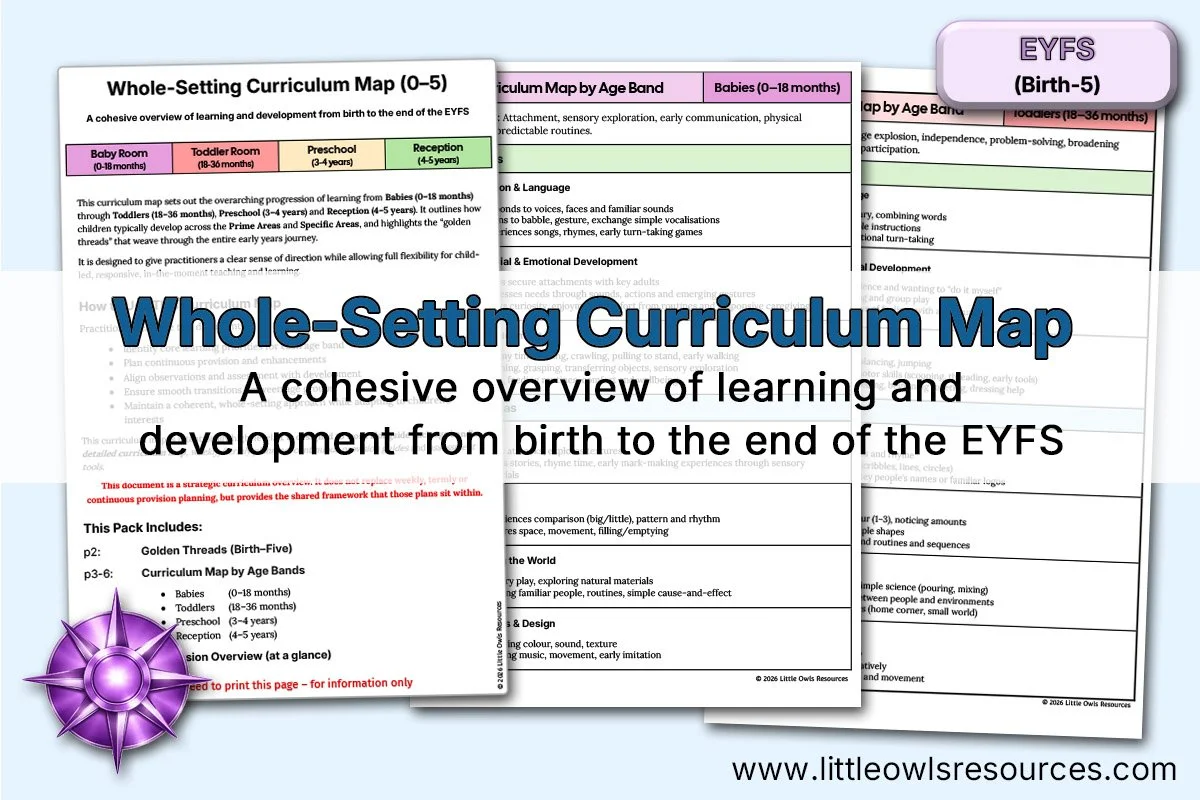



Additional Whole-Setting Guidance | for Professional Members
Explore our whole-setting guidance below, including overarching curriculum and pedagogy documents, early years schemas and EYFS setting policies.
-
-
Early Years Schemas - Practitioner Toolkit | EYFS Birth-5
↪ Schema Cards (definition, behaviours, age-related examples, enabling resources)
↪ Schema Observation & Responsive Provision Planning Template
-
EYFS Group Setting Policies Pack
↪ x 25 Policy Documents
↪ Policy Sign-Off and Confirmation Document
↪ EYFS Setting Policy Folder Contents List
Childminder Setting Policies Pack
↪ x 25 Policy Documents
↪ Childminder Assistant or Volunteer Policy Sign-Off and Confirmation Document
↪ Childminder Policy Folder Contents List
-
↪ Clear, practitioner-friendly explanations of key curriculum and pedagogy terms used throughout our guidance.
Looking for age-specific pathway documents?
Select the pathway that best reflects your role or the age group you work with. You do not need to use everything. (Some practitioners may use more than one pathway.)
Latest EYFS Articles & Practical Guides | From Our Blog
Stay informed, get expert advice, and find inspiration from our collection of articles and useful external resources, tailored specifically for EYFS practitioners. We regularly publish in-depth articles to support you with current best practices, regulatory changes, and fresh ideas.




Are you looking for a specific resource or document for your provision?
Use our 🔍 SEARCH Bar located at the top of every page.
Content within the EYFS Curriculum & Pedagogy Membership is provided as professional guidance and support. It reflects current understanding of the EYFS statutory framework, Development Matters and inspection expectations at the time of writing. Practitioners are responsible for applying professional judgement and ensuring practice aligns with current statutory requirements and their specific context.
Updated: January 2026