

Home › EYFS Curriculum & Pedagogy › Preschool Curriculum & Pedagogy
Read our web document below or download here: DOCX 📝 | PDF 📄
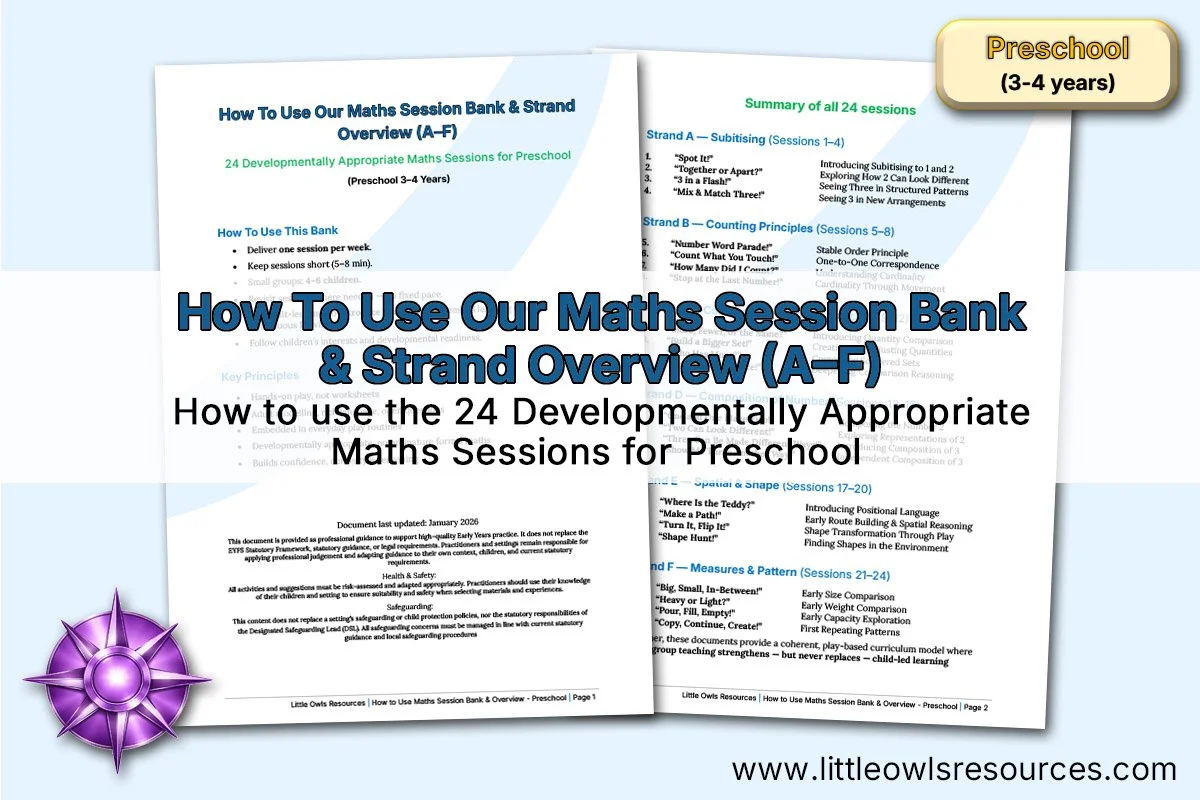
How To Use Our Maths Session Bank & Strand Overview (A–F)
24 Developmentally Appropriate Maths Sessions for Preschool (3–4 Years)
EYFS Curriculum & Pedagogy Membership (Professional)
How To Use This Bank
Deliver one session per week.
Keep sessions short (5–8 min).
Small groups: 4–6 children.
Revisit sessions where needed — no fixed pace.
Use adult-led time to introduce concepts, then embed learning through Continuous Provision.
Follow children’s interests and developmental readiness.
Key Principles
Hands-on play, not worksheets
Adult modelling, rich language, open questions
Embedded in everyday play routines
Developmentally appropriate, no premature formal maths
Builds confidence, curiosity & reasoning
This 24-session sequence provides a complete, developmentally aligned, high-quality preschool maths curriculum that blends adult-guided learning with child-led exploration.
Preschool Maths Small-Group Session Bank (3–4 Years)
Summary of all 24 sessions
Aligned with Development Matters & EYFS Best Practice
Strand A — Subitising (Sessions 1–4)
1. “Spot It!” – Introducing Subitising to 1 and 2
2. “Together or Apart?” — Exploring How 2 Can Look Different
3. “3 in a Flash!” — Seeing Three in Structured Patterns
4. “Mix & Match Three!” — Seeing 3 in New Arrangements
Strand B — Counting Principles (Sessions 5–8)
5. “Number Word Parade!” — Stable Order Principle
6. “Count What You Touch!” — One-to-One Correspondence
7. “How Many Did I Count?” — Understanding Cardinality
8. “Stop at the Last Number!” — Cardinality Through Movement
Strand C — Comparing Quantities (Sessions 9–12)
9. “More, Fewer, or the Same?” — Introducing Quantity Comparison
10. “Build a Bigger Set!” — Creating and Adjusting Quantities
11. “Who Has More?” — Comparing Scattered Sets
12. “Explain Your Choice!” — Deepening Comparison Reasoning
Strand D — Composition of Number (Sessions 13–16)
13. “One and One Make Two!” — Composing the Number 2
14. “Two Can Look Different!” — Exploring Representations of 2
15. “Three Can Be Made Different Ways!” — Introducing Composition of 3
16. “Show Me Three Another Way!” — Independent Composition of 3
Strand E — Spatial & Shape (Sessions 17–20)
17. “Where Is the Teddy?” — Introducing Positional Language
18. “Make a Path!” — Early Route Building & Spatial Reasoning
19. “Turn It, Flip It!” — Shape Transformation Through Play
20. “Shape Hunt!” — Finding Shapes in the Environment
Strand F — Measures & Pattern (Sessions 21–24)
21. “Big, Small, In-Between!” — Early Size Comparison
22. “Heavy or Light?” — Early Weight Comparison
23. “Pour, Fill, Empty!” — Early Capacity Exploration
24. “Copy, Continue, Create!” — First Repeating Patterns
Together, these documents provide a coherent, play-based curriculum model where small-group teaching strengthens — but never replaces — child-led learning
Little Owls Resources
Document Updated: March 2026
Related documents include:



Or read our ‘Little Owls Resources’ Curriculum Intent Statement’
Additional Documents | Professional Membership Contents (Preschool 3-4 Years)
Navigate our Curriculum & Pedagogy guidance documents here.
Pedagogical identity:
Broad, play-based, theme-led curriculum with purposeful adult input and strong continuous provision.
-
-
👉 Big-picture curriculum intent and progression.
Skills Progression Ladders (3–4 Years) - Including Practitioner Guidance
↪ Early Maths - Subitising, Counting & Comparing
↪ Early Maths - Pattern, Shape & Spatial Awareness
Our Preschool Curriculum Intent, Implementation & Impact - OFSTED Conversation Statement
-
👉 Theme-led planning lives here.
Core Preschool Themes (6 Weeks Each)
Optional Mini-Themes (1–2 Weeks)
-
👉 The engine room of daily practice.
Universal Continuous Provision Packs (Preschool | 3–4 Years)
Construction Area
Small World Area
Role-Play Area
Writing / Mark-Making Area
Maths Area
Creative Area (Art & Making)
Investigation / STEM / Discovery Area
Book Corner / Reading Den
Fine Motor Station
Water Area
Sand Area
Snack Area / Independence Station
Outdoor Provision Core Zones
Physical play
Gross motor skills
Nature area
Outdoor mark-making
Outdoor maths
-
👉 Purposeful adult input without formalisation.
Early Reading & Phonics
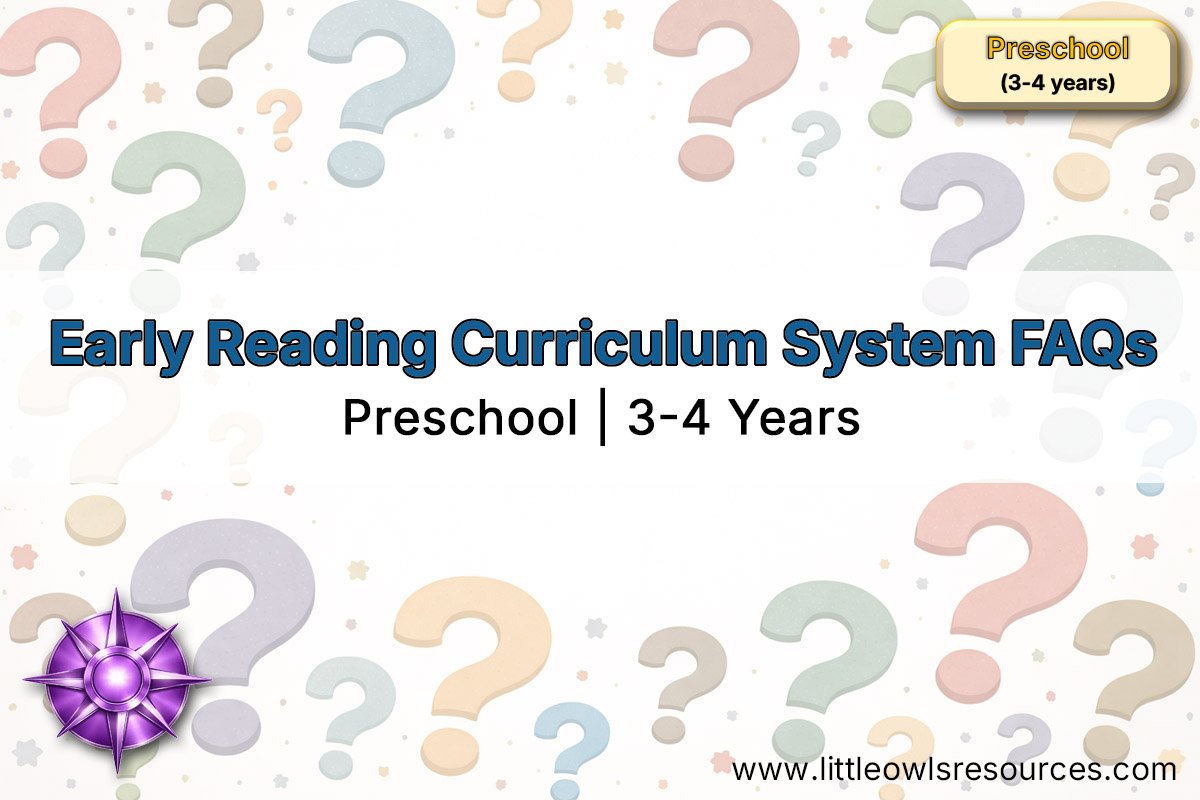
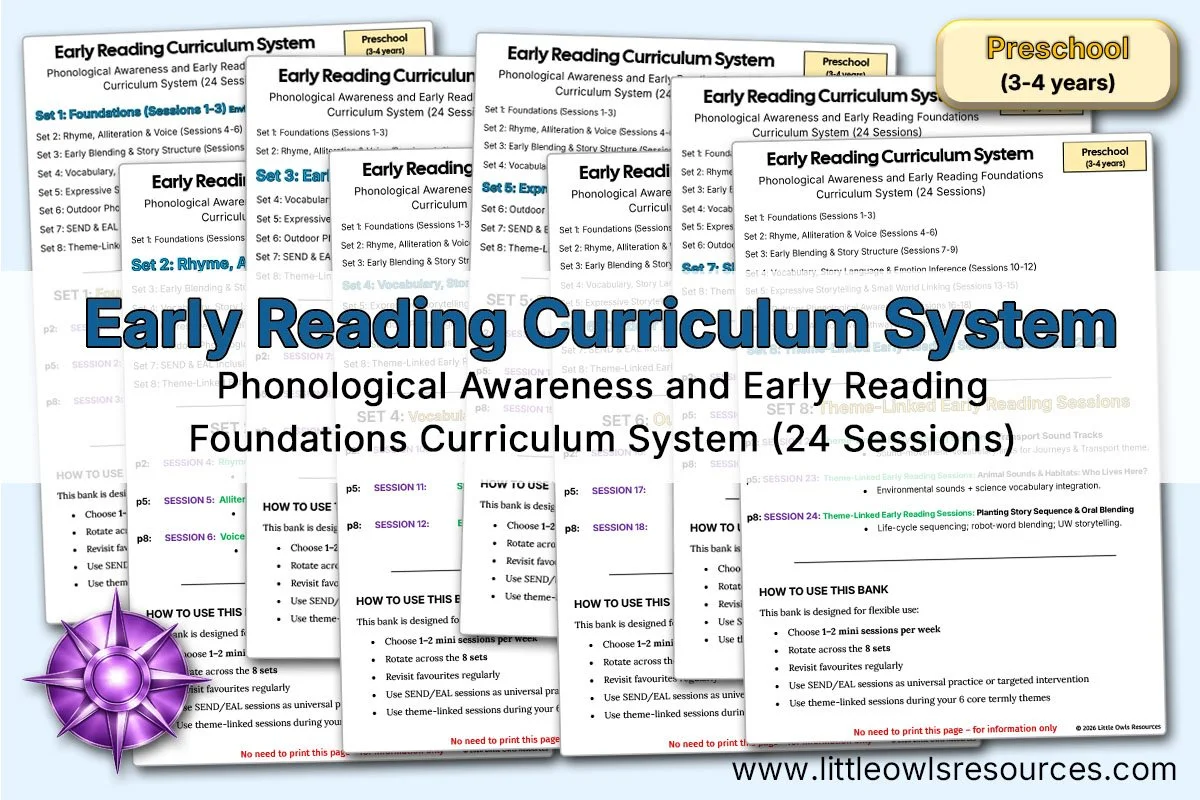
Early Reading Curriculum System (24 Sessions)
8 themed sets
24 mini session plans
Vocabulary & story-building scaffolds
Outdoor phonological play ideas
SEND & EAL accessible sessions
Theme-linked sessions (Transport, Animals, Growth)
Assessment & observation prompts
Continuous Provision follow-up suggestions
Maths
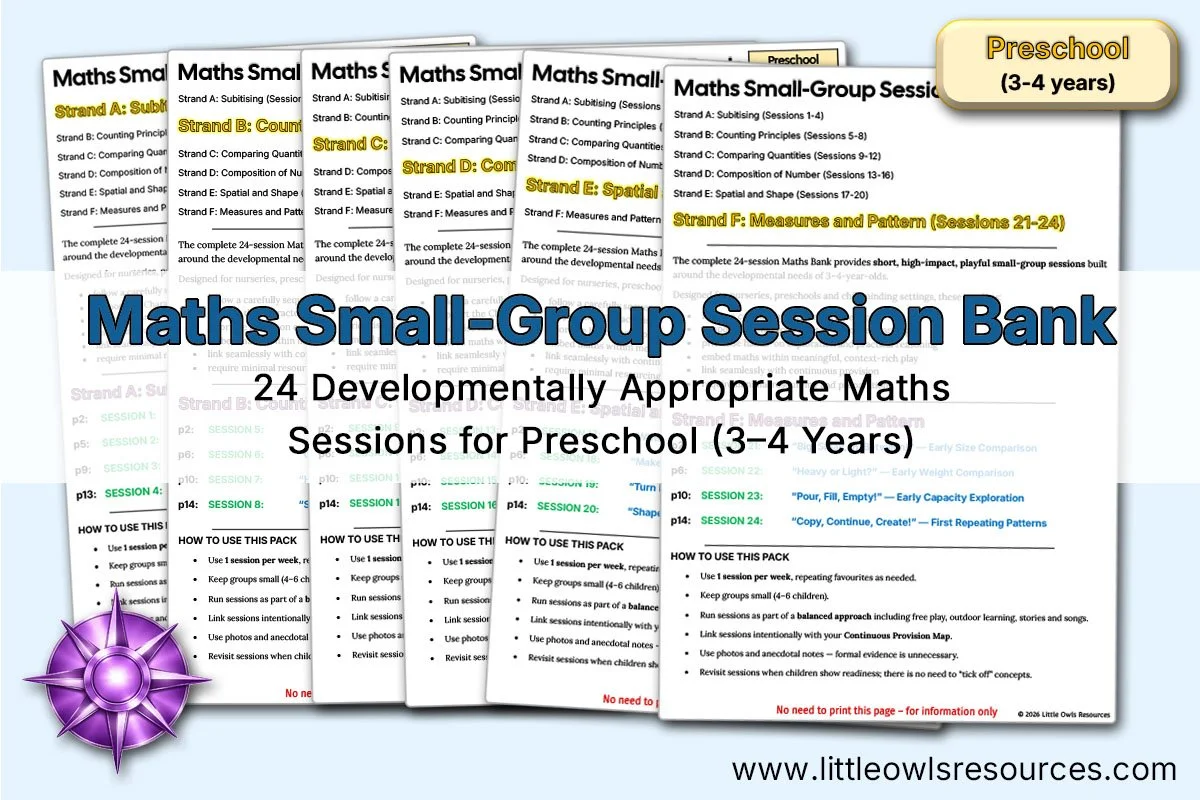
Maths Small Group Session Bank (24 Sessions)
Strand A - Subitising (Sessions 1-4)
Strand B - Counting Principles (Sessions 5-8)
Strand C - Comparing Quantites (Sessions 9-12)
Strand D - Composition of Number (Sessions 13-16)
Strand E - Spatial & Shape (Sessions 17-20)
Strand F - Measures & Pattern (Sessions 21-24)
Writing & Fine Motor
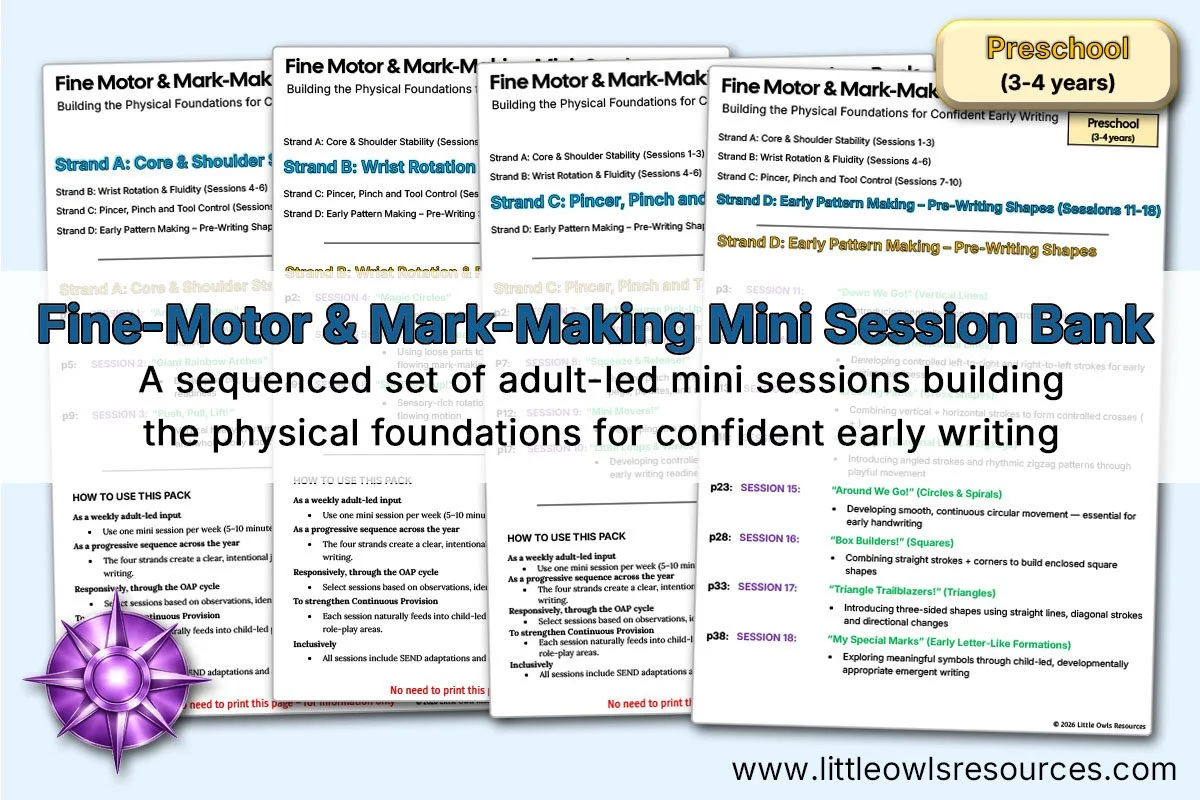
Fine Motor & Mark Making Mini Sessions (18)
How To Use Our Fine Motor & Mark Making Mini Sessions Bank
Strand A - Core & Shoulder Stability (Sessions 1-3)
Strand B - Wrist Rotation & Fluidity (Sessions 4-6)
Strand C - Pincer, Pinch & Tool Control (Sessions 7-10)
Strand D - Early Pattern Making: Pre-Writing Shapes (Sessions 11-18)
Early Writing Purpose Mini Sessions (6)
How To Use Our Early Writing Purpose Mini Sessions Bank
Lists
Labels
Messages
Maps
Signs
Tickets & Recipes
-
-
👉 Practical planning support.
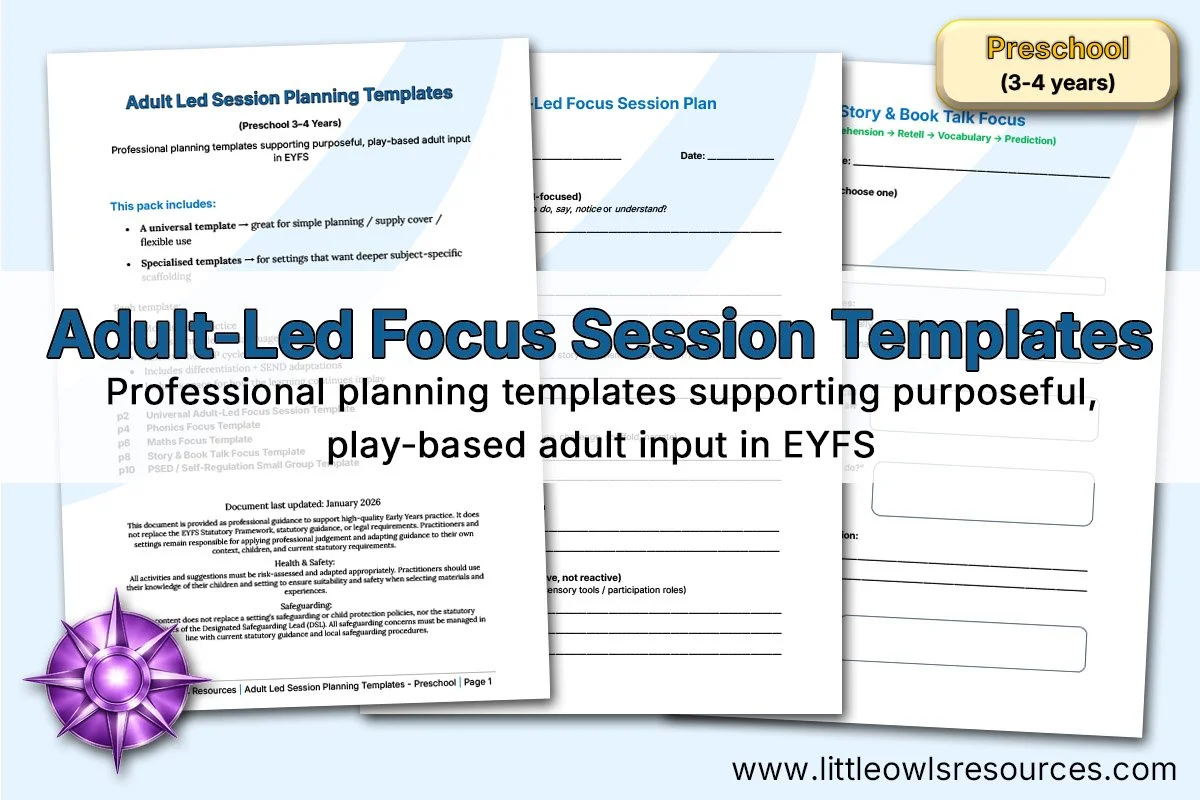
Adult-Led Session Planning Templates Pack
Universal
Phonics / Early Language Focus (Listening → Rhyme → Sound Awareness)
Maths Focus (Number + Pattern + Shape + Measure)
Story & Book Talk Focus (Comprehension → Retell → Vocabulary → Prediction)
PSED / Self-Regulation Small Group
-
👉 Proportionate, non-statutory assessment.
Short & Long Versions
Guidance - How To Complete And Share With Families
End of Term Template
End of Year Template
Guidance - How To Write Strength-Based Reports
Sentence Starters Bank
-
👉 Parent Engagement plus Emotional, environmental and communicative transition.
Preschool Transition to Reception Pack
↪ Child Passport
↪ Practitioner-To-Practitioner Handover Summary
↪ SEND Transition Sheet
↪ Family Transition Summary Sheet
↪ Parent Leaflet — “Preparing For Reception”
↪ Child Voice Page
↪ Guidance Page— “How To Complete & Share Transition Information”
Home & Setting Communication
↪ Our Preschool Curriculum (Age 3–4) | Parent-Facing Document
(Additional parent literature within planning documents.)
Additional Whole-Setting Guidance | for Professional Members
Explore our whole-setting guidance below, including overarching curriculum and pedagogy documents, early years schemas and EYFS setting policies.
-
-
Early Years Schemas - Practitioner Toolkit | EYFS Birth-5
↪ Schema Cards (definition, behaviours, age-related examples, enabling resources)
↪ Schema Observation & Responsive Provision Planning Template
-
EYFS Group Setting Policies Pack
↪ x 22 Policy Documents
↪ Policy Sign-Off and Confirmation Document
↪ EYFS Setting Policy Folder Contents List
Childminder Setting Policies Pack
↪ x 22 Policy Documents
↪ Childminder Assistant or Volunteer Policy Sign-Off and Confirmation Document
↪ Childminder Policy Folder Contents List
-
↪ Clear, practitioner-friendly explanations of key curriculum and pedagogy terms used throughout our guidance.
Looking for a different age group pathway?
Select the pathway that best reflects your role or the age group you work with. You do not need to use everything. (Some practitioners may use more than one pathway.)
What is Professional Membership?
Find our more about our Professional guidance for confident, reflective EYFS practice (Birth–5)
Latest EYFS Articles & Practical Guides | From Our Blog
Stay informed, get expert advice, and find inspiration from our collection of articles and useful external resources, tailored specifically for EYFS practitioners. We regularly publish in-depth articles to support you with current best practices, regulatory changes, and fresh ideas.





Are you looking for a specific resource or document for your provision?
Use our 🔍 SEARCH Bar located at the top of every page.
Content within the EYFS Curriculum & Pedagogy Membership is provided as professional guidance and support. It reflects current understanding of the EYFS statutory framework, Development Matters and inspection expectations at the time of writing. Practitioners are responsible for applying professional judgement and ensuring practice aligns with current statutory requirements and their specific context.
Updated: January 2026