

Scroll down to read this web document or download files here: DOCX 📝 | PDF 📄
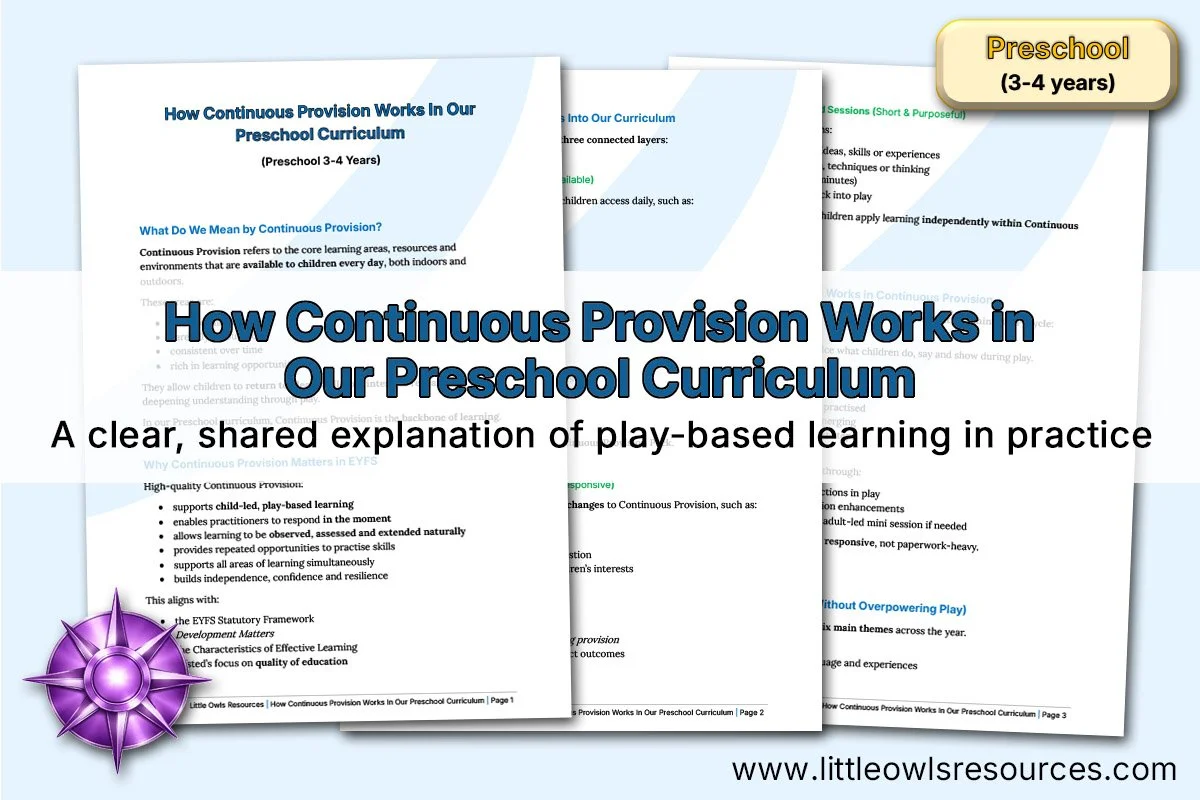
How Continuous Provision Works in Our Preschool Curriculum (3–4 Years)
A clear, shared explanation of play-based learning in practice
What Do We Mean by Continuous Provision?
Continuous Provision refers to the core learning areas, resources and environments that are available to children every day, both indoors and outdoors.
These areas are:
intentionally planned
carefully resourced
consistent over time
rich in learning opportunities
They allow children to return to ideas, skills and interests repeatedly, deepening understanding through play.
In our Preschool curriculum, Continuous Provision is the backbone of learning.
Why Continuous Provision Matters in EYFS
High-quality Continuous Provision:
supports child-led, play-based learning
enables practitioners to respond in the moment
allows learning to be observed, assessed and extended naturally
provides repeated opportunities to practise skills
supports all areas of learning simultaneously
builds independence, confidence and resilience
This aligns with:
the EYFS Statutory Framework
Development Matters
the Characteristics of Effective Learning
Ofsted’s focus on quality of education
How Continuous Provision Fits Into Our Curriculum
Our curriculum is designed around three connected layers:
1. Continuous Provision (Always Available)
These are the stable learning zones children access daily, such as:
construction
role-play
mark-making
maths
creative
small world
outdoors
snack / independence
Each area has:
a clear purpose
identified learning opportunities
adult interaction prompts
vocabulary to model
SEND & EAL adaptations
This is outlined in our Universal Continuous Provision Pack.
2. Enhancements & Provocations (Responsive)
Enhancements are small, thoughtful changes to Continuous Provision, such as:
adding new resources
introducing themed materials
offering a new challenge or question
placing an object linked to children’s interests
Enhancements:
are short-term
respond to observations
link to themes without replacing provision
invite curiosity rather than direct outcomes
3. Adult-Led Focused Sessions (Short & Purposeful)
Adult-led mini sessions:
introduce new ideas, skills or experiences
model language, techniques or thinking
are brief (5–10 minutes)
feed directly back into play
After these sessions, children apply learning independently within Continuous Provision.
How the OAP Cycle Works in Continuous Provision
Our approach follows the Observation–Assessment–Planning (OAP) cycle:
Observe
Practitioners notice what children do, say and show during play.Assess
Adults consider:skills being practised
interests emerging
possible next steps
Plan
Planning happens through:adult interactions in play
small provision enhancements
selecting an adult-led mini session if needed
This cycle is ongoing and responsive, not paperwork-heavy.
How Themes Fit In (Without Overpowering Play)
Our curriculum includes six main themes across the year. These themes:
provide shared language and experiences
support vocabulary development
offer cultural capital
inspire enhancements and adult-led sessions
However:
themes do not dictate play
Continuous Provision remains stable
children’s interests always lead
Themes are a vehicle, not a restriction.
The Role of the Adult in Continuous Provision
Adults:
observe attentively
model language and thinking
join play sensitively
scaffold learning through interaction
extend learning through questions and prompts
know when to step back
High-quality interaction is more important than frequent resource changes.
Inclusion Within Continuous Provision
Our Continuous Provision approach:
supports SEND and EAL learners
includes sensory regulation options
offers multiple ways to engage
values all forms of communication
allows children to access learning at their own level
Adaptations are built into provision, not added later.
In Summary
Continuous Provision in our Preschool curriculum:
is intentional, not accidental
is stable, but flexible
supports all areas of learning
works alongside adult-led teaching
places the child at the centre
Document Updated: February 2026
Download Document Here:
Recommended next read selection


Additional Documents | Professional Membership Contents (Preschool 3-4 Years)
Navigate our Curriculum & Pedagogy guidance documents here.
Pedagogical identity:
Broad, play-based, theme-led curriculum with purposeful adult input and strong continuous provision.
-
-
👉 Big-picture curriculum intent and progression.
Skills Progression Ladders (3–4 Years) - Including Practitioner Guidance
↪ Early Maths - Subitising, Counting & Comparing
↪ Early Maths - Pattern, Shape & Spatial Awareness
Our Preschool Curriculum Intent, Implementation & Impact - OFSTED Conversation Statement
-
👉 Theme-led planning lives here.
Core Preschool Themes (6 Weeks Each)
Optional Mini-Themes (1–2 Weeks)
-
👉 The engine room of daily practice.
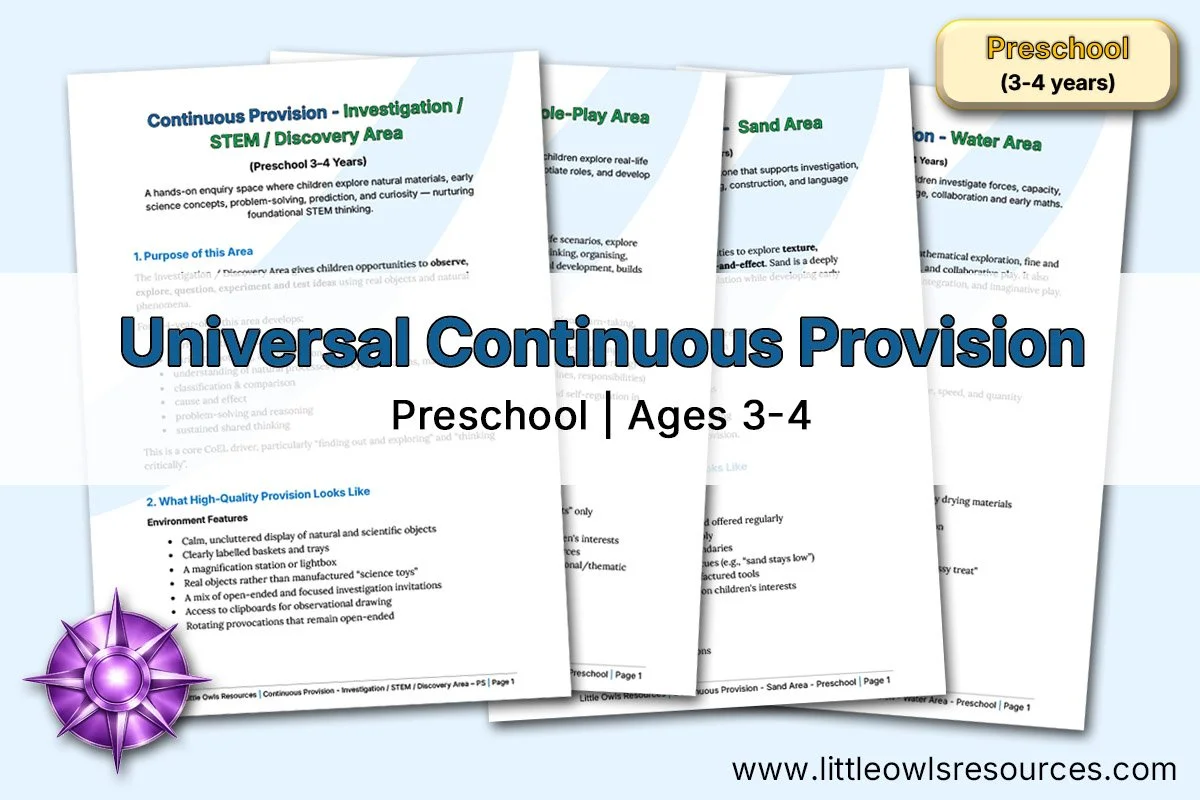
Universal Continuous Provision Packs (Preschool | 3–4 Years)
Construction Area
Small World Area
Role-Play Area
Writing / Mark-Making Area
Maths Area
Creative Area (Art & Making)
Investigation / STEM / Discovery Area
Book Corner / Reading Den
Fine Motor Station
Water Area
Sand Area
Snack Area / Independence Station
Outdoor Provision Core Zones
Physical play
Gross motor skills
Nature area
Outdoor mark-making
Outdoor maths
-
👉 Purposeful adult input without formalisation.
Early Reading & Phonics
Early Reading Curriculum System (24 Sessions)
8 themed sets
24 mini session plans
Vocabulary & story-building scaffolds
Outdoor phonological play ideas
SEND & EAL accessible sessions
Theme-linked sessions (Transport, Animals, Growth)
Assessment & observation prompts
Continuous Provision follow-up suggestions
Maths
Maths Small Group Session Bank (24 Sessions)
Strand A - Subitising (Sessions 1-4)
Strand B - Counting Principles (Sessions 5-8)
Strand C - Comparing Quantites (Sessions 9-12)
Strand D - Composition of Number (Sessions 13-16)
Strand E - Spatial & Shape (Sessions 17-20)
Strand F - Measures & Pattern (Sessions 21-24)
Writing & Fine Motor
Fine Motor & Mark Making Mini Sessions (18)
How To Use Our Fine Motor & Mark Making Mini Sessions Bank
Strand A - Core & Shoulder Stability (Sessions 1-3)
Strand B - Wrist Rotation & Fluidity (Sessions 4-6)
Strand C - Pincer, Pinch & Tool Control (Sessions 7-10)
Strand D - Early Pattern Making: Pre-Writing Shapes (Sessions 11-18)
Early Writing Purpose Mini Sessions (6)
How To Use Our Early Writing Purpose Mini Sessions Bank
Lists
Labels
Messages
Maps
Signs
Tickets & Recipes
-
-
👉 Practical planning support.
Adult-Led Session Planning Templates Pack
Universal
Phonics / Early Language Focus (Listening → Rhyme → Sound Awareness)
Maths Focus (Number + Pattern + Shape + Measure)
Story & Book Talk Focus (Comprehension → Retell → Vocabulary → Prediction)
PSED / Self-Regulation Small Group
-
👉 Proportionate, non-statutory assessment.
Short & Long Versions
Guidance - How To Complete And Share With Families
End of Term Template
End of Year Template
Guidance - How To Write Strength-Based Reports
Sentence Starters Bank
-
👉 Parent Engagement plus Emotional, environmental and communicative transition.
Preschool Transition to Reception Pack
↪ Child Passport
↪ Practitioner-To-Practitioner Handover Summary
↪ SEND Transition Sheet
↪ Family Transition Summary Sheet
↪ Parent Leaflet — “Preparing For Reception”
↪ Child Voice Page
↪ Guidance Page— “How To Complete & Share Transition Information”
Home & Setting Communication
↪ Our Preschool Curriculum (Age 3–4) | Parent-Facing Document
(Additional parent literature within planning documents.)
Additional Whole-Setting Guidance | for Professional Members
Explore our whole-setting guidance below, including overarching curriculum and pedagogy documents, early years schemas and EYFS setting policies.
-
-
Early Years Schemas - Practitioner Toolkit | EYFS Birth-5
↪ Schema Cards (definition, behaviours, age-related examples, enabling resources)
↪ Schema Observation & Responsive Provision Planning Template
-
EYFS Group Setting Policies Pack
↪ x 22 Policy Documents
↪ Policy Sign-Off and Confirmation Document
↪ EYFS Setting Policy Folder Contents List
Childminder Setting Policies Pack
↪ x 22 Policy Documents
↪ Childminder Assistant or Volunteer Policy Sign-Off and Confirmation Document
↪ Childminder Policy Folder Contents List
-
↪ Clear, practitioner-friendly explanations of key curriculum and pedagogy terms used throughout our guidance.
Looking for a different age-group pathway?
Select the pathway that best reflects your role or the age group you work with. You do not need to use everything. (Some practitioners may use more than one pathway.)
Latest EYFS Articles & Practical Guides | From Our Blog
Stay informed, get expert advice, and find inspiration from our collection of articles and useful external resources, tailored specifically for EYFS practitioners. We regularly publish in-depth articles to support you with current best practices, regulatory changes, and fresh ideas.




Are you looking for a specific resource or document for your provision?
Use our 🔍 SEARCH Bar located at the top of every page.
Content within the EYFS Curriculum & Pedagogy Membership is provided as professional guidance and support. It reflects current understanding of the EYFS statutory framework, Development Matters and inspection expectations at the time of writing. Practitioners are responsible for applying professional judgement and ensuring practice aligns with current statutory requirements and their specific context.
Updated: January 2026