• Home 🏠
  • About Us
  • Pricing
    • 🌟Printable Resources Hub🌟
    • ↪ Themes
    • ↪ Role Play
    • ↪ Festivals & Celebrations
    • ↪ Special Dates Calendar
    • ↪ Areas of Learning
    • ↪ Organisational Tools
  • EYFS Curriculum & Pedagogy
  • Special Dates Calendar
Menu

Little Owls Resources - Free and Premium Early Years Printables

Street Address
City, State, Zip
Phone Number
Early Years/Preschool/EYFS Printable Activities/Planning/Displays/Paperwork and ideas for Childminders, Preschools, Nursery Practitioners, Teachers and Parents

Your Custom Text Here

Little Owls Resources - Free and Premium Early Years Printables

  • Home 🏠
  • About Us
  • Pricing
  • Printable Resources ⬇
    • 🌟Printable Resources Hub🌟
    • ↪ Themes
    • ↪ Role Play
    • ↪ Festivals & Celebrations
    • ↪ Special Dates Calendar
    • ↪ Areas of Learning
    • ↪ Organisational Tools
  • EYFS Curriculum & Pedagogy
  • Special Dates Calendar

Reception SEND & Inclusion Toolkit | 4-5 Years

January 18, 2026 Stuart Murphy

Home › EYFS Curriculum & Pedagogy › Reception Curriculum & Pedagogy › Reception SEND & Inclusion Toolkit | 4-5 Years

Reception SEND & Inclusion Toolkit | 4-5 Years

Download Document Here:

(This pathway component will be available for download by: March 31st 2026)

 
Download DOCX 📝
Download PDF 📄
 

Document Updated: January 2026

Recommended next read Selection

EYFS
Reception SEND & Inclusion Toolkit | 4-5 Years

Extensive SEND & Inclusion pack specifically designed for use within Reception.

Read More →
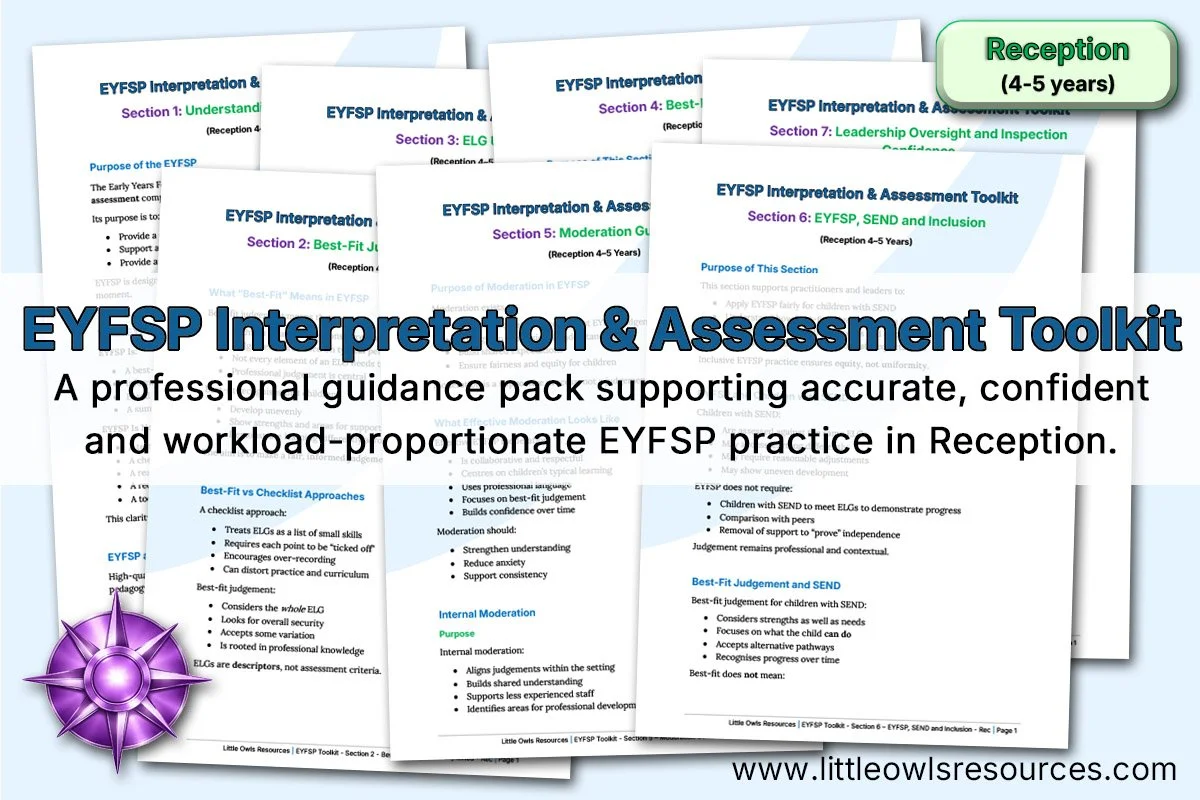
EYFSP Interpretation & Assessment Toolkit | Reception (4-5 Years)

A professional guidance pack supporting accurate, confident and workload-proportionate EYFSP practice in Reception.

Read More →

Professional Membership Contents (Reception 4-5 Years)

Below you will find listed the component documents of our ‘Reception Curriculum & Pedagogy Suite’. They are separated into Strands 1-10. You do not need to use everything all at once.

  • 👉 This section is essential for alignment.

    • Reception Curriculum Overview & Rationale [Free Orienting Sample]

    • Reception Pedagogy Position Statement [Free Orienting Sample]

    • About Our Reception Curriculum Phase Framework

    • How To Use The Reception Pathway

    • Why Themes Are Optional in Reception

  • 👉 Curriculum clarity and sequencing.

    • Reception Curriculum Progression Maps (all areas of learning)

      • Guide to Learning Progression: How to Use the Reception Curriculum Progression Maps

      • Progression Maps for:

        • Communication and Language

        • Personal, Social and Emotional Development

        • Physical Development

        • Literacy

        • Mathematics

        • Understanding the World

        • Expressive Arts and Design

    • Reception Curriculum Phase Framework

      • How To Use The Reception Curriculum Phase Pack

      • Phase 1: Settling & Foundations

      • Phase 2: Exploration & Early Application

      • Phase 3: Independence & Depth

      • Phase 4: Consolidation & Transition

  • 👉 OAP as the organising principle.

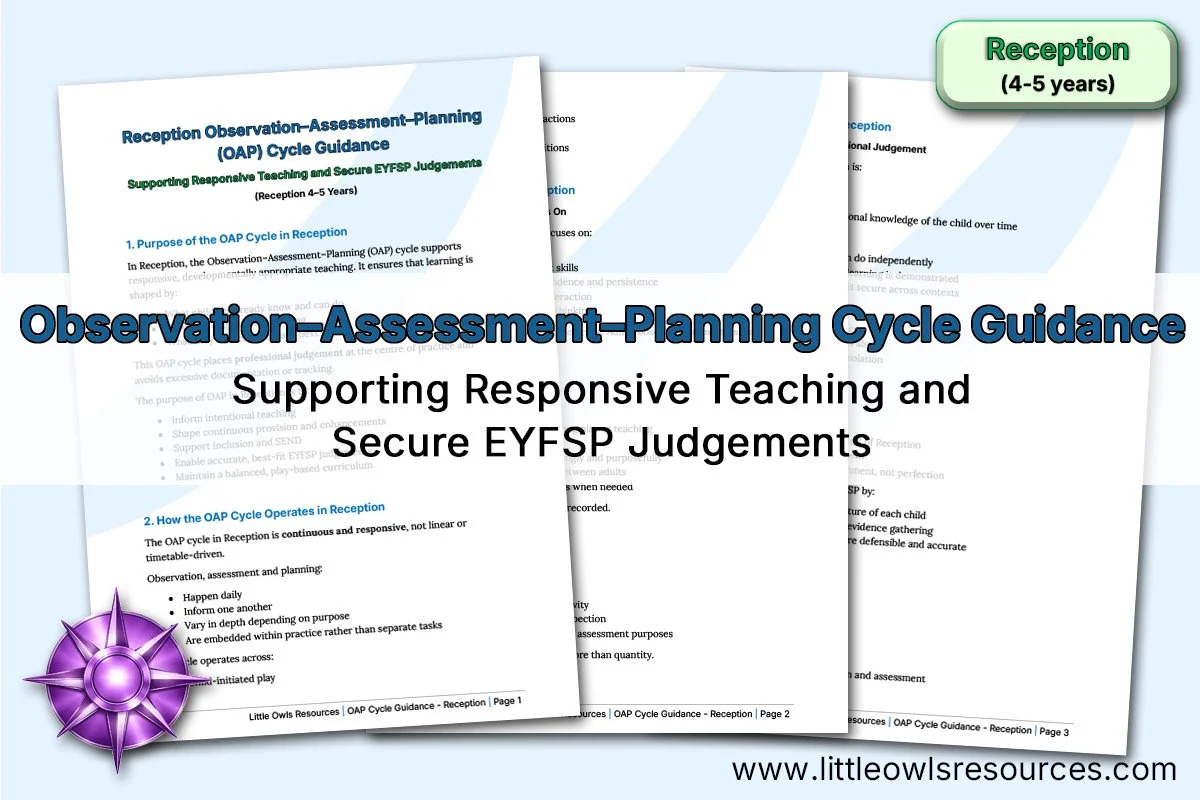
    • Reception OAP Cycle Guidance

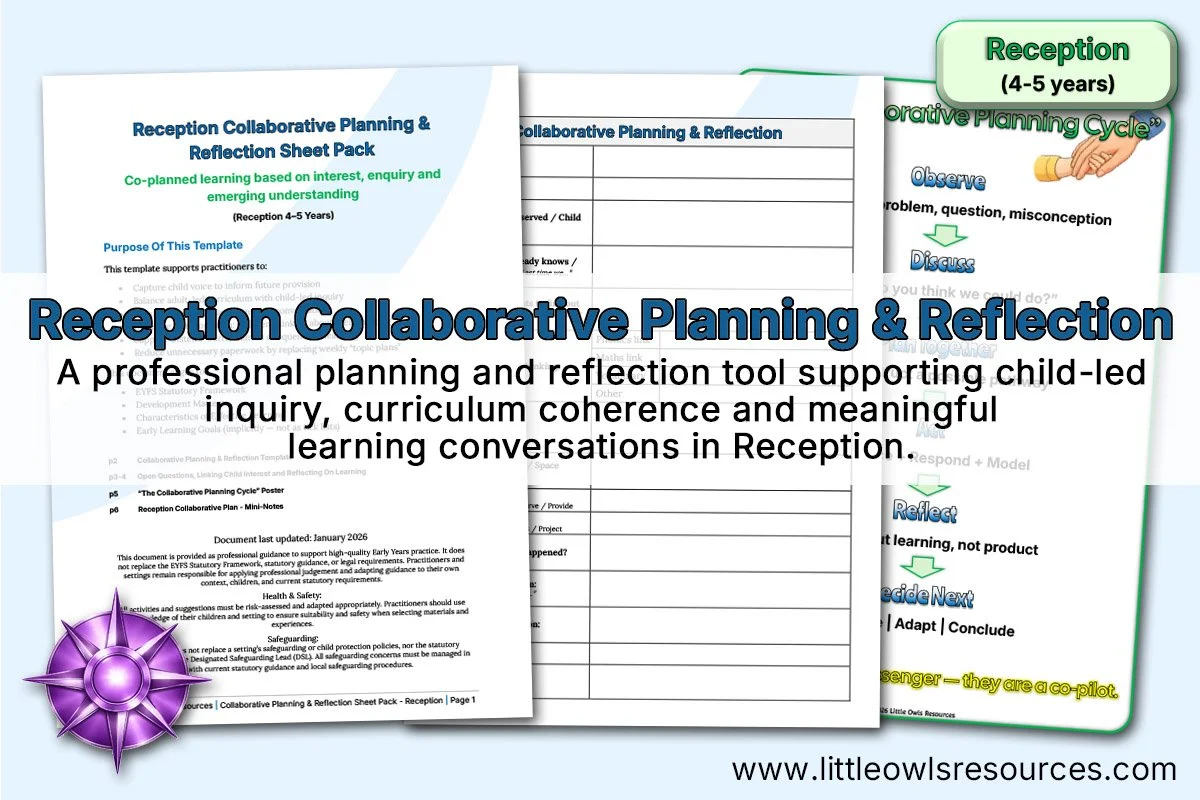
    • Reception Collaborative Planning & Reflective Sheet Pack

    • Self-Regulation & Learning Behaviours in Reception

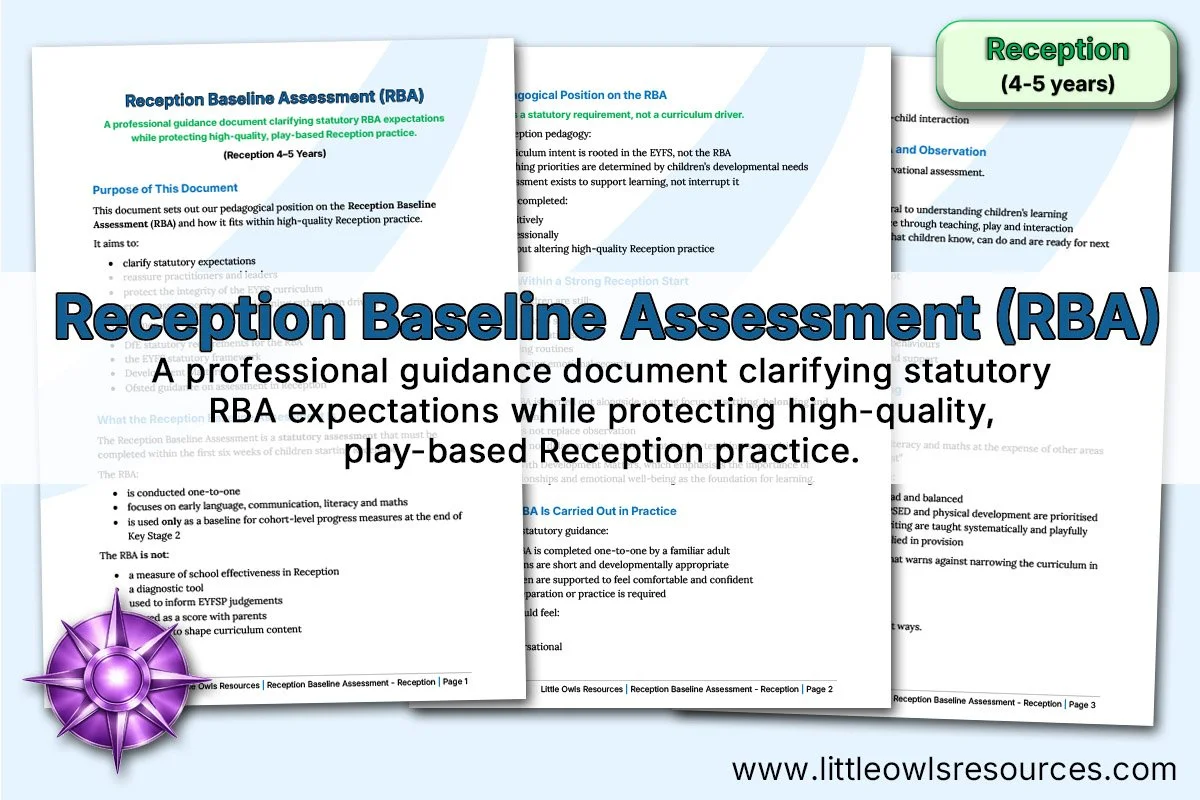
    • Reception Baseline Assessment (RBA)

    • Characteristics of Effective Learning in Reception

  • 👉 Stable, purposeful provision.

    • Reception Continuous Provision – Structure & Rationale

    • Universal Continuous Provision Pack (Areas listed below)

      • Construction

      • Creative

      • Investigation / Discovery

      • Maths

      • Reading

      • Role Play / Small World

      • Malleable / Sensory

      • Writing

    • Outdoor Continuous Provision (Reception)

    • Adult-Guided Learning in Provision

    • Reception Labelling Pack | 4-5 Years

  • 👉 Light-touch, application-focused.

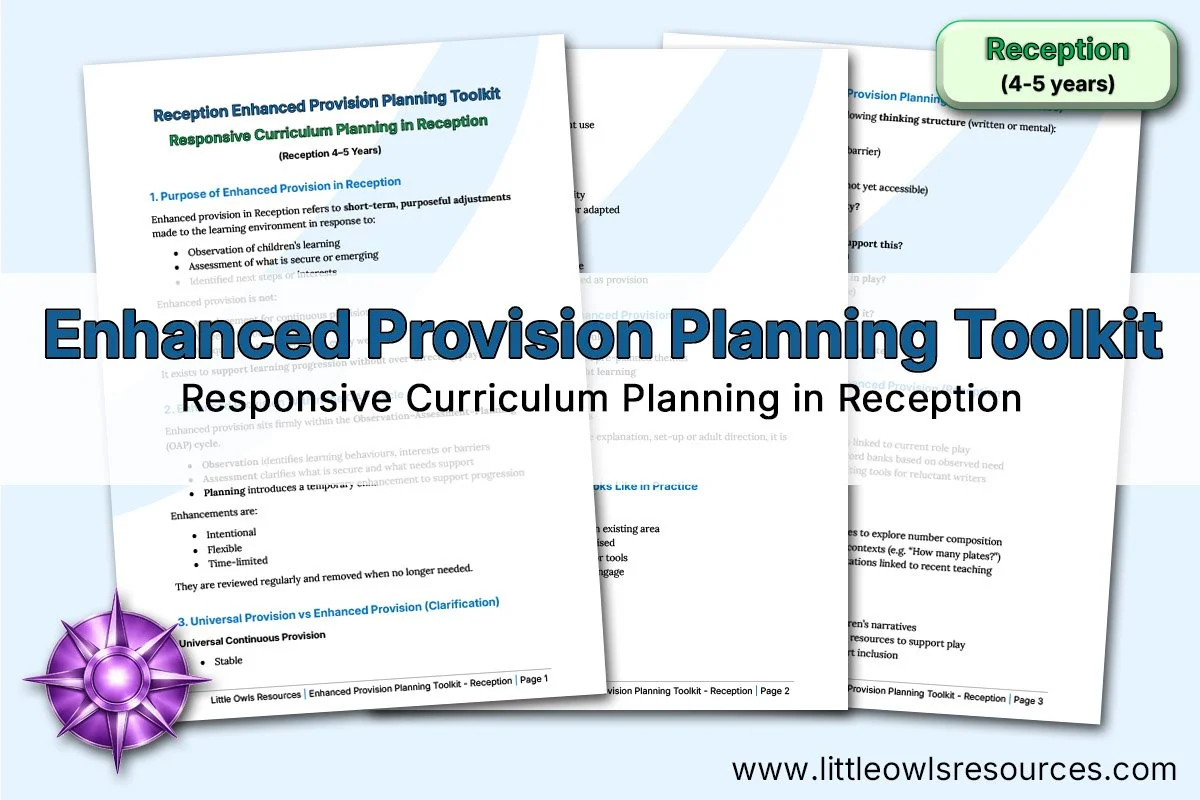
    • Reception Enhanced Provision Planning Toolkit

    • Reception Optional Themed Enhancements - Idea Banks

  • 👉 Systematic teaching without Year 1 drift.

    Phonics (Scheme-Compatible)

    • Phonics in Reception: Teaching, Application & Inclusion

      • Pedagogy

      • Adult-Led Sessions

      • Phonics in Provision

      • Supporting Children Not Keeping Up

      • Phonics & EYFSP

      • Scheme Compatibility Statement

    Maths

    • Reception Maths Teaching Framework

      • Term by Tem Maths Concept Emphasis Map

      • Maths Adult-Led Mini Session Banks (9 Banks)

      • Maths Across the Curriculum & Provision

      • Maths & EYFSP Guidance

    Writing

    • Reception Early Writing Purpose Pack

      • Writing Adult-Led Mini Session Bank (12 Sessions)

    • Fine Motor & Physical Development

      • Guidance Surrounding Foundations for Writing in Reception (4–5 Years)

  • 👉 Precision language for application.

    • Adult-Guided Learning in Provision

    • Theme-Based High-Impact Question & Vocabulary Banks

      • Leadership Rationale: Why Questions Differ by Age

    • Five Sentence Stems For Reception Practitioners

  • 👉 Statutory confidence with inclusive practice.

    • EYFSP Interpretation & Assessment Toolkit

      • ELG Unpacking

      • Best-Fit Exemplification

      • Moderation Guidance

    • Reception SEND & Inclusion Toolkit

      • The graduated response (Universal → Targeted → Specialist)

      • Adaptations across phonics, maths & writing

      • Visual Communication Pack

      • Language-first strategies for inclusion

      • Observation, assessment and SEND

      • Collaborative working with families and specialists

      • Referral Preparation — for EHCP pathway

      • Reception APDR Template

      • Leadership and inspection readiness

  • 👉 Leadership assurance.

    • Reception Leadership & Inspection Readiness Pack

      • Curriculum Intent & Implementation Guidance

      • Ofsted Conversation Prompts

  • 👉 Clear communication beyond the classroom.

    • Reception Parent Partnership Pack

    • Reception Transition to Year 1 Pack

Additional Whole-Setting Guidance | for Professional Members

Explore our whole-setting guidance below, including overarching curriculum and pedagogy documents, early years schemas and EYFS setting policies.

    • Little Owls Resources’ Curriculum Intent Statement

    • EYFS from Birth to 5: Curriculum Coherence & Pedagogical Throughline

    • Whole-Setting Curriculum Map (Birth-5): Curriculum Intent & Progression

    • Pedagogy Guidance Document

    • Speech & Language Development - Setting Statement

    • EYFS Inspection-Facing Summaries

  • Early Years Schemas - Practitioner Toolkit | EYFS Birth-5

    ↪ Schema Cards (definition, behaviours, age-related examples, enabling resources)

    ↪ Schema Observation & Responsive Provision Planning Template

    • EYFS Group Setting Policies Pack

      ↪ x 22 Policy Documents

      ↪ Policy Sign-Off and Confirmation Document

      ↪ EYFS Setting Policy Folder Contents List

    • Childminder Setting Policies Pack

      ↪ x 22 Policy Documents

      ↪ Childminder Assistant or Volunteer Policy Sign-Off and Confirmation Document

      ↪ Childminder Policy Folder Contents List

  • EYFS Glossary

    ↪ Clear, practitioner-friendly explanations of key curriculum and pedagogy terms used throughout our guidance.

Looking for a different age group pathway?

Select the pathway that best reflects your role or the age group you work with. You do not need to use everything. (Some practitioners may use more than one pathway.)
Featured
🍼 Babies (0–18 months)

Responsive care, observation and development in the earliest years

🚼 Toddlers (18–36 months)

Development, play and progression in the toddler years

🎨 Preschool (3–4 years)

Curriculum, continuous provision and purposeful teaching

🎓 Reception (4–5 years)

Play-based pedagogy, progression and EYFSP readiness

🏡 Childminders (Birth–5)

Mixed-age pedagogy, planning without overload and inspection confidence

Latest EYFS Articles & Practical Guides | From Our Blog

Stay informed, get expert advice, and find inspiration from our collection of articles and useful external resources, tailored specifically for EYFS practitioners. We regularly publish in-depth articles to support you with current best practices, regulatory changes, and fresh ideas.

EYFS & KS1 Articles
Major UK Curriculum Shake-Up Announced: What EYFS & KS1 Practitioners Need to Know

A major overhaul of the national curriculum in England has been announced following the publication of the independent Curriculum and Assessment Review. For those working in the Early Years Foundation Stage (EYFS) and Key Stage 1 (KS1), the changes signal a renewed focus on practical life skills, digital literacy, and enriching learning experiences…

Read More →
New Education Inspection Framework | What EYFS Settings Need to Know

The world of early years education is constantly evolving, and with it, the frameworks that guide and assess our invaluable work. Come November 2025, a significant shift will occur as the new Education Inspection Framework (EIF) comes into effect, bringing with it some crucial changes…

Read More →
Revised 2025 EYFS Statutory Framework for Group & School-Based Providers | What You Need to Know

With the new 2025 EYFS Statutory Framework for group and school-based providers coming into effect on 1st September 2025, it's essential to understand the updates to ensure your practice remains compliant, effective…

Read More →
DfE Press Release | Parents urged to read more to boost children’s life chances

The Education Secretary is calling on parents to lead by example and make reading a daily habit to help reverse the decline in reading for pleasure, to help give kids the best start in life as part of the…

Read More →
DfE Update | Drowning Prevention Week: what children learn about water safety at school

As we head into summer, it’s especially important that children are prepared with these skills. This year, the Royal Life Saving Society UK's Drowning Prevention Week runs from 14 June to 21…

Read More →
DfE Update | Hot weather and heatwaves: guidance for schools and other education settings

There are several ways that schools can make changes to keep children safe in hot weather, especially as children are more at risk of becoming ill with heat-related issues than adults…

Read More →

Are you looking for a specific resource or document for your provision?

Use our 🔍 Search Bar located at the top of every page.

___________________________

Content within the EYFS Curriculum & Pedagogy Membership is provided as professional guidance and support. It reflects current understanding of the EYFS statutory framework, Development Matters and inspection expectations at the time of writing. Practitioners are responsible for applying professional judgement and ensuring practice aligns with current statutory requirements and their specific context. All resources, experiences and environment arrangements must be risk assessed by the setting and used in accordance with individual children’s developmental stages, needs and supervision requirements.

Safeguarding content does not replace a setting’s safeguarding and child protection policy or the statutory role of the Designated Safeguarding Lead (DSL). All concerns must be managed in line with current statutory guidance and local safeguarding procedures.

_____________________________

 
In Reception | 4-5 Years, -R8 Tags Reception, Reception SEND & Inclusion Toolkit | 4-5 Years

EYFSP Interpretation & Assessment Toolkit | Reception (4–5 Years)

January 18, 2026 Stuart Murphy

Home › EYFS Curriculum & Pedagogy › Reception Curriculum & Pedagogy › EYFSP Interpretation & Assessment Toolkit | Reception (4-5 Years)

EYFSP Interpretation & Assessment Toolkit

Reception (4–5 Years)

A professional guidance pack supporting accurate, confident and workload-proportionate EYFSP practice in Reception.

Download Document Here:

(This pathway component will be available for download by: March 31st 2026)

 
Download DOCX 📝
Download PDF 📄
 

Document Updated: January 2026

Recommended next read Selection

EYFS
Reception SEND & Inclusion Toolkit | 4-5 Years

Extensive SEND & Inclusion pack specifically designed for use within Reception.

Read More →
EYFSP Interpretation & Assessment Toolkit | Reception (4-5 Years)

A professional guidance pack supporting accurate, confident and workload-proportionate EYFSP practice in Reception.

Read More →

Professional Membership Contents (Reception 4-5 Years)

Below you will find listed the component documents of our ‘Reception Curriculum & Pedagogy Suite’. They are separated into Strands 1-10. You do not need to use everything all at once.

  • 👉 This section is essential for alignment.

    • Reception Curriculum Overview & Rationale [Free Orienting Sample]

    • Reception Pedagogy Position Statement [Free Orienting Sample]

    • About Our Reception Curriculum Phase Framework

    • How To Use The Reception Pathway

    • Why Themes Are Optional in Reception

  • 👉 Curriculum clarity and sequencing.

    • Reception Curriculum Progression Maps (all areas of learning)

      • Guide to Learning Progression: How to Use the Reception Curriculum Progression Maps

      • Progression Maps for:

        • Communication and Language

        • Personal, Social and Emotional Development

        • Physical Development

        • Literacy

        • Mathematics

        • Understanding the World

        • Expressive Arts and Design

    • Reception Curriculum Phase Framework

      • How To Use The Reception Curriculum Phase Pack

      • Phase 1: Settling & Foundations

      • Phase 2: Exploration & Early Application

      • Phase 3: Independence & Depth

      • Phase 4: Consolidation & Transition

  • 👉 OAP as the organising principle.

    • Reception OAP Cycle Guidance

    • Reception Collaborative Planning & Reflective Sheet Pack

    • Self-Regulation & Learning Behaviours in Reception

    • Reception Baseline Assessment (RBA)

    • Characteristics of Effective Learning in Reception

  • 👉 Stable, purposeful provision.

    • Reception Continuous Provision – Structure & Rationale

    • Universal Continuous Provision Pack (Areas listed below)

      • Construction

      • Creative

      • Investigation / Discovery

      • Maths

      • Reading

      • Role Play / Small World

      • Malleable / Sensory

      • Writing

    • Outdoor Continuous Provision (Reception)

    • Adult-Guided Learning in Provision

    • Reception Labelling Pack | 4-5 Years

  • 👉 Light-touch, application-focused.

    • Reception Enhanced Provision Planning Toolkit

    • Reception Optional Themed Enhancements - Idea Banks

  • 👉 Systematic teaching without Year 1 drift.

    Phonics (Scheme-Compatible)

    • Phonics in Reception: Teaching, Application & Inclusion

      • Pedagogy

      • Adult-Led Sessions

      • Phonics in Provision

      • Supporting Children Not Keeping Up

      • Phonics & EYFSP

      • Scheme Compatibility Statement

    Maths

    • Reception Maths Teaching Framework

      • Term by Tem Maths Concept Emphasis Map

      • Maths Adult-Led Mini Session Banks (9 Banks)

      • Maths Across the Curriculum & Provision

      • Maths & EYFSP Guidance

    Writing

    • Reception Early Writing Purpose Pack

      • Writing Adult-Led Mini Session Bank (12 Sessions)

    • Fine Motor & Physical Development

      • Guidance Surrounding Foundations for Writing in Reception (4–5 Years)

  • 👉 Precision language for application.

    • Adult-Guided Learning in Provision

    • Theme-Based High-Impact Question & Vocabulary Banks

      • Leadership Rationale: Why Questions Differ by Age

    • Five Sentence Stems For Reception Practitioners

  • 👉 Statutory confidence with inclusive practice.

    • EYFSP Interpretation & Assessment Toolkit

      • ELG Unpacking

      • Best-Fit Exemplification

      • Moderation Guidance

    • Reception SEND & Inclusion Toolkit

      • The graduated response (Universal → Targeted → Specialist)

      • Adaptations across phonics, maths & writing

      • Visual Communication Pack

      • Language-first strategies for inclusion

      • Observation, assessment and SEND

      • Collaborative working with families and specialists

      • Referral Preparation — for EHCP pathway

      • Reception APDR Template

      • Leadership and inspection readiness

  • 👉 Leadership assurance.

    • Reception Leadership & Inspection Readiness Pack

      • Curriculum Intent & Implementation Guidance

      • Ofsted Conversation Prompts

  • 👉 Clear communication beyond the classroom.

    • Reception Parent Partnership Pack

    • Reception Transition to Year 1 Pack

Additional Whole-Setting Guidance | for Professional Members

Explore our whole-setting guidance below, including overarching curriculum and pedagogy documents, early years schemas and EYFS setting policies.

    • Little Owls Resources’ Curriculum Intent Statement

    • EYFS from Birth to 5: Curriculum Coherence & Pedagogical Throughline

    • Whole-Setting Curriculum Map (Birth-5): Curriculum Intent & Progression

    • Pedagogy Guidance Document

    • Speech & Language Development - Setting Statement

    • EYFS Inspection-Facing Summaries

  • Early Years Schemas - Practitioner Toolkit | EYFS Birth-5

    ↪ Schema Cards (definition, behaviours, age-related examples, enabling resources)

    ↪ Schema Observation & Responsive Provision Planning Template

    • EYFS Group Setting Policies Pack

      ↪ x 22 Policy Documents

      ↪ Policy Sign-Off and Confirmation Document

      ↪ EYFS Setting Policy Folder Contents List

    • Childminder Setting Policies Pack

      ↪ x 22 Policy Documents

      ↪ Childminder Assistant or Volunteer Policy Sign-Off and Confirmation Document

      ↪ Childminder Policy Folder Contents List

  • EYFS Glossary

    ↪ Clear, practitioner-friendly explanations of key curriculum and pedagogy terms used throughout our guidance.

Looking for a different age group pathway?

Select the pathway that best reflects your role or the age group you work with. You do not need to use everything. (Some practitioners may use more than one pathway.)
Featured
🍼 Babies (0–18 months)

Responsive care, observation and development in the earliest years

🚼 Toddlers (18–36 months)

Development, play and progression in the toddler years

🎨 Preschool (3–4 years)

Curriculum, continuous provision and purposeful teaching

🎓 Reception (4–5 years)

Play-based pedagogy, progression and EYFSP readiness

🏡 Childminders (Birth–5)

Mixed-age pedagogy, planning without overload and inspection confidence

Latest EYFS Articles & Practical Guides | From Our Blog

Stay informed, get expert advice, and find inspiration from our collection of articles and useful external resources, tailored specifically for EYFS practitioners. We regularly publish in-depth articles to support you with current best practices, regulatory changes, and fresh ideas.

EYFS & KS1 Articles
Major UK Curriculum Shake-Up Announced: What EYFS & KS1 Practitioners Need to Know

A major overhaul of the national curriculum in England has been announced following the publication of the independent Curriculum and Assessment Review. For those working in the Early Years Foundation Stage (EYFS) and Key Stage 1 (KS1), the changes signal a renewed focus on practical life skills, digital literacy, and enriching learning experiences…

Read More →
New Education Inspection Framework | What EYFS Settings Need to Know

The world of early years education is constantly evolving, and with it, the frameworks that guide and assess our invaluable work. Come November 2025, a significant shift will occur as the new Education Inspection Framework (EIF) comes into effect, bringing with it some crucial changes…

Read More →
Revised 2025 EYFS Statutory Framework for Group & School-Based Providers | What You Need to Know

With the new 2025 EYFS Statutory Framework for group and school-based providers coming into effect on 1st September 2025, it's essential to understand the updates to ensure your practice remains compliant, effective…

Read More →
DfE Press Release | Parents urged to read more to boost children’s life chances

The Education Secretary is calling on parents to lead by example and make reading a daily habit to help reverse the decline in reading for pleasure, to help give kids the best start in life as part of the…

Read More →
DfE Update | Drowning Prevention Week: what children learn about water safety at school

As we head into summer, it’s especially important that children are prepared with these skills. This year, the Royal Life Saving Society UK's Drowning Prevention Week runs from 14 June to 21…

Read More →
DfE Update | Hot weather and heatwaves: guidance for schools and other education settings

There are several ways that schools can make changes to keep children safe in hot weather, especially as children are more at risk of becoming ill with heat-related issues than adults…

Read More →

Are you looking for a specific resource or document for your provision?

Use our 🔍 Search Bar located at the top of every page.

___________________________

Content within the EYFS Curriculum & Pedagogy Membership is provided as professional guidance and support. It reflects current understanding of the EYFS statutory framework, Development Matters and inspection expectations at the time of writing. Practitioners are responsible for applying professional judgement and ensuring practice aligns with current statutory requirements and their specific context. All resources, experiences and environment arrangements must be risk assessed by the setting and used in accordance with individual children’s developmental stages, needs and supervision requirements.

Safeguarding content does not replace a setting’s safeguarding and child protection policy or the statutory role of the Designated Safeguarding Lead (DSL). All concerns must be managed in line with current statutory guidance and local safeguarding procedures.

_____________________________

 
In Reception | 4-5 Years, -R8 Tags Reception, EYFSP Interpretation & Assessment Toolkit | Reception (4–5 Years)

Five Sentence Stems for Reception Practitioners

January 18, 2026 Stuart Murphy

Home › EYFS Curriculum & Pedagogy › Reception Curriculum & Pedagogy › Five Sentence Stems for Reception Practitioners

Five Sentence Stems for Reception Practitioners

Supporting Thinking, Talk and Reflection in Reception (4–5 Years)

A practical language tool supporting high-quality adult interaction, reasoning and reflection in Reception.

Download Document Here:

(This pathway component will be available for download by: March 31st 2026)

 
Download DOCX 📝
Download PDF 📄
 

Document Updated: January 2026

Recommended next read Selection

EYFS
Five Sentence Stems for Reception Practitioners

A practical language tool supporting high-quality adult interaction, reasoning and reflection in Reception.

Read More →
Reception Optional Theme-Based High-Impact Question & Vocabulary Banks

Bank of theme-based high-impact question & vocabulary for use within Reception provision.

Read More →
Fine Motor & Physical Development | Foundations for Writing in Reception (4–5 Years)

A professional guidance document supporting confident, developmentally appropriate physical development and early writing practice in Reception.

Read More →
Reception Early Writing Purpose Pack | 4–5 Years

A professional guidance pack supporting developmentally appropriate early writing through purpose-led modelling, phonics application and play-based follow-through in continuous provision.

Read More →
Reception Maths Teaching Framework | 4-5 Years

Play-Based & Progression-Led

Read More →
Phonics in Reception: Teaching, Application & Inclusion (Scheme-Compatible)

A professional guidance pack supporting high-quality, SSP-aligned phonics teaching in Reception — with a strong focus on application in provision, adult interaction and inclusive practice.

Read More →
Reception Labelling Pack | 4-5 Years

Labelling pack designed specifically for the reception environment.

Read More →
Adult-Guided Learning in Provision | Reception (4-5 Years)

A professional guidance document explaining how intentional adult interaction supports learning, application and inclusion within child-initiated play in Reception.

Read More →
Outdoor Area Continuous Provision | Reception 4–5 Years

A professional guidance document outlining the purpose, structure and pedagogy of outdoor continuous provision in Reception.

Read More →
Universal Continuous Provision Pack | Reception 4–5 Years

A comprehensive set of professional guidance documents supporting high-quality, purposeful continuous provision across all key areas of the Reception environment.

Read More →
Reception Universal Continuous Provision: Structure & Rationale

A professional guidance document outlining how continuous provision is designed, structured and used to support learning, progression and independence in Reception.

Read More →

Professional Membership Contents (Reception 4-5 Years)

Below you will find listed the component documents of our ‘Reception Curriculum & Pedagogy Suite’. They are separated into Strands 1-10. You do not need to use everything all at once.

  • 👉 This section is essential for alignment.

    • Reception Curriculum Overview & Rationale [Free Orienting Sample]

    • Reception Pedagogy Position Statement [Free Orienting Sample]

    • About Our Reception Curriculum Phase Framework

    • How To Use The Reception Pathway

    • Why Themes Are Optional in Reception

  • 👉 Curriculum clarity and sequencing.

    • Reception Curriculum Progression Maps (all areas of learning)

      • Guide to Learning Progression: How to Use the Reception Curriculum Progression Maps

      • Progression Maps for:

        • Communication and Language

        • Personal, Social and Emotional Development

        • Physical Development

        • Literacy

        • Mathematics

        • Understanding the World

        • Expressive Arts and Design

    • Reception Curriculum Phase Framework

      • How To Use The Reception Curriculum Phase Pack

      • Phase 1: Settling & Foundations

      • Phase 2: Exploration & Early Application

      • Phase 3: Independence & Depth

      • Phase 4: Consolidation & Transition

  • 👉 OAP as the organising principle.

    • Reception OAP Cycle Guidance

    • Reception Collaborative Planning & Reflective Sheet Pack

    • Self-Regulation & Learning Behaviours in Reception

    • Reception Baseline Assessment (RBA)

    • Characteristics of Effective Learning in Reception

  • 👉 Stable, purposeful provision.

    • Reception Continuous Provision – Structure & Rationale

    • Universal Continuous Provision Pack (Areas listed below)

      • Construction

      • Creative

      • Investigation / Discovery

      • Maths

      • Reading

      • Role Play / Small World

      • Malleable / Sensory

      • Writing

    • Outdoor Continuous Provision (Reception)

    • Adult-Guided Learning in Provision

    • Reception Labelling Pack | 4-5 Years

  • 👉 Light-touch, application-focused.

    • Reception Enhanced Provision Planning Toolkit

    • Reception Optional Themed Enhancements - Idea Banks

  • 👉 Systematic teaching without Year 1 drift.

    Phonics (Scheme-Compatible)

    • Phonics in Reception: Teaching, Application & Inclusion

      • Pedagogy

      • Adult-Led Sessions

      • Phonics in Provision

      • Supporting Children Not Keeping Up

      • Phonics & EYFSP

      • Scheme Compatibility Statement

    Maths

    • Reception Maths Teaching Framework

      • Term by Tem Maths Concept Emphasis Map

      • Maths Adult-Led Mini Session Banks (9 Banks)

      • Maths Across the Curriculum & Provision

      • Maths & EYFSP Guidance

    Writing

    • Reception Early Writing Purpose Pack

      • Writing Adult-Led Mini Session Bank (12 Sessions)

    • Fine Motor & Physical Development

      • Guidance Surrounding Foundations for Writing in Reception (4–5 Years)

  • 👉 Precision language for application.

    • Adult-Guided Learning in Provision

    • Theme-Based High-Impact Question & Vocabulary Banks

      • Leadership Rationale: Why Questions Differ by Age

    • Five Sentence Stems For Reception Practitioners

  • 👉 Statutory confidence with inclusive practice.

    • EYFSP Interpretation & Assessment Toolkit

      • ELG Unpacking

      • Best-Fit Exemplification

      • Moderation Guidance

    • Reception SEND & Inclusion Toolkit

      • The graduated response (Universal → Targeted → Specialist)

      • Adaptations across phonics, maths & writing

      • Visual Communication Pack

      • Language-first strategies for inclusion

      • Observation, assessment and SEND

      • Collaborative working with families and specialists

      • Referral Preparation — for EHCP pathway

      • Reception APDR Template

      • Leadership and inspection readiness

  • 👉 Leadership assurance.

    • Reception Leadership & Inspection Readiness Pack

      • Curriculum Intent & Implementation Guidance

      • Ofsted Conversation Prompts

  • 👉 Clear communication beyond the classroom.

    • Reception Parent Partnership Pack

    • Reception Transition to Year 1 Pack

Additional Whole-Setting Guidance | for Professional Members

Explore our whole-setting guidance below, including overarching curriculum and pedagogy documents, early years schemas and EYFS setting policies.

    • Little Owls Resources’ Curriculum Intent Statement

    • EYFS from Birth to 5: Curriculum Coherence & Pedagogical Throughline

    • Whole-Setting Curriculum Map (Birth-5): Curriculum Intent & Progression

    • Pedagogy Guidance Document

    • Speech & Language Development - Setting Statement

    • EYFS Inspection-Facing Summaries

  • Early Years Schemas - Practitioner Toolkit | EYFS Birth-5

    ↪ Schema Cards (definition, behaviours, age-related examples, enabling resources)

    ↪ Schema Observation & Responsive Provision Planning Template

    • EYFS Group Setting Policies Pack

      ↪ x 22 Policy Documents

      ↪ Policy Sign-Off and Confirmation Document

      ↪ EYFS Setting Policy Folder Contents List

    • Childminder Setting Policies Pack

      ↪ x 22 Policy Documents

      ↪ Childminder Assistant or Volunteer Policy Sign-Off and Confirmation Document

      ↪ Childminder Policy Folder Contents List

  • EYFS Glossary

    ↪ Clear, practitioner-friendly explanations of key curriculum and pedagogy terms used throughout our guidance.

Looking for a different age group pathway?

Select the pathway that best reflects your role or the age group you work with. You do not need to use everything. (Some practitioners may use more than one pathway.)
Featured
🍼 Babies (0–18 months)

Responsive care, observation and development in the earliest years

🚼 Toddlers (18–36 months)

Development, play and progression in the toddler years

🎨 Preschool (3–4 years)

Curriculum, continuous provision and purposeful teaching

🎓 Reception (4–5 years)

Play-based pedagogy, progression and EYFSP readiness

🏡 Childminders (Birth–5)

Mixed-age pedagogy, planning without overload and inspection confidence

Latest EYFS Articles & Practical Guides | From Our Blog

Stay informed, get expert advice, and find inspiration from our collection of articles and useful external resources, tailored specifically for EYFS practitioners. We regularly publish in-depth articles to support you with current best practices, regulatory changes, and fresh ideas.

EYFS & KS1 Articles
Major UK Curriculum Shake-Up Announced: What EYFS & KS1 Practitioners Need to Know

A major overhaul of the national curriculum in England has been announced following the publication of the independent Curriculum and Assessment Review. For those working in the Early Years Foundation Stage (EYFS) and Key Stage 1 (KS1), the changes signal a renewed focus on practical life skills, digital literacy, and enriching learning experiences…

Read More →
New Education Inspection Framework | What EYFS Settings Need to Know

The world of early years education is constantly evolving, and with it, the frameworks that guide and assess our invaluable work. Come November 2025, a significant shift will occur as the new Education Inspection Framework (EIF) comes into effect, bringing with it some crucial changes…

Read More →
Revised 2025 EYFS Statutory Framework for Group & School-Based Providers | What You Need to Know

With the new 2025 EYFS Statutory Framework for group and school-based providers coming into effect on 1st September 2025, it's essential to understand the updates to ensure your practice remains compliant, effective…

Read More →
DfE Press Release | Parents urged to read more to boost children’s life chances

The Education Secretary is calling on parents to lead by example and make reading a daily habit to help reverse the decline in reading for pleasure, to help give kids the best start in life as part of the…

Read More →
DfE Update | Drowning Prevention Week: what children learn about water safety at school

As we head into summer, it’s especially important that children are prepared with these skills. This year, the Royal Life Saving Society UK's Drowning Prevention Week runs from 14 June to 21…

Read More →
DfE Update | Hot weather and heatwaves: guidance for schools and other education settings

There are several ways that schools can make changes to keep children safe in hot weather, especially as children are more at risk of becoming ill with heat-related issues than adults…

Read More →

Are you looking for a specific resource or document for your provision?

Use our 🔍 Search Bar located at the top of every page.

___________________________

Content within the EYFS Curriculum & Pedagogy Membership is provided as professional guidance and support. It reflects current understanding of the EYFS statutory framework, Development Matters and inspection expectations at the time of writing. Practitioners are responsible for applying professional judgement and ensuring practice aligns with current statutory requirements and their specific context. All resources, experiences and environment arrangements must be risk assessed by the setting and used in accordance with individual children’s developmental stages, needs and supervision requirements.

Safeguarding content does not replace a setting’s safeguarding and child protection policy or the statutory role of the Designated Safeguarding Lead (DSL). All concerns must be managed in line with current statutory guidance and local safeguarding procedures.

_____________________________

 
In Reception | 4-5 Years, -R7 Tags Reception, Five Sentence Stems for Reception Practitioners

Reception Optional Theme-Based High-Impact Question & Vocabulary Banks

January 18, 2026 Stuart Murphy

Home › EYFS Curriculum & Pedagogy › Reception Curriculum & Pedagogy › Reception Optional Theme-Based High-Impact Question & Vocabulary Banks

Reception Optional Theme-Based High-Impact Question & Vocabulary Banks

4-5 Years

Download Document Here:

(This pathway component will be available for download by: March 31st 2026)

 
Download DOCX 📝
Download PDF 📄
 

Document Updated: January 2026

Recommended next read Selection

EYFS
Five Sentence Stems for Reception Practitioners

A practical language tool supporting high-quality adult interaction, reasoning and reflection in Reception.

Read More →
Reception Optional Theme-Based High-Impact Question & Vocabulary Banks

Bank of theme-based high-impact question & vocabulary for use within Reception provision.

Read More →
Fine Motor & Physical Development | Foundations for Writing in Reception (4–5 Years)

A professional guidance document supporting confident, developmentally appropriate physical development and early writing practice in Reception.

Read More →
Reception Early Writing Purpose Pack | 4–5 Years

A professional guidance pack supporting developmentally appropriate early writing through purpose-led modelling, phonics application and play-based follow-through in continuous provision.

Read More →
Reception Maths Teaching Framework | 4-5 Years

Play-Based & Progression-Led

Read More →
Phonics in Reception: Teaching, Application & Inclusion (Scheme-Compatible)

A professional guidance pack supporting high-quality, SSP-aligned phonics teaching in Reception — with a strong focus on application in provision, adult interaction and inclusive practice.

Read More →
Reception Labelling Pack | 4-5 Years

Labelling pack designed specifically for the reception environment.

Read More →
Adult-Guided Learning in Provision | Reception (4-5 Years)

A professional guidance document explaining how intentional adult interaction supports learning, application and inclusion within child-initiated play in Reception.

Read More →
Outdoor Area Continuous Provision | Reception 4–5 Years

A professional guidance document outlining the purpose, structure and pedagogy of outdoor continuous provision in Reception.

Read More →
Universal Continuous Provision Pack | Reception 4–5 Years

A comprehensive set of professional guidance documents supporting high-quality, purposeful continuous provision across all key areas of the Reception environment.

Read More →
Reception Universal Continuous Provision: Structure & Rationale

A professional guidance document outlining how continuous provision is designed, structured and used to support learning, progression and independence in Reception.

Read More →

Professional Membership Contents (Reception 4-5 Years)

Below you will find listed the component documents of our ‘Reception Curriculum & Pedagogy Suite’. They are separated into Strands 1-10. You do not need to use everything all at once.

  • 👉 This section is essential for alignment.

    • Reception Curriculum Overview & Rationale [Free Orienting Sample]

    • Reception Pedagogy Position Statement [Free Orienting Sample]

    • About Our Reception Curriculum Phase Framework

    • How To Use The Reception Pathway

    • Why Themes Are Optional in Reception

  • 👉 Curriculum clarity and sequencing.

    • Reception Curriculum Progression Maps (all areas of learning)

      • Guide to Learning Progression: How to Use the Reception Curriculum Progression Maps

      • Progression Maps for:

        • Communication and Language

        • Personal, Social and Emotional Development

        • Physical Development

        • Literacy

        • Mathematics

        • Understanding the World

        • Expressive Arts and Design

    • Reception Curriculum Phase Framework

      • How To Use The Reception Curriculum Phase Pack

      • Phase 1: Settling & Foundations

      • Phase 2: Exploration & Early Application

      • Phase 3: Independence & Depth

      • Phase 4: Consolidation & Transition

  • 👉 OAP as the organising principle.

    • Reception OAP Cycle Guidance

    • Reception Collaborative Planning & Reflective Sheet Pack

    • Self-Regulation & Learning Behaviours in Reception

    • Reception Baseline Assessment (RBA)

    • Characteristics of Effective Learning in Reception

  • 👉 Stable, purposeful provision.

    • Reception Continuous Provision – Structure & Rationale

    • Universal Continuous Provision Pack (Areas listed below)

      • Construction

      • Creative

      • Investigation / Discovery

      • Maths

      • Reading

      • Role Play / Small World

      • Malleable / Sensory

      • Writing

    • Outdoor Continuous Provision (Reception)

    • Adult-Guided Learning in Provision

    • Reception Labelling Pack | 4-5 Years

  • 👉 Light-touch, application-focused.

    • Reception Enhanced Provision Planning Toolkit

    • Reception Optional Themed Enhancements - Idea Banks

  • 👉 Systematic teaching without Year 1 drift.

    Phonics (Scheme-Compatible)

    • Phonics in Reception: Teaching, Application & Inclusion

      • Pedagogy

      • Adult-Led Sessions

      • Phonics in Provision

      • Supporting Children Not Keeping Up

      • Phonics & EYFSP

      • Scheme Compatibility Statement

    Maths

    • Reception Maths Teaching Framework

      • Term by Tem Maths Concept Emphasis Map

      • Maths Adult-Led Mini Session Banks (9 Banks)

      • Maths Across the Curriculum & Provision

      • Maths & EYFSP Guidance

    Writing

    • Reception Early Writing Purpose Pack

      • Writing Adult-Led Mini Session Bank (12 Sessions)

    • Fine Motor & Physical Development

      • Guidance Surrounding Foundations for Writing in Reception (4–5 Years)

  • 👉 Precision language for application.

    • Adult-Guided Learning in Provision

    • Theme-Based High-Impact Question & Vocabulary Banks

      • Leadership Rationale: Why Questions Differ by Age

    • Five Sentence Stems For Reception Practitioners

  • 👉 Statutory confidence with inclusive practice.

    • EYFSP Interpretation & Assessment Toolkit

      • ELG Unpacking

      • Best-Fit Exemplification

      • Moderation Guidance

    • Reception SEND & Inclusion Toolkit

      • The graduated response (Universal → Targeted → Specialist)

      • Adaptations across phonics, maths & writing

      • Visual Communication Pack

      • Language-first strategies for inclusion

      • Observation, assessment and SEND

      • Collaborative working with families and specialists

      • Referral Preparation — for EHCP pathway

      • Reception APDR Template

      • Leadership and inspection readiness

  • 👉 Leadership assurance.

    • Reception Leadership & Inspection Readiness Pack

      • Curriculum Intent & Implementation Guidance

      • Ofsted Conversation Prompts

  • 👉 Clear communication beyond the classroom.

    • Reception Parent Partnership Pack

    • Reception Transition to Year 1 Pack

Additional Whole-Setting Guidance | for Professional Members

Explore our whole-setting guidance below, including overarching curriculum and pedagogy documents, early years schemas and EYFS setting policies.

    • Little Owls Resources’ Curriculum Intent Statement

    • EYFS from Birth to 5: Curriculum Coherence & Pedagogical Throughline

    • Whole-Setting Curriculum Map (Birth-5): Curriculum Intent & Progression

    • Pedagogy Guidance Document

    • Speech & Language Development - Setting Statement

    • EYFS Inspection-Facing Summaries

  • Early Years Schemas - Practitioner Toolkit | EYFS Birth-5

    ↪ Schema Cards (definition, behaviours, age-related examples, enabling resources)

    ↪ Schema Observation & Responsive Provision Planning Template

    • EYFS Group Setting Policies Pack

      ↪ x 22 Policy Documents

      ↪ Policy Sign-Off and Confirmation Document

      ↪ EYFS Setting Policy Folder Contents List

    • Childminder Setting Policies Pack

      ↪ x 22 Policy Documents

      ↪ Childminder Assistant or Volunteer Policy Sign-Off and Confirmation Document

      ↪ Childminder Policy Folder Contents List

  • EYFS Glossary

    ↪ Clear, practitioner-friendly explanations of key curriculum and pedagogy terms used throughout our guidance.

Looking for a different age group pathway?

Select the pathway that best reflects your role or the age group you work with. You do not need to use everything. (Some practitioners may use more than one pathway.)
Featured
🍼 Babies (0–18 months)

Responsive care, observation and development in the earliest years

🚼 Toddlers (18–36 months)

Development, play and progression in the toddler years

🎨 Preschool (3–4 years)

Curriculum, continuous provision and purposeful teaching

🎓 Reception (4–5 years)

Play-based pedagogy, progression and EYFSP readiness

🏡 Childminders (Birth–5)

Mixed-age pedagogy, planning without overload and inspection confidence

Latest EYFS Articles & Practical Guides | From Our Blog

Stay informed, get expert advice, and find inspiration from our collection of articles and useful external resources, tailored specifically for EYFS practitioners. We regularly publish in-depth articles to support you with current best practices, regulatory changes, and fresh ideas.
EYFS & KS1 Articles
Major UK Curriculum Shake-Up Announced: What EYFS & KS1 Practitioners Need to Know

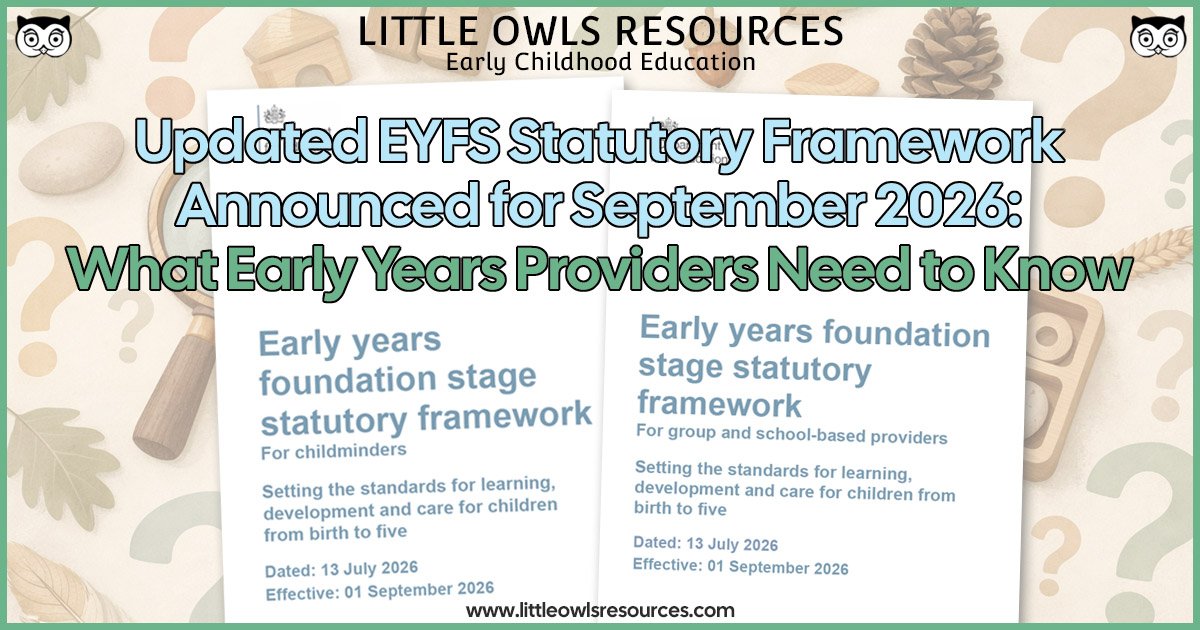
A major overhaul of the national curriculum in England has been announced following the publication of the independent Curriculum and Assessment Review. For those working in the Early Years Foundation Stage (EYFS) and Key Stage 1 (KS1), the changes signal a renewed focus on practical life skills, digital literacy, and enriching learning experiences…

Read More →
New Education Inspection Framework | What EYFS Settings Need to Know

The world of early years education is constantly evolving, and with it, the frameworks that guide and assess our invaluable work. Come November 2025, a significant shift will occur as the new Education Inspection Framework (EIF) comes into effect, bringing with it some crucial changes…

Read More →
Revised 2025 EYFS Statutory Framework for Group & School-Based Providers | What You Need to Know

With the new 2025 EYFS Statutory Framework for group and school-based providers coming into effect on 1st September 2025, it's essential to understand the updates to ensure your practice remains compliant, effective…

Read More →
DfE Press Release | Parents urged to read more to boost children’s life chances

The Education Secretary is calling on parents to lead by example and make reading a daily habit to help reverse the decline in reading for pleasure, to help give kids the best start in life as part of the…

Read More →
DfE Update | Drowning Prevention Week: what children learn about water safety at school

As we head into summer, it’s especially important that children are prepared with these skills. This year, the Royal Life Saving Society UK's Drowning Prevention Week runs from 14 June to 21…

Read More →
DfE Update | Hot weather and heatwaves: guidance for schools and other education settings

There are several ways that schools can make changes to keep children safe in hot weather, especially as children are more at risk of becoming ill with heat-related issues than adults…

Read More →

Are you looking for a specific resource or document for your provision?

Use our 🔍 Search Bar located at the top of every page.

___________________________

Content within the EYFS Curriculum & Pedagogy Membership is provided as professional guidance and support. It reflects current understanding of the EYFS statutory framework, Development Matters and inspection expectations at the time of writing. Practitioners are responsible for applying professional judgement and ensuring practice aligns with current statutory requirements and their specific context. All resources, experiences and environment arrangements must be risk assessed by the setting and used in accordance with individual children’s developmental stages, needs and supervision requirements.

Safeguarding content does not replace a setting’s safeguarding and child protection policy or the statutory role of the Designated Safeguarding Lead (DSL). All concerns must be managed in line with current statutory guidance and local safeguarding procedures.

_____________________________

 
In Reception | 4-5 Years, -R7 Tags Reception, Reception Optional Theme-Based High-Impact Question & Vocabulary Banks

Fine Motor & Physical Development | Foundations for Writing in Reception (4–5 Years)

January 18, 2026 Stuart Murphy

Home › EYFS Curriculum & Pedagogy › Reception Curriculum & Pedagogy › Fine Motor & Physical Development | Foundations for Writing in Reception (4–5 Years)

Fine Motor & Physical Development

Foundations for Writing in Reception (4–5 Years)

A professional guidance document supporting confident, developmentally appropriate physical development and early writing practice in Reception.

Download Document Here:

(This pathway component will be available for download by: March 31st 2026)

 
Download DOCX 📝
Download PDF 📄
 

Document Updated: January 2026

Recommended next read Selection

EYFS
Fine Motor & Physical Development | Foundations for Writing in Reception (4–5 Years)

A professional guidance document supporting confident, developmentally appropriate physical development and early writing practice in Reception.

Read More →
Reception Early Writing Purpose Pack | 4–5 Years

A professional guidance pack supporting developmentally appropriate early writing through purpose-led modelling, phonics application and play-based follow-through in continuous provision.

Read More →
Reception Maths Teaching Framework | 4-5 Years

Play-Based & Progression-Led

Read More →
Phonics in Reception: Teaching, Application & Inclusion (Scheme-Compatible)

A professional guidance pack supporting high-quality, SSP-aligned phonics teaching in Reception — with a strong focus on application in provision, adult interaction and inclusive practice.

Read More →

Professional Membership Contents (Reception 4-5 Years)

Below you will find listed the component documents of our ‘Reception Curriculum & Pedagogy Suite’. They are separated into Strands 1-10. You do not need to use everything all at once.

  • 👉 This section is essential for alignment.

    • Reception Curriculum Overview & Rationale [Free Orienting Sample]

    • Reception Pedagogy Position Statement [Free Orienting Sample]

    • About Our Reception Curriculum Phase Framework

    • How To Use The Reception Pathway

    • Why Themes Are Optional in Reception

  • 👉 Curriculum clarity and sequencing.

    • Reception Curriculum Progression Maps (all areas of learning)

      • Guide to Learning Progression: How to Use the Reception Curriculum Progression Maps

      • Progression Maps for:

        • Communication and Language

        • Personal, Social and Emotional Development

        • Physical Development

        • Literacy

        • Mathematics

        • Understanding the World

        • Expressive Arts and Design

    • Reception Curriculum Phase Framework

      • How To Use The Reception Curriculum Phase Pack

      • Phase 1: Settling & Foundations

      • Phase 2: Exploration & Early Application

      • Phase 3: Independence & Depth

      • Phase 4: Consolidation & Transition

  • 👉 OAP as the organising principle.

    • Reception OAP Cycle Guidance

    • Reception Collaborative Planning & Reflective Sheet Pack

    • Self-Regulation & Learning Behaviours in Reception

    • Reception Baseline Assessment (RBA)

    • Characteristics of Effective Learning in Reception

  • 👉 Stable, purposeful provision.

    • Reception Continuous Provision – Structure & Rationale

    • Universal Continuous Provision Pack (Areas listed below)

      • Construction

      • Creative

      • Investigation / Discovery

      • Maths

      • Reading

      • Role Play / Small World

      • Malleable / Sensory

      • Writing

    • Outdoor Continuous Provision (Reception)

    • Adult-Guided Learning in Provision

    • Reception Labelling Pack | 4-5 Years

  • 👉 Light-touch, application-focused.

    • Reception Enhanced Provision Planning Toolkit

    • Reception Optional Themed Enhancements - Idea Banks

  • 👉 Systematic teaching without Year 1 drift.

    Phonics (Scheme-Compatible)

    • Phonics in Reception: Teaching, Application & Inclusion

      • Pedagogy

      • Adult-Led Sessions

      • Phonics in Provision

      • Supporting Children Not Keeping Up

      • Phonics & EYFSP

      • Scheme Compatibility Statement

    Maths

    • Reception Maths Teaching Framework

      • Term by Tem Maths Concept Emphasis Map

      • Maths Adult-Led Mini Session Banks (9 Banks)

      • Maths Across the Curriculum & Provision

      • Maths & EYFSP Guidance

    Writing

    • Reception Early Writing Purpose Pack

      • Writing Adult-Led Mini Session Bank (12 Sessions)

    • Fine Motor & Physical Development

      • Guidance Surrounding Foundations for Writing in Reception (4–5 Years)

  • 👉 Precision language for application.

    • Adult-Guided Learning in Provision

    • Theme-Based High-Impact Question & Vocabulary Banks

      • Leadership Rationale: Why Questions Differ by Age

    • Five Sentence Stems For Reception Practitioners

  • 👉 Statutory confidence with inclusive practice.

    • EYFSP Interpretation & Assessment Toolkit

      • ELG Unpacking

      • Best-Fit Exemplification

      • Moderation Guidance

    • Reception SEND & Inclusion Toolkit

      • The graduated response (Universal → Targeted → Specialist)

      • Adaptations across phonics, maths & writing

      • Visual Communication Pack

      • Language-first strategies for inclusion

      • Observation, assessment and SEND

      • Collaborative working with families and specialists

      • Referral Preparation — for EHCP pathway

      • Reception APDR Template

      • Leadership and inspection readiness

  • 👉 Leadership assurance.

    • Reception Leadership & Inspection Readiness Pack

      • Curriculum Intent & Implementation Guidance

      • Ofsted Conversation Prompts

  • 👉 Clear communication beyond the classroom.

    • Reception Parent Partnership Pack

    • Reception Transition to Year 1 Pack

Additional Whole-Setting Guidance | for Professional Members

Explore our whole-setting guidance below, including overarching curriculum and pedagogy documents, early years schemas and EYFS setting policies.

    • Little Owls Resources’ Curriculum Intent Statement

    • EYFS from Birth to 5: Curriculum Coherence & Pedagogical Throughline

    • Whole-Setting Curriculum Map (Birth-5): Curriculum Intent & Progression

    • Pedagogy Guidance Document

    • Speech & Language Development - Setting Statement

    • EYFS Inspection-Facing Summaries

  • Early Years Schemas - Practitioner Toolkit | EYFS Birth-5

    ↪ Schema Cards (definition, behaviours, age-related examples, enabling resources)

    ↪ Schema Observation & Responsive Provision Planning Template

    • EYFS Group Setting Policies Pack

      ↪ x 22 Policy Documents

      ↪ Policy Sign-Off and Confirmation Document

      ↪ EYFS Setting Policy Folder Contents List

    • Childminder Setting Policies Pack

      ↪ x 22 Policy Documents

      ↪ Childminder Assistant or Volunteer Policy Sign-Off and Confirmation Document

      ↪ Childminder Policy Folder Contents List

  • EYFS Glossary

    ↪ Clear, practitioner-friendly explanations of key curriculum and pedagogy terms used throughout our guidance.

Looking for a different age group pathway?

Select the pathway that best reflects your role or the age group you work with. You do not need to use everything. (Some practitioners may use more than one pathway.)

Featured
🍼 Babies (0–18 months)

Responsive care, observation and development in the earliest years

🚼 Toddlers (18–36 months)

Development, play and progression in the toddler years

🎨 Preschool (3–4 years)

Curriculum, continuous provision and purposeful teaching

🎓 Reception (4–5 years)

Play-based pedagogy, progression and EYFSP readiness

🏡 Childminders (Birth–5)

Mixed-age pedagogy, planning without overload and inspection confidence

Latest EYFS Articles & Practical Guides | From Our Blog

Stay informed, get expert advice, and find inspiration from our collection of articles and useful external resources, tailored specifically for EYFS practitioners. We regularly publish in-depth articles to support you with current best practices, regulatory changes, and fresh ideas.
EYFS & KS1 Articles
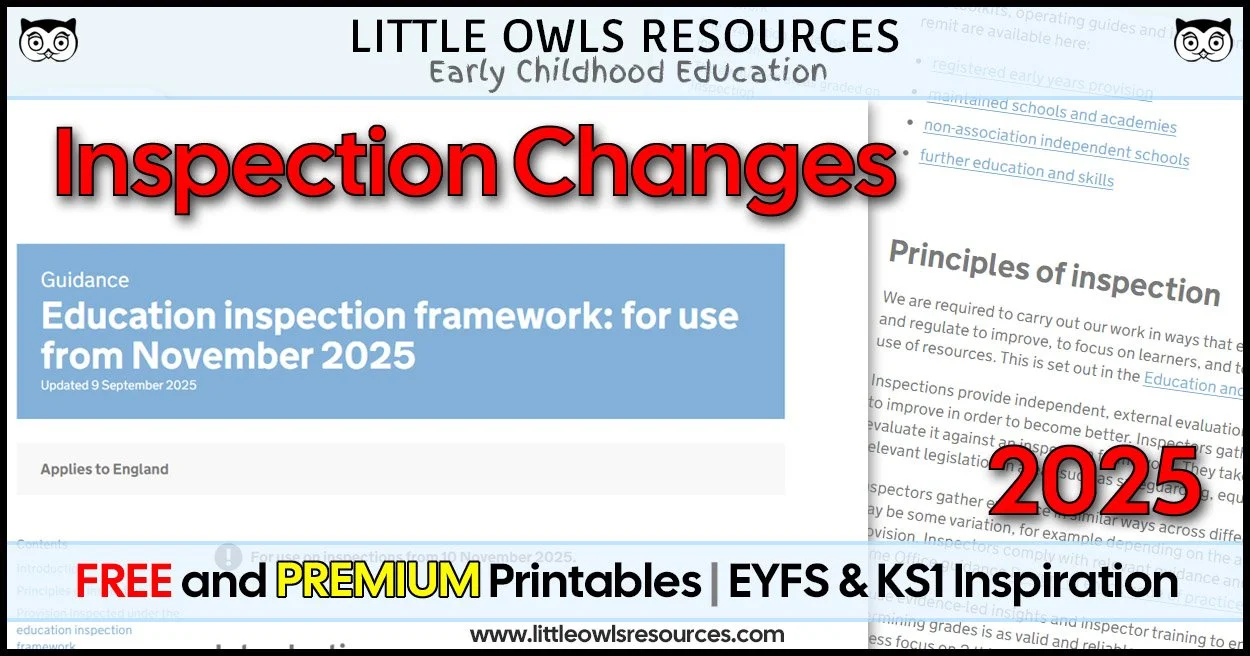
Major UK Curriculum Shake-Up Announced: What EYFS & KS1 Practitioners Need to Know

A major overhaul of the national curriculum in England has been announced following the publication of the independent Curriculum and Assessment Review. For those working in the Early Years Foundation Stage (EYFS) and Key Stage 1 (KS1), the changes signal a renewed focus on practical life skills, digital literacy, and enriching learning experiences…

Read More →
New Education Inspection Framework | What EYFS Settings Need to Know

The world of early years education is constantly evolving, and with it, the frameworks that guide and assess our invaluable work. Come November 2025, a significant shift will occur as the new Education Inspection Framework (EIF) comes into effect, bringing with it some crucial changes…

Read More →
Revised 2025 EYFS Statutory Framework for Group & School-Based Providers | What You Need to Know

With the new 2025 EYFS Statutory Framework for group and school-based providers coming into effect on 1st September 2025, it's essential to understand the updates to ensure your practice remains compliant, effective…

Read More →
DfE Press Release | Parents urged to read more to boost children’s life chances

The Education Secretary is calling on parents to lead by example and make reading a daily habit to help reverse the decline in reading for pleasure, to help give kids the best start in life as part of the…

Read More →
DfE Update | Drowning Prevention Week: what children learn about water safety at school

As we head into summer, it’s especially important that children are prepared with these skills. This year, the Royal Life Saving Society UK's Drowning Prevention Week runs from 14 June to 21…

Read More →
DfE Update | Hot weather and heatwaves: guidance for schools and other education settings

There are several ways that schools can make changes to keep children safe in hot weather, especially as children are more at risk of becoming ill with heat-related issues than adults…

Read More →

Are you looking for a specific resource or document for your provision?

Use our 🔍 Search Bar located at the top of every page.

___________________________

Content within the EYFS Curriculum & Pedagogy Membership is provided as professional guidance and support. It reflects current understanding of the EYFS statutory framework, Development Matters and inspection expectations at the time of writing. Practitioners are responsible for applying professional judgement and ensuring practice aligns with current statutory requirements and their specific context. All resources, experiences and environment arrangements must be risk assessed by the setting and used in accordance with individual children’s developmental stages, needs and supervision requirements.

Safeguarding content does not replace a setting’s safeguarding and child protection policy or the statutory role of the Designated Safeguarding Lead (DSL). All concerns must be managed in line with current statutory guidance and local safeguarding procedures.

_____________________________

 
In Reception | 4-5 Years, -R6 Tags Reception, Fine Motor & Physical Development | Foundations for Writing in Reception (4–5 Years)

Reception Early Writing Purpose Pack | 4–5 Years

January 18, 2026 Stuart Murphy

Home › EYFS Curriculum & Pedagogy › Reception Curriculum & Pedagogy › Reception Early Writing Purpose Pack | 4–5 Years

Reception Early Writing Purpose Pack

Reception (4-5 Years)

A professional guidance pack supporting developmentally appropriate early writing through purpose-led modelling, phonics application and play-based follow-through in continuous provision.

Download Documents Here:

1) Guidance: Reception Adult-Led Writing Mini Session Bank ⋙ DOCX 📝 | PDF 📄

2) Adult-Led Writing Mini Session Banks (Purpose-Led)

  • Lists ⋙ DOCX 📝 | PDF 📄

  • Labels ⋙ DOCX 📝 | PDF 📄

  • Messages ⋙ DOCX 📝 | PDF 📄

  • Signs & Notices ⋙ DOCX 📝 | PDF 📄

  • Captions ⋙ DOCX 📝 | PDF 📄

  • Simple Narratives ⋙ DOCX 📝 | PDF 📄

Documents Updated: January 2026

Recommended next read Selection

EYFS
Fine Motor & Physical Development | Foundations for Writing in Reception (4–5 Years)

A professional guidance document supporting confident, developmentally appropriate physical development and early writing practice in Reception.

Read More →
Reception Early Writing Purpose Pack | 4–5 Years

A professional guidance pack supporting developmentally appropriate early writing through purpose-led modelling, phonics application and play-based follow-through in continuous provision.

Read More →
Reception Maths Teaching Framework | 4-5 Years

Play-Based & Progression-Led

Read More →
Phonics in Reception: Teaching, Application & Inclusion (Scheme-Compatible)

A professional guidance pack supporting high-quality, SSP-aligned phonics teaching in Reception — with a strong focus on application in provision, adult interaction and inclusive practice.

Read More →

Professional Membership Contents (Reception 4-5 Years)

Below you will find listed the component documents of our ‘Reception Curriculum & Pedagogy Suite’. They are separated into Strands 1-10. You do not need to use everything all at once.

  • 👉 This section is essential for alignment.

    • Reception Curriculum Overview & Rationale [Free Orienting Sample]

    • Reception Pedagogy Position Statement [Free Orienting Sample]

    • About Our Reception Curriculum Phase Framework

    • How To Use The Reception Pathway

    • Why Themes Are Optional in Reception

  • 👉 Curriculum clarity and sequencing.

    • Reception Curriculum Progression Maps (all areas of learning)

      • Guide to Learning Progression: How to Use the Reception Curriculum Progression Maps

      • Progression Maps for:

        • Communication and Language

        • Personal, Social and Emotional Development

        • Physical Development

        • Literacy

        • Mathematics

        • Understanding the World

        • Expressive Arts and Design

    • Reception Curriculum Phase Framework

      • How To Use The Reception Curriculum Phase Pack

      • Phase 1: Settling & Foundations

      • Phase 2: Exploration & Early Application

      • Phase 3: Independence & Depth

      • Phase 4: Consolidation & Transition

  • 👉 OAP as the organising principle.

    • Reception OAP Cycle Guidance

    • Reception Collaborative Planning & Reflective Sheet Pack

    • Self-Regulation & Learning Behaviours in Reception

    • Reception Baseline Assessment (RBA)

    • Characteristics of Effective Learning in Reception

  • 👉 Stable, purposeful provision.

    • Reception Continuous Provision – Structure & Rationale

    • Universal Continuous Provision Pack (Areas listed below)

      • Construction

      • Creative

      • Investigation / Discovery

      • Maths

      • Reading

      • Role Play / Small World

      • Malleable / Sensory

      • Writing

    • Outdoor Continuous Provision (Reception)

    • Adult-Guided Learning in Provision

    • Reception Labelling Pack | 4-5 Years

  • 👉 Light-touch, application-focused.

    • Reception Enhanced Provision Planning Toolkit

    • Reception Optional Themed Enhancements - Idea Banks

  • 👉 Systematic teaching without Year 1 drift.

    Phonics (Scheme-Compatible)

    • Phonics in Reception: Teaching, Application & Inclusion

      • Pedagogy

      • Adult-Led Sessions

      • Phonics in Provision

      • Supporting Children Not Keeping Up

      • Phonics & EYFSP

      • Scheme Compatibility Statement

    Maths

    • Reception Maths Teaching Framework

      • Term by Tem Maths Concept Emphasis Map

      • Maths Adult-Led Mini Session Banks (9 Banks)

      • Maths Across the Curriculum & Provision

      • Maths & EYFSP Guidance

    Writing

    • Reception Early Writing Purpose Pack

      • Writing Adult-Led Mini Session Bank (12 Sessions)

    • Fine Motor & Physical Development

      • Guidance Surrounding Foundations for Writing in Reception (4–5 Years)

  • 👉 Precision language for application.

    • Adult-Guided Learning in Provision

    • Theme-Based High-Impact Question & Vocabulary Banks

      • Leadership Rationale: Why Questions Differ by Age

    • Five Sentence Stems For Reception Practitioners

  • 👉 Statutory confidence with inclusive practice.

    • EYFSP Interpretation & Assessment Toolkit

      • ELG Unpacking

      • Best-Fit Exemplification

      • Moderation Guidance

    • Reception SEND & Inclusion Toolkit

      • The graduated response (Universal → Targeted → Specialist)

      • Adaptations across phonics, maths & writing

      • Visual Communication Pack

      • Language-first strategies for inclusion

      • Observation, assessment and SEND

      • Collaborative working with families and specialists

      • Referral Preparation — for EHCP pathway

      • Reception APDR Template

      • Leadership and inspection readiness

  • 👉 Leadership assurance.

    • Reception Leadership & Inspection Readiness Pack

      • Curriculum Intent & Implementation Guidance

      • Ofsted Conversation Prompts

  • 👉 Clear communication beyond the classroom.

    • Reception Parent Partnership Pack

    • Reception Transition to Year 1 Pack

Additional Whole-Setting Guidance | for Professional Members

Explore our whole-setting guidance below, including overarching curriculum and pedagogy documents, early years schemas and EYFS setting policies.

    • Little Owls Resources’ Curriculum Intent Statement

    • EYFS from Birth to 5: Curriculum Coherence & Pedagogical Throughline

    • Whole-Setting Curriculum Map (Birth-5): Curriculum Intent & Progression

    • Pedagogy Guidance Document

    • Speech & Language Development - Setting Statement

    • EYFS Inspection-Facing Summaries

  • Early Years Schemas - Practitioner Toolkit | EYFS Birth-5

    ↪ Schema Cards (definition, behaviours, age-related examples, enabling resources)

    ↪ Schema Observation & Responsive Provision Planning Template

    • EYFS Group Setting Policies Pack

      ↪ x 22 Policy Documents

      ↪ Policy Sign-Off and Confirmation Document

      ↪ EYFS Setting Policy Folder Contents List

    • Childminder Setting Policies Pack

      ↪ x 22 Policy Documents

      ↪ Childminder Assistant or Volunteer Policy Sign-Off and Confirmation Document

      ↪ Childminder Policy Folder Contents List

  • EYFS Glossary

    ↪ Clear, practitioner-friendly explanations of key curriculum and pedagogy terms used throughout our guidance.

Looking for a different age group pathway?

Select the pathway that best reflects your role or the age group you work with. You do not need to use everything. (Some practitioners may use more than one pathway.)

Featured
🍼 Babies (0–18 months)

Responsive care, observation and development in the earliest years

🚼 Toddlers (18–36 months)

Development, play and progression in the toddler years

🎨 Preschool (3–4 years)

Curriculum, continuous provision and purposeful teaching

🎓 Reception (4–5 years)

Play-based pedagogy, progression and EYFSP readiness

🏡 Childminders (Birth–5)

Mixed-age pedagogy, planning without overload and inspection confidence

Latest EYFS Articles & Practical Guides | From Our Blog

Stay informed, get expert advice, and find inspiration from our collection of articles and useful external resources, tailored specifically for EYFS practitioners. We regularly publish in-depth articles to support you with current best practices, regulatory changes, and fresh ideas.

EYFS & KS1 Articles
Major UK Curriculum Shake-Up Announced: What EYFS & KS1 Practitioners Need to Know

A major overhaul of the national curriculum in England has been announced following the publication of the independent Curriculum and Assessment Review. For those working in the Early Years Foundation Stage (EYFS) and Key Stage 1 (KS1), the changes signal a renewed focus on practical life skills, digital literacy, and enriching learning experiences…

Read More →
New Education Inspection Framework | What EYFS Settings Need to Know

The world of early years education is constantly evolving, and with it, the frameworks that guide and assess our invaluable work. Come November 2025, a significant shift will occur as the new Education Inspection Framework (EIF) comes into effect, bringing with it some crucial changes…

Read More →
Revised 2025 EYFS Statutory Framework for Group & School-Based Providers | What You Need to Know

With the new 2025 EYFS Statutory Framework for group and school-based providers coming into effect on 1st September 2025, it's essential to understand the updates to ensure your practice remains compliant, effective…

Read More →
DfE Press Release | Parents urged to read more to boost children’s life chances

The Education Secretary is calling on parents to lead by example and make reading a daily habit to help reverse the decline in reading for pleasure, to help give kids the best start in life as part of the…

Read More →
DfE Update | Drowning Prevention Week: what children learn about water safety at school

As we head into summer, it’s especially important that children are prepared with these skills. This year, the Royal Life Saving Society UK's Drowning Prevention Week runs from 14 June to 21…

Read More →
DfE Update | Hot weather and heatwaves: guidance for schools and other education settings

There are several ways that schools can make changes to keep children safe in hot weather, especially as children are more at risk of becoming ill with heat-related issues than adults…

Read More →

Are you looking for a specific resource or document for your provision?

Use our 🔍 Search Bar located at the top of every page.

___________________________

Content within the EYFS Curriculum & Pedagogy Membership is provided as professional guidance and support. It reflects current understanding of the EYFS statutory framework, Development Matters and inspection expectations at the time of writing. Practitioners are responsible for applying professional judgement and ensuring practice aligns with current statutory requirements and their specific context. All resources, experiences and environment arrangements must be risk assessed by the setting and used in accordance with individual children’s developmental stages, needs and supervision requirements.

Safeguarding content does not replace a setting’s safeguarding and child protection policy or the statutory role of the Designated Safeguarding Lead (DSL). All concerns must be managed in line with current statutory guidance and local safeguarding procedures.

_____________________________

 
In Reception | 4-5 Years, -R6 Tags Reception, Reception Early Writing Purpose Pack | 4–5 Years

Reception Maths Teaching Framework | 4-5 Years

January 18, 2026 Stuart Murphy

Home › EYFS Curriculum & Pedagogy › Reception Curriculum & Pedagogy › Reception Maths Teaching Framework | 4-5 Years

Reception Maths Teaching Framework

Reception (4–5 Years)

Download Document Here:

(This pathway component will be available for download by: March 31st 2026)

 
Download DOCX 📝
Download PDF 📄
 

Document Updated: January 2026

Recommended next read Selection

EYFS
Fine Motor & Physical Development | Foundations for Writing in Reception (4–5 Years)

A professional guidance document supporting confident, developmentally appropriate physical development and early writing practice in Reception.

Read More →
Reception Early Writing Purpose Pack | 4–5 Years

A professional guidance pack supporting developmentally appropriate early writing through purpose-led modelling, phonics application and play-based follow-through in continuous provision.

Read More →
Reception Maths Teaching Framework | 4-5 Years

Play-Based & Progression-Led

Read More →
Phonics in Reception: Teaching, Application & Inclusion (Scheme-Compatible)

A professional guidance pack supporting high-quality, SSP-aligned phonics teaching in Reception — with a strong focus on application in provision, adult interaction and inclusive practice.

Read More →

Professional Membership Contents (Reception 4-5 Years)

Below you will find listed the component documents of our ‘Reception Curriculum & Pedagogy Suite’. They are separated into Strands 1-10. You do not need to use everything all at once.

  • 👉 This section is essential for alignment.

    • Reception Curriculum Overview & Rationale [Free Orienting Sample]

    • Reception Pedagogy Position Statement [Free Orienting Sample]

    • About Our Reception Curriculum Phase Framework

    • How To Use The Reception Pathway

    • Why Themes Are Optional in Reception

  • 👉 Curriculum clarity and sequencing.

    • Reception Curriculum Progression Maps (all areas of learning)

      • Guide to Learning Progression: How to Use the Reception Curriculum Progression Maps

      • Progression Maps for:

        • Communication and Language

        • Personal, Social and Emotional Development

        • Physical Development

        • Literacy

        • Mathematics

        • Understanding the World

        • Expressive Arts and Design

    • Reception Curriculum Phase Framework

      • How To Use The Reception Curriculum Phase Pack

      • Phase 1: Settling & Foundations

      • Phase 2: Exploration & Early Application

      • Phase 3: Independence & Depth

      • Phase 4: Consolidation & Transition

  • 👉 OAP as the organising principle.

    • Reception OAP Cycle Guidance

    • Reception Collaborative Planning & Reflective Sheet Pack

    • Self-Regulation & Learning Behaviours in Reception

    • Reception Baseline Assessment (RBA)

    • Characteristics of Effective Learning in Reception

  • 👉 Stable, purposeful provision.

    • Reception Continuous Provision – Structure & Rationale

    • Universal Continuous Provision Pack (Areas listed below)

      • Construction

      • Creative

      • Investigation / Discovery

      • Maths

      • Reading

      • Role Play / Small World

      • Malleable / Sensory

      • Writing

    • Outdoor Continuous Provision (Reception)

    • Adult-Guided Learning in Provision

    • Reception Labelling Pack | 4-5 Years

  • 👉 Light-touch, application-focused.

    • Reception Enhanced Provision Planning Toolkit

    • Reception Optional Themed Enhancements - Idea Banks

  • 👉 Systematic teaching without Year 1 drift.

    Phonics (Scheme-Compatible)

    • Phonics in Reception: Teaching, Application & Inclusion

      • Pedagogy

      • Adult-Led Sessions

      • Phonics in Provision

      • Supporting Children Not Keeping Up

      • Phonics & EYFSP

      • Scheme Compatibility Statement

    Maths

    • Reception Maths Teaching Framework

      • Term by Tem Maths Concept Emphasis Map

      • Maths Adult-Led Mini Session Banks (9 Banks)

      • Maths Across the Curriculum & Provision

      • Maths & EYFSP Guidance

    Writing

    • Reception Early Writing Purpose Pack

      • Writing Adult-Led Mini Session Bank (12 Sessions)

    • Fine Motor & Physical Development

      • Guidance Surrounding Foundations for Writing in Reception (4–5 Years)

  • 👉 Precision language for application.

    • Adult-Guided Learning in Provision

    • Theme-Based High-Impact Question & Vocabulary Banks

      • Leadership Rationale: Why Questions Differ by Age

    • Five Sentence Stems For Reception Practitioners

  • 👉 Statutory confidence with inclusive practice.

    • EYFSP Interpretation & Assessment Toolkit

      • ELG Unpacking

      • Best-Fit Exemplification

      • Moderation Guidance

    • Reception SEND & Inclusion Toolkit

      • The graduated response (Universal → Targeted → Specialist)

      • Adaptations across phonics, maths & writing

      • Visual Communication Pack

      • Language-first strategies for inclusion

      • Observation, assessment and SEND

      • Collaborative working with families and specialists

      • Referral Preparation — for EHCP pathway

      • Reception APDR Template

      • Leadership and inspection readiness

  • 👉 Leadership assurance.

    • Reception Leadership & Inspection Readiness Pack

      • Curriculum Intent & Implementation Guidance

      • Ofsted Conversation Prompts

  • 👉 Clear communication beyond the classroom.

    • Reception Parent Partnership Pack

    • Reception Transition to Year 1 Pack

Additional Whole-Setting Guidance | for Professional Members

Explore our whole-setting guidance below, including overarching curriculum and pedagogy documents, early years schemas and EYFS setting policies.

    • Little Owls Resources’ Curriculum Intent Statement

    • EYFS from Birth to 5: Curriculum Coherence & Pedagogical Throughline

    • Whole-Setting Curriculum Map (Birth-5): Curriculum Intent & Progression

    • Pedagogy Guidance Document

    • Speech & Language Development - Setting Statement

    • EYFS Inspection-Facing Summaries

  • Early Years Schemas - Practitioner Toolkit | EYFS Birth-5

    ↪ Schema Cards (definition, behaviours, age-related examples, enabling resources)

    ↪ Schema Observation & Responsive Provision Planning Template

    • EYFS Group Setting Policies Pack

      ↪ x 22 Policy Documents

      ↪ Policy Sign-Off and Confirmation Document

      ↪ EYFS Setting Policy Folder Contents List

    • Childminder Setting Policies Pack

      ↪ x 22 Policy Documents

      ↪ Childminder Assistant or Volunteer Policy Sign-Off and Confirmation Document

      ↪ Childminder Policy Folder Contents List

  • EYFS Glossary

    ↪ Clear, practitioner-friendly explanations of key curriculum and pedagogy terms used throughout our guidance.

Looking for a different age group pathway?

Select the pathway that best reflects your role or the age group you work with. You do not need to use everything. (Some practitioners may use more than one pathway.)

Featured
🍼 Babies (0–18 months)

Responsive care, observation and development in the earliest years

🚼 Toddlers (18–36 months)

Development, play and progression in the toddler years

🎨 Preschool (3–4 years)

Curriculum, continuous provision and purposeful teaching

🎓 Reception (4–5 years)

Play-based pedagogy, progression and EYFSP readiness

🏡 Childminders (Birth–5)

Mixed-age pedagogy, planning without overload and inspection confidence

Latest EYFS Articles & Practical Guides | From Our Blog

Stay informed, get expert advice, and find inspiration from our collection of articles and useful external resources, tailored specifically for EYFS practitioners. We regularly publish in-depth articles to support you with current best practices, regulatory changes, and fresh ideas.

EYFS & KS1 Articles
Major UK Curriculum Shake-Up Announced: What EYFS & KS1 Practitioners Need to Know

A major overhaul of the national curriculum in England has been announced following the publication of the independent Curriculum and Assessment Review. For those working in the Early Years Foundation Stage (EYFS) and Key Stage 1 (KS1), the changes signal a renewed focus on practical life skills, digital literacy, and enriching learning experiences…

Read More →
New Education Inspection Framework | What EYFS Settings Need to Know

The world of early years education is constantly evolving, and with it, the frameworks that guide and assess our invaluable work. Come November 2025, a significant shift will occur as the new Education Inspection Framework (EIF) comes into effect, bringing with it some crucial changes…

Read More →
Revised 2025 EYFS Statutory Framework for Group & School-Based Providers | What You Need to Know

With the new 2025 EYFS Statutory Framework for group and school-based providers coming into effect on 1st September 2025, it's essential to understand the updates to ensure your practice remains compliant, effective…

Read More →
DfE Press Release | Parents urged to read more to boost children’s life chances

The Education Secretary is calling on parents to lead by example and make reading a daily habit to help reverse the decline in reading for pleasure, to help give kids the best start in life as part of the…

Read More →
DfE Update | Drowning Prevention Week: what children learn about water safety at school

As we head into summer, it’s especially important that children are prepared with these skills. This year, the Royal Life Saving Society UK's Drowning Prevention Week runs from 14 June to 21…

Read More →
DfE Update | Hot weather and heatwaves: guidance for schools and other education settings

There are several ways that schools can make changes to keep children safe in hot weather, especially as children are more at risk of becoming ill with heat-related issues than adults…

Read More →

Are you looking for a specific resource or document for your provision?

Use our 🔍 Search Bar located at the top of every page.

___________________________

Content within the EYFS Curriculum & Pedagogy Membership is provided as professional guidance and support. It reflects current understanding of the EYFS statutory framework, Development Matters and inspection expectations at the time of writing. Practitioners are responsible for applying professional judgement and ensuring practice aligns with current statutory requirements and their specific context. All resources, experiences and environment arrangements must be risk assessed by the setting and used in accordance with individual children’s developmental stages, needs and supervision requirements.

Safeguarding content does not replace a setting’s safeguarding and child protection policy or the statutory role of the Designated Safeguarding Lead (DSL). All concerns must be managed in line with current statutory guidance and local safeguarding procedures.

_____________________________

 
In Reception | 4-5 Years, -R6 Tags Reception, Reception Maths Teaching Framework | 4-5 Years

Phonics in Reception: Teaching, Application & Inclusion (Scheme-Compatible)

January 18, 2026 Stuart Murphy

Home › EYFS Curriculum & Pedagogy › Reception Curriculum & Pedagogy › Phonics in Reception: Teaching, Application & Inclusion (Scheme-Compatible)

Phonics in Reception: Teaching, Application & Inclusion (Scheme-Compatible)

Reception (4–5 Years)

A professional guidance pack supporting high-quality, SSP-aligned phonics teaching in Reception — with a strong focus on application in provision, adult interaction and inclusive practice.

Download Document Here:

(This pathway component will be available for download by: March 31st 2026)

 
Download DOCX 📝
Download PDF 📄
 

Document Updated: January 2026

Recommended next read Selection

EYFS
Fine Motor & Physical Development | Foundations for Writing in Reception (4–5 Years)

A professional guidance document supporting confident, developmentally appropriate physical development and early writing practice in Reception.

Read More →
Reception Early Writing Purpose Pack | 4–5 Years

A professional guidance pack supporting developmentally appropriate early writing through purpose-led modelling, phonics application and play-based follow-through in continuous provision.

Read More →
Reception Maths Teaching Framework | 4-5 Years

Play-Based & Progression-Led

Read More →
Phonics in Reception: Teaching, Application & Inclusion (Scheme-Compatible)

A professional guidance pack supporting high-quality, SSP-aligned phonics teaching in Reception — with a strong focus on application in provision, adult interaction and inclusive practice.

Read More →

Professional Membership Contents (Reception 4-5 Years)

Below you will find listed the component documents of our ‘Reception Curriculum & Pedagogy Suite’. They are separated into Strands 1-10. You do not need to use everything all at once.

  • 👉 This section is essential for alignment.

    • Reception Curriculum Overview & Rationale [Free Orienting Sample]

    • Reception Pedagogy Position Statement [Free Orienting Sample]

    • About Our Reception Curriculum Phase Framework

    • How To Use The Reception Pathway

    • Why Themes Are Optional in Reception

  • 👉 Curriculum clarity and sequencing.

    • Reception Curriculum Progression Maps (all areas of learning)

      • Guide to Learning Progression: How to Use the Reception Curriculum Progression Maps

      • Progression Maps for:

        • Communication and Language

        • Personal, Social and Emotional Development

        • Physical Development

        • Literacy

        • Mathematics

        • Understanding the World

        • Expressive Arts and Design

    • Reception Curriculum Phase Framework

      • How To Use The Reception Curriculum Phase Pack

      • Phase 1: Settling & Foundations

      • Phase 2: Exploration & Early Application

      • Phase 3: Independence & Depth

      • Phase 4: Consolidation & Transition

  • 👉 OAP as the organising principle.

    • Reception OAP Cycle Guidance

    • Reception Collaborative Planning & Reflective Sheet Pack

    • Self-Regulation & Learning Behaviours in Reception

    • Reception Baseline Assessment (RBA)

    • Characteristics of Effective Learning in Reception

  • 👉 Stable, purposeful provision.

    • Reception Continuous Provision – Structure & Rationale

    • Universal Continuous Provision Pack (Areas listed below)

      • Construction

      • Creative

      • Investigation / Discovery

      • Maths

      • Reading

      • Role Play / Small World

      • Malleable / Sensory

      • Writing

    • Outdoor Continuous Provision (Reception)

    • Adult-Guided Learning in Provision

    • Reception Labelling Pack | 4-5 Years

  • 👉 Light-touch, application-focused.

    • Reception Enhanced Provision Planning Toolkit

    • Reception Optional Themed Enhancements - Idea Banks

  • 👉 Systematic teaching without Year 1 drift.

    Phonics (Scheme-Compatible)

    • Phonics in Reception: Teaching, Application & Inclusion

      • Pedagogy

      • Adult-Led Sessions

      • Phonics in Provision

      • Supporting Children Not Keeping Up

      • Phonics & EYFSP

      • Scheme Compatibility Statement

    Maths

    • Reception Maths Teaching Framework

      • Term by Tem Maths Concept Emphasis Map

      • Maths Adult-Led Mini Session Banks (9 Banks)

      • Maths Across the Curriculum & Provision

      • Maths & EYFSP Guidance

    Writing

    • Reception Early Writing Purpose Pack

      • Writing Adult-Led Mini Session Bank (12 Sessions)

    • Fine Motor & Physical Development

      • Guidance Surrounding Foundations for Writing in Reception (4–5 Years)

  • 👉 Precision language for application.

    • Adult-Guided Learning in Provision

    • Theme-Based High-Impact Question & Vocabulary Banks

      • Leadership Rationale: Why Questions Differ by Age

    • Five Sentence Stems For Reception Practitioners

  • 👉 Statutory confidence with inclusive practice.

    • EYFSP Interpretation & Assessment Toolkit

      • ELG Unpacking

      • Best-Fit Exemplification

      • Moderation Guidance

    • Reception SEND & Inclusion Toolkit

      • The graduated response (Universal → Targeted → Specialist)

      • Adaptations across phonics, maths & writing

      • Visual Communication Pack

      • Language-first strategies for inclusion

      • Observation, assessment and SEND

      • Collaborative working with families and specialists

      • Referral Preparation — for EHCP pathway

      • Reception APDR Template

      • Leadership and inspection readiness

  • 👉 Leadership assurance.

    • Reception Leadership & Inspection Readiness Pack

      • Curriculum Intent & Implementation Guidance

      • Ofsted Conversation Prompts

  • 👉 Clear communication beyond the classroom.

    • Reception Parent Partnership Pack

    • Reception Transition to Year 1 Pack

Additional Whole-Setting Guidance | for Professional Members

Explore our whole-setting guidance below, including overarching curriculum and pedagogy documents, early years schemas and EYFS setting policies.

    • Little Owls Resources’ Curriculum Intent Statement

    • EYFS from Birth to 5: Curriculum Coherence & Pedagogical Throughline

    • Whole-Setting Curriculum Map (Birth-5): Curriculum Intent & Progression

    • Pedagogy Guidance Document

    • Speech & Language Development - Setting Statement

    • EYFS Inspection-Facing Summaries

  • Early Years Schemas - Practitioner Toolkit | EYFS Birth-5

    ↪ Schema Cards (definition, behaviours, age-related examples, enabling resources)

    ↪ Schema Observation & Responsive Provision Planning Template

    • EYFS Group Setting Policies Pack

      ↪ x 22 Policy Documents

      ↪ Policy Sign-Off and Confirmation Document

      ↪ EYFS Setting Policy Folder Contents List

    • Childminder Setting Policies Pack

      ↪ x 22 Policy Documents

      ↪ Childminder Assistant or Volunteer Policy Sign-Off and Confirmation Document

      ↪ Childminder Policy Folder Contents List

  • EYFS Glossary

    ↪ Clear, practitioner-friendly explanations of key curriculum and pedagogy terms used throughout our guidance.

Looking for a different age group pathway?

Select the pathway that best reflects your role or the age group you work with. You do not need to use everything. (Some practitioners may use more than one pathway.)

Featured
🍼 Babies (0–18 months)

Responsive care, observation and development in the earliest years

🚼 Toddlers (18–36 months)

Development, play and progression in the toddler years

🎨 Preschool (3–4 years)

Curriculum, continuous provision and purposeful teaching

🎓 Reception (4–5 years)

Play-based pedagogy, progression and EYFSP readiness

🏡 Childminders (Birth–5)

Mixed-age pedagogy, planning without overload and inspection confidence

Latest EYFS Articles & Practical Guides | From Our Blog

Stay informed, get expert advice, and find inspiration from our collection of articles and useful external resources, tailored specifically for EYFS practitioners. We regularly publish in-depth articles to support you with current best practices, regulatory changes, and fresh ideas.
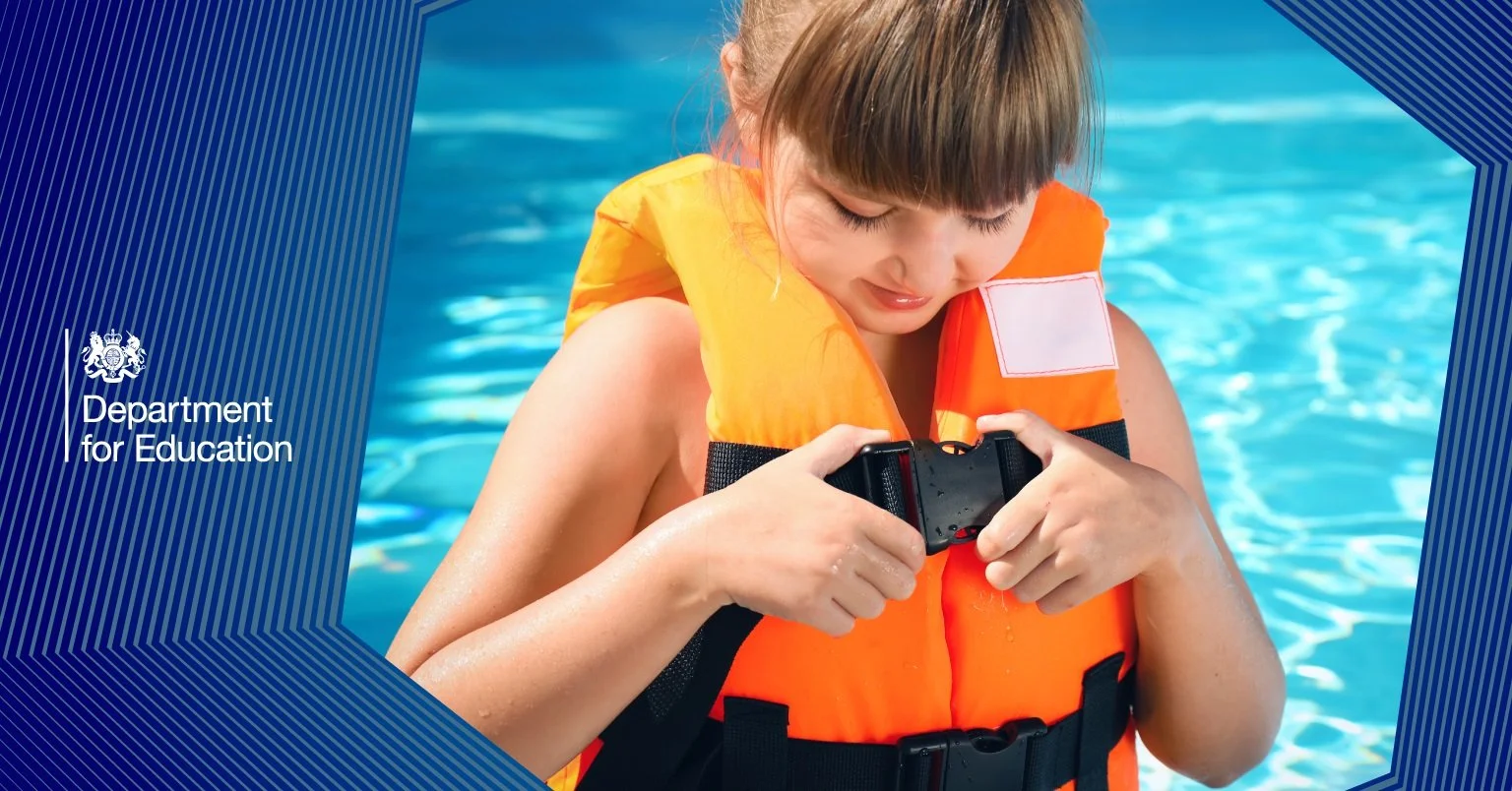
EYFS & KS1 Articles
Major UK Curriculum Shake-Up Announced: What EYFS & KS1 Practitioners Need to Know

A major overhaul of the national curriculum in England has been announced following the publication of the independent Curriculum and Assessment Review. For those working in the Early Years Foundation Stage (EYFS) and Key Stage 1 (KS1), the changes signal a renewed focus on practical life skills, digital literacy, and enriching learning experiences…

Read More →
New Education Inspection Framework | What EYFS Settings Need to Know

The world of early years education is constantly evolving, and with it, the frameworks that guide and assess our invaluable work. Come November 2025, a significant shift will occur as the new Education Inspection Framework (EIF) comes into effect, bringing with it some crucial changes…

Read More →
Revised 2025 EYFS Statutory Framework for Group & School-Based Providers | What You Need to Know

With the new 2025 EYFS Statutory Framework for group and school-based providers coming into effect on 1st September 2025, it's essential to understand the updates to ensure your practice remains compliant, effective…

Read More →
DfE Press Release | Parents urged to read more to boost children’s life chances

The Education Secretary is calling on parents to lead by example and make reading a daily habit to help reverse the decline in reading for pleasure, to help give kids the best start in life as part of the…

Read More →
DfE Update | Drowning Prevention Week: what children learn about water safety at school

As we head into summer, it’s especially important that children are prepared with these skills. This year, the Royal Life Saving Society UK's Drowning Prevention Week runs from 14 June to 21…

Read More →
DfE Update | Hot weather and heatwaves: guidance for schools and other education settings

There are several ways that schools can make changes to keep children safe in hot weather, especially as children are more at risk of becoming ill with heat-related issues than adults…

Read More →

Are you looking for a specific resource or document for your provision?

Use our 🔍 Search Bar located at the top of every page.

___________________________

Content within the EYFS Curriculum & Pedagogy Membership is provided as professional guidance and support. It reflects current understanding of the EYFS statutory framework, Development Matters and inspection expectations at the time of writing. Practitioners are responsible for applying professional judgement and ensuring practice aligns with current statutory requirements and their specific context. All resources, experiences and environment arrangements must be risk assessed by the setting and used in accordance with individual children’s developmental stages, needs and supervision requirements.

Safeguarding content does not replace a setting’s safeguarding and child protection policy or the statutory role of the Designated Safeguarding Lead (DSL). All concerns must be managed in line with current statutory guidance and local safeguarding procedures.

_____________________________

 
In Reception | 4-5 Years, -R6 Tags Reception, Phonics in Reception: Teaching Application & Inclusion (Scheme-Compatible)

Reception Optional Themed Enhancements - Idea Banks | 4-5 Years

January 18, 2026 Stuart Murphy

Home › EYFS Curriculum & Pedagogy › Reception Curriculum & Pedagogy › Reception Optional Themed Enhancements - Idea Banks | 4-5 Years

Reception Optional Themed Enhancements - Idea Banks

4-5 Years

Download Document Here:

(This pathway component will be available for download by: March 31st 2026)

 
Download DOCX 📝
Download PDF 📄
 

Document Updated: January 2026

Recommended next read Selection

EYFS
Reception Optional Themed Enhancements - Idea Banks | 4-5 Years

Bank of themed continuous provision enhancement ideas.

Read More →
Reception Enhanced Provision Planning Toolkit | 4–5 Years

A professional guidance toolkit supporting responsive, observation-led enhancements that strengthen learning without over-directing play in Reception.

Read More →

Professional Membership Contents (Reception 4-5 Years)

Below you will find listed the component documents of our ‘Reception Curriculum & Pedagogy Suite’. They are separated into Strands 1-10. You do not need to use everything all at once.

  • 👉 This section is essential for alignment.

    • Reception Curriculum Overview & Rationale [Free Orienting Sample]

    • Reception Pedagogy Position Statement [Free Orienting Sample]

    • About Our Reception Curriculum Phase Framework

    • How To Use The Reception Pathway

    • Why Themes Are Optional in Reception

  • 👉 Curriculum clarity and sequencing.

    • Reception Curriculum Progression Maps (all areas of learning)

      • Guide to Learning Progression: How to Use the Reception Curriculum Progression Maps

      • Progression Maps for:

        • Communication and Language

        • Personal, Social and Emotional Development

        • Physical Development

        • Literacy

        • Mathematics

        • Understanding the World

        • Expressive Arts and Design

    • Reception Curriculum Phase Framework

      • How To Use The Reception Curriculum Phase Pack

      • Phase 1: Settling & Foundations

      • Phase 2: Exploration & Early Application

      • Phase 3: Independence & Depth

      • Phase 4: Consolidation & Transition

  • 👉 OAP as the organising principle.

    • Reception OAP Cycle Guidance

    • Reception Collaborative Planning & Reflective Sheet Pack

    • Self-Regulation & Learning Behaviours in Reception

    • Reception Baseline Assessment (RBA)

    • Characteristics of Effective Learning in Reception

  • 👉 Stable, purposeful provision.

    • Reception Continuous Provision – Structure & Rationale

    • Universal Continuous Provision Pack (Areas listed below)

      • Construction

      • Creative

      • Investigation / Discovery

      • Maths

      • Reading

      • Role Play / Small World

      • Malleable / Sensory

      • Writing

    • Outdoor Continuous Provision (Reception)

    • Adult-Guided Learning in Provision

    • Reception Labelling Pack | 4-5 Years

  • 👉 Light-touch, application-focused.

    • Reception Enhanced Provision Planning Toolkit

    • Reception Optional Themed Enhancements - Idea Banks

  • 👉 Systematic teaching without Year 1 drift.

    Phonics (Scheme-Compatible)

    • Phonics in Reception: Teaching, Application & Inclusion

      • Pedagogy

      • Adult-Led Sessions

      • Phonics in Provision

      • Supporting Children Not Keeping Up

      • Phonics & EYFSP

      • Scheme Compatibility Statement

    Maths

    • Reception Maths Teaching Framework

      • Term by Tem Maths Concept Emphasis Map

      • Maths Adult-Led Mini Session Banks (9 Banks)

      • Maths Across the Curriculum & Provision

      • Maths & EYFSP Guidance

    Writing

    • Reception Early Writing Purpose Pack

      • Writing Adult-Led Mini Session Bank (12 Sessions)

    • Fine Motor & Physical Development

      • Guidance Surrounding Foundations for Writing in Reception (4–5 Years)

  • 👉 Precision language for application.

    • Adult-Guided Learning in Provision

    • Theme-Based High-Impact Question & Vocabulary Banks

      • Leadership Rationale: Why Questions Differ by Age

    • Five Sentence Stems For Reception Practitioners

  • 👉 Statutory confidence with inclusive practice.

    • EYFSP Interpretation & Assessment Toolkit

      • ELG Unpacking

      • Best-Fit Exemplification

      • Moderation Guidance

    • Reception SEND & Inclusion Toolkit

      • The graduated response (Universal → Targeted → Specialist)

      • Adaptations across phonics, maths & writing

      • Visual Communication Pack

      • Language-first strategies for inclusion

      • Observation, assessment and SEND

      • Collaborative working with families and specialists

      • Referral Preparation — for EHCP pathway

      • Reception APDR Template

      • Leadership and inspection readiness

  • 👉 Leadership assurance.

    • Reception Leadership & Inspection Readiness Pack

      • Curriculum Intent & Implementation Guidance

      • Ofsted Conversation Prompts

  • 👉 Clear communication beyond the classroom.

    • Reception Parent Partnership Pack

    • Reception Transition to Year 1 Pack

Additional Whole-Setting Guidance | for Professional Members

Explore our whole-setting guidance below, including overarching curriculum and pedagogy documents, early years schemas and EYFS setting policies.

    • Little Owls Resources’ Curriculum Intent Statement

    • EYFS from Birth to 5: Curriculum Coherence & Pedagogical Throughline

    • Whole-Setting Curriculum Map (Birth-5): Curriculum Intent & Progression

    • Pedagogy Guidance Document

    • Speech & Language Development - Setting Statement

    • EYFS Inspection-Facing Summaries

  • Early Years Schemas - Practitioner Toolkit | EYFS Birth-5

    ↪ Schema Cards (definition, behaviours, age-related examples, enabling resources)

    ↪ Schema Observation & Responsive Provision Planning Template

    • EYFS Group Setting Policies Pack

      ↪ x 22 Policy Documents

      ↪ Policy Sign-Off and Confirmation Document

      ↪ EYFS Setting Policy Folder Contents List

    • Childminder Setting Policies Pack

      ↪ x 22 Policy Documents

      ↪ Childminder Assistant or Volunteer Policy Sign-Off and Confirmation Document

      ↪ Childminder Policy Folder Contents List

  • EYFS Glossary

    ↪ Clear, practitioner-friendly explanations of key curriculum and pedagogy terms used throughout our guidance.

Looking for a different age group pathway?

Select the pathway that best reflects your role or the age group you work with. You do not need to use everything. (Some practitioners may use more than one pathway.)

Featured
🍼 Babies (0–18 months)

Responsive care, observation and development in the earliest years

🚼 Toddlers (18–36 months)

Development, play and progression in the toddler years

🎨 Preschool (3–4 years)

Curriculum, continuous provision and purposeful teaching

🎓 Reception (4–5 years)

Play-based pedagogy, progression and EYFSP readiness

🏡 Childminders (Birth–5)

Mixed-age pedagogy, planning without overload and inspection confidence

Latest EYFS Articles & Practical Guides | From Our Blog

Stay informed, get expert advice, and find inspiration from our collection of articles and useful external resources, tailored specifically for EYFS practitioners. We regularly publish in-depth articles to support you with current best practices, regulatory changes, and fresh ideas.

EYFS & KS1 Articles
Major UK Curriculum Shake-Up Announced: What EYFS & KS1 Practitioners Need to Know

A major overhaul of the national curriculum in England has been announced following the publication of the independent Curriculum and Assessment Review. For those working in the Early Years Foundation Stage (EYFS) and Key Stage 1 (KS1), the changes signal a renewed focus on practical life skills, digital literacy, and enriching learning experiences…

Read More →
New Education Inspection Framework | What EYFS Settings Need to Know

The world of early years education is constantly evolving, and with it, the frameworks that guide and assess our invaluable work. Come November 2025, a significant shift will occur as the new Education Inspection Framework (EIF) comes into effect, bringing with it some crucial changes…

Read More →
Revised 2025 EYFS Statutory Framework for Group & School-Based Providers | What You Need to Know

With the new 2025 EYFS Statutory Framework for group and school-based providers coming into effect on 1st September 2025, it's essential to understand the updates to ensure your practice remains compliant, effective…

Read More →
DfE Press Release | Parents urged to read more to boost children’s life chances

The Education Secretary is calling on parents to lead by example and make reading a daily habit to help reverse the decline in reading for pleasure, to help give kids the best start in life as part of the…

Read More →
DfE Update | Drowning Prevention Week: what children learn about water safety at school

As we head into summer, it’s especially important that children are prepared with these skills. This year, the Royal Life Saving Society UK's Drowning Prevention Week runs from 14 June to 21…

Read More →
DfE Update | Hot weather and heatwaves: guidance for schools and other education settings

There are several ways that schools can make changes to keep children safe in hot weather, especially as children are more at risk of becoming ill with heat-related issues than adults…

Read More →

Are you looking for a specific resource or document for your provision?

Use our 🔍 Search Bar located at the top of every page.

___________________________

Content within the EYFS Curriculum & Pedagogy Membership is provided as professional guidance and support. It reflects current understanding of the EYFS statutory framework, Development Matters and inspection expectations at the time of writing. Practitioners are responsible for applying professional judgement and ensuring practice aligns with current statutory requirements and their specific context. All resources, experiences and environment arrangements must be risk assessed by the setting and used in accordance with individual children’s developmental stages, needs and supervision requirements.

Safeguarding content does not replace a setting’s safeguarding and child protection policy or the statutory role of the Designated Safeguarding Lead (DSL). All concerns must be managed in line with current statutory guidance and local safeguarding procedures.

_____________________________
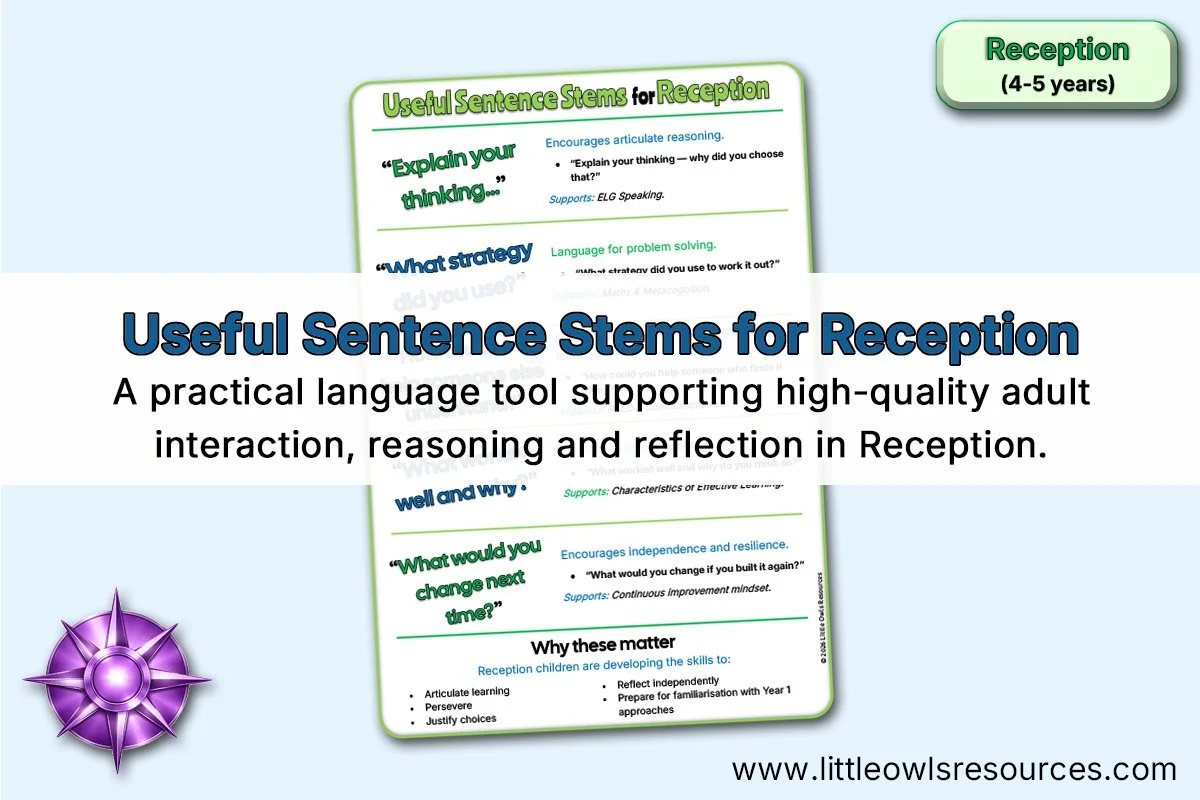
 
In Reception | 4-5 Years, -R5 Tags Reception, Reception Optional Themed Enhancements - Idea Banks | 4-5 Years

Reception Enhanced Provision Planning Toolkit | 4-5 Years

January 18, 2026 Stuart Murphy

Home › EYFS Curriculum & Pedagogy › Reception Curriculum & Pedagogy › Reception Enhanced Provision Planning Toolkit | 4–5 Years

Reception Enhanced Provision Planning Toolkit

Reception (4-5 Years)

A professional guidance toolkit supporting responsive, observation-led enhancements that strengthen learning without over-directing play in Reception.

Download Document Here:

 
Download DOCX 📝
Download PDF 📄
 

Document Updated: January 2026

Recommended next read Selection

EYFS
Reception Optional Themed Enhancements - Idea Banks | 4-5 Years

Bank of themed continuous provision enhancement ideas.

Read More →
Reception Enhanced Provision Planning Toolkit | 4–5 Years

A professional guidance toolkit supporting responsive, observation-led enhancements that strengthen learning without over-directing play in Reception.

Read More →

Professional Membership Contents (Reception 4-5 Years)

Below you will find listed the component documents of our ‘Reception Curriculum & Pedagogy Suite’. They are separated into Strands 1-10. You do not need to use everything all at once.

  • 👉 This section is essential for alignment.

    • Reception Curriculum Overview & Rationale [Free Orienting Sample]

    • Reception Pedagogy Position Statement [Free Orienting Sample]

    • About Our Reception Curriculum Phase Framework

    • How To Use The Reception Pathway

    • Why Themes Are Optional in Reception

  • 👉 Curriculum clarity and sequencing.

    • Reception Curriculum Progression Maps (all areas of learning)

      • Guide to Learning Progression: How to Use the Reception Curriculum Progression Maps

      • Progression Maps for:

        • Communication and Language

        • Personal, Social and Emotional Development

        • Physical Development

        • Literacy

        • Mathematics

        • Understanding the World

        • Expressive Arts and Design

    • Reception Curriculum Phase Framework

      • How To Use The Reception Curriculum Phase Pack

      • Phase 1: Settling & Foundations

      • Phase 2: Exploration & Early Application

      • Phase 3: Independence & Depth

      • Phase 4: Consolidation & Transition

  • 👉 OAP as the organising principle.

    • Reception OAP Cycle Guidance

    • Reception Collaborative Planning & Reflective Sheet Pack

    • Self-Regulation & Learning Behaviours in Reception

    • Reception Baseline Assessment (RBA)

    • Characteristics of Effective Learning in Reception

  • 👉 Stable, purposeful provision.

    • Reception Continuous Provision – Structure & Rationale

    • Universal Continuous Provision Pack (Areas listed below)

      • Construction

      • Creative

      • Investigation / Discovery

      • Maths

      • Reading

      • Role Play / Small World

      • Malleable / Sensory

      • Writing

    • Outdoor Continuous Provision (Reception)

    • Adult-Guided Learning in Provision

    • Reception Labelling Pack | 4-5 Years

  • 👉 Light-touch, application-focused.

    • Reception Enhanced Provision Planning Toolkit

    • Reception Optional Themed Enhancements - Idea Banks

  • 👉 Systematic teaching without Year 1 drift.

    Phonics (Scheme-Compatible)

    • Phonics in Reception: Teaching, Application & Inclusion

      • Pedagogy

      • Adult-Led Sessions

      • Phonics in Provision

      • Supporting Children Not Keeping Up

      • Phonics & EYFSP

      • Scheme Compatibility Statement

    Maths

    • Reception Maths Teaching Framework

      • Term by Tem Maths Concept Emphasis Map

      • Maths Adult-Led Mini Session Banks (9 Banks)

      • Maths Across the Curriculum & Provision

      • Maths & EYFSP Guidance

    Writing

    • Reception Early Writing Purpose Pack

      • Writing Adult-Led Mini Session Bank (12 Sessions)

    • Fine Motor & Physical Development

      • Guidance Surrounding Foundations for Writing in Reception (4–5 Years)

  • 👉 Precision language for application.

    • Adult-Guided Learning in Provision

    • Theme-Based High-Impact Question & Vocabulary Banks

      • Leadership Rationale: Why Questions Differ by Age

    • Five Sentence Stems For Reception Practitioners

  • 👉 Statutory confidence with inclusive practice.

    • EYFSP Interpretation & Assessment Toolkit

      • ELG Unpacking

      • Best-Fit Exemplification

      • Moderation Guidance

    • Reception SEND & Inclusion Toolkit

      • The graduated response (Universal → Targeted → Specialist)

      • Adaptations across phonics, maths & writing

      • Visual Communication Pack

      • Language-first strategies for inclusion

      • Observation, assessment and SEND

      • Collaborative working with families and specialists

      • Referral Preparation — for EHCP pathway

      • Reception APDR Template

      • Leadership and inspection readiness

  • 👉 Leadership assurance.

    • Reception Leadership & Inspection Readiness Pack

      • Curriculum Intent & Implementation Guidance

      • Ofsted Conversation Prompts

  • 👉 Clear communication beyond the classroom.

    • Reception Parent Partnership Pack

    • Reception Transition to Year 1 Pack

Additional Whole-Setting Guidance | for Professional Members

Explore our whole-setting guidance below, including overarching curriculum and pedagogy documents, early years schemas and EYFS setting policies.

    • Little Owls Resources’ Curriculum Intent Statement

    • EYFS from Birth to 5: Curriculum Coherence & Pedagogical Throughline

    • Whole-Setting Curriculum Map (Birth-5): Curriculum Intent & Progression

    • Pedagogy Guidance Document

    • Speech & Language Development - Setting Statement

    • EYFS Inspection-Facing Summaries

  • Early Years Schemas - Practitioner Toolkit | EYFS Birth-5

    ↪ Schema Cards (definition, behaviours, age-related examples, enabling resources)

    ↪ Schema Observation & Responsive Provision Planning Template

    • EYFS Group Setting Policies Pack

      ↪ x 22 Policy Documents

      ↪ Policy Sign-Off and Confirmation Document

      ↪ EYFS Setting Policy Folder Contents List

    • Childminder Setting Policies Pack

      ↪ x 22 Policy Documents

      ↪ Childminder Assistant or Volunteer Policy Sign-Off and Confirmation Document

      ↪ Childminder Policy Folder Contents List

  • EYFS Glossary

    ↪ Clear, practitioner-friendly explanations of key curriculum and pedagogy terms used throughout our guidance.

Looking for a different age group pathway?

Select the pathway that best reflects your role or the age group you work with. You do not need to use everything. (Some practitioners may use more than one pathway.)

Featured
🍼 Babies (0–18 months)

Responsive care, observation and development in the earliest years

🚼 Toddlers (18–36 months)

Development, play and progression in the toddler years

🎨 Preschool (3–4 years)

Curriculum, continuous provision and purposeful teaching

🎓 Reception (4–5 years)

Play-based pedagogy, progression and EYFSP readiness

🏡 Childminders (Birth–5)

Mixed-age pedagogy, planning without overload and inspection confidence

Latest EYFS Articles & Practical Guides | From Our Blog

Stay informed, get expert advice, and find inspiration from our collection of articles and useful external resources, tailored specifically for EYFS practitioners. We regularly publish in-depth articles to support you with current best practices, regulatory changes, and fresh ideas.

EYFS & KS1 Articles
Major UK Curriculum Shake-Up Announced: What EYFS & KS1 Practitioners Need to Know

A major overhaul of the national curriculum in England has been announced following the publication of the independent Curriculum and Assessment Review. For those working in the Early Years Foundation Stage (EYFS) and Key Stage 1 (KS1), the changes signal a renewed focus on practical life skills, digital literacy, and enriching learning experiences…

Read More →
New Education Inspection Framework | What EYFS Settings Need to Know

The world of early years education is constantly evolving, and with it, the frameworks that guide and assess our invaluable work. Come November 2025, a significant shift will occur as the new Education Inspection Framework (EIF) comes into effect, bringing with it some crucial changes…

Read More →
Revised 2025 EYFS Statutory Framework for Group & School-Based Providers | What You Need to Know

With the new 2025 EYFS Statutory Framework for group and school-based providers coming into effect on 1st September 2025, it's essential to understand the updates to ensure your practice remains compliant, effective…

Read More →
DfE Press Release | Parents urged to read more to boost children’s life chances

The Education Secretary is calling on parents to lead by example and make reading a daily habit to help reverse the decline in reading for pleasure, to help give kids the best start in life as part of the…

Read More →
DfE Update | Drowning Prevention Week: what children learn about water safety at school

As we head into summer, it’s especially important that children are prepared with these skills. This year, the Royal Life Saving Society UK's Drowning Prevention Week runs from 14 June to 21…

Read More →
DfE Update | Hot weather and heatwaves: guidance for schools and other education settings

There are several ways that schools can make changes to keep children safe in hot weather, especially as children are more at risk of becoming ill with heat-related issues than adults…

Read More →

Are you looking for a specific resource or document for your provision?

Use our 🔍 Search Bar located at the top of every page.

___________________________

Content within the EYFS Curriculum & Pedagogy Membership is provided as professional guidance and support. It reflects current understanding of the EYFS statutory framework, Development Matters and inspection expectations at the time of writing. Practitioners are responsible for applying professional judgement and ensuring practice aligns with current statutory requirements and their specific context. All resources, experiences and environment arrangements must be risk assessed by the setting and used in accordance with individual children’s developmental stages, needs and supervision requirements.

Safeguarding content does not replace a setting’s safeguarding and child protection policy or the statutory role of the Designated Safeguarding Lead (DSL). All concerns must be managed in line with current statutory guidance and local safeguarding procedures.

_____________________________
 
In Reception | 4-5 Years, -R5 Tags Reception, Reception Enhanced Provision Planning Toolkit | 4-5 Years

Reception Labelling Pack | 4-5 Years

January 18, 2026 Stuart Murphy

Home › EYFS Curriculum & Pedagogy › Reception Curriculum & Pedagogy › Reception Labelling Pack | 4-5 Years

Reception Labelling Pack | 4-5 Years

Download Document Here:

(This pathway component will be available for download by: March 31st 2026)

 
Download DOCX 📝
Download PDF 📄
 

Document Updated: January 2026

Recommended next read Selection

EYFS
Reception Labelling Pack | 4-5 Years

Labelling pack designed specifically for the reception environment.

Read More →
Adult-Guided Learning in Provision | Reception (4-5 Years)

A professional guidance document explaining how intentional adult interaction supports learning, application and inclusion within child-initiated play in Reception.

Read More →
Outdoor Area Continuous Provision | Reception 4–5 Years

A professional guidance document outlining the purpose, structure and pedagogy of outdoor continuous provision in Reception.

Read More →
Universal Continuous Provision Pack | Reception 4–5 Years

A comprehensive set of professional guidance documents supporting high-quality, purposeful continuous provision across all key areas of the Reception environment.

Read More →
Reception Universal Continuous Provision: Structure & Rationale

A professional guidance document outlining how continuous provision is designed, structured and used to support learning, progression and independence in Reception.

Read More →

Professional Membership Contents (Reception 4-5 Years)

Below you will find listed the component documents of our ‘Reception Curriculum & Pedagogy Suite’. They are separated into Strands 1-10. You do not need to use everything all at once.

  • 👉 This section is essential for alignment.

    • Reception Curriculum Overview & Rationale [Free Orienting Sample]

    • Reception Pedagogy Position Statement [Free Orienting Sample]

    • About Our Reception Curriculum Phase Framework

    • How To Use The Reception Pathway

    • Why Themes Are Optional in Reception

  • 👉 Curriculum clarity and sequencing.

    • Reception Curriculum Progression Maps (all areas of learning)

      • Guide to Learning Progression: How to Use the Reception Curriculum Progression Maps

      • Progression Maps for:

        • Communication and Language

        • Personal, Social and Emotional Development

        • Physical Development

        • Literacy

        • Mathematics

        • Understanding the World

        • Expressive Arts and Design

    • Reception Curriculum Phase Framework

      • How To Use The Reception Curriculum Phase Pack

      • Phase 1: Settling & Foundations

      • Phase 2: Exploration & Early Application

      • Phase 3: Independence & Depth

      • Phase 4: Consolidation & Transition

  • 👉 OAP as the organising principle.

    • Reception OAP Cycle Guidance

    • Reception Collaborative Planning & Reflective Sheet Pack

    • Self-Regulation & Learning Behaviours in Reception

    • Reception Baseline Assessment (RBA)

    • Characteristics of Effective Learning in Reception

  • 👉 Stable, purposeful provision.

    • Reception Continuous Provision – Structure & Rationale

    • Universal Continuous Provision Pack (Areas listed below)

      • Construction

      • Creative

      • Investigation / Discovery

      • Maths

      • Reading

      • Role Play / Small World

      • Malleable / Sensory

      • Writing

    • Outdoor Continuous Provision (Reception)

    • Adult-Guided Learning in Provision

    • Reception Labelling Pack | 4-5 Years

  • 👉 Light-touch, application-focused.

    • Reception Enhanced Provision Planning Toolkit

    • Reception Optional Themed Enhancements - Idea Banks

  • 👉 Systematic teaching without Year 1 drift.

    Phonics (Scheme-Compatible)

    • Phonics in Reception: Teaching, Application & Inclusion

      • Pedagogy

      • Adult-Led Sessions

      • Phonics in Provision

      • Supporting Children Not Keeping Up

      • Phonics & EYFSP

      • Scheme Compatibility Statement

    Maths

    • Reception Maths Teaching Framework

      • Term by Tem Maths Concept Emphasis Map

      • Maths Adult-Led Mini Session Banks (9 Banks)

      • Maths Across the Curriculum & Provision

      • Maths & EYFSP Guidance

    Writing

    • Reception Early Writing Purpose Pack

      • Writing Adult-Led Mini Session Bank (12 Sessions)

    • Fine Motor & Physical Development

      • Guidance Surrounding Foundations for Writing in Reception (4–5 Years)

  • 👉 Precision language for application.

    • Adult-Guided Learning in Provision

    • Theme-Based High-Impact Question & Vocabulary Banks

      • Leadership Rationale: Why Questions Differ by Age

    • Five Sentence Stems For Reception Practitioners

  • 👉 Statutory confidence with inclusive practice.

    • EYFSP Interpretation & Assessment Toolkit

      • ELG Unpacking

      • Best-Fit Exemplification

      • Moderation Guidance

    • Reception SEND & Inclusion Toolkit

      • The graduated response (Universal → Targeted → Specialist)

      • Adaptations across phonics, maths & writing

      • Visual Communication Pack

      • Language-first strategies for inclusion

      • Observation, assessment and SEND

      • Collaborative working with families and specialists

      • Referral Preparation — for EHCP pathway

      • Reception APDR Template

      • Leadership and inspection readiness

  • 👉 Leadership assurance.

    • Reception Leadership & Inspection Readiness Pack

      • Curriculum Intent & Implementation Guidance

      • Ofsted Conversation Prompts

  • 👉 Clear communication beyond the classroom.

    • Reception Parent Partnership Pack

    • Reception Transition to Year 1 Pack

Additional Whole-Setting Guidance | for Professional Members

Explore our whole-setting guidance below, including overarching curriculum and pedagogy documents, early years schemas and EYFS setting policies.

    • Little Owls Resources’ Curriculum Intent Statement

    • EYFS from Birth to 5: Curriculum Coherence & Pedagogical Throughline

    • Whole-Setting Curriculum Map (Birth-5): Curriculum Intent & Progression

    • Pedagogy Guidance Document

    • Speech & Language Development - Setting Statement

    • EYFS Inspection-Facing Summaries

  • Early Years Schemas - Practitioner Toolkit | EYFS Birth-5

    ↪ Schema Cards (definition, behaviours, age-related examples, enabling resources)

    ↪ Schema Observation & Responsive Provision Planning Template

    • EYFS Group Setting Policies Pack

      ↪ x 22 Policy Documents

      ↪ Policy Sign-Off and Confirmation Document

      ↪ EYFS Setting Policy Folder Contents List

    • Childminder Setting Policies Pack

      ↪ x 22 Policy Documents

      ↪ Childminder Assistant or Volunteer Policy Sign-Off and Confirmation Document

      ↪ Childminder Policy Folder Contents List

  • EYFS Glossary

    ↪ Clear, practitioner-friendly explanations of key curriculum and pedagogy terms used throughout our guidance.

Looking for a different age group pathway?

Select the pathway that best reflects your role or the age group you work with. You do not need to use everything. (Some practitioners may use more than one pathway.)

Featured
🍼 Babies (0–18 months)

Responsive care, observation and development in the earliest years

🚼 Toddlers (18–36 months)

Development, play and progression in the toddler years

🎨 Preschool (3–4 years)

Curriculum, continuous provision and purposeful teaching

🎓 Reception (4–5 years)

Play-based pedagogy, progression and EYFSP readiness

🏡 Childminders (Birth–5)

Mixed-age pedagogy, planning without overload and inspection confidence

Latest EYFS Articles & Practical Guides | From Our Blog

Stay informed, get expert advice, and find inspiration from our collection of articles and useful external resources, tailored specifically for EYFS practitioners. We regularly publish in-depth articles to support you with current best practices, regulatory changes, and fresh ideas.

EYFS & KS1 Articles
Major UK Curriculum Shake-Up Announced: What EYFS & KS1 Practitioners Need to Know

A major overhaul of the national curriculum in England has been announced following the publication of the independent Curriculum and Assessment Review. For those working in the Early Years Foundation Stage (EYFS) and Key Stage 1 (KS1), the changes signal a renewed focus on practical life skills, digital literacy, and enriching learning experiences…

Read More →
New Education Inspection Framework | What EYFS Settings Need to Know

The world of early years education is constantly evolving, and with it, the frameworks that guide and assess our invaluable work. Come November 2025, a significant shift will occur as the new Education Inspection Framework (EIF) comes into effect, bringing with it some crucial changes…

Read More →
Revised 2025 EYFS Statutory Framework for Group & School-Based Providers | What You Need to Know

With the new 2025 EYFS Statutory Framework for group and school-based providers coming into effect on 1st September 2025, it's essential to understand the updates to ensure your practice remains compliant, effective…

Read More →
DfE Press Release | Parents urged to read more to boost children’s life chances

The Education Secretary is calling on parents to lead by example and make reading a daily habit to help reverse the decline in reading for pleasure, to help give kids the best start in life as part of the…

Read More →
DfE Update | Drowning Prevention Week: what children learn about water safety at school

As we head into summer, it’s especially important that children are prepared with these skills. This year, the Royal Life Saving Society UK's Drowning Prevention Week runs from 14 June to 21…

Read More →
DfE Update | Hot weather and heatwaves: guidance for schools and other education settings

There are several ways that schools can make changes to keep children safe in hot weather, especially as children are more at risk of becoming ill with heat-related issues than adults…

Read More →

Are you looking for a specific resource or document for your provision?

Use our 🔍 Search Bar located at the top of every page.

___________________________

Content within the EYFS Curriculum & Pedagogy Membership is provided as professional guidance and support. It reflects current understanding of the EYFS statutory framework, Development Matters and inspection expectations at the time of writing. Practitioners are responsible for applying professional judgement and ensuring practice aligns with current statutory requirements and their specific context. All resources, experiences and environment arrangements must be risk assessed by the setting and used in accordance with individual children’s developmental stages, needs and supervision requirements.

Safeguarding content does not replace a setting’s safeguarding and child protection policy or the statutory role of the Designated Safeguarding Lead (DSL). All concerns must be managed in line with current statutory guidance and local safeguarding procedures.

_____________________________
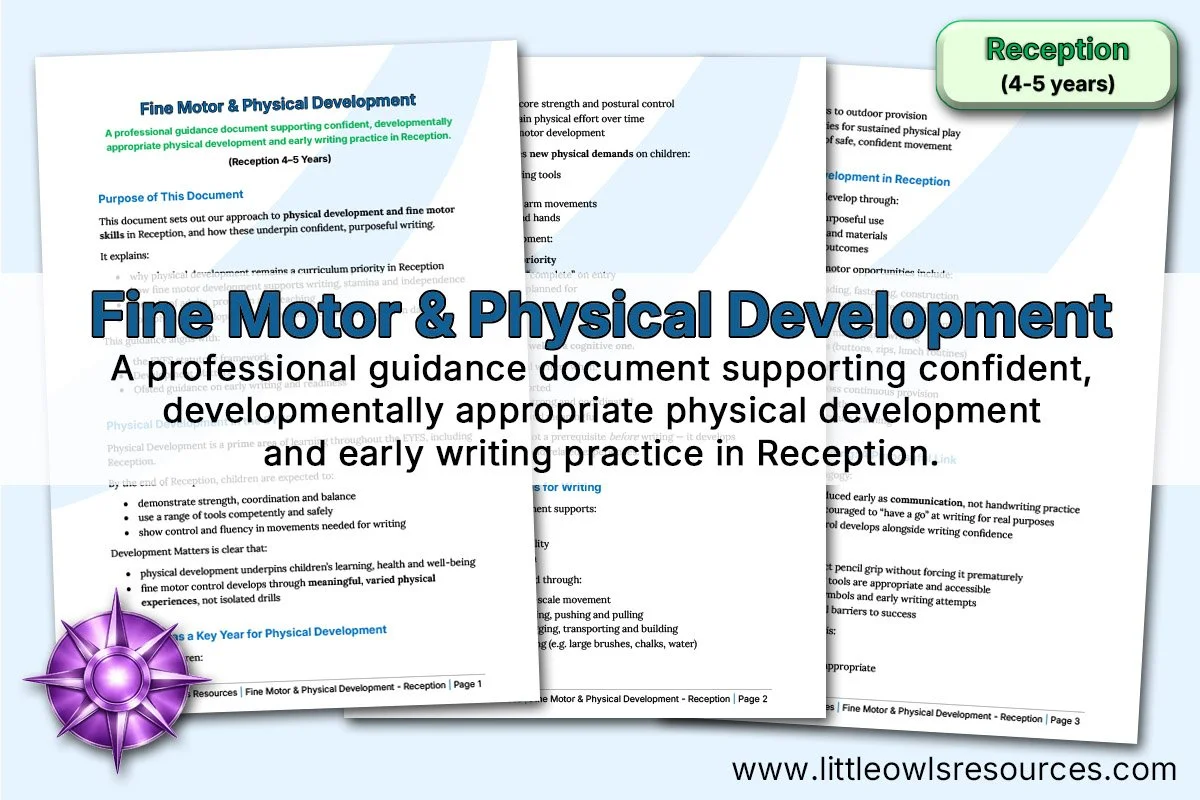
 
In Reception | 4-5 Years, -R4 Tags Reception, Reception Labelling Pack | 4-5 Years

Adult-Guided Learning in Provision | Reception (4–5 Years)

January 18, 2026 Stuart Murphy

Home › EYFS Curriculum & Pedagogy › Reception Curriculum & Pedagogy › Adult-Guided Learning in Provision | Reception (4-5 Years)

Adult-Guided Learning in Provision

Reception (4–5 Years)

A professional guidance document explaining how intentional adult interaction supports learning, application and inclusion within child-initiated play in Reception.

Download Document Here:

(This pathway component will be available for download by: March 31st 2026)

 
Download DOCX 📝
Download PDF 📄
 

Document Updated: January 2026

Recommended next read Selection

EYFS
Reception Labelling Pack | 4-5 Years

Labelling pack designed specifically for the reception environment.

Read More →
Adult-Guided Learning in Provision | Reception (4-5 Years)

A professional guidance document explaining how intentional adult interaction supports learning, application and inclusion within child-initiated play in Reception.

Read More →
Outdoor Area Continuous Provision | Reception 4–5 Years

A professional guidance document outlining the purpose, structure and pedagogy of outdoor continuous provision in Reception.

Read More →
Universal Continuous Provision Pack | Reception 4–5 Years

A comprehensive set of professional guidance documents supporting high-quality, purposeful continuous provision across all key areas of the Reception environment.

Read More →
Reception Universal Continuous Provision: Structure & Rationale

A professional guidance document outlining how continuous provision is designed, structured and used to support learning, progression and independence in Reception.

Read More →

Professional Membership Contents (Reception 4-5 Years)

Below you will find listed the component documents of our ‘Reception Curriculum & Pedagogy Suite’. They are separated into Strands 1-10. You do not need to use everything all at once.

  • 👉 This section is essential for alignment.

    • Reception Curriculum Overview & Rationale [Free Orienting Sample]

    • Reception Pedagogy Position Statement [Free Orienting Sample]

    • About Our Reception Curriculum Phase Framework

    • How To Use The Reception Pathway

    • Why Themes Are Optional in Reception

  • 👉 Curriculum clarity and sequencing.

    • Reception Curriculum Progression Maps (all areas of learning)

      • Guide to Learning Progression: How to Use the Reception Curriculum Progression Maps

      • Progression Maps for:

        • Communication and Language

        • Personal, Social and Emotional Development

        • Physical Development

        • Literacy

        • Mathematics

        • Understanding the World

        • Expressive Arts and Design

    • Reception Curriculum Phase Framework

      • How To Use The Reception Curriculum Phase Pack

      • Phase 1: Settling & Foundations

      • Phase 2: Exploration & Early Application

      • Phase 3: Independence & Depth

      • Phase 4: Consolidation & Transition

  • 👉 OAP as the organising principle.

    • Reception OAP Cycle Guidance

    • Reception Collaborative Planning & Reflective Sheet Pack

    • Self-Regulation & Learning Behaviours in Reception

    • Reception Baseline Assessment (RBA)

    • Characteristics of Effective Learning in Reception

  • 👉 Stable, purposeful provision.

    • Reception Continuous Provision – Structure & Rationale

    • Universal Continuous Provision Pack (Areas listed below)

      • Construction

      • Creative

      • Investigation / Discovery

      • Maths

      • Reading

      • Role Play / Small World

      • Malleable / Sensory

      • Writing

    • Outdoor Continuous Provision (Reception)

    • Adult-Guided Learning in Provision

    • Reception Labelling Pack | 4-5 Years

  • 👉 Light-touch, application-focused.

    • Reception Enhanced Provision Planning Toolkit

    • Reception Optional Themed Enhancements - Idea Banks

  • 👉 Systematic teaching without Year 1 drift.

    Phonics (Scheme-Compatible)

    • Phonics in Reception: Teaching, Application & Inclusion

      • Pedagogy

      • Adult-Led Sessions

      • Phonics in Provision

      • Supporting Children Not Keeping Up

      • Phonics & EYFSP

      • Scheme Compatibility Statement

    Maths

    • Reception Maths Teaching Framework

      • Term by Tem Maths Concept Emphasis Map

      • Maths Adult-Led Mini Session Banks (9 Banks)

      • Maths Across the Curriculum & Provision

      • Maths & EYFSP Guidance

    Writing

    • Reception Early Writing Purpose Pack

      • Writing Adult-Led Mini Session Bank (12 Sessions)

    • Fine Motor & Physical Development

      • Guidance Surrounding Foundations for Writing in Reception (4–5 Years)

  • 👉 Precision language for application.

    • Adult-Guided Learning in Provision

    • Theme-Based High-Impact Question & Vocabulary Banks

      • Leadership Rationale: Why Questions Differ by Age

    • Five Sentence Stems For Reception Practitioners

  • 👉 Statutory confidence with inclusive practice.

    • EYFSP Interpretation & Assessment Toolkit

      • ELG Unpacking

      • Best-Fit Exemplification

      • Moderation Guidance

    • Reception SEND & Inclusion Toolkit

      • The graduated response (Universal → Targeted → Specialist)

      • Adaptations across phonics, maths & writing

      • Visual Communication Pack

      • Language-first strategies for inclusion

      • Observation, assessment and SEND

      • Collaborative working with families and specialists

      • Referral Preparation — for EHCP pathway

      • Reception APDR Template

      • Leadership and inspection readiness

  • 👉 Leadership assurance.

    • Reception Leadership & Inspection Readiness Pack

      • Curriculum Intent & Implementation Guidance

      • Ofsted Conversation Prompts

  • 👉 Clear communication beyond the classroom.

    • Reception Parent Partnership Pack

    • Reception Transition to Year 1 Pack

Additional Whole-Setting Guidance | for Professional Members

Explore our whole-setting guidance below, including overarching curriculum and pedagogy documents, early years schemas and EYFS setting policies.

    • Little Owls Resources’ Curriculum Intent Statement

    • EYFS from Birth to 5: Curriculum Coherence & Pedagogical Throughline

    • Whole-Setting Curriculum Map (Birth-5): Curriculum Intent & Progression

    • Pedagogy Guidance Document

    • Speech & Language Development - Setting Statement

    • EYFS Inspection-Facing Summaries

  • Early Years Schemas - Practitioner Toolkit | EYFS Birth-5

    ↪ Schema Cards (definition, behaviours, age-related examples, enabling resources)

    ↪ Schema Observation & Responsive Provision Planning Template

    • EYFS Group Setting Policies Pack

      ↪ x 22 Policy Documents

      ↪ Policy Sign-Off and Confirmation Document

      ↪ EYFS Setting Policy Folder Contents List

    • Childminder Setting Policies Pack

      ↪ x 22 Policy Documents

      ↪ Childminder Assistant or Volunteer Policy Sign-Off and Confirmation Document

      ↪ Childminder Policy Folder Contents List

  • EYFS Glossary

    ↪ Clear, practitioner-friendly explanations of key curriculum and pedagogy terms used throughout our guidance.

Looking for a different age group pathway?

Select the pathway that best reflects your role or the age group you work with. You do not need to use everything. (Some practitioners may use more than one pathway.)

Featured
🍼 Babies (0–18 months)

Responsive care, observation and development in the earliest years

🚼 Toddlers (18–36 months)

Development, play and progression in the toddler years

🎨 Preschool (3–4 years)

Curriculum, continuous provision and purposeful teaching

🎓 Reception (4–5 years)

Play-based pedagogy, progression and EYFSP readiness

🏡 Childminders (Birth–5)

Mixed-age pedagogy, planning without overload and inspection confidence

Latest EYFS Articles & Practical Guides | From Our Blog

Stay informed, get expert advice, and find inspiration from our collection of articles and useful external resources, tailored specifically for EYFS practitioners. We regularly publish in-depth articles to support you with current best practices, regulatory changes, and fresh ideas.

EYFS & KS1 Articles
Major UK Curriculum Shake-Up Announced: What EYFS & KS1 Practitioners Need to Know

A major overhaul of the national curriculum in England has been announced following the publication of the independent Curriculum and Assessment Review. For those working in the Early Years Foundation Stage (EYFS) and Key Stage 1 (KS1), the changes signal a renewed focus on practical life skills, digital literacy, and enriching learning experiences…

Read More →
New Education Inspection Framework | What EYFS Settings Need to Know

The world of early years education is constantly evolving, and with it, the frameworks that guide and assess our invaluable work. Come November 2025, a significant shift will occur as the new Education Inspection Framework (EIF) comes into effect, bringing with it some crucial changes…

Read More →
Revised 2025 EYFS Statutory Framework for Group & School-Based Providers | What You Need to Know

With the new 2025 EYFS Statutory Framework for group and school-based providers coming into effect on 1st September 2025, it's essential to understand the updates to ensure your practice remains compliant, effective…

Read More →
DfE Press Release | Parents urged to read more to boost children’s life chances

The Education Secretary is calling on parents to lead by example and make reading a daily habit to help reverse the decline in reading for pleasure, to help give kids the best start in life as part of the…

Read More →
DfE Update | Drowning Prevention Week: what children learn about water safety at school

As we head into summer, it’s especially important that children are prepared with these skills. This year, the Royal Life Saving Society UK's Drowning Prevention Week runs from 14 June to 21…

Read More →
DfE Update | Hot weather and heatwaves: guidance for schools and other education settings

There are several ways that schools can make changes to keep children safe in hot weather, especially as children are more at risk of becoming ill with heat-related issues than adults…

Read More →

Are you looking for a specific resource or document for your provision?

Use our 🔍 Search Bar located at the top of every page.

___________________________

Content within the EYFS Curriculum & Pedagogy Membership is provided as professional guidance and support. It reflects current understanding of the EYFS statutory framework, Development Matters and inspection expectations at the time of writing. Practitioners are responsible for applying professional judgement and ensuring practice aligns with current statutory requirements and their specific context. All resources, experiences and environment arrangements must be risk assessed by the setting and used in accordance with individual children’s developmental stages, needs and supervision requirements.

Safeguarding content does not replace a setting’s safeguarding and child protection policy or the statutory role of the Designated Safeguarding Lead (DSL). All concerns must be managed in line with current statutory guidance and local safeguarding procedures.

_____________________________
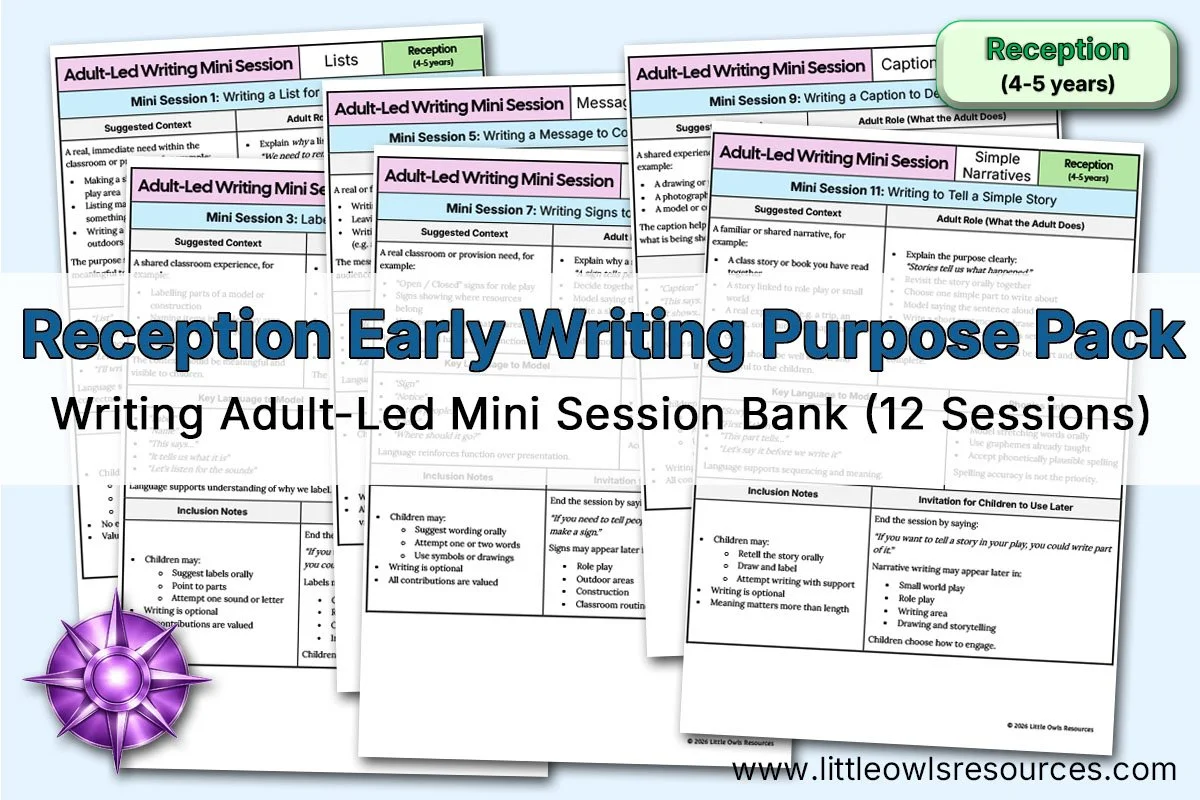
 
In Reception | 4-5 Years, -R4 Tags Reception, Adult-Guided Learning in Provision | Reception (4–5 Years)

Outdoor Area Continuous Provision | Reception 4–5 Years

January 18, 2026 Stuart Murphy

Home › EYFS Curriculum & Pedagogy › Reception Curriculum & Pedagogy › Outdoor Area Continuous Provision | Reception 4–5 Years

Reception Universal Continuous Provision: Outdoor Area

Reception (4-5 Years)

A professional guidance document outlining the purpose, structure and pedagogy of outdoor continuous provision in Reception.

Download Document Here:

  • Outdoor Continuous Provision ⋙ DOCX 📝 | PDF 📄

You may also find the following connected documents useful:

  • Reception Continuous Provision: Structure & Rationale ⋙ DOCX 📝 | PDF 📄

  • Documents for each (indoor) area

  • Construction ⋙ DOCX 📝 | PDF 📄

  • Creative ⋙ DOCX 📝 | PDF 📄

  • Investigation / Discovery ⋙ DOCX 📝 | PDF 📄

  • Maths ⋙ DOCX 📝 | PDF 📄

  • Reading ⋙ DOCX 📝 | PDF 📄

  • Role Play / Small World ⋙ DOCX 📝 | PDF 📄

  • Malleable / Sensory ⋙ DOCX 📝 | PDF 📄

  • Writing ⋙ DOCX 📝 | PDF 📄

Documents Updated: January 2026

Recommended next read Selection

EYFS
Reception Labelling Pack | 4-5 Years

Labelling pack designed specifically for the reception environment.

Read More →
Adult-Guided Learning in Provision | Reception (4-5 Years)

A professional guidance document explaining how intentional adult interaction supports learning, application and inclusion within child-initiated play in Reception.

Read More →
Outdoor Area Continuous Provision | Reception 4–5 Years

A professional guidance document outlining the purpose, structure and pedagogy of outdoor continuous provision in Reception.

Read More →
Universal Continuous Provision Pack | Reception 4–5 Years

A comprehensive set of professional guidance documents supporting high-quality, purposeful continuous provision across all key areas of the Reception environment.

Read More →
Reception Universal Continuous Provision: Structure & Rationale

A professional guidance document outlining how continuous provision is designed, structured and used to support learning, progression and independence in Reception.

Read More →

Professional Membership Contents (Reception 4-5 Years)

Below you will find listed the component documents of our ‘Reception Curriculum & Pedagogy Suite’. They are separated into Strands 1-10. You do not need to use everything all at once.

  • 👉 This section is essential for alignment.

    • Reception Curriculum Overview & Rationale [Free Orienting Sample]

    • Reception Pedagogy Position Statement [Free Orienting Sample]

    • About Our Reception Curriculum Phase Framework

    • How To Use The Reception Pathway

    • Why Themes Are Optional in Reception

  • 👉 Curriculum clarity and sequencing.

    • Reception Curriculum Progression Maps (all areas of learning)

      • Guide to Learning Progression: How to Use the Reception Curriculum Progression Maps

      • Progression Maps for:

        • Communication and Language

        • Personal, Social and Emotional Development

        • Physical Development

        • Literacy

        • Mathematics

        • Understanding the World

        • Expressive Arts and Design

    • Reception Curriculum Phase Framework

      • How To Use The Reception Curriculum Phase Pack

      • Phase 1: Settling & Foundations

      • Phase 2: Exploration & Early Application

      • Phase 3: Independence & Depth

      • Phase 4: Consolidation & Transition

  • 👉 OAP as the organising principle.

    • Reception OAP Cycle Guidance

    • Reception Collaborative Planning & Reflective Sheet Pack

    • Self-Regulation & Learning Behaviours in Reception

    • Reception Baseline Assessment (RBA)

    • Characteristics of Effective Learning in Reception

  • 👉 Stable, purposeful provision.

    • Reception Continuous Provision – Structure & Rationale

    • Universal Continuous Provision Pack (Areas listed below)

      • Construction

      • Creative

      • Investigation / Discovery

      • Maths

      • Reading

      • Role Play / Small World

      • Malleable / Sensory

      • Writing

    • Outdoor Continuous Provision (Reception)

    • Adult-Guided Learning in Provision

    • Reception Labelling Pack | 4-5 Years

  • 👉 Light-touch, application-focused.

    • Reception Enhanced Provision Planning Toolkit

    • Reception Optional Themed Enhancements - Idea Banks

  • 👉 Systematic teaching without Year 1 drift.

    Phonics (Scheme-Compatible)

    • Phonics in Reception: Teaching, Application & Inclusion

      • Pedagogy

      • Adult-Led Sessions

      • Phonics in Provision

      • Supporting Children Not Keeping Up

      • Phonics & EYFSP

      • Scheme Compatibility Statement

    Maths

    • Reception Maths Teaching Framework

      • Term by Tem Maths Concept Emphasis Map

      • Maths Adult-Led Mini Session Banks (9 Banks)

      • Maths Across the Curriculum & Provision

      • Maths & EYFSP Guidance

    Writing

    • Reception Early Writing Purpose Pack

      • Writing Adult-Led Mini Session Bank (12 Sessions)

    • Fine Motor & Physical Development

      • Guidance Surrounding Foundations for Writing in Reception (4–5 Years)

  • 👉 Precision language for application.

    • Adult-Guided Learning in Provision

    • Theme-Based High-Impact Question & Vocabulary Banks

      • Leadership Rationale: Why Questions Differ by Age

    • Five Sentence Stems For Reception Practitioners

  • 👉 Statutory confidence with inclusive practice.

    • EYFSP Interpretation & Assessment Toolkit

      • ELG Unpacking

      • Best-Fit Exemplification

      • Moderation Guidance

    • Reception SEND & Inclusion Toolkit

      • The graduated response (Universal → Targeted → Specialist)

      • Adaptations across phonics, maths & writing

      • Visual Communication Pack

      • Language-first strategies for inclusion

      • Observation, assessment and SEND

      • Collaborative working with families and specialists

      • Referral Preparation — for EHCP pathway

      • Reception APDR Template

      • Leadership and inspection readiness

  • 👉 Leadership assurance.

    • Reception Leadership & Inspection Readiness Pack

      • Curriculum Intent & Implementation Guidance

      • Ofsted Conversation Prompts

  • 👉 Clear communication beyond the classroom.

    • Reception Parent Partnership Pack

    • Reception Transition to Year 1 Pack

Additional Whole-Setting Guidance | for Professional Members

Explore our whole-setting guidance below, including overarching curriculum and pedagogy documents, early years schemas and EYFS setting policies.

    • Little Owls Resources’ Curriculum Intent Statement

    • EYFS from Birth to 5: Curriculum Coherence & Pedagogical Throughline

    • Whole-Setting Curriculum Map (Birth-5): Curriculum Intent & Progression

    • Pedagogy Guidance Document

    • Speech & Language Development - Setting Statement

    • EYFS Inspection-Facing Summaries

  • Early Years Schemas - Practitioner Toolkit | EYFS Birth-5

    ↪ Schema Cards (definition, behaviours, age-related examples, enabling resources)

    ↪ Schema Observation & Responsive Provision Planning Template

    • EYFS Group Setting Policies Pack

      ↪ x 22 Policy Documents

      ↪ Policy Sign-Off and Confirmation Document

      ↪ EYFS Setting Policy Folder Contents List

    • Childminder Setting Policies Pack

      ↪ x 22 Policy Documents

      ↪ Childminder Assistant or Volunteer Policy Sign-Off and Confirmation Document

      ↪ Childminder Policy Folder Contents List

  • EYFS Glossary

    ↪ Clear, practitioner-friendly explanations of key curriculum and pedagogy terms used throughout our guidance.

Looking for a different age group pathway?

Select the pathway that best reflects your role or the age group you work with. You do not need to use everything. (Some practitioners may use more than one pathway.)

Featured
🍼 Babies (0–18 months)

Responsive care, observation and development in the earliest years

🚼 Toddlers (18–36 months)

Development, play and progression in the toddler years

🎨 Preschool (3–4 years)

Curriculum, continuous provision and purposeful teaching

🎓 Reception (4–5 years)

Play-based pedagogy, progression and EYFSP readiness

🏡 Childminders (Birth–5)

Mixed-age pedagogy, planning without overload and inspection confidence

Latest EYFS Articles & Practical Guides | From Our Blog

Stay informed, get expert advice, and find inspiration from our collection of articles and useful external resources, tailored specifically for EYFS practitioners. We regularly publish in-depth articles to support you with current best practices, regulatory changes, and fresh ideas.

EYFS & KS1 Articles
Major UK Curriculum Shake-Up Announced: What EYFS & KS1 Practitioners Need to Know

A major overhaul of the national curriculum in England has been announced following the publication of the independent Curriculum and Assessment Review. For those working in the Early Years Foundation Stage (EYFS) and Key Stage 1 (KS1), the changes signal a renewed focus on practical life skills, digital literacy, and enriching learning experiences…

Read More →
New Education Inspection Framework | What EYFS Settings Need to Know

The world of early years education is constantly evolving, and with it, the frameworks that guide and assess our invaluable work. Come November 2025, a significant shift will occur as the new Education Inspection Framework (EIF) comes into effect, bringing with it some crucial changes…

Read More →
Revised 2025 EYFS Statutory Framework for Group & School-Based Providers | What You Need to Know

With the new 2025 EYFS Statutory Framework for group and school-based providers coming into effect on 1st September 2025, it's essential to understand the updates to ensure your practice remains compliant, effective…

Read More →
DfE Press Release | Parents urged to read more to boost children’s life chances

The Education Secretary is calling on parents to lead by example and make reading a daily habit to help reverse the decline in reading for pleasure, to help give kids the best start in life as part of the…

Read More →
DfE Update | Drowning Prevention Week: what children learn about water safety at school

As we head into summer, it’s especially important that children are prepared with these skills. This year, the Royal Life Saving Society UK's Drowning Prevention Week runs from 14 June to 21…

Read More →
DfE Update | Hot weather and heatwaves: guidance for schools and other education settings

There are several ways that schools can make changes to keep children safe in hot weather, especially as children are more at risk of becoming ill with heat-related issues than adults…

Read More →

Are you looking for a specific resource or document for your provision?

Use our 🔍 Search Bar located at the top of every page.

___________________________

Content within the EYFS Curriculum & Pedagogy Membership is provided as professional guidance and support. It reflects current understanding of the EYFS statutory framework, Development Matters and inspection expectations at the time of writing. Practitioners are responsible for applying professional judgement and ensuring practice aligns with current statutory requirements and their specific context. All resources, experiences and environment arrangements must be risk assessed by the setting and used in accordance with individual children’s developmental stages, needs and supervision requirements.

Safeguarding content does not replace a setting’s safeguarding and child protection policy or the statutory role of the Designated Safeguarding Lead (DSL). All concerns must be managed in line with current statutory guidance and local safeguarding procedures.

_____________________________
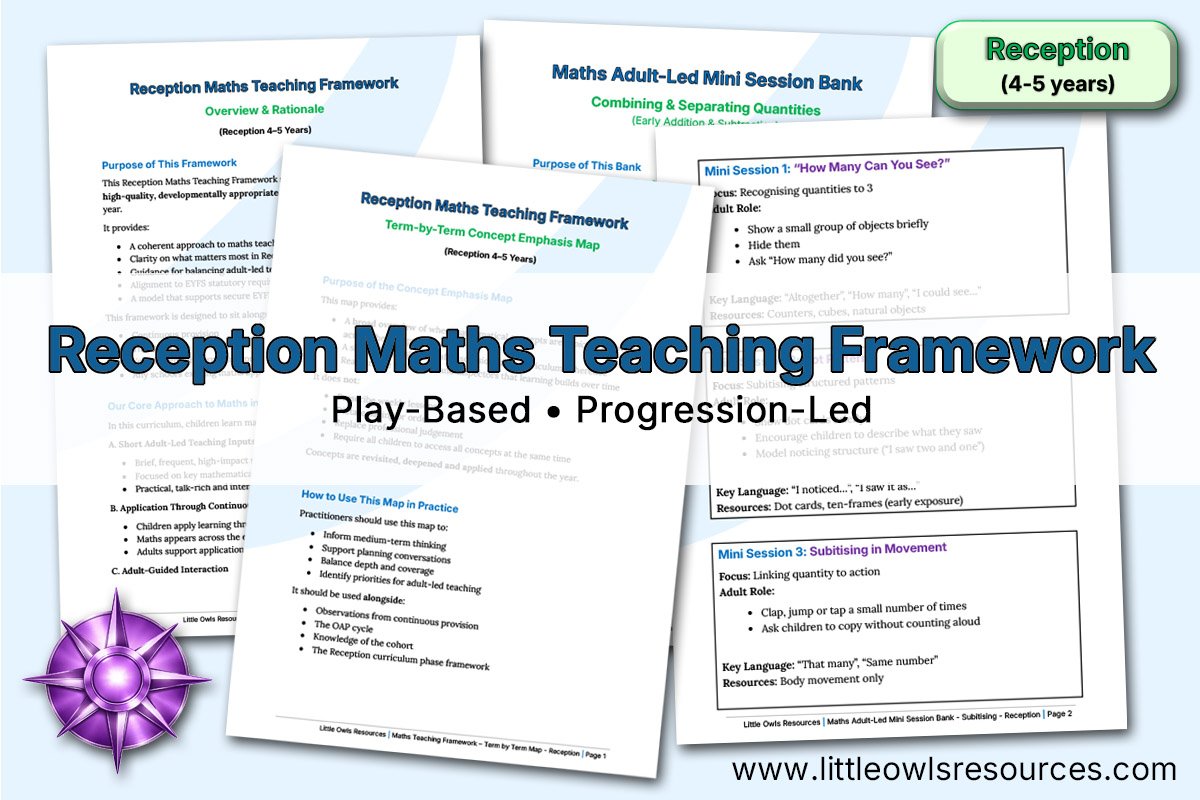
 
In Reception | 4-5 Years, -R4 Tags Reception, Outdoor Area Continuous Provision | Reception 4–5 Years

Universal Continuous Provision Pack | Reception 4–5 Years

January 18, 2026 Stuart Murphy

Home › EYFS Curriculum & Pedagogy › Reception Curriculum & Pedagogy › Universal Continuous Provision Pack | Reception 4–5 Years

Universal Continuous Provision Pack

Reception (4-5 Years)

A comprehensive set of professional guidance documents supporting high-quality, purposeful continuous provision across all key areas of the Reception environment.

Download Documents Here:

Documents for each area

  • Construction ⋙ DOCX 📝 | PDF 📄

  • Creative ⋙ DOCX 📝 | PDF 📄

  • Investigation / Discovery ⋙ DOCX 📝 | PDF 📄

  • Maths ⋙ DOCX 📝 | PDF 📄

  • Reading ⋙ DOCX 📝 | PDF 📄

  • Role Play / Small World ⋙ DOCX 📝 | PDF 📄

  • Malleable / Sensory ⋙ DOCX 📝 | PDF 📄

  • Writing ⋙ DOCX 📝 | PDF 📄

You may also find the following connected documents useful:

  • Reception Continuous Provision: Structure & Rationale ⋙ DOCX 📝 | PDF 📄

  • Outdoor Continuous Provision ⋙ DOCX 📝 | PDF 📄

Documents Updated: January 2026

Recommended next read Selection

EYFS
Reception Labelling Pack | 4-5 Years

Labelling pack designed specifically for the reception environment.

Read More →
Adult-Guided Learning in Provision | Reception (4-5 Years)

A professional guidance document explaining how intentional adult interaction supports learning, application and inclusion within child-initiated play in Reception.

Read More →
Outdoor Area Continuous Provision | Reception 4–5 Years

A professional guidance document outlining the purpose, structure and pedagogy of outdoor continuous provision in Reception.

Read More →
Universal Continuous Provision Pack | Reception 4–5 Years

A comprehensive set of professional guidance documents supporting high-quality, purposeful continuous provision across all key areas of the Reception environment.

Read More →
Reception Universal Continuous Provision: Structure & Rationale

A professional guidance document outlining how continuous provision is designed, structured and used to support learning, progression and independence in Reception.

Read More →

Professional Membership Contents (Reception 4-5 Years)

Below you will find listed the component documents of our ‘Reception Curriculum & Pedagogy Suite’. They are separated into Strands 1-10. You do not need to use everything all at once.

  • 👉 This section is essential for alignment.

    • Reception Curriculum Overview & Rationale [Free Orienting Sample]

    • Reception Pedagogy Position Statement [Free Orienting Sample]

    • About Our Reception Curriculum Phase Framework

    • How To Use The Reception Pathway

    • Why Themes Are Optional in Reception

  • 👉 Curriculum clarity and sequencing.

    • Reception Curriculum Progression Maps (all areas of learning)

      • Guide to Learning Progression: How to Use the Reception Curriculum Progression Maps

      • Progression Maps for:

        • Communication and Language

        • Personal, Social and Emotional Development

        • Physical Development

        • Literacy

        • Mathematics

        • Understanding the World

        • Expressive Arts and Design

    • Reception Curriculum Phase Framework

      • How To Use The Reception Curriculum Phase Pack

      • Phase 1: Settling & Foundations

      • Phase 2: Exploration & Early Application

      • Phase 3: Independence & Depth

      • Phase 4: Consolidation & Transition

  • 👉 OAP as the organising principle.

    • Reception OAP Cycle Guidance

    • Reception Collaborative Planning & Reflective Sheet Pack

    • Self-Regulation & Learning Behaviours in Reception

    • Reception Baseline Assessment (RBA)

    • Characteristics of Effective Learning in Reception

  • 👉 Stable, purposeful provision.

    • Reception Continuous Provision – Structure & Rationale

    • Universal Continuous Provision Pack (Areas listed below)

      • Construction

      • Creative

      • Investigation / Discovery

      • Maths

      • Reading

      • Role Play / Small World

      • Malleable / Sensory

      • Writing

    • Outdoor Continuous Provision (Reception)

    • Adult-Guided Learning in Provision

    • Reception Labelling Pack | 4-5 Years

  • 👉 Light-touch, application-focused.

    • Reception Enhanced Provision Planning Toolkit

    • Reception Optional Themed Enhancements - Idea Banks

  • 👉 Systematic teaching without Year 1 drift.

    Phonics (Scheme-Compatible)

    • Phonics in Reception: Teaching, Application & Inclusion

      • Pedagogy

      • Adult-Led Sessions

      • Phonics in Provision

      • Supporting Children Not Keeping Up

      • Phonics & EYFSP

      • Scheme Compatibility Statement

    Maths

    • Reception Maths Teaching Framework

      • Term by Tem Maths Concept Emphasis Map

      • Maths Adult-Led Mini Session Banks (9 Banks)

      • Maths Across the Curriculum & Provision

      • Maths & EYFSP Guidance

    Writing

    • Reception Early Writing Purpose Pack

      • Writing Adult-Led Mini Session Bank (12 Sessions)

    • Fine Motor & Physical Development

      • Guidance Surrounding Foundations for Writing in Reception (4–5 Years)

  • 👉 Precision language for application.

    • Adult-Guided Learning in Provision

    • Theme-Based High-Impact Question & Vocabulary Banks

      • Leadership Rationale: Why Questions Differ by Age

    • Five Sentence Stems For Reception Practitioners

  • 👉 Statutory confidence with inclusive practice.

    • EYFSP Interpretation & Assessment Toolkit

      • ELG Unpacking

      • Best-Fit Exemplification

      • Moderation Guidance

    • Reception SEND & Inclusion Toolkit

      • The graduated response (Universal → Targeted → Specialist)

      • Adaptations across phonics, maths & writing

      • Visual Communication Pack

      • Language-first strategies for inclusion

      • Observation, assessment and SEND

      • Collaborative working with families and specialists

      • Referral Preparation — for EHCP pathway

      • Reception APDR Template

      • Leadership and inspection readiness

  • 👉 Leadership assurance.

    • Reception Leadership & Inspection Readiness Pack

      • Curriculum Intent & Implementation Guidance

      • Ofsted Conversation Prompts

  • 👉 Clear communication beyond the classroom.

    • Reception Parent Partnership Pack

    • Reception Transition to Year 1 Pack

Additional Whole-Setting Guidance | for Professional Members

Explore our whole-setting guidance below, including overarching curriculum and pedagogy documents, early years schemas and EYFS setting policies.

    • Little Owls Resources’ Curriculum Intent Statement

    • EYFS from Birth to 5: Curriculum Coherence & Pedagogical Throughline

    • Whole-Setting Curriculum Map (Birth-5): Curriculum Intent & Progression

    • Pedagogy Guidance Document

    • Speech & Language Development - Setting Statement

    • EYFS Inspection-Facing Summaries

  • Early Years Schemas - Practitioner Toolkit | EYFS Birth-5

    ↪ Schema Cards (definition, behaviours, age-related examples, enabling resources)

    ↪ Schema Observation & Responsive Provision Planning Template

    • EYFS Group Setting Policies Pack

      ↪ x 22 Policy Documents

      ↪ Policy Sign-Off and Confirmation Document

      ↪ EYFS Setting Policy Folder Contents List

    • Childminder Setting Policies Pack

      ↪ x 22 Policy Documents

      ↪ Childminder Assistant or Volunteer Policy Sign-Off and Confirmation Document

      ↪ Childminder Policy Folder Contents List

  • EYFS Glossary

    ↪ Clear, practitioner-friendly explanations of key curriculum and pedagogy terms used throughout our guidance.

Looking for a different age group pathway?

Select the pathway that best reflects your role or the age group you work with. You do not need to use everything. (Some practitioners may use more than one pathway.)

Featured
🍼 Babies (0–18 months)

Responsive care, observation and development in the earliest years

🚼 Toddlers (18–36 months)

Development, play and progression in the toddler years

🎨 Preschool (3–4 years)

Curriculum, continuous provision and purposeful teaching

🎓 Reception (4–5 years)

Play-based pedagogy, progression and EYFSP readiness

🏡 Childminders (Birth–5)

Mixed-age pedagogy, planning without overload and inspection confidence

Latest EYFS Articles & Practical Guides | From Our Blog

Stay informed, get expert advice, and find inspiration from our collection of articles and useful external resources, tailored specifically for EYFS practitioners. We regularly publish in-depth articles to support you with current best practices, regulatory changes, and fresh ideas.

EYFS & KS1 Articles
Major UK Curriculum Shake-Up Announced: What EYFS & KS1 Practitioners Need to Know

A major overhaul of the national curriculum in England has been announced following the publication of the independent Curriculum and Assessment Review. For those working in the Early Years Foundation Stage (EYFS) and Key Stage 1 (KS1), the changes signal a renewed focus on practical life skills, digital literacy, and enriching learning experiences…

Read More →
New Education Inspection Framework | What EYFS Settings Need to Know

The world of early years education is constantly evolving, and with it, the frameworks that guide and assess our invaluable work. Come November 2025, a significant shift will occur as the new Education Inspection Framework (EIF) comes into effect, bringing with it some crucial changes…

Read More →
Revised 2025 EYFS Statutory Framework for Group & School-Based Providers | What You Need to Know

With the new 2025 EYFS Statutory Framework for group and school-based providers coming into effect on 1st September 2025, it's essential to understand the updates to ensure your practice remains compliant, effective…

Read More →
DfE Press Release | Parents urged to read more to boost children’s life chances

The Education Secretary is calling on parents to lead by example and make reading a daily habit to help reverse the decline in reading for pleasure, to help give kids the best start in life as part of the…

Read More →
DfE Update | Drowning Prevention Week: what children learn about water safety at school

As we head into summer, it’s especially important that children are prepared with these skills. This year, the Royal Life Saving Society UK's Drowning Prevention Week runs from 14 June to 21…

Read More →
DfE Update | Hot weather and heatwaves: guidance for schools and other education settings

There are several ways that schools can make changes to keep children safe in hot weather, especially as children are more at risk of becoming ill with heat-related issues than adults…

Read More →

Are you looking for a specific resource or document for your provision?

Use our 🔍 Search Bar located at the top of every page.

___________________________

Content within the EYFS Curriculum & Pedagogy Membership is provided as professional guidance and support. It reflects current understanding of the EYFS statutory framework, Development Matters and inspection expectations at the time of writing. Practitioners are responsible for applying professional judgement and ensuring practice aligns with current statutory requirements and their specific context. All resources, experiences and environment arrangements must be risk assessed by the setting and used in accordance with individual children’s developmental stages, needs and supervision requirements.

Safeguarding content does not replace a setting’s safeguarding and child protection policy or the statutory role of the Designated Safeguarding Lead (DSL). All concerns must be managed in line with current statutory guidance and local safeguarding procedures.

_____________________________
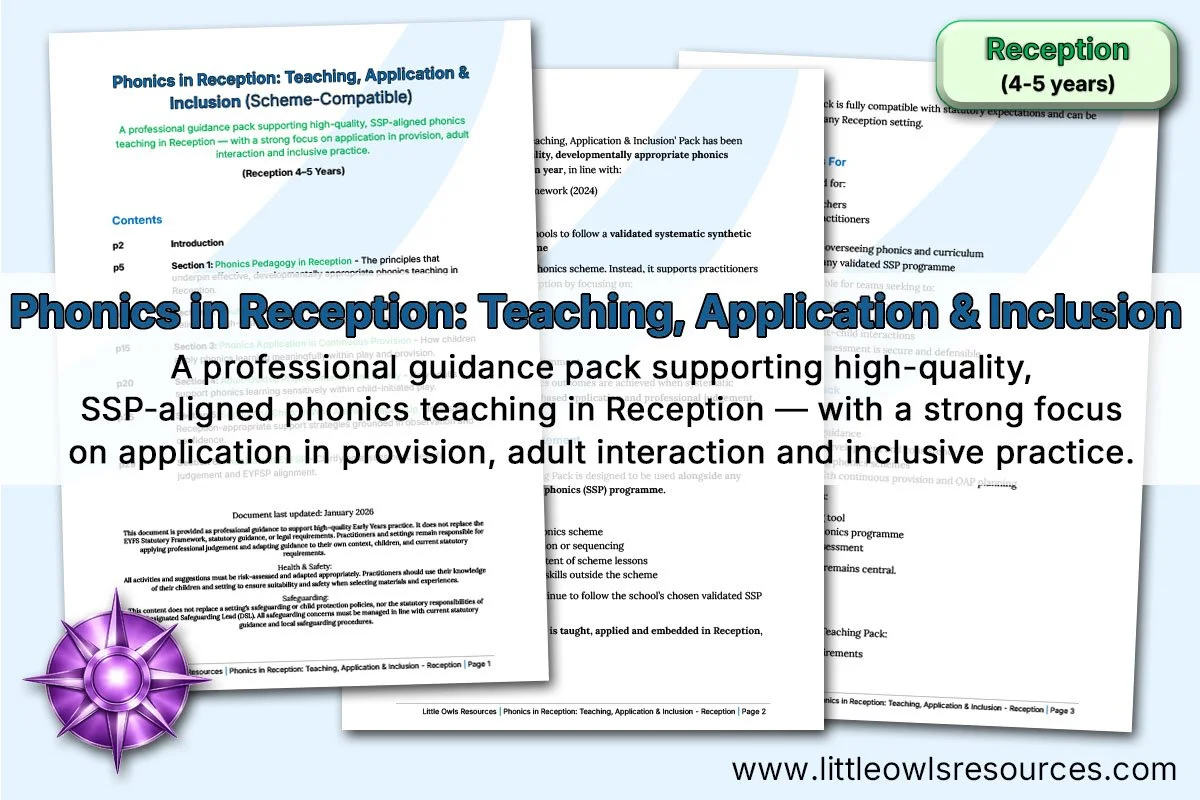
 
In Reception | 4-5 Years, -R4 Tags Reception, Universal Continuous Provision Pack | Reception 4–5 Years

Reception Universal Continuous Provision: Structure & Rationale

January 18, 2026 Stuart Murphy

Home › EYFS Curriculum & Pedagogy › Reception Curriculum & Pedagogy › Reception Universal Continuous Provision: Structure & Rationale

Reception Universal Continuous Provision: Structure & Rationale

Reception (4-5 Years)

A professional guidance document outlining how continuous provision is designed, structured and used to support learning, progression and independence in Reception.

Download Document Here:

 
Download DOCX 📝
Download PDF 📄
 

Document Updated: January 2026

Recommended next read Selection

EYFS
Reception Labelling Pack | 4-5 Years

Labelling pack designed specifically for the reception environment.

Read More →
Adult-Guided Learning in Provision | Reception (4-5 Years)

A professional guidance document explaining how intentional adult interaction supports learning, application and inclusion within child-initiated play in Reception.

Read More →
Outdoor Area Continuous Provision | Reception 4–5 Years

A professional guidance document outlining the purpose, structure and pedagogy of outdoor continuous provision in Reception.

Read More →
Universal Continuous Provision Pack | Reception 4–5 Years

A comprehensive set of professional guidance documents supporting high-quality, purposeful continuous provision across all key areas of the Reception environment.

Read More →
Reception Universal Continuous Provision: Structure & Rationale

A professional guidance document outlining how continuous provision is designed, structured and used to support learning, progression and independence in Reception.

Read More →

Professional Membership Contents (Reception 4-5 Years)

Below you will find listed the component documents of our ‘Reception Curriculum & Pedagogy Suite’. They are separated into Strands 1-10. You do not need to use everything all at once.

  • 👉 This section is essential for alignment.

    • Reception Curriculum Overview & Rationale [Free Orienting Sample]

    • Reception Pedagogy Position Statement [Free Orienting Sample]

    • About Our Reception Curriculum Phase Framework

    • How To Use The Reception Pathway

    • Why Themes Are Optional in Reception

  • 👉 Curriculum clarity and sequencing.

    • Reception Curriculum Progression Maps (all areas of learning)

      • Guide to Learning Progression: How to Use the Reception Curriculum Progression Maps

      • Progression Maps for:

        • Communication and Language

        • Personal, Social and Emotional Development

        • Physical Development

        • Literacy

        • Mathematics

        • Understanding the World

        • Expressive Arts and Design

    • Reception Curriculum Phase Framework

      • How To Use The Reception Curriculum Phase Pack

      • Phase 1: Settling & Foundations

      • Phase 2: Exploration & Early Application

      • Phase 3: Independence & Depth

      • Phase 4: Consolidation & Transition

  • 👉 OAP as the organising principle.

    • Reception OAP Cycle Guidance

    • Reception Collaborative Planning & Reflective Sheet Pack

    • Self-Regulation & Learning Behaviours in Reception

    • Reception Baseline Assessment (RBA)

    • Characteristics of Effective Learning in Reception

  • 👉 Stable, purposeful provision.

    • Reception Continuous Provision – Structure & Rationale

    • Universal Continuous Provision Pack (Areas listed below)

      • Construction

      • Creative

      • Investigation / Discovery

      • Maths

      • Reading

      • Role Play / Small World

      • Malleable / Sensory

      • Writing

    • Outdoor Continuous Provision (Reception)

    • Adult-Guided Learning in Provision

    • Reception Labelling Pack | 4-5 Years

  • 👉 Light-touch, application-focused.

    • Reception Enhanced Provision Planning Toolkit

    • Reception Optional Themed Enhancements - Idea Banks

  • 👉 Systematic teaching without Year 1 drift.

    Phonics (Scheme-Compatible)

    • Phonics in Reception: Teaching, Application & Inclusion

      • Pedagogy

      • Adult-Led Sessions

      • Phonics in Provision

      • Supporting Children Not Keeping Up

      • Phonics & EYFSP

      • Scheme Compatibility Statement

    Maths

    • Reception Maths Teaching Framework

      • Term by Tem Maths Concept Emphasis Map

      • Maths Adult-Led Mini Session Banks (9 Banks)

      • Maths Across the Curriculum & Provision

      • Maths & EYFSP Guidance

    Writing

    • Reception Early Writing Purpose Pack

      • Writing Adult-Led Mini Session Bank (12 Sessions)

    • Fine Motor & Physical Development

      • Guidance Surrounding Foundations for Writing in Reception (4–5 Years)

  • 👉 Precision language for application.

    • Adult-Guided Learning in Provision

    • Theme-Based High-Impact Question & Vocabulary Banks

      • Leadership Rationale: Why Questions Differ by Age

    • Five Sentence Stems For Reception Practitioners

  • 👉 Statutory confidence with inclusive practice.

    • EYFSP Interpretation & Assessment Toolkit

      • ELG Unpacking

      • Best-Fit Exemplification

      • Moderation Guidance

    • Reception SEND & Inclusion Toolkit

      • The graduated response (Universal → Targeted → Specialist)

      • Adaptations across phonics, maths & writing

      • Visual Communication Pack

      • Language-first strategies for inclusion

      • Observation, assessment and SEND

      • Collaborative working with families and specialists

      • Referral Preparation — for EHCP pathway

      • Reception APDR Template

      • Leadership and inspection readiness

  • 👉 Leadership assurance.

    • Reception Leadership & Inspection Readiness Pack

      • Curriculum Intent & Implementation Guidance

      • Ofsted Conversation Prompts

  • 👉 Clear communication beyond the classroom.

    • Reception Parent Partnership Pack

    • Reception Transition to Year 1 Pack

Additional Whole-Setting Guidance | for Professional Members

Explore our whole-setting guidance below, including overarching curriculum and pedagogy documents, early years schemas and EYFS setting policies.

    • Little Owls Resources’ Curriculum Intent Statement

    • EYFS from Birth to 5: Curriculum Coherence & Pedagogical Throughline

    • Whole-Setting Curriculum Map (Birth-5): Curriculum Intent & Progression

    • Pedagogy Guidance Document

    • Speech & Language Development - Setting Statement

    • EYFS Inspection-Facing Summaries

  • Early Years Schemas - Practitioner Toolkit | EYFS Birth-5

    ↪ Schema Cards (definition, behaviours, age-related examples, enabling resources)

    ↪ Schema Observation & Responsive Provision Planning Template

    • EYFS Group Setting Policies Pack

      ↪ x 22 Policy Documents

      ↪ Policy Sign-Off and Confirmation Document

      ↪ EYFS Setting Policy Folder Contents List

    • Childminder Setting Policies Pack

      ↪ x 22 Policy Documents

      ↪ Childminder Assistant or Volunteer Policy Sign-Off and Confirmation Document

      ↪ Childminder Policy Folder Contents List

  • EYFS Glossary

    ↪ Clear, practitioner-friendly explanations of key curriculum and pedagogy terms used throughout our guidance.

Looking for a different age group pathway?

Select the pathway that best reflects your role or the age group you work with. You do not need to use everything. (Some practitioners may use more than one pathway.)

Featured
🍼 Babies (0–18 months)

Responsive care, observation and development in the earliest years

🚼 Toddlers (18–36 months)

Development, play and progression in the toddler years

🎨 Preschool (3–4 years)

Curriculum, continuous provision and purposeful teaching

🎓 Reception (4–5 years)

Play-based pedagogy, progression and EYFSP readiness

🏡 Childminders (Birth–5)

Mixed-age pedagogy, planning without overload and inspection confidence

Latest EYFS Articles & Practical Guides | From Our Blog

Stay informed, get expert advice, and find inspiration from our collection of articles and useful external resources, tailored specifically for EYFS practitioners. We regularly publish in-depth articles to support you with current best practices, regulatory changes, and fresh ideas.

EYFS & KS1 Articles
Major UK Curriculum Shake-Up Announced: What EYFS & KS1 Practitioners Need to Know

A major overhaul of the national curriculum in England has been announced following the publication of the independent Curriculum and Assessment Review. For those working in the Early Years Foundation Stage (EYFS) and Key Stage 1 (KS1), the changes signal a renewed focus on practical life skills, digital literacy, and enriching learning experiences…

Read More →
New Education Inspection Framework | What EYFS Settings Need to Know

The world of early years education is constantly evolving, and with it, the frameworks that guide and assess our invaluable work. Come November 2025, a significant shift will occur as the new Education Inspection Framework (EIF) comes into effect, bringing with it some crucial changes…

Read More →
Revised 2025 EYFS Statutory Framework for Group & School-Based Providers | What You Need to Know

With the new 2025 EYFS Statutory Framework for group and school-based providers coming into effect on 1st September 2025, it's essential to understand the updates to ensure your practice remains compliant, effective…

Read More →
DfE Press Release | Parents urged to read more to boost children’s life chances

The Education Secretary is calling on parents to lead by example and make reading a daily habit to help reverse the decline in reading for pleasure, to help give kids the best start in life as part of the…

Read More →
DfE Update | Drowning Prevention Week: what children learn about water safety at school

As we head into summer, it’s especially important that children are prepared with these skills. This year, the Royal Life Saving Society UK's Drowning Prevention Week runs from 14 June to 21…

Read More →
DfE Update | Hot weather and heatwaves: guidance for schools and other education settings

There are several ways that schools can make changes to keep children safe in hot weather, especially as children are more at risk of becoming ill with heat-related issues than adults…

Read More →

Are you looking for a specific resource or document for your provision?

Use our 🔍 Search Bar located at the top of every page.

___________________________

Content within the EYFS Curriculum & Pedagogy Membership is provided as professional guidance and support. It reflects current understanding of the EYFS statutory framework, Development Matters and inspection expectations at the time of writing. Practitioners are responsible for applying professional judgement and ensuring practice aligns with current statutory requirements and their specific context. All resources, experiences and environment arrangements must be risk assessed by the setting and used in accordance with individual children’s developmental stages, needs and supervision requirements.

Safeguarding content does not replace a setting’s safeguarding and child protection policy or the statutory role of the Designated Safeguarding Lead (DSL). All concerns must be managed in line with current statutory guidance and local safeguarding procedures.

_____________________________
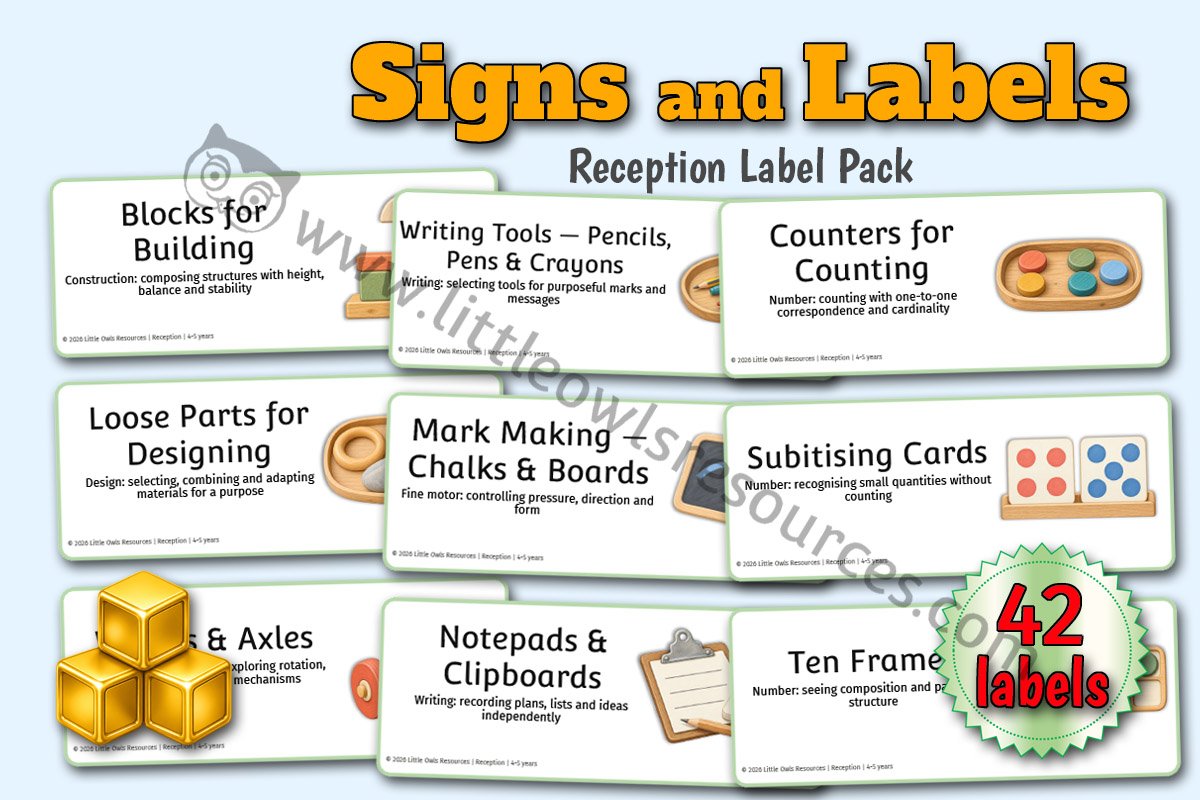
 
In Reception | 4-5 Years, -R4 Tags Reception, Reception Universal Continuous Provision: Structure & Rationale

Characteristics of Effective Learning in Reception | 4-5 Years

January 18, 2026 Stuart Murphy

Home › EYFS Curriculum & Pedagogy › Reception Curriculum & Pedagogy › Characteristics of Effective Learning in Reception | 4-5 Years

Scroll down to read this document or download files here: DOCX 📝 | PDF 📄

(This pathway component is currently available to read on the page below and will be available for download by: March 31st 2026)

Characteristics of Effective Learning in Reception

Reception (4-5 Years)

A practical professional guide to recognising, planning for and assessing how Reception children learn through play, teaching and application.

Purpose of This Document

This document explains how we interpret and implement the Characteristics of Effective Learning (CoEL) in Reception.

It supports practitioners to:

  • recognise CoEL in both adult-led teaching and continuous provision

  • plan for CoEL deliberately (rather than hoping they “happen”)

  • use CoEL as part of a Reception approach that balances systematic teaching with playful application

  • strengthen observation and assessment without creating unnecessary workload

The EYFS requires practitioners to consider how children learn, as well as what they learn, including the three Characteristics of Effective Learning.

Why CoEL Matter in Reception

Reception is a distinct phase: children are older, more independent, and ready for greater curriculum structure. The EYFS is explicit that as children move into Reception, there should be greater focus on teaching essential knowledge and skills, while still learning through play and adult-guided learning.

CoEL matter because they help practitioners ensure that:

  • learning is deep, transferable and sustained

  • children are not simply “doing activities” but developing learning behaviours

  • teaching leads to application (in provision and across contexts)

  • observation focuses on meaningful evidence of learning, not volume of paperwork

Ofsted’s inspection guidance is explicit that teaching in early years includes planned and child-initiated play, adult interaction, modelling, routines and environment design, and that it should take account of children’s dispositions to learn (CoEL).

Our Reception View: CoEL Are Not an Add-On

In our Reception pedagogy:

  • adult-led teaching builds knowledge and skills (phonics, maths, writing, talk)

  • continuous provision provides the context to apply that learning

  • CoEL describe how well children engage with that learning, not a separate “subject”

CoEL are most visible when:

  • children use taught knowledge independently

  • adults model and guide thinking (without taking over)

  • children persevere, revisit, refine and explain their ideas

The Three Characteristics in Reception

The EYFS defines the three CoEL as:

  1. Playing and exploring – children investigate and experience things, and “have a go”

  2. Active learning – children concentrate, keep trying, and enjoy achievements

  3. Creating and thinking critically – children develop ideas, make links, and develop strategies

Below is what these look like specifically in Reception.

1) Playing and Exploring in Reception

What it looks like (Reception indicators)

Children:

  • explore resources with purpose and curiosity

  • ask questions and seek information (“How do I…?”, “What happens if…?”)

  • make choices and initiate play that links to lived experience or taught content

  • “have a go” at writing, reading, counting, building, drawing, explaining

  • move between areas with increasing independence and intention

What adults do in Reception

Adults deliberately:

  • create provision that invites exploration with clear learning potential

  • model how to use resources (especially early in the year)

  • teach children how to access equipment and tidy/restore areas so exploration can continue

  • notice “teachable moments” and guide learning through interaction rather than worksheets

Examples (application of taught learning)

  • Phonics: child chooses to write labels/signs in role play using taught graphemes

  • Maths: child uses a number line / ten frame to solve a problem they created in play

  • Understanding the World: child investigates magnets/water/soil and records findings in drawings or marks

  • Communication & Language: child retells a story using props and adapts it creatively

Observation prompts (for assessment without workload)

Look for evidence of:

  • curiosity and risk-taking

  • purposeful choice-making

  • willingness to attempt challenging tasks (especially writing/reading/maths)

  • independence in accessing resources

2) Active Learning in Reception

What it looks like (Reception indicators)

Children:

  • sustain attention for longer periods (with support where needed)

  • practise and revisit learning through play (not just once)

  • show pride in improving work (better model, clearer writing, more accurate counting)

  • respond to feedback and try again

  • persevere even when learning is effortful (e.g., blending, forming letters, solving problems)

What adults do in Reception

Adults deliberately:

  • teach in small steps and build in repetition

  • keep core teaching routines predictable (helping children concentrate and remember)

  • praise effort, strategies and improvement, not just completion

  • help children recognise progress (“Yesterday you needed help… today you did it yourself”)

  • ensure provision includes opportunities to practise taught content frequently

Ofsted’s inspection guidance emphasises high-quality teaching and interaction that helps children practise key knowledge and transfer it into long-term memory.

Examples (application over time)

  • child returns to the writing area across the week to improve a message/sign

  • child repeats a maths game, becomes faster/more accurate, explains strategy

  • child sustains a collaborative build over several sessions and adapts when it collapses

Observation prompts

Look for evidence of:

  • concentration and persistence

  • return to tasks across days/weeks

  • resilience and recovery from mistakes

  • increasing independence in practising taught skills

3) Creating and Thinking Critically in Reception

What it looks like (Reception indicators)

Children:

  • plan and explain ideas (“First we need… because…”)

  • make links between new learning and prior knowledge

  • adapt strategies (“That didn’t work — I’ll try…”)

  • solve problems collaboratively and talk through reasoning

  • represent thinking through talk, drawings, models, maps, marks, captions

What adults do in Reception

Adults deliberately:

  • model thinking aloud (“I wonder…”, “Let’s test…”, “What else could we try?”)

  • ask questions that promote reasoning, not just recall

  • support children to use taught vocabulary in explanations

  • teach children how to check, refine, and improve work (especially in maths and writing)

Examples (reasoning and strategy)

  • Maths: child explains why two amounts are equal using a model

  • Literacy: child changes story ending and justifies the choice

  • Construction: child evaluates why a bridge won’t hold weight and redesigns it

  • Provision: child invents a role-play scenario, sets rules, negotiates roles, solves disputes

Observation prompts

Look for evidence of:

  • planning and evaluation

  • linking ideas across contexts

  • strategy use and problem-solving

  • reasoning language (“because”, “if…then”, “I noticed”, “I predict”)

Inclusion: Ensuring Every Child Can Demonstrate CoEL

CoEL are not about personality (e.g., “quiet children don’t show CoEL”). They are about whether children:

  • can access experiences

  • are supported to engage, persist and think

  • can communicate learning in ways that work for them

In Reception, some children will need:

  • adjustments to the environment (reduced choices, clearer organisation, visual cues)

  • adult proximity and coaching to sustain engagement

  • alternative ways to show thinking (talk, photos, models, gestures, symbols)

  • predictable routines and repeated modelling

This aligns with the EYFS commitment to inclusion and supporting all children, including those with SEND.

How CoEL Fit With Observation, Planning and EYFSP

In our approach:

  • CoEL are observed in the flow of learning (teaching and provision)

  • evidence is gathered through normal practice (talk, work samples, photos where useful)

  • CoEL strengthen assessment because they show whether learning is secure and usable, not just attempted

CoEL support EYFSP judgements by adding depth to “best fit” understanding:

  • not just what a child can do

  • but whether they can do it independently, consistently, and in different contexts

Leadership Summary: What Strong CoEL Implementation Looks Like

In a strong Reception classroom:

  • systematic teaching is clear

  • provision is designed for application

  • adults interact deliberately during play

  • children practise core learning frequently

  • CoEL are visible in talk, problem-solving, persistence, and independent use of taught knowledge

This reflects both EYFS expectations for mixed approaches (play + adult-guided learning) and inspection expectations for ambitious curriculum and effective teaching across the day.


Document Updated: January 2026

Download Document Here:

(This pathway component is currently available to read on the page above and will be available for download by: March 31st 2026)

 
Download DOCX 📝
Download PDF 📄


Recommended next read Selection

EYFS
Characteristics of Effective Learning in Reception | 4-5 Years

A practical professional guide to recognising, planning for and assessing how Reception children learn through play, teaching and application.

Read More →
Reception Baseline Assessment (RBA): Pedagogical Positioning and Practice

A professional guidance document clarifying statutory RBA expectations while protecting high-quality, play-based Reception practice.

Read More →
Self-Regulation & Learning Behaviours in Reception | 4-5 Years

A professional guidance document supporting the development of self-regulation, learning behaviours and independence in Reception.

Read More →
Reception Collaborative Planning & Reflection Sheet | 4-5 Years

A professional planning and reflection tool supporting child-led inquiry, curriculum coherence and meaningful learning conversations in Reception.

Read More →
Reception Observation–Assessment–Planning (OAP) Cycle Guidance

A professional guidance document supporting responsive teaching, proportionate assessment and secure EYFSP judgements in Reception.

Read More →

Professional Membership Contents (Reception 4-5 Years)

Below you will find listed the component documents of our ‘Reception Curriculum & Pedagogy Suite’. They are separated into Strands 1-10. You do not need to use everything all at once.

  • 👉 This section is essential for alignment.

    • Reception Curriculum Overview & Rationale [Free Orienting Sample]

    • Reception Pedagogy Position Statement [Free Orienting Sample]

    • About Our Reception Curriculum Phase Framework

    • How To Use The Reception Pathway

    • Why Themes Are Optional in Reception

  • 👉 Curriculum clarity and sequencing.

    • Reception Curriculum Progression Maps (all areas of learning)

      • Guide to Learning Progression: How to Use the Reception Curriculum Progression Maps

      • Progression Maps for:

        • Communication and Language

        • Personal, Social and Emotional Development

        • Physical Development

        • Literacy

        • Mathematics

        • Understanding the World

        • Expressive Arts and Design

    • Reception Curriculum Phase Framework

      • How To Use The Reception Curriculum Phase Pack

      • Phase 1: Settling & Foundations

      • Phase 2: Exploration & Early Application

      • Phase 3: Independence & Depth

      • Phase 4: Consolidation & Transition

  • 👉 OAP as the organising principle.

    • Reception OAP Cycle Guidance

    • Reception Collaborative Planning & Reflective Sheet Pack

    • Self-Regulation & Learning Behaviours in Reception

    • Reception Baseline Assessment (RBA)

    • Characteristics of Effective Learning in Reception

  • 👉 Stable, purposeful provision.

    • Reception Continuous Provision – Structure & Rationale

    • Universal Continuous Provision Pack (Areas listed below)

      • Construction

      • Creative

      • Investigation / Discovery

      • Maths

      • Reading

      • Role Play / Small World

      • Malleable / Sensory

      • Writing

    • Outdoor Continuous Provision (Reception)

    • Adult-Guided Learning in Provision

    • Reception Labelling Pack | 4-5 Years

  • 👉 Light-touch, application-focused.

    • Reception Enhanced Provision Planning Toolkit

    • Reception Optional Themed Enhancements - Idea Banks

  • 👉 Systematic teaching without Year 1 drift.

    Phonics (Scheme-Compatible)

    • Phonics in Reception: Teaching, Application & Inclusion

      • Pedagogy

      • Adult-Led Sessions

      • Phonics in Provision

      • Supporting Children Not Keeping Up

      • Phonics & EYFSP

      • Scheme Compatibility Statement

    Maths

    • Reception Maths Teaching Framework

      • Term by Tem Maths Concept Emphasis Map

      • Maths Adult-Led Mini Session Banks (9 Banks)

      • Maths Across the Curriculum & Provision

      • Maths & EYFSP Guidance

    Writing

    • Reception Early Writing Purpose Pack

      • Writing Adult-Led Mini Session Bank (12 Sessions)

    • Fine Motor & Physical Development

      • Guidance Surrounding Foundations for Writing in Reception (4–5 Years)

  • 👉 Precision language for application.

    • Adult-Guided Learning in Provision

    • Theme-Based High-Impact Question & Vocabulary Banks

      • Leadership Rationale: Why Questions Differ by Age

    • Five Sentence Stems For Reception Practitioners

  • 👉 Statutory confidence with inclusive practice.

    • EYFSP Interpretation & Assessment Toolkit

      • ELG Unpacking

      • Best-Fit Exemplification

      • Moderation Guidance

    • Reception SEND & Inclusion Toolkit

      • The graduated response (Universal → Targeted → Specialist)

      • Adaptations across phonics, maths & writing

      • Visual Communication Pack

      • Language-first strategies for inclusion

      • Observation, assessment and SEND

      • Collaborative working with families and specialists

      • Referral Preparation — for EHCP pathway

      • Reception APDR Template

      • Leadership and inspection readiness

  • 👉 Leadership assurance.

    • Reception Leadership & Inspection Readiness Pack

      • Curriculum Intent & Implementation Guidance

      • Ofsted Conversation Prompts

  • 👉 Clear communication beyond the classroom.

    • Reception Parent Partnership Pack

    • Reception Transition to Year 1 Pack

Additional Whole-Setting Guidance | for Professional Members

Explore our whole-setting guidance below, including overarching curriculum and pedagogy documents, early years schemas and EYFS setting policies.

    • Little Owls Resources’ Curriculum Intent Statement

    • EYFS from Birth to 5: Curriculum Coherence & Pedagogical Throughline

    • Whole-Setting Curriculum Map (Birth-5): Curriculum Intent & Progression

    • Pedagogy Guidance Document

    • Speech & Language Development - Setting Statement

    • EYFS Inspection-Facing Summaries

  • Early Years Schemas - Practitioner Toolkit | EYFS Birth-5

    ↪ Schema Cards (definition, behaviours, age-related examples, enabling resources)

    ↪ Schema Observation & Responsive Provision Planning Template

    • EYFS Group Setting Policies Pack

      ↪ x 22 Policy Documents

      ↪ Policy Sign-Off and Confirmation Document

      ↪ EYFS Setting Policy Folder Contents List

    • Childminder Setting Policies Pack

      ↪ x 22 Policy Documents

      ↪ Childminder Assistant or Volunteer Policy Sign-Off and Confirmation Document

      ↪ Childminder Policy Folder Contents List

  • EYFS Glossary

    ↪ Clear, practitioner-friendly explanations of key curriculum and pedagogy terms used throughout our guidance.

Looking for a different age group pathway?

Select the pathway that best reflects your role or the age group you work with. You do not need to use everything. (Some practitioners may use more than one pathway.)

Featured
🍼 Babies (0–18 months)

Responsive care, observation and development in the earliest years

🚼 Toddlers (18–36 months)

Development, play and progression in the toddler years

🎨 Preschool (3–4 years)

Curriculum, continuous provision and purposeful teaching

🎓 Reception (4–5 years)

Play-based pedagogy, progression and EYFSP readiness

🏡 Childminders (Birth–5)

Mixed-age pedagogy, planning without overload and inspection confidence

Latest EYFS Articles & Practical Guides | From Our Blog

Stay informed, get expert advice, and find inspiration from our collection of articles and useful external resources, tailored specifically for EYFS practitioners. We regularly publish in-depth articles to support you with current best practices, regulatory changes, and fresh ideas.

EYFS & KS1 Articles
Major UK Curriculum Shake-Up Announced: What EYFS & KS1 Practitioners Need to Know

A major overhaul of the national curriculum in England has been announced following the publication of the independent Curriculum and Assessment Review. For those working in the Early Years Foundation Stage (EYFS) and Key Stage 1 (KS1), the changes signal a renewed focus on practical life skills, digital literacy, and enriching learning experiences…

Read More →
New Education Inspection Framework | What EYFS Settings Need to Know

The world of early years education is constantly evolving, and with it, the frameworks that guide and assess our invaluable work. Come November 2025, a significant shift will occur as the new Education Inspection Framework (EIF) comes into effect, bringing with it some crucial changes…

Read More →
Revised 2025 EYFS Statutory Framework for Group & School-Based Providers | What You Need to Know

With the new 2025 EYFS Statutory Framework for group and school-based providers coming into effect on 1st September 2025, it's essential to understand the updates to ensure your practice remains compliant, effective…

Read More →
DfE Press Release | Parents urged to read more to boost children’s life chances

The Education Secretary is calling on parents to lead by example and make reading a daily habit to help reverse the decline in reading for pleasure, to help give kids the best start in life as part of the…

Read More →
DfE Update | Drowning Prevention Week: what children learn about water safety at school

As we head into summer, it’s especially important that children are prepared with these skills. This year, the Royal Life Saving Society UK's Drowning Prevention Week runs from 14 June to 21…

Read More →
DfE Update | Hot weather and heatwaves: guidance for schools and other education settings

There are several ways that schools can make changes to keep children safe in hot weather, especially as children are more at risk of becoming ill with heat-related issues than adults…

Read More →

Are you looking for a specific resource or document for your provision?

Use our 🔍 Search Bar located at the top of every page.

___________________________

Content within the EYFS Curriculum & Pedagogy Membership is provided as professional guidance and support. It reflects current understanding of the EYFS statutory framework, Development Matters and inspection expectations at the time of writing. Practitioners are responsible for applying professional judgement and ensuring practice aligns with current statutory requirements and their specific context. All resources, experiences and environment arrangements must be risk assessed by the setting and used in accordance with individual children’s developmental stages, needs and supervision requirements.

Safeguarding content does not replace a setting’s safeguarding and child protection policy or the statutory role of the Designated Safeguarding Lead (DSL). All concerns must be managed in line with current statutory guidance and local safeguarding procedures.

_____________________________
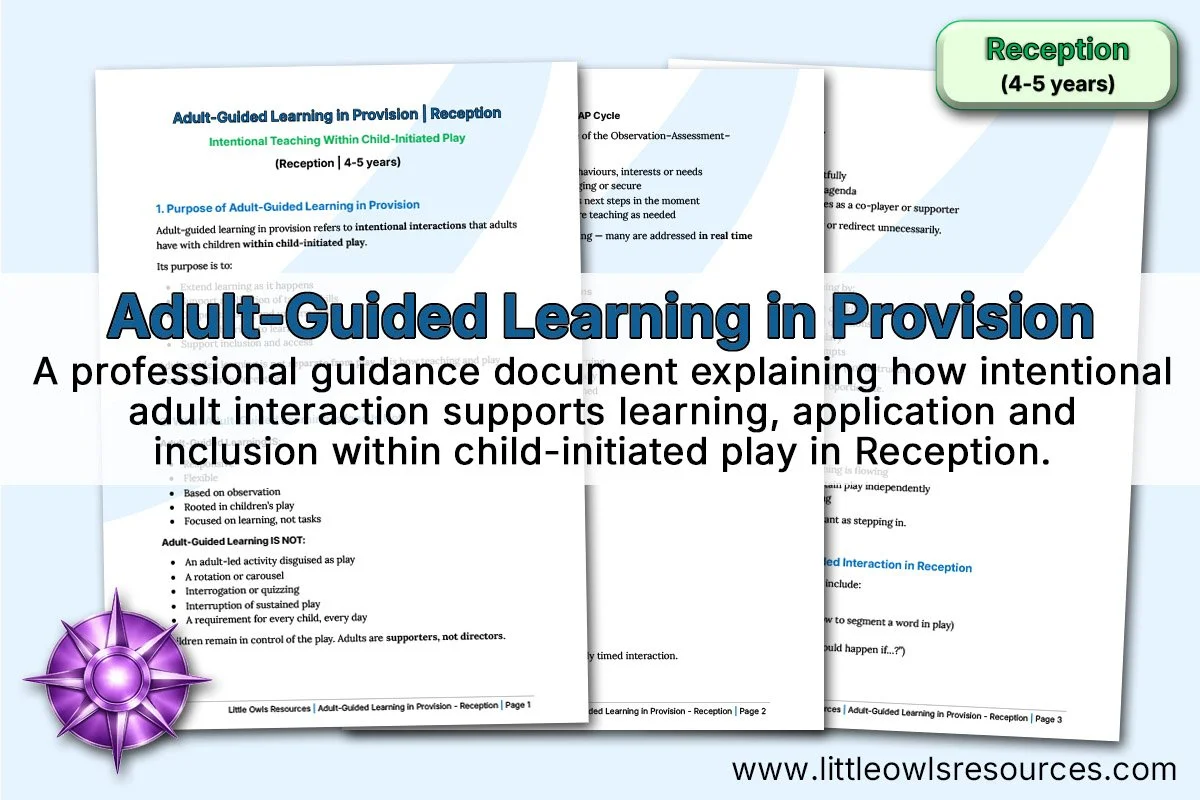
 
In Reception | 4-5 Years, -R3 Tags Reception, Characteristics of Effective Learning in Reception | 4-5 Years

Reception Baseline Assessment (RBA): Pedagogical Positioning and Practice

January 18, 2026 Stuart Murphy

Home › EYFS Curriculum & Pedagogy › Reception Curriculum & Pedagogy › Reception Baseline Assessment (RBA): Pedagogical Positioning and Practice

Reception Baseline Assessment (RBA): Pedagogical Positioning and Practice

Reception (4–5 Years)

A professional guidance document clarifying statutory RBA expectations while protecting high-quality, play-based Reception practice.

Download Document Here:

(This pathway component will be available for download by: March 31st 2026)

 
Download DOCX 📝
Download PDF 📄
 

Document Updated: January 2026

Recommended next read Selection

EYFS
Characteristics of Effective Learning in Reception | 4-5 Years

A practical professional guide to recognising, planning for and assessing how Reception children learn through play, teaching and application.

Read More →
Reception Baseline Assessment (RBA): Pedagogical Positioning and Practice

A professional guidance document clarifying statutory RBA expectations while protecting high-quality, play-based Reception practice.

Read More →
Self-Regulation & Learning Behaviours in Reception | 4-5 Years

A professional guidance document supporting the development of self-regulation, learning behaviours and independence in Reception.

Read More →
Reception Collaborative Planning & Reflection Sheet | 4-5 Years

A professional planning and reflection tool supporting child-led inquiry, curriculum coherence and meaningful learning conversations in Reception.

Read More →
Reception Observation–Assessment–Planning (OAP) Cycle Guidance

A professional guidance document supporting responsive teaching, proportionate assessment and secure EYFSP judgements in Reception.

Read More →

Professional Membership Contents (Reception 4-5 Years)

Below you will find listed the component documents of our ‘Reception Curriculum & Pedagogy Suite’. They are separated into Strands 1-10. You do not need to use everything all at once.

  • 👉 This section is essential for alignment.

    • Reception Curriculum Overview & Rationale [Free Orienting Sample]

    • Reception Pedagogy Position Statement [Free Orienting Sample]

    • About Our Reception Curriculum Phase Framework

    • How To Use The Reception Pathway

    • Why Themes Are Optional in Reception

  • 👉 Curriculum clarity and sequencing.

    • Reception Curriculum Progression Maps (all areas of learning)

      • Guide to Learning Progression: How to Use the Reception Curriculum Progression Maps

      • Progression Maps for:

        • Communication and Language

        • Personal, Social and Emotional Development

        • Physical Development

        • Literacy

        • Mathematics

        • Understanding the World

        • Expressive Arts and Design

    • Reception Curriculum Phase Framework

      • How To Use The Reception Curriculum Phase Pack

      • Phase 1: Settling & Foundations

      • Phase 2: Exploration & Early Application

      • Phase 3: Independence & Depth

      • Phase 4: Consolidation & Transition

  • 👉 OAP as the organising principle.

    • Reception OAP Cycle Guidance

    • Reception Collaborative Planning & Reflective Sheet Pack

    • Self-Regulation & Learning Behaviours in Reception

    • Reception Baseline Assessment (RBA)

    • Characteristics of Effective Learning in Reception

  • 👉 Stable, purposeful provision.

    • Reception Continuous Provision – Structure & Rationale

    • Universal Continuous Provision Pack (Areas listed below)

      • Construction

      • Creative

      • Investigation / Discovery

      • Maths

      • Reading

      • Role Play / Small World

      • Malleable / Sensory

      • Writing

    • Outdoor Continuous Provision (Reception)

    • Adult-Guided Learning in Provision

    • Reception Labelling Pack | 4-5 Years

  • 👉 Light-touch, application-focused.

    • Reception Enhanced Provision Planning Toolkit

    • Reception Optional Themed Enhancements - Idea Banks

  • 👉 Systematic teaching without Year 1 drift.

    Phonics (Scheme-Compatible)

    • Phonics in Reception: Teaching, Application & Inclusion

      • Pedagogy

      • Adult-Led Sessions

      • Phonics in Provision

      • Supporting Children Not Keeping Up

      • Phonics & EYFSP

      • Scheme Compatibility Statement

    Maths

    • Reception Maths Teaching Framework

      • Term by Tem Maths Concept Emphasis Map

      • Maths Adult-Led Mini Session Banks (9 Banks)

      • Maths Across the Curriculum & Provision

      • Maths & EYFSP Guidance

    Writing

    • Reception Early Writing Purpose Pack

      • Writing Adult-Led Mini Session Bank (12 Sessions)

    • Fine Motor & Physical Development

      • Guidance Surrounding Foundations for Writing in Reception (4–5 Years)

  • 👉 Precision language for application.

    • Adult-Guided Learning in Provision

    • Theme-Based High-Impact Question & Vocabulary Banks

      • Leadership Rationale: Why Questions Differ by Age

    • Five Sentence Stems For Reception Practitioners

  • 👉 Statutory confidence with inclusive practice.

    • EYFSP Interpretation & Assessment Toolkit

      • ELG Unpacking

      • Best-Fit Exemplification

      • Moderation Guidance

    • Reception SEND & Inclusion Toolkit

      • The graduated response (Universal → Targeted → Specialist)

      • Adaptations across phonics, maths & writing

      • Visual Communication Pack

      • Language-first strategies for inclusion

      • Observation, assessment and SEND

      • Collaborative working with families and specialists

      • Referral Preparation — for EHCP pathway

      • Reception APDR Template

      • Leadership and inspection readiness

  • 👉 Leadership assurance.

    • Reception Leadership & Inspection Readiness Pack

      • Curriculum Intent & Implementation Guidance

      • Ofsted Conversation Prompts

  • 👉 Clear communication beyond the classroom.

    • Reception Parent Partnership Pack

    • Reception Transition to Year 1 Pack

Additional Whole-Setting Guidance | for Professional Members

Explore our whole-setting guidance below, including overarching curriculum and pedagogy documents, early years schemas and EYFS setting policies.

    • Little Owls Resources’ Curriculum Intent Statement

    • EYFS from Birth to 5: Curriculum Coherence & Pedagogical Throughline

    • Whole-Setting Curriculum Map (Birth-5): Curriculum Intent & Progression

    • Pedagogy Guidance Document

    • Speech & Language Development - Setting Statement

    • EYFS Inspection-Facing Summaries

  • Early Years Schemas - Practitioner Toolkit | EYFS Birth-5

    ↪ Schema Cards (definition, behaviours, age-related examples, enabling resources)

    ↪ Schema Observation & Responsive Provision Planning Template

    • EYFS Group Setting Policies Pack

      ↪ x 22 Policy Documents

      ↪ Policy Sign-Off and Confirmation Document

      ↪ EYFS Setting Policy Folder Contents List

    • Childminder Setting Policies Pack

      ↪ x 22 Policy Documents

      ↪ Childminder Assistant or Volunteer Policy Sign-Off and Confirmation Document

      ↪ Childminder Policy Folder Contents List

  • EYFS Glossary

    ↪ Clear, practitioner-friendly explanations of key curriculum and pedagogy terms used throughout our guidance.

Looking for a different age group pathway?

Select the pathway that best reflects your role or the age group you work with. You do not need to use everything. (Some practitioners may use more than one pathway.)

Featured
🍼 Babies (0–18 months)

Responsive care, observation and development in the earliest years

🚼 Toddlers (18–36 months)

Development, play and progression in the toddler years

🎨 Preschool (3–4 years)

Curriculum, continuous provision and purposeful teaching

🎓 Reception (4–5 years)

Play-based pedagogy, progression and EYFSP readiness

🏡 Childminders (Birth–5)

Mixed-age pedagogy, planning without overload and inspection confidence

Latest EYFS Articles & Practical Guides | From Our Blog

Stay informed, get expert advice, and find inspiration from our collection of articles and useful external resources, tailored specifically for EYFS practitioners. We regularly publish in-depth articles to support you with current best practices, regulatory changes, and fresh ideas.

EYFS & KS1 Articles
Major UK Curriculum Shake-Up Announced: What EYFS & KS1 Practitioners Need to Know

A major overhaul of the national curriculum in England has been announced following the publication of the independent Curriculum and Assessment Review. For those working in the Early Years Foundation Stage (EYFS) and Key Stage 1 (KS1), the changes signal a renewed focus on practical life skills, digital literacy, and enriching learning experiences…

Read More →
New Education Inspection Framework | What EYFS Settings Need to Know

The world of early years education is constantly evolving, and with it, the frameworks that guide and assess our invaluable work. Come November 2025, a significant shift will occur as the new Education Inspection Framework (EIF) comes into effect, bringing with it some crucial changes…

Read More →
Revised 2025 EYFS Statutory Framework for Group & School-Based Providers | What You Need to Know

With the new 2025 EYFS Statutory Framework for group and school-based providers coming into effect on 1st September 2025, it's essential to understand the updates to ensure your practice remains compliant, effective…

Read More →
DfE Press Release | Parents urged to read more to boost children’s life chances

The Education Secretary is calling on parents to lead by example and make reading a daily habit to help reverse the decline in reading for pleasure, to help give kids the best start in life as part of the…

Read More →
DfE Update | Drowning Prevention Week: what children learn about water safety at school

As we head into summer, it’s especially important that children are prepared with these skills. This year, the Royal Life Saving Society UK's Drowning Prevention Week runs from 14 June to 21…

Read More →
DfE Update | Hot weather and heatwaves: guidance for schools and other education settings

There are several ways that schools can make changes to keep children safe in hot weather, especially as children are more at risk of becoming ill with heat-related issues than adults…

Read More →

Are you looking for a specific resource or document for your provision?

Use our 🔍 Search Bar located at the top of every page.

___________________________

Content within the EYFS Curriculum & Pedagogy Membership is provided as professional guidance and support. It reflects current understanding of the EYFS statutory framework, Development Matters and inspection expectations at the time of writing. Practitioners are responsible for applying professional judgement and ensuring practice aligns with current statutory requirements and their specific context. All resources, experiences and environment arrangements must be risk assessed by the setting and used in accordance with individual children’s developmental stages, needs and supervision requirements.

Safeguarding content does not replace a setting’s safeguarding and child protection policy or the statutory role of the Designated Safeguarding Lead (DSL). All concerns must be managed in line with current statutory guidance and local safeguarding procedures.

_____________________________
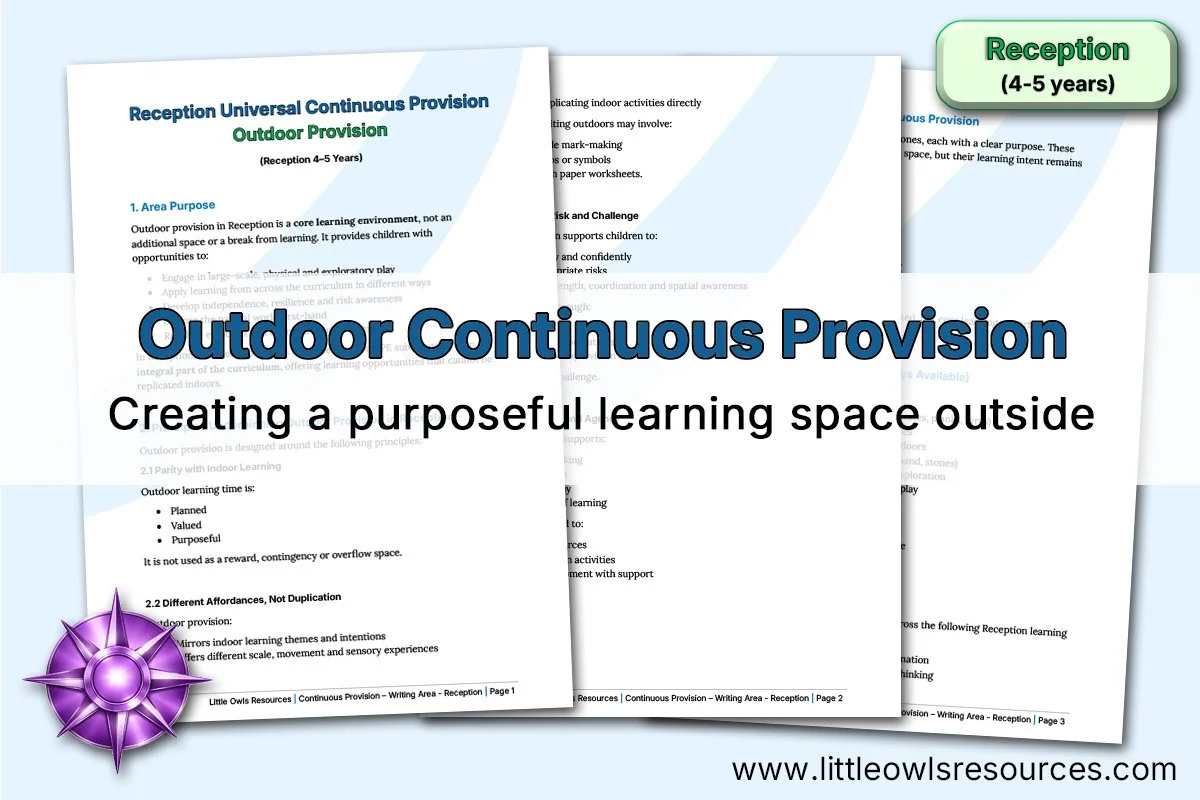
 
In Reception | 4-5 Years, -R3 Tags Reception, Reception Baseline Assessment (RBA): Pedagogical Positioning and Practice

Self-Regulation & Learning Behaviours in Reception | 4-5 Years

January 18, 2026 Stuart Murphy

Home › EYFS Curriculum & Pedagogy › Reception Curriculum & Pedagogy › Self-Regulation & Learning Behaviours in Reception | 4-5 Years

Scroll down to read this document or download files here: DOCX 📝 | PDF 📄

(This pathway component is currently available to read on the page below and will be available for download by: March 31st 2026)

Self-Regulation & Learning Behaviours in Reception

A professional guidance document supporting the development of self-regulation, learning behaviours and independence in Reception.

Purpose of This Document

This document sets out our approach to developing self-regulation and positive learning behaviours in Reception.

It explains:

  • what self-regulation means in the context of the EYFS

  • how learning behaviours are taught, scaffolded and practised in Reception

  • the role of adults, routines and provision

  • how self-regulation supports learning, independence and transition to Year 1

This guidance reflects:

  • the EYFS statutory framework

  • Development Matters

  • Ofsted guidance on behaviour, attitudes and learning in Reception

Self-Regulation in the EYFS Context

The EYFS identifies Self-Regulation and Managing Self as core aspects of Personal, Social and Emotional Development (PSED).

By the end of Reception, children are expected to:

  • show an understanding of their own feelings and those of others

  • manage emotions and behaviour appropriately

  • follow instructions and manage transitions

  • demonstrate persistence and focus when learning is challenging

Self-regulation is not innate. It develops through:

  • secure relationships

  • predictable routines

  • adult modelling

  • repeated opportunities to practise within real learning contexts

Reception as a Key Year for Self-Regulation

Reception is a distinct and crucial phase for developing self-regulation because:

  • expectations increase (sustained attention, group learning, independent tasks)

  • children encounter more adult-led teaching alongside provision

  • learning requires greater effort (phonics, writing, maths reasoning)

This does not mean children should be expected to behave like Year 1 pupils.

Instead, Reception provides:

  • structured support

  • explicit teaching of learning behaviours

  • gradual release of responsibility

Our Core Principle

In Reception, self-regulation is taught, not demanded.

Children learn to regulate themselves when adults:

  • create emotionally safe environments

  • model calm, respectful behaviour

  • break learning into achievable steps

  • respond consistently and predictably

What Self-Regulation Looks Like in Reception

Self-Regulation Includes:

  • managing emotions during learning

  • coping with frustration or mistakes

  • waiting, taking turns and listening

  • sustaining attention for increasing periods

  • returning to a task after interruption

  • seeking help appropriately

These skills develop alongside curriculum learning, not separately from it.

Learning Behaviours We Intentionally Develop

1. Attention and Listening

Children are supported to:

  • attend to short adult-led sessions

  • listen to instructions and stories

  • respond appropriately to questions

  • remain engaged during group learning

Adult strategies include:

  • clear routines and signals

  • consistent expectations

  • short, purposeful teaching inputs

  • visual supports and modelling

2. Persistence and Resilience

Children are supported to:

  • “have a go” even when unsure

  • tolerate mistakes

  • try again with guidance

  • complete tasks that require effort

Adults support this by:

  • praising effort and strategies

  • normalising mistakes as part of learning

  • breaking tasks into manageable steps

  • modelling problem-solving language

3. Emotional Regulation

Children are supported to:

  • recognise and name emotions

  • calm themselves with adult support

  • express feelings appropriately

  • recover after setbacks

Adults support this through:

  • emotionally responsive interactions

  • predictable routines

  • calm, respectful responses

  • teaching emotional vocabulary

4. Independence and Responsibility

Children are supported to:

  • manage personal needs

  • make choices within boundaries

  • follow routines independently

  • take responsibility for resources

Independence is:

  • scaffolded

  • modelled

  • gradually increased across the year

The Role of Routines in Reception

Routines are not about control — they are about security and predictability.

Effective Reception routines:

  • reduce anxiety

  • support attention and focus

  • free children’s cognitive capacity for learning

Key routines include:

  • arrival and transitions

  • carpet expectations

  • accessing and tidying provision

  • seeking help

  • moving between adult-led learning and play

These routines are taught explicitly, revisited and practised, especially in Phase 1.

Self-Regulation Through Play and Provision

Continuous provision plays a vital role in developing self-regulation.

Through play, children practise:

  • negotiation and turn-taking

  • sustaining shared ideas

  • managing disagreements

  • planning and adapting play

  • regulating emotions in real situations

Adults support this by:

  • modelling language for problem-solving

  • staying close where needed

  • guiding rather than directing

  • helping children reflect on what worked and why

This aligns with EYFS expectations that learning occurs through a combination of adult-guided and child-initiated experiences.

Inclusion and Self-Regulation

Not all children develop self-regulation at the same pace.

In Reception, some children may need:

  • additional adult proximity

  • visual timetables or prompts

  • reduced distractions

  • shorter learning inputs

  • repeated modelling and rehearsal

Children with SEND may require:

  • adapted expectations

  • alternative strategies for regulation

  • consistent adult support

Support is always focused on access, participation and success, not compliance.

How Self-Regulation Supports Learning and Assessment

Strong self-regulation enables children to:

  • engage more deeply with phonics, maths and writing

  • apply learning independently in provision

  • demonstrate learning more consistently

  • cope with challenge and feedback

Observation of self-regulation:

  • informs teaching and intervention

  • supports best-fit EYFSP judgements

  • contributes to understanding a child’s overall learning profile

Transition to Year 1

Reception supports transition by:

  • increasing expectations gradually

  • building stamina for learning

  • fostering confidence and independence

  • maintaining developmentally appropriate practice

Children leave Reception:

  • secure in routines

  • confident as learners

  • able to regulate emotions and behaviour with support

  • ready for the next stage — without being rushed

Leadership Summary

In strong Reception practice:

  • behaviour is understood as communication

  • self-regulation is explicitly taught

  • routines support learning, not restrict it

  • adults guide, model and scaffold consistently

  • expectations are ambitious and developmentally appropriate

This reflects best practice in EYFS and aligns with inspection expectations for behaviour, attitudes and learning in Reception.


Document Updated: January 2026

Download Document Here:

(This pathway component is currently available to read on the page above and will be available for download by: March 31st 2026)

 
Download DOCX 📝
Download PDF 📄


Recommended next read Selection

EYFS
Characteristics of Effective Learning in Reception | 4-5 Years

A practical professional guide to recognising, planning for and assessing how Reception children learn through play, teaching and application.

Read More →
Reception Baseline Assessment (RBA): Pedagogical Positioning and Practice

A professional guidance document clarifying statutory RBA expectations while protecting high-quality, play-based Reception practice.

Read More →
Self-Regulation & Learning Behaviours in Reception | 4-5 Years

A professional guidance document supporting the development of self-regulation, learning behaviours and independence in Reception.

Read More →
Reception Collaborative Planning & Reflection Sheet | 4-5 Years

A professional planning and reflection tool supporting child-led inquiry, curriculum coherence and meaningful learning conversations in Reception.

Read More →
Reception Observation–Assessment–Planning (OAP) Cycle Guidance

A professional guidance document supporting responsive teaching, proportionate assessment and secure EYFSP judgements in Reception.

Read More →

Professional Membership Contents (Reception 4-5 Years)

Below you will find listed the component documents of our ‘Reception Curriculum & Pedagogy Suite’. They are separated into Strands 1-10. You do not need to use everything all at once.

  • 👉 This section is essential for alignment.

    • Reception Curriculum Overview & Rationale [Free Orienting Sample]

    • Reception Pedagogy Position Statement [Free Orienting Sample]

    • About Our Reception Curriculum Phase Framework

    • How To Use The Reception Pathway

    • Why Themes Are Optional in Reception

  • 👉 Curriculum clarity and sequencing.

    • Reception Curriculum Progression Maps (all areas of learning)

      • Guide to Learning Progression: How to Use the Reception Curriculum Progression Maps

      • Progression Maps for:

        • Communication and Language

        • Personal, Social and Emotional Development

        • Physical Development

        • Literacy

        • Mathematics

        • Understanding the World

        • Expressive Arts and Design

    • Reception Curriculum Phase Framework

      • How To Use The Reception Curriculum Phase Pack

      • Phase 1: Settling & Foundations

      • Phase 2: Exploration & Early Application

      • Phase 3: Independence & Depth

      • Phase 4: Consolidation & Transition

  • 👉 OAP as the organising principle.

    • Reception OAP Cycle Guidance

    • Reception Collaborative Planning & Reflective Sheet Pack

    • Self-Regulation & Learning Behaviours in Reception

    • Reception Baseline Assessment (RBA)

    • Characteristics of Effective Learning in Reception

  • 👉 Stable, purposeful provision.

    • Reception Continuous Provision – Structure & Rationale

    • Universal Continuous Provision Pack (Areas listed below)

      • Construction

      • Creative

      • Investigation / Discovery

      • Maths

      • Reading

      • Role Play / Small World

      • Malleable / Sensory

      • Writing

    • Outdoor Continuous Provision (Reception)

    • Adult-Guided Learning in Provision

    • Reception Labelling Pack | 4-5 Years

  • 👉 Light-touch, application-focused.

    • Reception Enhanced Provision Planning Toolkit

    • Reception Optional Themed Enhancements - Idea Banks

  • 👉 Systematic teaching without Year 1 drift.

    Phonics (Scheme-Compatible)

    • Phonics in Reception: Teaching, Application & Inclusion

      • Pedagogy

      • Adult-Led Sessions

      • Phonics in Provision

      • Supporting Children Not Keeping Up

      • Phonics & EYFSP

      • Scheme Compatibility Statement

    Maths

    • Reception Maths Teaching Framework

      • Term by Tem Maths Concept Emphasis Map

      • Maths Adult-Led Mini Session Banks (9 Banks)

      • Maths Across the Curriculum & Provision

      • Maths & EYFSP Guidance

    Writing

    • Reception Early Writing Purpose Pack

      • Writing Adult-Led Mini Session Bank (12 Sessions)

    • Fine Motor & Physical Development

      • Guidance Surrounding Foundations for Writing in Reception (4–5 Years)

  • 👉 Precision language for application.

    • Adult-Guided Learning in Provision

    • Theme-Based High-Impact Question & Vocabulary Banks

      • Leadership Rationale: Why Questions Differ by Age

    • Five Sentence Stems For Reception Practitioners

  • 👉 Statutory confidence with inclusive practice.

    • EYFSP Interpretation & Assessment Toolkit

      • ELG Unpacking

      • Best-Fit Exemplification

      • Moderation Guidance

    • Reception SEND & Inclusion Toolkit

      • The graduated response (Universal → Targeted → Specialist)

      • Adaptations across phonics, maths & writing

      • Visual Communication Pack

      • Language-first strategies for inclusion

      • Observation, assessment and SEND

      • Collaborative working with families and specialists

      • Referral Preparation — for EHCP pathway

      • Reception APDR Template

      • Leadership and inspection readiness

  • 👉 Leadership assurance.

    • Reception Leadership & Inspection Readiness Pack

      • Curriculum Intent & Implementation Guidance

      • Ofsted Conversation Prompts

  • 👉 Clear communication beyond the classroom.

    • Reception Parent Partnership Pack

    • Reception Transition to Year 1 Pack

Additional Whole-Setting Guidance | for Professional Members

Explore our whole-setting guidance below, including overarching curriculum and pedagogy documents, early years schemas and EYFS setting policies.

    • Little Owls Resources’ Curriculum Intent Statement

    • EYFS from Birth to 5: Curriculum Coherence & Pedagogical Throughline

    • Whole-Setting Curriculum Map (Birth-5): Curriculum Intent & Progression

    • Pedagogy Guidance Document

    • Speech & Language Development - Setting Statement

    • EYFS Inspection-Facing Summaries

  • Early Years Schemas - Practitioner Toolkit | EYFS Birth-5

    ↪ Schema Cards (definition, behaviours, age-related examples, enabling resources)

    ↪ Schema Observation & Responsive Provision Planning Template

    • EYFS Group Setting Policies Pack

      ↪ x 22 Policy Documents

      ↪ Policy Sign-Off and Confirmation Document

      ↪ EYFS Setting Policy Folder Contents List

    • Childminder Setting Policies Pack

      ↪ x 22 Policy Documents

      ↪ Childminder Assistant or Volunteer Policy Sign-Off and Confirmation Document

      ↪ Childminder Policy Folder Contents List

  • EYFS Glossary

    ↪ Clear, practitioner-friendly explanations of key curriculum and pedagogy terms used throughout our guidance.

Looking for a different age group pathway?

Select the pathway that best reflects your role or the age group you work with. You do not need to use everything. (Some practitioners may use more than one pathway.)

Featured
🍼 Babies (0–18 months)

Responsive care, observation and development in the earliest years

🚼 Toddlers (18–36 months)

Development, play and progression in the toddler years

🎨 Preschool (3–4 years)

Curriculum, continuous provision and purposeful teaching

🎓 Reception (4–5 years)

Play-based pedagogy, progression and EYFSP readiness

🏡 Childminders (Birth–5)

Mixed-age pedagogy, planning without overload and inspection confidence

Latest EYFS Articles & Practical Guides | From Our Blog

Stay informed, get expert advice, and find inspiration from our collection of articles and useful external resources, tailored specifically for EYFS practitioners. We regularly publish in-depth articles to support you with current best practices, regulatory changes, and fresh ideas.

EYFS & KS1 Articles
Major UK Curriculum Shake-Up Announced: What EYFS & KS1 Practitioners Need to Know

A major overhaul of the national curriculum in England has been announced following the publication of the independent Curriculum and Assessment Review. For those working in the Early Years Foundation Stage (EYFS) and Key Stage 1 (KS1), the changes signal a renewed focus on practical life skills, digital literacy, and enriching learning experiences…

Read More →
New Education Inspection Framework | What EYFS Settings Need to Know

The world of early years education is constantly evolving, and with it, the frameworks that guide and assess our invaluable work. Come November 2025, a significant shift will occur as the new Education Inspection Framework (EIF) comes into effect, bringing with it some crucial changes…

Read More →
Revised 2025 EYFS Statutory Framework for Group & School-Based Providers | What You Need to Know

With the new 2025 EYFS Statutory Framework for group and school-based providers coming into effect on 1st September 2025, it's essential to understand the updates to ensure your practice remains compliant, effective…

Read More →
DfE Press Release | Parents urged to read more to boost children’s life chances

The Education Secretary is calling on parents to lead by example and make reading a daily habit to help reverse the decline in reading for pleasure, to help give kids the best start in life as part of the…

Read More →
DfE Update | Drowning Prevention Week: what children learn about water safety at school

As we head into summer, it’s especially important that children are prepared with these skills. This year, the Royal Life Saving Society UK's Drowning Prevention Week runs from 14 June to 21…

Read More →
DfE Update | Hot weather and heatwaves: guidance for schools and other education settings

There are several ways that schools can make changes to keep children safe in hot weather, especially as children are more at risk of becoming ill with heat-related issues than adults…

Read More →

Are you looking for a specific resource or document for your provision?

Use our 🔍 Search Bar located at the top of every page.

___________________________

Content within the EYFS Curriculum & Pedagogy Membership is provided as professional guidance and support. It reflects current understanding of the EYFS statutory framework, Development Matters and inspection expectations at the time of writing. Practitioners are responsible for applying professional judgement and ensuring practice aligns with current statutory requirements and their specific context. All resources, experiences and environment arrangements must be risk assessed by the setting and used in accordance with individual children’s developmental stages, needs and supervision requirements.

Safeguarding content does not replace a setting’s safeguarding and child protection policy or the statutory role of the Designated Safeguarding Lead (DSL). All concerns must be managed in line with current statutory guidance and local safeguarding procedures.

_____________________________
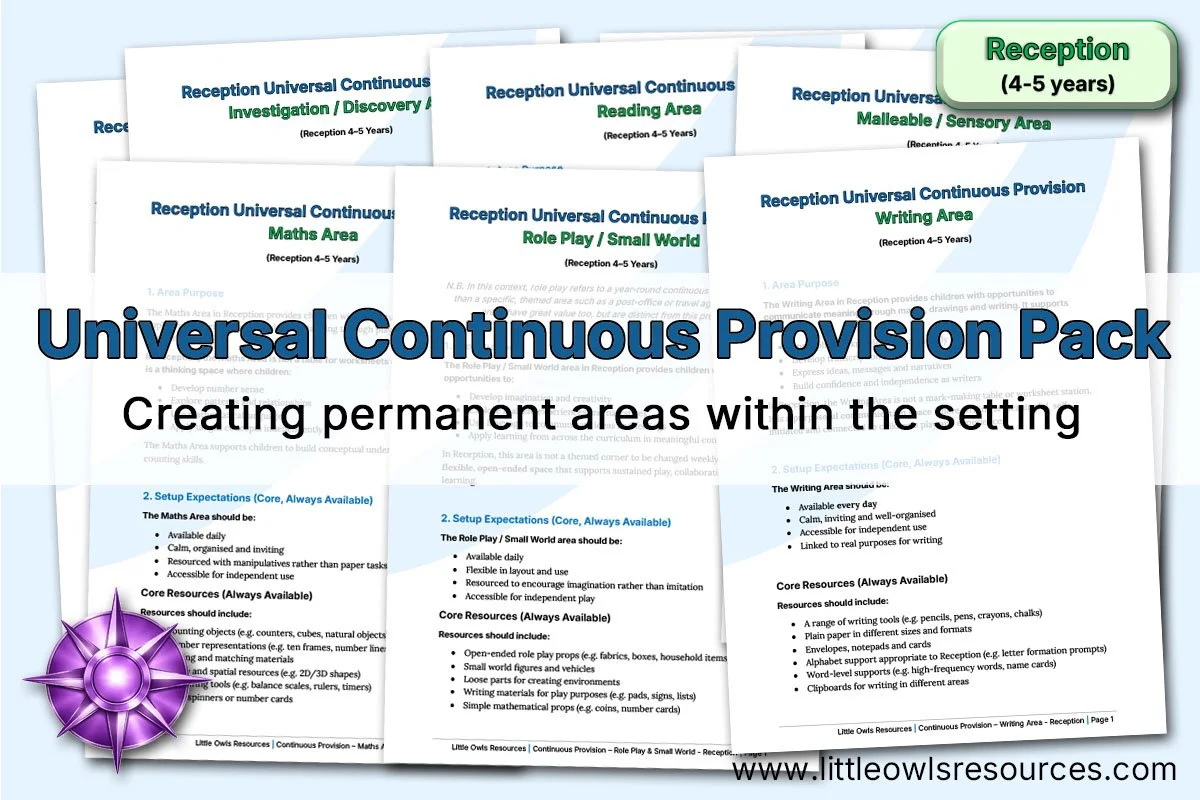
 
In Reception | 4-5 Years, -R3 Tags Reception, Self-Regulation & Learning Behaviours in Reception | 4-5 Years

Reception Collaborative Planning & Reflection Sheet | 4–5 Years

January 18, 2026 Stuart Murphy

Home › EYFS Curriculum & Pedagogy › Reception Curriculum & Pedagogy › Reception Collaborative Planning & Reflection Sheet | 4-5 Years

Reception Collaborative Planning & Reflection Sheet | 4–5 Years

A professional planning and reflection tool supporting child-led inquiry, curriculum coherence and meaningful learning conversations in Reception.

Download Document Here:

(This pathway component will be available for download by: March 31st 2026)

 
Download DOCX 📝
Download PDF 📄
 

Document Updated: January 2026

Recommended next read Selection

EYFS
Characteristics of Effective Learning in Reception | 4-5 Years

A practical professional guide to recognising, planning for and assessing how Reception children learn through play, teaching and application.

Read More →
Reception Baseline Assessment (RBA): Pedagogical Positioning and Practice

A professional guidance document clarifying statutory RBA expectations while protecting high-quality, play-based Reception practice.

Read More →
Self-Regulation & Learning Behaviours in Reception | 4-5 Years

A professional guidance document supporting the development of self-regulation, learning behaviours and independence in Reception.

Read More →
Reception Collaborative Planning & Reflection Sheet | 4-5 Years

A professional planning and reflection tool supporting child-led inquiry, curriculum coherence and meaningful learning conversations in Reception.

Read More →
Reception Observation–Assessment–Planning (OAP) Cycle Guidance

A professional guidance document supporting responsive teaching, proportionate assessment and secure EYFSP judgements in Reception.

Read More →

Professional Membership Contents (Reception 4-5 Years)

Below you will find listed the component documents of our ‘Reception Curriculum & Pedagogy Suite’. They are separated into Strands 1-10. You do not need to use everything all at once.

  • 👉 This section is essential for alignment.

    • Reception Curriculum Overview & Rationale [Free Orienting Sample]

    • Reception Pedagogy Position Statement [Free Orienting Sample]

    • About Our Reception Curriculum Phase Framework

    • How To Use The Reception Pathway

    • Why Themes Are Optional in Reception

  • 👉 Curriculum clarity and sequencing.

    • Reception Curriculum Progression Maps (all areas of learning)

      • Guide to Learning Progression: How to Use the Reception Curriculum Progression Maps

      • Progression Maps for:

        • Communication and Language

        • Personal, Social and Emotional Development

        • Physical Development

        • Literacy

        • Mathematics

        • Understanding the World

        • Expressive Arts and Design

    • Reception Curriculum Phase Framework

      • How To Use The Reception Curriculum Phase Pack

      • Phase 1: Settling & Foundations

      • Phase 2: Exploration & Early Application

      • Phase 3: Independence & Depth

      • Phase 4: Consolidation & Transition

  • 👉 OAP as the organising principle.

    • Reception OAP Cycle Guidance

    • Reception Collaborative Planning & Reflective Sheet Pack

    • Self-Regulation & Learning Behaviours in Reception

    • Reception Baseline Assessment (RBA)

    • Characteristics of Effective Learning in Reception

  • 👉 Stable, purposeful provision.

    • Reception Continuous Provision – Structure & Rationale

    • Universal Continuous Provision Pack (Areas listed below)

      • Construction

      • Creative

      • Investigation / Discovery

      • Maths

      • Reading

      • Role Play / Small World

      • Malleable / Sensory

      • Writing

    • Outdoor Continuous Provision (Reception)

    • Adult-Guided Learning in Provision

    • Reception Labelling Pack | 4-5 Years

  • 👉 Light-touch, application-focused.

    • Reception Enhanced Provision Planning Toolkit

    • Reception Optional Themed Enhancements - Idea Banks

  • 👉 Systematic teaching without Year 1 drift.

    Phonics (Scheme-Compatible)

    • Phonics in Reception: Teaching, Application & Inclusion

      • Pedagogy

      • Adult-Led Sessions

      • Phonics in Provision

      • Supporting Children Not Keeping Up

      • Phonics & EYFSP

      • Scheme Compatibility Statement

    Maths

    • Reception Maths Teaching Framework

      • Term by Tem Maths Concept Emphasis Map

      • Maths Adult-Led Mini Session Banks (9 Banks)

      • Maths Across the Curriculum & Provision

      • Maths & EYFSP Guidance

    Writing

    • Reception Early Writing Purpose Pack

      • Writing Adult-Led Mini Session Bank (12 Sessions)

    • Fine Motor & Physical Development

      • Guidance Surrounding Foundations for Writing in Reception (4–5 Years)

  • 👉 Precision language for application.

    • Adult-Guided Learning in Provision

    • Theme-Based High-Impact Question & Vocabulary Banks

      • Leadership Rationale: Why Questions Differ by Age

    • Five Sentence Stems For Reception Practitioners

  • 👉 Statutory confidence with inclusive practice.

    • EYFSP Interpretation & Assessment Toolkit

      • ELG Unpacking

      • Best-Fit Exemplification

      • Moderation Guidance

    • Reception SEND & Inclusion Toolkit

      • The graduated response (Universal → Targeted → Specialist)

      • Adaptations across phonics, maths & writing

      • Visual Communication Pack

      • Language-first strategies for inclusion

      • Observation, assessment and SEND

      • Collaborative working with families and specialists

      • Referral Preparation — for EHCP pathway

      • Reception APDR Template

      • Leadership and inspection readiness

  • 👉 Leadership assurance.

    • Reception Leadership & Inspection Readiness Pack

      • Curriculum Intent & Implementation Guidance

      • Ofsted Conversation Prompts

  • 👉 Clear communication beyond the classroom.

    • Reception Parent Partnership Pack

    • Reception Transition to Year 1 Pack

Additional Whole-Setting Guidance | for Professional Members

Explore our whole-setting guidance below, including overarching curriculum and pedagogy documents, early years schemas and EYFS setting policies.

    • Little Owls Resources’ Curriculum Intent Statement

    • EYFS from Birth to 5: Curriculum Coherence & Pedagogical Throughline

    • Whole-Setting Curriculum Map (Birth-5): Curriculum Intent & Progression

    • Pedagogy Guidance Document

    • Speech & Language Development - Setting Statement

    • EYFS Inspection-Facing Summaries

  • Early Years Schemas - Practitioner Toolkit | EYFS Birth-5

    ↪ Schema Cards (definition, behaviours, age-related examples, enabling resources)

    ↪ Schema Observation & Responsive Provision Planning Template

    • EYFS Group Setting Policies Pack

      ↪ x 22 Policy Documents

      ↪ Policy Sign-Off and Confirmation Document

      ↪ EYFS Setting Policy Folder Contents List

    • Childminder Setting Policies Pack

      ↪ x 22 Policy Documents

      ↪ Childminder Assistant or Volunteer Policy Sign-Off and Confirmation Document

      ↪ Childminder Policy Folder Contents List

  • EYFS Glossary

    ↪ Clear, practitioner-friendly explanations of key curriculum and pedagogy terms used throughout our guidance.

Looking for a different age group pathway?

Select the pathway that best reflects your role or the age group you work with. You do not need to use everything. (Some practitioners may use more than one pathway.)

Featured
🍼 Babies (0–18 months)

Responsive care, observation and development in the earliest years

🚼 Toddlers (18–36 months)

Development, play and progression in the toddler years

🎨 Preschool (3–4 years)

Curriculum, continuous provision and purposeful teaching

🎓 Reception (4–5 years)

Play-based pedagogy, progression and EYFSP readiness

🏡 Childminders (Birth–5)

Mixed-age pedagogy, planning without overload and inspection confidence

Latest EYFS Articles & Practical Guides | From Our Blog

Stay informed, get expert advice, and find inspiration from our collection of articles and useful external resources, tailored specifically for EYFS practitioners. We regularly publish in-depth articles to support you with current best practices, regulatory changes, and fresh ideas.

EYFS & KS1 Articles
Major UK Curriculum Shake-Up Announced: What EYFS & KS1 Practitioners Need to Know

A major overhaul of the national curriculum in England has been announced following the publication of the independent Curriculum and Assessment Review. For those working in the Early Years Foundation Stage (EYFS) and Key Stage 1 (KS1), the changes signal a renewed focus on practical life skills, digital literacy, and enriching learning experiences…

Read More →
New Education Inspection Framework | What EYFS Settings Need to Know

The world of early years education is constantly evolving, and with it, the frameworks that guide and assess our invaluable work. Come November 2025, a significant shift will occur as the new Education Inspection Framework (EIF) comes into effect, bringing with it some crucial changes…

Read More →
Revised 2025 EYFS Statutory Framework for Group & School-Based Providers | What You Need to Know

With the new 2025 EYFS Statutory Framework for group and school-based providers coming into effect on 1st September 2025, it's essential to understand the updates to ensure your practice remains compliant, effective…

Read More →
DfE Press Release | Parents urged to read more to boost children’s life chances

The Education Secretary is calling on parents to lead by example and make reading a daily habit to help reverse the decline in reading for pleasure, to help give kids the best start in life as part of the…

Read More →
DfE Update | Drowning Prevention Week: what children learn about water safety at school

As we head into summer, it’s especially important that children are prepared with these skills. This year, the Royal Life Saving Society UK's Drowning Prevention Week runs from 14 June to 21…

Read More →
DfE Update | Hot weather and heatwaves: guidance for schools and other education settings

There are several ways that schools can make changes to keep children safe in hot weather, especially as children are more at risk of becoming ill with heat-related issues than adults…

Read More →

Are you looking for a specific resource or document for your provision?

Use our 🔍 Search Bar located at the top of every page.

___________________________

Content within the EYFS Curriculum & Pedagogy Membership is provided as professional guidance and support. It reflects current understanding of the EYFS statutory framework, Development Matters and inspection expectations at the time of writing. Practitioners are responsible for applying professional judgement and ensuring practice aligns with current statutory requirements and their specific context. All resources, experiences and environment arrangements must be risk assessed by the setting and used in accordance with individual children’s developmental stages, needs and supervision requirements.

Safeguarding content does not replace a setting’s safeguarding and child protection policy or the statutory role of the Designated Safeguarding Lead (DSL). All concerns must be managed in line with current statutory guidance and local safeguarding procedures.

_____________________________
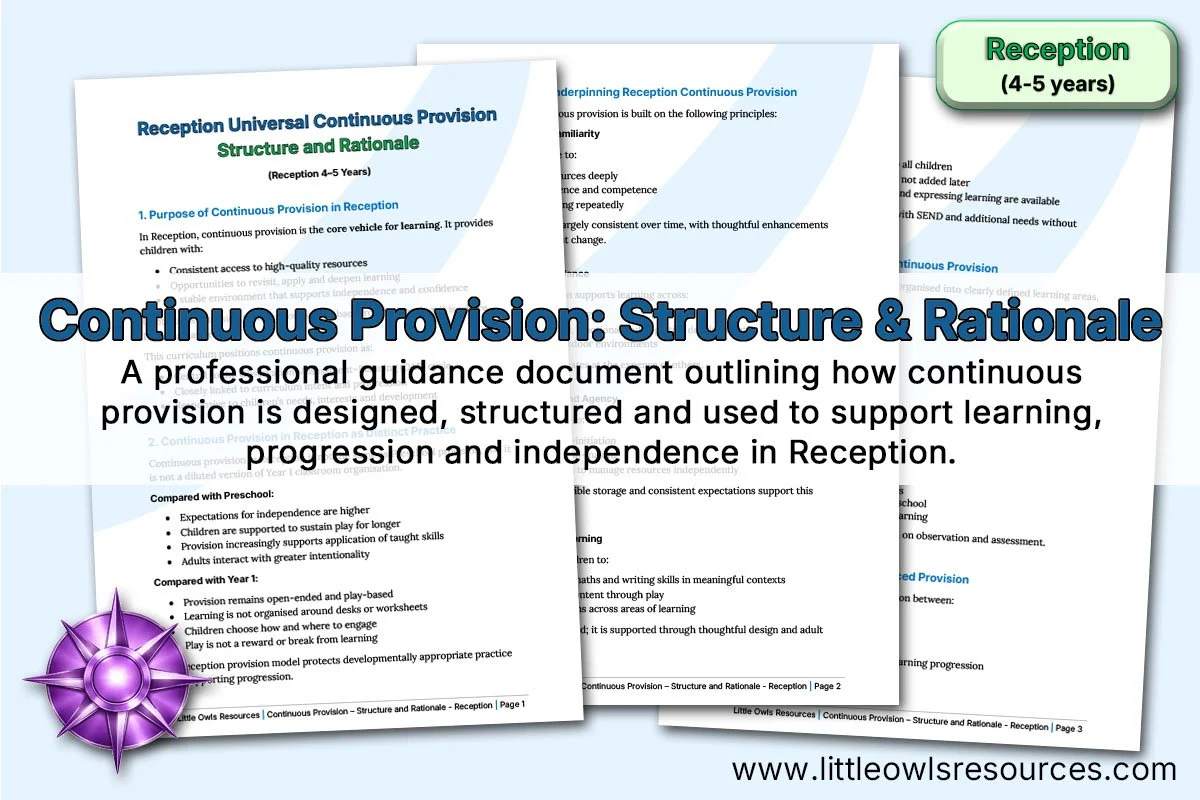
 
In Reception | 4-5 Years, -R3 Tags Reception, Reception Collaborative Planning & Reflection Sheet | 4–5 Years

Reception Observation–Assessment–Planning (OAP) Cycle Guidance

January 18, 2026 Stuart Murphy

Home › EYFS Curriculum & Pedagogy › Reception Curriculum & Pedagogy › Reception Observation–Assessment–Planning (OAP) Cycle Guidance

Reception Observation–Assessment–Planning (OAP) Cycle Guidance

A professional guidance document supporting responsive teaching, proportionate assessment and secure EYFSP judgements in Reception.

Download Document Here:

 
Download DOCX 📝
Download PDF 📄
 

Document Updated: January 2026

Recommended next read Selection

EYFS
Characteristics of Effective Learning in Reception | 4-5 Years

A practical professional guide to recognising, planning for and assessing how Reception children learn through play, teaching and application.

Read More →
Reception Baseline Assessment (RBA): Pedagogical Positioning and Practice

A professional guidance document clarifying statutory RBA expectations while protecting high-quality, play-based Reception practice.

Read More →
Self-Regulation & Learning Behaviours in Reception | 4-5 Years

A professional guidance document supporting the development of self-regulation, learning behaviours and independence in Reception.

Read More →
Reception Collaborative Planning & Reflection Sheet | 4-5 Years

A professional planning and reflection tool supporting child-led inquiry, curriculum coherence and meaningful learning conversations in Reception.

Read More →
Reception Observation–Assessment–Planning (OAP) Cycle Guidance

A professional guidance document supporting responsive teaching, proportionate assessment and secure EYFSP judgements in Reception.

Read More →

Professional Membership Contents (Reception 4-5 Years)

Below you will find listed the component documents of our ‘Reception Curriculum & Pedagogy Suite’. They are separated into Strands 1-10. You do not need to use everything all at once.

  • 👉 This section is essential for alignment.

    • Reception Curriculum Overview & Rationale [Free Orienting Sample]

    • Reception Pedagogy Position Statement [Free Orienting Sample]

    • About Our Reception Curriculum Phase Framework

    • How To Use The Reception Pathway

    • Why Themes Are Optional in Reception

  • 👉 Curriculum clarity and sequencing.

    • Reception Curriculum Progression Maps (all areas of learning)

      • Guide to Learning Progression: How to Use the Reception Curriculum Progression Maps

      • Progression Maps for:

        • Communication and Language

        • Personal, Social and Emotional Development

        • Physical Development

        • Literacy

        • Mathematics

        • Understanding the World

        • Expressive Arts and Design

    • Reception Curriculum Phase Framework

      • How To Use The Reception Curriculum Phase Pack

      • Phase 1: Settling & Foundations

      • Phase 2: Exploration & Early Application

      • Phase 3: Independence & Depth

      • Phase 4: Consolidation & Transition

  • 👉 OAP as the organising principle.

    • Reception OAP Cycle Guidance

    • Reception Collaborative Planning & Reflective Sheet Pack

    • Self-Regulation & Learning Behaviours in Reception

    • Reception Baseline Assessment (RBA)

    • Characteristics of Effective Learning in Reception

  • 👉 Stable, purposeful provision.

    • Reception Continuous Provision – Structure & Rationale

    • Universal Continuous Provision Pack (Areas listed below)

      • Construction

      • Creative

      • Investigation / Discovery

      • Maths

      • Reading

      • Role Play / Small World

      • Malleable / Sensory

      • Writing

    • Outdoor Continuous Provision (Reception)

    • Adult-Guided Learning in Provision

    • Reception Labelling Pack | 4-5 Years

  • 👉 Light-touch, application-focused.

    • Reception Enhanced Provision Planning Toolkit

    • Reception Optional Themed Enhancements - Idea Banks

  • 👉 Systematic teaching without Year 1 drift.

    Phonics (Scheme-Compatible)

    • Phonics in Reception: Teaching, Application & Inclusion

      • Pedagogy

      • Adult-Led Sessions

      • Phonics in Provision

      • Supporting Children Not Keeping Up

      • Phonics & EYFSP

      • Scheme Compatibility Statement

    Maths

    • Reception Maths Teaching Framework

      • Term by Tem Maths Concept Emphasis Map

      • Maths Adult-Led Mini Session Banks (9 Banks)

      • Maths Across the Curriculum & Provision

      • Maths & EYFSP Guidance

    Writing

    • Reception Early Writing Purpose Pack

      • Writing Adult-Led Mini Session Bank (12 Sessions)

    • Fine Motor & Physical Development

      • Guidance Surrounding Foundations for Writing in Reception (4–5 Years)

  • 👉 Precision language for application.

    • Adult-Guided Learning in Provision

    • Theme-Based High-Impact Question & Vocabulary Banks

      • Leadership Rationale: Why Questions Differ by Age

    • Five Sentence Stems For Reception Practitioners

  • 👉 Statutory confidence with inclusive practice.

    • EYFSP Interpretation & Assessment Toolkit

      • ELG Unpacking

      • Best-Fit Exemplification

      • Moderation Guidance

    • Reception SEND & Inclusion Toolkit

      • The graduated response (Universal → Targeted → Specialist)

      • Adaptations across phonics, maths & writing

      • Visual Communication Pack

      • Language-first strategies for inclusion

      • Observation, assessment and SEND

      • Collaborative working with families and specialists

      • Referral Preparation — for EHCP pathway

      • Reception APDR Template

      • Leadership and inspection readiness

  • 👉 Leadership assurance.

    • Reception Leadership & Inspection Readiness Pack

      • Curriculum Intent & Implementation Guidance

      • Ofsted Conversation Prompts

  • 👉 Clear communication beyond the classroom.

    • Reception Parent Partnership Pack

    • Reception Transition to Year 1 Pack

Additional Whole-Setting Guidance | for Professional Members

Explore our whole-setting guidance below, including overarching curriculum and pedagogy documents, early years schemas and EYFS setting policies.

    • Little Owls Resources’ Curriculum Intent Statement

    • EYFS from Birth to 5: Curriculum Coherence & Pedagogical Throughline

    • Whole-Setting Curriculum Map (Birth-5): Curriculum Intent & Progression

    • Pedagogy Guidance Document

    • Speech & Language Development - Setting Statement

    • EYFS Inspection-Facing Summaries

  • Early Years Schemas - Practitioner Toolkit | EYFS Birth-5

    ↪ Schema Cards (definition, behaviours, age-related examples, enabling resources)

    ↪ Schema Observation & Responsive Provision Planning Template

    • EYFS Group Setting Policies Pack

      ↪ x 22 Policy Documents

      ↪ Policy Sign-Off and Confirmation Document

      ↪ EYFS Setting Policy Folder Contents List

    • Childminder Setting Policies Pack

      ↪ x 22 Policy Documents

      ↪ Childminder Assistant or Volunteer Policy Sign-Off and Confirmation Document

      ↪ Childminder Policy Folder Contents List

  • EYFS Glossary

    ↪ Clear, practitioner-friendly explanations of key curriculum and pedagogy terms used throughout our guidance.

Looking for a different age group pathway?

Select the pathway that best reflects your role or the age group you work with. You do not need to use everything. (Some practitioners may use more than one pathway.)

Featured
🍼 Babies (0–18 months)

Responsive care, observation and development in the earliest years

🚼 Toddlers (18–36 months)

Development, play and progression in the toddler years

🎨 Preschool (3–4 years)

Curriculum, continuous provision and purposeful teaching

🎓 Reception (4–5 years)

Play-based pedagogy, progression and EYFSP readiness

🏡 Childminders (Birth–5)

Mixed-age pedagogy, planning without overload and inspection confidence

Latest EYFS Articles & Practical Guides | From Our Blog

Stay informed, get expert advice, and find inspiration from our collection of articles and useful external resources, tailored specifically for EYFS practitioners. We regularly publish in-depth articles to support you with current best practices, regulatory changes, and fresh ideas.

EYFS & KS1 Articles
Major UK Curriculum Shake-Up Announced: What EYFS & KS1 Practitioners Need to Know

A major overhaul of the national curriculum in England has been announced following the publication of the independent Curriculum and Assessment Review. For those working in the Early Years Foundation Stage (EYFS) and Key Stage 1 (KS1), the changes signal a renewed focus on practical life skills, digital literacy, and enriching learning experiences…

Read More →
New Education Inspection Framework | What EYFS Settings Need to Know

The world of early years education is constantly evolving, and with it, the frameworks that guide and assess our invaluable work. Come November 2025, a significant shift will occur as the new Education Inspection Framework (EIF) comes into effect, bringing with it some crucial changes…

Read More →
Revised 2025 EYFS Statutory Framework for Group & School-Based Providers | What You Need to Know

With the new 2025 EYFS Statutory Framework for group and school-based providers coming into effect on 1st September 2025, it's essential to understand the updates to ensure your practice remains compliant, effective…

Read More →
DfE Press Release | Parents urged to read more to boost children’s life chances

The Education Secretary is calling on parents to lead by example and make reading a daily habit to help reverse the decline in reading for pleasure, to help give kids the best start in life as part of the…

Read More →
DfE Update | Drowning Prevention Week: what children learn about water safety at school

As we head into summer, it’s especially important that children are prepared with these skills. This year, the Royal Life Saving Society UK's Drowning Prevention Week runs from 14 June to 21…

Read More →
DfE Update | Hot weather and heatwaves: guidance for schools and other education settings

There are several ways that schools can make changes to keep children safe in hot weather, especially as children are more at risk of becoming ill with heat-related issues than adults…

Read More →

Are you looking for a specific resource or document for your provision?

Use our 🔍 Search Bar located at the top of every page.

___________________________

Content within the EYFS Curriculum & Pedagogy Membership is provided as professional guidance and support. It reflects current understanding of the EYFS statutory framework, Development Matters and inspection expectations at the time of writing. Practitioners are responsible for applying professional judgement and ensuring practice aligns with current statutory requirements and their specific context. All resources, experiences and environment arrangements must be risk assessed by the setting and used in accordance with individual children’s developmental stages, needs and supervision requirements.

Safeguarding content does not replace a setting’s safeguarding and child protection policy or the statutory role of the Designated Safeguarding Lead (DSL). All concerns must be managed in line with current statutory guidance and local safeguarding procedures.

_____________________________
 
In Reception | 4-5 Years, -R3 Tags Reception, Reception Observation–Assessment–Planning (OAP) Cycle Guidance
Older Posts →

Trusted by over 35,000 members

- early years professionals across nurseries, schools and childminding settings


Contact Little Owls Resources support:

support@littleowlsresources.com

Information

  • About | Testimonials

  • Privacy Policy

  • Cookie Policy

  • Terms & Conditions

  • Help Page

Core Navigation

  • Membership

  • Printable Resources

  • Events Calendar

  • Curriculum & Pedagogy

Thank-you Little Owls Resources members! Our community is growing! 😊


Read our File Format information

Copyright on all of the images, files & resources housed on this website is held by ‘Little Owls Resources’. In downloading any of these resources you are issued a single licence for your own use and the right to grant a limited licence to your students to use the licensed material as part of your teaching and their own use.

Our resources (including the images within them), cannot be shared or sold commercially.

Website powered by Squarespace

Search powered by https://www.sitesearch360.com