• Home 🏠
  • About Us
  • Pricing
    • 🌟Printable Resources Hub🌟
    • ↪ Themes
    • ↪ Role Play
    • ↪ Festivals & Celebrations
    • ↪ Special Dates Calendar
    • ↪ Areas of Learning
    • ↪ Organisational Tools
  • EYFS Curriculum & Pedagogy
  • Special Dates Calendar
Menu

Little Owls Resources - Free and Premium Early Years Printables

Street Address
City, State, Zip
Phone Number
Early Years/Preschool/EYFS Printable Activities/Planning/Displays/Paperwork and ideas for Childminders, Preschools, Nursery Practitioners, Teachers and Parents

Your Custom Text Here

Little Owls Resources - Free and Premium Early Years Printables

  • Home 🏠
  • About Us
  • Pricing
  • Printable Resources ⬇
    • 🌟Printable Resources Hub🌟
    • ↪ Themes
    • ↪ Role Play
    • ↪ Festivals & Celebrations
    • ↪ Special Dates Calendar
    • ↪ Areas of Learning
    • ↪ Organisational Tools
  • EYFS Curriculum & Pedagogy
  • Special Dates Calendar

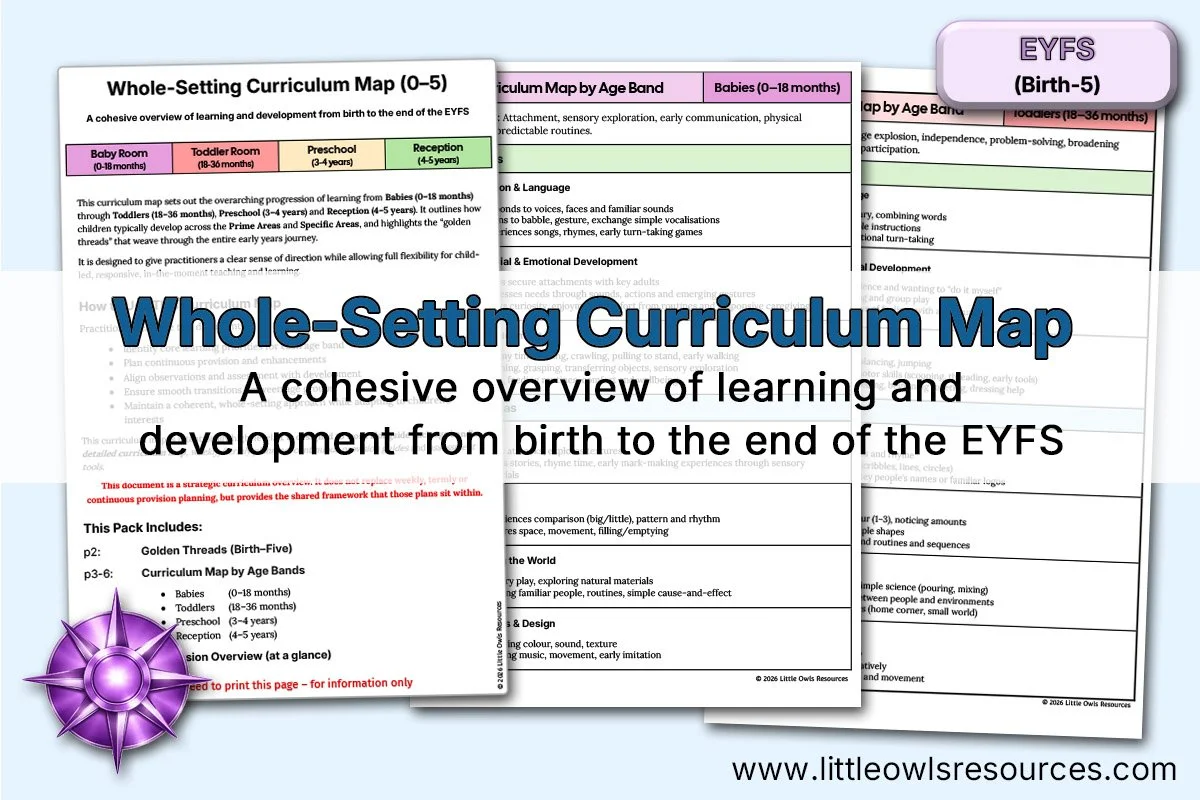
Whole-Setting Curriculum Map (Birth–5): Curriculum Intent & Progression Document

January 18, 2026 Stuart Murphy

Home › EYFS Curriculum & Pedagogy › Whole-Setting Curriculum Map (Birth–5): Curriculum Intent & Progression (Overview)


Whole-Setting Curriculum Map (Birth–5) | Curriculum Intent & Progression Document

A cohesive, high-level overview of learning and development from birth to the end of the EYFS.


Download Document Here:

 
Download DOCX 📝
Download PDF 📄


Document Updated: January 2026


Recommended next read Selection

EYFS
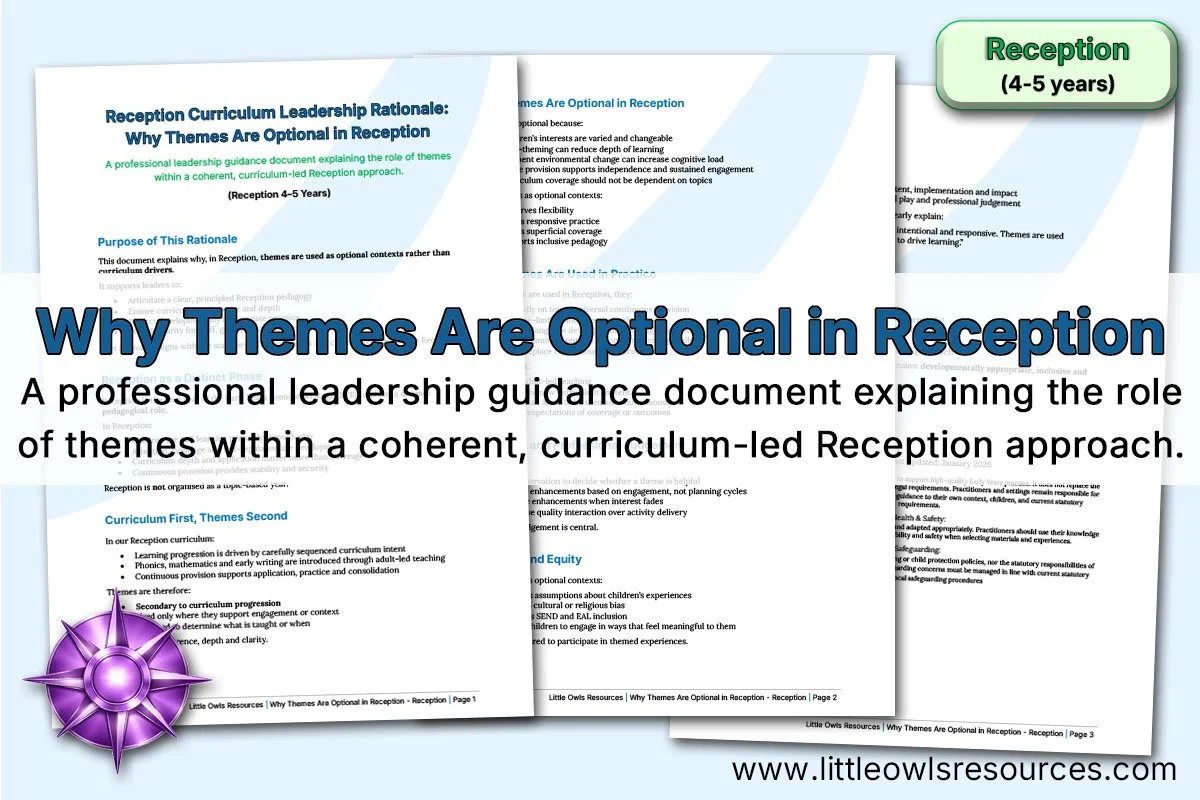
Why Themes Are Optional in Reception | 4-5 Years

A professional leadership guidance document explaining the role of themes within a coherent, curriculum-led Reception approach.

Read More →
How to Use the Reception Pathway | 4-5 Years

This document is designed to help practitioners and leaders understand how to navigate and use the Reception Pathway effectively.

Read More →
About Our Reception Curriculum Phase Framework | 4-5 Years

A professional guidance document explaining the rationale and structure behind our phase-based approach to Reception curriculum design.

Read More →
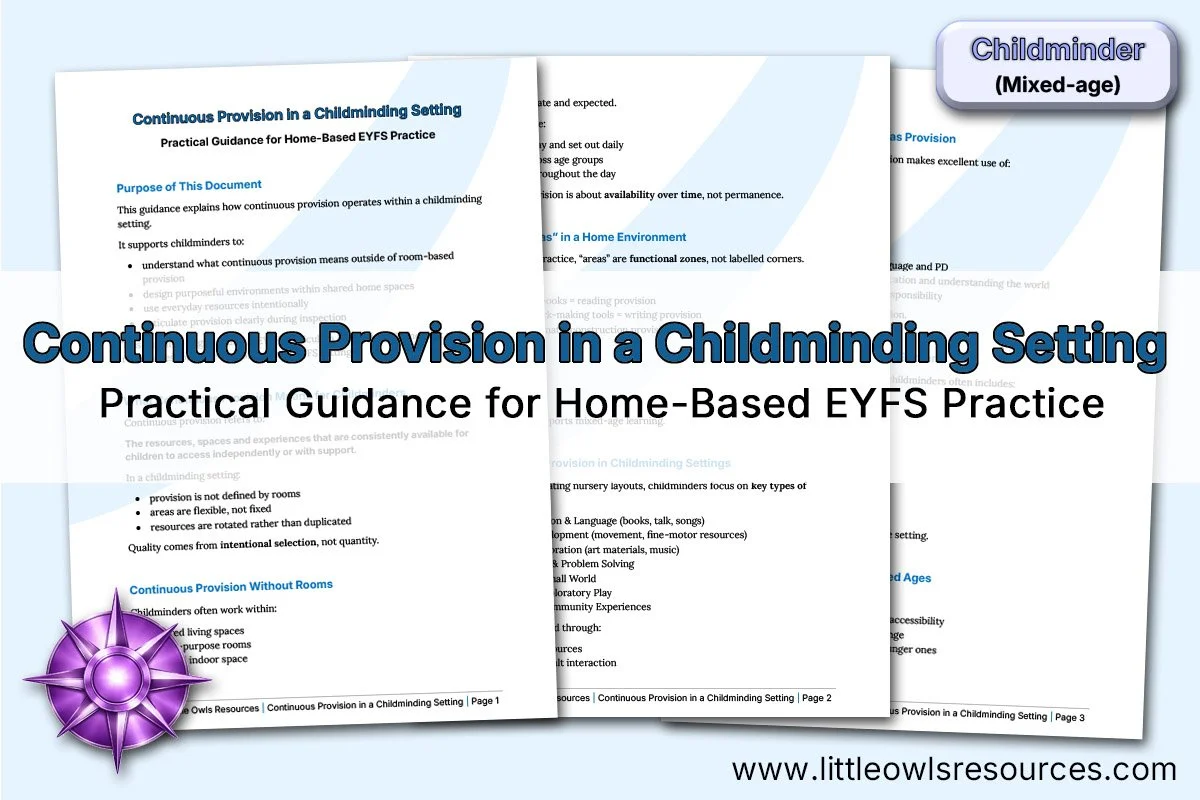
Continuous Provision in a Childminding Setting | Mixed-Age

A professional guidance document supporting confident continuous provision in home-based, mixed-age EYFS settings.

Read More →
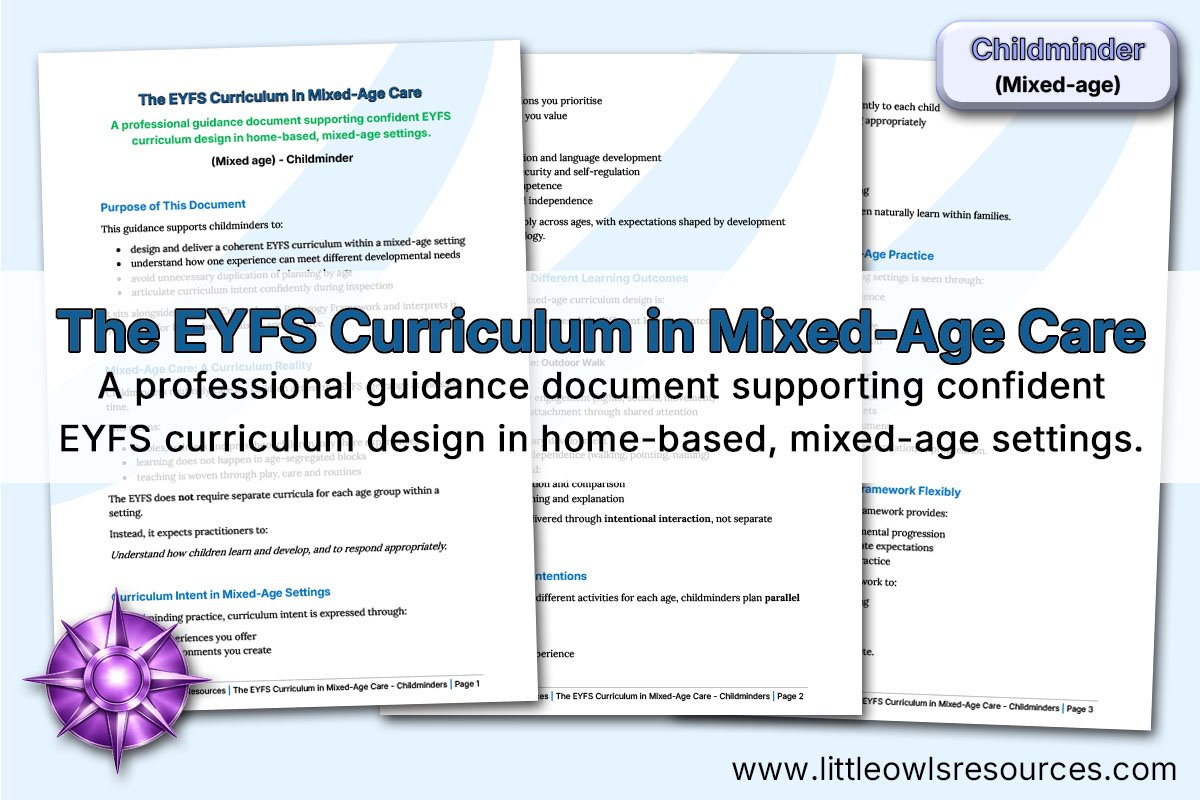
The EYFS Curriculum in Mixed-Age Care | Childminder Guidance

A professional guidance document supporting confident EYFS curriculum design in home-based, mixed-age settings.

Read More →
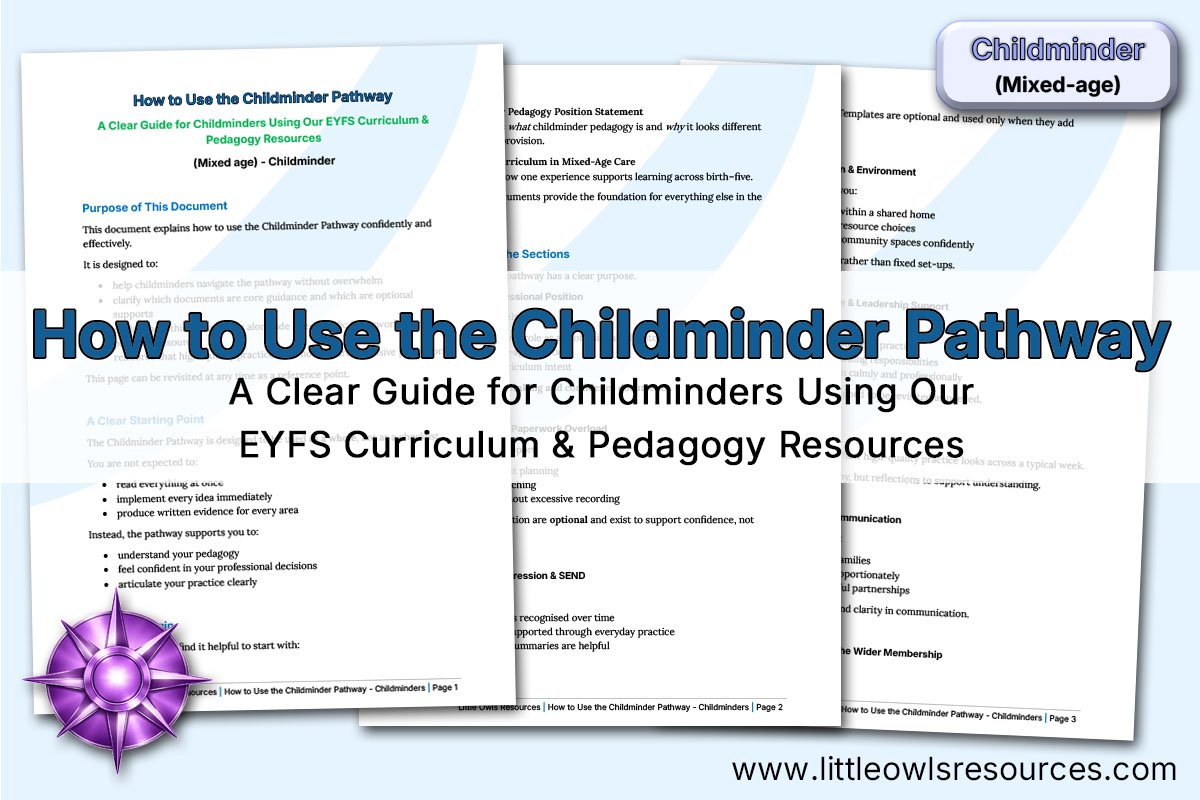
How To Use The Childminder Pathway | Mixed-Age

A Clear Guide for Childminders Using Our EYFS Curriculum & Pedagogy Resources

Read More →
FAQs: Toddler Planning & Pedagogy (18–36 Months)

This page answers frequently asked questions about planning and pedagogy in toddler rooms.

Read More →
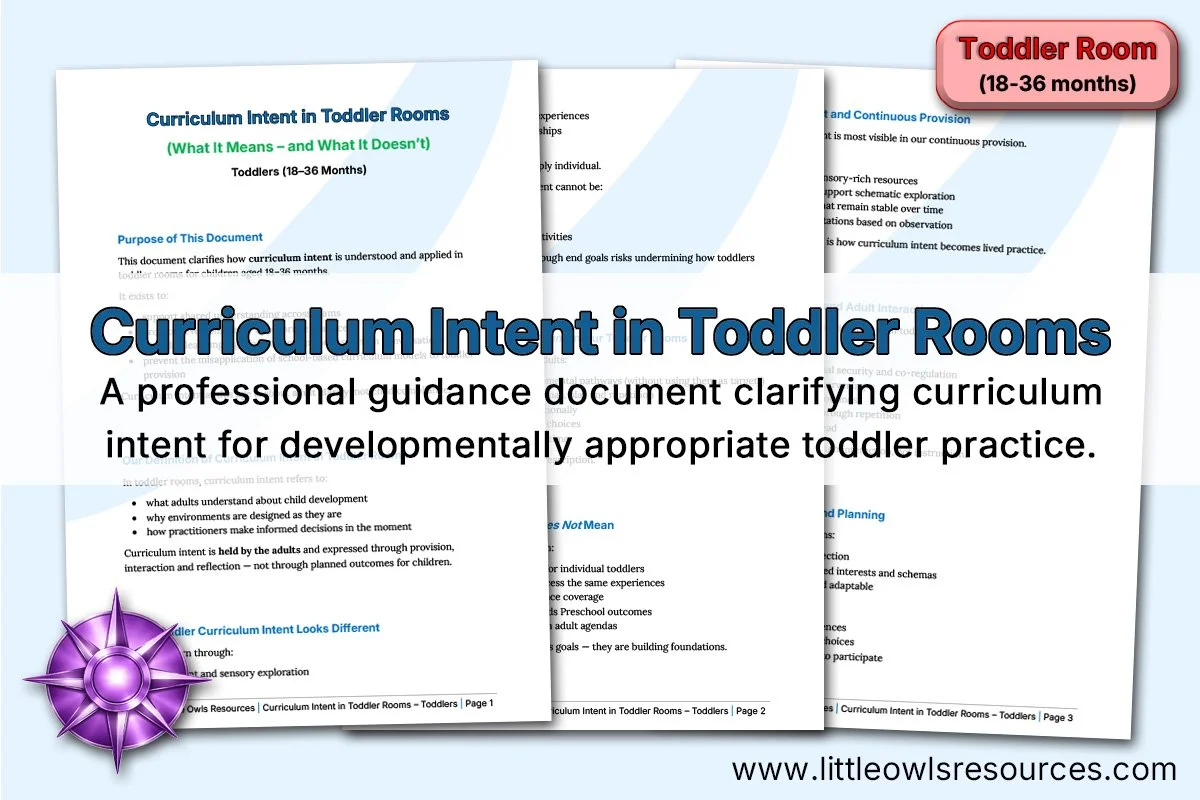
Curriculum Intent in Toddler Rooms | Toddlers (18–36 Months)

A professional guidance document clarifying curriculum intent for developmentally appropriate toddler practice.

Read More →
How Our Toddler Curriculum Works (18–36 Months)

A professional guidance document explaining how curriculum intent, implementation and impact operate in toddler rooms.

Read More →
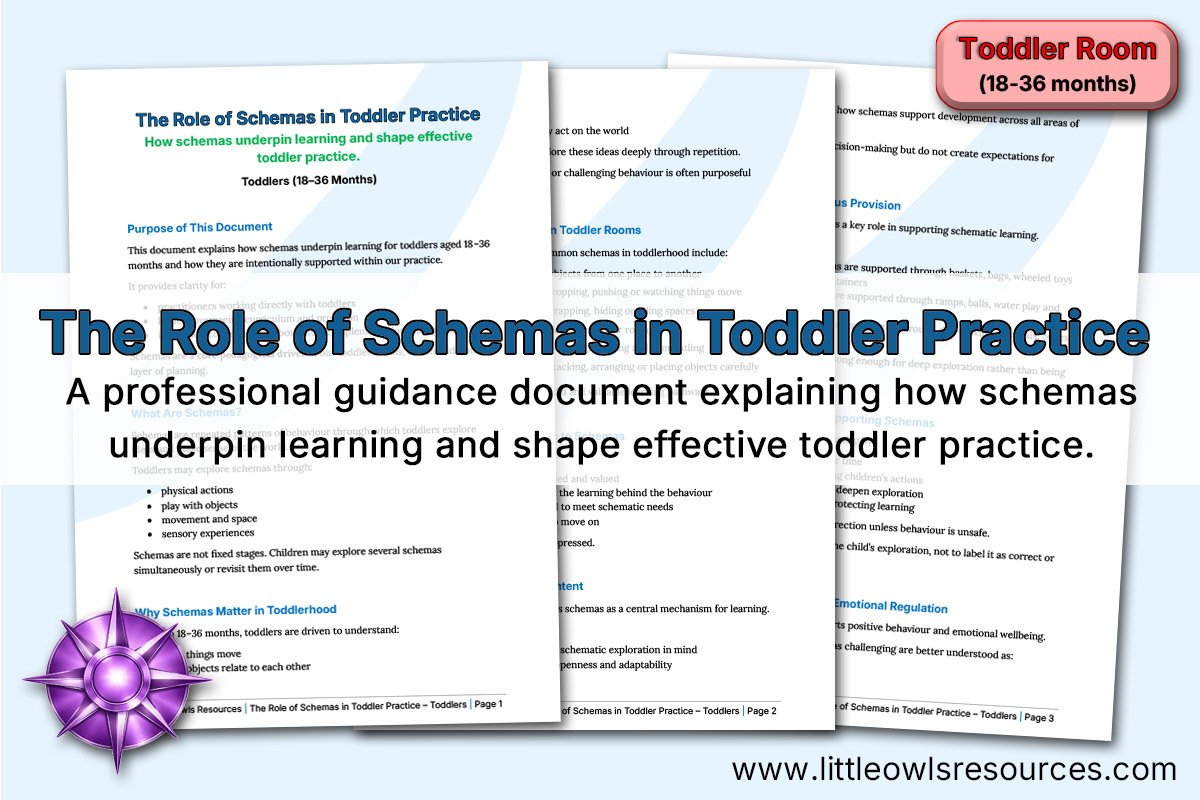
The Role of Schemas in Toddler Practice (18-36 Months)

A professional guidance document explaining how schemas underpin learning and shape effective toddler practice.

Read More →
How To Use The Toddler (18-36 Months) Pathway

This overview explains how to navigate, understand and use the Toddler (18–36 months) Pathway effectively.

Read More →
Curriculum Language in Baby Rooms | Babies (birth-18 months)

Explaining Intent, Implementation & Impact for babies aged 0–18 months

Read More →
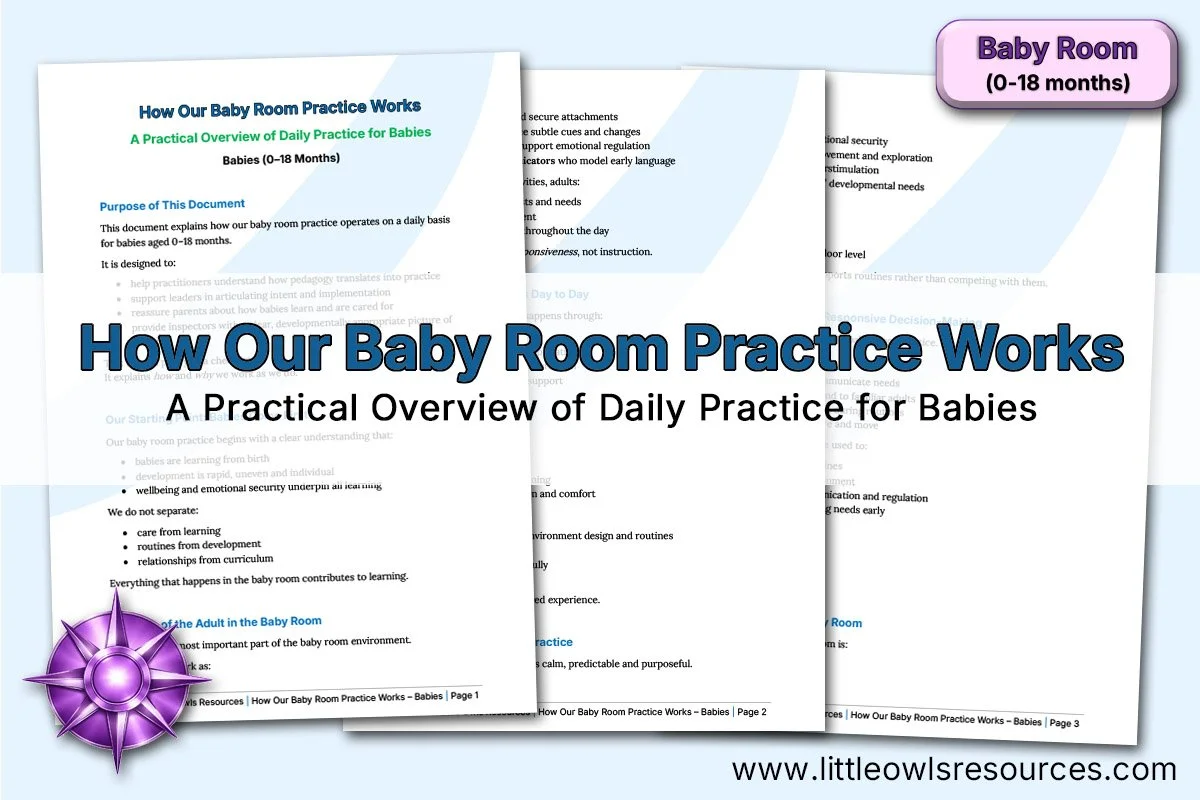
How Our Baby Room Practice Works | Babies (birth-18 months)

A professional overview explaining day-to-day EYFS practice for babies aged 0–18 months

Read More →
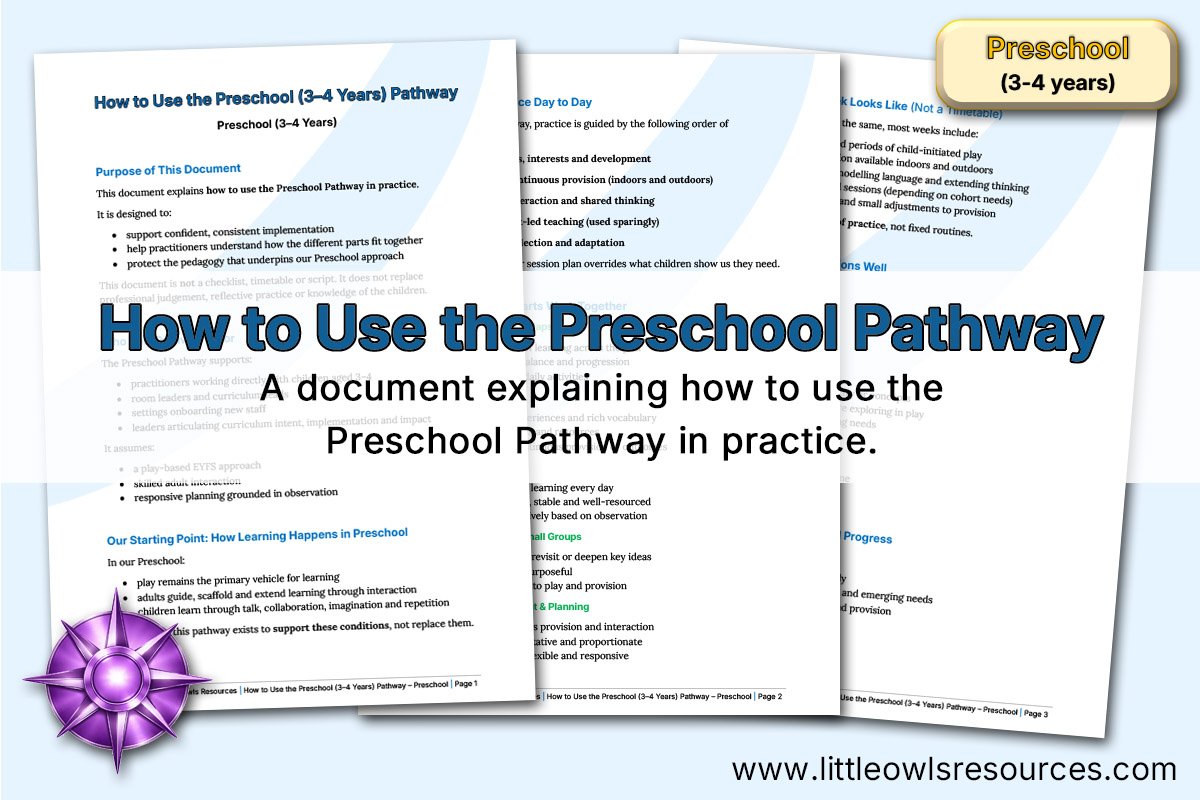
How To Use The Preschool (3-4 Years) Pathway

This document explains how to use the Preschool Pathway in practice.

Read More →
Adult-Led With Purpose Poster | Preschool 3-4 Years

A practitioner guidance poster clarifying intentional, play-based adult-led teaching

Read More →
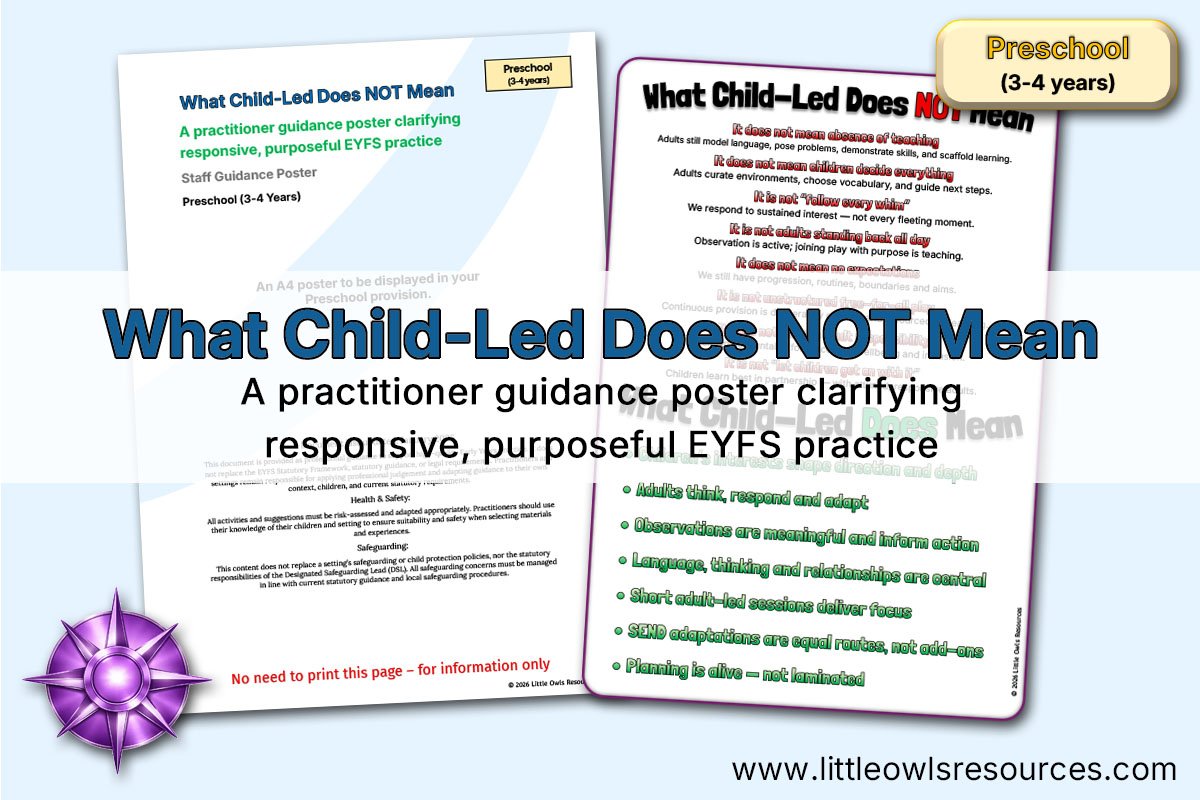
What Child-Led Does NOT Mean Poster | Preschool 3-4 Years

A practitioner guidance poster clarifying responsive, purposeful EYFS practice

Read More →
Preschool (3–4 Years) Curriculum Overview | How Themes Fit Together (Overview)

A full-year, responsive EYFS planning framework

Read More →
Whole-Setting Curriculum Map (Birth–5): Curriculum Intent & Progression (Overview)

A cohesive, high-level overview of learning and development from birth to the end of the EYFS.

Read More →
EYFS Inspection-Facing Summaries | Birth-5 Document (Overview)

Clear, age-phase inspection summaries articulating curriculum intent, implementation and impact across the EYFS.

Read More →
Speech & Language Development - Setting Statement | Birth-5 Document (Overview)

Setting Statement for Parents, Inspectors & Website

Read More →
EYFS from Birth to 5 | Curriculum Coherence & Pedagogical Throughline

Curriculum Coherence & Pedagogical Throughline

Read More →
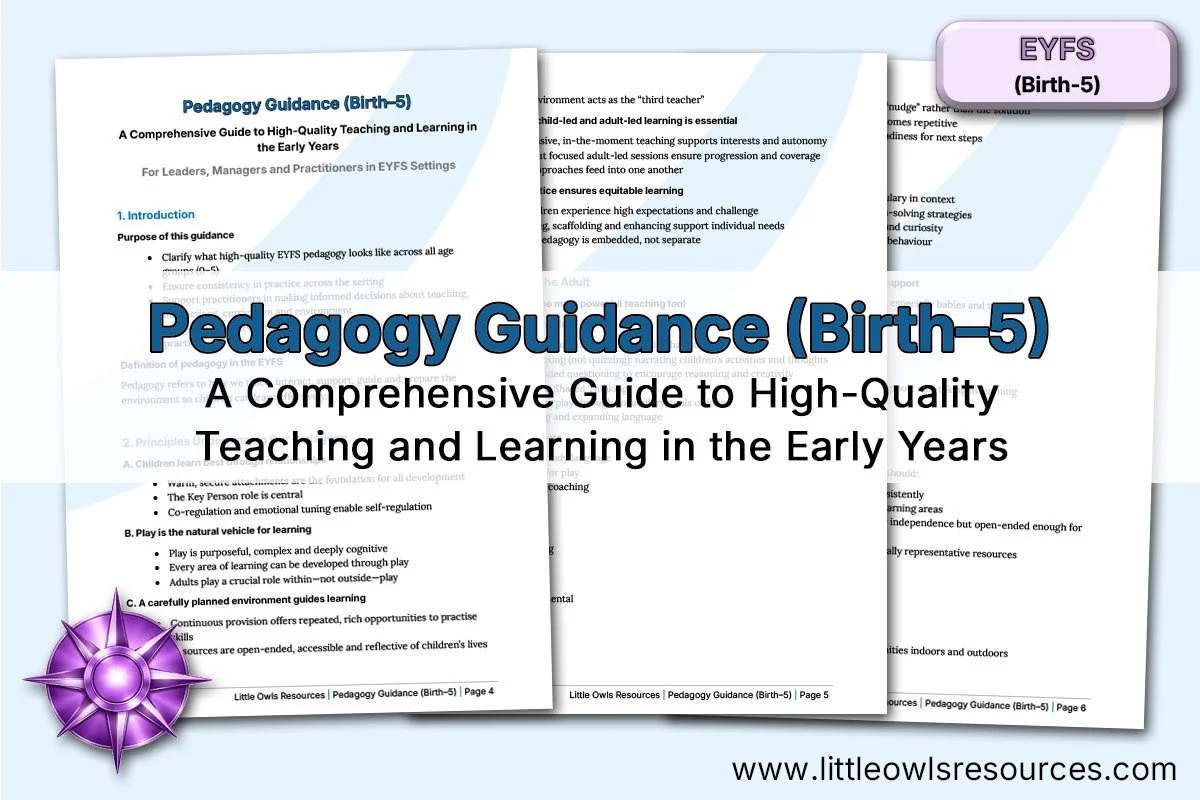
Pedagogy Guidance (Birth–5) | Whole-Setting Document (Overview)

A professional guidance document supporting confident, consistent EYFS pedagogy from birth to five.

Read More →
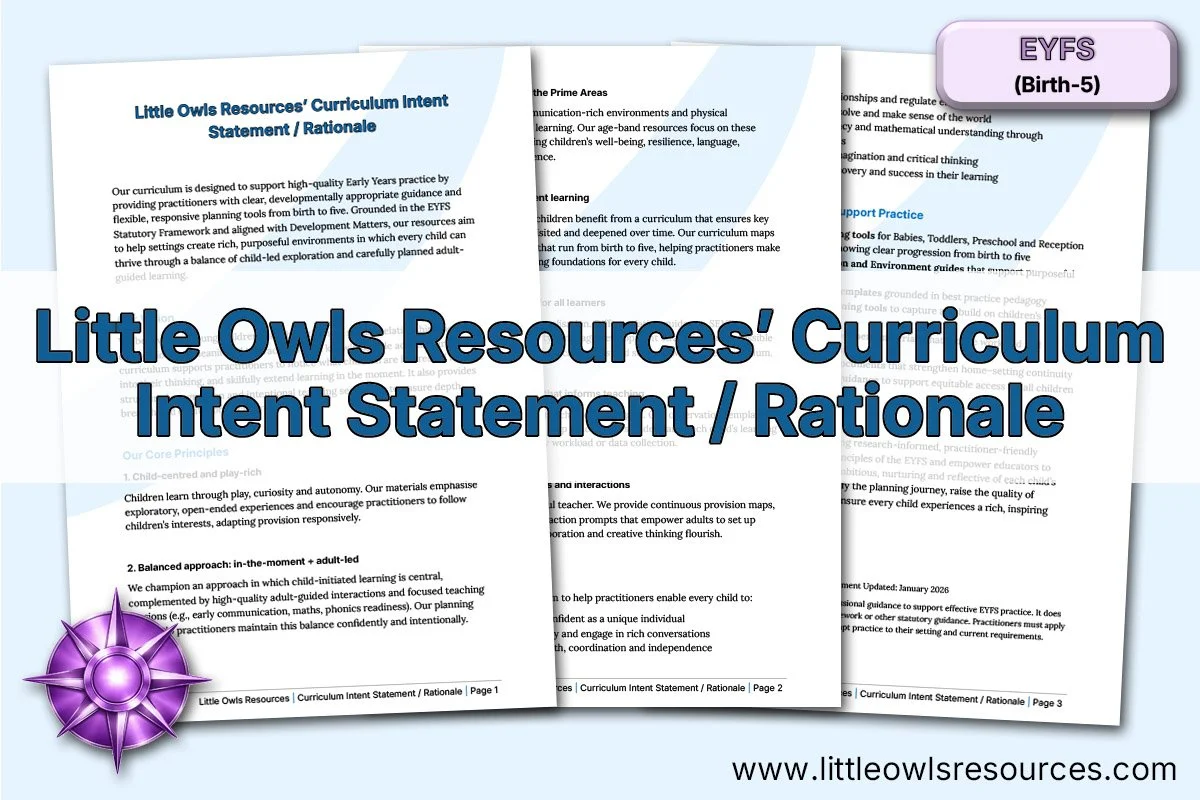
Little Owls Resources' Curriculum Intent Statement | Birth-5

Our curriculum is designed to support high-quality Early Years practice by providing practitioners with clear, developmentally appropriate guidance and flexible, responsive planning tools from birth to five.

Read More →
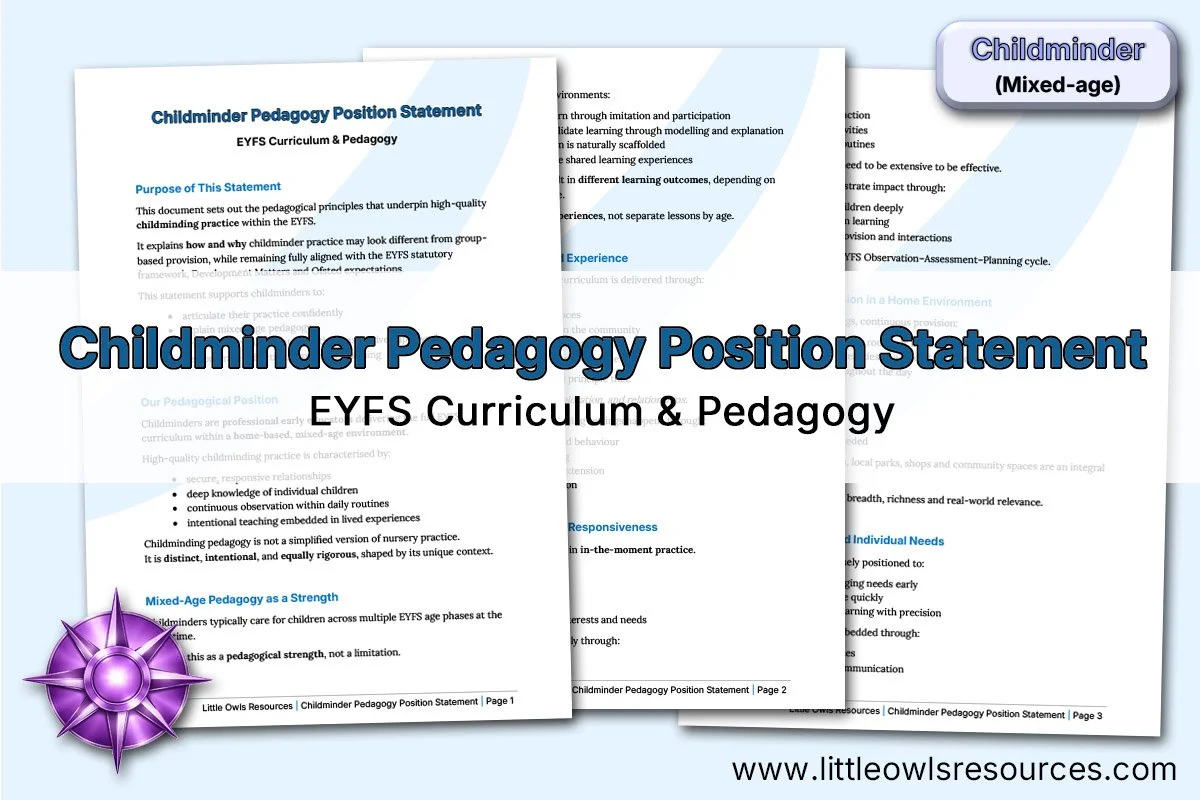
Childminder Pedagogy Position Statement | Mixed-Age

EYFS Curriculum & Pedagogy

Read More →
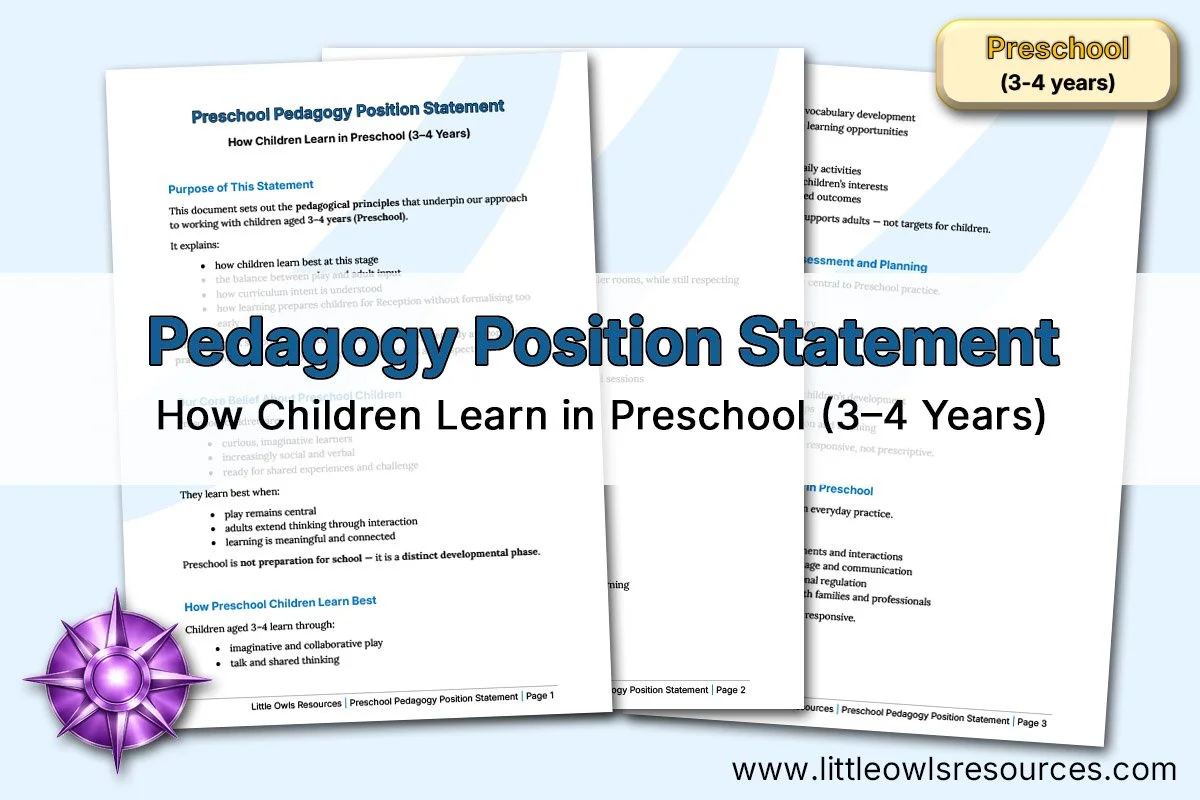
Preschool Pedagogy Position Statement | 3-4 Years

How Children Learn in Preschool (3–4 Years)

Read More →
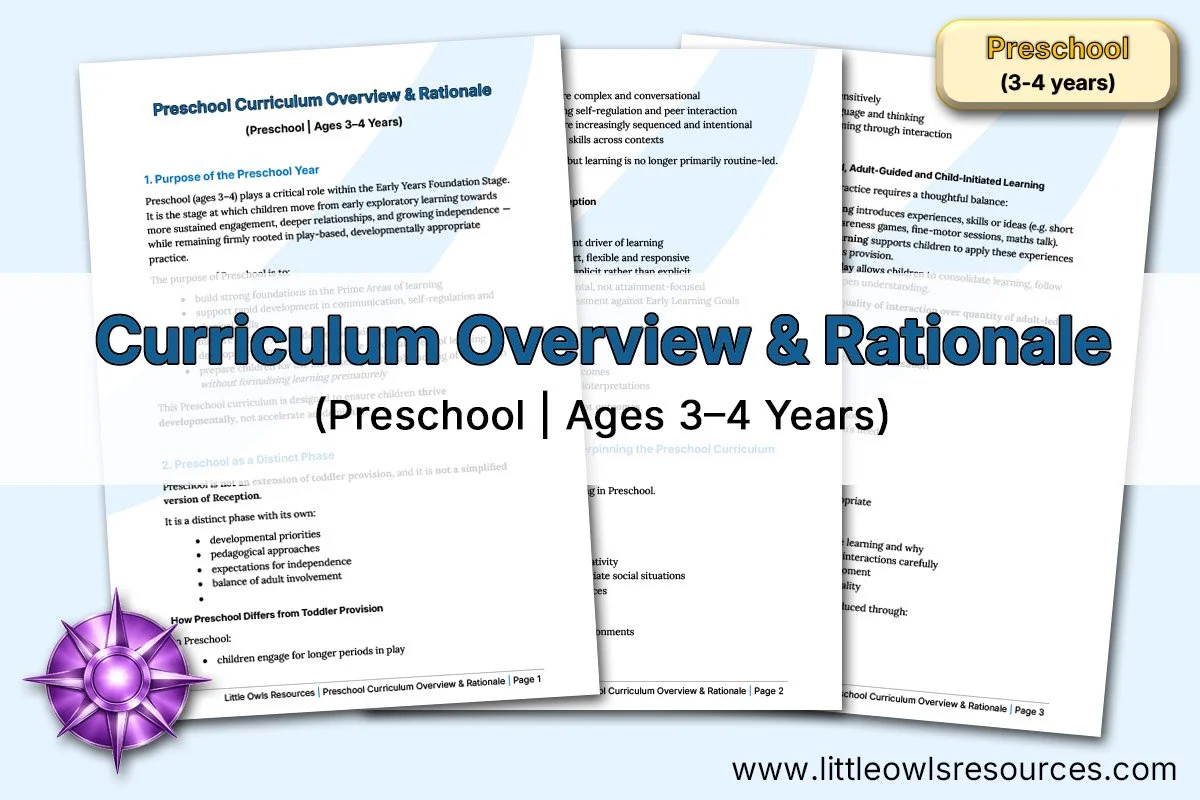
Preschool Curriculum Overview & Rationale | 3-4 Years

(Preschool | Ages 3–4 Years)

Read More →
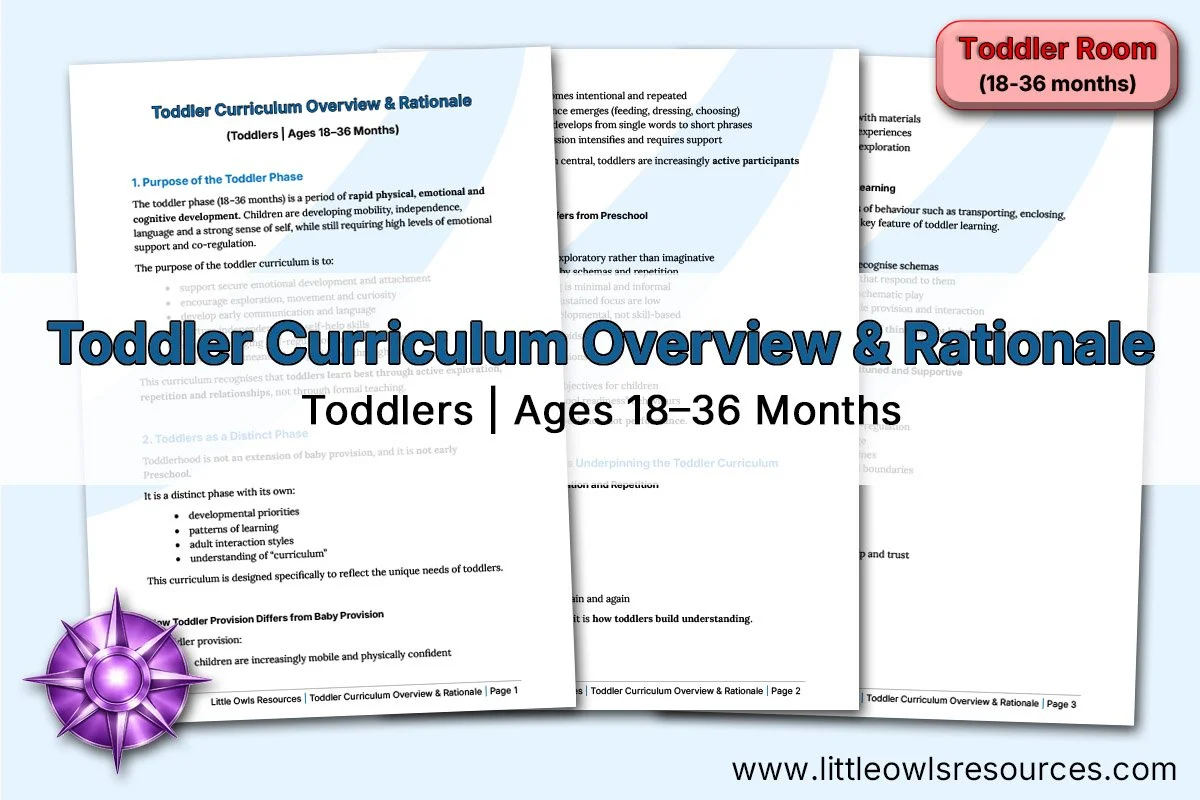
Toddler Curriculum Overview & Rationale | 18-36 Months

(Toddlers | Ages 18–36 Months)

Read More →
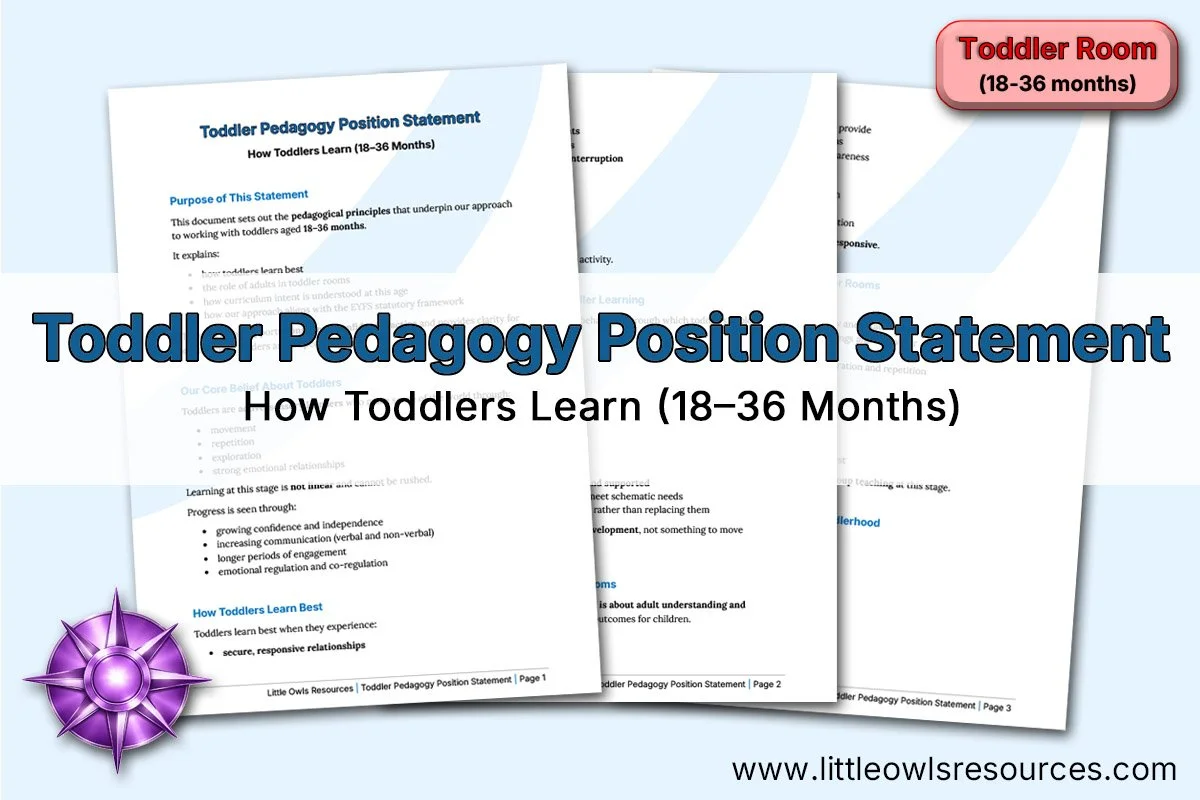
Toddler Pedagogy Position Statement | 18-36 Months

How Toddlers Learn (18–36 Months)

Read More →
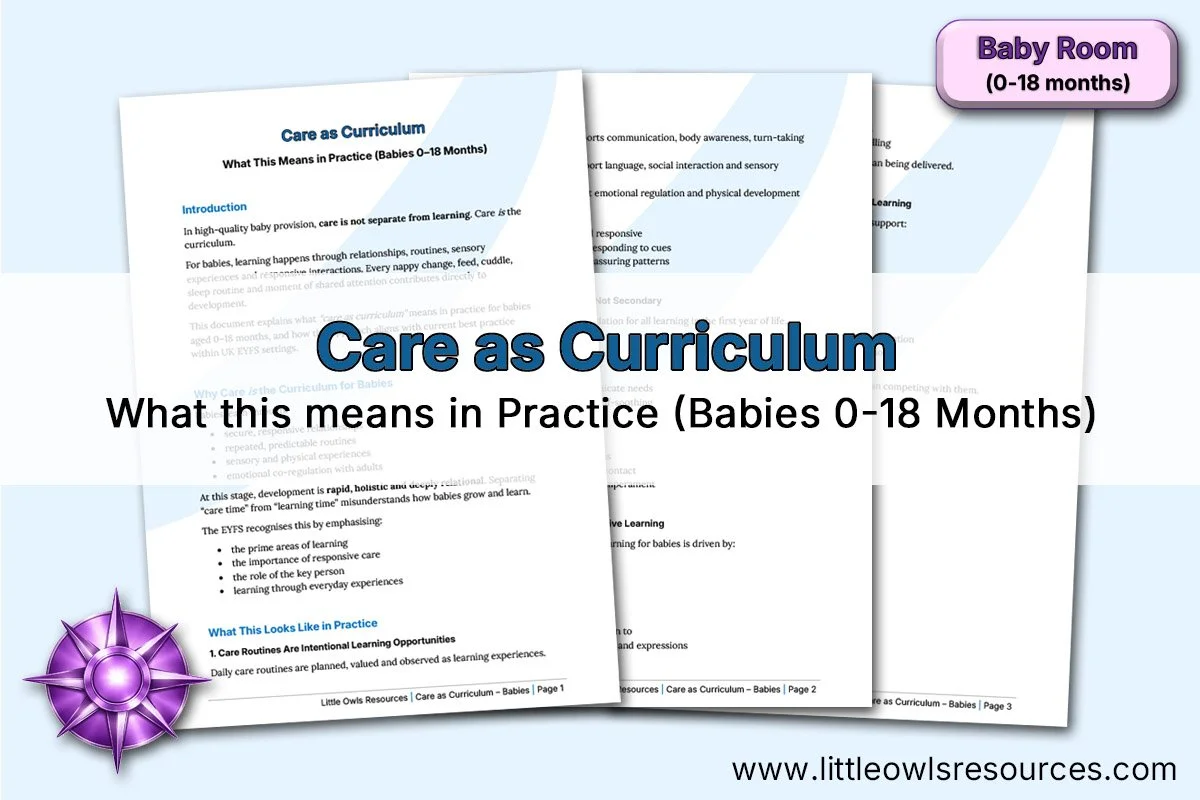
Care as Curriculum: What This Means in Practice | Babies 0-18 Months

What This Means in Practice (Babies 0–18 Months)

Read More →
Reception Curriculum Overview & Rationale | 4-5 Years

Reception Year | Ages 4–5

Read More →
 

Additional Whole-Setting Guidance | for Professional Members

Explore our whole-setting guidance below, including overarching curriculum and pedagogy documents, early years schemas and EYFS setting policies.

    • Little Owls Resources’ Curriculum Intent Statement

    • EYFS from Birth to 5: Curriculum Coherence & Pedagogical Throughline

    • Whole-Setting Curriculum Map (Birth-5): Curriculum Intent & Progression

    • Pedagogy Guidance Document

    • Speech & Language Development - Setting Statement

    • EYFS Inspection-Facing Summaries

  • Early Years Schemas - Practitioner Toolkit | EYFS Birth-5

    ↪ Schema Cards (definition, behaviours, age-related examples, enabling resources)

    ↪ Schema Observation & Responsive Provision Planning Template

    • EYFS Group Setting Policies Pack

      ↪ x 22 Policy Documents

      ↪ Policy Sign-Off and Confirmation Document

      ↪ EYFS Setting Policy Folder Contents List

    • Childminder Setting Policies Pack

      ↪ x 22 Policy Documents

      ↪ Childminder Assistant or Volunteer Policy Sign-Off and Confirmation Document

      ↪ Childminder Policy Folder Contents List

  • EYFS Glossary

    ↪ Clear, practitioner-friendly explanations of key curriculum and pedagogy terms used throughout our guidance.


Looking for age-specific pathway documents?

Select the pathway that best reflects your role or the age group you work with. You do not need to use everything. (Some practitioners may use more than one pathway.)
Featured
🍼 Babies (0–18 months)

Responsive care, observation and development in the earliest years

🚼 Toddlers (18–36 months)

Development, play and progression in the toddler years

🎨 Preschool (3–4 years)

Curriculum, continuous provision and purposeful teaching

🎓 Reception (4–5 years)

Play-based pedagogy, progression and EYFSP readiness

🏡 Childminders (Birth–5)

Mixed-age pedagogy, planning without overload and inspection confidence


Latest EYFS Articles & Practical Guides | From Our Blog

Stay informed, get expert advice, and find inspiration from our collection of articles and useful external resources, tailored specifically for EYFS practitioners. We regularly publish in-depth articles to support you with current best practices, regulatory changes, and fresh ideas.

EYFS & KS1 Articles
Major UK Curriculum Shake-Up Announced: What EYFS & KS1 Practitioners Need to Know

A major overhaul of the national curriculum in England has been announced following the publication of the independent Curriculum and Assessment Review. For those working in the Early Years Foundation Stage (EYFS) and Key Stage 1 (KS1), the changes signal a renewed focus on practical life skills, digital literacy, and enriching learning experiences…

Read More →
New Education Inspection Framework | What EYFS Settings Need to Know

The world of early years education is constantly evolving, and with it, the frameworks that guide and assess our invaluable work. Come November 2025, a significant shift will occur as the new Education Inspection Framework (EIF) comes into effect, bringing with it some crucial changes…

Read More →
Revised 2025 EYFS Statutory Framework for Group & School-Based Providers | What You Need to Know

With the new 2025 EYFS Statutory Framework for group and school-based providers coming into effect on 1st September 2025, it's essential to understand the updates to ensure your practice remains compliant, effective…

Read More →
DfE Press Release | Parents urged to read more to boost children’s life chances

The Education Secretary is calling on parents to lead by example and make reading a daily habit to help reverse the decline in reading for pleasure, to help give kids the best start in life as part of the…

Read More →
DfE Update | Drowning Prevention Week: what children learn about water safety at school

As we head into summer, it’s especially important that children are prepared with these skills. This year, the Royal Life Saving Society UK's Drowning Prevention Week runs from 14 June to 21…

Read More →
DfE Update | Hot weather and heatwaves: guidance for schools and other education settings

There are several ways that schools can make changes to keep children safe in hot weather, especially as children are more at risk of becoming ill with heat-related issues than adults…

Read More →
 

Are you looking for a specific resource or document for your provision?

Use our 🔍 SEARCH Bar located at the top of every page.


Content within the EYFS Curriculum & Pedagogy Membership is provided as professional guidance and support. It reflects current understanding of the EYFS statutory framework, Development Matters and inspection expectations at the time of writing. Practitioners are responsible for applying professional judgement and ensuring practice aligns with current statutory requirements and their specific context.

Updated: January 2026

 
In Whole-Setting | C & P, Birth-5, Pedagogy, Inspection-Facing, Group & School-Based, Childminder, Curriculum Tags Whole-Setting Curriculum Map (Birth–5): Curriculum Intent & Progression Document

Childminder Setting Policies Pack | Birth-5 Documents

January 18, 2026 Stuart Murphy

Home › EYFS Curriculum & Pedagogy › Whole-Setting Curriculum & Pedagogy › Childminder Setting Policies Pack | Birth-5 Documents (Overview)


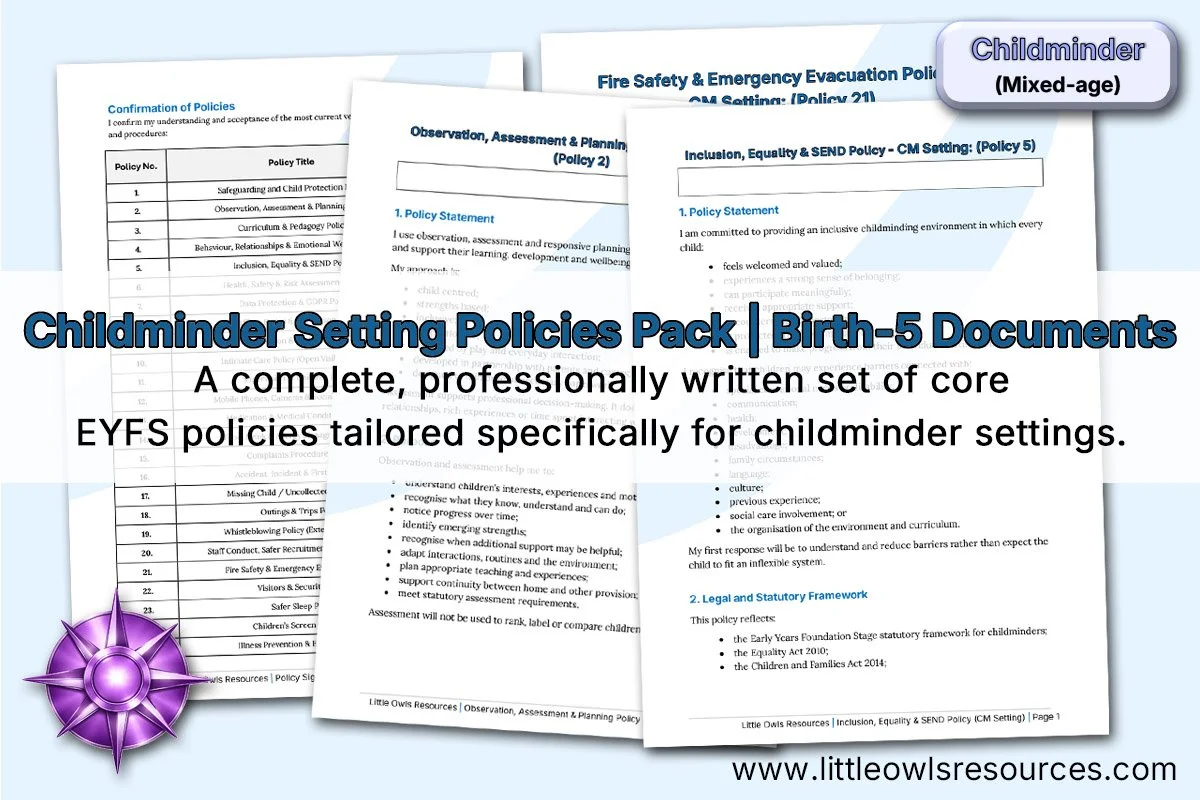
Childminder Setting Policies Pack | Birth-5 Documents

A complete, professionally written set of core EYFS policies tailored specifically for childminder settings.

Download Childminder Policy Documents Here:

  • 1. Safeguarding & Child Protection ⋙ DOCX 📝 | PDF 📄

  • 2. Observation, Assessment & Planning ⋙ DOCX 📝 | PDF 📄

  • 3. Curriculum & Pedagogy ⋙ DOCX 📝 | PDF 📄

  • 4. Behaviour, Relationships & Emotional Wellbeing ⋙ DOCX 📝 | PDF 📄

  • 5. Inclusion, Equality & SEND ⋙ DOCX 📝 | PDF 📄

  • 6. Health, Safety & Risk Assessment ⋙ DOCX 📝 | PDF 📄

  • 7. Data Protection & GDPR ⋙ DOCX 📝 | PDF 📄

  • 8. Staffing, Ratios & Key Person ⋙ DOCX 📝 | PDF 📄

  • 9. Physical Intervention & Positive Handling ⋙ DOCX 📝 | PDF 📄

  • 10. Intimate Care ⋙ DOCX 📝 | PDF 📄

  • 11. Supervision of Children ⋙ DOCX 📝 | PDF 📄

  • 12. Mobile Phones, Cameras & Social Media ⋙ DOCX 📝 | PDF 📄

  • 13. Medication & Medical Conditions ⋙ DOCX 📝 | PDF 📄

  • 14. Food, Drink & Allergy Management ⋙ DOCX 📝 | PDF 📄

  • 15. Complaints Procedure ⋙ DOCX 📝 | PDF 📄

  • 16. Accident, Incident & First Aid ⋙ DOCX 📝 | PDF 📄

  • 17. Missing Child / Uncollected Child ⋙ DOCX 📝 | PDF 📄

  • 18. Outings & Trips ⋙ DOCX 📝 | PDF 📄

  • 19. Whistleblowing ⋙ DOCX 📝 | PDF 📄

  • 20. Staff Conduct, Safer Recruitment & Induction ⋙ DOCX 📝 | PDF 📄

  • 21. Fire Safety & Emergency Evacuation ⋙ DOCX 📝 | PDF 📄

  • 22. Visitors & Security ⋙ DOCX 📝 | PDF 📄

The pack also includes:

  • Policy Sign-Off and Confirmation Document ⋙ DOCX 📝 | PDF 📄

  • Childminder Setting Policy Folder Contents List ⋙ DOCX 📝 | PDF 📄

Documents Updated: January 2026

Disclaimer Notice

These policies are provided as professionally written guidance to support Childminder settings in meeting their statutory duties and embedding high-quality practice in line with the EYFS Statutory Framework and associated legislation.

While every effort has been made to ensure accuracy and alignment with current requirements at the time of publication, this Policies Pack is intended to be adopted, adapted and implemented in accordance with each setting’s specific context, local authority guidance and regulatory requirements.

It remains the responsibility of the setting’s registered provider, leadership team and designated safeguarding leads to:

  • Ensure policies reflect their individual setting, cohort and operational arrangements

  • Keep policies up to date with changes to legislation, statutory guidance and local procedures

  • Implement policies consistently through staff training, supervision and monitoring

These documents are designed to support professional judgement, not replace statutory guidance, legal advice, or the requirements of regulatory bodies such as Ofsted, local safeguarding partnerships or health authorities.

By using this Policies Pack, settings acknowledge that policies must be reviewed regularly and contextualised to ensure they remain accurate, effective and compliant.


Recommended next read Selection

EYFS
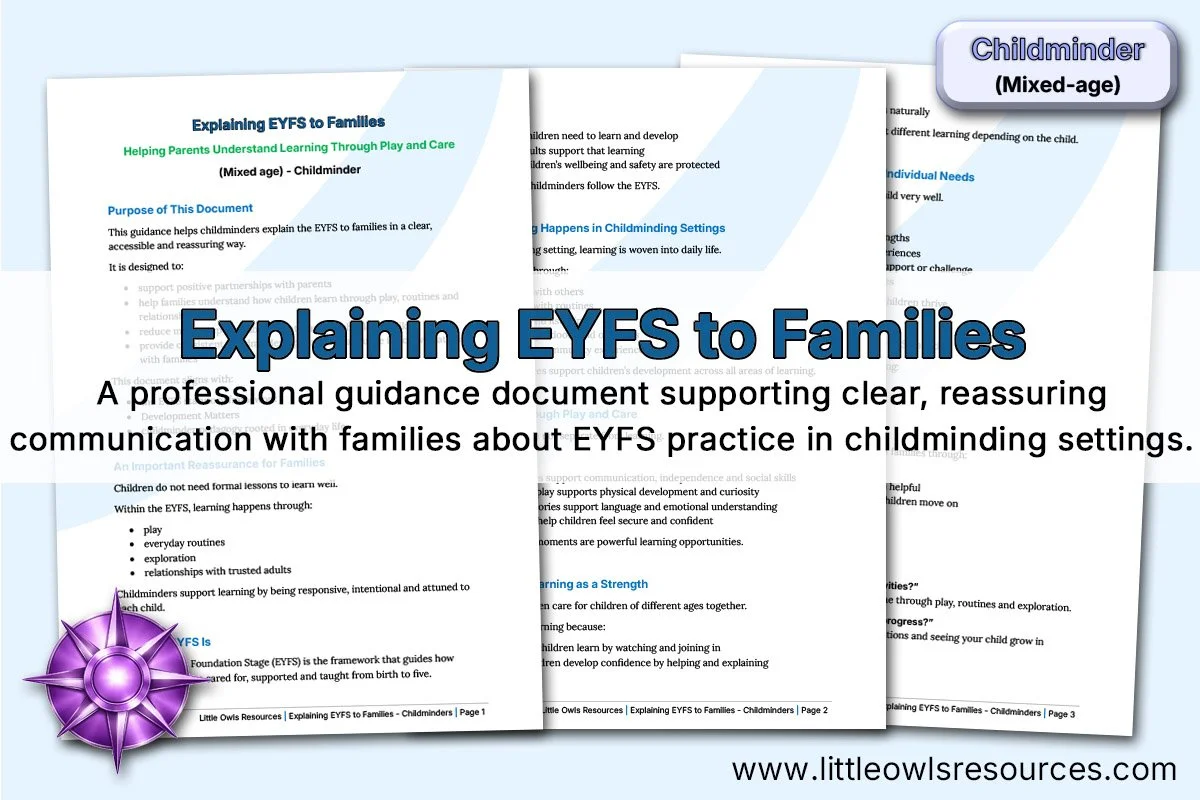
Explaining EYFS to Families | Childminder (Mixed-Age)

Helping Parents Understand Learning Through Play and Care - A professional guidance document supporting clear, reassuring communication with families about EYFS practice in childminding settings.

Read More →
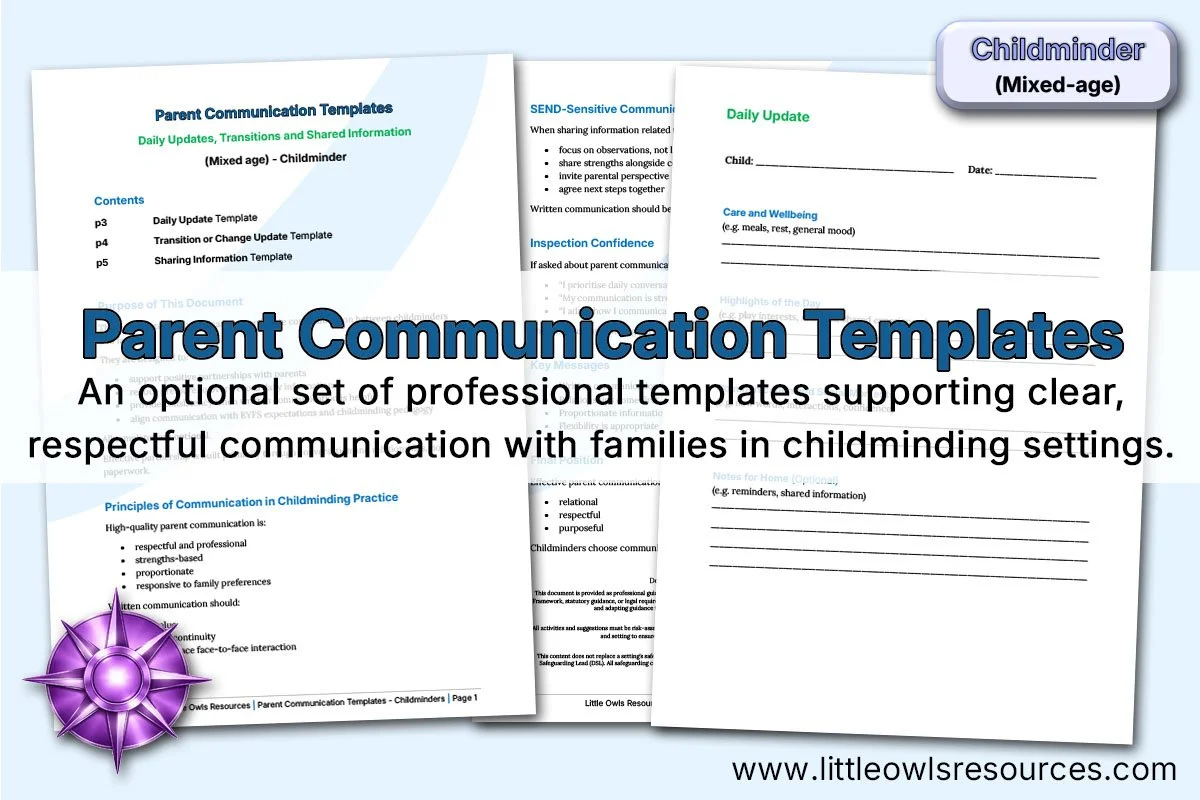
Parent Communication Templates | Childminder (Mixed-Age)

Daily Updates, Transitions and Shared Information - An optional set of professional templates supporting clear, respectful communication with families in childminding settings.

Read More →
Continuous Provision in a Childminding Setting | Mixed-Age

A professional guidance document supporting confident continuous provision in home-based, mixed-age EYFS settings.

Read More →
The EYFS Curriculum in Mixed-Age Care | Childminder Guidance

A professional guidance document supporting confident EYFS curriculum design in home-based, mixed-age settings.

Read More →
How To Use The Childminder Pathway | Mixed-Age

A Clear Guide for Childminders Using Our EYFS Curriculum & Pedagogy Resources

Read More →
Early Years Schemas - Practitioner Toolkit | EYFS Birth-5 (Overview)

A practical, research-informed toolkit for recognising schemas and responding through meaningful, child-led provision.

Read More →
Childminder Pedagogy Position Statement | Mixed-Age

EYFS Curriculum & Pedagogy

Read More →

Additional Whole-Setting Guidance | for Professional Members

Explore our whole-setting guidance below, including overarching curriculum and pedagogy documents, early years schemas and EYFS setting policies.

    • Little Owls Resources’ Curriculum Intent Statement

    • EYFS from Birth to 5: Curriculum Coherence & Pedagogical Throughline

    • Whole-Setting Curriculum Map (Birth-5): Curriculum Intent & Progression

    • Pedagogy Guidance Document

    • Speech & Language Development - Setting Statement

    • EYFS Inspection-Facing Summaries

  • Early Years Schemas - Practitioner Toolkit | EYFS Birth-5

    ↪ Schema Cards (definition, behaviours, age-related examples, enabling resources)

    ↪ Schema Observation & Responsive Provision Planning Template

    • EYFS Group Setting Policies Pack

      ↪ x 22 Policy Documents

      ↪ Policy Sign-Off and Confirmation Document

      ↪ EYFS Setting Policy Folder Contents List

    • Childminder Setting Policies Pack

      ↪ x 22 Policy Documents

      ↪ Childminder Assistant or Volunteer Policy Sign-Off and Confirmation Document

      ↪ Childminder Policy Folder Contents List

  • EYFS Glossary

    ↪ Clear, practitioner-friendly explanations of key curriculum and pedagogy terms used throughout our guidance.

Looking for age-specific pathway documents?

Select the pathway that best reflects your role or the age group you work with. You do not need to use everything. (Some practitioners may use more than one pathway.)
Featured
🍼 Babies (0–18 months)

Responsive care, observation and development in the earliest years

🚼 Toddlers (18–36 months)

Development, play and progression in the toddler years

🎨 Preschool (3–4 years)

Curriculum, continuous provision and purposeful teaching

🎓 Reception (4–5 years)

Play-based pedagogy, progression and EYFSP readiness

🏡 Childminders (Birth–5)

Mixed-age pedagogy, planning without overload and inspection confidence

Latest EYFS Articles & Practical Guides | From Our Blog

Stay informed, get expert advice, and find inspiration from our collection of articles and useful external resources, tailored specifically for EYFS practitioners. We regularly publish in-depth articles to support you with current best practices, regulatory changes, and fresh ideas.

EYFS & KS1 Articles
Major UK Curriculum Shake-Up Announced: What EYFS & KS1 Practitioners Need to Know

A major overhaul of the national curriculum in England has been announced following the publication of the independent Curriculum and Assessment Review. For those working in the Early Years Foundation Stage (EYFS) and Key Stage 1 (KS1), the changes signal a renewed focus on practical life skills, digital literacy, and enriching learning experiences…

Read More →
New Education Inspection Framework | What EYFS Settings Need to Know

The world of early years education is constantly evolving, and with it, the frameworks that guide and assess our invaluable work. Come November 2025, a significant shift will occur as the new Education Inspection Framework (EIF) comes into effect, bringing with it some crucial changes…

Read More →
Revised 2025 EYFS Statutory Framework for Group & School-Based Providers | What You Need to Know

With the new 2025 EYFS Statutory Framework for group and school-based providers coming into effect on 1st September 2025, it's essential to understand the updates to ensure your practice remains compliant, effective…

Read More →
DfE Press Release | Parents urged to read more to boost children’s life chances

The Education Secretary is calling on parents to lead by example and make reading a daily habit to help reverse the decline in reading for pleasure, to help give kids the best start in life as part of the…

Read More →
DfE Update | Drowning Prevention Week: what children learn about water safety at school

As we head into summer, it’s especially important that children are prepared with these skills. This year, the Royal Life Saving Society UK's Drowning Prevention Week runs from 14 June to 21…

Read More →
DfE Update | Hot weather and heatwaves: guidance for schools and other education settings

There are several ways that schools can make changes to keep children safe in hot weather, especially as children are more at risk of becoming ill with heat-related issues than adults…

Read More →
 

Are you looking for a specific resource or document for your provision?

Use our 🔍 SEARCH Bar located at the top of every page.

Content within the EYFS Curriculum & Pedagogy Membership is provided as professional guidance and support. It reflects current understanding of the EYFS statutory framework, Development Matters and inspection expectations at the time of writing. Practitioners are responsible for applying professional judgement and ensuring practice aligns with current statutory requirements and their specific context.

Updated: January 2026

 
In Whole-Setting | C & P, Birth-5, Pedagogy, Inspection-Facing, Parent-Facing, Policies, Childminder Tags Childminder Setting Policies Pack | Birth-5 Documents, Childminder

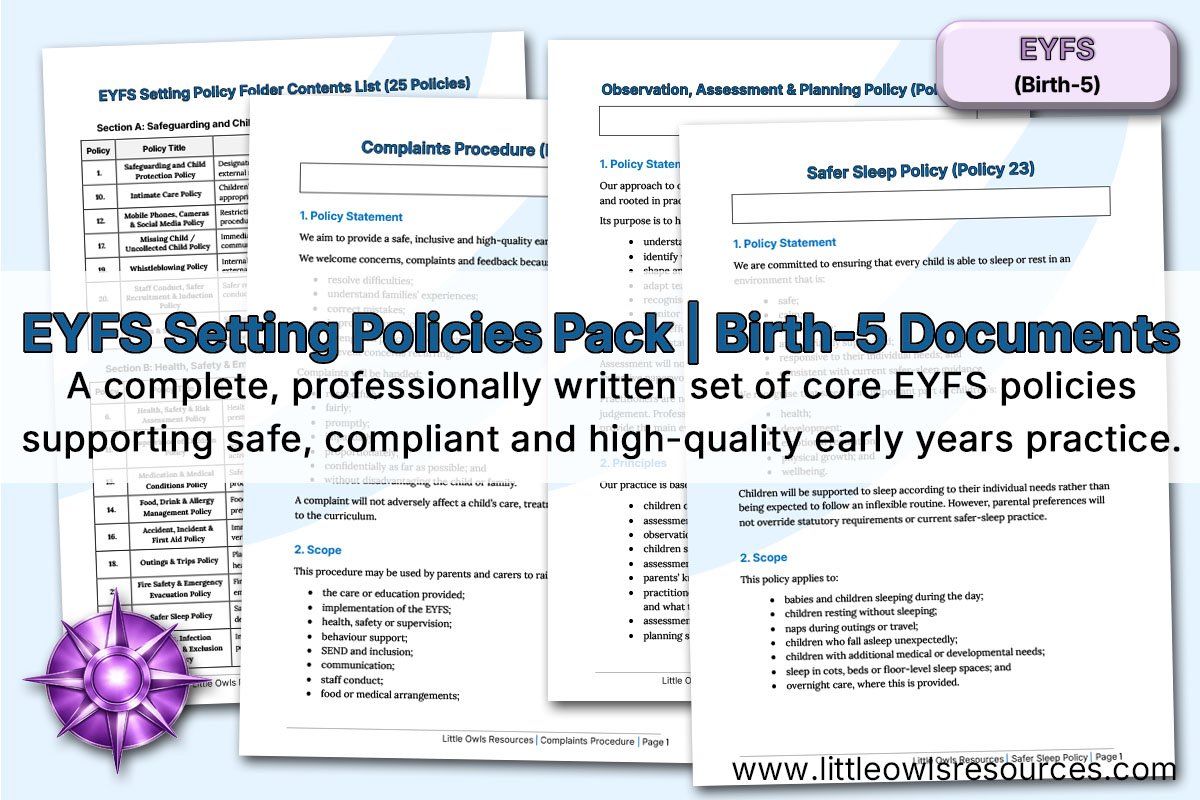
EYFS Setting Policies Pack | Birth-5 Documents

January 18, 2026 Stuart Murphy

Home › EYFS Curriculum & Pedagogy › EYFS Setting Policies Pack | Birth-5 Documents (Overview)


EYFS Setting Policies Pack | Birth-5 Documents

A complete, professionally written set of core EYFS policies supporting safe, compliant and high-quality early years practice.

Download EYFS Setting Policy Documents Here:

  • 1. Safeguarding & Child Protection ⋙ DOCX 📝 | PDF 📄

  • 2. Observation, Assessment & Planning ⋙ DOCX 📝 | PDF 📄

  • 3. Curriculum & Pedagogy ⋙ DOCX 📝 | PDF 📄

  • 4. Behaviour, Relationships & Emotional Wellbeing ⋙ DOCX 📝 | PDF 📄

  • 5. Inclusion, Equality & SEND ⋙ DOCX 📝 | PDF 📄

  • 6. Health, Safety & Risk Assessment ⋙ DOCX 📝 | PDF 📄

  • 7. Data Protection & GDPR ⋙ DOCX 📝 | PDF 📄

  • 8. Staffing, Ratios & Key Person ⋙ DOCX 📝 | PDF 📄

  • 9. Physical Intervention & Positive Handling ⋙ DOCX 📝 | PDF 📄

  • 10. Intimate Care ⋙ DOCX 📝 | PDF 📄

  • 11. Supervision of Children ⋙ DOCX 📝 | PDF 📄

  • 12. Mobile Phones, Cameras & Social Media ⋙ DOCX 📝 | PDF 📄

  • 13. Medication & Medical Conditions ⋙ DOCX 📝 | PDF 📄

  • 14. Food, Drink & Allergy Management ⋙ DOCX 📝 | PDF 📄

  • 15. Complaints Procedure ⋙ DOCX 📝 | PDF 📄

  • 16. Accident, Incident & First Aid ⋙ DOCX 📝 | PDF 📄

  • 17. Missing Child / Uncollected Child ⋙ DOCX 📝 | PDF 📄

  • 18. Outings & Trips ⋙ DOCX 📝 | PDF 📄

  • 19. Whistleblowing ⋙ DOCX 📝 | PDF 📄

  • 20. Staff Conduct, Safer Recruitment & Induction ⋙ DOCX 📝 | PDF 📄

  • 21. Fire Safety & Emergency Evacuation ⋙ DOCX 📝 | PDF 📄

  • 22. Visitors & Security ⋙ DOCX 📝 | PDF 📄

The pack also includes:

  • Policy Sign-Off and Confirmation Document ⋙ DOCX 📝 | PDF 📄

  • EYFS Setting Policy Folder Contents List ⋙ DOCX 📝 | PDF 📄

Documents Updated: January 2026

Disclaimer Notice

These policies are provided as professionally written guidance to support Early Years settings in meeting their statutory duties and embedding high-quality practice in line with the EYFS Statutory Framework and associated legislation.

While every effort has been made to ensure accuracy and alignment with current requirements at the time of publication, this Policies Pack is intended to be adopted, adapted and implemented in accordance with each setting’s specific context, local authority guidance and regulatory requirements.

It remains the responsibility of the setting’s registered provider, leadership team and designated safeguarding leads to:

  • Ensure policies reflect their individual setting, cohort and operational arrangements

  • Keep policies up to date with changes to legislation, statutory guidance and local procedures

  • Implement policies consistently through staff training, supervision and monitoring

These documents are designed to support professional judgement, not replace statutory guidance, legal advice, or the requirements of regulatory bodies such as Ofsted, local safeguarding partnerships or health authorities.

By using this Policies Pack, settings acknowledge that policies must be reviewed regularly and contextualised to ensure they remain accurate, effective and compliant.


Recommended next read Selection

EYFS
Early Years Schemas - Practitioner Toolkit | EYFS Birth-5 (Overview)

A practical, research-informed toolkit for recognising schemas and responding through meaningful, child-led provision.

Read More →
Whole-Setting Curriculum Map (Birth–5): Curriculum Intent & Progression (Overview)

A cohesive, high-level overview of learning and development from birth to the end of the EYFS.

Read More →
Childminder Setting Policies Pack | Birth-5 Documents (Overview)

A complete, professionally written set of core EYFS policies tailored specifically for childminder settings.

Read More →
EYFS Setting Policies Pack | Birth-5 Documents (Overview)

A complete, professionally written set of core EYFS policies supporting safe, compliant and high-quality early years practice.

Read More →
EYFS Inspection-Facing Summaries | Birth-5 Document (Overview)

Clear, age-phase inspection summaries articulating curriculum intent, implementation and impact across the EYFS.

Read More →
Speech & Language Development - Setting Statement | Birth-5 Document (Overview)

Setting Statement for Parents, Inspectors & Website

Read More →
EYFS from Birth to 5 | Curriculum Coherence & Pedagogical Throughline

Curriculum Coherence & Pedagogical Throughline

Read More →
Pedagogy Guidance (Birth–5) | Whole-Setting Document (Overview)

A professional guidance document supporting confident, consistent EYFS pedagogy from birth to five.

Read More →
Little Owls Resources' Curriculum Intent Statement | Birth-5

Our curriculum is designed to support high-quality Early Years practice by providing practitioners with clear, developmentally appropriate guidance and flexible, responsive planning tools from birth to five.

Read More →

Additional Whole-Setting Guidance | for Professional Members

Explore our whole-setting guidance below, including overarching curriculum and pedagogy documents, early years schemas and EYFS setting policies.

    • Little Owls Resources’ Curriculum Intent Statement

    • EYFS from Birth to 5: Curriculum Coherence & Pedagogical Throughline

    • Whole-Setting Curriculum Map (Birth-5): Curriculum Intent & Progression

    • Pedagogy Guidance Document

    • Speech & Language Development - Setting Statement

    • EYFS Inspection-Facing Summaries

  • Early Years Schemas - Practitioner Toolkit | EYFS Birth-5

    ↪ Schema Cards (definition, behaviours, age-related examples, enabling resources)

    ↪ Schema Observation & Responsive Provision Planning Template

    • EYFS Group Setting Policies Pack

      ↪ x 22 Policy Documents

      ↪ Policy Sign-Off and Confirmation Document

      ↪ EYFS Setting Policy Folder Contents List

    • Childminder Setting Policies Pack

      ↪ x 22 Policy Documents

      ↪ Childminder Assistant or Volunteer Policy Sign-Off and Confirmation Document

      ↪ Childminder Policy Folder Contents List

  • EYFS Glossary

    ↪ Clear, practitioner-friendly explanations of key curriculum and pedagogy terms used throughout our guidance.

Looking for age-specific pathway documents?

Select the pathway that best reflects your role or the age group you work with. You do not need to use everything. (Some practitioners may use more than one pathway.)
Featured
🍼 Babies (0–18 months)

Responsive care, observation and development in the earliest years

🚼 Toddlers (18–36 months)

Development, play and progression in the toddler years

🎨 Preschool (3–4 years)

Curriculum, continuous provision and purposeful teaching

🎓 Reception (4–5 years)

Play-based pedagogy, progression and EYFSP readiness

🏡 Childminders (Birth–5)

Mixed-age pedagogy, planning without overload and inspection confidence

Latest EYFS Articles & Practical Guides | From Our Blog

Stay informed, get expert advice, and find inspiration from our collection of articles and useful external resources, tailored specifically for EYFS practitioners. We regularly publish in-depth articles to support you with current best practices, regulatory changes, and fresh ideas.

EYFS & KS1 Articles
Major UK Curriculum Shake-Up Announced: What EYFS & KS1 Practitioners Need to Know

A major overhaul of the national curriculum in England has been announced following the publication of the independent Curriculum and Assessment Review. For those working in the Early Years Foundation Stage (EYFS) and Key Stage 1 (KS1), the changes signal a renewed focus on practical life skills, digital literacy, and enriching learning experiences…

Read More →
New Education Inspection Framework | What EYFS Settings Need to Know

The world of early years education is constantly evolving, and with it, the frameworks that guide and assess our invaluable work. Come November 2025, a significant shift will occur as the new Education Inspection Framework (EIF) comes into effect, bringing with it some crucial changes…

Read More →
Revised 2025 EYFS Statutory Framework for Group & School-Based Providers | What You Need to Know

With the new 2025 EYFS Statutory Framework for group and school-based providers coming into effect on 1st September 2025, it's essential to understand the updates to ensure your practice remains compliant, effective…

Read More →
DfE Press Release | Parents urged to read more to boost children’s life chances

The Education Secretary is calling on parents to lead by example and make reading a daily habit to help reverse the decline in reading for pleasure, to help give kids the best start in life as part of the…

Read More →
DfE Update | Drowning Prevention Week: what children learn about water safety at school

As we head into summer, it’s especially important that children are prepared with these skills. This year, the Royal Life Saving Society UK's Drowning Prevention Week runs from 14 June to 21…

Read More →
DfE Update | Hot weather and heatwaves: guidance for schools and other education settings

There are several ways that schools can make changes to keep children safe in hot weather, especially as children are more at risk of becoming ill with heat-related issues than adults…

Read More →
 

Are you looking for a specific resource or document for your provision?

Use our 🔍 SEARCH Bar located at the top of every page.

Content within the EYFS Curriculum & Pedagogy Membership is provided as professional guidance and support. It reflects current understanding of the EYFS statutory framework, Development Matters and inspection expectations at the time of writing. Practitioners are responsible for applying professional judgement and ensuring practice aligns with current statutory requirements and their specific context.

Updated: January 2026

 
In Whole-Setting | C & P, Birth-5, Pedagogy, Inspection-Facing, Policies, Parent-Facing, Group & School-Based Tags EYFS Setting Policies Pack | Birth-5 Documents

EYFS Inspection-Facing Summaries | Birth to 5 Document

January 18, 2026 Stuart Murphy

Home › EYFS Curriculum & Pedagogy › EYFS Inspection-Facing Summaries | Birth-5 Document (Overview)


Scroll down to read this web document or download files here: DOCX 📝 | PDF 📄

EYFS Inspection-Facing Summaries

Birth to 5

Babies (0–18 Months)

Inspection-Facing Practice Summary

In our baby rooms, care is the curriculum.

For babies aged 0–18 months, learning is rooted in:

  • secure attachments

  • responsive care

  • sensory and physical exploration

  • predictable routines

Babies learn through relationships, movement and repeated experiences.
There are no planned activities or learning outcomes for babies.

Our curriculum intent at this stage describes:

  • how we design calm, sensory-rich environments

  • how adults interact, respond and co-regulate

  • how routines support communication and wellbeing

Implementation is seen in:

  • consistent key-person relationships

  • attuned adult interaction

  • narration, imitation and shared attention

Impact is seen through:

  • babies’ wellbeing and engagement

  • growing curiosity and movement

  • early communication signals

  • secure, trusting relationships

We use observation to understand each baby and respond sensitively.
Assessment is narrative, not data-driven.

This approach aligns fully with the EYFS statutory framework and Development Matters guidance for babies.

Toddlers (18–36 Months)

Inspection-Facing Practice Summary

In our toddler rooms, play, schemas and relationships drive learning.

Toddlers learn through:

  • movement and exploration

  • repetition and schematic play

  • emerging independence

  • language developed through interaction

Our curriculum intent supports adult understanding, not targets for children.

It helps practitioners design environments and interactions that respond to:

  • children’s interests

  • schemas

  • communication and emotional needs

Adults:

  • observe before intervening

  • follow children’s lead in play

  • model language and support regulation

  • use brief, playful adult-led moments when appropriate

Themes or projects are used flexibly as shared contexts and never override child-led exploration.

Impact is seen in:

  • increased confidence and independence

  • longer periods of engagement

  • growing vocabulary and expressive communication

Assessment remains observation-led and proportionate, including the statutory progress check at age two.

This ensures toddlers are not rushed and are supported at the right developmental pace.

Preschool (3–4 Years)

Inspection-Facing Practice Summary

In Preschool, we balance play-based learning with purposeful adult input.

Children aged 3–4 learn best through:

  • imaginative play

  • shared experiences

  • rich language interactions

  • early skill-building in context

Our curriculum uses themes to organise learning experiences, while maintaining:

  • strong continuous provision

  • responsive adult interaction

  • short, focused adult-led sessions

Adult-led teaching supports:

  • early phonological awareness

  • mathematical understanding

  • fine-motor development

  • early writing for purpose

Planning is led by observation and children’s interests, not by fixed outcomes.

Impact is seen through:

  • richer language and play narratives

  • developing reasoning and problem-solving

  • increasing independence and collaboration

Assessment is non-statutory, proportionate and focused on understanding children, not tracking data.

This phase prepares children developmentally, not academically, for Reception.

Reception (4–5 Years)

Inspection-Facing Practice Summary

Reception is a distinct curriculum year with statutory expectations.

In Reception, we deliver the EYFS curriculum through:

  • high-quality adult-led teaching

  • stable, well-resourced continuous provision

  • purposeful application of learning through play

We maintain a strong balance between:

  • child-initiated learning

  • adult-guided interaction

  • systematic teaching (phonics, maths, writing)

Our curriculum intent is clearly sequenced and aligned with:

  • the EYFS statutory framework

  • Development Matters

  • EYFSP expectations

Themes are optional and used only where they support application — they do not drive the curriculum.

Observation, assessment and planning form a continuous cycle, ensuring teaching responds to children’s needs.

Impact is seen in:

  • confident application of taught skills

  • independence and reflective talk

  • readiness for the transition into Year 1

Reception remains play-based and inclusive, without becoming Year 1.

EYFS as a Whole

Inspection-Facing Summary Statement

Across birth to 5, our EYFS curriculum is:

  • developmentally sequenced

  • play-based

  • inclusive

  • coherent

Each age phase is distinct, but connected through:

  • strong relationships

  • observation-led practice

  • high-quality environments

  • thoughtful adult interaction

Children are never rushed.

Expectations increase only when developmentally appropriate.

This ensures children experience a secure, confident and well-supported journey through the EYFS, fully aligned with statutory guidance and best practice.

Document Updated: January 2026


Download DOCX 📝
Download PDF 📄


Recommended next read Selection

EYFS
Why Themes Are Optional in Reception | 4-5 Years

A professional leadership guidance document explaining the role of themes within a coherent, curriculum-led Reception approach.

Read More →
How to Use the Reception Pathway | 4-5 Years

This document is designed to help practitioners and leaders understand how to navigate and use the Reception Pathway effectively.

Read More →
About Our Reception Curriculum Phase Framework | 4-5 Years

A professional guidance document explaining the rationale and structure behind our phase-based approach to Reception curriculum design.

Read More →
Continuous Provision in a Childminding Setting | Mixed-Age

A professional guidance document supporting confident continuous provision in home-based, mixed-age EYFS settings.

Read More →
The EYFS Curriculum in Mixed-Age Care | Childminder Guidance

A professional guidance document supporting confident EYFS curriculum design in home-based, mixed-age settings.

Read More →
How To Use The Childminder Pathway | Mixed-Age

A Clear Guide for Childminders Using Our EYFS Curriculum & Pedagogy Resources

Read More →
FAQs: Toddler Planning & Pedagogy (18–36 Months)

This page answers frequently asked questions about planning and pedagogy in toddler rooms.

Read More →
Curriculum Intent in Toddler Rooms | Toddlers (18–36 Months)

A professional guidance document clarifying curriculum intent for developmentally appropriate toddler practice.

Read More →
How Our Toddler Curriculum Works (18–36 Months)

A professional guidance document explaining how curriculum intent, implementation and impact operate in toddler rooms.

Read More →
The Role of Schemas in Toddler Practice (18-36 Months)

A professional guidance document explaining how schemas underpin learning and shape effective toddler practice.

Read More →
How To Use The Toddler (18-36 Months) Pathway

This overview explains how to navigate, understand and use the Toddler (18–36 months) Pathway effectively.

Read More →
Curriculum Language in Baby Rooms | Babies (birth-18 months)

Explaining Intent, Implementation & Impact for babies aged 0–18 months

Read More →
How Our Baby Room Practice Works | Babies (birth-18 months)

A professional overview explaining day-to-day EYFS practice for babies aged 0–18 months

Read More →
How To Use The Preschool (3-4 Years) Pathway

This document explains how to use the Preschool Pathway in practice.

Read More →
Adult-Led With Purpose Poster | Preschool 3-4 Years

A practitioner guidance poster clarifying intentional, play-based adult-led teaching

Read More →
What Child-Led Does NOT Mean Poster | Preschool 3-4 Years

A practitioner guidance poster clarifying responsive, purposeful EYFS practice

Read More →
Preschool (3–4 Years) Curriculum Overview | How Themes Fit Together (Overview)

A full-year, responsive EYFS planning framework

Read More →
Whole-Setting Curriculum Map (Birth–5): Curriculum Intent & Progression (Overview)

A cohesive, high-level overview of learning and development from birth to the end of the EYFS.

Read More →
EYFS Inspection-Facing Summaries | Birth-5 Document (Overview)

Clear, age-phase inspection summaries articulating curriculum intent, implementation and impact across the EYFS.

Read More →
Speech & Language Development - Setting Statement | Birth-5 Document (Overview)

Setting Statement for Parents, Inspectors & Website

Read More →
EYFS from Birth to 5 | Curriculum Coherence & Pedagogical Throughline

Curriculum Coherence & Pedagogical Throughline

Read More →
Pedagogy Guidance (Birth–5) | Whole-Setting Document (Overview)

A professional guidance document supporting confident, consistent EYFS pedagogy from birth to five.

Read More →
Little Owls Resources' Curriculum Intent Statement | Birth-5

Our curriculum is designed to support high-quality Early Years practice by providing practitioners with clear, developmentally appropriate guidance and flexible, responsive planning tools from birth to five.

Read More →
Childminder Pedagogy Position Statement | Mixed-Age

EYFS Curriculum & Pedagogy

Read More →
Preschool Pedagogy Position Statement | 3-4 Years

How Children Learn in Preschool (3–4 Years)

Read More →
Preschool Curriculum Overview & Rationale | 3-4 Years

(Preschool | Ages 3–4 Years)

Read More →
Toddler Curriculum Overview & Rationale | 18-36 Months

(Toddlers | Ages 18–36 Months)

Read More →
Toddler Pedagogy Position Statement | 18-36 Months

How Toddlers Learn (18–36 Months)

Read More →
Care as Curriculum: What This Means in Practice | Babies 0-18 Months

What This Means in Practice (Babies 0–18 Months)

Read More →
Reception Curriculum Overview & Rationale | 4-5 Years

Reception Year | Ages 4–5

Read More →
 

Additional Whole-Setting Guidance | for Professional Members

Explore our whole-setting guidance below, including overarching curriculum and pedagogy documents, early years schemas and EYFS setting policies.

    • Little Owls Resources’ Curriculum Intent Statement

    • EYFS from Birth to 5: Curriculum Coherence & Pedagogical Throughline

    • Whole-Setting Curriculum Map (Birth-5): Curriculum Intent & Progression

    • Pedagogy Guidance Document

    • Speech & Language Development - Setting Statement

    • EYFS Inspection-Facing Summaries

  • Early Years Schemas - Practitioner Toolkit | EYFS Birth-5

    ↪ Schema Cards (definition, behaviours, age-related examples, enabling resources)

    ↪ Schema Observation & Responsive Provision Planning Template

    • EYFS Group Setting Policies Pack

      ↪ x 22 Policy Documents

      ↪ Policy Sign-Off and Confirmation Document

      ↪ EYFS Setting Policy Folder Contents List

    • Childminder Setting Policies Pack

      ↪ x 22 Policy Documents

      ↪ Childminder Assistant or Volunteer Policy Sign-Off and Confirmation Document

      ↪ Childminder Policy Folder Contents List

  • EYFS Glossary

    ↪ Clear, practitioner-friendly explanations of key curriculum and pedagogy terms used throughout our guidance.


Looking for age-specific pathway documents?

Select the pathway that best reflects your role or the age group you work with. You do not need to use everything. (Some practitioners may use more than one pathway.)
Featured
🍼 Babies (0–18 months)

Responsive care, observation and development in the earliest years

🚼 Toddlers (18–36 months)

Development, play and progression in the toddler years

🎨 Preschool (3–4 years)

Curriculum, continuous provision and purposeful teaching

🎓 Reception (4–5 years)

Play-based pedagogy, progression and EYFSP readiness

🏡 Childminders (Birth–5)

Mixed-age pedagogy, planning without overload and inspection confidence


Latest EYFS Articles & Practical Guides | From Our Blog

Stay informed, get expert advice, and find inspiration from our collection of articles and useful external resources, tailored specifically for EYFS practitioners. We regularly publish in-depth articles to support you with current best practices, regulatory changes, and fresh ideas.
EYFS & KS1 Articles
Major UK Curriculum Shake-Up Announced: What EYFS & KS1 Practitioners Need to Know

A major overhaul of the national curriculum in England has been announced following the publication of the independent Curriculum and Assessment Review. For those working in the Early Years Foundation Stage (EYFS) and Key Stage 1 (KS1), the changes signal a renewed focus on practical life skills, digital literacy, and enriching learning experiences…

Read More →
New Education Inspection Framework | What EYFS Settings Need to Know

The world of early years education is constantly evolving, and with it, the frameworks that guide and assess our invaluable work. Come November 2025, a significant shift will occur as the new Education Inspection Framework (EIF) comes into effect, bringing with it some crucial changes…

Read More →
Revised 2025 EYFS Statutory Framework for Group & School-Based Providers | What You Need to Know

With the new 2025 EYFS Statutory Framework for group and school-based providers coming into effect on 1st September 2025, it's essential to understand the updates to ensure your practice remains compliant, effective…

Read More →
DfE Press Release | Parents urged to read more to boost children’s life chances

The Education Secretary is calling on parents to lead by example and make reading a daily habit to help reverse the decline in reading for pleasure, to help give kids the best start in life as part of the…

Read More →
DfE Update | Drowning Prevention Week: what children learn about water safety at school

As we head into summer, it’s especially important that children are prepared with these skills. This year, the Royal Life Saving Society UK's Drowning Prevention Week runs from 14 June to 21…

Read More →
DfE Update | Hot weather and heatwaves: guidance for schools and other education settings

There are several ways that schools can make changes to keep children safe in hot weather, especially as children are more at risk of becoming ill with heat-related issues than adults…

Read More →
 

Are you looking for a specific resource or document for your provision?

Use our 🔍 SEARCH Bar located at the top of every page.


Content within the EYFS Curriculum & Pedagogy Membership is provided as professional guidance and support. It reflects current understanding of the EYFS statutory framework, Development Matters and inspection expectations at the time of writing. Practitioners are responsible for applying professional judgement and ensuring practice aligns with current statutory requirements and their specific context.

Updated: January 2026

 
In Whole-Setting | C & P, Birth-5, Pedagogy, Inspection-Facing Tags EYFS Inspection-Facing Summaries | Birth to 5 Document

Trusted by over 35,000 members

- early years professionals across nurseries, schools and childminding settings


Contact Little Owls Resources support:

support@littleowlsresources.com

Information

  • About | Testimonials

  • Privacy Policy

  • Cookie Policy

  • Terms & Conditions

  • Help Page

Core Navigation

  • Membership

  • Printable Resources

  • Events Calendar

  • Curriculum & Pedagogy

Thank-you Little Owls Resources members! Our community is growing! 😊


Read our File Format information

Copyright on all of the images, files & resources housed on this website is held by ‘Little Owls Resources’. In downloading any of these resources you are issued a single licence for your own use and the right to grant a limited licence to your students to use the licensed material as part of your teaching and their own use.

Our resources (including the images within them), cannot be shared or sold commercially.

Website powered by Squarespace

Search powered by https://www.sitesearch360.com