
EYFS Schema Resources: Supporting Schematic Play Through Provision
Practical resources to help early years practitioners recognise children’s repeated patterns of play and respond through meaningful, flexible provision.
🛠️ Page in development 🛠️
Schematic Play | Printable Resources & Guidance
Explore schema-supporting resources for babies, toddlers, preschool children, Reception and mixed-age childminding provision. Use them to create environments that give children time, space and open-ended opportunities to investigate movement, connection, position, space, transformation and other recurring interests.
On this page, you’ll find:
Professional guidance explaining how to support schematic play
Printable resources and support documents to help early years practitioners recognise children’s repeated patterns of play and respond through meaningful, flexible provision
Schema-specific provision packs






📌 Jump to Section
What Are Schemas in Early Years Play?
Supporting Schemas Through Provision
Professional Guidance Documents for Understanding and Responding to Schemas
↪ Early Years Schemas – Practitioner Toolkit
Choosing the Right Schema Resource
Browse Schema Resources
Select a schema below to explore practical resources that can help you respond to repeated patterns of play through safe, flexible and developmentally appropriate provision.
🚪 Going Through and Passageway Schema
Explore Schema-Responsive EYFS Practice
↪ Continuous Provision Resources
↪ Schema – EYFS Glossary Term
Membership Options
What Are Schemas in Early Years Play?
Schemas are recurring patterns of action, interest and thinking that may be noticed as children explore the world through play.
A child might repeatedly carry objects from place to place, connect and disconnect materials, arrange items in particular positions, wrap or cover objects, create enclosures or investigate how things move and rotate.
These repeated actions can offer useful clues about what a child is exploring. However, schemas should not become fixed labels for children. Practitioners look for patterns over time and across different experiences, recognising that several schemas may overlap.
New to this subject? Read our [Schema – EYFS Glossary definition] for a clear introduction to the term.
Supporting Schemas Through Provision
Schema-responsive provision begins with observation rather than a predetermined activity.
Practitioners can:
Notice recurring actions, interests and ways of exploring.
Offer safe, adaptable resources and sufficient space for the exploration to continue.
Extend learning sensitively through language, interaction or carefully chosen additions.
Review how children use the provision and adapt it without expecting a particular response or outcome.
The aim is not to create a separate “schema curriculum” or to plan an adult-directed activity for every schema. It is to make thoughtful decisions about environments and resources in response to the play that is actually taking place.
Professional Guidance for Understanding and Responding to Schemas
When practitioners need more than a printable provision resource, the following Professional Membership documents provide deeper guidance.

A practical, research-informed toolkit for recognising schemas and responding through meaningful, child-led provision.
Early Years Schemas – Practitioner Toolkit | EYFS Birth–5
A comprehensive, research-informed toolkit containing reference cards for 13 schemas, age-related examples, enabling resource ideas and a Schema Observation and Responsive Provision Planning Template.
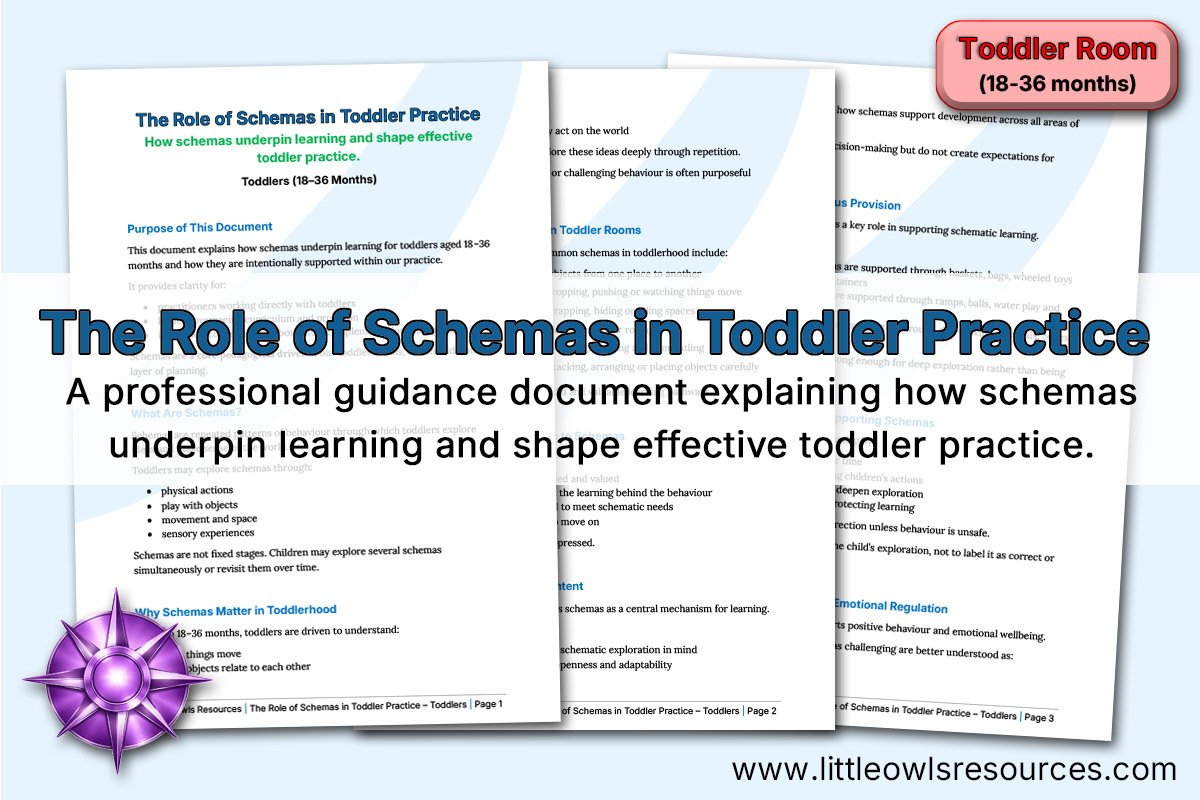
A professional guidance document explaining how schemas underpin learning and shape effective toddler practice.
The Role of Schemas in Toddler Practice | 18–36 Months
Professional guidance explaining why schemas are particularly significant during toddlerhood and how they can inform observation, continuous provision and adult interaction.

Professional guidance showing how schematic learning is intentionally embedded across toddler projects.
Toddler Projects: Schema Coverage & Support Map | 18–36 Months
See how schematic learning is supported across the Little Owls Toddler Projects through open-ended resources, environmental design, language and interaction—without turning projects into prescribed activities.
Schematic Play Provision | Find Resources by What You Notice
⚖️ Choosing the Right Schema Resource
Begin with the child or group you are observing rather than trying to provide for every schema at once.
Consider:
What actions or interests are being repeated?
Where and when does the exploration occur?
Which existing materials are children already choosing?
Could additional space, time or open-ended resources deepen the exploration?
Is the provision safe, accessible and appropriate for the children using it?
Are adults supporting the play without unnecessarily directing it?
Schemas may appear differently according to children’s age, development, communication, sensory preferences and individual ways of engaging. Resource choices should therefore remain flexible and informed by professional judgement.
👀 Browse Schema Resources
The behaviours described below are possible indications of schematic exploration rather than a checklist or means of assigning a fixed label to a child. Practitioners consider repeated patterns over time, recognising that children may explore several schemas simultaneously and in different ways.
For a fuller explanation of schemas, visit our Schema – EYFS Glossary entry. For detailed schema cards, age-related examples and observation-led planning support, explore our Early Years Schemas – Practitioner Toolkit | EYFS Birth–5.
The wider Little Owls resource pages linked below contain provision ideas and materials that may support different forms of schematic exploration. They are not prescriptive collections of “schema activities”. Practitioners can select and adapt resources in response to the children, interests and patterns of play they observe.
➡️ Trajectory Schema Resources & Guidance
What practitioners may notice: Children may be particularly interested in how they, objects or materials move through space. This can include repeatedly dropping, throwing, rolling, pushing or pouring things, watching moving objects, making lines or enjoying energetic whole-body movement.
Supporting this through provision: Consider balls, ramps, guttering, rolling objects, scarves, ribbons, water channels and opportunities for safe throwing, running, jumping and climbing. Clear boundaries and appropriate spaces can allow children to investigate direction, speed, force and distance safely.
Trajectory Schema Resources:

Trajectory Schema Label Pack | Birth-5
A calm, practical labelling system for schema-informed provision. Each card pairs a clear resource name with a short line showing how it can support trajectory exploration.
24 purpose-led labels | 4 provision sections | 8 printable pages
Contents
- Rolling, Sliding & Sending
Balls, ramps, wheels, vehicles, chutes and tracks | 6 labels
- Dropping, Throwing & Aiming
Posting, dropping, throwing, kicking, targets and tower play | 6 labels
- Pouring, Flowing & Mark-Making
Jugs, funnels, water channels, sand, chalks and rollers | 6 labels
- Whole-Body Movement & Pathways
Push-pull play, ride-ons, ribbons, trails and large movements | 6 labels
Pedagogy in brief
Children exploring a trajectory schema may be especially interested in how things move through space - rolling, dropping, throwing, pouring, sweeping or travelling. These labels help practitioners make open-ended resources visible and accessible without turning observed behaviour into a fixed category. Children may explore several schemas at once. Select only safe, developmentally appropriate resources, with suitable supervision and risk assessment.
Using this file
Pages 2-9 are the printable label sheets. Print at 100% scale. Text and illustrations can be edited in Word. Choose only the labels that suit the children, space and resources available. Place labels where children can see and use them. The labels support choice, language and responsive provision; they are not a checklist or a way to assign a fixed schema to a child.
Additional/Alternate Use
The labels may be kept as cards for professional knowledge and CPD. Settings may find it useful to keep cards available as a reference tool for practitioner use within a responsive planning environment.
Both editable docx file and pdf files available. To change wording or font on a label to suit your particular setting, select the ‘DOCX’ option below.
DOWNLOAD (DOCX) 📝
DOWNLOAD (PDF) 📄
DOWNLOAD (Zipped JPEGs) 📂

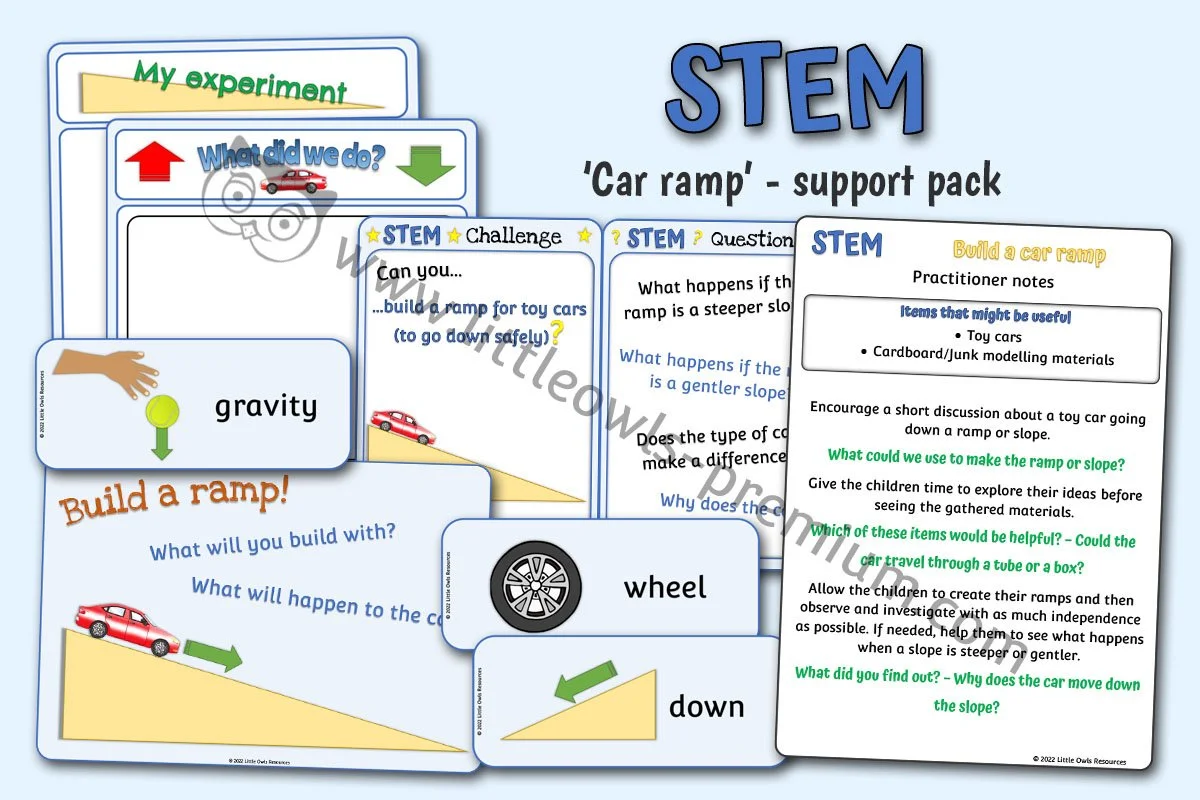
This STEM ‘Make a Car Ramp - Support Pack’ includes a variety of resources to help inspire and engage adults and children alike.
Materials within the pack encourage open ended exploration of the challenge ‘Can you make a car ramp?’
STEM learning brings together Science, Technology, Engineering and Mathematics.
Skills such as critical thinking, creativity, teamwork, communication, initiative, inquiry and problem solving are all developed within STEM learning.
We hope you find this pack useful and you all have fun!
Original artwork drawn by Sara Murphy and final digital resources created by Stuart Murphy. COPYRIGHT ON ALL OF THE RESOURCES HOUSED ON THIS WEBSITE IS HELD BY ‘LITTLE OWLS RESOURCES’. OUR RESOURCES (INCLUDING THE IMAGES WITHIN THEM), CANNOT BE SHARED OR SOLD COMMERCIALLY.
DOWNLOAD EDITABLE (DOCX)
DOWNLOAD NON-EDITABLE (PDF)
DOWNLOAD NON-EDITABLE (Zipped JPEGs)

Set of 6 A4 Sport Skills description cards. Could be used as adult prompts, self-select challenge cards, PE display, etc.
Each card describes in picture and word format a sport skill which can be practised with young children. Have fun!
Original artwork drawn by Sara Murphy and final digital resources created by Stuart Murphy. COPYRIGHT ON ALL OF THE RESOURCES HOUSED ON THIS WEBSITE IS HELD BY ‘LITTLE OWLS RESOURCES’. OUR RESOURCES (INCLUDING THE IMAGES WITHIN THEM), CANNOT BE SHARED OR SOLD COMMERCIALLY.
DOWNLOAD EDITABLE (DOCX)
DOWNLOAD NON-EDITABLE (PDF)
DOWNLOAD NON-EDITABLE (Zipped JPEGs)
<<-BACK TO ‘SPORT AND PE GAMES’ MENU

Set of 6 A5 Sport Skills description cards. Could be used as adult prompts, self-select challenge cards, PE display, etc.
Each card describes in picture and word format a sport skill which can be practised with young children.
N.B. Fold along the line (to create 2-sided card - image on one side and writing on the other) and laminate before use.
Have fun!
Original artwork drawn by Sara Murphy and final digital resources created by Stuart Murphy. COPYRIGHT ON ALL OF THE RESOURCES HOUSED ON THIS WEBSITE IS HELD BY ‘LITTLE OWLS RESOURCES’. OUR RESOURCES (INCLUDING THE IMAGES WITHIN THEM), CANNOT BE SHARED OR SOLD COMMERCIALLY.
DOWNLOAD EDITABLE (DOCX)
DOWNLOAD NON-EDITABLE (PDF)
DOWNLOAD NON-EDITABLE (Zipped JPEGs)
<<-BACK TO ‘SPORT AND PE GAMES’ MENU
Related Little Owls Resource Pages
Outdoor Area Resources
Outdoor provision can give children the space to investigate movement, speed, direction and distance through running, rolling, throwing, pushing and whole-body play.
Transport and Travel Resources
Vehicles, wheels, routes and journeys offer many opportunities to explore how objects and people move through space.
Water Play Resources
Pouring, squirting and directing flowing water through channels can support investigation of direction, force, speed and cause and effect.
Outdoor Mark-Making Resources
Large-scale lines, trails, arcs and sweeping movements allow trajectory interests to be represented through whole-arm and whole-body mark-making.
🔄 Rotation Schema Resources
What practitioners may notice: Children may repeatedly turn, spin or rotate objects—or enjoy rotating their own bodies. They might be fascinated by wheels, taps, knobs, cogs, whisks, washing machines, circular movements or round marks.
Supporting this through provision: Consider wheeled toys, spinning tops, rolling objects, safe cogs and mechanisms, mixing and stirring equipment, ribbons for circular movements and opportunities to create spirals and circles through mark-making. Resources can help children explore turning, direction, speed and cause and effect.
Rotation Schema Resources:

Rotation Schema Label Pack | Birth-5
A calm, practical labelling system for schema-informed provision. Each card pairs a clear resource name with a short line showing how it can support rotation exploration.
24 purpose-led labels | 4 provision sections | 8 printable pages
Contents
- Wheels, Rolling & Mechanisms
Wheels, vehicles, rolling objects, reels, connectors and spinners | 6 labels
- Twisting, Turning & Joining
Lids, fastenings, tools, controls, shakers and winding materials | 6 labels
- Circular Making & Sensory Play
Dough, rollers, round marks, ribbons, stirring and reflections | 6 labels
- Whole-Body Turning & Movement
Hoops, dancing, steering, curved trails, rhythm and wind toys | 6 labels
Pedagogy in brief
Children exploring a rotation schema may be especially interested in things that turn, spin, roll, twist or move in circles. They may repeat circular movements with objects, tools or their whole body. These labels help practitioners make open-ended resources visible and accessible without turning observed behaviour into a fixed category. Children may explore several schemas at once. Select only safe, developmentally appropriate resources; check small parts, cords, tools and spinning equipment carefully, with suitable supervision and risk assessment.
Using this file
Pages 2-9 are the printable label sheets. Print at 100% scale. Text and illustrations can be edited in Word. Choose only the labels that suit the children, space and resources available. Place labels where children can see and use them. The labels support choice, language and responsive provision; they are not a checklist or a way to assign a fixed schema to a child.
Additional/Alternate Use
The labels may be kept as cards for professional knowledge and CPD. Settings may find it useful to keep cards available as a reference tool for practitioner use within a responsive planning environment.
Both editable docx file and pdf files available. To change wording or font on a label to suit your particular setting, select the ‘DOCX’ option below.
DOWNLOAD (DOCX) 📝
DOWNLOAD (PDF) 📄
DOWNLOAD (Zipped JPEGs) 📂

‘The Wheels on the Bus’ Nursery Rhyme Poster. Useful for displays and reading or musical activities.
Younger children will love to explore the rhythm of this nursery rhyme and join in, especially with the aid of visual stimulus.
Perhaps with older children you might like to highlight the CVC words such as ‘bus’ and ‘long’ to practise blending or identify all of the Phase 2 or 3 sounds or high frequency words?
Want to incorporate music? How about clapping or using percussion instruments to feel the ‘beat’? Have fun!
Original artwork drawn by Sara Murphy and final digital resources created by Stuart Murphy. COPYRIGHT ON ALL OF THE RESOURCES HOUSED ON THIS WEBSITE IS HELD BY ‘LITTLE OWLS RESOURCES’. OUR RESOURCES (INCLUDING THE IMAGES WITHIN THEM), CANNOT BE SHARED OR SOLD COMMERCIALLY.
DOWNLOAD EDITABLE (DOCX)
DOWNLOAD NON-EDITABLE (PDF)
DOWNLOAD NON-EDITABLE (Zipped JPEGs)

‘The Wheels on the Bus’ Nursery Rhyme Individual Handout.
Why not send these home for children to enjoy sharing with their families? Small enough to fit in children’s bags and won’t waste too much printer ink, but will still encourage communication and language development at home.
Children may also enjoy sharing what they have learnt at school/your setting regarding the rhyme, whether it be actions, new key words or letters and sounds or being able to recite the whole rhyme rhythmically. It also may encourage children to share with their families insights into their day e.g. ‘We played a game where our teacher pretended to be a nursery rhyme character and we had to guess which one she was’, or ‘We learnt these actions to go with it!’
Younger children will love to explore the rhythm of this nursery rhyme and join in, especially with the aid of visual stimulus.
Perhaps with older children you might like to highlight the CVC words such as ‘bus’ and ‘long’ to practise blending or identify all of the Phase 2 or 3 sounds or high frequency words?
Want to incorporate music? How about clapping or using percussion instruments to feel the ‘beat’? Have fun!
Original artwork drawn by Sara Murphy and final digital resources created by Stuart Murphy. COPYRIGHT ON ALL OF THE RESOURCES HOUSED ON THIS WEBSITE IS HELD BY ‘LITTLE OWLS RESOURCES’. OUR RESOURCES (INCLUDING THE IMAGES WITHIN THEM), CANNOT BE SHARED OR SOLD COMMERCIALLY.
DOWNLOAD EDITABLE (DOCX)
DOWNLOAD NON-EDITABLE (PDF)
DOWNLOAD NON-EDITABLE (Zipped JPEGs)

‘The Wheels on the Bus’ Nursery Rhyme Colouring Poster.
Younger children will love to explore the rhythm of this nursery rhyme and join in, especially with the aid of visual stimulus.
Perhaps with older children you might like to highlight the CVC words such as ‘bus’ and ‘long’ to practise blending or identify all of the Phase 2 or 3 sounds or high frequency words?
Want to incorporate music? How about clapping or using percussion instruments to feel the ‘beat’? Have fun!
Original artwork drawn by Sara Murphy and final digital resources created by Stuart Murphy. COPYRIGHT ON ALL OF THE RESOURCES HOUSED ON THIS WEBSITE IS HELD BY ‘LITTLE OWLS RESOURCES’. OUR RESOURCES (INCLUDING THE IMAGES WITHIN THEM), CANNOT BE SHARED OR SOLD COMMERCIALLY.
DOWNLOAD EDITABLE (DOCX)
DOWNLOAD NON-EDITABLE (PDF)
DOWNLOAD NON-EDITABLE (Zipped JPEGs)
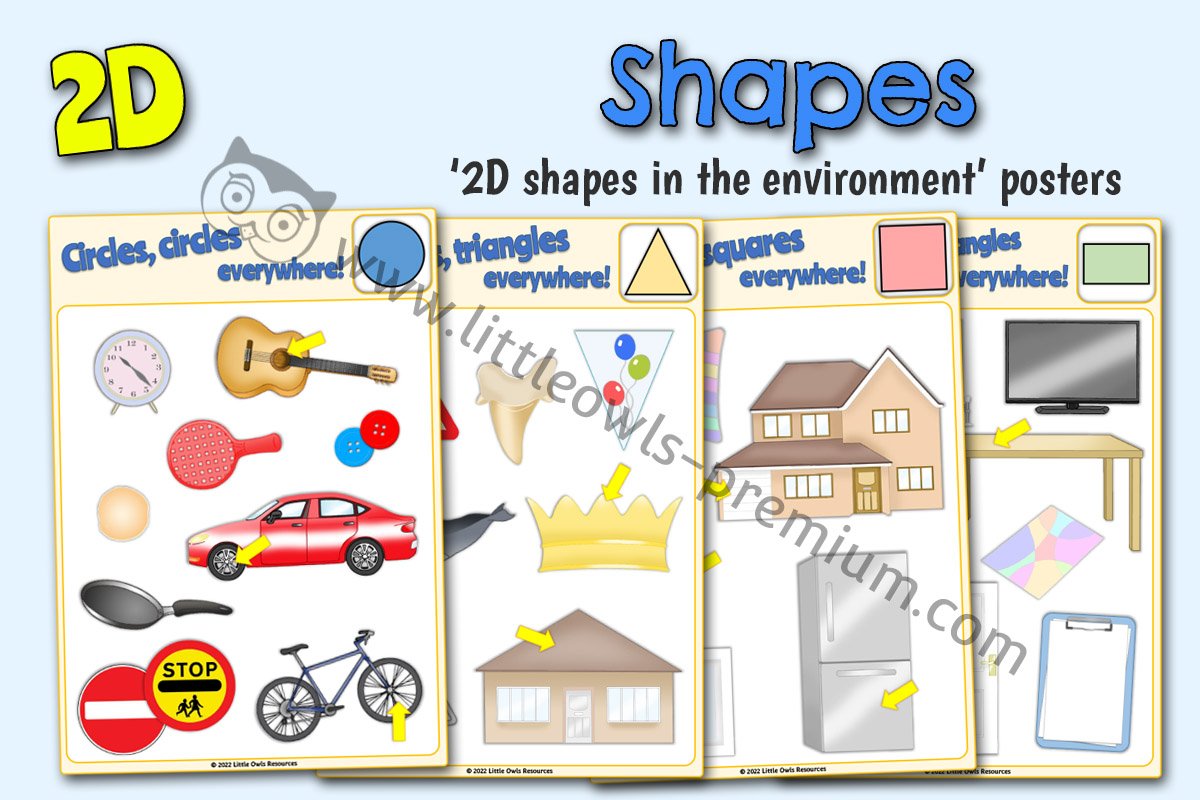
2D shapes in the environment display/prompt posters.
Use as part of a display area to enrich your setting environment, during an activity input or tuff spot activity as a stimulus.
Great for giving children a broader understanding of what e.g. a ‘triangle’ is and how the mathematical shape translates to objects around us in the ‘real world’.
Can children build on the knowledge gained by the posters and find shapes in their own environments?
Original artwork drawn by Sara Murphy and final digital resources created by Stuart Murphy. COPYRIGHT ON ALL OF THE RESOURCES HOUSED ON THIS WEBSITE IS HELD BY ‘LITTLE OWLS RESOURCES’. OUR RESOURCES (INCLUDING THE IMAGES WITHIN THEM), CANNOT BE SHARED OR SOLD COMMERCIALLY.
DOWNLOAD EDITABLE (DOCX)
DOWNLOAD NON-EDITABLE (PDF)
DOWNLOAD NON-EDITABLE (Zipped JPEGs)
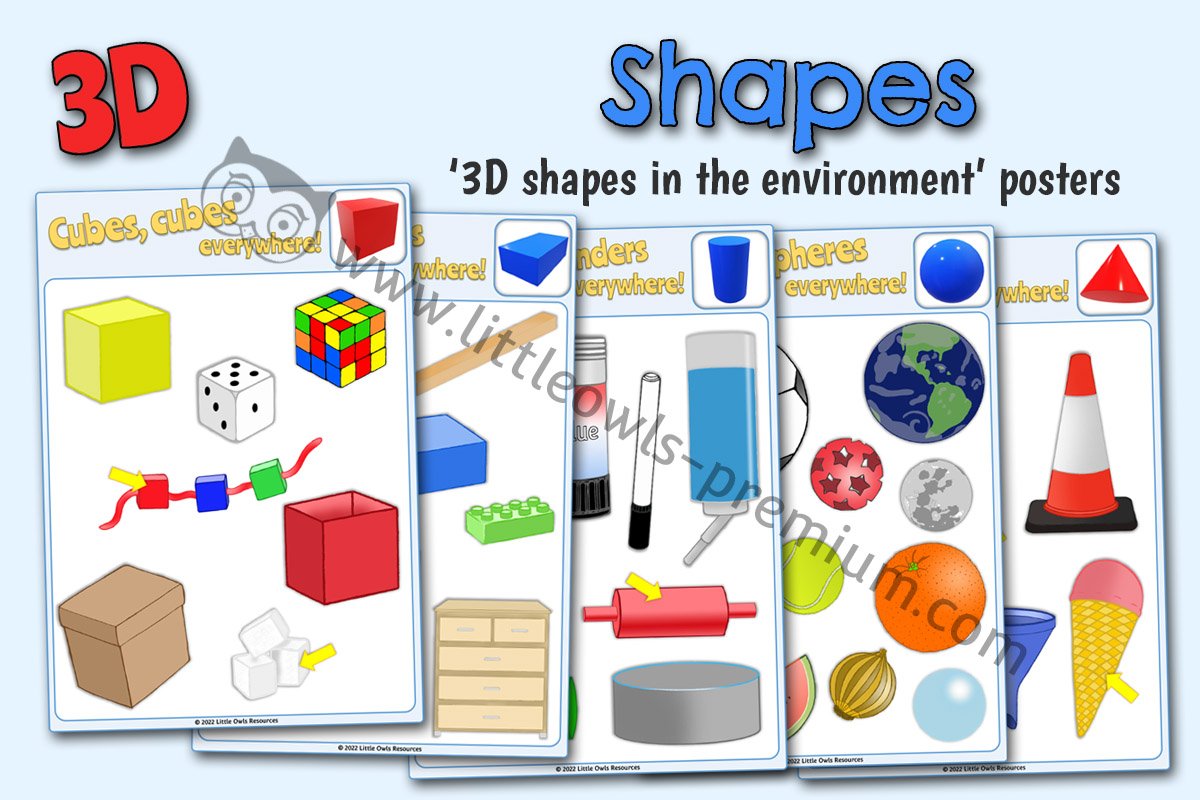
3D shapes in the environment display/prompt posters.
Use as part of a display area to enrich your setting environment, during an activity input or tuff spot activity as a stimulus.
Great for giving children a broader understanding of what e.g. a ‘sphere’ is and how the mathematical shape translates to objects around us in the ‘real world’.
Can children build on the knowledge gained by the posters and find shapes in their own environments?
Original artwork drawn by Sara Murphy and final digital resources created by Stuart Murphy. COPYRIGHT ON ALL OF THE RESOURCES HOUSED ON THIS WEBSITE IS HELD BY ‘LITTLE OWLS RESOURCES’. OUR RESOURCES (INCLUDING THE IMAGES WITHIN THEM), CANNOT BE SHARED OR SOLD COMMERCIALLY.
DOWNLOAD EDITABLE (DOCX)
DOWNLOAD NON-EDITABLE (PDF)
DOWNLOAD NON-EDITABLE (Zipped JPEGs)
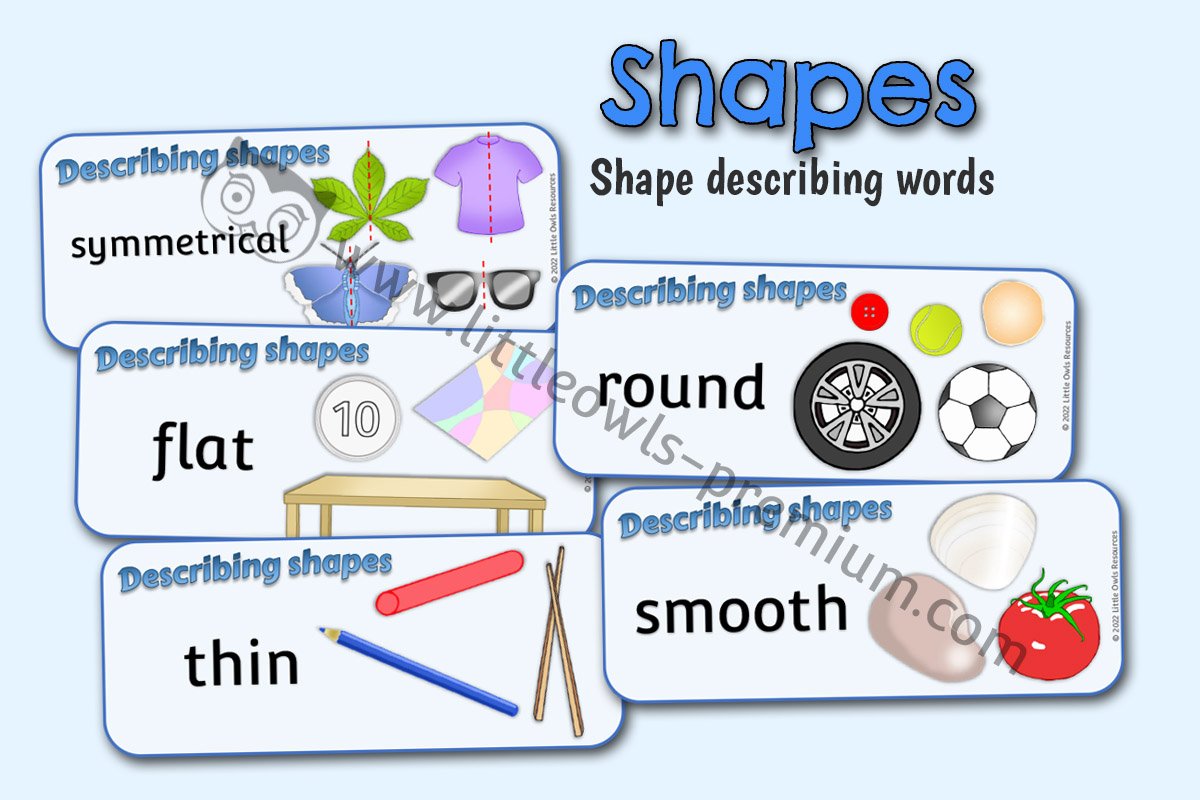
12 shape description word cards: round, spiky, smooth, bumpy, pointy, long, flat, straight, curved, symmetrical, spiral and thin.
Use as part of a display area to enrich your setting environment, during an activity input or tuff spot activity as a stimulus, e.g. collect all the smooth objects you can find!
Can children build on the knowledge gained by these word cards and find ‘real world’ items that fit these descriptive words in their own environments?
Original artwork drawn by Sara Murphy and final digital resources created by Stuart Murphy. COPYRIGHT ON ALL OF THE RESOURCES HOUSED ON THIS WEBSITE IS HELD BY ‘LITTLE OWLS RESOURCES’. OUR RESOURCES (INCLUDING THE IMAGES WITHIN THEM), CANNOT BE SHARED OR SOLD COMMERCIALLY.
DOWNLOAD EDITABLE (DOCX)
DOWNLOAD NON-EDITABLE (PDF)
DOWNLOAD NON-EDITABLE (Zipped JPEGs)
Related Little Owls Resource Pages
Transport and Travel Resources
Wheels and moving vehicles provide natural opportunities to investigate spinning, rolling, turning and circular movement.
Outdoor Area Resources
Outdoor provision can offer sufficient space for wheeled movement, turning, circling and safe whole-body rotation.
Mark-Making, Drawing and Writing Resources
Open-ended mark-making can enable children to explore circles, spirals, loops and repeated rotational movements.
Shape Resources
Resources involving circles, curves and round objects can help children notice and represent rotational forms within their play.
🚚 Transporting Schema Resources
What practitioners may notice: Children may repeatedly collect, carry or move objects and materials from one place to another. They might fill bags, baskets, pockets, containers or vehicles, move collections around the environment or transport materials during indoor and outdoor play.
Supporting this through provision: Consider baskets, bags, buckets, containers, trolleys, wheelbarrows and collections of safe, movable objects. Providing accessible storage and sufficient space can allow children to transport, unload, reorganise and return materials independently.
Transporting Schema Resources:

Transporting Schema Label Pack | Birth-5
A calm, practical labelling system for schema-informed provision. Each card pairs a clear resource name with a short line showing how it can support transporting exploration.
24 purpose-led labels | 4 provision sections | 8 printable pages
Contents
- Containers to Carry
Baskets, buckets, crates, pots, tubs and portable kits | 6 labels
- Scooping, Pouring & Transfer
Jugs, scoops, funnels, water, sand, mud, sponges and cloths | 6 labels
- Loading, Moving & Building
Trolleys, loose parts, blocks, tubes, ramps and posting | 6 labels
- Journeys & Everyday Roles
Vehicles, ride-ons, bags, caring play, tidying and digging | 6 labels
Pedagogy in brief
Children exploring a transporting schema may carry objects in their hands or move them in bags, baskets, buckets, containers and wheeled resources. They may repeatedly collect, fill, empty, load, unload, push or pull, often moving materials between favourite places. These labels help practitioners make open-ended resources visible and accessible without turning observed behaviour into a fixed category. Children may explore several schemas at once. Select only safe, developmentally appropriate resources; check small parts, heavy loads, trip hazards, straps, water, tools and wheeled equipment carefully, with suitable supervision and risk assessment.
Using this file
Pages 2-9 are the printable label sheets. Print at 100% scale. Text and illustrations can be edited in Word. Choose only the labels that suit the children, space and resources available. Place labels where children can see and use them. The labels support choice, language and responsive provision; they are not a checklist or a way to assign a fixed schema to a child.
Additional/Alternate Use
The labels may be kept as cards for professional knowledge and CPD. Settings may find it useful to keep cards available as a reference tool for practitioner use within a responsive planning environment.
Both editable docx file and pdf files available. To change wording or font on a label to suit your particular setting, select the ‘DOCX’ option below.
DOWNLOAD (DOCX) 📝
DOWNLOAD (PDF) 📄
DOWNLOAD (Zipped JPEGs) 📂

This booklet includes spaces for designs regarding travel in air, water, by road, rail tracks and into space.
Original artwork drawn by Sara Murphy and final digital resources created by Stuart Murphy. COPYRIGHT ON ALL OF THE RESOURCES HOUSED ON THIS WEBSITE IS HELD BY ‘LITTLE OWLS RESOURCES’. OUR RESOURCES (INCLUDING THE IMAGES WITHIN OUR RESOURCES), CANNOT BE SHARED OR SOLD COMMERCIALLY.
DOWNLOAD EDITABLE (DOCX)
DOWNLOAD NON-EDITABLE (PDF)
DOWNLOAD NON-EDITABLE (Zipped JPEGs)

Word mat includes: car, train, motorbike, police car, fire engine, bicycle, lorry, bus, ambulance, ship, aeroplane and tractor.
Original artwork drawn by Sara Murphy and final digital resources created by Stuart Murphy. COPYRIGHT ON ALL OF THE RESOURCES HOUSED ON THIS WEBSITE IS HELD BY ‘LITTLE OWLS RESOURCES’. OUR RESOURCES (INCLUDING THE IMAGES WITHIN OUR RESOURCES), CANNOT BE SHARED OR SOLD COMMERCIALLY.
DOWNLOAD EDITABLE (DOCX)
DOWNLOAD NON-EDITABLE (PDF)
DOWNLOAD NON-EDITABLE (Zipped JPEGs)

Pack of 3 differentiated sheets depicting an open suitcase along with an ‘Activity Holiday’ poster. Children can decide what they will do on their activity/adventure holiday and what they will need to take with them. Choose appropriate sheet(s) within pack for drawing alone or a combination of drawing and writing.
Original artwork drawn by Sara Murphy and final digital resources created by Stuart Murphy. COPYRIGHT ON ALL OF THE RESOURCES HOUSED ON THIS WEBSITE IS HELD BY ‘LITTLE OWLS RESOURCES’. OUR RESOURCES (INCLUDING THE IMAGES WITHIN OUR RESOURCES), CANNOT BE SHARED OR SOLD COMMERCIALLY.
DOWNLOAD EDITABLE (DOCX)
DOWNLOAD NON-EDITABLE (PDF)
DOWNLOAD NON-EDITABLE (Zipped JPEGs)
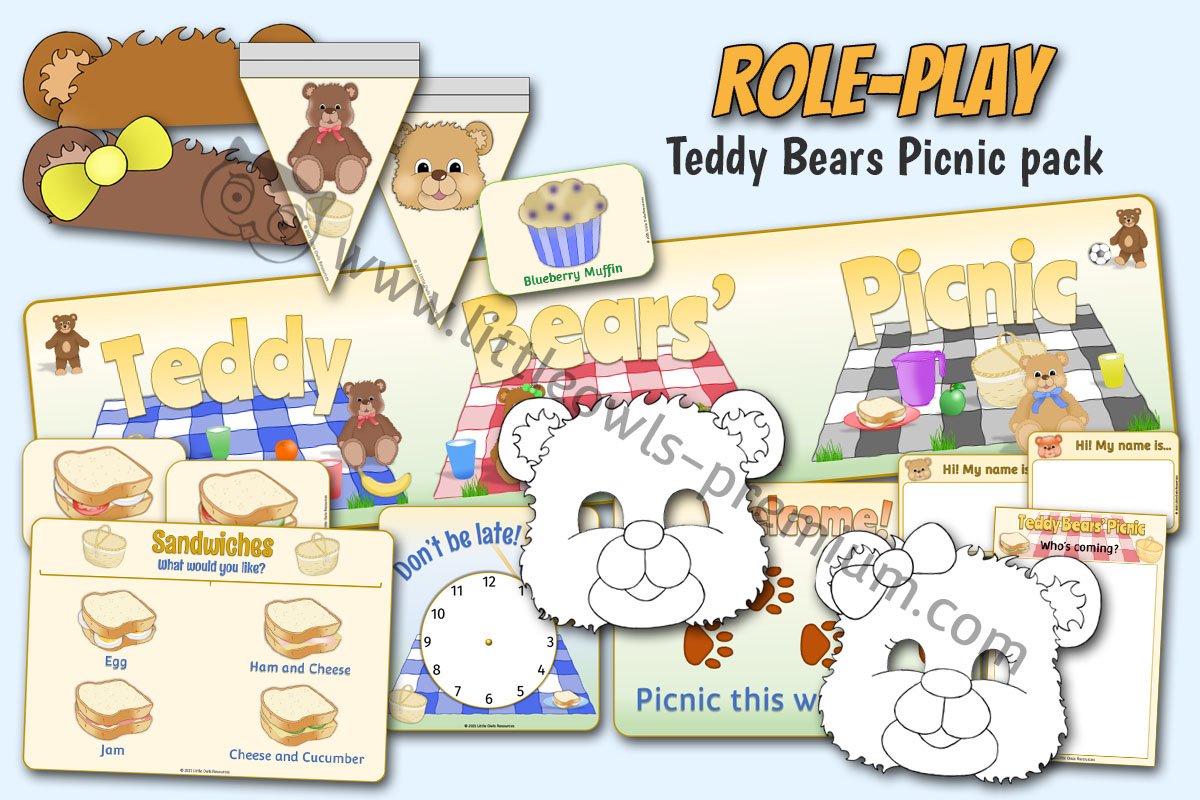
Everything you need to set up a ‘Teddy Bears’ Picnic’ role-play area!
Pack includes:
(Please note that words, etc. can be altered within the editable docx file version.)
‘Teddy Bears’ Picnic’ banner
Name badges - Name Writing
Teddy Bear Ears (full colour)
Teddy Bear Masks (colouring)
Sandwich Prop Cards
‘Welcome! Picnic this way’ Sign
‘Don’t be late!’ Sign - Space to draw hands on clock
Emergent writing/Mark making/Drawing Prompts - ‘Who’s coming?’ - ‘What will the bears take on their picnic?’ - ‘Shopping List’
Food Menu/Option Posters
Food Prop Cards
Bunting
‘Drink some water!’ - Jug Capacity Posters
Original artwork drawn by Sara Murphy and final digital resources created by Stuart Murphy. COPYRIGHT ON ALL OF THE RESOURCES HOUSED ON THIS WEBSITE IS HELD BY ‘LITTLE OWLS RESOURCES’. OUR RESOURCES (INCLUDING THE IMAGES WITHIN THEM), CANNOT BE SHARED OR SOLD COMMERCIALLY.
DOWNLOAD EDITABLE (DOCX)
DOWNLOAD NON-EDITABLE (PDF)
DOWNLOAD NON-EDITABLE (Zipped JPEGs)
<<-BACK TO ‘TEDDY BEARS’ PICNIC’ MENU
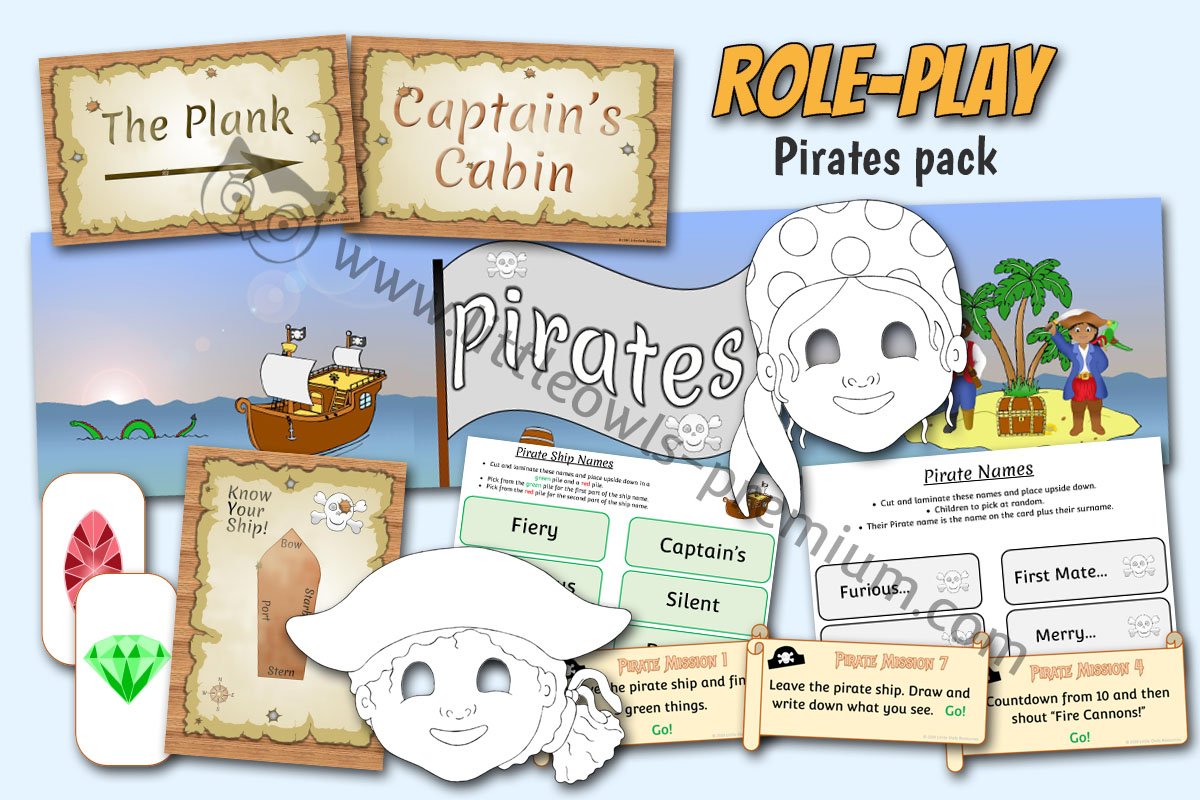
'Pirate Ship' role play pack.
Pack includes:
banner
pirate masks
various porthole views
pirate ship signs/posters
pirate and pirate ship name creator games
treasure item cards
pirate mission cards
Original artwork drawn by Sara Murphy and final digital resources created by Stuart Murphy. COPYRIGHT ON ALL OF THE RESOURCES HOUSED ON THIS WEBSITE IS HELD BY ‘LITTLE OWLS RESOURCES’. OUR RESOURCES (INCLUDING THE IMAGES WITHIN THEM), CANNOT BE SHARED OR SOLD COMMERCIALLY.
DOWNLOAD EDITABLE (DOCX)
DOWNLOAD NON-EDITABLE (PDF)
DOWNLOAD NON-EDITABLE (Zipped JPEGs)
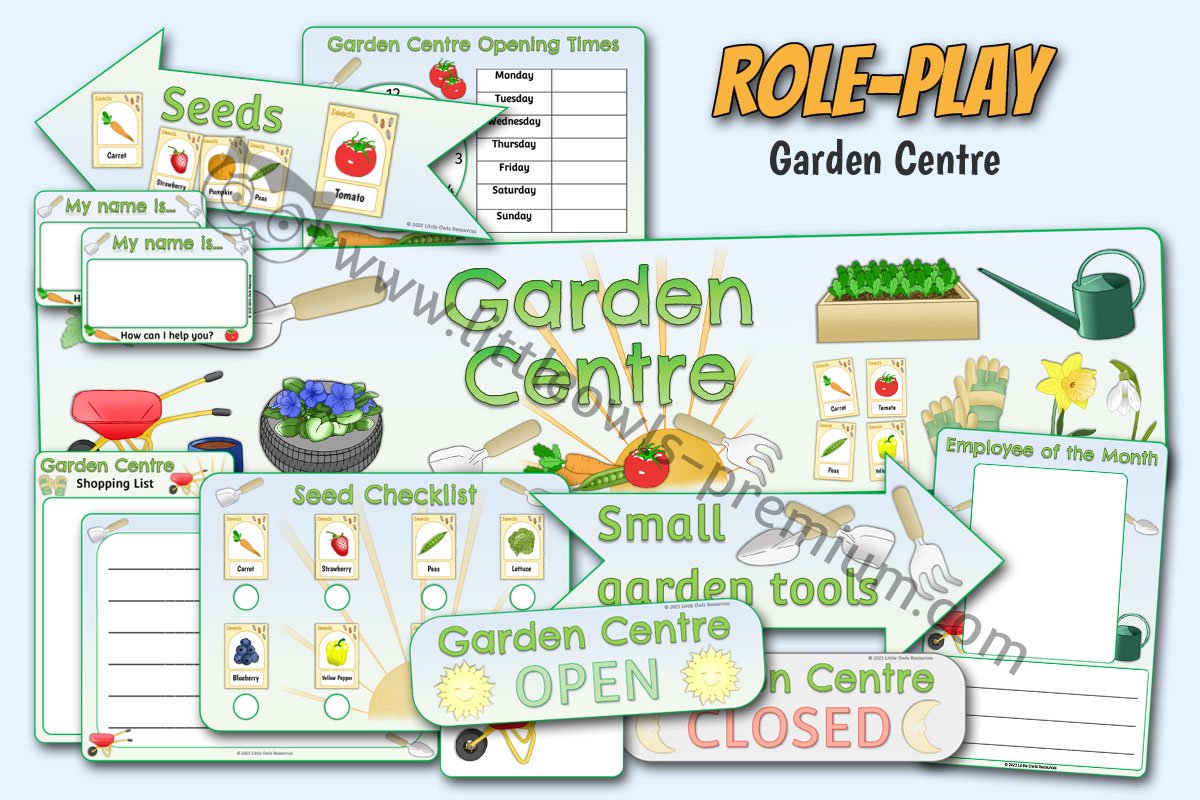
'Garden Centre' role play pack.
Pack includes:
Banner
Hi my name is…how can I help you? Name badges - Name Writing
Open/Closed signs
Timetable for opening times (including blank clock face for children to draw on their own hands)
Seed Checklist
Seed packet props - lettuce, peas, carrots, blueberries, peppers, strawberries, pumpkins, tomatoes
Seed packet mark making templates
Garden Centre shopping list mark making templates
Various signs for colouring - garden gloves, trowel, wheelbarrow, watering can, tyre planter, small spade, small rake, box planter
Direction signs - Flowers, Seeds, Small Garden Tools, Planters, Other Items
Various assorted prop cards
Drawing/Writing/Mark Making Sheets
Word cards/labels
‘Employee of the Month’ mark making template
‘Garden Centre’ list sheets
Original artwork drawn by Sara Murphy and final digital resources created by Stuart Murphy. COPYRIGHT ON ALL OF THE RESOURCES HOUSED ON THIS WEBSITE IS HELD BY ‘LITTLE OWLS RESOURCES’. OUR RESOURCES (INCLUDING THE IMAGES WITHIN THEM), CANNOT BE SHARED OR SOLD COMMERCIALLY.
DOWNLOAD EDITABLE (DOCX)
DOWNLOAD NON-EDITABLE (PDF)
DOWNLOAD NON-EDITABLE (Zipped JPEGs)

What will the bears take on their picnic?
These sheets can be used in the following ways:
Group Prompts to inspire discussion / communication and language skills and subsequent children’s art & craft work.
Printed for individual artwork use.
Laminated to be used repeatedly with whiteboard pens or as playdough/play dough mats.
Original artwork drawn by Sara Murphy and final digital resources created by Stuart Murphy. COPYRIGHT ON ALL OF THE RESOURCES HOUSED ON THIS WEBSITE IS HELD BY ‘LITTLE OWLS RESOURCES’. OUR RESOURCES (INCLUDING THE IMAGES WITHIN THEM), CANNOT BE SHARED OR SOLD COMMERCIALLY.
DOWNLOAD EDITABLE (DOCX)
DOWNLOAD NON-EDITABLE (PDF)
DOWNLOAD NON-EDITABLE (Zipped JPEGs)
<<-BACK TO ‘TEDDY BEARS’ PICNIC’ MENU
Original artwork drawn by Sara Murphy and final digital resources created by Stuart Murphy. COPYRIGHT ON ALL OF THE RESOURCES HOUSED ON THIS WEBSITE IS HELD BY ‘LITTLE OWLS RESOURCES’. OUR RESOURCES (INCLUDING THE IMAGES WITHIN THEM), CANNOT BE SHARED OR SOLD COMMERCIALLY.
DOWNLOAD EDITABLE (DOCX)
DOWNLOAD NON-EDITABLE (PDF)
DOWNLOAD NON-EDITABLE (Zipped JPEGs)
Related Little Owls Resource Pages
Outdoor Area Resources
Buckets, baskets, trolleys, wheelbarrows and movable natural materials can support carrying, collecting, loading and unloading on a larger scale.
Transport and Travel Resources
Vehicles and journey-related resources can extend children’s interest in moving themselves, objects and collections between places.
Water Play Resources
Jugs, scoops, vessels and containers allow water to be collected, carried, transferred and poured.
Sand Play Resources
Buckets, spades, scoops and containers provide opportunities to gather, move and redistribute sand and other suitable materials.
🔗 Connecting Schema Resources
What practitioners may notice: Children may repeatedly join objects or materials together and then separate them again. This might include building tracks, fastening objects, linking construction pieces, tying materials, joining pipes or investigating how parts fit together.
Supporting this through provision: Consider interlocking construction resources, train tracks, pipes, tubes, links, magnets, pegs, clips, tape, age-appropriate fastenings and materials for joining. Offer resources with different methods of connection so children can investigate strength, structure, sequence and relationships between parts.
Connecting Schema Resources:
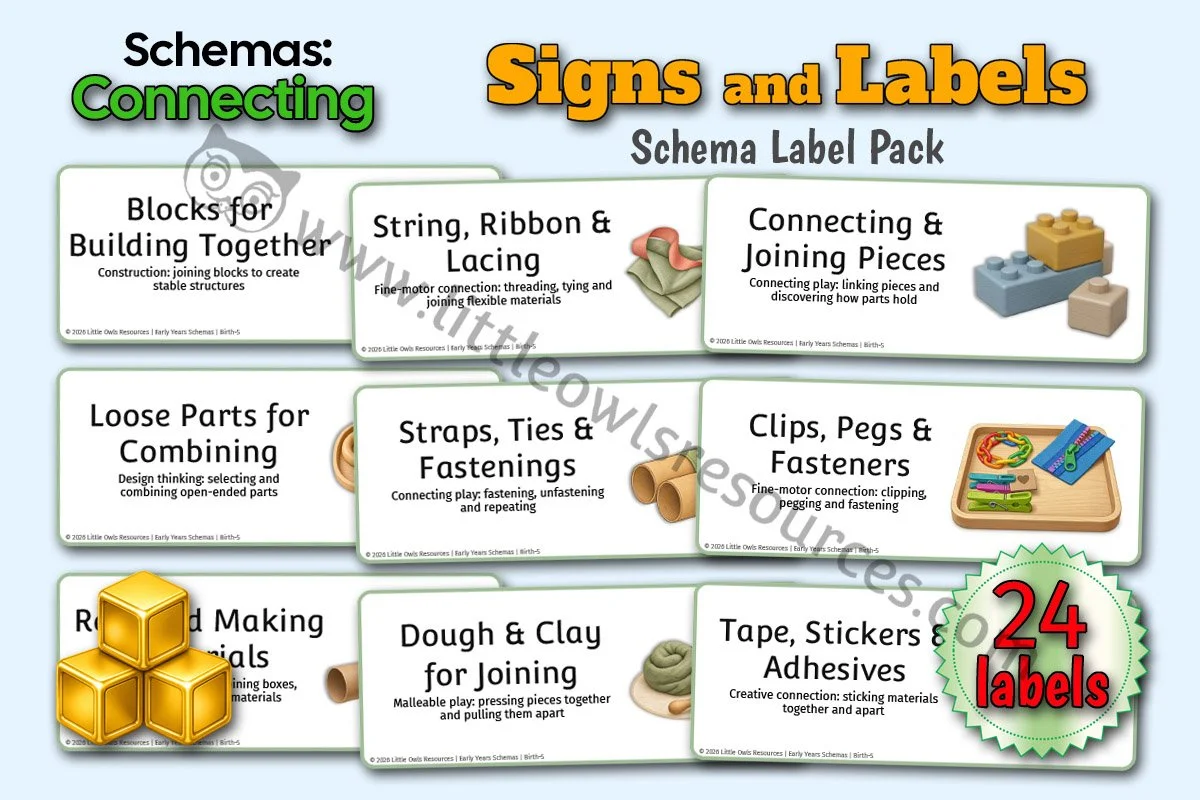
Connecting Schema Label Pack | Birth-5
A calm, practical labelling system for schema-informed provision. Each card pairs a clear resource name with a short line showing how it can support connecting exploration.
24 purpose-led labels | 4 provision sections | 8 printable pages
Contents
- Joining & Fastening
Connecting pieces, clips, tape, ribbon, fastenings and clay | 6 labels
- Construction & Design
Blocks, loose parts, recycled materials, collage, plans and testing | 6 labels
- Fitting, Linking & Mechanisms
Puzzles, magnets, tubes, axles, routes and shape pieces | 6 labels
- Large-Scale & Outdoor Connecting
Crates, dens, guttering, natural materials and open-ended building | 6 labels
Pedagogy in brief
Children exploring a connecting schema may be especially interested in joining and separating objects. They may link, fasten, tie, tape, thread, fit, stack or attach materials, then take them apart and begin again. These labels help practitioners make open-ended resources visible and accessible without turning observed behaviour into a fixed category. Children may explore several schemas at once. Select only safe, developmentally appropriate resources; check small parts, loose or damaged magnets, cords, fastenings, tools, adhesives, heavy blocks and unstable structures carefully, with suitable supervision and risk assessment.
Using this file
Pages 2-9 are the printable label sheets. Print at 100% scale. Text and illustrations can be edited in Word. Choose only the labels that suit the children, space and resources available. Place labels where children can see and use them. The labels support choice, language and responsive provision; they are not a checklist or a way to assign a fixed schema to a child.
Additional/Alternate Use
The labels may be kept as cards for professional knowledge and CPD. Settings may find it useful to keep cards available as a reference tool for practitioner use within a responsive planning environment.
Both editable docx file and pdf files available. To change wording or font on a label to suit your particular setting, select the ‘DOCX’ option below.
DOWNLOAD (DOCX) 📝
DOWNLOAD (PDF) 📄
DOWNLOAD (Zipped JPEGs) 📂
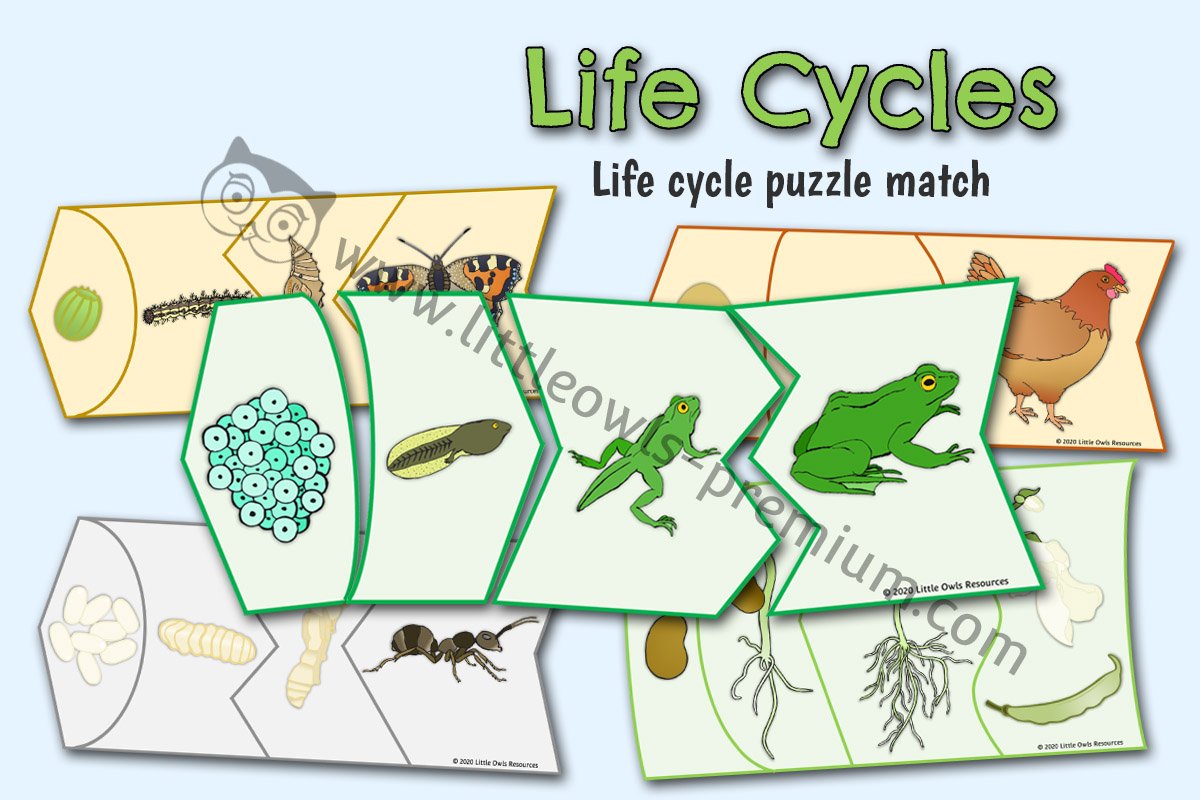
These endless puzzles are perfect to show the cyclic nature of life cycles. For example in the first instance the frog puzzle may be placed in the order ‘frogspawn’, ‘tadpole’, ‘froglet’ and then ‘frog’. To demonstrate to children that the frog then lays frogspawn, the ‘frogspawn’ piece may be brought to connect with the ‘frog’ piece at the end and thus continuing the cycle. This process can continue for as long as you like, bringing the ‘tadpole’ piece to then end and then the ‘froglet’ piece and so on!
Original artwork drawn by Sara Murphy and final digital resources created by Stuart Murphy. COPYRIGHT ON ALL OF THE RESOURCES HOUSED ON THIS WEBSITE IS HELD BY ‘LITTLE OWLS RESOURCES’. OUR RESOURCES (INCLUDING THE IMAGES WITHIN THEM), CANNOT BE SHARED OR SOLD COMMERCIALLY.
DOWNLOAD EDITABLE (DOCX)
DOWNLOAD NON-EDITABLE (PDF)
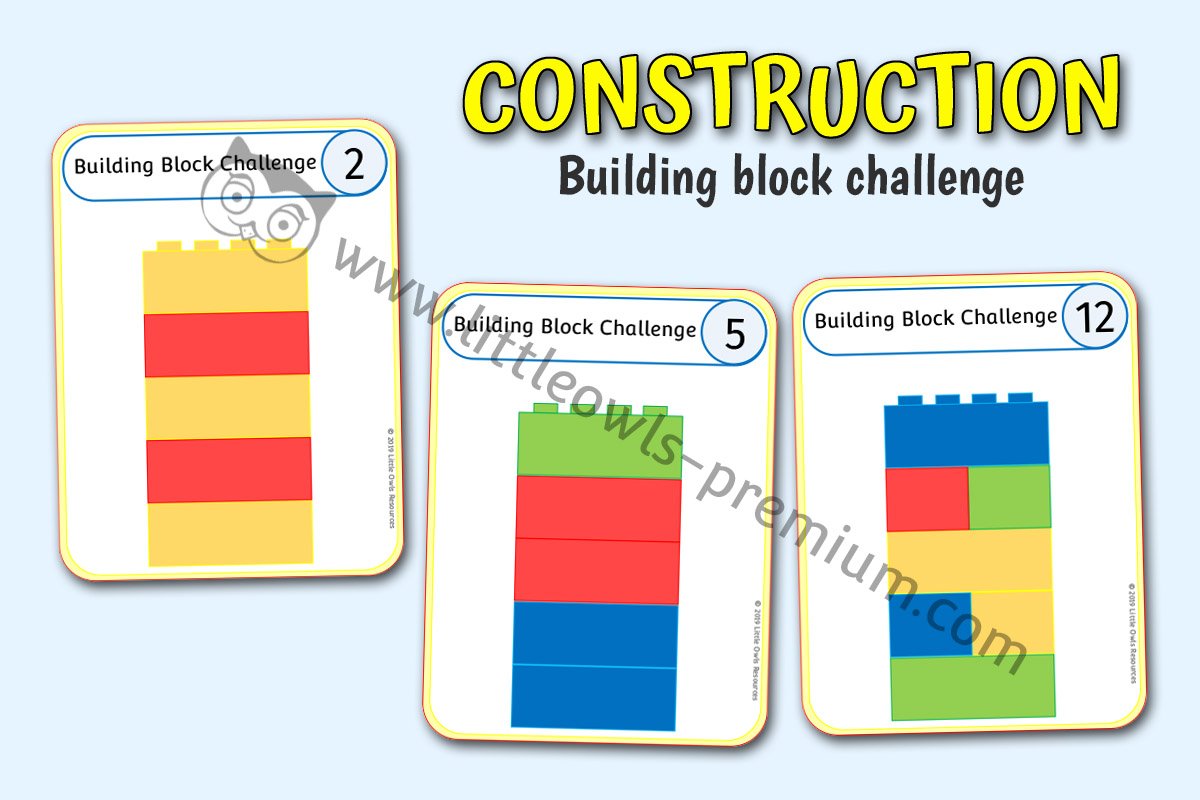
Challenge cards for children to use with building blocks such as Duplo and Lego. Children to look closely at the pattern on the cards and attempt to copy them with the blocks.
Ideal for observation skills, consolidating colour knowledge, fine motor control development and communication and language e.g. describing patterns/colours and discussing similarities and differences.
Original artwork drawn by Sara Murphy and final digital resources created by Stuart Murphy. COPYRIGHT ON ALL OF THE RESOURCES HOUSED ON THIS WEBSITE IS HELD BY ‘LITTLE OWLS RESOURCES’. OUR RESOURCES (INCLUDING THE IMAGES WITHIN THEM), CANNOT BE SHARED OR SOLD COMMERCIALLY.
DOWNLOAD EDITABLE (DOCX)
DOWNLOAD NON-EDITABLE (PDF)
DOWNLOAD NON-EDITABLE (Zipped JPEGs)
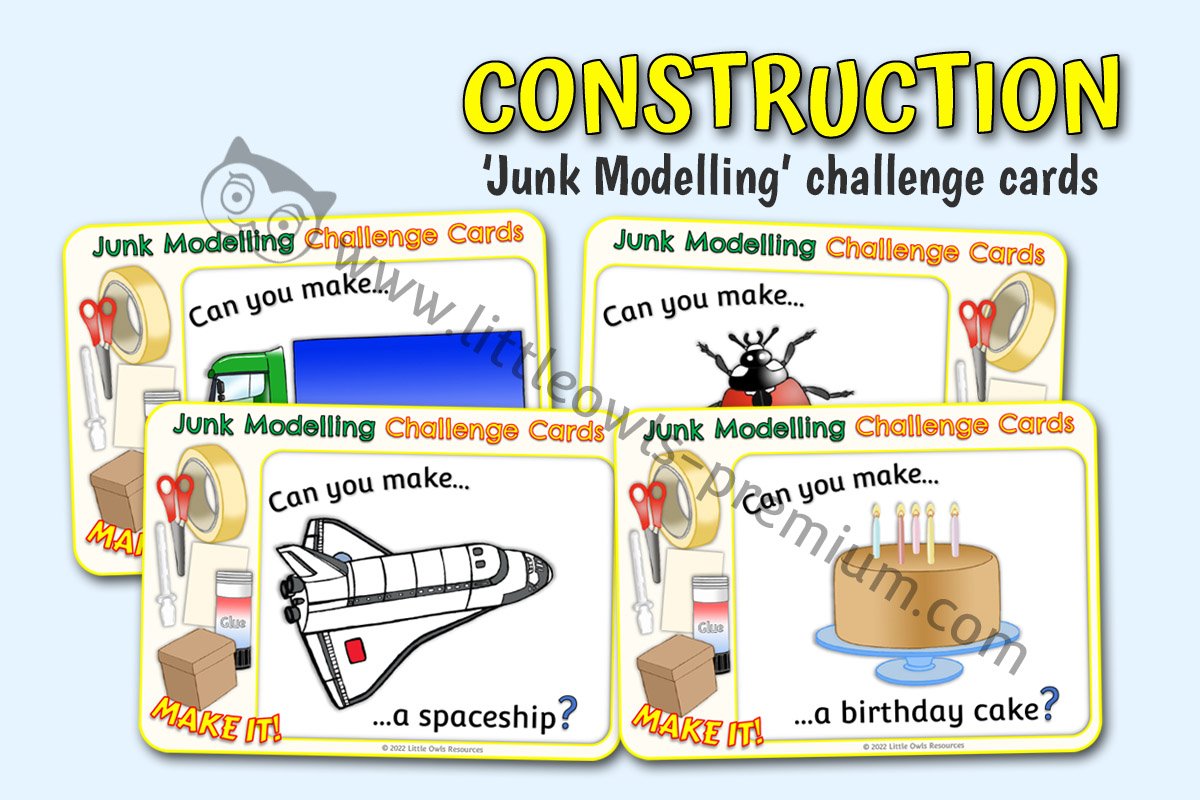
Set of 20 A5 sized ‘Can you make…?’ junk modelling construction cards.
Original artwork drawn by Sara Murphy and final digital resources created by Stuart Murphy. COPYRIGHT ON ALL OF THE RESOURCES HOUSED ON THIS WEBSITE IS HELD BY ‘LITTLE OWLS RESOURCES’. OUR RESOURCES (INCLUDING THE IMAGES WITHIN THEM), CANNOT BE SHARED OR SOLD COMMERCIALLY.
DOWNLOAD EDITABLE (DOCX)
DOWNLOAD NON-EDITABLE (PDF)
DOWNLOAD NON-EDITABLE (Zipped JPEGs)
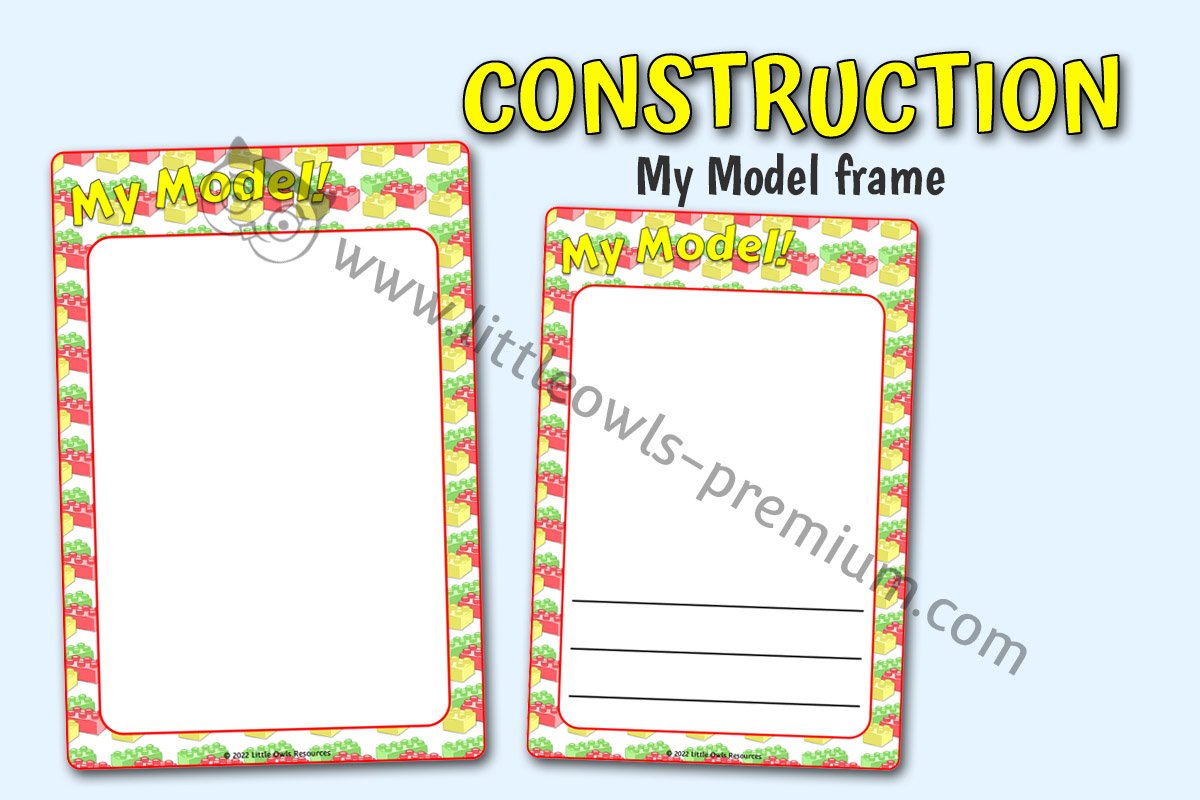
Building brick themed frames intended to display photographs of children’s building work. Two frames within pack; one which includes lines for annotation.
Original artwork drawn by Sara Murphy and final digital resources created by Stuart Murphy. COPYRIGHT ON ALL OF THE RESOURCES HOUSED ON THIS WEBSITE IS HELD BY ‘LITTLE OWLS RESOURCES’. OUR RESOURCES (INCLUDING THE IMAGES WITHIN THEM), CANNOT BE SHARED OR SOLD COMMERCIALLY.
DOWNLOAD EDITABLE (DOCX)
DOWNLOAD NON-EDITABLE (PDF)
DOWNLOAD NON-EDITABLE (Zipped JPEGs)

This STEM ‘Musical Instruments - Support Pack’ includes a variety of resources to help inspire and engage adults and children alike.
Materials within the pack encourage open ended exploration of the challenge ‘Can you make a musical instrument?’
STEM learning brings together Science, Technology, Engineering and Mathematics.
Skills such as critical thinking, creativity, teamwork, communication, initiative, inquiry and problem solving are all developed within STEM learning.
We hope you find this pack useful and you all have fun!
Original artwork drawn by Sara Murphy and final digital resources created by Stuart Murphy. COPYRIGHT ON ALL OF THE RESOURCES HOUSED ON THIS WEBSITE IS HELD BY ‘LITTLE OWLS RESOURCES’. OUR RESOURCES (INCLUDING THE IMAGES WITHIN THEM), CANNOT BE SHARED OR SOLD COMMERCIALLY.
DOWNLOAD EDITABLE (DOCX)
DOWNLOAD NON-EDITABLE (PDF)
DOWNLOAD NON-EDITABLE (Zipped JPEGs)
Related Little Owls Resource Pages
Construction and Building Resources
Blocks, bricks, tracks and junk-modelling materials offer varied possibilities for joining, fastening, building and taking structures apart.
STEM and STEAM Resources
Designing, making and investigating structures can help children explore how components connect and work together.
Art and Craft Resources
Tape, glue, collage materials and other appropriate joining methods can support experimentation with attaching, combining and separating materials.
Puzzle Resources
Puzzles encourage children to investigate how separate pieces connect, fit together and form a complete image or structure.
⭕ Enclosing Schema Resources
What practitioners may notice: Children may create boundaries around themselves, other people, objects or spaces. They might build fences around small-world figures, draw borders around pictures, make dens, arrange blocks around objects or seek out enclosed areas.
Supporting this through provision: Consider blocks, fences, hoops, boxes, crates, den-building materials and open-ended loose parts that can be arranged around people, objects or spaces. Indoor and outdoor environments can provide opportunities to explore boundaries, shape, space, inside and outside.
Enclosing Schema Resources:
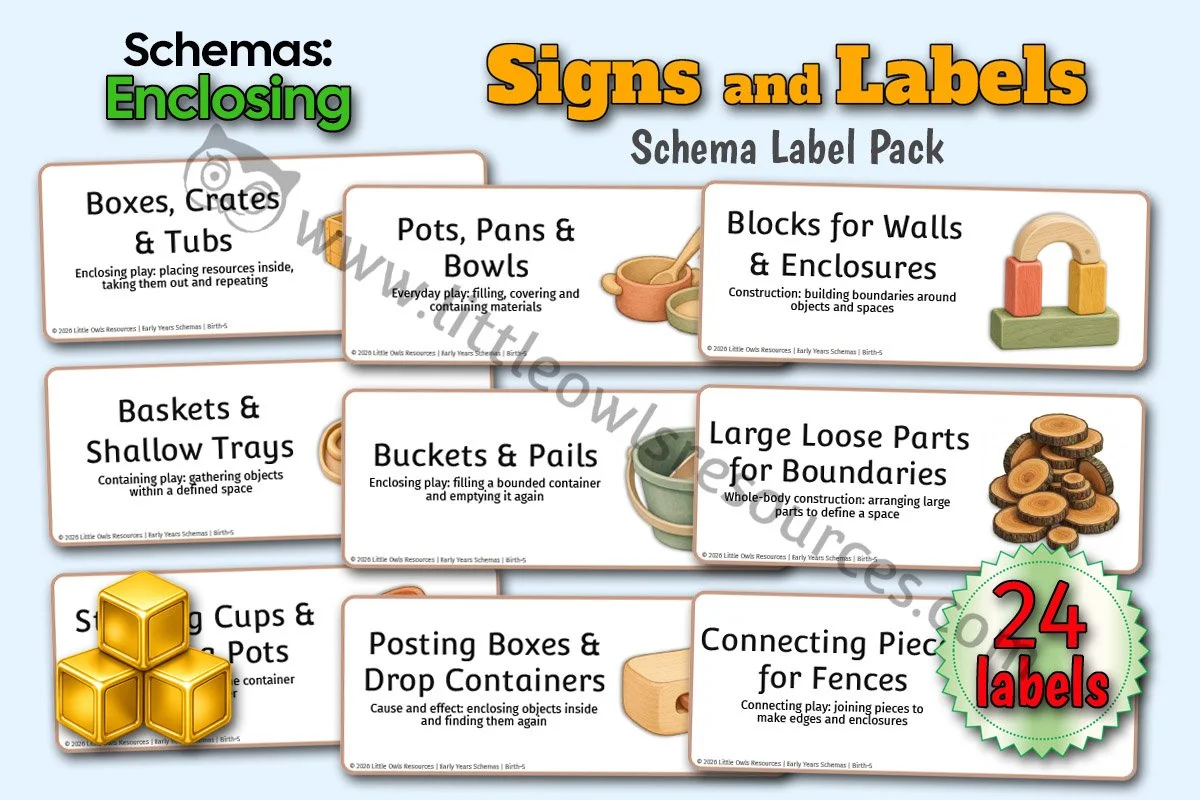
Enclosing Schema Label Pack | Birth-5
A calm, practical labelling system for schema-informed provision. Each card pairs a clear resource name with a short line showing how it can support enclosing exploration.
24 purpose-led labels | 4 provision sections | 8 printable pages
Contents
- Containing & Nesting
Boxes, baskets, pots, buckets and posting containers | 6 labels
- Constructing Boundaries
Blocks, loose parts, joining pieces, den fixings, tubes and tracks | 6 labels
- Dens, Homes & Small Worlds
Dens, homes, habitats, home spaces, story worlds and shelters | 6 labels
- Marking, Moulding & Outdoor
Paper, chalk, dough, sand, natural materials and hoops | 6 labels
Pedagogy in brief
Children exploring an enclosing schema may make boundaries around objects, people or spaces. They may place items inside containers, build walls or fences, make dens or nests, draw lines around objects, or create homes and defined spaces in small-world play. These labels help practitioners make open-ended resources visible and accessible without turning observed behaviour into a fixed category. Children may explore several schemas at once. Select only safe, developmentally appropriate resources; never allow children to enter containers not intended for play, and check cords, fabrics, fixings, heavy blocks, unstable structures, tunnels and enclosed spaces carefully, with suitable supervision, ventilation and risk assessment.
Using this file
Pages 2-9 are the printable label sheets. Print at 100% scale. Text and illustrations can be edited in Word. Choose only the labels that suit the children, space and resources available. Place labels where children can see and use them. The labels support choice, language and responsive provision; they are not a checklist or a way to assign a fixed schema to a child.
Additional/Alternate Use
The labels may be kept as cards for professional knowledge and CPD. Settings may find it useful to keep cards available as a reference tool for practitioner use within a responsive planning environment.
Both editable docx file and pdf files available. To change wording or font on a label to suit your particular setting, select the ‘DOCX’ option below.
DOWNLOAD (DOCX) 📝
DOWNLOAD (PDF) 📄
DOWNLOAD (Zipped JPEGs) 📂
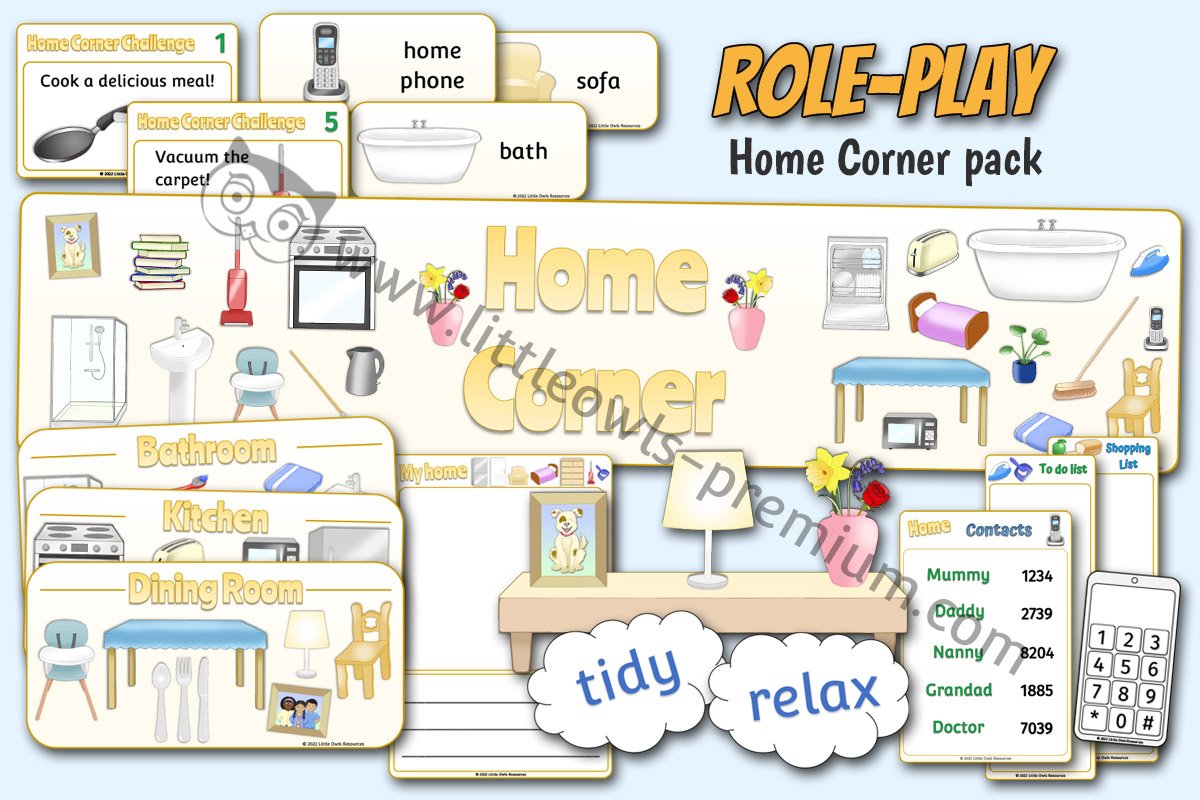
'Home Corner' role play pack.
Pack includes:
Banner
Verb clouds
Role-play activity prompt cards
Phone keypads & phone number/contacts prompt cards (pre filled and blank)
Room signs - Bedroom - Living Room - Dining Room - Kitchen - Bathroom - Toilet - Study - Utilities
Home themed drawing/mark making/writing sheets
Props for your home corner walls - photo frames x 2, shelves x 3 - 2 sizes, windows (curtains, blinds and plain) - 2 sizes and a clock (children can draw on hands to explore time)
Picture frame templates for mark making - plain x 2 - draw a picture of your family - draw a picture of your pet
Word cards x 54
‘To do list’ templates
‘Shopping List’ templates
‘My home’ drawing & writing templates
Food cut out props
Have fun!
Original artwork drawn by Sara Murphy and final digital resources created by Stuart Murphy. COPYRIGHT ON ALL OF THE RESOURCES HOUSED ON THIS WEBSITE IS HELD BY ‘LITTLE OWLS RESOURCES’. OUR RESOURCES (INCLUDING THE IMAGES WITHIN THEM), CANNOT BE SHARED OR SOLD COMMERCIALLY.
DOWNLOAD EDITABLE (DOCX)
DOWNLOAD NON-EDITABLE (PDF)
DOWNLOAD NON-EDITABLE (Zipped JPEGs)

Pack of 20 ‘Construction’ prompt cards. Ideal for outdoor play, fine and gross motor skills and building imagination!
These prompt cards are to be used as a starting point for construction and imagination in the outdoor area!
Original artwork drawn by Sara Murphy and final digital resources created by Stuart Murphy. COPYRIGHT ON ALL OF THE RESOURCES HOUSED ON THIS WEBSITE IS HELD BY ‘LITTLE OWLS RESOURCES’. OUR RESOURCES (INCLUDING THE IMAGES WITHIN THEM), CANNOT BE SHARED OR SOLD COMMERCIALLY.
DOWNLOAD EDITABLE (DOCX)
DOWNLOAD NON-EDITABLE (PDF)
DOWNLOAD NON-EDITABLE (Zipped JPEGs)

These cards are intended to be used as a stimulus for making shapes with natural materials in the outdoor area.
Extensions could include asking what other shapes the children could make or what other materials could they use.
Original artwork drawn by Sara Murphy and final digital resources created by Stuart Murphy. COPYRIGHT ON ALL OF THE RESOURCES HOUSED ON THIS WEBSITE IS HELD BY ‘LITTLE OWLS RESOURCES’. OUR RESOURCES (INCLUDING THE IMAGES WITHIN THEM), CANNOT BE SHARED OR SOLD COMMERCIALLY.
DOWNLOAD EDITABLE (DOCX)
DOWNLOAD NON-EDITABLE (PDF)
DOWNLOAD NON-EDITABLE (Zipped JPEGs)

These cards are intended to be used to aid shape formation in wet sand. The shapes could be attempted with a finger or a stick/pencil. They could also be used as part of a display by the sand area.
Original artwork drawn by Sara Murphy and final digital resources created by Stuart Murphy. COPYRIGHT ON ALL OF THE RESOURCES HOUSED ON THIS WEBSITE IS HELD BY ‘LITTLE OWLS RESOURCES’. OUR RESOURCES (INCLUDING THE IMAGES WITHIN THEM), CANNOT BE SHARED OR SOLD COMMERCIALLY.
DOWNLOAD EDITABLE (DOCX)
DOWNLOAD NON-EDITABLE (PDF)
DOWNLOAD NON-EDITABLE (Zipped JPEGs)

This mat is designed to encourage creativity whilst also engaging children in thinking about size. Ideal for use after a trip to the beach.
Who will share this shell?
Two printable sheets provided for a variety of purposes…mark making and drawing, playdough or even small world role-play!
How many creatures can share your shell? What are they each like? Do they work together to help each other?
Great for use alongside reading ‘Sharing a Shell’!
Keywords: shells, share, sharing, fit, capacity, size, big, bigger, biggest, small, smaller, smallest, counting, count, one to one correspondence, shape, natural, playdough, prompt, activities, activity, mat, maths, mathematics, math, numeracy, creative, creativity, role play
Original artwork drawn by Sara Murphy and final digital resources created by Stuart Murphy. COPYRIGHT ON ALL OF THE RESOURCES HOUSED ON THIS WEBSITE IS HELD BY ‘LITTLE OWLS RESOURCES’. OUR RESOURCES (INCLUDING THE IMAGES WITHIN THEM), CANNOT BE SHARED OR SOLD COMMERCIALLY.
DOWNLOAD EDITABLE (DOCX)
DOWNLOAD NON-EDITABLE (PDF)
DOWNLOAD NON-EDITABLE (Zipped JPEGs)
<<-BACK TO ‘BEACH SCHOOL’ MENU
<<-BACK TO ‘AT THE SEASIDE’ MENU
<<-BACK TO ‘OUTDOOR MATHS’ MENU
Related Little Owls Resource Pages
Construction and Building Resources
Construction materials can be used to create walls, fences, borders and spaces around figures, objects or children’s structures.
Outdoor Area Resources
Large-scale outdoor materials can support den building and the creation of boundaries, pathways and enclosed spaces.
Shape Resources
Shapes, outlines and frames can support exploration of boundaries and the spatial relationship between inside and outside.
Home Corner Resources
Defined rooms and domestic spaces can inspire children to recreate familiar enclosures and organise objects within them.
🎁 Enveloping Schema Resources
What practitioners may notice: Children may be interested in covering, wrapping, concealing or completely surrounding themselves or objects. They might wrap toys in fabric, cover pictures with paint, hide beneath blankets, place items inside layers of material or enjoy dressing in multiple layers.
Supporting this through provision: Consider scarves, fabrics, blankets, paper, dressing-up clothes, wrapping materials, playdough and opportunities for covering or concealing objects. Materials should be carefully selected and supervised according to children’s ages and needs, particularly when children are covering themselves or wrapping objects tightly.
Enveloping Schema Resources:
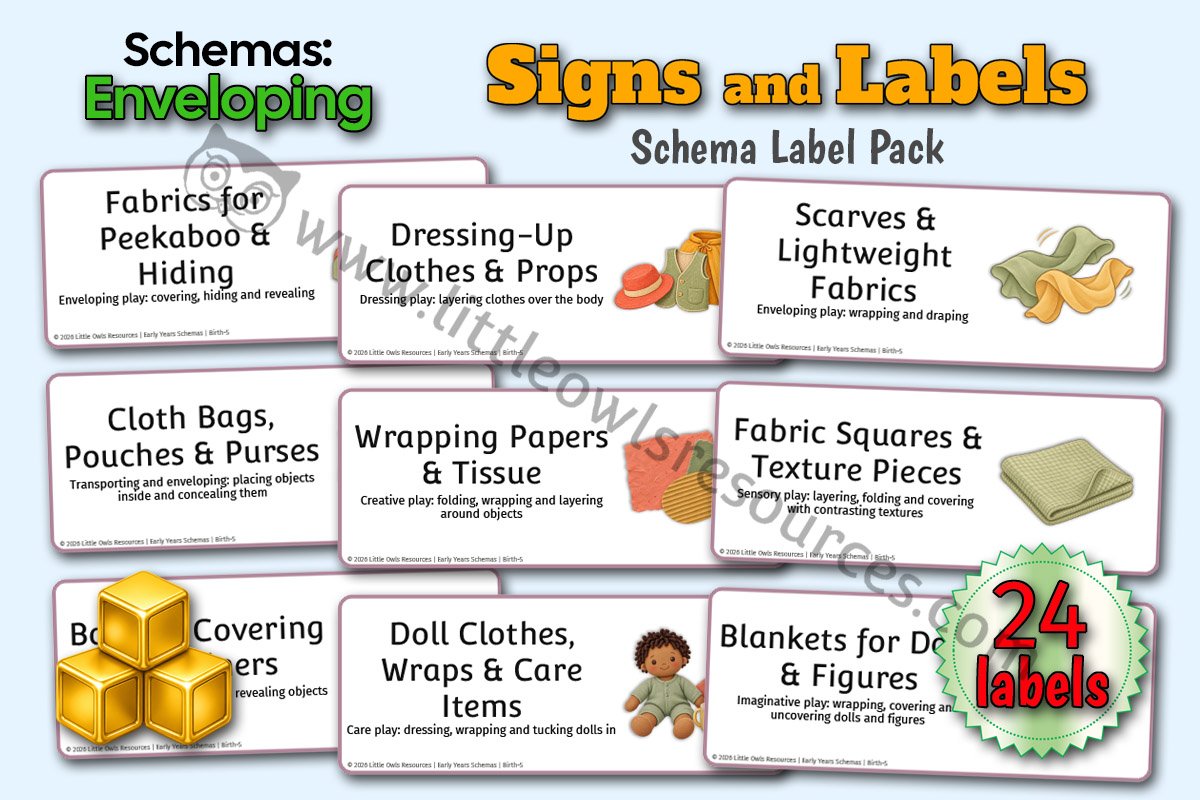
Enveloping Schema Label Pack | Birth-5
A calm, practical labelling system for schema-informed provision. Each card pairs a clear resource name with a short line showing how it can support enveloping exploration.
24 purpose-led labels | 4 provision sections | 8 printable pages
Contents
- Draping, Wrapping & Dressing
Scarves, fabrics, doll blankets, clothes, paper and care props | 6 labels
- Hiding, Covering & Revealing
Fabrics, bags, containers, dens, posting boxes and shelters | 6 labels
- Painting, Collage & Layering
Paint, rollers, paper, collage, sticky materials and dough | 6 labels
- Burying, Filling & Sensory Play
Sand, mud, leaves, water play, scooping tools and loose parts | 6 labels
Pedagogy in brief
Children exploring an enveloping schema may wrap or cover objects, themselves or spaces; hide things beneath materials; bury objects; cover surfaces with paint or collage; or dress in layers. These labels help practitioners make open-ended resources visible and accessible without turning observed behaviour into a fixed category. Children may explore several schemas at once. Select only safe, developmentally appropriate resources. Closely supervise all fabrics, bags, coverings and sensory materials; keep faces and airways uncovered; never provide plastic bags or long cords; do not use play-wrapping materials in sleep spaces; check small parts and allergies; and ensure dens are ventilated, stable and easy to exit.
Using this file
Pages 2-9 are the printable label sheets. Print at 100% scale. Text and illustrations can be edited in Word. Choose only the labels that suit the children, space and resources available. Place labels where children can see and use them. The labels support choice, language and responsive provision; they are not a checklist or a way to assign a fixed schema to a child.
Additional/Alternate Use
The labels may be kept as cards for professional knowledge and CPD. Settings may find it useful to keep cards available as a reference tool for practitioner use within a responsive planning environment.
Both editable docx file and pdf files available. To change wording or font on a label to suit your particular setting, select the ‘DOCX’ option below.
DOWNLOAD (DOCX) 📝
DOWNLOAD (PDF) 📄
DOWNLOAD (Zipped JPEGs) 📂
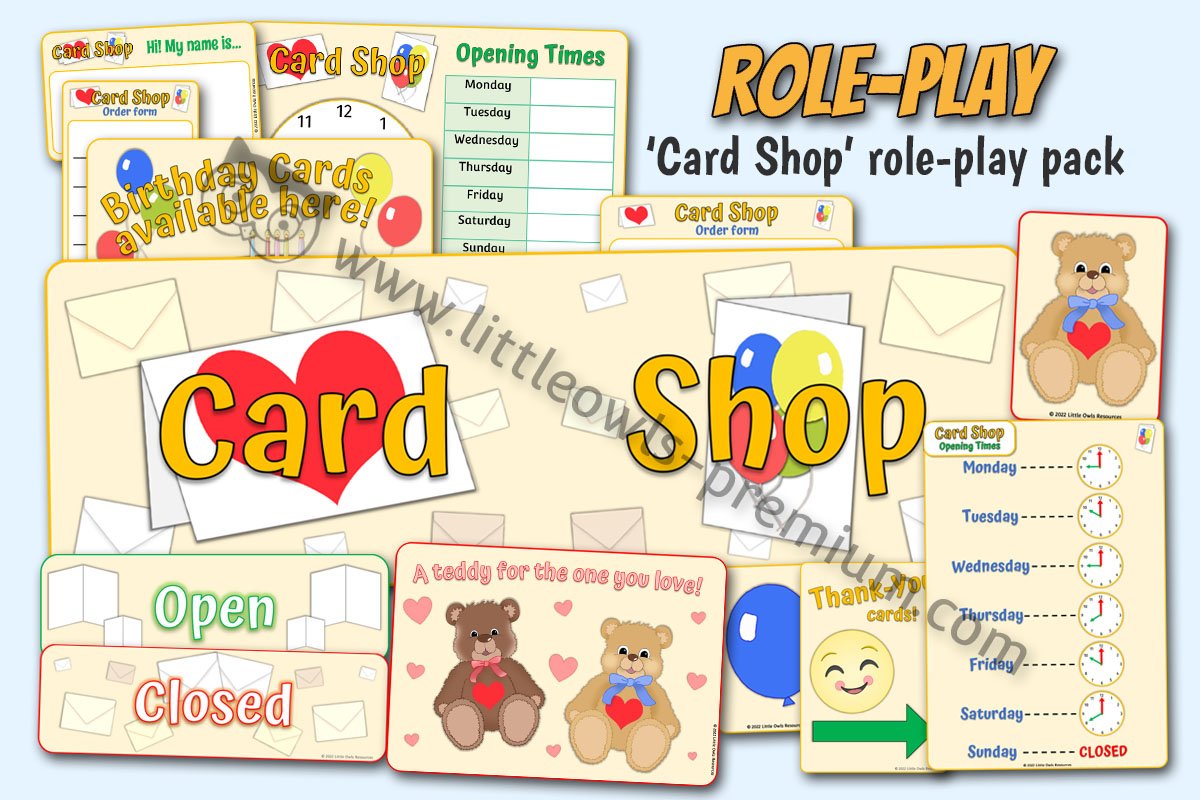
‘Card Shop’ role-play pack includes:
‘Card Shop’ banner
‘Hi! My name is…’ identity cards - Name Writing
Various opening times posters (both prefilled and blank for children to draw hands on clocks and write their own times)
‘Message’ and differentiated ‘Order Form’ templates for mark making/pre-writing
Open/Closed signs
Stamp & envelope price labels
Stamp, envelope, balloon and teddy bear props to be purchased in shop
Posters advertising/directing where cards are for events - Valentine’s Day, Birthdays, Mother’s Day, Father’s Day, Get Well soon, Thank-You & Good Luck
Teddy bear and balloon posters
Debit card posters and props
VISIT OUR ‘GREETING CARDS’ PAGE TO STOCK YOUR CARD SHOP WITH CARDS FOR WHICHEVER EVENT IS APPROPRIATE FOR THE TIME OF YEAR AND YOUR CHILDREN.
Original artwork drawn by Sara Murphy and final digital resources created by Stuart Murphy. COPYRIGHT ON ALL OF THE RESOURCES HOUSED ON THIS WEBSITE IS HELD BY ‘LITTLE OWLS RESOURCES’. OUR RESOURCES (INCLUDING THE IMAGES WITHIN THEM), CANNOT BE SHARED OR SOLD COMMERCIALLY.
DOWNLOAD EDITABLE (DOCX)
DOWNLOAD NON-EDITABLE (PDF)
DOWNLOAD NON-EDITABLE (Zipped JPEGs)
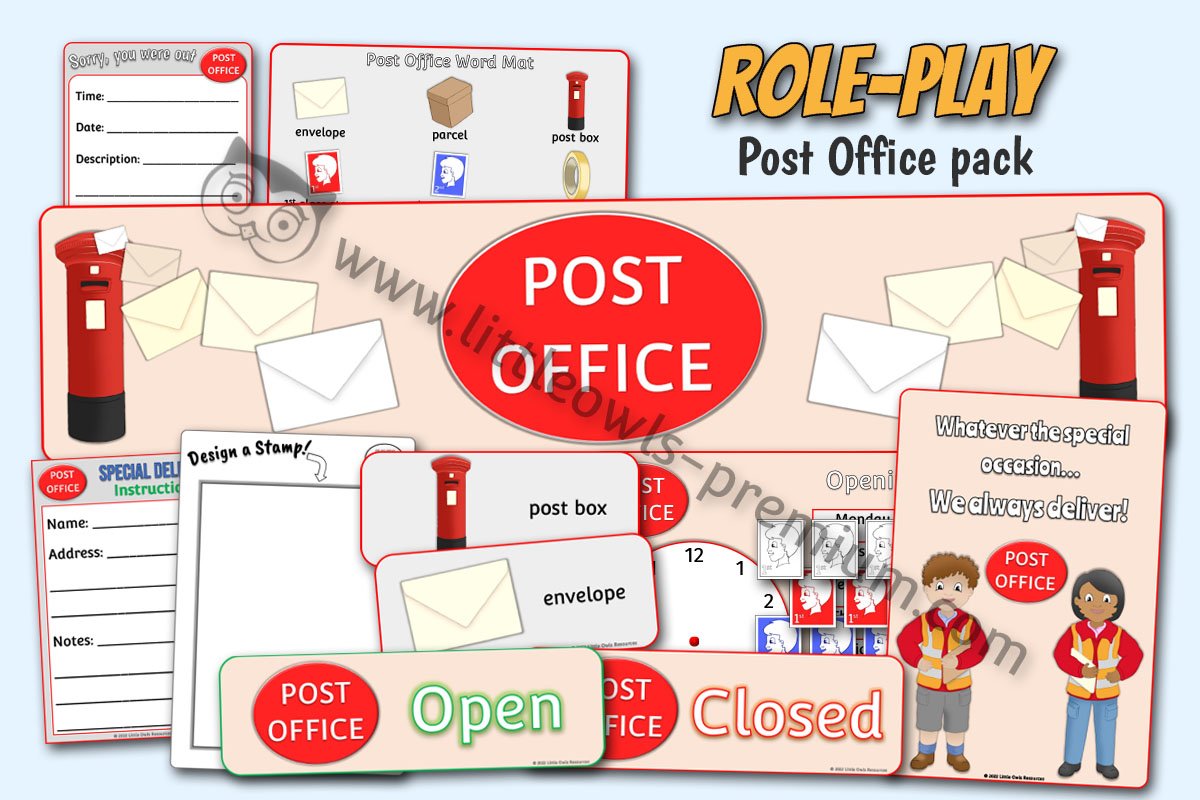
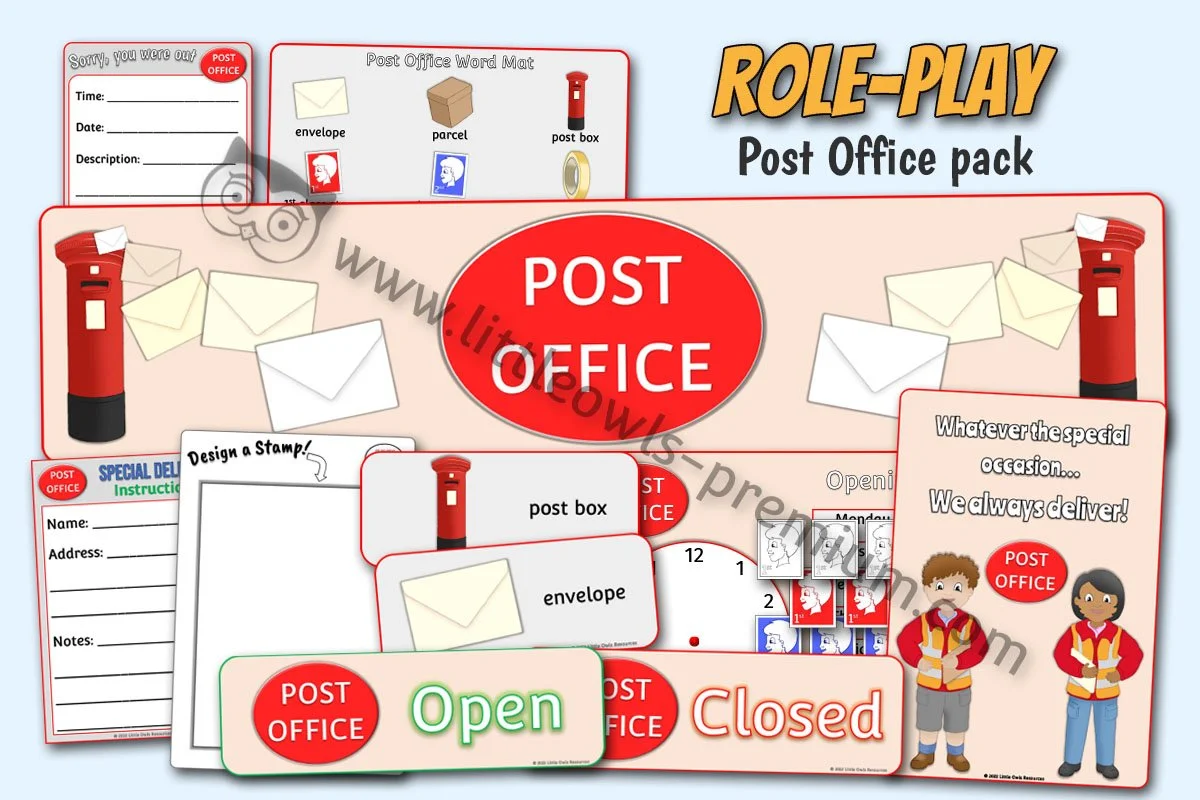
'Post Office' role play pack.
Pack includes:
banner
post box prop/display image across 2 A4 pages
name badges - Name Writing
opening times sign (with clock template to draw hands)
open and closed signs
various mark making sheets: ‘Special delivery instructions’ and ‘Sorry, you were out’ notes
1st and 2nd class stamp sheets (full colour & colouring versions)
various small signs & labels for items available for purchase with space for price tags
A4 sized posters/signs for display
Post office word mat & word cards
General post office mark making sheets
‘Design a stamp’ sheets
Have fun!
Alongside this role-play you may like to read: Dear Zoo, The Jolly Postman, Dragon Post or Paddington’s Post.
Keywords: post office, role play/role-play pack, postal worker, postal workers, postwoman, postman, postie, sending letters/parcels/presents/gifts/deliveries
Original artwork drawn by Sara Murphy and final digital resources created by Stuart Murphy. COPYRIGHT ON ALL OF THE RESOURCES HOUSED ON THIS WEBSITE IS HELD BY ‘LITTLE OWLS RESOURCES’. OUR RESOURCES (INCLUDING THE IMAGES WITHIN THEM), CANNOT BE SHARED OR SOLD COMMERCIALLY.
DOWNLOAD EDITABLE (DOCX)
DOWNLOAD NON-EDITABLE (PDF)
DOWNLOAD NON-EDITABLE (Zipped JPEGs)
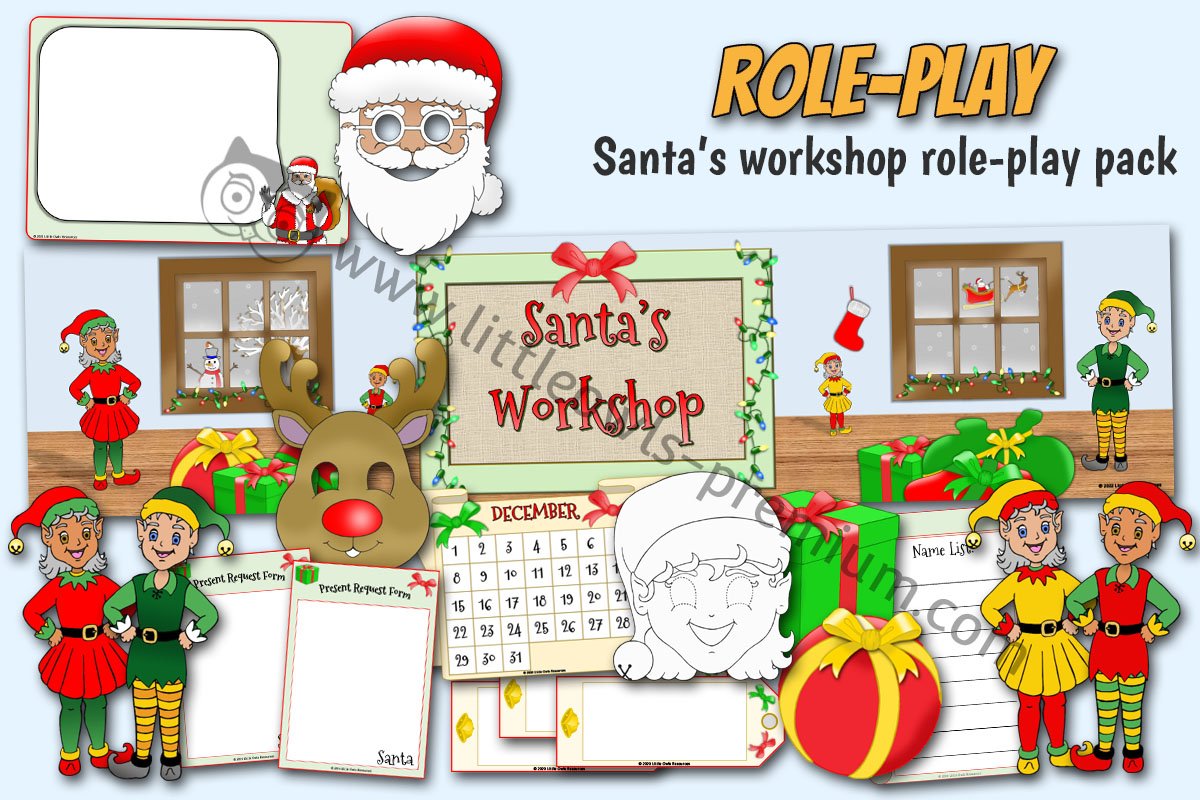
'Santa’s Workshop' role play pack.
Pack includes:
banner
windows
various signs
character masks
present props
A4 sized elves
gift tags, present request forms and a name list scroll for mark making and emergent writing - Name Writing.
Perhaps the name list could be displayed in the role-play area and every child who enters writes their own name on the list (at varying levels).
Original artwork drawn by Sara Murphy and final digital resources created by Stuart Murphy. COPYRIGHT ON ALL OF THE RESOURCES HOUSED ON THIS WEBSITE IS HELD BY ‘LITTLE OWLS RESOURCES’. OUR RESOURCES (INCLUDING THE IMAGES WITHIN THEM), CANNOT BE SHARED OR SOLD COMMERCIALLY.
DOWNLOAD EDITABLE (DOCX)
DOWNLOAD NON-EDITABLE (PDF)
DOWNLOAD NON-EDITABLE (Zipped JPEGs)
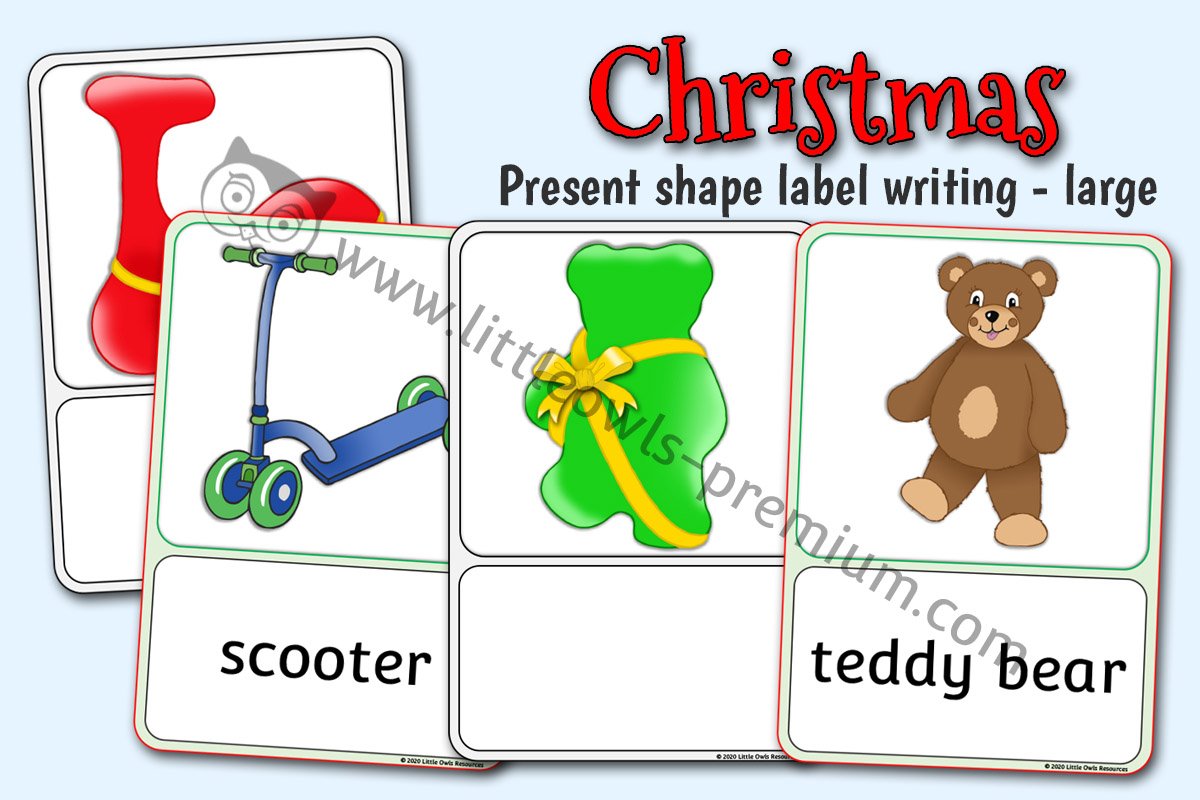
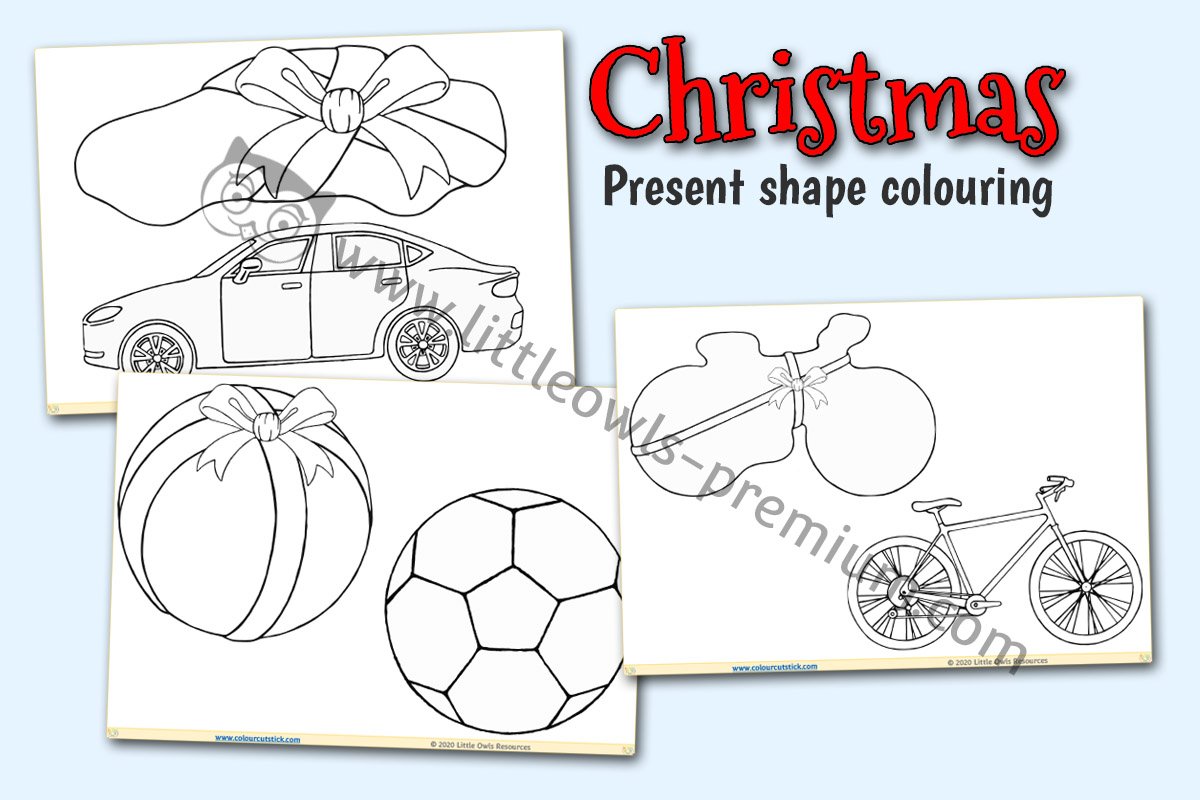
As an extension to our ‘Present Shape Match Cards’, these cards allow children to not only use their observational skills to match the present with its contents, but also write a label for what they think is inside. (Smaller A5 cards also available.)
20 A4 cards/posters are included in the pack; a toy poster with label, plus a wrapped present child activity card to match with each. 10 presents in total. All are intended to be laminated for multiple uses.
Ideas…
Place the 10 poster cards on display for your child(ren) to see. Give your child/each child one of the 10 activity cards. Encourage them to look at the posters and decide which one they think is inside their wrapped present. Encourage them to experiment with writing the label underneath.
Alternatively challenge your child(ren) to imagine what they think is inside a present by giving them an activity card without letting them see the posters. This allows for a more open ended problem solving task, plus gives more freedom for children to practice the phonics skills they have at their disposal, by allowing them to sound out the word they have in mind without seeing the written answer.
For additional differentiation/variation, we have created the poster cards in such a way that you may decide to separate the image and the label to make 2 separate cards out of each poster. This will enable you to allow your child(ren) to only see one or the other if you wish. For example, you may prefer to let them see the images to give them ideas for what may be inside their present, but would like to allow them to use their phonics skills to write the label independently.
Original artwork drawn by Sara Murphy and final digital resources created by Stuart Murphy. COPYRIGHT ON ALL OF THE RESOURCES HOUSED ON THIS WEBSITE IS HELD BY ‘LITTLE OWLS RESOURCES’. OUR RESOURCES (INCLUDING THE IMAGES WITHIN THEM), CANNOT BE SHARED OR SOLD COMMERCIALLY.
DOWNLOAD EDITABLE (DOCX)
DOWNLOAD NON-EDITABLE (PDF)
DOWNLOAD NON-EDITABLE (Zipped JPEGs)
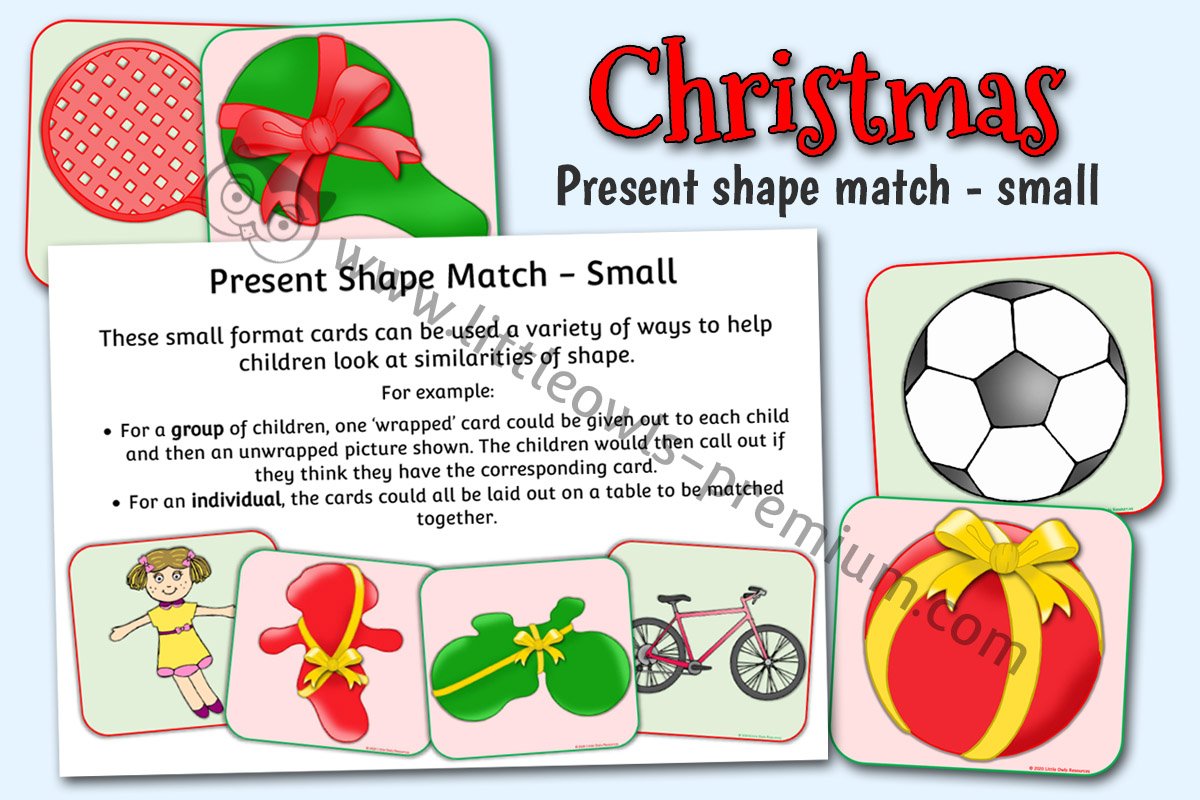
These small format cards can be used a variety of ways to help children look at similarities of shape.
For example:
For a group of children, one wrapped card could be given out to each child and then an unwrapped picture shown. The children would then call out if they think they have the corresponding card.
For an individual, the cards could all be laid out on the floor to be matched together.
Original artwork drawn by Sara Murphy and final digital resources created by Stuart Murphy. COPYRIGHT ON ALL OF THE RESOURCES HOUSED ON THIS WEBSITE IS HELD BY ‘LITTLE OWLS RESOURCES’. OUR RESOURCES (INCLUDING THE IMAGES WITHIN THEM), CANNOT BE SHARED OR SOLD COMMERCIALLY.
DOWNLOAD EDITABLE (DOCX)
DOWNLOAD NON-EDITABLE (PDF)
DOWNLOAD NON-EDITABLE (Zipped JPEGs)
Original artwork drawn by Sara Murphy and final digital resources created by Stuart Murphy. COPYRIGHT ON ALL OF THE RESOURCES HOUSED ON THIS WEBSITE IS HELD BY ‘LITTLE OWLS RESOURCES’. OUR RESOURCES (INCLUDING THE IMAGES WITHIN THEM), CANNOT BE SHARED OR SOLD COMMERCIALLY.
DOWNLOAD EDITABLE (DOCX)
DOWNLOAD NON-EDITABLE (PDF)
DOWNLOAD NON-EDITABLE (Zipped JPEGs)
Related Little Owls Resource Pages
Art and Craft Resources
Paper, paint, collage and suitable fabrics can provide opportunities to cover, layer, wrap or conceal surfaces and objects.
Home Corner Resources
Domestic play can involve wrapping dolls, using blankets, dressing up and covering or caring for familiar objects.
Imaginative Play Resources
Costumes, masks and adaptable props can support children who enjoy covering or transforming their appearance through imaginative play.
Sand Play Resources
Children may explore covering, hiding and burying suitable objects beneath sand before uncovering them again.
Enclosing, containing or enveloping?
These schemas frequently overlap. Enclosing generally involves creating a boundary around something; containing involves placing something inside a receptacle or space; and enveloping involves covering, wrapping or concealing it. Practitioners do not need to force a single interpretation when more than one schema may be involved.
📍 Positioning Schema Resources
What practitioners may notice: Children may show a strong interest in where objects are placed and how they relate spatially to one another. They might line up toys, create rows, arrange objects around edges, place items in particular locations or become absorbed in making precise layouts.
Supporting this through provision: Consider loose parts, blocks, figures, natural materials, sorting trays, frames, grids and open surfaces where objects can be placed and rearranged. Allow children to investigate position, spacing, alignment, symmetry and visual relationships in their own ways.
Positioning Schema Resources:

Positioning Schema Label Pack | Birth-5
A calm, practical labelling system for schema-informed provision. Each card pairs a clear resource name with a short line showing how it can support positioning exploration.
24 purpose-led labels | 4 provision sections | 8 printable pages
Contents
- Sorting, Matching & Grouping
Trays, counters, pairs, attribute sets, number frames and posting pieces | 6 labels
- Lines, Rows & Patterns
Loose parts, vehicles, figures, threading, pattern cards and dominoes | 6 labels
- Building, Balancing & Composing
Blocks, connectors, large loose parts, shapes, puzzles and route pieces | 6 labels
- Mark-Making, Small Worlds & Outdoor
Paper, stickers, dough, scene resources, natural materials and markers | 6 labels
Pedagogy in brief
Children exploring a positioning schema may line up, order, sort or arrange objects, place items carefully in particular locations, make patterns, balance pieces, or position their bodies in relation to spaces and markers. These labels help practitioners make open-ended resources visible and accessible without turning observed behaviour into a fixed category. Children may explore several schemas at once. Notice and model spatial, comparative and pattern language while leaving room for child-led repetition and change rather than making arrangements into a right-or-wrong task. Select only safe, developmentally appropriate resources; check small parts, threading materials, magnets, heavy blocks, unstable stacks and trip hazards carefully, with suitable supervision and risk assessment.
Using this file
Pages 2-9 are the printable label sheets. Print at 100% scale. Text and illustrations can be edited in Word. Choose only the labels that suit the children, space and resources available. Place labels where children can see and use them. The labels support choice, language and responsive provision; they are not a checklist or a way to assign a fixed schema to a child.
Additional/Alternate Use
The labels may be kept as cards for professional knowledge and CPD. Settings may find it useful to keep cards available as a reference tool for practitioner use within a responsive planning environment.
Both editable docx file and pdf files available. To change wording or font on a label to suit your particular setting, select the ‘DOCX’ option below.
DOWNLOAD (DOCX) 📝
DOWNLOAD (PDF) 📄
DOWNLOAD (Zipped JPEGs) 📂

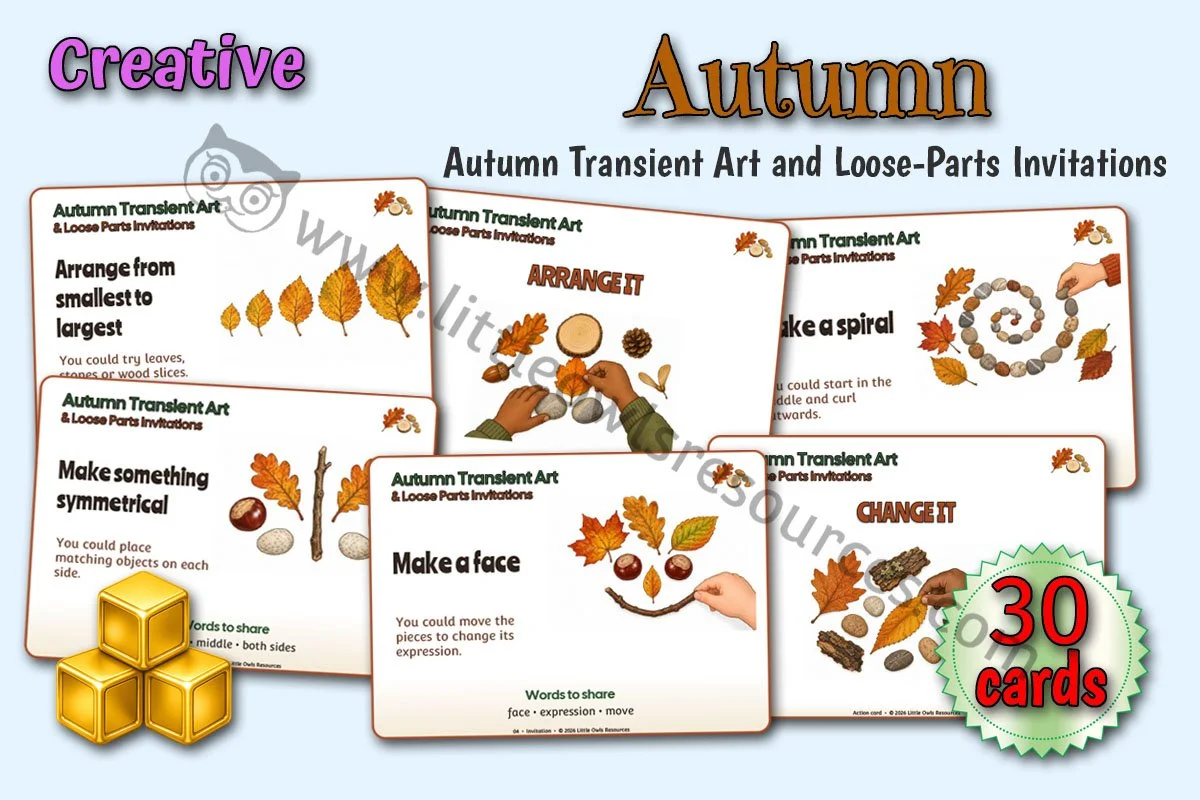
Twenty-four invitations for making temporary arrangements with autumn materials, plus six reusable action cards. Children place, move, combine and take apart loose pieces without glue. Enjoy the choosing and changing as much as the picture or arrangement that emerges.
Offer an invitation
Place one card beside a small choice of suitable materials and a clear working space. The card sits beside the play; it is not a mat to fill or a picture to cover. Read the invitation aloud if useful, then allow time to explore. The illustrations offer a possible starting idea. Welcome abstract arrangements, stories, experiments and ideas that grow beyond the prompt.
The smaller “You could…” line is optional support if a child wants a way in. “Words to share” gives adults useful vocabulary to model through conversation, gestures or signs. Neither is a checklist. Children can point, choose, move pieces, direct a partner or watch before joining in; they do not need to read the cards or produce a finished picture.
Use the action cards freely
ARRANGE IT • CHANGE IT • ADD TO IT • TAKE SOMETHING AWAY • PHOTOGRAPH IT • START AGAIN
Choose any action card beside an invitation, or use the action cards alone. They are choices, not a sequence to complete. Ask before changing or dismantling a child’s arrangement. Offer a photograph if the child wants a memory, with adult help as needed. Agree when to leave work in place and when to gather pieces for another day. Photographing and starting again are always optional.
DOWNLOAD (DOCX) 📝
DOWNLOAD (PDF) 📄
DOWNLOAD (Zipped JPEGs) 📂
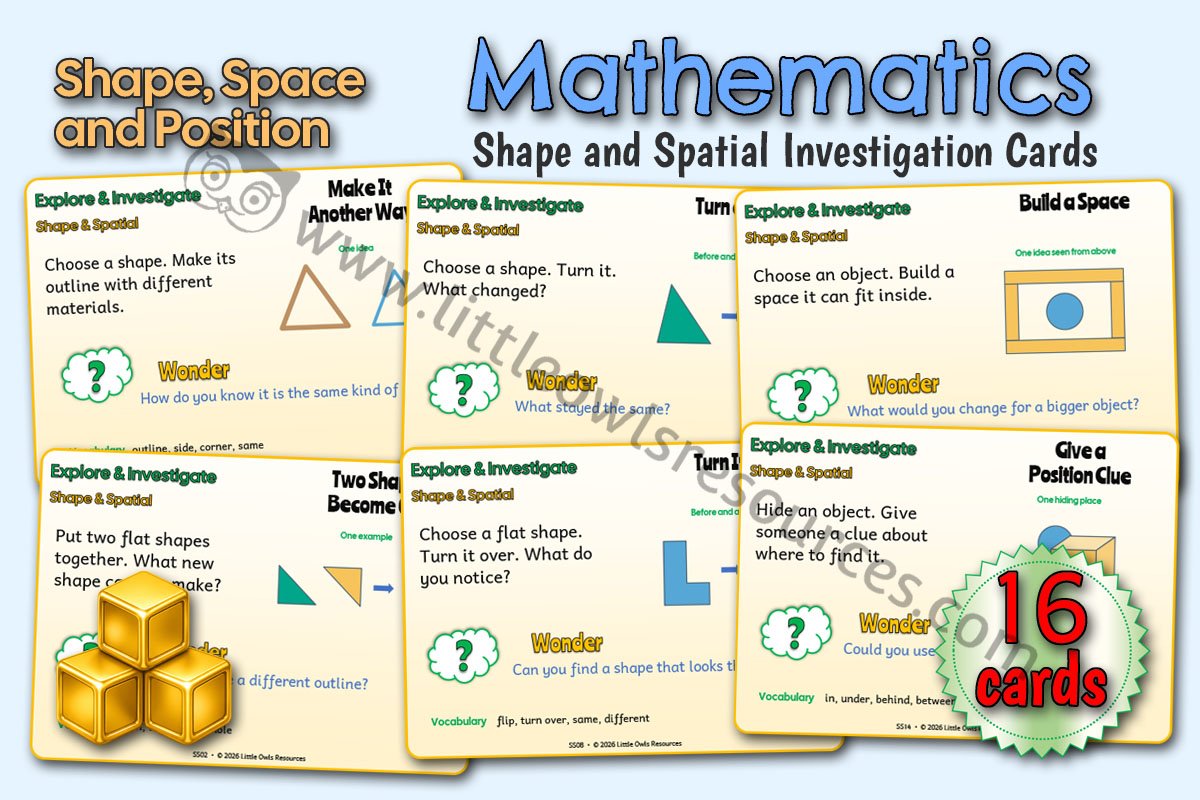
Sixteen practical invitations for fitting, combining, moving and representing shapes. Use with blocks, flat tiles, loose parts, cardboard shapes and everyday objects in maths, construction, creative play, small world or outdoors. Primarily for Preschool and Reception.
DOWNLOAD (DOCX)📝
DOWNLOAD (PDF)📄
DOWNLOAD (Zipped JPEGs)📂
← Back to ‘Maths Continuous Provision & Play’ Area
← Back to ‘Mathematics’ Menu (Areas of Learning)
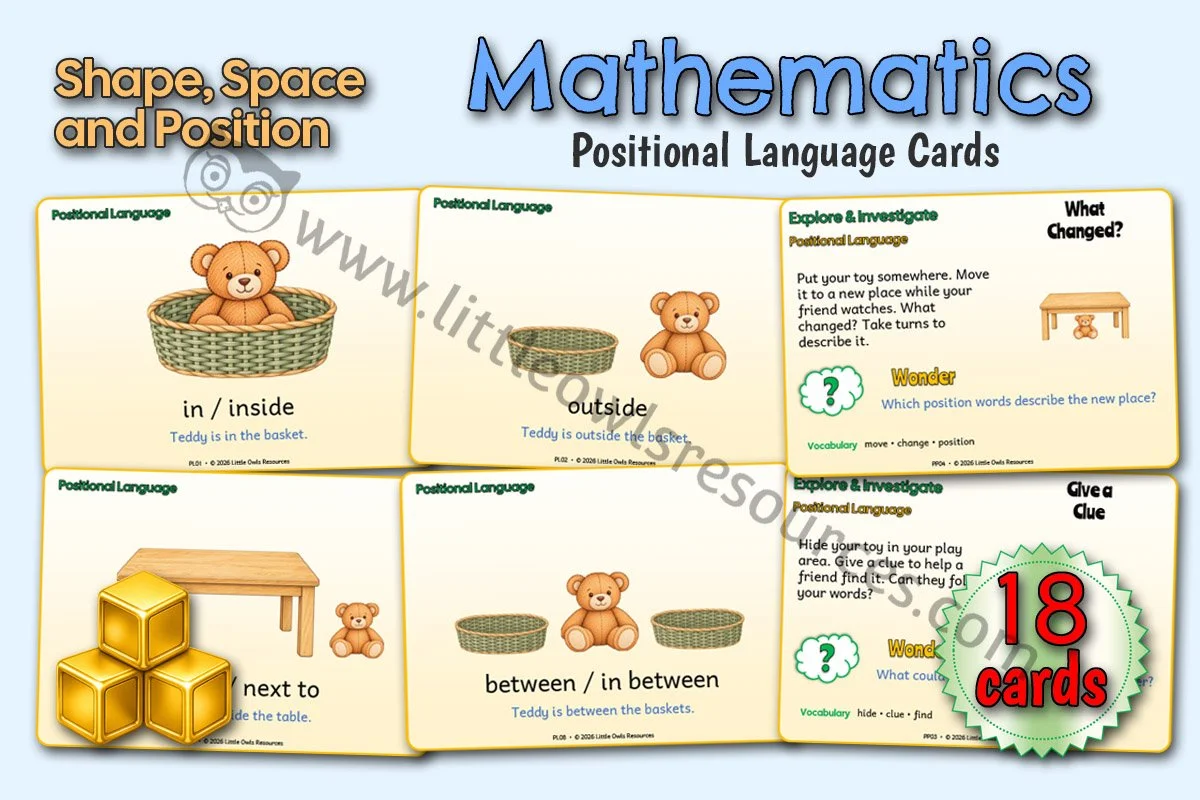
These twelve concept cards and six play prompts support talk about where things are. Offer a familiar toy, a basket and a low toy table, or suitable objects from your provision. Choose one or two cards that connect with children’s play. Read the words aloud and model an arrangement. Leave time for children to move objects, explore alternatives and describe their own ideas.
DOWNLOAD (DOCX)📝
DOWNLOAD (PDF)📄
DOWNLOAD (Zipped JPEGs)📂
← Back to ‘Maths Continuous Provision & Play’ Area
← Back to ‘Mathematics’ Menu (Areas of Learning)
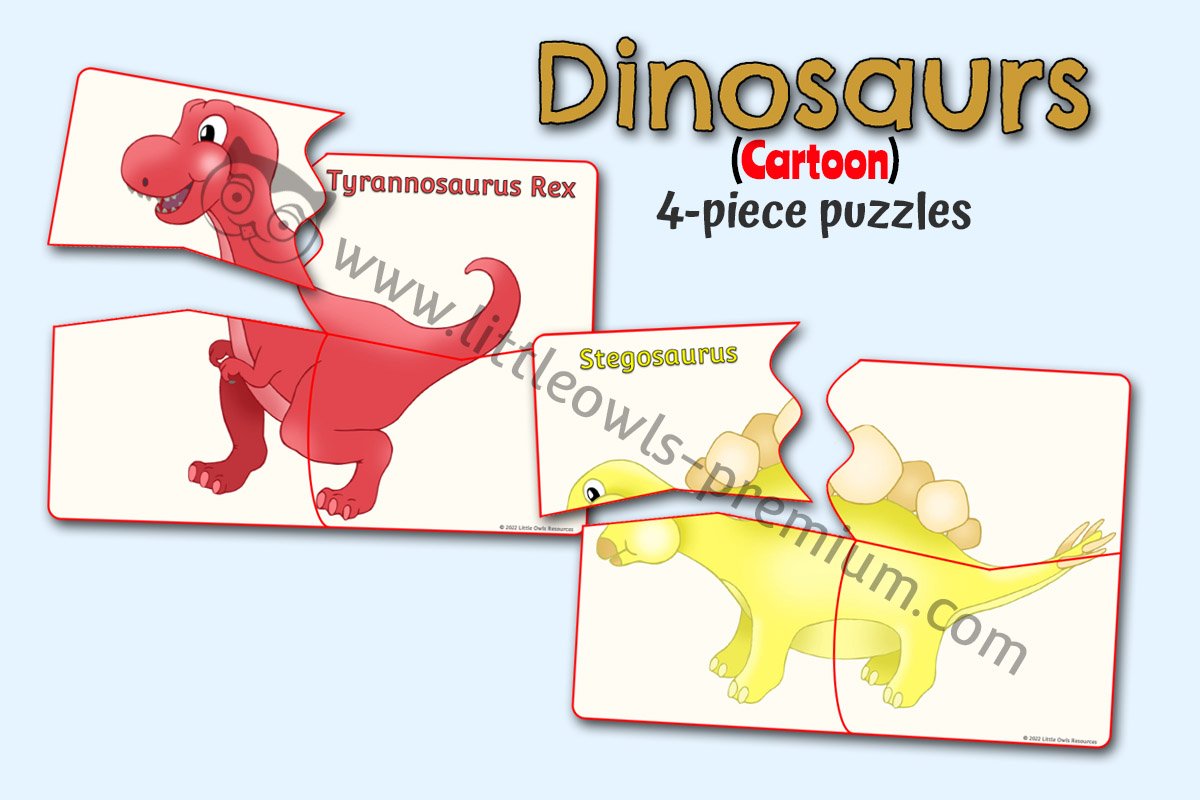
Pack of various cartoon dinosaur 4-piece puzzles, including: Brachiosaurus, Pachycephalosaurus, Ankylosaurus, Parasaurolophus, Plesiosaurus, Pterodactyl, Stegosaurus, Tyrannosaurus Rex and Triceratops.
Original artwork drawn by Sara Murphy and final digital resources created by Stuart Murphy. COPYRIGHT ON ALL OF THE RESOURCES HOUSED ON THIS WEBSITE IS HELD BY ‘LITTLE OWLS RESOURCES’. OUR RESOURCES (INCLUDING THE IMAGES WITHIN THEM), CANNOT BE SHARED OR SOLD COMMERCIALLY.
DOWNLOAD EDITABLE (DOCX)
DOWNLOAD NON-EDITABLE (PDF)
DOWNLOAD NON-EDITABLE (Zipped JPEGs)
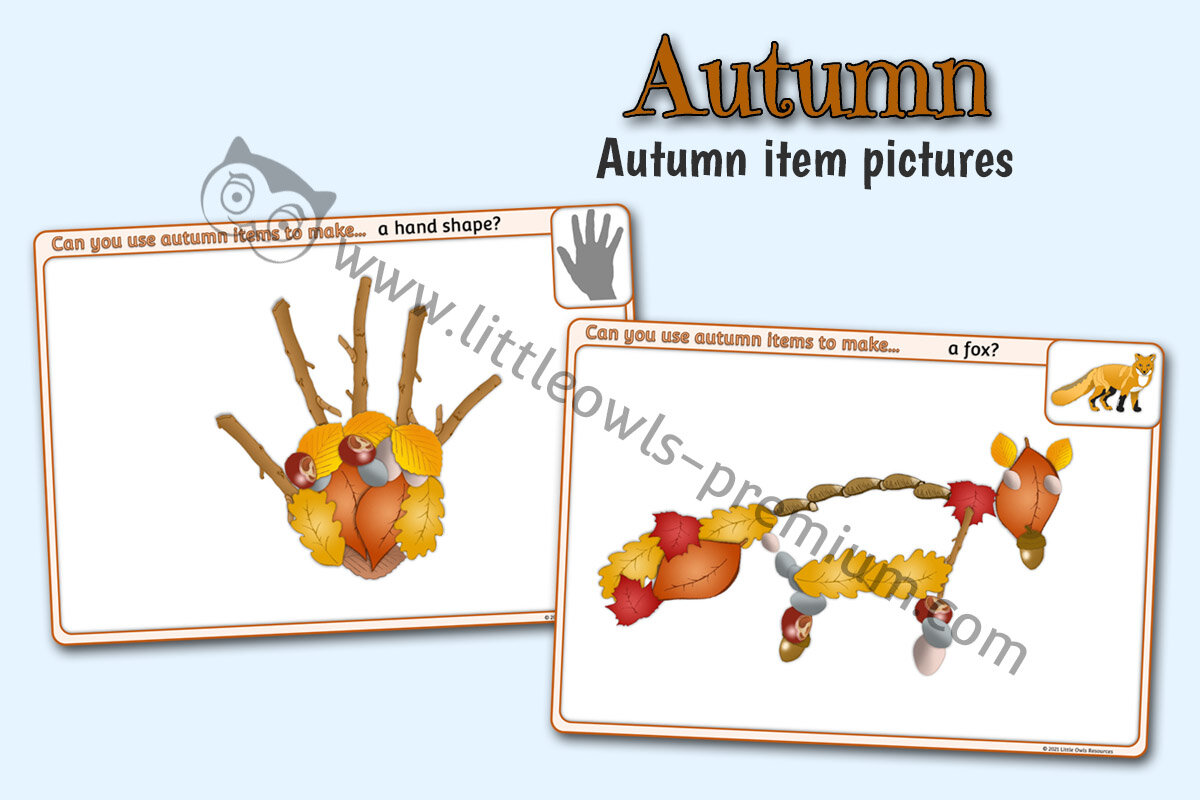
These cards/mats are intended to inspire children to use natural, autumnal items to create pictures.
It is not intended for these representations to be copied exactly; any combination of natural resources will do!
Original artwork drawn by Sara Murphy and final digital resources created by Stuart Murphy. COPYRIGHT ON ALL OF THE RESOURCES HOUSED ON THIS WEBSITE IS HELD BY ‘LITTLE OWLS RESOURCES’. OUR RESOURCES (INCLUDING THE IMAGES WITHIN THEM), CANNOT BE SHARED OR SOLD COMMERCIALLY.
DOWNLOAD EDITABLE (DOCX)
DOWNLOAD NON-EDITABLE (PDF)
DOWNLOAD NON-EDITABLE (Zipped JPEGs)
Related Little Owls Resource Pages
Pattern Resources
Pattern resources can support children who enjoy placing objects in repeated arrangements, rows or personally meaningful layouts.
Shape Resources
Loose shapes and shape-based resources can be positioned, turned and rearranged to explore spacing, alignment and spatial relationships.
Construction and Building Resources
Building materials allow children to make deliberate decisions about the location, alignment and balance of individual components.
Puzzle Resources
Completing puzzles involves examining position, orientation and the relationship of each piece to the whole.
🧭 Orientation Schema Resources
What practitioners may notice: Children may investigate how people, objects and spaces look from different positions or viewpoints. They might look through their legs, turn objects upside down, lie beneath furniture, climb to view something from above or examine reflections and images from unusual angles.
Supporting this through provision: Consider mirrors, viewing frames, transparent materials, magnifiers, tubes, slopes and safe opportunities to crawl, climb, balance or observe from different heights. These experiences can support children’s exploration of perspective, spatial awareness, body position and movement.
Orientation Schema Resources:
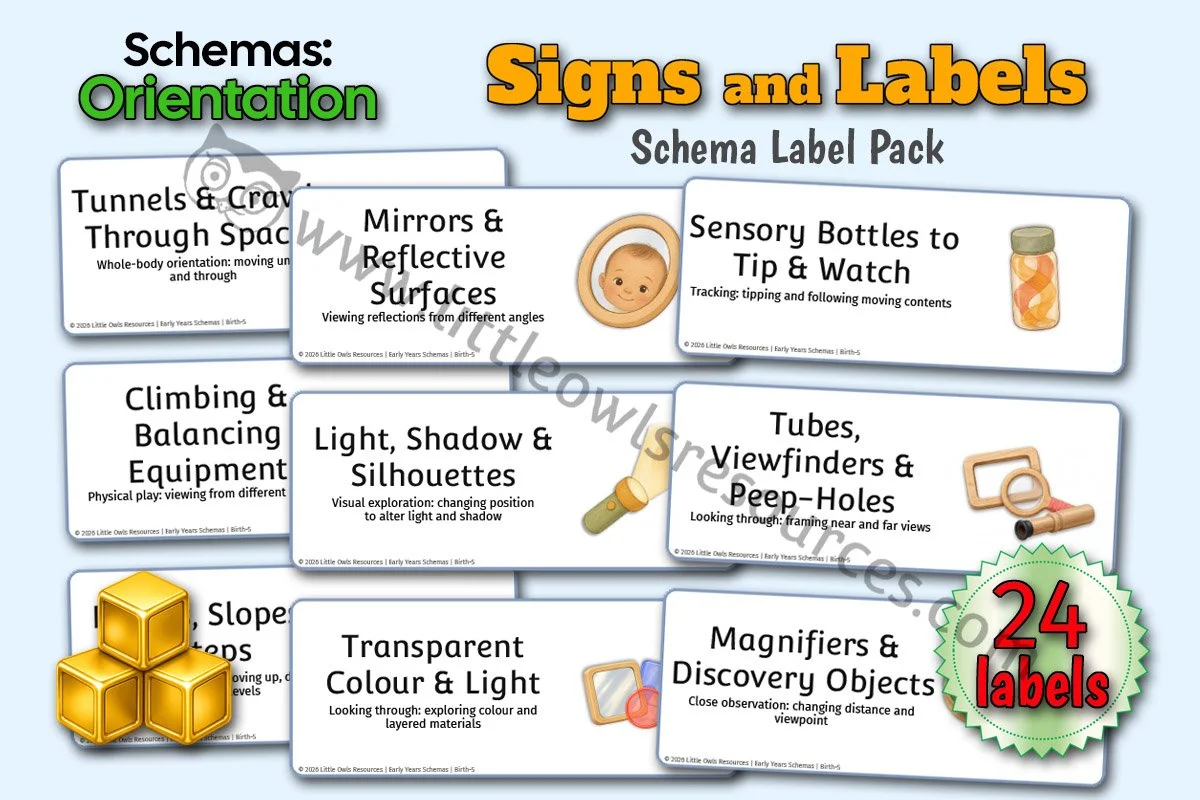
Orientation Schema Label Pack | Birth-5
A calm, practical labelling system for schema-informed provision. Each card pairs a clear resource name with a short line showing how it can support orientation exploration.
24 purpose-led labels | 4 provision sections | 8 printable pages
Contents
- Reflection, Light & Looking
Mirrors, shadows, transparent colour, sensory bottles, viewing tubes and magnifiers | 6 labels
- Levels, Movement & Body Viewpoints
Tunnels, climbing, slopes, trails, moving fabrics and floor mats | 6 labels
- Turning, Fitting & Reorienting Objects
Puzzles, posting pieces, blocks, loose parts, routes and tipping containers | 6 labels
- Maps, Scenes & Mark-Making Viewpoints
Maps, small worlds, books, boards, floor paper and clipboards | 6 labels
Pedagogy in brief
Children exploring an orientation schema may look at people, objects and spaces from unusual angles or levels; turn objects and pictures; peer through openings; inspect reflections; or change their own position to see what looks different from above, below, behind or upside down. These labels help practitioners make open-ended resources visible and accessible without turning observed behaviour into a fixed category. Children may explore several schemas at once. Notice and model spatial and directional language while allowing safe, child-led repetition rather than correcting an unconventional viewpoint. Select only developmentally appropriate resources; use shatterproof mirrors, avoid unsafe light sources, and supervise climbing, rolling, tunnels, water, tubes and small parts with suitable risk assessment.
Using this file
Pages 2-9 are the printable label sheets. Print at 100% scale. Text and illustrations can be edited in Word. Choose only the labels that suit the children, space and resources available. Place labels where children can see and use them. The labels support choice, language and responsive provision; they are not a checklist or a way to assign a fixed schema to a child.
Additional/Alternate Use
The labels may be kept as cards for professional knowledge and CPD. Settings may find it useful to keep cards available as a reference tool for practitioner use within a responsive planning environment.
Both editable docx file and pdf files available. To change wording or font on a label to suit your particular setting, select the ‘DOCX’ option below.
DOWNLOAD (DOCX) 📝
DOWNLOAD (PDF) 📄
DOWNLOAD (Zipped JPEGs) 📂

This STEM ‘Investigate Minibeasts - Support Pack’ includes a variety of resources to help inspire and engage adults and children alike.
Materials within the pack encourage open ended exploration of the challenge ‘Can you investigate minibeasts?’
STEM learning brings together Science, Technology, Engineering and Mathematics.
Skills such as critical thinking, creativity, teamwork, communication, initiative, inquiry and problem solving are all developed within STEM learning.
We hope you find this pack useful and you all have fun!
Original artwork drawn by Sara Murphy and final digital resources created by Stuart Murphy. COPYRIGHT ON ALL OF THE RESOURCES HOUSED ON THIS WEBSITE IS HELD BY ‘LITTLE OWLS RESOURCES’. OUR RESOURCES (INCLUDING THE IMAGES WITHIN THEM), CANNOT BE SHARED OR SOLD COMMERCIALLY.
DOWNLOAD EDITABLE (DOCX)
DOWNLOAD NON-EDITABLE (PDF)
DOWNLOAD NON-EDITABLE (Zipped JPEGs)

This ‘Minibeast Hunt Activity Pack’ includes a variety of resources to help inspire and engage adults and children alike.
The activity card plan breaks down key elements of the activity into sections: You will need, Activity description, Extra challenge, Development Matters statements (from Understanding the World), Key vocabulary, Key questions and Additional resources.
Also included in the pack are various handy printables such as a ‘Family Fun’ homework handout, checklist prompts, relevant word cards/mats, mark making sheets and posters.
In addition, the ‘Minibeast Hunt’ poster within this pack is designed to be used in conjunction with our ‘Science Banners’ pack which includes a space for activity posters from each of the ‘Science Activity Packs’ (of which this is one). You may like to set up a ‘Science Activity/Investigation/Experiment’ area (all of these banners are available) and swap in and out the posters from within our activity packs.
We hope you find this pack useful and you all have fun!
Original artwork drawn by Sara Murphy and final digital resources created by Stuart Murphy. COPYRIGHT ON ALL OF THE RESOURCES HOUSED ON THIS WEBSITE IS HELD BY ‘LITTLE OWLS RESOURCES’. OUR RESOURCES (INCLUDING THE IMAGES WITHIN THEM), CANNOT BE SHARED OR SOLD COMMERCIALLY.
DOWNLOAD EDITABLE (DOCX)
DOWNLOAD NON-EDITABLE (PDF)
DOWNLOAD NON-EDITABLE (Zipped JPEGs)

This ‘Plant Hunt Activity Pack’ includes a variety of resources to help inspire and engage adults and children alike.
The activity card plan breaks down key elements of the activity into sections: You will need, Activity description, Extra challenge, Development Matters statements (from Understanding the World), Key vocabulary, Key questions and Additional resources.
Also included in the pack are various handy printables such as a ‘Family Fun’ homework handout, checklist prompts, relevant word cards/mats, mark making sheets and posters.
In addition, the ‘Plant Hunt’ poster within this pack is designed to be used in conjunction with our ‘Science Banners’ pack which includes a space for activity posters from each of the ‘Science Activity Packs’ (of which this is one). You may like to set up a ‘Science Activity/Investigation/Experiment’ area (all of these banners are available) and swap in and out the posters from within our activity packs.
We hope you find this pack useful and you all have fun!
Original artwork drawn by Sara Murphy and final digital resources created by Stuart Murphy. COPYRIGHT ON ALL OF THE RESOURCES HOUSED ON THIS WEBSITE IS HELD BY ‘LITTLE OWLS RESOURCES’. OUR RESOURCES (INCLUDING THE IMAGES WITHIN THEM), CANNOT BE SHARED OR SOLD COMMERCIALLY.
DOWNLOAD EDITABLE (DOCX)
DOWNLOAD NON-EDITABLE (PDF)
DOWNLOAD NON-EDITABLE (Zipped JPEGs)
Related Little Owls Resource Pages
Outdoor Area Resources
Outdoor spaces can provide safe opportunities to observe from different heights, move around obstacles and experience changing body positions.
Transport and Travel Resources
Routes, journeys and moving vehicles can support exploration of direction, location, perspective and changing position.
Shape Resources
Children can investigate how shapes appear when they are turned, rotated, reflected or viewed from different angles.
STEM and STEAM Resources
Construction and investigation challenges can develop spatial thinking as children examine objects and structures from different viewpoints.
🦋 Transforming Schema Resources
What practitioners may notice: Children may be fascinated by how materials, objects or substances change. They might repeatedly mix, mould, squash, dissolve, melt, combine, take apart or alter the appearance and texture of materials.
Supporting this through provision: Consider playdough, clay, sand, mud, water, paint, natural materials and safe opportunities for mixing, cooking or investigating changes of state. Allow children time to revisit processes and observe what happens, using language that describes change without requiring a predetermined product.
Transforming Schema Resources:

Transforming Schema Label Pack | Birth-5
A calm, practical labelling system for schema-informed provision. Each card pairs a clear resource name with a short line showing how it can support transforming exploration.
24 purpose-led labels | 4 provision sections | 8 printable pages
Contents
- Shaping, Taking Apart & Remaking
Dough, modelling tools, paper, scissors, loose parts and recycled materials | 6 labels
- Mixing Colour, Marks & Materials
Paint, mixing tools, printing, collage, changing marks and fabrics | 6 labels
- Water, Texture & Changes of State
Ice, sand, mud, textures, sponges, containers and cooking tools | 6 labels
- Growing, Nature & Imaginative Change
Growing, natural art, mud kitchens, small worlds, dressing up and stories | 6 labels
Pedagogy in brief
Children exploring a transforming schema may be fascinated by how materials, objects, living things, marks or ideas can change. They may repeatedly mix, squash, tear, melt, mould, combine, take apart, rebuild or use one thing to represent another. These labels help practitioners make open-ended resources visible and accessible without turning observed behaviour into a fixed category. Children may explore several schemas at once. Notice and model language such as mix, change, melt, grow, squash, reshape, before and after while allowing safe, child-led repetition. Select only developmentally appropriate resources; check allergies and choking risks, use non-toxic and taste-safe materials where mouthing is likely, and closely supervise water, ice, tools, cooking, sensory mixtures and small parts with suitable risk assessment.
Using this file
Pages 2-9 are the printable label sheets. Print at 100% scale. Text and illustrations can be edited in Word. Choose only the labels that suit the children, space and resources available. Place labels where children can see and use them. The labels support choice, language and responsive provision; they are not a checklist or a way to assign a fixed schema to a child.
Additional/Alternate Use
The labels may be kept as cards for professional knowledge and CPD. Settings may find it useful to keep cards available as a reference tool for practitioner use within a responsive planning environment.
Both editable docx file and pdf files available. To change wording or font on a label to suit your particular setting, select the ‘DOCX’ option below.
DOWNLOAD (DOCX) 📝
DOWNLOAD (PDF) 📄
DOWNLOAD (Zipped JPEGs) 📂

Turn your Pancake Day celebrations into a vibrant science and art lesson with our Pancake: Colour Mixing Experiment Activity! These engaging printables are perfect for EYFS and KS1 children…
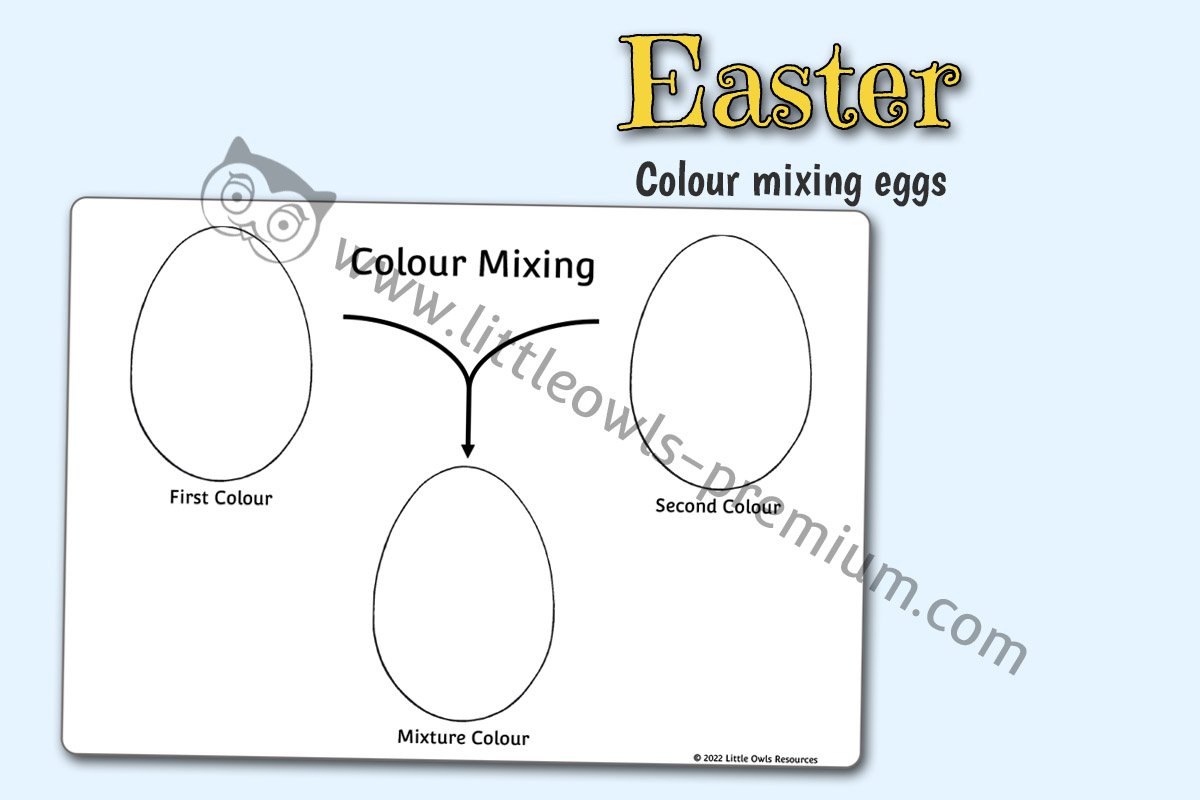
Colour mixing experiment sheets with an egg theme. For example, paint the first egg white and the second red. Then mix the two colours together and paint the bottom egg in the resulting pink colour. You may want to repeat this for a few different mixtures and make a ‘Colour Mixing’ display.
Original artwork drawn by Sara Murphy and final digital resources created by Stuart Murphy. COPYRIGHT ON ALL OF THE RESOURCES HOUSED ON THIS WEBSITE IS HELD BY ‘LITTLE OWLS RESOURCES’. OUR RESOURCES (INCLUDING THE IMAGES WITHIN THEM), CANNOT BE SHARED OR SOLD COMMERCIALLY.
DOWNLOAD EDITABLE (DOCX)
DOWNLOAD NON-EDITABLE (PDF)
DOWNLOAD NON-EDITABLE (Zipped JPEGs)

This STEM ‘Make Something Melt - Support Pack’ includes a variety of resources to help inspire and engage adults and children alike.
Materials within the pack encourage open ended exploration of the challenge ‘Can you make something melt?’
STEM learning brings together Science, Technology, Engineering and Mathematics.
Skills such as critical thinking, creativity, teamwork, communication, initiative, inquiry and problem solving are all developed within STEM learning.
We hope you find this pack useful and you all have fun!
Original artwork drawn by Sara Murphy and final digital resources created by Stuart Murphy. COPYRIGHT ON ALL OF THE RESOURCES HOUSED ON THIS WEBSITE IS HELD BY ‘LITTLE OWLS RESOURCES’. OUR RESOURCES (INCLUDING THE IMAGES WITHIN THEM), CANNOT BE SHARED OR SOLD COMMERCIALLY.
DOWNLOAD EDITABLE (DOCX)
DOWNLOAD NON-EDITABLE (PDF)
DOWNLOAD NON-EDITABLE (Zipped JPEGs)

This STEM ‘Fruit Slushies Activity Pack’ includes a variety of resources to help inspire and engage adults and children alike.
The activity card plan breaks down key elements of the activity into sections: You will need, Activity description, Extra challenge, Development Matters statements (from Understanding the World), Key vocabulary, Key questions and Additional resources.
Also included in the pack are various handy printables such as a ‘Family Fun’ homework handout, checklist prompts, relevant word cards, mark making sheets and posters.
In addition, the ‘Fruit Slushies’ poster within this pack is designed to be used in conjunction with our ‘Science Banners’ pack which includes a space for activity posters from each of the ‘Science Activity Packs’ (of which this is one). You may like to set up a ‘Science Activity/Investigation/Experiment’ area (all of these banners are available) and swap in and out the posters from within our activity packs.
We hope you find this pack useful and you all have fun!
Original artwork drawn by Sara Murphy and final digital resources created by Stuart Murphy. COPYRIGHT ON ALL OF THE RESOURCES HOUSED ON THIS WEBSITE IS HELD BY ‘LITTLE OWLS RESOURCES’. OUR RESOURCES (INCLUDING THE IMAGES WITHIN THEM), CANNOT BE SHARED OR SOLD COMMERCIALLY.
DOWNLOAD EDITABLE (DOCX)
DOWNLOAD NON-EDITABLE (PDF)
DOWNLOAD NON-EDITABLE (Zipped JPEGs)
Related Little Owls Resource Pages
Art and Craft Resources
Creative materials can be mixed, cut, combined, reshaped and altered as children investigate processes of change.
Colour Resources
Colour-mixing and matching resources can support exploration of what happens when colours and materials are combined.
Science and Understanding the World Resources
Practical investigations can help children notice changes in materials, substances, living things and the natural environment.
Water Play Resources
Water provides opportunities to investigate flowing, dissolving, mixing, freezing and changes between wet and dry.
Sand Play Resources
Children can explore how sand changes when it is mixed with water, compressed, moulded, poured or broken apart.
📦 Containing Schema Resources
What practitioners may notice: Children may repeatedly place objects or materials inside containers and take them out again. They might fill and empty boxes, pots, bags or cups, fit smaller objects inside larger ones or investigate how much a container will hold.
Supporting this through provision: Consider containers of different shapes and sizes, nesting resources, pots, bowls, boxes, tins, baskets, scoops and objects suitable for filling and emptying. These experiences can support exploration of capacity, quantity, size, space, containment and object permanence.
Containing Schema Resources:
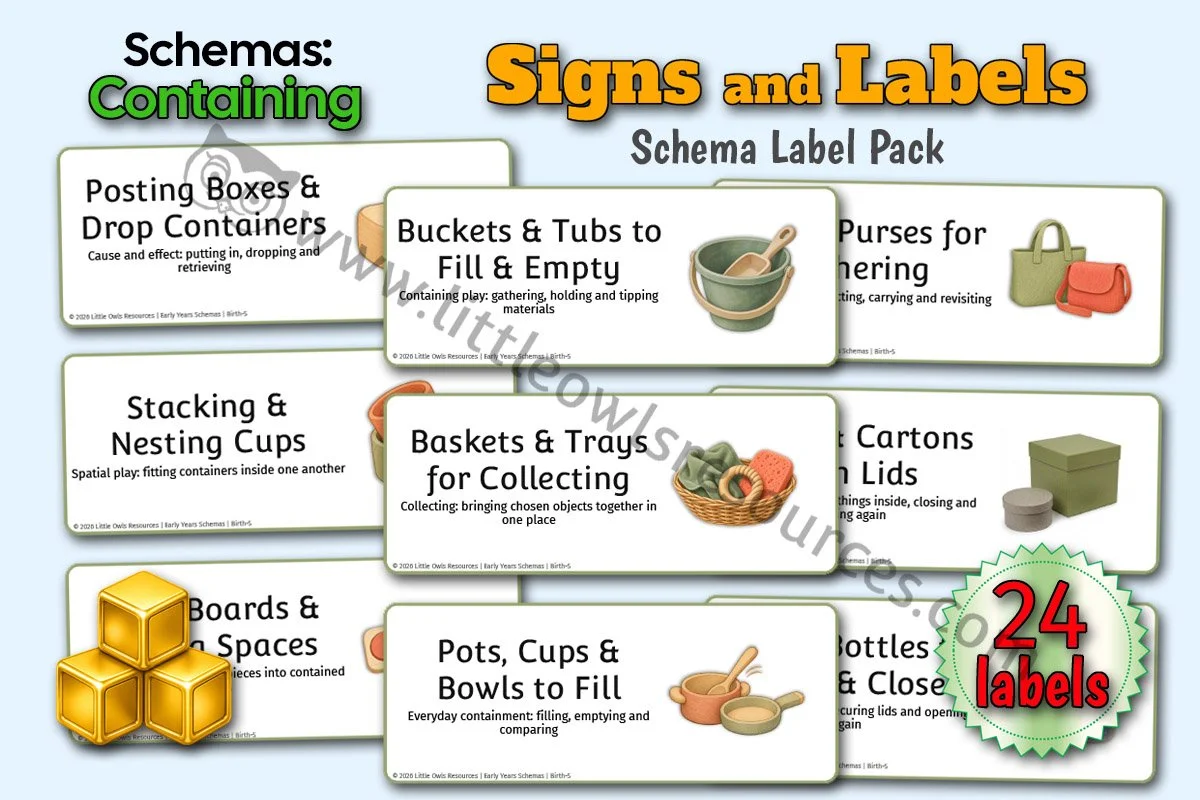
Containing Schema Label Pack | Birth-5
A calm, practical labelling system for schema-informed provision. Each card pairs a clear resource name with a short line showing how it can support containing exploration.
24 purpose-led labels | 4 provision sections | 8 printable pages
Contents
- Containers to Fill, Empty & Collect
Buckets, baskets, pots, bags, boxes, jars and bottles | 6 labels
- Posting, Nesting & Fitting
Posting boxes, nesting cups, inset spaces, tubes, funnels and compartments | 6 labels
- Carrying, Sorting & Storing
Carriers, trolleys, collection boxes, loose-part trays, homes and care containers | 6 labels
- Water, Sensory & Treasure Containers
Pouring, filling tools, water, sand, mud, dough and treasure collections | 6 labels
Pedagogy in brief
Children exploring a containing schema may repeatedly put objects or materials inside bags, boxes, baskets, pots or other vessels; fill and empty containers; post objects through openings; nest one container inside another; or carry and store collections. This differs from enclosing play, where the interest is often in creating a boundary around a person, object or space, although the two may overlap. These labels help practitioners make open-ended resources visible and accessible without turning observed behaviour into a fixed category. Children may explore several schemas at once. Notice and model language such as in, inside, full, empty, more, less, open, closed, fit, hold and pour while allowing safe, child-led repetition. Select only developmentally appropriate resources; avoid plastic bags, cords, glass and airtight or entrapment risks, and supervise water, sensory materials, lids, containers and small parts with suitable risk assessment.
Using this file
Pages 2-9 are the printable label sheets. Print at 100% scale. Text and illustrations can be edited in Word. Choose only the labels that suit the children, space and resources available. Place labels where children can see and use them. The labels support choice, language and responsive provision; they are not a checklist or a way to assign a fixed schema to a child.
Additional/Alternate Use
The labels may be kept as cards for professional knowledge and CPD. Settings may find it useful to keep cards available as a reference tool for practitioner use within a responsive planning environment.
Both editable docx file and pdf files available. To change wording or font on a label to suit your particular setting, select the ‘DOCX’ option below.
DOWNLOAD (DOCX) 📝
DOWNLOAD (PDF) 📄
DOWNLOAD (Zipped JPEGs) 📂
Versatile ‘How many animals can you fit in the house?’ sheet/mat. Great for use alongside reading ‘A Squash and a Squeeze’!
Here are some ideas:
Place small world animals into the house. Practice 1:1 correspondence counting.
Laminate and use as a playdough mat. Have fun creating playdough animals.
Draw/make marks to represent animals inside the house.
Original artwork drawn by Sara Murphy and final digital resources created by Stuart Murphy. COPYRIGHT ON ALL OF THE RESOURCES HOUSED ON THIS WEBSITE IS HELD BY ‘LITTLE OWLS RESOURCES’. OUR RESOURCES (INCLUDING THE IMAGES WITHIN THEM), CANNOT BE SHARED OR SOLD COMMERCIALLY.
DOWNLOAD EDITABLE (DOCX)
DOWNLOAD NON-EDITABLE (PDF)
DOWNLOAD NON-EDITABLE (Zipped JPEGs)

This mat is designed to engage children in thinking about size. Ideal for use after a trip to the beach.
How many shells can you fit into the rockpool? Does it matter what type of shells they are? How many big shells can you fit? How many smaller ones? Does it matter what shape the shells are?
Great for use alongside reading ‘Sharing a Shell’!
Keywords: shells, fit, capacity, size, big, bigger, biggest, small, smaller, smallest, counting, count, one to one correspondence, shape, natural, loose part, items, materials, prompt, activities, activity, mat, maths, mathematics, math, numeracy
Original artwork drawn by Sara Murphy and final digital resources created by Stuart Murphy. COPYRIGHT ON ALL OF THE RESOURCES HOUSED ON THIS WEBSITE IS HELD BY ‘LITTLE OWLS RESOURCES’. OUR RESOURCES (INCLUDING THE IMAGES WITHIN THEM), CANNOT BE SHARED OR SOLD COMMERCIALLY.
DOWNLOAD EDITABLE (DOCX)
DOWNLOAD NON-EDITABLE (PDF)
DOWNLOAD NON-EDITABLE (Zipped JPEGs)
<<-BACK TO ‘BEACH SCHOOL’ MENU
<<-BACK TO ‘AT THE SEASIDE’ MENU
<<-BACK TO ‘OUTDOOR MATHS’ MENU

Ignite an exploration of size, shape, and comparison with our delightful Valentine's Day: Loose Parts Hearts (Big/Small)! These engaging printables are perfect for EYFS and KS1 children…

The cards can be used as part of a small display near the water area or as a direct challenge to be used by the children when playing in the water tray.
Keywords: EYFS, Year 1, Y1, Yr1, Measurement, Capacity and Volume
Original artwork drawn by Sara Murphy and final digital resources created by Stuart Murphy. COPYRIGHT ON ALL OF THE RESOURCES HOUSED ON THIS WEBSITE IS HELD BY ‘LITTLE OWLS RESOURCES’. OUR RESOURCES (INCLUDING THE IMAGES WITHIN THEM), CANNOT BE SHARED OR SOLD COMMERCIALLY.
DOWNLOAD EDITABLE (DOCX)
DOWNLOAD NON-EDITABLE (PDF)
DOWNLOAD NON-EDITABLE (Zipped JPEGs)
← Back to ‘Maths Continuous Provision & Play’ Area
<<-BACK TO ‘OUTDOOR AREA’ MENU
<<-BACK TO ‘OUTDOOR AREA - WATER PLAY’ MENU

The cards can be used as part of a display near the water area or as a direct challenge to be used by the children when playing in the water tray.
Keywords: EYFS, Year 1, Y1, Yr1, Measurement, Capacity and Volume
Original artwork drawn by Sara Murphy and final digital resources created by Stuart Murphy. COPYRIGHT ON ALL OF THE RESOURCES HOUSED ON THIS WEBSITE IS HELD BY ‘LITTLE OWLS RESOURCES’. OUR RESOURCES (INCLUDING THE IMAGES WITHIN THEM), CANNOT BE SHARED OR SOLD COMMERCIALLY.
DOWNLOAD EDITABLE (DOCX)
DOWNLOAD NON-EDITABLE (PDF)
DOWNLOAD NON-EDITABLE (Zipped JPEGs)
← Back to ‘Maths Continuous Provision & Play’ Area
<<-BACK TO ‘OUTDOOR AREA’ MENU
<<-BACK TO ‘OUTDOOR AREA - WATER PLAY’ MENU
Encourage your child(ren) to consolidate their knowledge of these capacity terms by challenging them to colour the jugs on the sheets to the appropriate level. Alternatively you may like to use loose parts, or laminate to use with playdough or whiteboard pens!
Keywords: EYFS, Year 1, Y1, Yr1, Measurement, Capacity and Volume
Original artwork drawn by Sara Murphy and final digital resources created by Stuart Murphy. COPYRIGHT ON ALL OF THE RESOURCES HOUSED ON THIS WEBSITE IS HELD BY ‘LITTLE OWLS RESOURCES’. OUR RESOURCES (INCLUDING THE IMAGES WITHIN THEM), CANNOT BE SHARED OR SOLD COMMERCIALLY.
DOWNLOAD EDITABLE (DOCX)
DOWNLOAD NON-EDITABLE (PDF)
← Back to ‘Maths Continuous Provision & Play’ Area
<<-BACK TO ‘OUTDOOR AREA’ MENU
<<-BACK TO ‘OUTDOOR AREA - WATER PLAY’ MENU
Related Little Owls Resource Pages
Capacity Resources
Capacity resources support investigation of how much different containers can hold through filling, emptying, comparing and transferring.
Water Play Resources
Cups, bottles, jugs and other vessels allow children to explore full, empty and the ways liquids occupy containers.
Sand Play Resources
Buckets, moulds and containers can be filled, emptied and compared using sand and other suitable materials.
Home Corner Resources
Pots, bags, baskets, boxes and household containers can bring containing and filling into familiar, meaningful play.
🚪 Going Through and Passageway Schema Resources
What practitioners may notice: Children may repeatedly explore how they, objects or materials pass through openings, spaces or routes. They might crawl through tunnels, move beneath or between objects, post items through holes, thread materials or send objects through tubes and channels.
Supporting this through provision: Consider tunnels, arches, obstacle routes, posting resources, threading materials, tubes, pipes, funnels and construction pieces with openings. Resources should allow children to explore routes, direction, fit, movement and spatial relationships safely, on both a small and whole-body scale.
Going Through & Passageway Schema Resources:
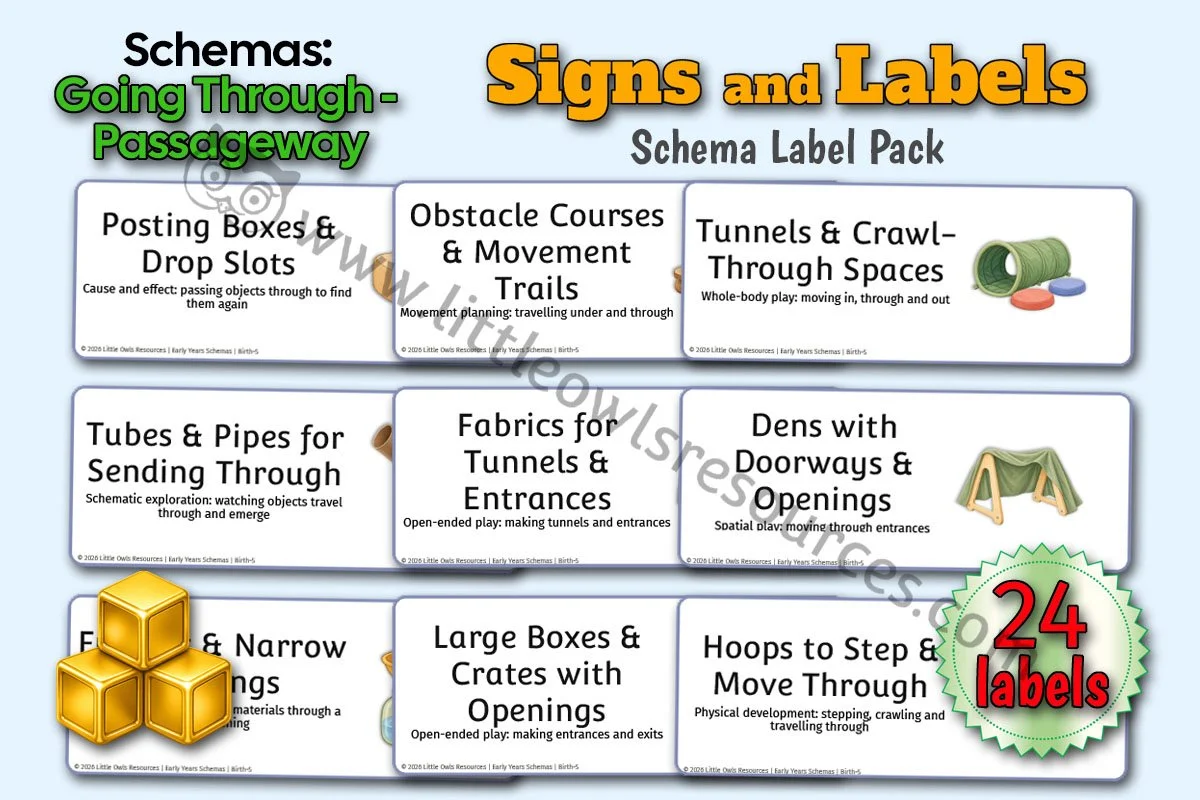
Going Through and Passageways Schema Label Pack | Birth-5
A calm, practical labelling system for schema-informed provision. Each card pairs a clear resource name with a short line showing how it can support going-through and passageway exploration.
24 purpose-led labels | 4 provision sections | 8 printable pages
Contents
- Whole-Body Routes & Passageways
Tunnels, dens, hoops, movement trails, fabric passages and large openings | 6 labels
- Posting, Threading & Fitting Through
Posting, pipes, funnels, threading pieces, shape spaces and lacing | 6 labels
- Building Tunnels, Bridges & Pathways
Blocks, routes, loose parts, channels, ramps and small-world passageways | 6 labels
- Flow, Sensory & Visual Passageways
Water, sand, pouring, viewing, dough tunnels and objects to send through | 6 labels
Pedagogy in brief
Children exploring a going-through or passageway schema may repeatedly move themselves, objects or materials through tunnels, openings, holes, channels, arches or spaces beneath structures. They may crawl in and out, post and retrieve objects, thread materials, send vehicles under bridges, or watch water and sand travel through a route. This overlaps with trajectory, connecting and containing play, but the particular interest here is often the passage from one side or space to another. These labels help practitioners make open-ended resources visible and accessible without turning observed behaviour into a fixed category. Children may explore several schemas at once. Notice and model language such as through, in, out, under, over, inside, outside, entrance, exit, tunnel, hole, path and emerge while allowing safe, child-led repetition. Select only developmentally appropriate resources; check that tunnels and openings cannot trap the head or body, avoid entanglement and choking risks, and supervise climbing, water, sensory materials, threading resources and small parts with suitable risk assessment.
Using this file
Pages 2-9 are the printable label sheets. Print at 100% scale. Text and illustrations can be edited in Word. Choose only the labels that suit the children, space and resources available. Place labels where children can see and use them. The labels support choice, language and responsive provision; they are not a checklist or a way to assign a fixed schema to a child.
Additional/Alternate Use
The labels may be kept as cards for professional knowledge and CPD. Settings may find it useful to keep cards available as a reference tool for practitioner use within a responsive planning environment.
Both editable docx file and pdf files available. To change wording or font on a label to suit your particular setting, select the ‘DOCX’ option below.
DOWNLOAD (DOCX) 📝
DOWNLOAD (PDF) 📄
DOWNLOAD (Zipped JPEGs) 📂
'Post Office' role play pack.
Pack includes:
banner
post box prop/display image across 2 A4 pages
name badges - Name Writing
opening times sign (with clock template to draw hands)
open and closed signs
various mark making sheets: ‘Special delivery instructions’ and ‘Sorry, you were out’ notes
1st and 2nd class stamp sheets (full colour & colouring versions)
various small signs & labels for items available for purchase with space for price tags
A4 sized posters/signs for display
Post office word mat & word cards
General post office mark making sheets
‘Design a stamp’ sheets
Have fun!
Alongside this role-play you may like to read: Dear Zoo, The Jolly Postman, Dragon Post or Paddington’s Post.
Keywords: post office, role play/role-play pack, postal worker, postal workers, postwoman, postman, postie, sending letters/parcels/presents/gifts/deliveries
Original artwork drawn by Sara Murphy and final digital resources created by Stuart Murphy. COPYRIGHT ON ALL OF THE RESOURCES HOUSED ON THIS WEBSITE IS HELD BY ‘LITTLE OWLS RESOURCES’. OUR RESOURCES (INCLUDING THE IMAGES WITHIN THEM), CANNOT BE SHARED OR SOLD COMMERCIALLY.
DOWNLOAD EDITABLE (DOCX)
DOWNLOAD NON-EDITABLE (PDF)
DOWNLOAD NON-EDITABLE (Zipped JPEGs)
Related Little Owls Resource Pages
Outdoor Area Resources
Outdoor routes, tunnels and spaces between or beneath equipment can support whole-body exploration of pathways and passageways.
Construction and Building Resources
Children can use construction materials to make arches, bridges, tunnels, doorways and routes for themselves or small-world objects.
Water Play Resources
Pipes, funnels, channels and tubes allow children to investigate how water and suitable objects travel through connected spaces.
Transport and Travel Resources
Roads, tracks, routes and journeys can inspire children to move vehicles through, under, over and between structures.
📏 Ordering and Seriation Schema Resources
What practitioners may notice: Children may repeatedly arrange, group or sequence objects according to characteristics such as size, length, colour, shape or quantity. They might create graded rows, repeat a particular sequence or reorganise collections until they appear ordered.
Supporting this through provision: Consider collections of objects that vary in size, length, shade, shape or texture, together with nesting resources, graded blocks, natural materials and open-ended loose parts.
Ordering & Seriation Schema Resources:

Ordering and Seriation Schema Label Pack | Birth-5
A calm, practical labelling system for schema-informed provision. Each card pairs a clear resource name with a short line showing how it can support ordering and seriation exploration.
24 purpose-led labels | 4 provision sections | 8 printable pages
Contents
- Sorting, Matching & Classifying
Trays, matching cards, counters, natural collections, attribute sets and figures | 6 labels
- Grading by Size, Length & Quantity
Nesting sets, graded pieces, comparing objects, measures, containers and quantities | 6 labels
- Patterns, Lines & Ordered Arrangements
Loose parts, pattern pieces, cards, counters, connecting sets and games | 6 labels
- Number, Routine & Story Sequences
Number tracks, symbols, stories, photo routines, practical steps and rhythms | 6 labels
Pedagogy in brief
Children exploring an ordering or seriation schema may repeatedly line up, match, sort, grade or arrange objects into a meaningful sequence. They may group by colour or type, place items from smallest to largest, repeat a pattern, organise objects into rows, or revisit the order of events in a routine or story. This can overlap with positioning, connecting and containing play, but the particular interest here is often the relationship between items and the rule or progression that orders them. These labels help practitioners make open-ended resources visible and accessible without turning observed behaviour into a fixed category. Children may explore several schemas at once. Notice and model language such as same, different, match, group, sort, first, next, last, before, after, smallest, larger, longest, repeat and pattern while allowing children to invent and change their own systems. Select only developmentally appropriate resources; prevent choking and ingestion risks, check magnets and small parts carefully, and supervise loose pieces, threading resources and sensory collections with suitable risk assessment.
Using this file
Pages 2-9 are the printable label sheets. Print at 100% scale. Text and illustrations can be edited in Word. Choose only the labels that suit the children, space and resources available. Place labels where children can see and use them. The labels support choice, language and responsive provision; they are not a checklist or a way to assign a fixed schema to a child.
Additional/Alternate Use
The labels may be kept as cards for professional knowledge and CPD. Settings may find it useful to keep cards available as a reference tool for practitioner use within a responsive planning environment.
Both editable docx file and pdf files available. To change wording or font on a label to suit your particular setting, select the ‘DOCX’ option below.
DOWNLOAD (DOCX) 📝
DOWNLOAD (PDF) 📄
DOWNLOAD (Zipped JPEGs) 📂
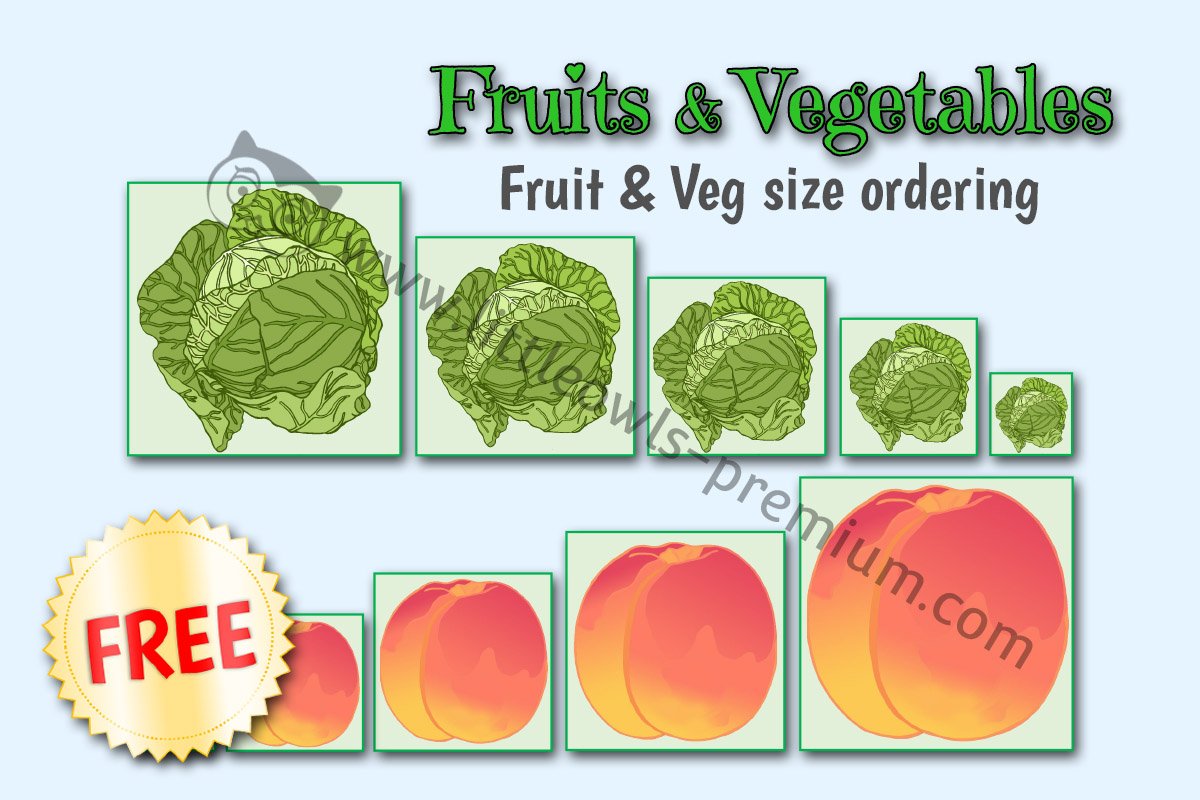
Fruit and Vegetable themed size ordering pictures. Intended to be cut out (and ideally laminated) for use by children in repeatable size ordering activities. If you have access to a fuzzy felt board, why not stick velcro tabs on the back so that children can move them around on the board? Alternatively use them as a cut and stick activity (to also strengthen fine motor skills) for the children to take home and discuss with their families using words such as ‘small, smaller, smallest, big, bigger, biggest’.
Original artwork drawn by Sara Murphy and final digital resources created by Stuart Murphy. COPYRIGHT ON ALL OF THE RESOURCES HOUSED ON THIS WEBSITE IS HELD BY ‘LITTLE OWLS RESOURCES’. OUR RESOURCES (INCLUDING THE IMAGES WITHIN THEM), CANNOT BE SHARED OR SOLD COMMERCIALLY.
DOWNLOAD EDITABLE (DOCX)
DOWNLOAD NON-EDITABLE (PDF)

Cut along the vertical lines on these Fruit and Vegetable themed number slice puzzles and allow your children to order numbers to reveal the correct sequence and picture as they place the pieces in the right order! Great for fine motor, problem solving, observational skills, number recognition and ordering. Cut and stick use once activity or laminate to use time and time again.
Original artwork drawn by Sara Murphy and final digital resources created by Stuart Murphy. COPYRIGHT ON ALL OF THE RESOURCES HOUSED ON THIS WEBSITE IS HELD BY ‘LITTLE OWLS RESOURCES’. OUR RESOURCES (INCLUDING THE IMAGES WITHIN THEM), CANNOT BE SHARED OR SOLD COMMERCIALLY.
DOWNLOAD EDITABLE (DOCX)
DOWNLOAD NON-EDITABLE (PDF)

Download this one stop 'Farm Shop' role play pack. Ideal role play area for the Autumn Harvest term.
Pack includes:
banner
menu with prices
blank proforma menu for children to fill in
picture cards of various things to be sold in the role-play shop (to ideally cut out and laminate)
food signs
open/closed signs
advert posters
shopping list templates
opening times poster (including days of the week)
product price signs (pre-written versions and those to be filled in by children)
Original artwork drawn by Sara Murphy and final digital resources created by Stuart Murphy. COPYRIGHT ON ALL OF THE RESOURCES HOUSED ON THIS WEBSITE IS HELD BY ‘LITTLE OWLS RESOURCES’. OUR RESOURCES (INCLUDING THE IMAGES WITHIN THEM), CANNOT BE SHARED OR SOLD COMMERCIALLY.
DOWNLOAD EDITABLE (DOCX)
DOWNLOAD NON-EDITABLE (PDF)
DOWNLOAD NON-EDITABLE (Zipped JPEGs)
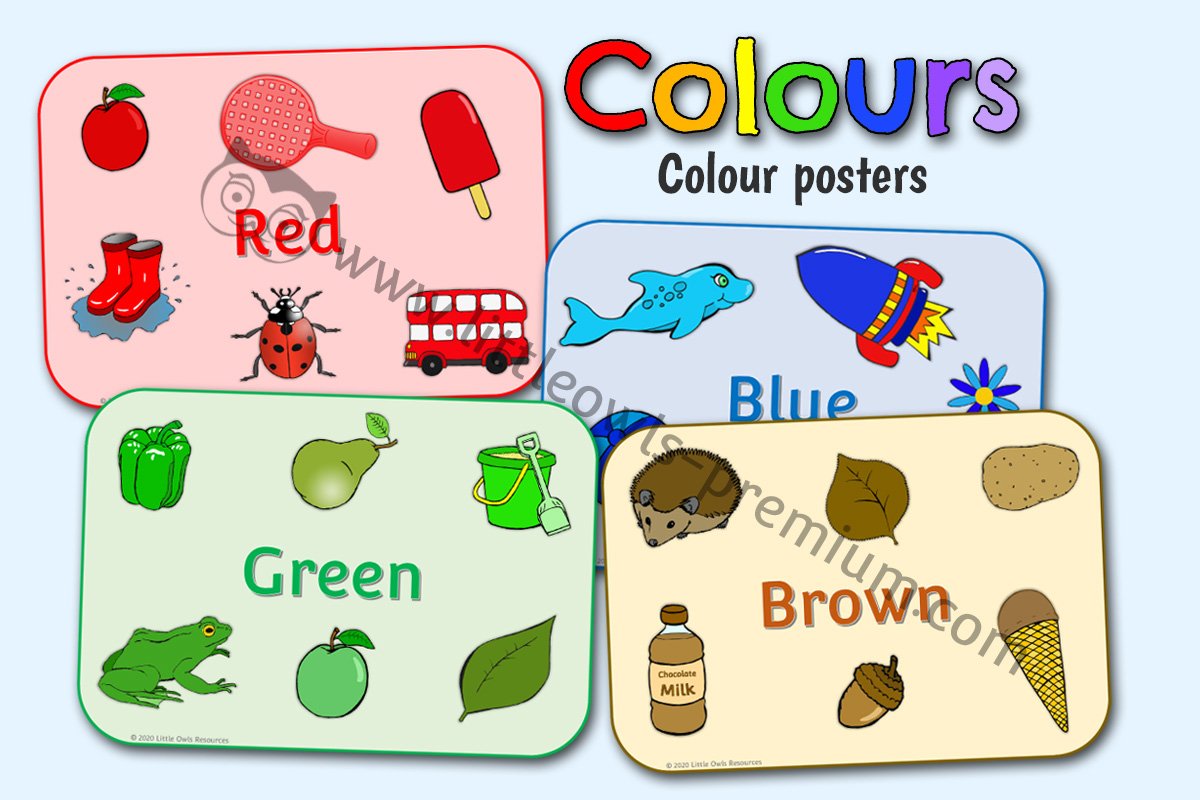
Colour mats/ posters. Ideal for displaying in your setting or using to aid colour sorting and matching activities. Perhaps place one on a table and challenge your child to collect objects from around the room of the correct colour and place them on table.
Original artwork drawn by Sara Murphy and final digital resources created by Stuart Murphy. COPYRIGHT ON ALL OF THE RESOURCES HOUSED ON THIS WEBSITE IS HELD BY ‘LITTLE OWLS RESOURCES’. OUR RESOURCES (INCLUDING THE IMAGES WITHIN THEM), CANNOT BE SHARED OR SOLD COMMERCIALLY.
DOWNLOAD EDITABLE (DOCX)
DOWNLOAD NON-EDITABLE (PDF)
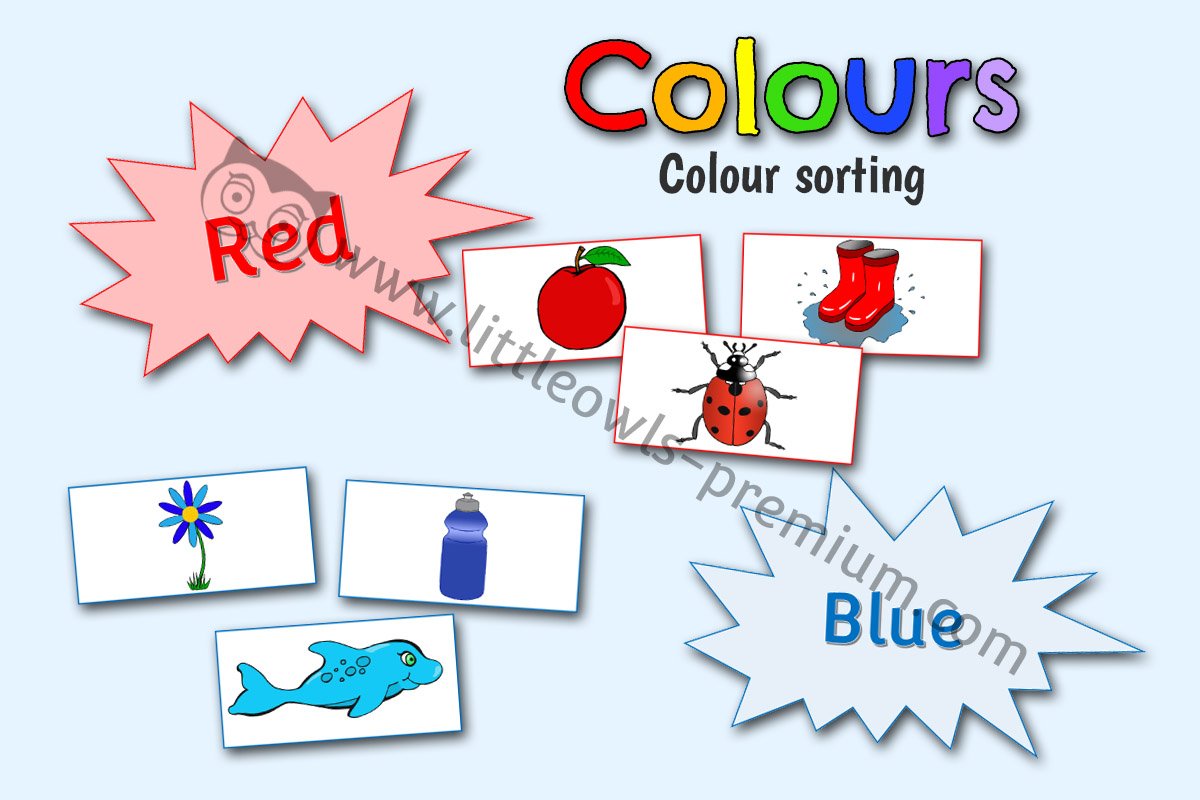
Colour sorting game to aid learning and consolidation of colour recognition. Print colour names and cut out objects in order for children to match the objects to the correct colours. Laminate for multiple uses or use as a cut and stick activity (to also strengthen fine motor skills) for children to take home and discuss with their families. Why not also take a look at our ‘Colour Mats/Posters’?
Original artwork drawn by Sara Murphy and final digital resources created by Stuart Murphy. COPYRIGHT ON ALL OF THE RESOURCES HOUSED ON THIS WEBSITE IS HELD BY ‘LITTLE OWLS RESOURCES’. OUR RESOURCES (INCLUDING THE IMAGES WITHIN THEM), CANNOT BE SHARED OR SOLD COMMERCIALLY.
DOWNLOAD EDITABLE (DOCX)
DOWNLOAD NON-EDITABLE (PDF)

🌍 Spark your children's curiosity about the changing year with our wonderful Seasons: Sort & Match Activity Cards! This engaging printable resource is perfect for EYFS and KS1 children…
Floor Puzzle to cut out and laminate. Children can help put together to learn the ordinal numbers.
Original artwork drawn by Sara Murphy and final digital resources created by Stuart Murphy. COPYRIGHT ON ALL OF THE RESOURCES HOUSED ON THIS WEBSITE IS HELD BY ‘LITTLE OWLS RESOURCES’. OUR RESOURCES (INCLUDING THE IMAGES WITHIN THEM), CANNOT BE SHARED OR SOLD COMMERCIALLY.
DOWNLOAD EDITABLE (DOCX)
DOWNLOAD NON-EDITABLE (PDF)
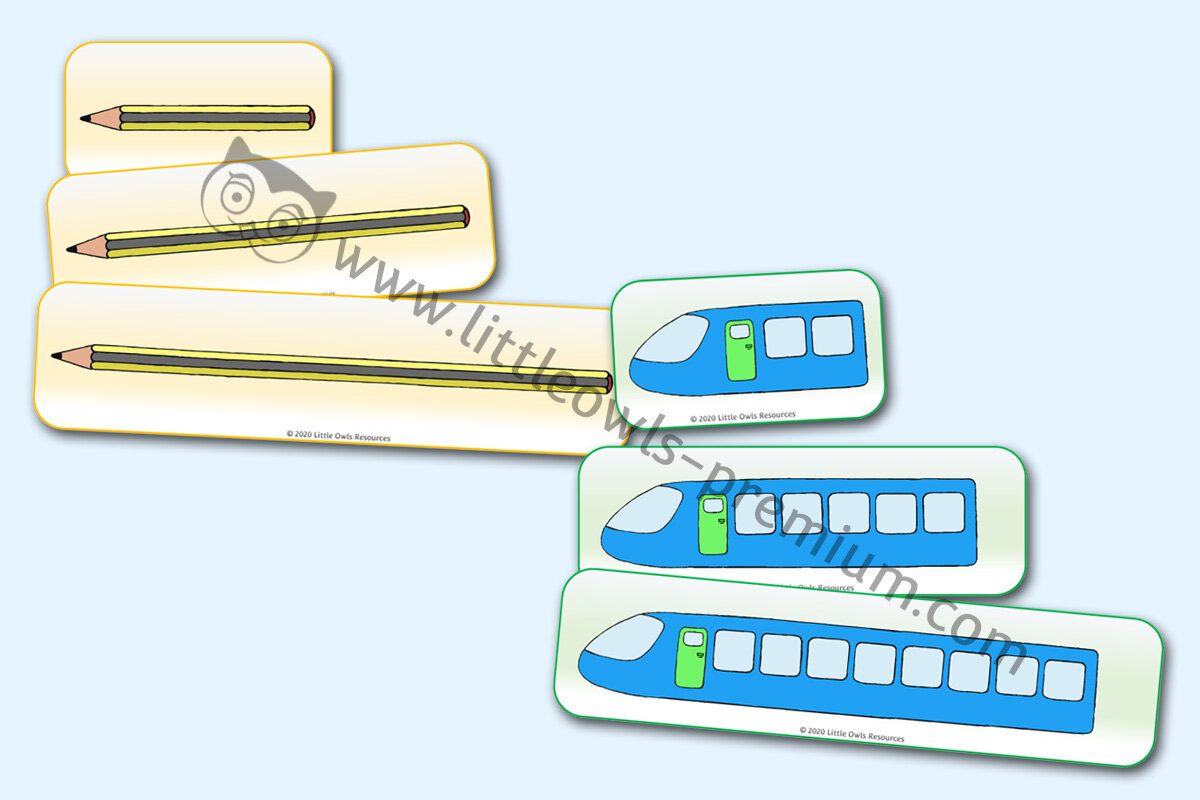
Length ordering activity cards. Give your children an appropriate selection of cards to order. Develop from just 2 cards within each theme ‘long’ and ‘short to a adding a third to increase the language explored such as ‘longer’, ‘shorter’, ‘longest’, ‘shortest’.
Keywords: EYFS, Year 1, Y1, Yr1, Measurement
Original artwork drawn by Sara Murphy and final digital resources created by Stuart Murphy. COPYRIGHT ON ALL OF THE RESOURCES HOUSED ON THIS WEBSITE IS HELD BY ‘LITTLE OWLS RESOURCES’. OUR RESOURCES (INCLUDING THE IMAGES WITHIN THEM), CANNOT BE SHARED OR SOLD COMMERCIALLY.
DOWNLOAD EDITABLE (DOCX)
DOWNLOAD NON-EDITABLE (PDF)
← Back to ‘Maths Continuous Provision & Play’ Area
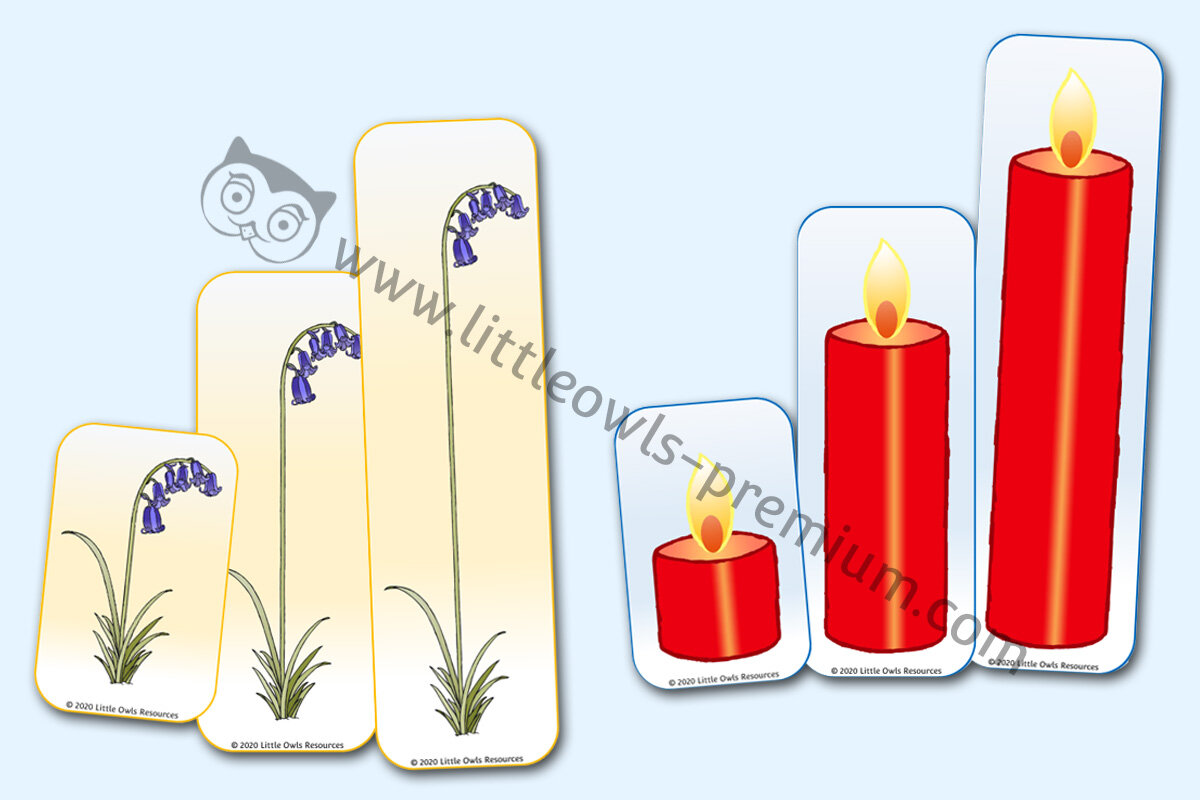
Height ordering activity cards. Give your children an appropriate selection of cards to order. Develop from just 2 cards within each theme ‘tall’ and ‘short to a adding a third to increase the language explored such as ‘taller’, ‘shorter’, ‘tallest’, ‘shortest’.
Keywords: EYFS, Year 1, Y1, Yr1, Measurement
Original artwork drawn by Sara Murphy and final digital resources created by Stuart Murphy. COPYRIGHT ON ALL OF THE RESOURCES HOUSED ON THIS WEBSITE IS HELD BY ‘LITTLE OWLS RESOURCES’. OUR RESOURCES (INCLUDING THE IMAGES WITHIN THEM), CANNOT BE SHARED OR SOLD COMMERCIALLY.
DOWNLOAD EDITABLE(DOCX)
DOWNLOAD NON-EDITABLE (PDF)
← Back to ‘Maths Continuous Provision & Play’ Area
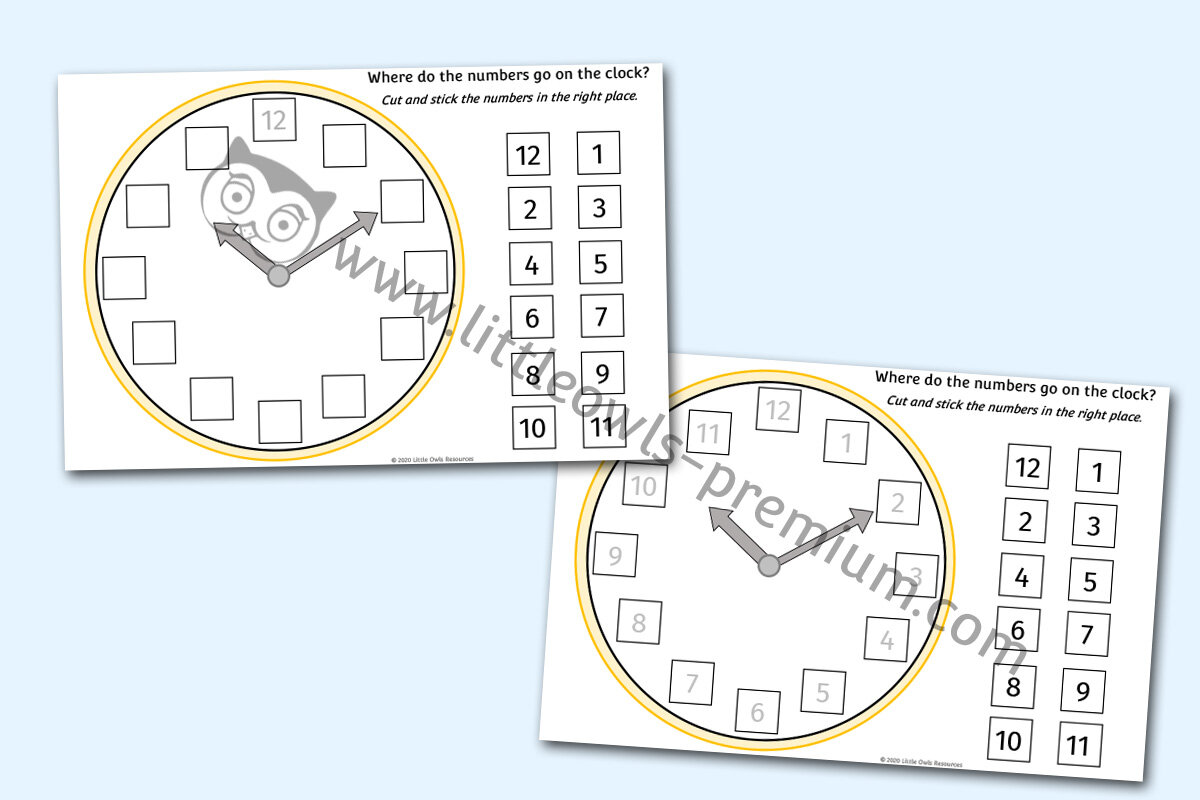
Cut and stick activity to reinforce number recognition and think about the number positions on a clock face.
Original artwork drawn by Sara Murphy and final digital resources created by Stuart Murphy. COPYRIGHT ON ALL OF THE RESOURCES HOUSED ON THIS WEBSITE IS HELD BY ‘LITTLE OWLS RESOURCES’. OUR RESOURCES (INCLUDING THE IMAGES WITHIN THEM), CANNOT BE SHARED OR SOLD COMMERCIALLY.
DOWNLOAD EDITABLE (DOCX)
DOWNLOAD NON-EDITABLE (PDF)
Related Little Owls Resource Pages
Ordering and Sequencing Resources
This collection brings together practical resources for arranging pictures, numbers and objects into meaningful, comparative or chronological sequences.
Pattern Resources
Pattern resources can support children in noticing, continuing and creating repeated arrangements and sequences.
Counting and Number Recognition Resources
Numbers, number lines and counting resources can support exploration of numerical sequence and ordinal relationships.
Size, Length, Height and Weight Resources
Comparing and grading objects by measurable qualities can support seriation from smallest to largest, shortest to longest or lightest to heaviest.
Puzzle Resources
Number-slice, picture and sequencing puzzles can encourage children to examine order and relationships between individual parts.
🎭 Symbolic and Pretending Schema Resources
What practitioners may notice: Children may use an object, action, sound or movement to represent something else. A block might become a telephone, a box might become a vehicle, marks may carry personal meaning or children may recreate familiar people, routines and experiences through pretend play.
Supporting this through provision: Consider open-ended objects, loose parts, boxes, fabrics, small-world materials, figures, mark-making resources and flexible role-play props. Less prescriptive resources allow children to assign their own meanings, develop narratives and represent ideas through movement, language, construction, drawing and imaginative play.
Symbolic & Pretending Schema Resources:

Symbolic & Pretending Schema Label Pack | Birth-5
A calm, practical labelling system for schema-informed provision. Each card pairs a clear resource name with a short line showing how it can support symbolic and pretending play.
24 purpose-led labels | 4 provision sections | 8 printable pages
Contents
- Open-Ended Props & Symbol-Making
Loose parts, recycled props, fabrics, blocks, modelling materials and mark-making | 6 labels
- Home, Family & Community Play
Dolls, home play, dressing up, communication, shopping and community roles | 6 labels
- Small-World Characters & Stories
People, animals, journeys, homes, story worlds and puppets | 6 labels
- Performance, Storytelling & Imagined Worlds
Character props, sound, songs, story prompts, journey writing and dens | 6 labels
Pedagogy in brief
Children exploring a symbolic or pretending schema may repeatedly give objects new meanings, take on roles, animate figures, recreate familiar experiences or build imagined worlds. A block may become a phone, a scarf may become a river, marks may become a menu, and a small-world figure may be given thoughts, feelings and a story. This representational play can overlap with transporting, connecting, enclosing and other schemas, but the particular interest here is often in what an object, action or person can stand for within an imagined situation. These labels help practitioners make versatile resources visible and accessible without turning observed behaviour into a fixed category. Children may explore several schemas at once, move between real and imagined meanings, or prefer to observe before joining shared play. Notice and model language such as pretend, imagine, role, character, prop, story, setting, plan, message, think, feel and say. Offer inclusive figures and culturally familiar experiences alongside open-ended materials that children can reinterpret. Select only developmentally appropriate resources; check small parts, cords, bags, dressing-up items and damaged props carefully, and supervise den-making and large fabrics with suitable risk assessment.
Using this file
Pages 2-9 are the printable label sheets. Print at 100% scale. Text and illustrations can be edited in Word. Choose only the labels that suit the children, space and resources available. Place labels where children can see and use them. The labels support choice, language and responsive provision; they are not a checklist or a way to assign a fixed schema to a child.
Additional/Alternate Use
The labels may be kept as cards for professional knowledge and CPD. Settings may find it useful to keep cards available as a reference tool for practitioner use within a responsive planning environment.
Both editable docx file and pdf files available. To change wording or font on a label to suit your particular setting, select the ‘DOCX’ option below.
DOWNLOAD (DOCX) 📝
DOWNLOAD (PDF) 📄
DOWNLOAD (Zipped JPEGs) 📂
Everything you need to set up a ‘Teddy Bears’ Picnic’ role-play area!
Pack includes:
(Please note that words, etc. can be altered within the editable docx file version.)
‘Teddy Bears’ Picnic’ banner
Name badges - Name Writing
Teddy Bear Ears (full colour)
Teddy Bear Masks (colouring)
Sandwich Prop Cards
‘Welcome! Picnic this way’ Sign
‘Don’t be late!’ Sign - Space to draw hands on clock
Emergent writing/Mark making/Drawing Prompts - ‘Who’s coming?’ - ‘What will the bears take on their picnic?’ - ‘Shopping List’
Food Menu/Option Posters
Food Prop Cards
Bunting
‘Drink some water!’ - Jug Capacity Posters
Original artwork drawn by Sara Murphy and final digital resources created by Stuart Murphy. COPYRIGHT ON ALL OF THE RESOURCES HOUSED ON THIS WEBSITE IS HELD BY ‘LITTLE OWLS RESOURCES’. OUR RESOURCES (INCLUDING THE IMAGES WITHIN THEM), CANNOT BE SHARED OR SOLD COMMERCIALLY.
DOWNLOAD EDITABLE (DOCX)
DOWNLOAD NON-EDITABLE (PDF)
DOWNLOAD NON-EDITABLE (Zipped JPEGs)
<<-BACK TO ‘TEDDY BEARS’ PICNIC’ MENU
'Home Corner' role play pack.
Pack includes:
Banner
Verb clouds
Role-play activity prompt cards
Phone keypads & phone number/contacts prompt cards (pre filled and blank)
Room signs - Bedroom - Living Room - Dining Room - Kitchen - Bathroom - Toilet - Study - Utilities
Home themed drawing/mark making/writing sheets
Props for your home corner walls - photo frames x 2, shelves x 3 - 2 sizes, windows (curtains, blinds and plain) - 2 sizes and a clock (children can draw on hands to explore time)
Picture frame templates for mark making - plain x 2 - draw a picture of your family - draw a picture of your pet
Word cards x 54
‘To do list’ templates
‘Shopping List’ templates
‘My home’ drawing & writing templates
Food cut out props
Have fun!
Original artwork drawn by Sara Murphy and final digital resources created by Stuart Murphy. COPYRIGHT ON ALL OF THE RESOURCES HOUSED ON THIS WEBSITE IS HELD BY ‘LITTLE OWLS RESOURCES’. OUR RESOURCES (INCLUDING THE IMAGES WITHIN THEM), CANNOT BE SHARED OR SOLD COMMERCIALLY.
DOWNLOAD EDITABLE (DOCX)
DOWNLOAD NON-EDITABLE (PDF)
DOWNLOAD NON-EDITABLE (Zipped JPEGs)
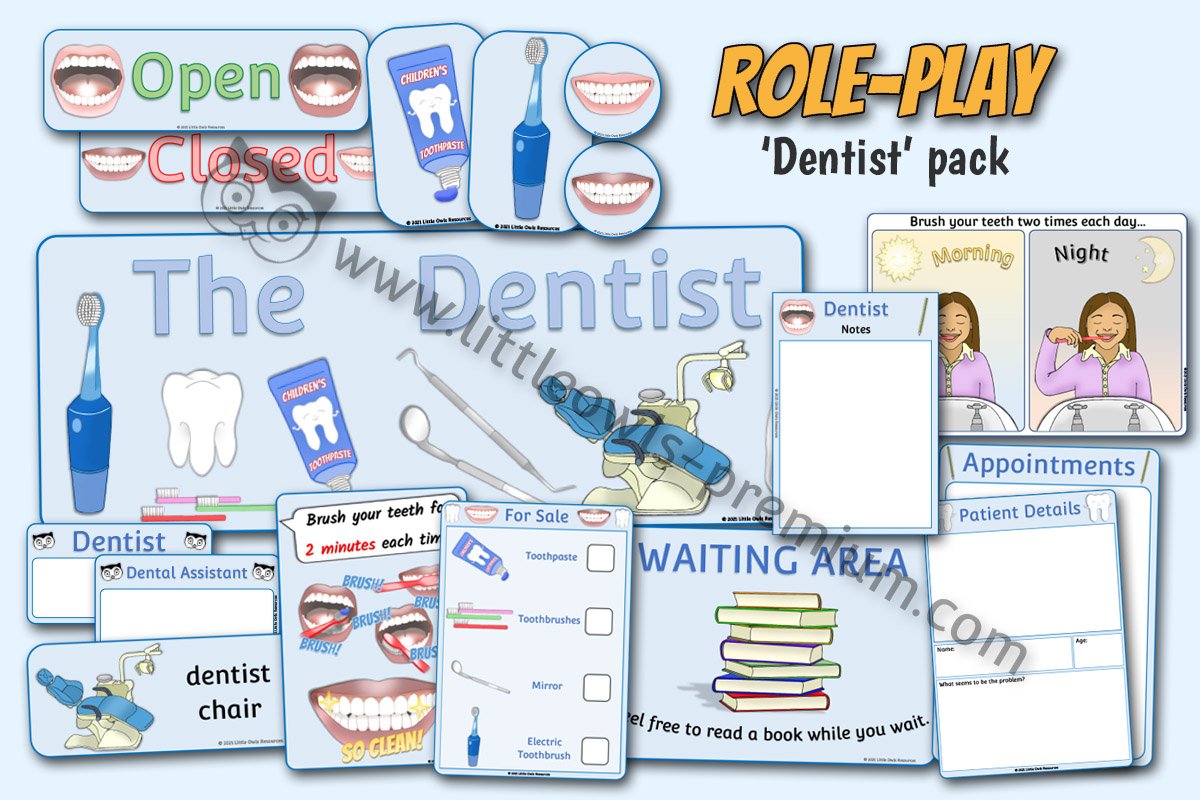
Everything you need to set up a dentist role-play area!
Pack includes:
(Please note that words, etc. can be altered within the editable docx file version.)
‘The Dentist’ banner
Smiling mouth decorative signs
Dentist and Dental Assistant identity cards - Name Writing
‘Waiting Area’ Poster
Various ‘Brush your teeth’ Posters
Social distancing signs & floormats
‘Please wait’ footprint floormats
Dentist word mats
Dentist word cards
‘Welcome! Please sign in for your appointment’ sign for encouraging emergent writing
‘Open’ & ‘Closed’ signs
‘Dentist Opening Times’ Poster - Space to draw hands on clock and write times
‘Opens at…o’ clock’ and ‘Closes at…o’ clock’ signs - spaces for emergent writing
Templates for emergent writing (ideally laminated) - ‘Dentist Notes’, ‘Appointments’ & ‘Patient Details’ forms
‘For Sale’ Menu sign - Space to write prices by items
Items for sale prop cards
Original artwork drawn by Sara Murphy and final digital resources created by Stuart Murphy. COPYRIGHT ON ALL OF THE RESOURCES HOUSED ON THIS WEBSITE IS HELD BY ‘LITTLE OWLS RESOURCES’. OUR RESOURCES (INCLUDING THE IMAGES WITHIN THEM), CANNOT BE SHARED OR SOLD COMMERCIALLY.
DOWNLOAD EDITABLE (DOCX)
DOWNLOAD NON-EDITABLE (PDF)
DOWNLOAD NON-EDITABLE (Zipped JPEGs)
<<-BACK TO ‘TEETH AND ORAL HEALTH’ TOPIC MENU
'Pirate Ship' role play pack.
Pack includes:
banner
pirate masks
various porthole views
pirate ship signs/posters
pirate and pirate ship name creator games
treasure item cards
pirate mission cards
Original artwork drawn by Sara Murphy and final digital resources created by Stuart Murphy. COPYRIGHT ON ALL OF THE RESOURCES HOUSED ON THIS WEBSITE IS HELD BY ‘LITTLE OWLS RESOURCES’. OUR RESOURCES (INCLUDING THE IMAGES WITHIN THEM), CANNOT BE SHARED OR SOLD COMMERCIALLY.
DOWNLOAD EDITABLE (DOCX)
DOWNLOAD NON-EDITABLE (PDF)
DOWNLOAD NON-EDITABLE (Zipped JPEGs)
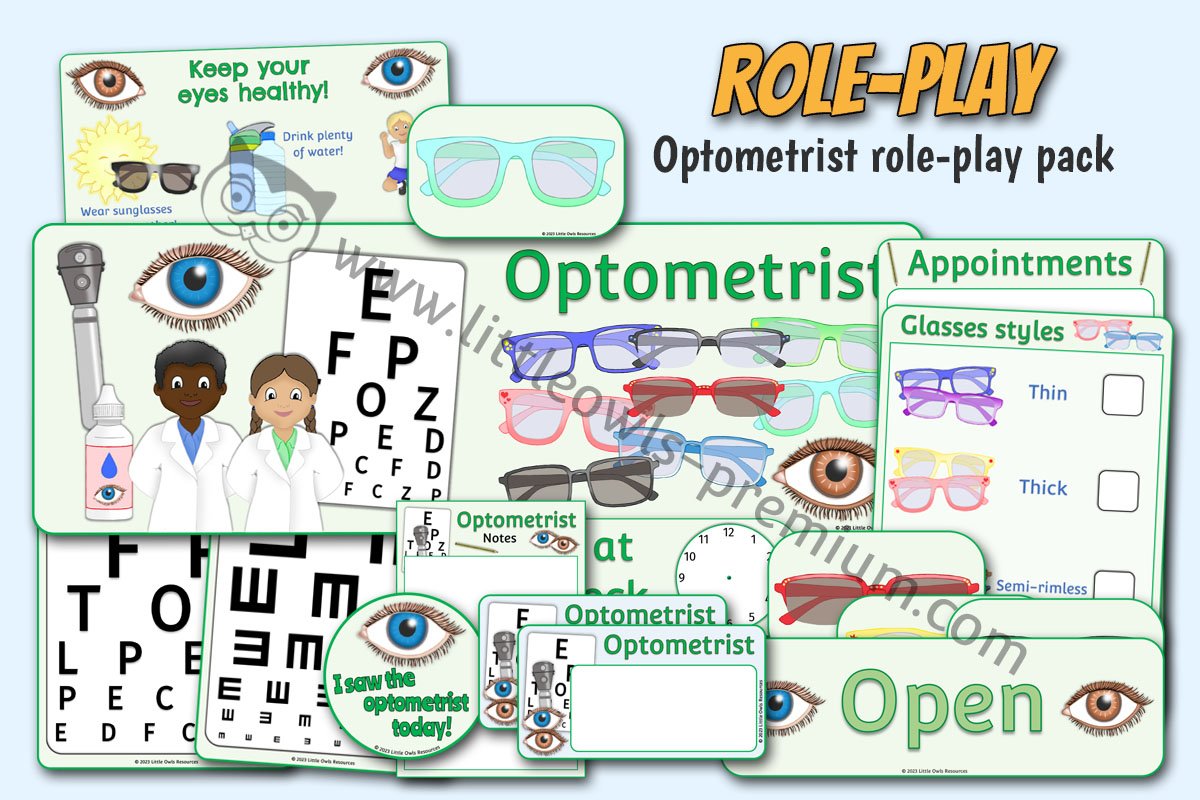
Everything you need to set up an optometrist role-play area!
Pack includes:
(Please note that words, etc. can be altered within the editable docx file version.)
‘Optometrist’ banner
‘I saw the optometrist today!’ badges
Optometrist and Optician identity cards - Name Writing
‘Waiting Area’ and ‘Please Wait’ Posters/Signs
‘Keep your eyes healthy’ Poster
Optometrist word mats
Optometrist word cards
‘Welcome! Please sign in for your appointment’ sign for encouraging emergent writing
‘Open’ & ‘Closed’ signs
‘Optometrist Opening Times’ Poster - Space to draw hands on clock and write times
‘Opens at…o’ clock’ and ‘Closes at…o’ clock’ signs - spaces for emergent writing
Templates for emergent writing - ‘Optometrist Notes’, ‘Appointments’ & ‘Patient Details’ forms
Eye charts x3
Glasses Styles tick sheet
Glass and Sunglasses prop cards x16
Original artwork drawn by Sara Murphy and final digital resources created by Stuart Murphy. COPYRIGHT ON ALL OF THE RESOURCES HOUSED ON THIS WEBSITE IS HELD BY ‘LITTLE OWLS RESOURCES’. OUR RESOURCES (INCLUDING THE IMAGES WITHIN THEM), CANNOT BE SHARED OR SOLD COMMERCIALLY.
DOWNLOAD EDITABLE (DOCX)
DOWNLOAD NON-EDITABLE (PDF)
DOWNLOAD NON-EDITABLE (Zipped JPEGs)
<<-BACK TO ‘EYE HEALTH’ TOPIC MENU
‘Card Shop’ role-play pack includes:
‘Card Shop’ banner
‘Hi! My name is…’ identity cards - Name Writing
Various opening times posters (both prefilled and blank for children to draw hands on clocks and write their own times)
‘Message’ and differentiated ‘Order Form’ templates for mark making/pre-writing
Open/Closed signs
Stamp & envelope price labels
Stamp, envelope, balloon and teddy bear props to be purchased in shop
Posters advertising/directing where cards are for events - Valentine’s Day, Birthdays, Mother’s Day, Father’s Day, Get Well soon, Thank-You & Good Luck
Teddy bear and balloon posters
Debit card posters and props
VISIT OUR ‘GREETING CARDS’ PAGE TO STOCK YOUR CARD SHOP WITH CARDS FOR WHICHEVER EVENT IS APPROPRIATE FOR THE TIME OF YEAR AND YOUR CHILDREN.
Original artwork drawn by Sara Murphy and final digital resources created by Stuart Murphy. COPYRIGHT ON ALL OF THE RESOURCES HOUSED ON THIS WEBSITE IS HELD BY ‘LITTLE OWLS RESOURCES’. OUR RESOURCES (INCLUDING THE IMAGES WITHIN THEM), CANNOT BE SHARED OR SOLD COMMERCIALLY.
DOWNLOAD EDITABLE (DOCX)
DOWNLOAD NON-EDITABLE (PDF)
DOWNLOAD NON-EDITABLE (Zipped JPEGs)
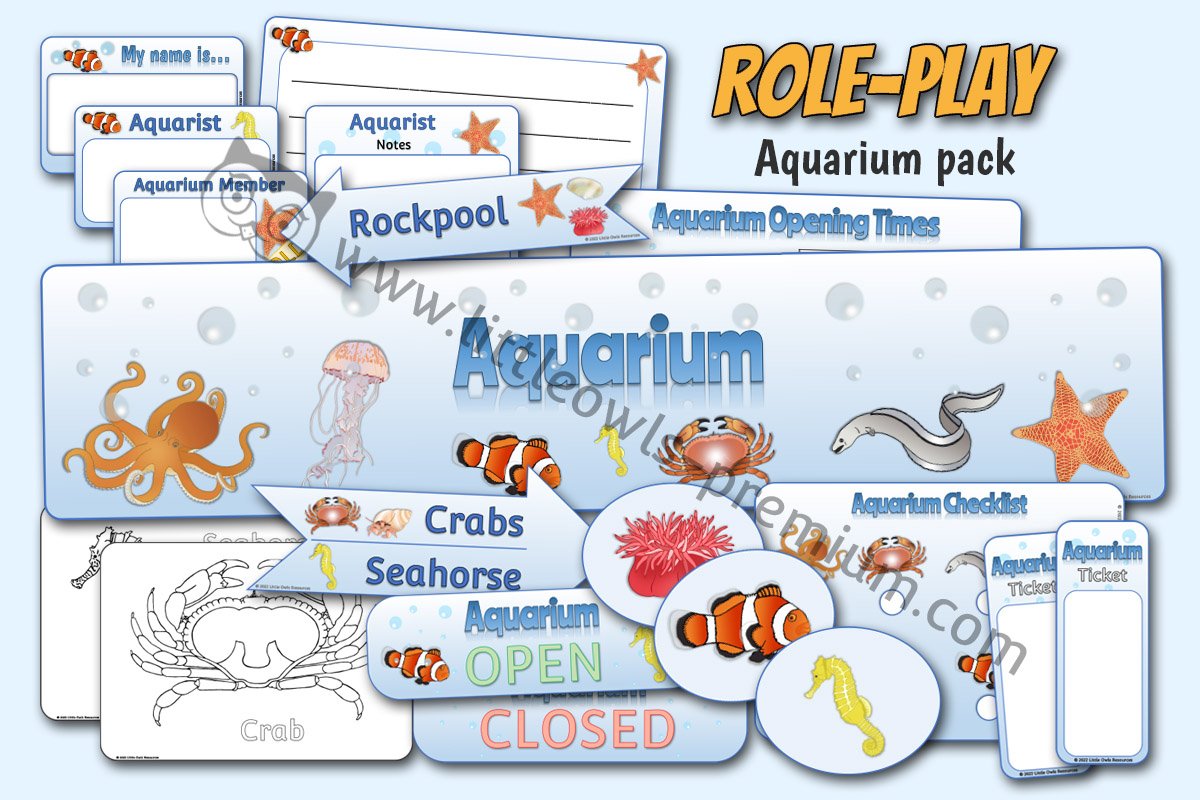
Aquarium Role Play Pack includes:
banner
tickets - Name Writing
open/closed signs
opening times poster
‘Which animals can you find?’ tick sheet
colouring sheets
aquarium gold member cards
direction posters/arrows
exhibit posters (include feeding and experience times )
various mark making sheets
word cards
sea creature prop cards
aquarist name card templates
Original artwork drawn by Sara Murphy and final digital resources created by Stuart Murphy. COPYRIGHT ON ALL OF THE RESOURCES HOUSED ON THIS WEBSITE IS HELD BY ‘LITTLE OWLS RESOURCES’. OUR RESOURCES (INCLUDING THE IMAGES WITHIN THEM), CANNOT BE SHARED OR SOLD COMMERCIALLY.
DOWNLOAD EDITABLE (DOCX)
DOWNLOAD NON-EDITABLE (PDF)
DOWNLOAD NON-EDITABLE (Zipped JPEGs)
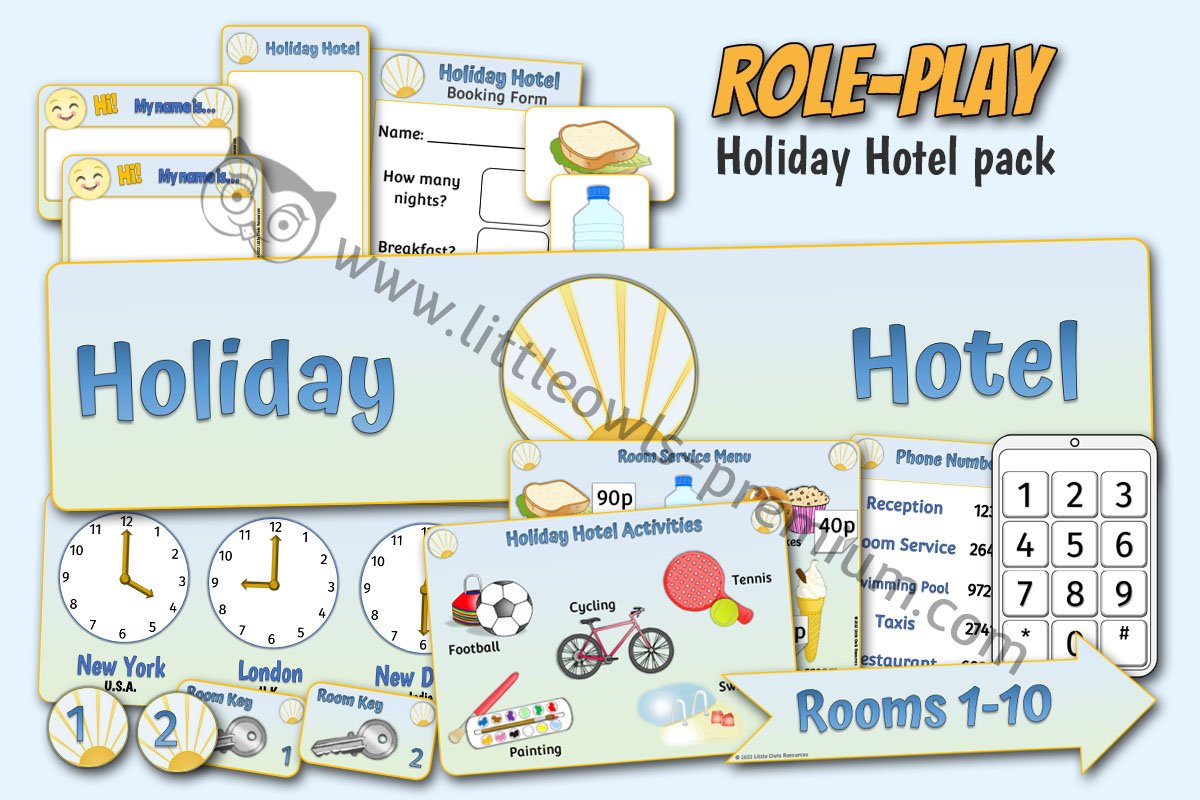
'Holiday Hotel' role play pack.
Pack includes:
Banner
Name badges - Name Writing
New York, London, New Delhi and Tokyo reception area clocks (pre filled and blank for emergent writing)
Open and closed signs
Various ‘Booking Form’ mark making sheets
Room key props
Direction signs e.g. ‘Reception’, ‘Exit’, ‘Rooms 1-10’.
Room numbers
Various signs, e.g. ‘Please do not disturb’, ‘Holiday Hotel Activities’
Internal phone numbers sheet e.g. ‘Reception’ and ‘Room Service’ and dial pad
‘Room Service’ menus (with and without prices)
General mark making sheets, e.g. ‘Employee of the month’, ‘Room Prices’
Various room service prop cards
Have fun!
Original artwork drawn by Sara Murphy and final digital resources created by Stuart Murphy. COPYRIGHT ON ALL OF THE RESOURCES HOUSED ON THIS WEBSITE IS HELD BY ‘LITTLE OWLS RESOURCES’. OUR RESOURCES (INCLUDING THE IMAGES WITHIN THEM), CANNOT BE SHARED OR SOLD COMMERCIALLY.
DOWNLOAD EDITABLE (DOCX)
DOWNLOAD NON-EDITABLE (PDF)
DOWNLOAD NON-EDITABLE (Zipped JPEGs)
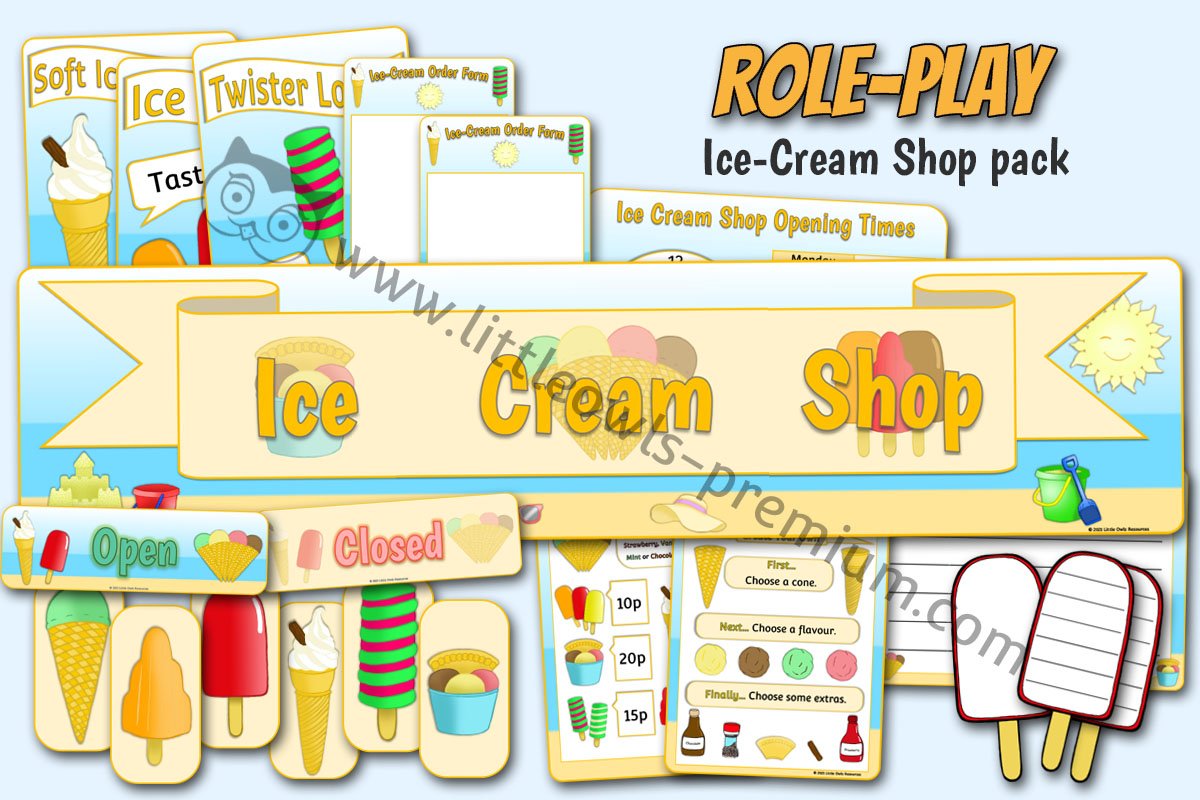
Download this one stop 'Ice Cream Shop' role play pack. Ideal role play area for the hot weather.
Pack includes:
banner
menu with prices
create your own ice cream menu
blank proforma menu for children to fill in
picture cards of various things to be sold in the role-play shop (to ideally cut out and laminate)
lolly writing sheets
ice cream order form
advert posters with descriptive vocab
open and closed signs
opening times clock
blank mark making/drawing/writing sheets
Original artwork drawn by Sara Murphy and final digital resources created by Stuart Murphy. COPYRIGHT ON ALL OF THE RESOURCES HOUSED ON THIS WEBSITE IS HELD BY ‘LITTLE OWLS RESOURCES’. OUR RESOURCES (INCLUDING THE IMAGES WITHIN THEM), CANNOT BE SHARED OR SOLD COMMERCIALLY.
DOWNLOAD EDITABLE (DOCX)
DOWNLOAD NON-EDITABLE (PDF)
DOWNLOAD NON-EDITABLE (Zipped JPEGs)
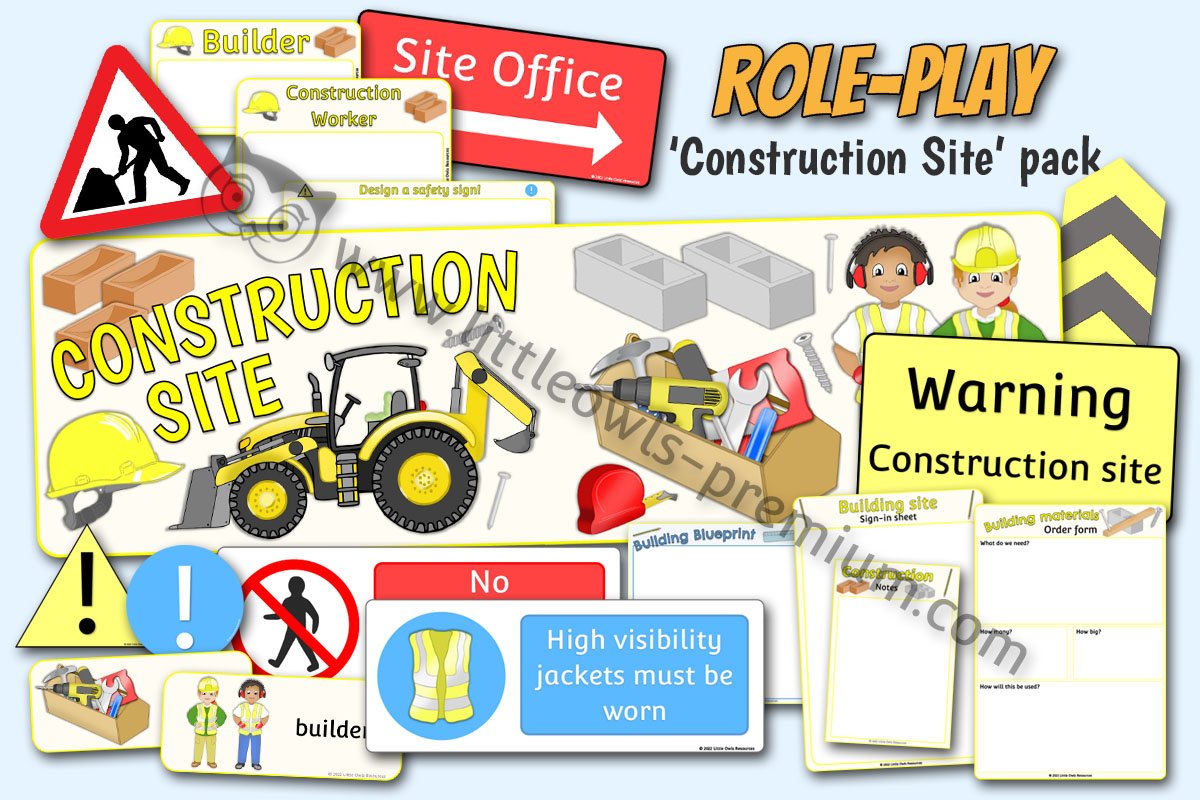
Everything you need to set up a construction/building site role-play area!
Pack includes:
(Please note that words, etc. can be altered within the editable docx file version.)
‘Construction Site’ & ‘Building Site’ banners
Roadworks signs
Builder and Construction Worker identity cards - Name Writing
Safety signs: High visibility jackets must be worn, Protective footwear must be worn, Hard hats must be worn, Ear defenders must be worn
Various sized warning signs: Warning Construction Site, Keep Out and ‘!’ marks
Various ‘Site Office’ signs
Design a safety sign template
‘No unauthorised access’ sign
‘Building Blueprint’ and ‘Construction Blueprint’ templates
‘Construction Notes’ and ‘Building Notes’ mark making sheets
Construction Word Mat
‘Construction Site’ and Building Site’ Sign-in sheets (for name writing practice
‘Building Materials Order Form’ template
Construction Word Cards
Have fun!
Original artwork drawn by Sara Murphy and final digital resources created by Stuart Murphy. COPYRIGHT ON ALL OF THE RESOURCES HOUSED ON THIS WEBSITE IS HELD BY ‘LITTLE OWLS RESOURCES’. OUR RESOURCES (INCLUDING THE IMAGES WITHIN THEM), CANNOT BE SHARED OR SOLD COMMERCIALLY.
DOWNLOAD EDITABLE (DOCX)
DOWNLOAD NON-EDITABLE (PDF)
DOWNLOAD NON-EDITABLE (Zipped JPEGs)
'Garden Centre' role play pack.
Pack includes:
Banner
Hi my name is…how can I help you? Name badges - Name Writing
Open/Closed signs
Timetable for opening times (including blank clock face for children to draw on their own hands)
Seed Checklist
Seed packet props - lettuce, peas, carrots, blueberries, peppers, strawberries, pumpkins, tomatoes
Seed packet mark making templates
Garden Centre shopping list mark making templates
Various signs for colouring - garden gloves, trowel, wheelbarrow, watering can, tyre planter, small spade, small rake, box planter
Direction signs - Flowers, Seeds, Small Garden Tools, Planters, Other Items
Various assorted prop cards
Drawing/Writing/Mark Making Sheets
Word cards/labels
‘Employee of the Month’ mark making template
‘Garden Centre’ list sheets
Original artwork drawn by Sara Murphy and final digital resources created by Stuart Murphy. COPYRIGHT ON ALL OF THE RESOURCES HOUSED ON THIS WEBSITE IS HELD BY ‘LITTLE OWLS RESOURCES’. OUR RESOURCES (INCLUDING THE IMAGES WITHIN THEM), CANNOT BE SHARED OR SOLD COMMERCIALLY.
DOWNLOAD EDITABLE (DOCX)
DOWNLOAD NON-EDITABLE (PDF)
DOWNLOAD NON-EDITABLE (Zipped JPEGs)
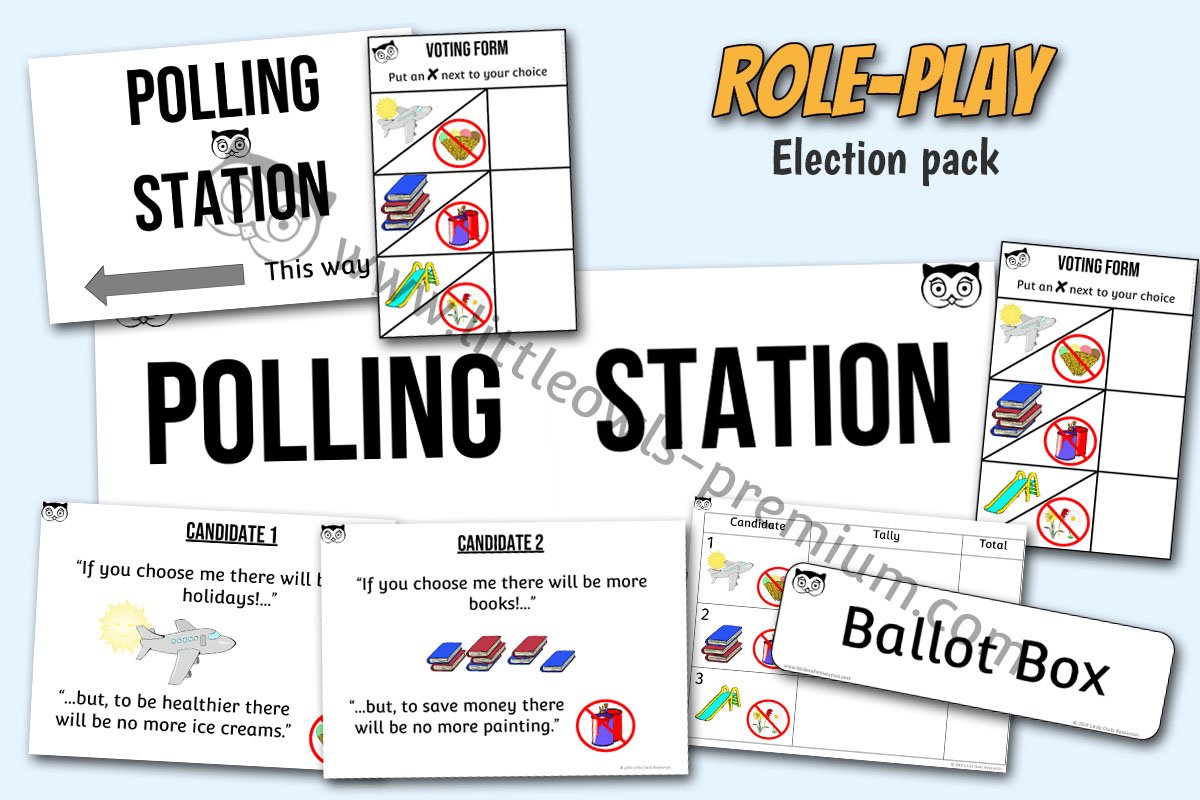
This role-play activity pack is designed to introduce children to the idea of an election, and the decision process involved in voting.
It is completely non-partisan and unrelated to any real-world political parties/views.
1. An adult reads out the ‘pitch’ from each fictitious candidate and then the children are encouraged to discuss anything they might not understand about the proposals, asking the impartial adult for guidance. Let them know that their vote will be secret, but they can talk about it if they wish.
2. (A possible extension at this point could be to get the children to think about their own views and the views of others. For example, a child may think they would vote for the second candidate because they dislike painting. However, all of their friends may love painting. What is best for the group?)
3. Show the children one of the election voting forms and relate the images to the candidates discussed. Show them the process of going to the Polling Station, getting the form, marking an X in just one box, folding the paper in half and putting in the ballot box.
4. As the adult removes the forms from the ballot box and announces the votes for each candidate, the tally sheet can be filled in to find the winner!
5. (Second possible extension - the children can fill in their own tally sheets to count the votes!)
Enjoy this activity with the voters of the future! We hope this helps!
Original artwork drawn by Sara Murphy and final digital resources created by Stuart Murphy. COPYRIGHT ON ALL OF THE RESOURCES HOUSED ON THIS WEBSITE IS HELD BY ‘LITTLE OWLS RESOURCES’. OUR RESOURCES (INCLUDING THE IMAGES WITHIN THEM), CANNOT BE SHARED OR SOLD COMMERCIALLY.
DOWNLOAD EDITABLE (DOCX)
DOWNLOAD NON-EDITABLE (PDF)
DOWNLOAD NON-EDITABLE (Zipped JPEGs)
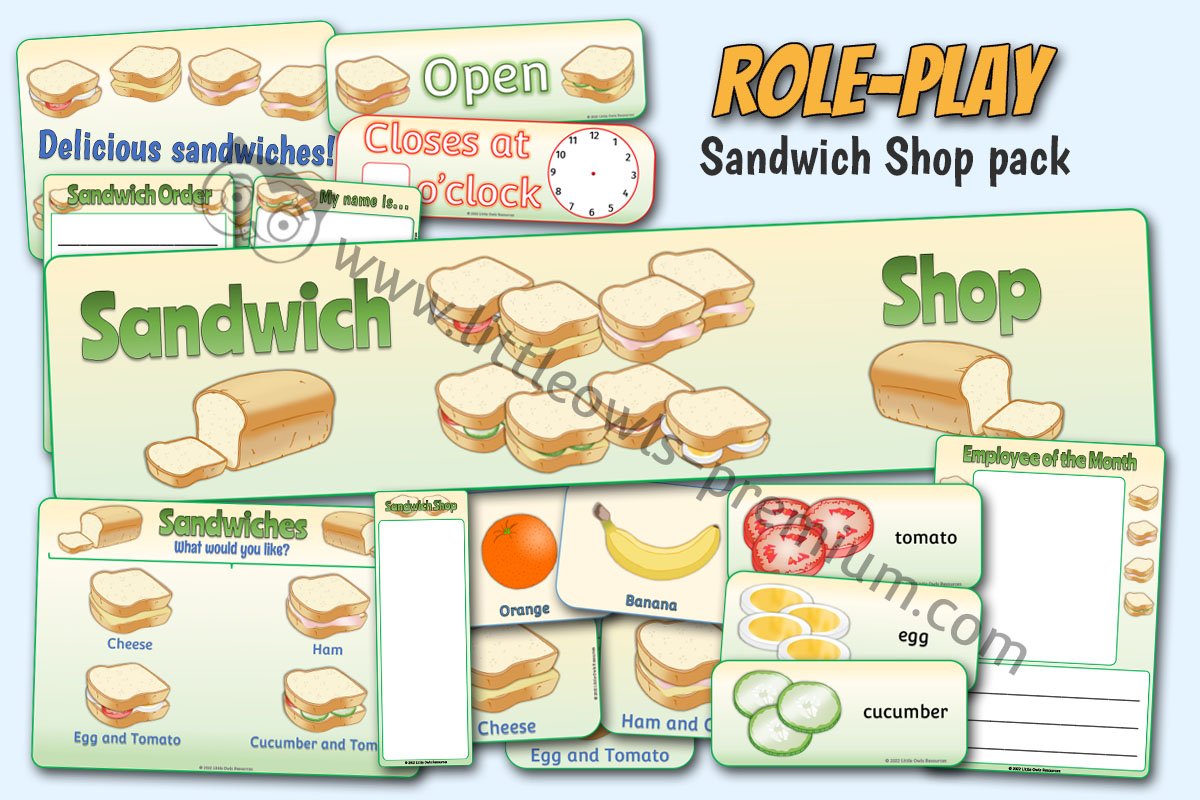
Download this one stop 'Sandwich Shop' role play pack. Ideal role play area for learning about personal choice/opinion/preferences, healthy eating, time and money.
Pack includes:
Banner
Name badges - Name Writing
Sandwich, fillings and extras prop cards (to be sold in shop)
Various posters
Sandwich order forms
Various menus
Open and closed signs (with and without clocks)
Various mark making sheets, e.g. ‘Employee of the month’ and note sheets
Opening times poster
Contactless payment poster and prop cards
Original artwork drawn by Sara Murphy and final digital resources created by Stuart Murphy. COPYRIGHT ON ALL OF THE RESOURCES HOUSED ON THIS WEBSITE IS HELD BY ‘LITTLE OWLS RESOURCES’. OUR RESOURCES (INCLUDING THE IMAGES WITHIN THEM), CANNOT BE SHARED OR SOLD COMMERCIALLY.
DOWNLOAD EDITABLE (DOCX)
DOWNLOAD NON-EDITABLE (PDF)
DOWNLOAD NON-EDITABLE (Zipped JPEGs)
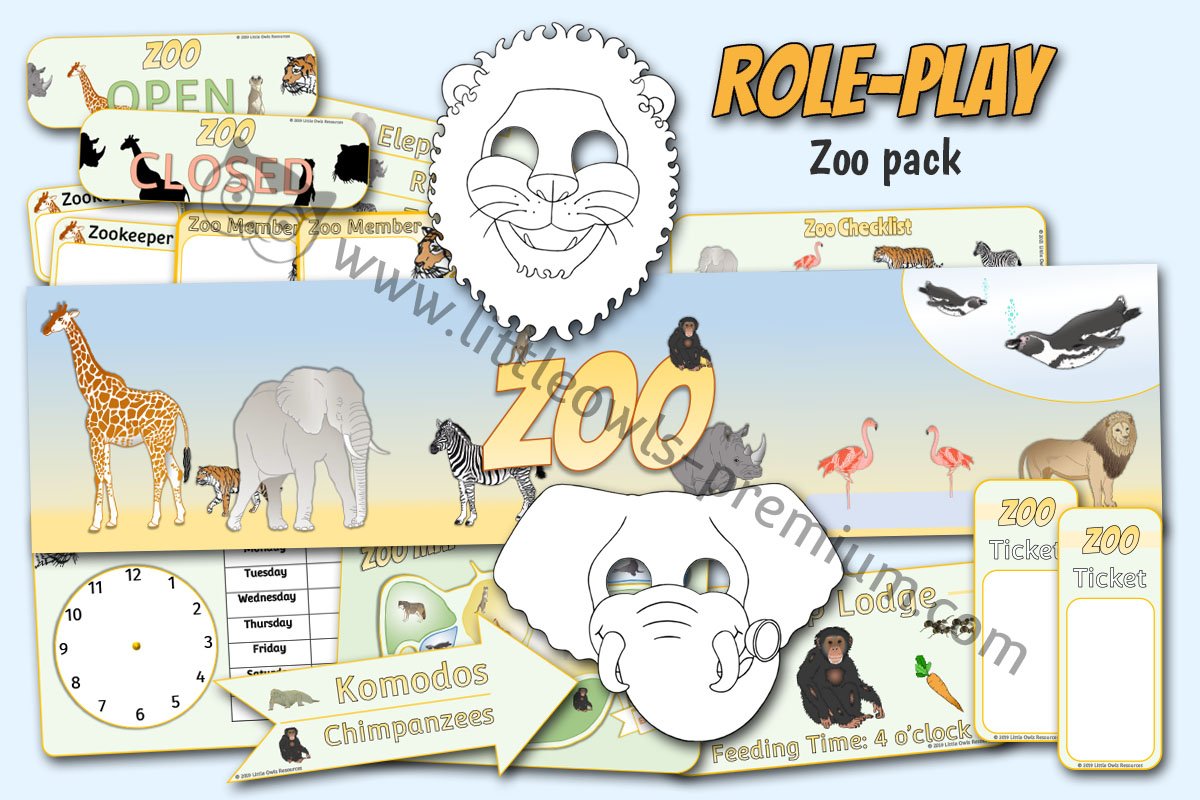
Zoo Role Play Pack includes:
zoo banner
tickets - Name Writing
open/closed signs
opening times poster
‘Which animals can you find?’ tick sheet
ice cream/lolly prices poster
ice cream/lolly role play cards
zoo map
zoo gold member card templates
direction posters/arrows
animal enclosure posters (include feeding times with food each animal eats)
animal food role play cards for children to feed animals correct foods
zookeeper name card templates - Name Writing
animal masks
Alongside this role-play you may like to read: Dear Zoo, Hole in the Zoo, Rumble in the Jungle, Giraffes Can’t Dance or Who’s at the Zoo?
Original artwork drawn by Sara Murphy and final digital resources created by Stuart Murphy. COPYRIGHT ON ALL OF THE RESOURCES HOUSED ON THIS WEBSITE IS HELD BY ‘LITTLE OWLS RESOURCES’. OUR RESOURCES (INCLUDING THE IMAGES WITHIN THEM), CANNOT BE SHARED OR SOLD COMMERCIALLY.
DOWNLOAD EDITABLE (DOCX)
DOWNLOAD NON-EDITABLE (PDF)
DOWNLOAD NON-EDITABLE (Zipped JPEGs)
'Singing Contest' role play pack.
Pack includes:
Banner
Name badges (singers/contestants & judges)
Ticket template (name writing)
Open and closed signs (for ‘Contest’ and ‘Auditions’)
Various direction signs, e.g. ‘Audience’, ‘Exit’, ‘Singers this way’, ‘Judges’, ‘Seat 1-5’, ‘Seats 6-10’, etc.
Number score cards
‘Singing Contest - Auditions here today!’ sign
Judge note sheets (mark making)
Various additional mark making sheets, e.g. ‘Now performing…’, ‘Winner’, etc.
Have fun!
Original artwork drawn by Sara Murphy and final digital resources created by Stuart Murphy. COPYRIGHT ON ALL OF THE RESOURCES HOUSED ON THIS WEBSITE IS HELD BY ‘LITTLE OWLS RESOURCES’. OUR RESOURCES (INCLUDING THE IMAGES WITHIN THEM), CANNOT BE SHARED OR SOLD COMMERCIALLY.
DOWNLOAD EDITABLE (DOCX)
DOWNLOAD NON-EDITABLE (PDF)
DOWNLOAD NON-EDITABLE (Zipped JPEGs)
'Post Office' role play pack.
Pack includes:
banner
post box prop/display image across 2 A4 pages
name badges - Name Writing
opening times sign (with clock template to draw hands)
open and closed signs
various mark making sheets: ‘Special delivery instructions’ and ‘Sorry, you were out’ notes
1st and 2nd class stamp sheets (full colour & colouring versions)
various small signs & labels for items available for purchase with space for price tags
A4 sized posters/signs for display
Post office word mat & word cards
General post office mark making sheets
‘Design a stamp’ sheets
Have fun!
Alongside this role-play you may like to read: Dear Zoo, The Jolly Postman, Dragon Post or Paddington’s Post.
Keywords: post office, role play/role-play pack, postal worker, postal workers, postwoman, postman, postie, sending letters/parcels/presents/gifts/deliveries
Original artwork drawn by Sara Murphy and final digital resources created by Stuart Murphy. COPYRIGHT ON ALL OF THE RESOURCES HOUSED ON THIS WEBSITE IS HELD BY ‘LITTLE OWLS RESOURCES’. OUR RESOURCES (INCLUDING THE IMAGES WITHIN THEM), CANNOT BE SHARED OR SOLD COMMERCIALLY.
DOWNLOAD EDITABLE (DOCX)
DOWNLOAD NON-EDITABLE (PDF)
DOWNLOAD NON-EDITABLE (Zipped JPEGs)
Download this one stop 'Ice Cream Shop' role play pack. Ideal role play area for the hot weather.
Pack includes:
banner
menu with prices
create your own ice cream menu
blank proforma menu for children to fill in
picture cards of various things to be sold in the role-play shop (to ideally cut out and laminate)
lolly writing sheets
ice cream order form
advert posters with descriptive vocab
open and closed signs
opening times clock
blank mark making/drawing/writing sheets
Original artwork drawn by Sara Murphy and final digital resources created by Stuart Murphy. COPYRIGHT ON ALL OF THE RESOURCES HOUSED ON THIS WEBSITE IS HELD BY ‘LITTLE OWLS RESOURCES’. OUR RESOURCES (INCLUDING THE IMAGES WITHIN THEM), CANNOT BE SHARED OR SOLD COMMERCIALLY.
DOWNLOAD EDITABLE (DOCX)
DOWNLOAD NON-EDITABLE (PDF)
DOWNLOAD NON-EDITABLE (Zipped JPEGs)

Everything you need to set up a veterinary surgery role-play area!
Pack includes:
(Please note that words, etc. can be altered within the editable docx file version.)
‘Veterinary Surgery’ banner
Paw print decorative signs
Vet identity cards - Name Writing
Posters ‘Thank-you for waiting’, ‘After handling animals…wash you hands’
Social distancing signs & floormats
‘Please wait’ footprint floormats
Animal word cards
‘Put medicine bottles here’ & ‘Put bandages here’ activity signs
‘Open’ & ‘Closed’ signs
‘Vet Opening Times’ Poster - Space to draw hands on clock and write times
‘Opens at…o’ clock’ and ‘Closes at…o’ clock’ signs - spaces for emergent writing
Templates for emergent writing (ideally laminated) - ‘Medicine Prescription’, ‘Appointments’ & ‘Pet Details’ forms
‘For Sale’ Menu sign - Space to write prices by items
Items for sale prop cards
Animal fact cards
Original artwork drawn by Sara Murphy and final digital resources created by Stuart Murphy. COPYRIGHT ON ALL OF THE RESOURCES HOUSED ON THIS WEBSITE IS HELD BY ‘LITTLE OWLS RESOURCES’. OUR RESOURCES (INCLUDING THE IMAGES WITHIN THEM), CANNOT BE SHARED OR SOLD COMMERCIALLY.
DOWNLOAD EDITABLE (DOCX)
DOWNLOAD NON-EDITABLE (PDF)
DOWNLOAD NON-EDITABLE (Zipped JPEGs)
'Fairy Tale Theatre' role play pack.
Pack includes:
(Please note that due to file size, the docx document has been split into 2 separate files. However, the pdf and zip files are still available as a single download each.)
Banner
Hi my name is…how can I help you? Name badges
Ticket templates
Open/Closed signs
Timetable for opening times (including blank clock face for children to draw on their own hands)
Various signs, e.g. box office, exit, stage door, actors this way
Seat number signs
Name writing activity - Character image posters with writing ‘Played by…’ with space for children to write their name underneath. Blank version also available for additional characters.
Advert posters, e.g. ‘Fairy Tale Theatre Presents Goldilocks and the Three Bears’ - full colour, colouring in and design your own versions: Goldilocks and the Three Bears, Jack and the Beanstalk, Little Red Riding Hood, The Little Red Hen and The Three Little Pigs.
Mark making border sheets
Mark making ‘Starring…’ sheets
Character masks x 21: Daddy Bear, Mummy Bear, Baby Bear, Goldilocks, Jack, Jack’s Mum, Giant, Red Riding Hood, Brick Pig, Straw Pig, Stick Pig, Little Red Hen, Lazy Cat, Lazy Goose, Lazy Pig, Bean Seller, Giant’s Wife, Grandmother, Wolf in disguise, Wolf and Wood Cutter.
Original artwork drawn by Sara Murphy and final digital resources created by Stuart Murphy. COPYRIGHT ON ALL OF THE RESOURCES HOUSED ON THIS WEBSITE IS HELD BY ‘LITTLE OWLS RESOURCES’. OUR RESOURCES (INCLUDING THE IMAGES WITHIN THEM), CANNOT BE SHARED OR SOLD COMMERCIALLY.
DOWNLOAD EDITABLE (Part 1) (DOCX)
DOWNLOAD EDITABLE (Part 2 - Masks) (DOCX)
DOWNLOAD NON-EDITABLE (PDF)
DOWNLOAD NON-EDITABLE (Zipped JPEGs)
Everything you need to set up a doctor’s surgery role-play area!
Pack includes:
(Please note that words, etc. can be altered within the editable docx file version.)
‘Doctor’s Surgery’ banner
First Aid Red Cross signs
Doctor and Nurse identity cards - Name Writing
‘Waiting Area’ Poster
Various Posters promoting ‘Good Health’
Social distancing signs & floormats
‘Please wait’ footprint floormats
Medical word mat
Medical word cards
‘Welcome! Please sign in for your appointment’ sign for encouraging emergent writing
‘Open’ & ‘Closed’ signs
‘Surgery Opening Times’ Poster - Space to draw hands on clock and write times
‘Opens at…o’ clock’ and ‘Closes at…o’ clock’ signs - spaces for emergent writing
Templates for emergent writing (ideally laminated) - ‘Doctor Notes’, ‘Nurse Notes’, ‘Appointments’ & ‘Patient Details’ forms
Clipboard template for mark making
Role-Play Prop cards
Original artwork drawn by Sara Murphy and final digital resources created by Stuart Murphy. COPYRIGHT ON ALL OF THE RESOURCES HOUSED ON THIS WEBSITE IS HELD BY ‘LITTLE OWLS RESOURCES’. OUR RESOURCES (INCLUDING THE IMAGES WITHIN THEM), CANNOT BE SHARED OR SOLD COMMERCIALLY.
DOWNLOAD EDITABLE (DOCX)
DOWNLOAD NON-EDITABLE (PDF)
DOWNLOAD NON-EDITABLE (Zipped JPEGs)
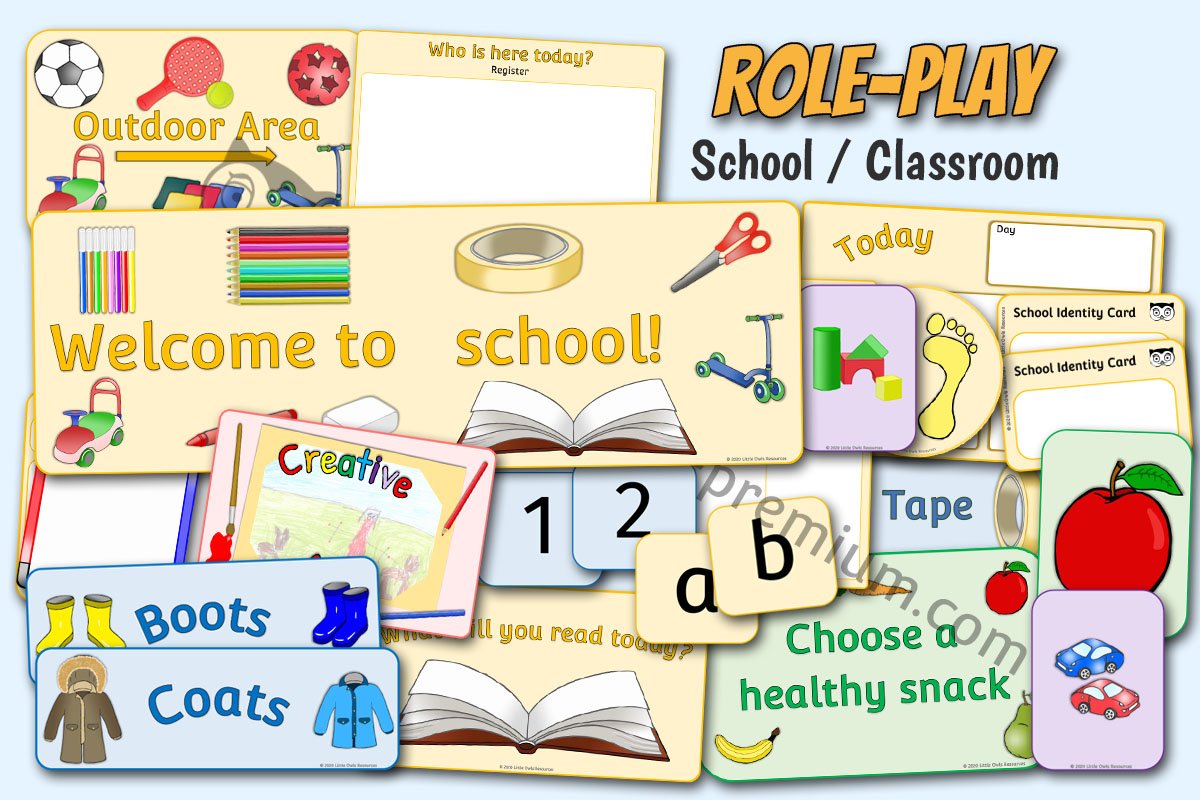
Everything you need to set up a mini classroom role-play area!
Pack includes:
(Please note that words, etc. can be altered within the editable docx file version.)
‘Welcome to school!’ banner
Calendar base (ideally to be laminated for mark making)
School identity cards - Name Writing
Posters - ‘We are friends!’, ‘What will you read today?’
Reading record note sheets
Mini footprint floormats
Cloakroom signs - ‘Boots’, ‘Wellies’, ‘Coats’, ‘Jackets’
‘Choose a healthy snack’ sign with fruit and vegetable signs and prop cards
‘What will you make?’ sign with classroom equipment signs and prop cards
‘What will you choose?’ sign with classroom activity signs and prop cards
Various creative area signs to choose from
Templates for emergent writing (ideally laminated) - ‘Class Rules’, ‘Who is here today? Register’, Mini-Whiteboards
Alphabet cards
Number cards (1-10)
Original artwork drawn by Sara Murphy and final digital resources created by Stuart Murphy. COPYRIGHT ON ALL OF THE RESOURCES HOUSED ON THIS WEBSITE IS HELD BY ‘LITTLE OWLS RESOURCES’. OUR RESOURCES (INCLUDING THE IMAGES WITHIN THEM), CANNOT BE SHARED OR SOLD COMMERCIALLY.
DOWNLOAD EDITABLE (DOCX)
DOWNLOAD NON-EDITABLE (PDF)
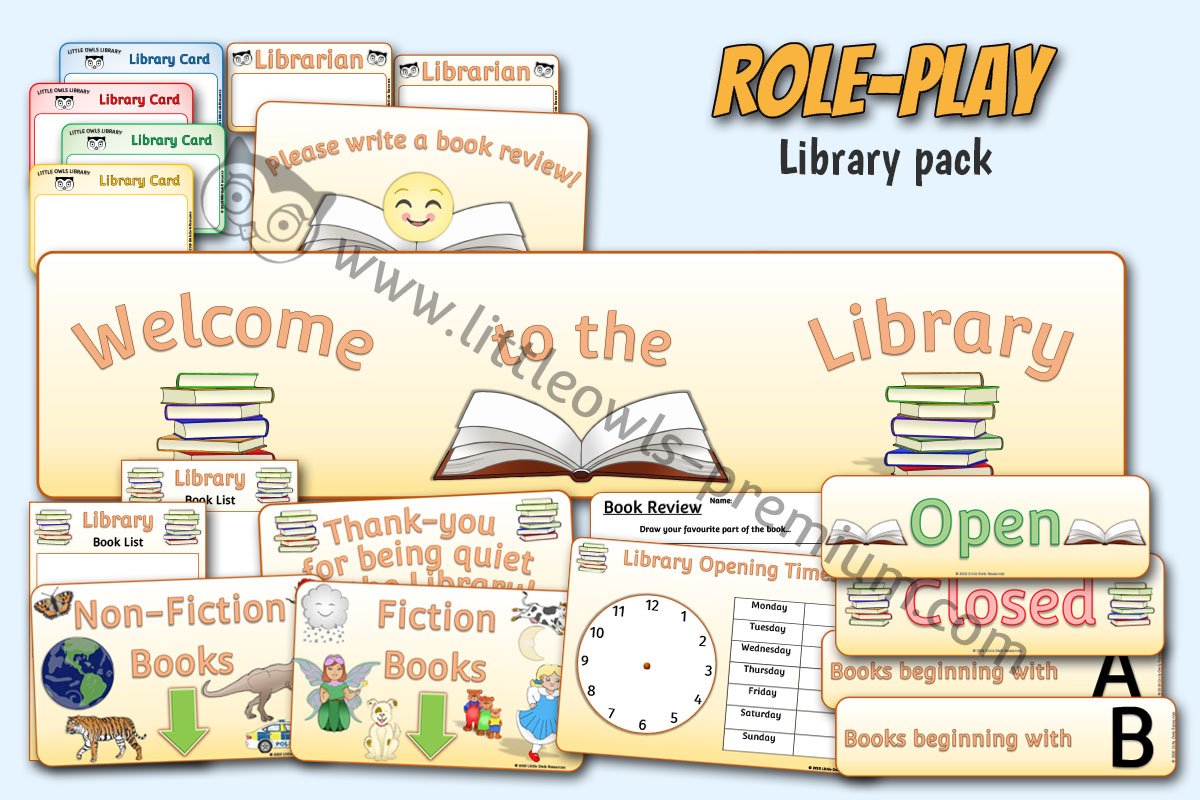
Everything you need to set up a library role-play area!
Pack includes:
(Please note that words, etc. can be altered within the editable docx file version.)
‘Welcome to the Library’ banner
Library cards
Librarian identity cards - Name Writing
Posters
‘Please wait’ footprint floormats
Signs for - ‘Non-Fiction Books’ and ‘Fiction Books’
‘Books beginning with…’ signs for sorting activities
‘Put…books in a pile here’ counting activity signs
‘Open’ & ‘Closed’ signs
‘Library Opening Times’ Poster
Templates for emergent writing (ideally laminated) - ‘Library Book List’ & ‘Write your name here when you borrow a book’,
Differentiated book review sheets
Original artwork drawn by Sara Murphy and final digital resources created by Stuart Murphy. COPYRIGHT ON ALL OF THE RESOURCES HOUSED ON THIS WEBSITE IS HELD BY ‘LITTLE OWLS RESOURCES’. OUR RESOURCES (INCLUDING THE IMAGES WITHIN THEM), CANNOT BE SHARED OR SOLD COMMERCIALLY.
DOWNLOAD EDITABLE (DOCX)
DOWNLOAD NON-EDITABLE (PDF)
DOWNLOAD NON-EDITABLE (Zipped JPEGs)
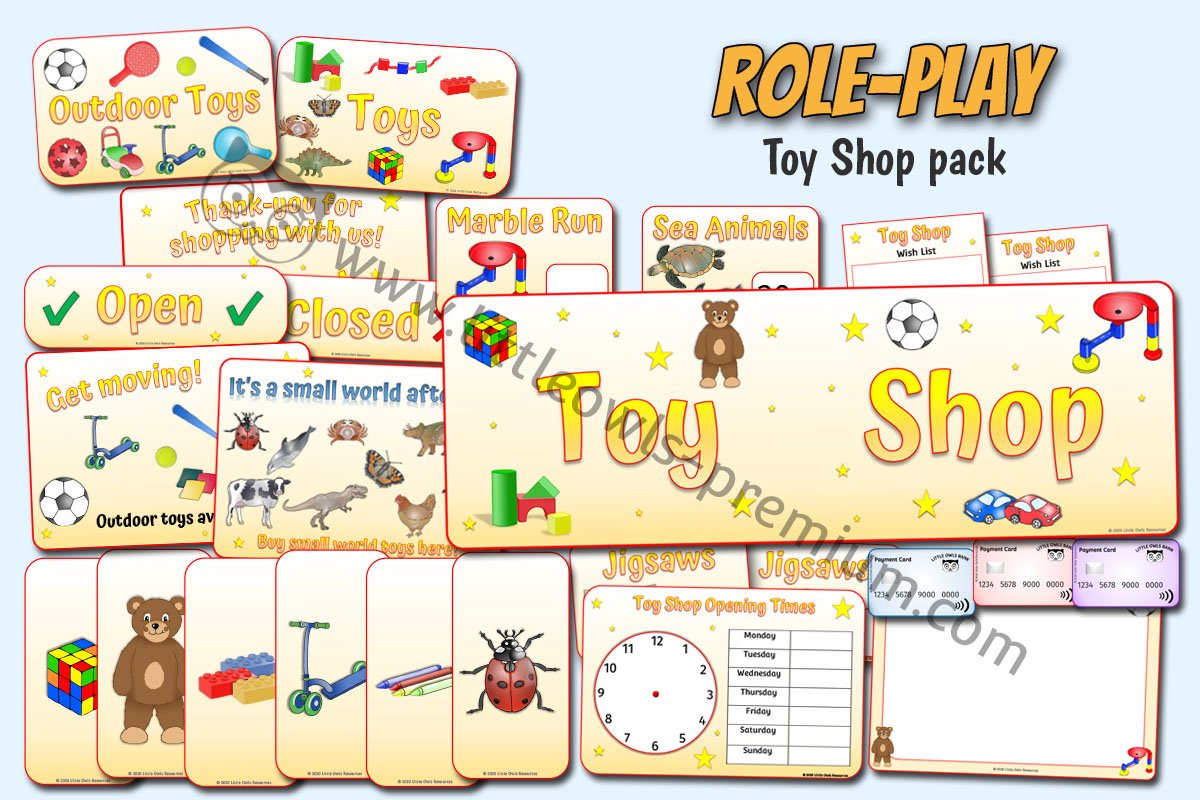
We have created this ‘Toy Shop Role-Play Pack’ with social distancing practices within shops included.
Pack includes:
‘Toy Shop’ banner
‘Please pay using contactless’ signs
Credit cards in various colours
‘Don’t stand too close! Thank-you!’ social distancing sign
‘Thank-you for shopping with us! Stay Safe!’ sign
‘Please wait’ footprint floor mat
‘Toys’ and ‘Outdoor Toys’ signs
Various individual toy labels (within the categories above) - version with price and version with a blank box for children to write price
Open/Closed signs
‘Get moving! Outdoor toys available here!’ sign
‘It’s a small world after all! Buy small world toys here!’ sign
Opening times poster - with blank clock for children/adult to draw hands on plus days of the week blank timetable
Toy Shop Wish List templates for emergent writing
Drawing and Writing blank sheets with toy themed borders for mark making and emergent writing
Picture cards of various toys to be sold in the role-play shop (to ideally cut out and laminate)
Original artwork drawn by Sara Murphy and final digital resources created by Stuart Murphy. COPYRIGHT ON ALL OF THE RESOURCES HOUSED ON THIS WEBSITE IS HELD BY ‘LITTLE OWLS RESOURCES’. OUR RESOURCES (INCLUDING THE IMAGES WITHIN THEM), CANNOT BE SHARED OR SOLD COMMERCIALLY.
DOWNLOAD EDITABLE (DOCX)
DOWNLOAD NON-EDITABLE (PDF)
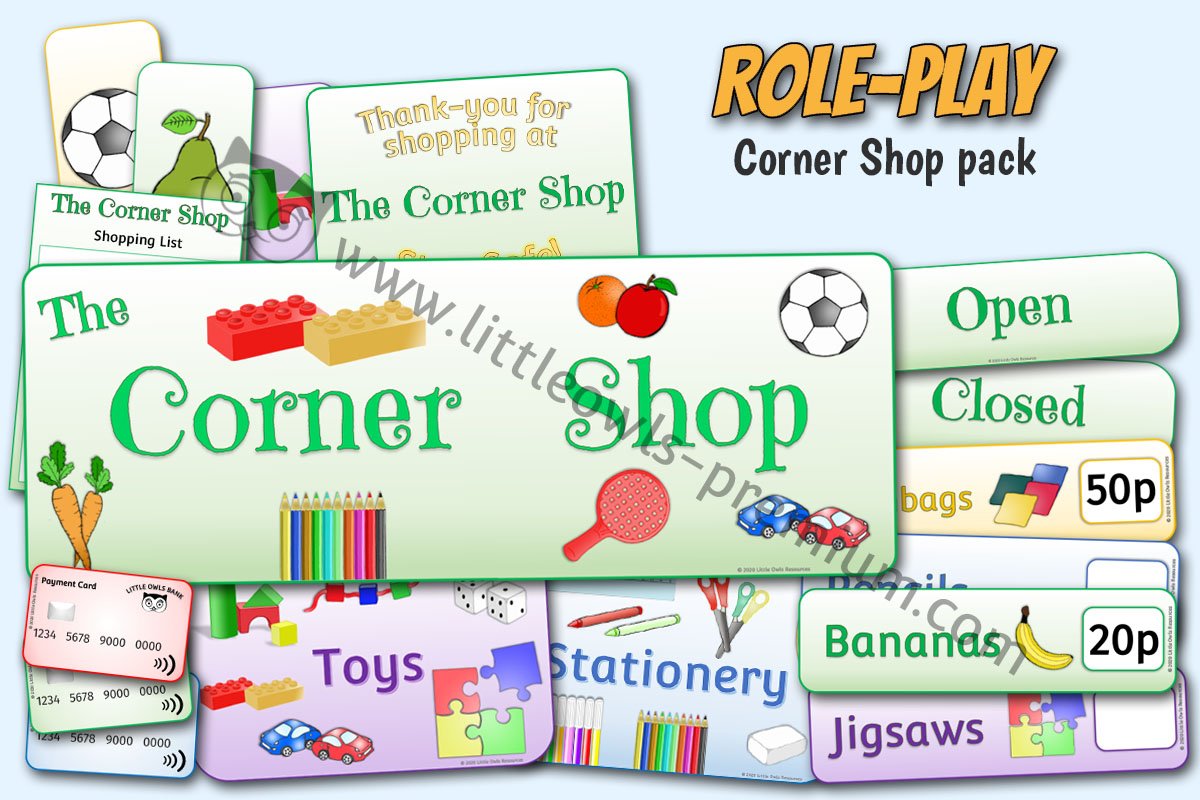
We have created this ‘Corner Shop Role-Play Pack’ with possible social distancing practices within shops in mind.
Pack includes:
‘Corner Shop’ banner
‘Please pay using contactless’ signs
Credit cards in various colours
‘Not too close! Thank-you!’ social distancing sign
‘Thank-you for shopping at the Corner Shop. Stay Safe!’ sign
‘Please wait’ footprint floor mats
‘Special offers!’ sign
‘Fresh fruit and vegetables’, ‘Stationery’, Toys’ & ‘Outdoor Toys’ signs/labels
Various individual goods labels (within the categories above) - version with price and version with a blank box for children to write price
Open/Closed signs
Opening times poster - with blank clock for children/adult to draw hands on plus days of the week blank timetable
Shopping list templates for emergent writing
Picture cards of various goods to be sold in the role-play shop (to ideally cut out and laminate)
Original artwork drawn by Sara Murphy and final digital resources created by Stuart Murphy. COPYRIGHT ON ALL OF THE RESOURCES HOUSED ON THIS WEBSITE IS HELD BY ‘LITTLE OWLS RESOURCES’. OUR RESOURCES (INCLUDING THE IMAGES WITHIN THEM), CANNOT BE SHARED OR SOLD COMMERCIALLY.
DOWNLOAD EDITABLE (DOCX)
DOWNLOAD NON-EDITABLE (PDF)
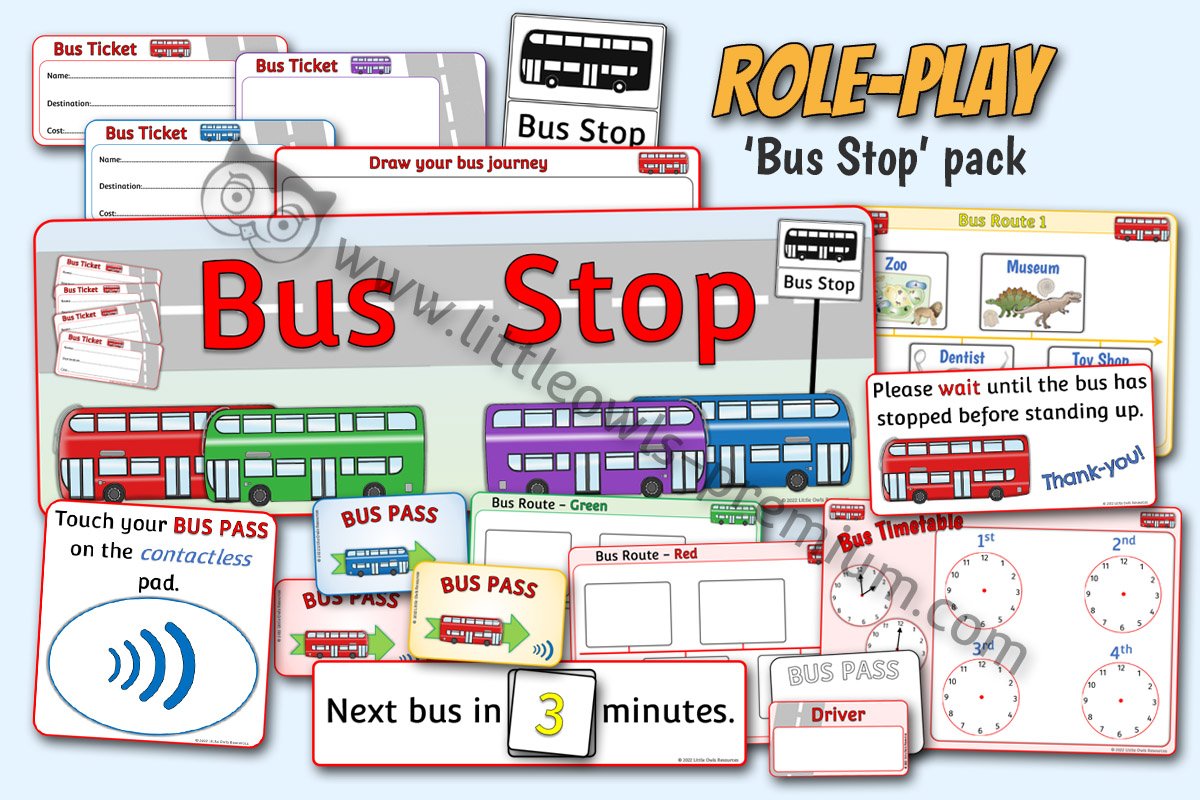
This 'Bus Stop' role play pack is ideal to create a transport or travel themed role play area!
Pack includes:
Banner
Contactless pads
Bus passes (pre-made and templates for children’s mark making) - Name Writing
Next bus in … minutes interactive sign
Driver name tags - Name Writing
Bus tickets (various templates for children’s mark making)
Bus stop signs (2 designs)
Posters
Ticket prices poster template
Draw and write about your journey template sheets
Bus timetable clocks
Bus route poster and templates for mark making
Original artwork drawn by Sara Murphy and final digital resources created by Stuart Murphy. COPYRIGHT ON ALL OF THE RESOURCES HOUSED ON THIS WEBSITE IS HELD BY ‘LITTLE OWLS RESOURCES’. OUR RESOURCES (INCLUDING THE IMAGES WITHIN THEM), CANNOT BE SHARED OR SOLD COMMERCIALLY.
DOWNLOAD EDITABLE (DOCX)
DOWNLOAD NON-EDITABLE (PDF)
DOWNLOAD NON-EDITABLE (Zipped JPEGs)
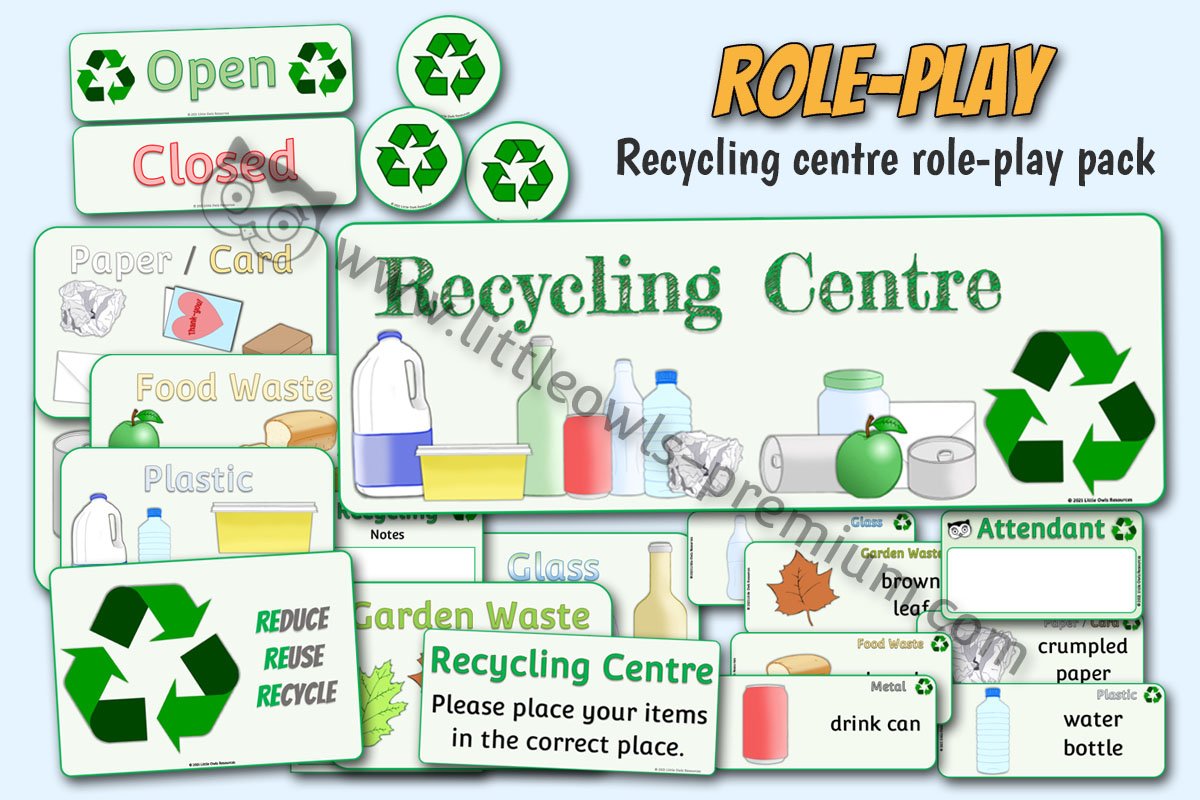
Everything you need to set up a Recycling Centre role-play area!
Pack includes:
(Please note that words, etc. can be altered within the editable docx file version.)
‘Recycling Centre’ banner
Signs for sorting ‘Metal’, ‘Plastic’, ‘Food Waste’, ‘Garden Waste’, ‘Paper/Card’ and ‘Glass’
Recycling Symbols
‘Attendant’ identity cards - Name Writing
Social distancing signs & floormats
Various Posters, such as ‘Reduce, Reuse, Recycle’ and ‘Not sure where your items go?…Please ask an attendant’
‘Open’ & ‘Closed’ signs
‘Recycling Centre Opening Times’ Poster - Space to draw hands on clock and write times
‘Opens at…o’ clock’ and ‘Closes at…o’ clock’ signs - spaces for emergent writing
‘Recycling Notes’ Template sheets for emergent writing
Recycling item word cards to be used for display or sorting activities in conjunction with the material signs mentioned above.
Original artwork drawn by Sara Murphy and final digital resources created by Stuart Murphy. COPYRIGHT ON ALL OF THE RESOURCES HOUSED ON THIS WEBSITE IS HELD BY ‘LITTLE OWLS RESOURCES’. OUR RESOURCES (INCLUDING THE IMAGES WITHIN THEM), CANNOT BE SHARED OR SOLD COMMERCIALLY.
DOWNLOAD EDITABLE (DOCX)
DOWNLOAD NON-EDITABLE (PDF)
DOWNLOAD NON-EDITABLE (Zipped JPEGs)
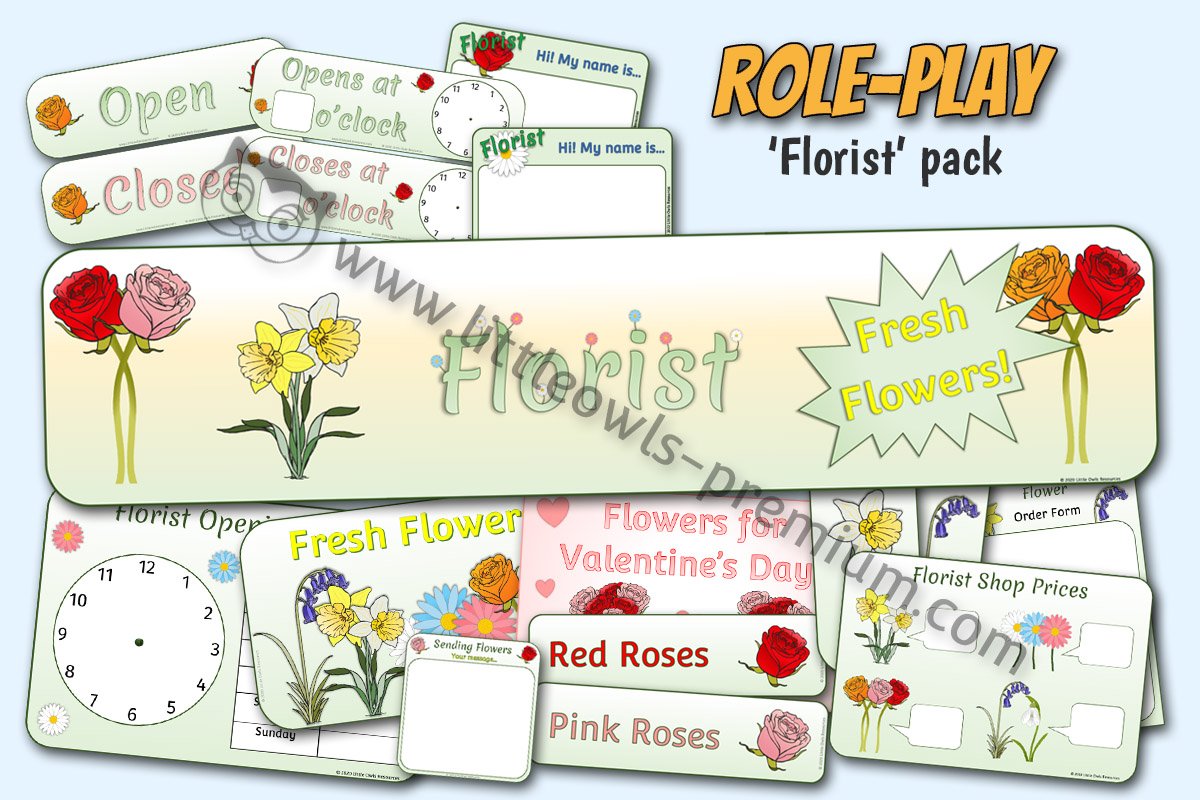
Download this one stop 'Florist' role play pack.
Pack includes:
banner
prices poster
blank proforma prices for children to fill in
picture cards of various flowers to be sold in the role-play florist (to ideally cut out and laminate)
flower signs
open/closed signs (2 styles)
flower order and message templates
opening times poster (including days of the week)
Original artwork drawn by Sara Murphy and final digital resources created by Stuart Murphy. COPYRIGHT ON ALL OF THE RESOURCES HOUSED ON THIS WEBSITE IS HELD BY ‘LITTLE OWLS RESOURCES’. OUR RESOURCES (INCLUDING THE IMAGES WITHIN THEM), CANNOT BE SHARED OR SOLD COMMERCIALLY.
DOWNLOAD EDITABLE (DOCX)
DOWNLOAD NON-EDITABLE (PDF)
DOWNLOAD NON-EDITABLE (Zipped JPEGs)
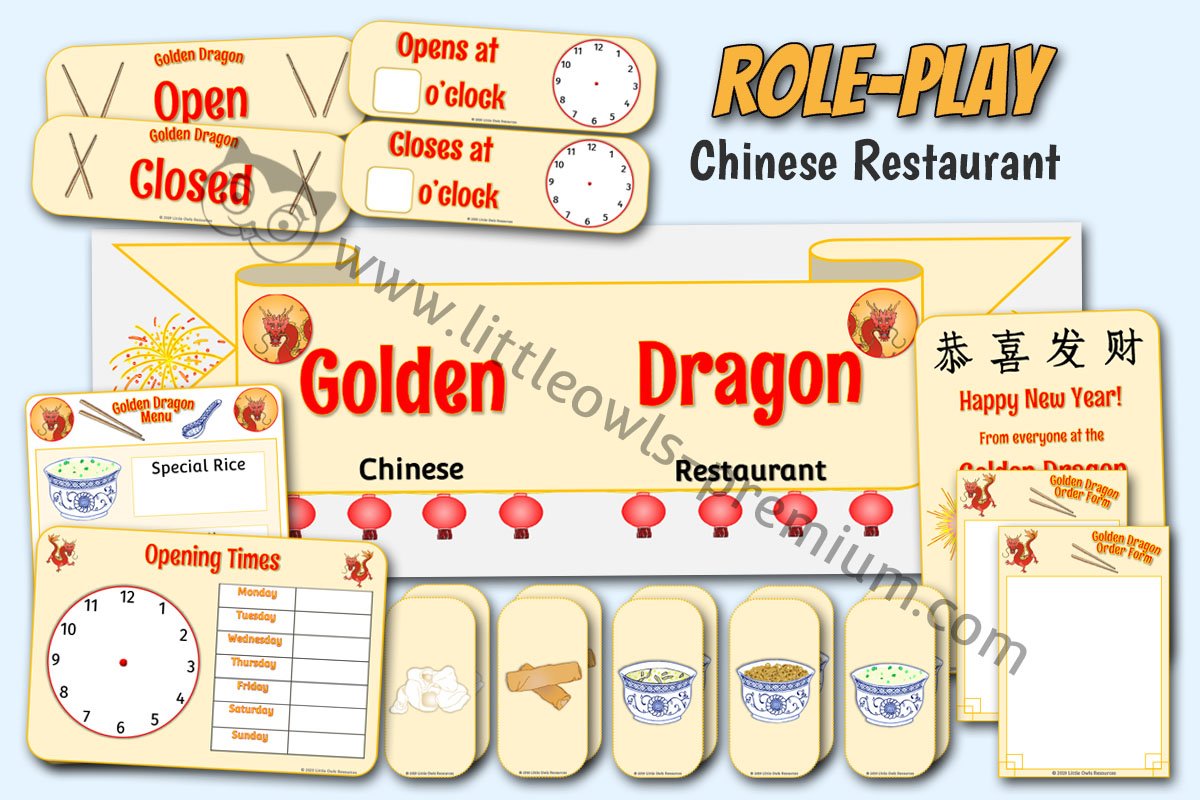
Chinese restaurant role-play pack includes:
banner
order forms for mark making/pre-writing
open/closed signs
posters (one of which includes opening times)
two versions of a basic menu (one with prices and one without for children to practise writing numbers)
set of corresponding food cards to stock your restaurant
CLICK HERE to visit ‘Chinese/Lunar New Year’ topic page.
Original artwork drawn by Sara Murphy and final digital resources created by Stuart Murphy. COPYRIGHT ON ALL OF THE RESOURCES HOUSED ON THIS WEBSITE IS HELD BY ‘LITTLE OWLS RESOURCES’. OUR RESOURCES (INCLUDING THE IMAGES WITHIN THEM), CANNOT BE SHARED OR SOLD COMMERCIALLY.
DOWNLOAD EDITABLE (DOCX)
DOWNLOAD NON-EDITABLE (PDF)
DOWNLOAD NON-EDITABLE (Zipped JPEGs)
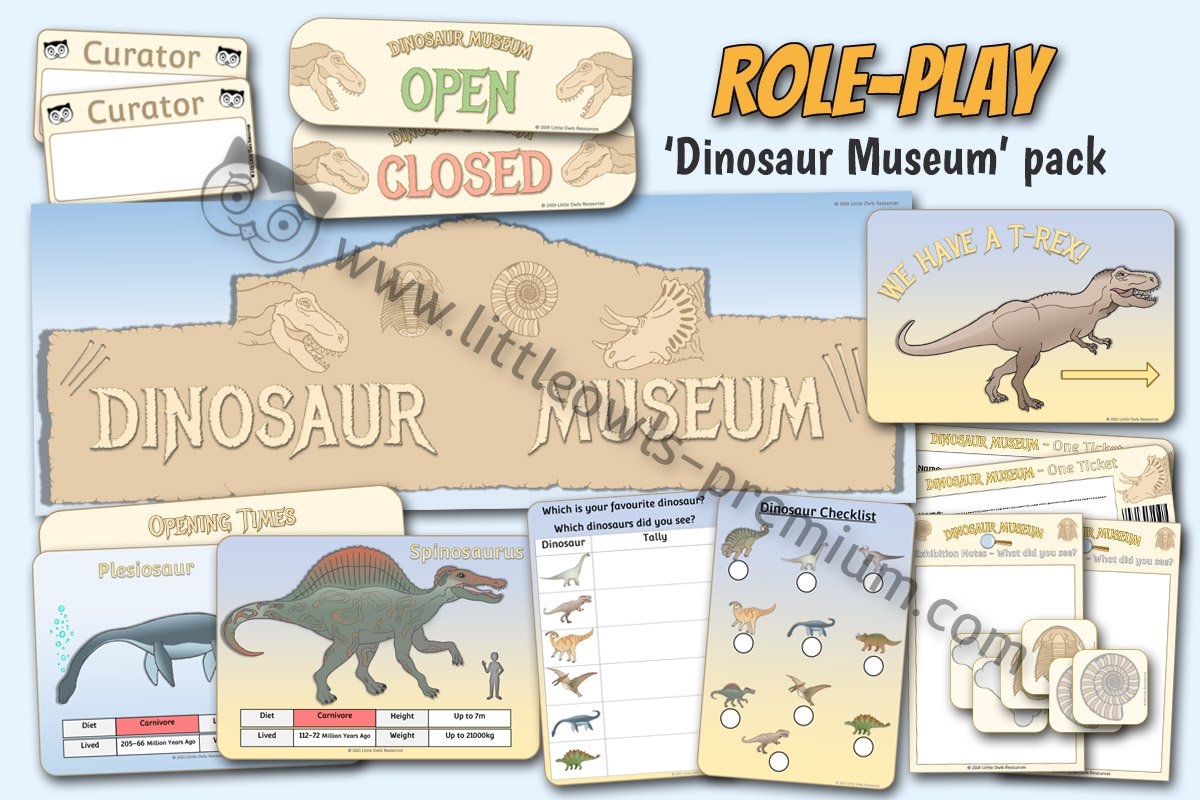
Dinosaur Museum Role Play Pack includes (36 pages):
museum banner
curator badges - Name Writing
open/closed signs
opening times poster
tickets - Name Writing
exhibition note sheets for mark making and emergent writing
dinosaur border paper (colour and b/w)
direction posters
dinosaur exhibit posters (large dinosaur with comparison to human height picture plus basic facts at the bottom as you may find when walking around a museum)
fossil finding equipment poster
various fossil cards to use in order to set up a paleontological dig sand tray in your museum
dinosaur tally and check list sheets
writing/drawing/mark making sheets which could be used as activities whilst at the museum
Please also see our other paleontological dig site sand tray resources in our ‘Dinosaurs topic’ which include: letters, numbers, shapes and phase 2 & 3 keywords on fossils.
CLICK HERE to visit ‘Dinosaur’ topic page.
Original artwork drawn by Sara Murphy and final digital resources created by Stuart Murphy. COPYRIGHT ON ALL OF THE RESOURCES HOUSED ON THIS WEBSITE IS HELD BY ‘LITTLE OWLS RESOURCES’. OUR RESOURCES (INCLUDING THE IMAGES WITHIN THEM), CANNOT BE SHARED OR SOLD COMMERCIALLY.
DOWNLOAD EDITABLE (DOCX)
DOWNLOAD NON-EDITABLE (PDF)
DOWNLOAD NON-EDITABLE (Zipped JPEGs)
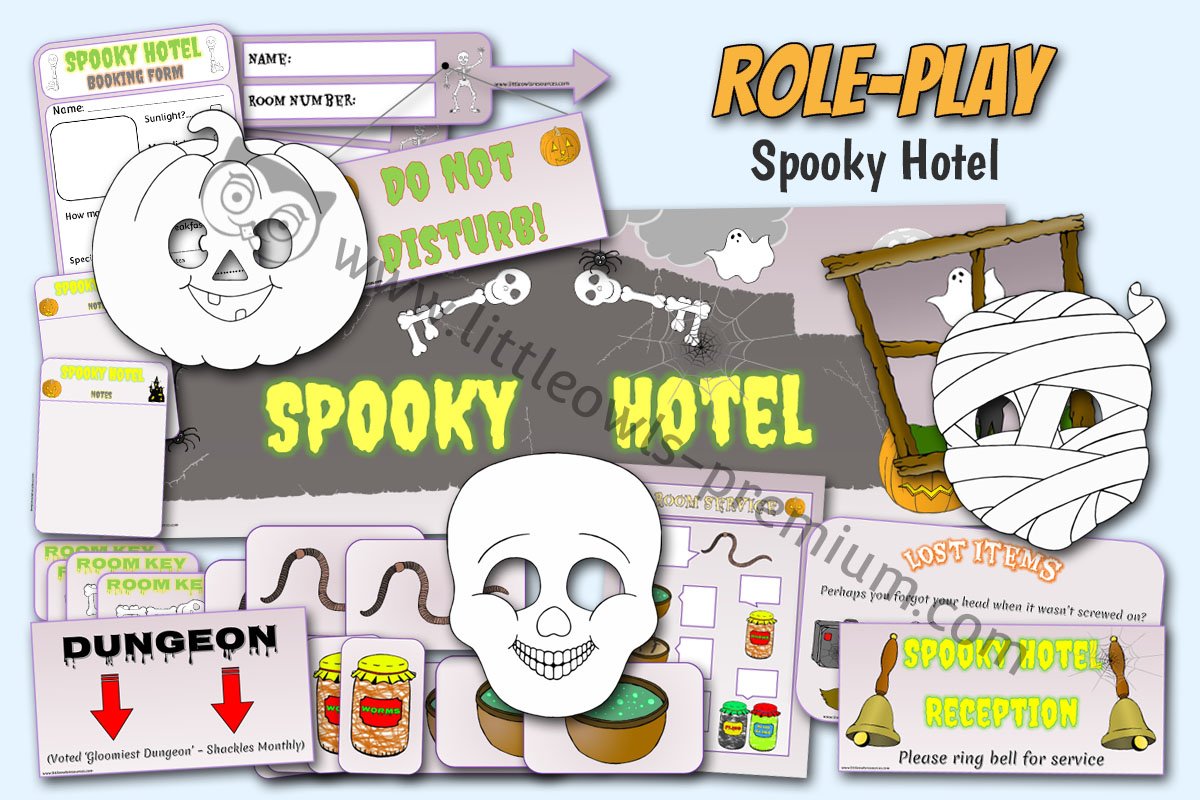
Transform your role-play area into a Spooky Hotel. All you need to inspire role-play whilst also developing key skills.
Pack includes:
friendly halloween character masks
banner
luggage tags
spooky view windows
numbered room key cards (skeleton key theme)
posters and signs
room service menu sheets (one pre-filled with prices and the other left blank for children to fill in)
spooky food cards to stock your room service shop
spooky hotel note sheets for mark making and emergent writing
employee of the month template for mark making
spooky hotel booking form for mark making, drawing and emergent writing
Original artwork drawn by Sara Murphy and final digital resources created by Stuart Murphy. COPYRIGHT ON ALL OF THE RESOURCES HOUSED ON THIS WEBSITE IS HELD BY ‘LITTLE OWLS RESOURCES’. OUR RESOURCES (INCLUDING THE IMAGES WITHIN THEM), CANNOT BE SHARED OR SOLD COMMERCIALLY.
DOWNLOAD EDITABLE (DOCX)
DOWNLOAD NON-EDITABLE (PDF)
DOWNLOAD NON-EDITABLE (Zipped JPEGs)
Related Little Owls Resource Pages
Role-Play Resources
Role-play resources help children represent people, places, experiences and ideas through assumed roles, imagined situations and purposeful language.
Imaginative Play Resources
Props, puppets, masks and movement prompts can support children in giving objects, actions and characters imagined meanings.
Home Corner Resources
A home corner enables children to recreate familiar routines, relationships and experiences through symbolic and pretend play.
Traditional and Fairy Tales Resources
Stories, characters, masks and dramatic-play resources can inspire children to recreate familiar narratives and develop their own variations.
Books and Storytelling Resources
Storytelling resources can help children represent events, characters and imagined worlds through talk, mark-making, small-world play and performance.
Professional Schema Guidance
Professional guidance showing how schematic learning is intentionally embedded across toddler projects.
A professional guidance document explaining how schemas underpin learning and shape effective toddler practice.
A practical, research-informed toolkit for recognising schemas and responding through meaningful, child-led provision.
Explore Schema-Responsive EYFS Practice
Our schema resources sit within a wider approach to observation-led planning, enabling environments, continuous provision and child-led learning.
Explore further:
Continuous Provision Resources
Schema – EYFS Glossary Term
Membership Options at a Glance
Free Access
Explore a selection of free resources before upgrading.
Premium Membership
Full access to our EYFS & KS1 Printable Provision library.
Professional Membership
Full access to Printable Provision plus our EYFS Curriculum & Pedagogy Suite.

NEW | From Our Blog: Latest Articles & Practical Guides
We regularly publish in-depth articles to support you with current best practices, regulatory changes, and fresh ideas.
The Department for Education has published updated versions of the Early Years Foundation Stage statutory framework, which will come into effect on 1 September 2026.
The revised frameworks introduce strengthened requirements relating primarily to safeguarding, children’s welfare, safer sleep, suitability checks and screen use. There are also several smaller clarifications intended to make existing expectations easier for providers to understand and apply…

A major overhaul of the national curriculum in England has been announced following the publication of the independent Curriculum and Assessment Review. For those working in the Early Years Foundation Stage (EYFS) and Key Stage 1 (KS1), the changes signal a renewed focus on practical life skills, digital literacy, and enriching learning experiences…
The world of early years education is constantly evolving, and with it, the frameworks that guide and assess our invaluable work. Come November 2025, a significant shift will occur as the new Education Inspection Framework (EIF) comes into effect, bringing with it some crucial changes…

With the new 2025 EYFS Statutory Framework for group and school-based providers coming into effect on 1st September 2025, it's essential to understand the updates to ensure your practice remains compliant, effective…

As dedicated early years professionals, you play a vital role in nurturing the growth and development of our youngest learners. Keeping up-to-date with the latest guidelines is crucial, and today, July 14, 2025…

The Education Secretary is calling on parents to lead by example and make reading a daily habit to help reverse the decline in reading for pleasure, to help give kids the best start in life as part of the…
As we head into summer, it’s especially important that children are prepared with these skills. This year, the Royal Life Saving Society UK's Drowning Prevention Week runs from 14 June to 21…

There are several ways that schools can make changes to keep children safe in hot weather, especially as children are more at risk of becoming ill with heat-related issues than adults…
Infuse your Valentine's Day celebrations with a splash of science and art using our delightful FREE Valentine's Day: Heart Colour Mixing activity! These engaging printables are perfect for EYFS…