• Home 🏠
  • About Us
  • Pricing
    • 🌟Printable Resources Hub🌟
    • ↪ Themes
    • ↪ Role Play
    • ↪ Festivals & Celebrations
    • ↪ Special Dates Calendar
    • ↪ Areas of Learning
    • ↪ Organisational Tools
  • EYFS Curriculum & Pedagogy
  • Special Dates Calendar
Menu

Little Owls Resources - Free and Premium Early Years Printables

Street Address
City, State, Zip
Phone Number
Early Years/Preschool/EYFS Printable Activities/Planning/Displays/Paperwork and ideas for Childminders, Preschools, Nursery Practitioners, Teachers and Parents

Your Custom Text Here

Little Owls Resources - Free and Premium Early Years Printables

  • Home 🏠
  • About Us
  • Pricing
  • Printable Resources ⬇
    • 🌟Printable Resources Hub🌟
    • ↪ Themes
    • ↪ Role Play
    • ↪ Festivals & Celebrations
    • ↪ Special Dates Calendar
    • ↪ Areas of Learning
    • ↪ Organisational Tools
  • EYFS Curriculum & Pedagogy
  • Special Dates Calendar

Reception Curriculum Phase Framework | 4–5 Years

January 18, 2026 Stuart Murphy

Home › EYFS Curriculum & Pedagogy › Reception Curriculum & Pedagogy › Reception Curriculum Phase Framework | 4-5 Years

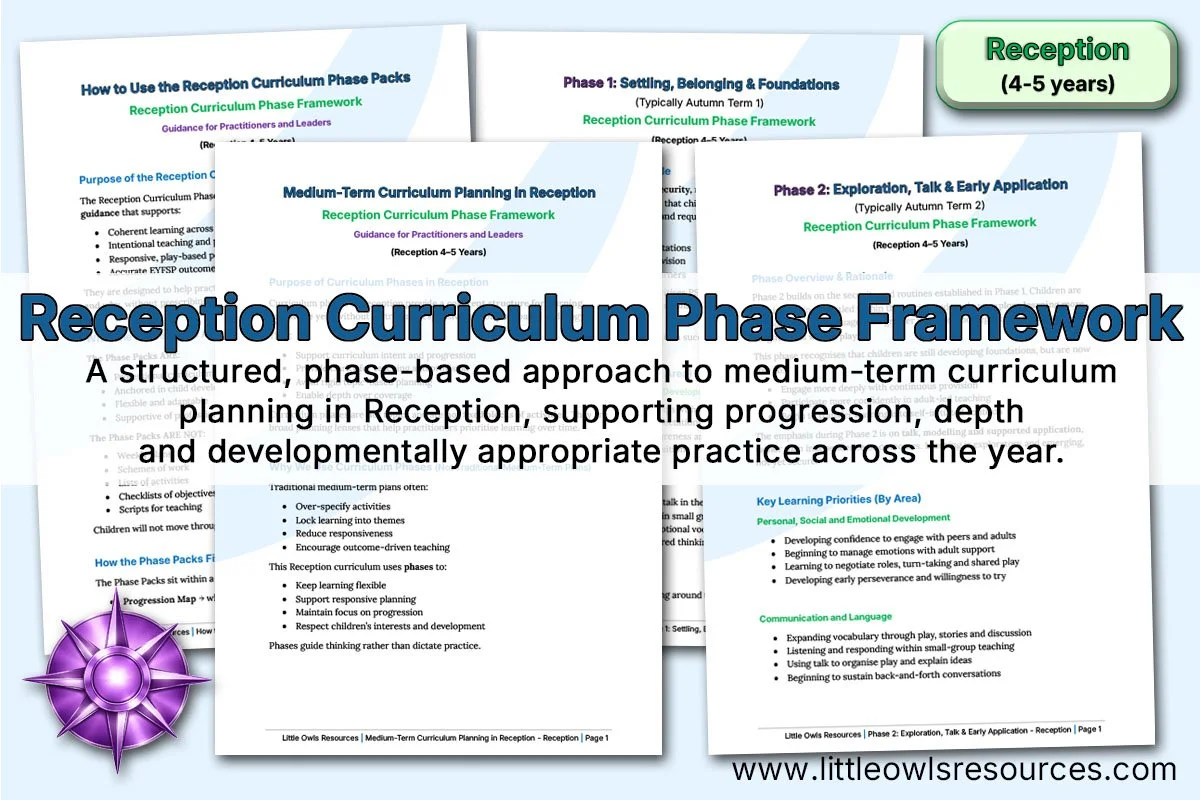
Reception Curriculum Phase Framework | 4–5 Years

A structured, phase-based approach to medium-term curriculum planning in Reception, supporting progression, depth and developmentally appropriate practice across the year.

Download Documents Here:

(All elements of this pathway component will be available for download by: March 31st 2026)

  • How to Use the Reception Curriculum Phase Pack
    Guidance for practitioners and leaders on using phase packs as medium-term curriculum support, alongside observation, provision and adult-led teaching. ⋙ DOCX 📝 | PDF 📄

  • Medium-Term Curriculum Planning in Reception
    An overview of why and how curriculum phases are used in place of traditional medium-term plans, including structure, principles and inspection alignment. ⋙ DOCX 📝 | PDF 📄

  • Phase 1: Settling, Belonging & Foundations
    Focused on emotional security, routines, communication and foundational learning behaviours. ⋙ DOCX 📝 | PDF 📄

  • Phase 2: Exploration & Early Application
    Supporting increasing engagement, talk, early phonics, maths and purposeful application in play. ⋙ DOCX 📝 | PDF 📄

  • Phase 3: Independence & Depth
    Emphasising sustained engagement, independent application, consolidation and depth of learning. ⋙ DOCX 📝 | PDF 📄

  • Phase 4: Consolidation & Transition
    Securing learning across areas and supporting a gradual, developmentally sensitive transition to Year 1.  ⋙ DOCX 📝 | PDF 📄

Documents Updated: January 2026

Recommended next read Selection

EYFS
Reception Curriculum Phase Framework | 4-5 Years

A structured, phase-based approach to medium-term curriculum planning in Reception, supporting progression, depth and developmentally appropriate practice across the year.

Read More →
Reception Curriculum Progression Maps Toolkit | 4-5 Years

A comprehensive professional toolkit outlining learning progression across the Reception year, aligned with the EYFS framework and EYFSP expectations.

Read More →
About Our Reception Curriculum Phase Framework | 4-5 Years

A professional guidance document explaining the rationale and structure behind our phase-based approach to Reception curriculum design.

Read More →

Professional Membership Contents (Reception 4-5 Years)

Below you will find listed the component documents of our ‘Reception Curriculum & Pedagogy Suite’. They are separated into Strands 1-10. You do not need to use everything all at once.

  • 👉 This section is essential for alignment.

    • Reception Curriculum Overview & Rationale [Free Orienting Sample]

    • Reception Pedagogy Position Statement [Free Orienting Sample]

    • About Our Reception Curriculum Phase Framework

    • How To Use The Reception Pathway

    • Why Themes Are Optional in Reception

  • 👉 Curriculum clarity and sequencing.

    • Reception Curriculum Progression Maps (all areas of learning)

      • Guide to Learning Progression: How to Use the Reception Curriculum Progression Maps

      • Progression Maps for:

        • Communication and Language

        • Personal, Social and Emotional Development

        • Physical Development

        • Literacy

        • Mathematics

        • Understanding the World

        • Expressive Arts and Design

    • Reception Curriculum Phase Framework

      • How To Use The Reception Curriculum Phase Pack

      • Phase 1: Settling & Foundations

      • Phase 2: Exploration & Early Application

      • Phase 3: Independence & Depth

      • Phase 4: Consolidation & Transition

  • 👉 OAP as the organising principle.

    • Reception OAP Cycle Guidance

    • Reception Collaborative Planning & Reflective Sheet Pack

    • Self-Regulation & Learning Behaviours in Reception

    • Reception Baseline Assessment (RBA)

    • Characteristics of Effective Learning in Reception

  • 👉 Stable, purposeful provision.

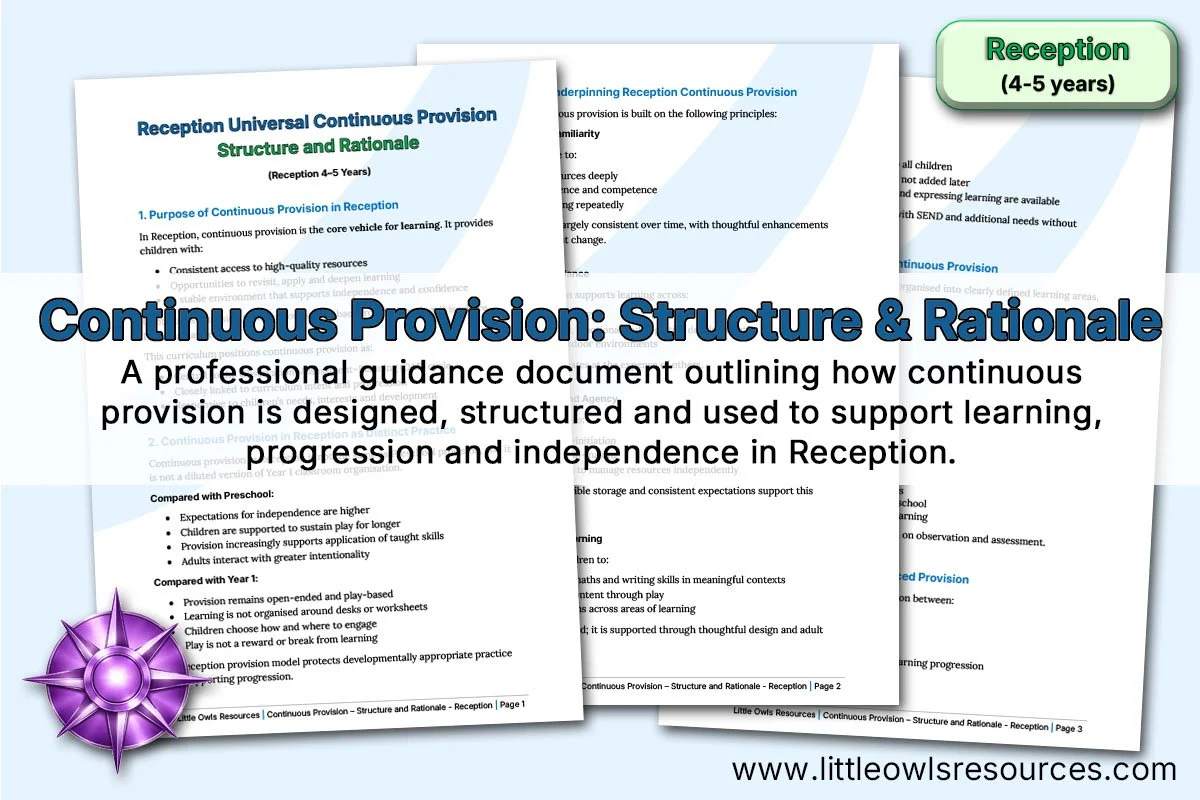
    • Reception Continuous Provision – Structure & Rationale

    • Universal Continuous Provision Pack (Areas listed below)

      • Construction

      • Creative

      • Investigation / Discovery

      • Maths

      • Reading

      • Role Play / Small World

      • Malleable / Sensory

      • Writing

    • Outdoor Continuous Provision (Reception)

    • Adult-Guided Learning in Provision

    • Reception Labelling Pack | 4-5 Years

  • 👉 Light-touch, application-focused.

    • Reception Enhanced Provision Planning Toolkit

    • Reception Optional Themed Enhancements - Idea Banks

  • 👉 Systematic teaching without Year 1 drift.

    Phonics (Scheme-Compatible)

    • Phonics in Reception: Teaching, Application & Inclusion

      • Pedagogy

      • Adult-Led Sessions

      • Phonics in Provision

      • Supporting Children Not Keeping Up

      • Phonics & EYFSP

      • Scheme Compatibility Statement

    Maths

    • Reception Maths Teaching Framework

      • Term by Tem Maths Concept Emphasis Map

      • Maths Adult-Led Mini Session Banks (9 Banks)

      • Maths Across the Curriculum & Provision

      • Maths & EYFSP Guidance

    Writing

    • Reception Early Writing Purpose Pack

      • Writing Adult-Led Mini Session Bank (12 Sessions)

    • Fine Motor & Physical Development

      • Guidance Surrounding Foundations for Writing in Reception (4–5 Years)

  • 👉 Precision language for application.

    • Adult-Guided Learning in Provision

    • Theme-Based High-Impact Question & Vocabulary Banks

      • Leadership Rationale: Why Questions Differ by Age

    • Five Sentence Stems For Reception Practitioners

  • 👉 Statutory confidence with inclusive practice.

    • EYFSP Interpretation & Assessment Toolkit

      • ELG Unpacking

      • Best-Fit Exemplification

      • Moderation Guidance

    • Reception SEND & Inclusion Toolkit

      • The graduated response (Universal → Targeted → Specialist)

      • Adaptations across phonics, maths & writing

      • Visual Communication Pack

      • Language-first strategies for inclusion

      • Observation, assessment and SEND

      • Collaborative working with families and specialists

      • Referral Preparation — for EHCP pathway

      • Reception APDR Template

      • Leadership and inspection readiness

  • 👉 Leadership assurance.

    • Reception Leadership & Inspection Readiness Pack

      • Curriculum Intent & Implementation Guidance

      • Ofsted Conversation Prompts

  • 👉 Clear communication beyond the classroom.

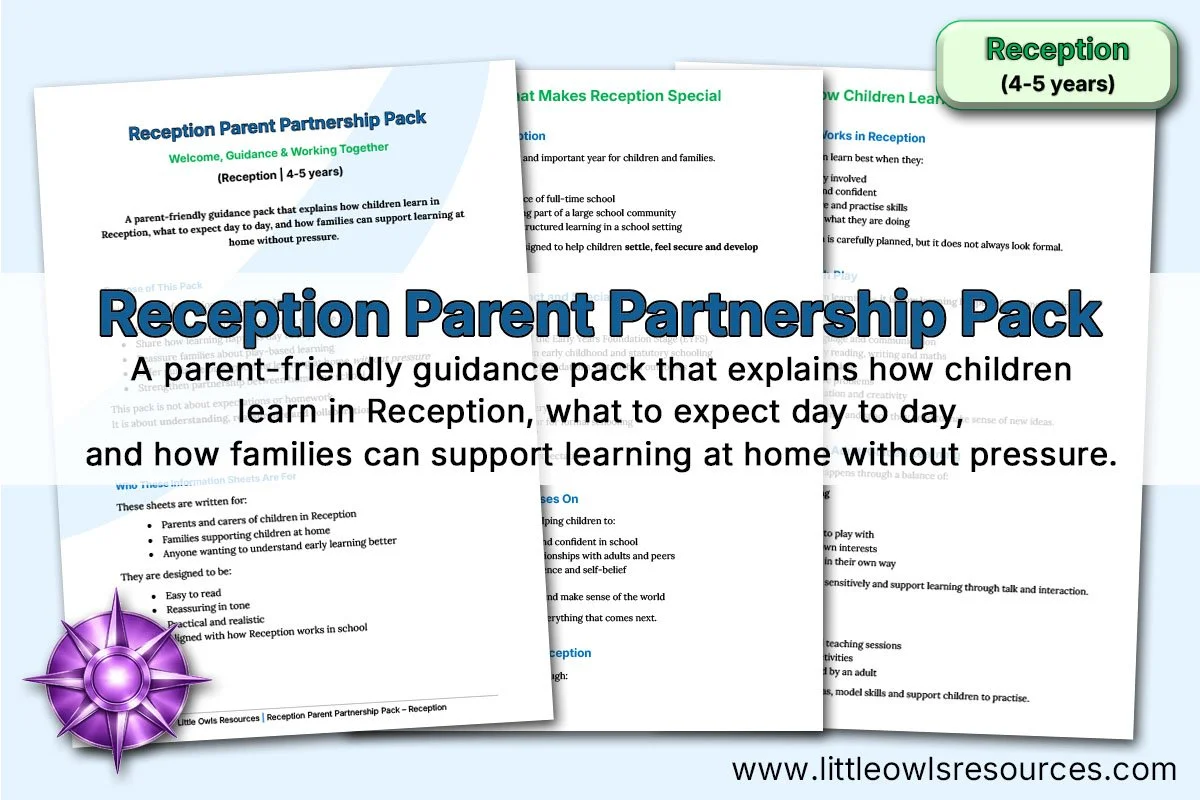
    • Reception Parent Partnership Pack

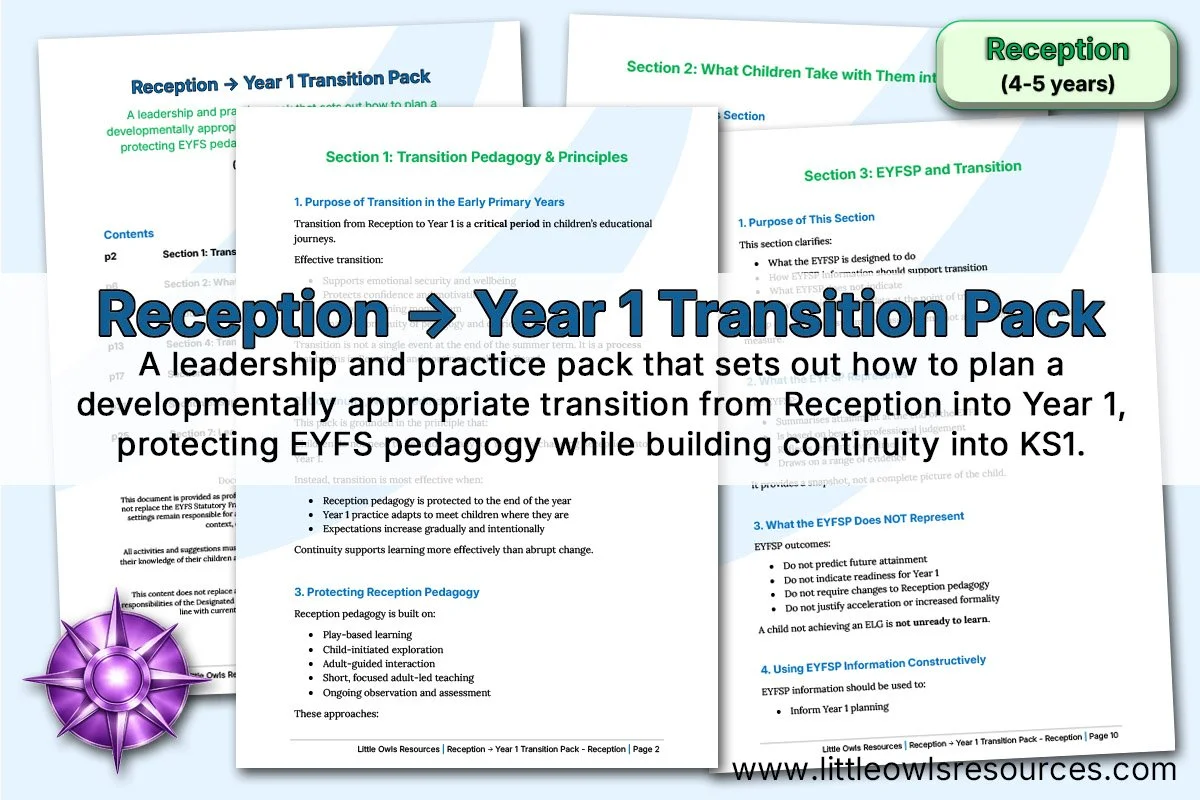
    • Reception Transition to Year 1 Pack

Additional Whole-Setting Guidance | for Professional Members

Explore our whole-setting guidance below, including overarching curriculum and pedagogy documents, early years schemas and EYFS setting policies.

    • Little Owls Resources’ Curriculum Intent Statement

    • EYFS from Birth to 5: Curriculum Coherence & Pedagogical Throughline

    • Whole-Setting Curriculum Map (Birth-5): Curriculum Intent & Progression

    • Pedagogy Guidance Document

    • Speech & Language Development - Setting Statement

    • EYFS Inspection-Facing Summaries

  • Early Years Schemas - Practitioner Toolkit | EYFS Birth-5

    ↪ Schema Cards (definition, behaviours, age-related examples, enabling resources)

    ↪ Schema Observation & Responsive Provision Planning Template

    • EYFS Group Setting Policies Pack

      ↪ x 22 Policy Documents

      ↪ Policy Sign-Off and Confirmation Document

      ↪ EYFS Setting Policy Folder Contents List

    • Childminder Setting Policies Pack

      ↪ x 22 Policy Documents

      ↪ Childminder Assistant or Volunteer Policy Sign-Off and Confirmation Document

      ↪ Childminder Policy Folder Contents List

  • EYFS Glossary

    ↪ Clear, practitioner-friendly explanations of key curriculum and pedagogy terms used throughout our guidance.

Looking for a different age group pathway?

Select the pathway that best reflects your role or the age group you work with. You do not need to use everything. (Some practitioners may use more than one pathway.)
Featured
🍼 Babies (0–18 months)

Responsive care, observation and development in the earliest years

🚼 Toddlers (18–36 months)

Development, play and progression in the toddler years

🎨 Preschool (3–4 years)

Curriculum, continuous provision and purposeful teaching

🎓 Reception (4–5 years)

Play-based pedagogy, progression and EYFSP readiness

🏡 Childminders (Birth–5)

Mixed-age pedagogy, planning without overload and inspection confidence

Latest EYFS Articles & Practical Guides | From Our Blog

Stay informed, get expert advice, and find inspiration from our collection of articles and useful external resources, tailored specifically for EYFS practitioners. We regularly publish in-depth articles to support you with current best practices, regulatory changes, and fresh ideas.

EYFS & KS1 Articles
Major UK Curriculum Shake-Up Announced: What EYFS & KS1 Practitioners Need to Know

A major overhaul of the national curriculum in England has been announced following the publication of the independent Curriculum and Assessment Review. For those working in the Early Years Foundation Stage (EYFS) and Key Stage 1 (KS1), the changes signal a renewed focus on practical life skills, digital literacy, and enriching learning experiences…

Read More →
New Education Inspection Framework | What EYFS Settings Need to Know

The world of early years education is constantly evolving, and with it, the frameworks that guide and assess our invaluable work. Come November 2025, a significant shift will occur as the new Education Inspection Framework (EIF) comes into effect, bringing with it some crucial changes…

Read More →
Revised 2025 EYFS Statutory Framework for Group & School-Based Providers | What You Need to Know

With the new 2025 EYFS Statutory Framework for group and school-based providers coming into effect on 1st September 2025, it's essential to understand the updates to ensure your practice remains compliant, effective…

Read More →
DfE Press Release | Parents urged to read more to boost children’s life chances

The Education Secretary is calling on parents to lead by example and make reading a daily habit to help reverse the decline in reading for pleasure, to help give kids the best start in life as part of the…

Read More →
DfE Update | Drowning Prevention Week: what children learn about water safety at school

As we head into summer, it’s especially important that children are prepared with these skills. This year, the Royal Life Saving Society UK's Drowning Prevention Week runs from 14 June to 21…

Read More →
DfE Update | Hot weather and heatwaves: guidance for schools and other education settings

There are several ways that schools can make changes to keep children safe in hot weather, especially as children are more at risk of becoming ill with heat-related issues than adults…

Read More →

Are you looking for a specific resource or document for your provision?

Use our 🔍 Search Bar located at the top of every page.

___________________________

Content within the EYFS Curriculum & Pedagogy Membership is provided as professional guidance and support. It reflects current understanding of the EYFS statutory framework, Development Matters and inspection expectations at the time of writing. Practitioners are responsible for applying professional judgement and ensuring practice aligns with current statutory requirements and their specific context. All resources, experiences and environment arrangements must be risk assessed by the setting and used in accordance with individual children’s developmental stages, needs and supervision requirements.

Safeguarding content does not replace a setting’s safeguarding and child protection policy or the statutory role of the Designated Safeguarding Lead (DSL). All concerns must be managed in line with current statutory guidance and local safeguarding procedures.

_____________________________

 
In Reception | 4-5 Years, -R2 Tags Reception, Reception Curriculum Phase Framework | 4–5 Years

Reception Curriculum Progression Maps Toolkit | 4-5 Years

January 18, 2026 Stuart Murphy

Home › EYFS Curriculum & Pedagogy › Reception Curriculum & Pedagogy › Reception Curriculum Progression Maps Toolkit | 4-5 Years

Reception Curriculum Progression Maps Toolkit (4–5 Years)

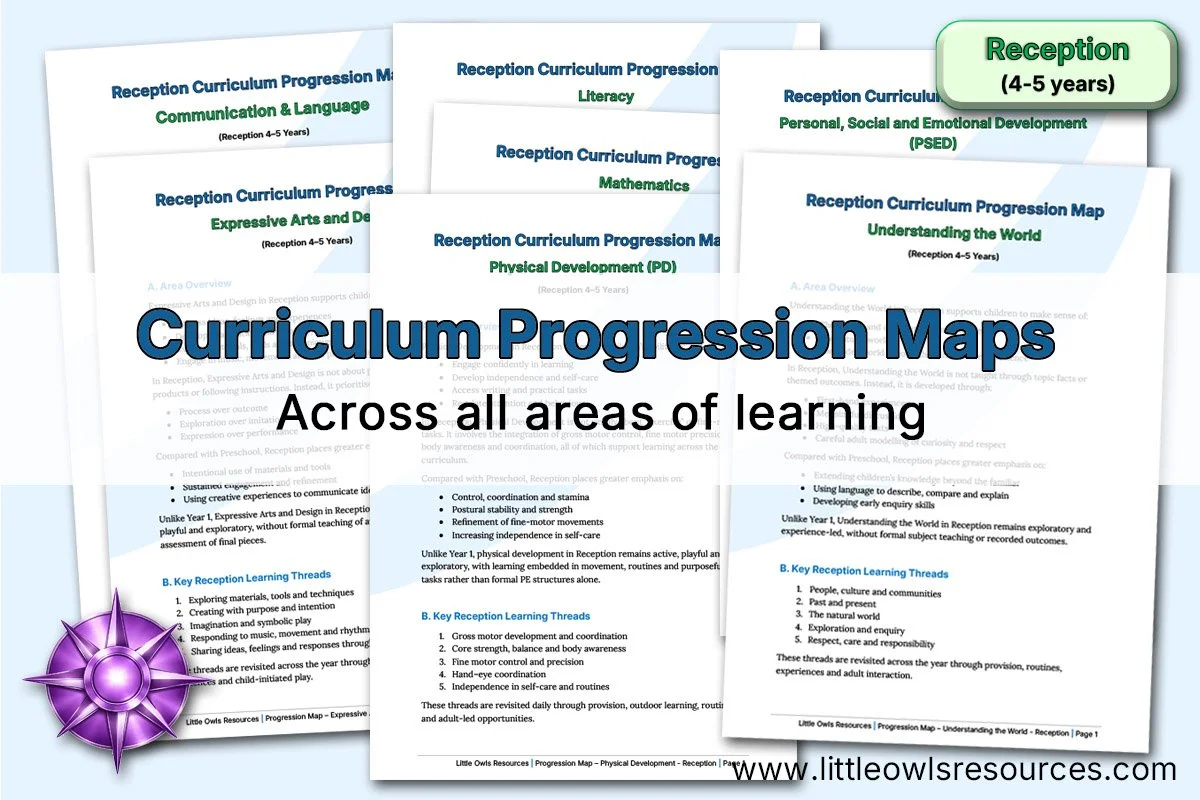
A comprehensive professional toolkit outlining learning progression across the Reception year, aligned with the EYFS framework and EYFSP expectations.

Download Documents Here:

  •  Guide to Learning Progression: How to Use the Reception Curriculum Progression Maps ⋙ DOCX 📝 | PDF 📄

  • Progression Maps for:

    • Communication and Language ⋙ DOCX 📝 | PDF 📄

    • Personal, Social and Emotional Development ⋙ DOCX 📝 | PDF 📄

    • Physical Development ⋙ DOCX 📝 | PDF 📄

    • Literacy ⋙ DOCX 📝 | PDF 📄

    • Mathematics ⋙ DOCX 📝 | PDF 📄

    • Understanding the World ⋙ DOCX 📝 | PDF 📄

    • Expressive Arts and Design ⋙ DOCX 📝 | PDF 📄

Documents Updated: January 2026

Recommended next read Selection

EYFS
Reception Curriculum Phase Framework | 4-5 Years

A structured, phase-based approach to medium-term curriculum planning in Reception, supporting progression, depth and developmentally appropriate practice across the year.

Read More →
Reception Curriculum Progression Maps Toolkit | 4-5 Years

A comprehensive professional toolkit outlining learning progression across the Reception year, aligned with the EYFS framework and EYFSP expectations.

Read More →
About Our Reception Curriculum Phase Framework | 4-5 Years

A professional guidance document explaining the rationale and structure behind our phase-based approach to Reception curriculum design.

Read More →

Professional Membership Contents (Reception 4-5 Years)

Below you will find listed the component documents of our ‘Reception Curriculum & Pedagogy Suite’. They are separated into Strands 1-10. You do not need to use everything all at once.

  • 👉 This section is essential for alignment.

    • Reception Curriculum Overview & Rationale [Free Orienting Sample]

    • Reception Pedagogy Position Statement [Free Orienting Sample]

    • About Our Reception Curriculum Phase Framework

    • How To Use The Reception Pathway

    • Why Themes Are Optional in Reception

  • 👉 Curriculum clarity and sequencing.

    • Reception Curriculum Progression Maps (all areas of learning)

      • Guide to Learning Progression: How to Use the Reception Curriculum Progression Maps

      • Progression Maps for:

        • Communication and Language

        • Personal, Social and Emotional Development

        • Physical Development

        • Literacy

        • Mathematics

        • Understanding the World

        • Expressive Arts and Design

    • Reception Curriculum Phase Framework

      • How To Use The Reception Curriculum Phase Pack

      • Phase 1: Settling & Foundations

      • Phase 2: Exploration & Early Application

      • Phase 3: Independence & Depth

      • Phase 4: Consolidation & Transition

  • 👉 OAP as the organising principle.

    • Reception OAP Cycle Guidance

    • Reception Collaborative Planning & Reflective Sheet Pack

    • Self-Regulation & Learning Behaviours in Reception

    • Reception Baseline Assessment (RBA)

    • Characteristics of Effective Learning in Reception

  • 👉 Stable, purposeful provision.

    • Reception Continuous Provision – Structure & Rationale

    • Universal Continuous Provision Pack (Areas listed below)

      • Construction

      • Creative

      • Investigation / Discovery

      • Maths

      • Reading

      • Role Play / Small World

      • Malleable / Sensory

      • Writing

    • Outdoor Continuous Provision (Reception)

    • Adult-Guided Learning in Provision

    • Reception Labelling Pack | 4-5 Years

  • 👉 Light-touch, application-focused.

    • Reception Enhanced Provision Planning Toolkit

    • Reception Optional Themed Enhancements - Idea Banks

  • 👉 Systematic teaching without Year 1 drift.

    Phonics (Scheme-Compatible)

    • Phonics in Reception: Teaching, Application & Inclusion

      • Pedagogy

      • Adult-Led Sessions

      • Phonics in Provision

      • Supporting Children Not Keeping Up

      • Phonics & EYFSP

      • Scheme Compatibility Statement

    Maths

    • Reception Maths Teaching Framework

      • Term by Tem Maths Concept Emphasis Map

      • Maths Adult-Led Mini Session Banks (9 Banks)

      • Maths Across the Curriculum & Provision

      • Maths & EYFSP Guidance

    Writing

    • Reception Early Writing Purpose Pack

      • Writing Adult-Led Mini Session Bank (12 Sessions)

    • Fine Motor & Physical Development

      • Guidance Surrounding Foundations for Writing in Reception (4–5 Years)

  • 👉 Precision language for application.

    • Adult-Guided Learning in Provision

    • Theme-Based High-Impact Question & Vocabulary Banks

      • Leadership Rationale: Why Questions Differ by Age

    • Five Sentence Stems For Reception Practitioners

  • 👉 Statutory confidence with inclusive practice.

    • EYFSP Interpretation & Assessment Toolkit

      • ELG Unpacking

      • Best-Fit Exemplification

      • Moderation Guidance

    • Reception SEND & Inclusion Toolkit

      • The graduated response (Universal → Targeted → Specialist)

      • Adaptations across phonics, maths & writing

      • Visual Communication Pack

      • Language-first strategies for inclusion

      • Observation, assessment and SEND

      • Collaborative working with families and specialists

      • Referral Preparation — for EHCP pathway

      • Reception APDR Template

      • Leadership and inspection readiness

  • 👉 Leadership assurance.

    • Reception Leadership & Inspection Readiness Pack

      • Curriculum Intent & Implementation Guidance

      • Ofsted Conversation Prompts

  • 👉 Clear communication beyond the classroom.

    • Reception Parent Partnership Pack

    • Reception Transition to Year 1 Pack

Additional Whole-Setting Guidance | for Professional Members

Explore our whole-setting guidance below, including overarching curriculum and pedagogy documents, early years schemas and EYFS setting policies.

    • Little Owls Resources’ Curriculum Intent Statement

    • EYFS from Birth to 5: Curriculum Coherence & Pedagogical Throughline

    • Whole-Setting Curriculum Map (Birth-5): Curriculum Intent & Progression

    • Pedagogy Guidance Document

    • Speech & Language Development - Setting Statement

    • EYFS Inspection-Facing Summaries

  • Early Years Schemas - Practitioner Toolkit | EYFS Birth-5

    ↪ Schema Cards (definition, behaviours, age-related examples, enabling resources)

    ↪ Schema Observation & Responsive Provision Planning Template

    • EYFS Group Setting Policies Pack

      ↪ x 22 Policy Documents

      ↪ Policy Sign-Off and Confirmation Document

      ↪ EYFS Setting Policy Folder Contents List

    • Childminder Setting Policies Pack

      ↪ x 22 Policy Documents

      ↪ Childminder Assistant or Volunteer Policy Sign-Off and Confirmation Document

      ↪ Childminder Policy Folder Contents List

  • EYFS Glossary

    ↪ Clear, practitioner-friendly explanations of key curriculum and pedagogy terms used throughout our guidance.

Looking for a different age group pathway?

Select the pathway that best reflects your role or the age group you work with. You do not need to use everything. (Some practitioners may use more than one pathway.)
Featured
🍼 Babies (0–18 months)

Responsive care, observation and development in the earliest years

🚼 Toddlers (18–36 months)

Development, play and progression in the toddler years

🎨 Preschool (3–4 years)

Curriculum, continuous provision and purposeful teaching

🎓 Reception (4–5 years)

Play-based pedagogy, progression and EYFSP readiness

🏡 Childminders (Birth–5)

Mixed-age pedagogy, planning without overload and inspection confidence

Latest EYFS Articles & Practical Guides | From Our Blog

Stay informed, get expert advice, and find inspiration from our collection of articles and useful external resources, tailored specifically for EYFS practitioners. We regularly publish in-depth articles to support you with current best practices, regulatory changes, and fresh ideas.

EYFS & KS1 Articles
Major UK Curriculum Shake-Up Announced: What EYFS & KS1 Practitioners Need to Know

A major overhaul of the national curriculum in England has been announced following the publication of the independent Curriculum and Assessment Review. For those working in the Early Years Foundation Stage (EYFS) and Key Stage 1 (KS1), the changes signal a renewed focus on practical life skills, digital literacy, and enriching learning experiences…

Read More →
New Education Inspection Framework | What EYFS Settings Need to Know

The world of early years education is constantly evolving, and with it, the frameworks that guide and assess our invaluable work. Come November 2025, a significant shift will occur as the new Education Inspection Framework (EIF) comes into effect, bringing with it some crucial changes…

Read More →
Revised 2025 EYFS Statutory Framework for Group & School-Based Providers | What You Need to Know

With the new 2025 EYFS Statutory Framework for group and school-based providers coming into effect on 1st September 2025, it's essential to understand the updates to ensure your practice remains compliant, effective…

Read More →
DfE Press Release | Parents urged to read more to boost children’s life chances

The Education Secretary is calling on parents to lead by example and make reading a daily habit to help reverse the decline in reading for pleasure, to help give kids the best start in life as part of the…

Read More →
DfE Update | Drowning Prevention Week: what children learn about water safety at school

As we head into summer, it’s especially important that children are prepared with these skills. This year, the Royal Life Saving Society UK's Drowning Prevention Week runs from 14 June to 21…

Read More →
DfE Update | Hot weather and heatwaves: guidance for schools and other education settings

There are several ways that schools can make changes to keep children safe in hot weather, especially as children are more at risk of becoming ill with heat-related issues than adults…

Read More →

Are you looking for a specific resource or document for your provision?

Use our 🔍 Search Bar located at the top of every page.

___________________________

Content within the EYFS Curriculum & Pedagogy Membership is provided as professional guidance and support. It reflects current understanding of the EYFS statutory framework, Development Matters and inspection expectations at the time of writing. Practitioners are responsible for applying professional judgement and ensuring practice aligns with current statutory requirements and their specific context. All resources, experiences and environment arrangements must be risk assessed by the setting and used in accordance with individual children’s developmental stages, needs and supervision requirements.

Safeguarding content does not replace a setting’s safeguarding and child protection policy or the statutory role of the Designated Safeguarding Lead (DSL). All concerns must be managed in line with current statutory guidance and local safeguarding procedures.

_____________________________

 
In Reception | 4-5 Years, -R2 Tags Reception, Reception Curriculum Progression Maps Toolkit | 4-5 Years

Why Themes Are Optional in Reception | 4-5 Years

January 18, 2026 Stuart Murphy

Home › EYFS Curriculum & Pedagogy › Reception Curriculum & Pedagogy › Why Themes Are Optional in Reception | 4-5 Years

Scroll down to read this document or download files here: DOCX 📝 | PDF 📄

(This pathway component is currently available to read on the page below and will be available for download by: March 31st 2026)

Reception Curriculum Leadership Rationale: Why Themes Are Optional in Reception

A professional leadership guidance document explaining the role of themes within a coherent, curriculum-led Reception approach.

Purpose of This Rationale

This document explains why, in Reception, themes are used as optional contexts rather than curriculum drivers.

It supports leaders to:

  • Articulate a clear, principled Reception pedagogy

  • Ensure curriculum coherence and depth

  • Protect developmentally appropriate practice

  • Provide clarity for staff, governors and inspectors

This approach aligns with the statutory EYFS framework and current best practice in Reception.

Reception as a Distinct Phase

Reception is the final year of the Early Years Foundation Stage (EYFS) and has a distinct pedagogical role.

In Reception:

  • Children are still learning primarily through play

  • Attention, language and self-regulation are developing

  • Curriculum depth and application matter more than coverage

  • Continuous provision provides stability and security

Reception is not organised as a topic-based year.

Curriculum First, Themes Second

In our Reception curriculum:

  • Learning progression is driven by carefully sequenced curriculum intent

  • Phonics, mathematics and early writing are introduced through adult-led teaching

  • Continuous provision supports application, practice and consolidation

Themes are therefore:

  • Secondary to curriculum progression

  • Used only where they support engagement or context

  • Not used to determine what is taught or when

This ensures coherence, depth and clarity.

Why Themes Are Optional in Reception

Themes are optional because:

  • Children’s interests are varied and changeable

  • Over-theming can reduce depth of learning

  • Frequent environmental change can increase cognitive load

  • Stable provision supports independence and sustained engagement

  • Curriculum coverage should not be dependent on topics

Using themes as optional contexts:

  • Preserves flexibility

  • Allows responsive practice

  • Avoids superficial coverage

  • Supports inclusive pedagogy

How Themes Are Used in Practice

Where themes are used in Reception, they:

  • Sit lightly on top of universal continuous provision

  • Are time-limited and selectively chosen

  • Support language development and imaginative play

  • Provide familiar contexts for applying existing skills

  • Never replace core resources or provision

Themes do not:

  • Drive adult-led teaching

  • Introduce new curriculum content

  • Require all areas to be themed simultaneously

  • Create expectations of coverage or outcomes

Adult Role and Professional Judgement

Practitioners:

  • Use observation to decide whether a theme is helpful

  • Choose enhancements based on engagement, not planning cycles

  • Remove enhancements when interest fades

  • Prioritise quality interaction over activity delivery

Professional judgement is central.

Inclusion and Equity

Using themes as optional contexts:

  • Prevents assumptions about children’s experiences

  • Reduces cultural or religious bias

  • Supports SEND and EAL inclusion

  • Allows children to engage in ways that feel meaningful to them

No child is required to participate in themed experiences.

Inspection Alignment

This approach aligns with:

  • EYFS statutory requirements

  • Development Matters guidance

  • Ofsted’s focus on curriculum intent, implementation and impact

  • Expectations around purposeful play and professional judgement

It allows leaders and practitioners to clearly explain:

“Our Reception curriculum is coherent, intentional and responsive. Themes are used thoughtfully to support application, not to drive learning.”

Summary

In Reception:

  • Curriculum progression is primary

  • Continuous provision is stable and purposeful

  • Adult-led teaching introduces key knowledge

  • Play supports application and depth

  • Themes are optional, contextual and light-touch

This approach ensures that Reception remains: developmentally appropriate, inclusive and curriculum-secure.


Document Updated: January 2026

Download Document Here:

(This pathway component is currently available to read on the page above and will be available for download by: March 31st 2026)

 
Download DOCX 📝
Download PDF 📄


Recommended next read Selection

EYFS
Reception Curriculum Phase Framework | 4-5 Years

A structured, phase-based approach to medium-term curriculum planning in Reception, supporting progression, depth and developmentally appropriate practice across the year.

Read More →
Reception Curriculum Progression Maps Toolkit | 4-5 Years

A comprehensive professional toolkit outlining learning progression across the Reception year, aligned with the EYFS framework and EYFSP expectations.

Read More →
Why Themes Are Optional in Reception | 4-5 Years

A professional leadership guidance document explaining the role of themes within a coherent, curriculum-led Reception approach.

Read More →
How to Use the Reception Pathway | 4-5 Years

This document is designed to help practitioners and leaders understand how to navigate and use the Reception Pathway effectively.

Read More →
About Our Reception Curriculum Phase Framework | 4-5 Years

A professional guidance document explaining the rationale and structure behind our phase-based approach to Reception curriculum design.

Read More →
Reception Curriculum Overview & Rationale | 4-5 Years

Reception Year | Ages 4–5

Read More →
Reception Pedagogy Position Statement | 4-5 Years

How Children Learn in Reception (4–5 Years)

Read More →

Professional Membership Contents (Reception 4-5 Years)

Below you will find listed the component documents of our ‘Reception Curriculum & Pedagogy Suite’. They are separated into Strands 1-10. You do not need to use everything all at once.

  • 👉 This section is essential for alignment.

    • Reception Curriculum Overview & Rationale [Free Orienting Sample]

    • Reception Pedagogy Position Statement [Free Orienting Sample]

    • About Our Reception Curriculum Phase Framework

    • How To Use The Reception Pathway

    • Why Themes Are Optional in Reception

  • 👉 Curriculum clarity and sequencing.

    • Reception Curriculum Progression Maps (all areas of learning)

      • Guide to Learning Progression: How to Use the Reception Curriculum Progression Maps

      • Progression Maps for:

        • Communication and Language

        • Personal, Social and Emotional Development

        • Physical Development

        • Literacy

        • Mathematics

        • Understanding the World

        • Expressive Arts and Design

    • Reception Curriculum Phase Framework

      • How To Use The Reception Curriculum Phase Pack

      • Phase 1: Settling & Foundations

      • Phase 2: Exploration & Early Application

      • Phase 3: Independence & Depth

      • Phase 4: Consolidation & Transition

  • 👉 OAP as the organising principle.

    • Reception OAP Cycle Guidance

    • Reception Collaborative Planning & Reflective Sheet Pack

    • Self-Regulation & Learning Behaviours in Reception

    • Reception Baseline Assessment (RBA)

    • Characteristics of Effective Learning in Reception

  • 👉 Stable, purposeful provision.

    • Reception Continuous Provision – Structure & Rationale

    • Universal Continuous Provision Pack (Areas listed below)

      • Construction

      • Creative

      • Investigation / Discovery

      • Maths

      • Reading

      • Role Play / Small World

      • Malleable / Sensory

      • Writing

    • Outdoor Continuous Provision (Reception)

    • Adult-Guided Learning in Provision

    • Reception Labelling Pack | 4-5 Years

  • 👉 Light-touch, application-focused.

    • Reception Enhanced Provision Planning Toolkit

    • Reception Optional Themed Enhancements - Idea Banks

  • 👉 Systematic teaching without Year 1 drift.

    Phonics (Scheme-Compatible)

    • Phonics in Reception: Teaching, Application & Inclusion

      • Pedagogy

      • Adult-Led Sessions

      • Phonics in Provision

      • Supporting Children Not Keeping Up

      • Phonics & EYFSP

      • Scheme Compatibility Statement

    Maths

    • Reception Maths Teaching Framework

      • Term by Tem Maths Concept Emphasis Map

      • Maths Adult-Led Mini Session Banks (9 Banks)

      • Maths Across the Curriculum & Provision

      • Maths & EYFSP Guidance

    Writing

    • Reception Early Writing Purpose Pack

      • Writing Adult-Led Mini Session Bank (12 Sessions)

    • Fine Motor & Physical Development

      • Guidance Surrounding Foundations for Writing in Reception (4–5 Years)

  • 👉 Precision language for application.

    • Adult-Guided Learning in Provision

    • Theme-Based High-Impact Question & Vocabulary Banks

      • Leadership Rationale: Why Questions Differ by Age

    • Five Sentence Stems For Reception Practitioners

  • 👉 Statutory confidence with inclusive practice.

    • EYFSP Interpretation & Assessment Toolkit

      • ELG Unpacking

      • Best-Fit Exemplification

      • Moderation Guidance

    • Reception SEND & Inclusion Toolkit

      • The graduated response (Universal → Targeted → Specialist)

      • Adaptations across phonics, maths & writing

      • Visual Communication Pack

      • Language-first strategies for inclusion

      • Observation, assessment and SEND

      • Collaborative working with families and specialists

      • Referral Preparation — for EHCP pathway

      • Reception APDR Template

      • Leadership and inspection readiness

  • 👉 Leadership assurance.

    • Reception Leadership & Inspection Readiness Pack

      • Curriculum Intent & Implementation Guidance

      • Ofsted Conversation Prompts

  • 👉 Clear communication beyond the classroom.

    • Reception Parent Partnership Pack

    • Reception Transition to Year 1 Pack

Additional Whole-Setting Guidance | for Professional Members

Explore our whole-setting guidance below, including overarching curriculum and pedagogy documents, early years schemas and EYFS setting policies.

    • Little Owls Resources’ Curriculum Intent Statement

    • EYFS from Birth to 5: Curriculum Coherence & Pedagogical Throughline

    • Whole-Setting Curriculum Map (Birth-5): Curriculum Intent & Progression

    • Pedagogy Guidance Document

    • Speech & Language Development - Setting Statement

    • EYFS Inspection-Facing Summaries

  • Early Years Schemas - Practitioner Toolkit | EYFS Birth-5

    ↪ Schema Cards (definition, behaviours, age-related examples, enabling resources)

    ↪ Schema Observation & Responsive Provision Planning Template

    • EYFS Group Setting Policies Pack

      ↪ x 22 Policy Documents

      ↪ Policy Sign-Off and Confirmation Document

      ↪ EYFS Setting Policy Folder Contents List

    • Childminder Setting Policies Pack

      ↪ x 22 Policy Documents

      ↪ Childminder Assistant or Volunteer Policy Sign-Off and Confirmation Document

      ↪ Childminder Policy Folder Contents List

  • EYFS Glossary

    ↪ Clear, practitioner-friendly explanations of key curriculum and pedagogy terms used throughout our guidance.

Looking for a different age group pathway?

Select the pathway that best reflects your role or the age group you work with. You do not need to use everything. (Some practitioners may use more than one pathway.)
Featured
🍼 Babies (0–18 months)

Responsive care, observation and development in the earliest years

🚼 Toddlers (18–36 months)

Development, play and progression in the toddler years

🎨 Preschool (3–4 years)

Curriculum, continuous provision and purposeful teaching

🎓 Reception (4–5 years)

Play-based pedagogy, progression and EYFSP readiness

🏡 Childminders (Birth–5)

Mixed-age pedagogy, planning without overload and inspection confidence

Latest EYFS Articles & Practical Guides | From Our Blog

Stay informed, get expert advice, and find inspiration from our collection of articles and useful external resources, tailored specifically for EYFS practitioners. We regularly publish in-depth articles to support you with current best practices, regulatory changes, and fresh ideas.

EYFS & KS1 Articles
Major UK Curriculum Shake-Up Announced: What EYFS & KS1 Practitioners Need to Know

A major overhaul of the national curriculum in England has been announced following the publication of the independent Curriculum and Assessment Review. For those working in the Early Years Foundation Stage (EYFS) and Key Stage 1 (KS1), the changes signal a renewed focus on practical life skills, digital literacy, and enriching learning experiences…

Read More →
New Education Inspection Framework | What EYFS Settings Need to Know

The world of early years education is constantly evolving, and with it, the frameworks that guide and assess our invaluable work. Come November 2025, a significant shift will occur as the new Education Inspection Framework (EIF) comes into effect, bringing with it some crucial changes…

Read More →
Revised 2025 EYFS Statutory Framework for Group & School-Based Providers | What You Need to Know

With the new 2025 EYFS Statutory Framework for group and school-based providers coming into effect on 1st September 2025, it's essential to understand the updates to ensure your practice remains compliant, effective…

Read More →
DfE Press Release | Parents urged to read more to boost children’s life chances

The Education Secretary is calling on parents to lead by example and make reading a daily habit to help reverse the decline in reading for pleasure, to help give kids the best start in life as part of the…

Read More →
DfE Update | Drowning Prevention Week: what children learn about water safety at school

As we head into summer, it’s especially important that children are prepared with these skills. This year, the Royal Life Saving Society UK's Drowning Prevention Week runs from 14 June to 21…

Read More →
DfE Update | Hot weather and heatwaves: guidance for schools and other education settings

There are several ways that schools can make changes to keep children safe in hot weather, especially as children are more at risk of becoming ill with heat-related issues than adults…

Read More →

Are you looking for a specific resource or document for your provision?

Use our 🔍 Search Bar located at the top of every page.

___________________________

Content within the EYFS Curriculum & Pedagogy Membership is provided as professional guidance and support. It reflects current understanding of the EYFS statutory framework, Development Matters and inspection expectations at the time of writing. Practitioners are responsible for applying professional judgement and ensuring practice aligns with current statutory requirements and their specific context. All resources, experiences and environment arrangements must be risk assessed by the setting and used in accordance with individual children’s developmental stages, needs and supervision requirements.

Safeguarding content does not replace a setting’s safeguarding and child protection policy or the statutory role of the Designated Safeguarding Lead (DSL). All concerns must be managed in line with current statutory guidance and local safeguarding procedures.

_____________________________

 
In -R1, Reception | 4-5 Years Tags Reception, Why Themes Are Optional in Reception | 4-5 Years

About Our Reception Curriculum Phase Framework | 4-5 Years

January 18, 2026 Stuart Murphy

Home › EYFS Curriculum & Pedagogy › Reception Curriculum & Pedagogy › About Our Reception Curriculum Phase Framework | 4-5 Years

Scroll down to read this document or download files here: DOCX 📝 | PDF 📄

(This pathway component is currently available to read on the page below and will be available for download by: March 31st 2026)

About Our Reception Curriculum Phase Framework

A professional guidance document explaining the rationale and structure behind our phase-based approach to Reception curriculum design.

Purpose of This Document

This document explains the rationale, structure and pedagogical intent behind our Reception Curriculum Phase Framework.

It is designed to help practitioners and leaders understand:

  • why the Reception curriculum is organised into phases

  • how the phases reflect how children develop and learn across the year

  • how this approach supports both EYFS principles and statutory expectations

  • how the framework differs from Preschool and Year 1 models

This document should be read alongside:

  • Reception Curriculum Overview & Rationale

  • Reception Pedagogy Position Statement

  • Reception Curriculum Phase Framework

  • How To Use the Reception Curriculum Phase Pack

Why a Phase-Based Framework in Reception?

Reception is a unique year:

  • the final year of the EYFS

  • a statutory assessment year

  • a bridge between early childhood and formal schooling

Children’s development in Reception does not progress neatly by:

  • topics

  • half terms

  • isolated subject blocks

Instead, progress is best supported through overlapping phases of development, where:

  • independence increases gradually

  • application deepens over time

  • expectations are raised responsively, not abruptly

A phase-based framework:

  • reflects how children actually learn

  • supports depth rather than pace

  • avoids artificial “termly jumps” in expectations

How This Differs from Preschool

In Preschool:

  • curriculum focus is broader and more exploratory

  • progression is more flexible and experience-led

  • adult-led teaching is lighter and shorter

In Reception:

  • curriculum intent is clearer and more explicit

  • phonics, maths and writing are taught systematically

  • children are expected to apply learning independently

  • assessment expectations increase

The Phase Framework allows for:

  • increased rigour without abandoning EYFS pedagogy

  • purposeful repetition and consolidation

  • a gradual shift in responsibility from adult to child

How This Differs from Year 1

Reception is not Year 1.

This framework explicitly avoids:

  • subject-heavy timetables

  • reduced play opportunities

  • premature formalisation

  • expectation of sustained written outcomes

Instead:

  • play remains central for application

  • adult-led teaching remains short and focused

  • provision continues to be carefully planned and resourced

  • physical, social and emotional development remain priorities

The final phase supports transition without rushing children.

Overview of the Reception Curriculum Phases

The Reception year is organised into four overlapping phases:

Phase 1: Settling & Foundations

Focus:

  • emotional security and belonging

  • routines and expectations

  • baseline observation and understanding children

  • foundational skills in communication, PSED and physical development

Teaching is:

  • highly supportive

  • routine-based

  • focused on modelling and relationships

Phase 2: Exploration & Early Application

Focus:

  • introducing and embedding core teaching routines

  • early phonics, maths and writing application

  • exploration of provision with increasing independence

Teaching is:

  • systematic but flexible

  • closely linked to provision

  • supported by adult-guided learning

Phase 3: Independence & Depth

Focus:

  • independent application of taught skills

  • deeper engagement and sustained learning

  • increasing reasoning, problem-solving and explanation

Teaching is:

  • responsive

  • focused on consolidation and depth

  • supported by targeted intervention where needed

Phase 4: Consolidation & Transition

Focus:

  • securing core learning

  • applying skills across contexts

  • building confidence and learning stamina

  • preparing for Year 1 expectations

Teaching:

  • maintains EYFS principles

  • supports gradual transition

  • avoids sudden changes in pedagogy

How the Phases Work in Practice

The phases:

  • are not fixed dates or rigid blocks

  • overlap and flex based on cohort needs

  • support professional judgement

Children:

  • may move through phases at different rates

  • may show characteristics of multiple phases at once

Planning:

  • is informed by observation

  • responds to learning needs

  • avoids “coverage-driven” approaches

Relationship to Assessment and EYFSP

The Phase Framework:

  • supports ongoing formative assessment

  • helps practitioners recognise progress over time

  • aligns with best-fit EYFSP judgement

It does not:

  • map phases directly to ELGs

  • treat ELGs as termly targets

  • reduce learning to checklists

Assessment remains:

  • holistic

  • observation-led

  • grounded in everyday learning

Leadership and Inspection Readiness

This framework supports leaders to:

  • articulate clear curriculum intent

  • explain progression across the year

  • demonstrate ambitious but appropriate expectations

  • justify play-based and adult-guided learning

It aligns with Ofsted expectations that:

  • curriculum is coherently planned and sequenced

  • teaching builds knowledge and skills over time

  • early years pedagogy is understood and defended

Summary

Our Reception Curriculum Phase Framework:

  • reflects how children develop and learn

  • balances play with purposeful teaching

  • supports depth, independence and confidence

  • protects EYFS principles

  • prepares children for Year 1 without rushing

It provides a clear, flexible structure that supports high-quality Reception practice across the year.


Document Updated: January 2026

Download Document Here:

(This pathway component is currently available to read on the page above and will be available for download by: March 31st 2026)

 
Download DOCX 📝
Download PDF 📄


Recommended next read Selection

EYFS
Reception Curriculum Phase Framework | 4-5 Years

A structured, phase-based approach to medium-term curriculum planning in Reception, supporting progression, depth and developmentally appropriate practice across the year.

Read More →
Reception Curriculum Progression Maps Toolkit | 4-5 Years

A comprehensive professional toolkit outlining learning progression across the Reception year, aligned with the EYFS framework and EYFSP expectations.

Read More →
Why Themes Are Optional in Reception | 4-5 Years

A professional leadership guidance document explaining the role of themes within a coherent, curriculum-led Reception approach.

Read More →
How to Use the Reception Pathway | 4-5 Years

This document is designed to help practitioners and leaders understand how to navigate and use the Reception Pathway effectively.

Read More →
About Our Reception Curriculum Phase Framework | 4-5 Years

A professional guidance document explaining the rationale and structure behind our phase-based approach to Reception curriculum design.

Read More →
Reception Curriculum Overview & Rationale | 4-5 Years

Reception Year | Ages 4–5

Read More →
Reception Pedagogy Position Statement | 4-5 Years

How Children Learn in Reception (4–5 Years)

Read More →

Professional Membership Contents (Reception 4-5 Years)

Below you will find listed the component documents of our ‘Reception Curriculum & Pedagogy Suite’. They are separated into Strands 1-10. You do not need to use everything all at once.

  • 👉 This section is essential for alignment.

    • Reception Curriculum Overview & Rationale [Free Orienting Sample]

    • Reception Pedagogy Position Statement [Free Orienting Sample]

    • About Our Reception Curriculum Phase Framework

    • How To Use The Reception Pathway

    • Why Themes Are Optional in Reception

  • 👉 Curriculum clarity and sequencing.

    • Reception Curriculum Progression Maps (all areas of learning)

      • Guide to Learning Progression: How to Use the Reception Curriculum Progression Maps

      • Progression Maps for:

        • Communication and Language

        • Personal, Social and Emotional Development

        • Physical Development

        • Literacy

        • Mathematics

        • Understanding the World

        • Expressive Arts and Design

    • Reception Curriculum Phase Framework

      • How To Use The Reception Curriculum Phase Pack

      • Phase 1: Settling & Foundations

      • Phase 2: Exploration & Early Application

      • Phase 3: Independence & Depth

      • Phase 4: Consolidation & Transition

  • 👉 OAP as the organising principle.

    • Reception OAP Cycle Guidance

    • Reception Collaborative Planning & Reflective Sheet Pack

    • Self-Regulation & Learning Behaviours in Reception

    • Reception Baseline Assessment (RBA)

    • Characteristics of Effective Learning in Reception

  • 👉 Stable, purposeful provision.

    • Reception Continuous Provision – Structure & Rationale

    • Universal Continuous Provision Pack (Areas listed below)

      • Construction

      • Creative

      • Investigation / Discovery

      • Maths

      • Reading

      • Role Play / Small World

      • Malleable / Sensory

      • Writing

    • Outdoor Continuous Provision (Reception)

    • Adult-Guided Learning in Provision

    • Reception Labelling Pack | 4-5 Years

  • 👉 Light-touch, application-focused.

    • Reception Enhanced Provision Planning Toolkit

    • Reception Optional Themed Enhancements - Idea Banks

  • 👉 Systematic teaching without Year 1 drift.

    Phonics (Scheme-Compatible)

    • Phonics in Reception: Teaching, Application & Inclusion

      • Pedagogy

      • Adult-Led Sessions

      • Phonics in Provision

      • Supporting Children Not Keeping Up

      • Phonics & EYFSP

      • Scheme Compatibility Statement

    Maths

    • Reception Maths Teaching Framework

      • Term by Tem Maths Concept Emphasis Map

      • Maths Adult-Led Mini Session Banks (9 Banks)

      • Maths Across the Curriculum & Provision

      • Maths & EYFSP Guidance

    Writing

    • Reception Early Writing Purpose Pack

      • Writing Adult-Led Mini Session Bank (12 Sessions)

    • Fine Motor & Physical Development

      • Guidance Surrounding Foundations for Writing in Reception (4–5 Years)

  • 👉 Precision language for application.

    • Adult-Guided Learning in Provision

    • Theme-Based High-Impact Question & Vocabulary Banks

      • Leadership Rationale: Why Questions Differ by Age

    • Five Sentence Stems For Reception Practitioners

  • 👉 Statutory confidence with inclusive practice.

    • EYFSP Interpretation & Assessment Toolkit

      • ELG Unpacking

      • Best-Fit Exemplification

      • Moderation Guidance

    • Reception SEND & Inclusion Toolkit

      • The graduated response (Universal → Targeted → Specialist)

      • Adaptations across phonics, maths & writing

      • Visual Communication Pack

      • Language-first strategies for inclusion

      • Observation, assessment and SEND

      • Collaborative working with families and specialists

      • Referral Preparation — for EHCP pathway

      • Reception APDR Template

      • Leadership and inspection readiness

  • 👉 Leadership assurance.

    • Reception Leadership & Inspection Readiness Pack

      • Curriculum Intent & Implementation Guidance

      • Ofsted Conversation Prompts

  • 👉 Clear communication beyond the classroom.

    • Reception Parent Partnership Pack

    • Reception Transition to Year 1 Pack

Additional Whole-Setting Guidance | for Professional Members

Explore our whole-setting guidance below, including overarching curriculum and pedagogy documents, early years schemas and EYFS setting policies.

    • Little Owls Resources’ Curriculum Intent Statement

    • EYFS from Birth to 5: Curriculum Coherence & Pedagogical Throughline

    • Whole-Setting Curriculum Map (Birth-5): Curriculum Intent & Progression

    • Pedagogy Guidance Document

    • Speech & Language Development - Setting Statement

    • EYFS Inspection-Facing Summaries

  • Early Years Schemas - Practitioner Toolkit | EYFS Birth-5

    ↪ Schema Cards (definition, behaviours, age-related examples, enabling resources)

    ↪ Schema Observation & Responsive Provision Planning Template

    • EYFS Group Setting Policies Pack

      ↪ x 22 Policy Documents

      ↪ Policy Sign-Off and Confirmation Document

      ↪ EYFS Setting Policy Folder Contents List

    • Childminder Setting Policies Pack

      ↪ x 22 Policy Documents

      ↪ Childminder Assistant or Volunteer Policy Sign-Off and Confirmation Document

      ↪ Childminder Policy Folder Contents List

  • EYFS Glossary

    ↪ Clear, practitioner-friendly explanations of key curriculum and pedagogy terms used throughout our guidance.

Looking for a different age group pathway?

Select the pathway that best reflects your role or the age group you work with. You do not need to use everything. (Some practitioners may use more than one pathway.)
Featured
🍼 Babies (0–18 months)

Responsive care, observation and development in the earliest years

🚼 Toddlers (18–36 months)

Development, play and progression in the toddler years

🎨 Preschool (3–4 years)

Curriculum, continuous provision and purposeful teaching

🎓 Reception (4–5 years)

Play-based pedagogy, progression and EYFSP readiness

🏡 Childminders (Birth–5)

Mixed-age pedagogy, planning without overload and inspection confidence

Latest EYFS Articles & Practical Guides | From Our Blog

Stay informed, get expert advice, and find inspiration from our collection of articles and useful external resources, tailored specifically for EYFS practitioners. We regularly publish in-depth articles to support you with current best practices, regulatory changes, and fresh ideas.
EYFS & KS1 Articles
Major UK Curriculum Shake-Up Announced: What EYFS & KS1 Practitioners Need to Know

A major overhaul of the national curriculum in England has been announced following the publication of the independent Curriculum and Assessment Review. For those working in the Early Years Foundation Stage (EYFS) and Key Stage 1 (KS1), the changes signal a renewed focus on practical life skills, digital literacy, and enriching learning experiences…

Read More →
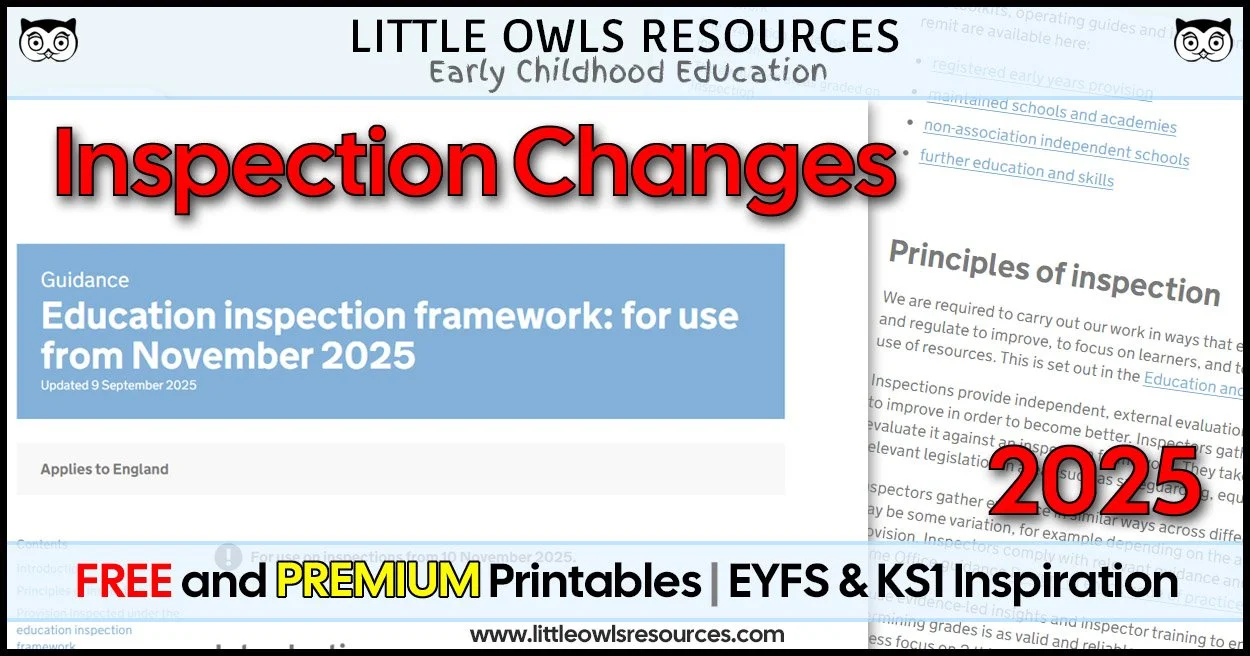
New Education Inspection Framework | What EYFS Settings Need to Know

The world of early years education is constantly evolving, and with it, the frameworks that guide and assess our invaluable work. Come November 2025, a significant shift will occur as the new Education Inspection Framework (EIF) comes into effect, bringing with it some crucial changes…

Read More →
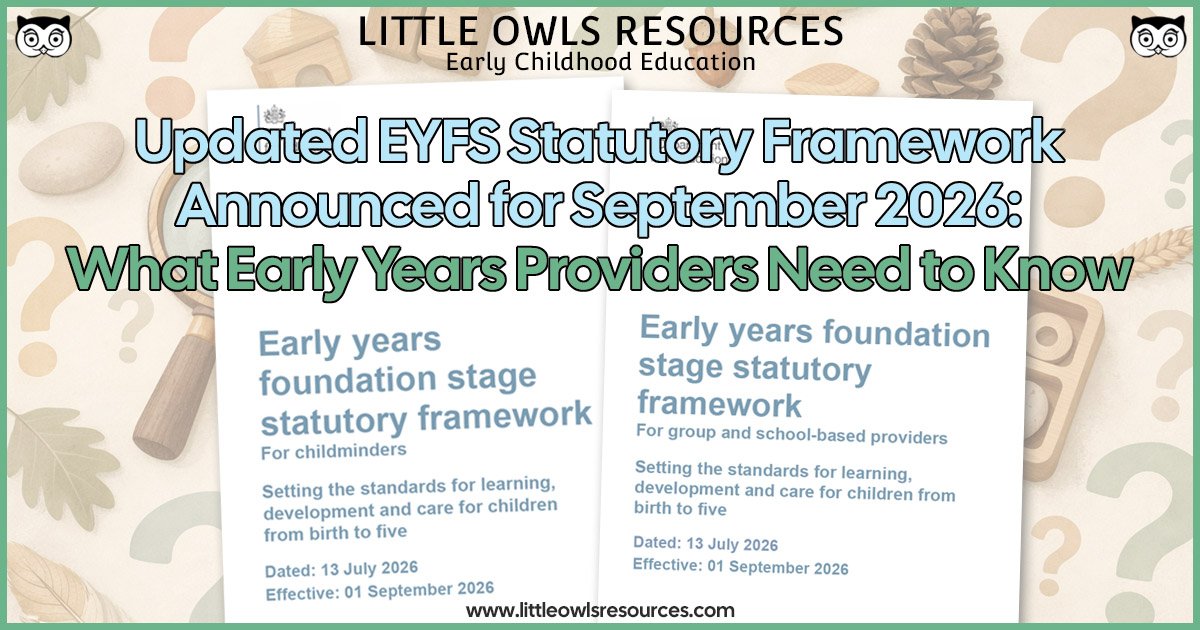
Revised 2025 EYFS Statutory Framework for Group & School-Based Providers | What You Need to Know

With the new 2025 EYFS Statutory Framework for group and school-based providers coming into effect on 1st September 2025, it's essential to understand the updates to ensure your practice remains compliant, effective…

Read More →
DfE Press Release | Parents urged to read more to boost children’s life chances

The Education Secretary is calling on parents to lead by example and make reading a daily habit to help reverse the decline in reading for pleasure, to help give kids the best start in life as part of the…

Read More →
DfE Update | Drowning Prevention Week: what children learn about water safety at school

As we head into summer, it’s especially important that children are prepared with these skills. This year, the Royal Life Saving Society UK's Drowning Prevention Week runs from 14 June to 21…

Read More →
DfE Update | Hot weather and heatwaves: guidance for schools and other education settings

There are several ways that schools can make changes to keep children safe in hot weather, especially as children are more at risk of becoming ill with heat-related issues than adults…

Read More →

Are you looking for a specific resource or document for your provision?

Use our 🔍 Search Bar located at the top of every page.

___________________________

Content within the EYFS Curriculum & Pedagogy Membership is provided as professional guidance and support. It reflects current understanding of the EYFS statutory framework, Development Matters and inspection expectations at the time of writing. Practitioners are responsible for applying professional judgement and ensuring practice aligns with current statutory requirements and their specific context. All resources, experiences and environment arrangements must be risk assessed by the setting and used in accordance with individual children’s developmental stages, needs and supervision requirements.

Safeguarding content does not replace a setting’s safeguarding and child protection policy or the statutory role of the Designated Safeguarding Lead (DSL). All concerns must be managed in line with current statutory guidance and local safeguarding procedures.

_____________________________

 
In -R1, Reception | 4-5 Years Tags About Our Reception Curriculum Phase Framework | 4-5 Years, Reception

About Our Reception Curriculum Phase Framework | 4-5 Years (Copy)

January 18, 2026 Stuart Murphy

Home › EYFS Curriculum & Pedagogy › Reception Curriculum & Pedagogy › About Our Reception Curriculum Phase Framework | 4-5 Years

Scroll down to read this document or download files here: DOCX 📝 | PDF 📄

(This pathway component is currently available to read on the page below and will be available for download by: March 31st 2026)

About Our Reception Curriculum Phase Framework

A professional guidance document explaining the rationale and structure behind our phase-based approach to Reception curriculum design.

Purpose of This Document

This document explains the rationale, structure and pedagogical intent behind our Reception Curriculum Phase Framework.

It is designed to help practitioners and leaders understand:

  • why the Reception curriculum is organised into phases

  • how the phases reflect how children develop and learn across the year

  • how this approach supports both EYFS principles and statutory expectations

  • how the framework differs from Preschool and Year 1 models

This document should be read alongside:

  • Reception Curriculum Overview & Rationale

  • Reception Pedagogy Position Statement

  • Reception Curriculum Phase Framework

  • How To Use the Reception Curriculum Phase Pack

Why a Phase-Based Framework in Reception?

Reception is a unique year:

  • the final year of the EYFS

  • a statutory assessment year

  • a bridge between early childhood and formal schooling

Children’s development in Reception does not progress neatly by:

  • topics

  • half terms

  • isolated subject blocks

Instead, progress is best supported through overlapping phases of development, where:

  • independence increases gradually

  • application deepens over time

  • expectations are raised responsively, not abruptly

A phase-based framework:

  • reflects how children actually learn

  • supports depth rather than pace

  • avoids artificial “termly jumps” in expectations

How This Differs from Preschool

In Preschool:

  • curriculum focus is broader and more exploratory

  • progression is more flexible and experience-led

  • adult-led teaching is lighter and shorter

In Reception:

  • curriculum intent is clearer and more explicit

  • phonics, maths and writing are taught systematically

  • children are expected to apply learning independently

  • assessment expectations increase

The Phase Framework allows for:

  • increased rigour without abandoning EYFS pedagogy

  • purposeful repetition and consolidation

  • a gradual shift in responsibility from adult to child

How This Differs from Year 1

Reception is not Year 1.

This framework explicitly avoids:

  • subject-heavy timetables

  • reduced play opportunities

  • premature formalisation

  • expectation of sustained written outcomes

Instead:

  • play remains central for application

  • adult-led teaching remains short and focused

  • provision continues to be carefully planned and resourced

  • physical, social and emotional development remain priorities

The final phase supports transition without rushing children.

Overview of the Reception Curriculum Phases

The Reception year is organised into four overlapping phases:

Phase 1: Settling & Foundations

Focus:

  • emotional security and belonging

  • routines and expectations

  • baseline observation and understanding children

  • foundational skills in communication, PSED and physical development

Teaching is:

  • highly supportive

  • routine-based

  • focused on modelling and relationships

Phase 2: Exploration & Early Application

Focus:

  • introducing and embedding core teaching routines

  • early phonics, maths and writing application

  • exploration of provision with increasing independence

Teaching is:

  • systematic but flexible

  • closely linked to provision

  • supported by adult-guided learning

Phase 3: Independence & Depth

Focus:

  • independent application of taught skills

  • deeper engagement and sustained learning

  • increasing reasoning, problem-solving and explanation

Teaching is:

  • responsive

  • focused on consolidation and depth

  • supported by targeted intervention where needed

Phase 4: Consolidation & Transition

Focus:

  • securing core learning

  • applying skills across contexts

  • building confidence and learning stamina

  • preparing for Year 1 expectations

Teaching:

  • maintains EYFS principles

  • supports gradual transition

  • avoids sudden changes in pedagogy

How the Phases Work in Practice

The phases:

  • are not fixed dates or rigid blocks

  • overlap and flex based on cohort needs

  • support professional judgement

Children:

  • may move through phases at different rates

  • may show characteristics of multiple phases at once

Planning:

  • is informed by observation

  • responds to learning needs

  • avoids “coverage-driven” approaches

Relationship to Assessment and EYFSP

The Phase Framework:

  • supports ongoing formative assessment

  • helps practitioners recognise progress over time

  • aligns with best-fit EYFSP judgement

It does not:

  • map phases directly to ELGs

  • treat ELGs as termly targets

  • reduce learning to checklists

Assessment remains:

  • holistic

  • observation-led

  • grounded in everyday learning

Leadership and Inspection Readiness

This framework supports leaders to:

  • articulate clear curriculum intent

  • explain progression across the year

  • demonstrate ambitious but appropriate expectations

  • justify play-based and adult-guided learning

It aligns with Ofsted expectations that:

  • curriculum is coherently planned and sequenced

  • teaching builds knowledge and skills over time

  • early years pedagogy is understood and defended

Summary

Our Reception Curriculum Phase Framework:

  • reflects how children develop and learn

  • balances play with purposeful teaching

  • supports depth, independence and confidence

  • protects EYFS principles

  • prepares children for Year 1 without rushing

It provides a clear, flexible structure that supports high-quality Reception practice across the year.


Document Updated: January 2026

Download Document Here:

(This pathway component is currently available to read on the page above and will be available for download by: March 31st 2026)

 
Download DOCX 📝
Download PDF 📄


Recommended next read Selection

EYFS
Reception Curriculum Phase Framework | 4-5 Years

A structured, phase-based approach to medium-term curriculum planning in Reception, supporting progression, depth and developmentally appropriate practice across the year.

Read More →
Reception Curriculum Progression Maps Toolkit | 4-5 Years

A comprehensive professional toolkit outlining learning progression across the Reception year, aligned with the EYFS framework and EYFSP expectations.

Read More →
Why Themes Are Optional in Reception | 4-5 Years

A professional leadership guidance document explaining the role of themes within a coherent, curriculum-led Reception approach.

Read More →
How to Use the Reception Pathway | 4-5 Years

This document is designed to help practitioners and leaders understand how to navigate and use the Reception Pathway effectively.

Read More →
About Our Reception Curriculum Phase Framework | 4-5 Years

A professional guidance document explaining the rationale and structure behind our phase-based approach to Reception curriculum design.

Read More →
Reception Curriculum Overview & Rationale | 4-5 Years

Reception Year | Ages 4–5

Read More →
Reception Pedagogy Position Statement | 4-5 Years

How Children Learn in Reception (4–5 Years)

Read More →

Professional Membership Contents (Reception 4-5 Years)

Below you will find listed the component documents of our ‘Reception Curriculum & Pedagogy Suite’. They are separated into Strands 1-10. You do not need to use everything all at once.

  • 👉 This section is essential for alignment.

    • Reception Curriculum Overview & Rationale [Free Orienting Sample]

    • Reception Pedagogy Position Statement [Free Orienting Sample]

    • About Our Reception Curriculum Phase Framework

    • How To Use The Reception Pathway

    • Why Themes Are Optional in Reception

  • 👉 Curriculum clarity and sequencing.

    • Reception Curriculum Progression Maps (all areas of learning)

      • Guide to Learning Progression: How to Use the Reception Curriculum Progression Maps

      • Progression Maps for:

        • Communication and Language

        • Personal, Social and Emotional Development

        • Physical Development

        • Literacy

        • Mathematics

        • Understanding the World

        • Expressive Arts and Design

    • Reception Curriculum Phase Framework

      • How To Use The Reception Curriculum Phase Pack

      • Phase 1: Settling & Foundations

      • Phase 2: Exploration & Early Application

      • Phase 3: Independence & Depth

      • Phase 4: Consolidation & Transition

  • 👉 OAP as the organising principle.

    • Reception OAP Cycle Guidance

    • Reception Collaborative Planning & Reflective Sheet Pack

    • Self-Regulation & Learning Behaviours in Reception

    • Reception Baseline Assessment (RBA)

    • Characteristics of Effective Learning in Reception

  • 👉 Stable, purposeful provision.

    • Reception Continuous Provision – Structure & Rationale

    • Universal Continuous Provision Pack (Areas listed below)

      • Construction

      • Creative

      • Investigation / Discovery

      • Maths

      • Reading

      • Role Play / Small World

      • Malleable / Sensory

      • Writing

    • Outdoor Continuous Provision (Reception)

    • Adult-Guided Learning in Provision

    • Reception Labelling Pack | 4-5 Years

  • 👉 Light-touch, application-focused.

    • Reception Enhanced Provision Planning Toolkit

    • Reception Optional Themed Enhancements - Idea Banks

  • 👉 Systematic teaching without Year 1 drift.

    Phonics (Scheme-Compatible)

    • Phonics in Reception: Teaching, Application & Inclusion

      • Pedagogy

      • Adult-Led Sessions

      • Phonics in Provision

      • Supporting Children Not Keeping Up

      • Phonics & EYFSP

      • Scheme Compatibility Statement

    Maths

    • Reception Maths Teaching Framework

      • Term by Tem Maths Concept Emphasis Map

      • Maths Adult-Led Mini Session Banks (9 Banks)

      • Maths Across the Curriculum & Provision

      • Maths & EYFSP Guidance

    Writing

    • Reception Early Writing Purpose Pack

      • Writing Adult-Led Mini Session Bank (12 Sessions)

    • Fine Motor & Physical Development

      • Guidance Surrounding Foundations for Writing in Reception (4–5 Years)

  • 👉 Precision language for application.

    • Adult-Guided Learning in Provision

    • Theme-Based High-Impact Question & Vocabulary Banks

      • Leadership Rationale: Why Questions Differ by Age

    • Five Sentence Stems For Reception Practitioners

  • 👉 Statutory confidence with inclusive practice.

    • EYFSP Interpretation & Assessment Toolkit

      • ELG Unpacking

      • Best-Fit Exemplification

      • Moderation Guidance

    • Reception SEND & Inclusion Toolkit

      • The graduated response (Universal → Targeted → Specialist)

      • Adaptations across phonics, maths & writing

      • Visual Communication Pack

      • Language-first strategies for inclusion

      • Observation, assessment and SEND

      • Collaborative working with families and specialists

      • Referral Preparation — for EHCP pathway

      • Reception APDR Template

      • Leadership and inspection readiness

  • 👉 Leadership assurance.

    • Reception Leadership & Inspection Readiness Pack

      • Curriculum Intent & Implementation Guidance

      • Ofsted Conversation Prompts

  • 👉 Clear communication beyond the classroom.

    • Reception Parent Partnership Pack

    • Reception Transition to Year 1 Pack

Additional Whole-Setting Guidance | for Professional Members

Explore our whole-setting guidance below, including overarching curriculum and pedagogy documents, early years schemas and EYFS setting policies.

    • Little Owls Resources’ Curriculum Intent Statement

    • EYFS from Birth to 5: Curriculum Coherence & Pedagogical Throughline

    • Whole-Setting Curriculum Map (Birth-5): Curriculum Intent & Progression

    • Pedagogy Guidance Document

    • Speech & Language Development - Setting Statement

    • EYFS Inspection-Facing Summaries

  • Early Years Schemas - Practitioner Toolkit | EYFS Birth-5

    ↪ Schema Cards (definition, behaviours, age-related examples, enabling resources)

    ↪ Schema Observation & Responsive Provision Planning Template

    • EYFS Group Setting Policies Pack

      ↪ x 22 Policy Documents

      ↪ Policy Sign-Off and Confirmation Document

      ↪ EYFS Setting Policy Folder Contents List

    • Childminder Setting Policies Pack

      ↪ x 22 Policy Documents

      ↪ Childminder Assistant or Volunteer Policy Sign-Off and Confirmation Document

      ↪ Childminder Policy Folder Contents List

  • EYFS Glossary

    ↪ Clear, practitioner-friendly explanations of key curriculum and pedagogy terms used throughout our guidance.

Looking for a different age group pathway?

Select the pathway that best reflects your role or the age group you work with. You do not need to use everything. (Some practitioners may use more than one pathway.)

Featured
🍼 Babies (0–18 months)

Responsive care, observation and development in the earliest years

🚼 Toddlers (18–36 months)

Development, play and progression in the toddler years

🎨 Preschool (3–4 years)

Curriculum, continuous provision and purposeful teaching

🎓 Reception (4–5 years)

Play-based pedagogy, progression and EYFSP readiness

🏡 Childminders (Birth–5)

Mixed-age pedagogy, planning without overload and inspection confidence

Latest EYFS Articles & Practical Guides | From Our Blog

Stay informed, get expert advice, and find inspiration from our collection of articles and useful external resources, tailored specifically for EYFS practitioners. We regularly publish in-depth articles to support you with current best practices, regulatory changes, and fresh ideas.
EYFS & KS1 Articles
Major UK Curriculum Shake-Up Announced: What EYFS & KS1 Practitioners Need to Know

A major overhaul of the national curriculum in England has been announced following the publication of the independent Curriculum and Assessment Review. For those working in the Early Years Foundation Stage (EYFS) and Key Stage 1 (KS1), the changes signal a renewed focus on practical life skills, digital literacy, and enriching learning experiences…

Read More →
New Education Inspection Framework | What EYFS Settings Need to Know

The world of early years education is constantly evolving, and with it, the frameworks that guide and assess our invaluable work. Come November 2025, a significant shift will occur as the new Education Inspection Framework (EIF) comes into effect, bringing with it some crucial changes…

Read More →
Revised 2025 EYFS Statutory Framework for Group & School-Based Providers | What You Need to Know

With the new 2025 EYFS Statutory Framework for group and school-based providers coming into effect on 1st September 2025, it's essential to understand the updates to ensure your practice remains compliant, effective…

Read More →
DfE Press Release | Parents urged to read more to boost children’s life chances

The Education Secretary is calling on parents to lead by example and make reading a daily habit to help reverse the decline in reading for pleasure, to help give kids the best start in life as part of the…

Read More →
DfE Update | Drowning Prevention Week: what children learn about water safety at school

As we head into summer, it’s especially important that children are prepared with these skills. This year, the Royal Life Saving Society UK's Drowning Prevention Week runs from 14 June to 21…

Read More →
DfE Update | Hot weather and heatwaves: guidance for schools and other education settings

There are several ways that schools can make changes to keep children safe in hot weather, especially as children are more at risk of becoming ill with heat-related issues than adults…

Read More →

Are you looking for a specific resource or document for your provision?

Use our 🔍 Search Bar located at the top of every page.

___________________________

Content within the EYFS Curriculum & Pedagogy Membership is provided as professional guidance and support. It reflects current understanding of the EYFS statutory framework, Development Matters and inspection expectations at the time of writing. Practitioners are responsible for applying professional judgement and ensuring practice aligns with current statutory requirements and their specific context. All resources, experiences and environment arrangements must be risk assessed by the setting and used in accordance with individual children’s developmental stages, needs and supervision requirements.

Safeguarding content does not replace a setting’s safeguarding and child protection policy or the statutory role of the Designated Safeguarding Lead (DSL). All concerns must be managed in line with current statutory guidance and local safeguarding procedures.

_____________________________

 
In -R1, Reception | 4-5 Years Tags About Our Reception Curriculum Phase Framework | 4-5 Years, Reception

Transition to Reception Pack | Preschool (3–4 Years) → Reception

January 18, 2026 Stuart Murphy

Home › EYFS Curriculum & Pedagogy › Preschool Curriculum & Pedagogy › Transition to Reception Pack | Preschool (3–4 Years) → Reception


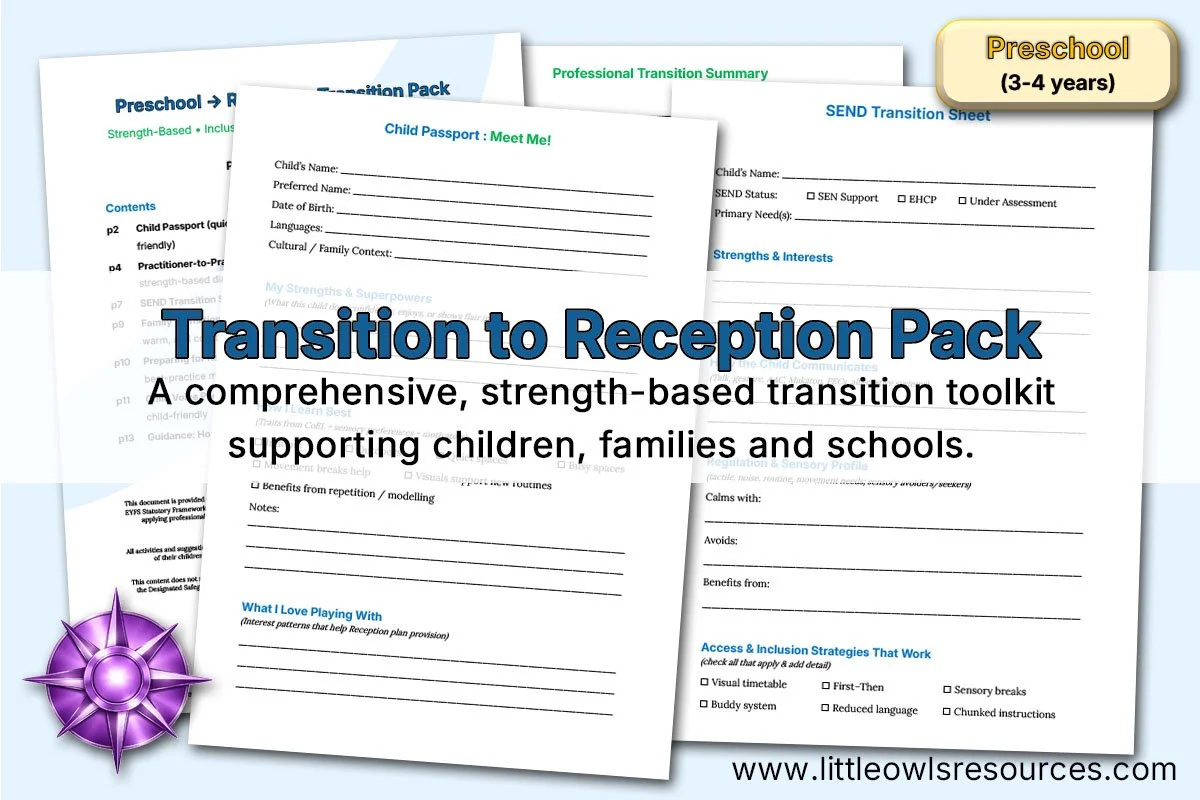
Transition to Reception Pack

Preschool (3–4 Years) → Reception

A comprehensive, strength-based transition toolkit supporting children, families and schools.

Download Document Here:

(This pathway component will be available for download by: March 31st 2026)

 
Download DOCX 📝
Download PDF 📄
 

Document Updated: January 2026


Recommended next read Selection

EYFS
Transition to Reception Pack | Preschool (3–4 Years) → Reception

A comprehensive, strength-based transition toolkit supporting children, families and schools.

Read More →
Strength-Based Reports & Transition Templates | Preschool (3–4 Years)

A professional reporting toolkit supporting meaningful communication with families and smooth transition to school.

Read More →
Progress Review (3–4 Years) | Non-Statutory Practitioner & Parent Summary

A strength-based progress review supporting meaningful partnership with families in preschool.

Read More →
Observe → Assess → Plan Toolkit | Preschool (3–4 Years)

A practical professional toolkit supporting responsive EYFS practice without over-planning.

Read More →
Our Preschool Curriculum (Age 3–4) | Parent-Facing Document (Overview)

What your child will learn during their Preschool year

Read More →
 

Additional Documents | Professional Membership Contents (Preschool 3-4 Years)

Navigate our Curriculum & Pedagogy guidance documents here.

Pedagogical identity:
Broad, play-based, theme-led curriculum with purposeful adult input and strong continuous provision.

  • 👉 Pre-planning orientation.

    • Preschool Pedagogy Position Statement

    • Preschool Curriculum Overview & Rationale

    • Curriculum Overview: How Themes Fit Together (6 Main + 8 Mini)

    • What Child-Led Does Not Mean

    • Adult-Led With Purpose in Preschool

  • 👉 Big-picture curriculum intent and progression.

    • Preschool Curriculum Map (By Term)

    • Skills Progression Ladders (3–4 Years) - Including Practitioner Guidance

      ↪ Communication & Language

      ↪ Early Reading (Phase 1 Readiness)

      ↪ Early Writing

      ↪ Early Maths - Subitising, Counting & Comparing

      ↪ Early Maths - Pattern, Shape & Spatial Awareness

      ↪ PSED - Self-Regulation & Relationships

      ↪ Fine Motor & Hand Control

    • Strength-Based Progress Overview

    • Our Preschool Curriculum Intent, Implementation & Impact - OFSTED Conversation Statement

  • 👉 Theme-led planning lives here.

    • Curriculum Overview | How Themes Fit Together

    • Preschool Theme Packs – FAQs

    • How Practitioners Use This Curriculum Daily

    Core Preschool Themes (6 Weeks Each)

    • ‍Autumn 1: This Is Me

    • Autumn 2: Who Helps When…?

    • Spring 1: Journeys & Transport

    • Spring 2: Animals & Habitats

    • Summer 1: Growing & Changing

    • Summer 2: Water World

    Optional Mini-Themes (1–2 Weeks)

    • Space

    • Dinosaurs & the Mystery Egg

    • Pets & Vets

    • Building & Construction

    • Traditional Tales

    • Beaches & Coastlines

    • Healthy Bodies & Wellbeing

    • Celebrations Around the World

  • 👉 The engine room of daily practice.

    • Universal Continuous Provision Packs (Preschool | 3–4 Years)

      • Construction Area

      • Small World Area

      • Role-Play Area

      • Writing / Mark-Making Area

      • Maths Area

      • Creative Area (Art & Making)

      • Investigation / STEM / Discovery Area

      • Book Corner / Reading Den

      • Fine Motor Station

      • Water Area

      • Sand Area

      • Snack Area / Independence Station

      • Outdoor Provision Core Zones

        • Physical play

        • Gross motor skills

        • Nature area

        • Outdoor mark-making

        • Outdoor maths

    • Preschool Environment & Provision Map Audit Pack

    • How Continuous Provision Works in Our Preschool Curriculum

    • Continuous Provision Audit Checklist

    • Continuous Provision FAQs (For Preschool Practitioners)

  • 👉 Purposeful adult input without formalisation.

    Early Reading & Phonics

    • Phonics & Early Reading Pack

    • Phase 1, Vocabulary & Early Comprehension, Curriculum System (24 Sessions)

      • 8 themed sets covering all aspects of Phase 1

      • 24 mini session plans

      • Vocabulary & story-building scaffolds

      • Outdoor phonological play ideas

      • SEND & EAL accessible sessions

      • Theme-linked sessions (Transport, Animals, Growth)

      • Assessment & observation prompts

      • Continuous Provision follow-up suggestions

    • Adult-Led Session Templates

    • Practitioner FAQs

    Maths

    • Maths Small Group Session Bank (24 Sessions)

      • Strand A - Subitising (Sessions 1-4)

      • Strand B - Counting Principles (Sessions 5-8)

      • Strand C - Comparing Quantites (Sessions 9-12)

      • Strand D - Composition of Number (Sessions 13-16)

      • Strand E - Spatial & Shape (Sessions 17-20)

      • Strand F - Measures & Pattern (Sessions 21-24)

    • How To Use Our Maths Session Bank & Strand Overview (A–F)

    • Adult-Led Session Templates

    • Practitioner FAQs

    Writing & Fine Motor

    • Fine Motor & Mark Making Mini Sessions (18)

      • How To Use Our Fine Motor & Mark Making Mini Sessions Bank

      • Strand A - Core & Shoulder Stability (Sessions 1-3)

      • Strand B - Wrist Rotation & Fluidity (Sessions 4-6)

      • Strand C - Pincer, Pinch & Tool Control (Sessions 7-10)

      • Strand D - Early Pattern Making: Pre-Writing Shapes (Sessions 11-18)

    • Early Writing Purpose Mini Sessions (6)

      • How To Use Our Early Writing Purpose Mini Sessions Bank

      • Lists

      • Labels

      • Messages

      • Maps

      • Signs

      • Tickets & Recipes

    • How These Two Session Banks Are Designed To Work Together

  • 👉 High-impact interaction guidance.

    • How We Talk to Children

    • Five Sentence Stems For Preschool Practitioners

    • If Interest Sparks — What Happens Next?

    • Preschool Staff Guidance Posters

  • 👉 Practical planning support.

    • Weekly Planning Templates (2 Versions)

    • How to Use the Preschool Weekly Planning Templates: Guide

    • Adult-Led Session Planning Templates Pack

      • Universal

      • Phonics / Early Language Focus (Listening → Rhyme → Sound Awareness)

      • Maths Focus (Number + Pattern + Shape + Measure)

      • Story & Book Talk Focus (Comprehension → Retell → Vocabulary → Prediction)

      • PSED / Self-Regulation Small Group

  • 👉 Proportionate, non-statutory assessment.

    • Observe–Assess–Plan (OAP) Toolkit - Preschool

    • Assessment Dashboard Pack (3 Versions)

      • Prime Areas Only Dashboard (Communication & Language, PSED, Physical)

      • Full EYFS Areas Dashboard (Prime + Specific)

      • Dashboard with Wellbeing & Involvement Scale (Leuven-inspired 1–5 ratings)

    • Progress Review (3–4 Years)

      • Short & Long Versions

      • Guidance - How To Complete And Share With Families

    • Preschool Report Pack

      • End of Term Template

      • End of Year Template

      • Guidance - How To Write Strength-Based Reports

      • Sentence Starters Bank

  • 👉 Parent Engagement plus Emotional, environmental and communicative transition.

    • Preschool Transition to Reception Pack

      ↪ Child Passport

      ↪ Practitioner-To-Practitioner Handover Summary

      ↪ SEND Transition Sheet

      ↪ Family Transition Summary Sheet

      ↪ Parent Leaflet — “Preparing For Reception”

      ↪ Child Voice Page

      ↪ Guidance Page— “How To Complete & Share Transition Information”

    • Home & Setting Communication

      ↪ Our Preschool Curriculum (Age 3–4) | Parent-Facing Document

      (Additional parent literature within planning documents.)


Additional Whole-Setting Guidance | for Professional Members

Explore our whole-setting guidance below, including overarching curriculum and pedagogy documents, early years schemas and EYFS setting policies.

    • Little Owls Resources’ Curriculum Intent Statement

    • EYFS from Birth to 5: Curriculum Coherence & Pedagogical Throughline

    • Whole-Setting Curriculum Map (Birth-5): Curriculum Intent & Progression

    • Pedagogy Guidance Document

    • Speech & Language Development - Setting Statement

    • EYFS Inspection-Facing Summaries

  • Early Years Schemas - Practitioner Toolkit | EYFS Birth-5

    ↪ Schema Cards (definition, behaviours, age-related examples, enabling resources)

    ↪ Schema Observation & Responsive Provision Planning Template

    • EYFS Group Setting Policies Pack

      ↪ x 22 Policy Documents

      ↪ Policy Sign-Off and Confirmation Document

      ↪ EYFS Setting Policy Folder Contents List

    • Childminder Setting Policies Pack

      ↪ x 22 Policy Documents

      ↪ Childminder Assistant or Volunteer Policy Sign-Off and Confirmation Document

      ↪ Childminder Policy Folder Contents List

  • EYFS Glossary

    ↪ Clear, practitioner-friendly explanations of key curriculum and pedagogy terms used throughout our guidance.


Looking for a different age-group pathway?

Select the pathway that best reflects your role or the age group you work with. You do not need to use everything. (Some practitioners may use more than one pathway.)

Featured
🍼 Babies (0–18 months)

Responsive care, observation and development in the earliest years

🚼 Toddlers (18–36 months)

Development, play and progression in the toddler years

🎨 Preschool (3–4 years)

Curriculum, continuous provision and purposeful teaching

🎓 Reception (4–5 years)

Play-based pedagogy, progression and EYFSP readiness

🏡 Childminders (Birth–5)

Mixed-age pedagogy, planning without overload and inspection confidence


Latest EYFS Articles & Practical Guides | From Our Blog

Stay informed, get expert advice, and find inspiration from our collection of articles and useful external resources, tailored specifically for EYFS practitioners. We regularly publish in-depth articles to support you with current best practices, regulatory changes, and fresh ideas.

EYFS & KS1 Articles
Major UK Curriculum Shake-Up Announced: What EYFS & KS1 Practitioners Need to Know

A major overhaul of the national curriculum in England has been announced following the publication of the independent Curriculum and Assessment Review. For those working in the Early Years Foundation Stage (EYFS) and Key Stage 1 (KS1), the changes signal a renewed focus on practical life skills, digital literacy, and enriching learning experiences…

Read More →
New Education Inspection Framework | What EYFS Settings Need to Know

The world of early years education is constantly evolving, and with it, the frameworks that guide and assess our invaluable work. Come November 2025, a significant shift will occur as the new Education Inspection Framework (EIF) comes into effect, bringing with it some crucial changes…

Read More →
Revised 2025 EYFS Statutory Framework for Group & School-Based Providers | What You Need to Know

With the new 2025 EYFS Statutory Framework for group and school-based providers coming into effect on 1st September 2025, it's essential to understand the updates to ensure your practice remains compliant, effective…

Read More →
DfE Press Release | Parents urged to read more to boost children’s life chances

The Education Secretary is calling on parents to lead by example and make reading a daily habit to help reverse the decline in reading for pleasure, to help give kids the best start in life as part of the…

Read More →
DfE Update | Drowning Prevention Week: what children learn about water safety at school

As we head into summer, it’s especially important that children are prepared with these skills. This year, the Royal Life Saving Society UK's Drowning Prevention Week runs from 14 June to 21…

Read More →
DfE Update | Hot weather and heatwaves: guidance for schools and other education settings

There are several ways that schools can make changes to keep children safe in hot weather, especially as children are more at risk of becoming ill with heat-related issues than adults…

Read More →
 

Are you looking for a specific resource or document for your provision?

Use our 🔍 SEARCH Bar located at the top of every page.


Content within the EYFS Curriculum & Pedagogy Membership is provided as professional guidance and support. It reflects current understanding of the EYFS statutory framework, Development Matters and inspection expectations at the time of writing. Practitioners are responsible for applying professional judgement and ensuring practice aligns with current statutory requirements and their specific context.

Updated: January 2026

 
In Preschool | 3-4 Years, -P8, Reception | 4-5 Years, -P9 Tags Preschool, Transition to Reception Pack | Preschool (3–4 Years) → Reception, Reception

Reception Leadership & Inspection Readiness Pack

January 17, 2026 Stuart Murphy

Home › EYFS Curriculum & Pedagogy › Reception Curriculum & Pedagogy › Reception Leadership & Inspection Readiness Pack

Reception Leadership & Inspection Readiness Pack

Reception (4–5 Years)

Strategic guidance for leading high-quality, inspection-secure Reception practice with confidence and integrity

Download Document Here:

(This pathway component will be available for download by: March 31st 2026)

 
Download DOCX 📝
Download PDF 📄
 

Document Updated: January 2026

Recommended next read Selection

EYFS
Reception Leadership & Inspection Readiness Pack

Strategic guidance for leading high-quality, inspection-secure Reception practice with confidence and integrity.

Read More →
Reception SEND & Inclusion Toolkit | 4-5 Years

Extensive SEND & Inclusion pack specifically designed for use within Reception.

Read More →
EYFSP Interpretation & Assessment Toolkit | Reception (4-5 Years)

A professional guidance pack supporting accurate, confident and workload-proportionate EYFSP practice in Reception.

Read More →
Reception Labelling Pack | 4-5 Years

Labelling pack designed specifically for the reception environment.

Read More →
Adult-Guided Learning in Provision | Reception (4-5 Years)

A professional guidance document explaining how intentional adult interaction supports learning, application and inclusion within child-initiated play in Reception.

Read More →
Outdoor Area Continuous Provision | Reception 4–5 Years

A professional guidance document outlining the purpose, structure and pedagogy of outdoor continuous provision in Reception.

Read More →
Universal Continuous Provision Pack | Reception 4–5 Years

A comprehensive set of professional guidance documents supporting high-quality, purposeful continuous provision across all key areas of the Reception environment.

Read More →
Reception Universal Continuous Provision: Structure & Rationale

A professional guidance document outlining how continuous provision is designed, structured and used to support learning, progression and independence in Reception.

Read More →
Why Themes Are Optional in Reception | 4-5 Years

A professional leadership guidance document explaining the role of themes within a coherent, curriculum-led Reception approach.

Read More →
How to Use the Reception Pathway | 4-5 Years

This document is designed to help practitioners and leaders understand how to navigate and use the Reception Pathway effectively.

Read More →
About Our Reception Curriculum Phase Framework | 4-5 Years

A professional guidance document explaining the rationale and structure behind our phase-based approach to Reception curriculum design.

Read More →
Reception Curriculum Overview & Rationale | 4-5 Years

Reception Year | Ages 4–5

Read More →
Reception Pedagogy Position Statement | 4-5 Years

How Children Learn in Reception (4–5 Years)

Read More →

Professional Membership Contents (Reception 4-5 Years)

Below you will find listed the component documents of our ‘Reception Curriculum & Pedagogy Suite’. They are separated into Strands 1-10. You do not need to use everything all at once.

  • 👉 This section is essential for alignment.

    • Reception Curriculum Overview & Rationale [Free Orienting Sample]

    • Reception Pedagogy Position Statement [Free Orienting Sample]

    • About Our Reception Curriculum Phase Framework

    • How To Use The Reception Pathway

    • Why Themes Are Optional in Reception

  • 👉 Curriculum clarity and sequencing.

    • Reception Curriculum Progression Maps (all areas of learning)

      • Guide to Learning Progression: How to Use the Reception Curriculum Progression Maps

      • Progression Maps for:

        • Communication and Language

        • Personal, Social and Emotional Development

        • Physical Development

        • Literacy

        • Mathematics

        • Understanding the World

        • Expressive Arts and Design

    • Reception Curriculum Phase Framework

      • How To Use The Reception Curriculum Phase Pack

      • Phase 1: Settling & Foundations

      • Phase 2: Exploration & Early Application

      • Phase 3: Independence & Depth

      • Phase 4: Consolidation & Transition

  • 👉 OAP as the organising principle.

    • Reception OAP Cycle Guidance

    • Reception Collaborative Planning & Reflective Sheet Pack

    • Self-Regulation & Learning Behaviours in Reception

    • Reception Baseline Assessment (RBA)

    • Characteristics of Effective Learning in Reception

  • 👉 Stable, purposeful provision.

    • Reception Continuous Provision – Structure & Rationale

    • Universal Continuous Provision Pack (Areas listed below)

      • Construction

      • Creative

      • Investigation / Discovery

      • Maths

      • Reading

      • Role Play / Small World

      • Malleable / Sensory

      • Writing

    • Outdoor Continuous Provision (Reception)

    • Adult-Guided Learning in Provision

    • Reception Labelling Pack | 4-5 Years

  • 👉 Light-touch, application-focused.

    • Reception Enhanced Provision Planning Toolkit

    • Reception Optional Themed Enhancements - Idea Banks

  • 👉 Systematic teaching without Year 1 drift.

    Phonics (Scheme-Compatible)

    • Phonics in Reception: Teaching, Application & Inclusion

      • Pedagogy

      • Adult-Led Sessions

      • Phonics in Provision

      • Supporting Children Not Keeping Up

      • Phonics & EYFSP

      • Scheme Compatibility Statement

    Maths

    • Reception Maths Teaching Framework

      • Term by Tem Maths Concept Emphasis Map

      • Maths Adult-Led Mini Session Banks (9 Banks)

      • Maths Across the Curriculum & Provision

      • Maths & EYFSP Guidance

    Writing

    • Reception Early Writing Purpose Pack

      • Writing Adult-Led Mini Session Bank (12 Sessions)

    • Fine Motor & Physical Development

      • Guidance Surrounding Foundations for Writing in Reception (4–5 Years)

  • 👉 Precision language for application.

    • Adult-Guided Learning in Provision

    • Theme-Based High-Impact Question & Vocabulary Banks

      • Leadership Rationale: Why Questions Differ by Age

    • Five Sentence Stems For Reception Practitioners

  • 👉 Statutory confidence with inclusive practice.

    • EYFSP Interpretation & Assessment Toolkit

      • ELG Unpacking

      • Best-Fit Exemplification

      • Moderation Guidance

    • Reception SEND & Inclusion Toolkit

      • The graduated response (Universal → Targeted → Specialist)

      • Adaptations across phonics, maths & writing

      • Visual Communication Pack

      • Language-first strategies for inclusion

      • Observation, assessment and SEND

      • Collaborative working with families and specialists

      • Referral Preparation — for EHCP pathway

      • Reception APDR Template

      • Leadership and inspection readiness

  • 👉 Leadership assurance.

    • Reception Leadership & Inspection Readiness Pack

      • Curriculum Intent & Implementation Guidance

      • Ofsted Conversation Prompts

  • 👉 Clear communication beyond the classroom.

    • Reception Parent Partnership Pack

    • Reception Transition to Year 1 Pack

Additional Whole-Setting Guidance | for Professional Members

Explore our whole-setting guidance below, including overarching curriculum and pedagogy documents, early years schemas and EYFS setting policies.

    • Little Owls Resources’ Curriculum Intent Statement

    • EYFS from Birth to 5: Curriculum Coherence & Pedagogical Throughline

    • Whole-Setting Curriculum Map (Birth-5): Curriculum Intent & Progression

    • Pedagogy Guidance Document

    • Speech & Language Development - Setting Statement

    • EYFS Inspection-Facing Summaries

  • Early Years Schemas - Practitioner Toolkit | EYFS Birth-5

    ↪ Schema Cards (definition, behaviours, age-related examples, enabling resources)

    ↪ Schema Observation & Responsive Provision Planning Template

    • EYFS Group Setting Policies Pack

      ↪ x 22 Policy Documents

      ↪ Policy Sign-Off and Confirmation Document

      ↪ EYFS Setting Policy Folder Contents List

    • Childminder Setting Policies Pack

      ↪ x 22 Policy Documents

      ↪ Childminder Assistant or Volunteer Policy Sign-Off and Confirmation Document

      ↪ Childminder Policy Folder Contents List

  • EYFS Glossary

    ↪ Clear, practitioner-friendly explanations of key curriculum and pedagogy terms used throughout our guidance.

Looking for a different age group pathway?

Select the pathway that best reflects your role or the age group you work with. You do not need to use everything. (Some practitioners may use more than one pathway.)

Featured
🍼 Babies (0–18 months)

Responsive care, observation and development in the earliest years

🚼 Toddlers (18–36 months)

Development, play and progression in the toddler years

🎨 Preschool (3–4 years)

Curriculum, continuous provision and purposeful teaching

🎓 Reception (4–5 years)

Play-based pedagogy, progression and EYFSP readiness

🏡 Childminders (Birth–5)

Mixed-age pedagogy, planning without overload and inspection confidence

Latest EYFS Articles & Practical Guides | From Our Blog

Stay informed, get expert advice, and find inspiration from our collection of articles and useful external resources, tailored specifically for EYFS practitioners. We regularly publish in-depth articles to support you with current best practices, regulatory changes, and fresh ideas.

EYFS & KS1 Articles
Major UK Curriculum Shake-Up Announced: What EYFS & KS1 Practitioners Need to Know

A major overhaul of the national curriculum in England has been announced following the publication of the independent Curriculum and Assessment Review. For those working in the Early Years Foundation Stage (EYFS) and Key Stage 1 (KS1), the changes signal a renewed focus on practical life skills, digital literacy, and enriching learning experiences…

Read More →
New Education Inspection Framework | What EYFS Settings Need to Know

The world of early years education is constantly evolving, and with it, the frameworks that guide and assess our invaluable work. Come November 2025, a significant shift will occur as the new Education Inspection Framework (EIF) comes into effect, bringing with it some crucial changes…

Read More →
Revised 2025 EYFS Statutory Framework for Group & School-Based Providers | What You Need to Know

With the new 2025 EYFS Statutory Framework for group and school-based providers coming into effect on 1st September 2025, it's essential to understand the updates to ensure your practice remains compliant, effective…

Read More →
DfE Press Release | Parents urged to read more to boost children’s life chances

The Education Secretary is calling on parents to lead by example and make reading a daily habit to help reverse the decline in reading for pleasure, to help give kids the best start in life as part of the…

Read More →
DfE Update | Drowning Prevention Week: what children learn about water safety at school

As we head into summer, it’s especially important that children are prepared with these skills. This year, the Royal Life Saving Society UK's Drowning Prevention Week runs from 14 June to 21…

Read More →
DfE Update | Hot weather and heatwaves: guidance for schools and other education settings

There are several ways that schools can make changes to keep children safe in hot weather, especially as children are more at risk of becoming ill with heat-related issues than adults…

Read More →

Are you looking for a specific resource or document for your provision?

Use our 🔍 Search Bar located at the top of every page.

___________________________

Content within the EYFS Curriculum & Pedagogy Membership is provided as professional guidance and support. It reflects current understanding of the EYFS statutory framework, Development Matters and inspection expectations at the time of writing. Practitioners are responsible for applying professional judgement and ensuring practice aligns with current statutory requirements and their specific context. All resources, experiences and environment arrangements must be risk assessed by the setting and used in accordance with individual children’s developmental stages, needs and supervision requirements.

Safeguarding content does not replace a setting’s safeguarding and child protection policy or the statutory role of the Designated Safeguarding Lead (DSL). All concerns must be managed in line with current statutory guidance and local safeguarding procedures.

_____________________________

 
In Reception | 4-5 Years, -R9 Tags Reception, Reception Leadership & Inspection Readiness Pack

Reception Parent Partnership Pack | Reception (4–5 Years)

January 17, 2026 Stuart Murphy

Home › EYFS Curriculum & Pedagogy › Reception Curriculum & Pedagogy › Reception Parent Partnership Pack | Reception (4-5 Years)

Reception Parent Partnership Pack

Reception (4–5 Years)

A parent-friendly guidance pack that explains how children learn in Reception (4–5), what to expect day to day, and how families can support learning at home without pressure.

Download Document Here:

(This pathway component will be available for download by: March 31st 2026)

 
Download DOCX 📝
Download PDF 📄
 

Document Updated: January 2026

Recommended next read Selection

EYFS
Reception Leadership & Inspection Readiness Pack

Strategic guidance for leading high-quality, inspection-secure Reception practice with confidence and integrity.

Read More →
Reception SEND & Inclusion Toolkit | 4-5 Years

Extensive SEND & Inclusion pack specifically designed for use within Reception.

Read More →
EYFSP Interpretation & Assessment Toolkit | Reception (4-5 Years)

A professional guidance pack supporting accurate, confident and workload-proportionate EYFSP practice in Reception.

Read More →
Reception Labelling Pack | 4-5 Years

Labelling pack designed specifically for the reception environment.

Read More →
Adult-Guided Learning in Provision | Reception (4-5 Years)

A professional guidance document explaining how intentional adult interaction supports learning, application and inclusion within child-initiated play in Reception.

Read More →
Outdoor Area Continuous Provision | Reception 4–5 Years

A professional guidance document outlining the purpose, structure and pedagogy of outdoor continuous provision in Reception.

Read More →
Universal Continuous Provision Pack | Reception 4–5 Years

A comprehensive set of professional guidance documents supporting high-quality, purposeful continuous provision across all key areas of the Reception environment.

Read More →
Reception Universal Continuous Provision: Structure & Rationale

A professional guidance document outlining how continuous provision is designed, structured and used to support learning, progression and independence in Reception.

Read More →
Why Themes Are Optional in Reception | 4-5 Years

A professional leadership guidance document explaining the role of themes within a coherent, curriculum-led Reception approach.

Read More →
How to Use the Reception Pathway | 4-5 Years

This document is designed to help practitioners and leaders understand how to navigate and use the Reception Pathway effectively.

Read More →
About Our Reception Curriculum Phase Framework | 4-5 Years

A professional guidance document explaining the rationale and structure behind our phase-based approach to Reception curriculum design.

Read More →
Reception Curriculum Overview & Rationale | 4-5 Years

Reception Year | Ages 4–5

Read More →
Reception Pedagogy Position Statement | 4-5 Years

How Children Learn in Reception (4–5 Years)

Read More →
Reception Parent Partnership Pack | Reception (4-5 Years)

A parent-friendly guidance pack that explains how children learn in Reception (4–5), what to expect day to day, and how families can support learning at home without pressure.

Read More →
Reception → Year 1 Transition Pack

A leadership and practice pack that sets out how to plan a developmentally appropriate transition from Reception into Year 1, protecting EYFS pedagogy while building continuity into KS1.

Read More →

Professional Membership Contents (Reception 4-5 Years)

Below you will find listed the component documents of our ‘Reception Curriculum & Pedagogy Suite’. They are separated into Strands 1-10. You do not need to use everything all at once.

  • 👉 This section is essential for alignment.

    • Reception Curriculum Overview & Rationale [Free Orienting Sample]

    • Reception Pedagogy Position Statement [Free Orienting Sample]

    • About Our Reception Curriculum Phase Framework

    • How To Use The Reception Pathway

    • Why Themes Are Optional in Reception

  • 👉 Curriculum clarity and sequencing.

    • Reception Curriculum Progression Maps (all areas of learning)

      • Guide to Learning Progression: How to Use the Reception Curriculum Progression Maps

      • Progression Maps for:

        • Communication and Language

        • Personal, Social and Emotional Development

        • Physical Development

        • Literacy

        • Mathematics

        • Understanding the World

        • Expressive Arts and Design

    • Reception Curriculum Phase Framework

      • How To Use The Reception Curriculum Phase Pack

      • Phase 1: Settling & Foundations

      • Phase 2: Exploration & Early Application

      • Phase 3: Independence & Depth

      • Phase 4: Consolidation & Transition

  • 👉 OAP as the organising principle.

    • Reception OAP Cycle Guidance

    • Reception Collaborative Planning & Reflective Sheet Pack

    • Self-Regulation & Learning Behaviours in Reception

    • Reception Baseline Assessment (RBA)

    • Characteristics of Effective Learning in Reception

  • 👉 Stable, purposeful provision.

    • Reception Continuous Provision – Structure & Rationale

    • Universal Continuous Provision Pack (Areas listed below)

      • Construction

      • Creative

      • Investigation / Discovery

      • Maths

      • Reading

      • Role Play / Small World

      • Malleable / Sensory

      • Writing

    • Outdoor Continuous Provision (Reception)

    • Adult-Guided Learning in Provision

    • Reception Labelling Pack | 4-5 Years

  • 👉 Light-touch, application-focused.

    • Reception Enhanced Provision Planning Toolkit

    • Reception Optional Themed Enhancements - Idea Banks

  • 👉 Systematic teaching without Year 1 drift.

    Phonics (Scheme-Compatible)

    • Phonics in Reception: Teaching, Application & Inclusion

      • Pedagogy

      • Adult-Led Sessions

      • Phonics in Provision

      • Supporting Children Not Keeping Up

      • Phonics & EYFSP

      • Scheme Compatibility Statement

    Maths

    • Reception Maths Teaching Framework

      • Term by Tem Maths Concept Emphasis Map

      • Maths Adult-Led Mini Session Banks (9 Banks)

      • Maths Across the Curriculum & Provision

      • Maths & EYFSP Guidance

    Writing

    • Reception Early Writing Purpose Pack

      • Writing Adult-Led Mini Session Bank (12 Sessions)

    • Fine Motor & Physical Development

      • Guidance Surrounding Foundations for Writing in Reception (4–5 Years)

  • 👉 Precision language for application.

    • Adult-Guided Learning in Provision

    • Theme-Based High-Impact Question & Vocabulary Banks

      • Leadership Rationale: Why Questions Differ by Age

    • Five Sentence Stems For Reception Practitioners

  • 👉 Statutory confidence with inclusive practice.

    • EYFSP Interpretation & Assessment Toolkit

      • ELG Unpacking

      • Best-Fit Exemplification

      • Moderation Guidance

    • Reception SEND & Inclusion Toolkit

      • The graduated response (Universal → Targeted → Specialist)

      • Adaptations across phonics, maths & writing

      • Visual Communication Pack

      • Language-first strategies for inclusion

      • Observation, assessment and SEND

      • Collaborative working with families and specialists

      • Referral Preparation — for EHCP pathway

      • Reception APDR Template

      • Leadership and inspection readiness

  • 👉 Leadership assurance.

    • Reception Leadership & Inspection Readiness Pack

      • Curriculum Intent & Implementation Guidance

      • Ofsted Conversation Prompts

  • 👉 Clear communication beyond the classroom.

    • Reception Parent Partnership Pack

    • Reception Transition to Year 1 Pack

Additional Whole-Setting Guidance | for Professional Members

Explore our whole-setting guidance below, including overarching curriculum and pedagogy documents, early years schemas and EYFS setting policies.

    • Little Owls Resources’ Curriculum Intent Statement

    • EYFS from Birth to 5: Curriculum Coherence & Pedagogical Throughline

    • Whole-Setting Curriculum Map (Birth-5): Curriculum Intent & Progression

    • Pedagogy Guidance Document

    • Speech & Language Development - Setting Statement

    • EYFS Inspection-Facing Summaries

  • Early Years Schemas - Practitioner Toolkit | EYFS Birth-5

    ↪ Schema Cards (definition, behaviours, age-related examples, enabling resources)

    ↪ Schema Observation & Responsive Provision Planning Template

    • EYFS Group Setting Policies Pack

      ↪ x 22 Policy Documents

      ↪ Policy Sign-Off and Confirmation Document

      ↪ EYFS Setting Policy Folder Contents List

    • Childminder Setting Policies Pack

      ↪ x 22 Policy Documents

      ↪ Childminder Assistant or Volunteer Policy Sign-Off and Confirmation Document

      ↪ Childminder Policy Folder Contents List

  • EYFS Glossary

    ↪ Clear, practitioner-friendly explanations of key curriculum and pedagogy terms used throughout our guidance.

Looking for a different age group pathway?

Select the pathway that best reflects your role or the age group you work with. You do not need to use everything. (Some practitioners may use more than one pathway.)

Featured
🍼 Babies (0–18 months)

Responsive care, observation and development in the earliest years

🚼 Toddlers (18–36 months)

Development, play and progression in the toddler years

🎨 Preschool (3–4 years)

Curriculum, continuous provision and purposeful teaching

🎓 Reception (4–5 years)

Play-based pedagogy, progression and EYFSP readiness

🏡 Childminders (Birth–5)

Mixed-age pedagogy, planning without overload and inspection confidence

Latest EYFS Articles & Practical Guides | From Our Blog

Stay informed, get expert advice, and find inspiration from our collection of articles and useful external resources, tailored specifically for EYFS practitioners. We regularly publish in-depth articles to support you with current best practices, regulatory changes, and fresh ideas.
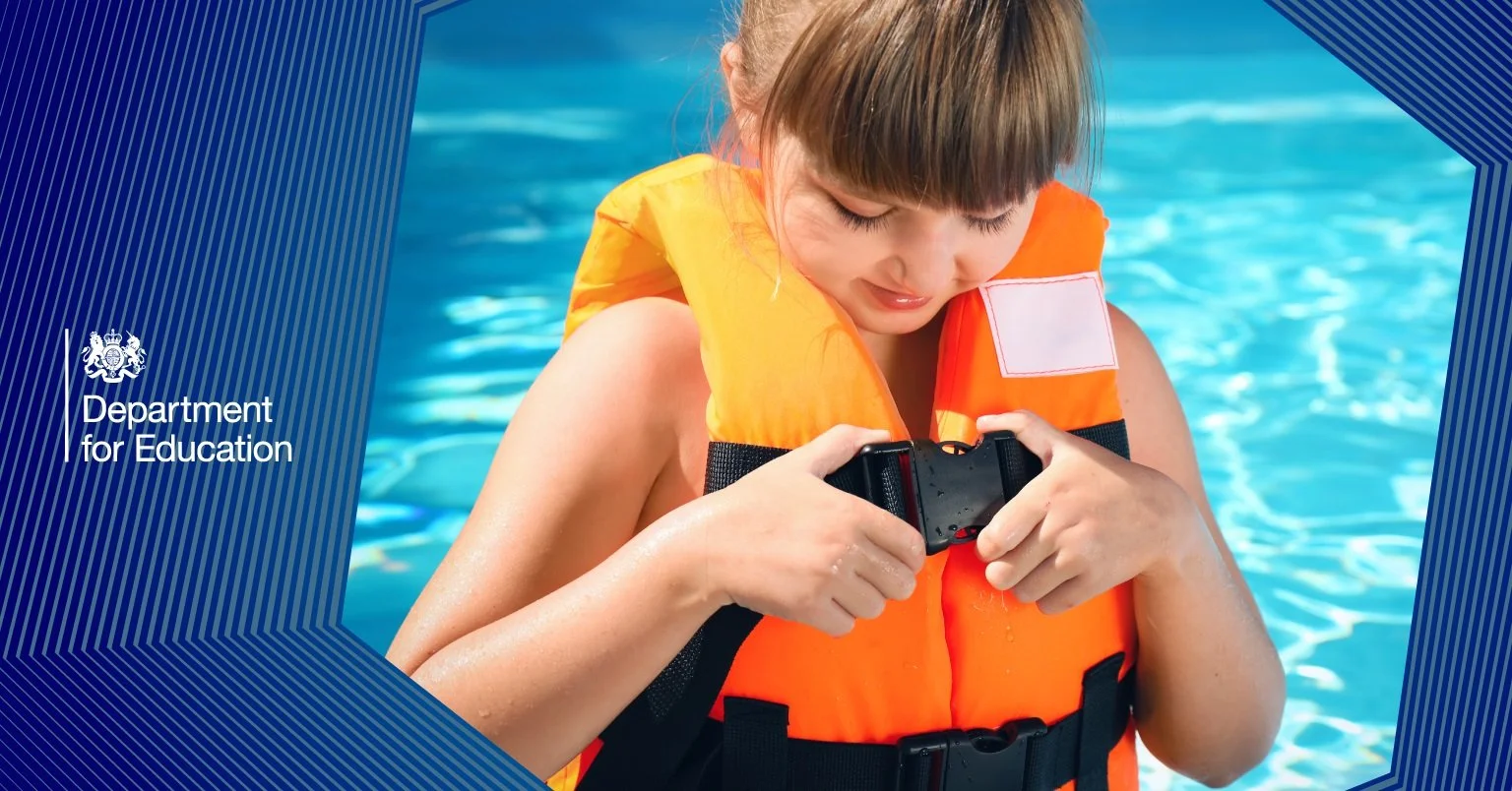
EYFS & KS1 Articles
Major UK Curriculum Shake-Up Announced: What EYFS & KS1 Practitioners Need to Know

A major overhaul of the national curriculum in England has been announced following the publication of the independent Curriculum and Assessment Review. For those working in the Early Years Foundation Stage (EYFS) and Key Stage 1 (KS1), the changes signal a renewed focus on practical life skills, digital literacy, and enriching learning experiences…

Read More →
New Education Inspection Framework | What EYFS Settings Need to Know

The world of early years education is constantly evolving, and with it, the frameworks that guide and assess our invaluable work. Come November 2025, a significant shift will occur as the new Education Inspection Framework (EIF) comes into effect, bringing with it some crucial changes…

Read More →
Revised 2025 EYFS Statutory Framework for Group & School-Based Providers | What You Need to Know

With the new 2025 EYFS Statutory Framework for group and school-based providers coming into effect on 1st September 2025, it's essential to understand the updates to ensure your practice remains compliant, effective…

Read More →
DfE Press Release | Parents urged to read more to boost children’s life chances

The Education Secretary is calling on parents to lead by example and make reading a daily habit to help reverse the decline in reading for pleasure, to help give kids the best start in life as part of the…

Read More →
DfE Update | Drowning Prevention Week: what children learn about water safety at school

As we head into summer, it’s especially important that children are prepared with these skills. This year, the Royal Life Saving Society UK's Drowning Prevention Week runs from 14 June to 21…

Read More →
DfE Update | Hot weather and heatwaves: guidance for schools and other education settings

There are several ways that schools can make changes to keep children safe in hot weather, especially as children are more at risk of becoming ill with heat-related issues than adults…

Read More →

Are you looking for a specific resource or document for your provision?

Use our 🔍 Search Bar located at the top of every page.

___________________________

Content within the EYFS Curriculum & Pedagogy Membership is provided as professional guidance and support. It reflects current understanding of the EYFS statutory framework, Development Matters and inspection expectations at the time of writing. Practitioners are responsible for applying professional judgement and ensuring practice aligns with current statutory requirements and their specific context. All resources, experiences and environment arrangements must be risk assessed by the setting and used in accordance with individual children’s developmental stages, needs and supervision requirements.

Safeguarding content does not replace a setting’s safeguarding and child protection policy or the statutory role of the Designated Safeguarding Lead (DSL). All concerns must be managed in line with current statutory guidance and local safeguarding procedures.

_____________________________

 
In Reception | 4-5 Years, -R10 Tags Reception, Reception Parent Partnership Pack | Reception (4–5 Years)

Reception → Year 1 Transition Pack

January 17, 2026 Stuart Murphy

Home › EYFS Curriculum & Pedagogy › Reception Curriculum & Pedagogy › Reception → Year 1 Transition Pack

Reception → Year 1 Transition Pack

Reception (4–5 Years)

A leadership and practice pack that sets out how to plan a developmentally appropriate transition from Reception into Year 1, protecting EYFS pedagogy while building continuity into KS1.

Download Document Here:

(This pathway component will be available for download by: March 31st 2026)

 
Download DOCX 📝
Download PDF 📄
 

Document Updated: January 2026

Recommended next read Selection

EYFS
Reception Leadership & Inspection Readiness Pack

Strategic guidance for leading high-quality, inspection-secure Reception practice with confidence and integrity.

Read More →
Reception SEND & Inclusion Toolkit | 4-5 Years

Extensive SEND & Inclusion pack specifically designed for use within Reception.

Read More →
EYFSP Interpretation & Assessment Toolkit | Reception (4-5 Years)

A professional guidance pack supporting accurate, confident and workload-proportionate EYFSP practice in Reception.

Read More →
Reception Labelling Pack | 4-5 Years

Labelling pack designed specifically for the reception environment.

Read More →
Adult-Guided Learning in Provision | Reception (4-5 Years)

A professional guidance document explaining how intentional adult interaction supports learning, application and inclusion within child-initiated play in Reception.

Read More →
Outdoor Area Continuous Provision | Reception 4–5 Years

A professional guidance document outlining the purpose, structure and pedagogy of outdoor continuous provision in Reception.

Read More →
Universal Continuous Provision Pack | Reception 4–5 Years

A comprehensive set of professional guidance documents supporting high-quality, purposeful continuous provision across all key areas of the Reception environment.

Read More →
Reception Universal Continuous Provision: Structure & Rationale

A professional guidance document outlining how continuous provision is designed, structured and used to support learning, progression and independence in Reception.

Read More →
Why Themes Are Optional in Reception | 4-5 Years

A professional leadership guidance document explaining the role of themes within a coherent, curriculum-led Reception approach.

Read More →
How to Use the Reception Pathway | 4-5 Years

This document is designed to help practitioners and leaders understand how to navigate and use the Reception Pathway effectively.

Read More →
About Our Reception Curriculum Phase Framework | 4-5 Years

A professional guidance document explaining the rationale and structure behind our phase-based approach to Reception curriculum design.

Read More →
Reception Curriculum Overview & Rationale | 4-5 Years

Reception Year | Ages 4–5

Read More →
Reception Pedagogy Position Statement | 4-5 Years

How Children Learn in Reception (4–5 Years)

Read More →
Reception Parent Partnership Pack | Reception (4-5 Years)

A parent-friendly guidance pack that explains how children learn in Reception (4–5), what to expect day to day, and how families can support learning at home without pressure.

Read More →
Reception → Year 1 Transition Pack

A leadership and practice pack that sets out how to plan a developmentally appropriate transition from Reception into Year 1, protecting EYFS pedagogy while building continuity into KS1.

Read More →

Professional Membership Contents (Reception 4-5 Years)

Below you will find listed the component documents of our ‘Reception Curriculum & Pedagogy Suite’. They are separated into Strands 1-10. You do not need to use everything all at once.

  • 👉 This section is essential for alignment.

    • Reception Curriculum Overview & Rationale [Free Orienting Sample]

    • Reception Pedagogy Position Statement [Free Orienting Sample]

    • About Our Reception Curriculum Phase Framework

    • How To Use The Reception Pathway

    • Why Themes Are Optional in Reception

  • 👉 Curriculum clarity and sequencing.

    • Reception Curriculum Progression Maps (all areas of learning)

      • Guide to Learning Progression: How to Use the Reception Curriculum Progression Maps

      • Progression Maps for:

        • Communication and Language

        • Personal, Social and Emotional Development

        • Physical Development

        • Literacy

        • Mathematics

        • Understanding the World

        • Expressive Arts and Design

    • Reception Curriculum Phase Framework

      • How To Use The Reception Curriculum Phase Pack

      • Phase 1: Settling & Foundations

      • Phase 2: Exploration & Early Application

      • Phase 3: Independence & Depth

      • Phase 4: Consolidation & Transition

  • 👉 OAP as the organising principle.

    • Reception OAP Cycle Guidance

    • Reception Collaborative Planning & Reflective Sheet Pack

    • Self-Regulation & Learning Behaviours in Reception

    • Reception Baseline Assessment (RBA)

    • Characteristics of Effective Learning in Reception

  • 👉 Stable, purposeful provision.

    • Reception Continuous Provision – Structure & Rationale

    • Universal Continuous Provision Pack (Areas listed below)

      • Construction

      • Creative

      • Investigation / Discovery

      • Maths

      • Reading

      • Role Play / Small World

      • Malleable / Sensory

      • Writing

    • Outdoor Continuous Provision (Reception)

    • Adult-Guided Learning in Provision

    • Reception Labelling Pack | 4-5 Years

  • 👉 Light-touch, application-focused.

    • Reception Enhanced Provision Planning Toolkit

    • Reception Optional Themed Enhancements - Idea Banks

  • 👉 Systematic teaching without Year 1 drift.

    Phonics (Scheme-Compatible)

    • Phonics in Reception: Teaching, Application & Inclusion

      • Pedagogy

      • Adult-Led Sessions

      • Phonics in Provision

      • Supporting Children Not Keeping Up

      • Phonics & EYFSP

      • Scheme Compatibility Statement

    Maths

    • Reception Maths Teaching Framework

      • Term by Tem Maths Concept Emphasis Map

      • Maths Adult-Led Mini Session Banks (9 Banks)

      • Maths Across the Curriculum & Provision

      • Maths & EYFSP Guidance

    Writing

    • Reception Early Writing Purpose Pack

      • Writing Adult-Led Mini Session Bank (12 Sessions)

    • Fine Motor & Physical Development

      • Guidance Surrounding Foundations for Writing in Reception (4–5 Years)

  • 👉 Precision language for application.

    • Adult-Guided Learning in Provision

    • Theme-Based High-Impact Question & Vocabulary Banks

      • Leadership Rationale: Why Questions Differ by Age

    • Five Sentence Stems For Reception Practitioners

  • 👉 Statutory confidence with inclusive practice.

    • EYFSP Interpretation & Assessment Toolkit

      • ELG Unpacking

      • Best-Fit Exemplification

      • Moderation Guidance

    • Reception SEND & Inclusion Toolkit

      • The graduated response (Universal → Targeted → Specialist)

      • Adaptations across phonics, maths & writing

      • Visual Communication Pack

      • Language-first strategies for inclusion

      • Observation, assessment and SEND

      • Collaborative working with families and specialists

      • Referral Preparation — for EHCP pathway

      • Reception APDR Template

      • Leadership and inspection readiness

  • 👉 Leadership assurance.

    • Reception Leadership & Inspection Readiness Pack

      • Curriculum Intent & Implementation Guidance

      • Ofsted Conversation Prompts

  • 👉 Clear communication beyond the classroom.

    • Reception Parent Partnership Pack

    • Reception Transition to Year 1 Pack

Additional Whole-Setting Guidance | for Professional Members

Explore our whole-setting guidance below, including overarching curriculum and pedagogy documents, early years schemas and EYFS setting policies.

    • Little Owls Resources’ Curriculum Intent Statement

    • EYFS from Birth to 5: Curriculum Coherence & Pedagogical Throughline

    • Whole-Setting Curriculum Map (Birth-5): Curriculum Intent & Progression

    • Pedagogy Guidance Document

    • Speech & Language Development - Setting Statement

    • EYFS Inspection-Facing Summaries

  • Early Years Schemas - Practitioner Toolkit | EYFS Birth-5

    ↪ Schema Cards (definition, behaviours, age-related examples, enabling resources)

    ↪ Schema Observation & Responsive Provision Planning Template

    • EYFS Group Setting Policies Pack

      ↪ x 22 Policy Documents

      ↪ Policy Sign-Off and Confirmation Document

      ↪ EYFS Setting Policy Folder Contents List

    • Childminder Setting Policies Pack

      ↪ x 22 Policy Documents

      ↪ Childminder Assistant or Volunteer Policy Sign-Off and Confirmation Document

      ↪ Childminder Policy Folder Contents List

  • EYFS Glossary

    ↪ Clear, practitioner-friendly explanations of key curriculum and pedagogy terms used throughout our guidance.

Looking for a different age group pathway?

Select the pathway that best reflects your role or the age group you work with. You do not need to use everything. (Some practitioners may use more than one pathway.)

Featured
🍼 Babies (0–18 months)

Responsive care, observation and development in the earliest years

🚼 Toddlers (18–36 months)

Development, play and progression in the toddler years

🎨 Preschool (3–4 years)

Curriculum, continuous provision and purposeful teaching

🎓 Reception (4–5 years)

Play-based pedagogy, progression and EYFSP readiness

🏡 Childminders (Birth–5)

Mixed-age pedagogy, planning without overload and inspection confidence

Latest EYFS Articles & Practical Guides | From Our Blog

Stay informed, get expert advice, and find inspiration from our collection of articles and useful external resources, tailored specifically for EYFS practitioners. We regularly publish in-depth articles to support you with current best practices, regulatory changes, and fresh ideas.

EYFS & KS1 Articles
Major UK Curriculum Shake-Up Announced: What EYFS & KS1 Practitioners Need to Know

A major overhaul of the national curriculum in England has been announced following the publication of the independent Curriculum and Assessment Review. For those working in the Early Years Foundation Stage (EYFS) and Key Stage 1 (KS1), the changes signal a renewed focus on practical life skills, digital literacy, and enriching learning experiences…

Read More →
New Education Inspection Framework | What EYFS Settings Need to Know

The world of early years education is constantly evolving, and with it, the frameworks that guide and assess our invaluable work. Come November 2025, a significant shift will occur as the new Education Inspection Framework (EIF) comes into effect, bringing with it some crucial changes…

Read More →
Revised 2025 EYFS Statutory Framework for Group & School-Based Providers | What You Need to Know

With the new 2025 EYFS Statutory Framework for group and school-based providers coming into effect on 1st September 2025, it's essential to understand the updates to ensure your practice remains compliant, effective…

Read More →
DfE Press Release | Parents urged to read more to boost children’s life chances

The Education Secretary is calling on parents to lead by example and make reading a daily habit to help reverse the decline in reading for pleasure, to help give kids the best start in life as part of the…

Read More →
DfE Update | Drowning Prevention Week: what children learn about water safety at school

As we head into summer, it’s especially important that children are prepared with these skills. This year, the Royal Life Saving Society UK's Drowning Prevention Week runs from 14 June to 21…

Read More →
DfE Update | Hot weather and heatwaves: guidance for schools and other education settings

There are several ways that schools can make changes to keep children safe in hot weather, especially as children are more at risk of becoming ill with heat-related issues than adults…

Read More →

Are you looking for a specific resource or document for your provision?

Use our 🔍 Search Bar located at the top of every page.

___________________________

Content within the EYFS Curriculum & Pedagogy Membership is provided as professional guidance and support. It reflects current understanding of the EYFS statutory framework, Development Matters and inspection expectations at the time of writing. Practitioners are responsible for applying professional judgement and ensuring practice aligns with current statutory requirements and their specific context. All resources, experiences and environment arrangements must be risk assessed by the setting and used in accordance with individual children’s developmental stages, needs and supervision requirements.

Safeguarding content does not replace a setting’s safeguarding and child protection policy or the statutory role of the Designated Safeguarding Lead (DSL). All concerns must be managed in line with current statutory guidance and local safeguarding procedures.

_____________________________
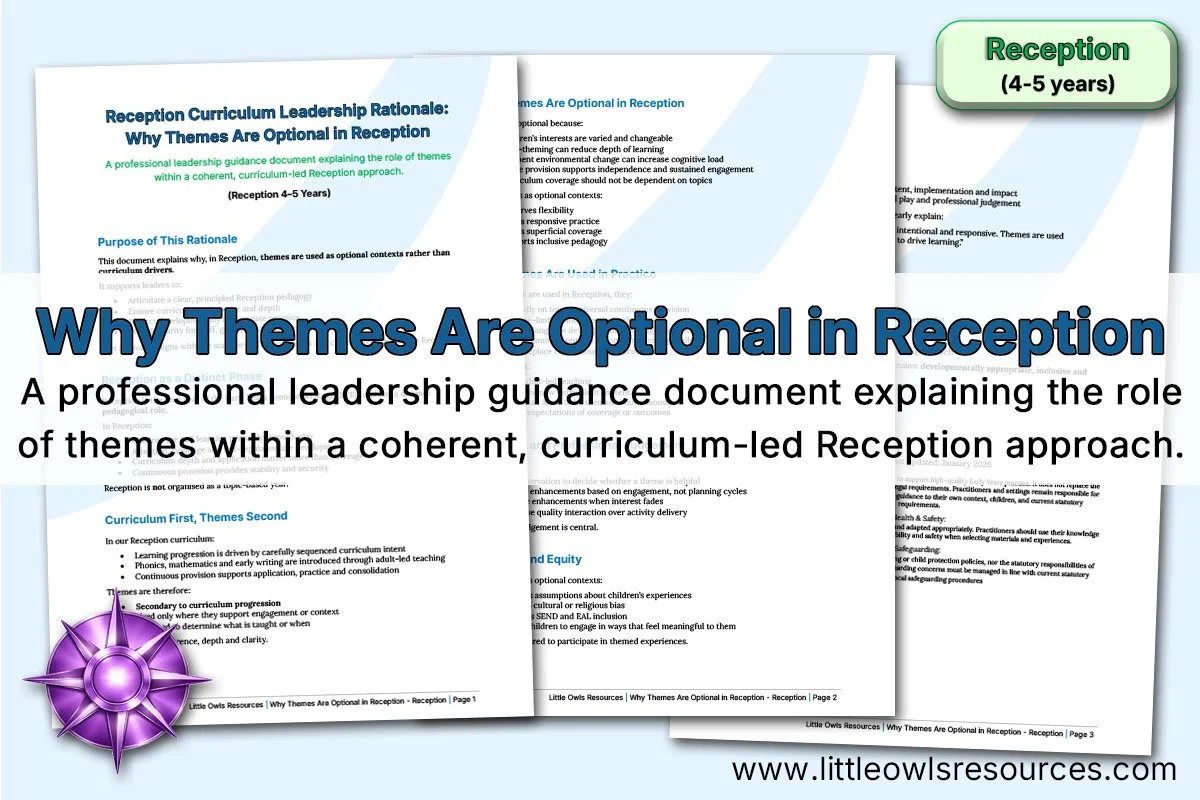
 
In Reception | 4-5 Years, -R10 Tags Reception, Reception → Year 1 Transition Pack
← Newer Posts

Trusted by over 35,000 members

- early years professionals across nurseries, schools and childminding settings


Contact Little Owls Resources support:

support@littleowlsresources.com

Information

  • About | Testimonials

  • Privacy Policy

  • Cookie Policy

  • Terms & Conditions

  • Help Page

Core Navigation

  • Membership

  • Printable Resources

  • Events Calendar

  • Curriculum & Pedagogy

Thank-you Little Owls Resources members! Our community is growing! 😊


Read our File Format information

Copyright on all of the images, files & resources housed on this website is held by ‘Little Owls Resources’. In downloading any of these resources you are issued a single licence for your own use and the right to grant a limited licence to your students to use the licensed material as part of your teaching and their own use.

Our resources (including the images within them), cannot be shared or sold commercially.

Website powered by Squarespace

Search powered by https://www.sitesearch360.com