
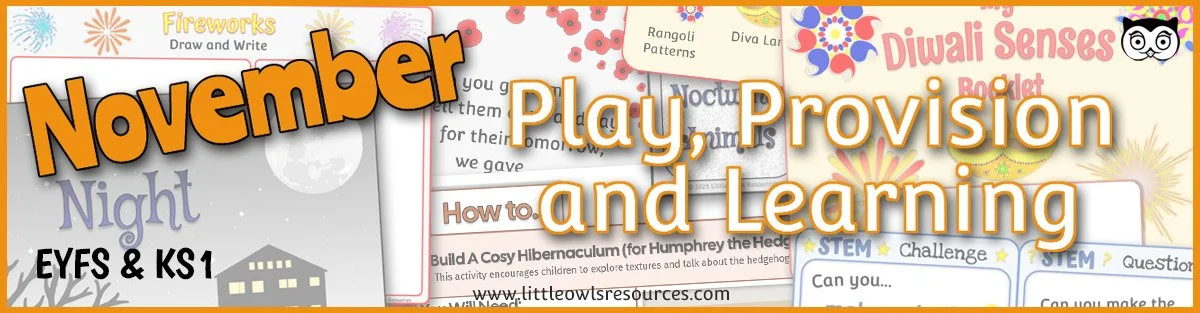
November · Play, provision & learning
Late autumn, light and shared discoveries
Find November starting points for babies, toddlers, preschool, Reception, Year 1, Year 2 and mixed-age settings. Explore light and shadow, changing weather, familiar rhymes, useful marks, practical maths and opportunities to care for one another.
Choose a few ideas that connect with the children you know. Keep successful play and familiar resources available, then add a new possibility where it supports an interest or something you are teaching.
Use the November calendar when dates are useful to your planning. Festivals and awareness weeks are optional connections; they do not need to determine every child's experience.
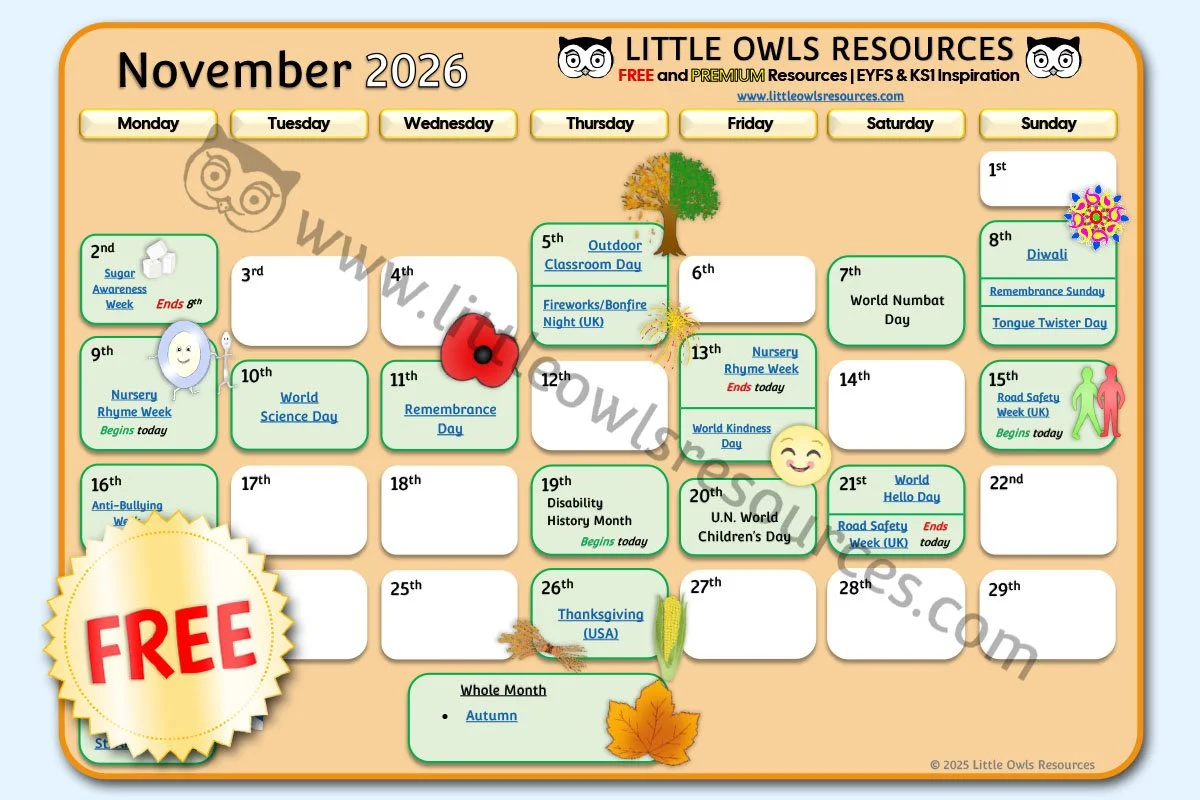
SPECIAL DATES EVENT CALENDAR - NOVEMBER 2026 (Free Download) - UPDATED 30.10.26
A November 2026 special-dates calendar for adults planning early-years or KS1 provision. Select events relevant to the children and community, then confirm any dates that matter to your plans.
View resource details →Choose your age group or setting
Start with the children; leave room to return
The age groups are browsing guides, not a timetable or a set of expectations. A child may revisit a familiar experience, join in through movement or communication, watch first, or take an idea in an unexpected direction. Adapt materials and adult support to the individual children.
November is still autumn in the UK. Notice what is happening where you are, rather than expecting the weather, trees or wildlife to match a picture. You do not need to make every area seasonal or introduce a new activity each day.
🍼 November Baby Play & Provision — 0–18 months
This month’s focus: shared attention, familiar care, sound and repeated exploration.
For babies, November’s useful starting points are close to everyday life: a familiar face, a comfortable outdoor pause, an interesting object or a song worth hearing again. Follow each baby’s cues rather than organising their day around festivals or finished seasonal activities.
The suggestions below are for adults to select and adapt. Printed materials remain adult-supported prompts, and younger babies may need only a brief shared look or exchange.
Share a simple picture as the light changes
Choose one of the Day and Night High Contrast Cards for a comfortable, awake moment together. The sun, moon, star and cloud pictures offer something simple to look at; babies do not need to understand day and night or name what they see.
Hold the picture where the baby can notice it and follow their response. A look, movement, sound or turn away can guide what happens next. Share a few words or a quiet sound, then pause. November’s changing light may be a connection for adults, but the important experience is the shared attention. Printed cards stay with the adult rather than becoming mouthing toys.

DAY AND NIGHT - High Contrast Cards for Babies
Black-and-white sun, moon, star and cloud images provide simple pictures to share with a baby. An adult can hold a card, notice the baby’s gaze and respond without expecting naming or sorting.
View resource details →Notice what an object can do
Use the Maths Treasure Basket Prompts as a reminder for adults to notice exploration, rather than as tasks for a baby to complete. For a baby who is ready to handle objects, offer a small choice of suitable familiar objects that they can investigate in their own way.
Watch what interests them: turning something over, moving it between hands, putting it into a container or retrieving it again. Join with a word such as “in” or “again” when it fits the action. There is no need to introduce counting, sorting or questions. Choose and check every object for the individual baby; small autumn finds are not suitable substitutes for baby-safe materials.
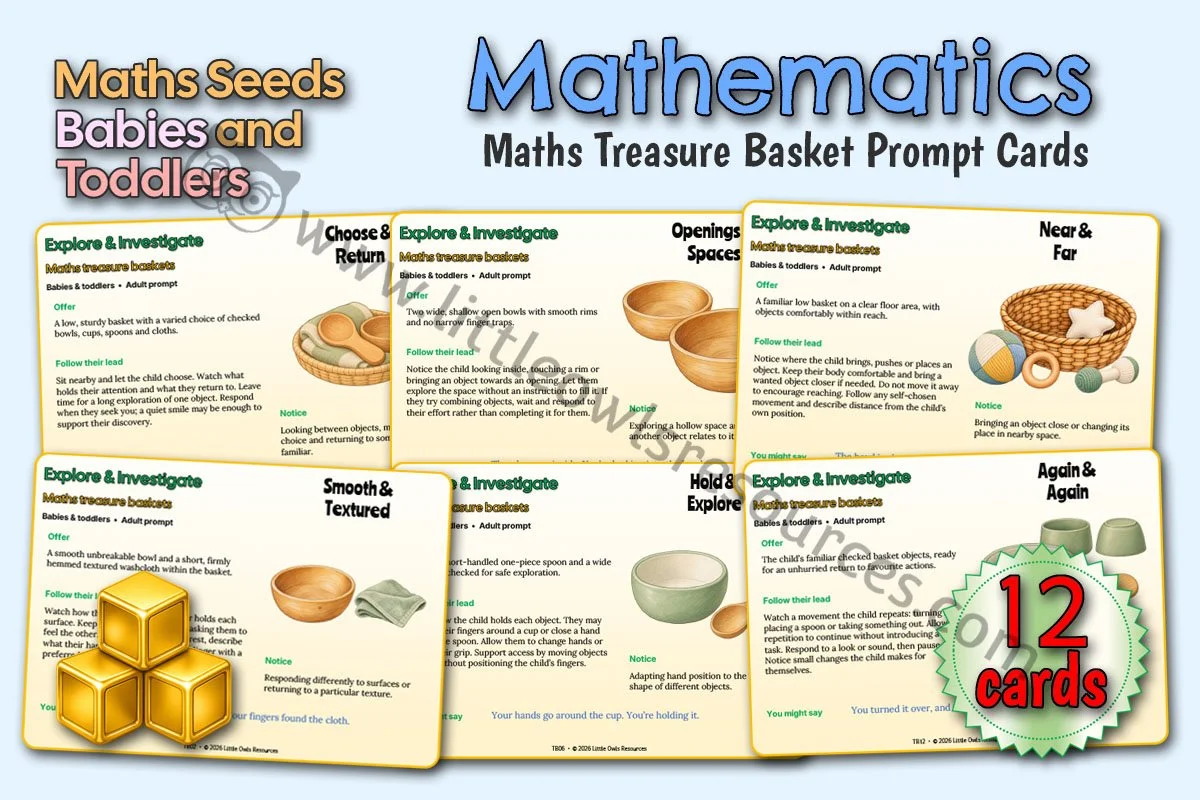
Maths Treasure Basket Prompts | Babies & Toddlers
Adult-facing cards highlight possible mathematical connections in babies’ and toddlers’ treasure-basket exploration. Use a relevant reminder while following the child’s choices; the cards are not a sequence of activities to complete.
View resource details →Pause together outdoors
Return to Being Outdoors Together when a familiar November outing offers something worth noticing. The baby does not need a new seasonal activity each week. A view of moving branches, a nearby sound or an opportunity for their own movement can be enough.
Choose a suitable moment and place for that baby, with their comfort and usual care arrangements guiding the visit. Share what catches their attention and allow time for their gaze, movements and sounds. A baby may simply watch with a familiar adult; another may explore through reaching or moving. Revisit a favourite place, change the experience or finish when their cues suggest it.
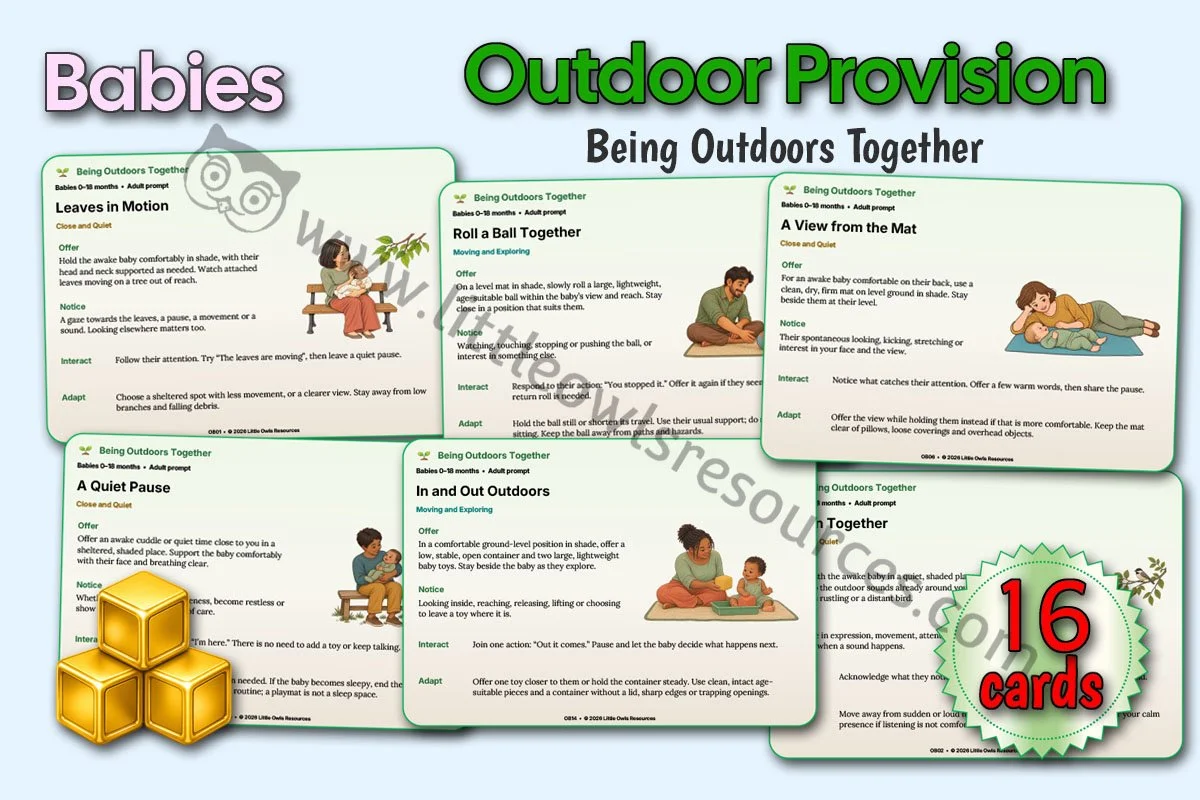
Being Outdoors Together — Babies
An adult companion for shared outdoor experiences with babies aged zero to eighteen months. Follow the baby’s attention and self-initiated movement while noticing the surroundings together.
View resource details →Listen to one familiar autumn sound
For an older baby who is interested, choose one Autumn Sound Card as an adult prompt for a short shared sound experience. A familiar patter or rustle can connect with something you have just noticed together. The card supports the adult; it is not a listening test for the baby.
Make a quiet sound with your voice, then pause and notice the response. The baby might look, move, vocalise or prefer to watch something else. Respond to their contribution instead of asking them to copy. Keep the sound comfortable and the experience brief, and return to familiar face-to-face interaction whenever that is more welcome.
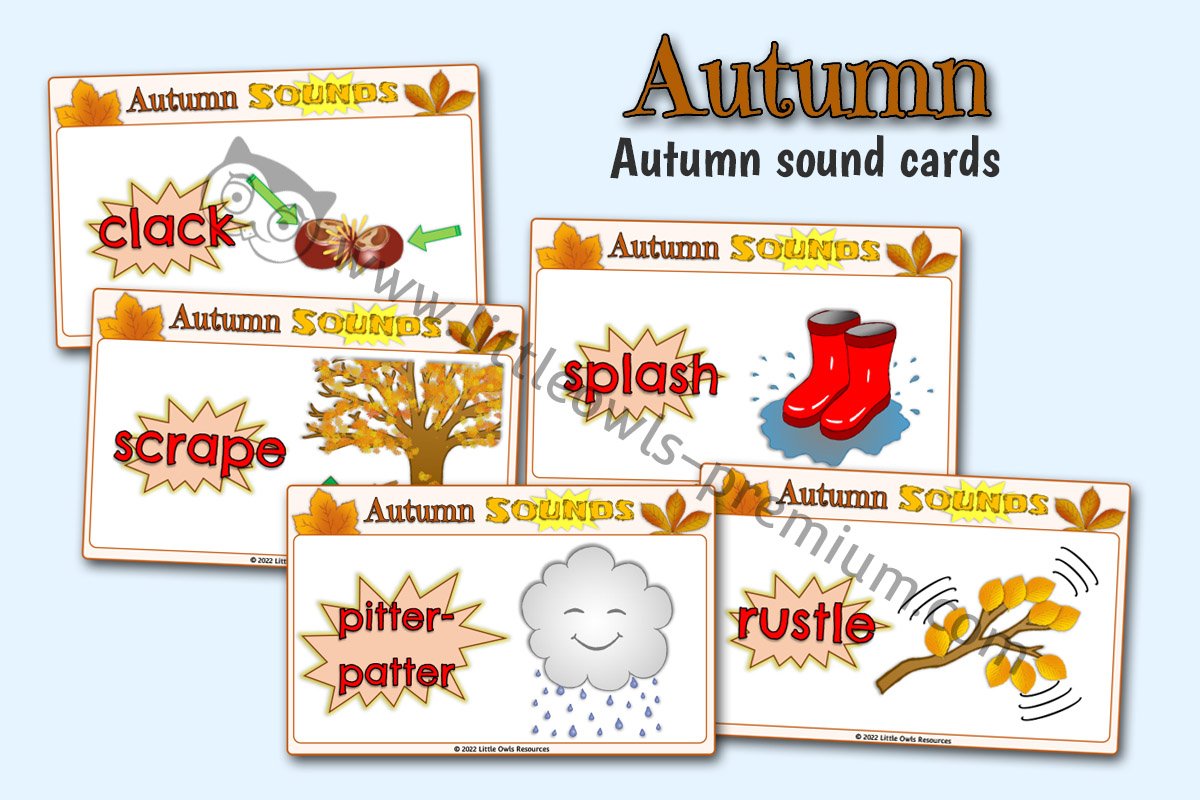
Autumn Sound Cards
Autumn picture and sound prompts support listening walks, vocal play and musical exploration. Notice a rustle, patter or crunch, then try recreating the sound in different ways.
View resource details →Make ordinary care moments responsive
Keep the In-the-Moment Prompt Cards for adults nearby when reflecting on familiar care and play. November can bring changes to routines and busy seasonal plans, but a baby’s everyday communication still provides the starting point. Choose one reminder about noticing, mirroring or responding rather than planning a performance.
During an ordinary shared moment, notice what the baby is attending to and respond with a simple word, gesture or sound. Leave time for another response and follow a change of interest. The aim is a warm exchange with a familiar person, not to produce a particular skill or collect evidence from every interaction.

In-the-Moment Prompt Cards | Babies (birth-18 months)
Baby practitioner prompt cards offer reminders for narration, mirroring, comforting and responsive interaction. Use them to reflect on adult attunement during care and play while following each baby’s cues.
View resource details →Enjoy a familiar song — free sample to try
Use The Wheels on the Bus free song-word poster as a prompt for an adult to share a familiar song. World Nursery Rhyme Week can be a reason to revisit songs families already enjoy, but singing does not need to wait for a special date or follow a set list.
Sing a short part at a comfortable pace and notice the baby’s response. They may watch your face, make a sound, move or signal that they have had enough. Repeat a favourite part when it is welcome. Reading, colouring and copying actions are not expected; the printable supports the adult while the baby shares the interaction.

The Wheels on the Bus — Free Sample
A free colouring words poster for The Wheels on the Bus. Use it as an adult prompt for shared singing, familiar actions and revisiting the song.
View resource details →Keep exploring
- Care as Curriculum — Babies 0–18 MonthsOptional free practitioner guidance: reflect on how responsive care, relationships and ordinary routines support learning. Use it to keep seasonal planning proportionate.
- Find more Baby resources →
🚼 November Toddler Play & Provision — 18–36 months
This month’s focus: familiar rhymes, useful words, repeated actions and small discoveries.
Begin with what toddlers are choosing to notice and do. Changing light, getting ready to go outside, a favourite rhyme or caring for a toy can offer November connections without replacing familiar provision.
Keep the invitations manageable and leave time to return. Children can join through looking, moving, pointing, sounds, signs or words; they do not need to complete a seasonal worksheet to take part.
Sing, pause and let the child join
Select the song words or a picture from the Row, Row, Row Your Boat Activity Pack for a short shared song. A familiar rhyme can be revisited during World Nursery Rhyme Week and throughout the month. Toddlers do not need the pack’s sequencing or illustration sheets to take part.
Sing together and invite a movement the child can choose and control, sitting or standing. Pause at a familiar point and welcome a gesture, sound, word or request to continue. Repeat a favourite verse rather than adding a new challenge. Watching another person sing is also a way to participate.

Row, Row, Row Your Boat Activity Pack
Lyric posters, sequence cards and illustration sheets for “Row, Row, Row Your Boat”. Share the song, revisit its pictures and invite gentle movements chosen by the child.
View resource details →Notice light and shadow in a familiar place
Use the Light, Dark & Celebrations Toddler Project Planner to help adults choose a small, concrete experience. Start with a patch of ordinary daylight or a shadow in a familiar room. There is no need to darken the space or introduce flashing lights to make November feel different.
Notice what happens when a hand or familiar object moves across the light. A child may watch, reach towards a shadow or try the movement again. Share simple words that fit what they are exploring, and allow the idea to change. If family celebrations become part of the conversation, follow their actual experiences rather than expecting every child to recognise the same festival.

Theme: Light, Dark & Celebrations | Toddler Project Planner (18–36 Months)
A toddler light-and-dark planner uses contrast, colour, cause and effect and familiar celebrations. It helps adults consider sensory experiences, shared language and emotional security while responding to children’s interests.
View resource details →Make marks that follow a movement
Choose an invitation from First Marks & Shared Discoveries alongside familiar tools and a generous surface. A toddler who is interested in rain, wind or moving leaves might make long strokes, taps or sweeping marks, but the marks do not have to represent the weather or become a recognisable picture.
Notice the movement and effect: “Your brush went all the way across,” or “You made lots of little marks.” Offer a tool or surface that suits the child’s current control and preferences, with room to repeat and change the action. Keep the experience open; copying an adult’s design or filling the page is not the goal.
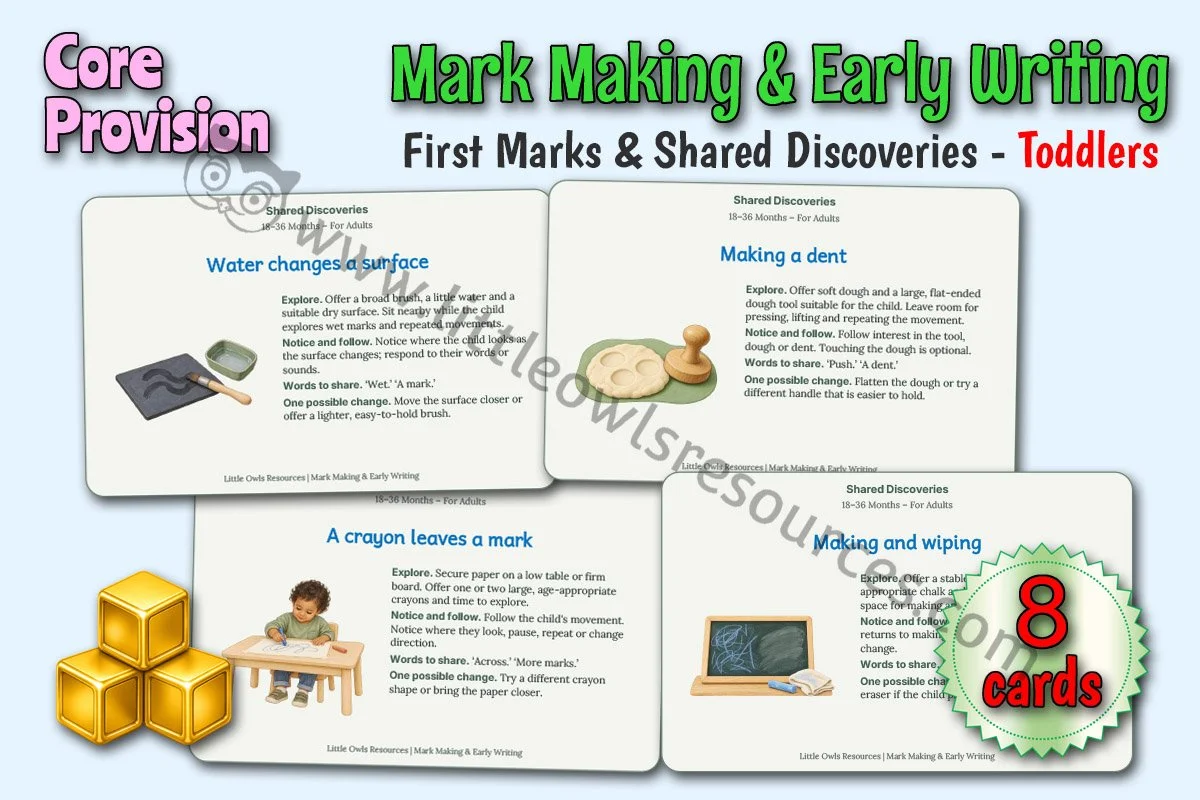
First Marks & Shared Discoveries — Toddlers
Adult-facing toddler mark-making invitations using familiar tools, surfaces and repeated actions. Follow what the child notices and revisit an invitation while it remains interesting.
View resource details →Connect a clothing picture with getting ready
Prepare one or two of the Clothes Two-Piece Puzzles that relate to familiar clothing. Bring the picture into a relaxed conversation about getting ready for the day, using the actual weather and the child’s own experiences. The puzzle can support shared noticing without becoming a test of naming or matching.
Look at a visible detail together and see whether the child wants to join the halves. Offer fewer pieces or place one half beside its partner when helpful. A child might point to a similar item, use a word from home or return to exploring their own clothing. Add another picture only while the shared activity remains interesting.

CLOTHES - 2-Piece Puzzles
Two-piece puzzles feature clothes. Adults prepare a small selection, then children compare the visible details and join matching halves, increasing the number of choices when ready.
View resource details →Make a place for a toy animal
Use the Animals & Their Homes Toddler Project Planner to support a familiar interest in caring for toy animals, moving them around or making spaces. Offer a few suitable animal toys with blocks and sturdy containers that the children can arrange. A small home or resting place can emerge from their play.
A toddler might put an animal inside, carry it to another place or rebuild the same enclosure several times. Join with a useful word or a simple pretend action when invited. There is no need to teach hibernation facts or produce a model den. Keep small parts away from children who mouth objects and choose materials that suit each child.

Theme: Animals & Their Homes | Toddler Project Planner (18–36 Months)
An animals-and-homes toddler planner builds on imitation, sound-making, care and constructing places for toy animals. It helps adults support language and schemas such as enclosing, connecting and transporting through play.
View resource details →Share a playful sound — free sample to try
Try the free Onomatopoeic Sound Cards as adult prompts for playful voices and short exchanges. Choose a picture or sound that connects with the child’s interest, perhaps after listening to the weather or making a sound in play. The printed words are there for adults; toddlers do not need to read them or learn the term “onomatopoeia”.
Model one comfortable sound and leave a pause. Accept a look, gesture, sound, sign or spoken response, then follow what the child offers. They may enjoy repeating the same sound or invent something different. Keep it conversational rather than asking children to identify every card or repeat a word on demand.

Onomatopoeic Sound Cards — Free Sample
Explore playful voice sounds and try a short call-and-response pattern using picture cues. Listen, make a sound and respond together, exploring changes without expecting reading or a formal musical performance.
View resource details →Keep exploring
- Communication and Language-Rich Approaches in Toddler RoomsOptional All Access practitioner support: reflect on responsive interaction, songs, stories and the many ways toddlers communicate during everyday play and routines.
- Find more Toddler resources →
🎨 November Preschool Play & Provision — 3–4 years
This month’s focus: listening, comparing, sharing ideas and changing a plan through play.
November can bring interesting sounds, changing light, familiar celebrations and questions about animals. Begin with what children have noticed, keeping comfortable, familiar provision available alongside a few carefully chosen additions.
The choices below offer different ways to join in through movement, objects, pictures, talk and marks. A child does not need to celebrate a particular festival, speak in a group or complete a finished product to take part.
Listen, choose and make an animal sound — free sample to try
Choose two or three pictures from the Nocturnal Animals Sound Cards. Share an animal sound with your voice, then leave time for children to choose a picture, join in or suggest a different sound. Keep the volume comfortable and welcome a child who prefers to watch.
An adult might model a quiet hoot, pause, and notice how another child responds. Children can use a gesture, a sound, a communication aid or a spoken word. The printed sound words support adults; children do not need to read them. Return to favourite pictures and sounds rather than turning the game into a listening test.

FREE Nocturnal Animals: Sound (Phase 1 Phonics) Cards | EYFS Printables
Nocturnal-animal picture and sound cards support matching, listening and playful vocal imitation. Share owl hoots, mouse squeaks and other represented sounds, then take turns choosing or recognising a picture.
View resource details →Explore a rangoli design with dough
When Diwali connects with your group, begin with a carefully chosen photograph or a family experience shared by someone who wishes to contribute. Introduce rangoli as part of a living celebration, allowing for different family practices, before offering the Rangoli Pattern Playdough Mats.
Children might roll a coil, press a shape or arrange pieces around a centre. They can follow part of a mat or make their own arrangement. Notice colour, position and shapes together, without expecting a symmetrical or matching finished design. Keep familiar dough play available too, so the experience can develop from each child’s interests.
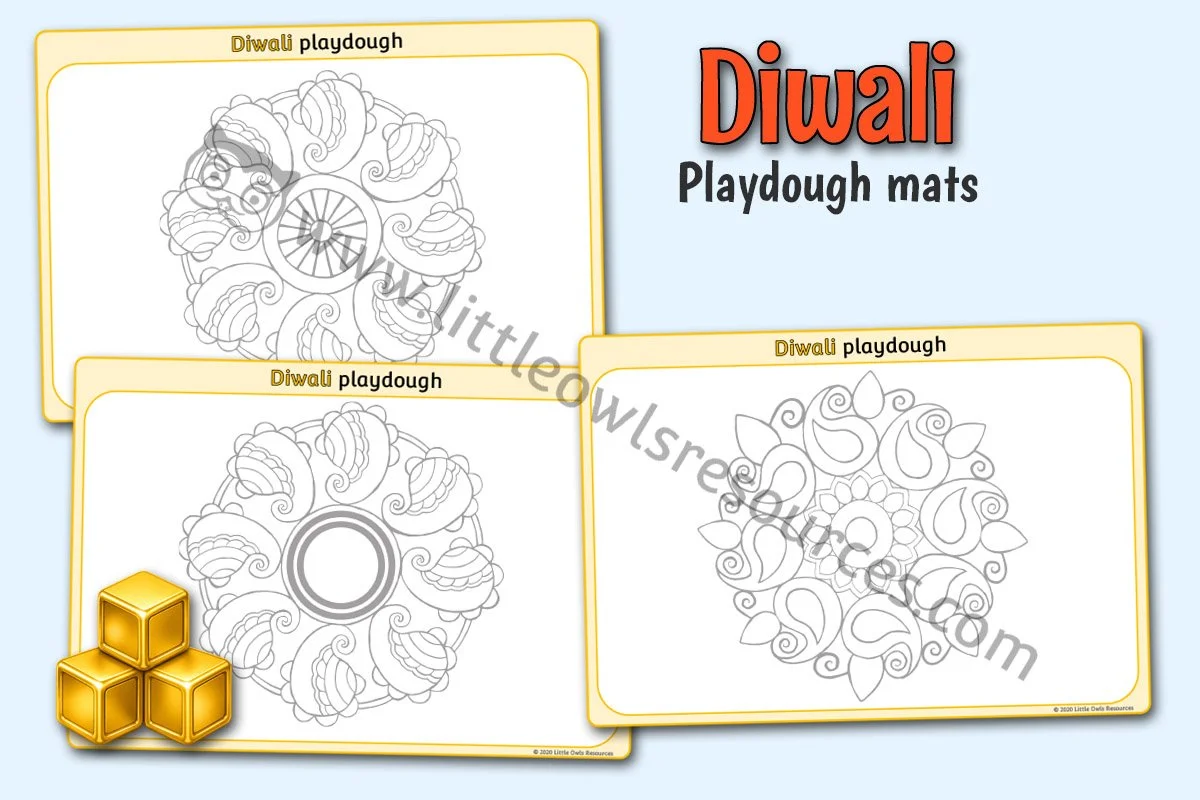
DIWALI RANGOLI PATTERN PLAYDOUGH MATS
Rangoli-pattern mats for shaping and arranging playdough. Children can explore colours and repeated shapes while practising rolling, pressing and positioning the dough.
View resource details →Build a model shelter for a pretend hedgehog
Use How to Build a Cosy Hibernaculum for Humphrey as a starting point for a small model home. Introduce hibernaculum as a shelter where an animal can spend a period of hibernation, then offer a toy or paper hedgehog and a few suitable construction materials.
Children might choose a base, make an entrance or try a covering. Ask a practical question when it helps: “Can your hedgehog fit inside?” Leave time to test, change and explain an idea through actions or words. This is pretend model-making with adult-selected materials, not a project for handling wildlife or disturbing a real nest.
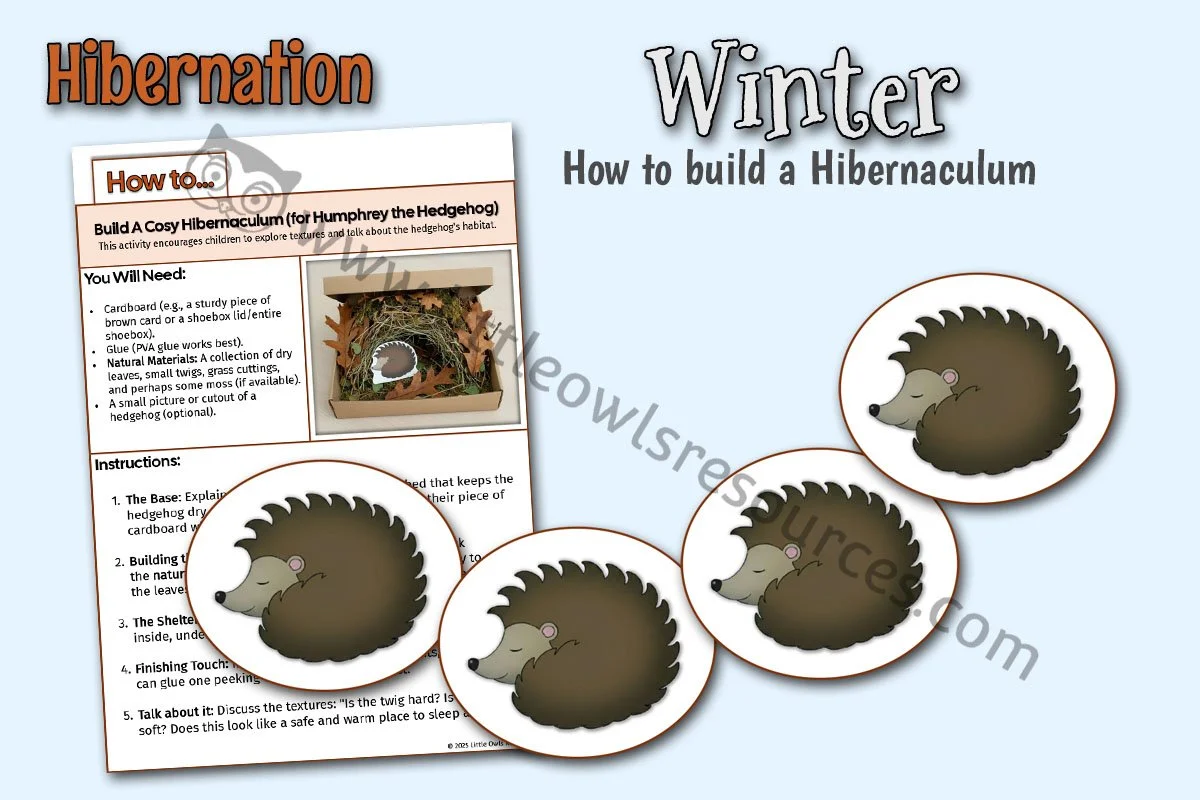
HIBERNATION - How to Build a Cosy Hibernaculum (for Humphrey)
An invitation to build a cosy hibernaculum for an imagined hedgehog. Explore materials and textures while children create and explain a model shelter.
View resource details →Compare sizes using calm firework pictures — free sample to try
Offer two contrasting cards from the free Firework Size Ordering pack. Invite children to put the pictures beside one another and show which is larger or smaller. Begin with a small selection so that comparing the pictures remains manageable.
When children want to extend the idea, add another card and wonder where it could fit. They can move the cards, point or explain their choices; there is no need to use the whole sequence or work quickly. The pictures provide a quiet November connection without a loud sound or a real firework. Offer another familiar context if firework pictures are unwelcome.
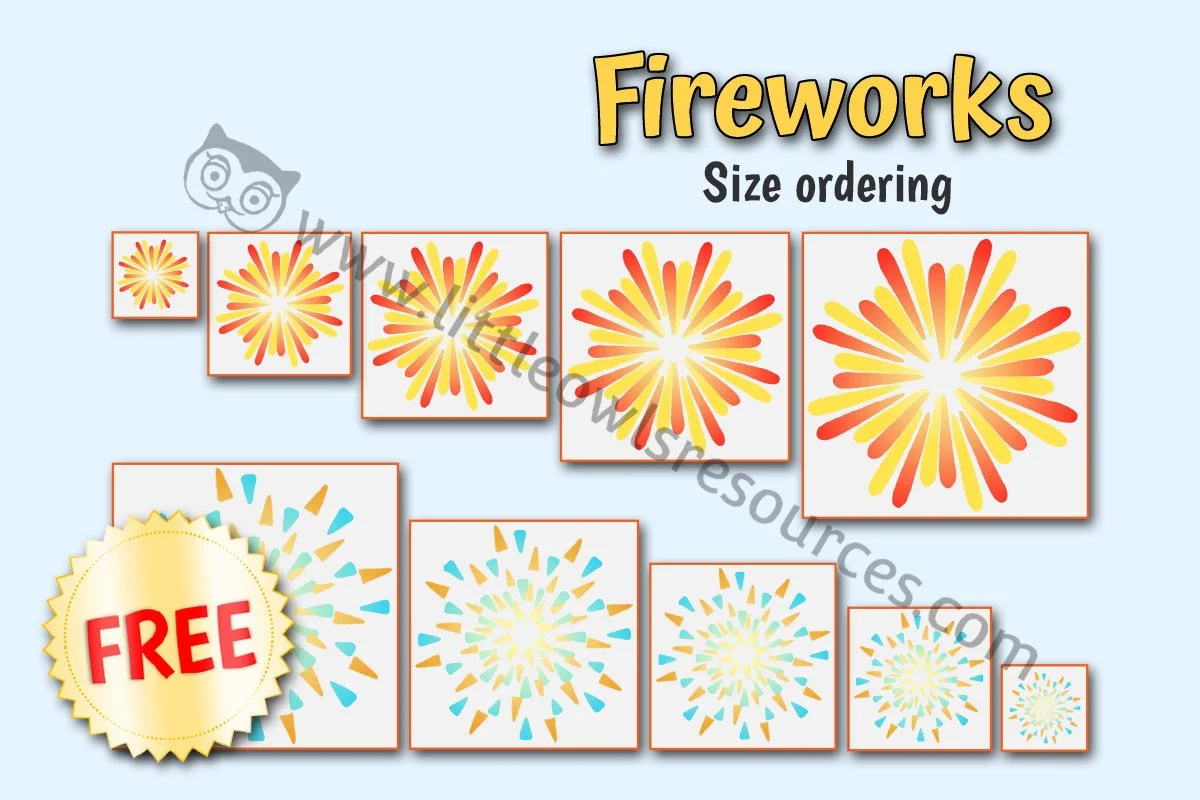
FIREWORK EXPLOSION - SIZE ORDERING CARDS (FREE SAMPLE)
Firework pictures in different sizes can be compared, sorted and arranged into an order. Use prepared cards for repeated play, talking together about which image is smaller, larger or between two others.
View resource details →Send a message that matters in the play
Place a few Autumn Writing for Purpose — Messages cards beside familiar drawing and mark-making materials. A child might want to tell someone about a discovery, invite a friend to join a game or leave a note for a character in small-world play.
Ask who the message is for and what the child wants it to say. Welcome a picture, meaningful marks, dictated words or an explanation delivered in person. Offer adult scribing when wanted, without replacing the child’s contribution. Help the message reach its recipient and make space for a response: communication gives the marks their purpose.
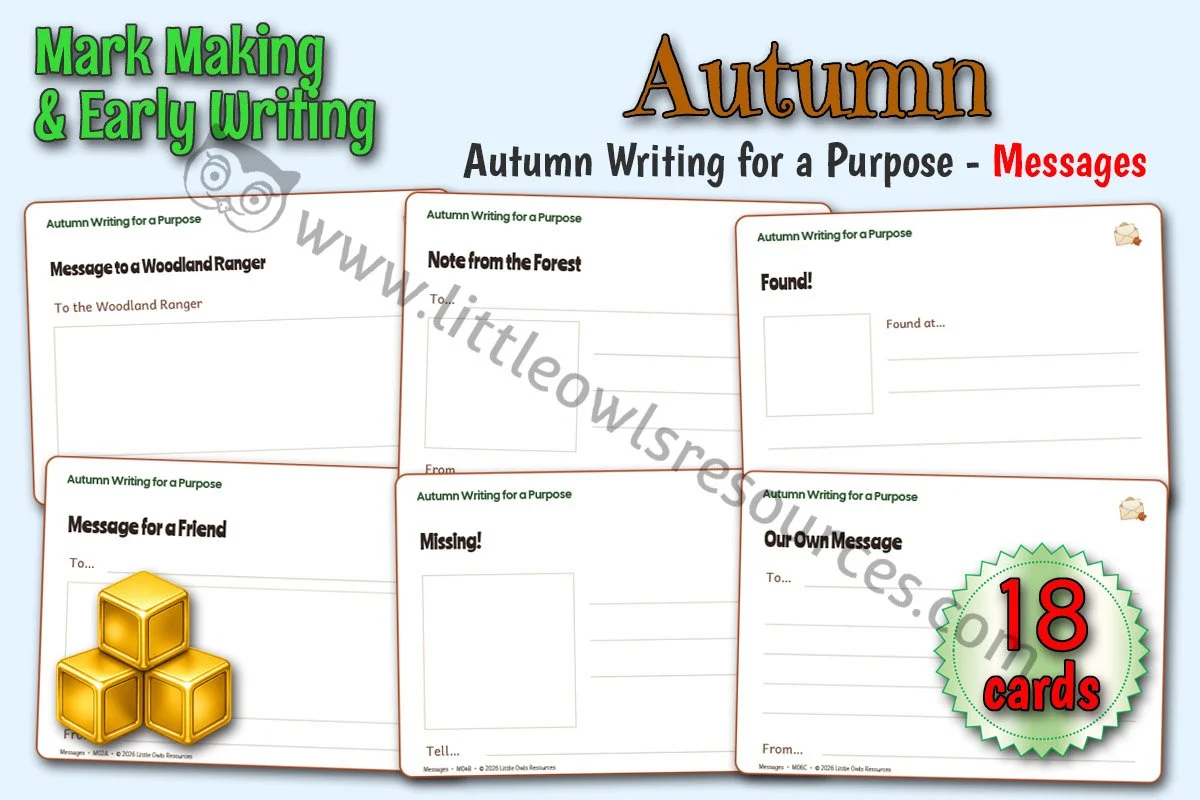
Autumn Writing for Purpose - Messages
Autumn message cards offer space to reach a friend, share a woodland discovery or contact a character in play. Children draw, mark or write, then deliver the message and invite a response.
View resource details →Make room for different ways to join the play
Keep a suitable Communication & Play Together Board within reach of a familiar small-world scene. Use it alongside each child’s usual speech, gestures, signs or communication system. Choose the pictures and layout according to the child’s communication needs, rather than assuming one board suits everyone.
Model a message such as asking, refusing, commenting or sharing an idea when it fits the play. A child may communicate without touching a picture, and their “no” matters as much as an invitation to join. Follow the children’s story and help peers notice one another’s messages. There is no requirement to take a speaking turn.
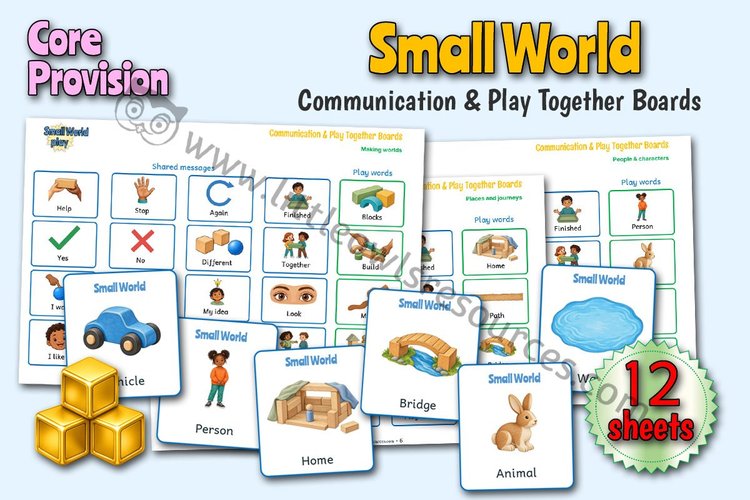
Communication & Play Together Boards
Picture boards support asking, refusing, commenting and sharing ideas during small-world play. Use alongside each child’s usual communication and model the pictures while following their play.
View resource details →Keep exploring
- Preschool Environment & Continuous Provision Map Audit PackOptional practitioner support: review one area of provision, who can use it and whether a small change would improve access. Keep useful familiar provision in place.
- Find more Preschool resources →
🎓 November Reception Play, Provision & Learning — 4–5 years
This month’s focus: using familiar knowledge to investigate, explain, listen and communicate for a purpose.
Connect November possibilities with what the class has actually explored and been taught. A question about a shadow, a familiar rhyme or a sign needed in play can become a useful starting point without turning every area into a seasonal display.
Choose number ranges and reading or writing support for individual children. These are options to revisit and adapt, with no expectation that every Reception child should be working at the same level in November.
Change something and notice the shadow
Use the Make a Shadow Support Pack for a small, adult-prepared investigation. Set up a suitable steady light, a plain surface and an opaque toy or object. Keep the light directed at the surface, and give children time to explore what happens when they move the object.
Invite them to notice a change: “What happened when you moved it nearer?” Try one change at a time, returning to an earlier position when helpful. Children can point, compare, describe or draw what they notice. Recording sheets are optional; the useful learning is in exploring a relationship and explaining an observation.

STEM - Make a Shadow - Support Pack
A support pack centres on the open-ended challenge “Can you make a shadow?” Adults provide an appropriate light setup while children test positions, compare shadows and explain changes they notice.
View resource details →Wonder which animals might be awake
Share a few selected pictures from Who Is Awake? with a reliable animal book or adult explanation. Talk about when those animals are often active, then invite children to place the pictures on the day or night mats and explain a choice.
Use “often” or “usually” rather than teaching that every animal follows a fixed timetable. A picture by itself does not tell us what the animal does, and children may bring an observation that prompts another question. Keep the selection small and revisit ideas together. The mats support conversation and comparison, rather than a test of facts children have not yet encountered.

Nocturnal Animals - Who Is Awake? Provision Pack
Cards and mats support sorting animals by whether they are generally active at night or by day. Discuss examples and the reasoning for each group with an adult, using the pictures as prompts rather than evidence of behaviour.
View resource details →Explain how you see a small quantity
Select familiar quantities from the Autumn Subitising Turn and Check Cards. Children can look at the conker pictures, say or show how many they notice, then turn the card to connect the quantity with its numeral. Use only the range that fits current learning; the pack’s maximum is not a starting requirement.
Ask “How did you see it?” and accept different ways of explaining. A child might notice two and two, show fingers, arrange counters or count to check. Compare another arrangement of the same quantity when useful. Keep the cards available for relaxed revisiting rather than a timed recognition challenge.

Autumn - Subitising - Turn and Check Cards (A5)
Double-sided autumn cards pair conker quantities from one to six with numerals. Children can describe how they see a quantity, then turn the card over to check and discuss the number.
View resource details →Use clues to recognise a familiar rhyme character
Revisit a familiar rhyme before choosing its Nursery Rhyme Character Description card. An adult reads a clue in role while children look at a small selection of pictures. Leave time for a response through pointing, gesture, a communication aid or words.
Talk about which clue helped, and return to the rhyme if a character is unfamiliar. Children who want to can choose a picture and give a clue themselves, with adult support. A pretend interview is optional, not a performance everyone must give. Keep the emphasis on shared enjoyment, vocabulary and listening; the printed descriptions are not independent reading practice.

Nursery Rhyme Character Descriptions - Acting, Hot Seat, Listening Activity
Nursery-rhyme characters have description cards and matching pictures. An adult speaks in role while children use the clues to identify the character; children can also try a supported hot-seat role.
View resource details →Write a sign that helps someone use the space
Choose an Autumn Writing for a Purpose — Signs template when children identify a need in their play. A model animal home might need a name, or a route through a pretend woodland may need a direction. Start with what someone visiting the space would need to understand.
Children can draw a symbol, add marks, dictate a phrase or write using the phonics they have been taught. Help with unfamiliar words without expecting copying to replace their own thinking. Put the sign where it will be used and invite a partner to interpret it. Children can change the sign if its message is unclear.

Autumn Writing for a Purpose: Signs
Autumn sign templates invite children to name places, show routes or explain how a woodland space is used. Put the signs into the play and see whether another person understands them.
View resource details →Offer a quiet poppy picture — free sample to try
If Remembrance is part of your setting’s November conversations, offer the free Poppy Colouring sheets after a brief, sensitive introduction. Choose words and resources appropriate to the children and their families; a picture should support the conversation rather than replace its meaning.
Children may choose a design, colouring tools or a different way to respond on plain paper. They can talk about their choices, work quietly or leave the activity. There is no requirement to use particular colours, share personal experiences or produce a matching display. Keep other familiar creative choices available for children who do not wish to take part.
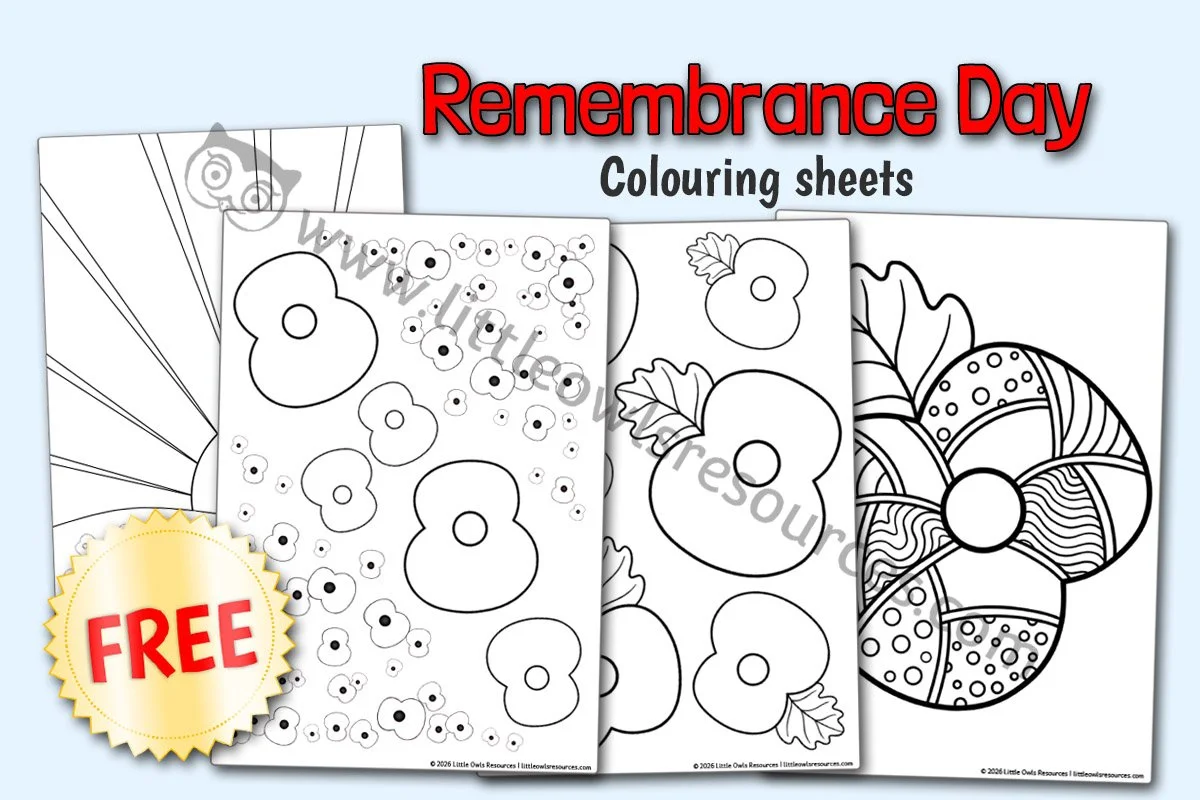
Poppy Colouring
Poppy Colouring. Offer a choice of colouring tools and encourage children’s own colour choices, with no requirement to copy a finished model.
View resource details →Keep exploring
- Reception Enhanced Provision Planning ToolkitOptional practitioner support: choose a purposeful addition to provision, decide what it may help children explore and notice whether it earns its place.
- Find more Reception resources →
📚 November KS1: Practical Learning & Provision — Year 1 & Year 2
This month’s focus: careful observation, purposeful reading and writing, comparing evidence and explaining choices.
Choose a few November connections that fit your current curriculum and the children’s interests. Fireworks, changing daylight, nocturnal animals, Diwali and Remembrance can provide contexts without making every lesson seasonal.
The Year 1 and Year 2 possibilities below are options to adapt, not a timetable or an expectation that every child works at the same level. Keep independent reading and spelling practice matched to what children have been taught.
Gather words for a fireworks poem
Use My Fireworks Senses Poem as an optional frame after looking at a still picture, sharing a drawing or talking about a remembered experience. Collect words and phrases aloud before deciding which ideas to keep. Children do not need to attend a display or listen to sound effects.
Year 1 children might rehearse a short line and record it using taught phonics, with help for unfamiliar spellings. Year 2 children could compare word choices, change the order of their lines and read the poem aloud to hear its effect. The poem does not need to rhyme; a child may choose to focus on colours and movement.
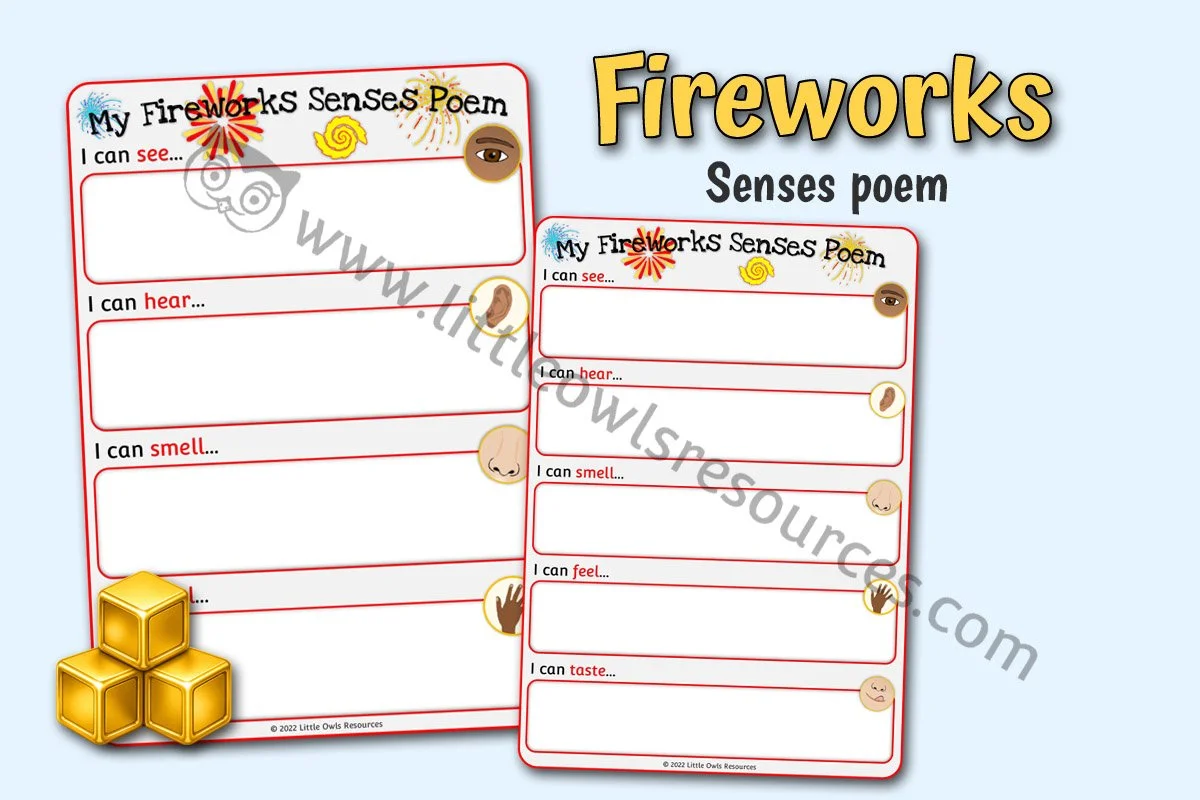
My Fireworks Senses Poem
Sensory poem prompts invite children to describe what they notice about fireworks. They can dictate a word, make marks, draw or complete a descriptive phrase; adults help collect the ideas into a poem without requiring rhyme.
View resource details →Notice how the days are changing
Return to one familiar, accessible viewpoint using Our Changing Year — Seasonal Observations & Day Length. Notice what is happening in your own surroundings: a tree, the weather, the light or something living nearby. Keep a dated drawing or photograph when it helps you compare visits.
Year 1 children could describe a change and compare today’s observation with an earlier record. Year 2 children might look across several records, explain what the evidence shows and identify something they still need to check. The pack’s daylight information can support adult-led discussion of changing day length. Do not assume every November day will look the same.
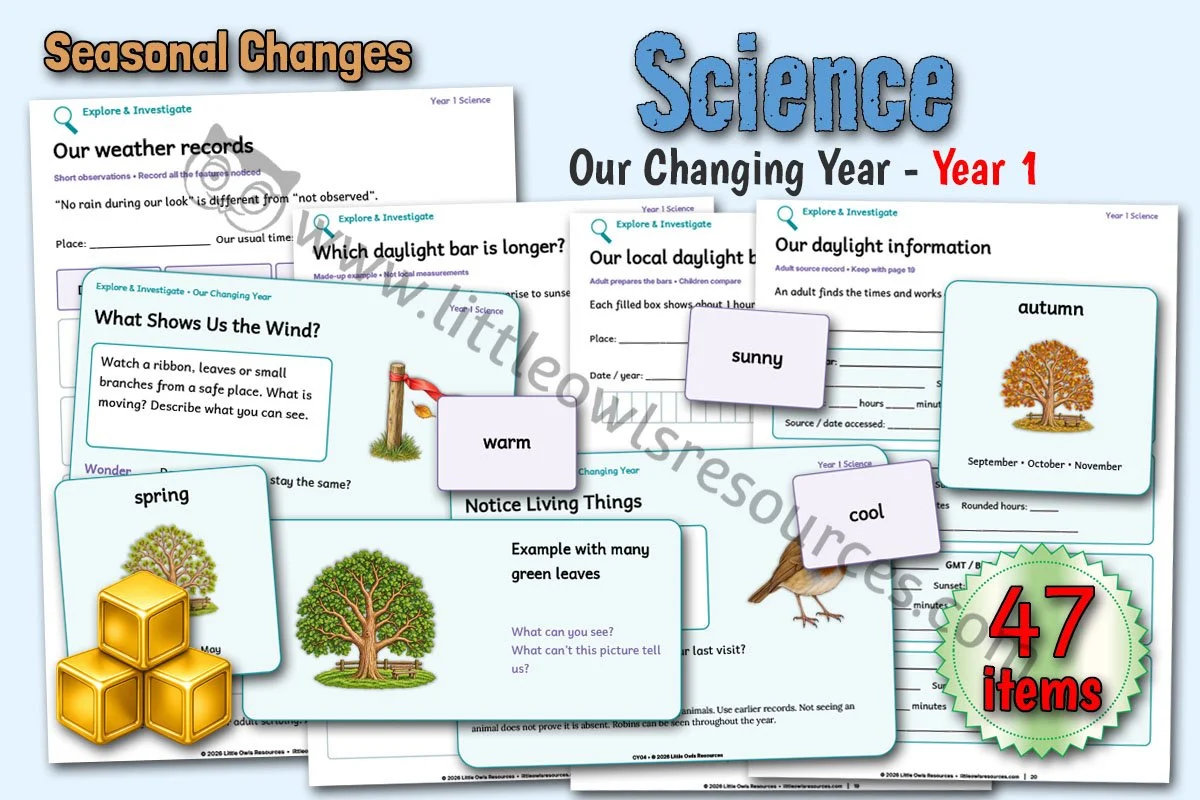
Our Changing Year — Seasonal Observations & Day Length
Revisit a familiar outdoor place to observe weather, living things and seasonal change. Begin with real examples and shared observations, then use the selected pictures or recording prompts to explain findings.
View resource details →Make a tally that answers a question
Use the Nocturnal Animals Tally Chart with a small, agreed selection of animal pictures. Decide exactly what you are counting, then make one mark for each picture as it is counted. This is a record of the chosen pictures, not evidence of how many wild animals live nearby.
Year 1 children might count the marks and compare two totals. Year 2 children could organise marks into groups of five when ready, then ask and answer questions about the completed chart. Check uncertain animal names together and use reliable information for discussion about day or night activity; recognising a picture alone does not establish an animal’s habits.

NOCTURNAL ANIMALS - Tally Chart (early data representation provision)
Nocturnal animals tally sheet designed for aiding the development of early data representation skills. Record observations with one mark per item, then compare totals and introduce tally groups when useful.
View resource details →Listen, sequence and retell a Diwali story — Free resource
Share the story represented in the free Diwali Story Sequence Colouring Cards before asking children to order any pictures. The cards depict the story of Rama and Sita, one story associated with Diwali. Use an appropriate shared account and welcome questions without assuming every family celebrates in the same way.
Year 1 children might select a few key pictures and rehearse the events orally. Year 2 children could explain how events connect, add useful story language and retell the sequence clearly to a partner. Colouring is optional. Adults should read the captions where needed: these story illustrations are not a phonically matched independent reading book.
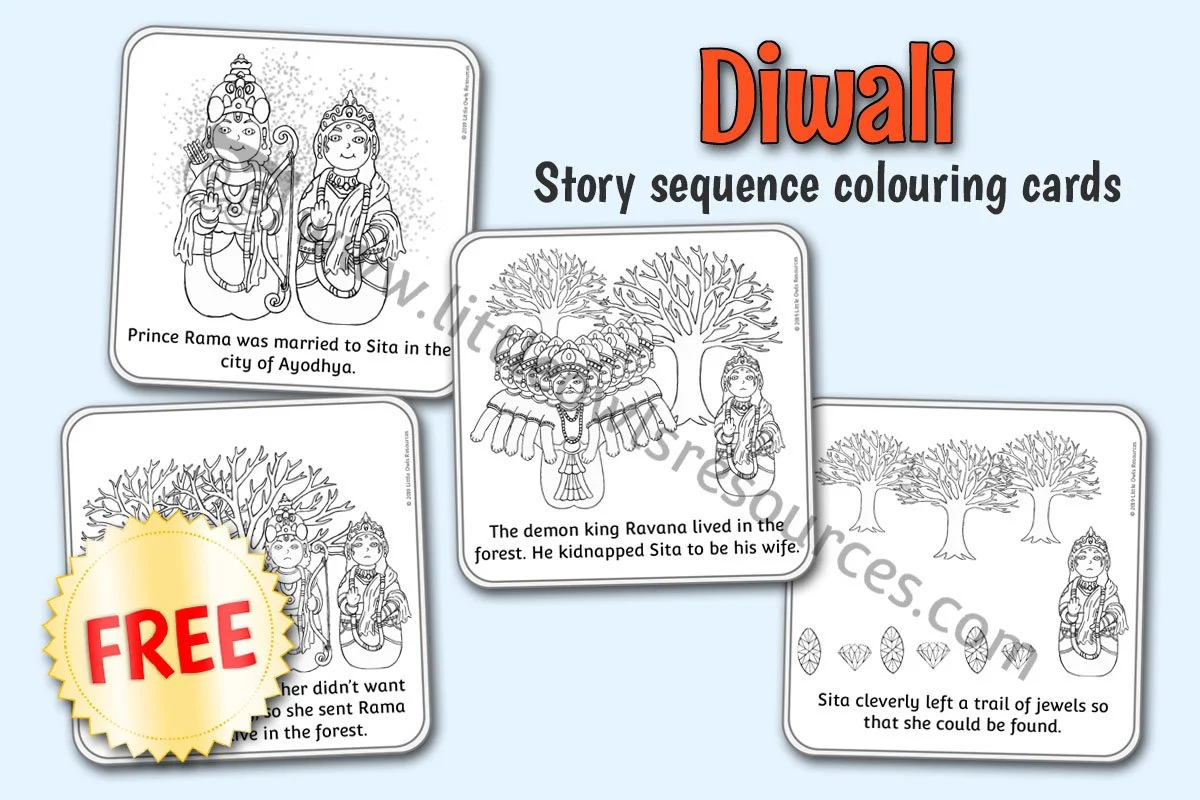
DIWALI STORY SEQUENCE COLOURING (FREE SAMPLE)
Large Diwali story pictures to colour and use in shared retelling. Adults can support the story language and select a manageable sequence of events.
View resource details →Choose a material for a job
Use selected pictures and prompts from Objects, Materials & Properties — Year 1 alongside real, manageable material samples. A November starting point might be choosing what could make a roof for a model shelter. Begin by looking, touching where appropriate and describing what the materials are like.
Year 1 children could identify the object and its material, then sort samples using an observable property. Year 2 children can revisit that vocabulary before comparing which material would suit the chosen job and explaining their reasons. This is selective consolidation using a Year 1 pack; extend the practical question to match current teaching rather than giving everyone the same worksheet.
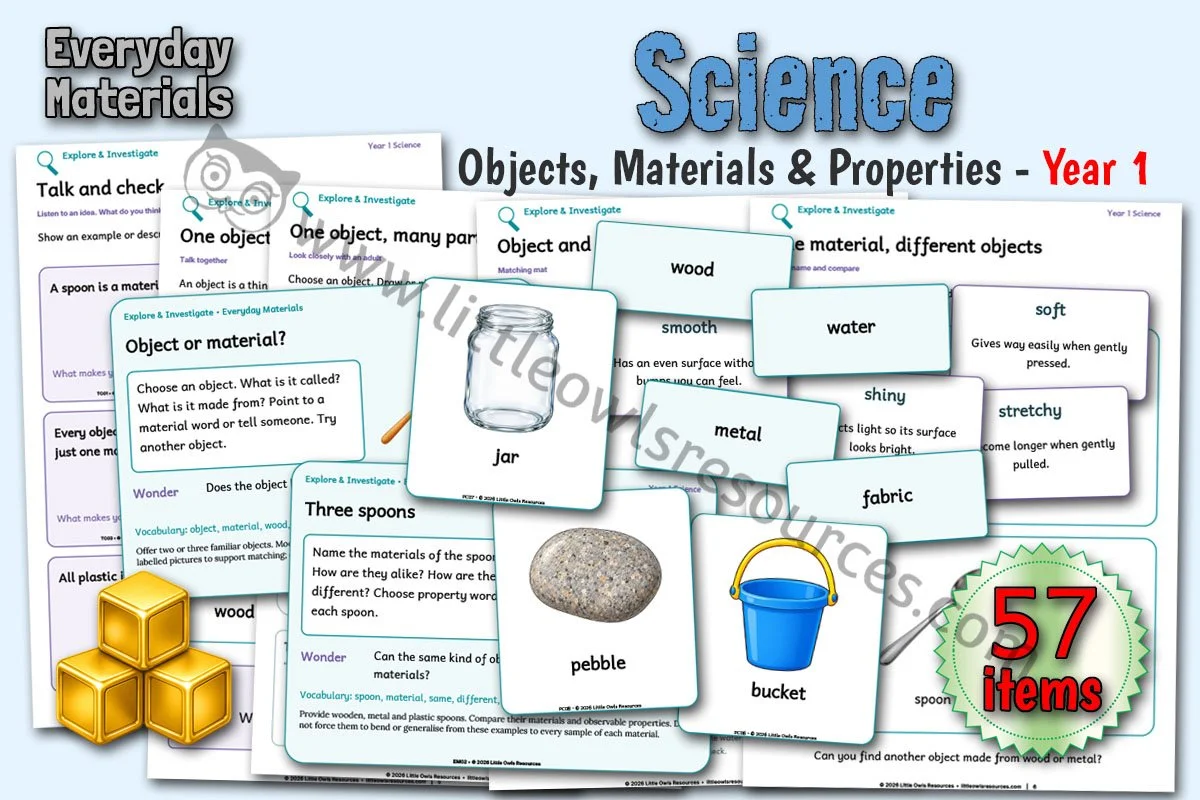
Objects, Materials & Properties — Year 1
Notice what real objects and building materials are made from, describe simple properties and sort samples by what children observe. Begin with real examples and shared observations, then use the selected pictures or recording prompts to explain findings.
View resource details →Make a thoughtful Remembrance message — Free resource
Begin with your setting’s sensitive, age-appropriate explanation of Remembrance before offering the free Remembrance Message Sheets & Cards. Children can choose drawing, a dictated idea or their own words to communicate something they have understood or a hope for peace. There is no need to ask for personal experiences of loss.
Year 1 children might rehearse one clear message and combine writing with an image. Year 2 children could explain a considered choice of words and read their message back to check that it says what they intend. The A5 and A4 formats are alternatives, not two tasks to finish. Respect children who prefer to listen or respond in another way.
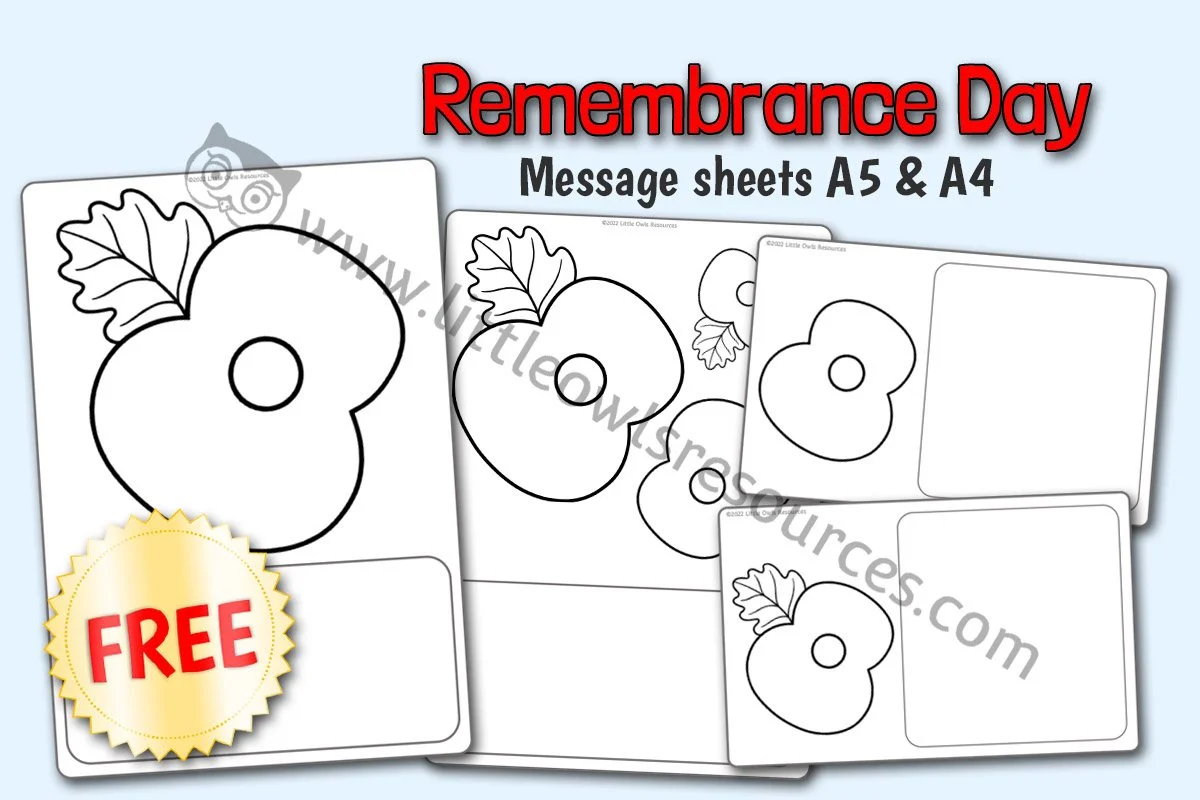
Remembrance Day - Message Sheets/Cards
These templates have detailed outlines to be used as a starting point for an art activity. Invite drawing and meaningful marks first; children can dictate an explanation or add words as their writing develops.
View resource details →Keep exploring
- KS1 Working Scientifically — Enquiry & Recording CompanionOptional All Access support: select a recording tool only when it helps children answer their practical science question.
- Key Stage 1 Hub
- Year 1 Resources (5–6 Years)
- Year 2 Resources (6–7 Years)
🏡 November Childminder & Mixed-Age Provision
This month’s focus: familiar routines, shared stories, considerate relationships and different ways to join in.
A shared song, a pretend shop or a place for a toy character can offer possibilities across ages. Keep the experience recognisable while changing the materials, adult support and level of challenge for each child.
You do not need a new activity for every special date. Leave useful provision available, protect babies’ and toddlers’ play space, and offer school-age children genuine choices about how they take part.
Return to a familiar rainy-day rhyme
Use the Incy Wincy Spider Puppets to revisit a familiar song during November’s nursery-rhyme connections or a rainy-day conversation. An adult can hold a puppet while singing slowly and pausing where children expect the next action. Repeat the rhyme when the group wants to hear it again.
A baby might enjoy the shared voice, face and movement; a toddler may gesture or add a sound. Preschool children can move the character, while older children can retell the sequence or lead a chosen verse. Keep cut-outs and puppet sticks in adult hands around babies and children who mouth objects. There is no requirement for everyone to sing or perform.

Incy Wincy Spider Puppets
Spider-song puppets for revisiting Incy Wincy Spider through singing, gestures and stories. Move the character as it climbs, falls and tries again.
View resource details →Open a small pretend Diwali sweet shop
If Diwali connects with your group’s learning, introduce the Diwali Sweet Shop Role-Play Pack through a suitable picture, story or conversation about celebrations. Choose just a few menus, sweet pictures, order forms or signs for a small pretend shop. Real food is not needed, and families need not be asked to represent a whole community.
A toddler might offer a picture or carry a large, suitable prop. Preschool children may negotiate roles, while school-age children write an order or plan a price within a familiar number range. Babies can share an adult’s talk and gaze nearby with their own suitable play materials. Adults read unfamiliar signs aloud and support each child’s chosen way of communicating.
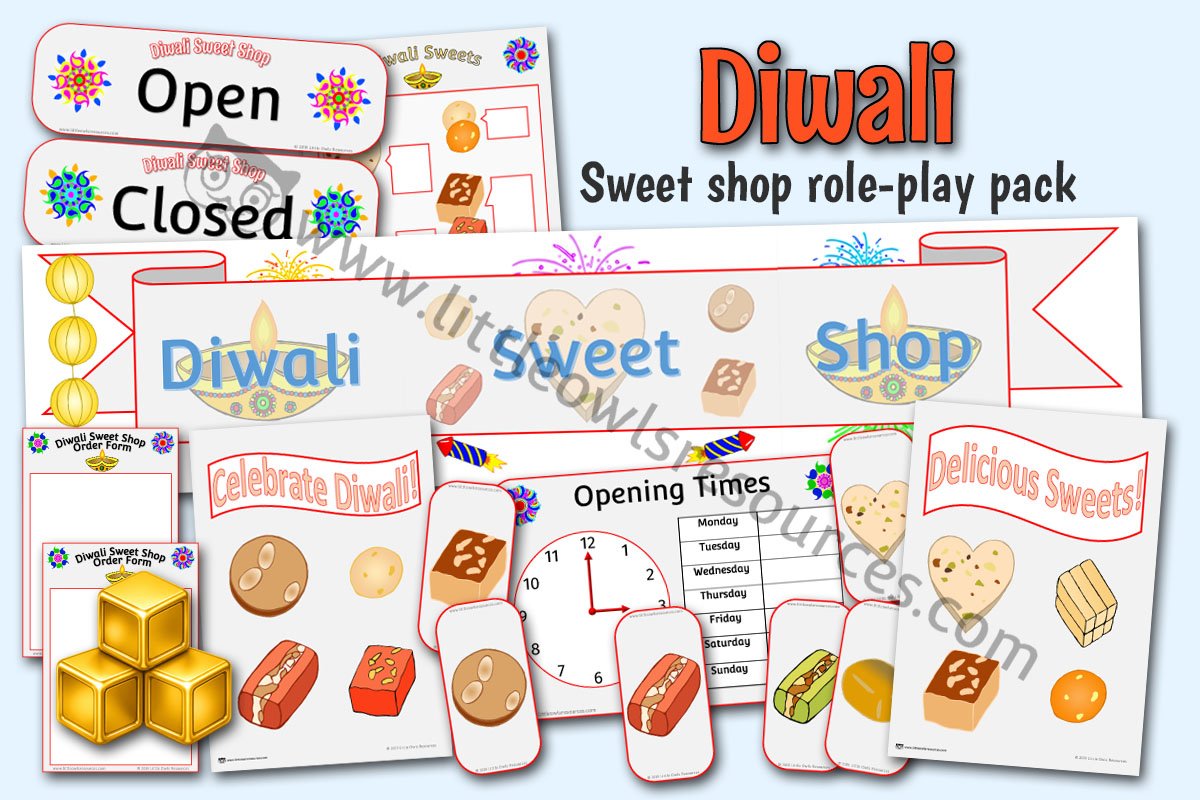
Diwali Sweet Shop Role-Play Pack
Set up a pretend Diwali sweet shop with menus, sweet pictures, order forms and opening signs. Children can negotiate purchases and make purposeful marks during play.
View resource details →Build a place for the story to happen
Choose an invitation from Homes, Shelters & Spaces when children want somewhere for a character to live, hide or meet a friend. Offer a manageable selection of blocks, fabric and familiar figures. The pack is primarily for Preschool and Reception, so select its prompts rather than treating every card as an activity for every age.
A toddler might explore a simple opening with large, suitable blocks; an older child can plan an entrance, compare possible roofs or explain a change to the design. Babies need a separate, suitable space and objects where small figures and older children’s constructions cannot be reached. Let the story change the building, and leave time to return to it.
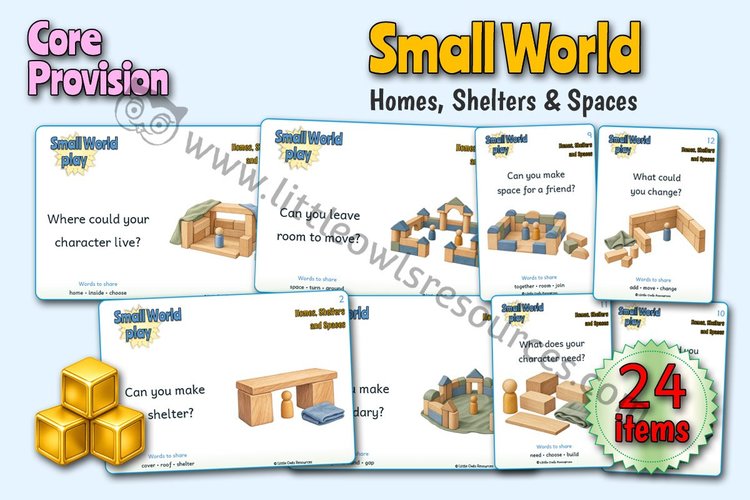
Homes, Shelters & Spaces
Invitations to make homes, entrances, boundaries and shelters with blocks, fabric and familiar figures. Children can test and change the design as their play develops.
View resource details →Move like the weather, in different ways
Choose one or two Weather Movement/Activity Challenge Cards after noticing the weather together. Invite children to suggest a movement, such as a gentle rain gesture or a slow stretch, and adapt the space and action so everyone who wants to can participate. Loud effects and large movements are optional.
A baby may watch an adult’s face and hands during a comfortable shared moment. A toddler might repeat one action, while a preschool child combines two. School-age children could arrange a short sequence and explain the order. Offer seated movements, pointing, watching or directing an adult as equally useful ways to join in. Pause or change the experience in response to the children.

Weather Movement/Activity Challenge Cards
Six weather movement cards invite children to act out different conditions. Use them for turn-taking group games, take a reduced set outdoors or sequence familiar actions into a weather dance.
View resource details →Make the next part of the day easier to understand
Busy celebrations, visitors or changes to the usual routine can make a familiar day feel different. Use the What’s Happening? First/Then or Now/Next boards with a few meaningful photographs or pictures to show what is happening now and what comes next. The picture cards are separate from this board resource.
Choose this support according to an individual child’s communication needs, not their age. A toddler might look with an adult; an older child could help choose the relevant picture or ask about a change. Keep speech, gesture and the child’s usual communication available. The board offers information and reassurance; it should not become a reward chart or require one activity to be earned by completing another.

PICTURE COMMUNICATION - What's Happening? Visual Support Boards - First/Then Now/Next
These visual support boards are to show the children the ‘ Now and Next ’ (or ‘ First and Then ’) for the activities of their day. Model relevant pictures alongside speech, gesture or the child’s usual communication, without requiring a particular way of responding.
View resource details →Notice a small act of kindness — Free resource
Use the free Acts of Kindness banner and note sheets to notice something concrete that helped another person: making room, bringing a needed object or listening to someone’s idea. An adult can model a simple comment and invite a drawing or a few words when a child wants to remember the moment.
For babies and toddlers, the starting point is the caring interaction itself; they do not need to produce a note. Preschool children may dictate or draw, while school-age children can explain how an action helped and suggest another considerate choice. Avoid comparisons, prizes or a tally of who has been kindest. Children may keep their response private rather than add it to a display.

‘Acts Of Kindness’ Activity And Display (Free Sample)
An “Acts of Kindness” banner and note sheets help create a shared display of kind deeds. Talk about a concrete example, record the child’s words or drawing and discuss how the action helped someone.
View resource details →Keep exploring
- Provision Rotation & Resource Selection Toolkit — ChildminderOptional All Access guidance for keeping useful resources, reducing clutter and choosing what to change in a shared home setting.
- Childminder Hub
Other November connections to explore
Choose connections that are meaningful to your children, families and curriculum. Use the linked calendar for this year's dates, and approach cultural and religious celebrations through accurate information and the experiences of the people who observe them.
Fireworks, colour and sound
Pictures, poetry, patterns and mark-making can connect with experiences children describe. A child does not need to attend a display or listen to loud sounds to take part.
Diwali
When Diwali falls in November, or connects with your families’ experiences, make space for their own accounts and use suitable stories and pictures to support understanding. Patterns and pretend play can sit alongside learning about the celebration, rather than stand in for it.
Remembrance
Choose gentle, age-appropriate ways to discuss remembering and appreciation where Remembrance is part of your setting's plans. For younger children, an adult may decide that the context is not relevant to their play.
World Nursery Rhyme Week
Return to favourite rhymes, share versions used at home and offer different ways to join in. Familiarity, repetition and enjoyment can matter more than learning a new rhyme every day.
Kindness and belonging
Use everyday opportunities to listen, include someone and seek help. Keep adult support and consistent responses at the centre; a themed activity does not replace responding to an individual concern.
St Andrew's Day and Scotland
Where there is a meaningful connection, explore Scotland through places, stories, music and people's experiences. Select a manageable starting point rather than trying to represent a whole country through one craft.
Keep exploration safe and accessible
Choose materials for the individual children using them, including their developmental stage and whether they mouth objects. Keep small parts, small natural finds and unsuitable materials out of reach. Supervision does not make an unsuitable material appropriate. Follow your setting's risk assessments and the instructions for equipment and materials.
Use child-appropriate light sources and ordinary room lighting for the suggested explorations. Keep battery compartments secure and inaccessible to children; avoid lasers, flames and flashing effects. Children can explore colour and shadow without a darkened room, loud sounds or an actual firework.
Offer different ways to participate: looking, moving, choosing, pointing, speaking, signing, using a communication aid or directing an adult. Adjust reach, space, tools and sensory demands. In a mixed-age group, provide separate suitable materials where needed and keep younger children's play space safe.
Looking ahead to December
If your setting or family is beginning to prepare Christmas cards or gifts, choose what fits the people taking part. Leave room for children’s own drawings, marks and creative choices, and keep preparation manageable.
A calendar template can provide space for a child’s own artwork. Offer an idea where it is useful without changing the whole environment or turning November into a list of things to finish.
Membership
All Access membership unlocks every resource on the site. Free Access lets you explore and download a selection of free resources.
Keep what is working
Notice what children return to, what support helps and what they want to explore next. Sometimes the most useful November plan is to keep a familiar opportunity available and give it more time.