

**Note: This page is for educational inspiration and is not officially affiliated with Outdoor Classroom Day. Outdoor Classroom Day is a global campaign to inspire and celebrate outdoor play and learning. It is led by Project Dirt and Save the Children. There are two designated days each year: in May and November. For official information and to learn more about the campaign, please visit their website (www.outdoorclassroomday.org.uk).
Thursday 20th May 2027 (TBC) & Thursday 5th November 2026
May & November (twice yearly)
-
Outdoor Classroom Day is a global campaign that celebrates and promotes learning outdoors. It encourages schools and early years settings to take learning beyond the classroom and recognise the value of outdoor environments for children’s development and wellbeing.
-
This theme provides rich opportunities to explore:
the natural world
physical development and movement
sensory experiences
problem-solving and exploration
environmental awareness
This supports:
EYFS
Physical Development (gross motor skills, coordination)
Understanding the World (nature, environments)
Characteristics of Effective Learning (exploration, thinking)
KS1 (National Curriculum):
Science (working scientifically, plants, seasonal change)
Geography (fieldwork, local environment)
PE (movement, coordination, outdoor activity)
-
In the EYFS, outdoor learning is not an “add-on” or special event.
It is:
a core part of everyday practice
embedded in continuous provision
led by children’s interests and exploration
👉 Find out more about developmentally appropriate practice in EYFS by exploring our ‘Curriculum & Pedagogy Suite’.
Pathways available for:
-
Learning outdoors supports:
🏃 Physical Development
Children develop strength, coordination and movement.
🌿 Sensory Exploration
Children experience varied textures, sounds and environments.
🧠 Problem-Solving & Creativity
Open-ended environments encourage thinking and imagination.
💪 Resilience & Risk Awareness
Children learn to manage challenge and build confidence.
🌍 Connection to Nature
Children develop respect and care for the natural world.
😊 Wellbeing
Outdoor time supports emotional regulation and happiness.
🌿 EYFS: Provision & Child-Led Ideas (0–5 Years)
These ideas are not activities to be planned or completed. They support learning through exploration, movement and real-world experience.
-
Exploration is sensory and relational.
Babies may:
experience outdoor sights, sounds and textures
observe movement (leaves, light, shadows)
respond to changes in environment
Adults can:
provide safe outdoor sensory experiences
narrate simple observations
support calm, shared exploration
👉 Additional curriculum & planning support for this age group may be found on our ‘EYFS Planning for Babies (0–18 Months)’ hub page.
-
Toddlers explore through movement and repetition.
Children may:
run, climb and transport objects
explore water, sand and natural materials
repeat actions and movements
Adults can:
allow freedom of movement
model simple language
support safe risk-taking
👉 Additional curriculum & planning support for this age group may be found on our ‘EYFS Planning for Toddlers (18–36 Months)’ hub page.
-
Children begin to explore ideas through play.
Children may:
investigate natural materials
engage in imaginative outdoor play
explore cause and effect
Adults can:
support curiosity through interaction
extend thinking through conversation
provide varied outdoor experiences
👉 Additional curriculum & planning support for this age group may be found on our ‘EYFS Planning for Preschool (3–4 Years)’ hub page.
-
Children deepen exploration and apply understanding.
Children may:
solve problems in outdoor contexts
explore patterns and relationships
use more complex language
Adults can:
support reasoning and explanation
introduce challenges through provision
extend learning through interaction
👉 Additional curriculum & planning support for this age group may be found on our ‘EYFS Planning for Reception (4–5 Years)’ hub page.
-
Outdoor learning is:
a way of learning
a way of experiencing the world
🌱 Environment Enhancements & Invitations (EYFS)
These are optional enhancements that may be added to outdoor provision if they align with children’s interests.
-
You might enhance provision by:
maintaining open-ended outdoor spaces
allowing movement, exploration and independence
providing access to varied materials
Resources that may support this include:
-
You might enhance provision by:
offering natural and open-ended materials (logs, sticks, crates)
allowing children to build and create freely
supporting problem-solving through play
-
You might enhance provision by:
providing water and sand play
allowing mixing, pouring and exploring
supporting sensory investigation
Resources that may support this include:
-
You might enhance provision by:
encouraging children to explore the environment
observing nature and seasonal change
allowing time for curiosity-led discovery
Resources that may support this include:
Scavenger hunt prompts
Observation cards
-
You might enhance provision by:
modelling language during outdoor play
responding to children’s ideas and discoveries
encouraging description and questioning
-
You might enhance provision by:
allowing appropriate challenge
supporting children to assess risk
encouraging independence
📘 KS1 Learning Activities for Outdoor Classroom Day
In Key Stage 1, outdoor learning can support structured learning across the curriculum.
-
Children can:
explore different learning areas outdoors
You may use our:
Outdoor Area Signs
“How Many Can Play” Signs
-
Children can:
observe and explore using their senses
You may use our:
Senses Prompt Cards (See/Hear)
Sound Exploration Cards
-
-
Children can:
apply maths in real environments
You may use our:
Outdoor Maths Activity Cards
Shape & Pattern Cards
-
Children can:
develop early writing skills
You may use our:
Outdoor Mark Making Cards
Sand writing resources
-
Children can:
explore through themed investigations
You may use our:
Dino Dig resources
Fossil finding activities
-
Children can:
explore scientific concepts
You may use our:
Float or Sink resources
Capacity Challenge Cards
Sea animal water play resources
-
Children can:
develop physical skills
You may use our:
Movement Prompt Cards
-
Children can:
integrate maths and literacy into play
You may use our:
Sand play writing and number cards
Treasure maps
-
You may wish to explore:
-
A helpful question: “Does this support meaningful outdoor exploration?”
If it supports:
movement
curiosity
real experiences
→ it is meaningful
-
Outdoor Classroom Day supports children to:
learn through movement and exploration
connect with nature
develop physical and cognitive skills
build confidence and resilience
In the EYFS, this is most effective when it is:
continuous
play-based
embedded in everyday practice
In KS1, it can be:
structured across the curriculum
enriched through outdoor contexts
-
We offer a range of resources to support practitioners across EYFS and KS1, including printable materials and in-depth curriculum and pedagogy guidance.
🟢 Free Membership
You can access a selection of free resources by creating a free account.
This includes:
selected printable resources
sample materials
weekly support emails for those who opt-in
🟡 Premium Membership (Printables)
Our Premium Membership provides access to our full library of printable teaching and provision resources.
This includes:
themed resources (e.g. Gardening, Emotions, Seasons)
continuous provision materials
activity cards, displays and printable packs
These resources can be used flexibly to support:
provision enhancements
small group work
classroom organisation
🟣 Professional Membership (Curriculum & Pedagogy)
Our Professional Membership provides access to our full Curriculum & Pedagogy Suite (Birth–5).
~ In addition to Premium Printable Provision access.~
This includes:
age-specific pathways (Babies, Toddlers, Preschool, Reception)
planning guidance and templates
observation and assessment support
SEND and inclusion guidance
inspection-ready documentation
These documents are designed to support:
confident decision-making
consistent practice across teams
clear articulation of EYFS pedagogy
(KS1 curriculum coming soon!)
👉 Visit EYFS Curriculum & Pedagogy Suite
👉 [View Professional Membership]
🧠 Choosing What Works for You
You do not need to use everything at once.
Many practitioners:
start with free resources
build their printable provision over time
use pedagogy documents to support team understanding and leadership
Choose what best fits your setting, role and stage of development.
👉 To explore more early years events, visit our Special Dates Calendar.
A selection of Printable resources to support teaching & learning surrounding: ‘Outdoor Classroom Day’
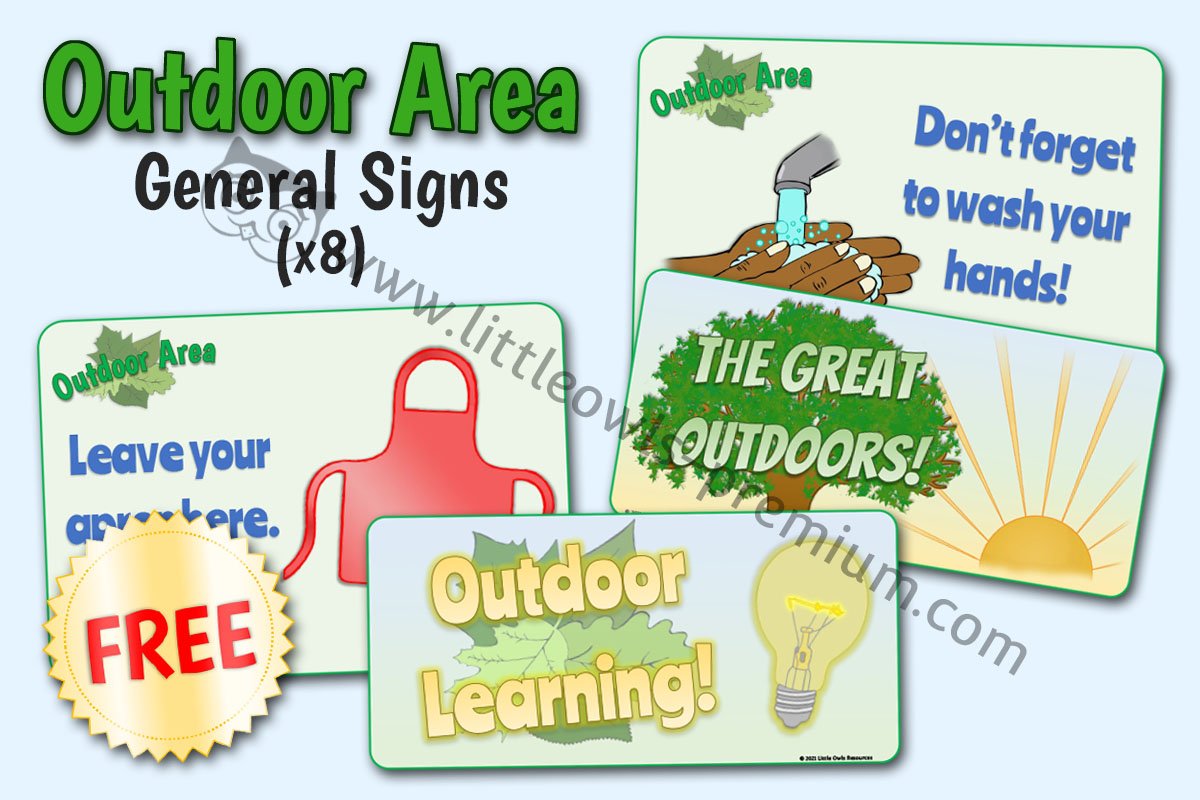
Pack of general outdoor area signs you may like to use in your outdoor area or garden.
Original artwork drawn by Sara Murphy and final digital resources created by Stuart Murphy. COPYRIGHT ON ALL OF THE RESOURCES HOUSED ON THIS WEBSITE IS HELD BY ‘LITTLE OWLS RESOURCES’. OUR RESOURCES (INCLUDING THE IMAGES WITHIN THEM), CANNOT BE SHARED OR SOLD COMMERCIALLY.
DOWNLOAD EDITABLE (DOCX)
DOWNLOAD NON-EDITABLE (PDF)
DOWNLOAD NON-EDITABLE (Zipped JPEGs)
<<-BACK TO ‘OUTDOOR AREA’ MENU

Original artwork drawn by Sara Murphy and final digital resources created by Stuart Murphy. COPYRIGHT ON ALL OF THE RESOURCES HOUSED ON THIS WEBSITE IS HELD BY ‘LITTLE OWLS RESOURCES’. OUR RESOURCES (INCLUDING THE IMAGES WITHIN THEM), CANNOT BE SHARED OR SOLD COMMERCIALLY.
DOWNLOAD EDITABLE (DOCX)
DOWNLOAD NON-EDITABLE (PDF)
DOWNLOAD NON-EDITABLE (Zipped JPEGs)
<<-BACK TO ‘OUTDOOR AREA’ MENU
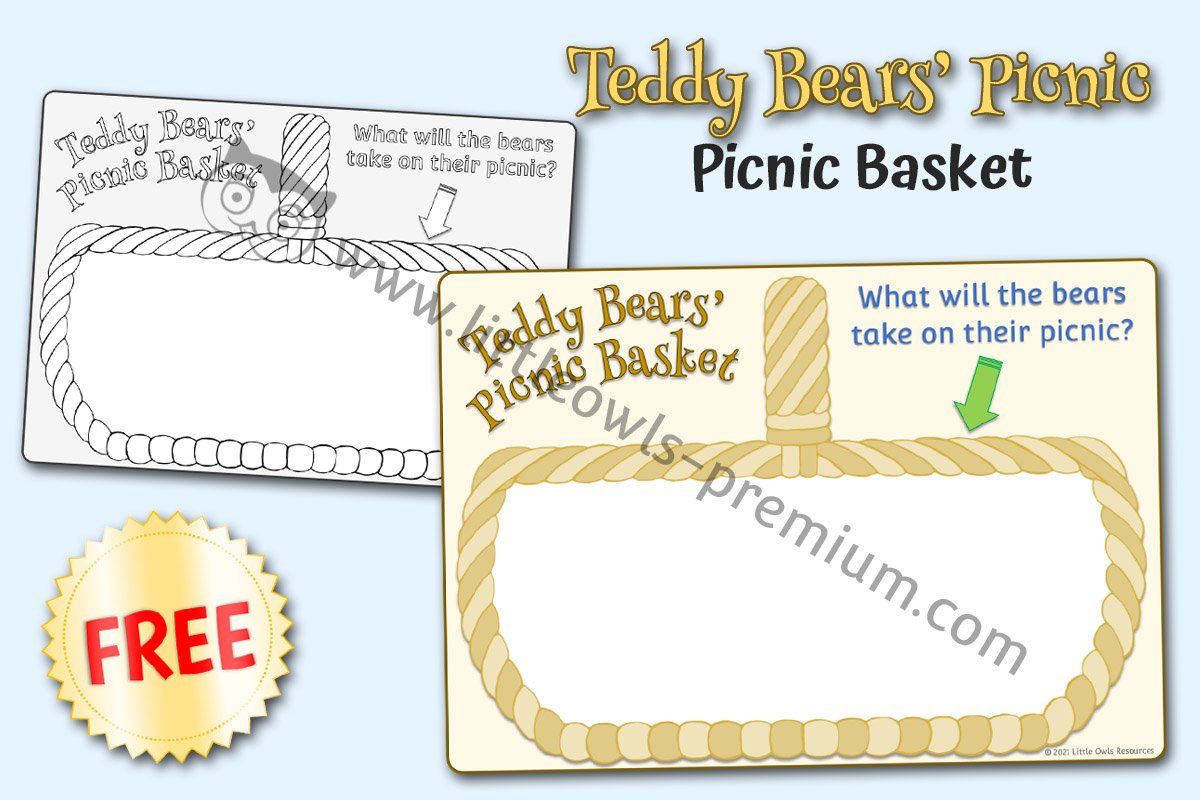
What will the bears take on their picnic?
These sheets can be used in the following ways:
Group Prompts to inspire discussion / communication and language skills and subsequent children’s art & craft work.
Printed for individual artwork use.
Laminated to be used repeatedly with whiteboard pens or as playdough mats.
Original artwork drawn by Sara Murphy and final digital resources created by Stuart Murphy. COPYRIGHT ON ALL OF THE RESOURCES HOUSED ON THIS WEBSITE IS HELD BY ‘LITTLE OWLS RESOURCES’. OUR RESOURCES (INCLUDING THE IMAGES WITHIN THEM), CANNOT BE SHARED OR SOLD COMMERCIALLY.
DOWNLOAD EDITABLE (DOCX)
DOWNLOAD NON-EDITABLE (PDF)
DOWNLOAD NON-EDITABLE (Zipped JPEGs)
<<-BACK TO ‘TEDDY BEARS’ PICNIC’ MENU

Perfect for ‘Teddy Bears’ Picnic’ role-play.
Here’s how to create them:
Prepare a loop of paper to fit the child’s head.
Cut out the desired ears and stick to the paper loop.
Wear the bear ears to the picnic!
Original artwork drawn by Sara Murphy and final digital resources created by Stuart Murphy. COPYRIGHT ON ALL OF THE RESOURCES HOUSED ON THIS WEBSITE IS HELD BY ‘LITTLE OWLS RESOURCES’. OUR RESOURCES (INCLUDING THE IMAGES WITHIN THEM), CANNOT BE SHARED OR SOLD COMMERCIALLY.
DOWNLOAD EDITABLE (DOCX)
DOWNLOAD NON-EDITABLE (PDF)
DOWNLOAD NON-EDITABLE (Zipped JPEGs)
<<-BACK TO ‘TEDDY BEARS’ PICNIC’ MENU

These number challenge mats can be laminated to be used repeatedly with whiteboard pens or playdough.
Original artwork drawn by Sara Murphy and final digital resources created by Stuart Murphy. COPYRIGHT ON ALL OF THE RESOURCES HOUSED ON THIS WEBSITE IS HELD BY ‘LITTLE OWLS RESOURCES’. OUR RESOURCES (INCLUDING THE IMAGES WITHIN THEM), CANNOT BE SHARED OR SOLD COMMERCIALLY.
DOWNLOAD EDITABLE (DOCX)
DOWNLOAD NON-EDITABLE (PDF)
DOWNLOAD NON-EDITABLE (Zipped JPEGs)
<<-BACK TO ‘TEDDY BEARS’ PICNIC’ MENU

Pack of 19 area signs you may like to use in your outdoor area or garden.
Original artwork drawn by Sara Murphy and final digital resources created by Stuart Murphy. COPYRIGHT ON ALL OF THE RESOURCES HOUSED ON THIS WEBSITE IS HELD BY ‘LITTLE OWLS RESOURCES’. OUR RESOURCES (INCLUDING THE IMAGES WITHIN THEM), CANNOT BE SHARED OR SOLD COMMERCIALLY.
DOWNLOAD EDITABLE (DOCX)
DOWNLOAD NON-EDITABLE (PDF)
DOWNLOAD NON-EDITABLE (Zipped JPEGs)

Pack of 19 thin area signs you may like to use in your outdoor area or garden.
Original artwork drawn by Sara Murphy and final digital resources created by Stuart Murphy. COPYRIGHT ON ALL OF THE RESOURCES HOUSED ON THIS WEBSITE IS HELD BY ‘LITTLE OWLS RESOURCES’. OUR RESOURCES (INCLUDING THE IMAGES WITHIN THEM), CANNOT BE SHARED OR SOLD COMMERCIALLY.
DOWNLOAD EDITABLE (DOCX)
DOWNLOAD NON-EDITABLE (PDF)
DOWNLOAD NON-EDITABLE (Zipped JPEGs)

Pack of 19 A4 ‘How many can play’ area signs you may like to use in your outdoor area or garden.
Original artwork drawn by Sara Murphy and final digital resources created by Stuart Murphy. COPYRIGHT ON ALL OF THE RESOURCES HOUSED ON THIS WEBSITE IS HELD BY ‘LITTLE OWLS RESOURCES’. OUR RESOURCES (INCLUDING THE IMAGES WITHIN THEM), CANNOT BE SHARED OR SOLD COMMERCIALLY.
DOWNLOAD EDITABLE (DOCX)
DOWNLOAD NON-EDITABLE (PDF)
DOWNLOAD NON-EDITABLE (Zipped JPEGs)

Pack of general outdoor area signs you may like to use in your outdoor area or garden.
Original artwork drawn by Sara Murphy and final digital resources created by Stuart Murphy. COPYRIGHT ON ALL OF THE RESOURCES HOUSED ON THIS WEBSITE IS HELD BY ‘LITTLE OWLS RESOURCES’. OUR RESOURCES (INCLUDING THE IMAGES WITHIN THEM), CANNOT BE SHARED OR SOLD COMMERCIALLY.
DOWNLOAD EDITABLE (DOCX)
DOWNLOAD NON-EDITABLE (PDF)
DOWNLOAD NON-EDITABLE (Zipped JPEGs)

Pack of 20 ‘Can you make this sound?’ prompt cards. Ideal for outdoor play problem solving, observation and inspiring exploration!
These prompt cards are to be used to encourage sound making in the outdoor area.
The accompanying pictures are just an example for inspiration. The children can make the sounds however they like!
DOWNLOAD (DOCX)
DOWNLOAD (PDF)
DOWNLOAD (Zipped JPEGs)

Pack of 20 ‘Construction’ prompt cards. Ideal for outdoor play, fine and gross motor skills and building imagination!
These prompt cards are to be used as a starting point for construction and imagination in the outdoor area!
Original artwork drawn by Sara Murphy and final digital resources created by Stuart Murphy. COPYRIGHT ON ALL OF THE RESOURCES HOUSED ON THIS WEBSITE IS HELD BY ‘LITTLE OWLS RESOURCES’. OUR RESOURCES (INCLUDING THE IMAGES WITHIN THEM), CANNOT BE SHARED OR SOLD COMMERCIALLY.
DOWNLOAD EDITABLE (DOCX)
DOWNLOAD NON-EDITABLE (PDF)
DOWNLOAD NON-EDITABLE (Zipped JPEGs)

Pack of 20 ‘Can you see?’ prompt cards. Ideal for outdoor play mindfulness, observation and inspiring exploration!
These prompt cards are to promote awareness of surroundings when in an outdoor play setting. This activity is intended to help children engage their senses to better notice and appreciate what they see around them.
Original artwork drawn by Sara Murphy and final digital resources created by Stuart Murphy. COPYRIGHT ON ALL OF THE RESOURCES HOUSED ON THIS WEBSITE IS HELD BY ‘LITTLE OWLS RESOURCES’. OUR RESOURCES (INCLUDING THE IMAGES WITHIN THEM), CANNOT BE SHARED OR SOLD COMMERCIALLY.
DOWNLOAD EDITABLE (DOCX)
DOWNLOAD NON-EDITABLE (PDF)
DOWNLOAD NON-EDITABLE (Zipped JPEGs)

Pack of 14 ‘Can you hear?’ prompt cards. Ideal for outdoor play, mindfulness, observation and inspiring exploration!
These prompt cards are to promote awareness of surroundings when in an outdoor play setting. This activity is intended to help children engage their senses to better notice and appreciate what they hear around them.
Original artwork drawn by Sara Murphy and final digital resources created by Stuart Murphy. COPYRIGHT ON ALL OF THE RESOURCES HOUSED ON THIS WEBSITE IS HELD BY ‘LITTLE OWLS RESOURCES’. OUR RESOURCES (INCLUDING THE IMAGES WITHIN THEM), CANNOT BE SHARED OR SOLD COMMERCIALLY.
DOWNLOAD EDITABLE (DOCX)
DOWNLOAD NON-EDITABLE (PDF)
DOWNLOAD NON-EDITABLE (Zipped JPEGs)

Pack of 14 ‘Movement’ prompt cards. Ideal for outdoor play, gross motor skills and physical activity!
These prompt cards are to be used as visual inspiration for getting the children moving in the outdoor area!
Original artwork drawn by Sara Murphy and final digital resources created by Stuart Murphy. COPYRIGHT ON ALL OF THE RESOURCES HOUSED ON THIS WEBSITE IS HELD BY ‘LITTLE OWLS RESOURCES’. OUR RESOURCES (INCLUDING THE IMAGES WITHIN THEM), CANNOT BE SHARED OR SOLD COMMERCIALLY.
DOWNLOAD EDITABLE (DOCX)
DOWNLOAD NON-EDITABLE (PDF)
DOWNLOAD NON-EDITABLE (Zipped JPEGs)

Original artwork drawn by Sara Murphy and final digital resources created by Stuart Murphy. COPYRIGHT ON ALL OF THE RESOURCES HOUSED ON THIS WEBSITE IS HELD BY ‘LITTLE OWLS RESOURCES’. OUR RESOURCES (INCLUDING THE IMAGES WITHIN THEM), CANNOT BE SHARED OR SOLD COMMERCIALLY.
DOWNLOAD EDITABLE (DOCX)
DOWNLOAD NON-EDITABLE (PDF)
DOWNLOAD NON-EDITABLE (Zipped JPEGs)

Original artwork drawn by Sara Murphy and final digital resources created by Stuart Murphy. COPYRIGHT ON ALL OF THE RESOURCES HOUSED ON THIS WEBSITE IS HELD BY ‘LITTLE OWLS RESOURCES’. OUR RESOURCES (INCLUDING THE IMAGES WITHIN THEM), CANNOT BE SHARED OR SOLD COMMERCIALLY.
DOWNLOAD EDITABLE (DOCX)
DOWNLOAD NON-EDITABLE (PDF)
DOWNLOAD NON-EDITABLE (Zipped JPEGs)

Original artwork drawn by Sara Murphy and final digital resources created by Stuart Murphy. COPYRIGHT ON ALL OF THE RESOURCES HOUSED ON THIS WEBSITE IS HELD BY ‘LITTLE OWLS RESOURCES’. OUR RESOURCES (INCLUDING THE IMAGES WITHIN THEM), CANNOT BE SHARED OR SOLD COMMERCIALLY.
DOWNLOAD EDITABLE (DOCX)
DOWNLOAD NON-EDITABLE (PDF)
DOWNLOAD NON-EDITABLE (Zipped JPEGs)
Original artwork drawn by Sara Murphy and final digital resources created by Stuart Murphy. COPYRIGHT ON ALL OF THE RESOURCES HOUSED ON THIS WEBSITE IS HELD BY ‘LITTLE OWLS RESOURCES’. OUR RESOURCES (INCLUDING THE IMAGES WITHIN THEM), CANNOT BE SHARED OR SOLD COMMERCIALLY.
DOWNLOAD EDITABLE (DOCX)
DOWNLOAD NON-EDITABLE (PDF)
DOWNLOAD NON-EDITABLE (Zipped JPEGs)

Original artwork drawn by Sara Murphy and final digital resources created by Stuart Murphy. COPYRIGHT ON ALL OF THE RESOURCES HOUSED ON THIS WEBSITE IS HELD BY ‘LITTLE OWLS RESOURCES’. OUR RESOURCES (INCLUDING THE IMAGES WITHIN THEM), CANNOT BE SHARED OR SOLD COMMERCIALLY.
DOWNLOAD EDITABLE (DOCX)
DOWNLOAD NON-EDITABLE (PDF)
DOWNLOAD NON-EDITABLE (Zipped JPEGs)

Original artwork drawn by Sara Murphy and final digital resources created by Stuart Murphy. COPYRIGHT ON ALL OF THE RESOURCES HOUSED ON THIS WEBSITE IS HELD BY ‘LITTLE OWLS RESOURCES’. OUR RESOURCES (INCLUDING THE IMAGES WITHIN THEM), CANNOT BE SHARED OR SOLD COMMERCIALLY.
DOWNLOAD EDITABLE (DOCX)
DOWNLOAD NON-EDITABLE (PDF)
DOWNLOAD NON-EDITABLE (Zipped JPEGs)

These activity cards provide ideas to encourage and facilitate mathematical development in the outdoor area. They can be used as a planning tool as well as at the moment of the activity.
This pack is aimed at the Birth to 3 age group. The descriptions are intended for the adult to read, with the bright colourful images there to provide visual reminders for the child where appropriate.
Original artwork drawn by Sara Murphy and final digital resources created by Stuart Murphy. COPYRIGHT ON ALL OF THE RESOURCES HOUSED ON THIS WEBSITE IS HELD BY ‘LITTLE OWLS RESOURCES’. OUR RESOURCES (INCLUDING THE IMAGES WITHIN THEM), CANNOT BE SHARED OR SOLD COMMERCIALLY.
DOWNLOAD EDITABLE (DOCX)
DOWNLOAD NON-EDITABLE (PDF)
DOWNLOAD NON-EDITABLE (Zipped JPEGs)

These cards are intended to be used as a stimulus for making shapes with natural materials in the outdoor area.
Extensions could include asking what other shapes the children could make or what other materials could they use.
Original artwork drawn by Sara Murphy and final digital resources created by Stuart Murphy. COPYRIGHT ON ALL OF THE RESOURCES HOUSED ON THIS WEBSITE IS HELD BY ‘LITTLE OWLS RESOURCES’. OUR RESOURCES (INCLUDING THE IMAGES WITHIN THEM), CANNOT BE SHARED OR SOLD COMMERCIALLY.
DOWNLOAD EDITABLE (DOCX)
DOWNLOAD NON-EDITABLE (PDF)
DOWNLOAD NON-EDITABLE (Zipped JPEGs)

These cards are intended to be cut and laminated before being given as a pattern making challenge in the outdoor area.
Encourage the children to look at the card patterns and try to recreate them using real life elements that are found or provided.
Original artwork drawn by Sara Murphy and final digital resources created by Stuart Murphy. COPYRIGHT ON ALL OF THE RESOURCES HOUSED ON THIS WEBSITE IS HELD BY ‘LITTLE OWLS RESOURCES’. OUR RESOURCES (INCLUDING THE IMAGES WITHIN THEM), CANNOT BE SHARED OR SOLD COMMERCIALLY.
DOWNLOAD EDITABLE (DOCX)
DOWNLOAD NON-EDITABLE (PDF)
DOWNLOAD NON-EDITABLE (Zipped JPEGs)

These cards can be laminated for repeated use. Each of the six minibeasts has a dotted line card and a card with a blank space.
Use the laminated cards with whiteboard pens or alternatively use the first card as stimulus e.g. in your outdoor area with chalk or water painting on paving stones or sand in your sand tray.
Original artwork drawn by Sara Murphy and final digital resources created by Stuart Murphy. COPYRIGHT ON ALL OF THE RESOURCES HOUSED ON THIS WEBSITE IS HELD BY ‘LITTLE OWLS RESOURCES’. OUR RESOURCES (INCLUDING THE IMAGES WITHIN THEM), CANNOT BE SHARED OR SOLD COMMERCIALLY.
DOWNLOAD EDITABLE (DOCX)
DOWNLOAD NON-EDITABLE (PDF)
DOWNLOAD NON-EDITABLE (Zipped JPEGs)

Pack of 26 word cards you may like to use to enhance learning through play within your mud kitchen area. Blank cards are also included for you and/or your children to make your own.
Original artwork drawn by Sara Murphy and final digital resources created by Stuart Murphy. COPYRIGHT ON ALL OF THE RESOURCES HOUSED ON THIS WEBSITE IS HELD BY ‘LITTLE OWLS RESOURCES’. OUR RESOURCES (INCLUDING THE IMAGES WITHIN THEM), CANNOT BE SHARED OR SOLD COMMERCIALLY.
DOWNLOAD EDITABLE (DOCX)
DOWNLOAD NON-EDITABLE (PDF)
DOWNLOAD NON-EDITABLE (Zipped JPEGs)

Pack of 5 ingredient challenge cards (plus a blank one) you may like to use to enhance learning through play within your mud kitchen area.
Ideally cards are to be laminated in order for you to write appropriate numbers for individual children/groups of children in each square using a whiteboard pen. The cards can then be repeatedly used all year round.
Original artwork drawn by Sara Murphy and final digital resources created by Stuart Murphy. COPYRIGHT ON ALL OF THE RESOURCES HOUSED ON THIS WEBSITE IS HELD BY ‘LITTLE OWLS RESOURCES’. OUR RESOURCES (INCLUDING THE IMAGES WITHIN THEM), CANNOT BE SHARED OR SOLD COMMERCIALLY.
DOWNLOAD EDITABLE (DOCX)
DOWNLOAD NON-EDITABLE (PDF)
DOWNLOAD NON-EDITABLE (Zipped JPEGs)

These A5 and A4 ‘Recipe Ingredient Cards’ are designed to be printed for single use or laminated for multiple uses to enhance learning through play in your mud kitchen area.
Numbers can be written into each box to denote the quantity of each ingredient required. Numbers can be written by either an adult or child.
Original artwork drawn by Sara Murphy and final digital resources created by Stuart Murphy. COPYRIGHT ON ALL OF THE RESOURCES HOUSED ON THIS WEBSITE IS HELD BY ‘LITTLE OWLS RESOURCES’. OUR RESOURCES (INCLUDING THE IMAGES WITHIN THEM), CANNOT BE SHARED OR SOLD COMMERCIALLY.
DOWNLOAD EDITABLE (DOCX)
DOWNLOAD NON-EDITABLE (PDF)
DOWNLOAD NON-EDITABLE (Zipped JPEGs)

These ‘Ingredients Lists’ are designed to be printed for single use or laminated for multiple uses to enhance learning through play in your mud kitchen area.
Ingredients can be written and/or drawn onto each proforma by either an adult or child.
Original artwork drawn by Sara Murphy and final digital resources created by Stuart Murphy. COPYRIGHT ON ALL OF THE RESOURCES HOUSED ON THIS WEBSITE IS HELD BY ‘LITTLE OWLS RESOURCES’. OUR RESOURCES (INCLUDING THE IMAGES WITHIN THEM), CANNOT BE SHARED OR SOLD COMMERCIALLY.
DOWNLOAD EDITABLE (DOCX)
DOWNLOAD NON-EDITABLE (PDF)
DOWNLOAD NON-EDITABLE (Zipped JPEGs)

Can you place pom poms or other loose parts on the multicoloured circles? Great for fine motor control and developing a pincer grip. Why not also introduce tools such as child tweezers? Have fun!
Original artwork drawn by Sara Murphy and final digital resources created by Stuart Murphy. COPYRIGHT ON ALL OF THE RESOURCES HOUSED ON THIS WEBSITE IS HELD BY ‘LITTLE OWLS RESOURCES’. OUR RESOURCES (INCLUDING THE IMAGES WITHIN THEM), CANNOT BE SHARED OR SOLD COMMERCIALLY.
DOWNLOAD EDITABLE (DOCX)
DOWNLOAD NON-EDITABLE (PDF)
DOWNLOAD NON-EDITABLE (Zipped JPEGs)

Pack of signs you may like to use to enhance organisation and independence through picture communication within your mud kitchen area.
Original artwork drawn by Sara Murphy and final digital resources created by Stuart Murphy. COPYRIGHT ON ALL OF THE RESOURCES HOUSED ON THIS WEBSITE IS HELD BY ‘LITTLE OWLS RESOURCES’. OUR RESOURCES (INCLUDING THE IMAGES WITHIN THEM), CANNOT BE SHARED OR SOLD COMMERCIALLY.
DOWNLOAD EDITABLE (DOCX)
DOWNLOAD NON-EDITABLE (PDF)
DOWNLOAD NON-EDITABLE (Zipped JPEGs)

These ‘Mud Menu’ proformas are designed to be printed for single use or laminated for multiple uses to enhance learning through play in your mud kitchen area.
Invented dishes can be written and/or drawn onto each proforma by either an adult or child.
Either…
…an adult may like to draw and name a dish giving inspiration for a child to create their interpretation of it
…or a child may like to experiment with creating their own dish(es) and invent their own name(s) and make marks to record it/them on the sheet once created.
Original artwork drawn by Sara Murphy and final digital resources created by Stuart Murphy. COPYRIGHT ON ALL OF THE RESOURCES HOUSED ON THIS WEBSITE IS HELD BY ‘LITTLE OWLS RESOURCES’. OUR RESOURCES (INCLUDING THE IMAGES WITHIN THEM), CANNOT BE SHARED OR SOLD COMMERCIALLY.
DOWNLOAD EDITABLE (DOCX)
DOWNLOAD NON-EDITABLE (PDF)
DOWNLOAD NON-EDITABLE (Zipped JPEGs)

These ‘My Mud Kitchen Creation!’ proformas are designed to be printed for single use or laminated for multiple uses to enhance learning through play in your mud kitchen area.
Once children have experimented with creating their own mud kitchen dish, why not encourage them to make marks/draw and/or write about their creation using the most appropriate sheet for them within this pack?
Original artwork drawn by Sara Murphy and final digital resources created by Stuart Murphy. COPYRIGHT ON ALL OF THE RESOURCES HOUSED ON THIS WEBSITE IS HELD BY ‘LITTLE OWLS RESOURCES’. OUR RESOURCES (INCLUDING THE IMAGES WITHIN THEM), CANNOT BE SHARED OR SOLD COMMERCIALLY.
DOWNLOAD EDITABLE (DOCX)
DOWNLOAD NON-EDITABLE (PDF)
DOWNLOAD NON-EDITABLE (Zipped JPEGs)

This ‘My Mud Kitchen Recipe Book’ proforma is designed to be printed for single use or laminated for multiple uses to enhance learning through play in your mud kitchen area.
Once children have experimented with creating their own mud kitchen dish, why not encourage them to make marks/draw and/or write about their recipe using the sheets within this book?
Original artwork drawn by Sara Murphy and final digital resources created by Stuart Murphy. COPYRIGHT ON ALL OF THE RESOURCES HOUSED ON THIS WEBSITE IS HELD BY ‘LITTLE OWLS RESOURCES’. OUR RESOURCES (INCLUDING THE IMAGES WITHIN THEM), CANNOT BE SHARED OR SOLD COMMERCIALLY.
DOWNLOAD EDITABLE (DOCX)
DOWNLOAD NON-EDITABLE (PDF)
DOWNLOAD NON-EDITABLE (Zipped JPEGs)

Print the cards that match the items you have in your setting and then write a number in the white box if desired.
Hide the items in the sand and then the children can use the cards as a finding challenge.
The children could also set challenges for each other using a whiteboard open to write numbers on the laminated cards.
N.B. As ever please do risk assess the items you use within your setting for your particular children. For example smaller objects such as buttons may not be appropriate for your youngest children.
Original artwork drawn by Sara Murphy and final digital resources created by Stuart Murphy. COPYRIGHT ON ALL OF THE RESOURCES HOUSED ON THIS WEBSITE IS HELD BY ‘LITTLE OWLS RESOURCES’. OUR RESOURCES (INCLUDING THE IMAGES WITHIN THEM), CANNOT BE SHARED OR SOLD COMMERCIALLY.
DOWNLOAD EDITABLE (DOCX)
DOWNLOAD NON-EDITABLE (PDF)
DOWNLOAD NON-EDITABLE (Zipped JPEGs)

These maps have blank centres for children to draw the sand tray and mark where they have hidden their treasure.
They can then challenge a friend to find the treasure using the map to guide them!
You may also like o encourage the use of positional language such as next to, under, on top, beside, left, right, behind, etc.
Original artwork drawn by Sara Murphy and final digital resources created by Stuart Murphy. COPYRIGHT ON ALL OF THE RESOURCES HOUSED ON THIS WEBSITE IS HELD BY ‘LITTLE OWLS RESOURCES’. OUR RESOURCES (INCLUDING THE IMAGES WITHIN THEM), CANNOT BE SHARED OR SOLD COMMERCIALLY.
DOWNLOAD EDITABLE (DOCX)
DOWNLOAD NON-EDITABLE (PDF)
DOWNLOAD NON-EDITABLE (Zipped JPEGs)
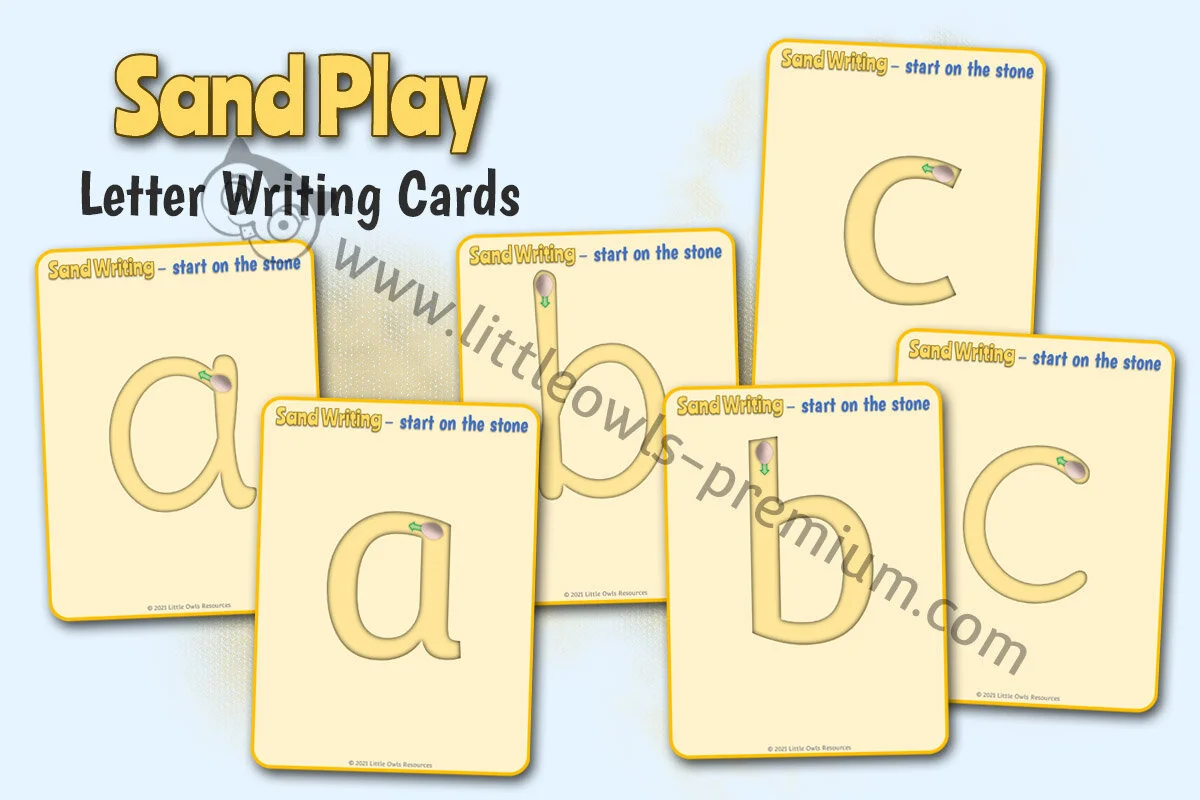
These cards are intended to be used to aid letter formation practice in wet sand. The writing could be attempted with a finger or a stick/pencil. A stone marks the spot where the writing of each letter should begin.
N.B. The pack includes two different font types for the letters: (p2-14) & (p15-27) (But don’t forget if you choose the editable docx file, you can change the font!)
Original artwork drawn by Sara Murphy and final digital resources created by Stuart Murphy. COPYRIGHT ON ALL OF THE RESOURCES HOUSED ON THIS WEBSITE IS HELD BY ‘LITTLE OWLS RESOURCES’. OUR RESOURCES (INCLUDING THE IMAGES WITHIN THEM), CANNOT BE SHARED OR SOLD COMMERCIALLY.
DOWNLOAD EDITABLE (DOCX)
DOWNLOAD NON-EDITABLE (PDF)
DOWNLOAD NON-EDITABLE (Zipped JPEGs)

These cards are intended to be used to aid number formation practice in wet sand. The numbers could be attempted with a finger or a stick/pencil. A stone marks the spot where the writing of each number should begin.
N.B. The pack includes two different font types for the numbers: (p2-6) & (p7-11) (But don’t forget if you choose the editable docx file, you can change the font!)
Original artwork drawn by Sara Murphy and final digital resources created by Stuart Murphy. COPYRIGHT ON ALL OF THE RESOURCES HOUSED ON THIS WEBSITE IS HELD BY ‘LITTLE OWLS RESOURCES’. OUR RESOURCES (INCLUDING THE IMAGES WITHIN THEM), CANNOT BE SHARED OR SOLD COMMERCIALLY.
DOWNLOAD EDITABLE (DOCX)
DOWNLOAD NON-EDITABLE (PDF)
DOWNLOAD NON-EDITABLE (Zipped JPEGs)

These cards are intended to be used to aid shape formation in wet sand. The shapes could be attempted with a finger or a stick/pencil. They could also be used as part of a display by the sand area.
Original artwork drawn by Sara Murphy and final digital resources created by Stuart Murphy. COPYRIGHT ON ALL OF THE RESOURCES HOUSED ON THIS WEBSITE IS HELD BY ‘LITTLE OWLS RESOURCES’. OUR RESOURCES (INCLUDING THE IMAGES WITHIN THEM), CANNOT BE SHARED OR SOLD COMMERCIALLY.
DOWNLOAD EDITABLE (DOCX)
DOWNLOAD NON-EDITABLE (PDF)
DOWNLOAD NON-EDITABLE (Zipped JPEGs)

Ideal banner to help transform your sand pit into a ‘Dino Dig’ area!
More ‘Dino Dig’ resources available here.
Have fun!
Original artwork drawn by Sara Murphy and final digital resources created by Stuart Murphy. COPYRIGHT ON ALL OF THE RESOURCES HOUSED ON THIS WEBSITE IS HELD BY ‘LITTLE OWLS RESOURCES’. OUR RESOURCES (INCLUDING THE IMAGES WITHIN THEM), CANNOT BE SHARED OR SOLD COMMERCIALLY.
DOWNLOAD EDITABLE (DOCX)
DOWNLOAD NON-EDITABLE (PDF)
DOWNLOAD NON-EDITABLE (Zipped JPEGs)
<<-BACK TO ‘OUTDOOR AREA’ MENU

Original artwork drawn by Sara Murphy and final digital resources created by Stuart Murphy. COPYRIGHT ON ALL OF THE RESOURCES HOUSED ON THIS WEBSITE IS HELD BY ‘LITTLE OWLS RESOURCES’. OUR RESOURCES (INCLUDING THE IMAGES WITHIN THEM), CANNOT BE SHARED OR SOLD COMMERCIALLY.
DOWNLOAD EDITABLE (DOCX)
DOWNLOAD NON-EDITABLE (PDF)
DOWNLOAD NON-EDITABLE (Zipped JPEGs)
<<-BACK TO ‘OUTDOOR AREA’ MENU

The cards are intended to be cut, folded and laminated before being buried in the sand pit/tray.
The silhouette or full picture cards can be used separately or a mixture of both.
The children can then dig in the sand to find the cards and then try to match up with the dinosaurs on the ‘Dino Dig Mat’ at the end of this pack.
Have fun!
Original artwork drawn by Sara Murphy and final digital resources created by Stuart Murphy. COPYRIGHT ON ALL OF THE RESOURCES HOUSED ON THIS WEBSITE IS HELD BY ‘LITTLE OWLS RESOURCES’. OUR RESOURCES (INCLUDING THE IMAGES WITHIN THEM), CANNOT BE SHARED OR SOLD COMMERCIALLY.
DOWNLOAD EDITABLE (DOCX)
DOWNLOAD NON-EDITABLE (PDF)
DOWNLOAD NON-EDITABLE (Zipped JPEGs)
<<-BACK TO ‘OUTDOOR AREA’ MENU

The cards are intended to be cut and laminated before being buried in the sand pit/tray.
The children can then dig in the sand to find and say the letters on the fossils.
(Don’t forget if you choose the editable docx file, you can change the font!)
Original artwork drawn by Sara Murphy and final digital resources created by Stuart Murphy. COPYRIGHT ON ALL OF THE RESOURCES HOUSED ON THIS WEBSITE IS HELD BY ‘LITTLE OWLS RESOURCES’. OUR RESOURCES (INCLUDING THE IMAGES WITHIN THEM), CANNOT BE SHARED OR SOLD COMMERCIALLY.
DOWNLOAD EDITABLE (DOCX)
DOWNLOAD NON-EDITABLE (PDF)
DOWNLOAD NON-EDITABLE (Zipped JPEGs)
<<-BACK TO ‘OUTDOOR AREA’ MENU

The cards are intended to be cut and laminated before being buried in the sand pit/tray.
The children can then dig in the sand to find and identify the shapes on the fossils.
Includes 4 sets of 6 shapes: triangle, square, circle, rectangle/oblong, pentagon and hexagon. Having 4 sets allows for matching the same shape and counting up to 4 of the same shape. If you would like less or more sets you may of course print as appropriate.
Have fun!
Original artwork drawn by Sara Murphy and final digital resources created by Stuart Murphy. COPYRIGHT ON ALL OF THE RESOURCES HOUSED ON THIS WEBSITE IS HELD BY ‘LITTLE OWLS RESOURCES’. OUR RESOURCES (INCLUDING THE IMAGES WITHIN THEM), CANNOT BE SHARED OR SOLD COMMERCIALLY.
DOWNLOAD EDITABLE (DOCX)
DOWNLOAD NON-EDITABLE (PDF)
DOWNLOAD NON-EDITABLE (Zipped JPEGs)
<<-BACK TO ‘OUTDOOR AREA’ MENU

The cards are intended to be cut and laminated before being buried in the sand pit/tray.
The children can then dig in the sand to find and say the numbers on the fossils.
(Don’t forget if you choose the editable docx file, you can change the font!)
Original artwork drawn by Sara Murphy and final digital resources created by Stuart Murphy. COPYRIGHT ON ALL OF THE RESOURCES HOUSED ON THIS WEBSITE IS HELD BY ‘LITTLE OWLS RESOURCES’. OUR RESOURCES (INCLUDING THE IMAGES WITHIN THEM), CANNOT BE SHARED OR SOLD COMMERCIALLY.
DOWNLOAD EDITABLE (DOCX)
DOWNLOAD NON-EDITABLE (PDF)
DOWNLOAD NON-EDITABLE (Zipped JPEGs)
<<-BACK TO ‘OUTDOOR AREA’ MENU

The puzzles are intended to be cut and laminated before being buried in the sand pit/tray.
The children can then dig in the sand to find the puzzle pieces and match them together.
Have fun!
Original artwork drawn by Sara Murphy and final digital resources created by Stuart Murphy. COPYRIGHT ON ALL OF THE RESOURCES HOUSED ON THIS WEBSITE IS HELD BY ‘LITTLE OWLS RESOURCES’. OUR RESOURCES (INCLUDING THE IMAGES WITHIN THEM), CANNOT BE SHARED OR SOLD COMMERCIALLY.
DOWNLOAD EDITABLE (DOCX)
DOWNLOAD NON-EDITABLE (PDF)
DOWNLOAD NON-EDITABLE (Zipped JPEGs)
<<-BACK TO ‘OUTDOOR AREA’ MENU

The cards are intended to be cut and laminated before being buried in the sand pit/tray.
The children can then dig in the sand to find the separate parts of the puzzle and cards and then try to match them together.
Have fun!
Original artwork drawn by Sara Murphy and final digital resources created by Stuart Murphy. COPYRIGHT ON ALL OF THE RESOURCES HOUSED ON THIS WEBSITE IS HELD BY ‘LITTLE OWLS RESOURCES’. OUR RESOURCES (INCLUDING THE IMAGES WITHIN THEM), CANNOT BE SHARED OR SOLD COMMERCIALLY.
DOWNLOAD EDITABLE (DOCX)
DOWNLOAD NON-EDITABLE (PDF)
DOWNLOAD NON-EDITABLE (Zipped JPEGs)
<<-BACK TO ‘OUTDOOR AREA’ MENU

The cards are intended to be cut and laminated before being buried in the sand pit/tray.
The children can then dig in the sand to find the five cards in a set and then order them by size.
Have fun!
Original artwork drawn by Sara Murphy and final digital resources created by Stuart Murphy. COPYRIGHT ON ALL OF THE RESOURCES HOUSED ON THIS WEBSITE IS HELD BY ‘LITTLE OWLS RESOURCES’. OUR RESOURCES (INCLUDING THE IMAGES WITHIN THEM), CANNOT BE SHARED OR SOLD COMMERCIALLY.
DOWNLOAD EDITABLE (DOCX)
DOWNLOAD NON-EDITABLE (PDF)
DOWNLOAD NON-EDITABLE (Zipped JPEGs)
<<-BACK TO ‘OUTDOOR AREA’ MENU

The bones are intended to be cut and laminated before being buried in the sand pit/tray.
The children can then dig in the sand to find and read the words on the bones.
Original artwork drawn by Sara Murphy and final digital resources created by Stuart Murphy. COPYRIGHT ON ALL OF THE RESOURCES HOUSED ON THIS WEBSITE IS HELD BY ‘LITTLE OWLS RESOURCES’. OUR RESOURCES (INCLUDING THE IMAGES WITHIN THEM), CANNOT BE SHARED OR SOLD COMMERCIALLY.
DOWNLOAD EDITABLE (DOCX)
DOWNLOAD NON-EDITABLE (PDF)
DOWNLOAD NON-EDITABLE (Zipped JPEGs)
<<-BACK TO ‘OUTDOOR AREA’ MENU

The bones are intended to be cut and laminated before being buried in the sand pit/tray.
The children can then dig in the sand to find and read the words on the bones.
Original artwork drawn by Sara Murphy and final digital resources created by Stuart Murphy. COPYRIGHT ON ALL OF THE RESOURCES HOUSED ON THIS WEBSITE IS HELD BY ‘LITTLE OWLS RESOURCES’. OUR RESOURCES (INCLUDING THE IMAGES WITHIN THEM), CANNOT BE SHARED OR SOLD COMMERCIALLY.
DOWNLOAD EDITABLE (DOCX)
DOWNLOAD NON-EDITABLE (PDF)
DOWNLOAD NON-EDITABLE (Zipped JPEGs)
<<-BACK TO ‘OUTDOOR AREA’ MENU
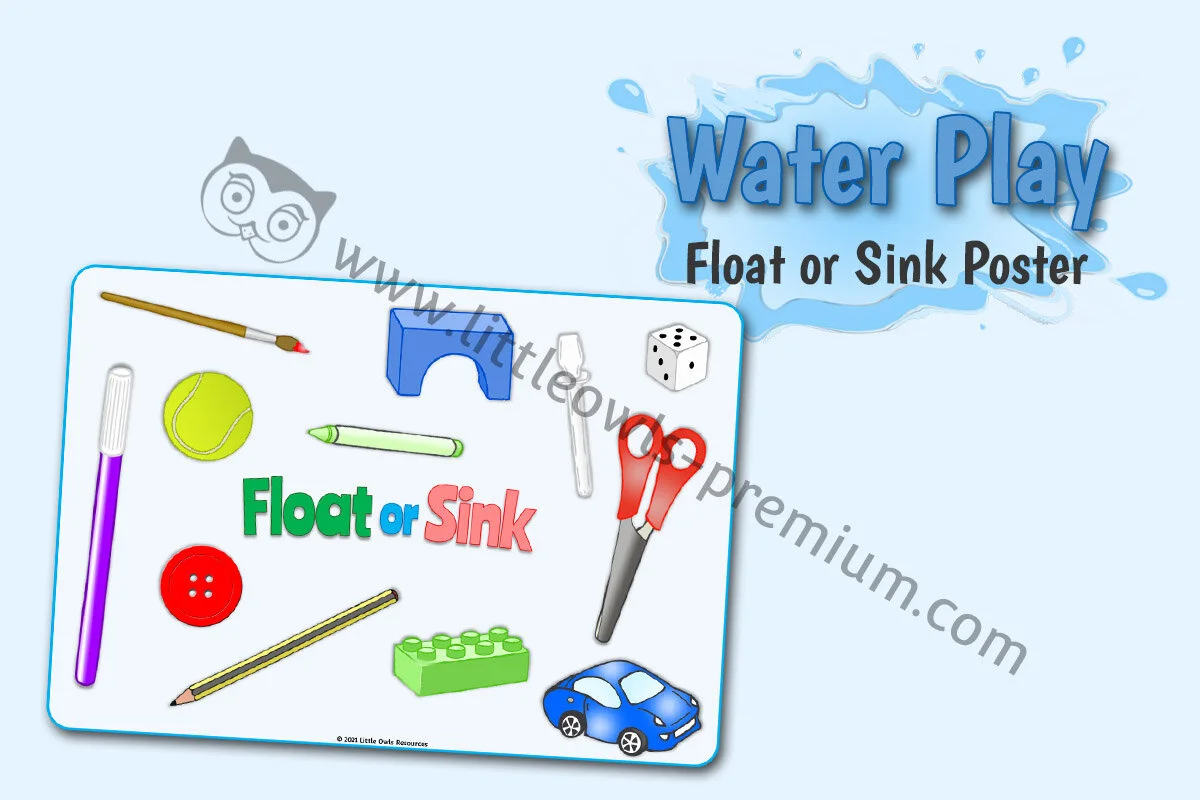
Inspirational poster to encourage children to think about and/or experiment with whether objects will float or sink in water.
This may lead to discussions about an object’s size, weight, shape, the material it is made from, whether it is hollow, etc.
Original artwork drawn by Sara Murphy and final digital resources created by Stuart Murphy. COPYRIGHT ON ALL OF THE RESOURCES HOUSED ON THIS WEBSITE IS HELD BY ‘LITTLE OWLS RESOURCES’. OUR RESOURCES (INCLUDING THE IMAGES WITHIN THEM), CANNOT BE SHARED OR SOLD COMMERCIALLY.
DOWNLOAD EDITABLE (DOCX)
DOWNLOAD NON-EDITABLE (PDF)
DOWNLOAD NON-EDITABLE (Zipped JPEGs)
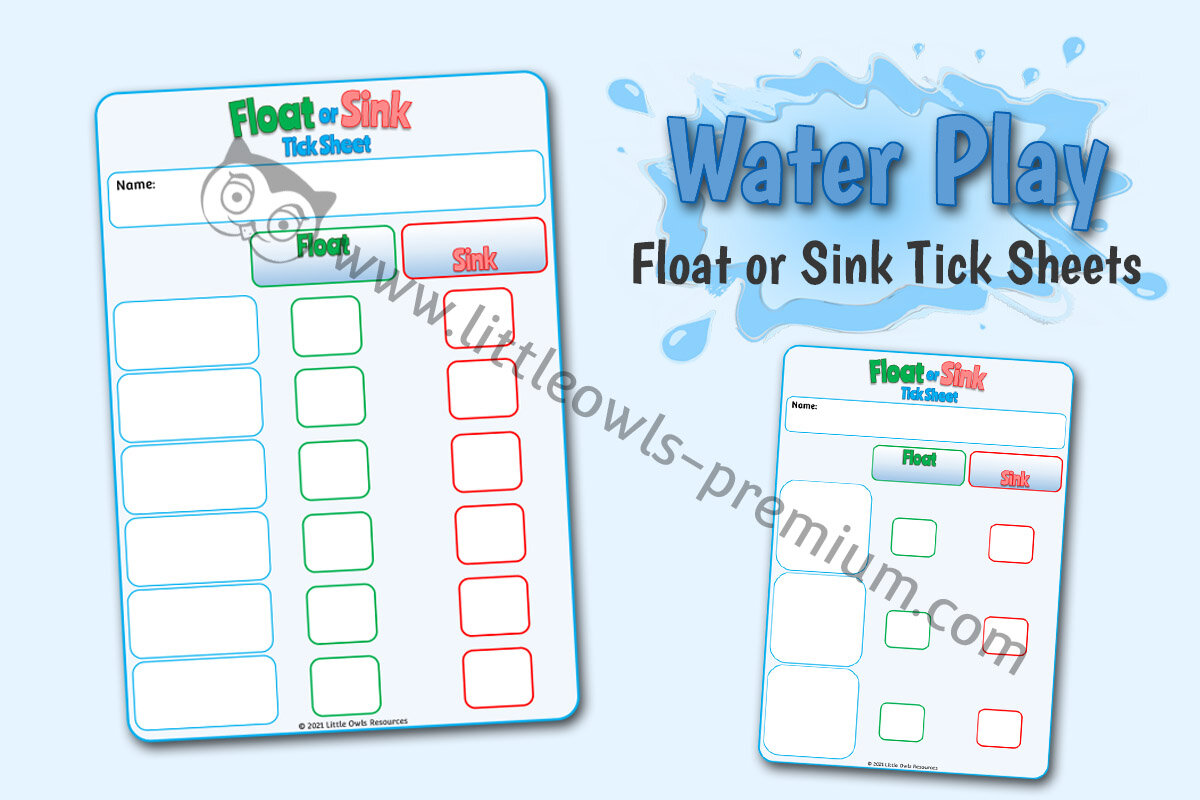
The tick sheets can be used as part of an investigation into floating and sinking.
The children can write or draw the item they are testing and then record the result.
This may lead to discussions about an object’s size, weight, shape, the material it is made from, whether it is hollow, etc.
Original artwork drawn by Sara Murphy and final digital resources created by Stuart Murphy. COPYRIGHT ON ALL OF THE RESOURCES HOUSED ON THIS WEBSITE IS HELD BY ‘LITTLE OWLS RESOURCES’. OUR RESOURCES (INCLUDING THE IMAGES WITHIN THEM), CANNOT BE SHARED OR SOLD COMMERCIALLY.
DOWNLOAD EDITABLE (DOCX)
DOWNLOAD NON-EDITABLE (PDF)
DOWNLOAD NON-EDITABLE (Zipped JPEGs)

These prompts can be used as part of lesson starter about floating and sinking or as a display to promote discussions and investigations around this topic.
This may lead to discussions about an object’s size, weight, shape, the material it is made from, whether it is hollow, etc.
Original artwork drawn by Sara Murphy and final digital resources created by Stuart Murphy. COPYRIGHT ON ALL OF THE RESOURCES HOUSED ON THIS WEBSITE IS HELD BY ‘LITTLE OWLS RESOURCES’. OUR RESOURCES (INCLUDING THE IMAGES WITHIN THEM), CANNOT BE SHARED OR SOLD COMMERCIALLY.
DOWNLOAD EDITABLE (DOCX)
DOWNLOAD NON-EDITABLE (PDF)
DOWNLOAD NON-EDITABLE (Zipped JPEGs)

The cards can be used as part of a small display near the water area or as a direct challenge to be used by the children when playing in the water tray.
Original artwork drawn by Sara Murphy and final digital resources created by Stuart Murphy. COPYRIGHT ON ALL OF THE RESOURCES HOUSED ON THIS WEBSITE IS HELD BY ‘LITTLE OWLS RESOURCES’. OUR RESOURCES (INCLUDING THE IMAGES WITHIN THEM), CANNOT BE SHARED OR SOLD COMMERCIALLY.
DOWNLOAD EDITABLE (DOCX)
DOWNLOAD NON-EDITABLE (PDF)
DOWNLOAD NON-EDITABLE (Zipped JPEGs)

The cards can be used as part of a display near the water area or as a direct challenge to be used by the children when playing in the water tray.
Original artwork drawn by Sara Murphy and final digital resources created by Stuart Murphy. COPYRIGHT ON ALL OF THE RESOURCES HOUSED ON THIS WEBSITE IS HELD BY ‘LITTLE OWLS RESOURCES’. OUR RESOURCES (INCLUDING THE IMAGES WITHIN THEM), CANNOT BE SHARED OR SOLD COMMERCIALLY.
DOWNLOAD EDITABLE (DOCX)
DOWNLOAD NON-EDITABLE (PDF)
DOWNLOAD NON-EDITABLE (Zipped JPEGs)

These cards can be used alongside small world sea animal toys for a water play challenge.
Print the cards that match the toys you have in your setting and then write a number in the white box if desired.
Place the sea animal toys in the water and then the children can use the cards as a finding challenge.
Add some bubbles to the water to increase the searching aspect of the task.
Original artwork drawn by Sara Murphy and final digital resources created by Stuart Murphy. COPYRIGHT ON ALL OF THE RESOURCES HOUSED ON THIS WEBSITE IS HELD BY ‘LITTLE OWLS RESOURCES’. OUR RESOURCES (INCLUDING THE IMAGES WITHIN THEM), CANNOT BE SHARED OR SOLD COMMERCIALLY.
DOWNLOAD EDITABLE (DOCX)
DOWNLOAD NON-EDITABLE (PDF)
DOWNLOAD NON-EDITABLE (Zipped JPEGs)

Under the Sea themed Alphabet cards. These cards could be used as learning prompts or a display around a water play area.
(Don’t forget if you choose the editable docx file, you can change the font!)
Original artwork drawn by Sara Murphy and final digital resources created by Stuart Murphy. COPYRIGHT ON ALL OF THE RESOURCES HOUSED ON THIS WEBSITE IS HELD BY ‘LITTLE OWLS RESOURCES’. OUR RESOURCES (INCLUDING THE IMAGES WITHIN THEM), CANNOT BE SHARED OR SOLD COMMERCIALLY.
DOWNLOAD EDITABLE (DOCX)
DOWNLOAD NON-EDITABLE (PDF)
DOWNLOAD NON-EDITABLE (Zipped JPEGs)

Under the Sea themed number cards 0-30. These cards could be used as learning prompts or a display around a water play area.
(Don’t forget if you choose the editable docx file, you can change the font!)
Original artwork drawn by Sara Murphy and final digital resources created by Stuart Murphy. COPYRIGHT ON ALL OF THE RESOURCES HOUSED ON THIS WEBSITE IS HELD BY ‘LITTLE OWLS RESOURCES’. OUR RESOURCES (INCLUDING THE IMAGES WITHIN THEM), CANNOT BE SHARED OR SOLD COMMERCIALLY.
DOWNLOAD EDITABLE (DOCX)
DOWNLOAD NON-EDITABLE (PDF)
DOWNLOAD NON-EDITABLE (Zipped JPEGs)

For our extensive catalogue of ‘Outdoor Area’ resources, please visit our ‘Outdoor Area’ page.
Additional Pages you may like to explore which cover relevant &/or connected themes


CLICK HERE to visit the ‘BEACH SCHOOL’ PAGE.
Printable ‘Beach’ teaching and learning resources include: scavenger hunts/checklists, mindfulness activity cards, cockle shell age poster, senses booklets and prompts, colouring pages, drawing/writing/mark making sheets, shell multimats, playdough/ loose part mats, art and craft activities, templates, pattern cards, natural loose part art prompts/posters, shapes, pre-writing, rockpool fact cards, symmetry, activity/movement challenges, display lettering, sand play and more!




CLICK HERE to visit ‘LIFE CYCLES’ PAGE.
Printable ‘Life Cycle’ teaching and learning resources include: cyclic puzzles, frog, chicken, caterpillar/butterfly, ant/bean life cycle display packs, posters, cut and stick activities, banners, cards, playdough mats and more!




More Early Years Event Pages for May & November


Sunday 23rd May 2027: 🐢🌊 For early years settings, nurseries, preschools, childminders, and Year 1 and Year 2 classrooms, World Turtle Day provides a wonderful and engaging theme for exploring animals (especially reptiles, sea creatures, and pets), habitats (ocean, desert, wetlands, gardens), conservation, life cycles,…

Saturday 22nd May 2027: 🌳🐠 International Day for Biological Diversity (IDB) is a special day celebrated every year on May 22nd. It was started by the United Nations to help everyone understand something very important called 'biological diversity', or 'biodiversity' for short. Biodiversity means…

Wednesday 19th May 2027 (TBC): 🔢➕ For early years settings, nurseries, preschools, childminders, and Year 1 and Year 2 classrooms, National Numeracy Day provides a fantastic and practical theme for exploring counting, number recognition, shapes, patterns, problem-solving, and early mathematical concepts. It's about building a positive attitude…

Thursday 20th May 2027: 🐝🍯 For early years settings, nurseries, preschools, childminders, and Year 1 and Year 2 classrooms, World Bee Day provides a wonderful and engaging theme for exploring minibeasts, plants, life cycles, food sources, the environment, and understanding the world (the world around us). It's about introducing…

Tuesday 18th May 2027: 🏛️🔎 For early years settings, nurseries, preschools, childminders, and Year 1 and Year 2 classrooms, International Museum Day provides a fantastic and engaging theme for exploring history, science, art, culture, discovery, role-play, and understanding the world (the world around us). It's about sparking children's curiosity,…

Sunday 9th May 2027 (TBC): 👧👦 For early years settings, nurseries, preschools, childminders, and Year 1 and Year 2 classrooms, National Children’s Day provides an incredibly broad and foundational opportunity to explore all aspects of a child's health, safety, well-being, emotions, physical development, rights, and…

Friday 21st May 2027: 🐾🌱 Endangered Species Day is a special day celebrated every year on the third Friday in May. It was started by a group called the National Endangered Species Act Education Centre in the United States and was recognised…

Saturday 15th May 2027: 👨👩👧👦💖 International Day of Families is a special day celebrated every year on May 15th. It was started by the United Nations in 1993 because they wanted everyone to remember how important…

Monday 10th - Sunday 16th May 2027 (TBC): 😊🧠 Mental Health Awareness Week happens every year in May. It's hosted by the Mental Health Foundation, a charity in the UK. This week is all about helping everyone understand that our minds…

Wednesday 12th May 2027: 👩⚕️🧑⚕️ For early years settings, nurseries, preschools, childminders, and Year 1 and Year 2 classrooms, International Nurses Day provides a fantastic and practical theme for exploring people who help us, health and well-being, empathy, role-play, and personal, social…

Wednesday 5th May 2027: ✨🧼 World Hand Hygiene Day is a special day celebrated every year on May 5th. It was started by the World Health Organization (WHO) with a very important message: 'SAVE LIVES:…

Sunday 2nd May 2027: 😄😂 The main idea of this day is to show how laughter can help bring peace and friendship to people all over the world. Dr. Kataria believes that laughter is like a super-power that can help people…

🚶♀️🚶♂️For early years settings, nurseries, preschools, childminders, and Year 1 and Year 2 classrooms, National Walking Month (1st - 31st May 2027) and Walk to School Week (Monday 17th - Friday 21st May 2027 - TBC) provide a fantastic and practical theme for exploring physical development, health and well-being, the environment, road safety…

Thursday 20th May 2027 (TBC) & Thursday 5th November 2026: Let's learn outside! 🌳☀️ Outdoor Classroom Day is a global campaign to inspire and celebrate outdoor play and learning, with two designated days each year: one in May and one in November…

Saturday 21st November 2026: Hello there! 👋🌍 World Hello Day is an international observance held annually on November 21st. It was founded in 1973 by Brian and Michael McCormack as a direct response to the Yom…

Monday 16th - Sunday 22nd November 2026: Sweet treats and healthy eats! 🍬🥕 Sugar Awareness Week is an annual campaign in the UK, organised by Action on Sugar, typically held in November. Its primary goal is to raise awareness of…

Friday 13th November 2026: Let's sprinkle kindness everywhere! 💖 World Kindness Day is an international observance on November 13th, introduced in 1998 by the World Kindness Movement. Its core purpose is to…

Monday 16th - Friday 20th November 2026: Let's make a stand together! ❤️ Anti-bullying Week is an annual event in the UK, organised by the Anti-Bullying Alliance (ABA), typically taking place in November. It aims to raise awareness of…

Monday 9th - Friday 13th November 2026: Twinkle, twinkle, little star! ✨ World Nursery Rhyme Week is an annual initiative, typically held in mid-November, created by Music Bugs in 2013. In 2025, the event is being held from the 10th…

Tuesday 10th November 2026: Let's explore and discover! 🧪🔬 World Science Day for Peace and Development is an annual event celebrated worldwide on November 10th. Established by UNESCO (United Nations…

Sunday 8th November 2026: She sells seashells by the seashore! 🗣️ International Tongue Twister Day is an informal observance, typically celebrated on the second Sunday in November (In 2025 on November 9th)…
Thursday 20th May 2027 (TBC) & Thursday 5th November 2026: Let's learn outside! 🌳☀️ Outdoor Classroom Day is a global campaign to inspire and celebrate outdoor play and learning, with two designated days each year: one in May and one in November…

Sunday 15th - Saturday 21st November 2026: Road Safety Week is an annual campaign coordinated by Brake, the national road safety charity. It's a fantastic opportunity to bring the vital message of road safety into your early years setting…
Explore special dates (including awareness dates, festivals, celebrations & events) relevant to your EYFS & KS1 children
Browse our ‘Special Dates Calendar’ page using the link below. You’ll find calendars for every month of the year to aid your planning!
Click here to visit our ‘Special Dates Calendar’ page for an entire year of key EYFS & KS1 events, festivals & celebrations.
Search ‘Little Owls Resources’ Using the following Menu Buttons…
Click here to visit our ‘Special Dates Calendar’ page for an entire year of key EYFS & KS1 events, festivals & celebrations.


Disclaimer:
This page is for educational purposes only and is intended to support early years and primary practitioners with ideas and resources related to 'Outdoor Classroom Day'. We are not officially affiliated with or endorsed by Project Dirt or Save the Children, who lead this campaign. We do not claim any rights to specific trademarks or official materials associated with this event. For official information and to learn more about the campaign, please visit their website at www.outdoorclassroomday.org.uk.
Saturday 29th May - Sunday 6th June 2027 (TBC): 🌱🥕 For early years settings, nurseries, preschools, childminders, and Year 1 and Year 2 classrooms, National Children’s Gardening Week provides a wonderfully rich and hands-on theme for exploring plants, life cycles, food sources, nature, science (growth and change), the environment, outdoor play,…