

**Note: This page is for educational inspiration and is not officially affiliated with National Children’s Day UK. National Children’s Day UK takes place annually in May and is a key initiative of the Save Childhood Movement. It is dedicated to celebrating childhood and advocating for children's rights and well-being. The day aims to highlight the importance of creating a healthy, happy, and sustainable future for all children, reflecting on their physical, emotional, and social needs. It promotes a holistic view of childhood, encouraging families, schools, and communities to reflect on children's fundamental rights and what is needed to ensure they thrive. For official information, themes, and how to get involved, please visit the National Children's Day UK website: www.nationalchildrensdayuk.com.
Sunday 9th May 2027 (TBC)
May / June (varies annually)
-
National Children’s Day UK celebrates children, their rights, and their wellbeing. It highlights the importance of ensuring every child is:
safe
healthy
heard
valued
It is closely linked to the principles of the Save Childhood Movement, which promotes children’s rights, play and wellbeing.
-
This theme provides a broad and meaningful opportunity to explore:
health and wellbeing
safety and self-care
emotions and identity
relationships and belonging
understanding the world
This supports:
EYFS:
PSED (self-confidence, relationships, wellbeing)
Physical Development (health, self-care)
Understanding the World (community, safety)
Communication & Language (expressing needs and feelings)
KS1 (National Curriculum):
PSHE (health, safety, rights, well-being)
Citizenship (community, responsibility, belonging)
Science (health and the human body)
-
In high-quality EYFS practice, themes such as children’s wellbeing and safety are embedded in:
daily routines
relationships
consistent adult responses
real-life experiences
The ideas below are:
flexible
optional
intended to support adult thinking
👉 Find out more about developmentally appropriate practice in EYFS by exploring our ‘Curriculum & Pedagogy Suite’.
Pathways available for:
-
Focusing on children’s wellbeing supports:
🧠 Emotional Wellbeing
Children learn to recognise and express feelings.
🛡️ Safety Awareness
Children begin to understand how to stay safe.
💪 Physical Health
Children develop habits that support healthy bodies.
🌱 Self-Esteem & Identity
Children learn that they are valued and important.
🤝 Relationships & Community
Children develop kindness, empathy and connection.
🌿 EYFS: Provision & Child-Led Ideas (0–5 Years)
These ideas are not activities to be planned or completed. They support wellbeing through relationships, routines and everyday experiences.
-
Wellbeing is rooted in care, attachment and emotional security.
Babies may:
seek comfort and reassurance
respond to familiar adults
communicate needs through behaviour
Adults can:
provide consistent, responsive care
support emotional regulation through co-regulation
use calm tone, eye contact and touch
build strong, secure attachments
👉 Additional curriculum & planning support for this age group may be found on our ‘EYFS Planning for Babies (0–18 Months)’ hub page.
-
Toddlers begin to experience independence alongside strong emotions.
Children may:
show big feelings
seek reassurance
begin to explore independence
Adults can:
respond calmly and consistently
name emotions simply
support routines (washing hands, eating, rest)
provide safe boundaries and reassurance
👉 Additional curriculum & planning support for this age group may be found on our ‘EYFS Planning for Toddlers (18–36 Months)’ hub page.
-
Children begin to understand routines, feelings and simple safety.
Children may:
talk about emotions and experiences
follow simple routines
begin to understand rules and expectations
Adults can:
support conversations about feelings
reinforce safety routines
model kindness and empathy
encourage independence within safe boundaries
👉 Additional curriculum & planning support for this age group may be found on our ‘EYFS Planning for Preschool (3–4 Years)’ hub page.
-
Children develop awareness of wellbeing, safety and responsibility.
Children may:
understand basic safety concepts
talk about how to stay healthy
reflect on feelings and actions
Adults can:
support discussion about safety and wellbeing
encourage independence and responsibility
introduce simple decision-making
reinforce consistent routines and expectations
👉 Additional curriculum & planning support for this age group may be found on our ‘EYFS Planning for Reception (4–5 Years)’ hub page.
-
Wellbeing and safety develop through:
secure relationships
consistent routines
responsive adults
real-life experiences
🌱 Environment Enhancements & Invitations (EYFS)
These are optional enhancements that may be reflected within everyday provision if they support children’s wellbeing, safety and sense of self.
-
You might enhance provision by:
maintaining calm, predictable routines across the day
ensuring spaces feel emotionally and physically safe
providing areas for rest, retreat and quiet regulation
supporting children to move confidently within the environment
Resources that may support this include:
Calm space visuals
-
You might enhance provision by:
embedding everyday routines such as handwashing, eating and rest
supporting children’s growing independence in self-care
using consistent language to describe routines and expectations
Resources:
-
You might enhance provision by:
reinforcing simple, consistent safety messages through daily routines
modelling safe behaviour (e.g. moving safely, using equipment appropriately)
supporting children to recognise familiar boundaries and expectations
Resources:
-
You might enhance provision by:
encouraging children to express needs, choices and feelings
listening and responding to children’s communication
modelling language that supports confidence and self-expression
Resources that may support this include:
Communication and language prompts
-
You might enhance provision by:
supporting children to recognise and name feelings
responding sensitively to emotional needs
helping children to feel valued and understood
Resources:
-
You might enhance provision by:
modelling respectful, caring relationships
supporting positive peer interaction
encouraging cooperation and shared play
Resources that may support this include:
“Let’s Connect” prompts
-
You might enhance provision by:
supporting children to understand their place within a group or community
recognising important people in their lives
linking experiences to familiar contexts (home, setting, community)
Resources:
-
Children’s wellbeing and safety develop through:
secure relationships
consistent routines
responsive adults
everyday lived experiences
📘 KS1 Learning Activities for National Children’s Day UK
In Key Stage 1, this theme can support more structured learning around health, safety and wellbeing.
-
Children can:
learn about the body and health
explore healthy habits
understand how to care for themselves
You may use our:
Doctors Surgery, Dentist & Optometrist Role-Play Packs
Poorly Teddy Posters & Medical Word Mat
Teeth & Oral Health resources
Healthy Eating Posters & Balanced Diet resources
Human Body resources
-
Children can:
explore the link between movement and health
reflect on how activity affects wellbeing
You may use our:
Exercise Cards
Movement Challenge Cards (e.g. Dinosaur, General Exercise)
-
Children can:
learn how to stay safe in different situations
understand responsibility for themselves and others
Additional resources:
Road Safety (Stop, Look, Listen resources)
-
Children can:
reinforce hygiene routines
understand why they matter
You may use our:
Handwashing posters and song resources
-
Children can:
explore emotions
reflect on their identity
understand their rights and voice
You may use our:
Healthy Minds Poster
Mood Booster Activity Cards
Emotion Cards & Teddy Emotion Packs
Let’s Connect / Let’s Show Kindness resources
Mindfulness Activity Cards
All About Me resources
-
Children can:
explore family and community
understand who supports them
develop a sense of belonging
-
-
A helpful question: “Does this support children’s real wellbeing, safety and everyday lives?”
If it supports:
health
safety
emotional wellbeing
→ it is meaningful
-
National Children’s Day UK supports children to:
feel safe and valued
understand wellbeing and health
develop emotional awareness
build confidence and independence
In the EYFS, this is most effective when it is:
embedded in everyday practice
relationship-led
routine-based
In KS1, it can be:
explored through structured learning
supported through discussion and reflection
linked to real-life contexts
-
We offer a range of resources to support practitioners across EYFS and KS1, including printable materials and in-depth curriculum and pedagogy guidance.
🟢 Free Membership
You can access a selection of free resources by creating a free account.
This includes:
selected printable resources
sample materials
weekly support emails for those who opt-in
🟡 Premium Membership (Printables)
Our Premium Membership provides access to our full library of printable teaching and provision resources.
This includes:
themed resources (e.g. Gardening, Emotions, Seasons)
continuous provision materials
activity cards, displays and printable packs
These resources can be used flexibly to support:
provision enhancements
small group work
classroom organisation
🟣 Professional Membership (Curriculum & Pedagogy)
Our Professional Membership provides access to our full Curriculum & Pedagogy Suite (Birth–5).
~ In addition to Premium Printable Provision access.~
This includes:
age-specific pathways (Babies, Toddlers, Preschool, Reception)
planning guidance and templates
observation and assessment support
SEND and inclusion guidance
inspection-ready documentation
These documents are designed to support:
confident decision-making
consistent practice across teams
clear articulation of EYFS pedagogy
(KS1 curriculum coming soon!)
👉 Visit EYFS Curriculum & Pedagogy Suite
👉 [View Professional Membership]
🧠 Choosing What Works for You
You do not need to use everything at once.
Many practitioners:
start with free resources
build their printable provision over time
use pedagogy documents to support team understanding and leadership
Choose what best fits your setting, role and stage of development.
👉 To explore more early years events, visit our Special Dates Calendar.
Printable resources to support teaching & learning surrounding: ‘National Children’s Day UK’
Free ‘Health’ and ‘Safety’ resources for EYFS & KS1:
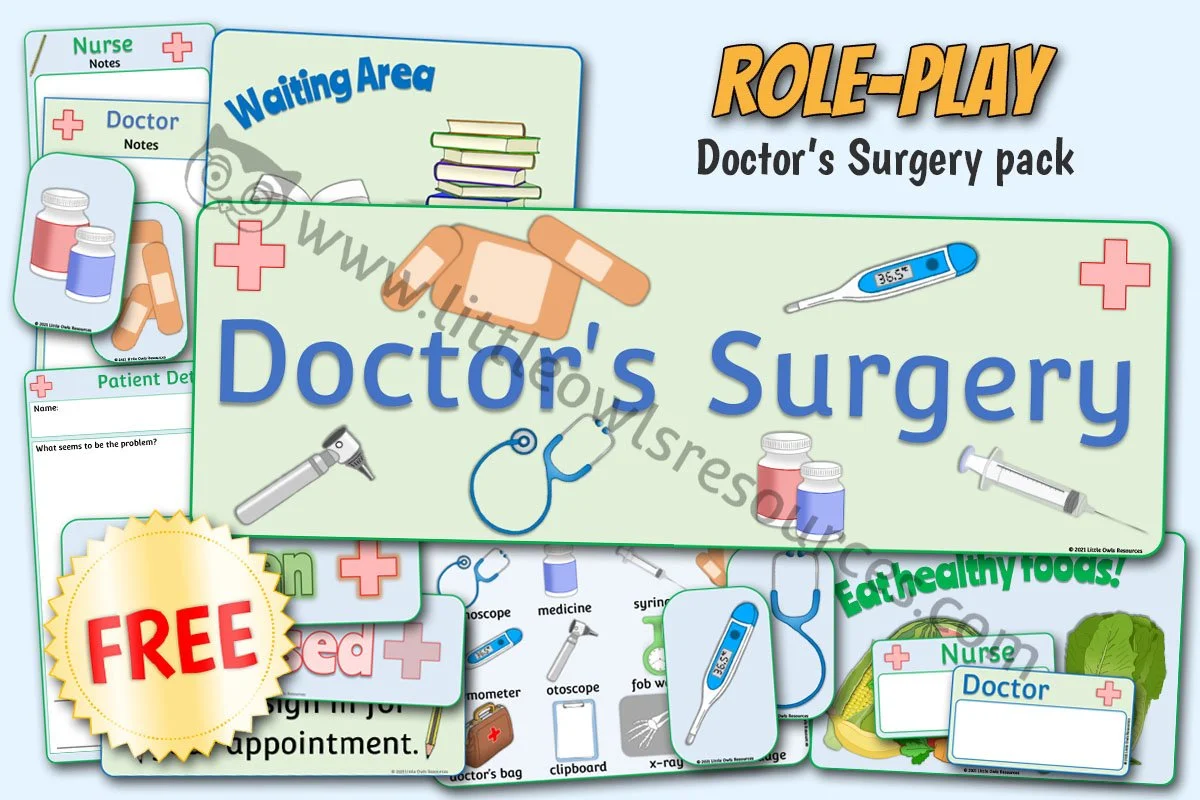
Everything you need to set up a doctor’s surgery role-play area!
Pack includes:
(Please note that words, etc. can be altered within the editable docx file version.)
‘Doctors Surgery’ banner
First Aid Red Cross signs
Doctor and Nurse identity cards
‘Waiting Area’ Poster
Various Posters promoting ‘Good Health’
Social distancing signs & floormats
‘Please wait’ footprint floormats
Medical word mat
Medical word cards
‘Welcome! Please sign in for your appointment’ sign for encouraging emergent writing
‘Open’ & ‘Closed’ signs
‘Surgery Opening Times’ Poster - Space to draw hands on clock and write times
‘Opens at…o’ clock’ and ‘Closes at…o’ clock’ signs - spaces for emergent writing
Templates for emergent writing (ideally laminated) - ‘Doctor Notes’, ‘Nurse Notes’, ‘Appointments’ & ‘Patient Details’ forms
Clipboard template for mark making
Role-Play Prop cards
Original artwork drawn by Sara Murphy and final digital resources created by Stuart Murphy. COPYRIGHT ON ALL OF THE RESOURCES HOUSED ON THIS WEBSITE IS HELD BY ‘LITTLE OWLS RESOURCES’. OUR RESOURCES (INCLUDING THE IMAGES WITHIN THEM), CANNOT BE SHARED OR SOLD COMMERCIALLY.
DOWNLOAD EDITABLE (DOCX)
DOWNLOAD NON-EDITABLE (PDF)
DOWNLOAD NON-EDITABLE (Zipped JPEGs)
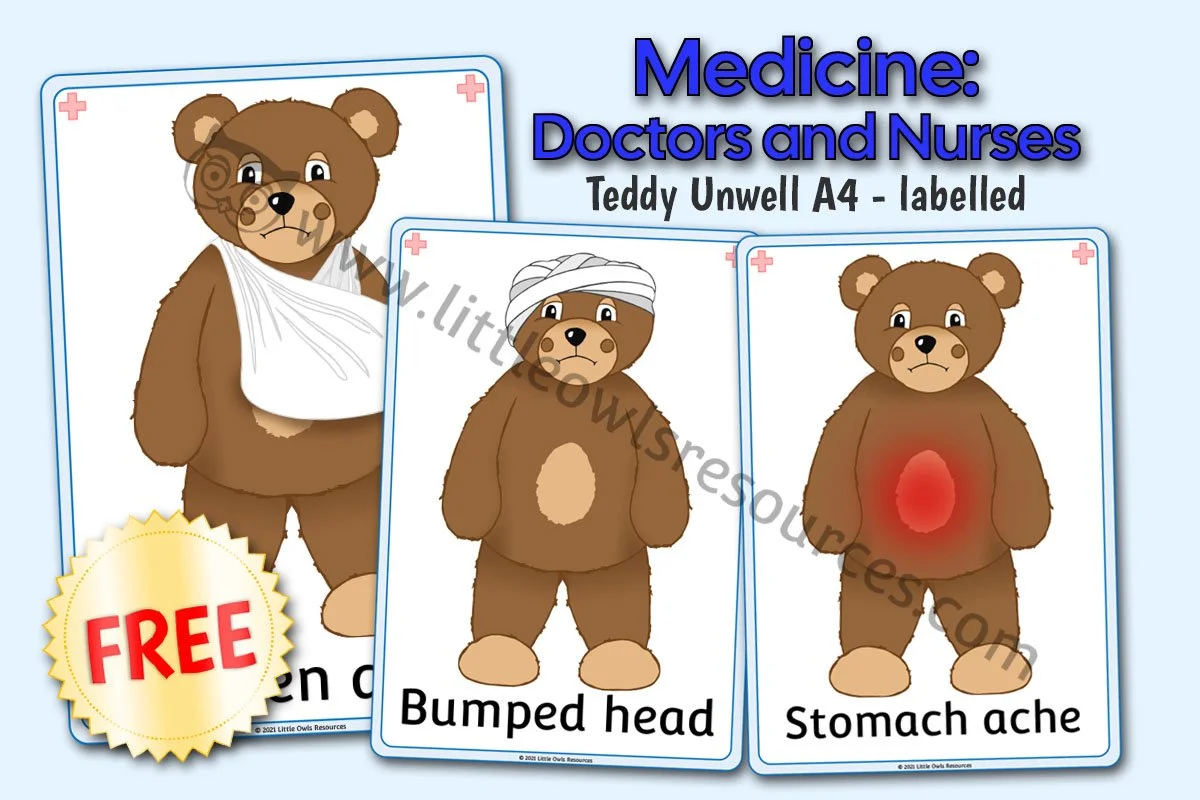
11 Poorly Teddy Posters included. Ideal for using as part of a medical/doctors and nurses display or activities such as role-play or emergent writing.
Original artwork drawn by Sara Murphy and final digital resources created by Stuart Murphy. COPYRIGHT ON ALL OF THE RESOURCES HOUSED ON THIS WEBSITE IS HELD BY ‘LITTLE OWLS RESOURCES’. OUR RESOURCES (INCLUDING THE IMAGES WITHIN THEM), CANNOT BE SHARED OR SOLD COMMERCIALLY.
DOWNLOAD EDITABLE (DOCX)
DOWNLOAD NON-EDITABLE (PDF)
DOWNLOAD NON-EDITABLE (Zipped JPEGs)
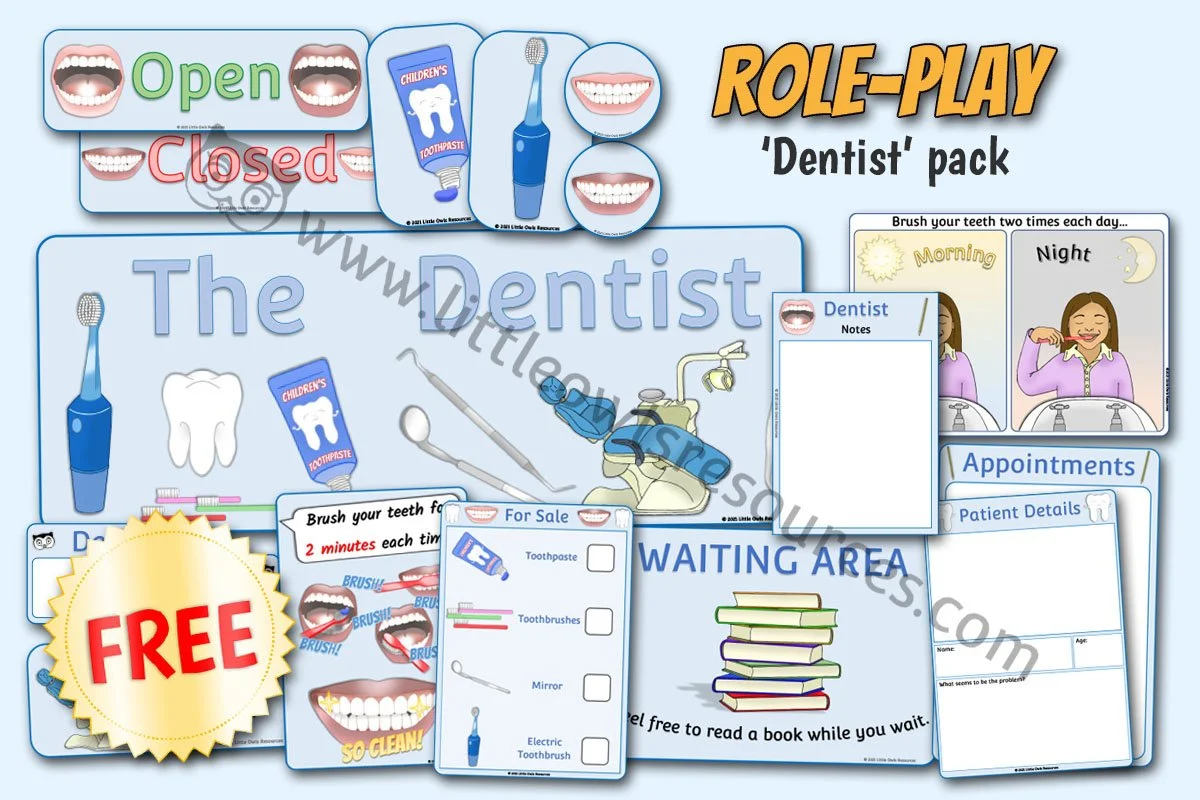
Everything you need to set up a dentist role-play area!
Pack includes:
(Please note that words, etc. can be altered within the editable docx file version.)
‘The Dentist’ banner
Smiling mouth decorative signs
Dentist and Dental Assistant identity cards
‘Waiting Area’ Poster
Various ‘Brush your teeth’ Posters
Social distancing signs & floormats
‘Please wait’ footprint floormats
Dentist word mats
Dentist word cards
‘Welcome! Please sign in for your appointment’ sign for encouraging emergent writing
‘Open’ & ‘Closed’ signs
‘Dentist Opening Times’ Poster - Space to draw hands on clock and write times
‘Opens at…o’ clock’ and ‘Closes at…o’ clock’ signs - spaces for emergent writing
Templates for emergent writing (ideally laminated) - ‘Dentist Notes’, ‘Appointments’ & ‘Patient Details’ forms
‘For Sale’ Menu sign - Space to write prices by items
Items for sale prop cards
Original artwork drawn by Sara Murphy and final digital resources created by Stuart Murphy. COPYRIGHT ON ALL OF THE RESOURCES HOUSED ON THIS WEBSITE IS HELD BY ‘LITTLE OWLS RESOURCES’. OUR RESOURCES (INCLUDING THE IMAGES WITHIN THEM), CANNOT BE SHARED OR SOLD COMMERCIALLY.
DOWNLOAD EDITABLE (DOCX)
DOWNLOAD NON-EDITABLE (PDF)
DOWNLOAD NON-EDITABLE (Zipped JPEGs)
<<-BACK TO ‘TEETH AND ORAL HEALTH’ TOPIC MENU

Design a Coronation meal!
Ideal for use as a reusable playdough or loose parts mat (once laminated). Alternatively, use in conjunction with whiteboard pens. Without lamination this design sheet is perfect for use with mark making tools or art and craft materials.
Original artwork drawn by Sara Murphy and final digital resources created by Stuart Murphy. COPYRIGHT ON ALL OF THE RESOURCES HOUSED ON THIS WEBSITE IS HELD BY ‘LITTLE OWLS RESOURCES’. OUR RESOURCES (INCLUDING THE IMAGES WITHIN THEM), CANNOT BE SHARED OR SOLD COMMERCIALLY.
DOWNLOAD EDITABLE (DOCX)
DOWNLOAD NON-EDITABLE (PDF)
DOWNLOAD NON-EDITABLE (Zipped JPEGs)

Ideal for display, role-play stimulus or mark making/writing activities.
Includes car, ambulance, police car, bicycle, bus, crossing button, walk, don’t walk, motorbike, lorry, fire engine and cone.
Original artwork drawn by Sara Murphy and final digital resources created by Stuart Murphy. COPYRIGHT ON ALL OF THE RESOURCES HOUSED ON THIS WEBSITE IS HELD BY ‘LITTLE OWLS RESOURCES’. OUR RESOURCES (INCLUDING THE IMAGES WITHIN THEM), CANNOT BE SHARED OR SOLD COMMERCIALLY.
DOWNLOAD EDITABLE (DOCX)
DOWNLOAD NON-EDITABLE (PDF)
DOWNLOAD NON-EDITABLE (Zipped JPEGs)

Selection of ‘Road Safety’ colouring sheets. Pack includes car, ambulance, police car, bicycle, bus, crossing button, walk/don’t walk pedestrian lights, motorbike, lorry, fire engine, walking man, standing man, holding hands and cone images.
Original artwork drawn by Sara Murphy and final digital resources created by Stuart Murphy. COPYRIGHT ON ALL OF THE RESOURCES HOUSED ON THIS WEBSITE IS HELD BY ‘LITTLE OWLS RESOURCES’. OUR RESOURCES (INCLUDING THE IMAGES WITHIN THEM), CANNOT BE SHARED OR SOLD COMMERCIALLY.
DOWNLOAD EDITABLE (DOCX)
DOWNLOAD NON-EDITABLE (PDF)
DOWNLOAD NON-EDITABLE (Zipped JPEGs)

Original artwork drawn by Sara Murphy and final digital resources created by Stuart Murphy. COPYRIGHT ON ALL OF THE RESOURCES HOUSED ON THIS WEBSITE IS HELD BY ‘LITTLE OWLS RESOURCES’. OUR RESOURCES (INCLUDING THE IMAGES WITHIN THEM), CANNOT BE SHARED OR SOLD COMMERCIALLY.
This resource is independently created by Little Owls Resources to support EYFS and KS1 teaching. We are not affiliated with or endorsed by Brake or the official Road Safety Week campaign.
DOWNLOAD EDITABLE (DOCX)
DOWNLOAD NON-EDITABLE (PDF)
DOWNLOAD NON-EDITABLE (Zipped JPEGs)

Build up a general awareness of road signs by using these A4 sized common road signs within your role-play area or displays.
N.B. These road sign images are Crown Copyright.
Digital resources created by Stuart Murphy. COPYRIGHT ON ALL OF THE RESOURCES HOUSED ON THIS WEBSITE IS HELD BY ‘LITTLE OWLS RESOURCES’. OUR RESOURCES (INCLUDING THE IMAGES WITHIN THEM), CANNOT BE SHARED OR SOLD COMMERCIALLY.
DOWNLOAD EDITABLE (DOCX)
DOWNLOAD NON-EDITABLE (PDF)
DOWNLOAD NON-EDITABLE (Zipped JPEGs)

Road Safety themed horizontal border paper. A variety of options including 2 types of lined and a blank sheet. Each of these are available within the pack in both full colour and black and white versions for colouring in.
Original artwork drawn by Sara Murphy and final digital resources created by Stuart Murphy. COPYRIGHT ON ALL OF THE RESOURCES HOUSED ON THIS WEBSITE IS HELD BY ‘LITTLE OWLS RESOURCES’. OUR RESOURCES (INCLUDING THE IMAGES WITHIN THEM), CANNOT BE SHARED OR SOLD COMMERCIALLY.
DOWNLOAD EDITABLE (DOCX)
DOWNLOAD NON-EDITABLE (PDF)
DOWNLOAD NON-EDITABLE (Zipped JPEGs)

Digital resources created by Stuart Murphy. COPYRIGHT ON ALL OF THE RESOURCES HOUSED ON THIS WEBSITE IS HELD BY ‘LITTLE OWLS RESOURCES’. OUR RESOURCES (INCLUDING THE IMAGES WITHIN THEM), CANNOT BE SHARED OR SOLD COMMERCIALLY.
DOWNLOAD EDITABLE (DOCX)
DOWNLOAD NON-EDITABLE (PDF)
DOWNLOAD NON-EDITABLE (Zipped JPEGs)

This 'Bus Stop' role play pack is ideal to create a transport or travel themed role play area!
Pack includes:
Banner
Contactless pads
Bus passes (pre-made and templates for children’s mark making)
Next bus in … minutes interactive sign
Driver name tags
Bus tickets (various templates for children’s mark making)
Bus stop signs (2 designs)
Posters
Ticket prices poster template
Draw and write about your journey template sheets
Bus timetable clocks
Bus route poster and templates for mark making
Digital resources created by Stuart Murphy. COPYRIGHT ON ALL OF THE RESOURCES HOUSED ON THIS WEBSITE IS HELD BY ‘LITTLE OWLS RESOURCES’. OUR RESOURCES (INCLUDING THE IMAGES WITHIN THEM), CANNOT BE SHARED OR SOLD COMMERCIALLY.
DOWNLOAD EDITABLE (DOCX)
DOWNLOAD NON-EDITABLE (PDF)
DOWNLOAD NON-EDITABLE (Zipped JPEGs)

Pack of various transportation themed colouring pages, including: car, train, motorbike, police car, fire engine, bicycle, lorry, bus, ambulance, ship, aeroplane and tractor.
Digital resources created by Stuart Murphy. COPYRIGHT ON ALL OF THE RESOURCES HOUSED ON THIS WEBSITE IS HELD BY ‘LITTLE OWLS RESOURCES’. OUR RESOURCES (INCLUDING THE IMAGES WITHIN THEM), CANNOT BE SHARED OR SOLD COMMERCIALLY.
DOWNLOAD EDITABLE (DOCX)
DOWNLOAD NON-EDITABLE (PDF)
DOWNLOAD NON-EDITABLE (Zipped JPEGs)

‘The Wheels on the Bus’ Nursery Rhyme Colouring Poster.
Younger children will love to explore the rhythm of this nursery rhyme and join in, especially with the aid of visual stimulus.
Perhaps with older children you might like to highlight the CVC words such as ‘bus’ and ‘long’ to practise blending or identify all of the Phase 2 or 3 sounds or high frequency words?
Want to incorporate music? How about clapping or using percussion instruments to feel the ‘beat’? Have fun!
Original artwork drawn by Sara Murphy and final digital resources created by Stuart Murphy. COPYRIGHT ON ALL OF THE RESOURCES HOUSED ON THIS WEBSITE IS HELD BY ‘LITTLE OWLS RESOURCES’. OUR RESOURCES (INCLUDING THE IMAGES WITHIN OUR RESOURCES), CANNOT BE SHARED OR SOLD COMMERCIALLY.
DOWNLOAD EDITABLE (DOCX)
DOWNLOAD NON-EDITABLE (PDF)
DOWNLOAD NON-EDITABLE (Zipped JPEGs)

Pack includes ‘The Enormous Turnip’ display banner and character faces for Man, Woman, Girl, Boy, Dog, Cat and Mouse.
Keywords: Animals, Man, Woman, Girl, Boy, Cat, Dog, Mouse, Communication and Language, Speech and Language, Posters/Displays, traditional fairy tales
Original artwork drawn by Sara Murphy and final digital resources created by Stuart Murphy. COPYRIGHT ON ALL OF THE RESOURCES HOUSED ON THIS WEBSITE IS HELD BY ‘LITTLE OWLS RESOURCES’. OUR RESOURCES (INCLUDING THE IMAGES WITHIN THEM), CANNOT BE SHARED OR SOLD COMMERCIALLY.
DOWNLOAD EDITABLE (DOCX)
DOWNLOAD NON-EDITABLE (PDF)
DOWNLOAD NON-EDITABLE (Zipped JPEGs)

Key points in ‘The Enormous Turnip’ story are highlighted. Space on each sheet is allocated for children to draw what is being described in the sentence(s) on each page. 11 pages included.
Keywords: Mark making/Drawing/Writing, Animals, Activities, Fine Motor, Descriptive Language, Communication and Language, Speech and Language, Take Home, Discussion Prompts, Posters/Displays, Pencil Control, traditional fairy tales, colouring, art and craft
Original artwork drawn by Sara Murphy and final digital resources created by Stuart Murphy. COPYRIGHT ON ALL OF THE RESOURCES HOUSED ON THIS WEBSITE IS HELD BY ‘LITTLE OWLS RESOURCES’. OUR RESOURCES (INCLUDING THE IMAGES WITHIN THEM), CANNOT BE SHARED OR SOLD COMMERCIALLY.
DOWNLOAD EDITABLE (DOCX)
DOWNLOAD NON-EDITABLE (PDF)
DOWNLOAD NON-EDITABLE (Zipped JPEGs)

2 x A4 fruit posters/mats - landscape and portrait. Intended for display, as table mats and teaching prompt purposes.
Original artwork drawn by Sara Murphy and final digital resources created by Stuart Murphy. COPYRIGHT ON ALL OF THE RESOURCES HOUSED ON THIS WEBSITE IS HELD BY ‘LITTLE OWLS RESOURCES’. OUR RESOURCES (INCLUDING THE IMAGES WITHIN THEM), CANNOT BE SHARED OR SOLD COMMERCIALLY.
DOWNLOAD EDITABLE (DOCX)
DOWNLOAD NON-EDITABLE (PDF)
DOWNLOAD NON-EDITABLE (Zipped JPEGs)

2 x A4 vegetable posters/mats - landscape and portrait. Intended for display, as table mats and teaching prompt purposes.
Please note that tomatoes, peppers and cucumbers are botanically defined as fruits, but have been included in our vegetables poster as they are most commonly nutritionally used as vegetables.
Original artwork drawn by Sara Murphy and final digital resources created by Stuart Murphy. COPYRIGHT ON ALL OF THE RESOURCES HOUSED ON THIS WEBSITE IS HELD BY ‘LITTLE OWLS RESOURCES’. OUR RESOURCES (INCLUDING THE IMAGES WITHIN THEM), CANNOT BE SHARED OR SOLD COMMERCIALLY.
DOWNLOAD EDITABLE (DOCX)
DOWNLOAD NON-EDITABLE (PDF)
DOWNLOAD NON-EDITABLE (Zipped JPEGs)

‘Fruit and Vegetables’ banner which spans the width of 2 A4 landscape sheets.
Original artwork drawn by Sara Murphy and final digital resources created by Stuart Murphy. COPYRIGHT ON ALL OF THE RESOURCES HOUSED ON THIS WEBSITE IS HELD BY ‘LITTLE OWLS RESOURCES’. OUR RESOURCES (INCLUDING THE IMAGES WITHIN THEM), CANNOT BE SHARED OR SOLD COMMERCIALLY.
DOWNLOAD EDITABLE (DOCX)
DOWNLOAD NON-EDITABLE (PDF)

Set of 12 fruit and vegetable puzzles each with 2 parts. Ideal for our youngest children in order for them to begin to spot similarities and differences, recognise 2D representations of 3D common objects and solve problems involving observational skills.
Original artwork drawn by Sara Murphy and final digital resources created by Stuart Murphy. COPYRIGHT ON ALL OF THE RESOURCES HOUSED ON THIS WEBSITE IS HELD BY ‘LITTLE OWLS RESOURCES’. OUR RESOURCES (INCLUDING THE IMAGES WITHIN THEM), CANNOT BE SHARED OR SOLD COMMERCIALLY.
DOWNLOAD EDITABLE (DOCX)
DOWNLOAD NON-EDITABLE (PDF)
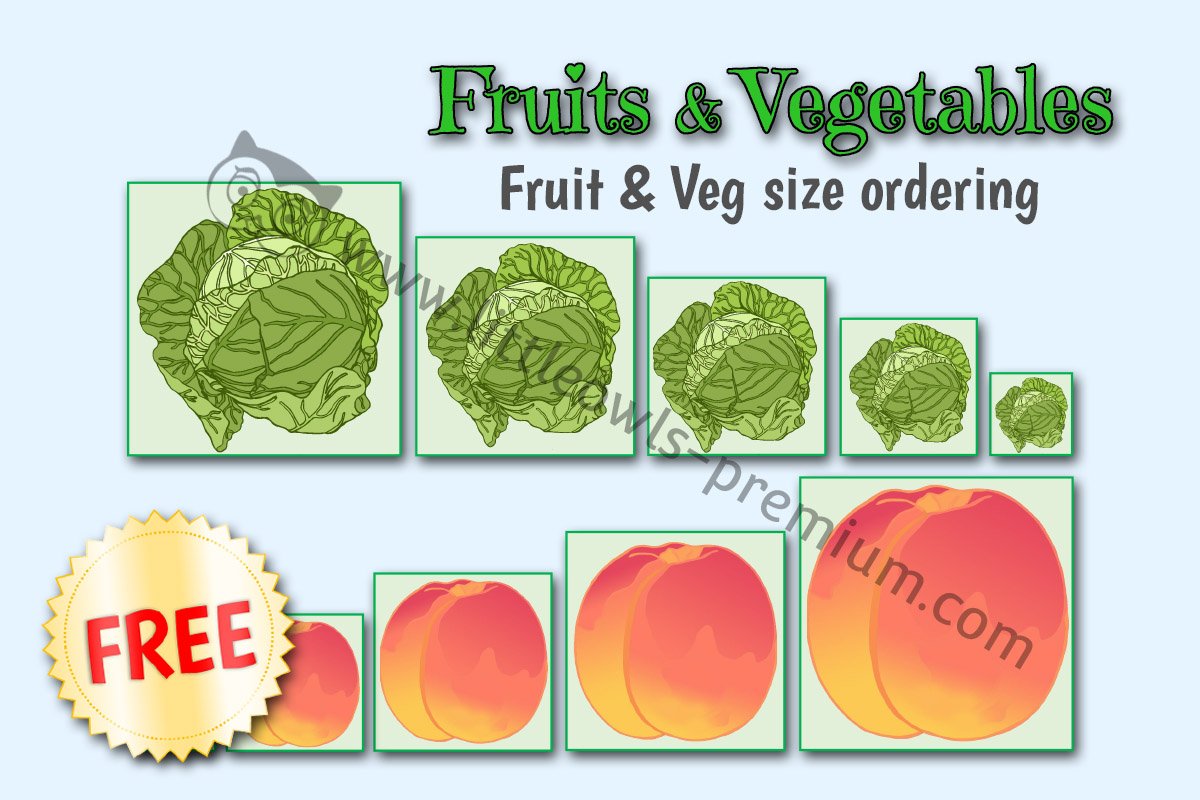
Fruit and Vegetable themed size ordering pictures. Intended to be cut out (and ideally laminated) for use by children in repeatable size ordering activities. If you have access to a fuzzy felt board, why not stick velcro tabs on the back so that children can move them around on the board? Alternatively use them as a cut and stick activity (to also strengthen fine motor skills) for the children to take home and discuss with their families using words such as ‘small, smaller, smallest, big, bigger, biggest’.
Original artwork drawn by Sara Murphy and final digital resources created by Stuart Murphy. COPYRIGHT ON ALL OF THE RESOURCES HOUSED ON THIS WEBSITE IS HELD BY ‘LITTLE OWLS RESOURCES’. OUR RESOURCES (INCLUDING THE IMAGES WITHIN THEM), CANNOT BE SHARED OR SOLD COMMERCIALLY.
DOWNLOAD EDITABLE (DOCX)
DOWNLOAD NON-EDITABLE (PDF)

35 A4 cards depicting fruit and vegetables included. Intended for display and teaching prompt purposes.
Original artwork drawn by Sara Murphy and final digital resources created by Stuart Murphy. COPYRIGHT ON ALL OF THE RESOURCES HOUSED ON THIS WEBSITE IS HELD BY ‘LITTLE OWLS RESOURCES’. OUR RESOURCES (INCLUDING THE IMAGES WITHIN THEM), CANNOT BE SHARED OR SOLD COMMERCIALLY.
DOWNLOAD EDITABLE (DOCX)
DOWNLOAD NON-EDITABLE (PDF)

35 A4 colouring sheets depicting various fruit and vegetables included.
Original artwork drawn by Sara Murphy and final digital resources created by Stuart Murphy. COPYRIGHT ON ALL OF THE RESOURCES HOUSED ON THIS WEBSITE IS HELD BY ‘LITTLE OWLS RESOURCES’. OUR RESOURCES (INCLUDING THE IMAGES WITHIN THEM), CANNOT BE SHARED OR SOLD COMMERCIALLY.
DOWNLOAD EDITABLE (DOCX)
DOWNLOAD NON-EDITABLE (PDF)

Fruit and vegetable food diary booklet/sheets. A mark making page included for each of the 7 days of the week for children to record which fruits/vegetables they have eaten. Front cover also included with space for child’s name in the event you would like to create a booklet.
Original artwork drawn by Sara Murphy and final digital resources created by Stuart Murphy. COPYRIGHT ON ALL OF THE RESOURCES HOUSED ON THIS WEBSITE IS HELD BY ‘LITTLE OWLS RESOURCES’. OUR RESOURCES (INCLUDING THE IMAGES WITHIN THEM), CANNOT BE SHARED OR SOLD COMMERCIALLY.
DOWNLOAD EDITABLE (DOCX)
DOWNLOAD NON-EDITABLE (PDF)

A set of fruit and vegetable image cards with matching description cards. Perhaps you could place the fruit and vegetable cards facing up for children to see. Pick a description card and read it to the children. Which card matches with the description I have just read? Great for observational, problem solving and listening skills! Also includes great descriptive and some mathematical vocabulary.
Original artwork drawn by Sara Murphy and final digital resources created by Stuart Murphy. COPYRIGHT ON ALL OF THE RESOURCES HOUSED ON THIS WEBSITE IS HELD BY ‘LITTLE OWLS RESOURCES’. OUR RESOURCES (INCLUDING THE IMAGES WITHIN THEM), CANNOT BE SHARED OR SOLD COMMERCIALLY.
DOWNLOAD EDITABLE (DOCX)
DOWNLOAD NON-EDITABLE (PDF)

Cut along the vertical lines on these Fruit and Vegetable themed number slice puzzles and allow your children to order numbers to reveal the correct sequence and picture as they place the pieces in the right order! Great for fine motor, problem solving, observational skills, number recognition and ordering. Cut and stick use once activity or laminate to use time and time again.
Original artwork drawn by Sara Murphy and final digital resources created by Stuart Murphy. COPYRIGHT ON ALL OF THE RESOURCES HOUSED ON THIS WEBSITE IS HELD BY ‘LITTLE OWLS RESOURCES’. OUR RESOURCES (INCLUDING THE IMAGES WITHIN THEM), CANNOT BE SHARED OR SOLD COMMERCIALLY.
DOWNLOAD EDITABLE (DOCX)
DOWNLOAD NON-EDITABLE (PDF)

Cut along the vertical lines on these Fruit and Vegetable themed number slice puzzles and allow your children to order numbers to reveal the correct sequence and picture as they place the pieces in the right order! Great for fine motor, problem solving, observational skills, number recognition and ordering. These colouring in versions are ideal for individual use cutting and sticking for children to take home in order to consolidate their knowledge further by talking to those at home about what they have learnt.
Original artwork drawn by Sara Murphy and final digital resources created by Stuart Murphy. COPYRIGHT ON ALL OF THE RESOURCES HOUSED ON THIS WEBSITE IS HELD BY ‘LITTLE OWLS RESOURCES’. OUR RESOURCES (INCLUDING THE IMAGES WITHIN THEM), CANNOT BE SHARED OR SOLD COMMERCIALLY.
DOWNLOAD EDITABLE (DOCX)
DOWNLOAD NON-EDITABLE (PDF)

Can you place pom poms or other loose parts on the multicoloured circles? Great for fine motor control and developing a pincer grip. Why not also introduce tools such as tweezers? Have fun!
Original artwork drawn by Sara Murphy and final digital resources created by Stuart Murphy. COPYRIGHT ON ALL OF THE RESOURCES HOUSED ON THIS WEBSITE IS HELD BY ‘LITTLE OWLS RESOURCES’. OUR RESOURCES (INCLUDING THE IMAGES WITHIN THEM), CANNOT BE SHARED OR SOLD COMMERCIALLY.
DOWNLOAD EDITABLE (DOCX)
DOWNLOAD NON-EDITABLE (PDF)

These A4 size mats can be laminated for use as playdough mats, or for number writing practice with a whiteboard pen. Alternatively, they can be part of a loose parts activity. They may even be used for a large number/counting display!
Original artwork drawn by Sara Murphy and final digital resources created by Stuart Murphy. COPYRIGHT ON ALL OF THE RESOURCES HOUSED ON THIS WEBSITE IS HELD BY ‘LITTLE OWLS RESOURCES’. OUR RESOURCES (INCLUDING THE IMAGES WITHIN THEM), CANNOT BE SHARED OR SOLD COMMERCIALLY.
DOWNLOAD EDITABLE (DOCX)
DOWNLOAD NON-EDITABLE (PDF)

Once laminated these Fruit and Vegetable Multimats are ideal to be used as reusable playdough or loose parts mats. Alternatively, use them in conjunction with whiteboard pens. Without lamination these sheets could also be used with mark making tools or art and craft materials.
Original artwork drawn by Sara Murphy and final digital resources created by Stuart Murphy. COPYRIGHT ON ALL OF THE RESOURCES HOUSED ON THIS WEBSITE IS HELD BY ‘LITTLE OWLS RESOURCES’. OUR RESOURCES (INCLUDING THE IMAGES WITHIN THEM), CANNOT BE SHARED OR SOLD COMMERCIALLY.
DOWNLOAD EDITABLE (DOCX)
DOWNLOAD NON-EDITABLE (PDF)

Can you make the right number of carrots out of playdough?
Original artwork drawn by Sara Murphy and final digital resources created by Stuart Murphy. COPYRIGHT ON ALL OF THE RESOURCES HOUSED ON THIS WEBSITE IS HELD BY ‘LITTLE OWLS RESOURCES’. OUR RESOURCES (INCLUDING THE IMAGES WITHIN THEM), CANNOT BE SHARED OR SOLD COMMERCIALLY.
DOWNLOAD EDITABLE (DOCX)
DOWNLOAD NON-EDITABLE (PDF)
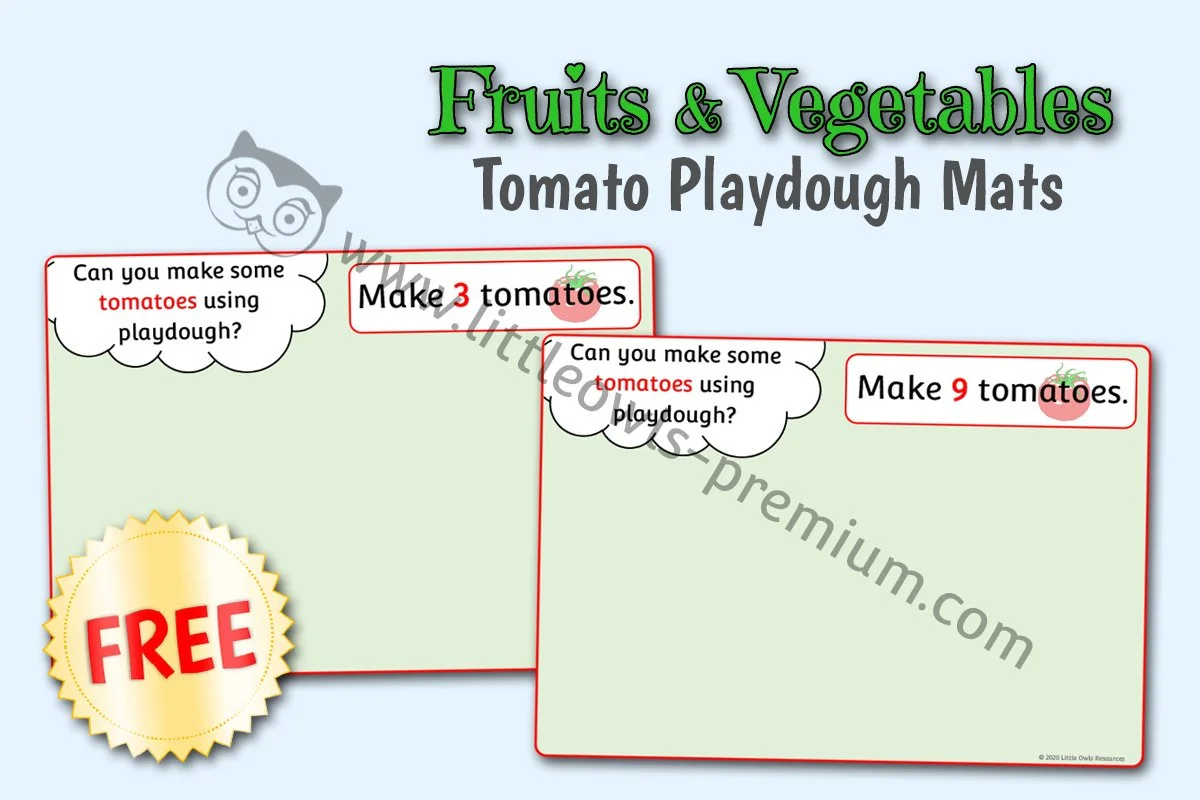
Can you make the right number of tomatoes out of playdough?
Original artwork drawn by Sara Murphy and final digital resources created by Stuart Murphy. COPYRIGHT ON ALL OF THE RESOURCES HOUSED ON THIS WEBSITE IS HELD BY ‘LITTLE OWLS RESOURCES’. OUR RESOURCES (INCLUDING THE IMAGES WITHIN THEM), CANNOT BE SHARED OR SOLD COMMERCIALLY.
DOWNLOAD EDITABLE (DOCX)
DOWNLOAD NON-EDITABLE (PDF)

Download this one stop 'Farm Shop' role play pack. Ideal role play area for the Autumn Harvest term.
Pack includes:
banner
menu with prices
blank proforma menu for children to fill in
picture cards of various things to be sold in the role-play shop (to ideally cut out and laminate)
food signs
open/closed signs
advert posters
shopping list templates
opening times poster (including days of the week)
product price signs (pre-written versions and those to be filled in by children)
Original artwork drawn by Sara Murphy and final digital resources created by Stuart Murphy. COPYRIGHT ON ALL OF THE RESOURCES HOUSED ON THIS WEBSITE IS HELD BY ‘LITTLE OWLS RESOURCES’. OUR RESOURCES (INCLUDING THE IMAGES WITHIN THEM), CANNOT BE SHARED OR SOLD COMMERCIALLY.
DOWNLOAD EDITABLE (DOCX)
DOWNLOAD NON-EDITABLE (PDF)
DOWNLOAD NON-EDITABLE (Zipped JPEGs)

Original artwork drawn by Sara Murphy and final digital resources created by Stuart Murphy. COPYRIGHT ON ALL OF THE RESOURCES HOUSED ON THIS WEBSITE IS HELD BY ‘LITTLE OWLS RESOURCES’. OUR RESOURCES (INCLUDING THE IMAGES WITHIN THEM), CANNOT BE SHARED OR SOLD COMMERCIALLY.
DOWNLOAD EDITABLE (DOCX)
DOWNLOAD NON-EDITABLE (PDF)
DOWNLOAD NON-EDITABLE (Zipped JPEGs)

As part of exploring Healthy foods with your children, why not ask them to draw a favourite healthy meal?...or even use some collage materials!
Original artwork drawn by Sara Murphy and final digital resources created by Stuart Murphy. COPYRIGHT ON ALL OF THE RESOURCES HOUSED ON THIS WEBSITE IS HELD BY ‘LITTLE OWLS RESOURCES’. OUR RESOURCES (INCLUDING THE IMAGES WITHIN THEM), CANNOT BE SHARED OR SOLD COMMERCIALLY.
DOWNLOAD EDITABLE (DOCX)
DOWNLOAD NON-EDITABLE (PDF)
DOWNLOAD NON-EDITABLE (Zipped JPEGs)

Our healthy plate posters (landscape and portrait) outline food group portions for healthy eating. Included on the poster are:
Fruits and Vegetables
Grains - whole grains, bread, noodles, pasta
Protein - meat, dairy, beans, eggs, fish
Original artwork drawn by Sara Murphy and final digital resources created by Stuart Murphy. COPYRIGHT ON ALL OF THE RESOURCES HOUSED ON THIS WEBSITE IS HELD BY ‘LITTLE OWLS RESOURCES’. OUR RESOURCES (INCLUDING THE IMAGES WITHIN THEM), CANNOT BE SHARED OR SOLD COMMERCIALLY.
DOWNLOAD EDITABLE (DOCX)
DOWNLOAD NON-EDITABLE (PDF)
DOWNLOAD NON-EDITABLE (Zipped JPEGs)

Healthy Eating Diary booklet/sheets. A mark making page included for each of the 7 days of the week for children to record what food/drink they have had. Front cover also included with space for child’s name in the event you would like to create a booklet.
Original artwork drawn by Sara Murphy and final digital resources created by Stuart Murphy. COPYRIGHT ON ALL OF THE RESOURCES HOUSED ON THIS WEBSITE IS HELD BY ‘LITTLE OWLS RESOURCES’. OUR RESOURCES (INCLUDING THE IMAGES WITHIN THEM), CANNOT BE SHARED OR SOLD COMMERCIALLY.
DOWNLOAD EDITABLE (DOCX)
DOWNLOAD NON-EDITABLE (PDF)
DOWNLOAD NON-EDITABLE (Zipped JPEGs)

This fruit and vegetables poster displays the message ‘Try to eat 5 a day!’ 5 stars are shown to illustrate this.
Whilst this resource can be used as an informative and encouraging poster, once laminated it could also be used in conjunction with whiteboard pens, magnets (if placed on a fridge), etc as a form of chart to mark off once the 5 fruits/veg are achieved each day.
Original artwork drawn by Sara Murphy and final digital resources created by Stuart Murphy. COPYRIGHT ON ALL OF THE RESOURCES HOUSED ON THIS WEBSITE IS HELD BY ‘LITTLE OWLS RESOURCES’. OUR RESOURCES (INCLUDING THE IMAGES WITHIN THEM), CANNOT BE SHARED OR SOLD COMMERCIALLY.
DOWNLOAD EDITABLE (DOCX)
DOWNLOAD NON-EDITABLE (PDF)
DOWNLOAD NON-EDITABLE (Zipped JPEGs)
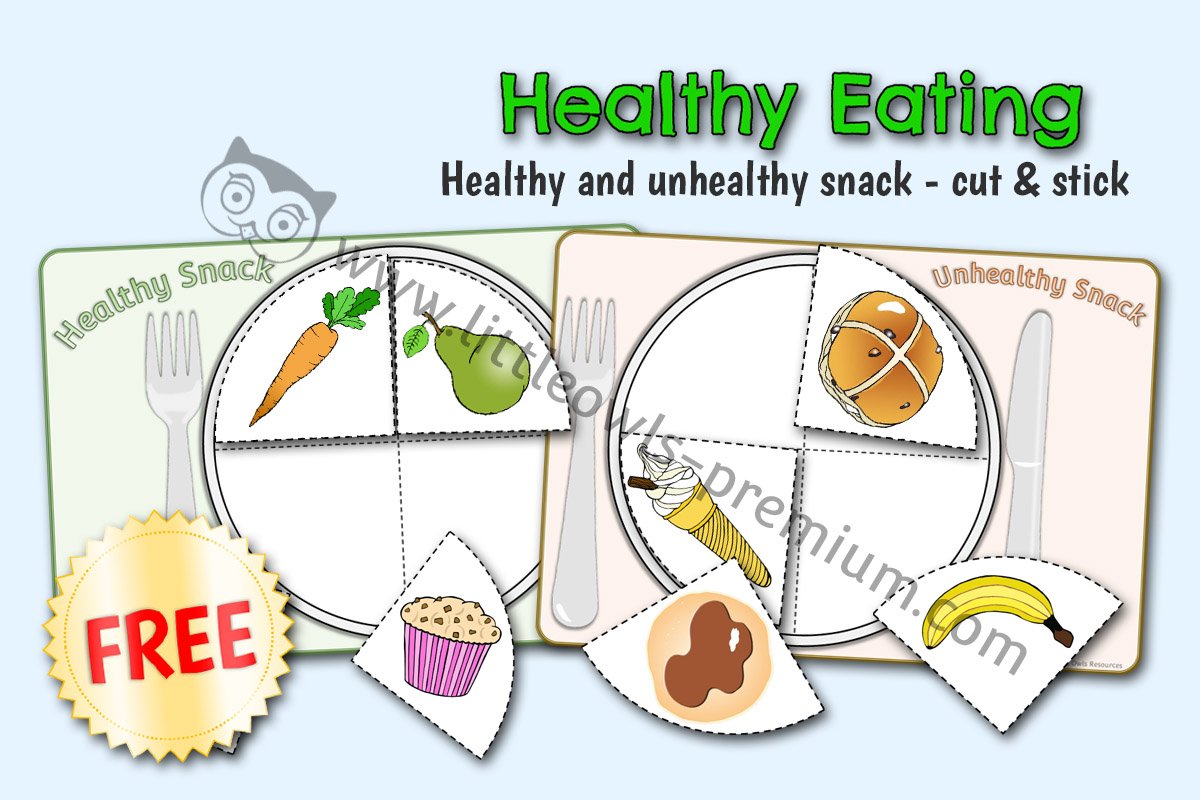
Healthy & Unhealthy snacks cut and stick activity. Encourage children to cut out the eight snacks (with appropriate guidance and supervision as necessary) and then stick the foods onto the correct plates.
Original artwork drawn by Sara Murphy and final digital resources created by Stuart Murphy. COPYRIGHT ON ALL OF THE RESOURCES HOUSED ON THIS WEBSITE IS HELD BY ‘LITTLE OWLS RESOURCES’. OUR RESOURCES (INCLUDING THE IMAGES WITHIN THEM), CANNOT BE SHARED OR SOLD COMMERCIALLY.
DOWNLOAD EDITABLE (DOCX)
DOWNLOAD NON-EDITABLE (PDF)
DOWNLOAD NON-EDITABLE (Zipped JPEGs)

Original artwork drawn by Sara Murphy and final digital resources created by Stuart Murphy. COPYRIGHT ON ALL OF THE RESOURCES HOUSED ON THIS WEBSITE IS HELD BY ‘LITTLE OWLS RESOURCES’. OUR RESOURCES (INCLUDING THE IMAGES WITHIN THEM), CANNOT BE SHARED OR SOLD COMMERCIALLY.
DOWNLOAD EDITABLE (DOCX)
DOWNLOAD NON-EDITABLE (PDF)
DOWNLOAD NON-EDITABLE (Zipped JPEGs)

Original artwork drawn by Sara Murphy and final digital resources created by Stuart Murphy. COPYRIGHT ON ALL OF THE RESOURCES HOUSED ON THIS WEBSITE IS HELD BY ‘LITTLE OWLS RESOURCES’. OUR RESOURCES (INCLUDING THE IMAGES WITHIN THEM), CANNOT BE SHARED OR SOLD COMMERCIALLY.
DOWNLOAD EDITABLE (DOCX)
DOWNLOAD NON-EDITABLE (PDF)
DOWNLOAD NON-EDITABLE (Zipped JPEGs)
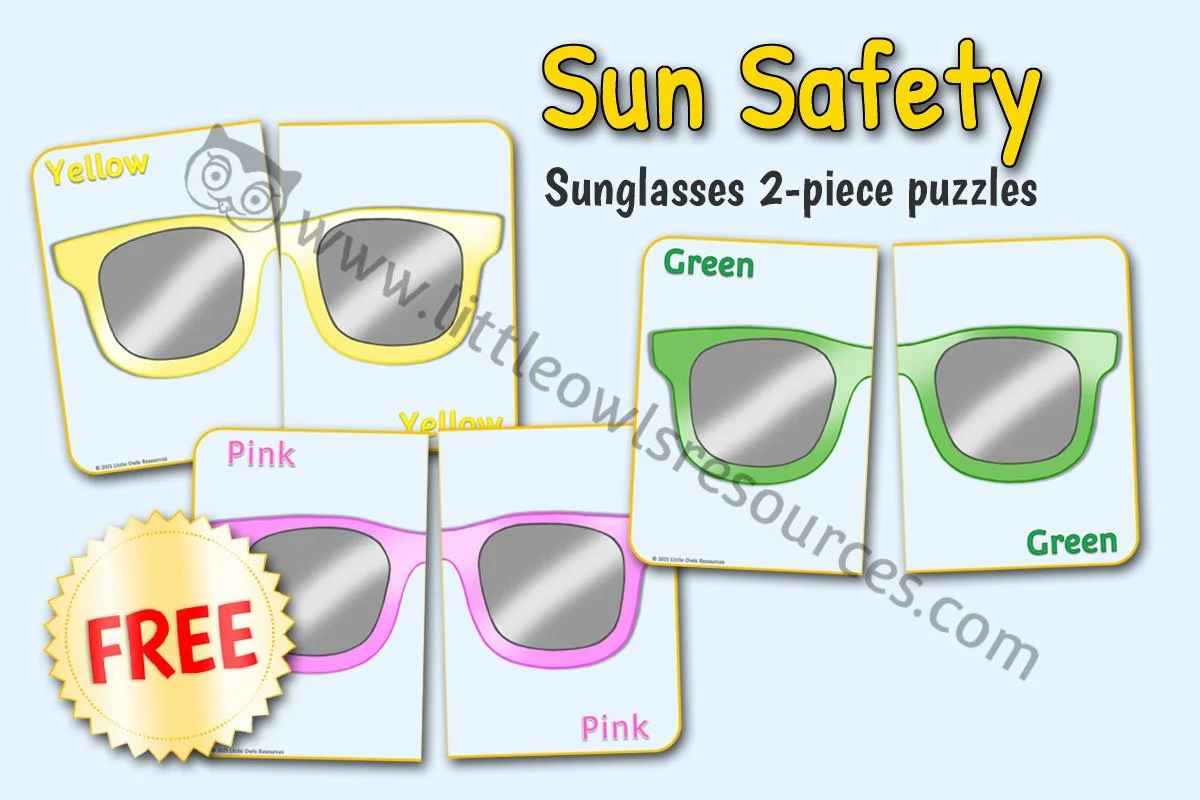
Consolidate colour knowledge with this fun sunglasses puzzle matching game. Children will also begin to recognise that print has meaning and connect written words to colours.
Original artwork drawn by Sara Murphy and final digital resources created by Stuart Murphy. COPYRIGHT ON ALL OF THE RESOURCES HOUSED ON THIS WEBSITE IS HELD BY ‘LITTLE OWLS RESOURCES’. OUR RESOURCES (INCLUDING THE IMAGES WITHIN THEM), CANNOT BE SHARED OR SOLD COMMERCIALLY.
DOWNLOAD EDITABLE (DOCX)
DOWNLOAD NON-EDITABLE (PDF)
DOWNLOAD NON-EDITABLE (Zipped JPEGs)
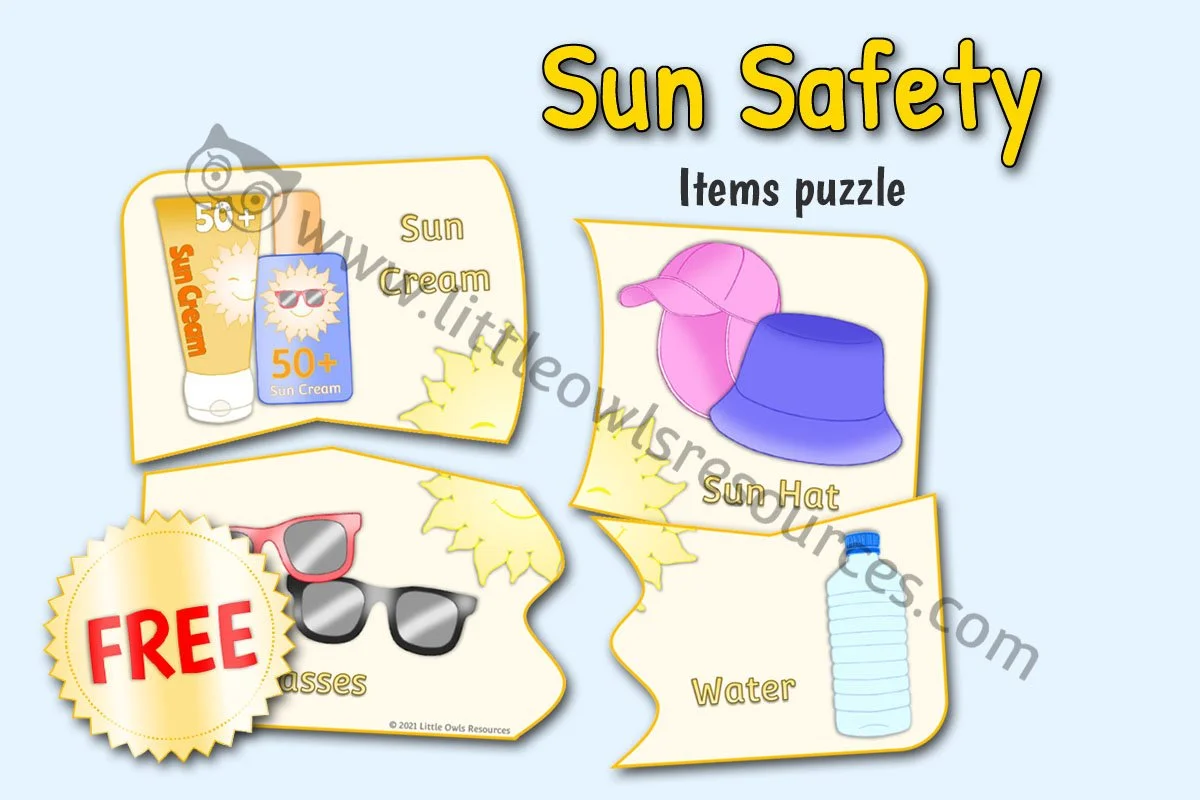
A fun way to help children to learn about sun safety. This puzzle highlights the need to wear sun cream, a sun hat and sunglasses and to drink plenty of water in hot weather.
Two versions - one with text and one without.
Original artwork drawn by Sara Murphy and final digital resources created by Stuart Murphy. COPYRIGHT ON ALL OF THE RESOURCES HOUSED ON THIS WEBSITE IS HELD BY ‘LITTLE OWLS RESOURCES’. OUR RESOURCES (INCLUDING THE IMAGES WITHIN THEM), CANNOT BE SHARED OR SOLD COMMERCIALLY.
DOWNLOAD EDITABLE (DOCX)
DOWNLOAD NON-EDITABLE (PDF)
DOWNLOAD NON-EDITABLE (Zipped JPEGs)
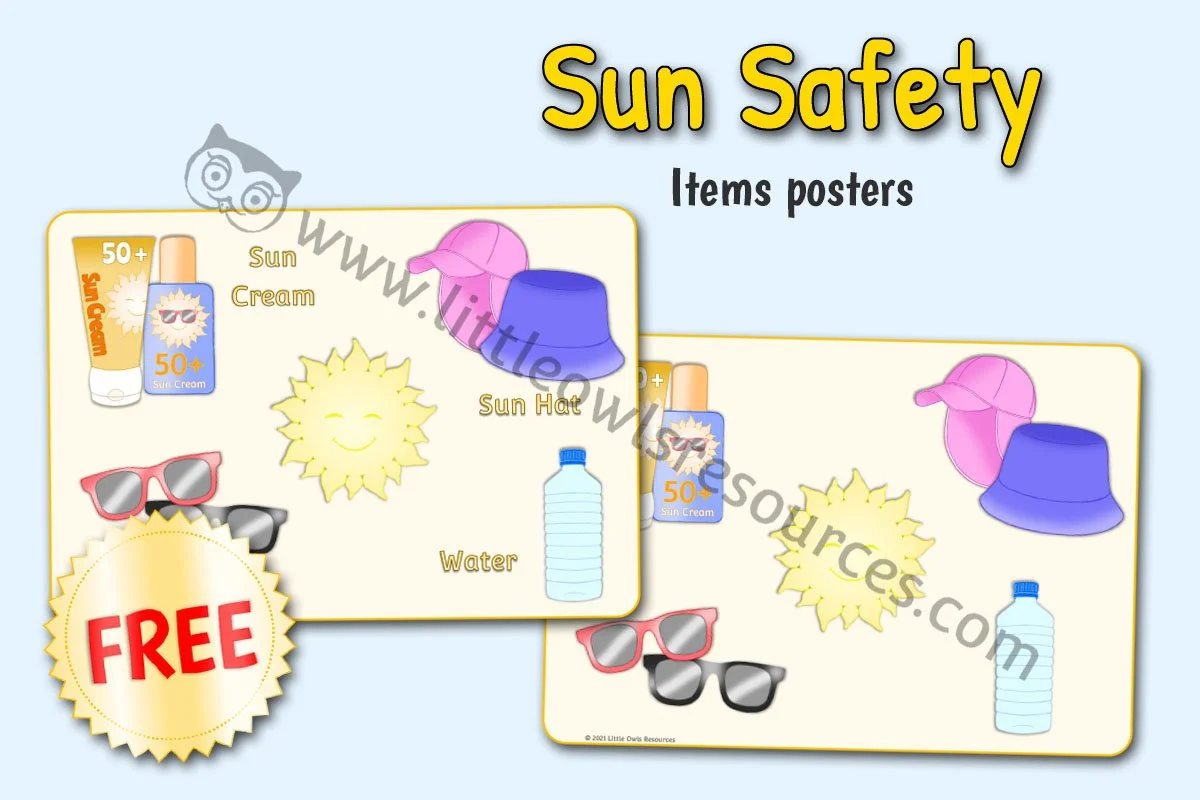
Posters to highlight the main Sun Safety objects for children to remember. Useful to display in common areas as a visual reminder for children, parents and practitioners alike!
Original artwork drawn by Sara Murphy and final digital resources created by Stuart Murphy. COPYRIGHT ON ALL OF THE RESOURCES HOUSED ON THIS WEBSITE IS HELD BY ‘LITTLE OWLS RESOURCES’. OUR RESOURCES (INCLUDING THE IMAGES WITHIN THEM), CANNOT BE SHARED OR SOLD COMMERCIALLY.
DOWNLOAD EDITABLE (DOCX)
DOWNLOAD NON-EDITABLE (PDF)
DOWNLOAD NON-EDITABLE (Zipped JPEGs)
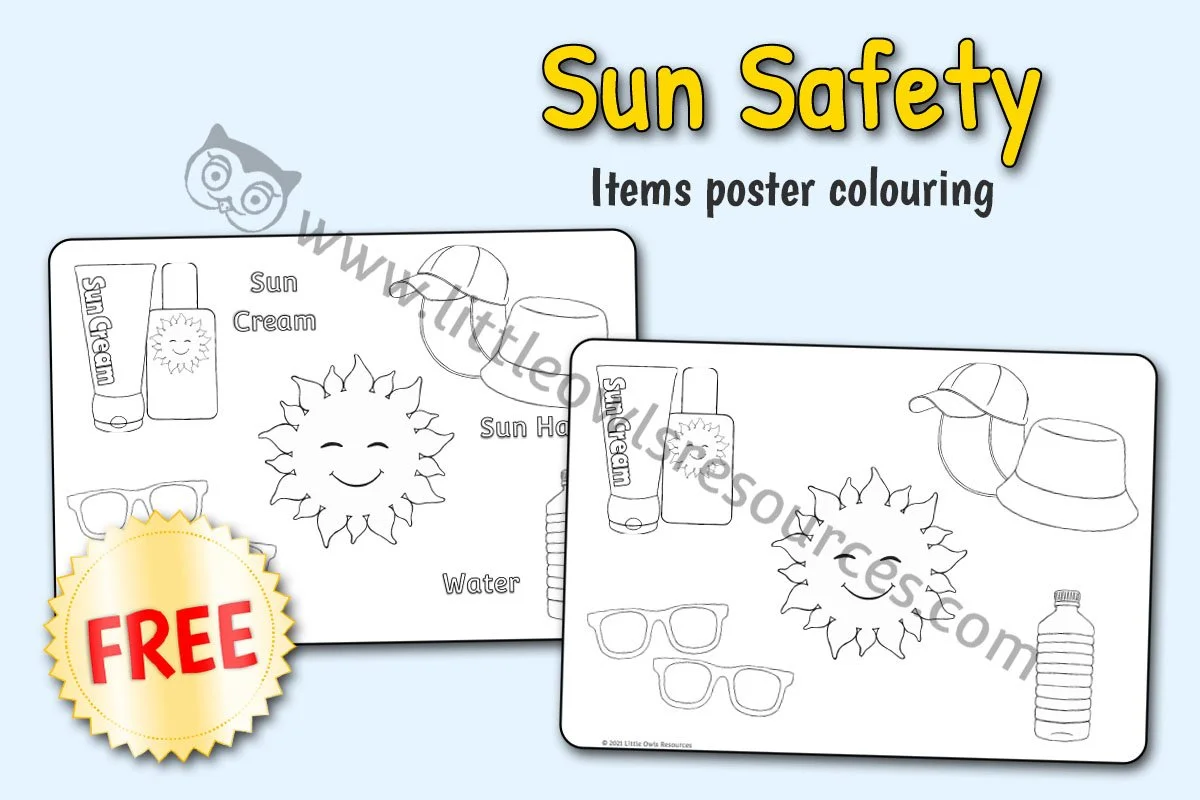
Colouring posters/sheets to highlight the main Sun Safety objects for children to remember. Useful as a visual reminder for children, parents and practitioners alike!
Original artwork drawn by Sara Murphy and final digital resources created by Stuart Murphy. COPYRIGHT ON ALL OF THE RESOURCES HOUSED ON THIS WEBSITE IS HELD BY ‘LITTLE OWLS RESOURCES’. OUR RESOURCES (INCLUDING THE IMAGES WITHIN THEM), CANNOT BE SHARED OR SOLD COMMERCIALLY.
DOWNLOAD EDITABLE (DOCX)
DOWNLOAD NON-EDITABLE (PDF)
DOWNLOAD NON-EDITABLE (Zipped JPEGs)
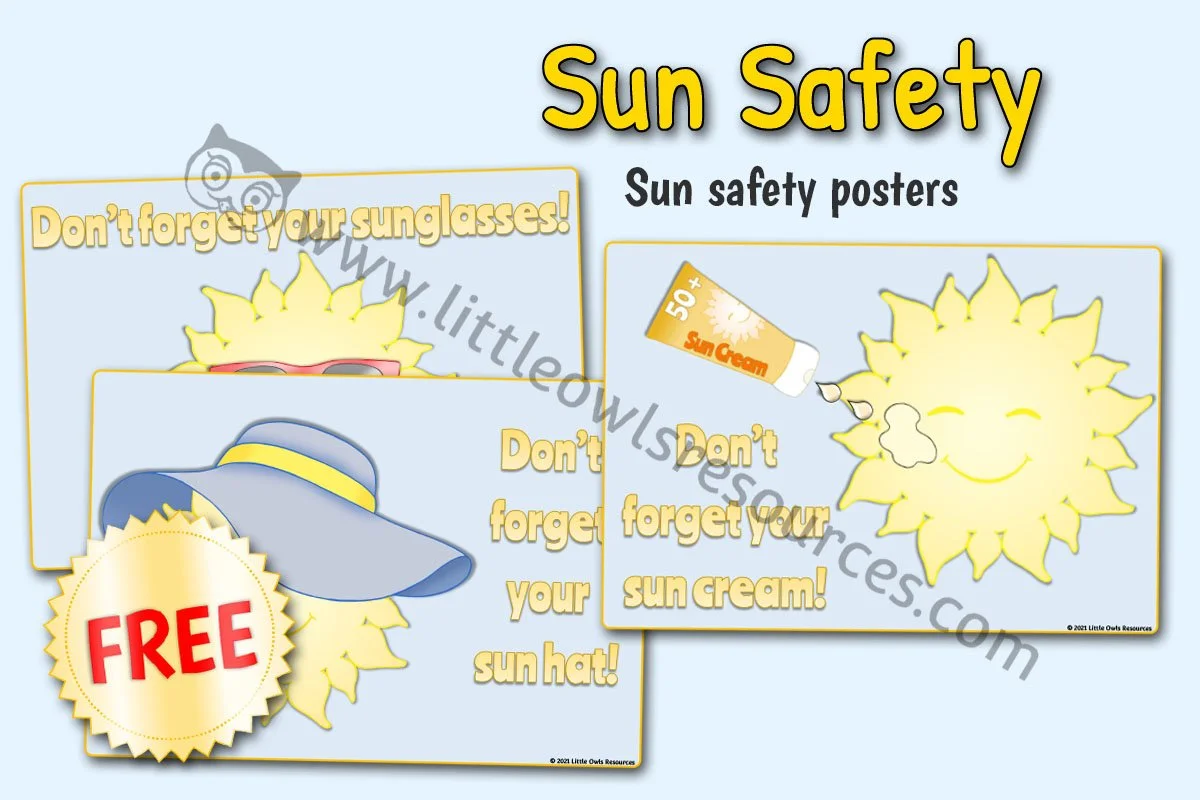
Set of ‘Don’t forget…’ posters to highlight the main aspects of Sun Safety. Useful to display in common areas as a visual reminder for children, parents and practitioners alike! Also useful as discussion prompts during Sun Safety discussions.
Original artwork drawn by Sara Murphy and final digital resources created by Stuart Murphy. COPYRIGHT ON ALL OF THE RESOURCES HOUSED ON THIS WEBSITE IS HELD BY ‘LITTLE OWLS RESOURCES’. OUR RESOURCES (INCLUDING THE IMAGES WITHIN THEM), CANNOT BE SHARED OR SOLD COMMERCIALLY.
DOWNLOAD EDITABLE (DOCX)
DOWNLOAD NON-EDITABLE (PDF)
DOWNLOAD NON-EDITABLE (Zipped JPEGs)
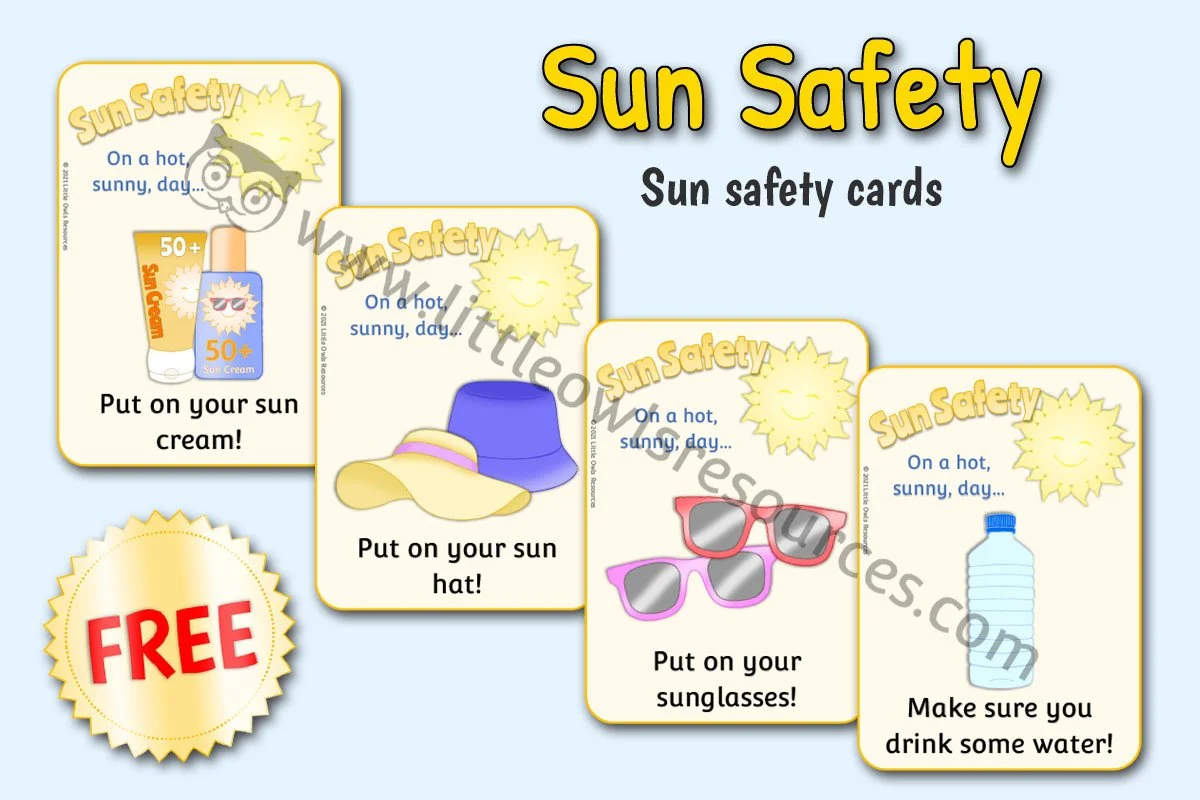
Cards to highlight the main aspects of Sun Safety. Useful to display in common areas as a visual reminder for children, parents and practitioners alike! Also useful as discussion prompts during Sun Safety discussions.
Original artwork drawn by Sara Murphy and final digital resources created by Stuart Murphy. COPYRIGHT ON ALL OF THE RESOURCES HOUSED ON THIS WEBSITE IS HELD BY ‘LITTLE OWLS RESOURCES’. OUR RESOURCES (INCLUDING THE IMAGES WITHIN THEM), CANNOT BE SHARED OR SOLD COMMERCIALLY.
DOWNLOAD EDITABLE (DOCX)
DOWNLOAD NON-EDITABLE (PDF)
DOWNLOAD NON-EDITABLE (Zipped JPEGs)
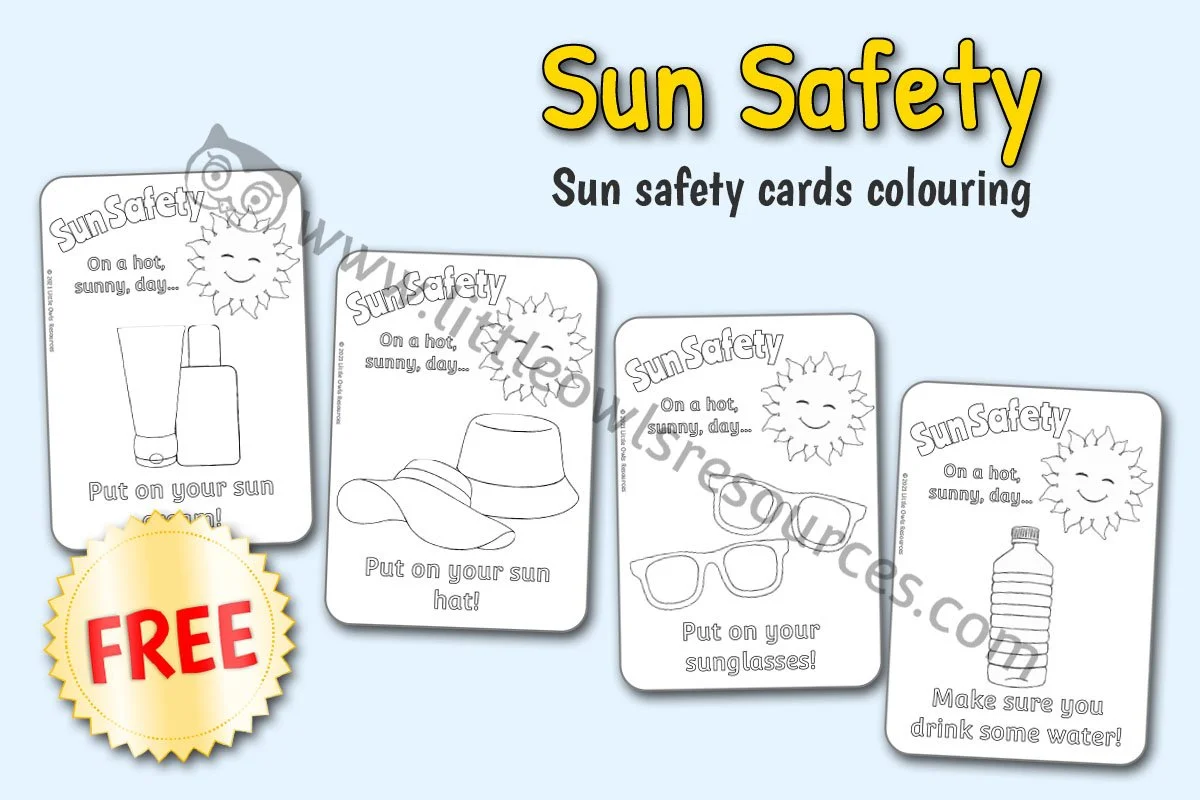
Colouring cards to highlight the main aspects of Sun Safety. Useful as a visual reminder for children, parents and practitioners alike! Also useful as discussion prompts during Sun Safety discussions.
Original artwork drawn by Sara Murphy and final digital resources created by Stuart Murphy. COPYRIGHT ON ALL OF THE RESOURCES HOUSED ON THIS WEBSITE IS HELD BY ‘LITTLE OWLS RESOURCES’. OUR RESOURCES (INCLUDING THE IMAGES WITHIN THEM), CANNOT BE SHARED OR SOLD COMMERCIALLY.
DOWNLOAD EDITABLE (DOCX)
DOWNLOAD NON-EDITABLE (PDF)
DOWNLOAD NON-EDITABLE (Zipped JPEGs)
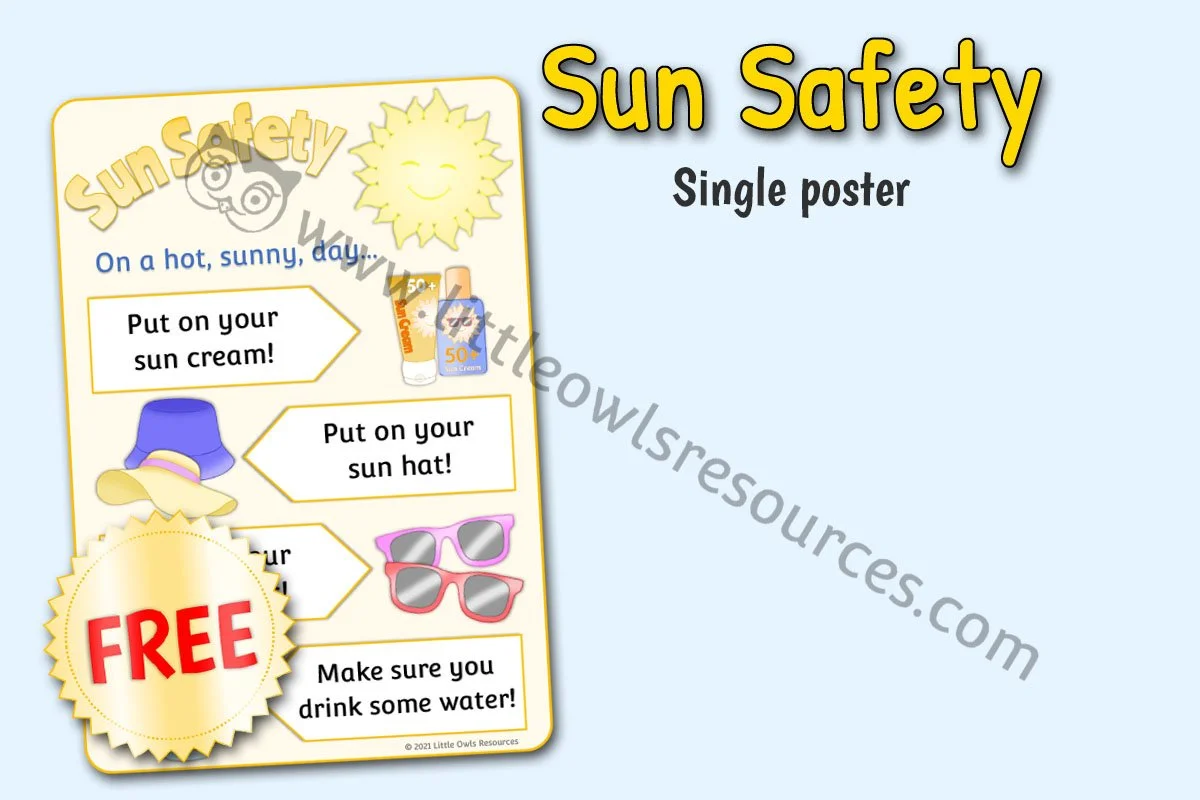
Poster to highlight the main aspects of Sun Safety. Useful to display in common areas as a visual reminder for children, parents and practitioners alike!
Original artwork drawn by Sara Murphy and final digital resources created by Stuart Murphy. COPYRIGHT ON ALL OF THE RESOURCES HOUSED ON THIS WEBSITE IS HELD BY ‘LITTLE OWLS RESOURCES’. OUR RESOURCES (INCLUDING THE IMAGES WITHIN THEM), CANNOT BE SHARED OR SOLD COMMERCIALLY.
DOWNLOAD EDITABLE (DOCX)
DOWNLOAD NON-EDITABLE (PDF)
DOWNLOAD NON-EDITABLE (Zipped JPEGs)
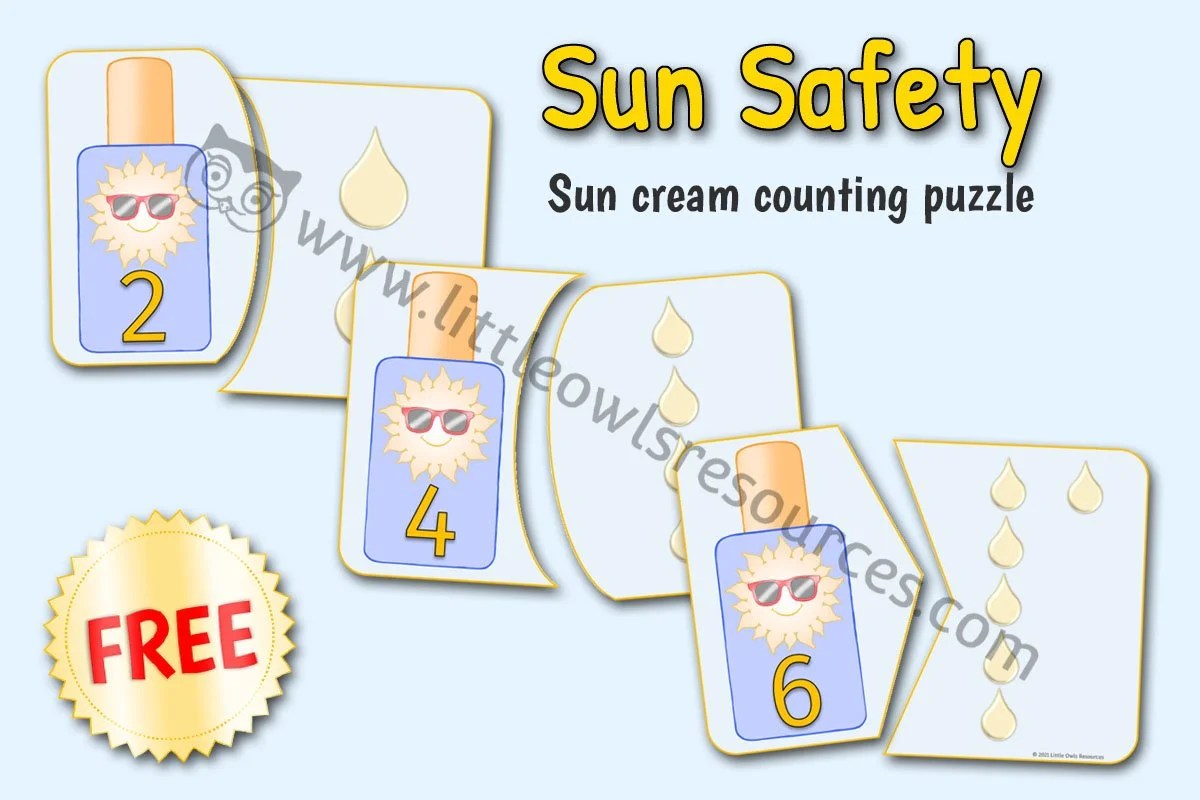
1-10 sun cream themed number recognition counting puzzles. Match the number to the correct quantity of sun cream drops. Practise counting objects which cannot be moved. Use as a table or floor activity or part of an interactive display board. Left uncut, can be used as flashcards, for number ordering games or tuff spot counting loose part activities!
Original artwork drawn by Sara Murphy and final digital resources created by Stuart Murphy. COPYRIGHT ON ALL OF THE RESOURCES HOUSED ON THIS WEBSITE IS HELD BY ‘LITTLE OWLS RESOURCES’. OUR RESOURCES (INCLUDING THE IMAGES WITHIN THEM), CANNOT BE SHARED OR SOLD COMMERCIALLY.
DOWNLOAD EDITABLE (DOCX)
DOWNLOAD NON-EDITABLE (PDF)
DOWNLOAD NON-EDITABLE (Zipped JPEGs)
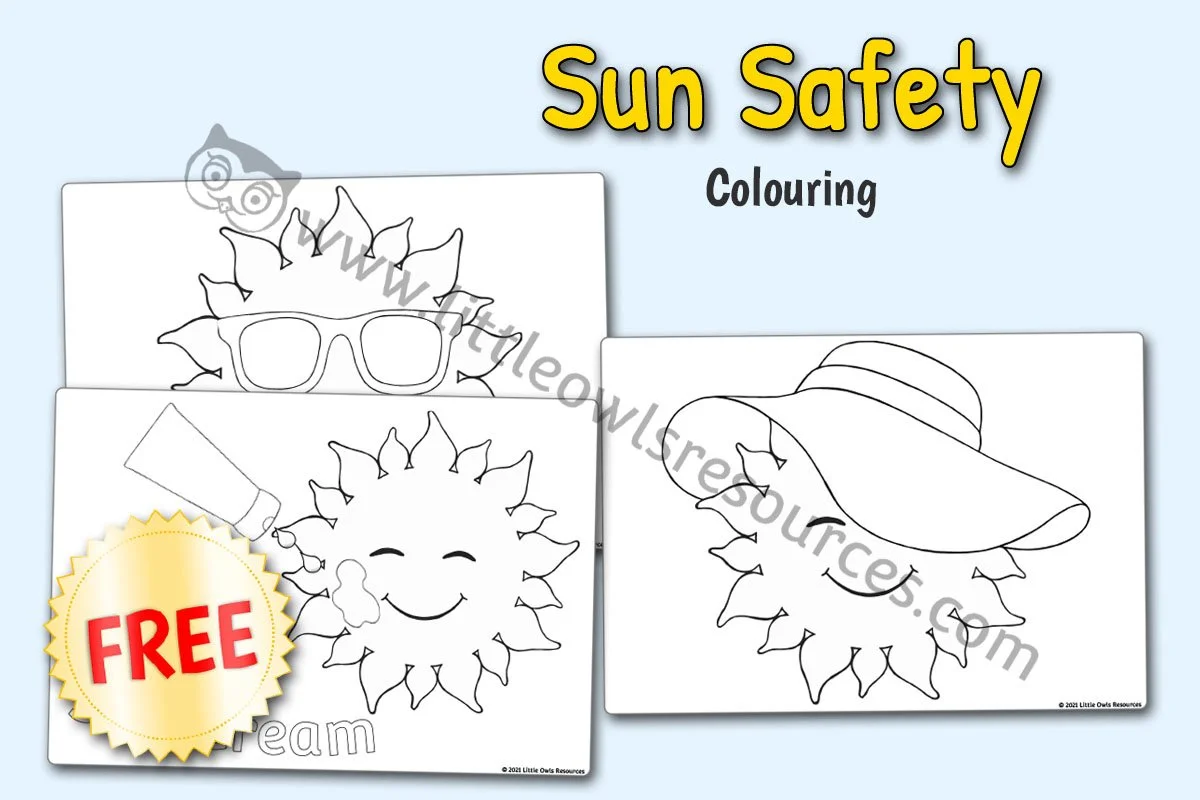
Sun Safety Colouring Pages/Sheets.
Original artwork drawn by Sara Murphy and final digital resources created by Stuart Murphy. COPYRIGHT ON ALL OF THE RESOURCES HOUSED ON THIS WEBSITE IS HELD BY ‘LITTLE OWLS RESOURCES’. OUR RESOURCES (INCLUDING THE IMAGES WITHIN THEM), CANNOT BE SHARED OR SOLD COMMERCIALLY.
DOWNLOAD EDITABLE (DOCX)
DOWNLOAD NON-EDITABLE (PDF)
DOWNLOAD NON-EDITABLE (Zipped JPEGs)
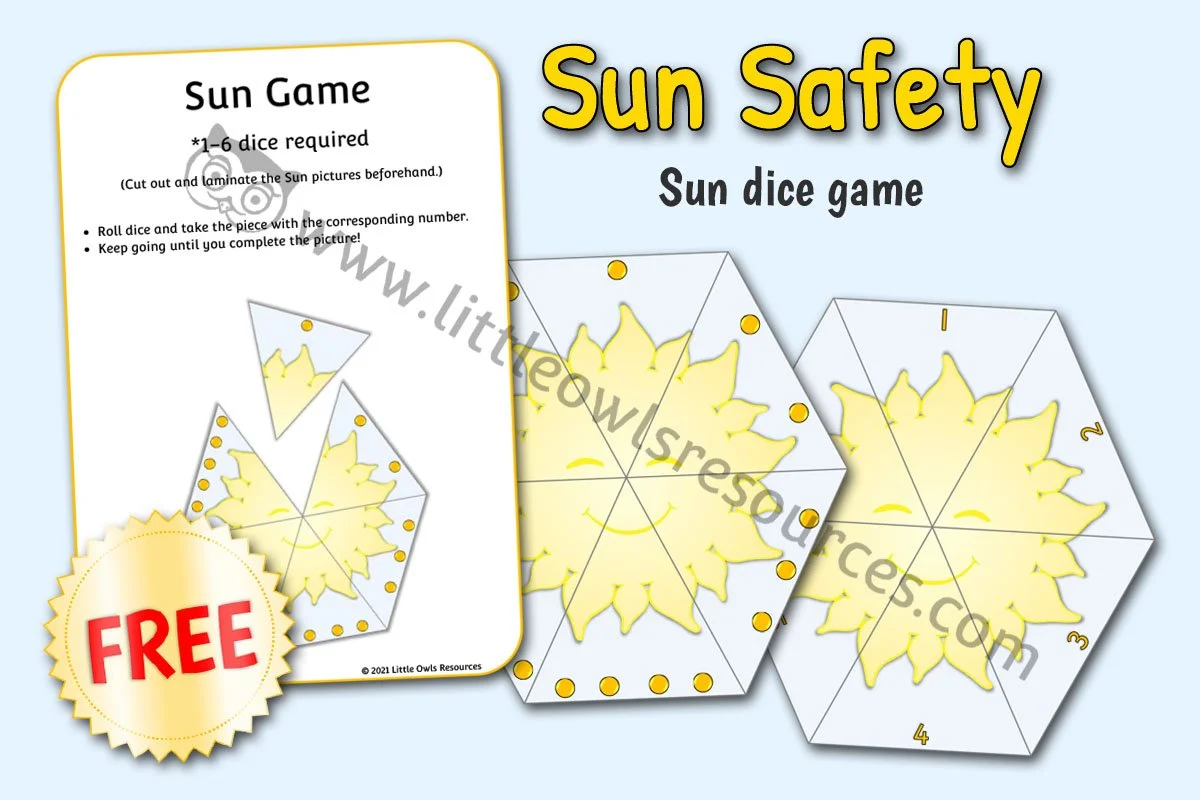
*1-6 dice required
(Cut out and laminate the Sun pictures beforehand.)
• Roll dice and take the piece with the corresponding number.
• Keep going until you complete the picture!
Original artwork drawn by Sara Murphy and final digital resources created by Stuart Murphy. COPYRIGHT ON ALL OF THE RESOURCES HOUSED ON THIS WEBSITE IS HELD BY ‘LITTLE OWLS RESOURCES’. OUR RESOURCES (INCLUDING THE IMAGES WITHIN THEM), CANNOT BE SHARED OR SOLD COMMERCIALLY.
DOWNLOAD EDITABLE (DOCX)
DOWNLOAD NON-EDITABLE (PDF)
DOWNLOAD NON-EDITABLE (Zipped JPEGs)
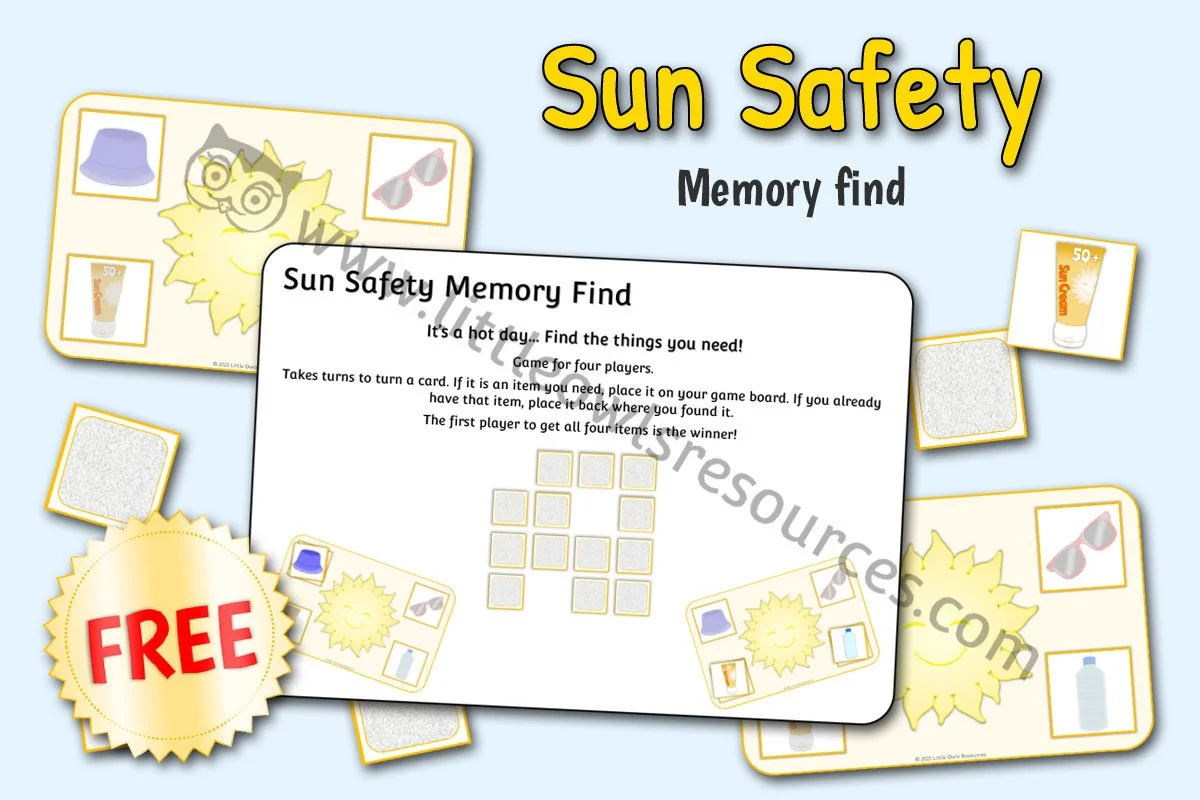
It’s a hot day… Find the things you need!
Game for four players.
Take turns to turn a card. If it is an item you need, place it on your game board. If you already have that item, place it back where you found it.
The first player to get all four items is the winner!
Original artwork drawn by Sara Murphy and final digital resources created by Stuart Murphy. COPYRIGHT ON ALL OF THE RESOURCES HOUSED ON THIS WEBSITE IS HELD BY ‘LITTLE OWLS RESOURCES’. OUR RESOURCES (INCLUDING THE IMAGES WITHIN THEM), CANNOT BE SHARED OR SOLD COMMERCIALLY.
DOWNLOAD EDITABLE (DOCX)
DOWNLOAD NON-EDITABLE (PDF)
DOWNLOAD NON-EDITABLE (Zipped JPEGs)
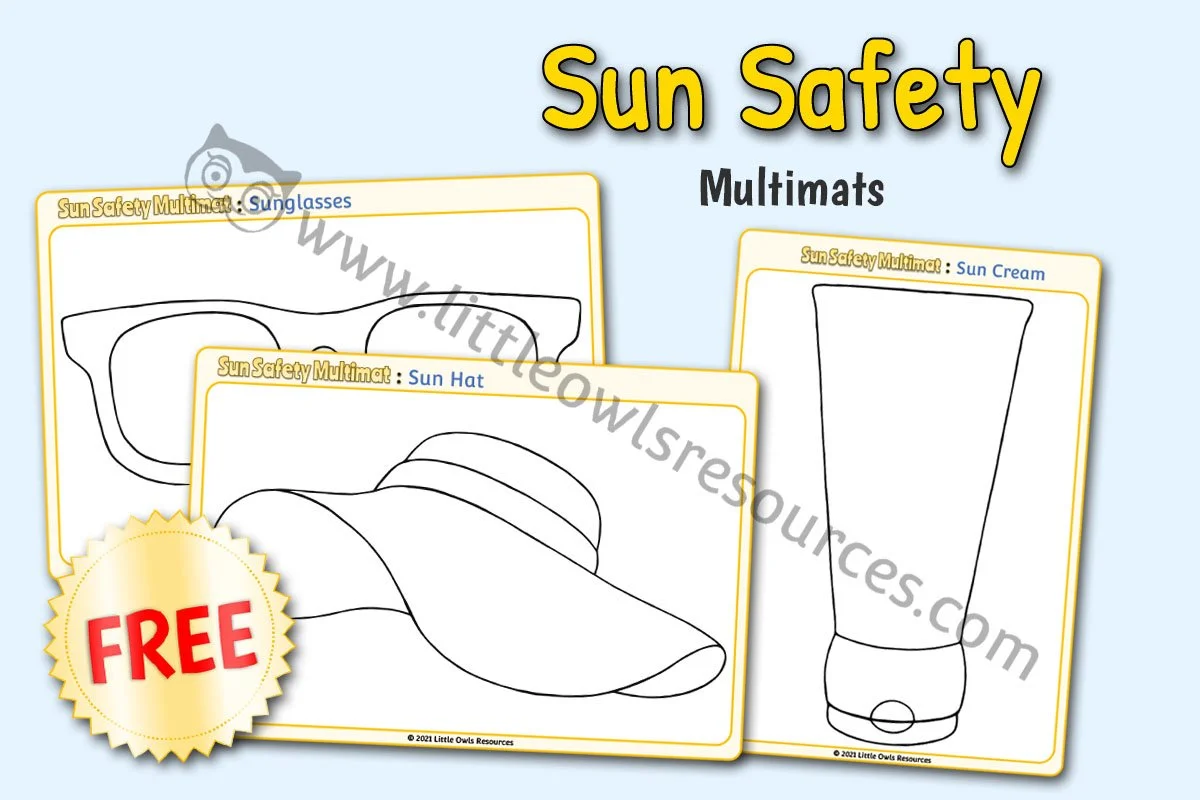
Sun Safety Multimats - These multimats can be coloured or used in conjunction with art and craft cut and stick materials. If laminated they may be used for playdough or loose parts design work.
Original artwork drawn by Sara Murphy and final digital resources created by Stuart Murphy. COPYRIGHT ON ALL OF THE RESOURCES HOUSED ON THIS WEBSITE IS HELD BY ‘LITTLE OWLS RESOURCES’. OUR RESOURCES (INCLUDING THE IMAGES WITHIN THEM), CANNOT BE SHARED OR SOLD COMMERCIALLY.
DOWNLOAD EDITABLE (DOCX)
DOWNLOAD NON-EDITABLE (PDF)
DOWNLOAD NON-EDITABLE (Zipped JPEGs)
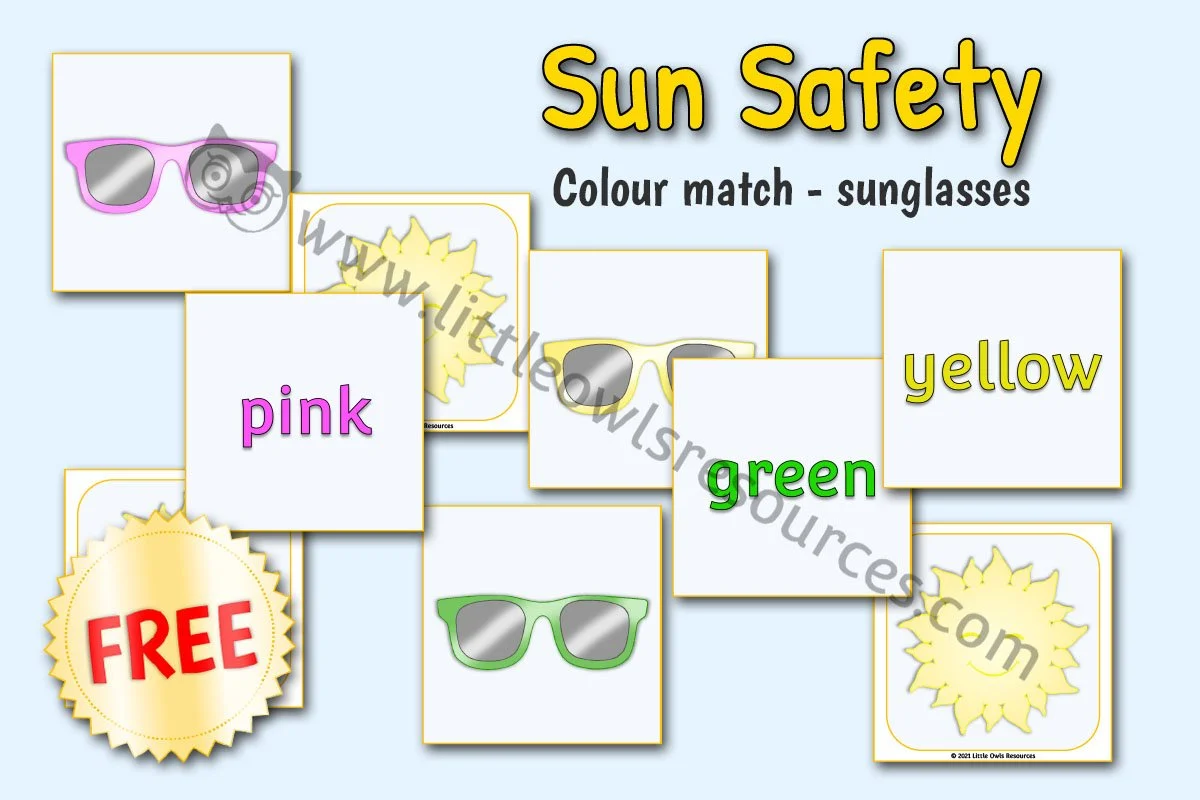
Consolidate colour knowledge with this fun matching game. Children will also begin to recognise that print has meaning and connect written words to colours.
Cards to use for a matching activity, picking up pairs memory game or as flash cards. Each card is made with a backing tab for folding before lamination to provide a more robust final product.
Original artwork drawn by Sara Murphy and final digital resources created by Stuart Murphy. COPYRIGHT ON ALL OF THE RESOURCES HOUSED ON THIS WEBSITE IS HELD BY ‘LITTLE OWLS RESOURCES’. OUR RESOURCES (INCLUDING THE IMAGES WITHIN THEM), CANNOT BE SHARED OR SOLD COMMERCIALLY.
DOWNLOAD EDITABLE (DOCX)
DOWNLOAD NON-EDITABLE (PDF)
DOWNLOAD NON-EDITABLE (Zipped JPEGs)
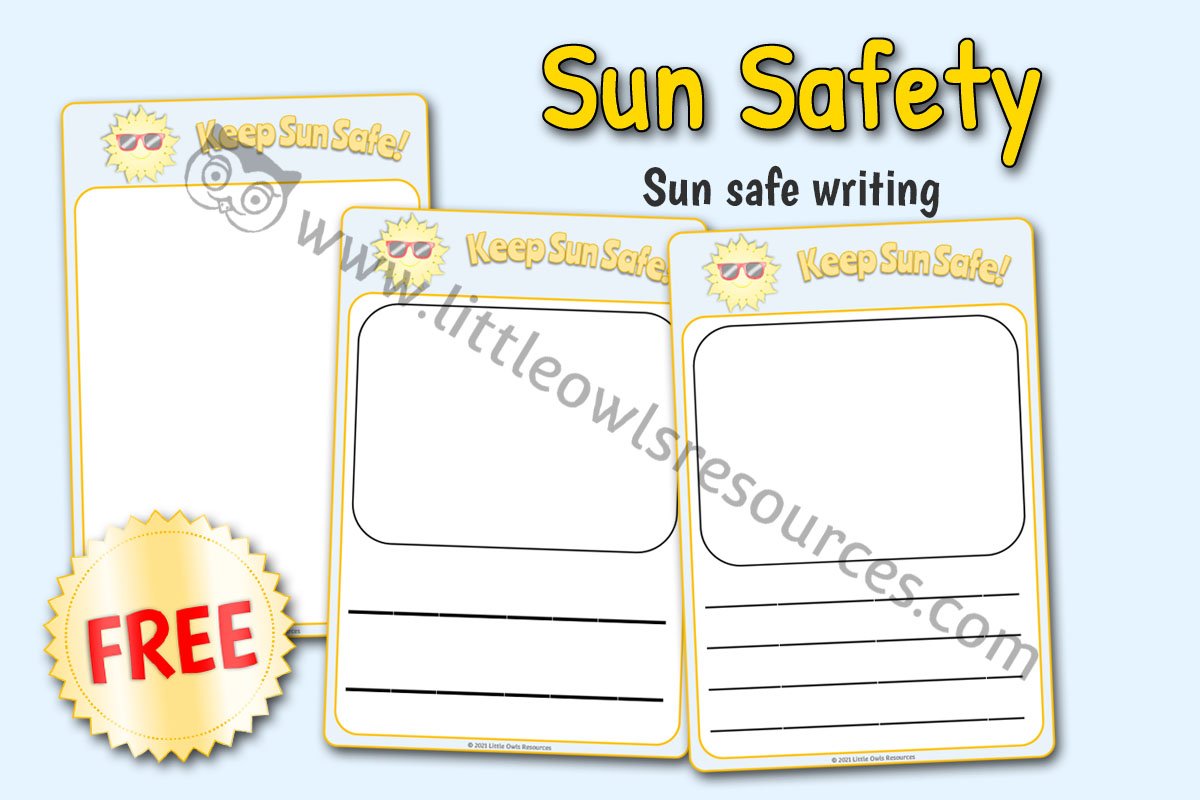
Encourage children to think about how we can stay safe in the sun. The sheets cover an ability range from first mark-making up to full phrase/sentence writing.
Original artwork drawn by Sara Murphy and final digital resources created by Stuart Murphy. COPYRIGHT ON ALL OF THE RESOURCES HOUSED ON THIS WEBSITE IS HELD BY ‘LITTLE OWLS RESOURCES’. OUR RESOURCES (INCLUDING THE IMAGES WITHIN THEM), CANNOT BE SHARED OR SOLD COMMERCIALLY.
DOWNLOAD EDITABLE (DOCX)
DOWNLOAD NON-EDITABLE (PDF)
DOWNLOAD NON-EDITABLE (Zipped JPEGs)
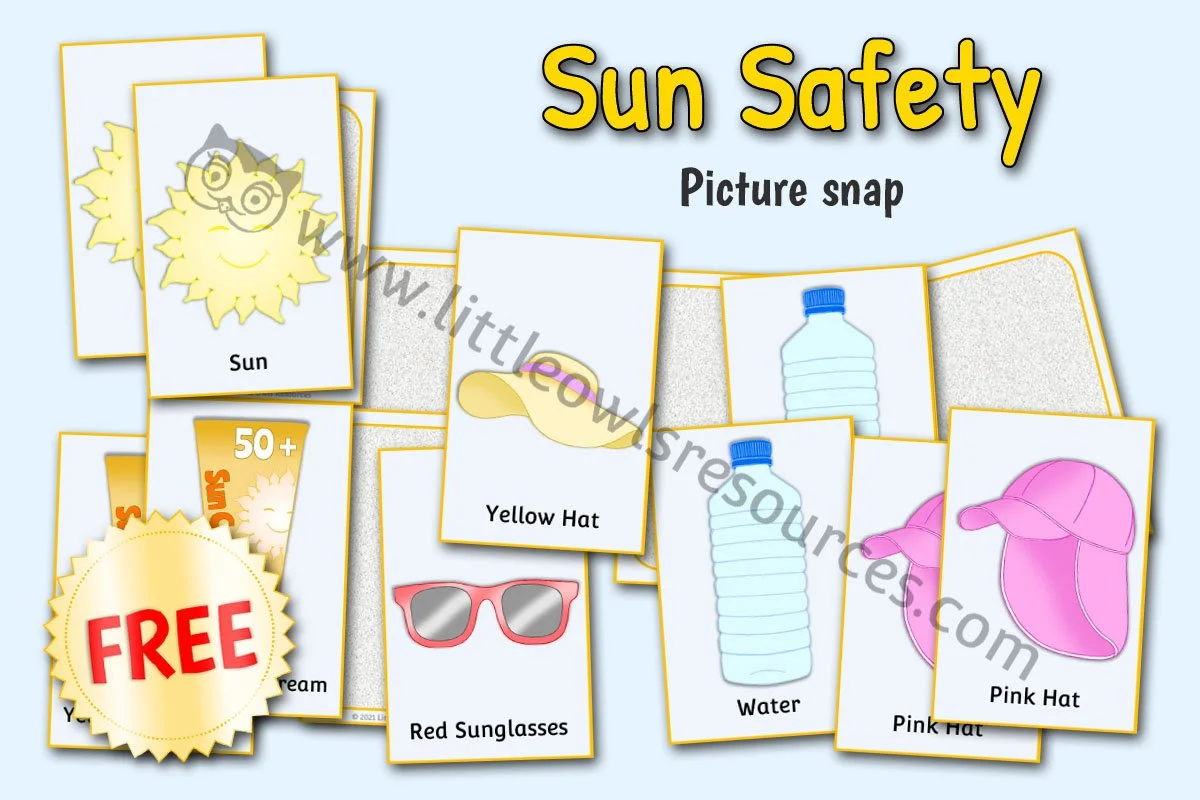
These ‘Sun Safety’ Picture Snap cards can be printed, cut out and laminated as a fun snap or memory matching pairs game to consolidate children's recognition of and descriptive language surrounding sun safety themed objects.
Each card is made with a backing tab for folding before lamination to provide a more robust final product.
Original artwork drawn by Sara Murphy and final digital resources created by Stuart Murphy. COPYRIGHT ON ALL OF THE RESOURCES HOUSED ON THIS WEBSITE IS HELD BY ‘LITTLE OWLS RESOURCES’. OUR RESOURCES (INCLUDING THE IMAGES WITHIN THEM), CANNOT BE SHARED OR SOLD COMMERCIALLY.
DOWNLOAD EDITABLE (DOCX)
DOWNLOAD NON-EDITABLE (PDF)
DOWNLOAD NON-EDITABLE (Zipped JPEGs)
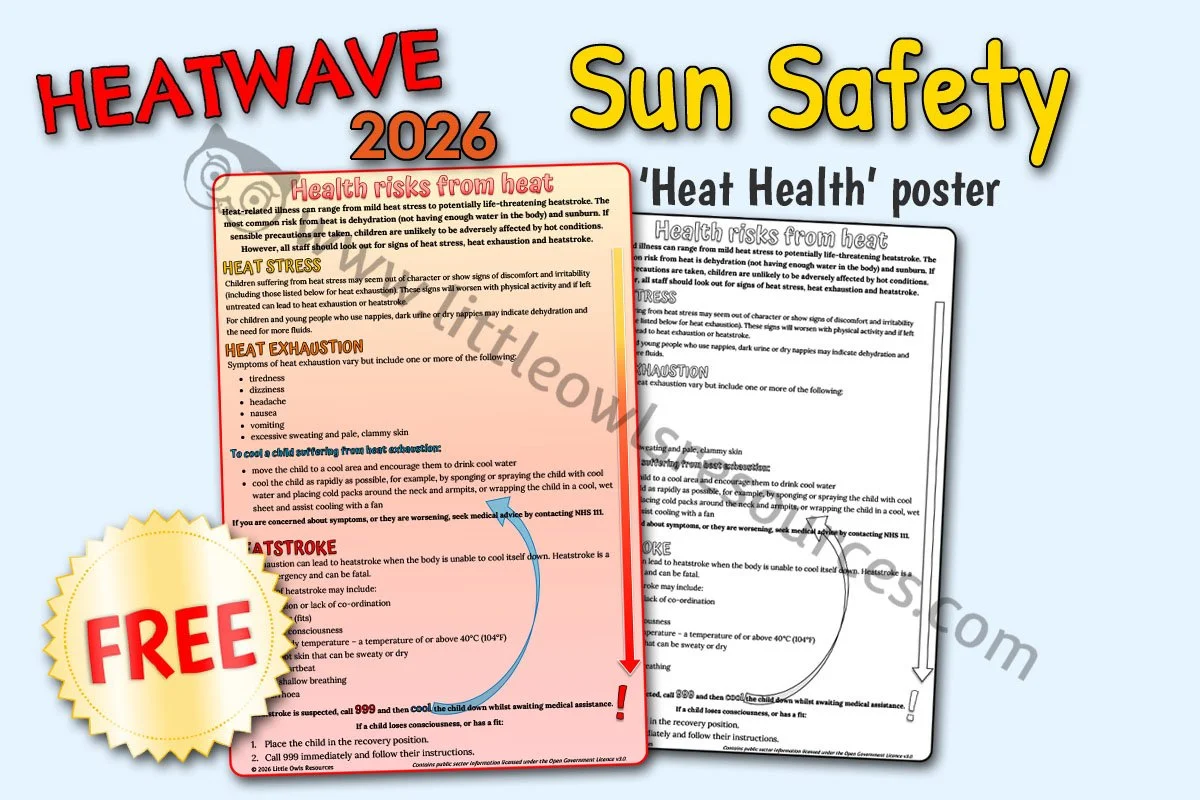
Poster/information sheet to highlight the symptoms to look out for in children for ‘heat stress’, ‘heat exhaustion’ and ‘heatstroke’. It also includes actions to take to protect a child exhibiting symptoms. Full colour and black and white versions within pack.
Contains public sector information licenced under the Open Government Licence v3.0.
Reviewed: May 2026
Original artwork drawn by Sara Murphy and final digital resources created by Stuart Murphy. COPYRIGHT ON ALL OF THE RESOURCES HOUSED ON THIS WEBSITE IS HELD BY ‘LITTLE OWLS RESOURCES’. OUR RESOURCES (INCLUDING THE IMAGES WITHIN THEM), CANNOT BE SHARED OR SOLD COMMERCIALLY.
DOWNLOAD EDITABLE (DOCX)
DOWNLOAD NON-EDITABLE (PDF)
DOWNLOAD NON-EDITABLE (Zipped JPEGs)
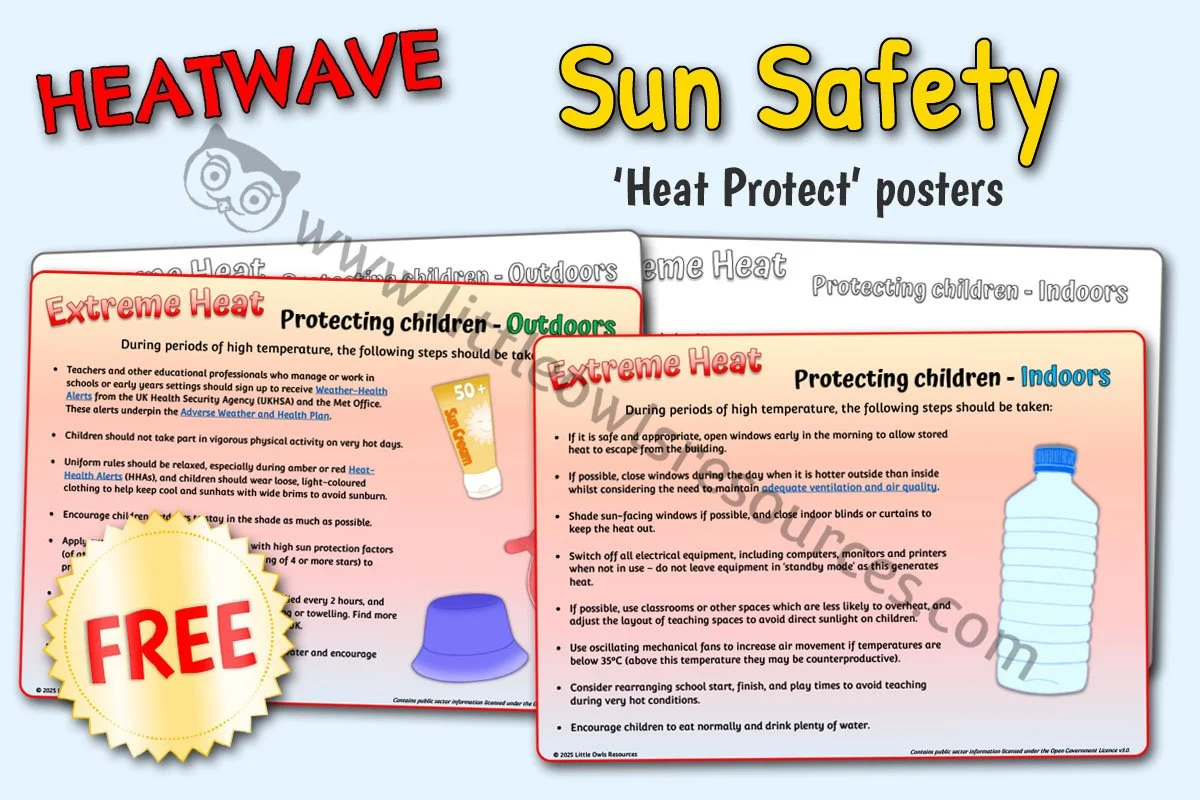
Poster/information sheets highlighting how to keep children safe indoors and outdoors during extreme heat. Full colour and black and white versions within pack.
Contains public sector information licenced under the Open Government Licence v3.0.
Reviewed: May 2026
Original artwork drawn by Sara Murphy and final digital resources created by Stuart Murphy. COPYRIGHT ON ALL OF THE RESOURCES HOUSED ON THIS WEBSITE IS HELD BY ‘LITTLE OWLS RESOURCES’. OUR RESOURCES (INCLUDING THE IMAGES WITHIN THEM), CANNOT BE SHARED OR SOLD COMMERCIALLY.
DOWNLOAD EDITABLE (DOCX)
DOWNLOAD NON-EDITABLE (PDF)
DOWNLOAD NON-EDITABLE (Zipped JPEGs)
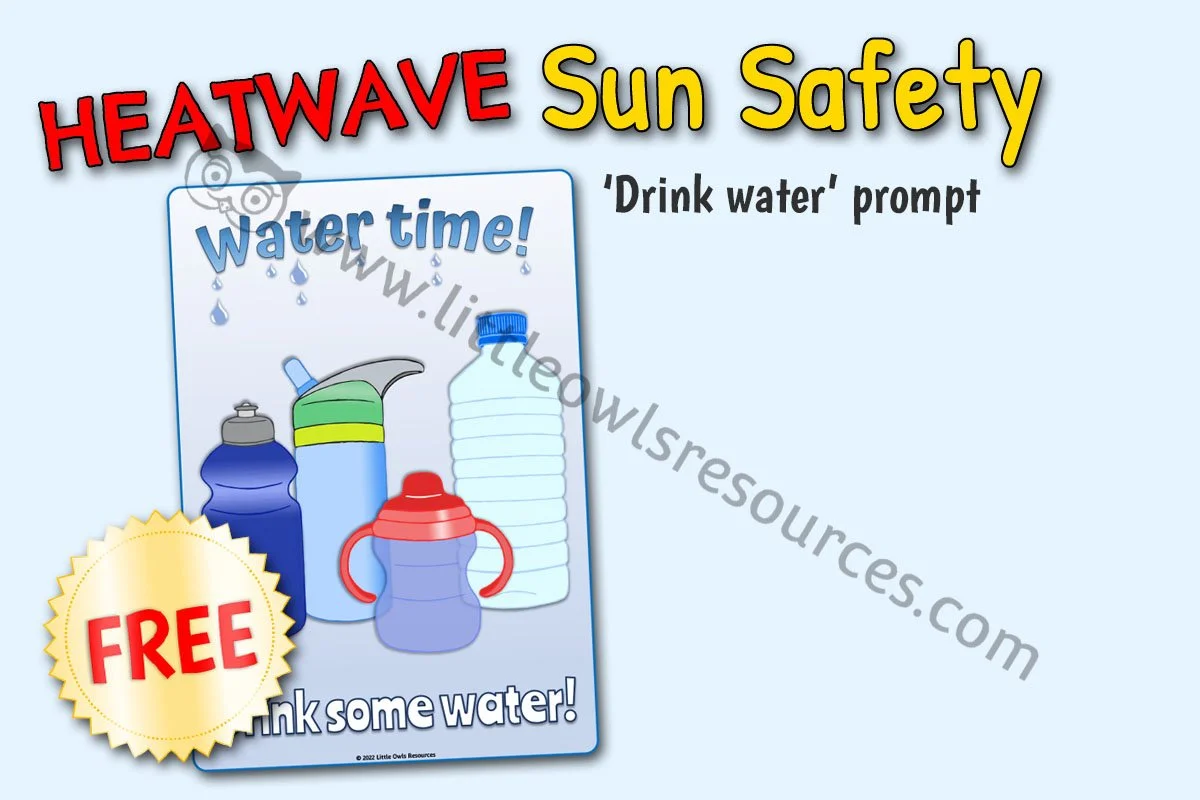
Visual communication aid in order to remind children to drink water during extreme heat. Practitioners may wish to hold this poster/card up periodically in front of children as a visual reminder to have a drink.
Original artwork drawn by Sara Murphy and final digital resources created by Stuart Murphy. COPYRIGHT ON ALL OF THE RESOURCES HOUSED ON THIS WEBSITE IS HELD BY ‘LITTLE OWLS RESOURCES’. OUR RESOURCES (INCLUDING THE IMAGES WITHIN THEM), CANNOT BE SHARED OR SOLD COMMERCIALLY.
DOWNLOAD EDITABLE (DOCX)
DOWNLOAD NON-EDITABLE (PDF)
DOWNLOAD NON-EDITABLE (Zipped JPEGs)
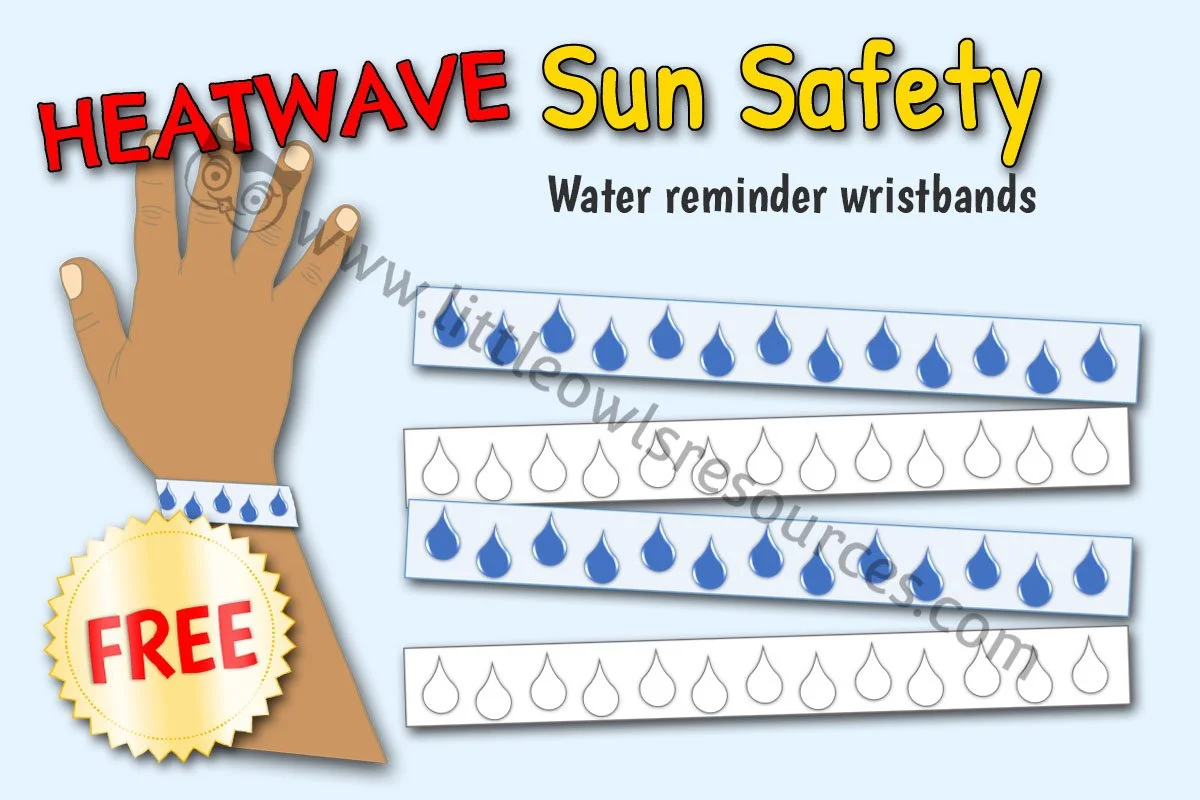
Visual communication aid in order to remind children to drink water during extreme heat. The intention with these wristbands is to create a visual and tactile reminder for young children to remember to drink regularly in the heat.
The wristbands are to be cut out and stuck on a child’s wrist. Hopefully, each time they notice it during the day they will think about drinking some more water!
Also included is a colouring version for an extended activity.
Original artwork drawn by Sara Murphy and final digital resources created by Stuart Murphy. COPYRIGHT ON ALL OF THE RESOURCES HOUSED ON THIS WEBSITE IS HELD BY ‘LITTLE OWLS RESOURCES’. OUR RESOURCES (INCLUDING THE IMAGES WITHIN THEM), CANNOT BE SHARED OR SOLD COMMERCIALLY.
DOWNLOAD EDITABLE (DOCX)
DOWNLOAD NON-EDITABLE (PDF)
DOWNLOAD NON-EDITABLE (Zipped JPEGs)
The following is a small selection of our inspirational ‘Health’ and ‘Safety’ resources for EYFS & KS1:
(Please visit our ‘Medicine’, ‘The Human Body’, ‘Exercise’, ‘Handwashing & Hygiene’, ‘Eye Health’, ‘Teeth & Oral Health’, ‘Food’ (Fruit & Vegetables plus Balanced Diet), ‘Mental Health’, ‘Sun Safety’, ‘Road Safety’, ‘Science’ or ‘EYFS Framework’ (Safeguarding) pages to explore our extensive catalogue of Health and Safety resources.)
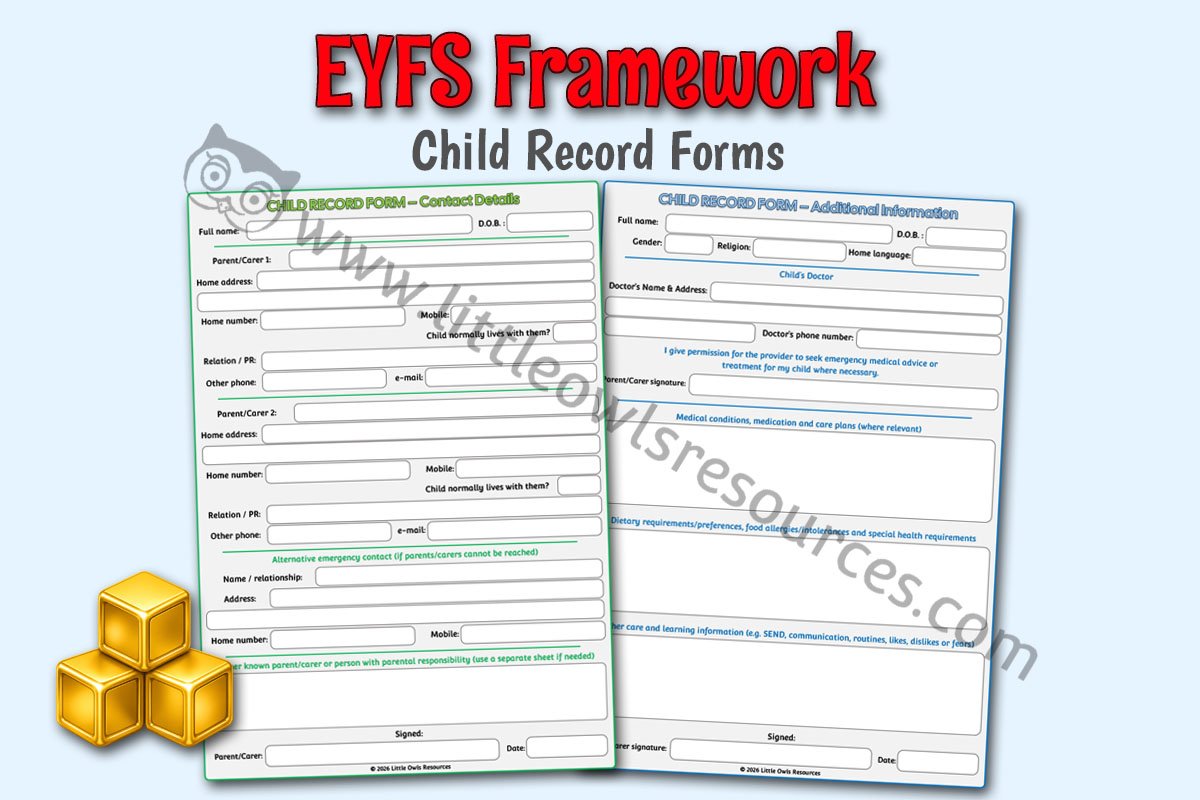
Child record form which comprises 2 A4 pages. The first page covers ‘Contact Details’ and the second ‘Additional Information’. If you would like to adapt the forms, simply choose the editable docx file.
Updated to align with the Early Years Foundation Stage Statutory Framework, effective 1st September 2026.
We hope you find this helpful!
Files contain public sector information licensed under the Open Government Licence v3.0.
Original artwork drawn by Sara Murphy and final digital resources created by Stuart Murphy. COPYRIGHT ON ALL OF THE RESOURCES HOUSED ON THIS WEBSITE IS HELD BY ‘LITTLE OWLS RESOURCES’. OUR RESOURCES (INCLUDING THE IMAGES WITHIN THEM), CANNOT BE SHARED OR SOLD COMMERCIALLY.
DOWNLOAD EDITABLE (DOCX)
DOWNLOAD NON-EDITABLE (PDF)
DOWNLOAD NON-EDITABLE (Zipped JPEGs)
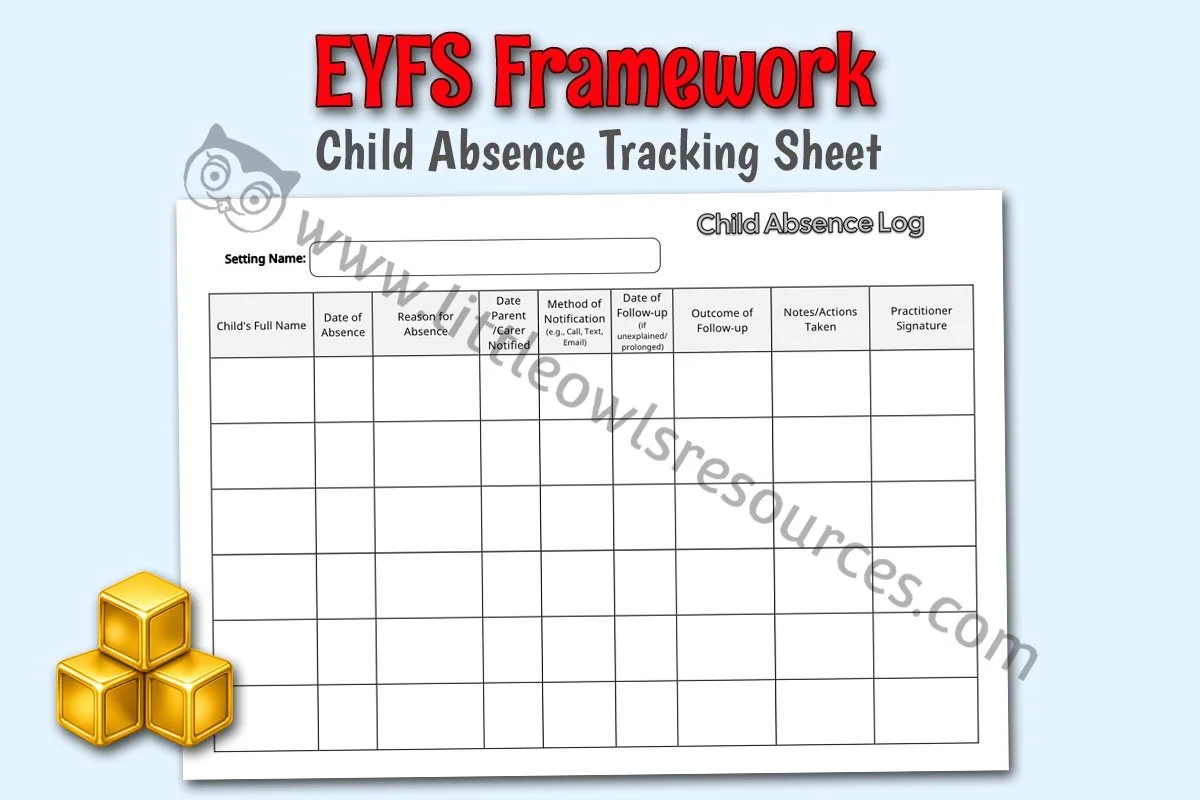
This 'Child Absence Tracking Sheet' is designed to help settings effectively record and monitor children's attendance, particularly focusing on the new EYFS Statutory Framework requirements (effective from September 2025) regarding the follow-up of prolonged or unexplained absences.
Maintaining accurate records is crucial for safeguarding and demonstrating compliance.
Files contain public sector information licensed under the Open Government Licence v3.0.
Original artwork drawn by Sara Murphy and final digital resources created by Stuart Murphy. COPYRIGHT ON ALL OF THE RESOURCES HOUSED ON THIS WEBSITE IS HELD BY ‘LITTLE OWLS RESOURCES’. OUR RESOURCES (INCLUDING THE IMAGES WITHIN THEM), CANNOT BE SHARED OR SOLD COMMERCIALLY.
DOWNLOAD EDITABLE (DOCX)
DOWNLOAD NON-EDITABLE (PDF)
DOWNLOAD NON-EDITABLE (Zipped JPEGs)
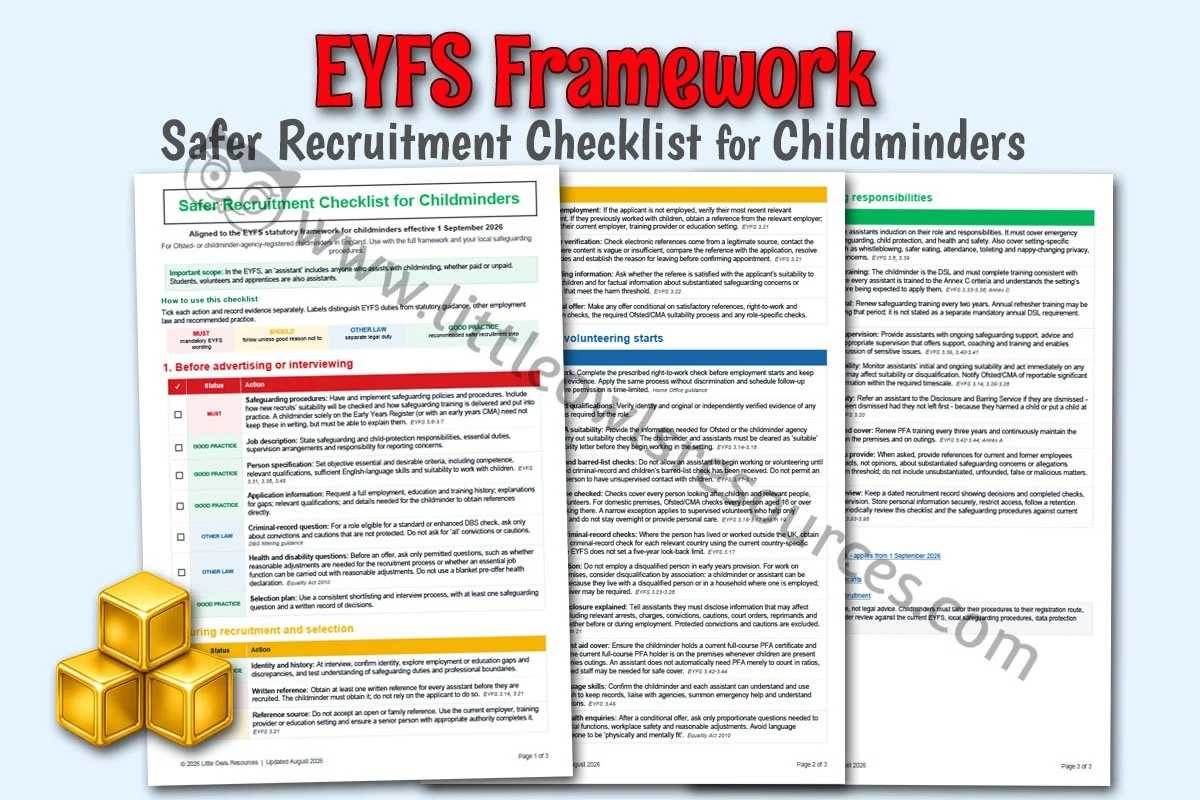
This checklist is designed to assist childminders in aligning their recruitment practices with the updated EYFS Statutory Framework. It should be used in conjunction with the full EYFS Statutory Framework for Childminders (effective from 1st September 2026).
Please note: This checklist is a template for guidance only. Users must tailor it to their specific setting's policies and ensure full compliance with the EYFS Statutory Framework, Data Protection Act 2018, UK GDPR, and all current employment legislation before implementation.
Original artwork drawn by Sara Murphy and final digital resources created by Stuart Murphy. COPYRIGHT ON ALL OF THE RESOURCES HOUSED ON THIS WEBSITE IS HELD BY ‘LITTLE OWLS RESOURCES’. OUR RESOURCES (INCLUDING THE IMAGES WITHIN THEM), CANNOT BE SHARED OR SOLD COMMERCIALLY.
DOWNLOAD EDITABLE (DOCX)
DOWNLOAD NON-EDITABLE (PDF)
DOWNLOAD NON-EDITABLE (Zipped JPEGs)
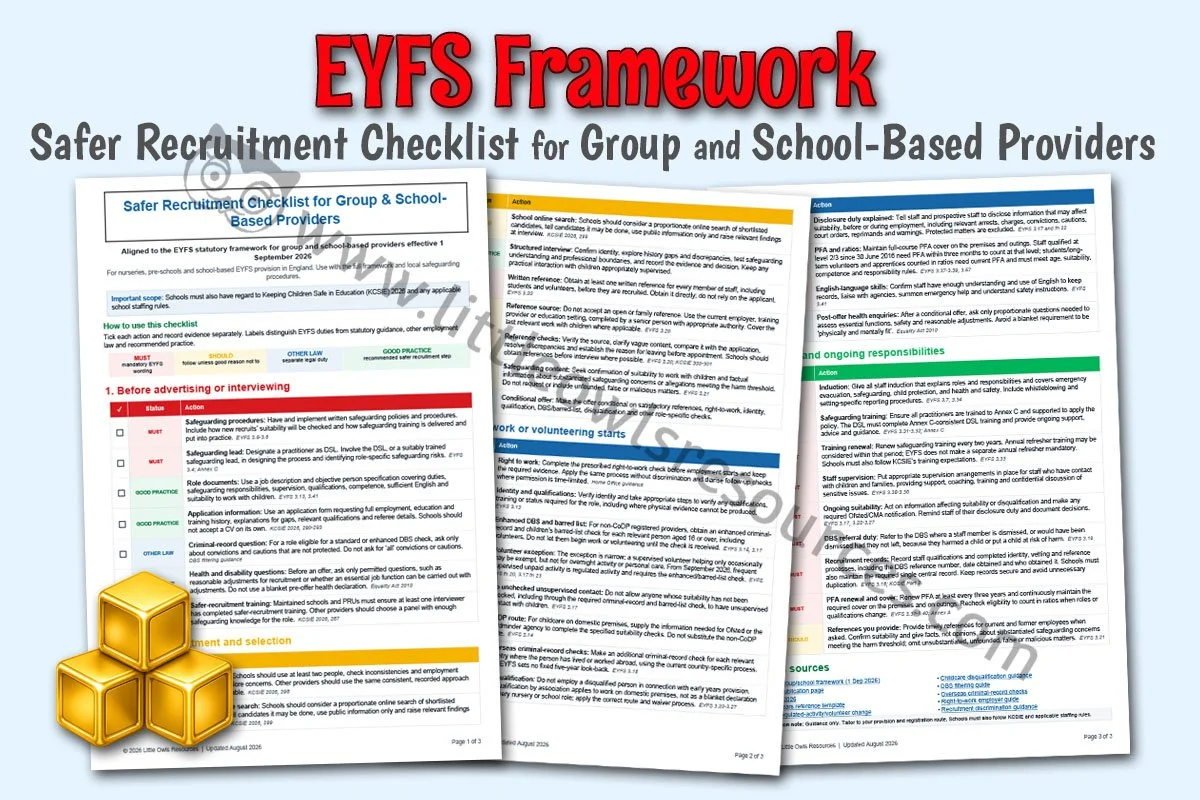
This checklist is designed to assist group and school-based providers in aligning their recruitment practices with the updated EYFS Statutory Framework. It should be used in conjunction with the full EYFS Statutory Framework for Group and School-Based Providers (effective from 1st September 2026).
Please note: This checklist is a template for guidance only. Users must tailor it to their specific setting's policies and ensure full compliance with the EYFS Statutory Framework, Data Protection Act 2018, UK GDPR, and all current employment legislation before implementation.
Original artwork drawn by Sara Murphy and final digital resources created by Stuart Murphy. COPYRIGHT ON ALL OF THE RESOURCES HOUSED ON THIS WEBSITE IS HELD BY ‘LITTLE OWLS RESOURCES’. OUR RESOURCES (INCLUDING THE IMAGES WITHIN THEM), CANNOT BE SHARED OR SOLD COMMERCIALLY.
DOWNLOAD EDITABLE (DOCX)
DOWNLOAD NON-EDITABLE (PDF)
DOWNLOAD NON-EDITABLE (Zipped JPEGs)
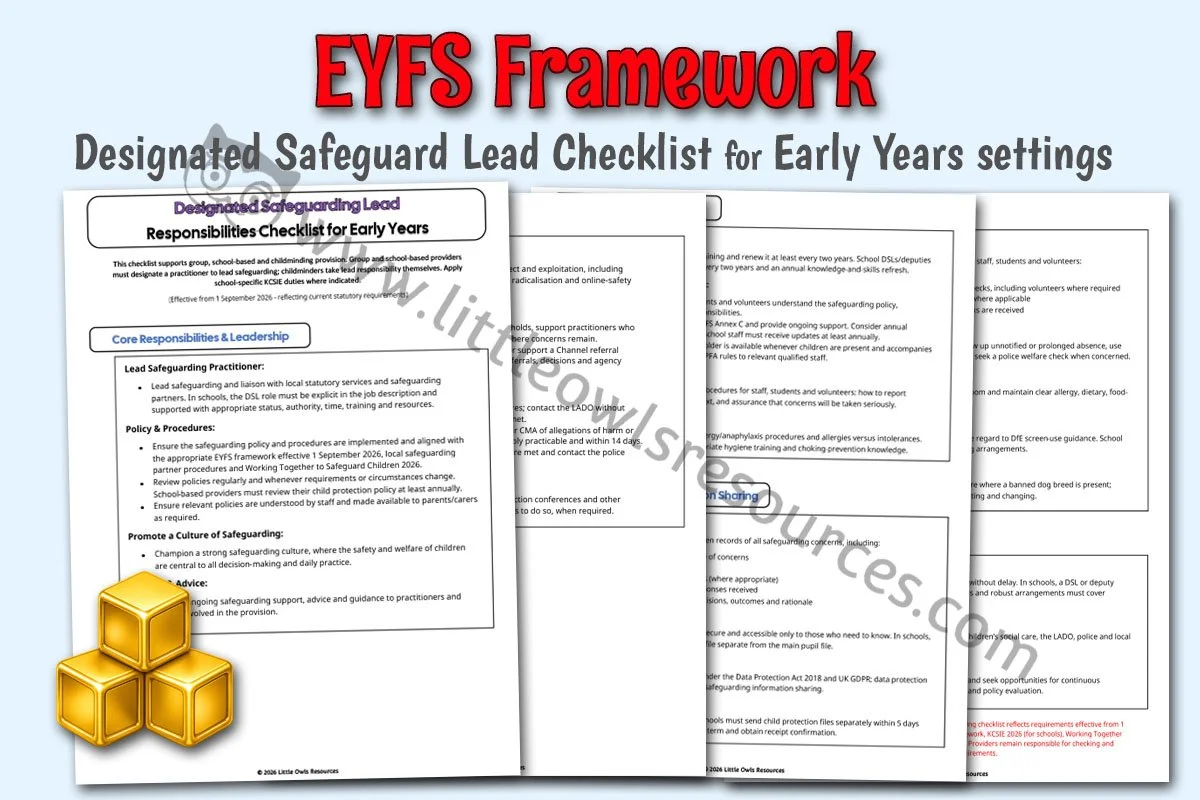
This checklist outlines the core responsibilities of the Designated Safeguarding Lead (DSL) in early years settings, including childminders, nurseries, and school-based providers. It is designed to help you ensure that robust and effective safeguarding practices are consistently embedded in your provision. (Effective from 1st September 2026 – Reflecting New EYFS Requirements)
Please note: This checklist is a template for guidance only. Users must adapt it to their specific setting's safeguarding policy and ensure full compliance with the EYFS Statutory Framework, 'Keeping Children Safe in Education' (where applicable), Data Protection Act 2018, UK GDPR, and all current employment legislation before implementation.
Original artwork drawn by Sara Murphy and final digital resources created by Stuart Murphy. COPYRIGHT ON ALL OF THE RESOURCES HOUSED ON THIS WEBSITE IS HELD BY ‘LITTLE OWLS RESOURCES’. OUR RESOURCES (INCLUDING THE IMAGES WITHIN THEM), CANNOT BE SHARED OR SOLD COMMERCIALLY.
DOWNLOAD EDITABLE (DOCX)
DOWNLOAD NON-EDITABLE (PDF)
DOWNLOAD NON-EDITABLE (Zipped JPEGs)
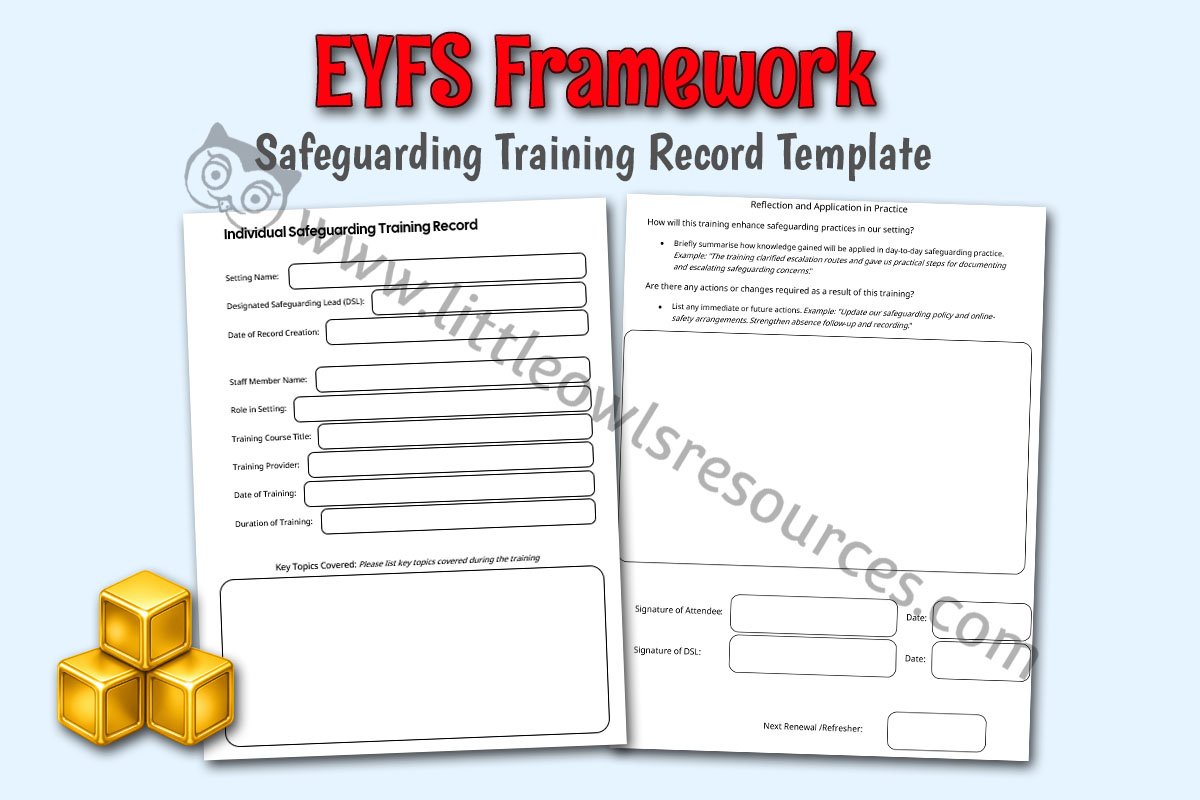
This template is designed to support all early years and educational providers in maintaining clear and up-to-date records of safeguarding training for staff, assistants, volunteers, and students, in line with statutory requirements such as the EYFS framework (effective from September 2026), Keeping Children Safe in Education, and local safeguarding partnership guidance.
Note: This template is intended as a guide and should be used alongside the most current version of the EYFS Statutory Framework, Keeping Children Safe in Education (where applicable), and guidance from your local safeguarding partnership.
Original artwork drawn by Sara Murphy and final digital resources created by Stuart Murphy. COPYRIGHT ON ALL OF THE RESOURCES HOUSED ON THIS WEBSITE IS HELD BY ‘LITTLE OWLS RESOURCES’. OUR RESOURCES (INCLUDING THE IMAGES WITHIN THEM), CANNOT BE SHARED OR SOLD COMMERCIALLY.
DOWNLOAD EDITABLE (DOCX)
DOWNLOAD NON-EDITABLE (PDF)
DOWNLOAD NON-EDITABLE (Zipped JPEGs)
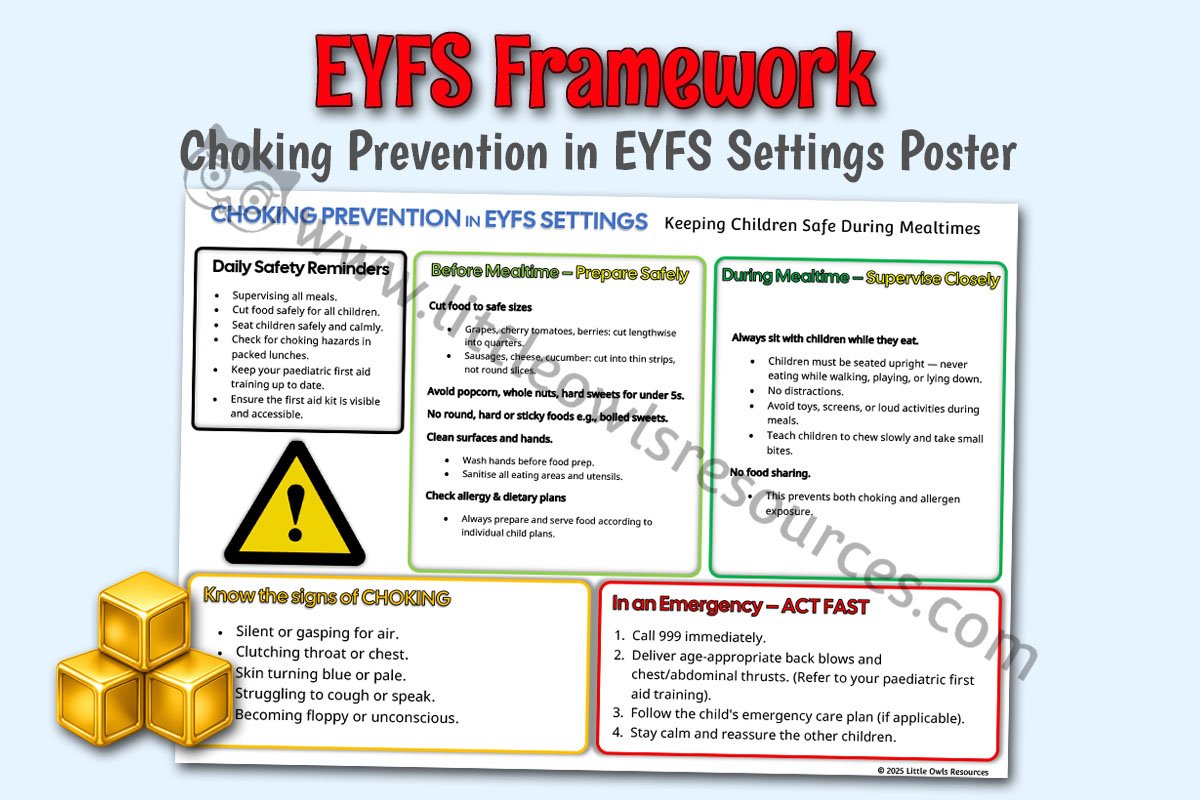
Choking Prevention in EYFS Settings Poster.
📌 Display this poster in:
- Food preparation areas
- Dining zones
- Staff break rooms
- Entry points for parents/carers
Important Disclaimer: This "Choking Prevention in EYFS Settings" poster provides general guidance and best practices. It is essential that all users also refer to and comply with the Statutory Framework for the Early Years Foundation Stage (EYFS). This poster does not substitute professional training, risk assessments, or your individual setting's health and safety policies and procedures, which must always be followed.
Original artwork drawn by Sara Murphy and final digital resources created by Stuart Murphy. COPYRIGHT ON ALL OF THE RESOURCES HOUSED ON THIS WEBSITE IS HELD BY ‘LITTLE OWLS RESOURCES’. OUR RESOURCES (INCLUDING THE IMAGES WITHIN THEM), CANNOT BE SHARED OR SOLD COMMERCIALLY.
DOWNLOAD EDITABLE (DOCX)
DOWNLOAD NON-EDITABLE (PDF)
DOWNLOAD NON-EDITABLE (Zipped JPEGs)
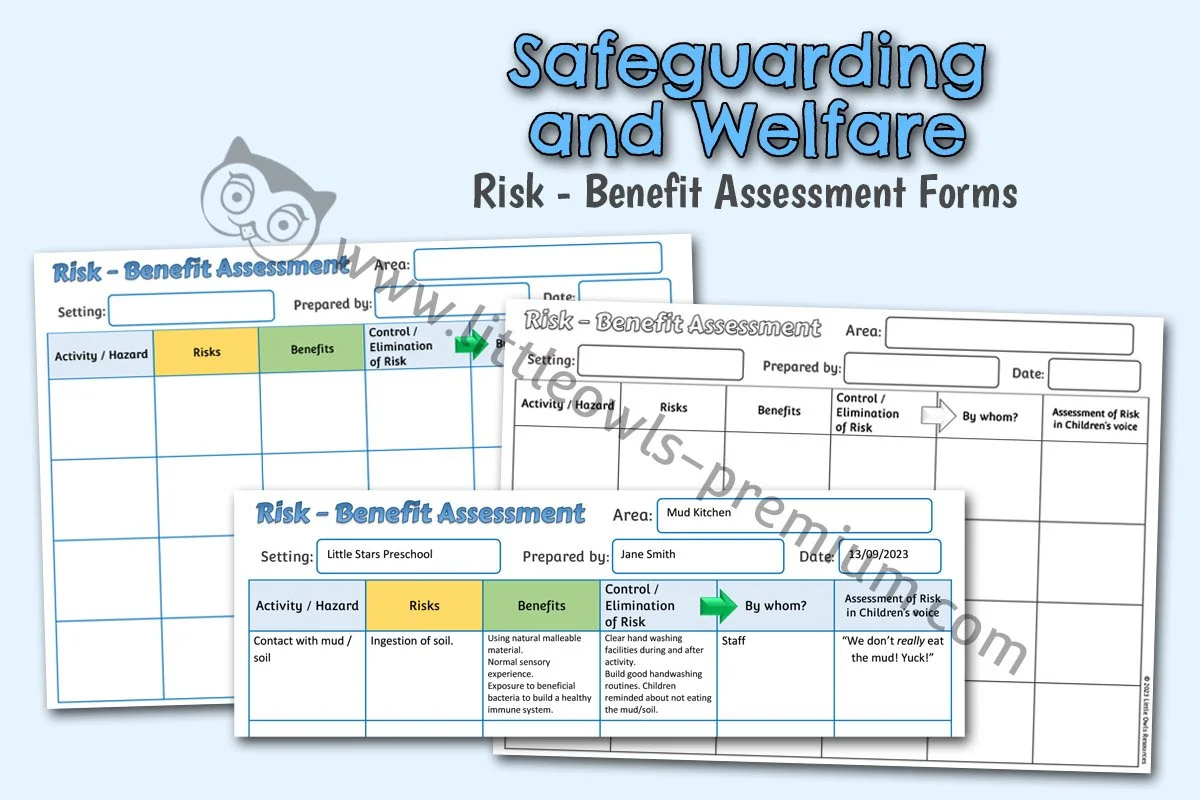
These forms can be used to note the risks and benefits for activities that take place within a setting or on trips/days out.
As can be seen in the example on the first page, there is also a section to think about how the children might be encouraged to think and talk about the risks.
We hope you find this helpful!
Original artwork drawn by Sara Murphy and final digital resources created by Stuart Murphy. COPYRIGHT ON ALL OF THE RESOURCES HOUSED ON THIS WEBSITE IS HELD BY ‘LITTLE OWLS RESOURCES’. OUR RESOURCES (INCLUDING THE IMAGES WITHIN THEM), CANNOT BE SHARED OR SOLD COMMERCIALLY.
DOWNLOAD EDITABLE (DOCX)
DOWNLOAD NON-EDITABLE (PDF)
DOWNLOAD NON-EDITABLE (Zipped JPEGs)
<<-BACK TO ‘EYFS FRAMEWORK’ MENU
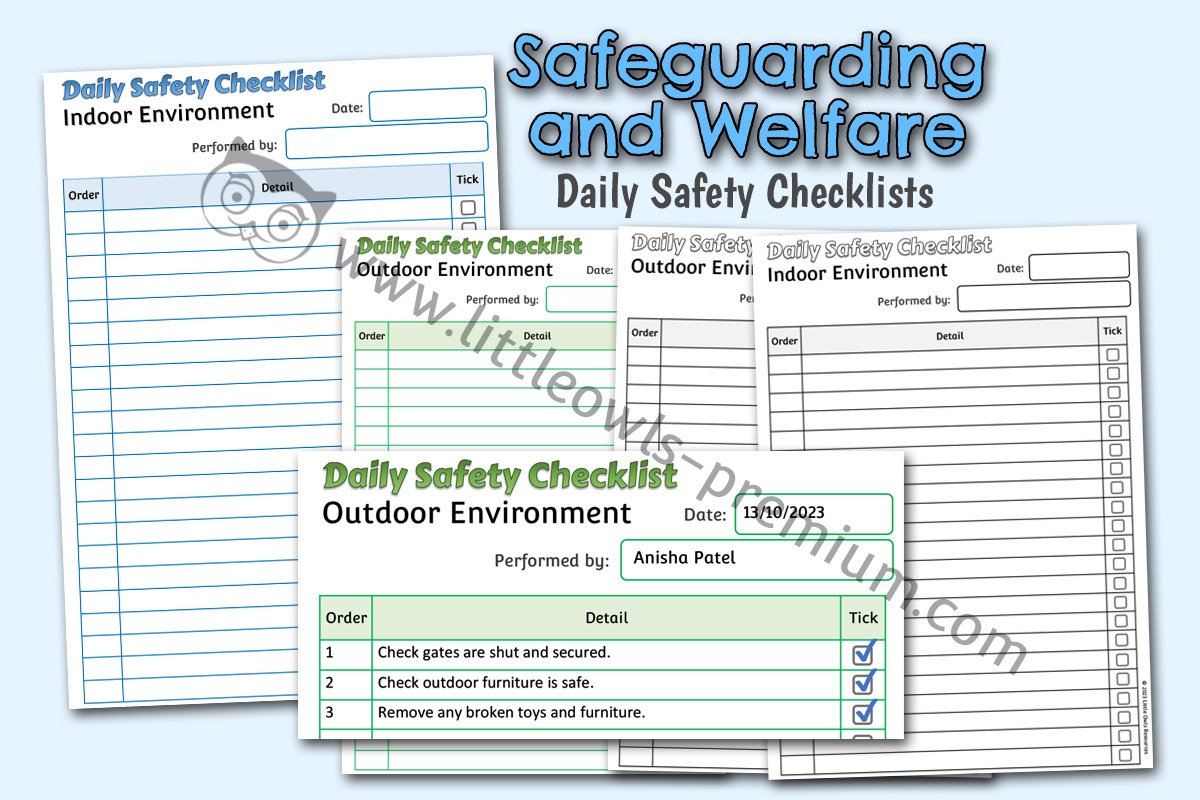
These checklists are to help with the day-to-day checks during preparation of a setting for the children’s welfare.
There are separate sheets for the indoor and outdoor environment.
These could be laminated for repeated use with a whiteboard pen.
p2-3 – colour versions
p4-5 – BW versions
We hope you find this helpful!
Original artwork drawn by Sara Murphy and final digital resources created by Stuart Murphy. COPYRIGHT ON ALL OF THE RESOURCES HOUSED ON THIS WEBSITE IS HELD BY ‘LITTLE OWLS RESOURCES’. OUR RESOURCES (INCLUDING THE IMAGES WITHIN THEM), CANNOT BE SHARED OR SOLD COMMERCIALLY.
DOWNLOAD EDITABLE (DOCX)
DOWNLOAD NON-EDITABLE (PDF)
DOWNLOAD NON-EDITABLE (Zipped JPEGs)
<<-BACK TO ‘EYFS FRAMEWORK’ MENU
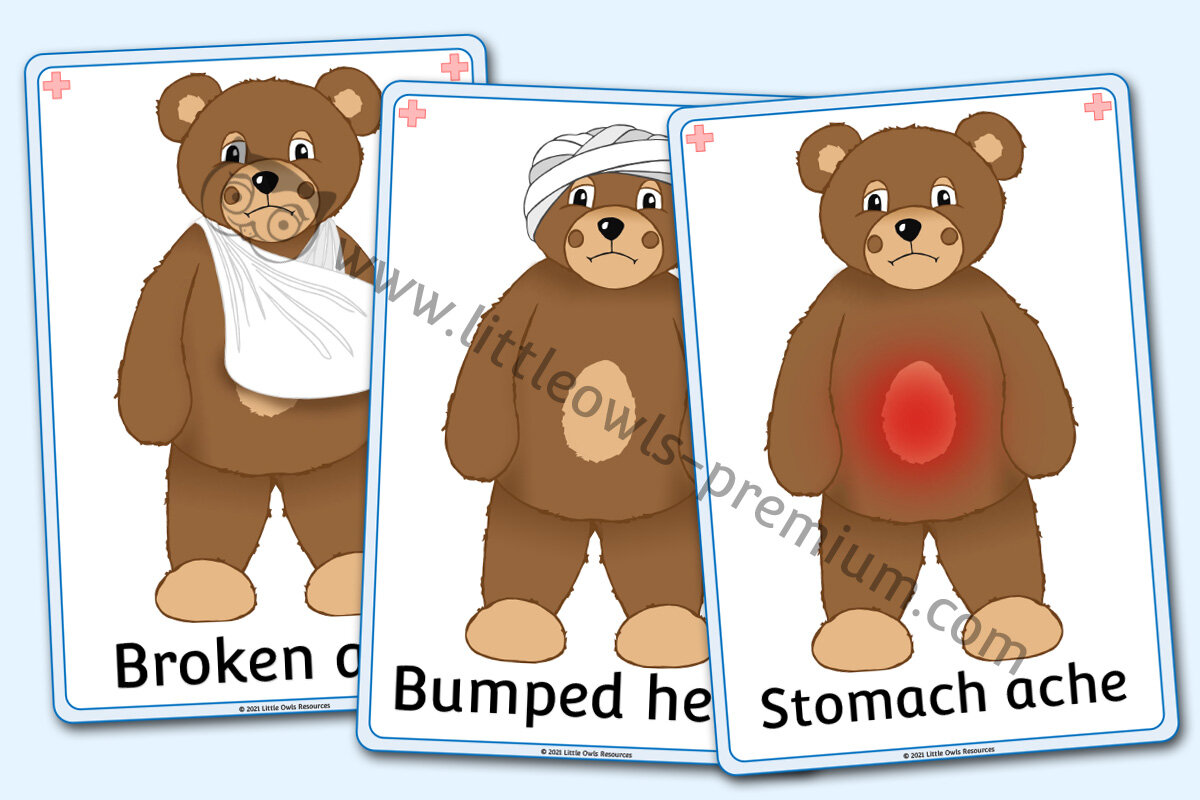
11 Poorly Teddy Posters included. Ideal for using as part of a medical/doctors and nurses display or activities such as role-play or emergent writing.
Original artwork drawn by Sara Murphy and final digital resources created by Stuart Murphy. COPYRIGHT ON ALL OF THE RESOURCES HOUSED ON THIS WEBSITE IS HELD BY ‘LITTLE OWLS RESOURCES’. OUR RESOURCES (INCLUDING THE IMAGES WITHIN THEM), CANNOT BE SHARED OR SOLD COMMERCIALLY.
DOWNLOAD EDITABLE (DOCX)
DOWNLOAD NON-EDITABLE (PDF)
DOWNLOAD NON-EDITABLE (Zipped JPEGs)
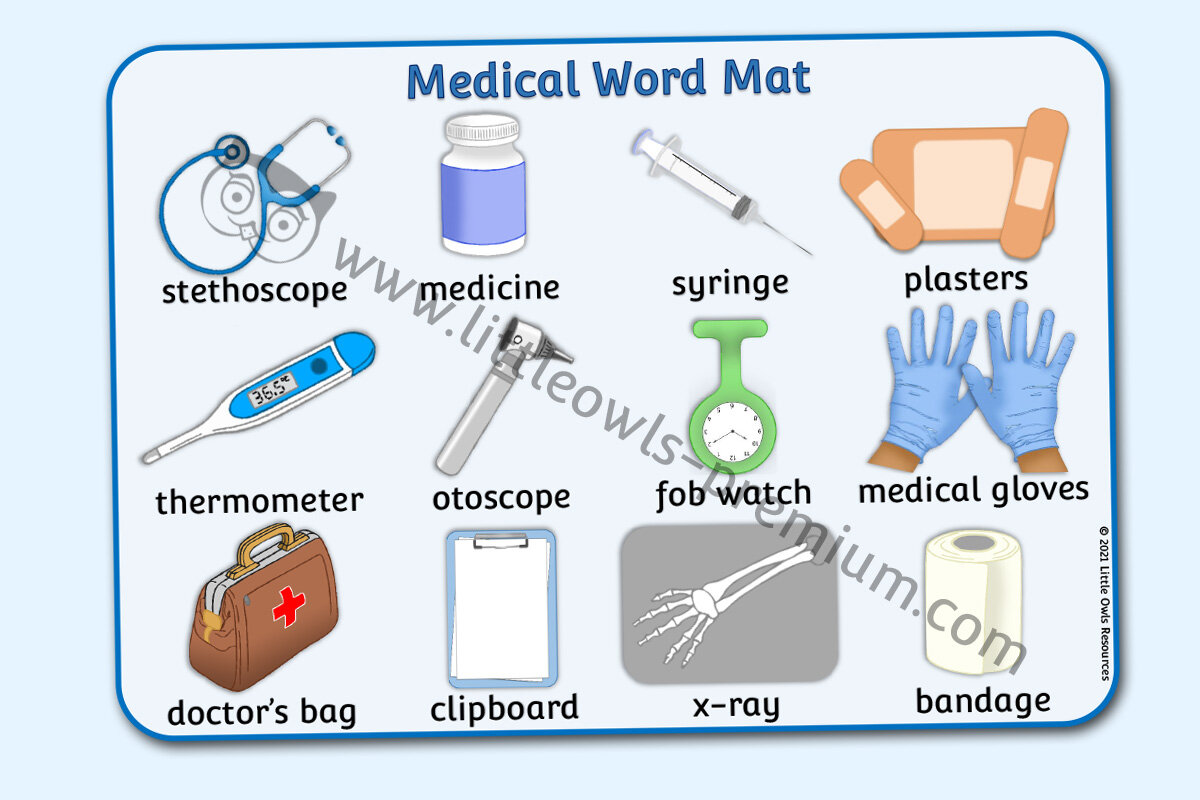
‘Medical’ word mat. Why not use in conjunction with our ‘Medical’ word cards? Can be used as part of a display or activities such as role-play or emergent writing.
Original artwork drawn by Sara Murphy and final digital resources created by Stuart Murphy. COPYRIGHT ON ALL OF THE RESOURCES HOUSED ON THIS WEBSITE IS HELD BY ‘LITTLE OWLS RESOURCES’. OUR RESOURCES (INCLUDING THE IMAGES WITHIN THEM), CANNOT BE SHARED OR SOLD COMMERCIALLY.
DOWNLOAD EDITABLE (DOCX)
DOWNLOAD NON-EDITABLE (PDF)
DOWNLOAD NON-EDITABLE (Zipped JPEGs)
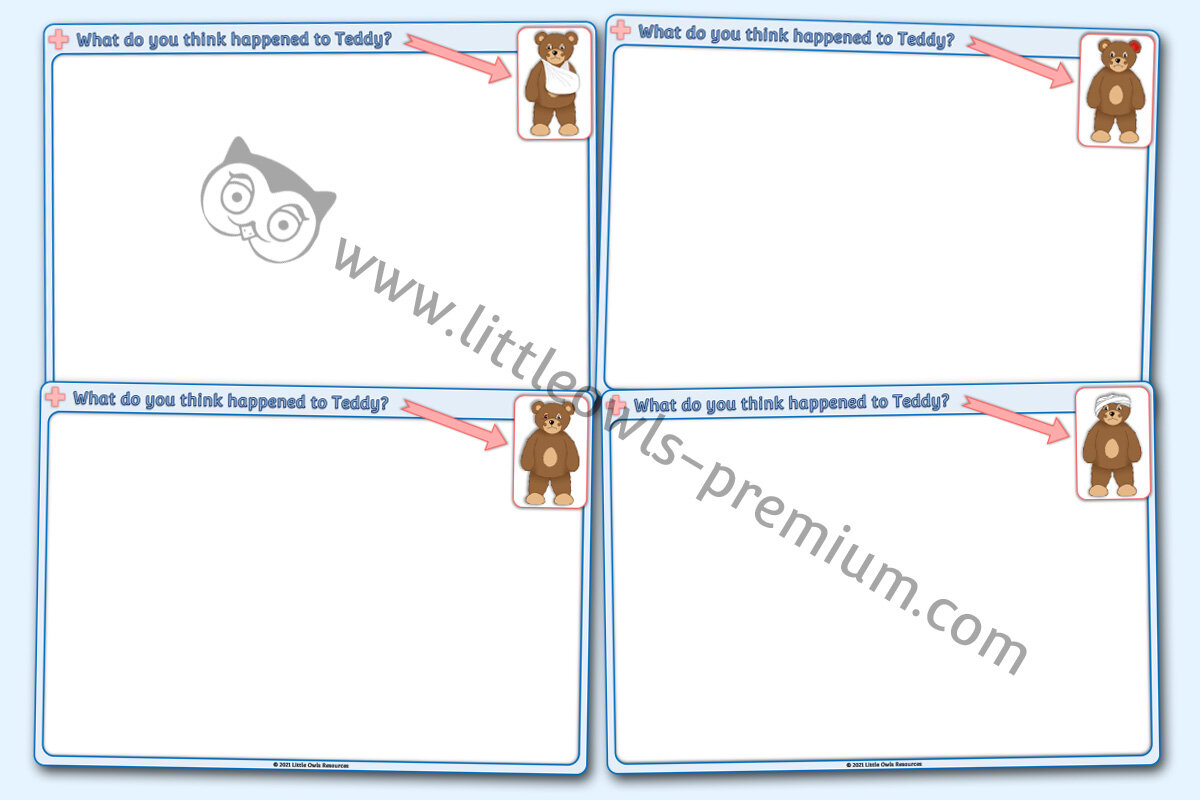
11 Poorly Teddy A4 Critical Thinking Sheets included.
Encourage children to look carefully at the picture of teddy provided in the corner. What do you think is wrong with him? What do you think might have happened to him to make him poorly? Children can then draw and/or write their ideas in the space provided. You may even like to role play scenarios that the children come up with.
Original artwork drawn by Sara Murphy and final digital resources created by Stuart Murphy. COPYRIGHT ON ALL OF THE RESOURCES HOUSED ON THIS WEBSITE IS HELD BY ‘LITTLE OWLS RESOURCES’. OUR RESOURCES (INCLUDING THE IMAGES WITHIN THEM), CANNOT BE SHARED OR SOLD COMMERCIALLY.
DOWNLOAD EDITABLE (DOCX)
DOWNLOAD NON-EDITABLE (PDF)
DOWNLOAD NON-EDITABLE (Zipped JPEGs)
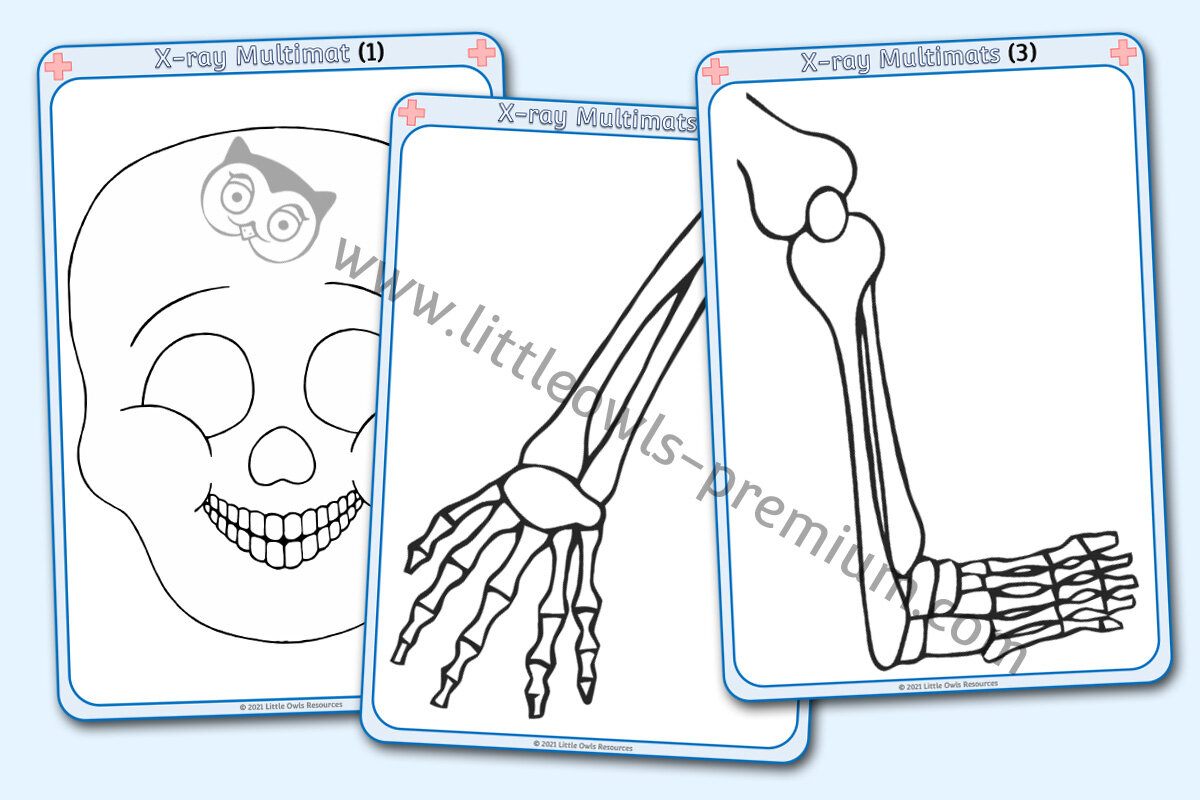
Once laminated these ‘X-Ray Multimats’ are ideal to be used as reusable playdough or loose part mats. Alternatively, use them in conjunction with whiteboard pens.
Without lamination these sheets may also be used with mark making tools or art and craft materials such as collage or fingerpainting.
Original artwork drawn by Sara Murphy and final digital resources created by Stuart Murphy. COPYRIGHT ON ALL OF THE RESOURCES HOUSED ON THIS WEBSITE IS HELD BY ‘LITTLE OWLS RESOURCES’. OUR RESOURCES (INCLUDING THE IMAGES WITHIN THEM), CANNOT BE SHARED OR SOLD COMMERCIALLY.
DOWNLOAD EDITABLE (DOCX)
DOWNLOAD NON-EDITABLE (PDF)
DOWNLOAD NON-EDITABLE (Zipped JPEGs)
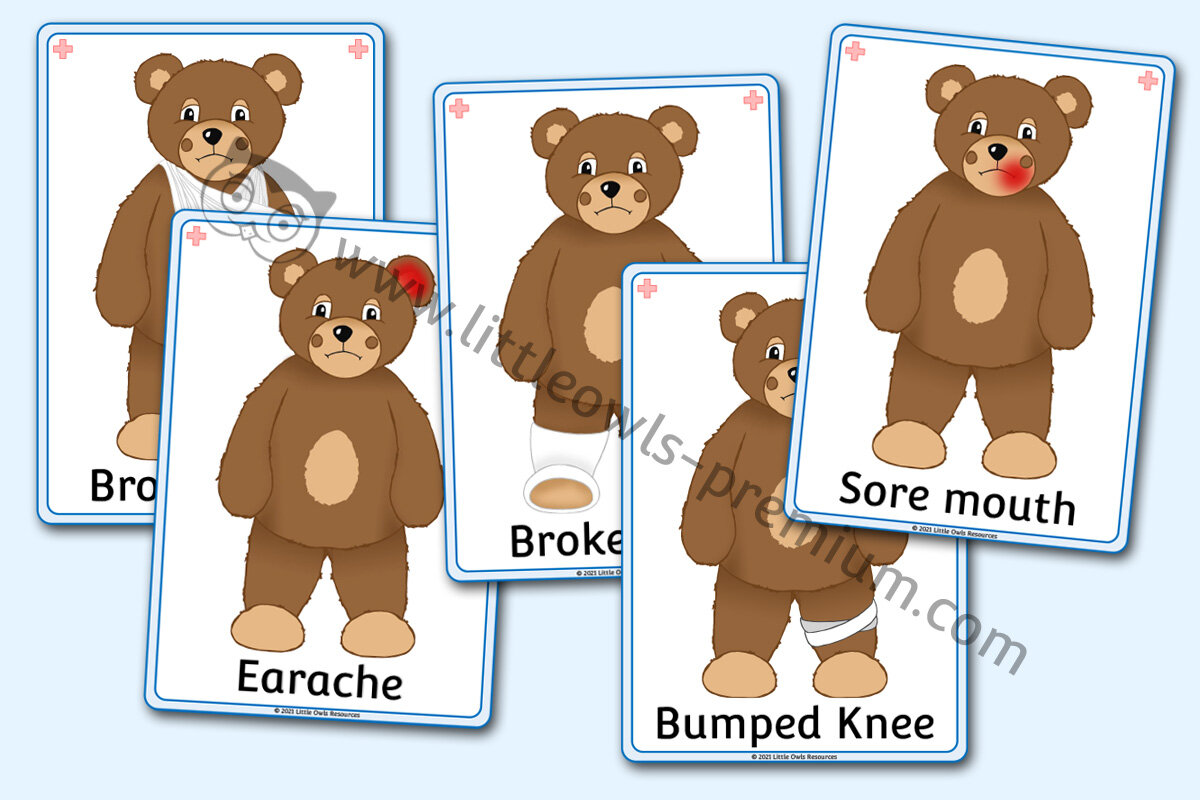
11 Poorly Teddy A5 Posters/Cards included. Ideal for using as part of a medical/doctors and nurses display or activities such as role-play or emergent writing.
Original artwork drawn by Sara Murphy and final digital resources created by Stuart Murphy. COPYRIGHT ON ALL OF THE RESOURCES HOUSED ON THIS WEBSITE IS HELD BY ‘LITTLE OWLS RESOURCES’. OUR RESOURCES (INCLUDING THE IMAGES WITHIN THEM), CANNOT BE SHARED OR SOLD COMMERCIALLY.
DOWNLOAD EDITABLE (DOCX)
DOWNLOAD NON-EDITABLE (PDF)
DOWNLOAD NON-EDITABLE (Zipped JPEGs)
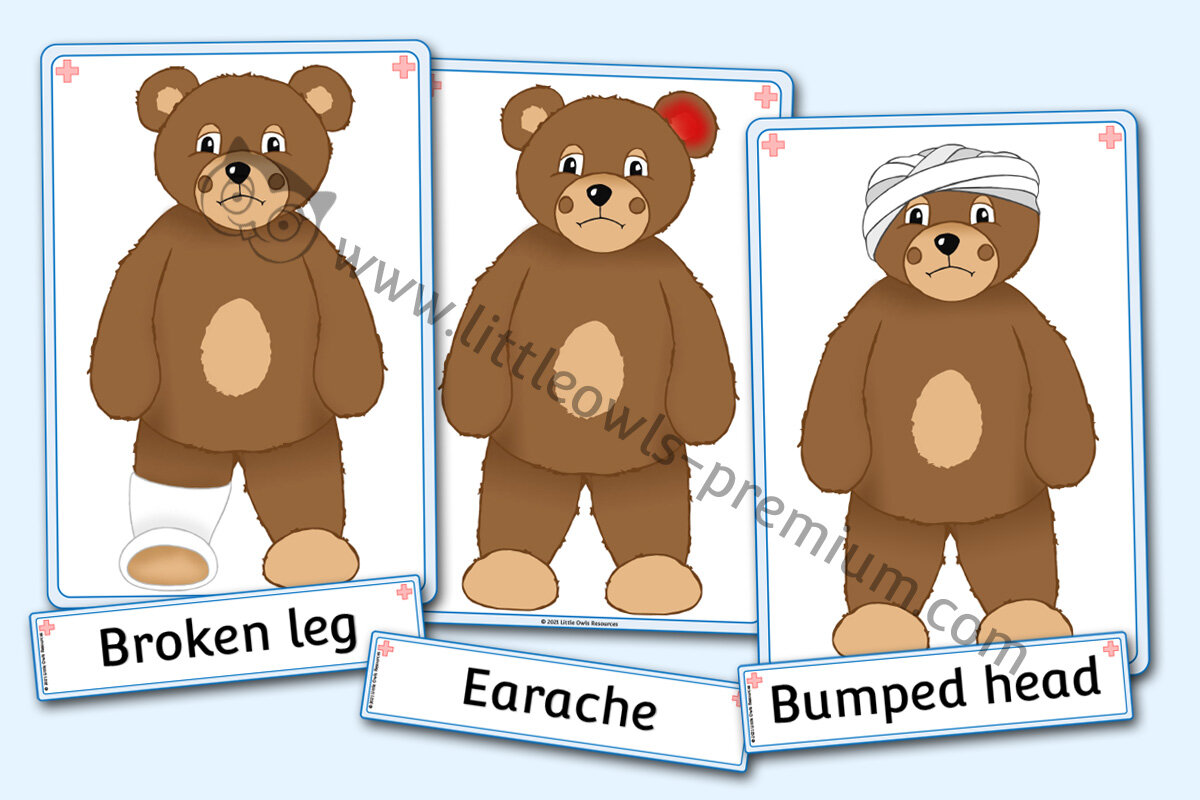
11 Poorly Teddy Posters included. Ideal for using as part of a medical/doctors and nurses display or activities such as role-play or emergent writing.
Also perfect for matching game activity. For example the 11 Poorly Teddy posters may be laid out in front of children. An adult can then select a label and read it to them. Children can listen carefully and select the correct poorly teddy picture to match with the illness/injury they have heard.
Original artwork drawn by Sara Murphy and final digital resources created by Stuart Murphy. COPYRIGHT ON ALL OF THE RESOURCES HOUSED ON THIS WEBSITE IS HELD BY ‘LITTLE OWLS RESOURCES’. OUR RESOURCES (INCLUDING THE IMAGES WITHIN THEM), CANNOT BE SHARED OR SOLD COMMERCIALLY.
DOWNLOAD EDITABLE (DOCX)
DOWNLOAD NON-EDITABLE (PDF)
DOWNLOAD NON-EDITABLE (Zipped JPEGs)
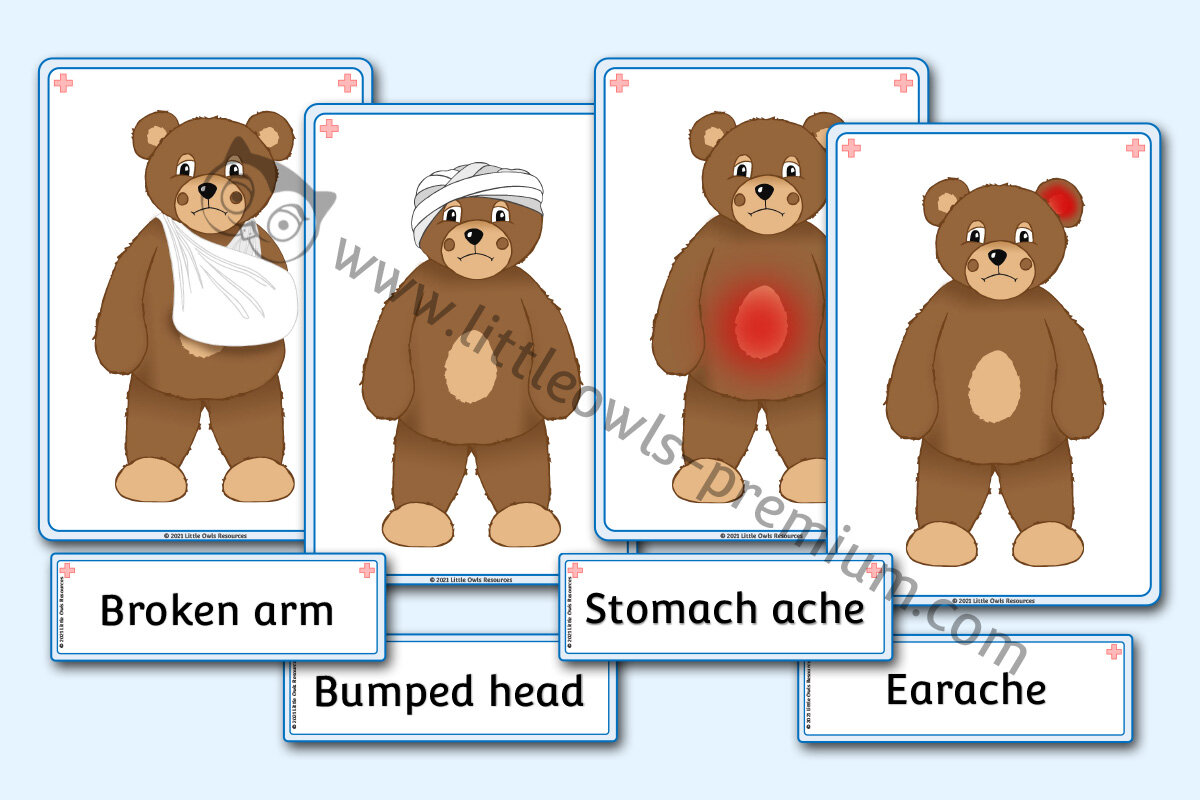
11 Poorly Teddy A5 Posters/Cards included. Ideal for using as part of a medical/doctors and nurses display or activities such as role-play or emergent writing.
Also perfect for matching game activity. For example the 11 Poorly Teddy posters may be laid out in front of children. An adult can then select a label and read it to them. Children can listen carefully and select the correct poorly teddy picture to match with the illness/injury they have heard.
Original artwork drawn by Sara Murphy and final digital resources created by Stuart Murphy. COPYRIGHT ON ALL OF THE RESOURCES HOUSED ON THIS WEBSITE IS HELD BY ‘LITTLE OWLS RESOURCES’. OUR RESOURCES (INCLUDING THE IMAGES WITHIN THEM), CANNOT BE SHARED OR SOLD COMMERCIALLY.
DOWNLOAD EDITABLE (DOCX)
DOWNLOAD NON-EDITABLE (PDF)
DOWNLOAD NON-EDITABLE (Zipped JPEGs)
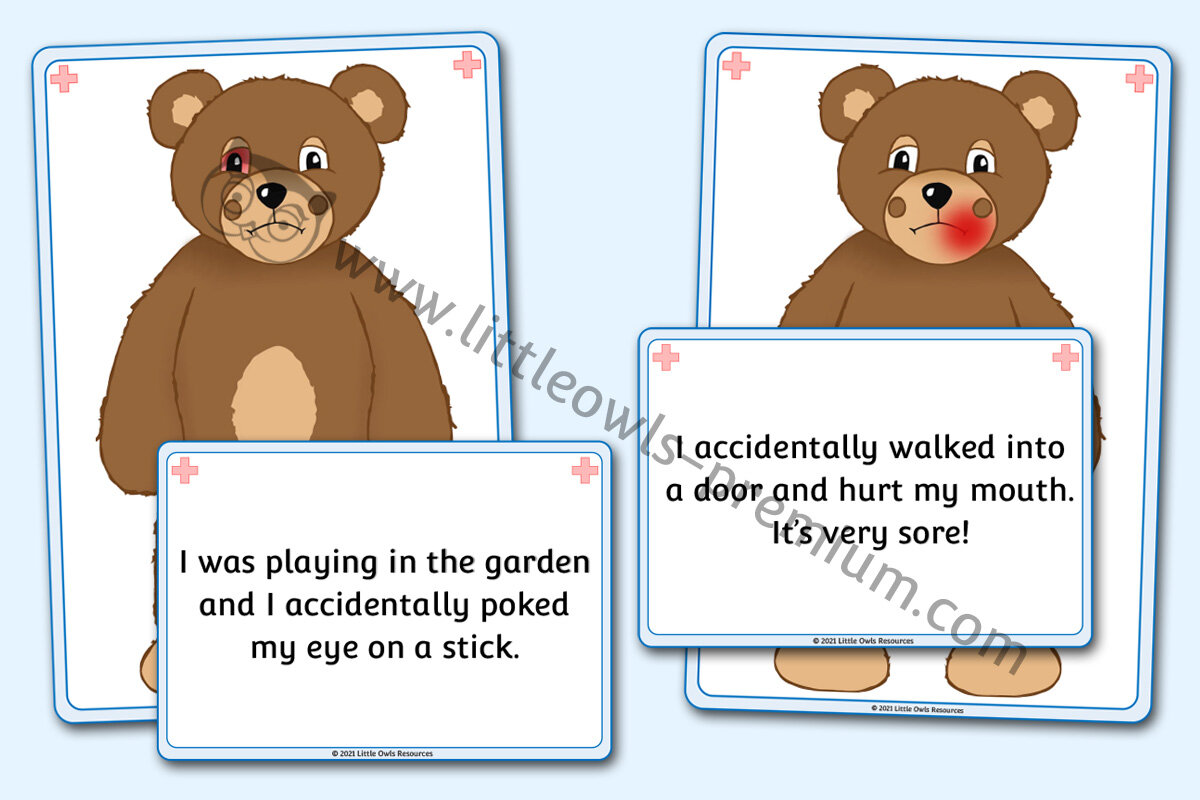
11 Poorly Teddy A4 Posters included. Ideal for using as part of a medical/doctors and nurses display or activities such as role-play or emergent writing.
Also perfect for a listening/problem solving/matching game activity. For example the 11 Poorly Teddy posters may be laid out in front of children. An adult can then select a description and read it to them. Children can listen carefully and select the correct poorly teddy picture to match with the illness/injury description they have heard.
Original artwork drawn by Sara Murphy and final digital resources created by Stuart Murphy. COPYRIGHT ON ALL OF THE RESOURCES HOUSED ON THIS WEBSITE IS HELD BY ‘LITTLE OWLS RESOURCES’. OUR RESOURCES (INCLUDING THE IMAGES WITHIN THEM), CANNOT BE SHARED OR SOLD COMMERCIALLY.
DOWNLOAD EDITABLE (DOCX)
DOWNLOAD NON-EDITABLE (PDF)
DOWNLOAD NON-EDITABLE (Zipped JPEGs)
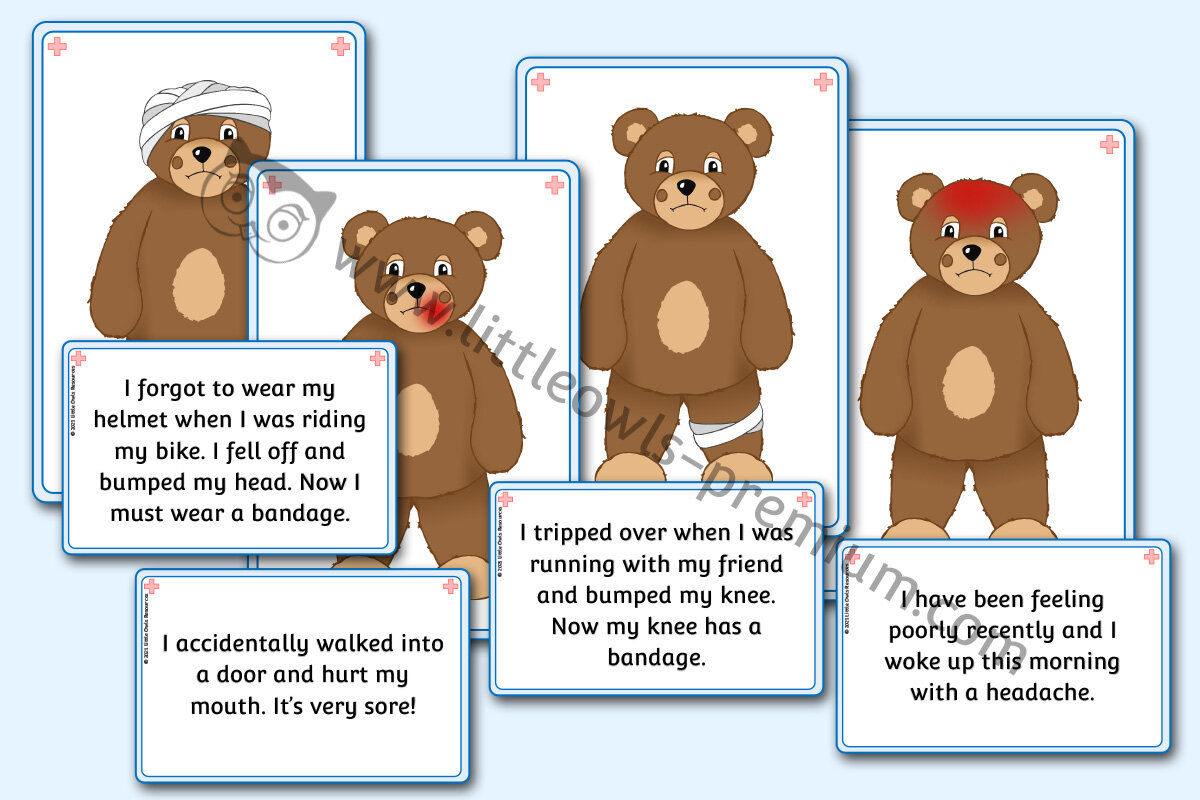
11 Poorly Teddy A5 Posters included. Ideal for using as part of a medical/doctors and nurses display or activities such as role-play or emergent writing.
Also perfect for a listening/problem solving/matching game activity. For example the 11 Poorly Teddy posters may be laid out in front of children. An adult can then select a description and read it to them. Children can listen carefully and select the correct poorly teddy picture to match with the illness/injury description they have heard.
Original artwork drawn by Sara Murphy and final digital resources created by Stuart Murphy. COPYRIGHT ON ALL OF THE RESOURCES HOUSED ON THIS WEBSITE IS HELD BY ‘LITTLE OWLS RESOURCES’. OUR RESOURCES (INCLUDING THE IMAGES WITHIN THEM), CANNOT BE SHARED OR SOLD COMMERCIALLY.
DOWNLOAD EDITABLE (DOCX)
DOWNLOAD NON-EDITABLE (PDF)
DOWNLOAD NON-EDITABLE (Zipped JPEGs)
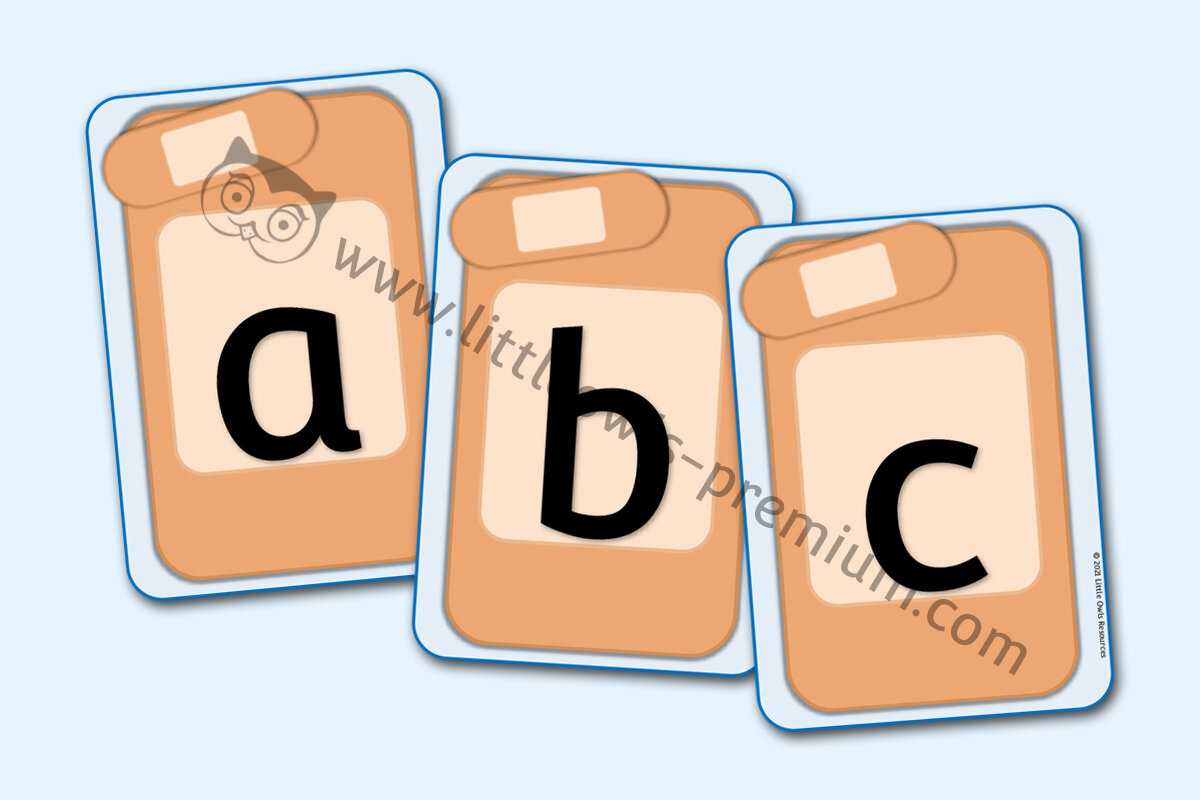
Plaster themed alphabet display. Print as it is for a display (A5 sized cards) or fewer for a set of plaster themed alphabet flashcards.
(Don’t forget you can use the editable docx file if you wish to change the font.)
Original artwork drawn by Sara Murphy and final digital resources created by Stuart Murphy. COPYRIGHT ON ALL OF THE RESOURCES HOUSED ON THIS WEBSITE IS HELD BY ‘LITTLE OWLS RESOURCES’. OUR RESOURCES (INCLUDING THE IMAGES WITHIN THEM), CANNOT BE SHARED OR SOLD COMMERCIALLY.
DOWNLOAD EDITABLE (DOCX)
DOWNLOAD NON-EDITABLE (PDF)
DOWNLOAD NON-EDITABLE (Zipped JPEGs)
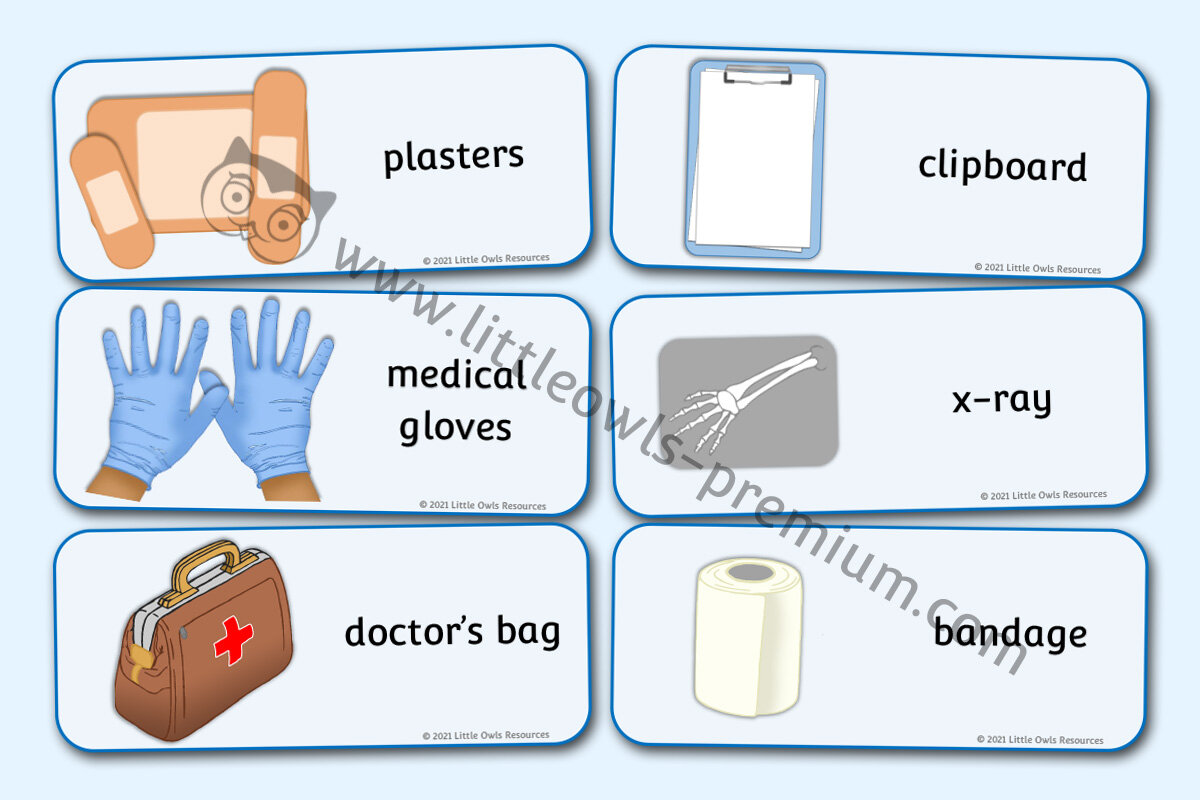
‘Medical’ word cards. Why not use in conjunction with our ‘Medical’ word mat? Can be used as part of a display or activities such as role-play or emergent writing.
Original artwork drawn by Sara Murphy and final digital resources created by Stuart Murphy. COPYRIGHT ON ALL OF THE RESOURCES HOUSED ON THIS WEBSITE IS HELD BY ‘LITTLE OWLS RESOURCES’. OUR RESOURCES (INCLUDING THE IMAGES WITHIN THEM), CANNOT BE SHARED OR SOLD COMMERCIALLY.
DOWNLOAD EDITABLE (DOCX)
DOWNLOAD NON-EDITABLE (PDF)
DOWNLOAD NON-EDITABLE (Zipped JPEGs)
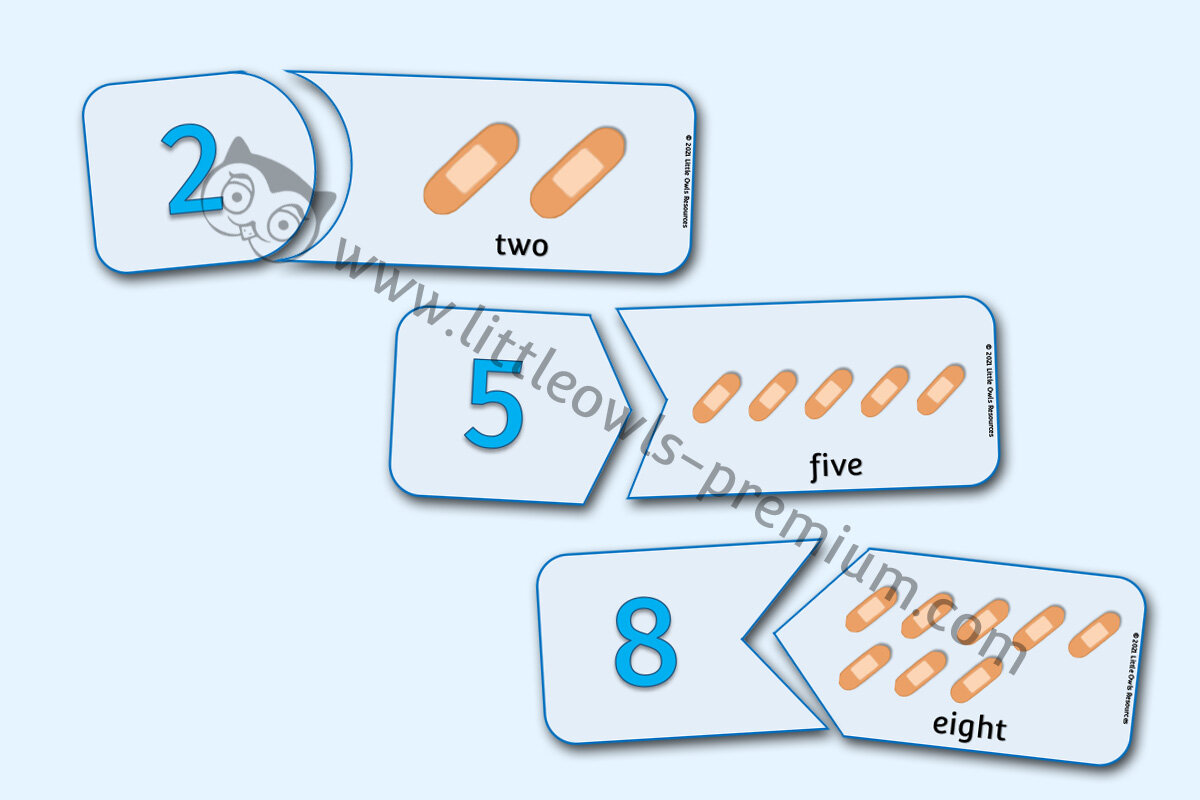
Why not set up an invitation to play using these ‘Plaster Counting Puzzles’?
Select those appropriate for your children (1-10 available) and allow them to match the number with the corresponding number of plasters. Each pair has a different way of connecting as a puzzle for the children to match and so even if they haven’t learnt what the number looks like yet, but are beginning to say the numbers in order, this can be a fun way to introduce them to new challenges.
Once the puzzles are complete, why not line the numbers up in order and count together? If your children would enjoy a further challenge, leave out a number and see if they can spot which one is missing from the sequence.
Puzzles could also be used as a fine motor control/counting activity if left uncut. Children could be given an appropriate number for their learning and encouraged to place objects on the plasters, counting as they go.
In addition, each number is also written as a word. For our youngest children, this adds to learning about text in the environment and how it has meaning. Our oldest children may start to recognise the words and associate them with the numbers. This will be beneficial for when they begin to read and write these words in subsequent years as they will have something to build on.
Original artwork drawn by Sara Murphy and final digital resources created by Stuart Murphy. COPYRIGHT ON ALL OF THE RESOURCES HOUSED ON THIS WEBSITE IS HELD BY ‘LITTLE OWLS RESOURCES’. OUR RESOURCES (INCLUDING THE IMAGES WITHIN THEM), CANNOT BE SHARED OR SOLD COMMERCIALLY.
DOWNLOAD EDITABLE (DOCX)
DOWNLOAD NON-EDITABLE (PDF)
DOWNLOAD NON-EDITABLE (Zipped JPEGs)
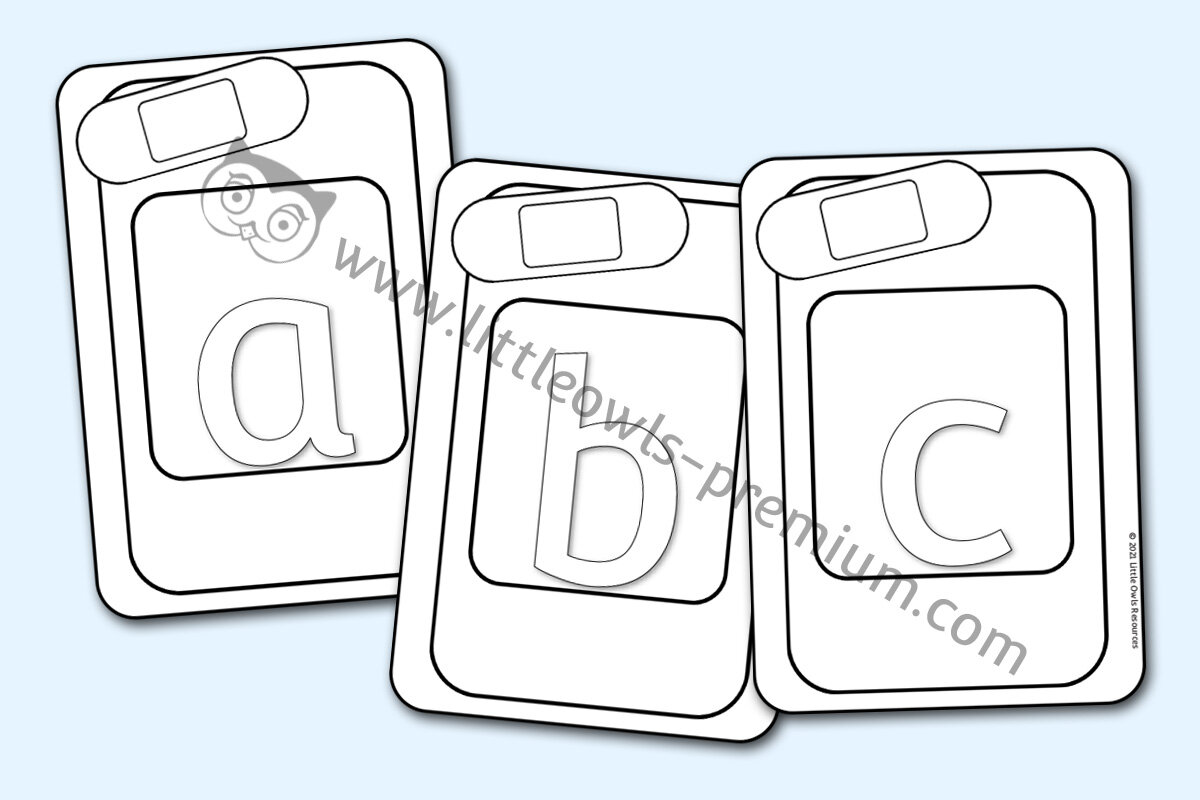
Plaster themed alphabet colouring.
(Don’t forget you can use the editable docx file if you wish to change the font.)
Original artwork drawn by Sara Murphy and final digital resources created by Stuart Murphy. COPYRIGHT ON ALL OF THE RESOURCES HOUSED ON THIS WEBSITE IS HELD BY ‘LITTLE OWLS RESOURCES’. OUR RESOURCES (INCLUDING THE IMAGES WITHIN THEM), CANNOT BE SHARED OR SOLD COMMERCIALLY.
DOWNLOAD EDITABLE (DOCX)
DOWNLOAD NON-EDITABLE (PDF)
DOWNLOAD NON-EDITABLE (Zipped JPEGs)
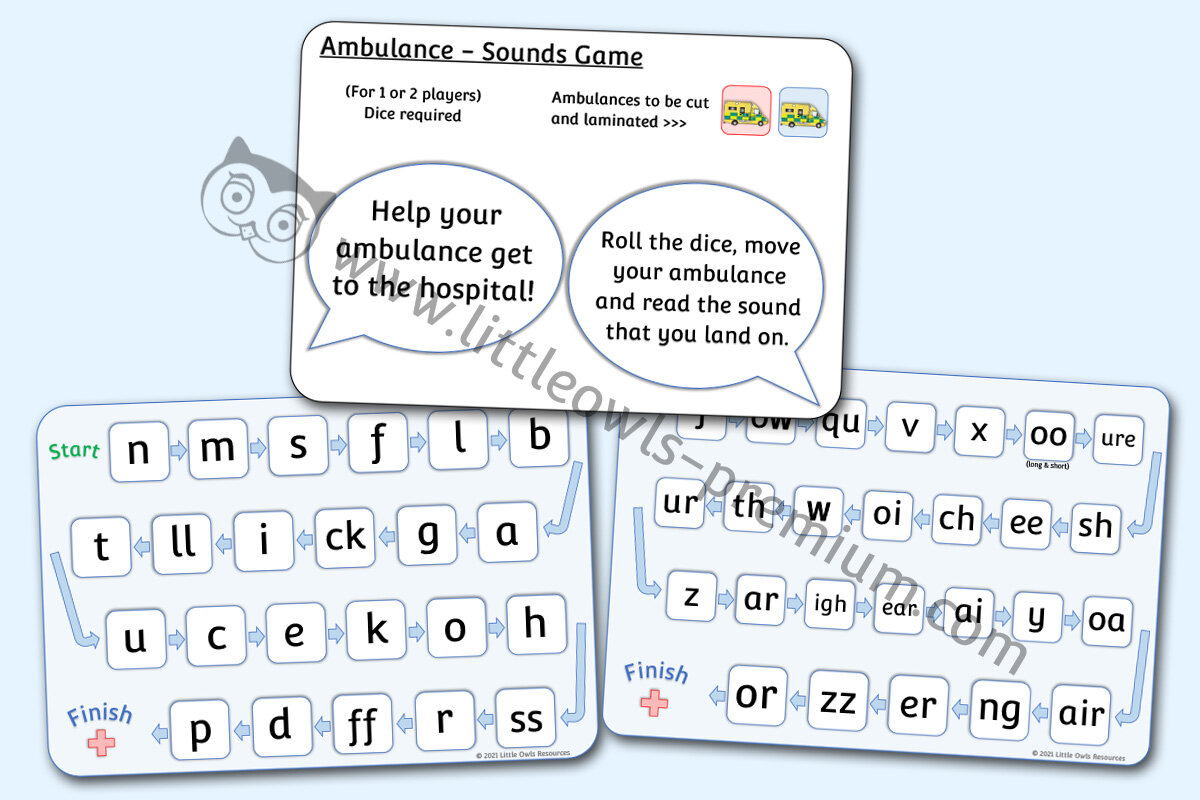
Help your ambulance to get to the hospital with this fun and engaging Letters and Sounds game.
Two different boards to choose from - one for Phase 2 Sounds and another for Phase 3 Sounds. Dice required.
Children choose an ambulance to place on the start, roll the dice and move the appropriate number of sound squares towards the hospital. When they land on a sound square they can practise saying the sound. Have fun!
(Don’t forget you can use the editable docx file if you wish to change the font.)
Original artwork drawn by Sara Murphy and final digital resources created by Stuart Murphy. COPYRIGHT ON ALL OF THE RESOURCES HOUSED ON THIS WEBSITE IS HELD BY ‘LITTLE OWLS RESOURCES’. OUR RESOURCES (INCLUDING THE IMAGES WITHIN THEM), CANNOT BE SHARED OR SOLD COMMERCIALLY.
DOWNLOAD EDITABLE (DOCX)
DOWNLOAD NON-EDITABLE (PDF)
DOWNLOAD NON-EDITABLE (Zipped JPEGs)
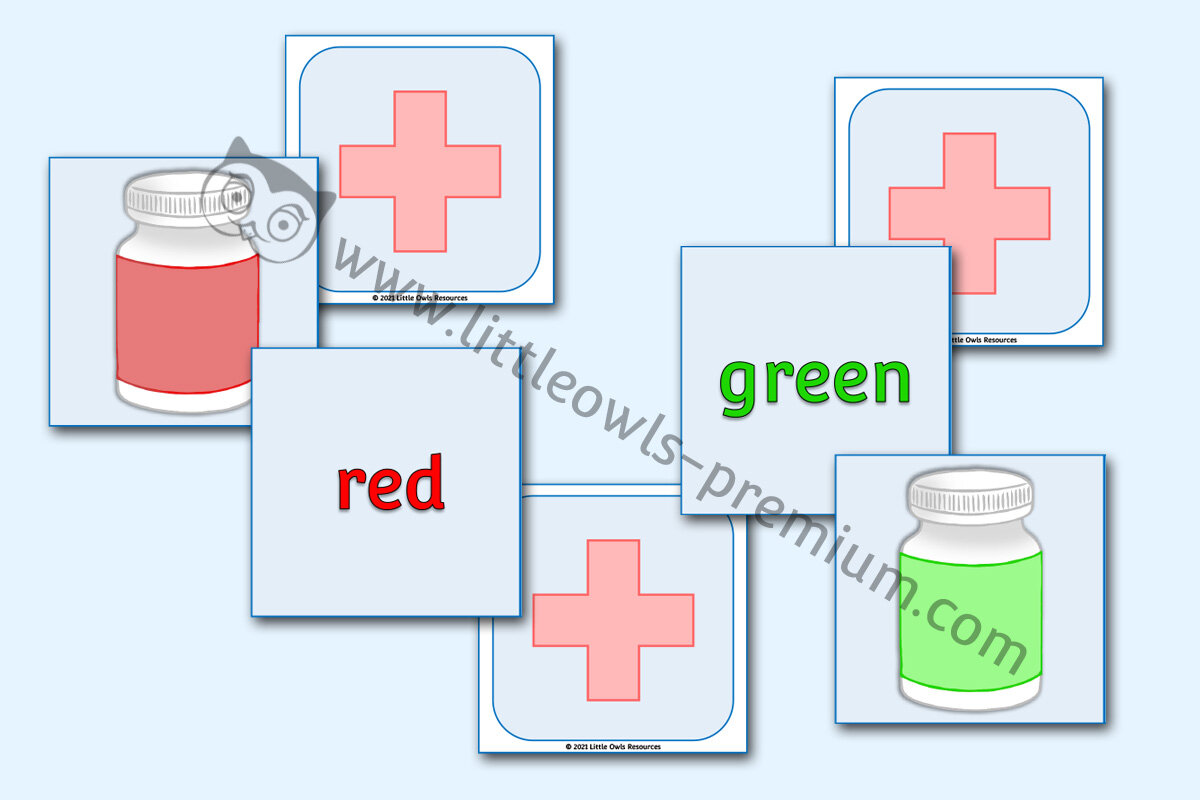
Set of 20 cards (10 colours). Use appropriate number of cards for your children in an invitation to play or adult led activity.
These cards may be used in a number of ways. Placed facing up on a table, children can simply match up the pairs placing them next to each other or alternatively, they may want to collect them as they go.
A further challenge could be a memory and turn taking game of ‘Picking up Pairs’. The cards are made with a tab which can be folded before lamination in order to strengthen the final product. This also means that when turned over, the pattern on the front can not be seen.
Original artwork drawn by Sara Murphy and final digital resources created by Stuart Murphy. COPYRIGHT ON ALL OF THE RESOURCES HOUSED ON THIS WEBSITE IS HELD BY ‘LITTLE OWLS RESOURCES’. OUR RESOURCES (INCLUDING THE IMAGES WITHIN THEM), CANNOT BE SHARED OR SOLD COMMERCIALLY.
DOWNLOAD EDITABLE (DOCX)
DOWNLOAD NON-EDITABLE (PDF)
DOWNLOAD NON-EDITABLE (Zipped JPEGs)
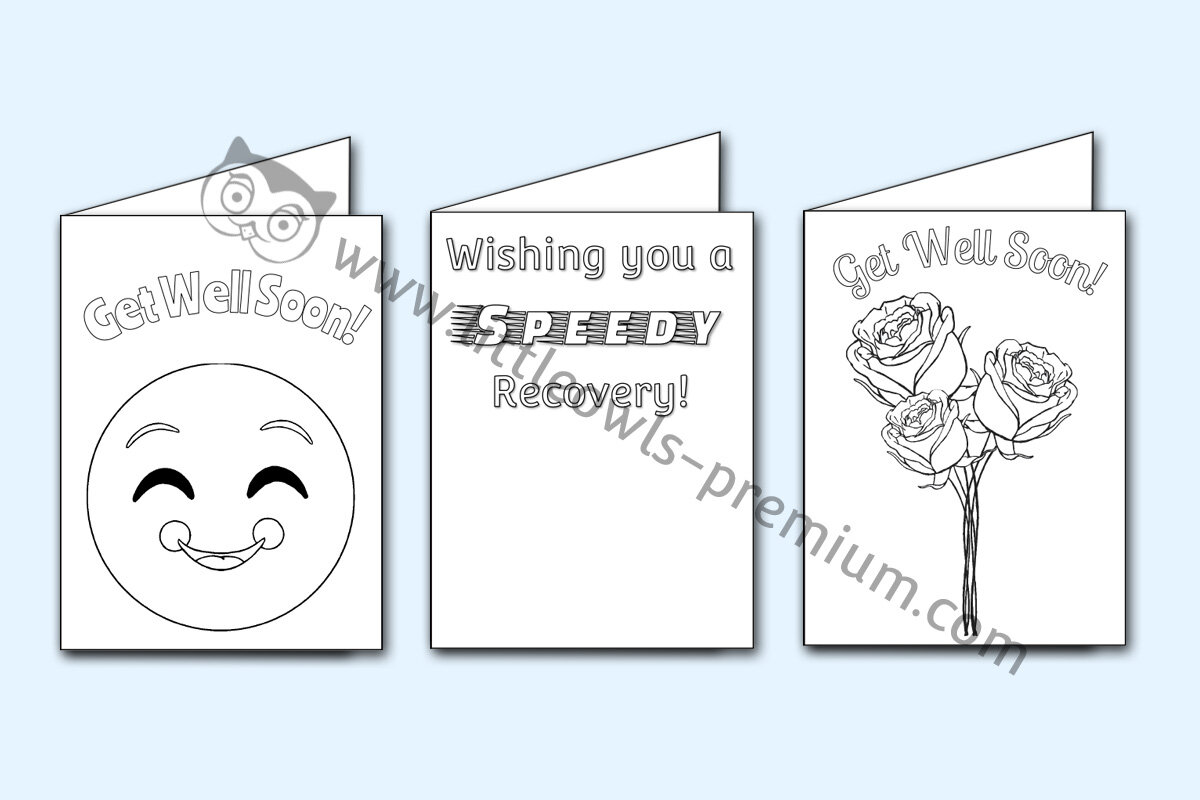
A selection of Get Well Soon Card Templates (vertical). These cards could be used as part of a focused adult led activity or left out as a more child led invitation to play activity as part of role-play.
Original artwork drawn by Sara Murphy and final digital resources created by Stuart Murphy. COPYRIGHT ON ALL OF THE RESOURCES HOUSED ON THIS WEBSITE IS HELD BY ‘LITTLE OWLS RESOURCES’. OUR RESOURCES (INCLUDING THE IMAGES WITHIN THEM), CANNOT BE SHARED OR SOLD COMMERCIALLY.
DOWNLOAD EDITABLE (DOCX)
DOWNLOAD NON-EDITABLE (PDF)
DOWNLOAD NON-EDITABLE (Zipped JPEGs)
Original artwork drawn by Sara Murphy and final digital resources created by Stuart Murphy. COPYRIGHT ON ALL OF THE RESOURCES HOUSED ON THIS WEBSITE IS HELD BY ‘LITTLE OWLS RESOURCES’. OUR RESOURCES (INCLUDING THE IMAGES WITHIN THEM), CANNOT BE SHARED OR SOLD COMMERCIALLY.
DOWNLOAD EDITABLE (DOCX)
DOWNLOAD NON-EDITABLE (PDF)
DOWNLOAD NON-EDITABLE (Zipped JPEGs)
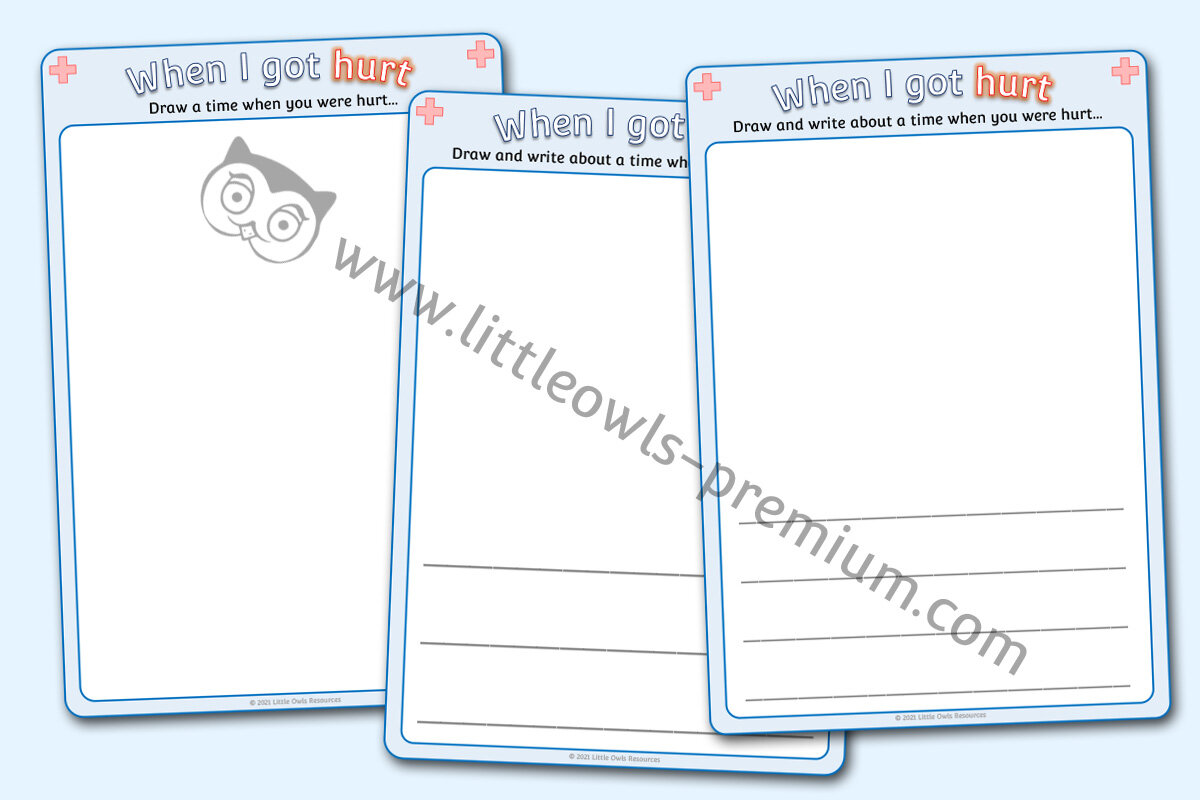
Original artwork drawn by Sara Murphy and final digital resources created by Stuart Murphy. COPYRIGHT ON ALL OF THE RESOURCES HOUSED ON THIS WEBSITE IS HELD BY ‘LITTLE OWLS RESOURCES’. OUR RESOURCES (INCLUDING THE IMAGES WITHIN THEM), CANNOT BE SHARED OR SOLD COMMERCIALLY.
DOWNLOAD EDITABLE (DOCX)
DOWNLOAD NON-EDITABLE (PDF)
DOWNLOAD NON-EDITABLE (Zipped JPEGs)
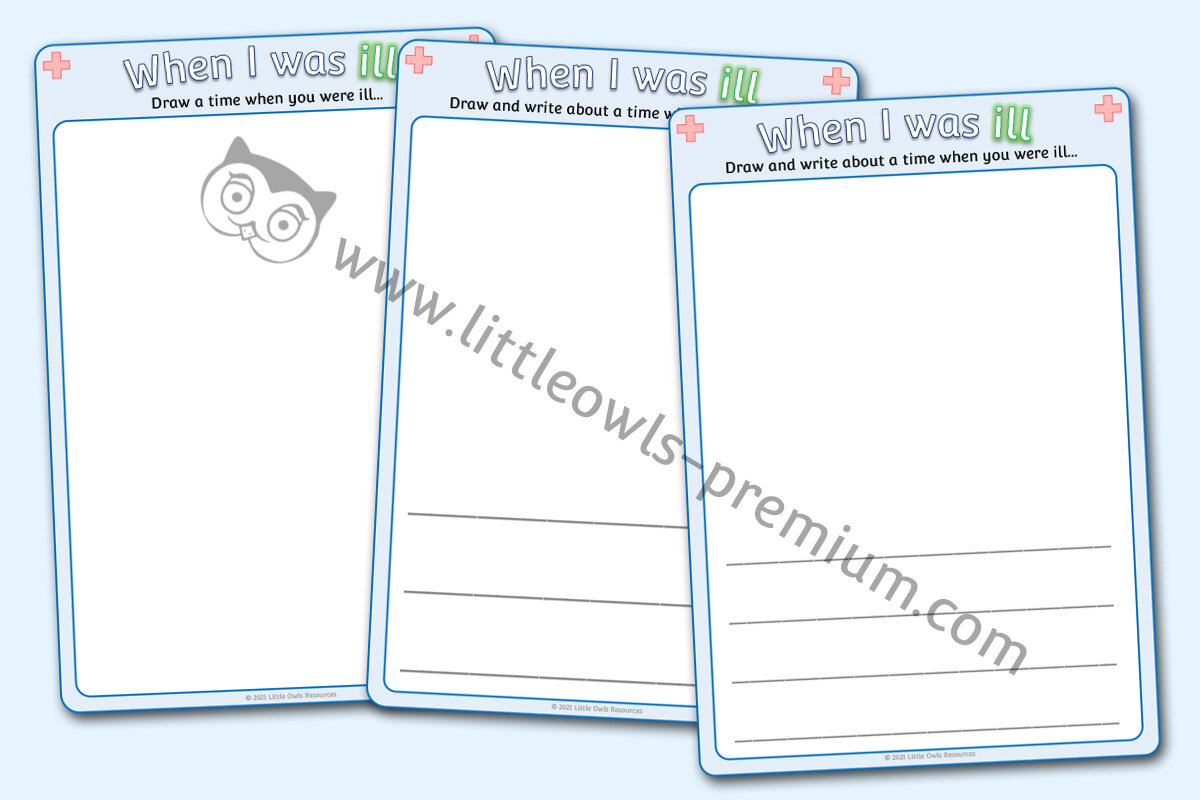
Original artwork drawn by Sara Murphy and final digital resources created by Stuart Murphy. COPYRIGHT ON ALL OF THE RESOURCES HOUSED ON THIS WEBSITE IS HELD BY ‘LITTLE OWLS RESOURCES’. OUR RESOURCES (INCLUDING THE IMAGES WITHIN THEM), CANNOT BE SHARED OR SOLD COMMERCIALLY.
DOWNLOAD EDITABLE (DOCX)
DOWNLOAD NON-EDITABLE (PDF)
DOWNLOAD NON-EDITABLE (Zipped JPEGs)
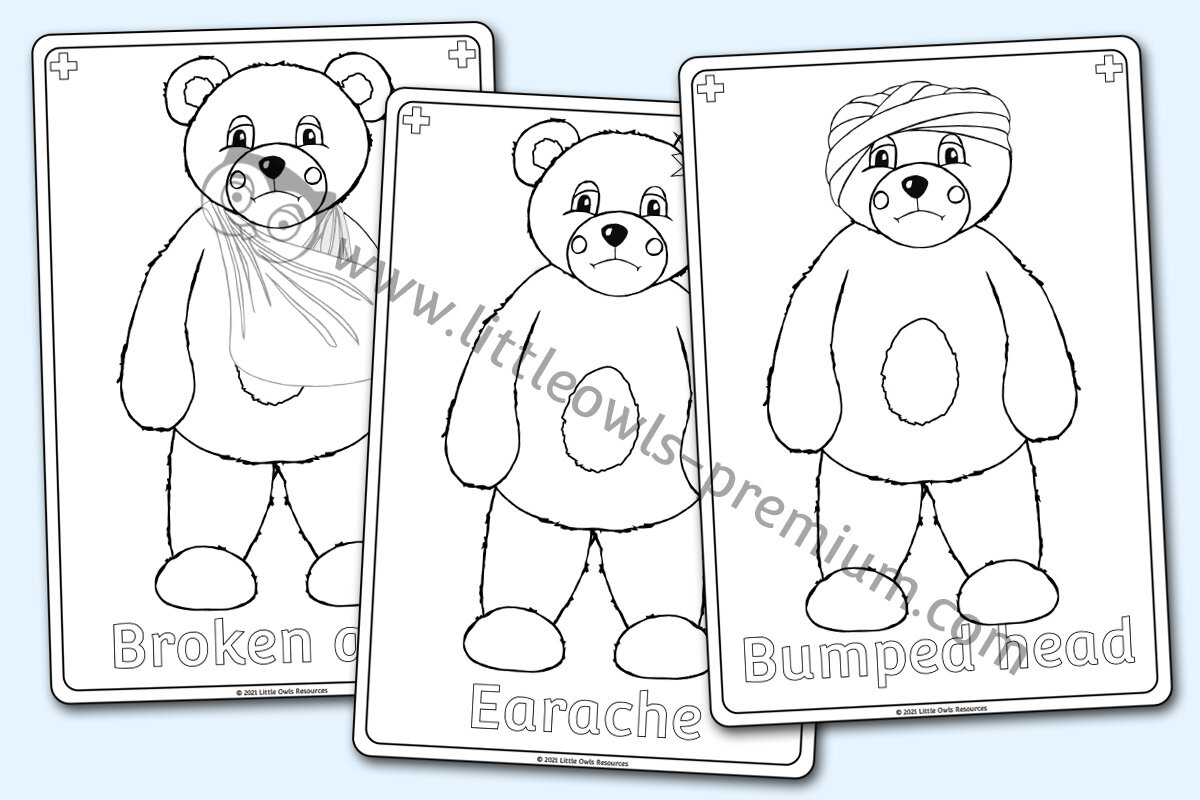
11 Poorly Teddy A4 Colouring Posters included. Ideal for using as part of a medical/doctors and nurses display or activities such as role-play or emergent writing.
Original artwork drawn by Sara Murphy and final digital resources created by Stuart Murphy. COPYRIGHT ON ALL OF THE RESOURCES HOUSED ON THIS WEBSITE IS HELD BY ‘LITTLE OWLS RESOURCES’. OUR RESOURCES (INCLUDING THE IMAGES WITHIN THEM), CANNOT BE SHARED OR SOLD COMMERCIALLY.
DOWNLOAD EDITABLE (DOCX)
DOWNLOAD NON-EDITABLE (PDF)
DOWNLOAD NON-EDITABLE (Zipped JPEGs)
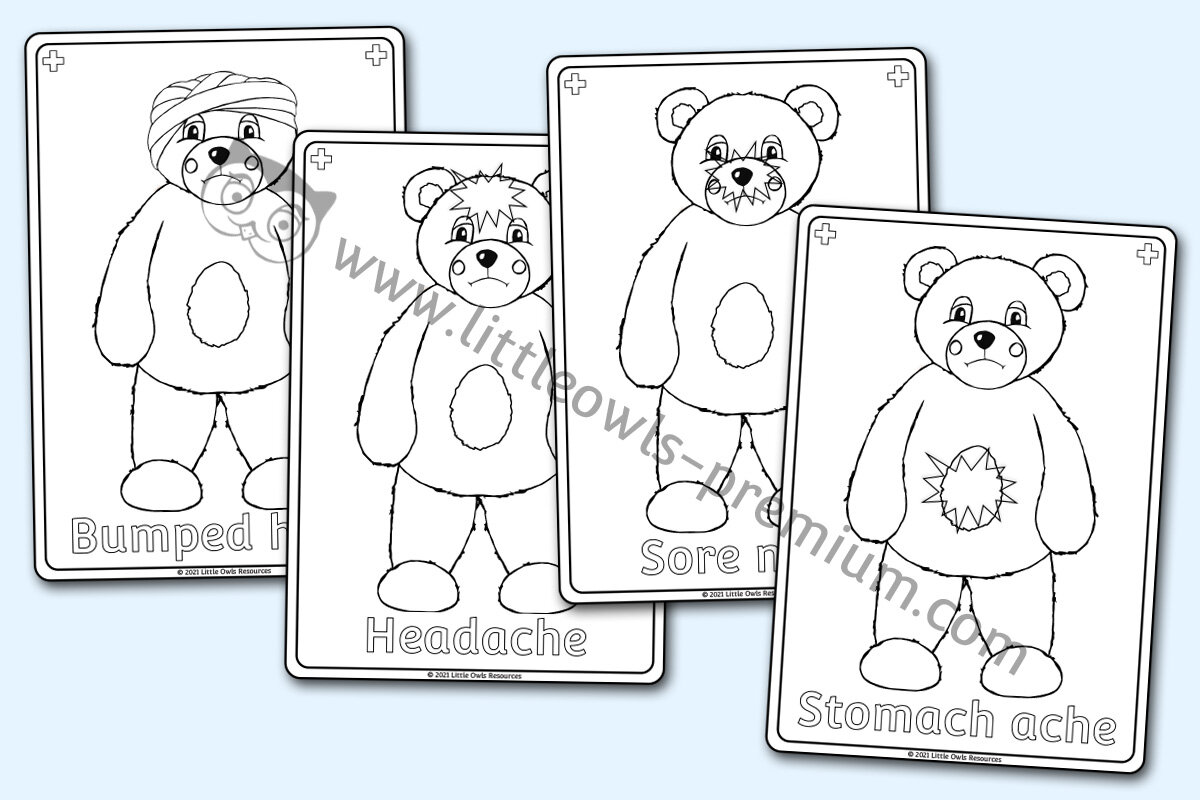
11 Poorly Teddy A5 Colouring Posters included. Ideal for using as part of a medical/doctors and nurses display or activities such as role-play or emergent writing.
Original artwork drawn by Sara Murphy and final digital resources created by Stuart Murphy. COPYRIGHT ON ALL OF THE RESOURCES HOUSED ON THIS WEBSITE IS HELD BY ‘LITTLE OWLS RESOURCES’. OUR RESOURCES (INCLUDING THE IMAGES WITHIN THEM), CANNOT BE SHARED OR SOLD COMMERCIALLY.
DOWNLOAD EDITABLE (DOCX)
DOWNLOAD NON-EDITABLE (PDF)
DOWNLOAD NON-EDITABLE (Zipped JPEGs)

Everything you need to set up a dentist role-play area!
Pack includes:
(Please note that words, etc. can be altered within the editable docx file version.)
‘The Dentist’ banner
Smiling mouth decorative signs
Dentist and Dental Assistant identity cards
‘Waiting Area’ Poster
Various ‘Brush your teeth’ Posters
Social distancing signs & floormats
‘Please wait’ footprint floormats
Dentist word mats
Dentist word cards
‘Welcome! Please sign in for your appointment’ sign for encouraging emergent writing
‘Open’ & ‘Closed’ signs
‘Dentist Opening Times’ Poster - Space to draw hands on clock and write times
‘Opens at…o’ clock’ and ‘Closes at…o’ clock’ signs - spaces for emergent writing
Templates for emergent writing (ideally laminated) - ‘Dentist Notes’, ‘Appointments’ & ‘Patient Details’ forms
‘For Sale’ Menu sign - Space to write prices by items
Items for sale prop cards
Original artwork drawn by Sara Murphy and final digital resources created by Stuart Murphy. COPYRIGHT ON ALL OF THE RESOURCES HOUSED ON THIS WEBSITE IS HELD BY ‘LITTLE OWLS RESOURCES’. OUR RESOURCES (INCLUDING THE IMAGES WITHIN THEM), CANNOT BE SHARED OR SOLD COMMERCIALLY.
DOWNLOAD EDITABLE (DOCX)
DOWNLOAD NON-EDITABLE (PDF)
DOWNLOAD NON-EDITABLE (Zipped JPEGs)
<<-BACK TO ‘TEETH AND ORAL HEALTH’ TOPIC MENU PAGE

Original artwork drawn by Sara Murphy and final digital resources created by Stuart Murphy. COPYRIGHT ON ALL OF THE RESOURCES HOUSED ON THIS WEBSITE IS HELD BY ‘LITTLE OWLS RESOURCES’. OUR RESOURCES (INCLUDING THE IMAGES WITHIN THEM), CANNOT BE SHARED OR SOLD COMMERCIALLY.
DOWNLOAD EDITABLE (DOCX)
DOWNLOAD NON-EDITABLE (PDF)
DOWNLOAD NON-EDITABLE (Zipped JPEGs)
<<-BACK TO ‘TEETH AND ORAL HEALTH’ TOPIC MENU PAGE

Original artwork drawn by Sara Murphy and final digital resources created by Stuart Murphy. COPYRIGHT ON ALL OF THE RESOURCES HOUSED ON THIS WEBSITE IS HELD BY ‘LITTLE OWLS RESOURCES’. OUR RESOURCES (INCLUDING THE IMAGES WITHIN THEM), CANNOT BE SHARED OR SOLD COMMERCIALLY.
DOWNLOAD EDITABLE (DOCX)
DOWNLOAD NON-EDITABLE (PDF)
DOWNLOAD NON-EDITABLE (Zipped JPEGs)
<<-BACK TO ‘TEETH AND ORAL HEALTH’ TOPIC MENU PAGE

Original artwork drawn by Sara Murphy and final digital resources created by Stuart Murphy. COPYRIGHT ON ALL OF THE RESOURCES HOUSED ON THIS WEBSITE IS HELD BY ‘LITTLE OWLS RESOURCES’. OUR RESOURCES (INCLUDING THE IMAGES WITHIN THEM), CANNOT BE SHARED OR SOLD COMMERCIALLY.
DOWNLOAD EDITABLE (DOCX)
DOWNLOAD NON-EDITABLE (PDF)
DOWNLOAD NON-EDITABLE (Zipped JPEGs)
<<-BACK TO ‘TEETH AND ORAL HEALTH’ TOPIC MENU PAGE

Original artwork drawn by Sara Murphy and final digital resources created by Stuart Murphy. COPYRIGHT ON ALL OF THE RESOURCES HOUSED ON THIS WEBSITE IS HELD BY ‘LITTLE OWLS RESOURCES’. OUR RESOURCES (INCLUDING THE IMAGES WITHIN THEM), CANNOT BE SHARED OR SOLD COMMERCIALLY.
DOWNLOAD EDITABLE (DOCX)
DOWNLOAD NON-EDITABLE (PDF)
DOWNLOAD NON-EDITABLE (Zipped JPEGs)
<<-BACK TO ‘TEETH AND ORAL HEALTH’ TOPIC MENU PAGE

Original artwork drawn by Sara Murphy and final digital resources created by Stuart Murphy. COPYRIGHT ON ALL OF THE RESOURCES HOUSED ON THIS WEBSITE IS HELD BY ‘LITTLE OWLS RESOURCES’. OUR RESOURCES (INCLUDING THE IMAGES WITHIN THEM), CANNOT BE SHARED OR SOLD COMMERCIALLY.
DOWNLOAD EDITABLE (DOCX)
DOWNLOAD NON-EDITABLE (PDF)
DOWNLOAD NON-EDITABLE (Zipped JPEGs)
<<-BACK TO ‘TEETH AND ORAL HEALTH’ TOPIC MENU PAGE

Original artwork drawn by Sara Murphy and final digital resources created by Stuart Murphy. COPYRIGHT ON ALL OF THE RESOURCES HOUSED ON THIS WEBSITE IS HELD BY ‘LITTLE OWLS RESOURCES’. OUR RESOURCES (INCLUDING THE IMAGES WITHIN THEM), CANNOT BE SHARED OR SOLD COMMERCIALLY.
DOWNLOAD EDITABLE (DOCX)
DOWNLOAD NON-EDITABLE (PDF)
DOWNLOAD NON-EDITABLE (Zipped JPEGs)
<<-BACK TO ‘TEETH AND ORAL HEALTH’ TOPIC MENU PAGE

Original artwork drawn by Sara Murphy and final digital resources created by Stuart Murphy. COPYRIGHT ON ALL OF THE RESOURCES HOUSED ON THIS WEBSITE IS HELD BY ‘LITTLE OWLS RESOURCES’. OUR RESOURCES (INCLUDING THE IMAGES WITHIN THEM), CANNOT BE SHARED OR SOLD COMMERCIALLY.
DOWNLOAD EDITABLE (DOCX)
DOWNLOAD NON-EDITABLE (PDF)
DOWNLOAD NON-EDITABLE (Zipped JPEGs)
<<-BACK TO ‘TEETH AND ORAL HEALTH’ TOPIC MENU PAGE
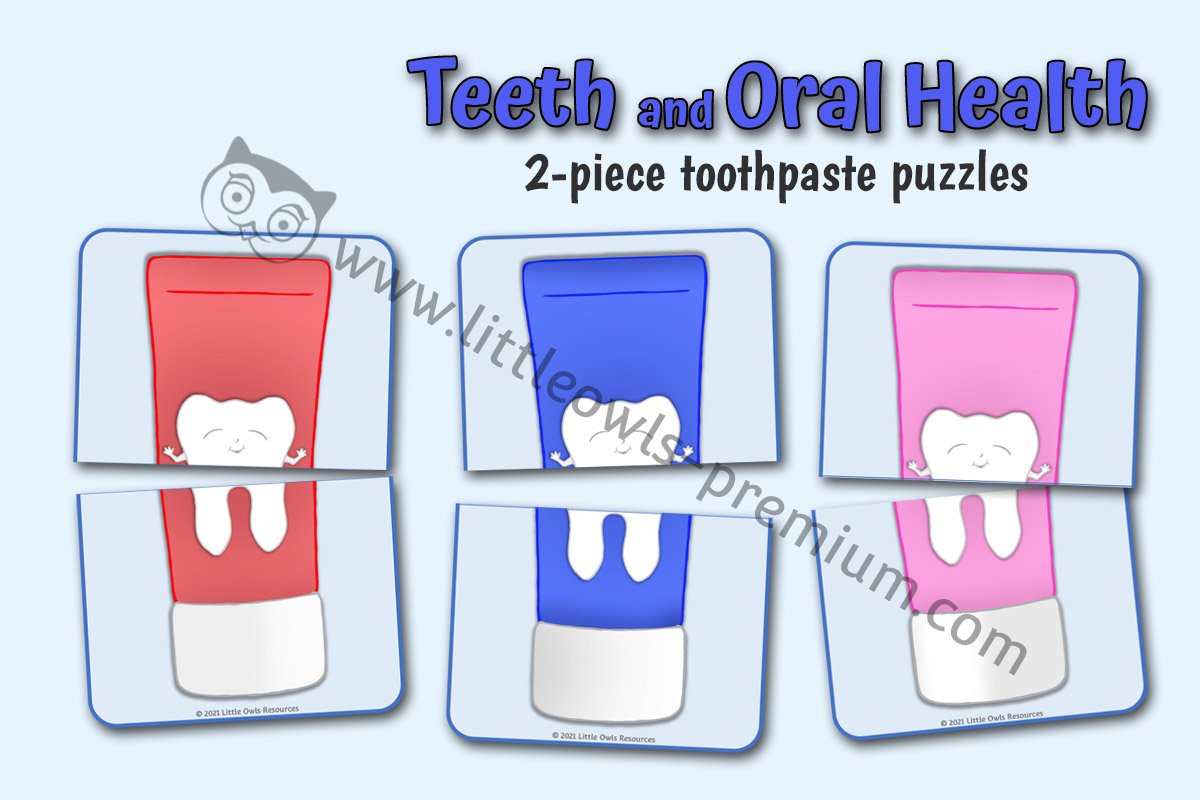
Original artwork drawn by Sara Murphy and final digital resources created by Stuart Murphy. COPYRIGHT ON ALL OF THE RESOURCES HOUSED ON THIS WEBSITE IS HELD BY ‘LITTLE OWLS RESOURCES’. OUR RESOURCES (INCLUDING THE IMAGES WITHIN THEM), CANNOT BE SHARED OR SOLD COMMERCIALLY.
DOWNLOAD EDITABLE (DOCX)
DOWNLOAD NON-EDITABLE (PDF)
DOWNLOAD NON-EDITABLE (Zipped JPEGs)
<<-BACK TO ‘TEETH AND ORAL HEALTH’ TOPIC MENU PAGE

Designed as part of the ‘Teeth and Oral Health’ topic, this pack of sheets can be used for multiple learning intentions. For example…
Learning about the need to brush our teeth
Development of fine motor control using mark making tools
Refining observational skills
Improving concentration
Communication and Language development
Ideal for multiple uses with whiteboard pens after lamination.
Original artwork drawn by Sara Murphy and final digital resources created by Stuart Murphy. COPYRIGHT ON ALL OF THE RESOURCES HOUSED ON THIS WEBSITE IS HELD BY ‘LITTLE OWLS RESOURCES’. OUR RESOURCES (INCLUDING THE IMAGES WITHIN THEM), CANNOT BE SHARED OR SOLD COMMERCIALLY.
DOWNLOAD EDITABLE (DOCX)
DOWNLOAD NON-EDITABLE (PDF)
DOWNLOAD NON-EDITABLE (Zipped JPEGs)
<<-BACK TO ‘TEETH AND ORAL HEALTH’ TOPIC MENU PAGE
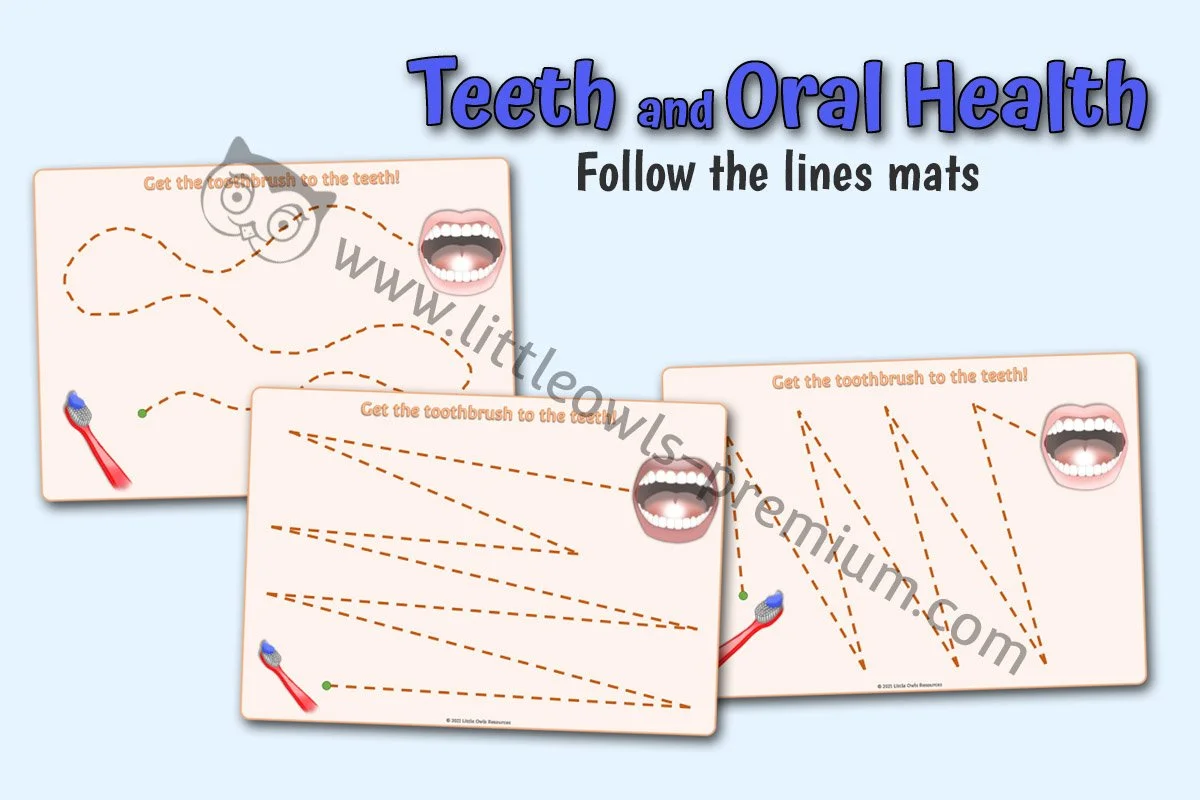
Designed as part of the ‘Teeth and Oral Health’ topic, this pack of mats can be used for multiple learning intentions. For example…
Learning about the need to brush our teeth
Development of fine motor control using mark making tools
Refining observational skills
Improving concentration
Communication and Language development
Ideal for multiple uses with whiteboard pens after lamination.
Original artwork drawn by Sara Murphy and final digital resources created by Stuart Murphy. COPYRIGHT ON ALL OF THE RESOURCES HOUSED ON THIS WEBSITE IS HELD BY ‘LITTLE OWLS RESOURCES’. OUR RESOURCES (INCLUDING THE IMAGES WITHIN THEM), CANNOT BE SHARED OR SOLD COMMERCIALLY.
DOWNLOAD EDITABLE (DOCX)
DOWNLOAD NON-EDITABLE (PDF)
DOWNLOAD NON-EDITABLE (Zipped JPEGs)
<<-BACK TO ‘TEETH AND ORAL HEALTH’ TOPIC MENU PAGE

Help your toothbrush to clean the teeth with this fun and engaging Letters and Sounds game. Two different boards to choose from - one for Phase 2 Sounds and another for Phase 3 Sounds. Dice required. Children choose a toothbrush to place on the teeth that need cleaning at the top of the board, roll the dice and move the appropriate number of sound squares towards the clean teeth at the bottom. When they land on a sound square they can practise saying the sound. Have fun!
Original artwork drawn by Sara Murphy and final digital resources created by Stuart Murphy. COPYRIGHT ON ALL OF THE RESOURCES HOUSED ON THIS WEBSITE IS HELD BY ‘LITTLE OWLS RESOURCES’. OUR RESOURCES (INCLUDING THE IMAGES WITHIN THEM), CANNOT BE SHARED OR SOLD COMMERCIALLY.
DOWNLOAD EDITABLE (DOCX)
DOWNLOAD NON-EDITABLE (PDF)
DOWNLOAD NON-EDITABLE (Zipped JPEGs)
<<-BACK TO ‘TEETH AND ORAL HEALTH’ TOPIC MENU PAGE

Challenge your children to cut out the teeth shapes and stick them to the corresponding numbers on the mouth template provided. Great for fine motor control, scissor skills, number recognition and number ordering.
Original artwork drawn by Sara Murphy and final digital resources created by Stuart Murphy. COPYRIGHT ON ALL OF THE RESOURCES HOUSED ON THIS WEBSITE IS HELD BY ‘LITTLE OWLS RESOURCES’. OUR RESOURCES (INCLUDING THE IMAGES WITHIN THEM), CANNOT BE SHARED OR SOLD COMMERCIALLY.
DOWNLOAD EDITABLE (DOCX)
DOWNLOAD NON-EDITABLE (PDF)
DOWNLOAD NON-EDITABLE (Zipped JPEGs)
<<-BACK TO ‘TEETH AND ORAL HEALTH’ TOPIC MENU PAGE
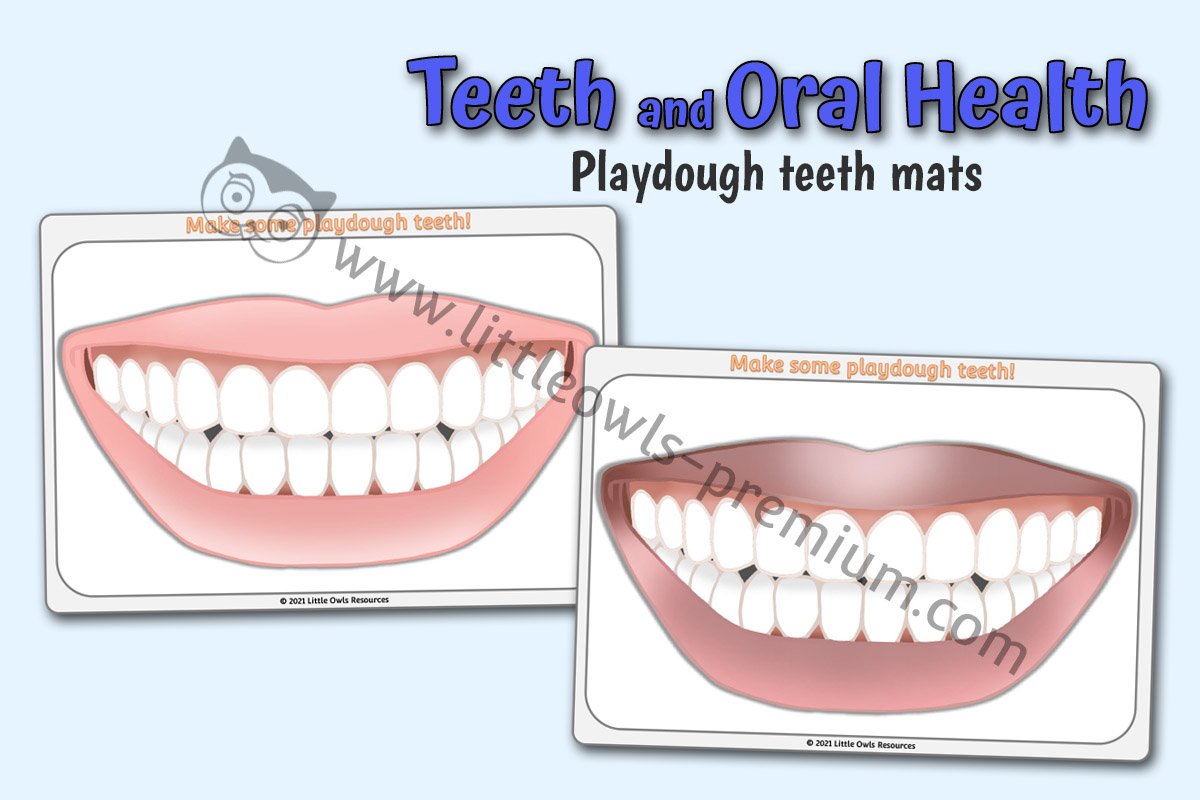
Encourage your child(ren) to make some teeth out of playdough to place on these mouth template mats.
Original artwork drawn by Sara Murphy and final digital resources created by Stuart Murphy. COPYRIGHT ON ALL OF THE RESOURCES HOUSED ON THIS WEBSITE IS HELD BY ‘LITTLE OWLS RESOURCES’. OUR RESOURCES (INCLUDING THE IMAGES WITHIN THEM), CANNOT BE SHARED OR SOLD COMMERCIALLY.
DOWNLOAD EDITABLE (DOCX)
DOWNLOAD NON-EDITABLE (PDF)
DOWNLOAD NON-EDITABLE (Zipped JPEGs)
<<-BACK TO ‘TEETH AND ORAL HEALTH’ TOPIC MENU PAGE

Original artwork drawn by Sara Murphy and final digital resources created by Stuart Murphy. COPYRIGHT ON ALL OF THE RESOURCES HOUSED ON THIS WEBSITE IS HELD BY ‘LITTLE OWLS RESOURCES’. OUR RESOURCES (INCLUDING THE IMAGES WITHIN THEM), CANNOT BE SHARED OR SOLD COMMERCIALLY.
DOWNLOAD EDITABLE (DOCX)
DOWNLOAD NON-EDITABLE (PDF)
DOWNLOAD NON-EDITABLE (Zipped JPEGs)
<<-BACK TO ‘TEETH AND ORAL HEALTH’ TOPIC MENU PAGE
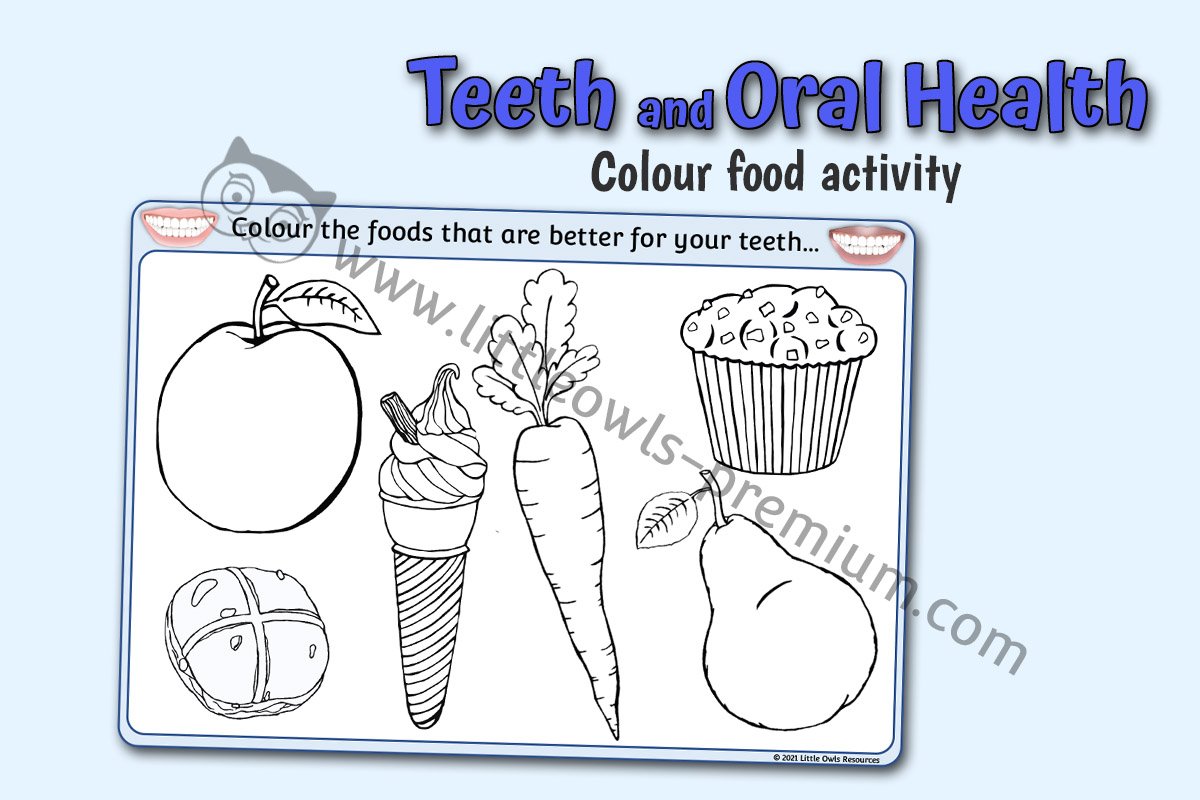
Original artwork drawn by Sara Murphy and final digital resources created by Stuart Murphy. COPYRIGHT ON ALL OF THE RESOURCES HOUSED ON THIS WEBSITE IS HELD BY ‘LITTLE OWLS RESOURCES’. OUR RESOURCES (INCLUDING THE IMAGES WITHIN THEM), CANNOT BE SHARED OR SOLD COMMERCIALLY.
DOWNLOAD EDITABLE (DOCX)
DOWNLOAD NON-EDITABLE (PDF)
DOWNLOAD NON-EDITABLE (Zipped JPEGs)
<<-BACK TO ‘TEETH AND ORAL HEALTH’ TOPIC MENU PAGE

Original artwork drawn by Sara Murphy and final digital resources created by Stuart Murphy. COPYRIGHT ON ALL OF THE RESOURCES HOUSED ON THIS WEBSITE IS HELD BY ‘LITTLE OWLS RESOURCES’. OUR RESOURCES (INCLUDING THE IMAGES WITHIN THEM), CANNOT BE SHARED OR SOLD COMMERCIALLY.
DOWNLOAD EDITABLE (DOCX)
DOWNLOAD NON-EDITABLE (PDF)
DOWNLOAD NON-EDITABLE (Zipped JPEGs)
<<-BACK TO ‘TEETH AND ORAL HEALTH’ TOPIC MENU PAGE

Original artwork drawn by Sara Murphy and final digital resources created by Stuart Murphy. COPYRIGHT ON ALL OF THE RESOURCES HOUSED ON THIS WEBSITE IS HELD BY ‘LITTLE OWLS RESOURCES’. OUR RESOURCES (INCLUDING THE IMAGES WITHIN THEM), CANNOT BE SHARED OR SOLD COMMERCIALLY.
DOWNLOAD EDITABLE (DOCX)
DOWNLOAD NON-EDITABLE (PDF)
DOWNLOAD NON-EDITABLE (Zipped JPEGs)
<<-BACK TO ‘TEETH AND ORAL HEALTH’ TOPIC MENU PAGE

2-Piece ‘Glasses’ puzzles. Can be used as an engaging part of structured activity or left out as an invitation to play.
Children look at each of the puzzle pieces and work out which of them match to make a pair of glasses or sunglasses. 16 puzzles included. Various colours, styles and designs. Great for developing observational skills and a knowledge of symmetry.
Original artwork drawn by Sara Murphy and final digital resources created by Stuart Murphy. COPYRIGHT ON ALL OF THE RESOURCES HOUSED ON THIS WEBSITE IS HELD BY ‘LITTLE OWLS RESOURCES’. OUR RESOURCES (INCLUDING THE IMAGES WITHIN THEM), CANNOT BE SHARED OR SOLD COMMERCIALLY.
DOWNLOAD EDITABLE (DOCX)
DOWNLOAD NON-EDITABLE (PDF)
DOWNLOAD NON-EDITABLE (Zipped JPEGs)

Poster entitled 'Keep Your Eyes Healthy!' Includes advice for how children can keep their eyes healthy:
Drink plenty of water
Get some exercise
Eat healthy foods
Get a good night’s sleep
Wear sunglasses in sunny weather
Original artwork drawn by Sara Murphy and final digital resources created by Stuart Murphy. COPYRIGHT ON ALL OF THE RESOURCES HOUSED ON THIS WEBSITE IS HELD BY ‘LITTLE OWLS RESOURCES’. OUR RESOURCES (INCLUDING THE IMAGES WITHIN THEM), CANNOT BE SHARED OR SOLD COMMERCIALLY.
DOWNLOAD EDITABLE (DOCX)
DOWNLOAD NON-EDITABLE (PDF)
DOWNLOAD NON-EDITABLE (Zipped JPEGs)

Eye health related word cards:
eye charts
optometrist
ophthalmoscope
eye-drops
computer
clipboard
eyes
glasses
sunglasses
Original artwork drawn by Sara Murphy and final digital resources created by Stuart Murphy. COPYRIGHT ON ALL OF THE RESOURCES HOUSED ON THIS WEBSITE IS HELD BY ‘LITTLE OWLS RESOURCES’. OUR RESOURCES (INCLUDING THE IMAGES WITHIN THEM), CANNOT BE SHARED OR SOLD COMMERCIALLY.
DOWNLOAD EDITABLE (DOCX)
DOWNLOAD NON-EDITABLE (PDF)
DOWNLOAD NON-EDITABLE (Zipped JPEGs)

Eye health related words included on Optometrist Word Mat:
eye charts
optometrist
ophthalmoscope
eye-drops
computer
clipboard
eyes
glasses
sunglasses
Original artwork drawn by Sara Murphy and final digital resources created by Stuart Murphy. COPYRIGHT ON ALL OF THE RESOURCES HOUSED ON THIS WEBSITE IS HELD BY ‘LITTLE OWLS RESOURCES’. OUR RESOURCES (INCLUDING THE IMAGES WITHIN THEM), CANNOT BE SHARED OR SOLD COMMERCIALLY.
DOWNLOAD EDITABLE (DOCX)
DOWNLOAD NON-EDITABLE (PDF)
DOWNLOAD NON-EDITABLE (Zipped JPEGs)

This poster outlines the basic process of ‘weeing’ (or how wee is created) for young children.
It illustrates the kidneys and bladder and where they are situated in the body and explains what happens within each with regard to the creation of ‘wee’ and where it gets stored.
Original artwork drawn by Sara Murphy and final digital resources created by Stuart Murphy. COPYRIGHT ON ALL OF THE RESOURCES HOUSED ON THIS WEBSITE IS HELD BY ‘LITTLE OWLS RESOURCES’. OUR RESOURCES (INCLUDING THE IMAGES WITHIN THEM), CANNOT BE SHARED OR SOLD COMMERCIALLY.
DOWNLOAD EDITABLE (DOCX)
DOWNLOAD NON-EDITABLE (PDF)
DOWNLOAD NON-EDITABLE (Zipped JPEGs)

Three different playdough mats showing the kidneys in the human body.
Each mat zooms in to a different degree so that you can choose how much context to give your child and how large you would like the resulting kidneys to be.
Original artwork drawn by Sara Murphy and final digital resources created by Stuart Murphy. COPYRIGHT ON ALL OF THE RESOURCES HOUSED ON THIS WEBSITE IS HELD BY ‘LITTLE OWLS RESOURCES’. OUR RESOURCES (INCLUDING THE IMAGES WITHIN THEM), CANNOT BE SHARED OR SOLD COMMERCIALLY.
DOWNLOAD EDITABLE (DOCX)
DOWNLOAD NON-EDITABLE (PDF)
DOWNLOAD NON-EDITABLE (Zipped JPEGs)

This resource enables children to physically place kidney shapes where they would be found on a human body template.
In addition children can also work on their fine motor skills concerning colouring, cutting using scissors and glue if appropriate.
Original artwork drawn by Sara Murphy and final digital resources created by Stuart Murphy. COPYRIGHT ON ALL OF THE RESOURCES HOUSED ON THIS WEBSITE IS HELD BY ‘LITTLE OWLS RESOURCES’. OUR RESOURCES (INCLUDING THE IMAGES WITHIN THEM), CANNOT BE SHARED OR SOLD COMMERCIALLY.
DOWNLOAD EDITABLE (DOCX)
DOWNLOAD NON-EDITABLE (PDF)
DOWNLOAD NON-EDITABLE (Zipped JPEGs)

This poster outlines the basic process of ‘breathing’ for young children.
It illustrates the mouth and nose, windpipe and lungs and where they are situated in the body and explains what happens within each with regard to the process of ‘breathing’.
Original artwork drawn by Sara Murphy and final digital resources created by Stuart Murphy. COPYRIGHT ON ALL OF THE RESOURCES HOUSED ON THIS WEBSITE IS HELD BY ‘LITTLE OWLS RESOURCES’. OUR RESOURCES (INCLUDING THE IMAGES WITHIN THEM), CANNOT BE SHARED OR SOLD COMMERCIALLY.
DOWNLOAD EDITABLE (DOCX)
DOWNLOAD NON-EDITABLE (PDF)
DOWNLOAD NON-EDITABLE (Zipped JPEGs)

Three different playdough mats showing the lungs in the human body.
Each mat zooms in to a different degree so that you can choose how much context to give your child and how large you would like the resulting lungs to be.
Original artwork drawn by Sara Murphy and final digital resources created by Stuart Murphy. COPYRIGHT ON ALL OF THE RESOURCES HOUSED ON THIS WEBSITE IS HELD BY ‘LITTLE OWLS RESOURCES’. OUR RESOURCES (INCLUDING THE IMAGES WITHIN THEM), CANNOT BE SHARED OR SOLD COMMERCIALLY.
DOWNLOAD EDITABLE (DOCX)
DOWNLOAD NON-EDITABLE (PDF)
DOWNLOAD NON-EDITABLE (Zipped JPEGs)

This resource enables children to physically place lung shapes where they would be found on a human body template.
In addition children can also work on their fine motor skills concerning colouring, cutting using scissors and glue if appropriate.
Original artwork drawn by Sara Murphy and final digital resources created by Stuart Murphy. COPYRIGHT ON ALL OF THE RESOURCES HOUSED ON THIS WEBSITE IS HELD BY ‘LITTLE OWLS RESOURCES’. OUR RESOURCES (INCLUDING THE IMAGES WITHIN THEM), CANNOT BE SHARED OR SOLD COMMERCIALLY.
DOWNLOAD EDITABLE (DOCX)
DOWNLOAD NON-EDITABLE (PDF)
DOWNLOAD NON-EDITABLE (Zipped JPEGs)

This poster outlines the basic process of ‘thinking and controlling’ for young children.
It illustrates the brain and nerves and where they are situated in the body and explains what happens within each.
Original artwork drawn by Sara Murphy and final digital resources created by Stuart Murphy. COPYRIGHT ON ALL OF THE RESOURCES HOUSED ON THIS WEBSITE IS HELD BY ‘LITTLE OWLS RESOURCES’. OUR RESOURCES (INCLUDING THE IMAGES WITHIN THEM), CANNOT BE SHARED OR SOLD COMMERCIALLY.
DOWNLOAD EDITABLE (DOCX)
DOWNLOAD NON-EDITABLE (PDF)
DOWNLOAD NON-EDITABLE (Zipped JPEGs)

Three different playdough mats showing the brain in the human body.
Each mat zooms in to a different degree so that you can choose how much context to give your child and how large you would like the resulting brain to be.
Original artwork drawn by Sara Murphy and final digital resources created by Stuart Murphy. COPYRIGHT ON ALL OF THE RESOURCES HOUSED ON THIS WEBSITE IS HELD BY ‘LITTLE OWLS RESOURCES’. OUR RESOURCES (INCLUDING THE IMAGES WITHIN THEM), CANNOT BE SHARED OR SOLD COMMERCIALLY.
DOWNLOAD EDITABLE (DOCX)
DOWNLOAD NON-EDITABLE (PDF)
DOWNLOAD NON-EDITABLE (Zipped JPEGs)

This resource enables children to physically place a brain shape where it would be found on a human body template.
In addition children can also work on their fine motor skills concerning colouring, cutting using scissors and glue if appropriate.
Original artwork drawn by Sara Murphy and final digital resources created by Stuart Murphy. COPYRIGHT ON ALL OF THE RESOURCES HOUSED ON THIS WEBSITE IS HELD BY ‘LITTLE OWLS RESOURCES’. OUR RESOURCES (INCLUDING THE IMAGES WITHIN THEM), CANNOT BE SHARED OR SOLD COMMERCIALLY.
DOWNLOAD EDITABLE (DOCX)
DOWNLOAD NON-EDITABLE (PDF)
DOWNLOAD NON-EDITABLE (Zipped JPEGs)

This poster outlines the basic ‘blood system’ (circulatory system) including heart for young children.
It illustrates the heart, arteries and veins and where they are situated in the body.
Original artwork drawn by Sara Murphy and final digital resources created by Stuart Murphy. COPYRIGHT ON ALL OF THE RESOURCES HOUSED ON THIS WEBSITE IS HELD BY ‘LITTLE OWLS RESOURCES’. OUR RESOURCES (INCLUDING THE IMAGES WITHIN THEM), CANNOT BE SHARED OR SOLD COMMERCIALLY.
DOWNLOAD EDITABLE (DOCX)
DOWNLOAD NON-EDITABLE (PDF)
DOWNLOAD NON-EDITABLE (Zipped JPEGs)

Three different playdough mats showing the heart in the human body.
Each mat zooms in to a different degree so that you can choose how much context to give your child and how large you would like the resulting heart to be.
Original artwork drawn by Sara Murphy and final digital resources created by Stuart Murphy. COPYRIGHT ON ALL OF THE RESOURCES HOUSED ON THIS WEBSITE IS HELD BY ‘LITTLE OWLS RESOURCES’. OUR RESOURCES (INCLUDING THE IMAGES WITHIN THEM), CANNOT BE SHARED OR SOLD COMMERCIALLY.
DOWNLOAD EDITABLE (DOCX)
DOWNLOAD NON-EDITABLE (PDF)
DOWNLOAD NON-EDITABLE (Zipped JPEGs)

This resource enables children to physically place a heart shape where it would be found on a human body template.
In addition children can also work on their fine motor skills concerning colouring, cutting using scissors and glue if appropriate.
Original artwork drawn by Sara Murphy and final digital resources created by Stuart Murphy. COPYRIGHT ON ALL OF THE RESOURCES HOUSED ON THIS WEBSITE IS HELD BY ‘LITTLE OWLS RESOURCES’. OUR RESOURCES (INCLUDING THE IMAGES WITHIN THEM), CANNOT BE SHARED OR SOLD COMMERCIALLY.
DOWNLOAD EDITABLE (DOCX)
DOWNLOAD NON-EDITABLE (PDF)
DOWNLOAD NON-EDITABLE (Zipped JPEGs)

This poster outlines the basic process of ‘Eating and Pooing’ (the digestive system) for young children.
It illustrates the mouth and teeth, liver, stomach, small intestine and large intestine and where they are situated in the body and explains what happens within each with regard to the process of ‘eating and pooing’.
Original artwork drawn by Sara Murphy and final digital resources created by Stuart Murphy. COPYRIGHT ON ALL OF THE RESOURCES HOUSED ON THIS WEBSITE IS HELD BY ‘LITTLE OWLS RESOURCES’. OUR RESOURCES (INCLUDING THE IMAGES WITHIN THEM), CANNOT BE SHARED OR SOLD COMMERCIALLY.
DOWNLOAD EDITABLE (DOCX)
DOWNLOAD NON-EDITABLE (PDF)
DOWNLOAD NON-EDITABLE (Zipped JPEGs)

Three different playdough mats showing the digestive system in the human body.
Each mat zooms in to a different degree so that you can choose how much context to give your child and how large you would like the resulting digestive system to be.
Original artwork drawn by Sara Murphy and final digital resources created by Stuart Murphy. COPYRIGHT ON ALL OF THE RESOURCES HOUSED ON THIS WEBSITE IS HELD BY ‘LITTLE OWLS RESOURCES’. OUR RESOURCES (INCLUDING THE IMAGES WITHIN THEM), CANNOT BE SHARED OR SOLD COMMERCIALLY.
DOWNLOAD EDITABLE (DOCX)
DOWNLOAD NON-EDITABLE (PDF)
DOWNLOAD NON-EDITABLE (Zipped JPEGs)
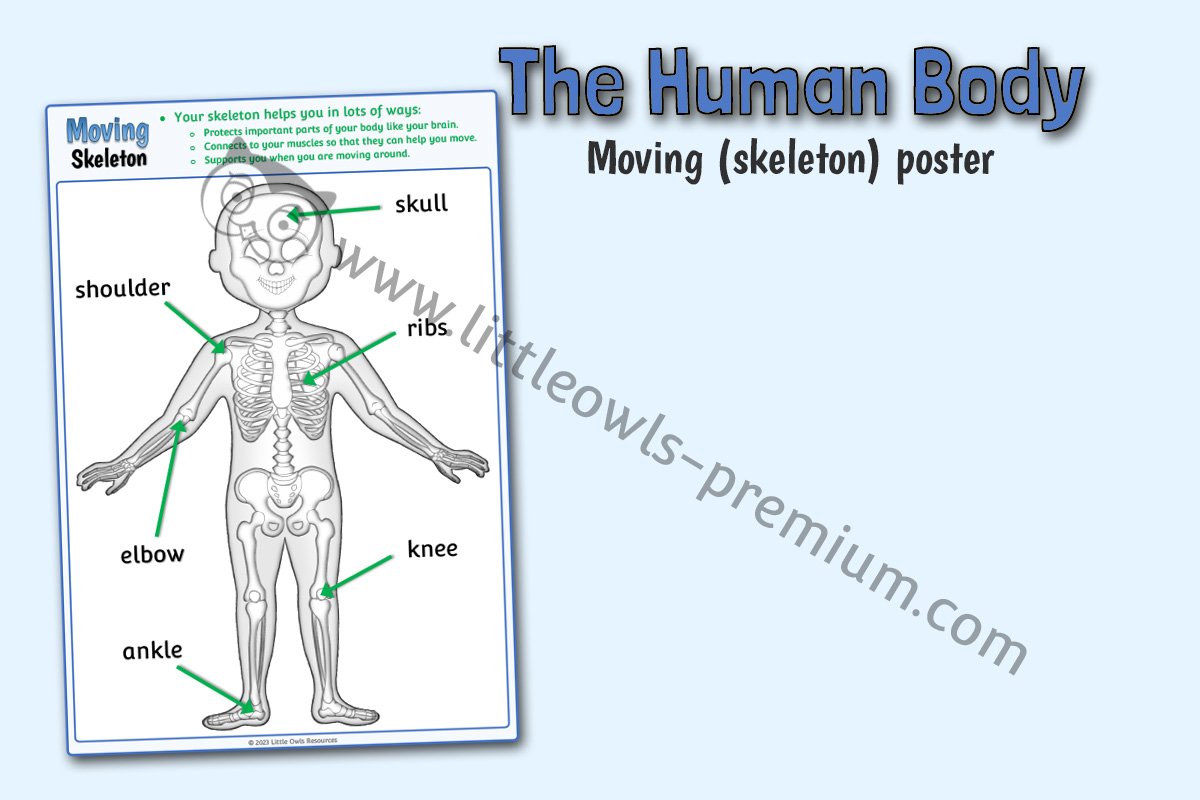
This poster outlines how our skeletons help us.
There are labels for the skull, shoulder, ribs, elbow, knee and ankle.
Original artwork drawn by Sara Murphy and final digital resources created by Stuart Murphy. COPYRIGHT ON ALL OF THE RESOURCES HOUSED ON THIS WEBSITE IS HELD BY ‘LITTLE OWLS RESOURCES’. OUR RESOURCES (INCLUDING THE IMAGES WITHIN THEM), CANNOT BE SHARED OR SOLD COMMERCIALLY.
DOWNLOAD EDITABLE (DOCX)
DOWNLOAD NON-EDITABLE (PDF)
DOWNLOAD NON-EDITABLE (Zipped JPEGs)

This poster outlines how our muscles help us.
An example of muscles tightening and relaxing in the arm is shown (biceps and triceps).
Original artwork drawn by Sara Murphy and final digital resources created by Stuart Murphy. COPYRIGHT ON ALL OF THE RESOURCES HOUSED ON THIS WEBSITE IS HELD BY ‘LITTLE OWLS RESOURCES’. OUR RESOURCES (INCLUDING THE IMAGES WITHIN THEM), CANNOT BE SHARED OR SOLD COMMERCIALLY.
DOWNLOAD EDITABLE (DOCX)
DOWNLOAD NON-EDITABLE (PDF)
DOWNLOAD NON-EDITABLE (Zipped JPEGs)
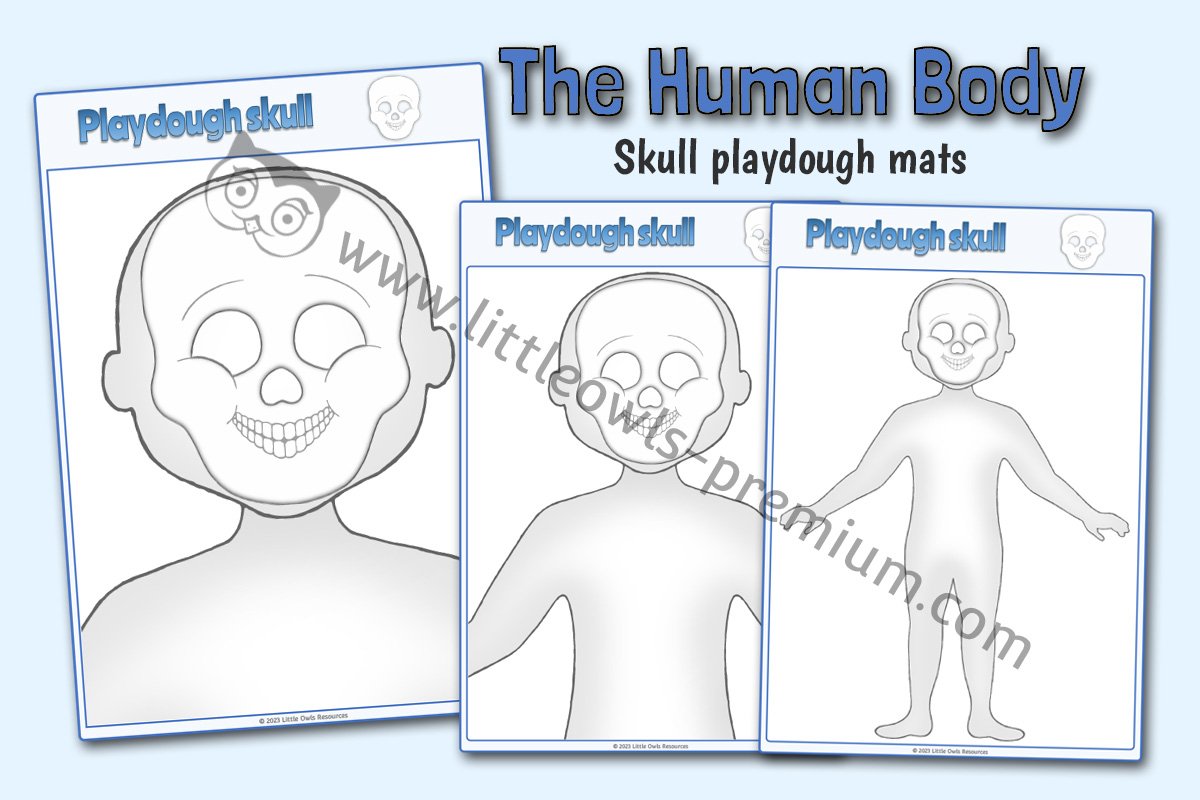
Three different playdough mats showing the skull in the human body.
Each mat zooms in to a different degree so that you can choose how much context to give your child and how large you would like the resulting skull to be.
Original artwork drawn by Sara Murphy and final digital resources created by Stuart Murphy. COPYRIGHT ON ALL OF THE RESOURCES HOUSED ON THIS WEBSITE IS HELD BY ‘LITTLE OWLS RESOURCES’. OUR RESOURCES (INCLUDING THE IMAGES WITHIN THEM), CANNOT BE SHARED OR SOLD COMMERCIALLY.
DOWNLOAD EDITABLE (DOCX)
DOWNLOAD NON-EDITABLE (PDF)
DOWNLOAD NON-EDITABLE (Zipped JPEGs)

This resource enables children to physically place a skull shape where it would be found on a human body template.
In addition children can also work on their fine motor skills concerning colouring, cutting using scissors and glue if appropriate.
Original artwork drawn by Sara Murphy and final digital resources created by Stuart Murphy. COPYRIGHT ON ALL OF THE RESOURCES HOUSED ON THIS WEBSITE IS HELD BY ‘LITTLE OWLS RESOURCES’. OUR RESOURCES (INCLUDING THE IMAGES WITHIN THEM), CANNOT BE SHARED OR SOLD COMMERCIALLY.
DOWNLOAD EDITABLE (DOCX)
DOWNLOAD NON-EDITABLE (PDF)
DOWNLOAD NON-EDITABLE (Zipped JPEGs)

Two different playdough mats showing the bicep and tricep muscles tightening and relaxing in the arm.
Original artwork drawn by Sara Murphy and final digital resources created by Stuart Murphy. COPYRIGHT ON ALL OF THE RESOURCES HOUSED ON THIS WEBSITE IS HELD BY ‘LITTLE OWLS RESOURCES’. OUR RESOURCES (INCLUDING THE IMAGES WITHIN THEM), CANNOT BE SHARED OR SOLD COMMERCIALLY.
DOWNLOAD EDITABLE (DOCX)
DOWNLOAD NON-EDITABLE (PDF)
DOWNLOAD NON-EDITABLE (Zipped JPEGs)

Pack includes 48 human body themed word cards.
Word cards for: kidneys, lungs, windpipe, bladder, brain, nerves, muscles, blood system, stomach, small intestine, large intestine, ear, thumb, nose, liver, skull, heart, skeleton, eye, eyebrow, mouth, teeth, lips, tongue, hand, fingernail, finger, hair, elbow, knee, leg, arm, head, shoulder, ankle, feet, bone, bones, cheek, chin, neck and chest.
Original artwork drawn by Sara Murphy and final digital resources created by Stuart Murphy. COPYRIGHT ON ALL OF THE RESOURCES HOUSED ON THIS WEBSITE IS HELD BY ‘LITTLE OWLS RESOURCES’. OUR RESOURCES (INCLUDING THE IMAGES WITHIN THEM), CANNOT BE SHARED OR SOLD COMMERCIALLY.
DOWNLOAD EDITABLE (DOCX)
DOWNLOAD NON-EDITABLE (PDF)
DOWNLOAD NON-EDITABLE (Zipped JPEGs)

Eight ‘Inside the Human Body - Silhouette Match Puzzles’ included.
A different connection for each set to allow the children to self-correct.
Puzzles for: kidneys, lungs, brain, stomach/intestines and liver, skull, heart, skeleton and muscles.
Original artwork drawn by Sara Murphy and final digital resources created by Stuart Murphy. COPYRIGHT ON ALL OF THE RESOURCES HOUSED ON THIS WEBSITE IS HELD BY ‘LITTLE OWLS RESOURCES’. OUR RESOURCES (INCLUDING THE IMAGES WITHIN THEM), CANNOT BE SHARED OR SOLD COMMERCIALLY.
DOWNLOAD EDITABLE (DOCX)
DOWNLOAD NON-EDITABLE (PDF)
DOWNLOAD NON-EDITABLE (Zipped JPEGs)

Original artwork drawn by Sara Murphy and final digital resources created by Stuart Murphy. COPYRIGHT ON ALL OF THE RESOURCES HOUSED ON THIS WEBSITE IS HELD BY ‘LITTLE OWLS RESOURCES’. OUR RESOURCES (INCLUDING THE IMAGES WITHIN THEM), CANNOT BE SHARED OR SOLD COMMERCIALLY.
DOWNLOAD EDITABLE (DOCX)
DOWNLOAD NON-EDITABLE (PDF)
DOWNLOAD NON-EDITABLE (Zipped JPEGs)

Original artwork drawn by Sara Murphy and final digital resources created by Stuart Murphy. COPYRIGHT ON ALL OF THE RESOURCES HOUSED ON THIS WEBSITE IS HELD BY ‘LITTLE OWLS RESOURCES’. OUR RESOURCES (INCLUDING THE IMAGES WITHIN THEM), CANNOT BE SHARED OR SOLD COMMERCIALLY.
DOWNLOAD EDITABLE (DOCX)
DOWNLOAD NON-EDITABLE (PDF)
DOWNLOAD NON-EDITABLE (Zipped JPEGs)
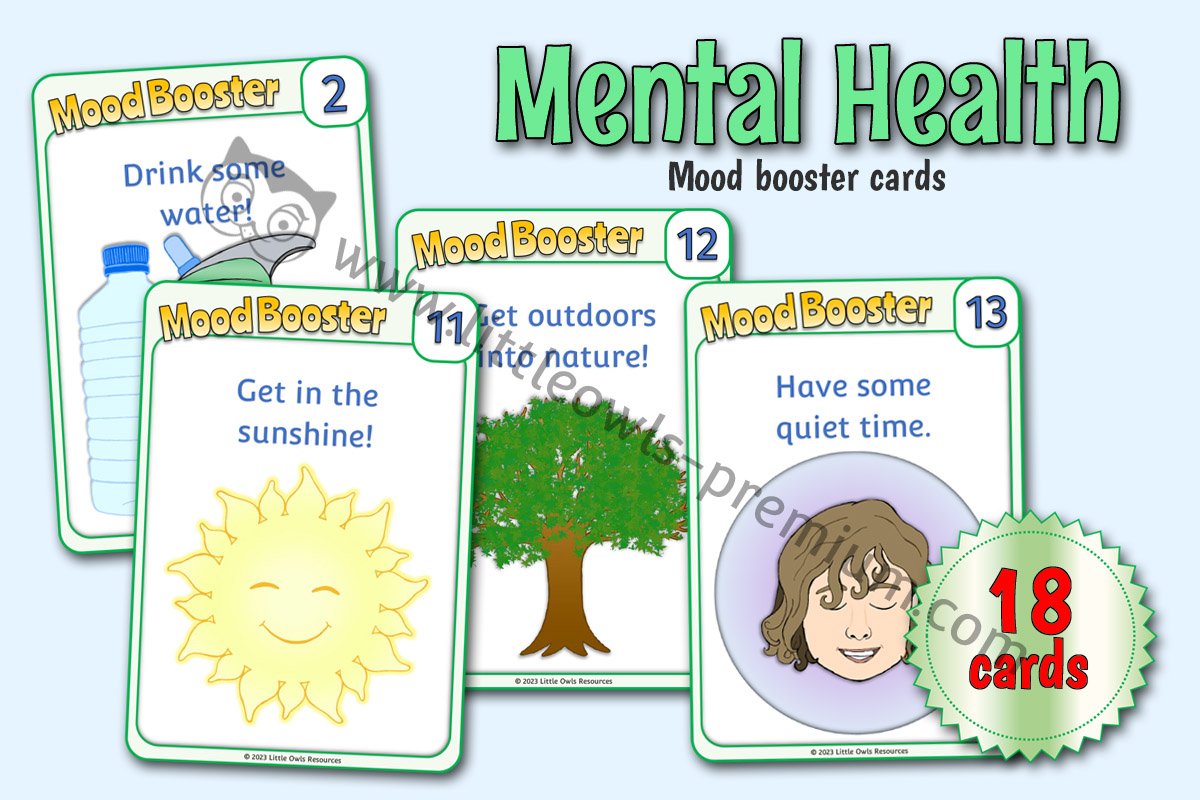
These cards are intended as a quick choice of ideas to help lift someone’s mood.
Each card has an activity that may help a child feel a little brighter if they are having a sad day.
Everyone is different and each child may respond differently to each activity.
Activities included:
Drink some water!
Eat a healthy snack!
Go for a walk!
Do some exercise!
Read a book!
Role-play a character!
Paint a picture!
Make a model!
Sing a song or make some music!
Listen to some music!
Get in the sunshine!
Get outdoors into nature!
Have some quiet time.
Do some yoga stretches.
Help someone else with something. A kind act!
Think of the things you are thankful for.
Talk with a friend or family member.
Do something you really enjoy!
We hope this helps!
Keywords: Emotions, emotion, feeling, feelings, emotional regulation, emotional dysregulation, self-regulation, health, wellness
Original artwork drawn by Sara Murphy and final digital resources created by Stuart Murphy. COPYRIGHT ON ALL OF THE RESOURCES HOUSED ON THIS WEBSITE IS HELD BY ‘LITTLE OWLS RESOURCES’. OUR RESOURCES (INCLUDING THE IMAGES WITHIN THEM), CANNOT BE SHARED OR SOLD COMMERCIALLY.
DOWNLOAD EDITABLE (DOCX)
DOWNLOAD NON-EDITABLE (PDF)
DOWNLOAD NON-EDITABLE (Zipped JPEGs)
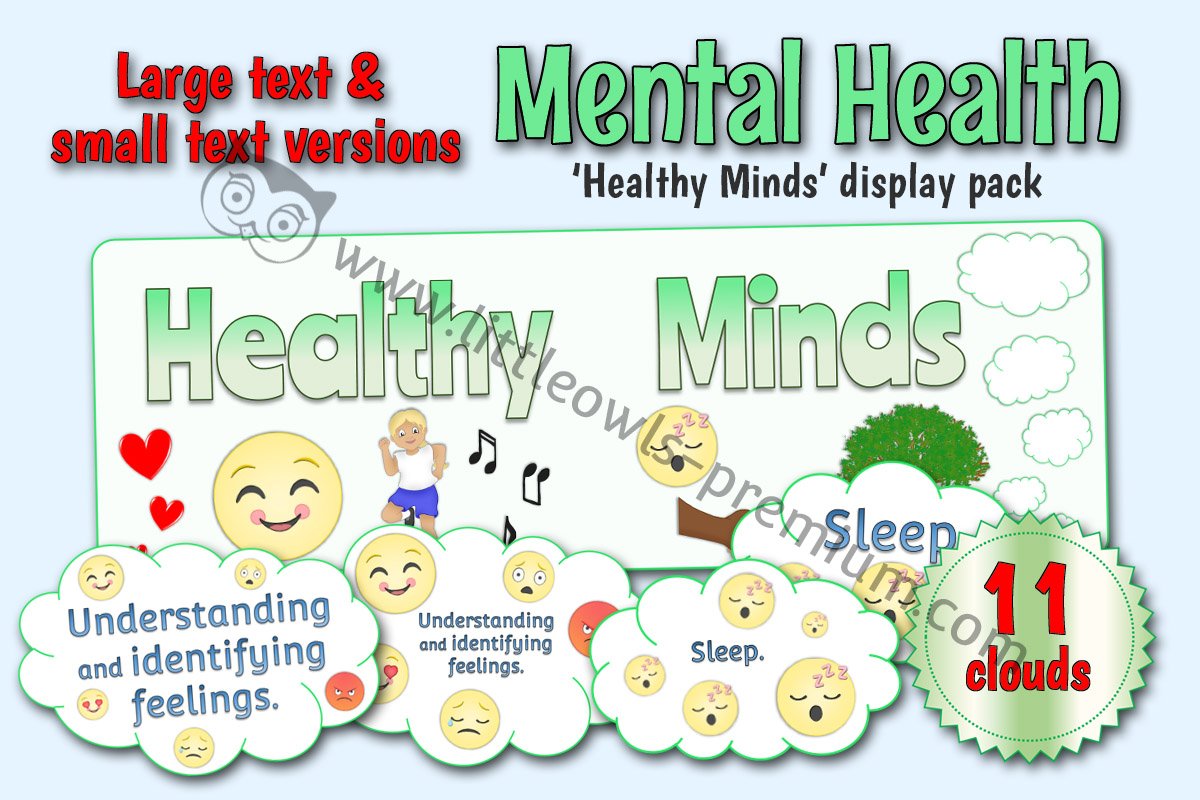
This display pack comprises a two-page banner and a set of cloud shaped headings.
p2-3: Banner
p4-11: Cloud headings (large writing with small images)
p12-19: Cloud headings (small writing with large images)
The bubbles all outline an aspect of how to look after your mental health.
Aspects included:
Understanding and identifying feelings
Connecting with people and loved ones
Exploring and developing personal interests
Structure and routine
Sleep
Healthy food and water
Exercise
Connecting with nature
Growth mindset
Kindness and helping others
Thankfulness and gratitude. Finding small positives
We hope it helps!
Keywords: Emotions, emotion, feeling, feelings, emotional regulation, emotional dysregulation, self-regulation, health, wellness
Original artwork drawn by Sara Murphy and final digital resources created by Stuart Murphy. COPYRIGHT ON ALL OF THE RESOURCES HOUSED ON THIS WEBSITE IS HELD BY ‘LITTLE OWLS RESOURCES’. OUR RESOURCES (INCLUDING THE IMAGES WITHIN THEM), CANNOT BE SHARED OR SOLD COMMERCIALLY.
DOWNLOAD EDITABLE (DOCX)
DOWNLOAD NON-EDITABLE (PDF)
DOWNLOAD NON-EDITABLE (Zipped JPEGs)
<<-BACK TO ‘ALL ABOUT ME’ MENU
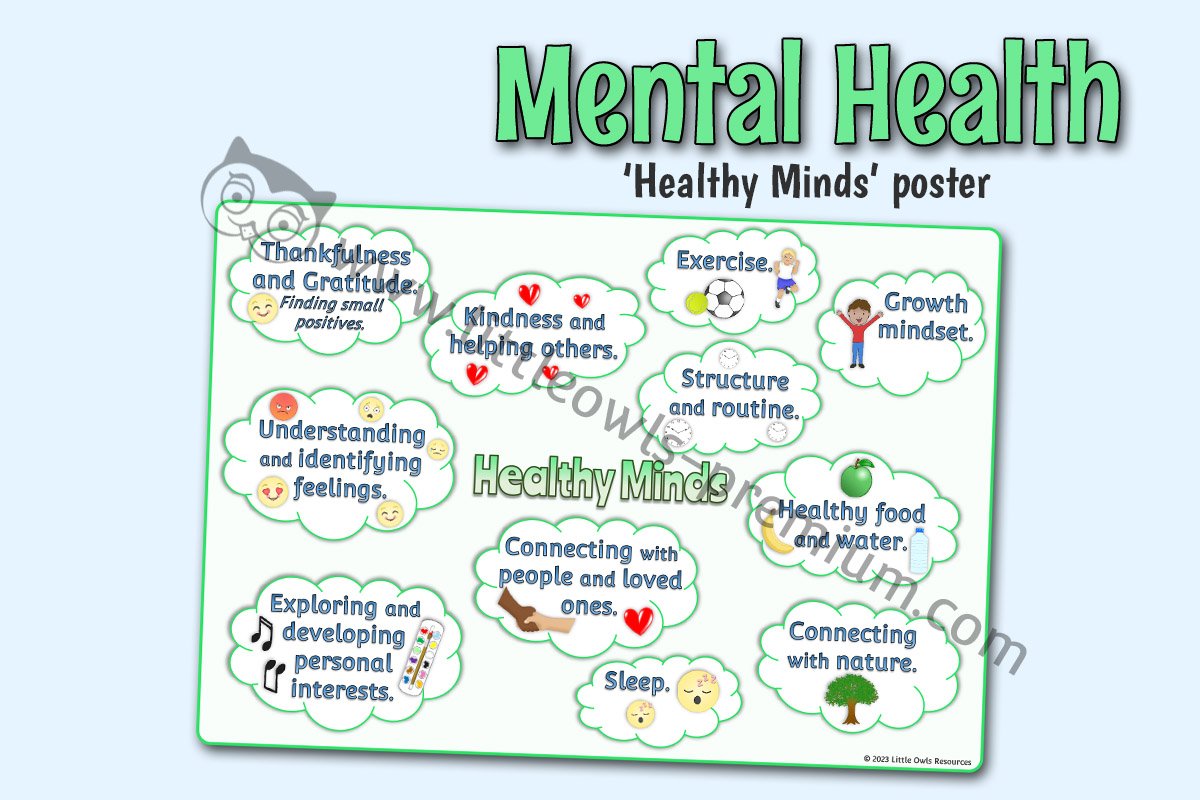
The bubbles on this ‘Healthy Minds’ poster all outline an aspect of how to look after your mental health.
Aspects included:
Understanding and identifying feelings
Connecting with people and loved ones
Exploring and developing personal interests
Structure and routine
Sleep
Healthy food and water
Exercise
Connecting with nature
Growth mindset
Kindness and helping others
Thankfulness and gratitude. Finding small positives
We hope it helps!
Keywords: Emotions, emotion, feeling, feelings, emotional regulation, emotional dysregulation, self-regulation, health, wellness
Original artwork drawn by Sara Murphy and final digital resources created by Stuart Murphy. COPYRIGHT ON ALL OF THE RESOURCES HOUSED ON THIS WEBSITE IS HELD BY ‘LITTLE OWLS RESOURCES’. OUR RESOURCES (INCLUDING THE IMAGES WITHIN THEM), CANNOT BE SHARED OR SOLD COMMERCIALLY.
DOWNLOAD EDITABLE (DOCX)
DOWNLOAD NON-EDITABLE (PDF)
DOWNLOAD NON-EDITABLE (Zipped JPEGs)
<<-BACK TO ‘ALL ABOUT ME’ MENU
‘Sleeping Area’ Sign for your setting.
Keywords: sleep, area signs/posters, health, wellness, setting area/areas, nap time, napping, cot, bed, night, routine, routines
Original artwork drawn by Sara Murphy and final digital resources created by Stuart Murphy. COPYRIGHT ON ALL OF THE RESOURCES HOUSED ON THIS WEBSITE IS HELD BY ‘LITTLE OWLS RESOURCES’. OUR RESOURCES (INCLUDING THE IMAGES WITHIN THEM), CANNOT BE SHARED OR SOLD COMMERCIALLY.
DOWNLOAD EDITABLE (DOCX)
DOWNLOAD NON-EDITABLE (PDF)
DOWNLOAD NON-EDITABLE (Zipped JPEGs)
<<-BACK TO ‘ALL ABOUT ME’ MENU
‘Sleep’ banner for use as part of a display. For example the display may outline routines within your setting for the benefit of children, practitioners and/or parents/guardians.
Keywords: sleep, sleeping, area signs/posters, health, wellness, setting area/areas, nap time, napping, cot, bed, display banner, night, moon, routine, routines
Original artwork drawn by Sara Murphy and final digital resources created by Stuart Murphy. COPYRIGHT ON ALL OF THE RESOURCES HOUSED ON THIS WEBSITE IS HELD BY ‘LITTLE OWLS RESOURCES’. OUR RESOURCES (INCLUDING THE IMAGES WITHIN THEM), CANNOT BE SHARED OR SOLD COMMERCIALLY.
DOWNLOAD EDITABLE (DOCX)
DOWNLOAD NON-EDITABLE (PDF)
DOWNLOAD NON-EDITABLE (Zipped JPEGs)
<<-BACK TO ‘ALL ABOUT ME’ MENU
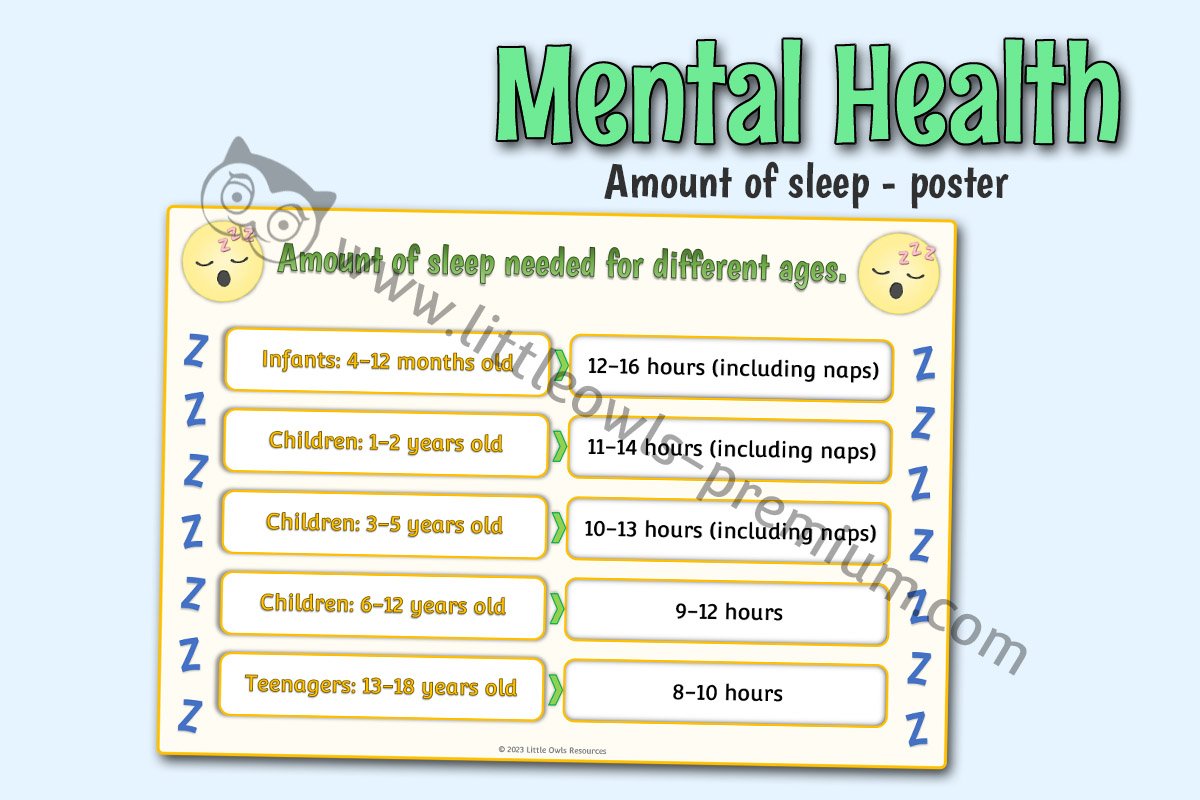
Handy poster showing the amount of sleep recommended within a day for children of different ages.
Keywords: sleep, sleeping, area signs/posters, health, wellness, nap time, napping, night, routine, routines
Original artwork drawn by Sara Murphy and final digital resources created by Stuart Murphy. COPYRIGHT ON ALL OF THE RESOURCES HOUSED ON THIS WEBSITE IS HELD BY ‘LITTLE OWLS RESOURCES’. OUR RESOURCES (INCLUDING THE IMAGES WITHIN THEM), CANNOT BE SHARED OR SOLD COMMERCIALLY.
DOWNLOAD EDITABLE (DOCX)
DOWNLOAD NON-EDITABLE (PDF)
DOWNLOAD NON-EDITABLE (Zipped JPEGs)
<<-BACK TO ‘ALL ABOUT ME’ MENU
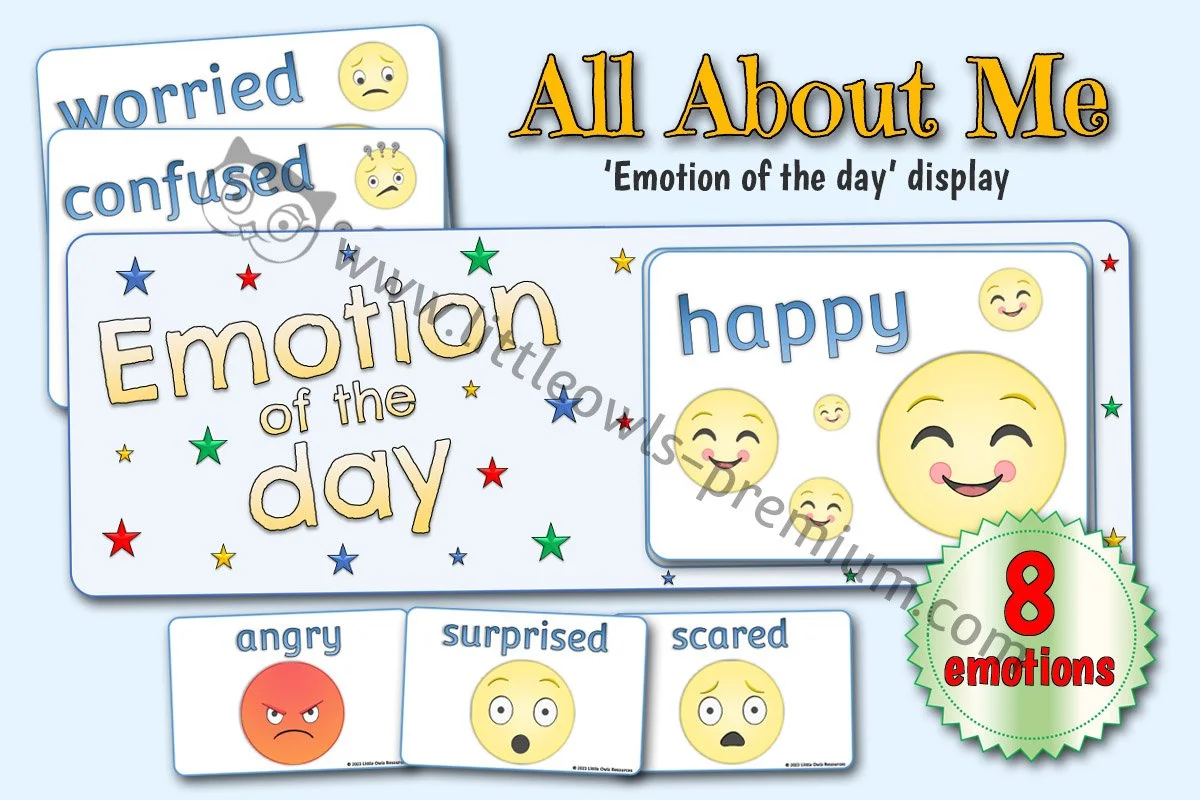
This display/activity is intended to help the child/children identify their emotions and the experiences that trigger those emotions.
At the start of the day, one emotion is to be highlighted and discussed with the children. The children are then encouraged to tell someone if they think they experience that emotion during the day. The aim is for the children to become more introspective of their emotions, and more perceptive of the emotions of others.
As a group activity the children have the chance to learn from their peer’s experiences as well as their own.
Pack includes:
• Changeable display banner with space for different ‘Emotion of the day’ cards.
• Emotion of the day display cards for happy, sad, excited, worried, angry, confused, scared, surprised.
• Small A6 emotion cards to be placed around the setting as a reminder of the ‘Emotion of the day’.
Keywords: picture/visual communication aids, feeling, feelings, emotions, emotion/emotional regulation/dysregulation/self-regulation, mindfulness
Original artwork drawn by Sara Murphy and final digital resources created by Stuart Murphy. COPYRIGHT ON ALL OF THE RESOURCES HOUSED ON THIS WEBSITE IS HELD BY ‘LITTLE OWLS RESOURCES’. OUR RESOURCES (INCLUDING THE IMAGES WITHIN THEM), CANNOT BE SHARED OR SOLD COMMERCIALLY.
DOWNLOAD EDITABLE (DOCX)
DOWNLOAD NON-EDITABLE (PDF)
DOWNLOAD NON-EDITABLE (Zipped JPEGs)
<<-BACK TO ‘ALL ABOUT ME’ MENU
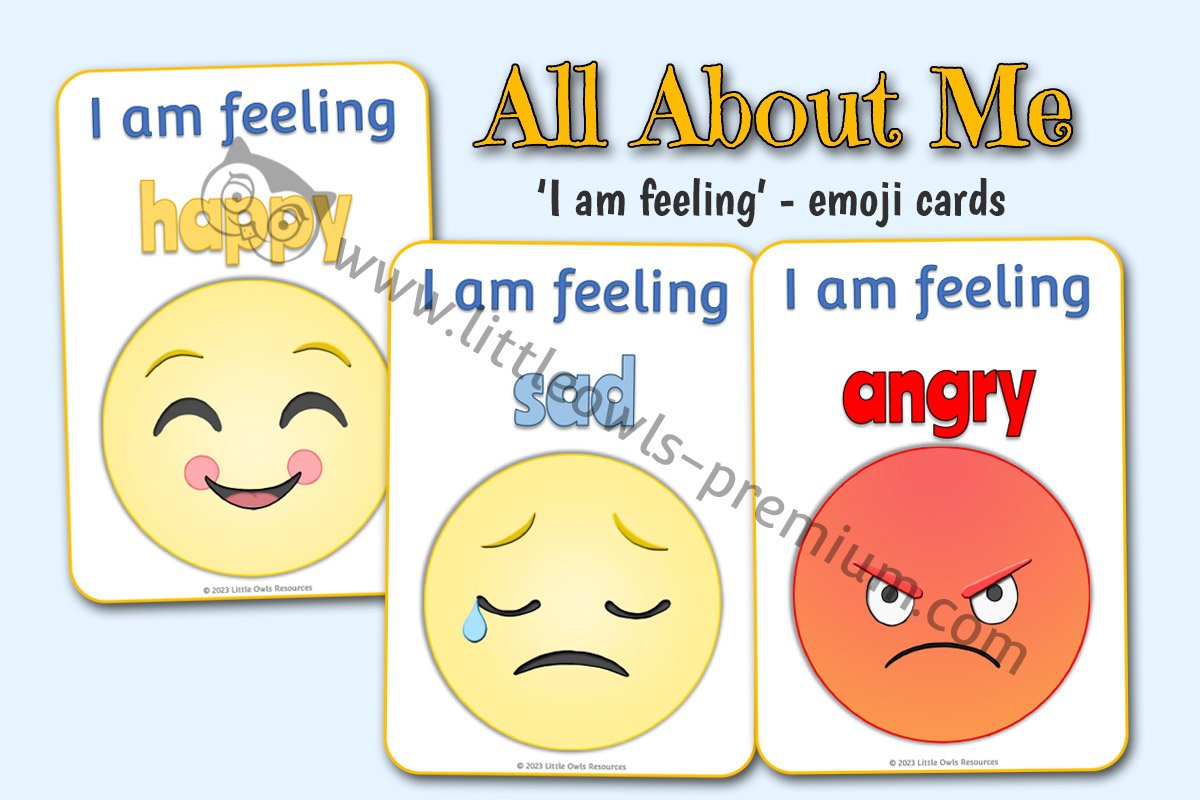
Set of 12 A5 ‘I am feeling’ cards. Useful for any individuals who need support in identifying and expressing their feelings.
Feelings include: happy, confused, excited, sad, scared, worried, love, sleepy, fine, angry, bored and frustrated.
Keywords: picture/visual communication aids, feeling, feelings, emotions, emotion/emotional regulation/dysregulation/self-regulation, autism, autistic, non verbal, non-verbal, mental health, wellness, mindfulness
Original artwork drawn by Sara Murphy and final digital resources created by Stuart Murphy. COPYRIGHT ON ALL OF THE RESOURCES HOUSED ON THIS WEBSITE IS HELD BY ‘LITTLE OWLS RESOURCES’. OUR RESOURCES (INCLUDING THE IMAGES WITHIN THEM), CANNOT BE SHARED OR SOLD COMMERCIALLY.
DOWNLOAD EDITABLE (DOCX)
DOWNLOAD NON-EDITABLE (PDF)
DOWNLOAD NON-EDITABLE (Zipped JPEGs)
<<-BACK TO ‘ALL ABOUT ME’ MENU
<<-BACK TO ‘MENTAL HEALTH’ MENU
<<-BACK TO ‘SEND’ MENU (Coming soon!)
Set of 12 A5 ‘I am feeling’ colouring cards. Useful for any individuals who need support in identifying and expressing their feelings.
Feelings include: happy, confused, excited, sad, scared, worried, love, sleepy, fine, angry, bored and frustrated.
Keywords: picture/visual communication aids, feeling, feelings, emotions, emotion/emotional regulation/dysregulation/self-regulation, autism, autistic, non verbal, non-verbal, mental health, wellness, colouring page/pages/sheet/sheets, mindfulness
Original artwork drawn by Sara Murphy and final digital resources created by Stuart Murphy. COPYRIGHT ON ALL OF THE RESOURCES HOUSED ON THIS WEBSITE IS HELD BY ‘LITTLE OWLS RESOURCES’. OUR RESOURCES (INCLUDING THE IMAGES WITHIN THEM), CANNOT BE SHARED OR SOLD COMMERCIALLY.
DOWNLOAD EDITABLE (DOCX)
DOWNLOAD NON-EDITABLE (PDF)
DOWNLOAD NON-EDITABLE (Zipped JPEGs)
<<-BACK TO ‘ALL ABOUT ME’ MENU
<<-BACK TO ‘MENTAL HEALTH’ MENU
<<-BACK TO ‘SEND’ MENU (Coming soon!)
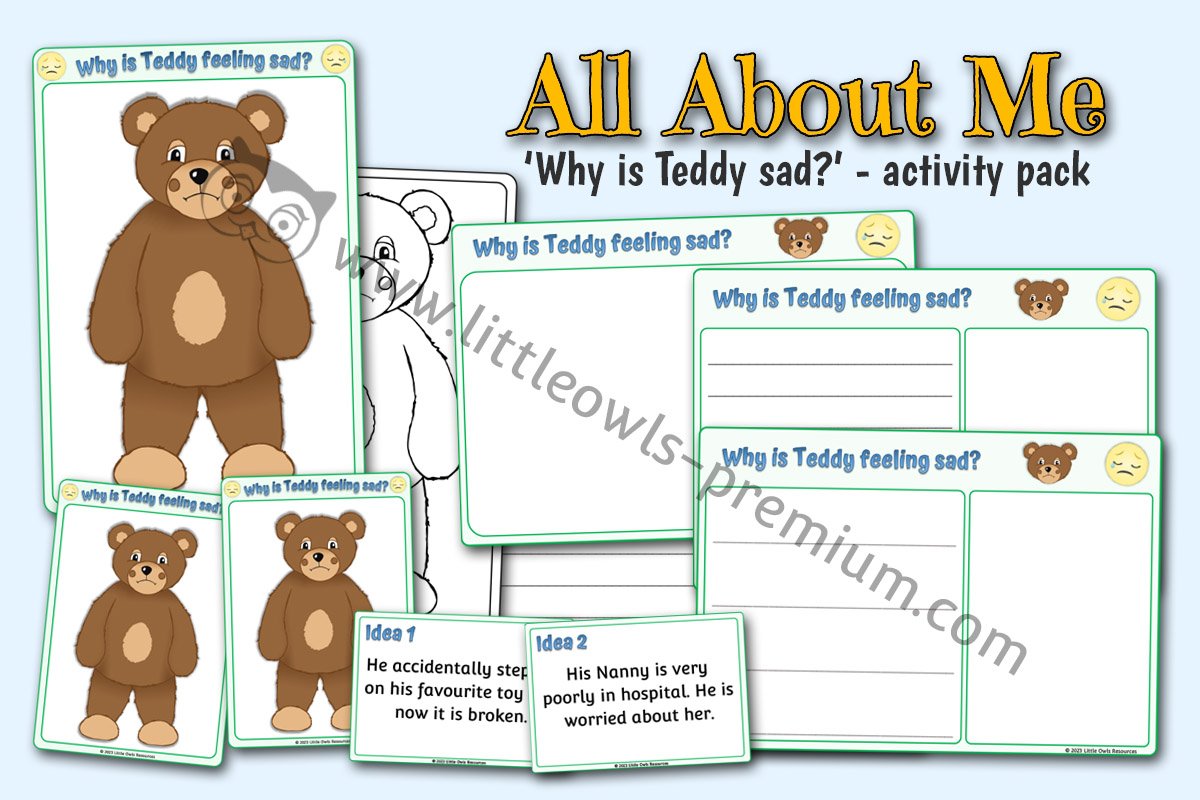
We created this ‘Why is Teddy sad?’ pack in order for you to be able to explore with children how sometimes something may feel wrong inside when there are no obvious cuts, bruises, etc.
As well as investigating the feeling of ‘sadness’ by talking about what might cause us to feel sad and what it actually feels like, this pack could also be a doorway to talking about mental health. It also aids in the mindfulness practice of recognising emotions.
Keywords: feeling, feelings, emotions, emotion/emotional regulation/dysregulation/self-regulation, autism, autistic, mental health, wellness, colouring page/pages/sheet/sheets, empathy, role play, role-play, mindfulness
Original artwork drawn by Sara Murphy and final digital resources created by Stuart Murphy. COPYRIGHT ON ALL OF THE RESOURCES HOUSED ON THIS WEBSITE IS HELD BY ‘LITTLE OWLS RESOURCES’. OUR RESOURCES (INCLUDING THE IMAGES WITHIN THEM), CANNOT BE SHARED OR SOLD COMMERCIALLY.
DOWNLOAD EDITABLE (DOCX)
DOWNLOAD NON-EDITABLE (PDF)
DOWNLOAD NON-EDITABLE (Zipped JPEGs)
<<-BACK TO ‘ALL ABOUT ME’ MENU

We created this ‘Why is Teddy happy?’ pack in conjunction with our ‘Why is Teddy sad?’ pack in order for you to be able to explore emotions, empathy and mental health with children.
As well as investigating the feeling of ‘happiness’ by talking about what might cause us to feel happy and what it actually feels like, this pack could also be a doorway to talking about mental health. In addition, it aids in the mindfulness practice of recognising emotions.
Keywords: feeling, feelings, emotions, emotion/emotional regulation/dysregulation/self-regulation, autism, autistic, mental health, wellness, colouring page/pages/sheet/sheets, empathy, role play, role-play, mindfulness
Original artwork drawn by Sara Murphy and final digital resources created by Stuart Murphy. COPYRIGHT ON ALL OF THE RESOURCES HOUSED ON THIS WEBSITE IS HELD BY ‘LITTLE OWLS RESOURCES’. OUR RESOURCES (INCLUDING THE IMAGES WITHIN THEM), CANNOT BE SHARED OR SOLD COMMERCIALLY.
DOWNLOAD EDITABLE (DOCX)
DOWNLOAD NON-EDITABLE (PDF)
DOWNLOAD NON-EDITABLE (Zipped JPEGs)
<<-BACK TO ‘ALL ABOUT ME’ MENU
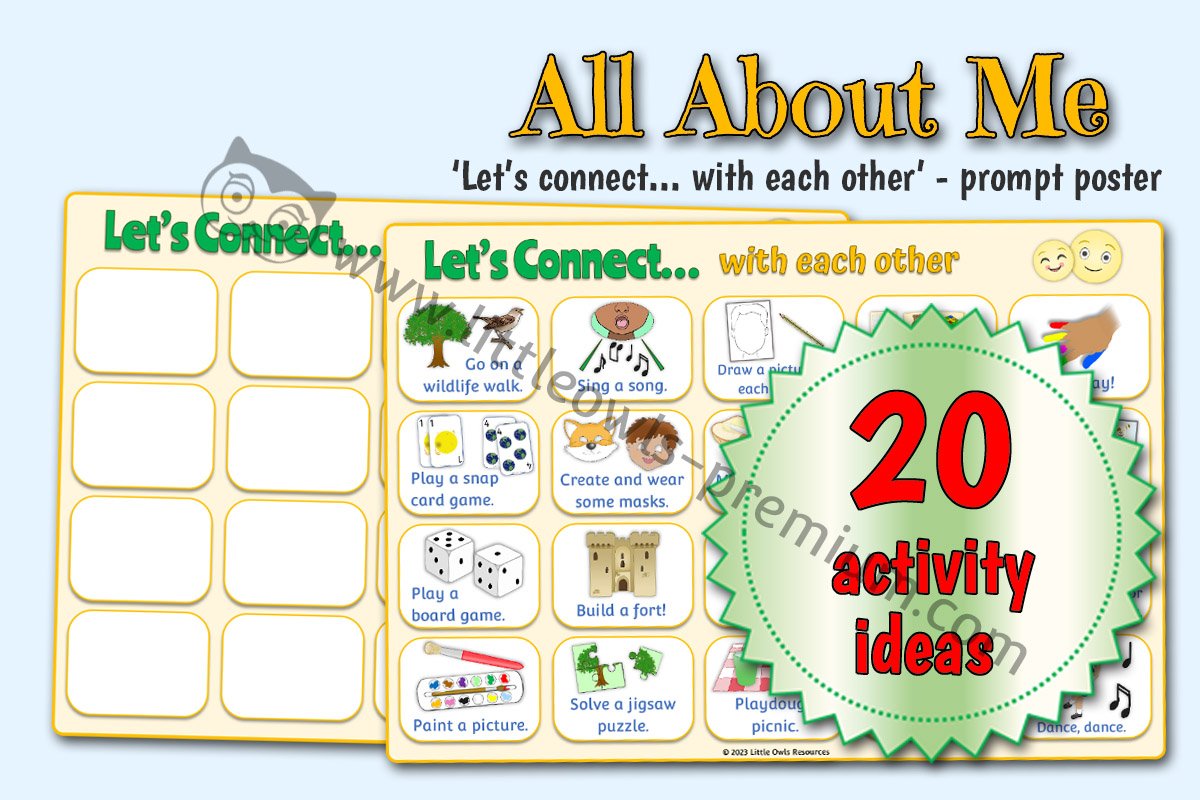
PLAY - CONNECT - TALK
On this poster are ideas for fun activities that could be undertaken 1:1 with a child in the hopes of fostering a connection that could lead to talk.
A relaxed, fun situation is conducive to conversation which, as well as developing talking skills, will provide an opportunity for the child to express their feelings about themselves and others.
We hope this helps!
Original artwork drawn by Sara Murphy and final digital resources created by Stuart Murphy. COPYRIGHT ON ALL OF THE RESOURCES HOUSED ON THIS WEBSITE IS HELD BY ‘LITTLE OWLS RESOURCES’. OUR RESOURCES (INCLUDING THE IMAGES WITHIN THEM), CANNOT BE SHARED OR SOLD COMMERCIALLY.
DOWNLOAD EDITABLE (DOCX)
DOWNLOAD NON-EDITABLE (PDF)
DOWNLOAD NON-EDITABLE (Zipped JPEGs)
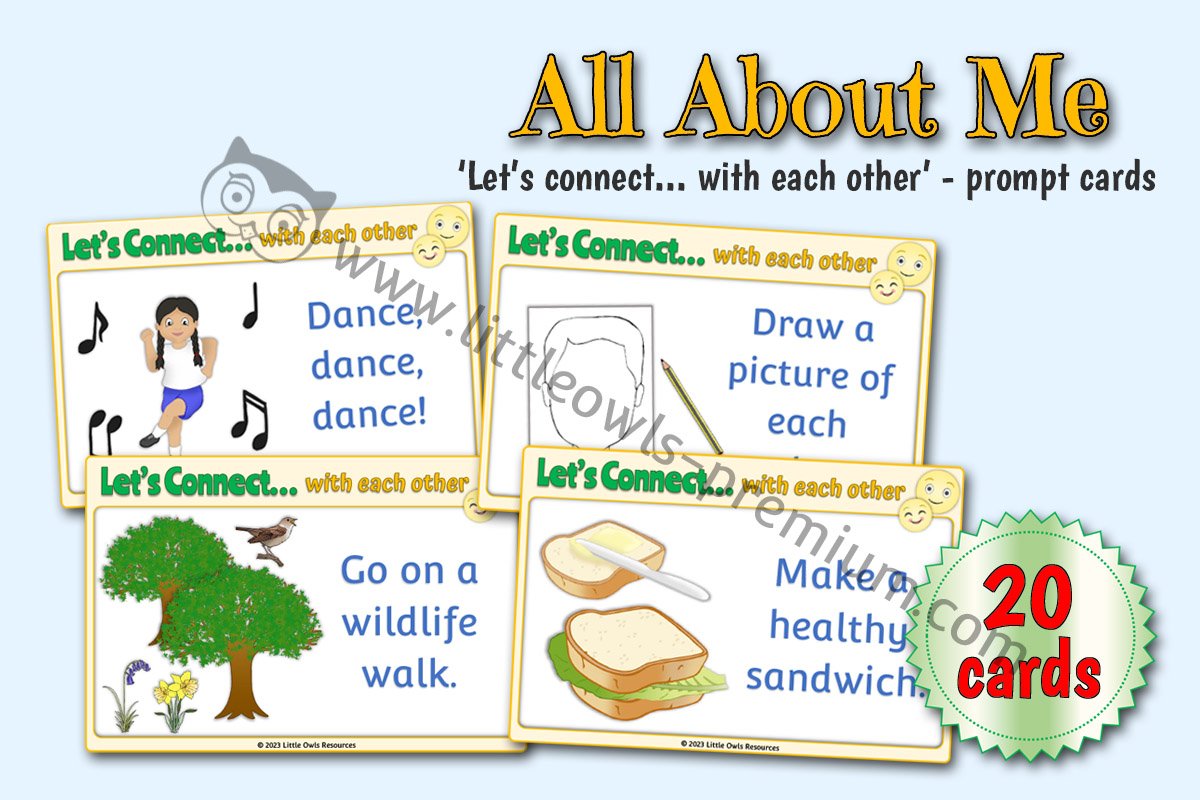
PLAY - CONNECT - TALK
These prompt cards are ideas for fun activities that could be undertaken 1:1 with a child in the hopes of fostering a connection that could lead to talk.
A relaxed, fun situation is conducive to conversation which, as well as developing talking skills, will provide an opportunity for the child to express their feelings about themselves and others.
We hope this helps!
Original artwork drawn by Sara Murphy and final digital resources created by Stuart Murphy. COPYRIGHT ON ALL OF THE RESOURCES HOUSED ON THIS WEBSITE IS HELD BY ‘LITTLE OWLS RESOURCES’. OUR RESOURCES (INCLUDING THE IMAGES WITHIN THEM), CANNOT BE SHARED OR SOLD COMMERCIALLY.
DOWNLOAD EDITABLE (DOCX)
DOWNLOAD NON-EDITABLE (PDF)
DOWNLOAD NON-EDITABLE (Zipped JPEGs)

This poster gives 20 fun activity ideas to get moving.
As well as being good for the body, movement and exercise are also an important part of a healthy mind!
We hope this helps!
Original artwork drawn by Sara Murphy and final digital resources created by Stuart Murphy. COPYRIGHT ON ALL OF THE RESOURCES HOUSED ON THIS WEBSITE IS HELD BY ‘LITTLE OWLS RESOURCES’. OUR RESOURCES (INCLUDING THE IMAGES WITHIN THEM), CANNOT BE SHARED OR SOLD COMMERCIALLY.
DOWNLOAD EDITABLE (DOCX)
DOWNLOAD NON-EDITABLE (PDF)
DOWNLOAD NON-EDITABLE (Zipped JPEGs)
These prompt cards are ideas for movement activities.
As well as being good for the body, movement and exercise are also an important part of a healthy mind!
We hope this helps!
Original artwork drawn by Sara Murphy and final digital resources created by Stuart Murphy. COPYRIGHT ON ALL OF THE RESOURCES HOUSED ON THIS WEBSITE IS HELD BY ‘LITTLE OWLS RESOURCES’. OUR RESOURCES (INCLUDING THE IMAGES WITHIN THEM), CANNOT BE SHARED OR SOLD COMMERCIALLY.
DOWNLOAD EDITABLE (DOCX)
DOWNLOAD NON-EDITABLE (PDF)
DOWNLOAD NON-EDITABLE (Zipped JPEGs)
<<-BACK TO ‘ALL ABOUT ME’ MENU
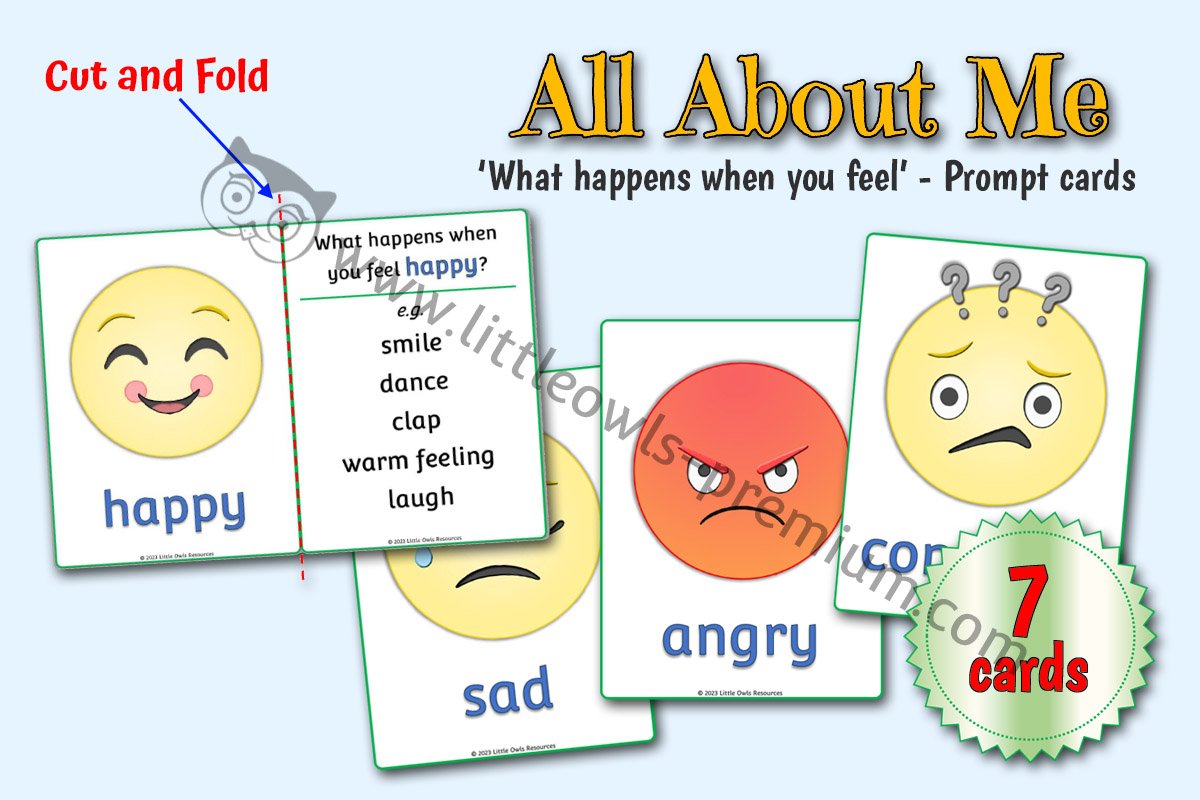
The cards can be used as part of an input about emotions and feelings. The intention is that the cards would be held with the image facing the child/children and the prompts facing the adult. The activity should help the child/children think carefully about what each emotion feels like to them when they experience them. For example, when we are happy we may feel like smiling, dancing, laughing, etc. This process aids in the mindfulness practice of recognising emotions.
Original artwork drawn by Sara Murphy and final digital resources created by Stuart Murphy. COPYRIGHT ON ALL OF THE RESOURCES HOUSED ON THIS WEBSITE IS HELD BY ‘LITTLE OWLS RESOURCES’. OUR RESOURCES (INCLUDING THE IMAGES WITHIN THEM), CANNOT BE SHARED OR SOLD COMMERCIALLY.
DOWNLOAD EDITABLE (DOCX)
DOWNLOAD NON-EDITABLE (PDF)
DOWNLOAD NON-EDITABLE (Zipped JPEGs)
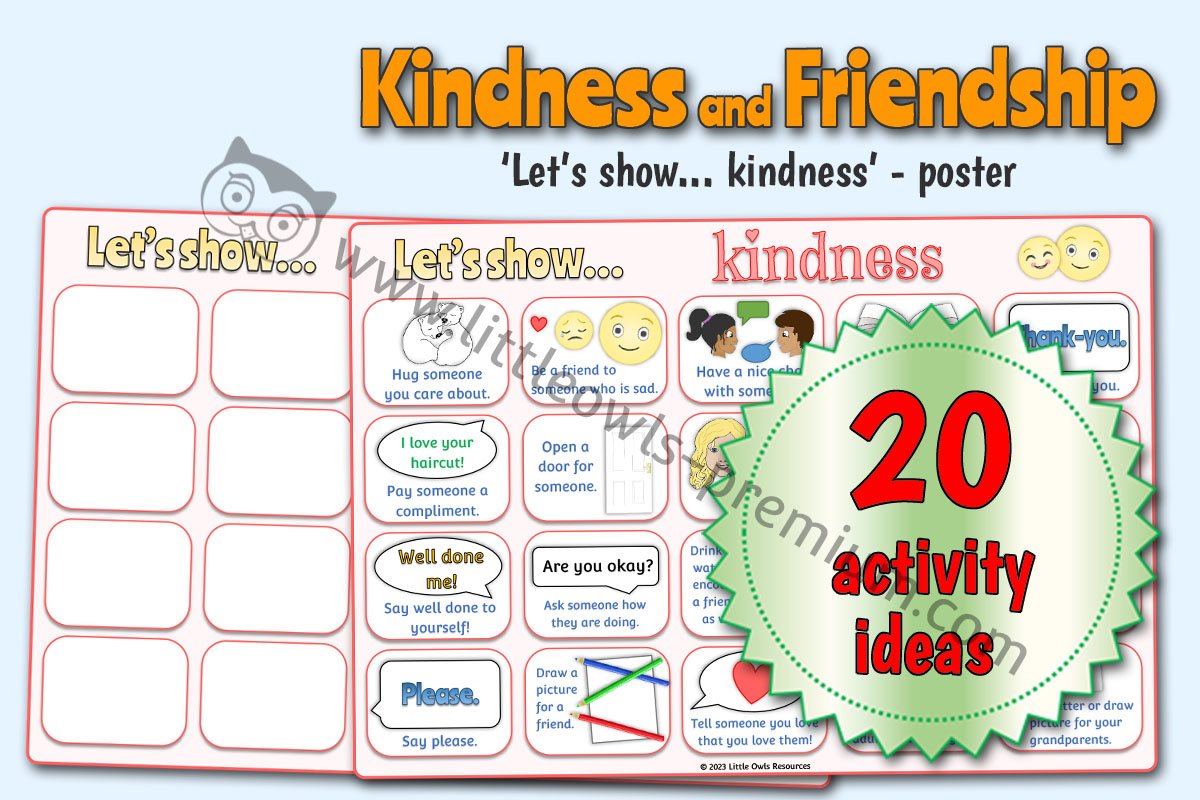
This poster gives 20 fun activity ideas to show kindness.
We hope this helps!
Original artwork drawn by Sara Murphy and final digital resources created by Stuart Murphy. COPYRIGHT ON ALL OF THE RESOURCES HOUSED ON THIS WEBSITE IS HELD BY ‘LITTLE OWLS RESOURCES’. OUR RESOURCES (INCLUDING THE IMAGES WITHIN THEM), CANNOT BE SHARED OR SOLD COMMERCIALLY.
DOWNLOAD EDITABLE (DOCX)
DOWNLOAD NON-EDITABLE (PDF)
DOWNLOAD NON-EDITABLE (Zipped JPEGs)
<<-BACK TO ‘ALL ABOUT ME’ MENU

These activity cards outline 20 fun activity ideas to show kindness.
We hope this helps!
Original artwork drawn by Sara Murphy and final digital resources created by Stuart Murphy. COPYRIGHT ON ALL OF THE RESOURCES HOUSED ON THIS WEBSITE IS HELD BY ‘LITTLE OWLS RESOURCES’. OUR RESOURCES (INCLUDING THE IMAGES WITHIN THEM), CANNOT BE SHARED OR SOLD COMMERCIALLY.
DOWNLOAD EDITABLE (DOCX)
DOWNLOAD NON-EDITABLE (PDF)
DOWNLOAD NON-EDITABLE (Zipped JPEGs)
<<-BACK TO ‘ALL ABOUT ME’ MENU
A variety of differentiated drawing/writing/mark making sheets which allow children to express how a piece of music made them feel. This is a great mindfulness tool for helping children to identify and understand their emotions.
Original artwork drawn by Sara Murphy and final digital resources created by Stuart Murphy. COPYRIGHT ON ALL OF THE RESOURCES HOUSED ON THIS WEBSITE IS HELD BY ‘LITTLE OWLS RESOURCES’. OUR RESOURCES (INCLUDING THE IMAGES WITHIN THEM), CANNOT BE SHARED OR SOLD COMMERCIALLY.
DOWNLOAD EDITABLE (DOCX)
DOWNLOAD NON-EDITABLE (PDF)
DOWNLOAD NON-EDITABLE (Zipped JPEGs)
A variety of differentiated drawing/writing/mark making sheets which allow children to express how a story made them feel. This is a great mindfulness tool for helping children to identify and understand their emotions.
Original artwork drawn by Sara Murphy and final digital resources created by Stuart Murphy. COPYRIGHT ON ALL OF THE RESOURCES HOUSED ON THIS WEBSITE IS HELD BY ‘LITTLE OWLS RESOURCES’. OUR RESOURCES (INCLUDING THE IMAGES WITHIN THEM), CANNOT BE SHARED OR SOLD COMMERCIALLY.
DOWNLOAD EDITABLE (DOCX)
DOWNLOAD NON-EDITABLE (PDF)
DOWNLOAD NON-EDITABLE (Zipped JPEGs)
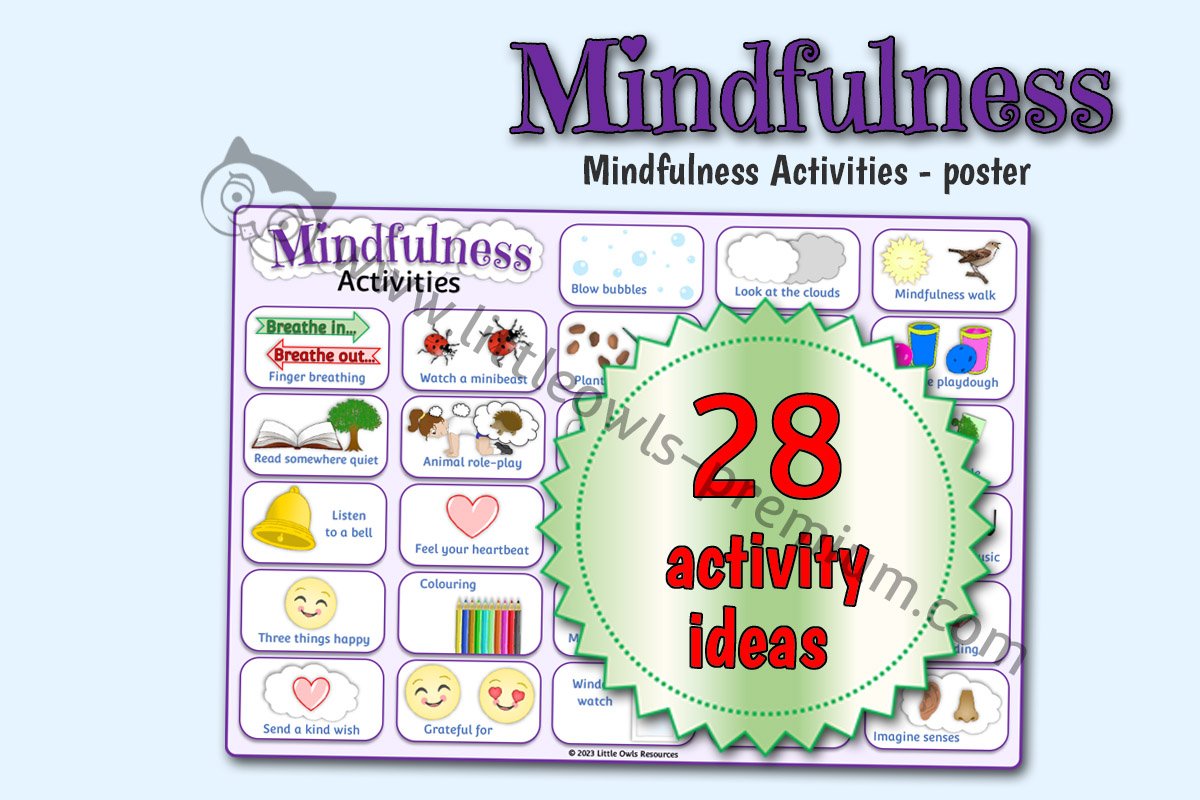
On this poster are ideas for mindfulness activities that could be undertaken 1:1 with a child or in a small group.
The aim is for the child to focus on one thing at a time and remain very much in the present moment - an important life skill.
This poster is designed as primarily a choosing prompt…perhaps a reminder of activities that have previously been undertaken. For more detailed descriptions for each activity, please see our ‘Mindfulness - Activity Cards’ pack.
We hope this helps!
Original artwork drawn by Sara Murphy and final digital resources created by Stuart Murphy. COPYRIGHT ON ALL OF THE RESOURCES HOUSED ON THIS WEBSITE IS HELD BY ‘LITTLE OWLS RESOURCES’. OUR RESOURCES (INCLUDING THE IMAGES WITHIN THEM), CANNOT BE SHARED OR SOLD COMMERCIALLY.
DOWNLOAD EDITABLE (DOCX)
DOWNLOAD NON-EDITABLE (PDF)
DOWNLOAD NON-EDITABLE (Zipped JPEGs)
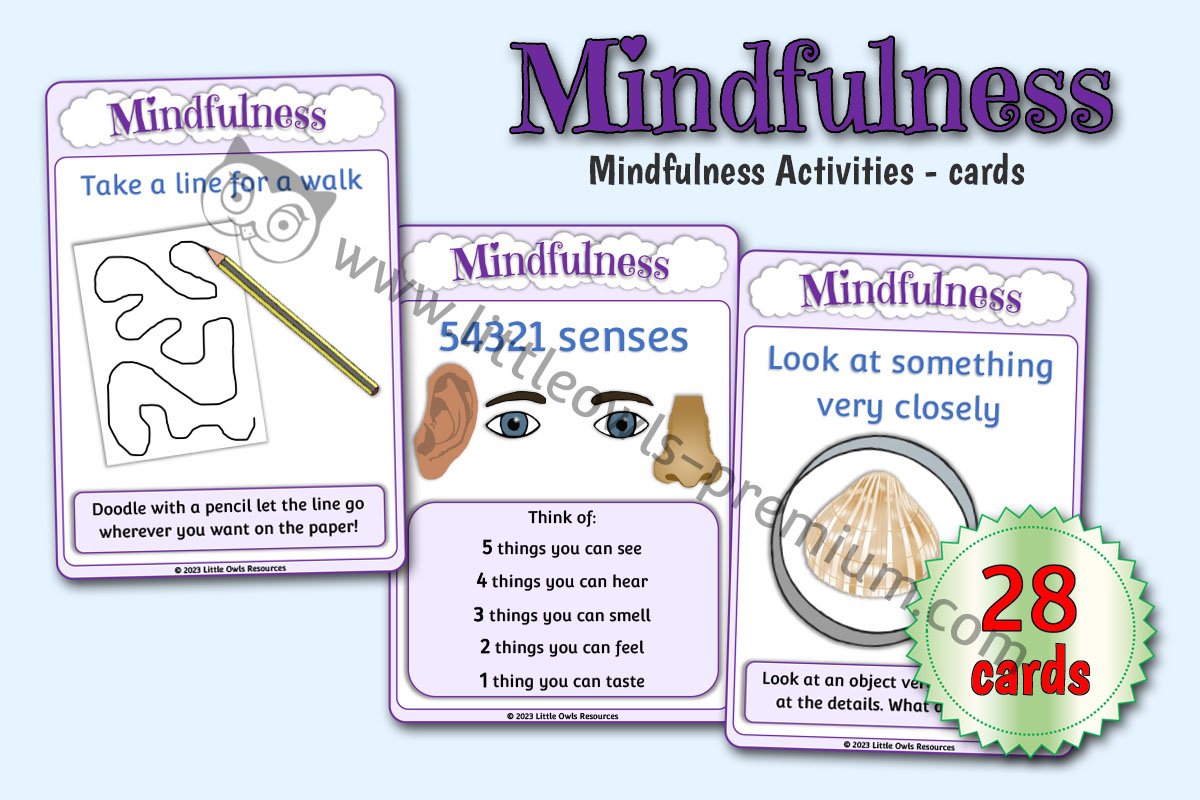
These activity cards contain ideas to promote mindfulness and awareness of surroundings.
The activities are intended to give the children time and space to focus on one thing at a time, remaining in the present moment.
If you would like a condensed version of these activity cards to go alongside them, please refer to our ‘Mindfulness - Activity Prompt Poster’.
We hope this helps!
Original artwork drawn by Sara Murphy and final digital resources created by Stuart Murphy. COPYRIGHT ON ALL OF THE RESOURCES HOUSED ON THIS WEBSITE IS HELD BY ‘LITTLE OWLS RESOURCES’. OUR RESOURCES (INCLUDING THE IMAGES WITHIN THEM), CANNOT BE SHARED OR SOLD COMMERCIALLY.
DOWNLOAD EDITABLE (DOCX)
DOWNLOAD NON-EDITABLE (PDF)
DOWNLOAD NON-EDITABLE (Zipped JPEGs)
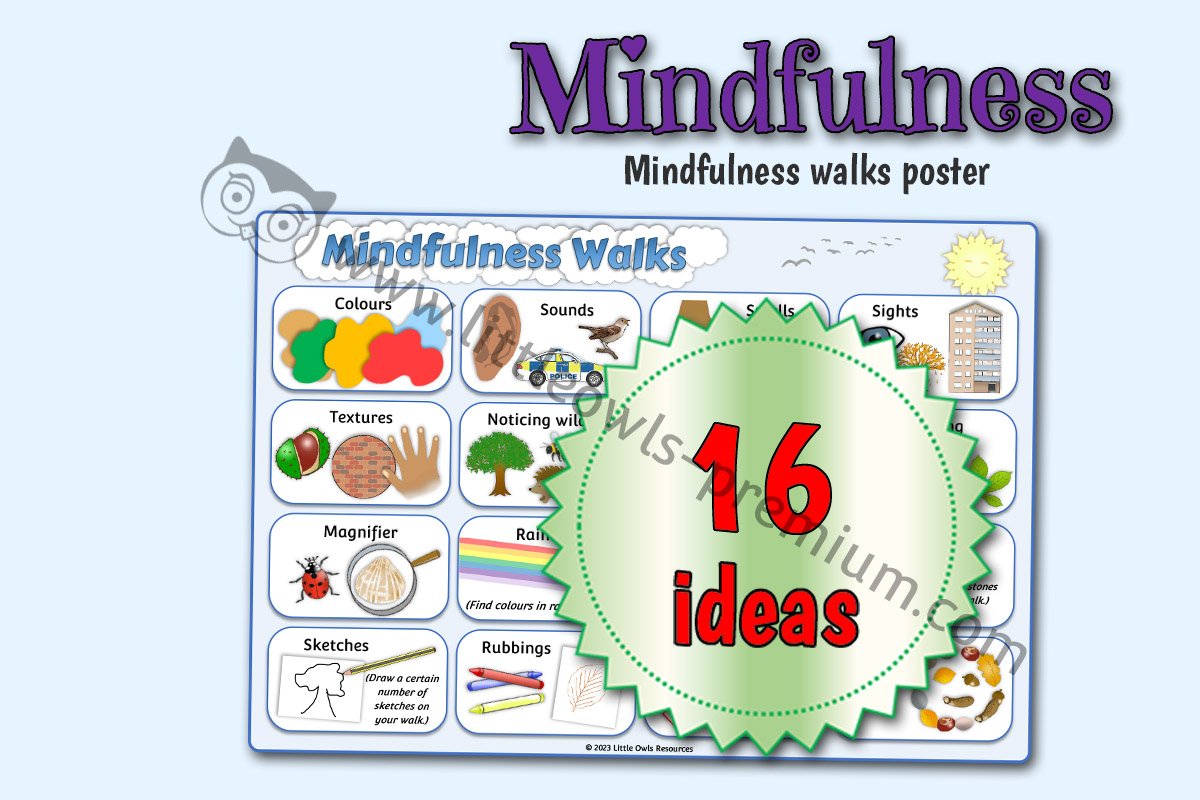
This poster contains ideas for walks that promote mindfulness and encourage an awareness of surroundings.
The ideas are intended to give the children time and space to focus on one thing at a time, remaining in the present moment.
This poster is designed as primarily a choosing prompt…perhaps a reminder of activities that have previously been undertaken. For more detailed descriptions for each activity, please see our ‘Mindfulness Walk Cards’ pack.
We hope this helps!
Original artwork drawn by Sara Murphy and final digital resources created by Stuart Murphy. COPYRIGHT ON ALL OF THE RESOURCES HOUSED ON THIS WEBSITE IS HELD BY ‘LITTLE OWLS RESOURCES’. OUR RESOURCES (INCLUDING THE IMAGES WITHIN THEM), CANNOT BE SHARED OR SOLD COMMERCIALLY.
DOWNLOAD EDITABLE (DOCX)
DOWNLOAD NON-EDITABLE (PDF)
DOWNLOAD NON-EDITABLE (Zipped JPEGs)
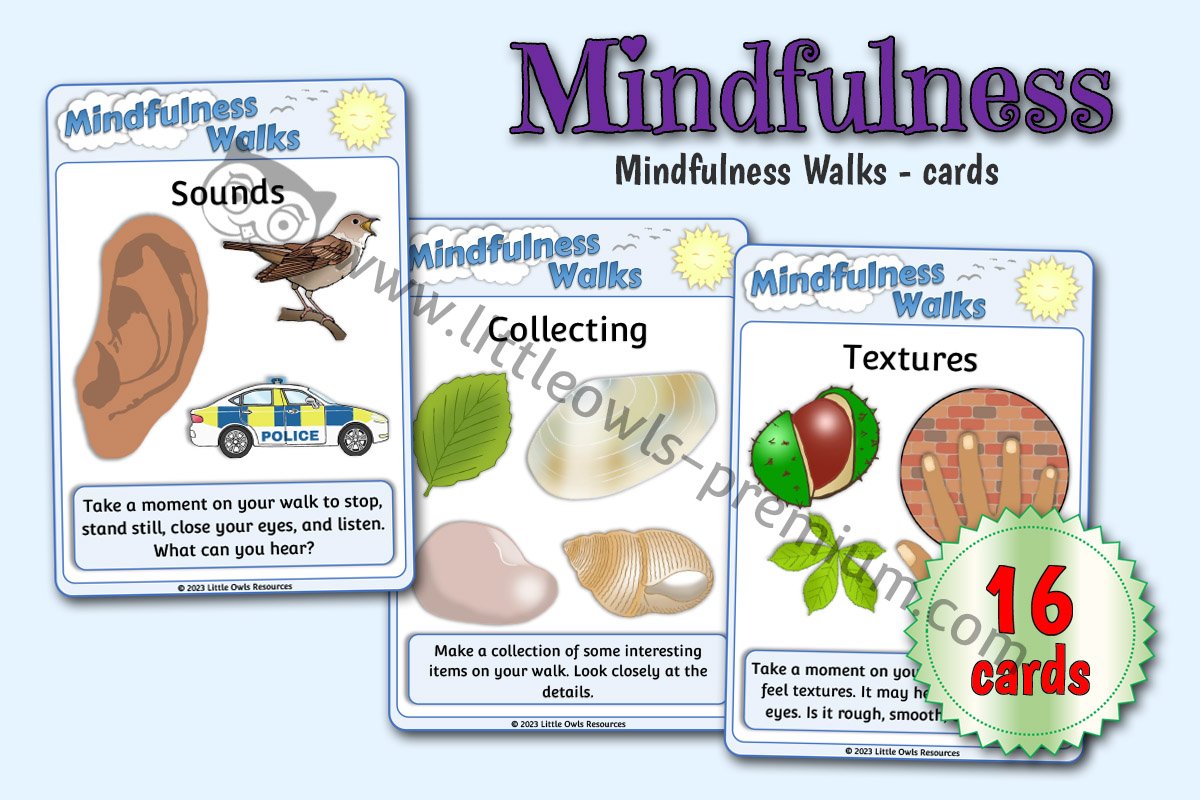
These cards contain ideas for walks that promote mindfulness and encourage an awareness of surroundings.
The ideas are intended to give the children time and space to focus on one thing at a time, remaining in the present moment.
We hope this helps!
Original artwork drawn by Sara Murphy and final digital resources created by Stuart Murphy. COPYRIGHT ON ALL OF THE RESOURCES HOUSED ON THIS WEBSITE IS HELD BY ‘LITTLE OWLS RESOURCES’. OUR RESOURCES (INCLUDING THE IMAGES WITHIN THEM), CANNOT BE SHARED OR SOLD COMMERCIALLY.
DOWNLOAD EDITABLE (DOCX)
DOWNLOAD NON-EDITABLE (PDF)
DOWNLOAD NON-EDITABLE (Zipped JPEGs)
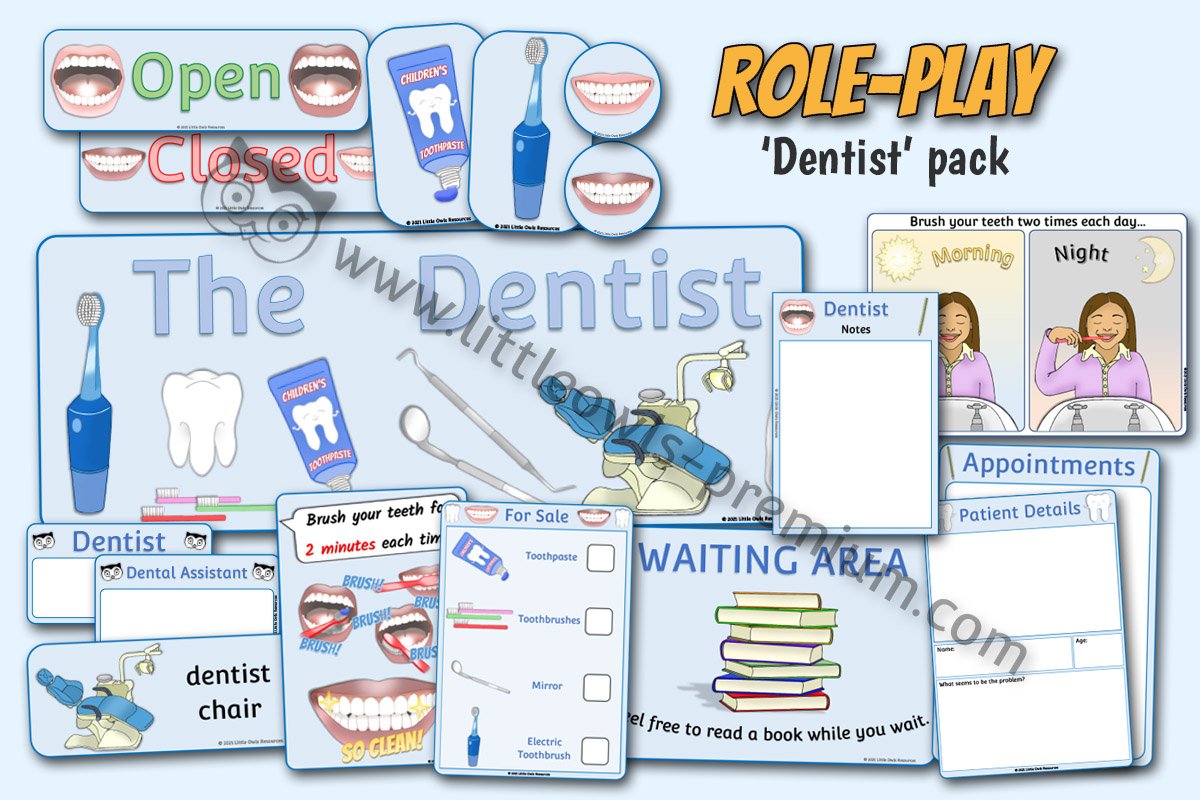
Everything you need to set up a dentist role-play area!
Pack includes:
(Please note that words, etc. can be altered within the editable docx file version.)
‘The Dentist’ banner
Smiling mouth decorative signs
Dentist and Dental Assistant identity cards - Name Writing
‘Waiting Area’ Poster
Various ‘Brush your teeth’ Posters
Social distancing signs & floormats
‘Please wait’ footprint floormats
Dentist word mats
Dentist word cards
‘Welcome! Please sign in for your appointment’ sign for encouraging emergent writing
‘Open’ & ‘Closed’ signs
‘Dentist Opening Times’ Poster - Space to draw hands on clock and write times
‘Opens at…o’ clock’ and ‘Closes at…o’ clock’ signs - spaces for emergent writing
Templates for emergent writing (ideally laminated) - ‘Dentist Notes’, ‘Appointments’ & ‘Patient Details’ forms
‘For Sale’ Menu sign - Space to write prices by items
Items for sale prop cards
Original artwork drawn by Sara Murphy and final digital resources created by Stuart Murphy. COPYRIGHT ON ALL OF THE RESOURCES HOUSED ON THIS WEBSITE IS HELD BY ‘LITTLE OWLS RESOURCES’. OUR RESOURCES (INCLUDING THE IMAGES WITHIN THEM), CANNOT BE SHARED OR SOLD COMMERCIALLY.
DOWNLOAD EDITABLE (DOCX)
DOWNLOAD NON-EDITABLE (PDF)
DOWNLOAD NON-EDITABLE (Zipped JPEGs)
<<-BACK TO ‘TEETH AND ORAL HEALTH’ TOPIC MENU
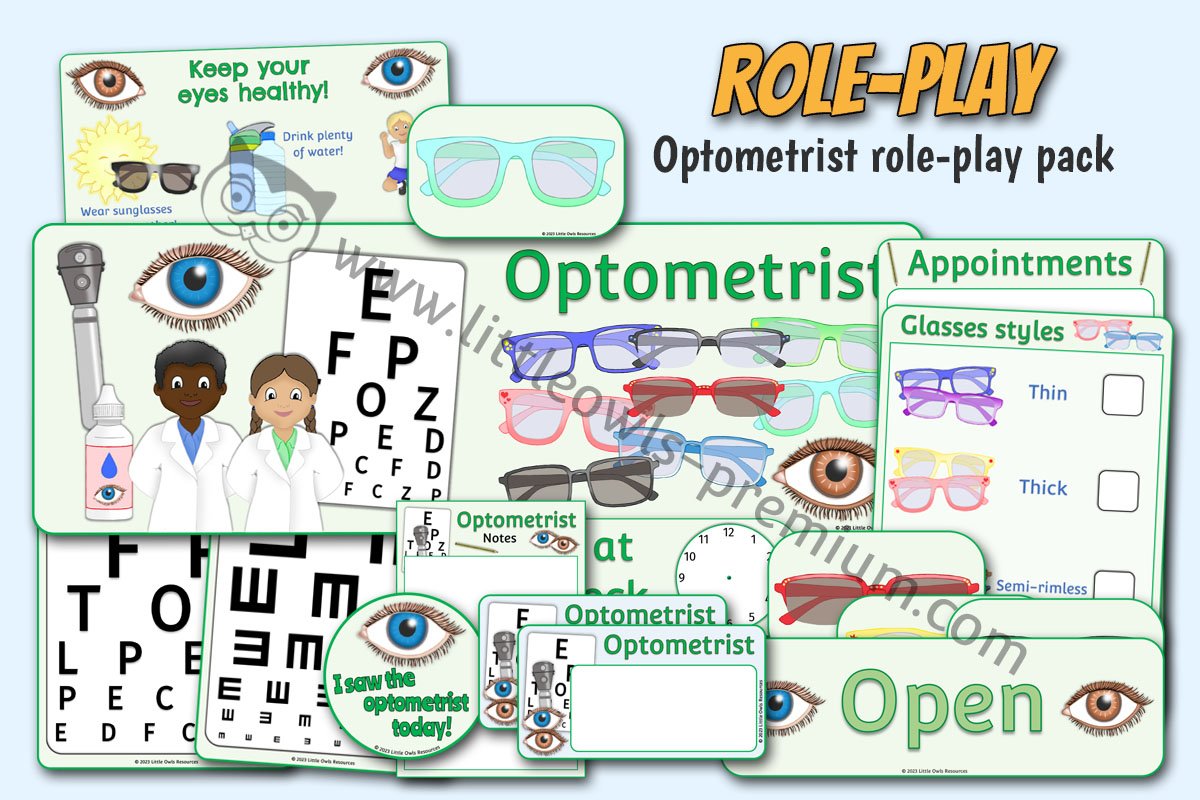
Everything you need to set up an optometrist role-play area!
Pack includes:
(Please note that words, etc. can be altered within the editable docx file version.)
‘Optometrist’ banner
‘I saw the optometrist today!’ badges
Optometrist and Optician identity cards - Name Writing
‘Waiting Area’ and ‘Please Wait’ Posters/Signs
‘Keep your eyes healthy’ Poster
Optometrist word mats
Optometrist word cards
‘Welcome! Please sign in for your appointment’ sign for encouraging emergent writing
‘Open’ & ‘Closed’ signs
‘Optometrist Opening Times’ Poster - Space to draw hands on clock and write times
‘Opens at…o’ clock’ and ‘Closes at…o’ clock’ signs - spaces for emergent writing
Templates for emergent writing - ‘Optometrist Notes’, ‘Appointments’ & ‘Patient Details’ forms
Eye charts x3
Glasses Styles tick sheet
Glass and Sunglasses prop cards x16
Original artwork drawn by Sara Murphy and final digital resources created by Stuart Murphy. COPYRIGHT ON ALL OF THE RESOURCES HOUSED ON THIS WEBSITE IS HELD BY ‘LITTLE OWLS RESOURCES’. OUR RESOURCES (INCLUDING THE IMAGES WITHIN THEM), CANNOT BE SHARED OR SOLD COMMERCIALLY.
DOWNLOAD EDITABLE (DOCX)
DOWNLOAD NON-EDITABLE (PDF)
DOWNLOAD NON-EDITABLE (Zipped JPEGs)
<<-BACK TO ‘EYE HEALTH’ TOPIC MENU
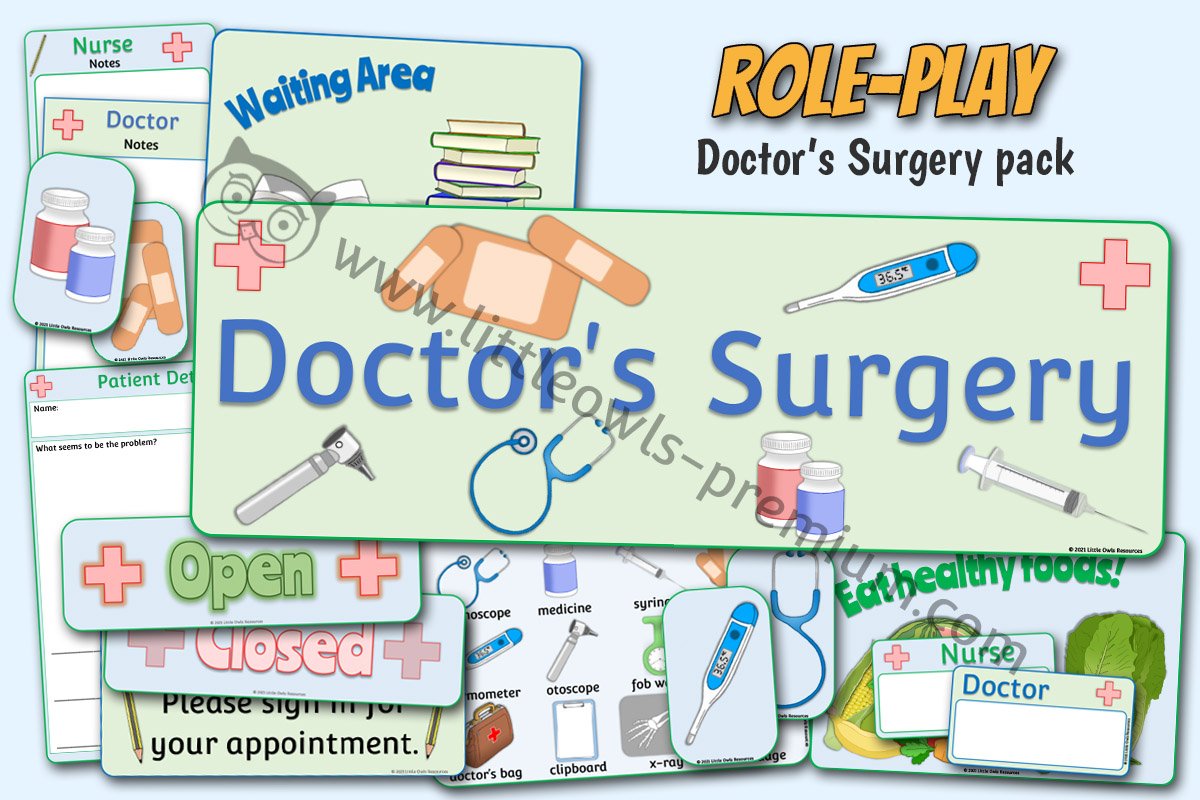
Everything you need to set up a doctor’s surgery role-play area!
Pack includes:
(Please note that words, etc. can be altered within the editable docx file version.)
‘Doctor’s Surgery’ banner
First Aid Red Cross signs
Doctor and Nurse identity cards - Name Writing
‘Waiting Area’ Poster
Various Posters promoting ‘Good Health’
Social distancing signs & floormats
‘Please wait’ footprint floormats
Medical word mat
Medical word cards
‘Welcome! Please sign in for your appointment’ sign for encouraging emergent writing
‘Open’ & ‘Closed’ signs
‘Surgery Opening Times’ Poster - Space to draw hands on clock and write times
‘Opens at…o’ clock’ and ‘Closes at…o’ clock’ signs - spaces for emergent writing
Templates for emergent writing (ideally laminated) - ‘Doctor Notes’, ‘Nurse Notes’, ‘Appointments’ & ‘Patient Details’ forms
Clipboard template for mark making
Role-Play Prop cards
Original artwork drawn by Sara Murphy and final digital resources created by Stuart Murphy. COPYRIGHT ON ALL OF THE RESOURCES HOUSED ON THIS WEBSITE IS HELD BY ‘LITTLE OWLS RESOURCES’. OUR RESOURCES (INCLUDING THE IMAGES WITHIN THEM), CANNOT BE SHARED OR SOLD COMMERCIALLY.
DOWNLOAD EDITABLE (DOCX)
DOWNLOAD NON-EDITABLE (PDF)
DOWNLOAD NON-EDITABLE (Zipped JPEGs)
Additional Pages you may like to explore which cover relevant &/or connected themes


More Early Years Event Pages for May

Sunday 23rd May 2027: 🐢🌊 For early years settings, nurseries, preschools, childminders, and Year 1 and Year 2 classrooms, World Turtle Day provides a wonderful and engaging theme for exploring animals (especially reptiles, sea creatures, and pets), habitats (ocean, desert, wetlands, gardens), conservation, life cycles,…

Saturday 22nd May 2027: 🌳🐠 International Day for Biological Diversity (IDB) is a special day celebrated every year on May 22nd. It was started by the United Nations to help everyone understand something very important called 'biological diversity', or 'biodiversity' for short. Biodiversity means…

Wednesday 19th May 2027 (TBC): 🔢➕ For early years settings, nurseries, preschools, childminders, and Year 1 and Year 2 classrooms, National Numeracy Day provides a fantastic and practical theme for exploring counting, number recognition, shapes, patterns, problem-solving, and early mathematical concepts. It's about building a positive attitude…

Thursday 20th May 2027: 🐝🍯 For early years settings, nurseries, preschools, childminders, and Year 1 and Year 2 classrooms, World Bee Day provides a wonderful and engaging theme for exploring minibeasts, plants, life cycles, food sources, the environment, and understanding the world (the world around us). It's about introducing…

Tuesday 18th May 2027: 🏛️🔎 For early years settings, nurseries, preschools, childminders, and Year 1 and Year 2 classrooms, International Museum Day provides a fantastic and engaging theme for exploring history, science, art, culture, discovery, role-play, and understanding the world (the world around us). It's about sparking children's curiosity,…

Sunday 9th May 2027 (TBC): 👧👦 For early years settings, nurseries, preschools, childminders, and Year 1 and Year 2 classrooms, National Children’s Day provides an incredibly broad and foundational opportunity to explore all aspects of a child's health, safety, well-being, emotions, physical development, rights, and…

Friday 21st May 2027: 🐾🌱 Endangered Species Day is a special day celebrated every year on the third Friday in May. It was started by a group called the National Endangered Species Act Education Centre in the United States and was recognised…

Saturday 15th May 2027: 👨👩👧👦💖 International Day of Families is a special day celebrated every year on May 15th. It was started by the United Nations in 1993 because they wanted everyone to remember how important…

Monday 10th - Sunday 16th May 2027 (TBC): 😊🧠 Mental Health Awareness Week happens every year in May. It's hosted by the Mental Health Foundation, a charity in the UK. This week is all about helping everyone understand that our minds…

Wednesday 12th May 2027: 👩⚕️🧑⚕️ For early years settings, nurseries, preschools, childminders, and Year 1 and Year 2 classrooms, International Nurses Day provides a fantastic and practical theme for exploring people who help us, health and well-being, empathy, role-play, and personal, social…

Wednesday 5th May 2027: ✨🧼 World Hand Hygiene Day is a special day celebrated every year on May 5th. It was started by the World Health Organization (WHO) with a very important message: 'SAVE LIVES:…

Sunday 2nd May 2027: 😄😂 The main idea of this day is to show how laughter can help bring peace and friendship to people all over the world. Dr. Kataria believes that laughter is like a super-power that can help people…

🚶♀️🚶♂️For early years settings, nurseries, preschools, childminders, and Year 1 and Year 2 classrooms, National Walking Month (1st - 31st May 2027) and Walk to School Week (Monday 17th - Friday 21st May 2027 - TBC) provide a fantastic and practical theme for exploring physical development, health and well-being, the environment, road safety…

Thursday 20th May 2027 (TBC) & Thursday 5th November 2026: Let's learn outside! 🌳☀️ Outdoor Classroom Day is a global campaign to inspire and celebrate outdoor play and learning, with two designated days each year: one in May and one in November…
Explore special dates (including awareness dates, festivals, celebrations & events) relevant to your EYFS & KS1 children
Browse our ‘Special Dates Calendar’ page using the link below. You’ll find calendars for every month of the year to aid your planning!
Click here to visit our ‘Special Dates Calendar’ page for an entire year of key EYFS & KS1 events, festivals & celebrations.
Search ‘Little Owls Resources’ Using the following Menu Buttons…
Click here to visit our ‘Special Dates Calendar’ page for an entire year of key EYFS & KS1 events, festivals & celebrations.


Disclaimer:
This page is for educational purposes only and is intended to support early years and primary practitioners with ideas and resources related to 'National Children’s Day UK'. National Children’s Day UK takes place annually in May and is a key initiative of the Save Childhood Movement. We are not officially affiliated with or endorsed by the Save Childhood Movement. We do not claim any rights to specific trademarks or official materials associated with this event. For official information, themes, and how to get involved, please visit the National Children's Day UK website: www.nationalchildrensdayuk.com.
Saturday 29th May - Sunday 6th June 2027 (TBC): 🌱🥕 For early years settings, nurseries, preschools, childminders, and Year 1 and Year 2 classrooms, National Children’s Gardening Week provides a wonderfully rich and hands-on theme for exploring plants, life cycles, food sources, nature, science (growth and change), the environment, outdoor play,…