
**Note: This page is for educational inspiration and is not officially affiliated with International Nurses Day. International Nurses Day is celebrated annually on May 12th. It was established by the International Council of Nurses (ICN) in 1965 to honour the invaluable contributions of nurses to society. The date was chosen to commemorate the birth anniversary of Florence Nightingale (1820–1910), the founder of modern nursing. The day's purpose is to celebrate and recognise nurses' vital role in providing care, promoting health, and saving lives. The ICN coordinates the day, providing an international theme and resources to highlight the important work of nurses worldwide. For official information, themes, and resources, please visit the International Council of Nurses (ICN) website: www.icn.ch.
Wednesday 12th May 2027
12th May every year
-
International Nurses Day is celebrated every year on 12th May, the birthday of Florence Nightingale.
It recognises the important role that nurses play in caring for people, supporting health and wellbeing, and helping communities stay safe.
The day highlights:
compassion and care
helping others
the importance of healthcare professionals
-
International Nurses Day provides a meaningful opportunity to explore:
people who help us
health and wellbeing
empathy and care
community roles
This theme can support:
EYFS:
PSED (empathy, relationships, caring for others)
Understanding the World (community and roles)
Communication & Language (talking about experiences)
Expressive Arts & Design (role-play and imagination)
KS1 (National Curriculum):
PSHE (health, caring for others, community roles)
Science (the human body, staying healthy)
Citizenship (roles and responsibilities in society)
-
In high-quality EYFS practice, special dates such as International Nurses Day are used:
flexibly
in response to children’s interests and experiences
to enhance play, conversation and understanding
The ideas below are:
optional
adaptable
intended to support adult thinking
👉 Find out more about developmentally appropriate practice in EYFS by exploring our ‘Curriculum & Pedagogy Suite’.
Pathways available for:
-
Exploring this theme supports children’s development in meaningful ways:
🏥 Understanding the World
Children begin to recognise the role of nurses and healthcare professionals in their community.
🤝 Empathy and Kindness
Children develop awareness of caring for others and responding to needs.
😊 Emotional Security
Familiarity with healthcare roles can help reduce fear or uncertainty.
🧠 Health Awareness
Children begin to understand how we look after our bodies and stay well.
💬 Communication & Language
Opportunities to talk about experiences, feelings and ideas.
🌿 EYFS: Provision & Child-Led Ideas
These ideas are not activities to be planned or completed. They support understanding through play, relationships and real-life experiences.
-
Understanding is rooted in care, relationships and familiar experiences.
Babies may:
experience care routines (comfort, soothing, feeding)
respond to familiar adults and nurturing interactions
observe simple cause and effect (being cared for → feeling better)
Adults can:
provide warm, consistent care
narrate simple actions (“I’m helping you”)
use calm tone, eye contact and touch
build trust through responsive interaction
👉 Additional curriculum & planning support for this age group may be found on our ‘EYFS Planning for Babies (0–18 Months)’ hub page.
-
Toddlers begin to explore caring roles through play and imitation.
Children may:
imitate caring behaviours (feeding, comforting, “helping”)
engage in simple role-play (teddies, dolls, familiar routines)
repeat actions linked to real-life experiences
Adults can:
join play without directing
model simple language (“The teddy feels poorly”)
provide props for exploration (dolls, blankets, basic role-play items)
support repetition and schema-driven play
👉 Additional curriculum & planning support for this age group may be found on our ‘EYFS Planning for Toddlers (18–36 Months)’ hub page.
-
Children begin to understand roles and make connections to real life.
Children may:
engage in imaginative role-play (doctors, nurses, families)
talk about experiences (visiting a doctor or hospital)
show empathy and concern for others
Adults can:
extend play through language and questioning
introduce simple vocabulary (nurse, help, care)
support cooperative play
model empathy and problem-solving
👉 Additional curriculum & planning support for this age group may be found on our ‘EYFS Planning for Preschool (3–4 Years)’ hub page.
-
Children develop a clearer understanding of roles and responsibilities.
Children may:
understand that nurses help people stay well
explore different scenarios through role-play
consider others’ feelings and needs
Adults can:
support discussion about real-world roles
guide understanding of helping professions
encourage reflection (“How can we help?”)
extend vocabulary and knowledge through conversation
👉 Additional curriculum & planning support for this age group may be found on our ‘EYFS Planning for Reception (4–5 Years)’ hub page.
-
Understanding people who help us develops through:
relationships and care experiences
play and imitation
conversation and shared understanding
meaningful real-life connections
🌱 Environment Enhancements & Invitations (EYFS)
These are optional enhancements that may be added to provision if they align with children’s interests and experiences.
-
You might enhance provision by:
adding familiar, real-life objects to a role-play area (e.g. bandages, clipboards, soft toys)
creating space for children to act out experiences such as caring, helping or visiting a doctor
allowing children to lead narratives based on their own experiences
Resources that may support this include:
Doctors Surgery Role-Play Pack
Dentist Dramatic Role-Play Pack
Medical Word Mat
-
You might enhance provision by:
including dolls, teddies or soft toys that children can care for
providing simple materials for nurturing play (e.g. blankets, wipes, role-play items)
supporting children to explore what it means to help and care for others
Resources that may support this include:
Poorly Teddy resources
-
You might enhance provision by:
introducing simple vocabulary linked to care, health and helping (e.g. “help”, “better”, “poorly”)
responding to children’s play with language that extends thinking
supporting children to talk about their own experiences (e.g. visiting a doctor or hospital)
-
You might enhance provision by:
supporting children to notice how others feel
modelling kindness, reassurance and care
responding sensitively to children’s emotional experiences
Resources:
-
You might enhance provision by:
introducing simple ideas about people who help us
using books, images or conversation to explore familiar roles in the community
allowing children to make connections between play and real life
Resources:
-
Understanding roles such as nurses develops through:
play and imitation
real-life experiences
conversation and interaction
relationships and care
📘 KS1 Learning Activities for International Nurses Day
In Key Stage 1, this theme can support more structured learning around community roles, health and empathy.
-
Children can:
explore structured role-play scenarios
act out real-life situations
develop understanding of healthcare roles
You may use our:
Doctors Surgery Role-Play Pack
Dentist Dramatic Role-Play Pack
Poorly Teddy Posters
This supports:
speaking and listening
understanding roles
imaginative play
-
Children can:
think about how to help someone who is poorly
discuss symptoms and solutions
explore simple cause and effect
You may use our:
What Happened To Teddy? – Critical Thinking
X-Ray Multimats
-
Children can:
discuss how we care for others
explore kindness and empathy
learn how to stay healthy
Resources:
-
Children can:
learn about the human body
explore how we keep it healthy
understand basic health routines
Resources:
-
-
A helpful question:
“What does this add to children’s understanding of the world around them?”
If it supports:
empathy
understanding
meaningful play
→ it is worthwhile
-
International Nurses Day helps children to:
understand people who help us
develop empathy and care
explore health and wellbeing
make sense of real-life experiences
In the EYFS, this learning is most effective when it is:
play-based
relationship-led
responsive
In KS1, it can be:
explored through structured role-play
discussed and reflected on
linked to real-world understanding
-
We offer a range of resources to support practitioners across EYFS and KS1, including printable materials and in-depth curriculum and pedagogy guidance.
🟢 Free Membership
You can access a selection of free resources by creating a free account.
This includes:
selected printable resources
sample materials
weekly support emails for those who opt-in
🟡 Premium Membership (Printables)
Our Premium Membership provides access to our full library of printable teaching and provision resources.
This includes:
themed resources (e.g. Gardening, Emotions, Seasons)
continuous provision materials
activity cards, displays and printable packs
These resources can be used flexibly to support:
provision enhancements
small group work
classroom organisation
🟣 Professional Membership (Curriculum & Pedagogy)
Our Professional Membership provides access to our full Curriculum & Pedagogy Suite (Birth–5).
~ In addition to Premium Printable Provision access.~
This includes:
age-specific pathways (Babies, Toddlers, Preschool, Reception)
planning guidance and templates
observation and assessment support
SEND and inclusion guidance
inspection-ready documentation
These documents are designed to support:
confident decision-making
consistent practice across teams
clear articulation of EYFS pedagogy
(KS1 curriculum coming soon!)
👉 Visit EYFS Curriculum & Pedagogy Suite
👉 [View Professional Membership]
🧠 Choosing What Works for You
You do not need to use everything at once.
Many practitioners:
start with free resources
build their printable provision over time
use pedagogy documents to support team understanding and leadership
Choose what best fits your setting, role and stage of development.
👉 To explore more early years events, visit our Special Dates Calendar.
Printable resources to support teaching & learning surrounding: ‘International Nurses Day’

The pages of this pack give some general information about the role of a nurse and some fun and engaging activities to foster and develop children’s interest in this role in society.
Pack includes:
Information Posters
Information Posters (Colouring)
Drawing/Writing Sheets
Draw items Sheet
Draw items Sheet (Colouring)
Item Poster
Item Poster (Colouring)
Multimats for Art & Craft/Loose Parts/Playdough
5 x 2-Piece individual items puzzles
1 x 4-Piece all items puzzle
Original artwork drawn by Sara Murphy and final digital resources created by Stuart Murphy. COPYRIGHT ON ALL OF THE RESOURCES HOUSED ON THIS WEBSITE IS HELD BY ‘LITTLE OWLS RESOURCES’. OUR RESOURCES (INCLUDING THE IMAGES WITHIN THEM), CANNOT BE SHARED OR SOLD COMMERCIALLY.
DOWNLOAD EDITABLE (DOCX)
DOWNLOAD NON-EDITABLE (PDF)
DOWNLOAD NON-EDITABLE (Zipped JPEGs)
Free ‘Health’ resources for EYFS & KS1:
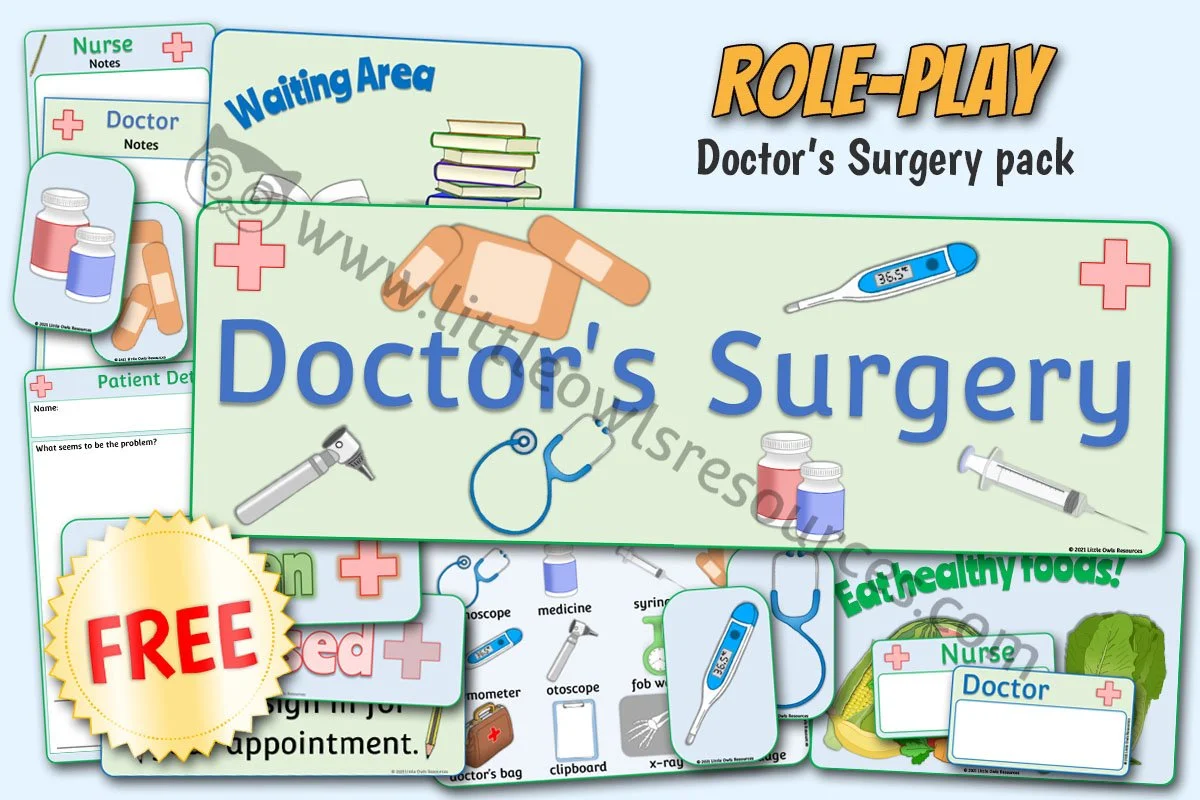
Everything you need to set up a doctor’s surgery role-play area!
Pack includes:
(Please note that words, etc. can be altered within the editable docx file version.)
‘Doctors Surgery’ banner
First Aid Red Cross signs
Doctor and Nurse identity cards
‘Waiting Area’ Poster
Various Posters promoting ‘Good Health’
Social distancing signs & floormats
‘Please wait’ footprint floormats
Medical word mat
Medical word cards
‘Welcome! Please sign in for your appointment’ sign for encouraging emergent writing
‘Open’ & ‘Closed’ signs
‘Surgery Opening Times’ Poster - Space to draw hands on clock and write times
‘Opens at…o’ clock’ and ‘Closes at…o’ clock’ signs - spaces for emergent writing
Templates for emergent writing (ideally laminated) - ‘Doctor Notes’, ‘Nurse Notes’, ‘Appointments’ & ‘Patient Details’ forms
Clipboard template for mark making
Role-Play Prop cards
Original artwork drawn by Sara Murphy and final digital resources created by Stuart Murphy. COPYRIGHT ON ALL OF THE RESOURCES HOUSED ON THIS WEBSITE IS HELD BY ‘LITTLE OWLS RESOURCES’. OUR RESOURCES (INCLUDING THE IMAGES WITHIN THEM), CANNOT BE SHARED OR SOLD COMMERCIALLY.
DOWNLOAD EDITABLE (DOCX)
DOWNLOAD NON-EDITABLE (PDF)
DOWNLOAD NON-EDITABLE (Zipped JPEGs)
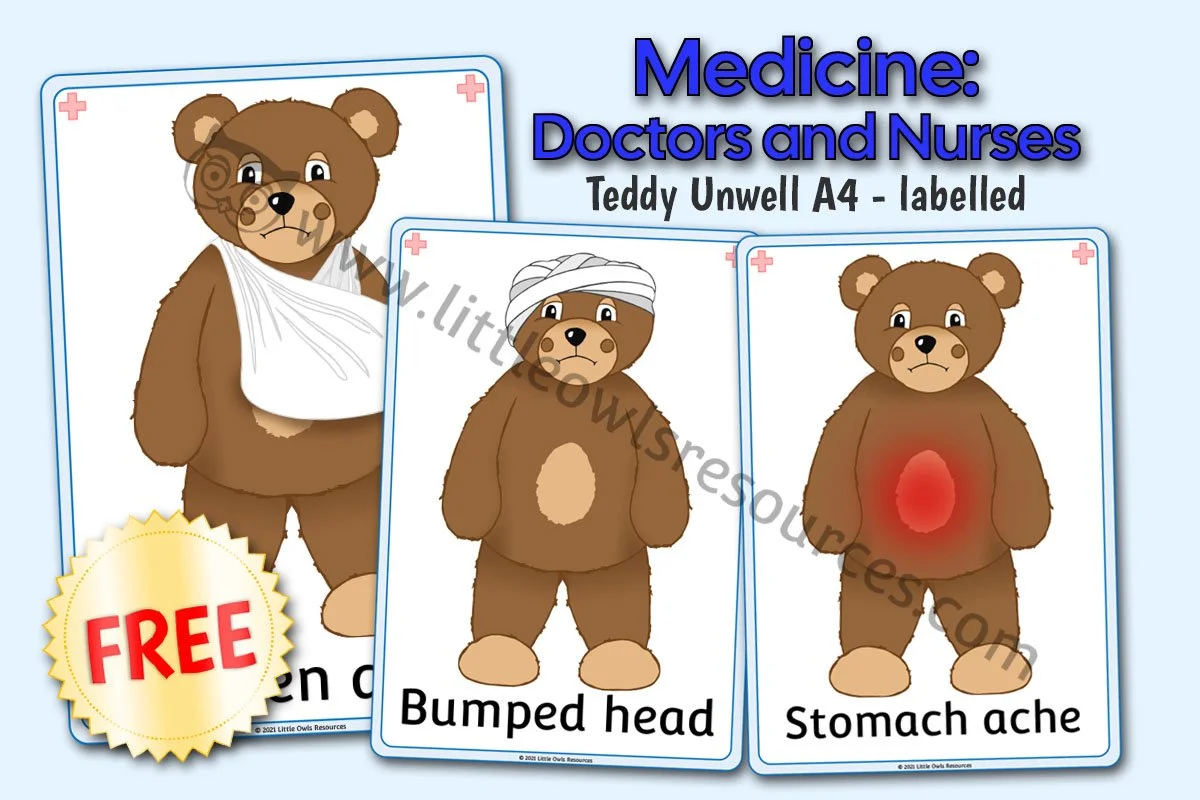
11 Poorly Teddy Posters included. Ideal for using as part of a medical/doctors and nurses display or activities such as role-play or emergent writing.
Original artwork drawn by Sara Murphy and final digital resources created by Stuart Murphy. COPYRIGHT ON ALL OF THE RESOURCES HOUSED ON THIS WEBSITE IS HELD BY ‘LITTLE OWLS RESOURCES’. OUR RESOURCES (INCLUDING THE IMAGES WITHIN THEM), CANNOT BE SHARED OR SOLD COMMERCIALLY.
DOWNLOAD EDITABLE (DOCX)
DOWNLOAD NON-EDITABLE (PDF)
DOWNLOAD NON-EDITABLE (Zipped JPEGs)
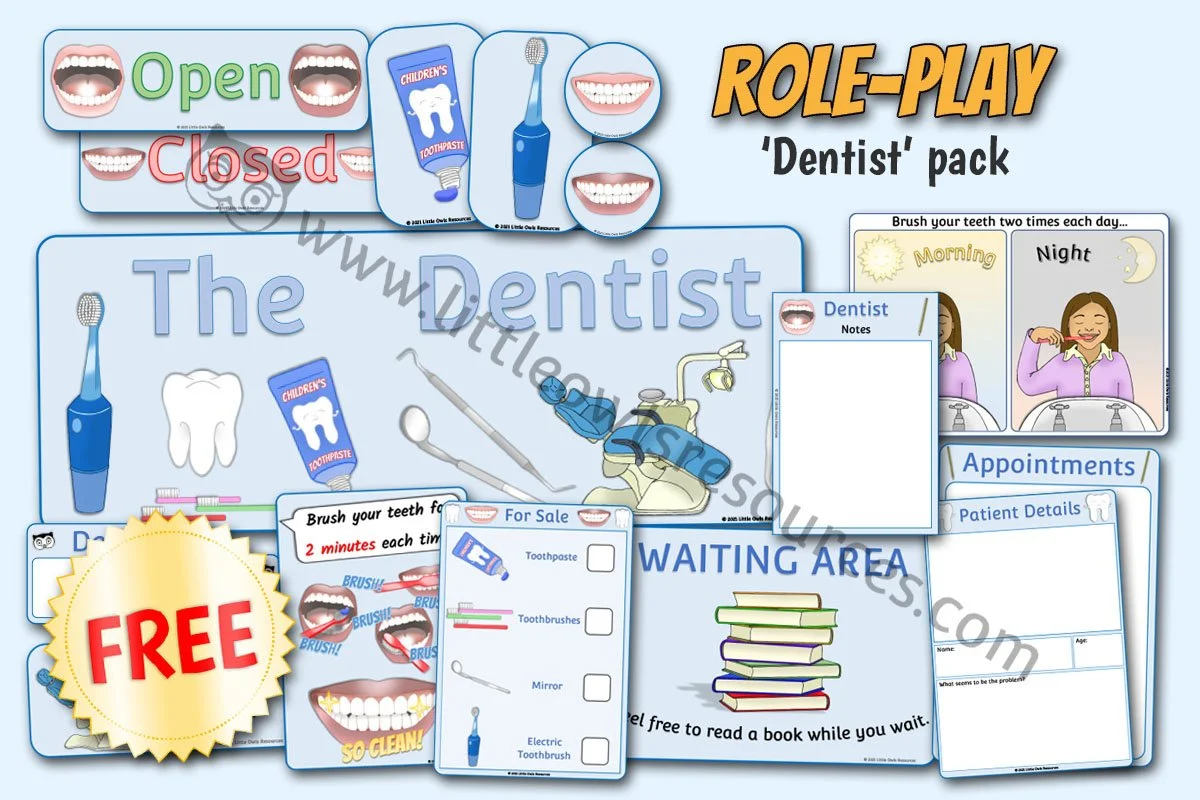
Everything you need to set up a dentist role-play area!
Pack includes:
(Please note that words, etc. can be altered within the editable docx file version.)
‘The Dentist’ banner
Smiling mouth decorative signs
Dentist and Dental Assistant identity cards
‘Waiting Area’ Poster
Various ‘Brush your teeth’ Posters
Social distancing signs & floormats
‘Please wait’ footprint floormats
Dentist word mats
Dentist word cards
‘Welcome! Please sign in for your appointment’ sign for encouraging emergent writing
‘Open’ & ‘Closed’ signs
‘Dentist Opening Times’ Poster - Space to draw hands on clock and write times
‘Opens at…o’ clock’ and ‘Closes at…o’ clock’ signs - spaces for emergent writing
Templates for emergent writing (ideally laminated) - ‘Dentist Notes’, ‘Appointments’ & ‘Patient Details’ forms
‘For Sale’ Menu sign - Space to write prices by items
Items for sale prop cards
Original artwork drawn by Sara Murphy and final digital resources created by Stuart Murphy. COPYRIGHT ON ALL OF THE RESOURCES HOUSED ON THIS WEBSITE IS HELD BY ‘LITTLE OWLS RESOURCES’. OUR RESOURCES (INCLUDING THE IMAGES WITHIN THEM), CANNOT BE SHARED OR SOLD COMMERCIALLY.
DOWNLOAD EDITABLE (DOCX)
DOWNLOAD NON-EDITABLE (PDF)
DOWNLOAD NON-EDITABLE (Zipped JPEGs)
<<-BACK TO ‘TEETH AND ORAL HEALTH’ TOPIC MENU

Design a Coronation meal!
Ideal for use as a reusable playdough or loose parts mat (once laminated). Alternatively, use in conjunction with whiteboard pens. Without lamination this design sheet is perfect for use with mark making tools or art and craft materials.
Original artwork drawn by Sara Murphy and final digital resources created by Stuart Murphy. COPYRIGHT ON ALL OF THE RESOURCES HOUSED ON THIS WEBSITE IS HELD BY ‘LITTLE OWLS RESOURCES’. OUR RESOURCES (INCLUDING THE IMAGES WITHIN THEM), CANNOT BE SHARED OR SOLD COMMERCIALLY.
DOWNLOAD EDITABLE (DOCX)
DOWNLOAD NON-EDITABLE (PDF)
DOWNLOAD NON-EDITABLE (Zipped JPEGs)
The following is a small selection of our inspirational ‘Health’ resources for EYFS & KS1:
(Please visit our ‘Medicine’, ‘The Human Body’, ‘Exercise’, ‘Handwashing & Hygiene’, ‘Eye Health’, ‘Teeth & Oral Health’, ‘Food’ (Fruit & Vegetables plus Balanced Diet), ‘Mental Health’, ‘Sun Safety’ or ‘Science’ pages to explore our extensive catalogue of Health resources.)
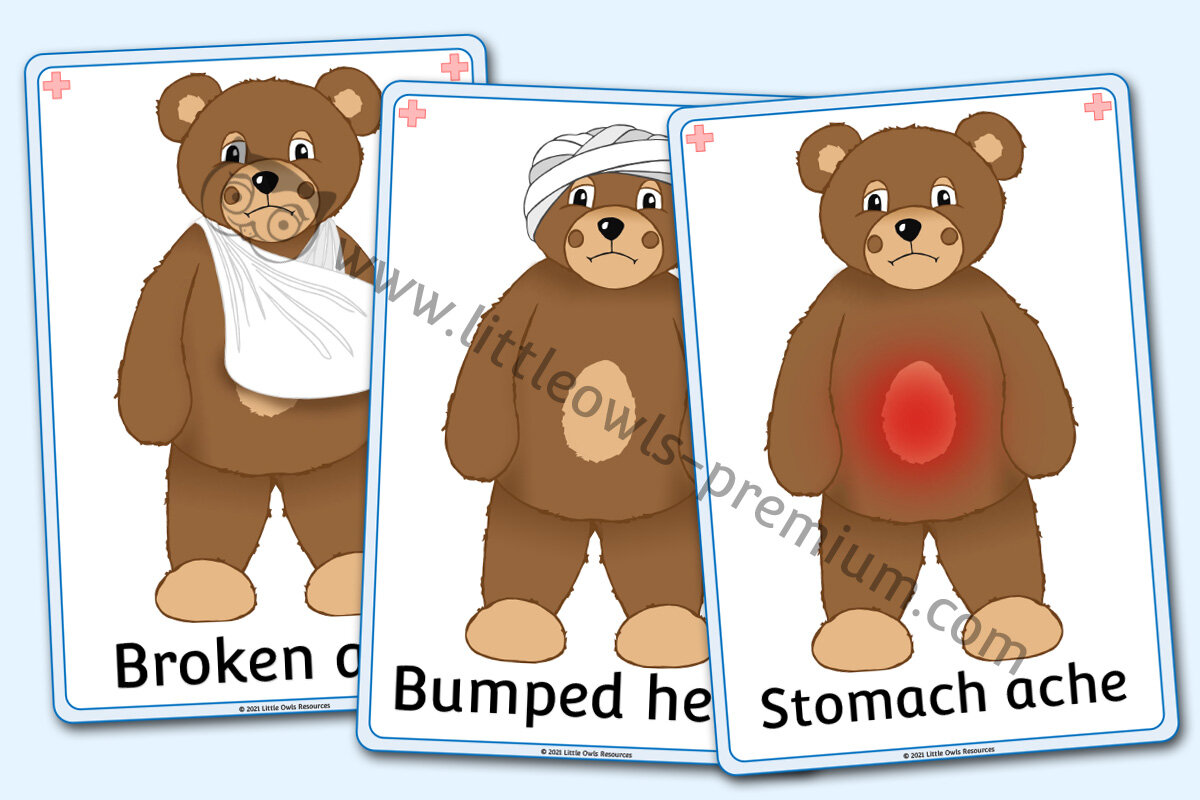
11 Poorly Teddy Posters included. Ideal for using as part of a medical/doctors and nurses display or activities such as role-play or emergent writing.
Original artwork drawn by Sara Murphy and final digital resources created by Stuart Murphy. COPYRIGHT ON ALL OF THE RESOURCES HOUSED ON THIS WEBSITE IS HELD BY ‘LITTLE OWLS RESOURCES’. OUR RESOURCES (INCLUDING THE IMAGES WITHIN THEM), CANNOT BE SHARED OR SOLD COMMERCIALLY.
DOWNLOAD EDITABLE (DOCX)
DOWNLOAD NON-EDITABLE (PDF)
DOWNLOAD NON-EDITABLE (Zipped JPEGs)
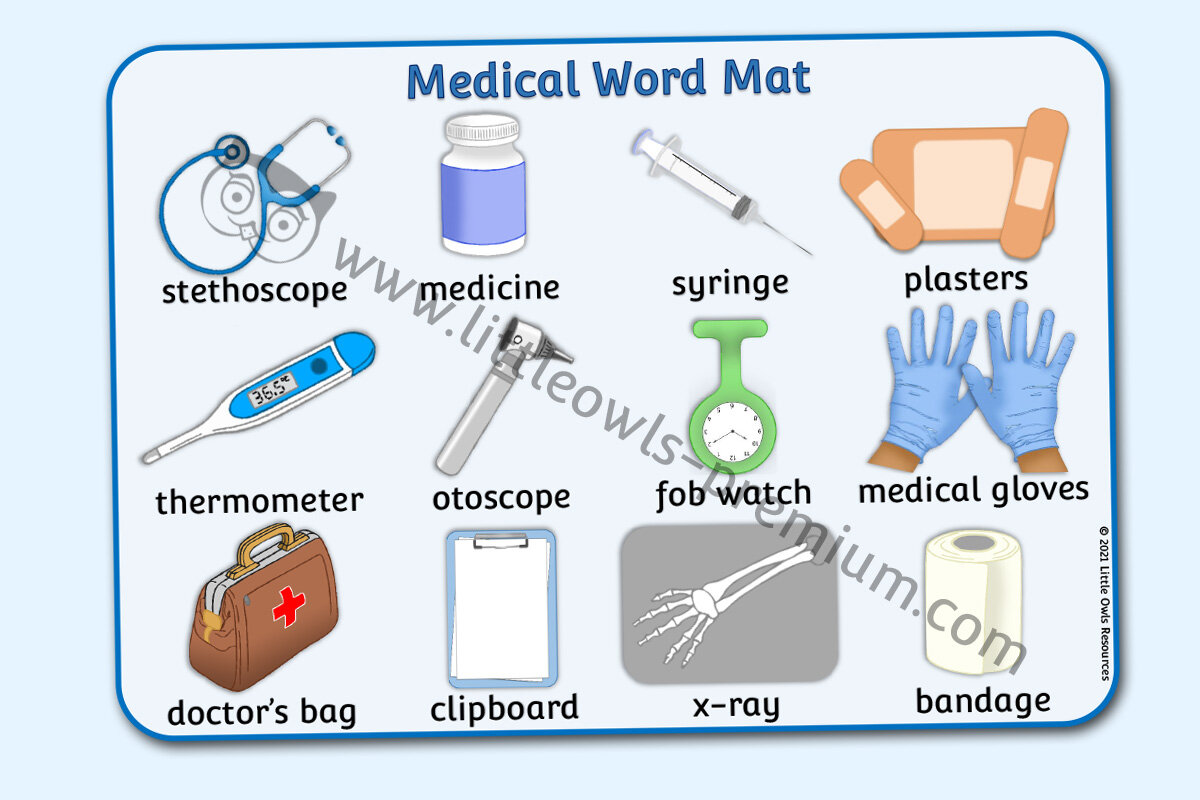
‘Medical’ word mat. Why not use in conjunction with our ‘Medical’ word cards? Can be used as part of a display or activities such as role-play or emergent writing.
Original artwork drawn by Sara Murphy and final digital resources created by Stuart Murphy. COPYRIGHT ON ALL OF THE RESOURCES HOUSED ON THIS WEBSITE IS HELD BY ‘LITTLE OWLS RESOURCES’. OUR RESOURCES (INCLUDING THE IMAGES WITHIN THEM), CANNOT BE SHARED OR SOLD COMMERCIALLY.
DOWNLOAD EDITABLE (DOCX)
DOWNLOAD NON-EDITABLE (PDF)
DOWNLOAD NON-EDITABLE (Zipped JPEGs)
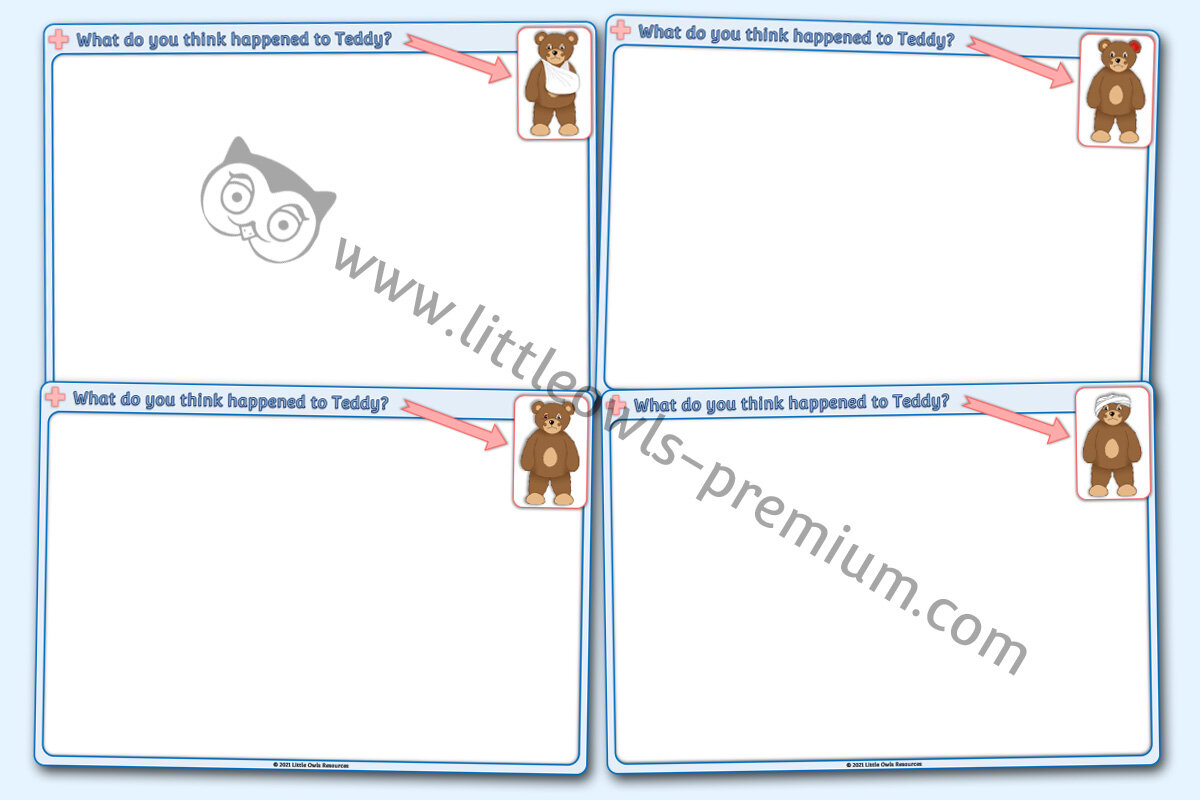
11 Poorly Teddy A4 Critical Thinking Sheets included.
Encourage children to look carefully at the picture of teddy provided in the corner. What do you think is wrong with him? What do you think might have happened to him to make him poorly? Children can then draw and/or write their ideas in the space provided. You may even like to role play scenarios that the children come up with.
Original artwork drawn by Sara Murphy and final digital resources created by Stuart Murphy. COPYRIGHT ON ALL OF THE RESOURCES HOUSED ON THIS WEBSITE IS HELD BY ‘LITTLE OWLS RESOURCES’. OUR RESOURCES (INCLUDING THE IMAGES WITHIN THEM), CANNOT BE SHARED OR SOLD COMMERCIALLY.
DOWNLOAD EDITABLE (DOCX)
DOWNLOAD NON-EDITABLE (PDF)
DOWNLOAD NON-EDITABLE (Zipped JPEGs)
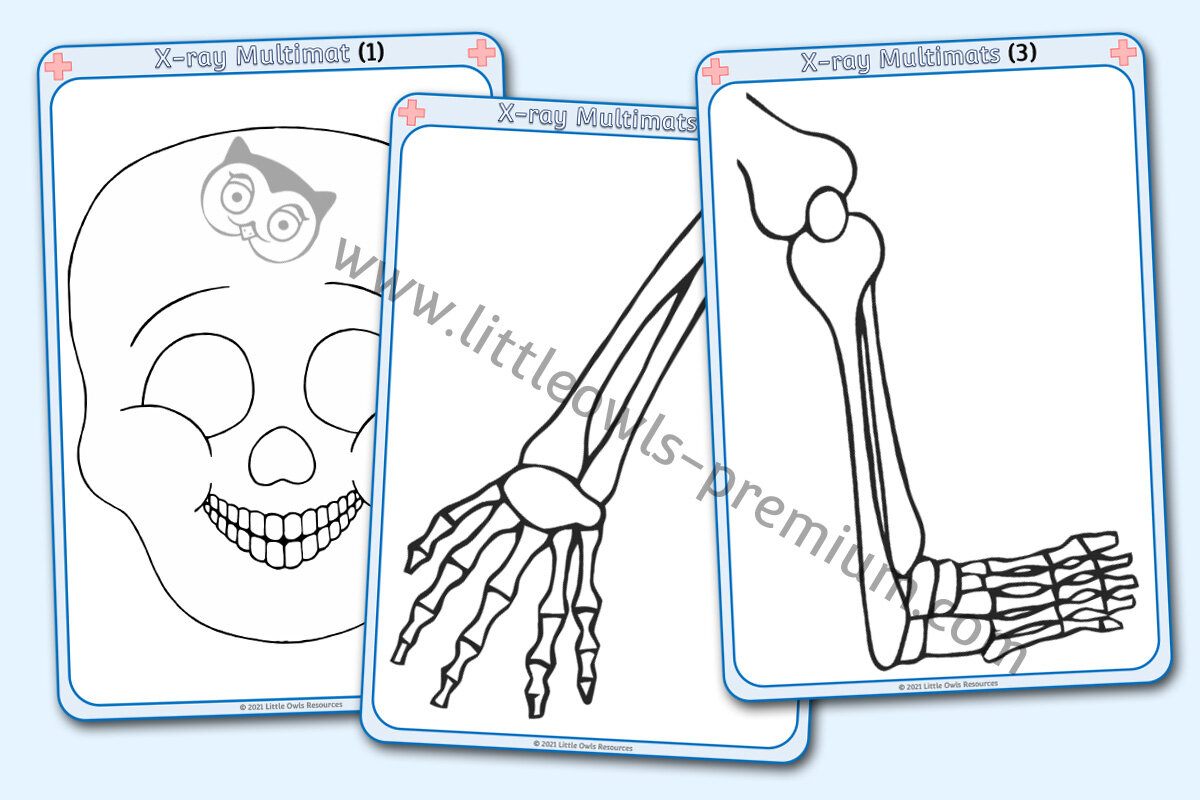
Once laminated these ‘X-Ray Multimats’ are ideal to be used as reusable playdough or loose part mats. Alternatively, use them in conjunction with whiteboard pens.
Without lamination these sheets may also be used with mark making tools or art and craft materials such as collage or fingerpainting.
Original artwork drawn by Sara Murphy and final digital resources created by Stuart Murphy. COPYRIGHT ON ALL OF THE RESOURCES HOUSED ON THIS WEBSITE IS HELD BY ‘LITTLE OWLS RESOURCES’. OUR RESOURCES (INCLUDING THE IMAGES WITHIN THEM), CANNOT BE SHARED OR SOLD COMMERCIALLY.
DOWNLOAD EDITABLE (DOCX)
DOWNLOAD NON-EDITABLE (PDF)
DOWNLOAD NON-EDITABLE (Zipped JPEGs)
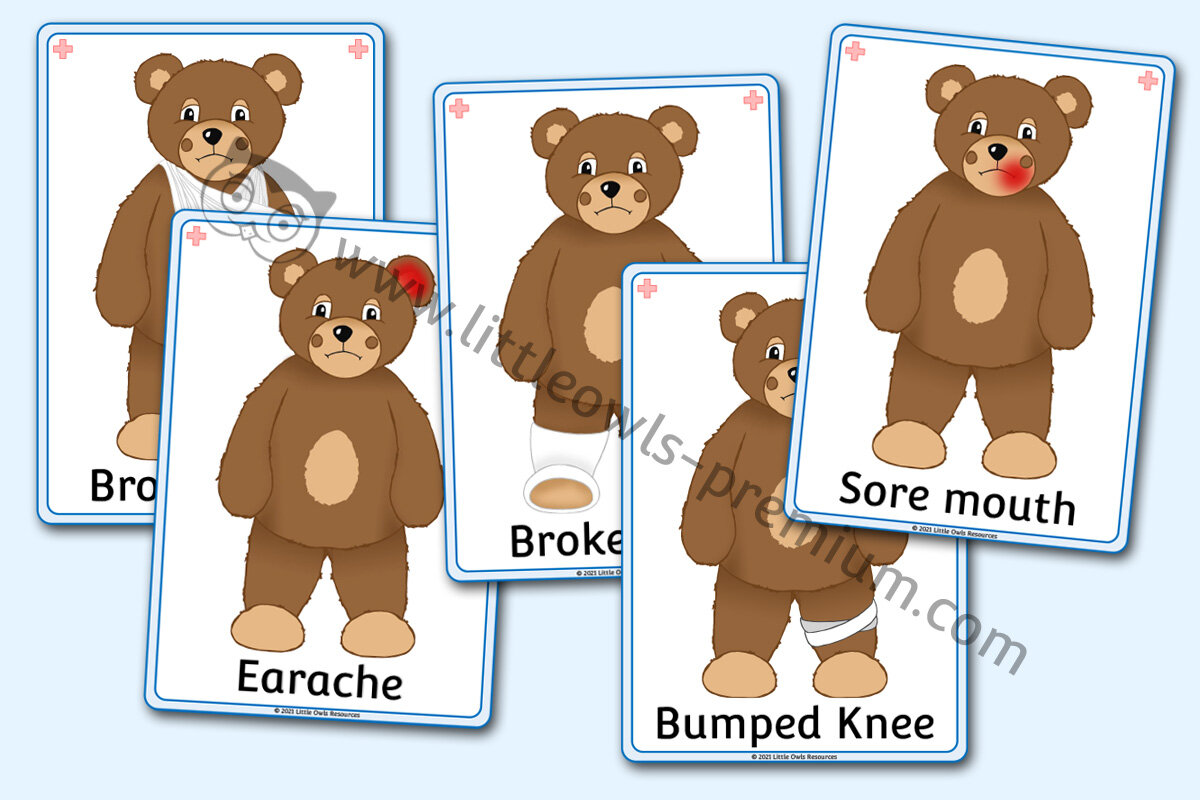
11 Poorly Teddy A5 Posters/Cards included. Ideal for using as part of a medical/doctors and nurses display or activities such as role-play or emergent writing.
Original artwork drawn by Sara Murphy and final digital resources created by Stuart Murphy. COPYRIGHT ON ALL OF THE RESOURCES HOUSED ON THIS WEBSITE IS HELD BY ‘LITTLE OWLS RESOURCES’. OUR RESOURCES (INCLUDING THE IMAGES WITHIN THEM), CANNOT BE SHARED OR SOLD COMMERCIALLY.
DOWNLOAD EDITABLE (DOCX)
DOWNLOAD NON-EDITABLE (PDF)
DOWNLOAD NON-EDITABLE (Zipped JPEGs)
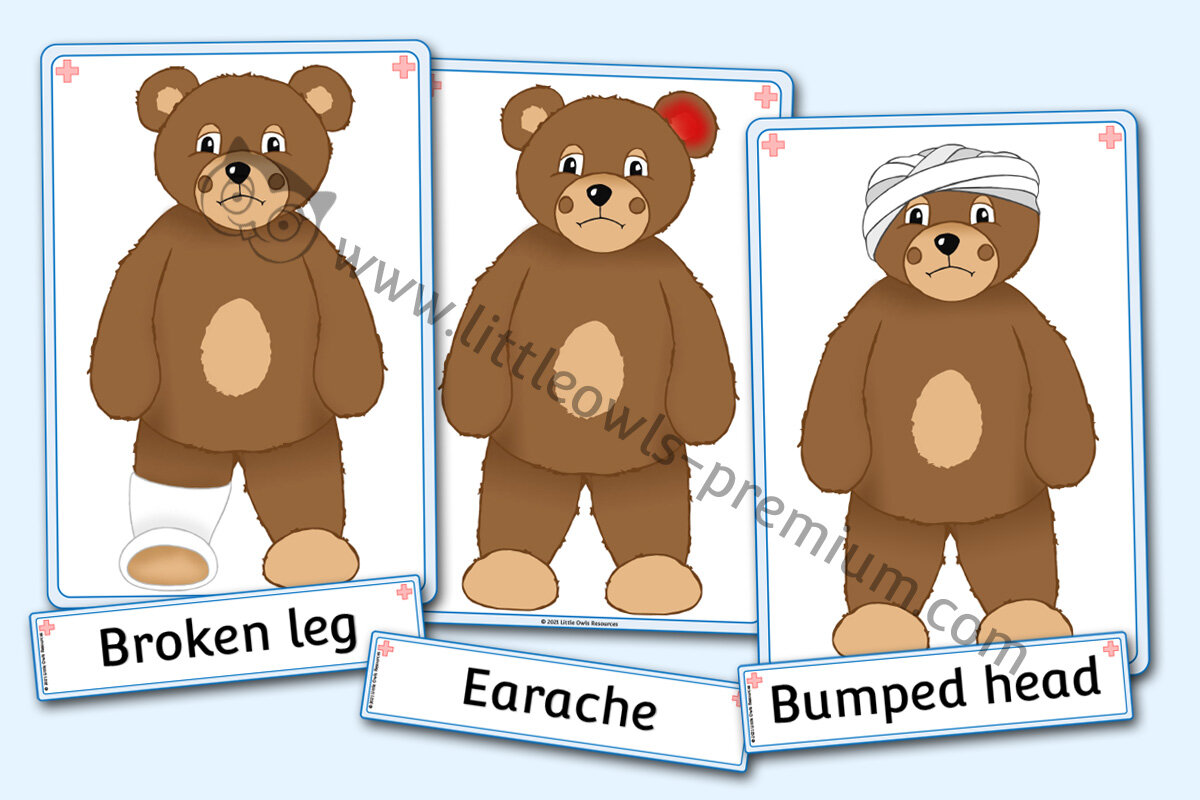
11 Poorly Teddy Posters included. Ideal for using as part of a medical/doctors and nurses display or activities such as role-play or emergent writing.
Also perfect for matching game activity. For example the 11 Poorly Teddy posters may be laid out in front of children. An adult can then select a label and read it to them. Children can listen carefully and select the correct poorly teddy picture to match with the illness/injury they have heard.
Original artwork drawn by Sara Murphy and final digital resources created by Stuart Murphy. COPYRIGHT ON ALL OF THE RESOURCES HOUSED ON THIS WEBSITE IS HELD BY ‘LITTLE OWLS RESOURCES’. OUR RESOURCES (INCLUDING THE IMAGES WITHIN THEM), CANNOT BE SHARED OR SOLD COMMERCIALLY.
DOWNLOAD EDITABLE (DOCX)
DOWNLOAD NON-EDITABLE (PDF)
DOWNLOAD NON-EDITABLE (Zipped JPEGs)
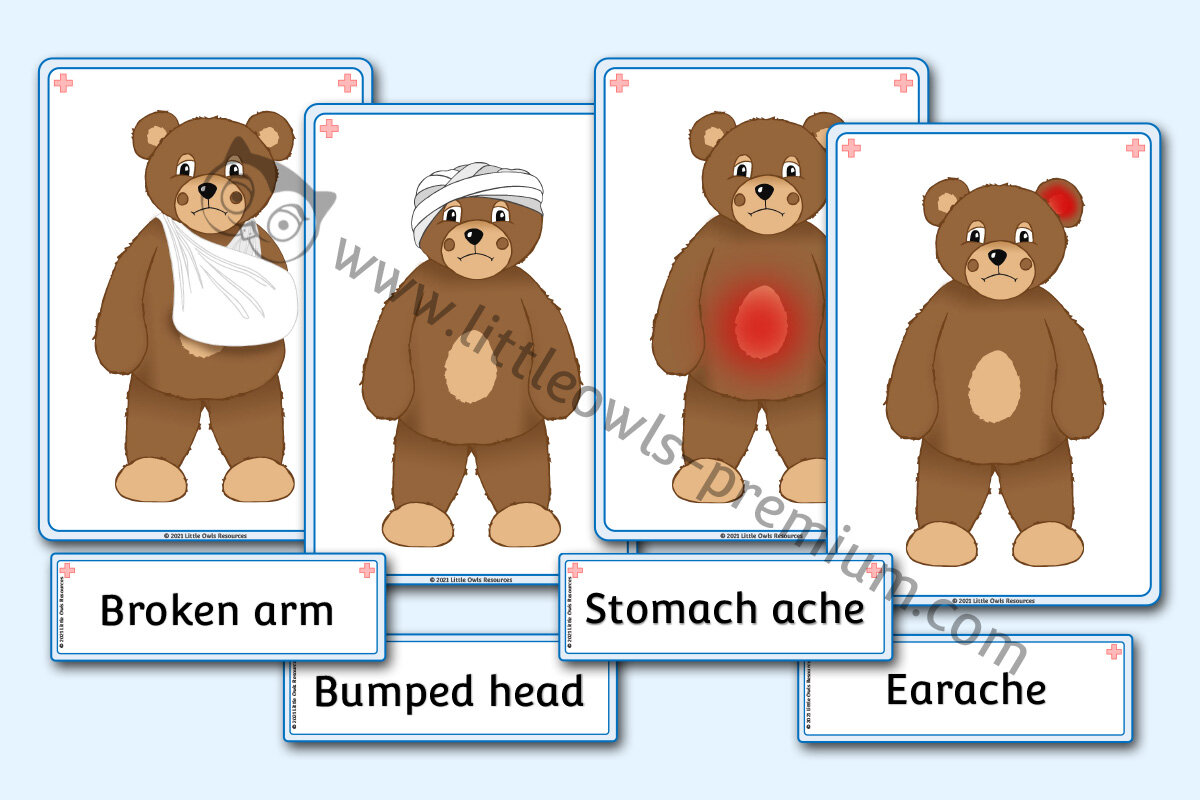
11 Poorly Teddy A5 Posters/Cards included. Ideal for using as part of a medical/doctors and nurses display or activities such as role-play or emergent writing.
Also perfect for matching game activity. For example the 11 Poorly Teddy posters may be laid out in front of children. An adult can then select a label and read it to them. Children can listen carefully and select the correct poorly teddy picture to match with the illness/injury they have heard.
Original artwork drawn by Sara Murphy and final digital resources created by Stuart Murphy. COPYRIGHT ON ALL OF THE RESOURCES HOUSED ON THIS WEBSITE IS HELD BY ‘LITTLE OWLS RESOURCES’. OUR RESOURCES (INCLUDING THE IMAGES WITHIN THEM), CANNOT BE SHARED OR SOLD COMMERCIALLY.
DOWNLOAD EDITABLE (DOCX)
DOWNLOAD NON-EDITABLE (PDF)
DOWNLOAD NON-EDITABLE (Zipped JPEGs)
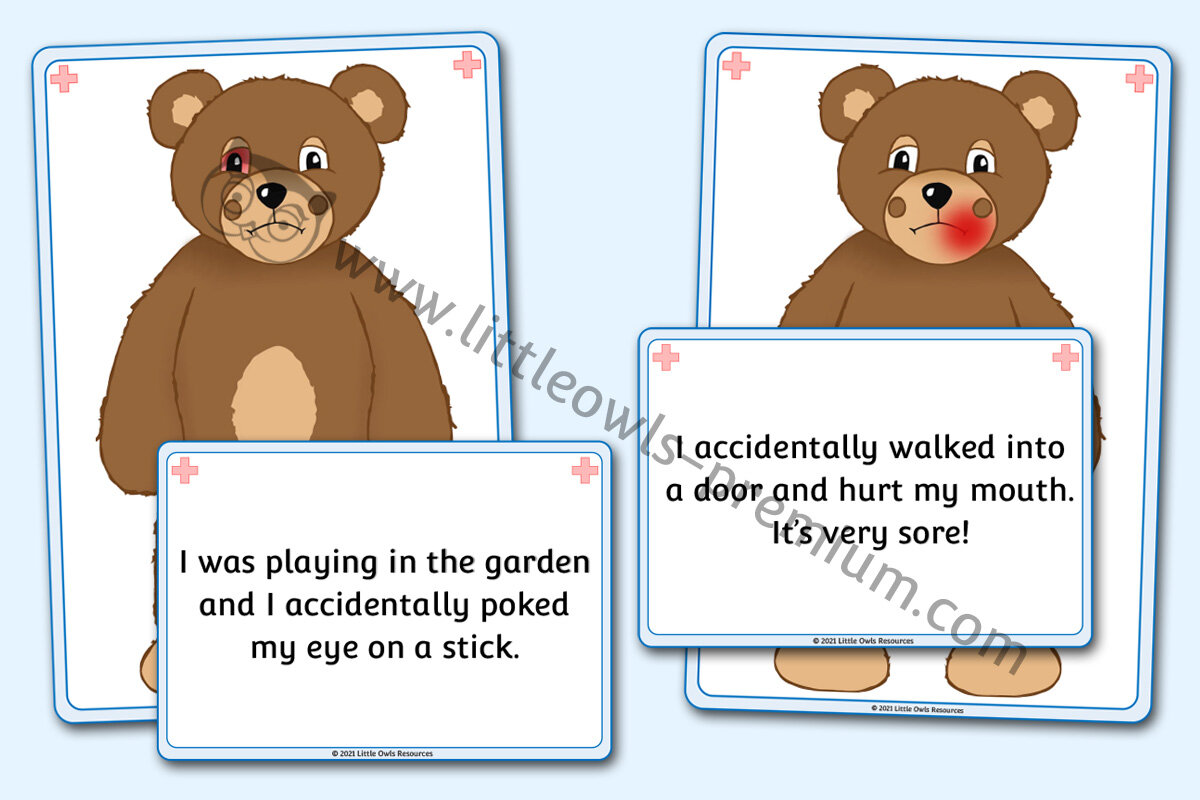
11 Poorly Teddy A4 Posters included. Ideal for using as part of a medical/doctors and nurses display or activities such as role-play or emergent writing.
Also perfect for a listening/problem solving/matching game activity. For example the 11 Poorly Teddy posters may be laid out in front of children. An adult can then select a description and read it to them. Children can listen carefully and select the correct poorly teddy picture to match with the illness/injury description they have heard.
Original artwork drawn by Sara Murphy and final digital resources created by Stuart Murphy. COPYRIGHT ON ALL OF THE RESOURCES HOUSED ON THIS WEBSITE IS HELD BY ‘LITTLE OWLS RESOURCES’. OUR RESOURCES (INCLUDING THE IMAGES WITHIN THEM), CANNOT BE SHARED OR SOLD COMMERCIALLY.
DOWNLOAD EDITABLE (DOCX)
DOWNLOAD NON-EDITABLE (PDF)
DOWNLOAD NON-EDITABLE (Zipped JPEGs)
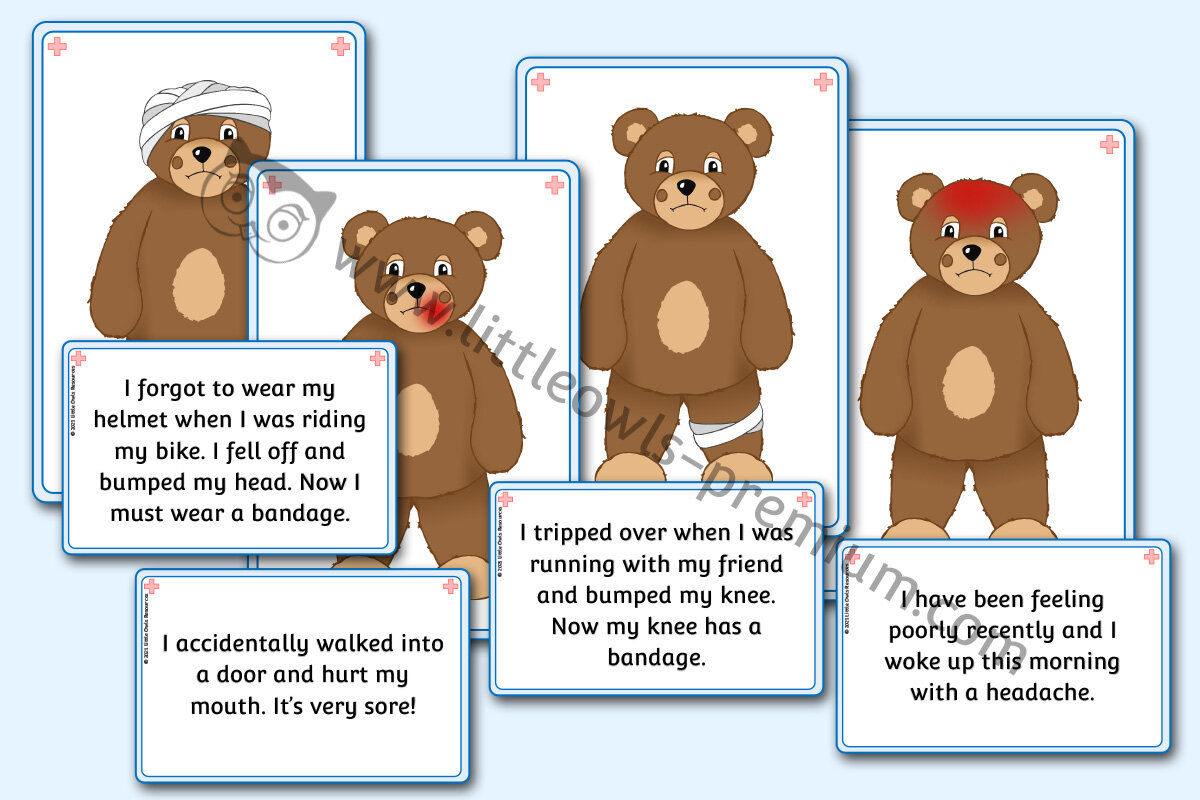
11 Poorly Teddy A5 Posters included. Ideal for using as part of a medical/doctors and nurses display or activities such as role-play or emergent writing.
Also perfect for a listening/problem solving/matching game activity. For example the 11 Poorly Teddy posters may be laid out in front of children. An adult can then select a description and read it to them. Children can listen carefully and select the correct poorly teddy picture to match with the illness/injury description they have heard.
Original artwork drawn by Sara Murphy and final digital resources created by Stuart Murphy. COPYRIGHT ON ALL OF THE RESOURCES HOUSED ON THIS WEBSITE IS HELD BY ‘LITTLE OWLS RESOURCES’. OUR RESOURCES (INCLUDING THE IMAGES WITHIN THEM), CANNOT BE SHARED OR SOLD COMMERCIALLY.
DOWNLOAD EDITABLE (DOCX)
DOWNLOAD NON-EDITABLE (PDF)
DOWNLOAD NON-EDITABLE (Zipped JPEGs)
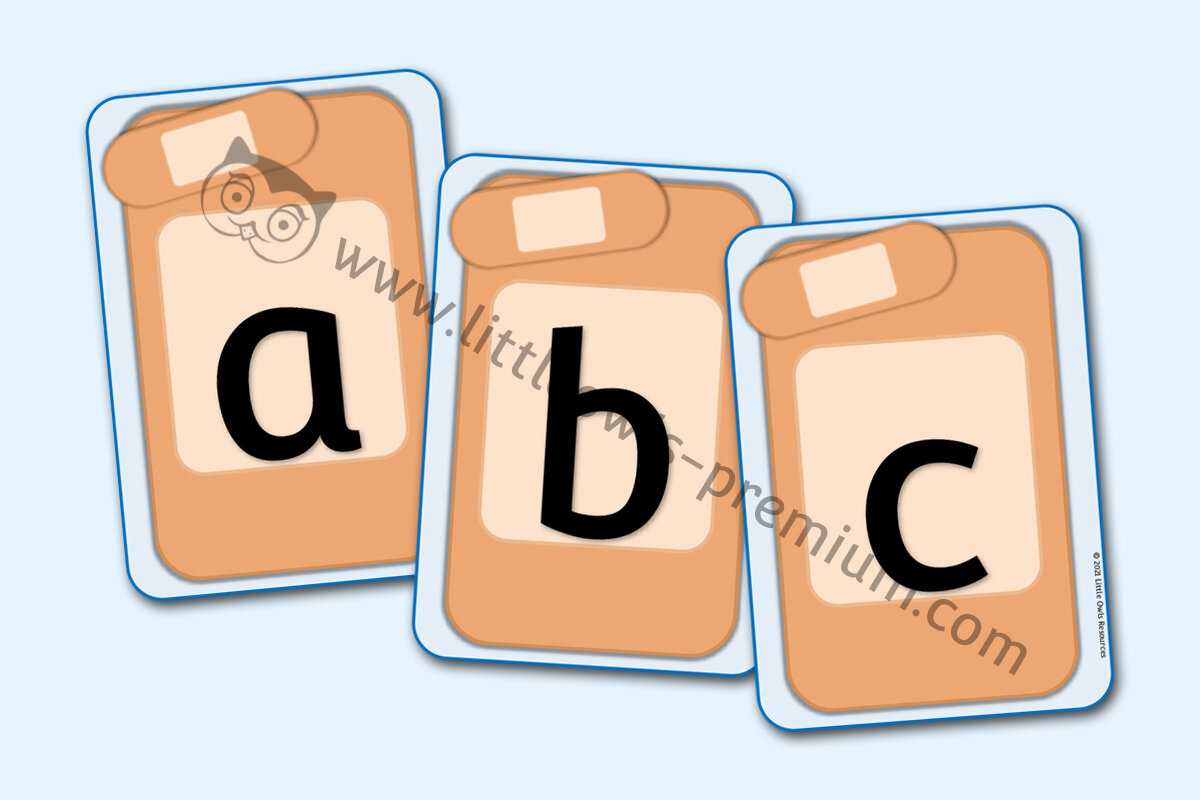
Plaster themed alphabet display. Print as it is for a display (A5 sized cards) or fewer for a set of plaster themed alphabet flashcards.
(Don’t forget you can use the editable docx file if you wish to change the font.)
Original artwork drawn by Sara Murphy and final digital resources created by Stuart Murphy. COPYRIGHT ON ALL OF THE RESOURCES HOUSED ON THIS WEBSITE IS HELD BY ‘LITTLE OWLS RESOURCES’. OUR RESOURCES (INCLUDING THE IMAGES WITHIN THEM), CANNOT BE SHARED OR SOLD COMMERCIALLY.
DOWNLOAD EDITABLE (DOCX)
DOWNLOAD NON-EDITABLE (PDF)
DOWNLOAD NON-EDITABLE (Zipped JPEGs)
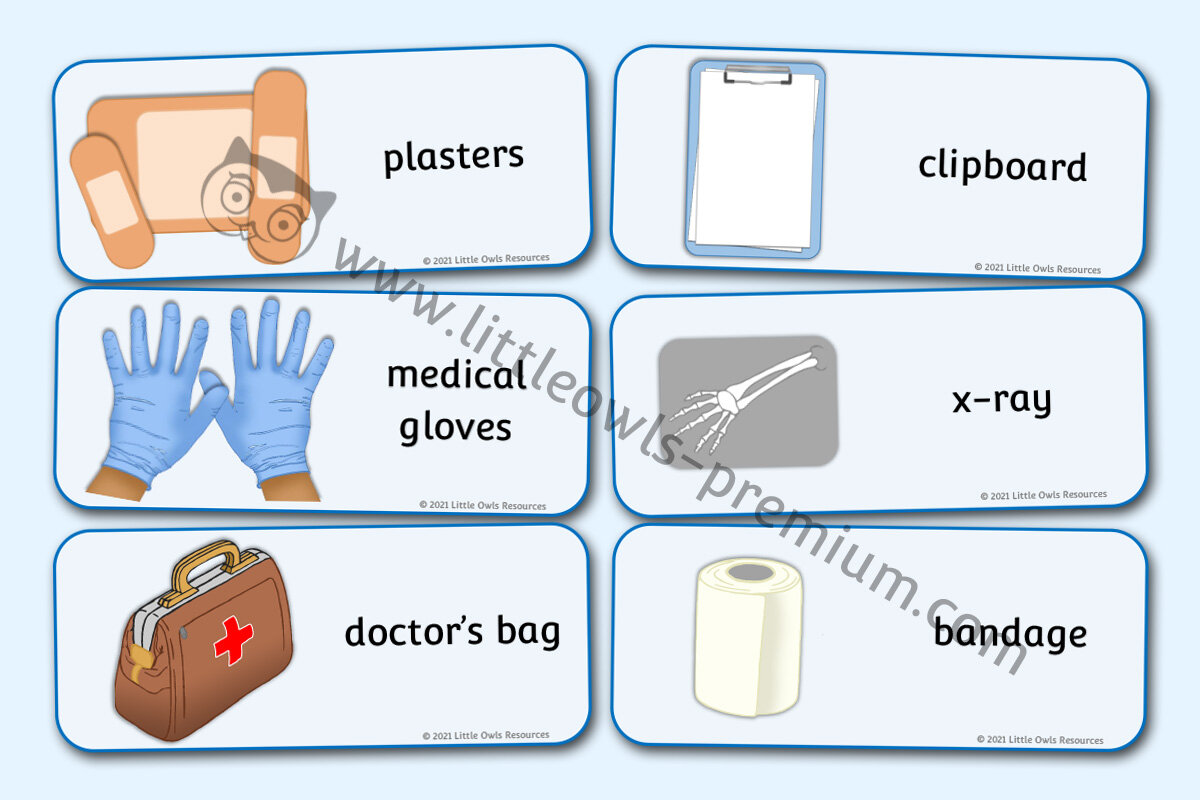
‘Medical’ word cards. Why not use in conjunction with our ‘Medical’ word mat? Can be used as part of a display or activities such as role-play or emergent writing.
Original artwork drawn by Sara Murphy and final digital resources created by Stuart Murphy. COPYRIGHT ON ALL OF THE RESOURCES HOUSED ON THIS WEBSITE IS HELD BY ‘LITTLE OWLS RESOURCES’. OUR RESOURCES (INCLUDING THE IMAGES WITHIN THEM), CANNOT BE SHARED OR SOLD COMMERCIALLY.
DOWNLOAD EDITABLE (DOCX)
DOWNLOAD NON-EDITABLE (PDF)
DOWNLOAD NON-EDITABLE (Zipped JPEGs)
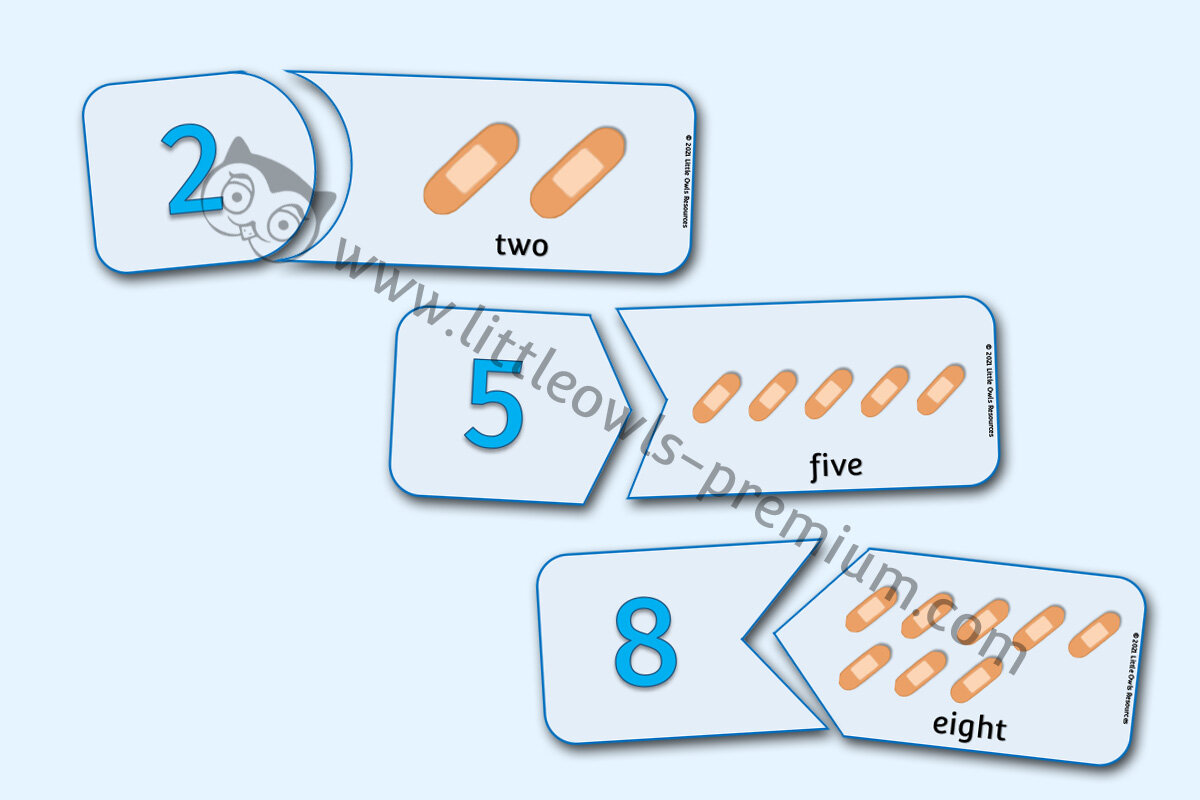
Why not set up an invitation to play using these ‘Plaster Counting Puzzles’?
Select those appropriate for your children (1-10 available) and allow them to match the number with the corresponding number of plasters. Each pair has a different way of connecting as a puzzle for the children to match and so even if they haven’t learnt what the number looks like yet, but are beginning to say the numbers in order, this can be a fun way to introduce them to new challenges.
Once the puzzles are complete, why not line the numbers up in order and count together? If your children would enjoy a further challenge, leave out a number and see if they can spot which one is missing from the sequence.
Puzzles could also be used as a fine motor control/counting activity if left uncut. Children could be given an appropriate number for their learning and encouraged to place objects on the plasters, counting as they go.
In addition, each number is also written as a word. For our youngest children, this adds to learning about text in the environment and how it has meaning. Our oldest children may start to recognise the words and associate them with the numbers. This will be beneficial for when they begin to read and write these words in subsequent years as they will have something to build on.
Original artwork drawn by Sara Murphy and final digital resources created by Stuart Murphy. COPYRIGHT ON ALL OF THE RESOURCES HOUSED ON THIS WEBSITE IS HELD BY ‘LITTLE OWLS RESOURCES’. OUR RESOURCES (INCLUDING THE IMAGES WITHIN THEM), CANNOT BE SHARED OR SOLD COMMERCIALLY.
DOWNLOAD EDITABLE (DOCX)
DOWNLOAD NON-EDITABLE (PDF)
DOWNLOAD NON-EDITABLE (Zipped JPEGs)
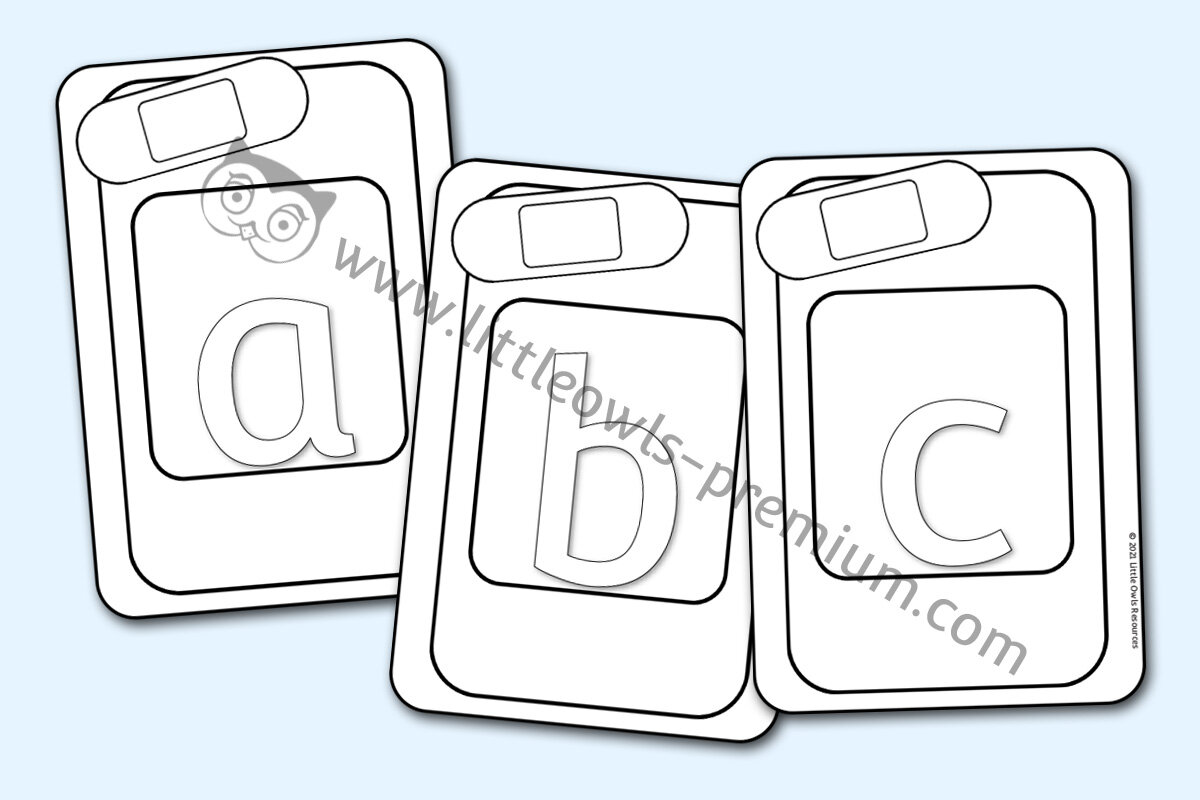
Plaster themed alphabet colouring.
(Don’t forget you can use the editable docx file if you wish to change the font.)
Original artwork drawn by Sara Murphy and final digital resources created by Stuart Murphy. COPYRIGHT ON ALL OF THE RESOURCES HOUSED ON THIS WEBSITE IS HELD BY ‘LITTLE OWLS RESOURCES’. OUR RESOURCES (INCLUDING THE IMAGES WITHIN THEM), CANNOT BE SHARED OR SOLD COMMERCIALLY.
DOWNLOAD EDITABLE (DOCX)
DOWNLOAD NON-EDITABLE (PDF)
DOWNLOAD NON-EDITABLE (Zipped JPEGs)
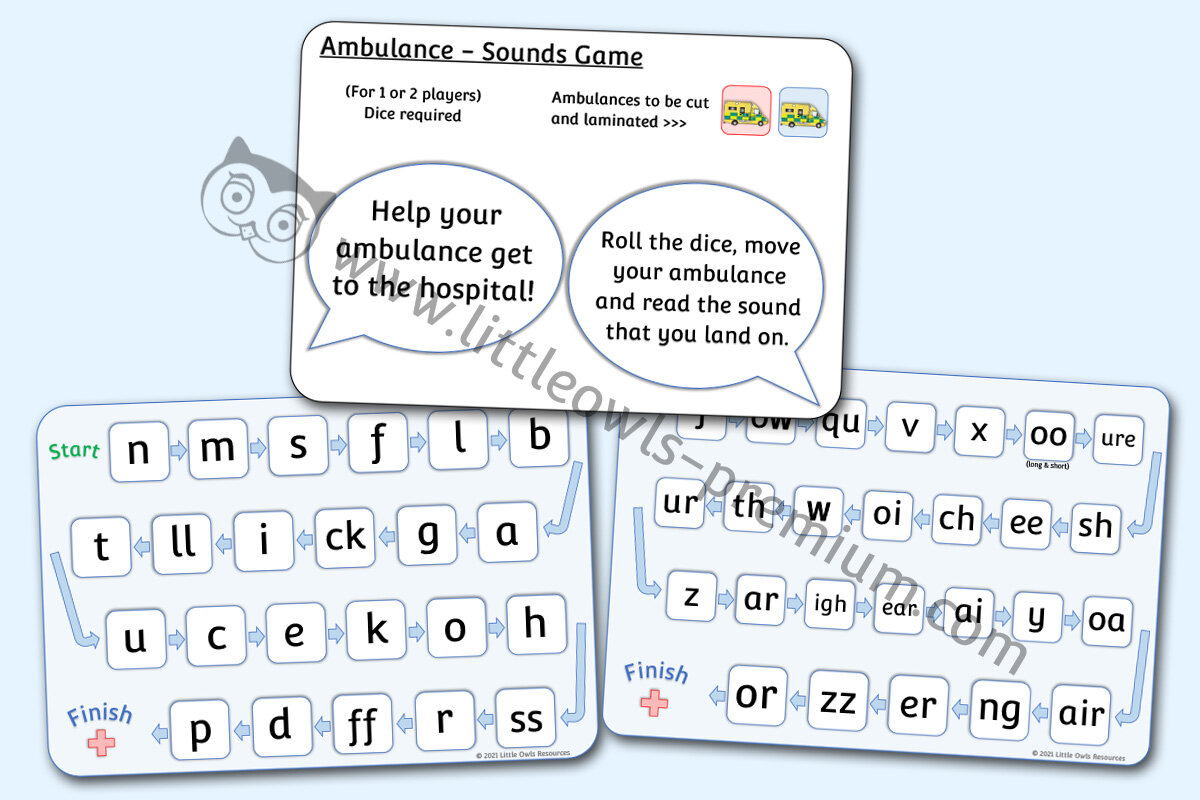
Help your ambulance to get to the hospital with this fun and engaging Letters and Sounds game.
Two different boards to choose from - one for Phase 2 Sounds and another for Phase 3 Sounds. Dice required.
Children choose an ambulance to place on the start, roll the dice and move the appropriate number of sound squares towards the hospital. When they land on a sound square they can practise saying the sound. Have fun!
(Don’t forget you can use the editable docx file if you wish to change the font.)
Original artwork drawn by Sara Murphy and final digital resources created by Stuart Murphy. COPYRIGHT ON ALL OF THE RESOURCES HOUSED ON THIS WEBSITE IS HELD BY ‘LITTLE OWLS RESOURCES’. OUR RESOURCES (INCLUDING THE IMAGES WITHIN THEM), CANNOT BE SHARED OR SOLD COMMERCIALLY.
DOWNLOAD EDITABLE (DOCX)
DOWNLOAD NON-EDITABLE (PDF)
DOWNLOAD NON-EDITABLE (Zipped JPEGs)
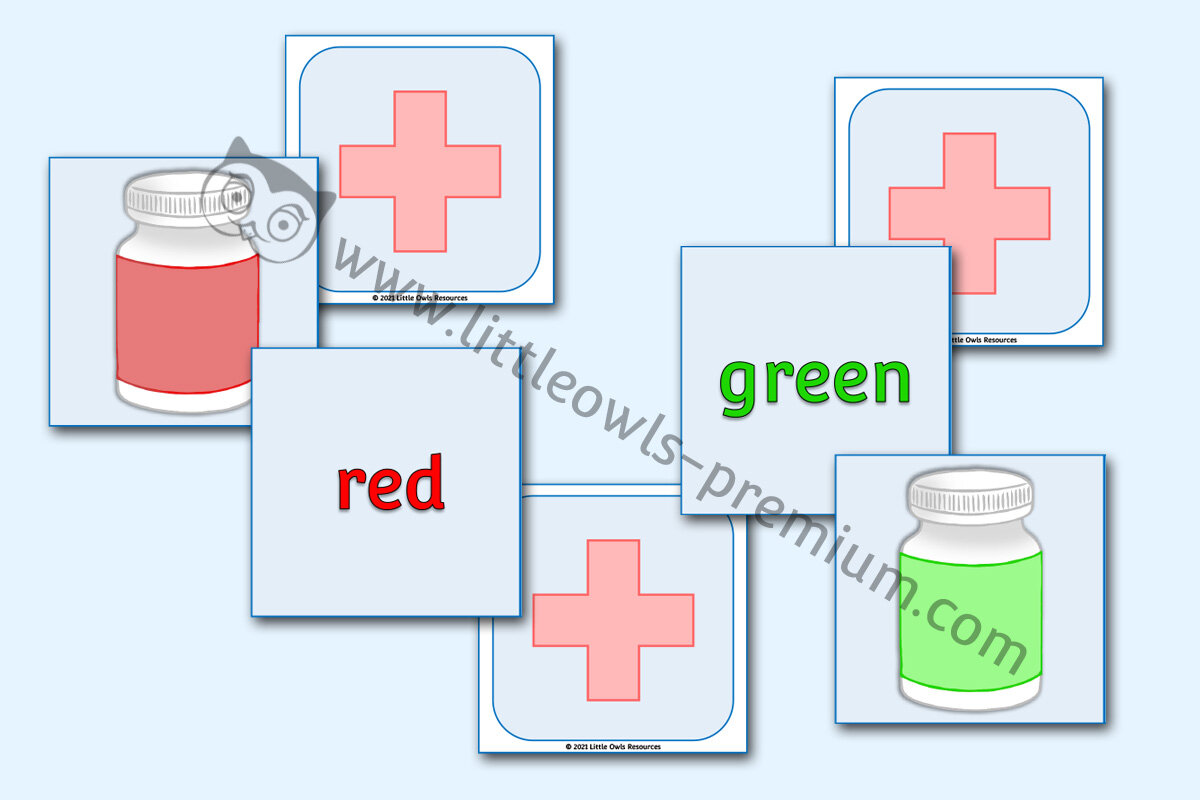
Set of 20 cards (10 colours). Use appropriate number of cards for your children in an invitation to play or adult led activity.
These cards may be used in a number of ways. Placed facing up on a table, children can simply match up the pairs placing them next to each other or alternatively, they may want to collect them as they go.
A further challenge could be a memory and turn taking game of ‘Picking up Pairs’. The cards are made with a tab which can be folded before lamination in order to strengthen the final product. This also means that when turned over, the pattern on the front can not be seen.
Original artwork drawn by Sara Murphy and final digital resources created by Stuart Murphy. COPYRIGHT ON ALL OF THE RESOURCES HOUSED ON THIS WEBSITE IS HELD BY ‘LITTLE OWLS RESOURCES’. OUR RESOURCES (INCLUDING THE IMAGES WITHIN THEM), CANNOT BE SHARED OR SOLD COMMERCIALLY.
DOWNLOAD EDITABLE (DOCX)
DOWNLOAD NON-EDITABLE (PDF)
DOWNLOAD NON-EDITABLE (Zipped JPEGs)
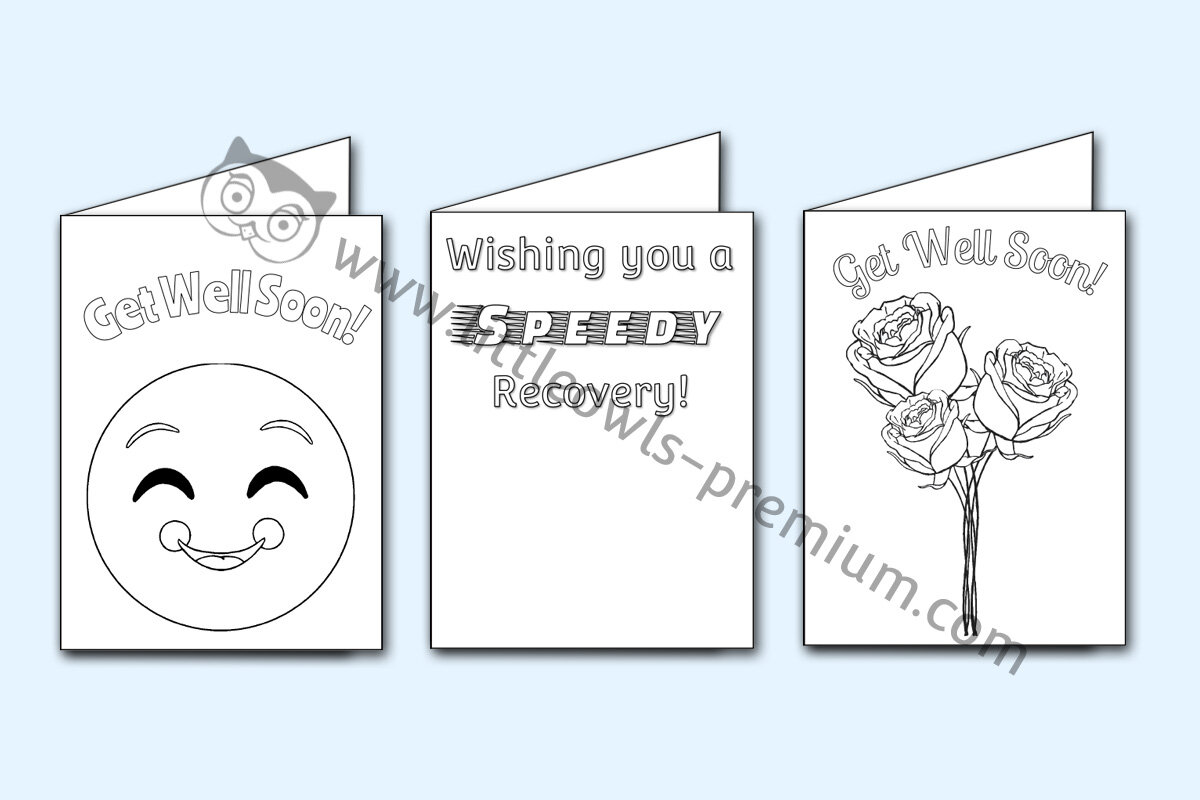
A selection of Get Well Soon Card Templates (vertical). These cards could be used as part of a focused adult led activity or left out as a more child led invitation to play activity as part of role-play.
Original artwork drawn by Sara Murphy and final digital resources created by Stuart Murphy. COPYRIGHT ON ALL OF THE RESOURCES HOUSED ON THIS WEBSITE IS HELD BY ‘LITTLE OWLS RESOURCES’. OUR RESOURCES (INCLUDING THE IMAGES WITHIN THEM), CANNOT BE SHARED OR SOLD COMMERCIALLY.
DOWNLOAD EDITABLE (DOCX)
DOWNLOAD NON-EDITABLE (PDF)
DOWNLOAD NON-EDITABLE (Zipped JPEGs)
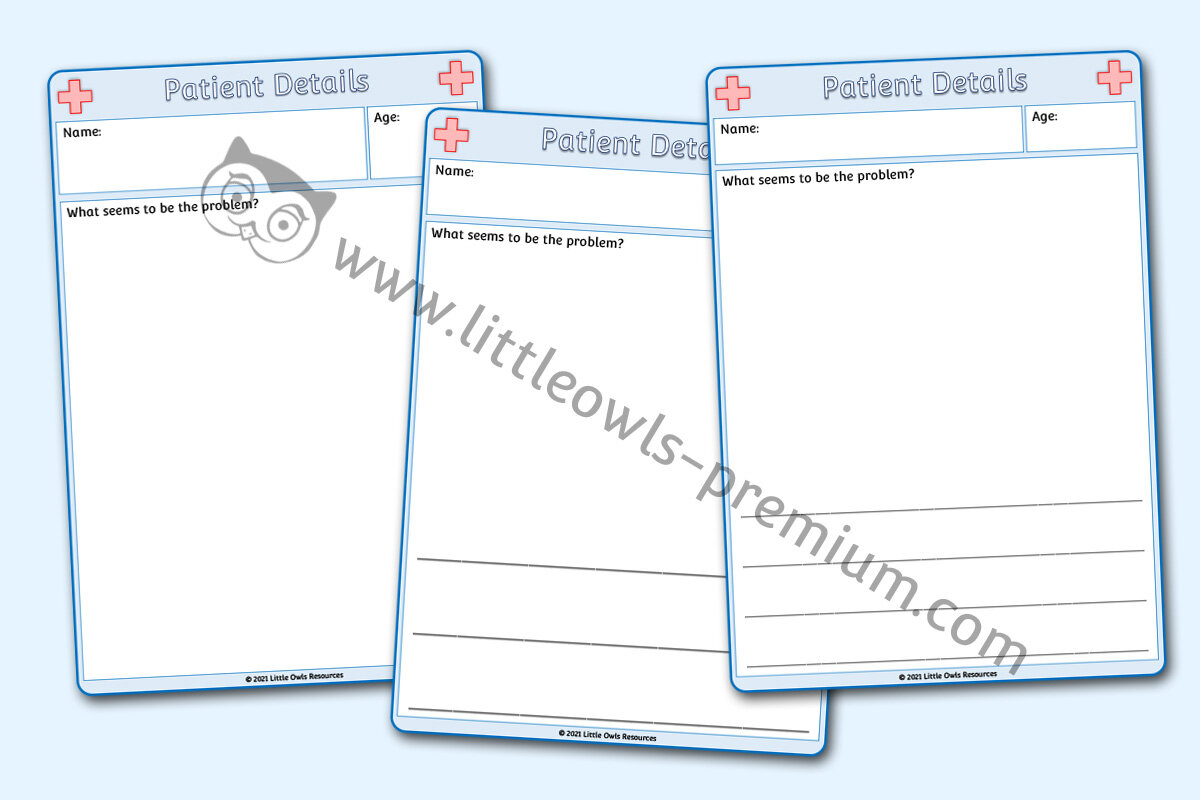
Original artwork drawn by Sara Murphy and final digital resources created by Stuart Murphy. COPYRIGHT ON ALL OF THE RESOURCES HOUSED ON THIS WEBSITE IS HELD BY ‘LITTLE OWLS RESOURCES’. OUR RESOURCES (INCLUDING THE IMAGES WITHIN THEM), CANNOT BE SHARED OR SOLD COMMERCIALLY.
DOWNLOAD EDITABLE (DOCX)
DOWNLOAD NON-EDITABLE (PDF)
DOWNLOAD NON-EDITABLE (Zipped JPEGs)
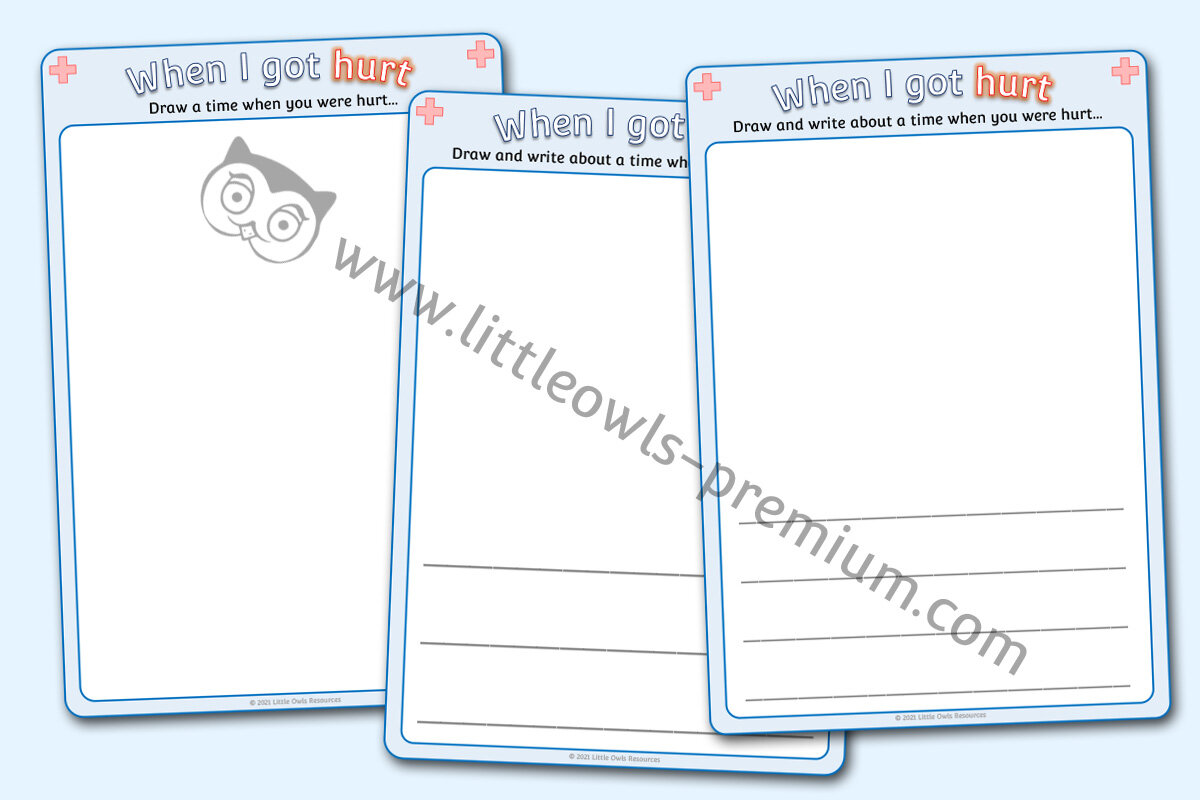
Original artwork drawn by Sara Murphy and final digital resources created by Stuart Murphy. COPYRIGHT ON ALL OF THE RESOURCES HOUSED ON THIS WEBSITE IS HELD BY ‘LITTLE OWLS RESOURCES’. OUR RESOURCES (INCLUDING THE IMAGES WITHIN THEM), CANNOT BE SHARED OR SOLD COMMERCIALLY.
DOWNLOAD EDITABLE (DOCX)
DOWNLOAD NON-EDITABLE (PDF)
DOWNLOAD NON-EDITABLE (Zipped JPEGs)
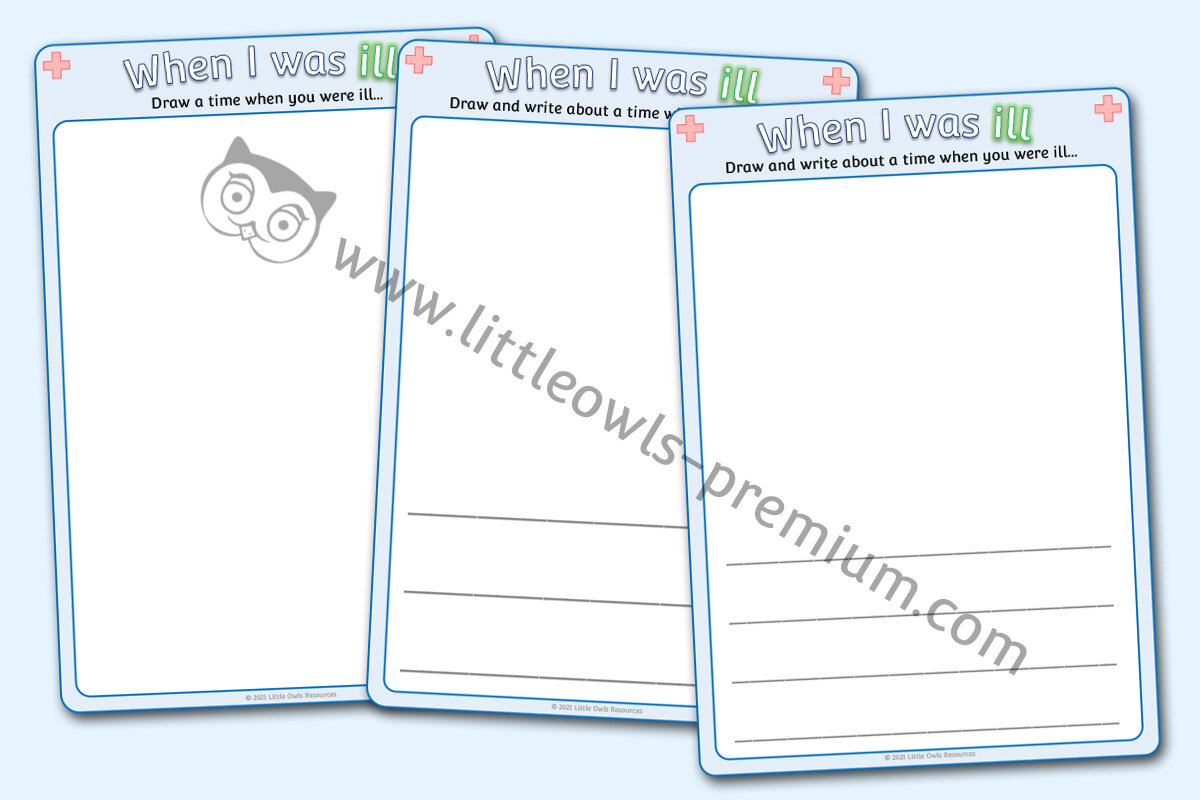
Original artwork drawn by Sara Murphy and final digital resources created by Stuart Murphy. COPYRIGHT ON ALL OF THE RESOURCES HOUSED ON THIS WEBSITE IS HELD BY ‘LITTLE OWLS RESOURCES’. OUR RESOURCES (INCLUDING THE IMAGES WITHIN THEM), CANNOT BE SHARED OR SOLD COMMERCIALLY.
DOWNLOAD EDITABLE (DOCX)
DOWNLOAD NON-EDITABLE (PDF)
DOWNLOAD NON-EDITABLE (Zipped JPEGs)
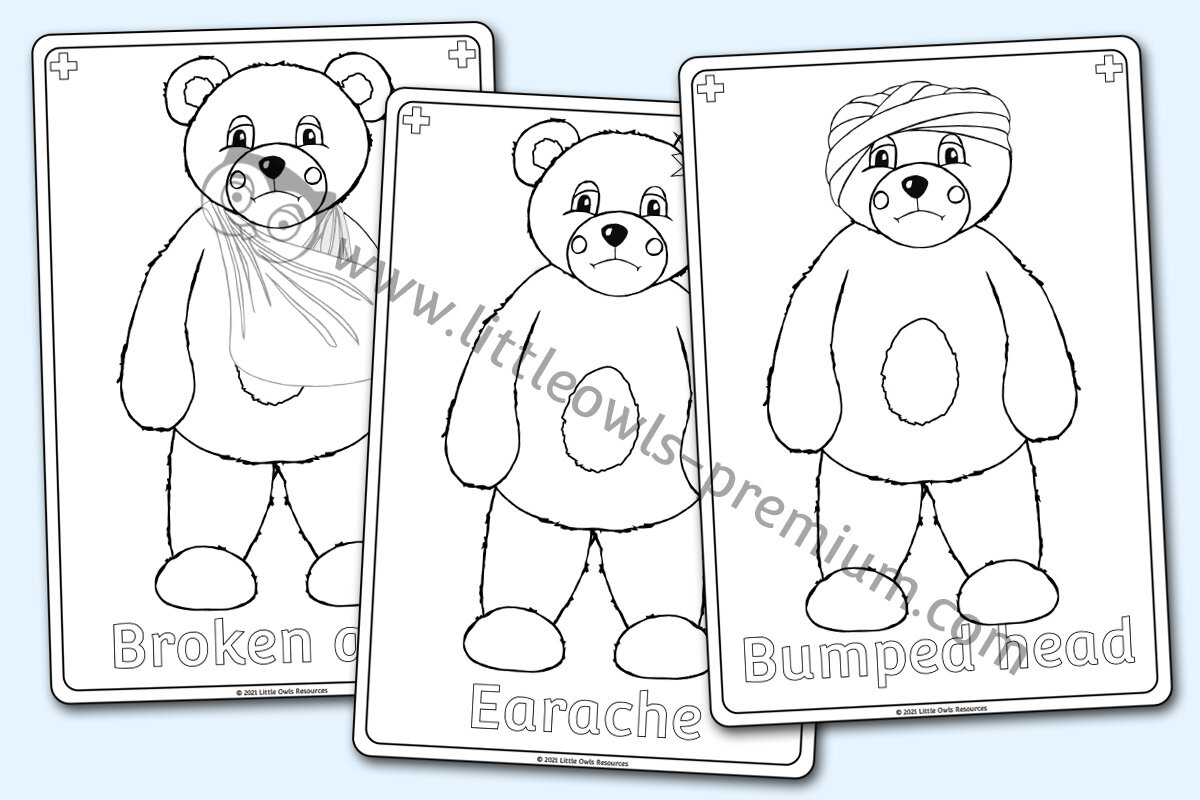
11 Poorly Teddy A4 Colouring Posters included. Ideal for using as part of a medical/doctors and nurses display or activities such as role-play or emergent writing.
Original artwork drawn by Sara Murphy and final digital resources created by Stuart Murphy. COPYRIGHT ON ALL OF THE RESOURCES HOUSED ON THIS WEBSITE IS HELD BY ‘LITTLE OWLS RESOURCES’. OUR RESOURCES (INCLUDING THE IMAGES WITHIN THEM), CANNOT BE SHARED OR SOLD COMMERCIALLY.
DOWNLOAD EDITABLE (DOCX)
DOWNLOAD NON-EDITABLE (PDF)
DOWNLOAD NON-EDITABLE (Zipped JPEGs)
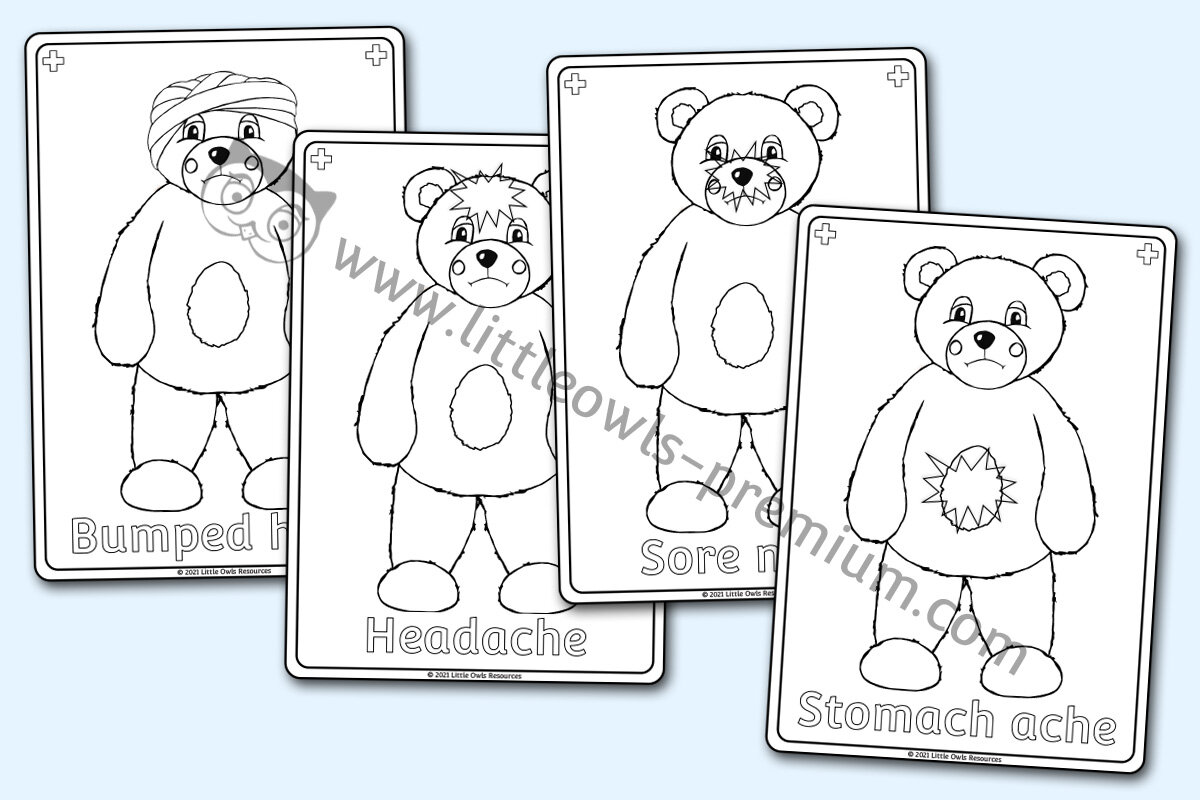
11 Poorly Teddy A5 Colouring Posters included. Ideal for using as part of a medical/doctors and nurses display or activities such as role-play or emergent writing.
Original artwork drawn by Sara Murphy and final digital resources created by Stuart Murphy. COPYRIGHT ON ALL OF THE RESOURCES HOUSED ON THIS WEBSITE IS HELD BY ‘LITTLE OWLS RESOURCES’. OUR RESOURCES (INCLUDING THE IMAGES WITHIN THEM), CANNOT BE SHARED OR SOLD COMMERCIALLY.
DOWNLOAD EDITABLE (DOCX)
DOWNLOAD NON-EDITABLE (PDF)
DOWNLOAD NON-EDITABLE (Zipped JPEGs)

Everything you need to set up a dentist role-play area!
Pack includes:
(Please note that words, etc. can be altered within the editable docx file version.)
‘The Dentist’ banner
Smiling mouth decorative signs
Dentist and Dental Assistant identity cards
‘Waiting Area’ Poster
Various ‘Brush your teeth’ Posters
Social distancing signs & floormats
‘Please wait’ footprint floormats
Dentist word mats
Dentist word cards
‘Welcome! Please sign in for your appointment’ sign for encouraging emergent writing
‘Open’ & ‘Closed’ signs
‘Dentist Opening Times’ Poster - Space to draw hands on clock and write times
‘Opens at…o’ clock’ and ‘Closes at…o’ clock’ signs - spaces for emergent writing
Templates for emergent writing (ideally laminated) - ‘Dentist Notes’, ‘Appointments’ & ‘Patient Details’ forms
‘For Sale’ Menu sign - Space to write prices by items
Items for sale prop cards
Original artwork drawn by Sara Murphy and final digital resources created by Stuart Murphy. COPYRIGHT ON ALL OF THE RESOURCES HOUSED ON THIS WEBSITE IS HELD BY ‘LITTLE OWLS RESOURCES’. OUR RESOURCES (INCLUDING THE IMAGES WITHIN THEM), CANNOT BE SHARED OR SOLD COMMERCIALLY.
DOWNLOAD EDITABLE (DOCX)
DOWNLOAD NON-EDITABLE (PDF)
DOWNLOAD NON-EDITABLE (Zipped JPEGs)
<<-BACK TO ‘TEETH AND ORAL HEALTH’ TOPIC MENU PAGE

Original artwork drawn by Sara Murphy and final digital resources created by Stuart Murphy. COPYRIGHT ON ALL OF THE RESOURCES HOUSED ON THIS WEBSITE IS HELD BY ‘LITTLE OWLS RESOURCES’. OUR RESOURCES (INCLUDING THE IMAGES WITHIN THEM), CANNOT BE SHARED OR SOLD COMMERCIALLY.
DOWNLOAD EDITABLE (DOCX)
DOWNLOAD NON-EDITABLE (PDF)
DOWNLOAD NON-EDITABLE (Zipped JPEGs)
<<-BACK TO ‘TEETH AND ORAL HEALTH’ TOPIC MENU PAGE

Original artwork drawn by Sara Murphy and final digital resources created by Stuart Murphy. COPYRIGHT ON ALL OF THE RESOURCES HOUSED ON THIS WEBSITE IS HELD BY ‘LITTLE OWLS RESOURCES’. OUR RESOURCES (INCLUDING THE IMAGES WITHIN THEM), CANNOT BE SHARED OR SOLD COMMERCIALLY.
DOWNLOAD EDITABLE (DOCX)
DOWNLOAD NON-EDITABLE (PDF)
DOWNLOAD NON-EDITABLE (Zipped JPEGs)
<<-BACK TO ‘TEETH AND ORAL HEALTH’ TOPIC MENU PAGE

Original artwork drawn by Sara Murphy and final digital resources created by Stuart Murphy. COPYRIGHT ON ALL OF THE RESOURCES HOUSED ON THIS WEBSITE IS HELD BY ‘LITTLE OWLS RESOURCES’. OUR RESOURCES (INCLUDING THE IMAGES WITHIN THEM), CANNOT BE SHARED OR SOLD COMMERCIALLY.
DOWNLOAD EDITABLE (DOCX)
DOWNLOAD NON-EDITABLE (PDF)
DOWNLOAD NON-EDITABLE (Zipped JPEGs)
<<-BACK TO ‘TEETH AND ORAL HEALTH’ TOPIC MENU PAGE

Original artwork drawn by Sara Murphy and final digital resources created by Stuart Murphy. COPYRIGHT ON ALL OF THE RESOURCES HOUSED ON THIS WEBSITE IS HELD BY ‘LITTLE OWLS RESOURCES’. OUR RESOURCES (INCLUDING THE IMAGES WITHIN THEM), CANNOT BE SHARED OR SOLD COMMERCIALLY.
DOWNLOAD EDITABLE (DOCX)
DOWNLOAD NON-EDITABLE (PDF)
DOWNLOAD NON-EDITABLE (Zipped JPEGs)
<<-BACK TO ‘TEETH AND ORAL HEALTH’ TOPIC MENU PAGE

Original artwork drawn by Sara Murphy and final digital resources created by Stuart Murphy. COPYRIGHT ON ALL OF THE RESOURCES HOUSED ON THIS WEBSITE IS HELD BY ‘LITTLE OWLS RESOURCES’. OUR RESOURCES (INCLUDING THE IMAGES WITHIN THEM), CANNOT BE SHARED OR SOLD COMMERCIALLY.
DOWNLOAD EDITABLE (DOCX)
DOWNLOAD NON-EDITABLE (PDF)
DOWNLOAD NON-EDITABLE (Zipped JPEGs)
<<-BACK TO ‘TEETH AND ORAL HEALTH’ TOPIC MENU PAGE

Original artwork drawn by Sara Murphy and final digital resources created by Stuart Murphy. COPYRIGHT ON ALL OF THE RESOURCES HOUSED ON THIS WEBSITE IS HELD BY ‘LITTLE OWLS RESOURCES’. OUR RESOURCES (INCLUDING THE IMAGES WITHIN THEM), CANNOT BE SHARED OR SOLD COMMERCIALLY.
DOWNLOAD EDITABLE (DOCX)
DOWNLOAD NON-EDITABLE (PDF)
DOWNLOAD NON-EDITABLE (Zipped JPEGs)
<<-BACK TO ‘TEETH AND ORAL HEALTH’ TOPIC MENU PAGE

Original artwork drawn by Sara Murphy and final digital resources created by Stuart Murphy. COPYRIGHT ON ALL OF THE RESOURCES HOUSED ON THIS WEBSITE IS HELD BY ‘LITTLE OWLS RESOURCES’. OUR RESOURCES (INCLUDING THE IMAGES WITHIN THEM), CANNOT BE SHARED OR SOLD COMMERCIALLY.
DOWNLOAD EDITABLE (DOCX)
DOWNLOAD NON-EDITABLE (PDF)
DOWNLOAD NON-EDITABLE (Zipped JPEGs)
<<-BACK TO ‘TEETH AND ORAL HEALTH’ TOPIC MENU PAGE
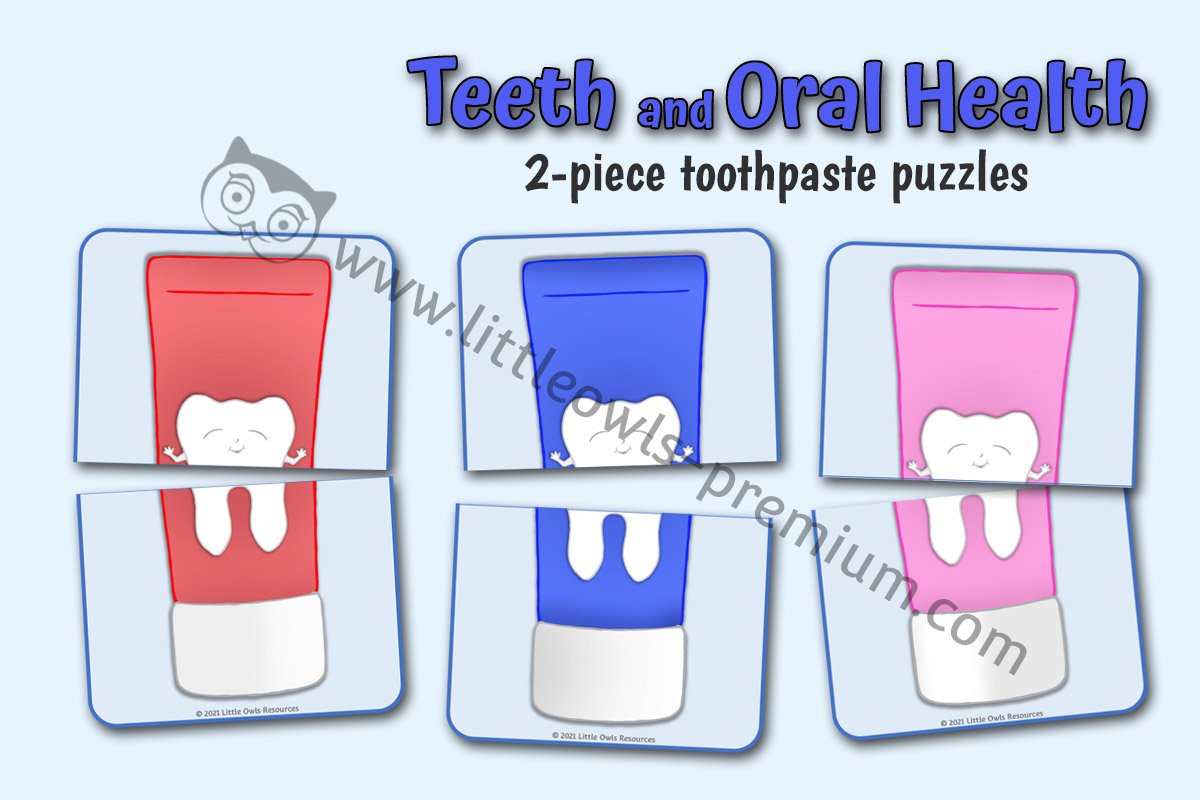
Original artwork drawn by Sara Murphy and final digital resources created by Stuart Murphy. COPYRIGHT ON ALL OF THE RESOURCES HOUSED ON THIS WEBSITE IS HELD BY ‘LITTLE OWLS RESOURCES’. OUR RESOURCES (INCLUDING THE IMAGES WITHIN THEM), CANNOT BE SHARED OR SOLD COMMERCIALLY.
DOWNLOAD EDITABLE (DOCX)
DOWNLOAD NON-EDITABLE (PDF)
DOWNLOAD NON-EDITABLE (Zipped JPEGs)
<<-BACK TO ‘TEETH AND ORAL HEALTH’ TOPIC MENU PAGE

Designed as part of the ‘Teeth and Oral Health’ topic, this pack of sheets can be used for multiple learning intentions. For example…
Learning about the need to brush our teeth
Development of fine motor control using mark making tools
Refining observational skills
Improving concentration
Communication and Language development
Ideal for multiple uses with whiteboard pens after lamination.
Original artwork drawn by Sara Murphy and final digital resources created by Stuart Murphy. COPYRIGHT ON ALL OF THE RESOURCES HOUSED ON THIS WEBSITE IS HELD BY ‘LITTLE OWLS RESOURCES’. OUR RESOURCES (INCLUDING THE IMAGES WITHIN THEM), CANNOT BE SHARED OR SOLD COMMERCIALLY.
DOWNLOAD EDITABLE (DOCX)
DOWNLOAD NON-EDITABLE (PDF)
DOWNLOAD NON-EDITABLE (Zipped JPEGs)
<<-BACK TO ‘TEETH AND ORAL HEALTH’ TOPIC MENU PAGE
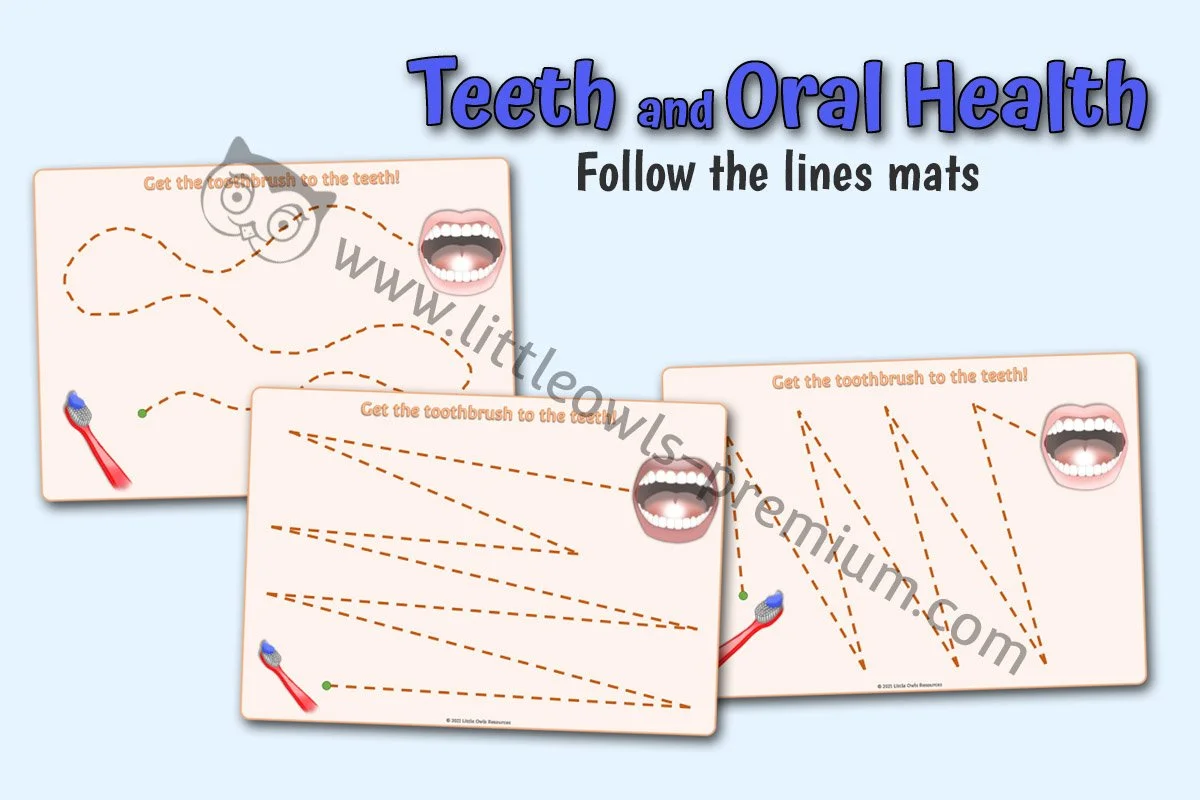
Designed as part of the ‘Teeth and Oral Health’ topic, this pack of mats can be used for multiple learning intentions. For example…
Learning about the need to brush our teeth
Development of fine motor control using mark making tools
Refining observational skills
Improving concentration
Communication and Language development
Ideal for multiple uses with whiteboard pens after lamination.
Original artwork drawn by Sara Murphy and final digital resources created by Stuart Murphy. COPYRIGHT ON ALL OF THE RESOURCES HOUSED ON THIS WEBSITE IS HELD BY ‘LITTLE OWLS RESOURCES’. OUR RESOURCES (INCLUDING THE IMAGES WITHIN THEM), CANNOT BE SHARED OR SOLD COMMERCIALLY.
DOWNLOAD EDITABLE (DOCX)
DOWNLOAD NON-EDITABLE (PDF)
DOWNLOAD NON-EDITABLE (Zipped JPEGs)
<<-BACK TO ‘TEETH AND ORAL HEALTH’ TOPIC MENU PAGE

Help your toothbrush to clean the teeth with this fun and engaging Letters and Sounds game. Two different boards to choose from - one for Phase 2 Sounds and another for Phase 3 Sounds. Dice required. Children choose a toothbrush to place on the teeth that need cleaning at the top of the board, roll the dice and move the appropriate number of sound squares towards the clean teeth at the bottom. When they land on a sound square they can practise saying the sound. Have fun!
Original artwork drawn by Sara Murphy and final digital resources created by Stuart Murphy. COPYRIGHT ON ALL OF THE RESOURCES HOUSED ON THIS WEBSITE IS HELD BY ‘LITTLE OWLS RESOURCES’. OUR RESOURCES (INCLUDING THE IMAGES WITHIN THEM), CANNOT BE SHARED OR SOLD COMMERCIALLY.
DOWNLOAD EDITABLE (DOCX)
DOWNLOAD NON-EDITABLE (PDF)
DOWNLOAD NON-EDITABLE (Zipped JPEGs)
<<-BACK TO ‘TEETH AND ORAL HEALTH’ TOPIC MENU PAGE

Challenge your children to cut out the teeth shapes and stick them to the corresponding numbers on the mouth template provided. Great for fine motor control, scissor skills, number recognition and number ordering.
Original artwork drawn by Sara Murphy and final digital resources created by Stuart Murphy. COPYRIGHT ON ALL OF THE RESOURCES HOUSED ON THIS WEBSITE IS HELD BY ‘LITTLE OWLS RESOURCES’. OUR RESOURCES (INCLUDING THE IMAGES WITHIN THEM), CANNOT BE SHARED OR SOLD COMMERCIALLY.
DOWNLOAD EDITABLE (DOCX)
DOWNLOAD NON-EDITABLE (PDF)
DOWNLOAD NON-EDITABLE (Zipped JPEGs)
<<-BACK TO ‘TEETH AND ORAL HEALTH’ TOPIC MENU PAGE
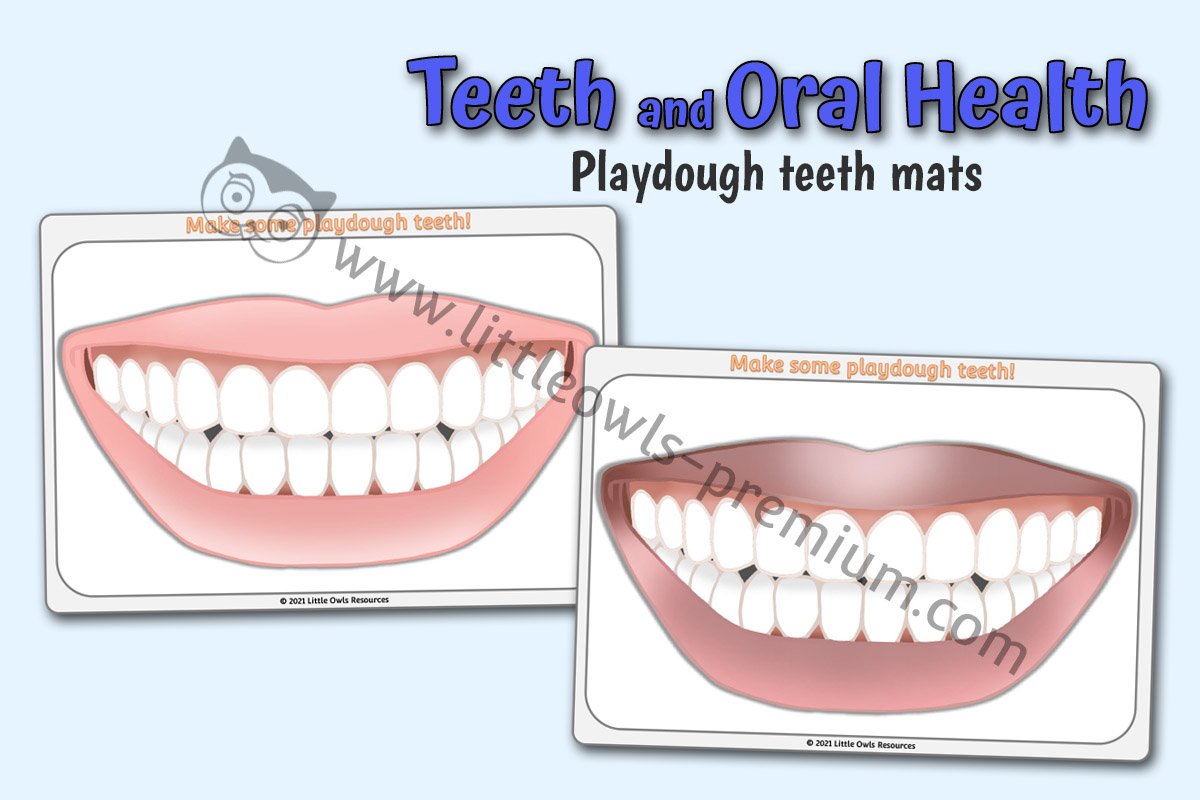
Encourage your child(ren) to make some teeth out of playdough to place on these mouth template mats.
Original artwork drawn by Sara Murphy and final digital resources created by Stuart Murphy. COPYRIGHT ON ALL OF THE RESOURCES HOUSED ON THIS WEBSITE IS HELD BY ‘LITTLE OWLS RESOURCES’. OUR RESOURCES (INCLUDING THE IMAGES WITHIN THEM), CANNOT BE SHARED OR SOLD COMMERCIALLY.
DOWNLOAD EDITABLE (DOCX)
DOWNLOAD NON-EDITABLE (PDF)
DOWNLOAD NON-EDITABLE (Zipped JPEGs)
<<-BACK TO ‘TEETH AND ORAL HEALTH’ TOPIC MENU PAGE

Original artwork drawn by Sara Murphy and final digital resources created by Stuart Murphy. COPYRIGHT ON ALL OF THE RESOURCES HOUSED ON THIS WEBSITE IS HELD BY ‘LITTLE OWLS RESOURCES’. OUR RESOURCES (INCLUDING THE IMAGES WITHIN THEM), CANNOT BE SHARED OR SOLD COMMERCIALLY.
DOWNLOAD EDITABLE (DOCX)
DOWNLOAD NON-EDITABLE (PDF)
DOWNLOAD NON-EDITABLE (Zipped JPEGs)
<<-BACK TO ‘TEETH AND ORAL HEALTH’ TOPIC MENU PAGE
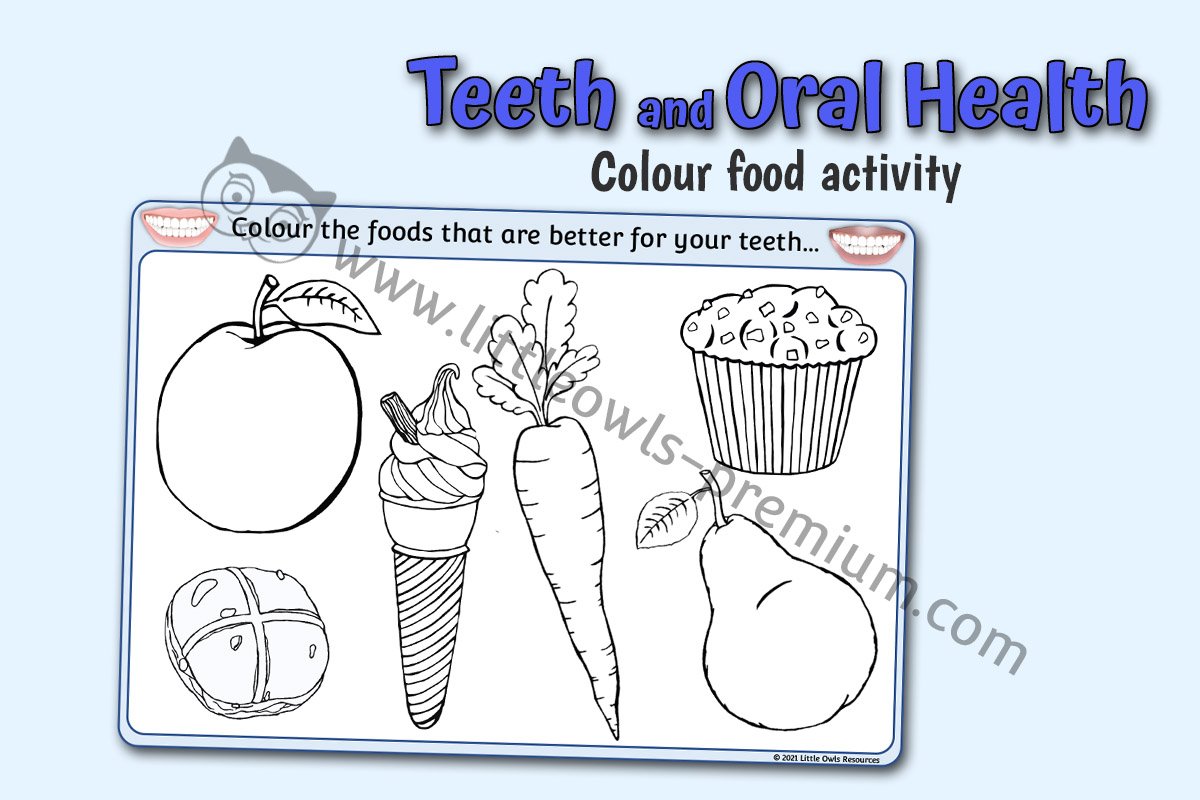
Original artwork drawn by Sara Murphy and final digital resources created by Stuart Murphy. COPYRIGHT ON ALL OF THE RESOURCES HOUSED ON THIS WEBSITE IS HELD BY ‘LITTLE OWLS RESOURCES’. OUR RESOURCES (INCLUDING THE IMAGES WITHIN THEM), CANNOT BE SHARED OR SOLD COMMERCIALLY.
DOWNLOAD EDITABLE (DOCX)
DOWNLOAD NON-EDITABLE (PDF)
DOWNLOAD NON-EDITABLE (Zipped JPEGs)
<<-BACK TO ‘TEETH AND ORAL HEALTH’ TOPIC MENU PAGE

Original artwork drawn by Sara Murphy and final digital resources created by Stuart Murphy. COPYRIGHT ON ALL OF THE RESOURCES HOUSED ON THIS WEBSITE IS HELD BY ‘LITTLE OWLS RESOURCES’. OUR RESOURCES (INCLUDING THE IMAGES WITHIN THEM), CANNOT BE SHARED OR SOLD COMMERCIALLY.
DOWNLOAD EDITABLE (DOCX)
DOWNLOAD NON-EDITABLE (PDF)
DOWNLOAD NON-EDITABLE (Zipped JPEGs)
<<-BACK TO ‘TEETH AND ORAL HEALTH’ TOPIC MENU PAGE

Original artwork drawn by Sara Murphy and final digital resources created by Stuart Murphy. COPYRIGHT ON ALL OF THE RESOURCES HOUSED ON THIS WEBSITE IS HELD BY ‘LITTLE OWLS RESOURCES’. OUR RESOURCES (INCLUDING THE IMAGES WITHIN THEM), CANNOT BE SHARED OR SOLD COMMERCIALLY.
DOWNLOAD EDITABLE (DOCX)
DOWNLOAD NON-EDITABLE (PDF)
DOWNLOAD NON-EDITABLE (Zipped JPEGs)
<<-BACK TO ‘TEETH AND ORAL HEALTH’ TOPIC MENU PAGE

2-Piece ‘Glasses’ puzzles. Can be used as an engaging part of structured activity or left out as an invitation to play.
Children look at each of the puzzle pieces and work out which of them match to make a pair of glasses or sunglasses. 16 puzzles included. Various colours, styles and designs. Great for developing observational skills and a knowledge of symmetry.
Original artwork drawn by Sara Murphy and final digital resources created by Stuart Murphy. COPYRIGHT ON ALL OF THE RESOURCES HOUSED ON THIS WEBSITE IS HELD BY ‘LITTLE OWLS RESOURCES’. OUR RESOURCES (INCLUDING THE IMAGES WITHIN THEM), CANNOT BE SHARED OR SOLD COMMERCIALLY.
DOWNLOAD EDITABLE (DOCX)
DOWNLOAD NON-EDITABLE (PDF)
DOWNLOAD NON-EDITABLE (Zipped JPEGs)

Poster entitled 'Keep Your Eyes Healthy!' Includes advice for how children can keep their eyes healthy:
Drink plenty of water
Get some exercise
Eat healthy foods
Get a good night’s sleep
Wear sunglasses in sunny weather
Original artwork drawn by Sara Murphy and final digital resources created by Stuart Murphy. COPYRIGHT ON ALL OF THE RESOURCES HOUSED ON THIS WEBSITE IS HELD BY ‘LITTLE OWLS RESOURCES’. OUR RESOURCES (INCLUDING THE IMAGES WITHIN THEM), CANNOT BE SHARED OR SOLD COMMERCIALLY.
DOWNLOAD EDITABLE (DOCX)
DOWNLOAD NON-EDITABLE (PDF)
DOWNLOAD NON-EDITABLE (Zipped JPEGs)

Eye health related word cards:
eye charts
optometrist
ophthalmoscope
eye-drops
computer
clipboard
eyes
glasses
sunglasses
Original artwork drawn by Sara Murphy and final digital resources created by Stuart Murphy. COPYRIGHT ON ALL OF THE RESOURCES HOUSED ON THIS WEBSITE IS HELD BY ‘LITTLE OWLS RESOURCES’. OUR RESOURCES (INCLUDING THE IMAGES WITHIN THEM), CANNOT BE SHARED OR SOLD COMMERCIALLY.
DOWNLOAD EDITABLE (DOCX)
DOWNLOAD NON-EDITABLE (PDF)
DOWNLOAD NON-EDITABLE (Zipped JPEGs)

Eye health related words included on Optometrist Word Mat:
eye charts
optometrist
ophthalmoscope
eye-drops
computer
clipboard
eyes
glasses
sunglasses
Original artwork drawn by Sara Murphy and final digital resources created by Stuart Murphy. COPYRIGHT ON ALL OF THE RESOURCES HOUSED ON THIS WEBSITE IS HELD BY ‘LITTLE OWLS RESOURCES’. OUR RESOURCES (INCLUDING THE IMAGES WITHIN THEM), CANNOT BE SHARED OR SOLD COMMERCIALLY.
DOWNLOAD EDITABLE (DOCX)
DOWNLOAD NON-EDITABLE (PDF)
DOWNLOAD NON-EDITABLE (Zipped JPEGs)
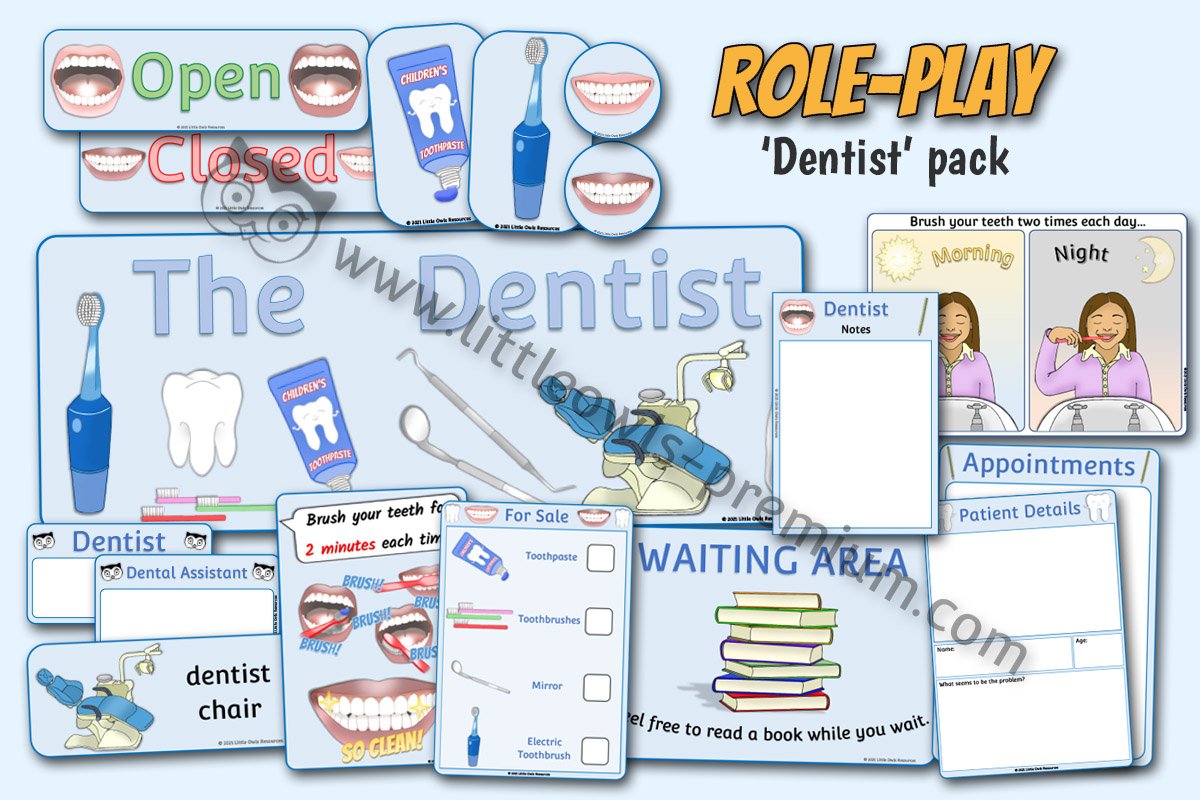
Everything you need to set up a dentist role-play area!
Pack includes:
(Please note that words, etc. can be altered within the editable docx file version.)
‘The Dentist’ banner
Smiling mouth decorative signs
Dentist and Dental Assistant identity cards - Name Writing
‘Waiting Area’ Poster
Various ‘Brush your teeth’ Posters
Social distancing signs & floormats
‘Please wait’ footprint floormats
Dentist word mats
Dentist word cards
‘Welcome! Please sign in for your appointment’ sign for encouraging emergent writing
‘Open’ & ‘Closed’ signs
‘Dentist Opening Times’ Poster - Space to draw hands on clock and write times
‘Opens at…o’ clock’ and ‘Closes at…o’ clock’ signs - spaces for emergent writing
Templates for emergent writing (ideally laminated) - ‘Dentist Notes’, ‘Appointments’ & ‘Patient Details’ forms
‘For Sale’ Menu sign - Space to write prices by items
Items for sale prop cards
Original artwork drawn by Sara Murphy and final digital resources created by Stuart Murphy. COPYRIGHT ON ALL OF THE RESOURCES HOUSED ON THIS WEBSITE IS HELD BY ‘LITTLE OWLS RESOURCES’. OUR RESOURCES (INCLUDING THE IMAGES WITHIN THEM), CANNOT BE SHARED OR SOLD COMMERCIALLY.
DOWNLOAD EDITABLE (DOCX)
DOWNLOAD NON-EDITABLE (PDF)
DOWNLOAD NON-EDITABLE (Zipped JPEGs)
<<-BACK TO ‘TEETH AND ORAL HEALTH’ TOPIC MENU
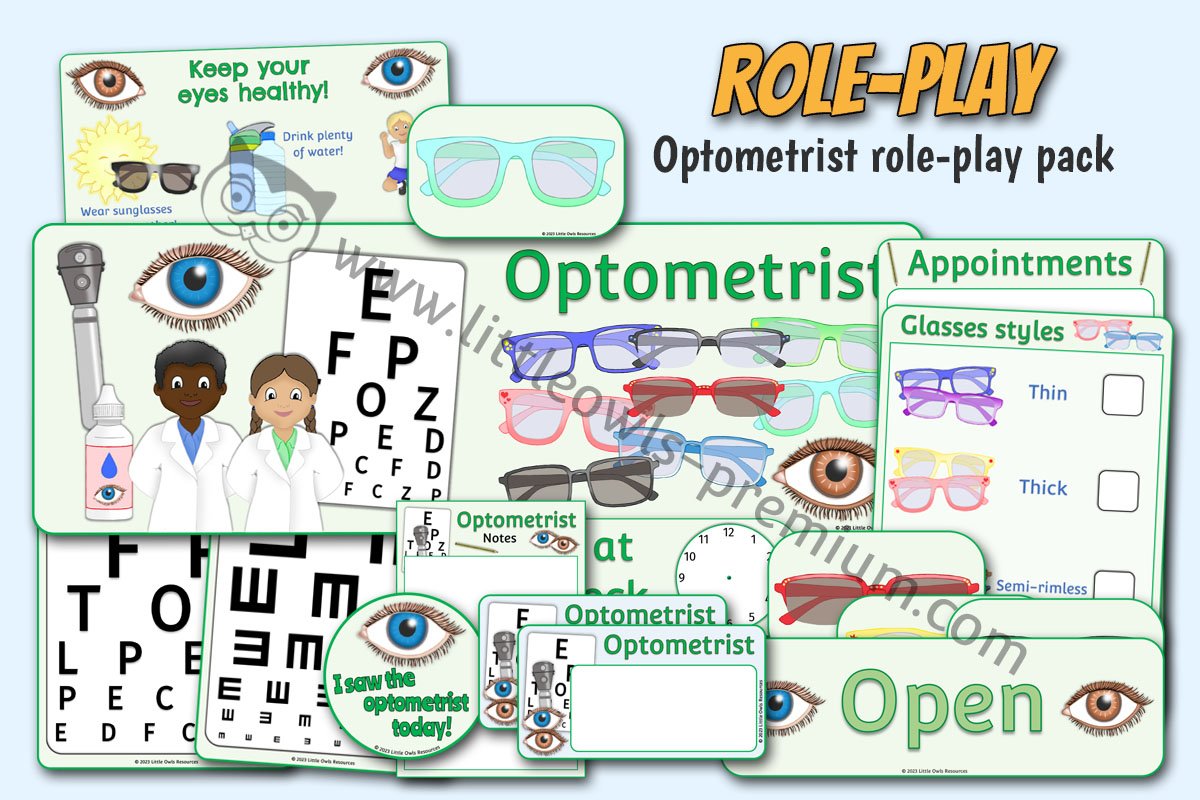
Everything you need to set up an optometrist role-play area!
Pack includes:
(Please note that words, etc. can be altered within the editable docx file version.)
‘Optometrist’ banner
‘I saw the optometrist today!’ badges
Optometrist and Optician identity cards - Name Writing
‘Waiting Area’ and ‘Please Wait’ Posters/Signs
‘Keep your eyes healthy’ Poster
Optometrist word mats
Optometrist word cards
‘Welcome! Please sign in for your appointment’ sign for encouraging emergent writing
‘Open’ & ‘Closed’ signs
‘Optometrist Opening Times’ Poster - Space to draw hands on clock and write times
‘Opens at…o’ clock’ and ‘Closes at…o’ clock’ signs - spaces for emergent writing
Templates for emergent writing - ‘Optometrist Notes’, ‘Appointments’ & ‘Patient Details’ forms
Eye charts x3
Glasses Styles tick sheet
Glass and Sunglasses prop cards x16
Original artwork drawn by Sara Murphy and final digital resources created by Stuart Murphy. COPYRIGHT ON ALL OF THE RESOURCES HOUSED ON THIS WEBSITE IS HELD BY ‘LITTLE OWLS RESOURCES’. OUR RESOURCES (INCLUDING THE IMAGES WITHIN THEM), CANNOT BE SHARED OR SOLD COMMERCIALLY.
DOWNLOAD EDITABLE (DOCX)
DOWNLOAD NON-EDITABLE (PDF)
DOWNLOAD NON-EDITABLE (Zipped JPEGs)
<<-BACK TO ‘EYE HEALTH’ TOPIC MENU
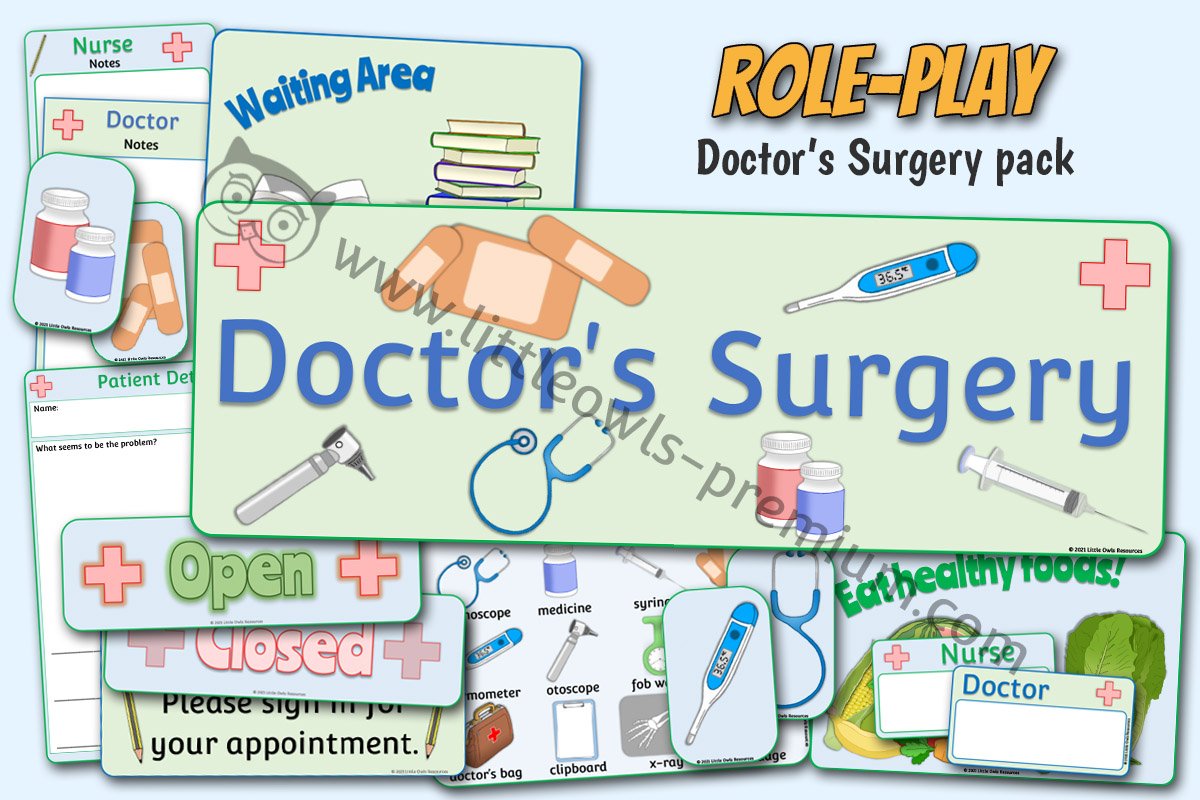
Everything you need to set up a doctor’s surgery role-play area!
Pack includes:
(Please note that words, etc. can be altered within the editable docx file version.)
‘Doctor’s Surgery’ banner
First Aid Red Cross signs
Doctor and Nurse identity cards - Name Writing
‘Waiting Area’ Poster
Various Posters promoting ‘Good Health’
Social distancing signs & floormats
‘Please wait’ footprint floormats
Medical word mat
Medical word cards
‘Welcome! Please sign in for your appointment’ sign for encouraging emergent writing
‘Open’ & ‘Closed’ signs
‘Surgery Opening Times’ Poster - Space to draw hands on clock and write times
‘Opens at…o’ clock’ and ‘Closes at…o’ clock’ signs - spaces for emergent writing
Templates for emergent writing (ideally laminated) - ‘Doctor Notes’, ‘Nurse Notes’, ‘Appointments’ & ‘Patient Details’ forms
Clipboard template for mark making
Role-Play Prop cards
Original artwork drawn by Sara Murphy and final digital resources created by Stuart Murphy. COPYRIGHT ON ALL OF THE RESOURCES HOUSED ON THIS WEBSITE IS HELD BY ‘LITTLE OWLS RESOURCES’. OUR RESOURCES (INCLUDING THE IMAGES WITHIN THEM), CANNOT BE SHARED OR SOLD COMMERCIALLY.
DOWNLOAD EDITABLE (DOCX)
DOWNLOAD NON-EDITABLE (PDF)
DOWNLOAD NON-EDITABLE (Zipped JPEGs)

The pages of this pack give some general information about the role of a dentist and some fun and engaging activities to foster and develop children’s interest in this role in society.
Pack includes:
Information Posters
Information Posters (Colouring)
Drawing/Writing Sheets
Draw items Sheet
Draw items Sheet (Colouring)
Item Poster
Item Poster (Colouring)
Multimats for Art & Craft/Loose Parts/Playdough
5 x 2-Piece individual items puzzles
1 x 4-Piece all items puzzle
Original artwork drawn by Sara Murphy and final digital resources created by Stuart Murphy. COPYRIGHT ON ALL OF THE RESOURCES HOUSED ON THIS WEBSITE IS HELD BY ‘LITTLE OWLS RESOURCES’. OUR RESOURCES (INCLUDING THE IMAGES WITHIN THEM), CANNOT BE SHARED OR SOLD COMMERCIALLY.
DOWNLOAD EDITABLE (DOCX)
DOWNLOAD NON-EDITABLE (PDF)
DOWNLOAD NON-EDITABLE (Zipped JPEGs)

The pages of this pack give some general information about the role of a doctor and some fun and engaging activities to foster and develop children’s interest in this role in society.
Pack includes:
Information Posters
Information Posters (Colouring)
Drawing/Writing Sheets
Draw items Sheet
Draw items Sheet (Colouring)
Item Poster
Item Poster (Colouring)
Multimats for Art & Craft/Loose Parts/Playdough
5 x 2-Piece individual items puzzles
1 x 4-Piece all items puzzle
Original artwork drawn by Sara Murphy and final digital resources created by Stuart Murphy. COPYRIGHT ON ALL OF THE RESOURCES HOUSED ON THIS WEBSITE IS HELD BY ‘LITTLE OWLS RESOURCES’. OUR RESOURCES (INCLUDING THE IMAGES WITHIN THEM), CANNOT BE SHARED OR SOLD COMMERCIALLY.
DOWNLOAD EDITABLE (DOCX)
DOWNLOAD NON-EDITABLE (PDF)
DOWNLOAD NON-EDITABLE (Zipped JPEGs)

The pages of this pack give some general information about the role of an optometrist and some fun and engaging activities to foster and develop children’s interest in this role in society.
Pack includes:
Information Posters
Information Posters (Colouring)
Drawing/Writing Sheets
Draw items Sheet
Draw items Sheet (Colouring)
Item Poster
Item Poster (Colouring)
Multimats for Art & Craft/Loose Parts/Playdough
5x 2-Piece individual items puzzles
1x 4-Piece all items puzzle
Original artwork drawn by Sara Murphy and final digital resources created by Stuart Murphy. COPYRIGHT ON ALL OF THE RESOURCES HOUSED ON THIS WEBSITE IS HELD BY ‘LITTLE OWLS RESOURCES’. OUR RESOURCES (INCLUDING THE IMAGES WITHIN THEM), CANNOT BE SHARED OR SOLD COMMERCIALLY.
DOWNLOAD EDITABLE (DOCX)
DOWNLOAD NON-EDITABLE (PDF)
DOWNLOAD NON-EDITABLE (Zipped JPEGs)
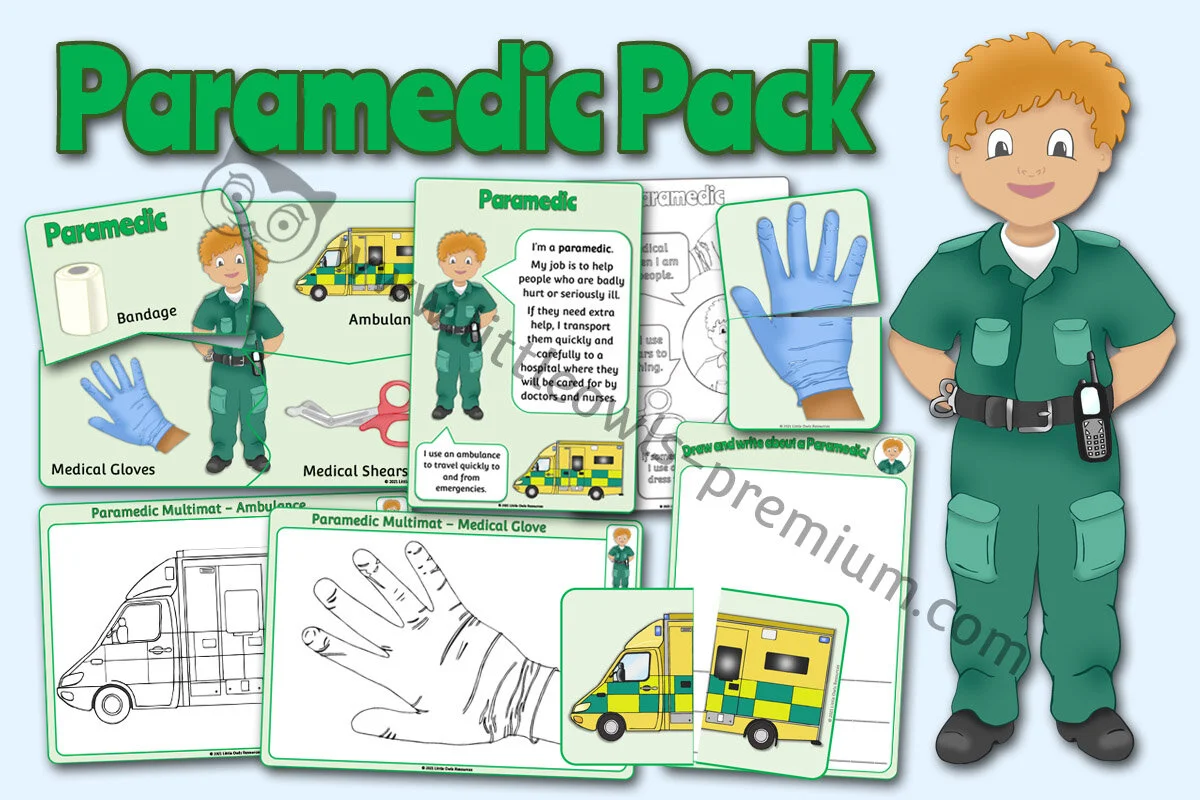
The pages of this pack give some general information about the role of a paramedic and some fun and engaging activities to foster and develop children’s interest in this role in society.
Pack includes:
Information Posters
Information Posters (Colouring)
Drawing/Writing Sheets
Draw items Sheet
Draw items Sheet (Colouring)
Item Poster
Item Poster (Colouring)
Multimats for Art & Craft/Loose Parts/Playdough
5 x 2-Piece individual items puzzles
1 x 4-Piece all items puzzle
Keywords: emergency service/services
Original artwork drawn by Sara Murphy and final digital resources created by Stuart Murphy. COPYRIGHT ON ALL OF THE RESOURCES HOUSED ON THIS WEBSITE IS HELD BY ‘LITTLE OWLS RESOURCES’. OUR RESOURCES (INCLUDING THE IMAGES WITHIN THEM), CANNOT BE SHARED OR SOLD COMMERCIALLY.
DOWNLOAD EDITABLE (DOCX)
DOWNLOAD NON-EDITABLE (PDF)
DOWNLOAD NON-EDITABLE (Zipped JPEGs)
Additional Pages you may like to explore which cover relevant &/or connected themes


More Early Years Event Pages for May

Sunday 23rd May 2027: 🐢🌊 For early years settings, nurseries, preschools, childminders, and Year 1 and Year 2 classrooms, World Turtle Day provides a wonderful and engaging theme for exploring animals (especially reptiles, sea creatures, and pets), habitats (ocean, desert, wetlands, gardens), conservation, life cycles,…

Saturday 22nd May 2027: 🌳🐠 International Day for Biological Diversity (IDB) is a special day celebrated every year on May 22nd. It was started by the United Nations to help everyone understand something very important called 'biological diversity', or 'biodiversity' for short. Biodiversity means…

Wednesday 19th May 2027 (TBC): 🔢➕ For early years settings, nurseries, preschools, childminders, and Year 1 and Year 2 classrooms, National Numeracy Day provides a fantastic and practical theme for exploring counting, number recognition, shapes, patterns, problem-solving, and early mathematical concepts. It's about building a positive attitude…

Thursday 20th May 2027: 🐝🍯 For early years settings, nurseries, preschools, childminders, and Year 1 and Year 2 classrooms, World Bee Day provides a wonderful and engaging theme for exploring minibeasts, plants, life cycles, food sources, the environment, and understanding the world (the world around us). It's about introducing…

Tuesday 18th May 2027: 🏛️🔎 For early years settings, nurseries, preschools, childminders, and Year 1 and Year 2 classrooms, International Museum Day provides a fantastic and engaging theme for exploring history, science, art, culture, discovery, role-play, and understanding the world (the world around us). It's about sparking children's curiosity,…

Sunday 9th May 2027 (TBC): 👧👦 For early years settings, nurseries, preschools, childminders, and Year 1 and Year 2 classrooms, National Children’s Day provides an incredibly broad and foundational opportunity to explore all aspects of a child's health, safety, well-being, emotions, physical development, rights, and…

Friday 21st May 2027: 🐾🌱 Endangered Species Day is a special day celebrated every year on the third Friday in May. It was started by a group called the National Endangered Species Act Education Centre in the United States and was recognised…

Saturday 15th May 2027: 👨👩👧👦💖 International Day of Families is a special day celebrated every year on May 15th. It was started by the United Nations in 1993 because they wanted everyone to remember how important…

Monday 10th - Sunday 16th May 2027 (TBC): 😊🧠 Mental Health Awareness Week happens every year in May. It's hosted by the Mental Health Foundation, a charity in the UK. This week is all about helping everyone understand that our minds…

Wednesday 12th May 2027: 👩⚕️🧑⚕️ For early years settings, nurseries, preschools, childminders, and Year 1 and Year 2 classrooms, International Nurses Day provides a fantastic and practical theme for exploring people who help us, health and well-being, empathy, role-play, and personal, social…

Wednesday 5th May 2027: ✨🧼 World Hand Hygiene Day is a special day celebrated every year on May 5th. It was started by the World Health Organization (WHO) with a very important message: 'SAVE LIVES:…

Sunday 2nd May 2027: 😄😂 The main idea of this day is to show how laughter can help bring peace and friendship to people all over the world. Dr. Kataria believes that laughter is like a super-power that can help people…

🚶♀️🚶♂️For early years settings, nurseries, preschools, childminders, and Year 1 and Year 2 classrooms, National Walking Month (1st - 31st May 2027) and Walk to School Week (Monday 17th - Friday 21st May 2027 - TBC) provide a fantastic and practical theme for exploring physical development, health and well-being, the environment, road safety…

Thursday 20th May 2027 (TBC) & Thursday 5th November 2026: Let's learn outside! 🌳☀️ Outdoor Classroom Day is a global campaign to inspire and celebrate outdoor play and learning, with two designated days each year: one in May and one in November…
Explore special dates (including awareness dates, festivals, celebrations & events) relevant to your EYFS & KS1 children
Browse our ‘Special Dates Calendar’ page using the link below. You’ll find calendars for every month of the year to aid your planning!
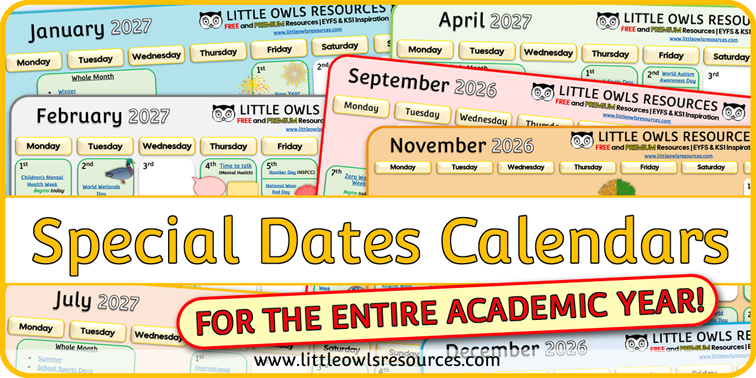
Click here to visit our ‘Special Dates Calendar’ page for an entire year of key EYFS & KS1 events, festivals & celebrations.
Search ‘Little Owls Resources’ Using the following Menu Buttons…
Click here to visit our ‘Special Dates Calendar’ page for an entire year of key EYFS & KS1 events, festivals & celebrations.


Disclaimer:
This page is for educational purposes only and is intended to support early years and primary practitioners with ideas and resources related to 'International Nurses Day'. We are not officially affiliated with or endorsed by the International Council of Nurses (ICN), which established this event. We do not claim any rights to specific trademarks or official materials associated with this event. For official information, themes, and resources, please visit the International Council of Nurses (ICN) website: www.icn.ch.
Saturday 29th May - Sunday 6th June 2027 (TBC): 🌱🥕 For early years settings, nurseries, preschools, childminders, and Year 1 and Year 2 classrooms, National Children’s Gardening Week provides a wonderfully rich and hands-on theme for exploring plants, life cycles, food sources, nature, science (growth and change), the environment, outdoor play,…