
EYFS definition
Repetitive play describes a child returning to the same action, sequence, material or play idea. In the EYFS, repetition can offer opportunities to practise, explore cause and effect, revisit an experience or enjoy something familiar.
What can repetition involve?
A baby may return to a sound-making action, a toddler may repeatedly fill and empty a container, or a Reception child may retell the same pretend story. The repeated experience can include small changes that are easy to overlook.
Repetitive play is a broad description. Some repeated patterns are interpreted as schemas, such as transporting or rotation, but not every repeated activity points to a particular schema.
What might it look like in practice?
A toddler rolls a ball down a slope several times, watching where it stops. Later, they try a different ball. Another child repeatedly builds the same enclosure, gradually changing its shape or adding a doorway.
A child may also repeat a familiar play sequence because it is enjoyable or predictable. The meaning can vary with the child, the activity and the moment.
How might adults respond?
Time to return to familiar materials can allow an interest to develop. An adult might watch, join in, add words or offer a small variation, then notice the child’s response. Novelty is one option rather than an automatic next step.
Considering what the child communicates, how comfortable they seem and what families notice can deepen understanding. Repetition on its own does not tell the whole story of a child’s learning.
Further Guidance | Related Documents
Explore resources connected with this term. Each card identifies the resource’s intended age group and access type.
Highlighted resource
-
 View resource
All Access
Autumn Heuristic Play Cards for Toddlers
Use open-ended collections as starting points for repeated filling, moving, nesting and discovering.
Toddlers · choose suitable objects
View resource details →
This selection is being reviewed. Please use the resource gateways below.
Related resources
Scroll sideways, focus the list and use your arrow keys, or use the buttons.
-
 View resource
All Access
The Role of Schemas in Toddler Practice (18-36 Months)
Explore one way of understanding recurring patterns within toddler play.
Toddlers · practitioner guidance
View resource details → -
 View resource
All Access
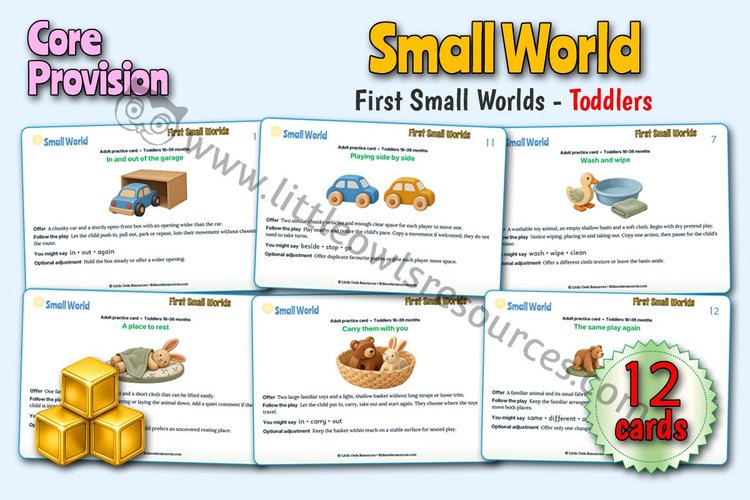
First Small Worlds — Toddlers
Support early small-world exploration without requiring children to follow a fixed story.
Toddlers · adult-facing provision cards
View and Download Resource → -
 View resource
All Access
Theme: Playful Patterns & Construction | Toddler Project Planner (18–36 Months)
Offer a context for returning to stacking, joining and arranging ideas over time.
Toddlers · adapt to children’s interests
View resource details → -
 View resource
All Access
Using Observation to Respond to Babies’ Needs | Babies (birth-18 months)
Consider babies’ cues and recurring interests within responsive observation.
Babies · practitioner guidance
View resource details →
This selection is being reviewed. Please use the resource gateways below.
Find practical resources for your setting
Start with an age gateway
Useful routes into practice
- Schemas & schematic play
Explore guidance on recurring actions and their possible connections.
- Small world provision
Browse resources children can return to and adapt in their play.