
EYFS definition
In early years practice, loose parts are movable materials that children can arrange, combine and use in different ways. They may be natural or manufactured, large or small, and can support exploration, construction and imaginative play within EYFS provision.
What makes something a loose part?
The emphasis is on what children can do with a material. A sturdy box could become a container, a seat for a toy or part of a building. Its meaning may change during play.
The idea is associated with Simon Nicholson’s theory of loose parts. In everyday early years use, the term commonly describes materials children can move and recombine.
What might it look like in practice?
- Combining blocks and fabric to make different places for small-world characters.
- Arranging suitable natural materials into a pattern, then changing the arrangement.
- Moving large, manageable containers to build a pretend vehicle outdoors.
Children may explore the materials alone or together. A finished model is one possible outcome, rather than the only purpose.
How are materials and support chosen?
Adults select and check materials for the children using them, considering size, condition, weight and how they may be handled. Small parts are unsuitable where children may put them in their mouths; supervision does not make an unsuitable item safe.
Adults can introduce materials, help with a practical difficulty or join a conversation while leaving room for children’s ideas.
Further Guidance | Related Documents
Explore resources connected with this term. Each card identifies the resource’s intended age group and access type.
Highlighted resource
-
 View resource
All Access
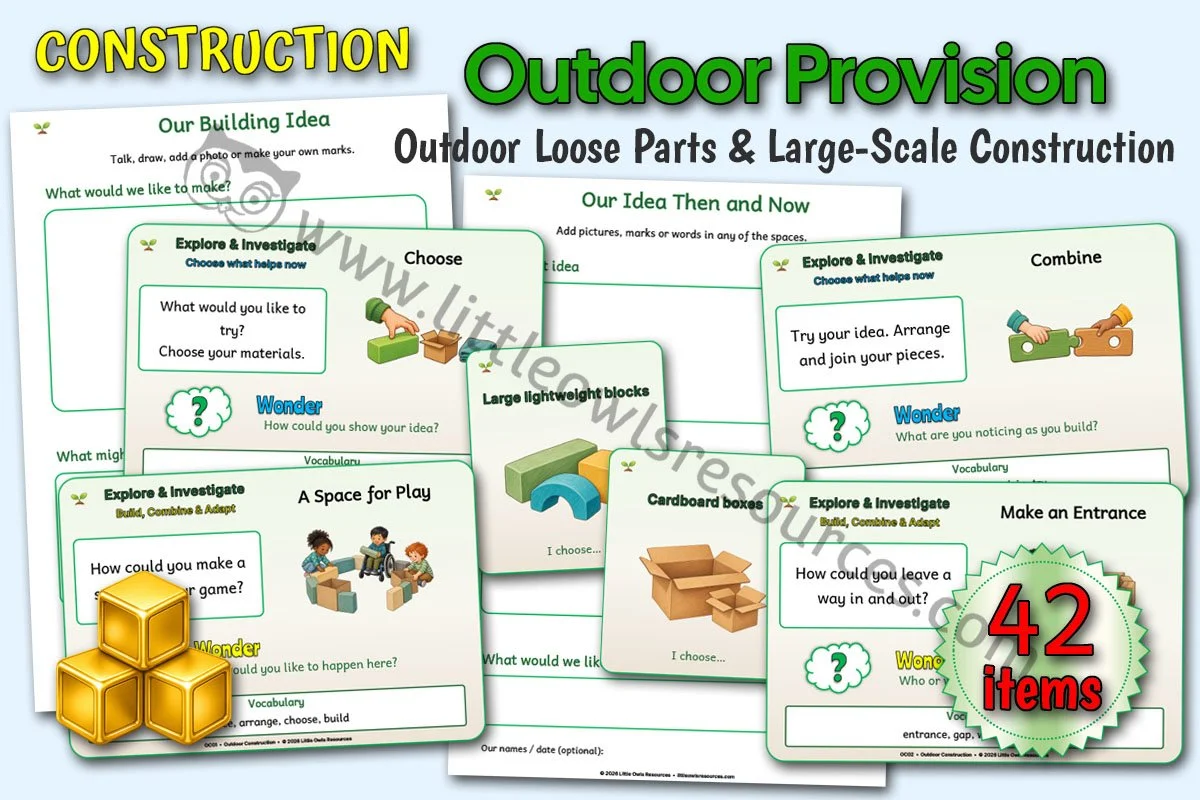
Outdoor Loose Parts & Large-Scale Construction
Explore optional invitations for choosing materials and changing large-scale constructions outdoors.
Preschool & Reception · select manageable, suitable materials
View and Download Resource →
This selection is being reviewed. Please use the resource gateways below.
Related resources
Scroll sideways, focus the list and use your arrow keys, or use the buttons.
-
 View resource
All Access
Autumn Heuristic Play Cards for Toddlers
Find toddler invitations for filling, nesting and moving suitable objects.
Toddlers · autumn-themed practitioner prompts
View resource details → -
 View resource
All Access
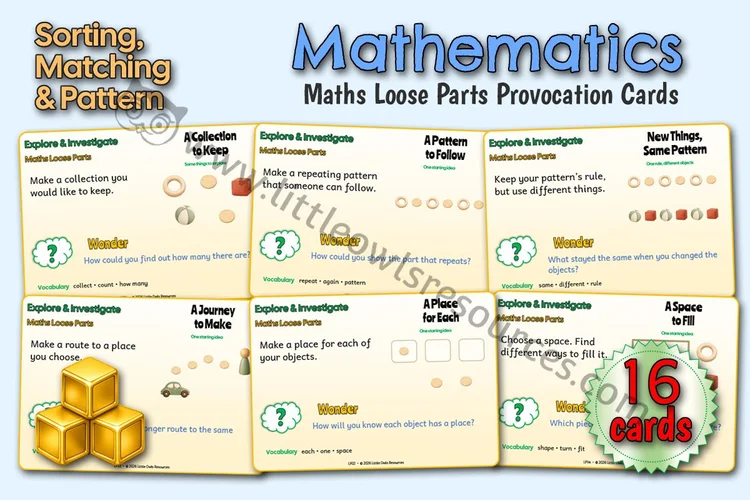
Loose Parts Provocations
Use optional prompts to notice mathematical ideas in children’s collections, constructions and play.
Preschool & Reception · adapt prompts to the child
View and Download Resource → -
 View resource
All Access
BEACH - Natural Loose Parts Pictures
Use natural-material pictures as optional starting points for children’s own arrangements.
Preschool & Reception · choose suitable materials
View and Download Resource → -
 View resource
Public collection
Construction & Building Provision
Browse a wider collection of building, construction and provision resources.
Toddlers to KS1 · select resources for the age group
Explore collection →
This selection is being reviewed. Please use the resource gateways below.
Find practical resources for your setting
Start with an age gateway
Useful routes into practice
- Outdoor provision
Explore larger-scale play and opportunities to combine materials outside.
- Art & craft
Find further starting points for exploring and combining materials.