
EYFS definition
Schema-informed provision means choosing or adapting spaces, materials and adult responses with children’s recurring play patterns in mind. In the EYFS, practitioners may use observations of schematic play to offer experiences that connect with what children are exploring.
What makes provision schema-informed?
The starting point is a possible connection between children’s actions, rather than a requirement to provide an activity for every named schema. Adults consider the materials, space and support that could make an interest easier to pursue.
The same resources may support several interests. Containers can be filled, carried, arranged or used in pretend play, depending on what children choose to do.
What might it look like in practice?
- A child repeatedly carries objects around. An adult makes suitable baskets available and leaves room for journeys between areas.
- Children keep wrapping and hiding toys. The provision includes suitable fabric pieces and objects to cover and reveal.
- A group enjoys turning and rolling materials. Adults offer objects with different movement possibilities and notice what children investigate.
How might practitioners respond over time?
An adult may introduce useful language, help children handle materials or offer a small variation. Watching what happens next can inform whether the change was useful.
Schema-informed provision can sit within continuous provision, a project or a spontaneous response. Settings may use the idea differently. Interests change, and the interpretation can remain open; children do not need to follow an adult’s suggested pattern or demonstrate every schema.
Further Guidance | Related Documents
Explore resources connected with this term. Each card identifies the resource’s intended age group and access type.
Highlighted resource
-
 View resource
All Access
The Role of Schemas in Toddler Practice (18-36 Months)
Consider the relationship between schematic interests, toddler provision and adult response.
Toddlers · practitioner guidance
View resource details →
This selection is being reviewed. Please use the resource gateways below.
Related resources
Scroll sideways, focus the list and use your arrow keys, or use the buttons.
-
 View resource
All Access
Early Years Schemas - Practitioner Toolkit | EYFS Birth-5 (Overview)
Use the reference cards and planning template to reflect on observed play patterns.
Birth–5 · optional practitioner support
View resource details → -
 View resource
All Access
Continuous Provision Audit & Resourcing List | Toddler Room (18–36 Months)
Review how space, resources and adult support work for the toddlers using them.
Toddlers · environment review
View resource details → -
 View resource
All Access
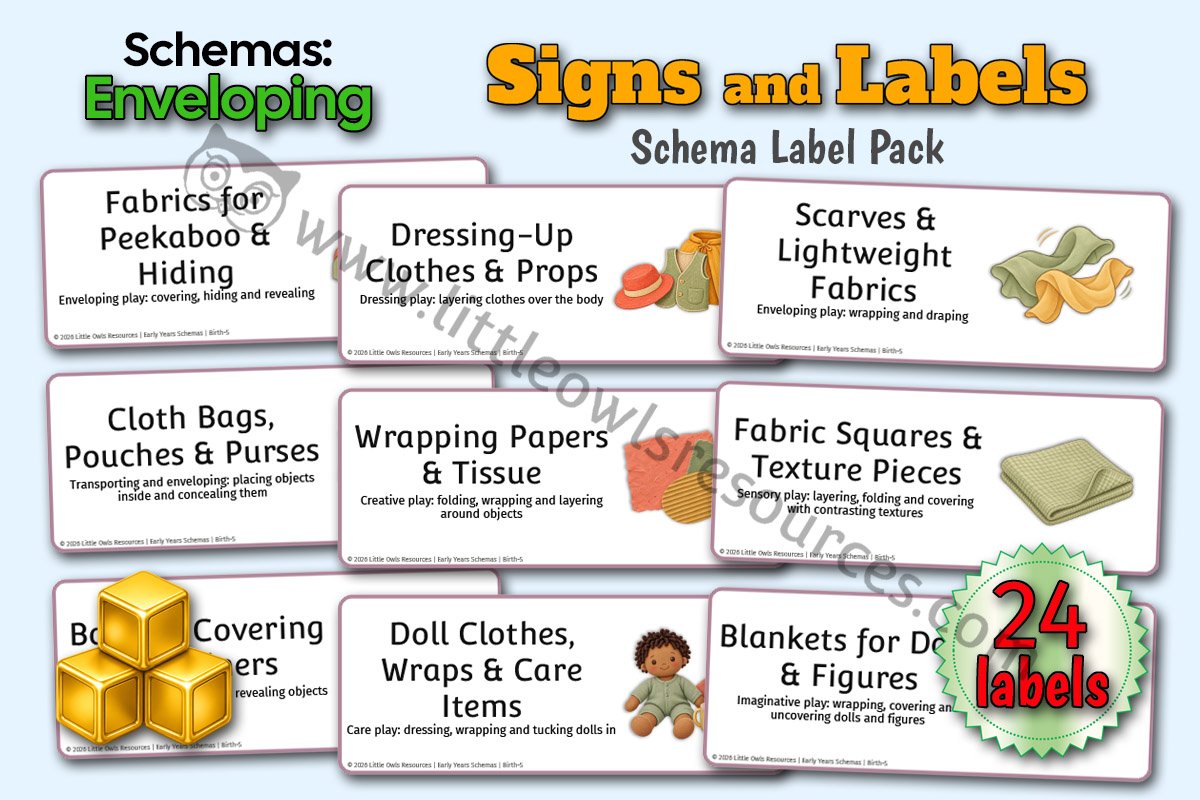
Schema Label Pack | Enveloping
Explore labels and prompts for materials connected with covering, wrapping and hiding.
Toddlers–Reception · select age-appropriate materials
View and Download Resource → -
 View resource
All Access
Theme: Playful Patterns & Construction | Toddler Project Planner (18–36 Months)
See one project context for responding to children’s construction and arrangement interests.
Toddlers · optional project approach
View resource details →
This selection is being reviewed. Please use the resource gateways below.
Find practical resources for your setting
Start with an age gateway
Useful routes into practice
- Schemas & schematic play
Find schema guidance, labels and provision resources.
- Construction & building
Browse materials for joining, arranging and moving ideas.