
EYFS definition
Alternative communication means communicating through ways other than speech. It sits within augmentative and alternative communication (AAC), which includes approaches that add to spoken communication or provide another way to express a message. In the EYFS, these approaches can support understanding, participation and relationships.
What forms can it take?
A child might use gestures, facial expressions, signs, objects, pictures, a communication book or a speech-generating device. Some children combine these with speech; others communicate without spoken words.
The useful combination depends on the child, their access needs, languages and circumstances. It may change across activities or over time.
What might it look like in practice?
During small-world play, a child points to a picture to suggest a character’s action. Another child uses a gesture to decline an offer or a device to comment on something funny.
Communication includes sharing interests and connecting with others, as well as requesting help or making choices.
How can adults support access?
Adults can notice and respond to communication, model an agreed system and allow time for replies. Access does not depend on producing a spoken word first.
Working with families and, where appropriate, speech and language professionals helps keep communication available and meaningful across the child’s day.
Further Guidance | Related Documents
Explore resources connected with this term, choosing those that fit your children and setting.
Highlighted resource
-
 View resource
All Access
Key Phrases — Picture Communication Mat
Explore picture options for everyday messages, using them alongside the child’s established communication.
Visual communication · choose by individual meaning and access needs
View and Download Resource →
This selection is being reviewed. Please use the resource gateways below.
Related resources
Scroll sideways, focus the list and use your arrow keys, or use the buttons.
-
 View resource
All Access
Picture Communication Cards - Key Phrases
Consider individual picture cards when these are meaningful and accessible for the child.
Visual communication · adult modelling and individual access
View and Download Resource → -
 View resource
All Access
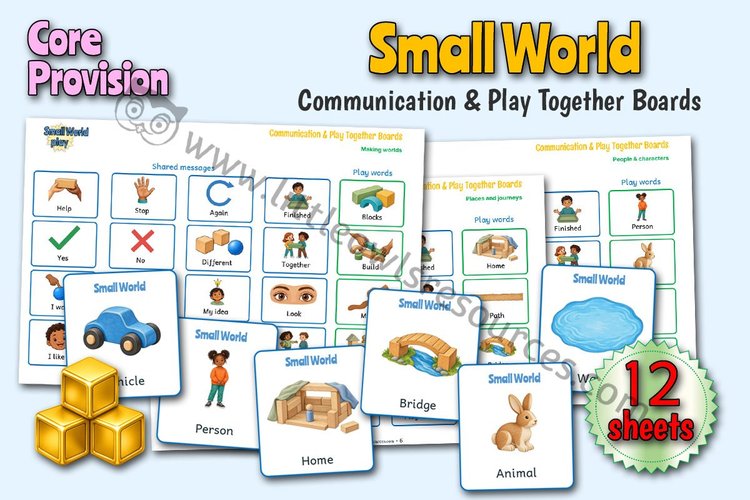
Communication & Play Together Boards
Support asking, refusing, commenting and sharing ideas during small-world play.
Small-world play · choose by communication needs, not age alone
View and Download Resource → -
 View resource
All Access
Supporting Early Communication | Babies (Birth-18 Months)
Recognise and respond to babies’ cues, gestures and sounds before and alongside emerging speech.
Babies (0–18 months) · practitioner communication guidance
View resource details → -
 View resource
All Access
Parent Communication Templates | Childminder (Mixed-Age)
Share useful information with families about the communication that works for their child.
Childminders · mixed-age family communication templates
View resource details →
This selection is being reviewed. Please use the resource gateways below.
Find practical resources for your setting
Start with an age gateway
Useful routes into practice
- Picture communication & visual supports
Explore visual resources to support understanding and expression alongside a child’s usual communication.
- Communication & Language
Find communication guidance and practical resources across the EYFS.