
Autumn Writing for a Purpose · Maps
Make a map someone else can use
Show a friend a woodland place, a path to an imagined animal home or a route through an agreed play space. These open map and route sheets give children room to invent the places, landmarks and connections that matter to their play.
Included with Premium and Professional membership. The download button opens the member resource page; sign in or join if needed.
Take a look inside
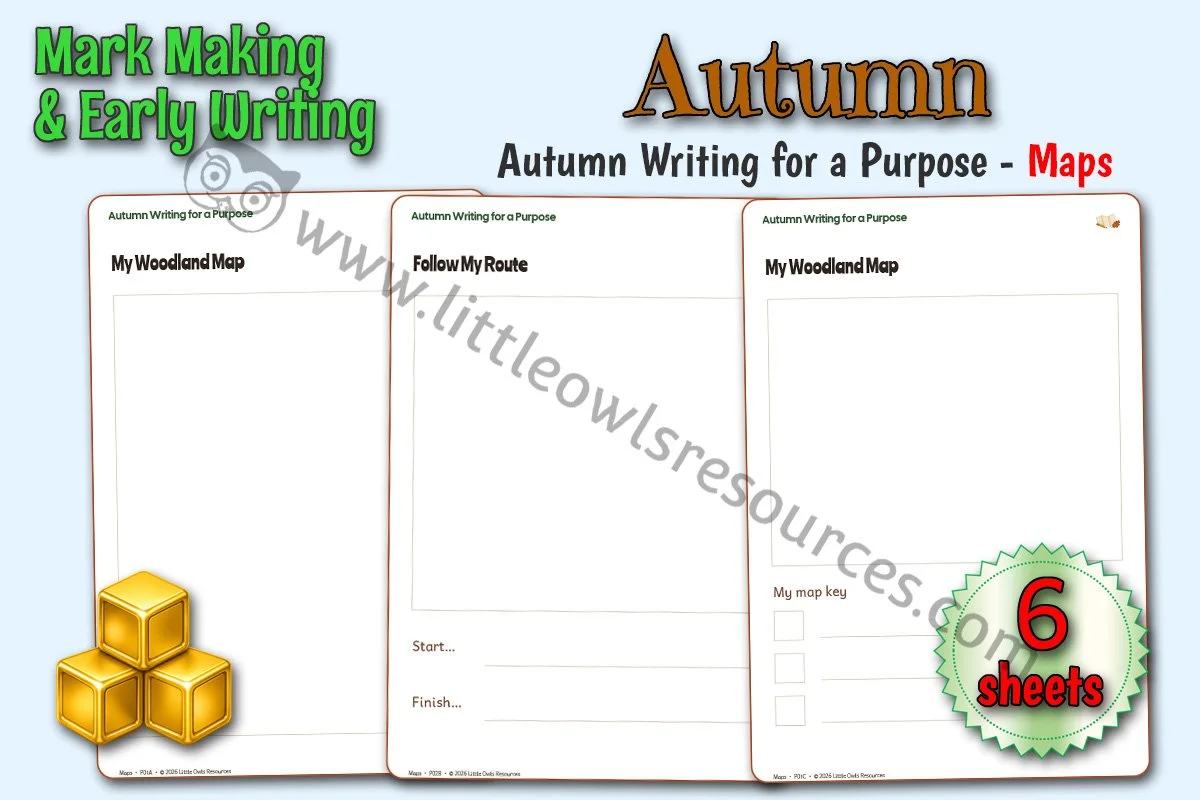
Browse one route sheet, a map-key extract and an extract from the practitioner notes. These three watermarked previews show a small selection of the layouts and guidance included.


On smaller screens, scroll or swipe sideways to browse the three watermarked previews. Download the file for all six printable sheets and the practitioner notes.
What’s included in the pack?
Autumn Writing for a Purpose: Maps. This seven-page file contains six printable sheets across two purposes, each offered in three layout choices, plus one page of practitioner guidance. Use them to represent woodland places or share a route with someone else.
Make a woodland map
Children can draw the places and landmarks they want someone else to find. The open drawing layout leaves a large space for their ideas; other layouts add room for a child-made map key to explain the symbols they choose.
Share a route
Children can draw a journey and show where it leads. Choose an open drawing layout, space for drawing with a start and finish, or a layout that also supports written directions. A friend can try the route and talk about what it means.
The map belongs to the child. The map areas are blank so children can invent their own places, landmarks and symbols. The pack provides recording layouts; there is no ready-made route or fixed set of symbols to copy.
This download is the Maps file from the Autumn Writing for a Purpose series. Other files in the series are available separately. A page finder in the practitioner notes helps you choose the purpose and layout you need.
Make the map useful in the play
A map can help someone find a place or follow a journey. Begin with somewhere the child wants to show, then choose a layout together.
Choose a place and a purpose
Use a small-world woodland, an imagined animal home or an agreed play space. Talk about who might use the map and what they need to find. Leave the places and route for the child to decide.
Let children explain their marks
Children can draw, point, use symbols or add words. Listen to what each part means. Offer language or scribe their exact words if invited, asking before adding anything and keeping their own marks visible.
Invite someone to try it
Ask a friend to follow the map or route. Children can point, explain, add a symbol or change something when it is unclear. Read any words back together and return the map to its purpose in the play.
Choose the space that helps
The three layouts offer drawing and marks, drawing with emergent writing, or more room for independent writing. They are choices of paper, not ability groups or a sequence. Children can use any version and switch when it helps.
Support different ways to communicate
A larger surface, adapted tool, pointing, familiar signs or home-language words may help. Children can combine pictures, symbols, letters and words, or dictate to an adult. Spoken explanation can accompany their map.
What should we print?
The file has seven pages: practitioner notes on page 1 and six printable sheets on pages 2–7. Print the pages you need on A4 at 100% / actual size. Use the whole page to give children room to draw and write. There is no need to print the practitioner notes.
What do the A, B and C codes mean?
They help adults find a layout. A offers drawing and mark-making space; B combines drawing with emergent writing; C offers more room for independent writing. Children do not need to work through them in order or move to another version before their map can be useful.
Do children need to write words or use standard map symbols?
No. Children can communicate through their own drawings, marks and symbols, explaining by pointing or talking if helpful. The key spaces are for symbols they create; no fixed set is supplied to copy. An adult can write their words if invited.
Can we adapt the prompts or writing space?
Yes. All text and line shapes are editable in Word. Adjust wording or the arrangement of lines to suit the purpose, while keeping the map areas open for children’s own places, landmarks and routes.
Download the Autumn Maps writing pack
Choose a layout, create a place or journey and invite someone to try the map.
Included with Premium and Professional membership. Already a member? Follow the download button and sign in if prompted.
You might also find these useful
Bring places, landmarks and journeys into the play with these companion resources. Each link below opens a public page where you can explore the resource before visiting its downloads.
Resource and preview images © Little Owls Resources.