
Small world provision · Section 6
Where will the woodland trail lead?
Move an animal, change where it hides or follow a trail through a small woodland world. Seven illustrated position invitations and six movable track strips offer starting points for spatial language, investigation and stories that children can develop in their own way.
Included with Premium and Professional membership. The download button opens the member resource page; sign in or join if needed.
Take a look inside
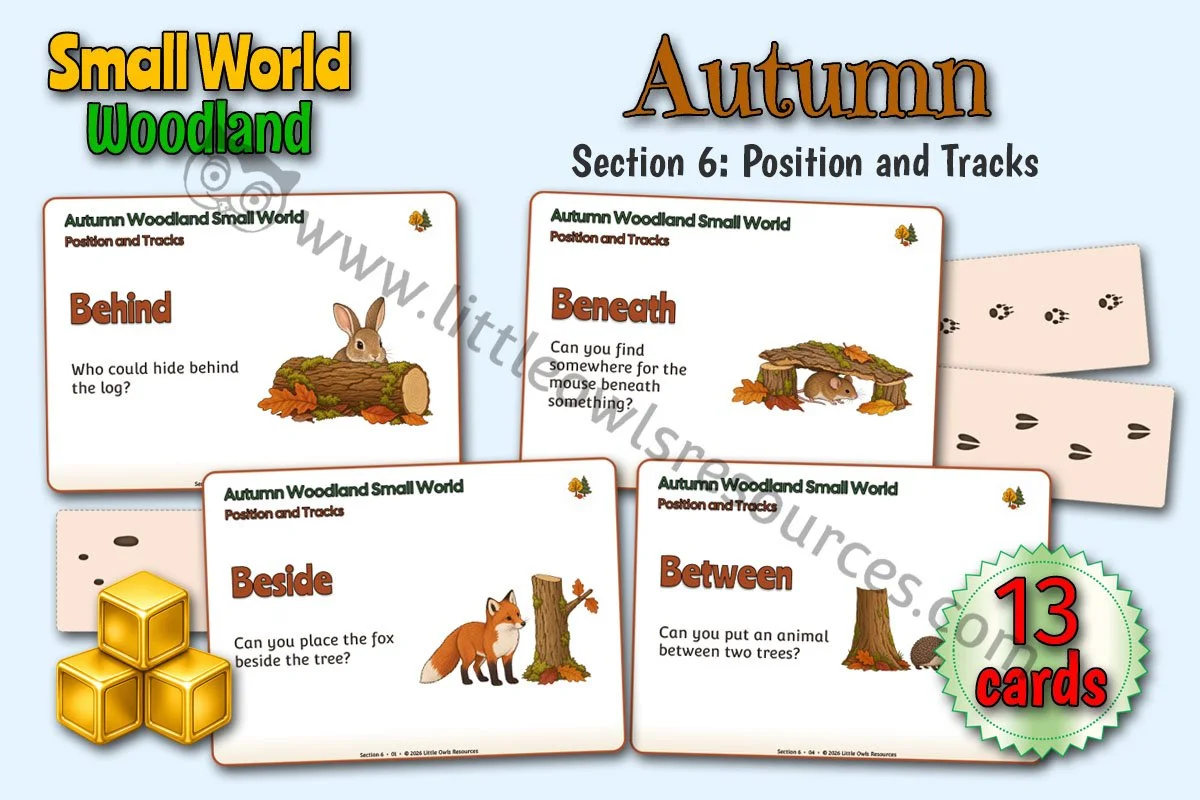
Browse a position-invitation sheet, one track-strip extract and an extract from the practitioner notes. These three watermarked previews show a small selection from the pack.


On smaller screens, scroll or swipe sideways to browse the three watermarked previews. Download the file for all seven illustrated invitations, six track strips, the blank card and practitioner notes.
What’s included in the pack?
Section 6: Position and Tracks. This separate seven-page file contains seven illustrated position invitations, one optional blank invitation and six movable track strips, with practitioner guidance on the first page.
Seven position invitations
Each card combines a position word, a short invitation and an illustration. Children can move figures, choose materials and try different arrangements. The pictures offer examples; there is no need to copy them or work through every card.
Six movable track strips
Animal-print diagrams can suggest a trail through the woodland. Children can move and combine the strips, follow them with a figure or imagine who passed by. Preparation labels sit outside the cut lines, so the finished strips can remain unlabelled.
Tracks for small-world play. These are simplified diagrams with illustrative spacing, not life-size animal identification records. They can prompt noticing and stories, but printed size or pattern cannot confirm a real animal’s identity.
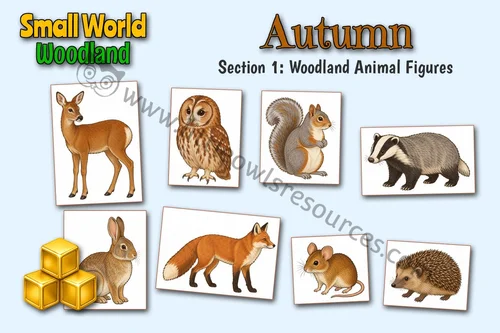
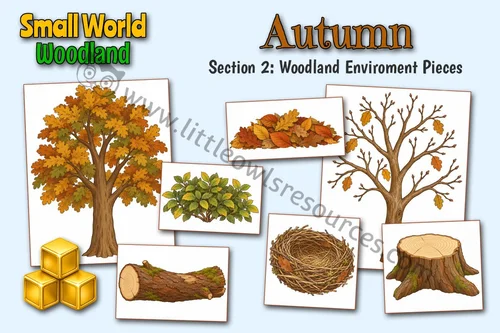
The blank invitation gives you space to add an idea of your own. Animal figures, environment pieces and other woodland sections are available separately; you can also use familiar toys, blocks, fabric and suitable natural materials.
Exploring position and trails in your provision
Begin with a small woodland arrangement and follow what children do. Offer a card or strip when it adds something to their play.
Offer a place to explore
Set out a few familiar figures and materials. Read an invitation aloud if useful, then pause. Children might move an animal, point to a hiding place or ask someone else to put a figure where they want it.
Put words to the movement
Describe what is happening as children play. You might connect “beneath” with “under”, or “beside” with “next to”. Look from the child’s viewpoint, allow time to respond and change one position at a time where helpful.
Let a trail become a story
Add one strip near a woodland feature and notice what children make of it. They can choose who made the prints, decide where the trail leads or rearrange it. There is no need to name an animal correctly before the story can continue.
Different ways to join in
Use larger figures, fewer objects or a reachable play surface where helpful. Children can respond through movement, pointing, gesture or their usual communication supports. They can direct a partner or adult; reading and spoken answers are not required.
Build on children’s ideas
Use the blank card to record an invitation that grows from the play, or leave it out. Children can choose different animals and arrangements, move a strip or begin again. The cards can be revisited whenever they are useful.
What should we print?
The file has seven pages. Pages 2–5 contain the invitations and blank card, two per sheet. Pages 6–7 have three track strips per sheet. Print the pages you need on A4 at 100% / actual size. Page 1 contains practitioner notes, with no need to print it.
How do we prepare the track strips?
Cut around the dashed outlines, leaving the animal names outside the strips. At actual size, each strip is approximately 18 × 5.6 cm. Keep strips whole for easier handling and print extra copies to extend a trail. Back with card or laminate if useful. Use them on a table or tray, clear of walking routes.
Can we use the strips to identify tracks outdoors?
The strips are designed for pretend play and are not to scale. Real tracks vary with the animal’s movement and the surface. If children want to investigate real tracks, use a wildlife guide and compare several clues. These printed diagrams cannot confirm an identification.
Can we adapt the invitations and materials?
Text is editable in Word and placed pictures can be replaced. Adjust the blank invitation or the wording to suit the children using it. Choose suitable materials, avoid small loose parts for children who mouth objects, check cut edges and keep small-world structures low and stable.
Download the Woodland Position and Tracks pack
Explore where animals might go and let children decide what happens along the trail.
Included with Premium and Professional membership. Already a member? Follow the download button and sign in if prompted.
You might also find these useful
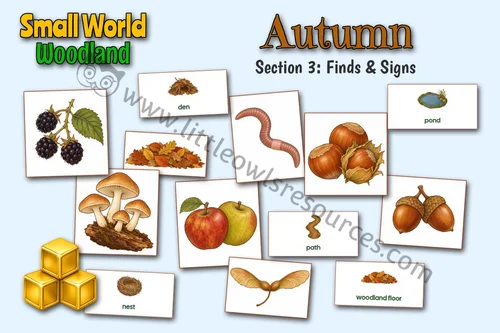
Add characters, places and signs to the woodland, or extend the maths explored through play. Each link below opens a public page where you can explore the companion resource before visiting its downloads.
Resource and preview images © Little Owls Resources.