
non-topic Literacy Resources
Same or Different Word Reading Cards
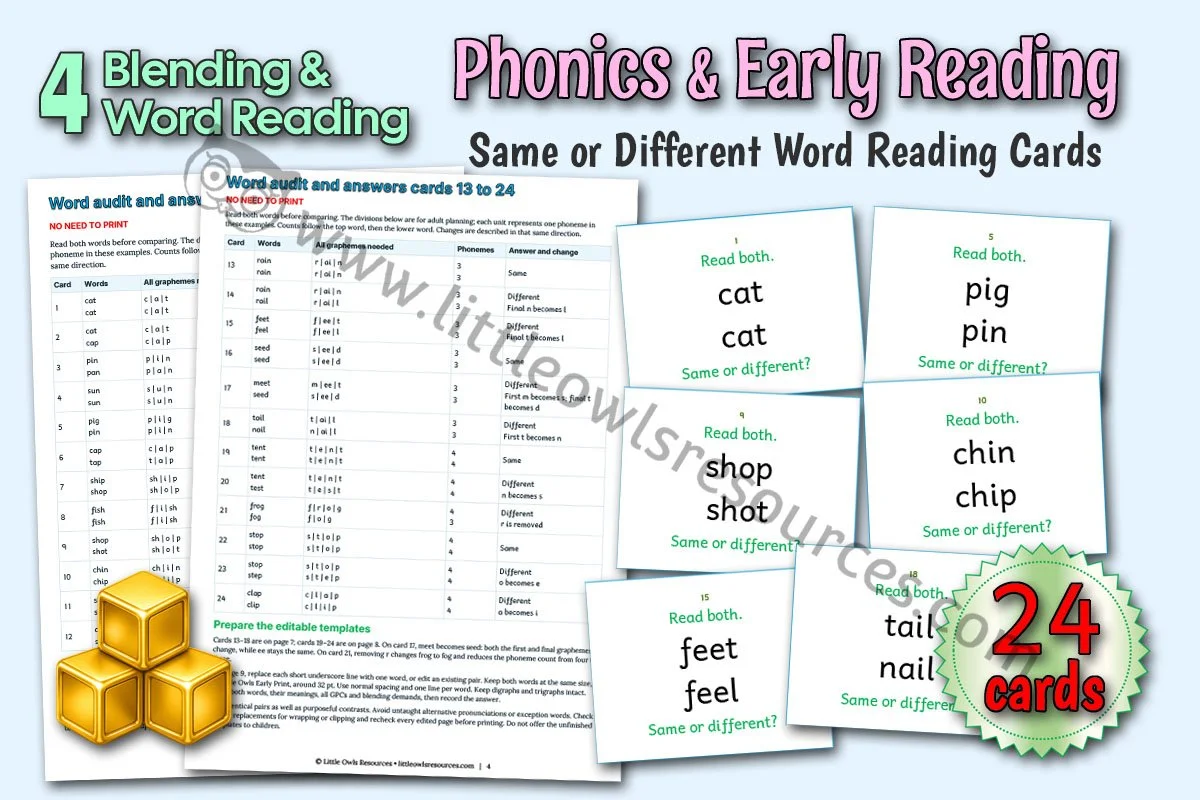
Twenty-four cards which invite children to read two complete words and compare their print. Eight pairs are identical; sixteen differ. Changes occur at the beginning, middle and end, with one removal and one pair with two changes. Six editable templates let you add examples matched to your learners.
Who the pack is for
Primarily Reception children applying grapheme–phoneme correspondences (GPCs) taught through their systematic synthetic phonics programme (SSP). Select a few pairs that match known code and blending confidence. These cards provide adaptable practice, not a new teaching sequence. Support other learners as appropriate.
Oral blending combines spoken sounds without print. This activity involves reading printed words; Preschool use is appropriate only where the relevant GPCs have been explicitly taught. Continue stories, talk and phonological-awareness play alongside phonics, without a prerequisite checklist.
Read both then compare
1. READ BOTH Present one card. Invite the child to read the top word, then the lower word, attending to every grapheme and blending using your SSP’s approach. Cover the lower word with plain paper during the first reading if helpful. Do not say either answer in advance.
2. COMPARE Ask “Are these words the same?” Here, same means exactly the same written word, with the same graphemes in the same order. Check both words all the way through; a shared first grapheme does not make them identical.
3. EXPLAIN AND REREAD For a different pair, ask “What changed?” Invite pointing to the relevant graphemes and, where accessible, identifying their sounds. For an identical pair, invite checking that every grapheme matches. Reread both complete words, then discuss meanings if useful.
DOWNLOAD (DOCX) 📝
DOWNLOAD (PDF) 📄
DOWNLOAD (Zipped JPEGs) 📂