• Home 🏠
  • About Us
  • Pricing
    • *Themes Menu*
    • 🍂 Autumn
    • ☃️ Winter
    • 🌸 Spring
    • 🌞 Summer
    • All About Me
    • Goldilocks and the Three Bears
    • Teeth and Oral Health - Free
    • Emotions and Feelings
    • Houses and Homes
    • Traditional Fairy Tales
    • The Little Red Hen
    • Animals
    • Minibeasts
    • Dinosaurs
    • Pirates
    • ➕ More Themes
    • *Special Dates Calendar*
    • *Festivals & Celebrations*
    • Snack-tember
    • Friendship Month
    • Harvest Festival
    • The Great British Beach Clean
    • National Eye Health Week
    • Sukkot
    • Black History Month (UK, IRL & NL)
    • The Big Draw Festival
    • National Poetry Day
    • World Smile Day
    • World Animal Day
    • ➕ More Special Dates
    • *Areas of Learning*
    • 💬 Communication & Language
    • ❤️ PSED
    • 🏃 Physical Development
    • 📖 Literacy
    • 🔢 Mathematics
    • 🌍 Understanding the World
    • 🎨 Expressive Arts & Design
    • - Phonics & Early Reading
    • - Subitising
    • - Shapes
    • - STEM
    • - Science
    • *Get Organised Menu*
    • Back To School
    • Planning
    • Displays & Environment
    • Observation & Assessment
    • EYFS Framework 2026
    • Timetables & Routines
    • Birthdays
    • Parent Communication
    • Role-Play Area
    • Home Corner
    • Outdoor Area
    • Transitions
    • Picture Communication
    • Dual-Language
    • Growth Mindset
    • ➕ More Organisational Tools
    • *EYFS Curriculum & Pedagogy*
    • 🍼 Babies (0–18 months)
    • 🚼 Toddlers (18-36 months)
    • 🎨 Preschool (3-4 Years)
    • 🎓 Reception (4-5 Years)
    • 🏡 Mixed-Age Care (Birth–5)
    • *EYFS Setting Planning*
    • ↪ Nursery
    • ↪ Preschool
    • ↪ Reception Class
    • ↪ Childminder
Menu

Little Owls Resources - Free and Premium Early Years Printables

Street Address
City, State, Zip
Phone Number
Early Years/Preschool/EYFS Printable Activities/Planning/Displays/Paperwork and ideas for Childminders, Preschools, Nursery Practitioners, Teachers and Parents

Your Custom Text Here

Little Owls Resources - Free and Premium Early Years Printables

  • Home 🏠
  • About Us
  • Pricing
  • Themes ⬇
    • *Themes Menu*
    • 🍂 Autumn
    • ☃️ Winter
    • 🌸 Spring
    • 🌞 Summer
    • All About Me
    • Goldilocks and the Three Bears
    • Teeth and Oral Health - Free
    • Emotions and Feelings
    • Houses and Homes
    • Traditional Fairy Tales
    • The Little Red Hen
    • Animals
    • Minibeasts
    • Dinosaurs
    • Pirates
    • ➕ More Themes
  • Special Dates ⬇
    • *Special Dates Calendar*
    • *Festivals & Celebrations*
    • Snack-tember
    • Friendship Month
    • Harvest Festival
    • The Great British Beach Clean
    • National Eye Health Week
    • Sukkot
    • Black History Month (UK, IRL & NL)
    • The Big Draw Festival
    • National Poetry Day
    • World Smile Day
    • World Animal Day
    • ➕ More Special Dates
  • Areas of Learning ⬇
    • *Areas of Learning*
    • 💬 Communication & Language
    • ❤️ PSED
    • 🏃 Physical Development
    • 📖 Literacy
    • 🔢 Mathematics
    • 🌍 Understanding the World
    • 🎨 Expressive Arts & Design
    • - Phonics & Early Reading
    • - Subitising
    • - Shapes
    • - STEM
    • - Science
  • Get Organised ⬇
    • *Get Organised Menu*
    • Back To School
    • Planning
    • Displays & Environment
    • Observation & Assessment
    • EYFS Framework 2026
    • Timetables & Routines
    • Birthdays
    • Parent Communication
    • Role-Play Area
    • Home Corner
    • Outdoor Area
    • Transitions
    • Picture Communication
    • Dual-Language
    • Growth Mindset
    • ➕ More Organisational Tools
  • EYFS C & P ⬇
    • *EYFS Curriculum & Pedagogy*
    • 🍼 Babies (0–18 months)
    • 🚼 Toddlers (18-36 months)
    • 🎨 Preschool (3-4 Years)
    • 🎓 Reception (4-5 Years)
    • 🏡 Mixed-Age Care (Birth–5)
    • *EYFS Setting Planning*
    • ↪ Nursery
    • ↪ Preschool
    • ↪ Reception Class
    • ↪ Childminder
  VIEW ALL CORE 'NON-TOPIC LITERACY' RESOURCES

non-topic Literacy Resources
non-topic Literacy Resources

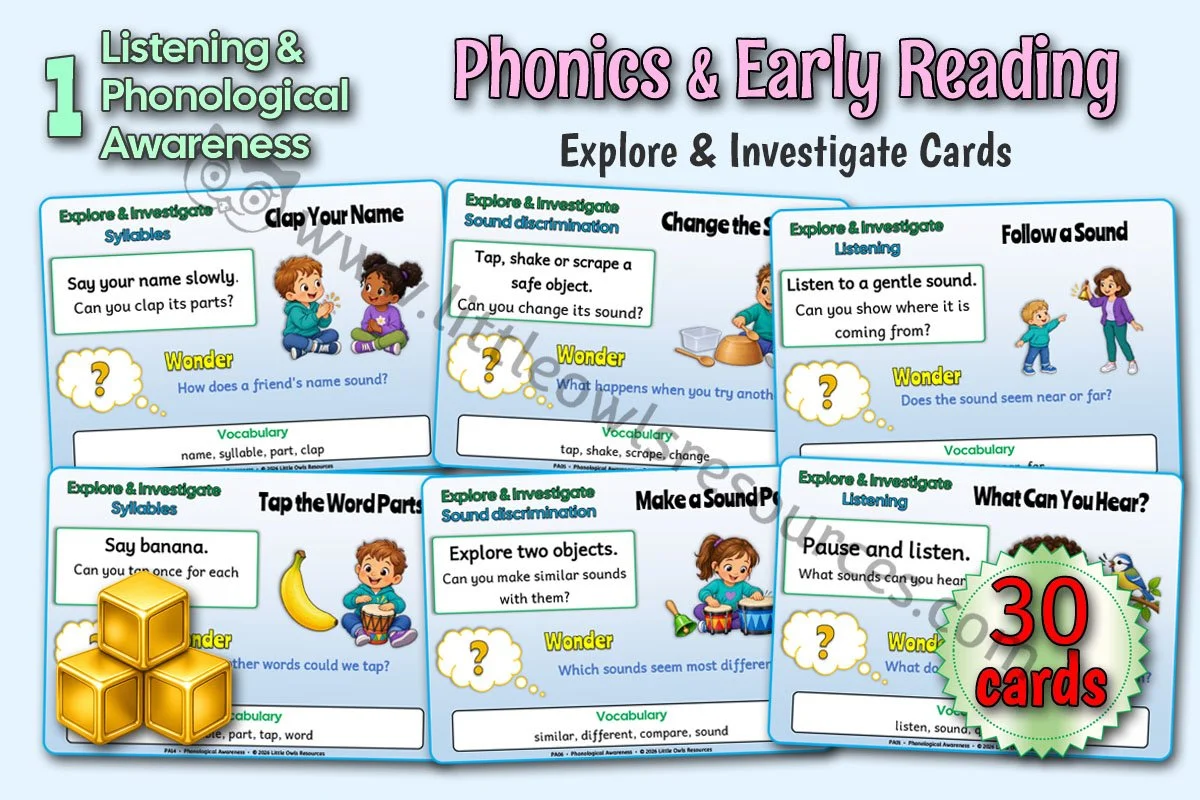
Phonological Awareness Explore & Investigate Cards

Phonological Awareness Explore & Investigate Cards

Thirty illustrated invitations for playful listening and spoken-language exploration. Created primarily for Preschool provision, with flexible support for individual children and continued use in Reception. Share a card with an adult, use real objects where helpful and follow the child’s ideas.

Using the cards

Offer one or two cards beside relevant provision. Read the invitation aloud and model a playful example. Wonder questions are optional; use the vocabulary naturally during play. Children do not need to read, complete every activity or give a spoken answer. Return to familiar favourites and stop while the experience is enjoyable.

The ten focus areas help you choose a card. They are not a teaching sequence or an assessment checklist. Environmental listening, music and sound memory support wider communication; phonological awareness focuses on sounds within spoken language. This pack brings these related experiences together.

DOWNLOAD (DOCX) 📝

DOWNLOAD (PDF) 📄

DOWNLOAD (Zipped JPEGs) 📂
← Back to ‘Phonics & Early Reading’

Syllable Investigation Cards

Syllable Investigation Cards

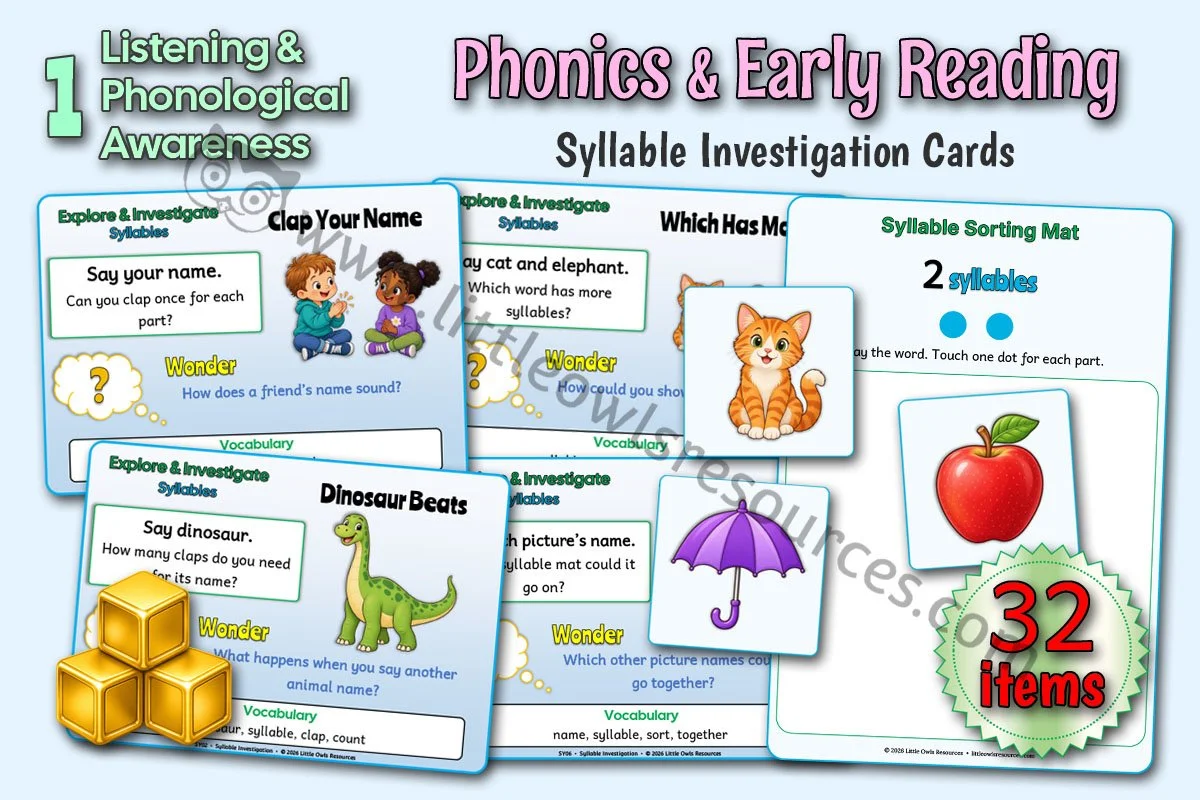
Twelve illustrated invitations, sixteen picture-only cards and four sorting mats for exploring the parts we hear in spoken words. Use them in Preschool provision with an adult, and revisit them in Reception as helpful. Children can clap names, tap picture words, move, compare and sort. No reading is required.

What children are listening for

A syllable is a part or beat we hear within a spoken word: cat has one, rabbit has two and banana has three. Here, “beat” means a syllable in a spoken word, rather than the steady beat of music. Count the spoken parts, not letters, individual speech sounds or the size of the pictured object.

Share one invitation at a time

Read the card aloud and name the pictures together. Say the whole word naturally first, then repeat it with a gentle clap or tap for each syllable. Say the whole word again. For banana, model ba–na–na with three taps. Keep the word recognisable; avoid adding extra vowel sounds or stretching it into individual phonemes. Wonder questions are optional invitations to talk.

Use the pictures and mats

Begin with two mats and a small selection of pictures, for example cat, dog, rabbit and apple with the 1 and 2 mats. Say each name, tap its parts and choose a mat together. Add the 3 and 4 mats when useful. Touch one printed dot for each syllable, then place the whole picture card in the open space below. Each mat can hold four cards; the dots count syllables in one word, not pictures on the mat.

DOWNLOAD (DOCX) 📝

DOWNLOAD (PDF) 📄

DOWNLOAD (Zipped JPEGs) 📂
← Back to ‘Phonics & Early Reading’

Auditory Memory & Sound Sequence Cards

Auditory Memory & Sound Sequence Cards

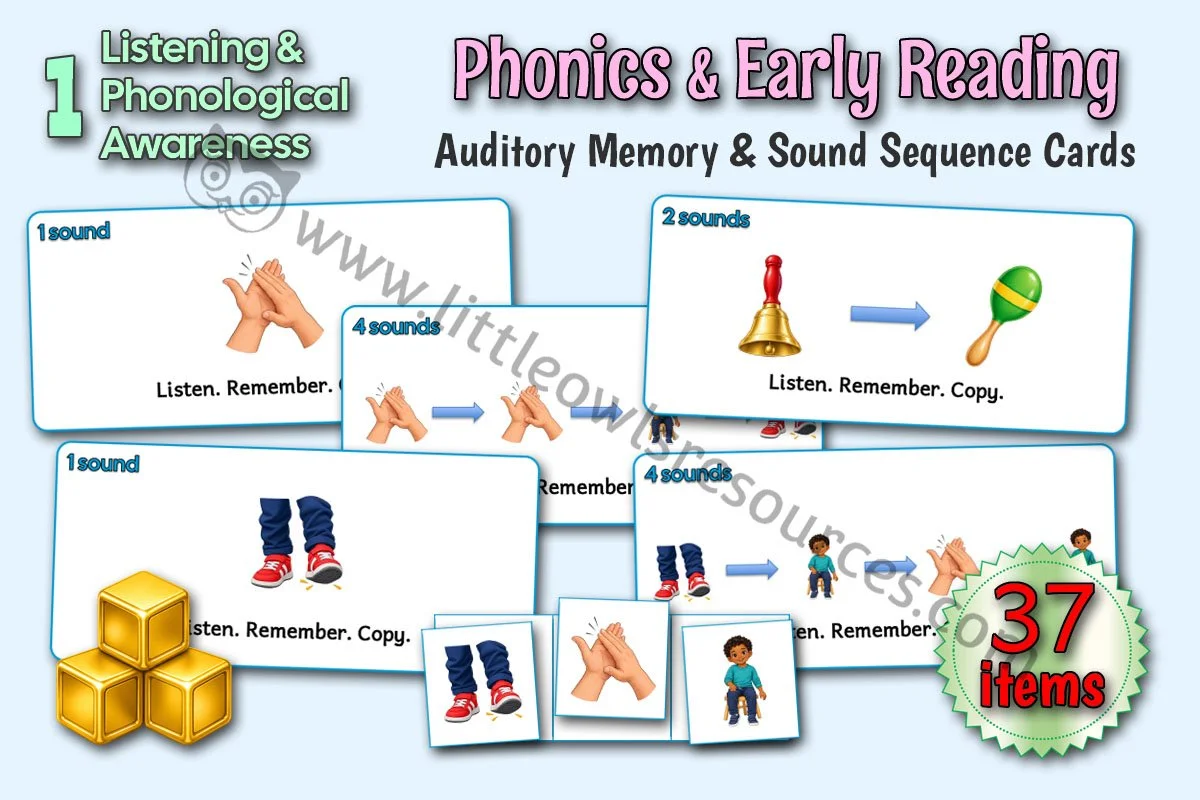
Invite children to listen to a short sequence and make the sounds back in the same order. Use the illustrated cards in Music and Sound provision, small groups or a quiet shared game. Begin with a single familiar sound and choose longer sequences when the child wants to try.

Introduce the six pictures

Explore each action and instrument together using the picture key on page 2. Agree what each picture means before playing. Here, a sound means one action or sound event, not a phoneme or a syllable. A bell ring or shaker movement may contain several tiny noises but counts as one turn in the sequence.

Play one short sequence

1. Get ready together. Offer a choice of sounds and wait until the child is ready. They do not need to sit still or make eye contact.

2. Make the sounds from left to right, once for each picture. Use a steady, unhurried pace with a clear space between actions. Let a bell fade before the next sound. Repeated pictures mean separate actions: clap, pause, clap.

3. Finish the whole sequence, pause, then invite the child to copy. Say “Your turn” after playing, rather than naming the sounds while you make them. Replay whenever helpful.

4. Swap roles. The child can choose a card or arrange loose pictures for you to copy. Enjoy their ideas and return to a shorter sequence whenever needed.

DOWNLOAD (DOCX) 📝

DOWNLOAD (PDF) 📄

DOWNLOAD (Zipped JPEGs) 📂
← Back to ‘Phonics & Early Reading’

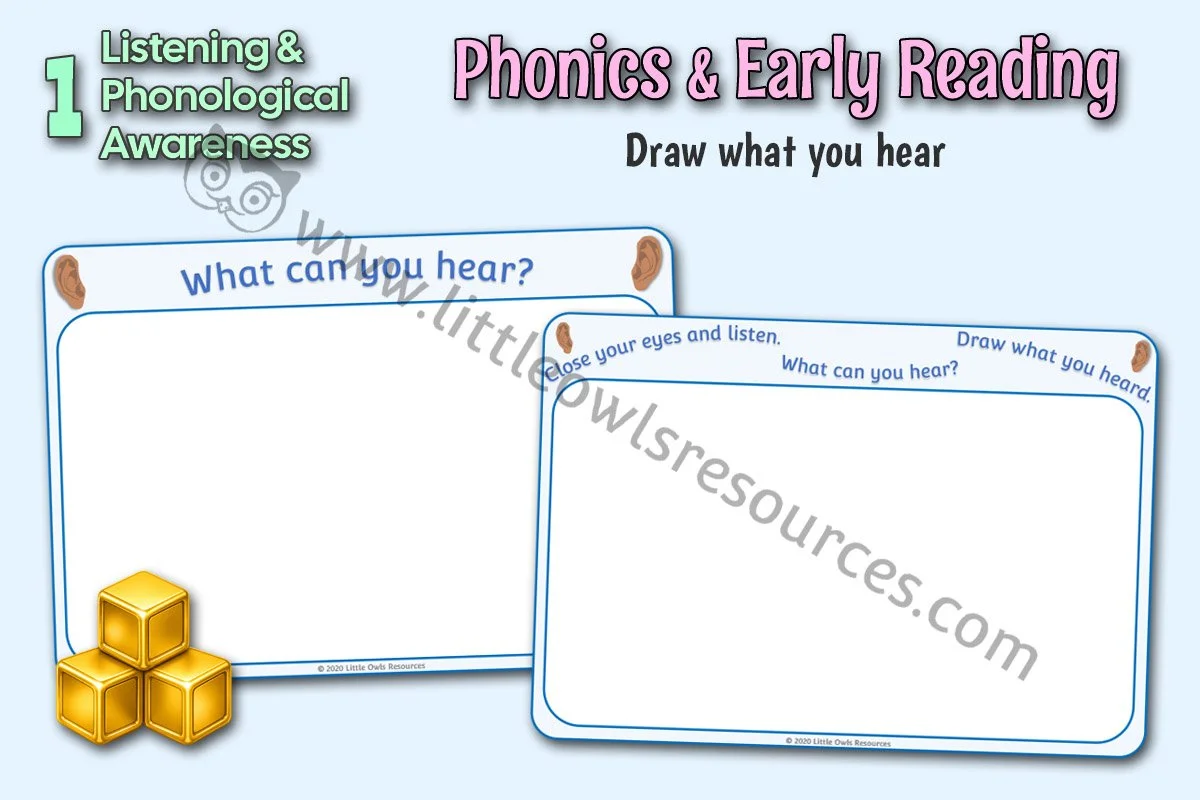
Draw What You Hear - Listening & Sound Awareness

Draw What You Hear - Listening & Sound Awareness

The aim of this activity is for children to listen carefully and identify sounds they are hearing.

‍ ‍

DOWNLOAD (DOCX) 📝

DOWNLOAD (PDF) 📄

DOWNLOAD (Zipped JPEGs) 📂
‍ ‍

← Back to ‘Phonics & Early Reading’

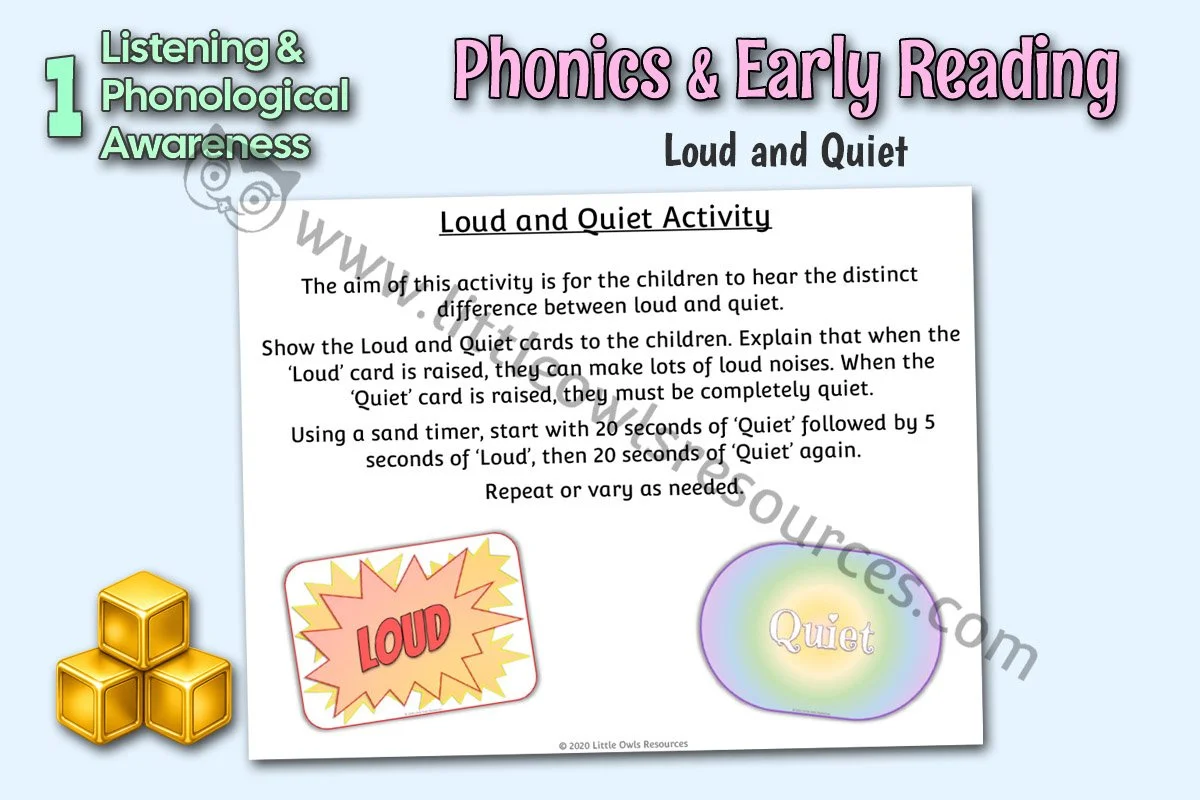
Loud and Quiet Sound Investigation Prompts

Loud and Quiet Sound Investigation Prompts

The aim of this activity is for the children to hear the distinct difference between loud and quiet.

Show the Loud and Quiet cards to the children. Explain that when the ‘Loud’ card is raised, they can make lots of loud noises. When the ‘Quiet’ card is raised, they must be completely quiet.

Using a sand timer, start with 20 seconds of ‘Quiet’ followed by 5 seconds of ‘Loud’, then 20 seconds of ‘Quiet’ again.

Repeat or vary as needed.

DOWNLOAD (DOCX) 📝

DOWNLOAD (PDF) 📄

DOWNLOAD (Zipped JPEGs) 📂

← Back to ‘Phonics & Early Reading’


Trusted by over 42,000 members

- early years professionals across nurseries, schools and childminding settings


Explore Membership Options →


Contact Little Owls Resources support:

support@littleowlsresources.com

Information

  • About | Testimonials

  • Privacy Policy

  • Cookie Policy

  • Terms & Conditions

  • Help Page

  • FAQs

Core Navigation

  • Membership

  • Printable Resources

  • Events Calendar

  • Curriculum & Pedagogy

Thank-you Little Owls Resources members! Our community is growing! 😊


This webpage and the documents, resources and guidance within it are provided to support high-quality EYFS and KS1 practice. They are intended as professional guidance only and do not replace the EYFS Statutory Framework, the National Curriculum, SEND Code of Practice, safeguarding requirements, or any other statutory guidance or local authority policies. Practitioners, teachers, leaders and settings remain responsible for applying professional judgement and adapting provision, teaching and assessment to meet the needs of their children, cohort, setting type and current statutory requirements.

Read our File Format information

Copyright on all of the images, files & resources housed on this website is held by ‘Little Owls Resources’. In downloading any of these resources you are issued a single licence for your own use and the right to grant a limited licence to your students to use the licensed material as part of your teaching and their own use.

Our resources (including the images within them), cannot be shared or sold commercially.


Website powered by Squarespace

Search powered by https://www.sitesearch360.com