
non-topic Literacy Resources
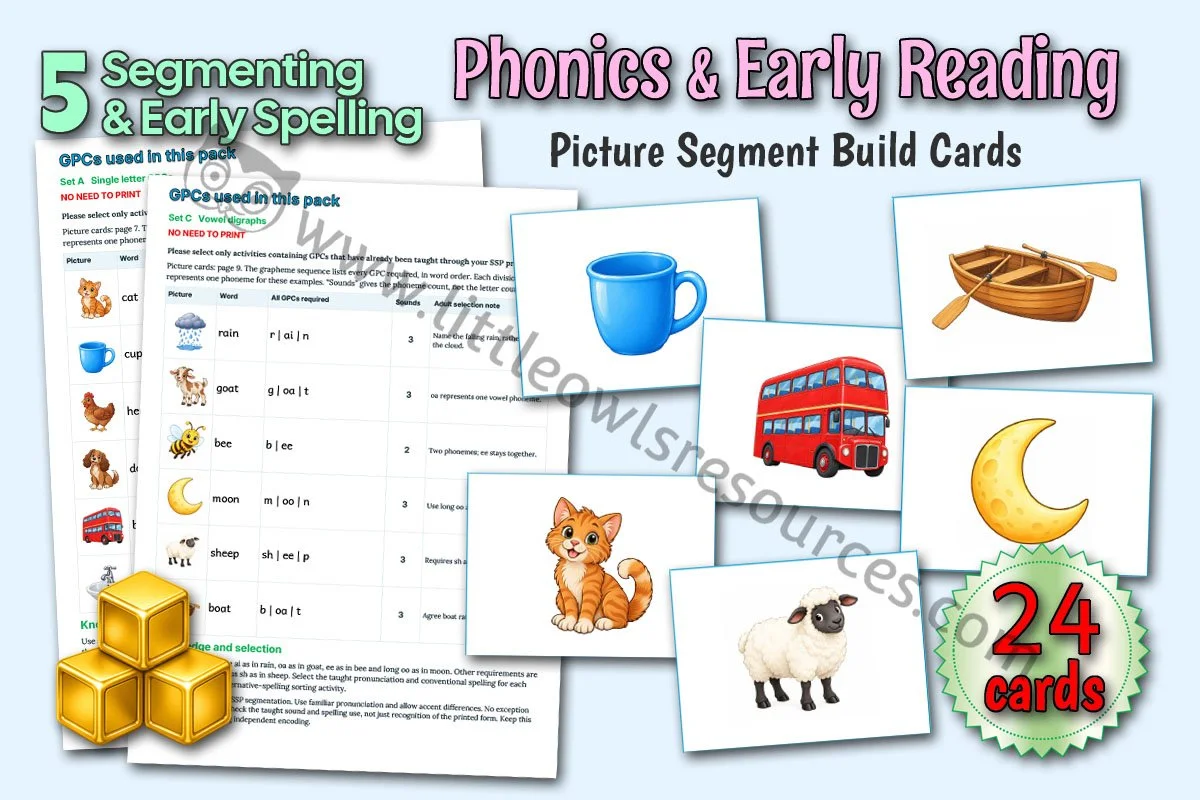
Picture Segment Build Cards
Twenty-four picture-only cards prompt children to name a familiar word, identify and count its phonemes, then choose graphemes to build its spelling. Four modular sets help adults select suitable cards. Use individual cards across sets according to teaching; the letters A to D do not prescribe a sequence.
(You may find our pack ‘Known GPC Cards - Build Your Own Set’ useful.)
Choose familiar words and taught code
Primarily for Reception children applying GPCs taught through their systematic synthetic phonics (SSP) programme, with adaptation for other learners. Check the word-by-word guide on pages 3–6 before offering a card. Establish the intended spoken label: a different reasonable name for a picture is not a spelling error.
For Preschool, use familiar pictures for conversation and playful oral segmenting where appropriate, without a spelling expectation. Oral activities need not be completed as a checklist before phonics begins.
Name, segment, count and build
1. NAME IT Show one picture. Invite the child to name or otherwise identify it. Agree the intended word orally and say it naturally. Keep the adult guide and complete written answer out of view.
2. SEGMENT IT Follow the SSP’s familiar routine to hear each phoneme in order. Use clear sounds without an added “uh”. The child can move or direct one counter for each phoneme, or use the programme’s familiar gestures.
3. COUNT IT Count the phonemes identified. For an independent counting attempt, start on an open surface; offering an already selected numbered frame gives a clue. Then choose a matching frame from Pack 1 or 2 if helpful.
4. BUILD IT Offer a manageable selection of known GPC tiles, including suitable additional taught choices. Keep multi-letter graphemes intact. Replace each counter with its grapheme tile, or build in a line on the table. Supply repeated tiles where needed.
5. READ BACK Blend through the spelling and check every position. After the attempt, provide the conventional spelling or model as needed. Hearing the sounds alone does not always identify which spelling to choose; use the SSP’s taught support.
DOWNLOAD (DOCX) 📝
DOWNLOAD (PDF) 📄
DOWNLOAD (Zipped JPEGs) 📂
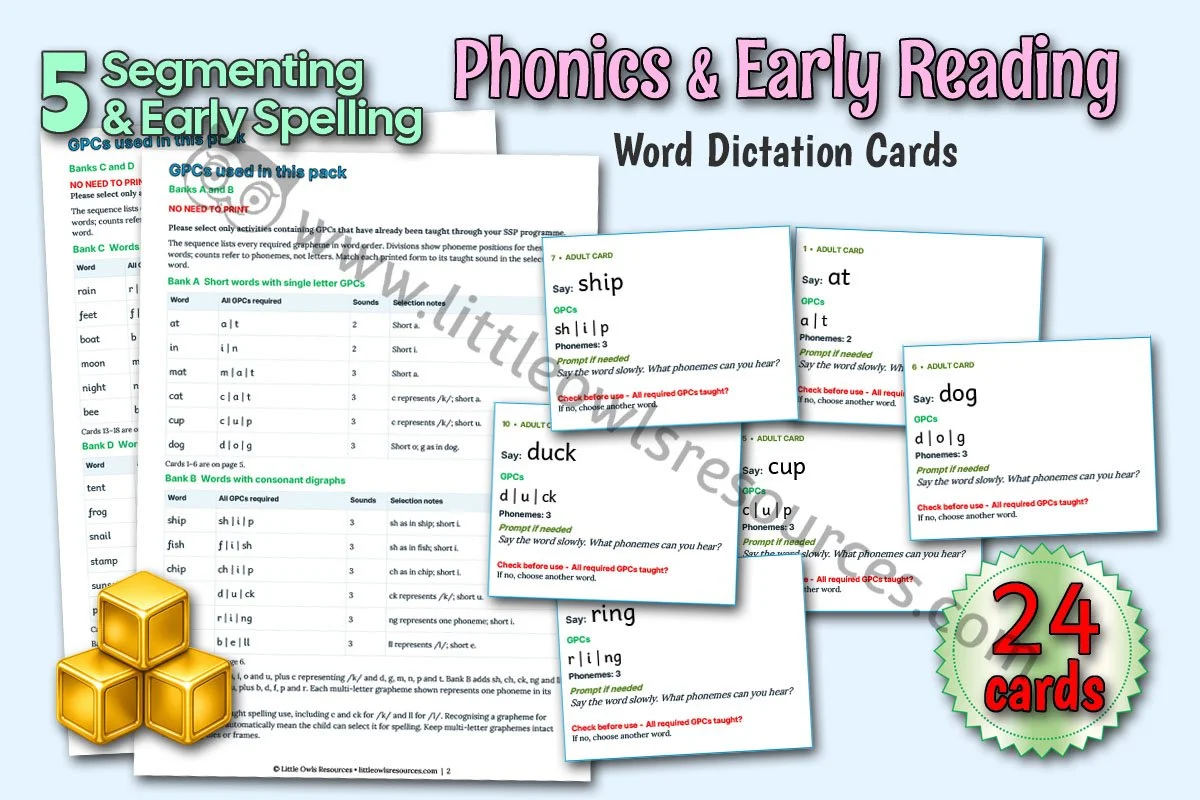
Word Dictation Cards
Twenty-four editable practitioner cards and six blank templates support short, carefully selected word-dictation practice. Children hear a word and apply their taught grapheme–phoneme correspondences (GPCs) to spell it. The cards remain with the adult; they are not child reading cards or a fixed spelling test.
Use only taught correspondences
Do not dictate words containing untaught GPCs. Check every correspondence in the intended word against what the child has been taught through your systematic synthetic phonics (SSP) programme. If any required GPC is untaught, choose another word.
Use a short dictation routine
1. SELECT Choose a small, manageable set from any bank, using the audits on pages 2–3. Banks A to D organise adult preparation; they are not a teaching sequence. Primarily for Reception learners applying taught code, with adaptation for other learners.
2. SAY Keep the written word and GPC sequence hidden. Say the whole word naturally, establish its meaning orally and repeat it when helpful. Do not initially give the segmented answer if you want the child to do the segmenting.
3. SPELL Invite the child to segment and write the word using the SSP’s familiar routine. If needed, use the card’s prompt: “Say the word slowly. What phonemes can you hear?” Keep pronunciation natural, without an added “uh” or an artificial extra syllable.
4. SUPPORT Pause and allow thinking time. If the child needs a model, provide one, then acknowledge that the attempt was supported. Hearing the phonemes alone does not always reveal the conventional spelling; use the spelling support already taught through the SSP.
5. READ BACK Invite the child to blend through what they wrote. Check for an appropriate grapheme for every phoneme, in order. Give specific feedback, then show a checking model if useful. A plausible spelling may show successful segmenting while still needing help with conventional spelling.
DOWNLOAD (DOCX) 📝
DOWNLOAD (PDF) 📄
DOWNLOAD (Zipped JPEGs) 📂