
non-topic Literacy Resources
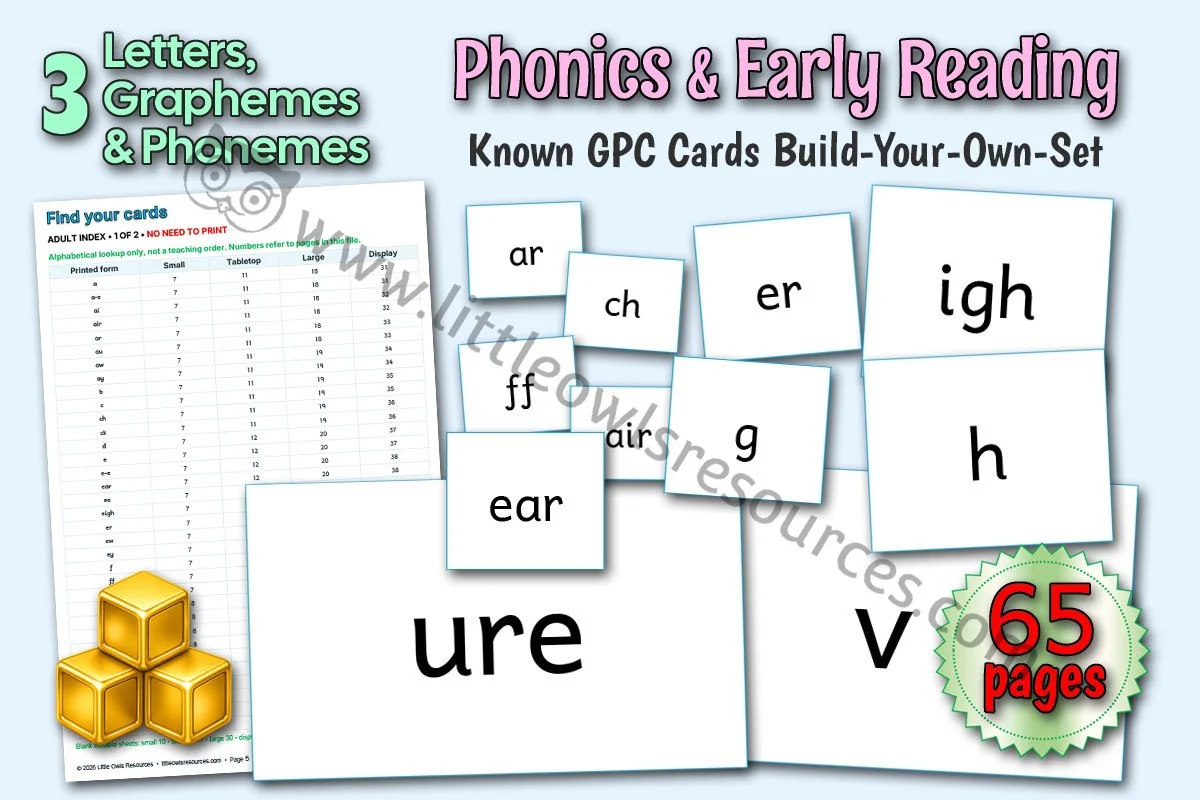
Known GPC Cards - Build Your Own Set
Choose the graphemes children have already been taught and make a small, useful practice set. These editable cards support adult-led recall, sound-to-print choices and familiar classroom routines.
Who this pack is for
Primarily Reception, with adult support and selection matched to the setting’s systematic synthetic phonics (SSP) programme. Older children can use the same materials for additional practice. For Preschool, use a few familiar letters responsively within meaningful play or name exploration; this pack is not a whole-set teaching expectation.
Choose only what you need
There are 68 printed forms in each of four sizes, including an optional qu card. The bank offers choices across programmes and stages. It is not a complete alphabetic code, a teaching sequence or a list every child should know. Alphabetical order is for finding cards only.
DOWNLOAD (DOCX) 📝
DOWNLOAD (PDF) 📄
DOWNLOAD (Zipped JPEGs) 📂
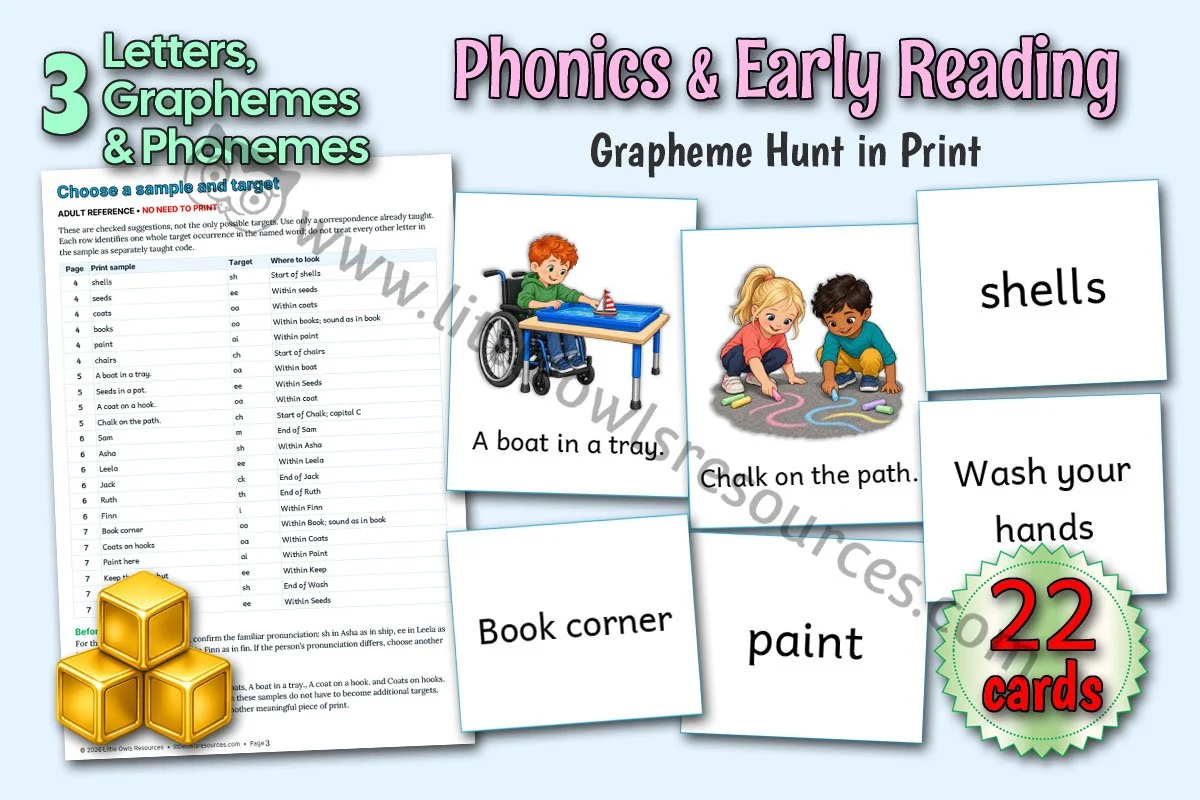
Grapheme Hunt in Print
Choose a taught grapheme and help the child find it within meaningful print: a label, caption, name or sign. Read the print aloud when needed, then invite the child to point to the whole grapheme. This is a print-focused noticing activity, with an adult helping connect the written form to its taught sound.
Try a hunt together
1. Select one taught target and one or two suitable print samples.
2. Show the target on a selected GPC card or write it clearly for the child.
3. Read the sample aloud and talk briefly about its purpose or meaning.
4. Ask, “Can you spot the grapheme we’re practising?”
5. Invite the child to point to, frame or mark the whole grapheme.
6. Revisit its taught sound in that word, modelling when needed.
Use the sample selector on page 3 before printing. A label placed by its resources or a sign beside the relevant area gives print a purpose. For a tabletop hunt, keep just the chosen cards visible. Do not ask the child to search the whole pack at once.
Make participation flexible
Children can point, touch, look towards a choice, gesture or use their familiar communication system. An adult can indicate letters following the child’s direction. No independent reading, writing or spoken repetition is required. Place print within comfortable sight and reach, including for seated children.
For Preschool, follow interest in familiar print and names, coordinating planned GPC teaching with the setting’s approach. Keep talk, stories and playful exploration central. This is not a readiness checklist or a requirement to know a fixed set of letters.
DOWNLOAD (DOCX) 📝
DOWNLOAD (PDF) 📄
DOWNLOAD (Zipped JPEGs) 📂