
Part of the EYFS Glossary
This article forms part of our EYFS Glossary of Early Years Education Terms, which explains key curriculum, pedagogy, and assessment language used in early years practice.
Adult-Led Learning refers to learning experiences that are planned and directed by an adult, where the practitioner determines the focus, structure, or intended learning outcome of the activity.
What is Adult-Led Learning?
Adult-Led Learning describes situations where the practitioner plans and directs an activity with a particular learning focus in mind. The adult usually introduces the task, explains what children will do, and guides the structure of the experience.
This approach is sometimes used to introduce new concepts, demonstrate skills, or provide focused learning opportunities.
Characteristics of Adult-Led Learning
Adult-led learning typically includes:
a planned activity or learning objective
adult direction or instruction
structured tasks or experiences
modelling of specific skills or knowledge
While the adult leads the activity, children still participate and engage with the learning experience.
Adult-Led Learning in Early Years Practice
In early years settings, adult-led learning may take place during short group sessions, storytelling, or activities where practitioners introduce specific concepts such as early mathematical ideas or phonological awareness.
These experiences are often balanced with opportunities for child-led play and exploration.
Adult-Led vs Adult-Guided Learning
Adult-led learning involves greater adult direction and planning. The practitioner usually determines the structure and learning goal of the activity.
In adult-guided learning, the adult supports children’s learning through interaction and guidance while allowing more flexibility in how the activity develops.
Common Questions About Adult-Led Learning
-
Adult-led learning can support children’s development when used alongside play-based and child-led experiences.
-
Adult-led activities in early years settings are often short and developmentally appropriate to maintain children’s engagement.
-
No. Play remains a central part of learning in the EYFS. Adult-led experiences usually complement play-based learning.
Summary
Adult-Led Learning refers to learning experiences planned and directed by a practitioner. The adult determines the focus or structure of the activity while children participate and engage with the learning experience.
Related Glossary Terms
The following glossary entries are closely related to Adult-Led Learning and provide additional context:
Further Guidance | Related Documents within our ‘EYFS Curriculum & Pedagogy’ suite:
Below you will find a selection of guidance documents from within our Little Owls Resources ‘Curriculum & Pedagogy’ area which explore this concept (& its age-specific application within EYFS settings) in greater depth.
[For additional documents please visit our support pathways: Baby | Toddler | Preschool | Reception | Mixed-Age]
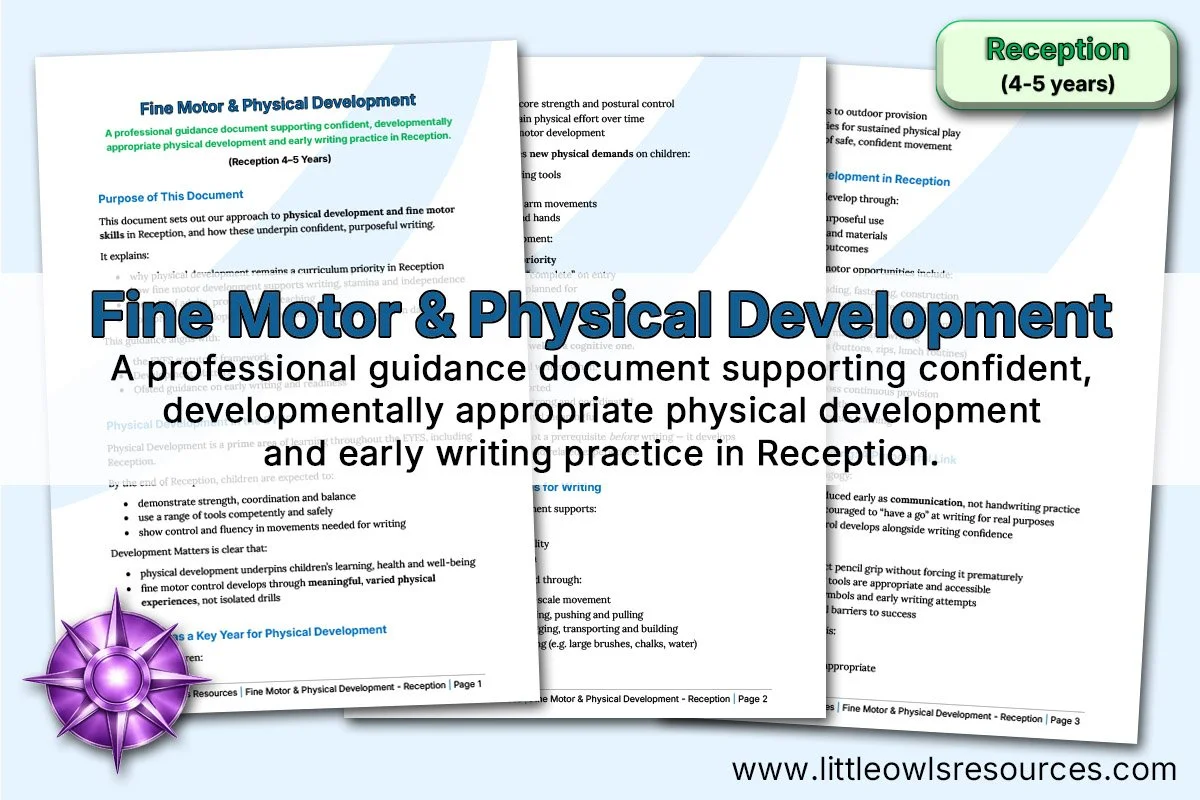
A professional guidance document supporting confident, developmentally appropriate physical development and early writing practice in Reception.
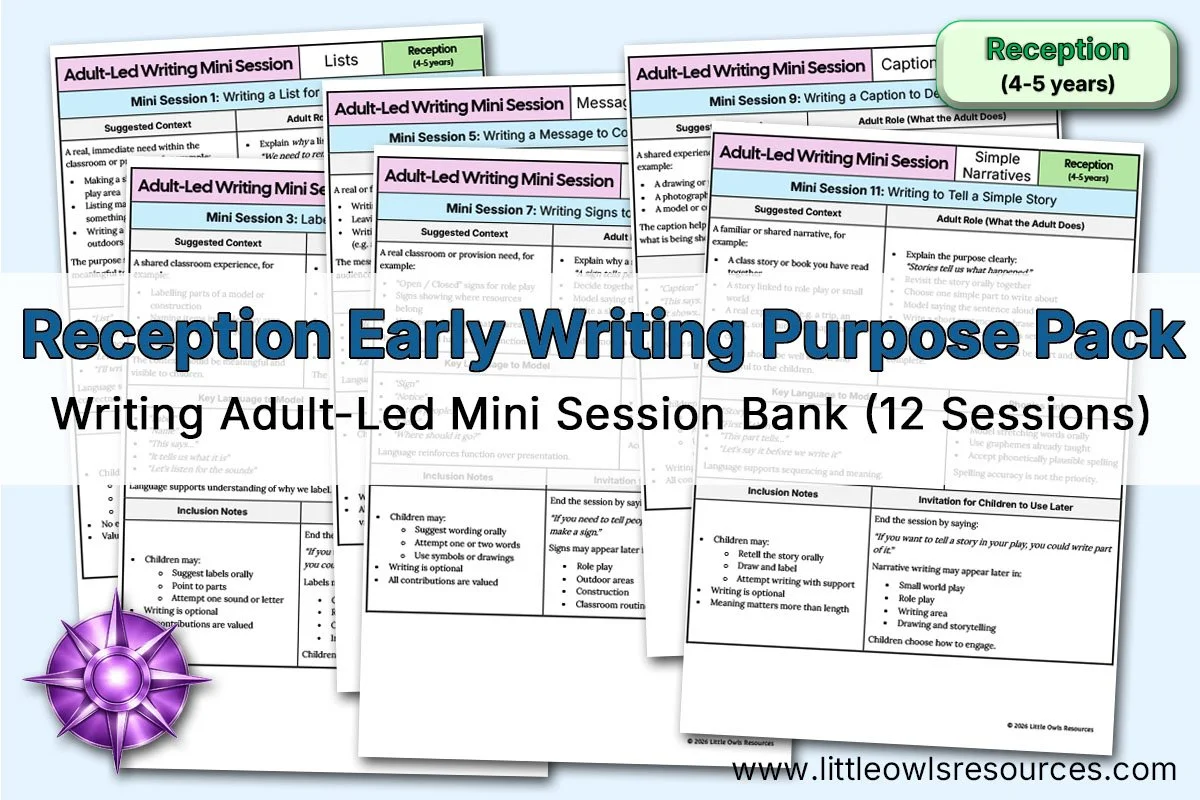
A professional guidance pack supporting developmentally appropriate early writing through purpose-led modelling, phonics application and play-based follow-through in continuous provision.
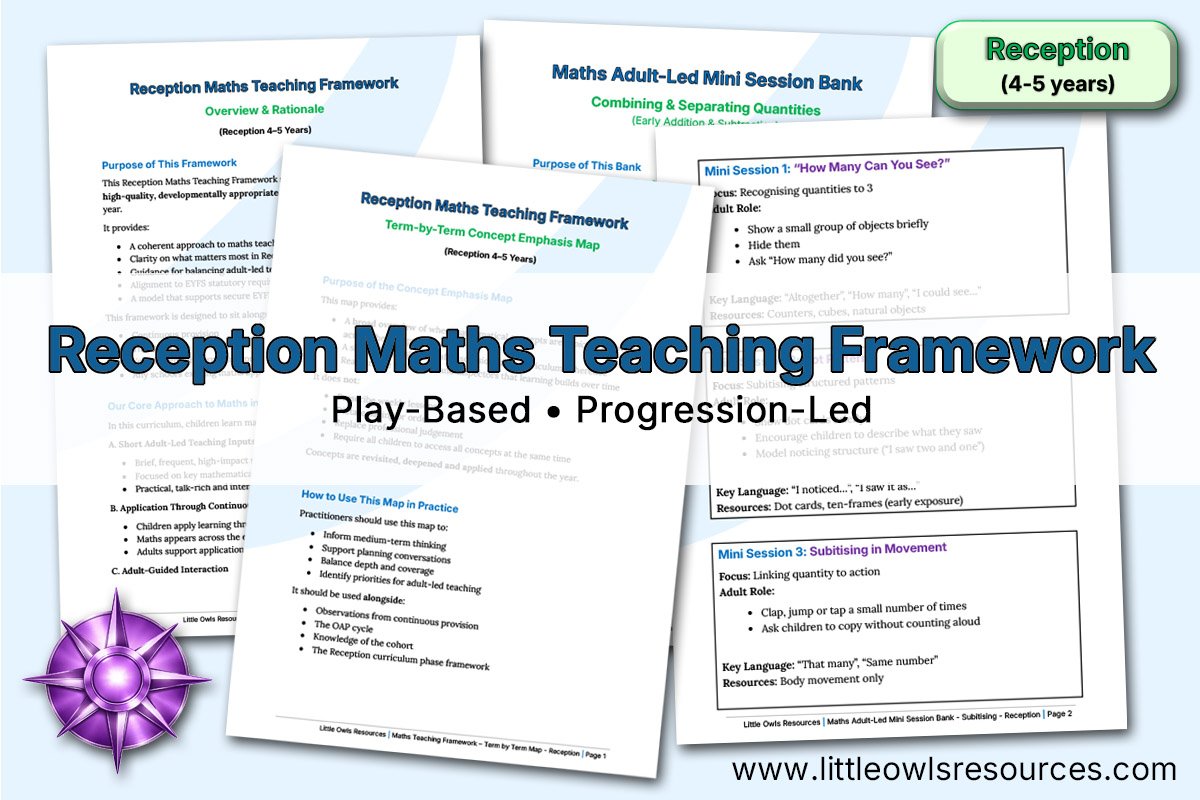
The Reception Maths Teaching Framework provides a clear, coherent model for play-based and progression-led teaching of mathematics across the Reception year that is developmentally appropriate and inspection-secure.
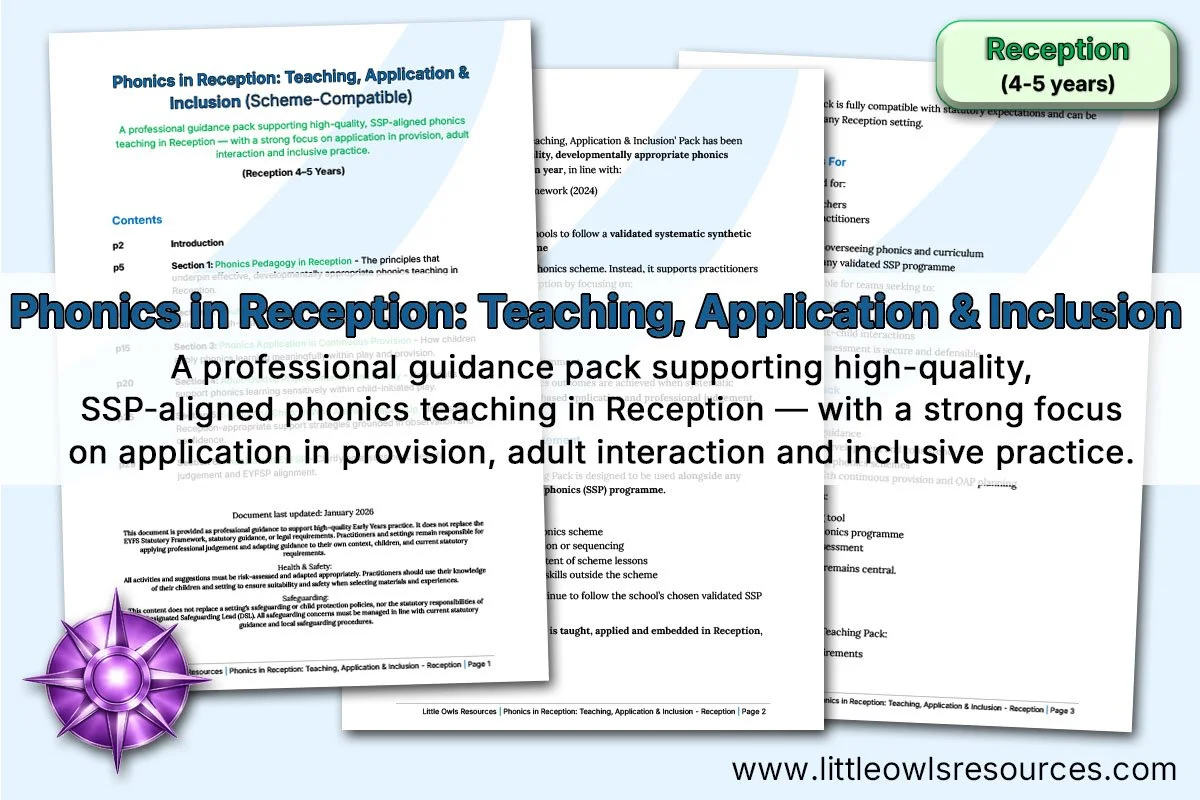
A professional guidance pack supporting high-quality, SSP-aligned phonics teaching in Reception — with a strong focus on application in provision, adult interaction and inclusive practice.

A professional support resource for childminders who prefer light-touch written reflection alongside responsive EYFS practice.
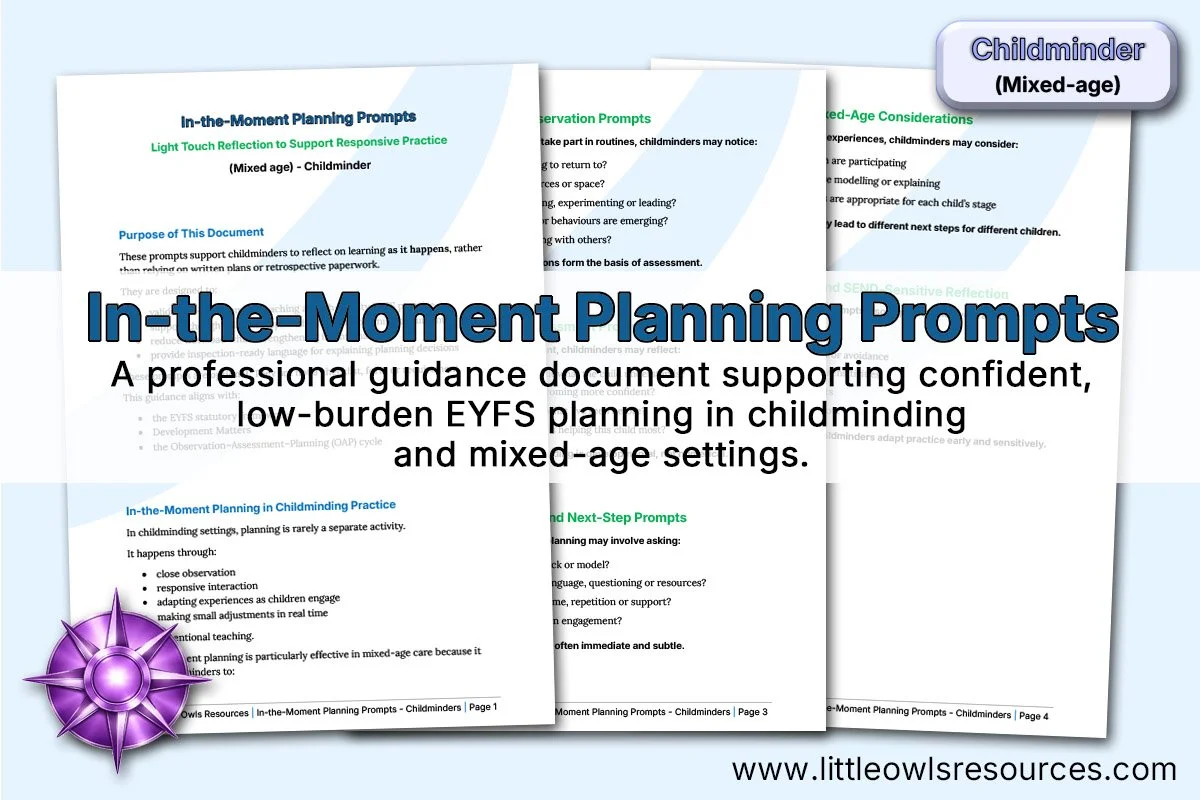
A professional guidance document supporting confident, low-burden EYFS planning in childminding and mixed-age settings.
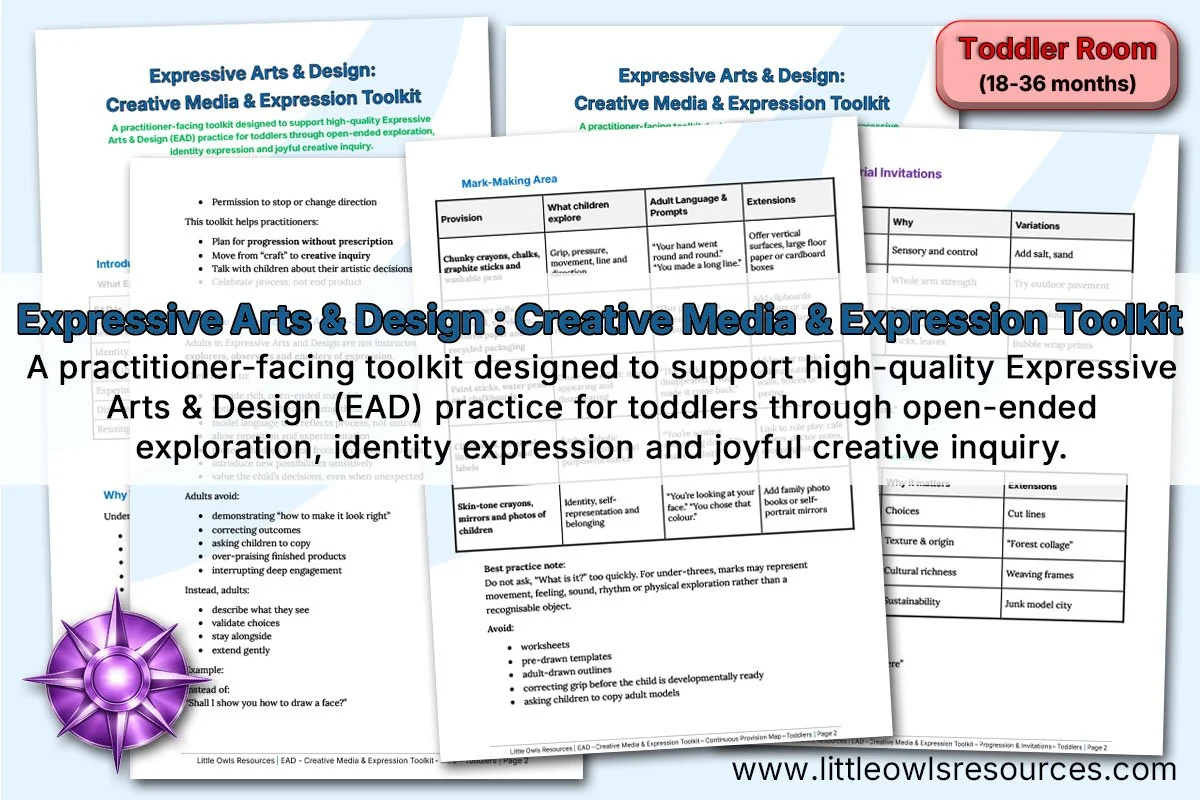
A practitioner-facing toolkit designed to support high-quality Expressive Arts & Design (EAD) practice for toddlers through open-ended exploration, identity expression and joyful creative inquiry.
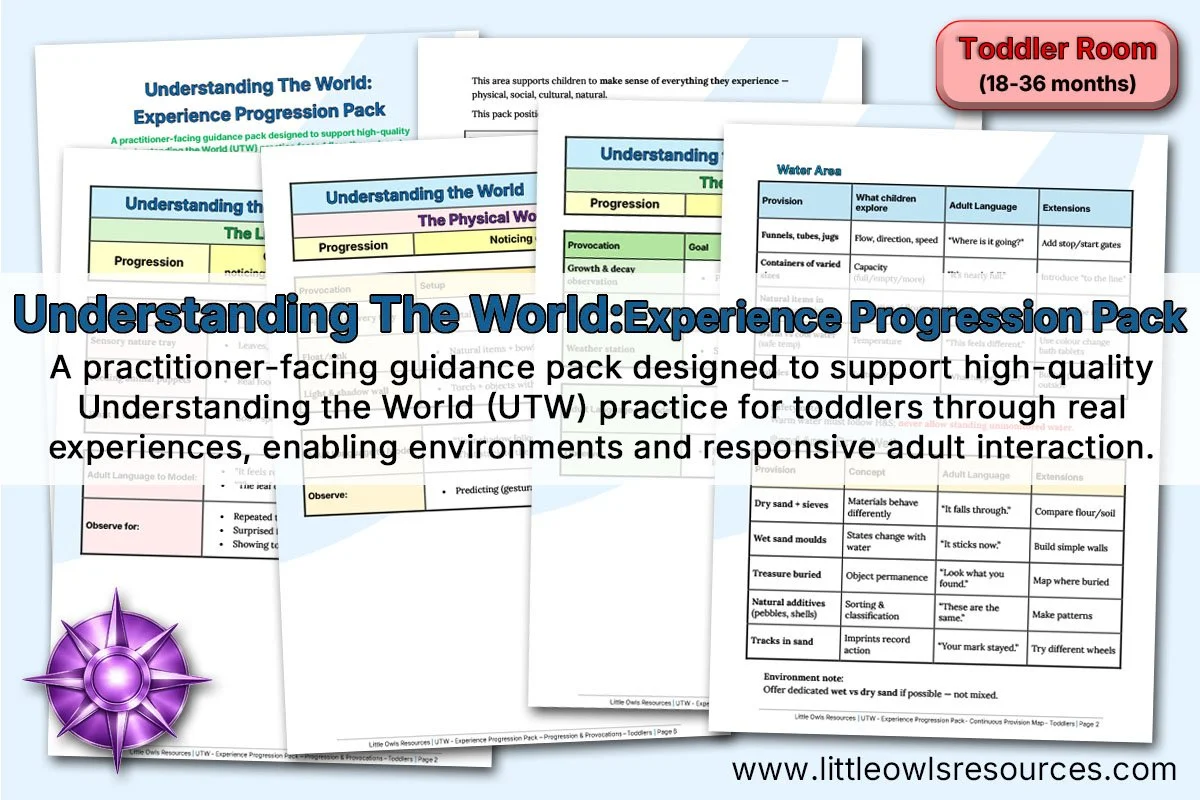
A practitioner-facing guidance pack designed to support high-quality Understanding the World (UTW) practice for toddlers through real experiences, enabling environments and responsive adult interaction.

Foundations for early reading, writing, sound and meaning through play. A practitioner-facing literacy resource designed to support the earliest foundations of reading, writing and communication — before formal phonics, letter instruction or written outcomes.
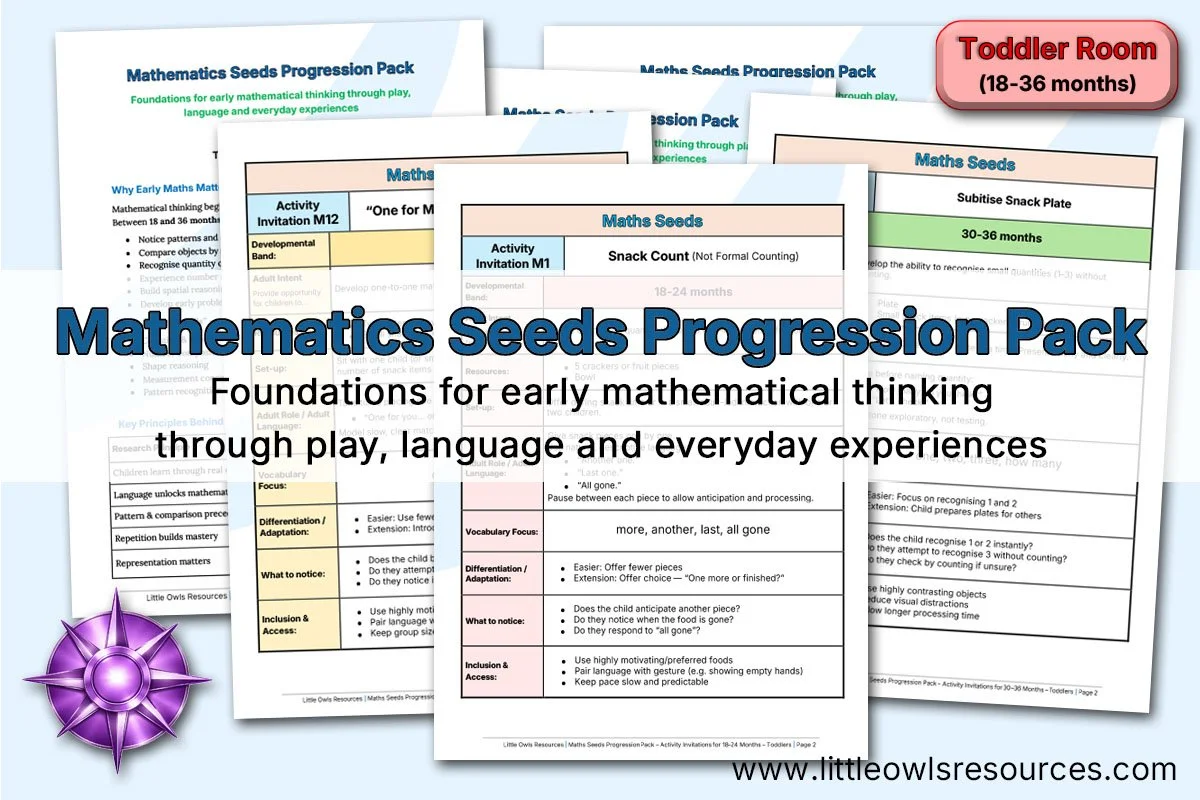
Foundations for early mathematical thinking through play, language and everyday experiences.
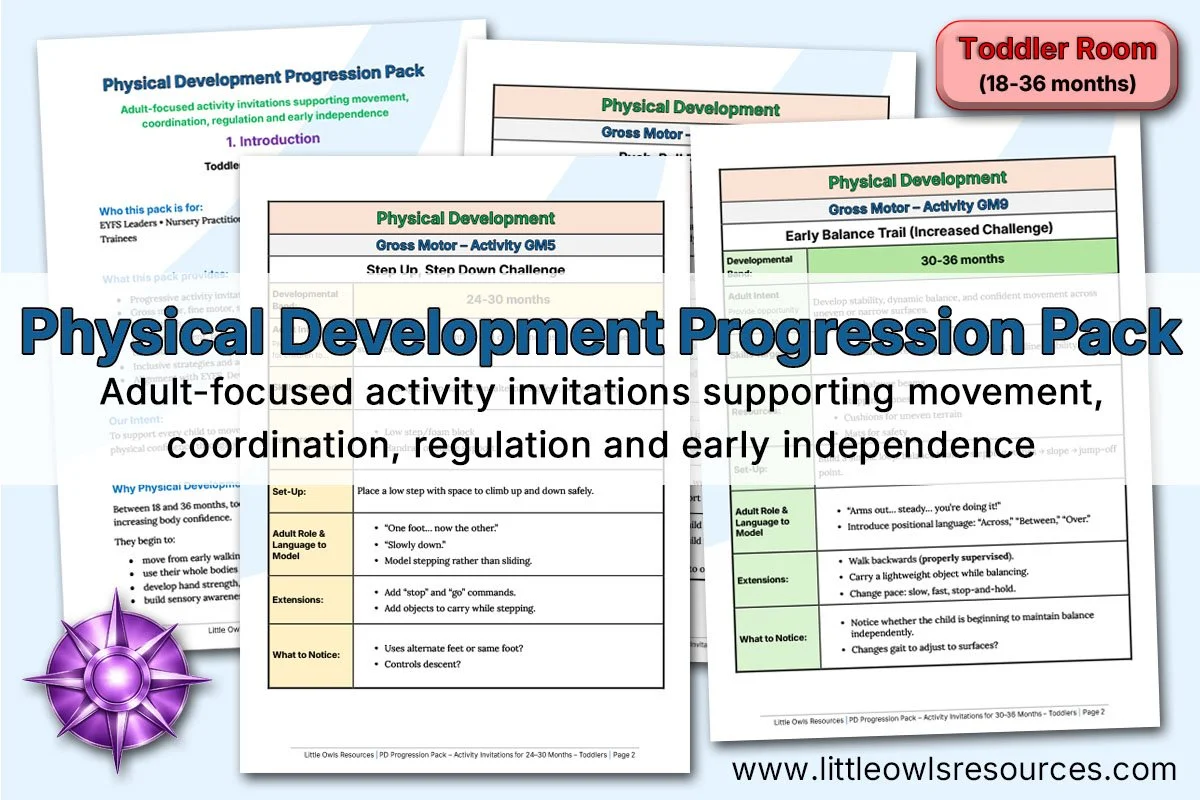
Adult initiated opportunity bank supporting movement, coordination, regulation and early independence.
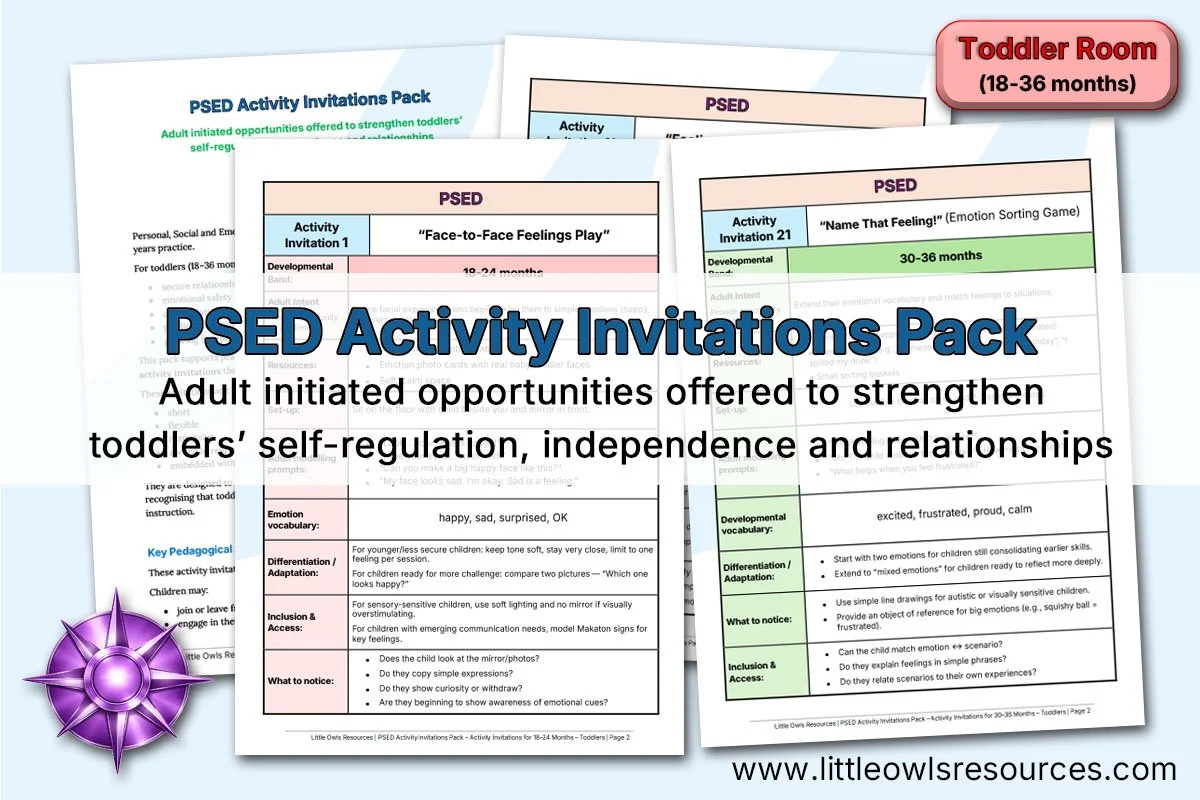
Adult initiated opportunities offered to strengthen toddlers’ self-regulation, independence and relationships.

Progression map and adult initiated opportunity bank to strengthen toddler language through high-quality interactions.
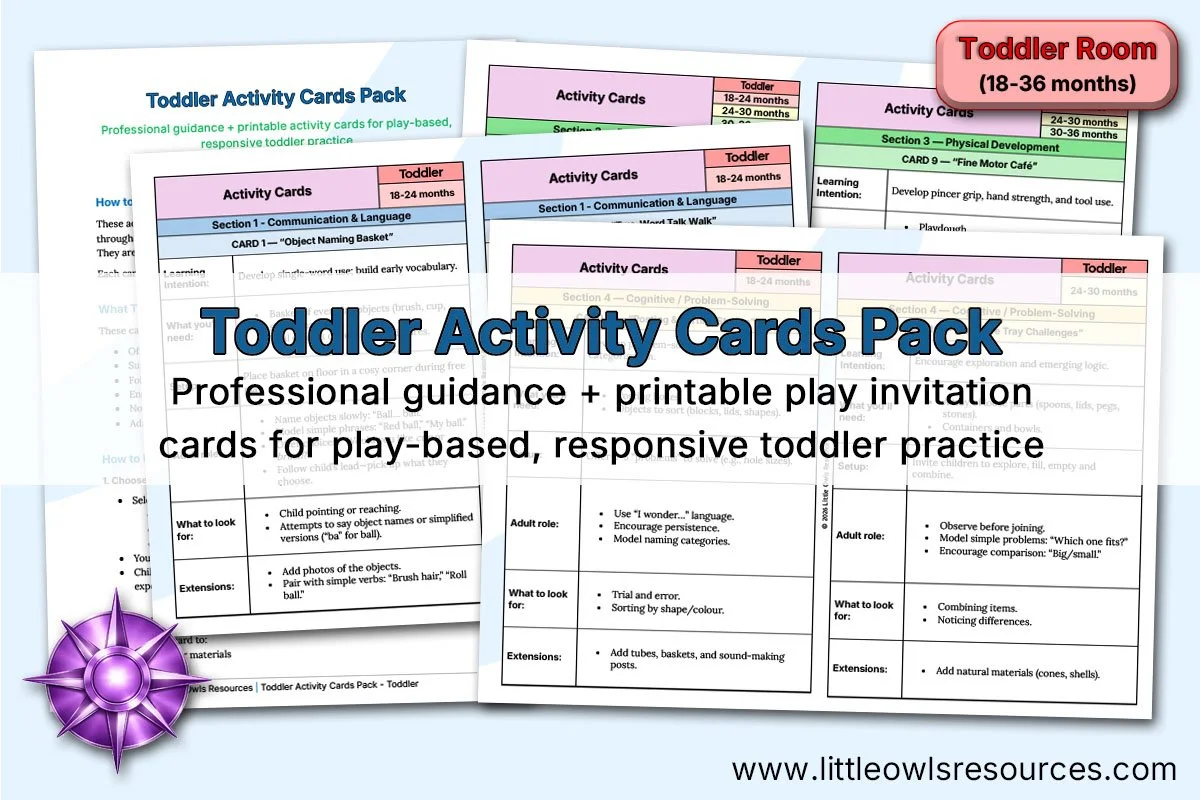
Professional guidance + printable activity cards for play-based, responsive toddler practice. A practical, practitioner-friendly pack of play invitations and interaction prompts to strengthen language, independence, movement and problem-solving in toddler rooms.

Practitioner-facing reference packs supporting intentional, developmentally appropriate toddler practice across key area of learning strands.
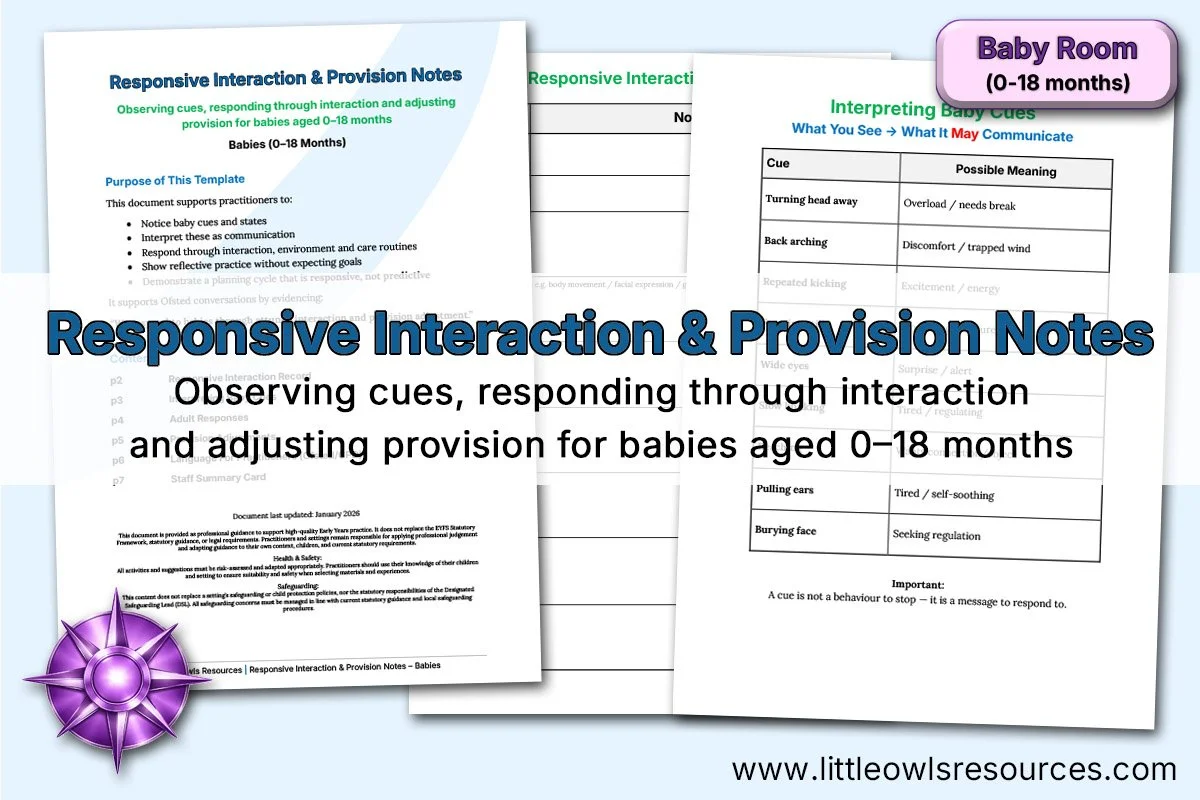
Observing cues, responding through interaction and adjusting provision for babies aged 0–18 months.


How our Fine-Motor & Marking-Making Mini Session Bank & our Early Writing Purpose Mini Session Bank are Designed To Work Together.

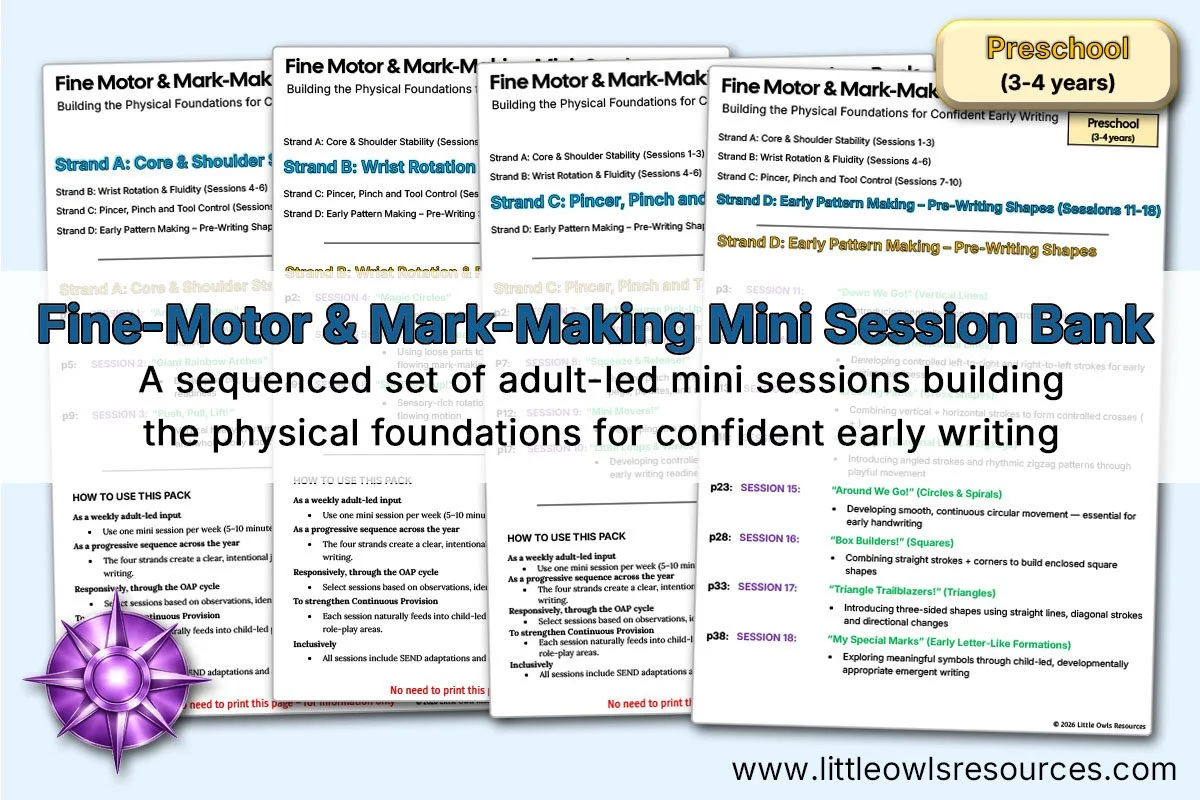
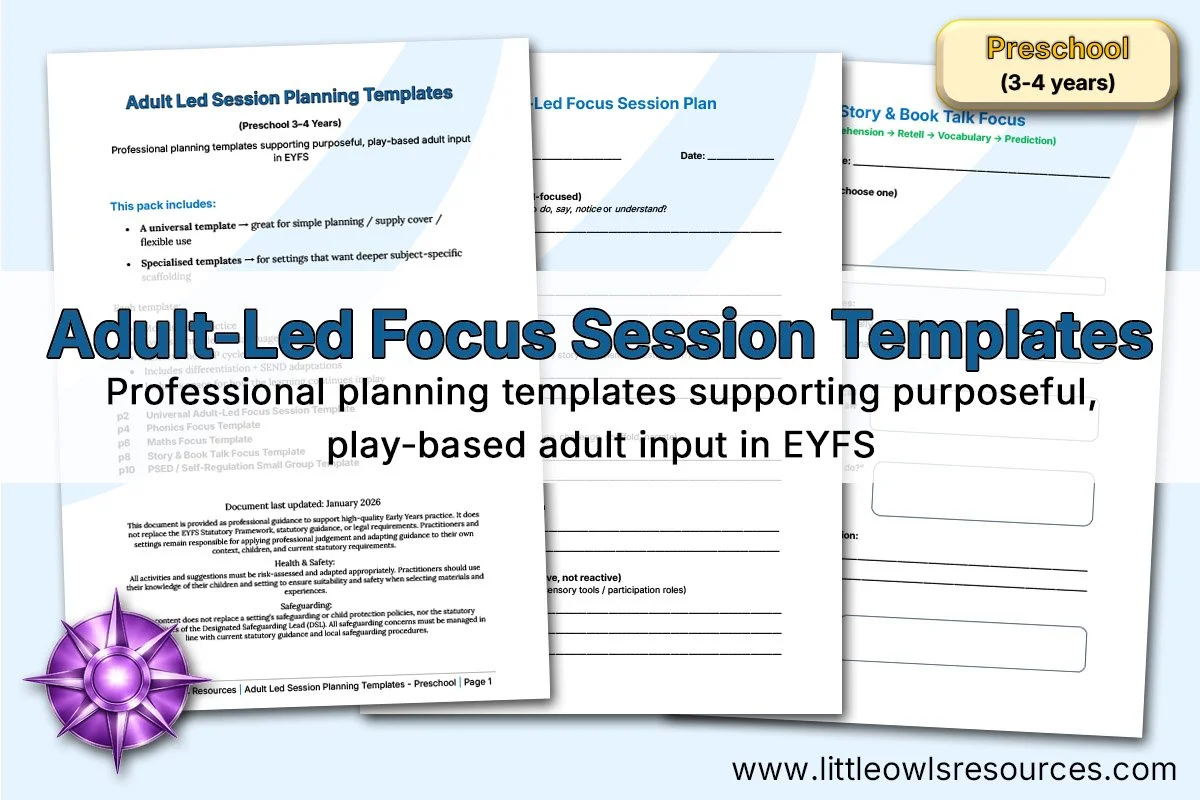
A sequenced set of adult-led mini sessions building the physical foundations for confident early writing.
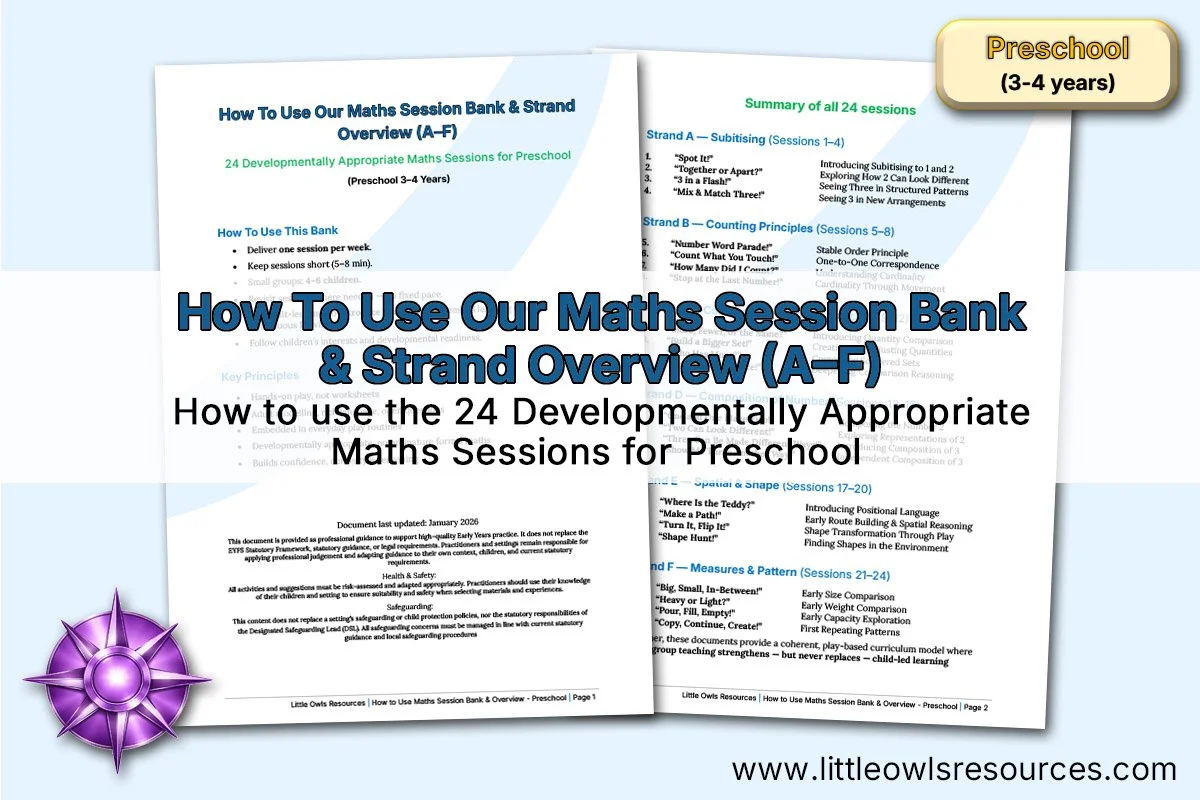
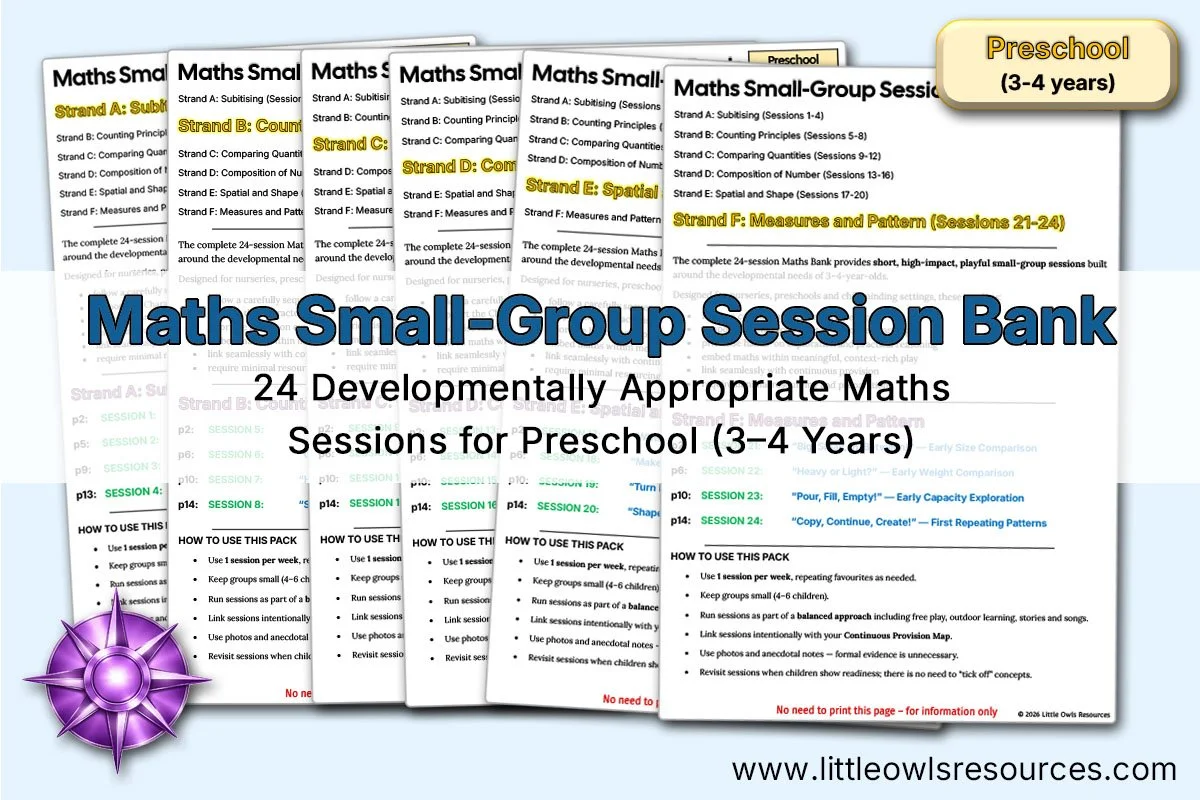
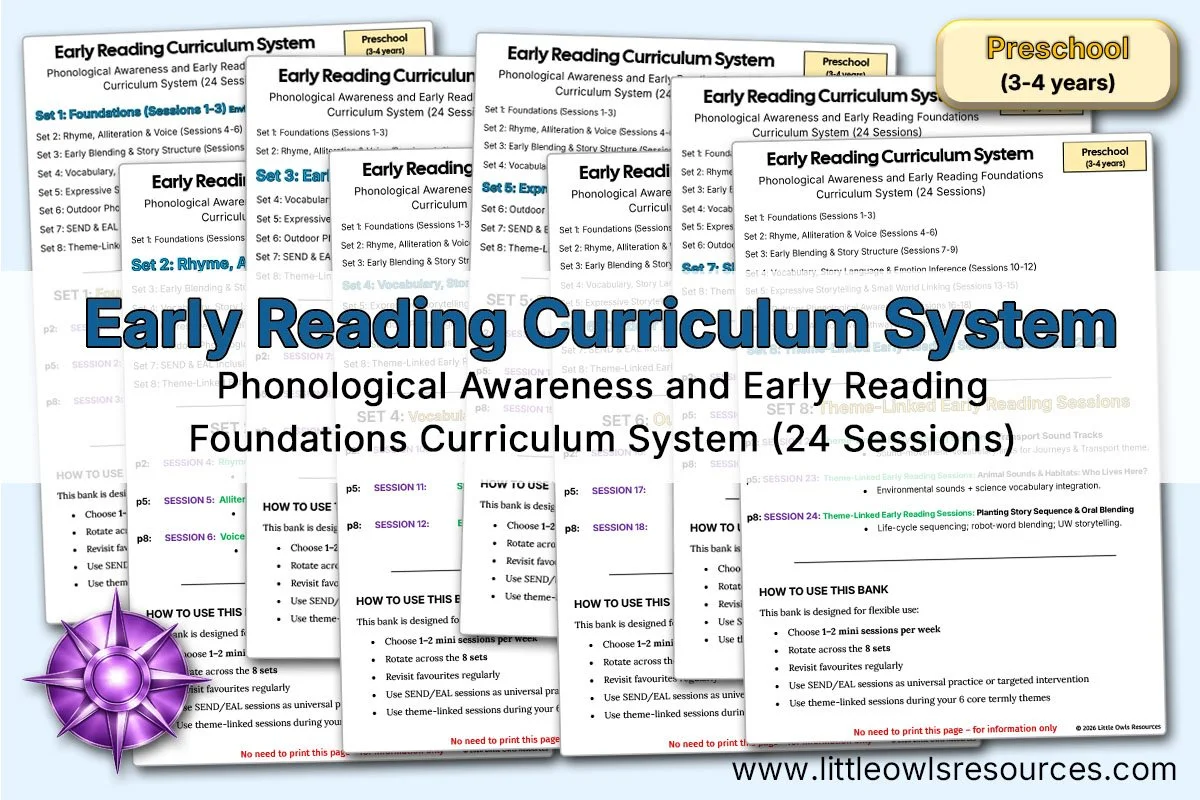
This document is a complete bank of 24 short, high-quality maths small-group sessions designed specifically for Preschool children aged 3–4 years.
The 24 sessions are organised into six developmental strands: Subitising, Counting Principles, Comparing Quantities, Composition of Number, Spatial & Shape and Measures & Pattern.

Further Guidance | Related Resources within our ‘Printable Provision’ area:
The following resources are within our ‘EYFS Framework’ collection. They refer to information contained within the ‘EYFS Statutory Framework’ and also supporting material within ‘Development Matters’.
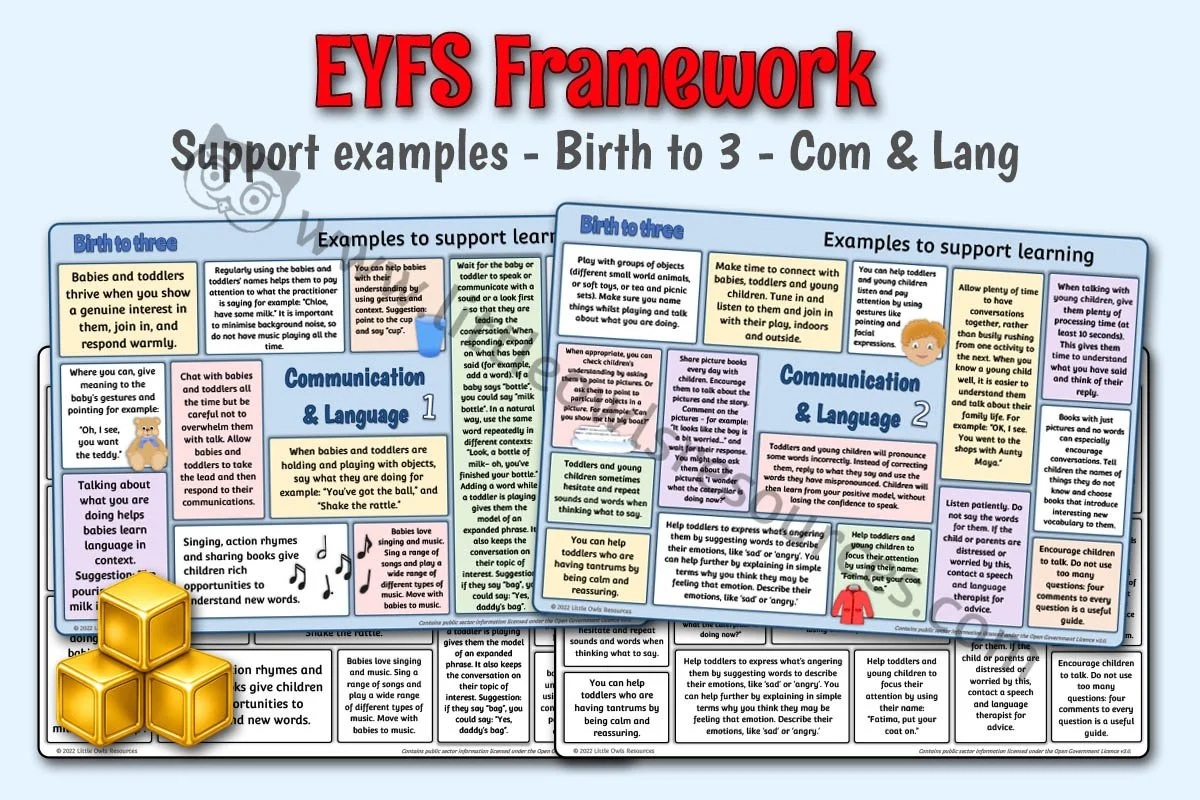
Examples of how to support ‘Communication & Language’ learning and development for birth to 3 year olds.
Extracted from Development Matters; non-statutory curriculum guidance for the early years foundation stage.
Includes colour and black and white versions.
Files contain public sector information licensed under the Open Government Licence v3.0.
Original artwork drawn by Sara Murphy and final digital resources created by Stuart Murphy. COPYRIGHT ON ALL OF THE RESOURCES HOUSED ON THIS WEBSITE IS HELD BY ‘LITTLE OWLS RESOURCES’. OUR RESOURCES (INCLUDING THE IMAGES WITHIN THEM), CANNOT BE SHARED OR SOLD COMMERCIALLY.
DOWNLOAD EDITABLE (DOCX)
DOWNLOAD NON-EDITABLE (PDF)
DOWNLOAD NON-EDITABLE (Zipped JPEGs)
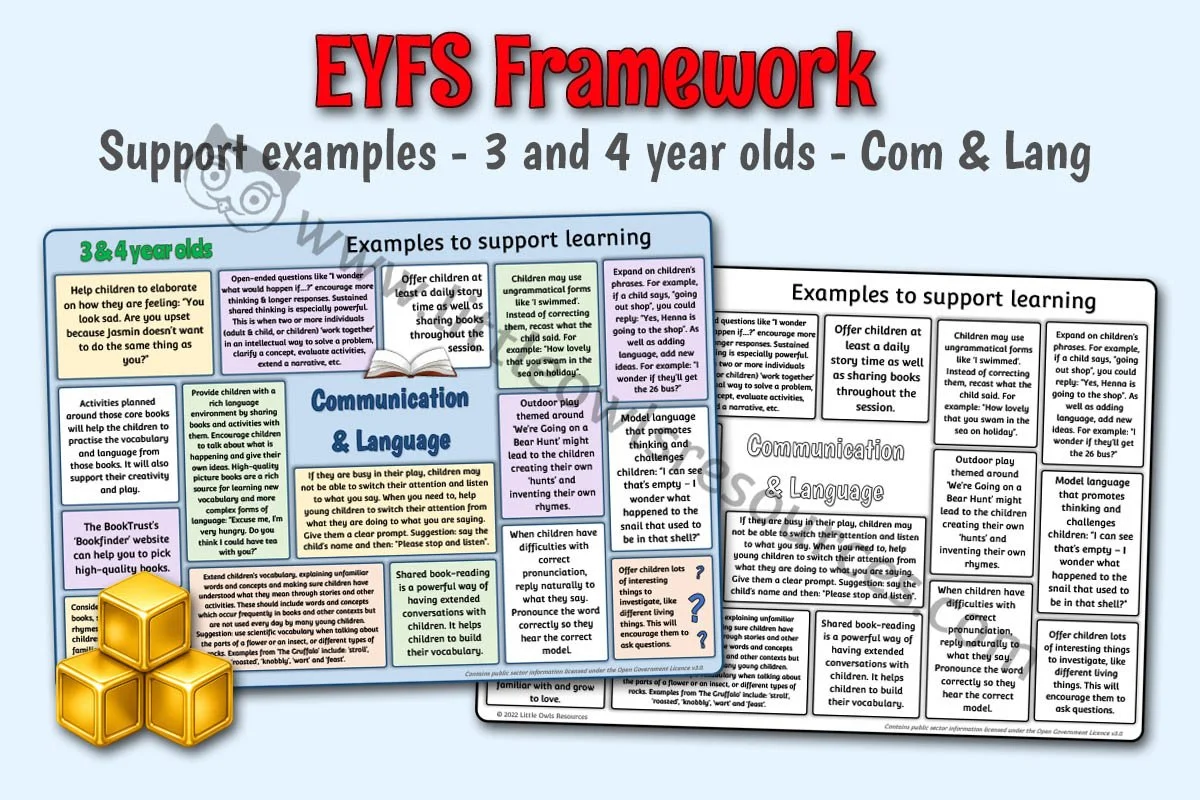
Examples of how to support ‘Communication & Language’ learning and development for 3 and 4 year olds.
Extracted from Development Matters; non-statutory curriculum guidance for the early years foundation stage.
Includes colour and black and white versions.
Files contain public sector information licensed under the Open Government Licence v3.0.
Original artwork drawn by Sara Murphy and final digital resources created by Stuart Murphy. COPYRIGHT ON ALL OF THE RESOURCES HOUSED ON THIS WEBSITE IS HELD BY ‘LITTLE OWLS RESOURCES’. OUR RESOURCES (INCLUDING THE IMAGES WITHIN THEM), CANNOT BE SHARED OR SOLD COMMERCIALLY.
DOWNLOAD EDITABLE (DOCX)
DOWNLOAD NON-EDITABLE (PDF)
DOWNLOAD NON-EDITABLE (Zipped JPEGs)
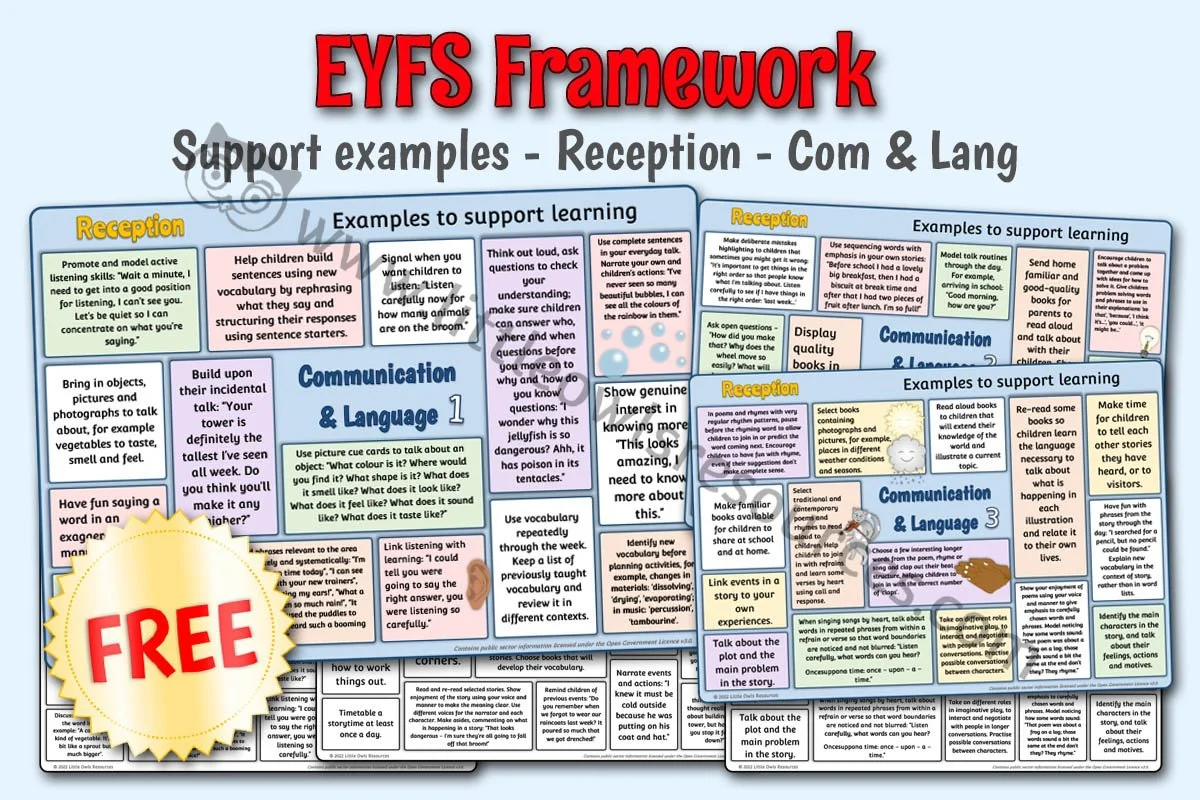
Examples of how to support ‘Communication & Language’ learning and development for Reception children.
Extracted from Development Matters; non-statutory curriculum guidance for the early years foundation stage.
Includes colour and black and white versions.
Files contain public sector information licensed under the Open Government Licence v3.0.
Original artwork drawn by Sara Murphy and final digital resources created by Stuart Murphy. COPYRIGHT ON ALL OF THE RESOURCES HOUSED ON THIS WEBSITE IS HELD BY ‘LITTLE OWLS RESOURCES’. OUR RESOURCES (INCLUDING THE IMAGES WITHIN THEM), CANNOT BE SHARED OR SOLD COMMERCIALLY.
DOWNLOAD EDITABLE (DOCX)
DOWNLOAD NON-EDITABLE (PDF)
DOWNLOAD NON-EDITABLE (Zipped JPEGs)
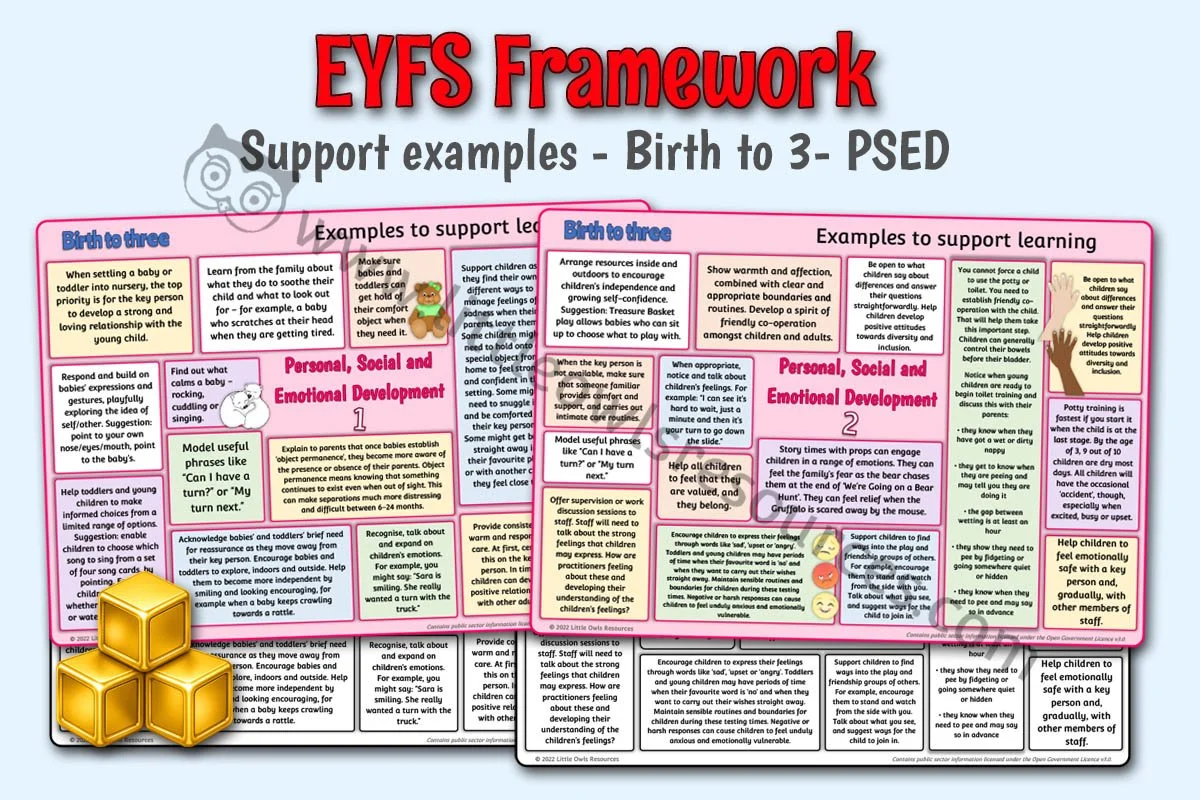
Examples of how to support Personal, Social & Emotional learning and development for birth to 3 year olds.
Extracted from Development Matters; non-statutory curriculum guidance for the early years foundation stage.
Includes colour and black and white versions.
Files contain public sector information licensed under the Open Government Licence v3.0.
Original artwork drawn by Sara Murphy and final digital resources created by Stuart Murphy. COPYRIGHT ON ALL OF THE RESOURCES HOUSED ON THIS WEBSITE IS HELD BY ‘LITTLE OWLS RESOURCES’. OUR RESOURCES (INCLUDING THE IMAGES WITHIN THEM), CANNOT BE SHARED OR SOLD COMMERCIALLY.
DOWNLOAD EDITABLE (DOCX)
DOWNLOAD NON-EDITABLE (PDF)
DOWNLOAD NON-EDITABLE (Zipped JPEGs)
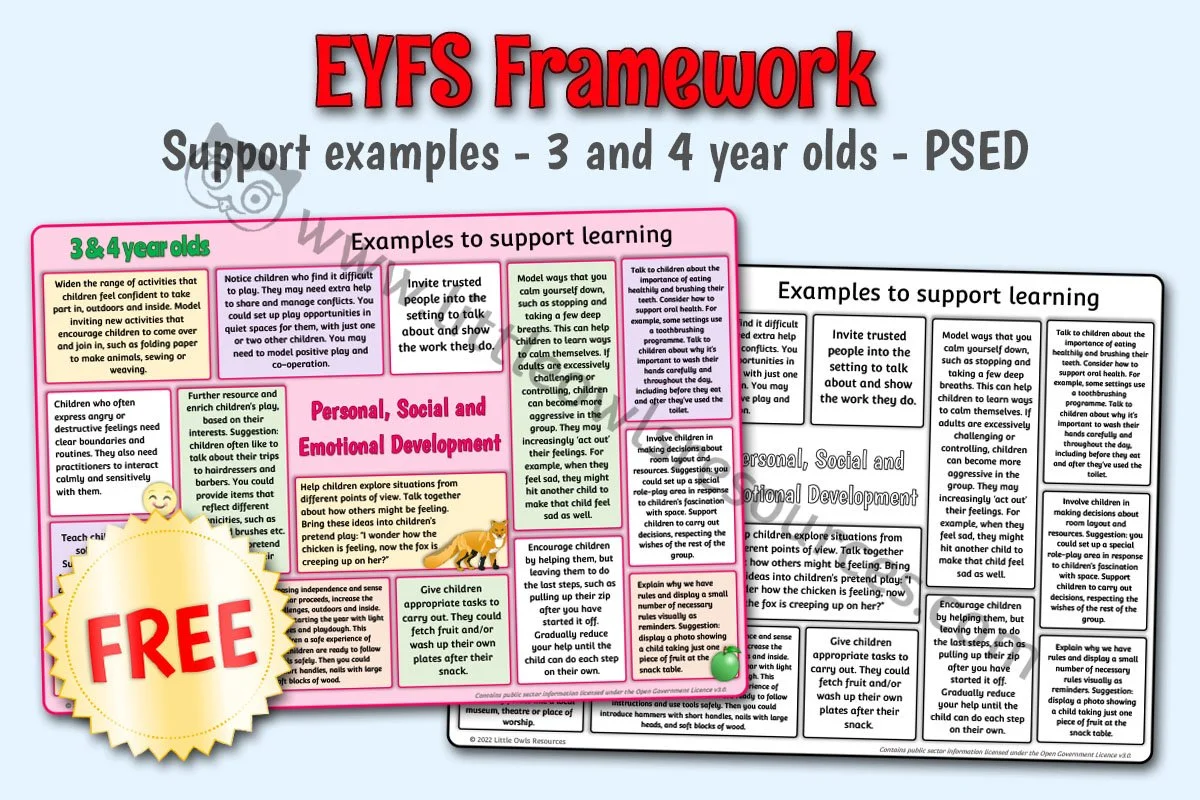
Examples of how to support Personal, Social & Emotional learning and development for 3 and 4 year olds.
Extracted from Development Matters; non-statutory curriculum guidance for the early years foundation stage.
Includes colour and black and white versions.
Files contain public sector information licensed under the Open Government Licence v3.0.
Original artwork drawn by Sara Murphy and final digital resources created by Stuart Murphy. COPYRIGHT ON ALL OF THE RESOURCES HOUSED ON THIS WEBSITE IS HELD BY ‘LITTLE OWLS RESOURCES’. OUR RESOURCES (INCLUDING THE IMAGES WITHIN THEM), CANNOT BE SHARED OR SOLD COMMERCIALLY.
DOWNLOAD EDITABLE (DOCX)
DOWNLOAD NON-EDITABLE (PDF)
DOWNLOAD NON-EDITABLE (Zipped JPEGs)
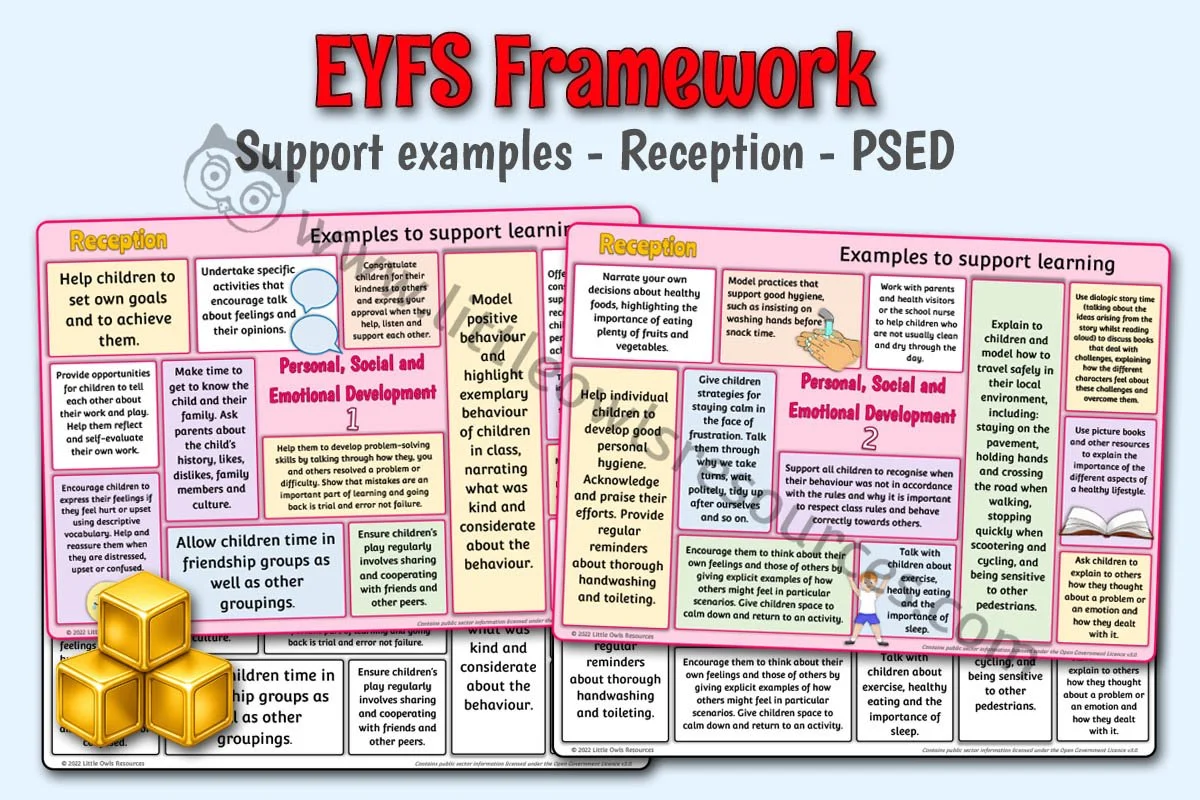
Examples of how to support Personal, Social and Emotional learning and development for Reception children.
Extracted from Development Matters; non-statutory curriculum guidance for the early years foundation stage.
Includes colour and black and white versions.
Files contain public sector information licensed under the Open Government Licence v3.0.
Original artwork drawn by Sara Murphy and final digital resources created by Stuart Murphy. COPYRIGHT ON ALL OF THE RESOURCES HOUSED ON THIS WEBSITE IS HELD BY ‘LITTLE OWLS RESOURCES’. OUR RESOURCES (INCLUDING THE IMAGES WITHIN THEM), CANNOT BE SHARED OR SOLD COMMERCIALLY.
DOWNLOAD EDITABLE (DOCX)
DOWNLOAD NON-EDITABLE (PDF)
DOWNLOAD NON-EDITABLE (Zipped JPEGs)
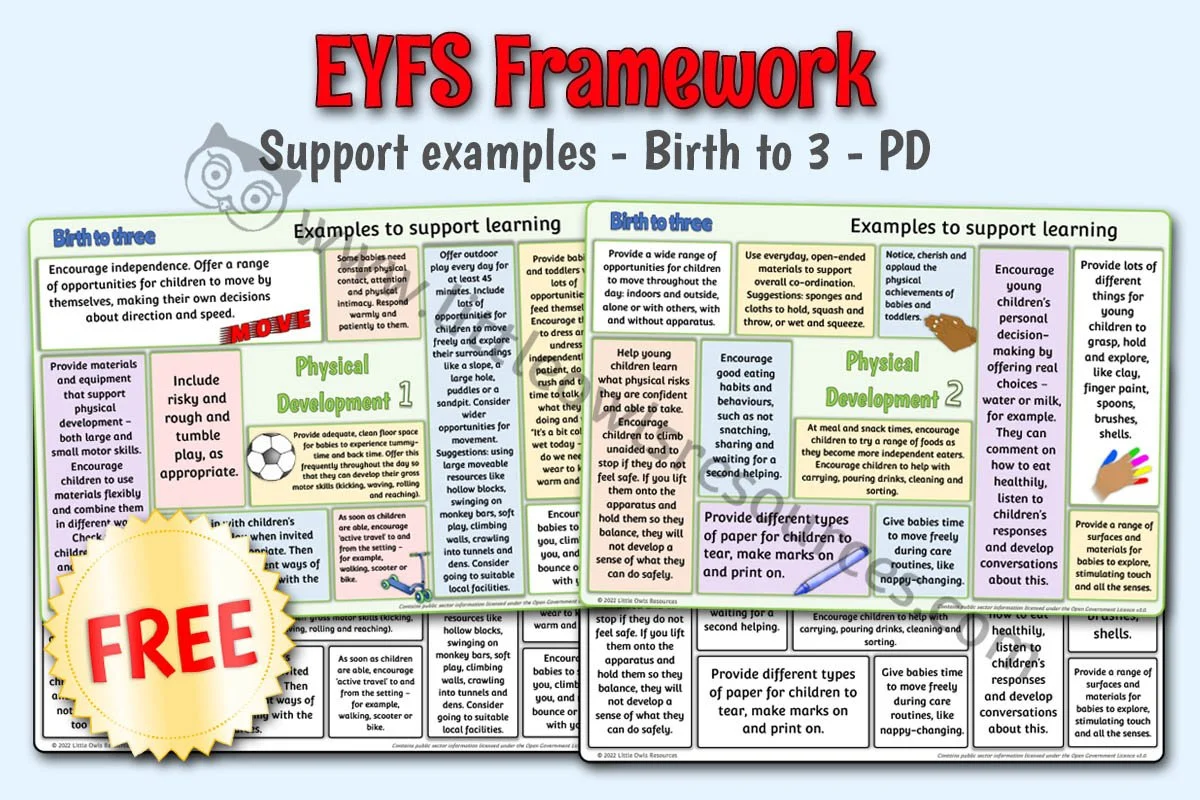
Examples of how to support ‘Physical Development’ for birth to 3 year olds.
Extracted from Development Matters; non-statutory curriculum guidance for the early years foundation stage.
Includes colour and black and white versions.
Files contain public sector information licensed under the Open Government Licence v3.0.
Original artwork drawn by Sara Murphy and final digital resources created by Stuart Murphy. COPYRIGHT ON ALL OF THE RESOURCES HOUSED ON THIS WEBSITE IS HELD BY ‘LITTLE OWLS RESOURCES’. OUR RESOURCES (INCLUDING THE IMAGES WITHIN THEM), CANNOT BE SHARED OR SOLD COMMERCIALLY.
DOWNLOAD EDITABLE (DOCX)
DOWNLOAD NON-EDITABLE (PDF)
DOWNLOAD NON-EDITABLE (Zipped JPEGs)
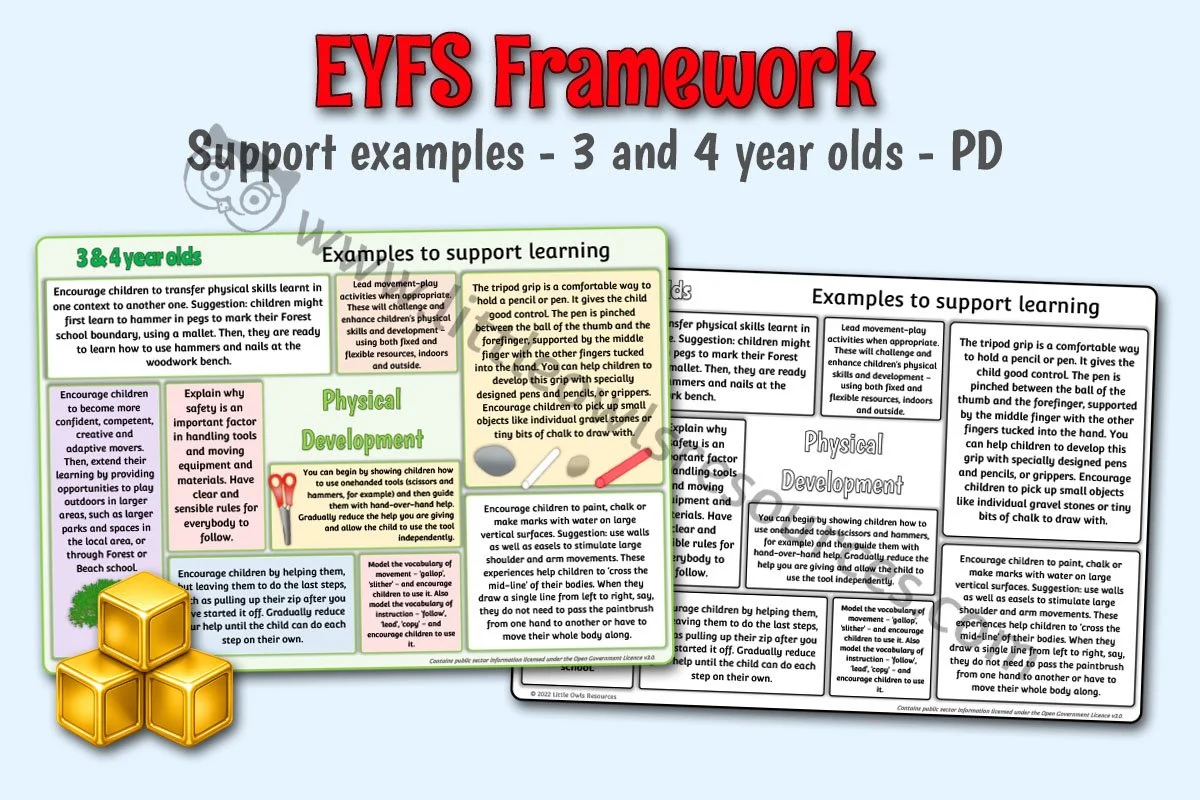
Examples of how to support Physical Development for 3 and 4 year olds.
Extracted from Development Matters; non-statutory curriculum guidance for the early years foundation stage.
Includes colour and black and white versions.
Files contain public sector information licensed under the Open Government Licence v3.0.
Original artwork drawn by Sara Murphy and final digital resources created by Stuart Murphy. COPYRIGHT ON ALL OF THE RESOURCES HOUSED ON THIS WEBSITE IS HELD BY ‘LITTLE OWLS RESOURCES’. OUR RESOURCES (INCLUDING THE IMAGES WITHIN THEM), CANNOT BE SHARED OR SOLD COMMERCIALLY.
DOWNLOAD EDITABLE (DOCX)
DOWNLOAD NON-EDITABLE (PDF)
DOWNLOAD NON-EDITABLE (Zipped JPEGs)
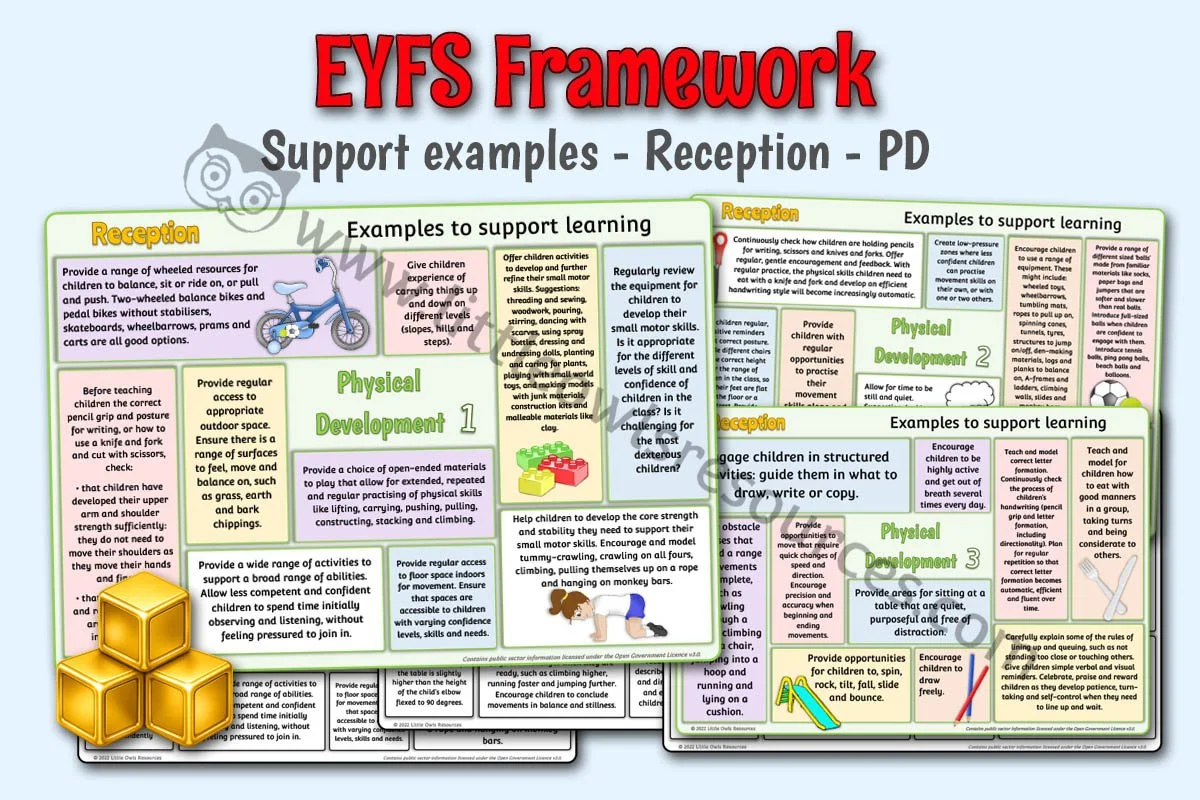
Examples of how to support ‘Physical Development’ for Reception children.
Extracted from Development Matters; non-statutory curriculum guidance for the early years foundation stage.
Includes colour and black and white versions.
Files contain public sector information licensed under the Open Government Licence v3.0.
Original artwork drawn by Sara Murphy and final digital resources created by Stuart Murphy. COPYRIGHT ON ALL OF THE RESOURCES HOUSED ON THIS WEBSITE IS HELD BY ‘LITTLE OWLS RESOURCES’. OUR RESOURCES (INCLUDING THE IMAGES WITHIN THEM), CANNOT BE SHARED OR SOLD COMMERCIALLY.
DOWNLOAD EDITABLE (DOCX)
DOWNLOAD NON-EDITABLE (PDF)
DOWNLOAD NON-EDITABLE (Zipped JPEGs)
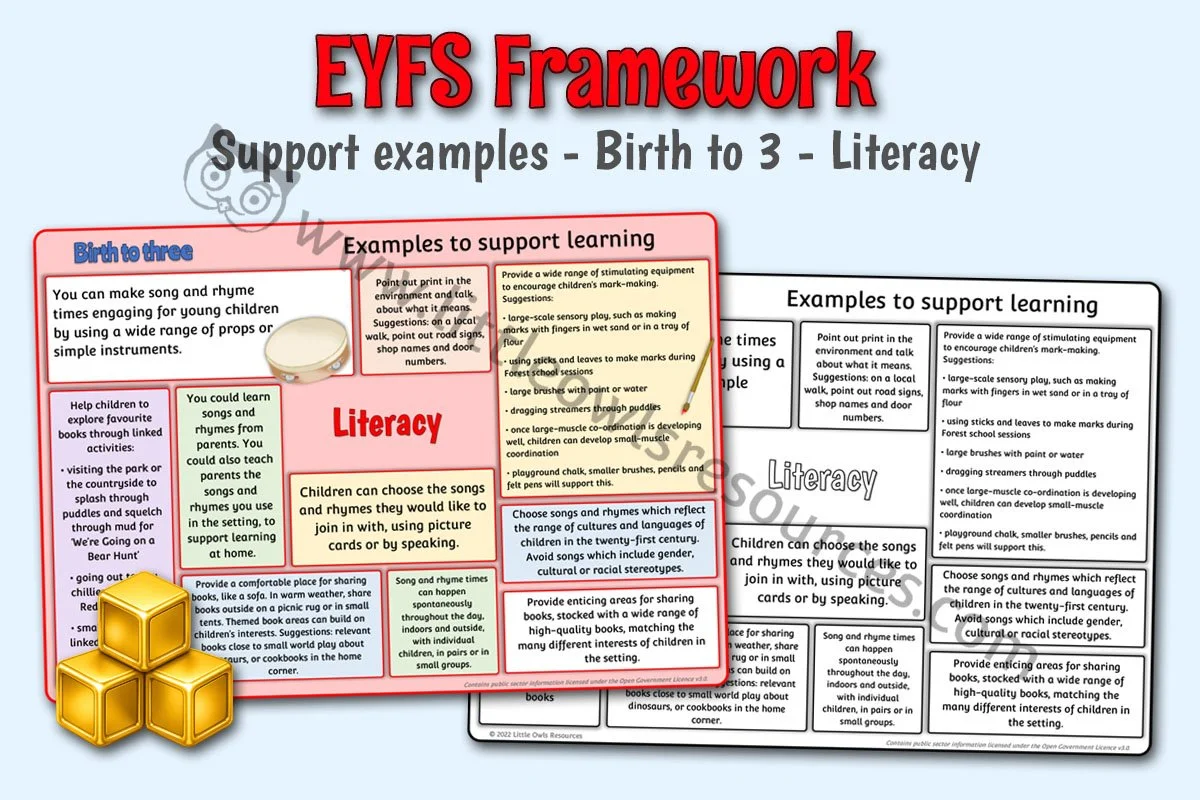
Examples of how to support ‘Literacy’ learning and development for birth to 3 year olds.
Extracted from Development Matters; non-statutory curriculum guidance for the early years foundation stage.
Includes colour and black and white versions.
Files contain public sector information licensed under the Open Government Licence v3.0.
Original artwork drawn by Sara Murphy and final digital resources created by Stuart Murphy. COPYRIGHT ON ALL OF THE RESOURCES HOUSED ON THIS WEBSITE IS HELD BY ‘LITTLE OWLS RESOURCES’. OUR RESOURCES (INCLUDING THE IMAGES WITHIN THEM), CANNOT BE SHARED OR SOLD COMMERCIALLY.
DOWNLOAD EDITABLE (DOCX)
DOWNLOAD NON-EDITABLE (PDF)
DOWNLOAD NON-EDITABLE (Zipped JPEGs)
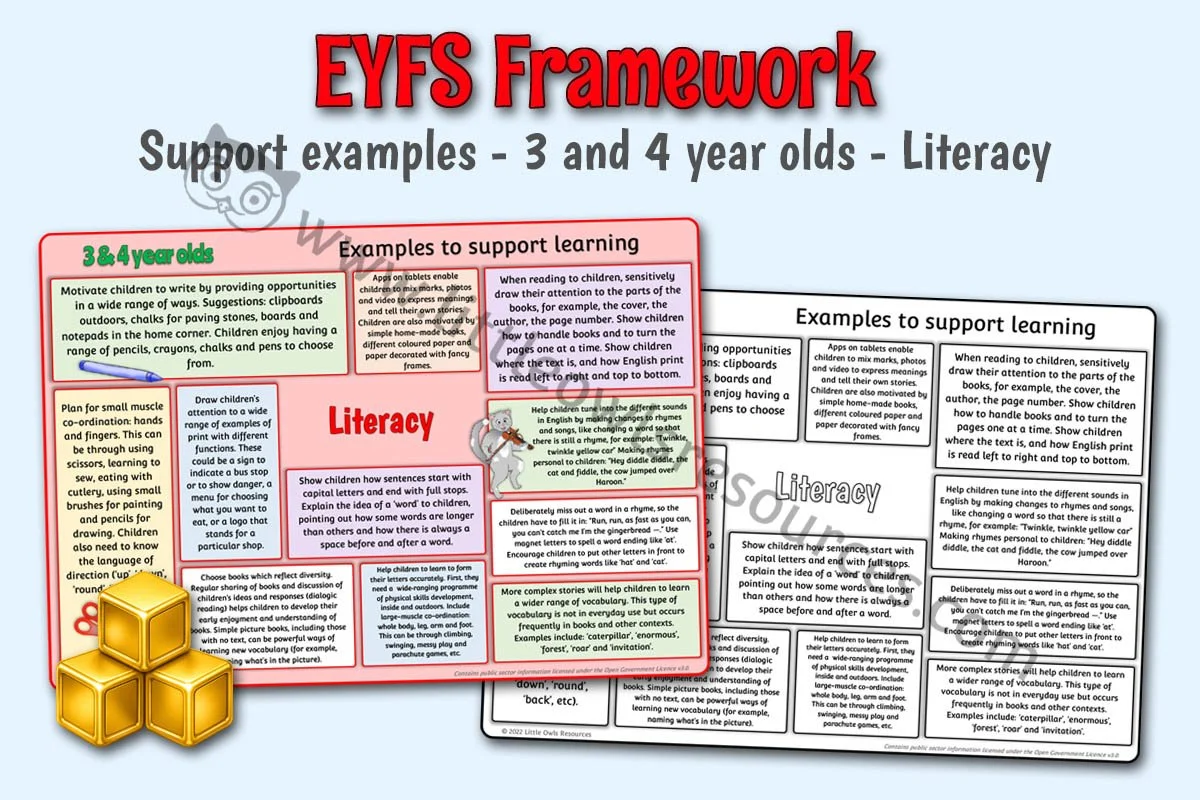
Examples of how to support ‘Literacy’ learning and development for 3 and 4 year olds.
Extracted from Development Matters; non-statutory curriculum guidance for the early years foundation stage.
Includes colour and black and white versions.
Files contain public sector information licensed under the Open Government Licence v3.0.
Original artwork drawn by Sara Murphy and final digital resources created by Stuart Murphy. COPYRIGHT ON ALL OF THE RESOURCES HOUSED ON THIS WEBSITE IS HELD BY ‘LITTLE OWLS RESOURCES’. OUR RESOURCES (INCLUDING THE IMAGES WITHIN THEM), CANNOT BE SHARED OR SOLD COMMERCIALLY.
DOWNLOAD EDITABLE (DOCX)
DOWNLOAD NON-EDITABLE (PDF)
DOWNLOAD NON-EDITABLE (Zipped JPEGs)
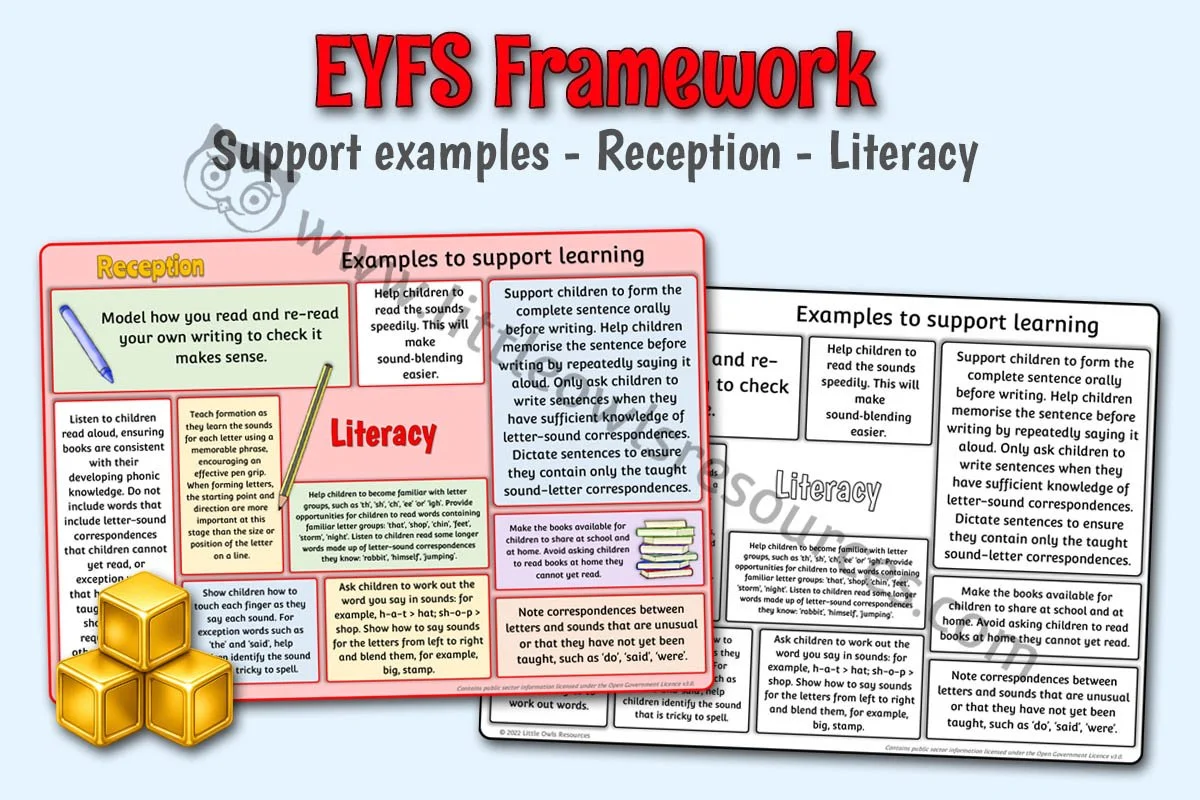
Examples of how to support ‘Literacy’ learning and development for Reception children.
Extracted from Development Matters; non-statutory curriculum guidance for the early years foundation stage.
Includes colour and black and white versions.
Files contain public sector information licensed under the Open Government Licence v3.0.
Original artwork drawn by Sara Murphy and final digital resources created by Stuart Murphy. COPYRIGHT ON ALL OF THE RESOURCES HOUSED ON THIS WEBSITE IS HELD BY ‘LITTLE OWLS RESOURCES’. OUR RESOURCES (INCLUDING THE IMAGES WITHIN THEM), CANNOT BE SHARED OR SOLD COMMERCIALLY.
DOWNLOAD EDITABLE (DOCX)
DOWNLOAD NON-EDITABLE (PDF)
DOWNLOAD NON-EDITABLE (Zipped JPEGs)
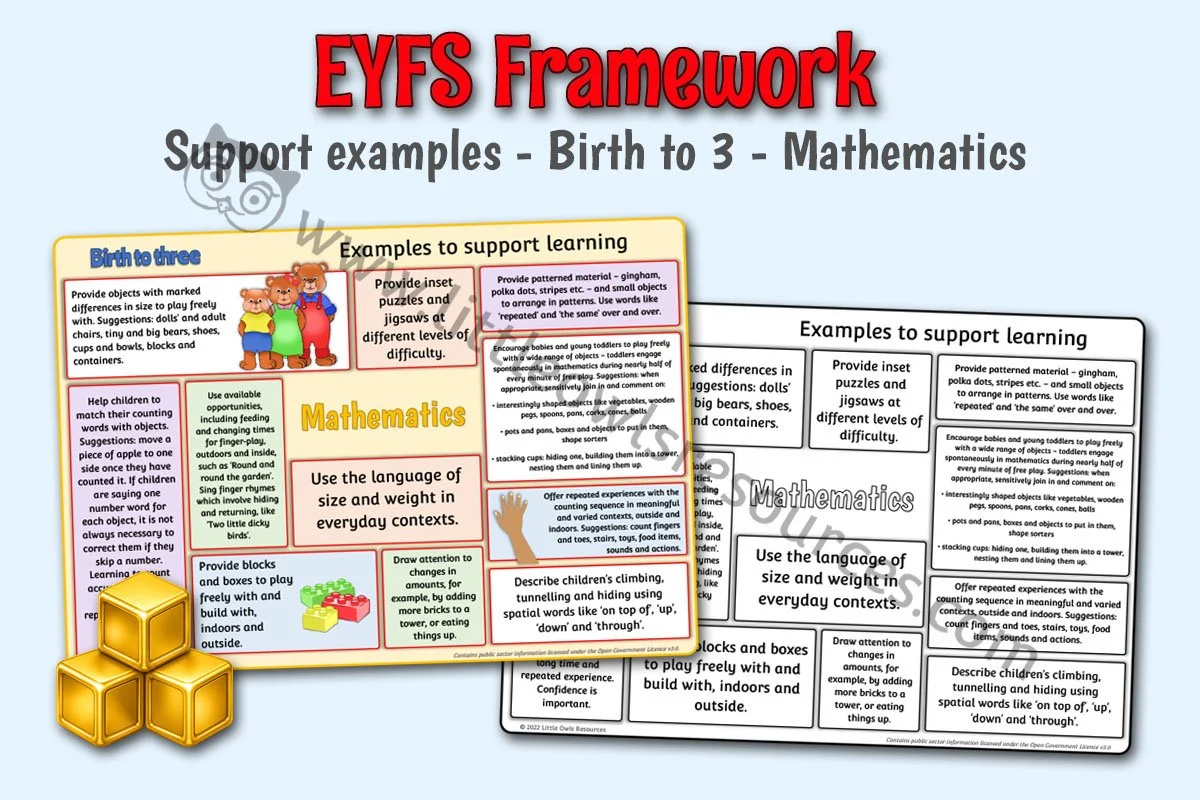
Examples of how to support ‘Mathematics’ learning and development for birth to 3 year olds.
Extracted from Development Matters; non-statutory curriculum guidance for the early years foundation stage.
Includes colour and black and white versions.
Files contain public sector information licensed under the Open Government Licence v3.0.
Original artwork drawn by Sara Murphy and final digital resources created by Stuart Murphy. COPYRIGHT ON ALL OF THE RESOURCES HOUSED ON THIS WEBSITE IS HELD BY ‘LITTLE OWLS RESOURCES’. OUR RESOURCES (INCLUDING THE IMAGES WITHIN THEM), CANNOT BE SHARED OR SOLD COMMERCIALLY.
DOWNLOAD EDITABLE (DOCX)
DOWNLOAD NON-EDITABLE (PDF)
DOWNLOAD NON-EDITABLE (Zipped JPEGs)
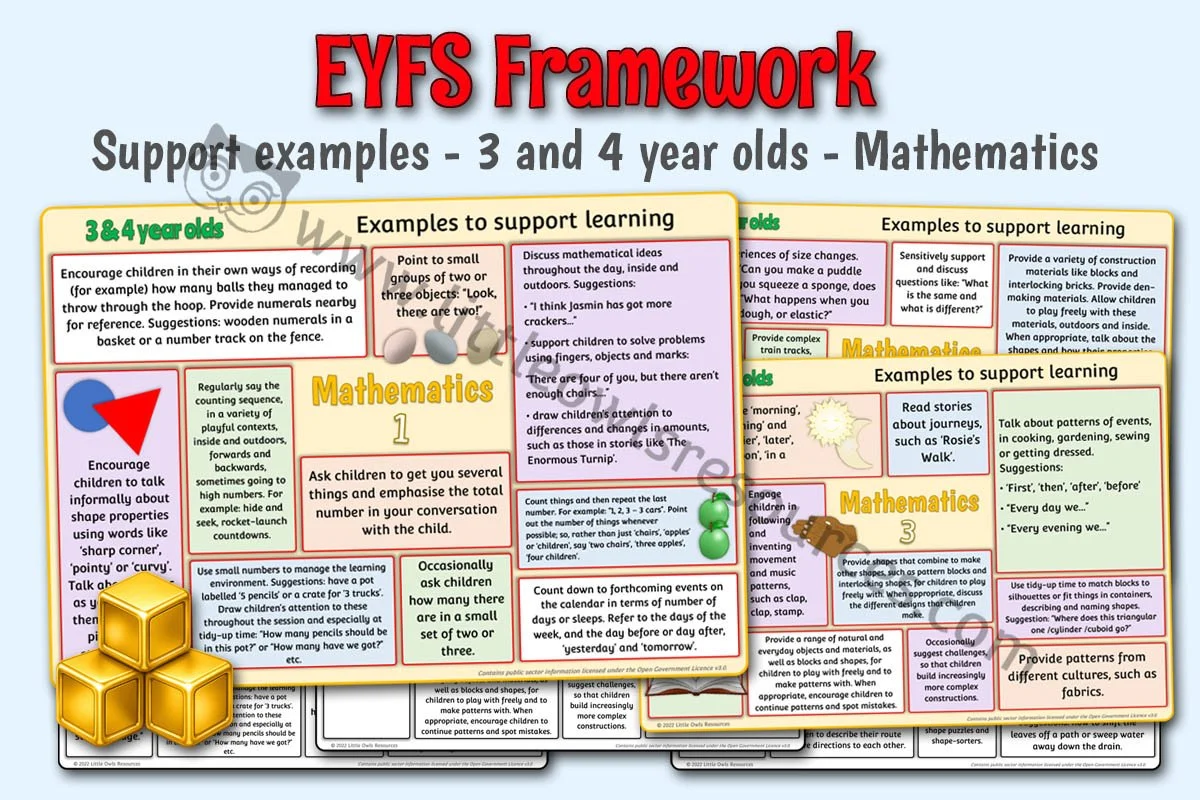
Examples of how to support ‘Mathematics’ learning and development for 3 and 4 year olds.
Extracted from Development Matters; non-statutory curriculum guidance for the early years foundation stage.
Includes colour and black and white versions.
Files contain public sector information licensed under the Open Government Licence v3.0.
Original artwork drawn by Sara Murphy and final digital resources created by Stuart Murphy. COPYRIGHT ON ALL OF THE RESOURCES HOUSED ON THIS WEBSITE IS HELD BY ‘LITTLE OWLS RESOURCES’. OUR RESOURCES (INCLUDING THE IMAGES WITHIN THEM), CANNOT BE SHARED OR SOLD COMMERCIALLY.
DOWNLOAD EDITABLE (DOCX)
DOWNLOAD NON-EDITABLE (PDF)
DOWNLOAD NON-EDITABLE (Zipped JPEGs)
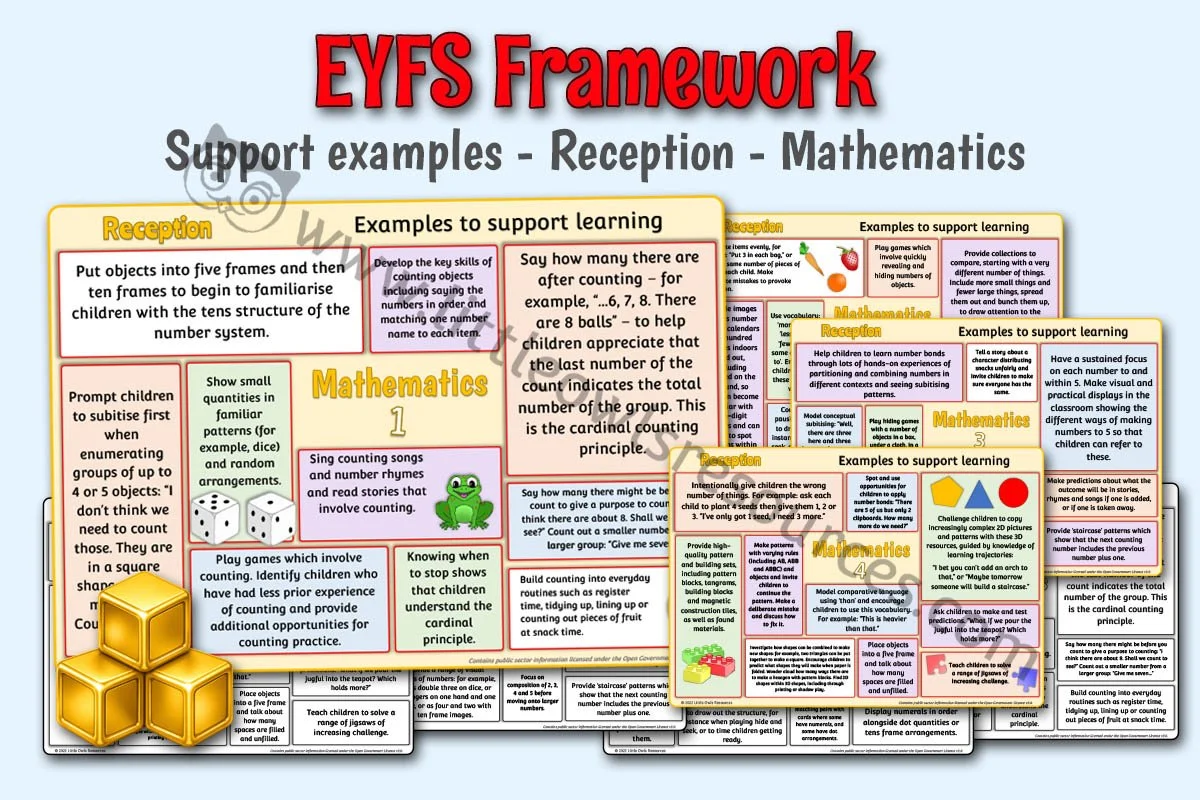
Examples of how to support ‘Mathematics’ learning and development for Reception children.
Extracted from Development Matters; non-statutory curriculum guidance for the early years foundation stage.
Includes colour and black and white versions.
Files contain public sector information licensed under the Open Government Licence v3.0.
Original artwork drawn by Sara Murphy and final digital resources created by Stuart Murphy. COPYRIGHT ON ALL OF THE RESOURCES HOUSED ON THIS WEBSITE IS HELD BY ‘LITTLE OWLS RESOURCES’. OUR RESOURCES (INCLUDING THE IMAGES WITHIN THEM), CANNOT BE SHARED OR SOLD COMMERCIALLY.
DOWNLOAD EDITABLE (DOCX)
DOWNLOAD NON-EDITABLE (PDF)
DOWNLOAD NON-EDITABLE (Zipped JPEGs)
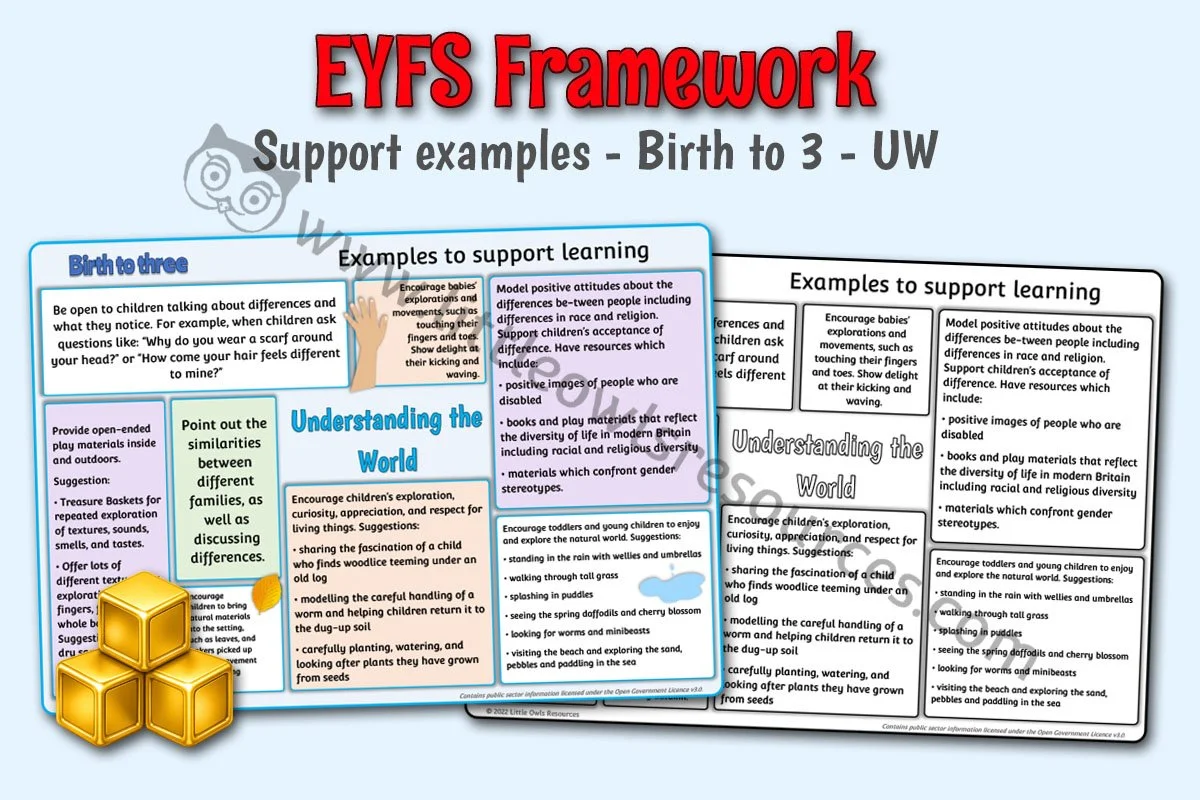
Examples of how to support ‘Understanding the World’ learning and development for birth to 3 year olds.
Extracted from Development Matters; non-statutory curriculum guidance for the early years foundation stage.
Includes colour and black and white versions.
Files contain public sector information licensed under the Open Government Licence v3.0.
Original artwork drawn by Sara Murphy and final digital resources created by Stuart Murphy. COPYRIGHT ON ALL OF THE RESOURCES HOUSED ON THIS WEBSITE IS HELD BY ‘LITTLE OWLS RESOURCES’. OUR RESOURCES (INCLUDING THE IMAGES WITHIN THEM), CANNOT BE SHARED OR SOLD COMMERCIALLY.
DOWNLOAD EDITABLE (DOCX)
DOWNLOAD NON-EDITABLE (PDF)
DOWNLOAD NON-EDITABLE (Zipped JPEGs)
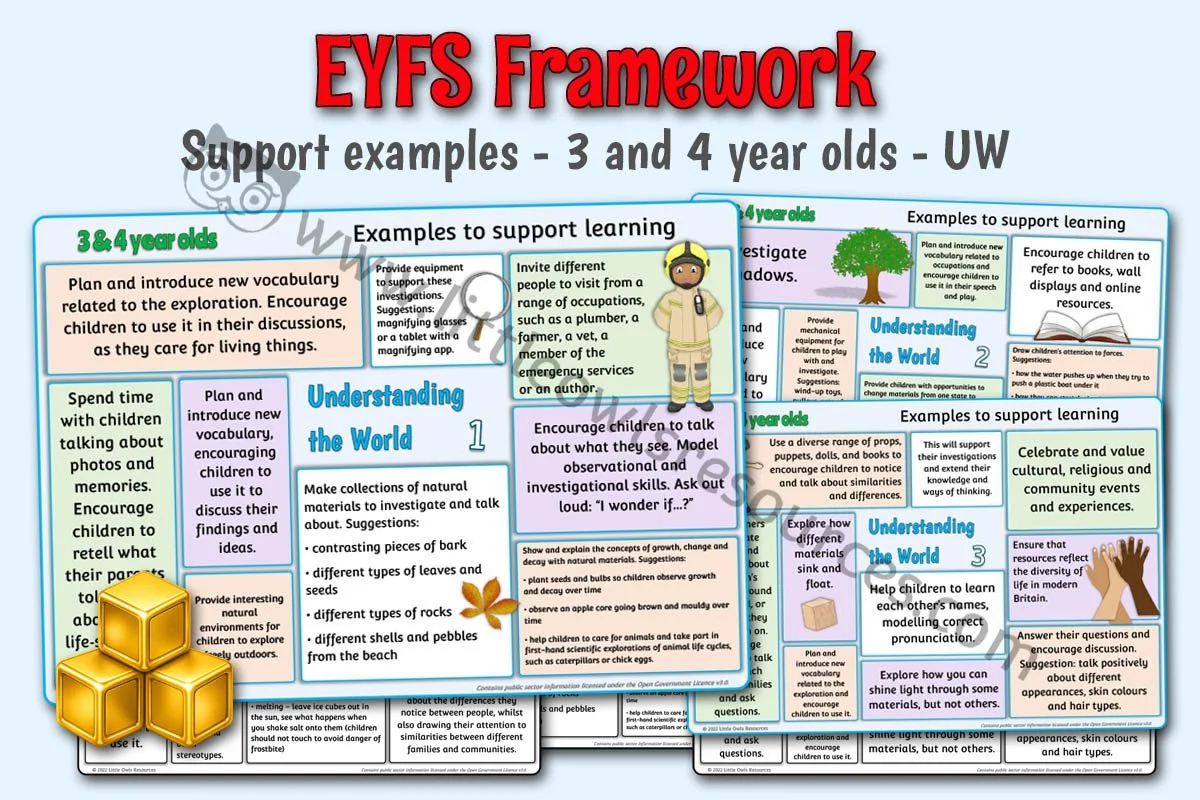
Examples of how to support ‘Understanding the World’ learning and development for 3 and 4 year olds.
Extracted from Development Matters; non-statutory curriculum guidance for the early years foundation stage.
Includes colour and black and white versions.
Files contain public sector information licensed under the Open Government Licence v3.0.
Original artwork drawn by Sara Murphy and final digital resources created by Stuart Murphy. COPYRIGHT ON ALL OF THE RESOURCES HOUSED ON THIS WEBSITE IS HELD BY ‘LITTLE OWLS RESOURCES’. OUR RESOURCES (INCLUDING THE IMAGES WITHIN THEM), CANNOT BE SHARED OR SOLD COMMERCIALLY.
DOWNLOAD EDITABLE (DOCX)
DOWNLOAD NON-EDITABLE (PDF)
DOWNLOAD NON-EDITABLE (Zipped JPEGs)
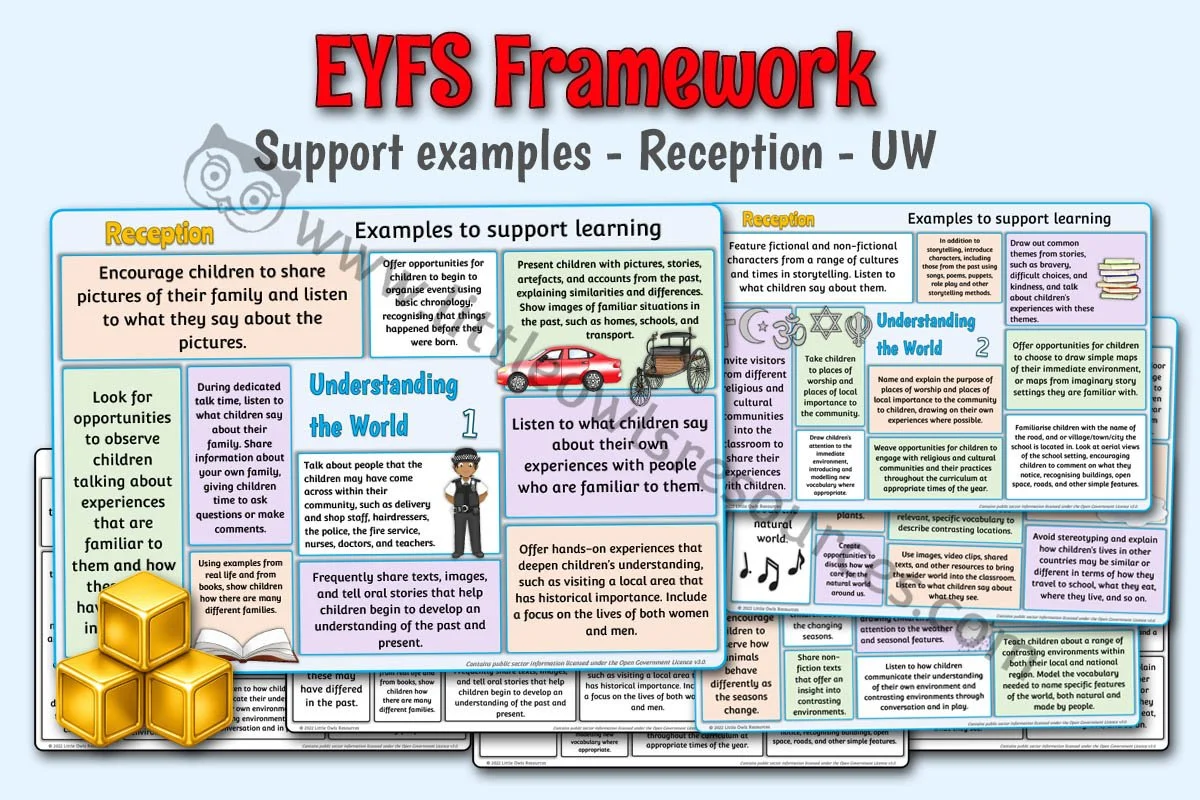
Examples of how to support ‘Understanding the World’ learning and development for Reception children.
Extracted from Development Matters; non-statutory curriculum guidance for the early years foundation stage.
Includes colour and black and white versions.
Files contain public sector information licensed under the Open Government Licence v3.0.
Original artwork drawn by Sara Murphy and final digital resources created by Stuart Murphy. COPYRIGHT ON ALL OF THE RESOURCES HOUSED ON THIS WEBSITE IS HELD BY ‘LITTLE OWLS RESOURCES’. OUR RESOURCES (INCLUDING THE IMAGES WITHIN THEM), CANNOT BE SHARED OR SOLD COMMERCIALLY.
DOWNLOAD EDITABLE (DOCX)
DOWNLOAD NON-EDITABLE (PDF)
DOWNLOAD NON-EDITABLE (Zipped JPEGs)
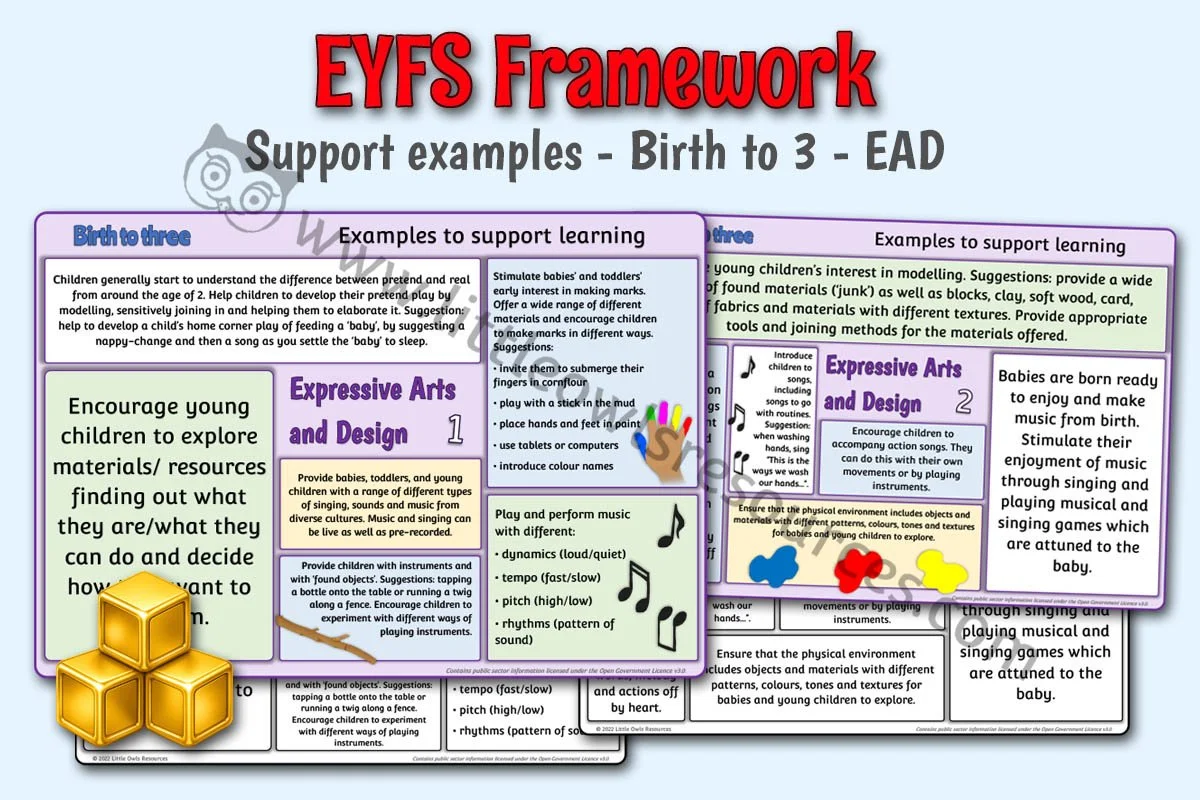
Examples of how to support ‘Expressive Arts and Design’ learning and development for birth to 3 year olds.
Extracted from Development Matters; non-statutory curriculum guidance for the early years foundation stage.
Includes colour and black and white versions.
Files contain public sector information licensed under the Open Government Licence v3.0.
Original artwork drawn by Sara Murphy and final digital resources created by Stuart Murphy. COPYRIGHT ON ALL OF THE RESOURCES HOUSED ON THIS WEBSITE IS HELD BY ‘LITTLE OWLS RESOURCES’. OUR RESOURCES (INCLUDING THE IMAGES WITHIN THEM), CANNOT BE SHARED OR SOLD COMMERCIALLY.
DOWNLOAD EDITABLE (DOCX)
DOWNLOAD NON-EDITABLE (PDF)
DOWNLOAD NON-EDITABLE (Zipped JPEGs)
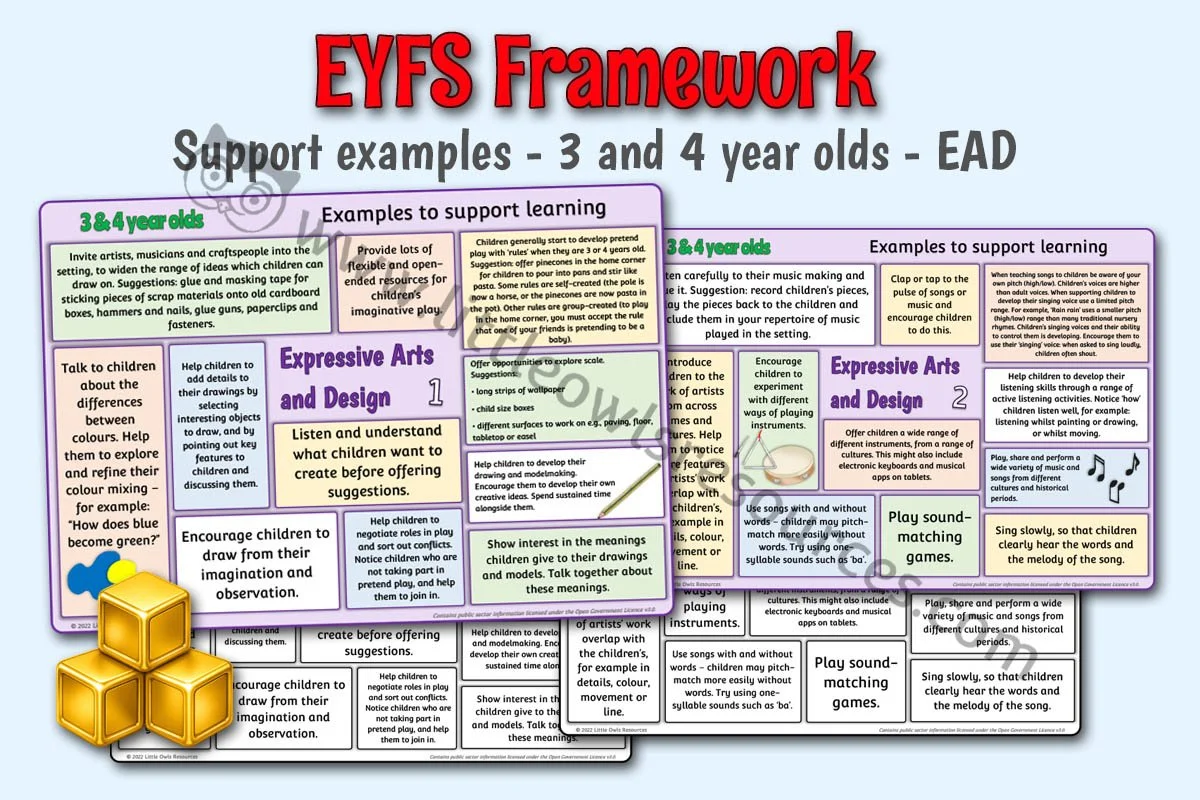
Examples of how to support ‘Expressive Arts and Design’ learning and development for 3 and 4 year olds.
Extracted from Development Matters; non-statutory curriculum guidance for the early years foundation stage.
Includes colour and black and white versions.
Files contain public sector information licensed under the Open Government Licence v3.0.
Original artwork drawn by Sara Murphy and final digital resources created by Stuart Murphy. COPYRIGHT ON ALL OF THE RESOURCES HOUSED ON THIS WEBSITE IS HELD BY ‘LITTLE OWLS RESOURCES’. OUR RESOURCES (INCLUDING THE IMAGES WITHIN THEM), CANNOT BE SHARED OR SOLD COMMERCIALLY.
DOWNLOAD EDITABLE (DOCX)
DOWNLOAD NON-EDITABLE (PDF)
DOWNLOAD NON-EDITABLE (Zipped JPEGs)
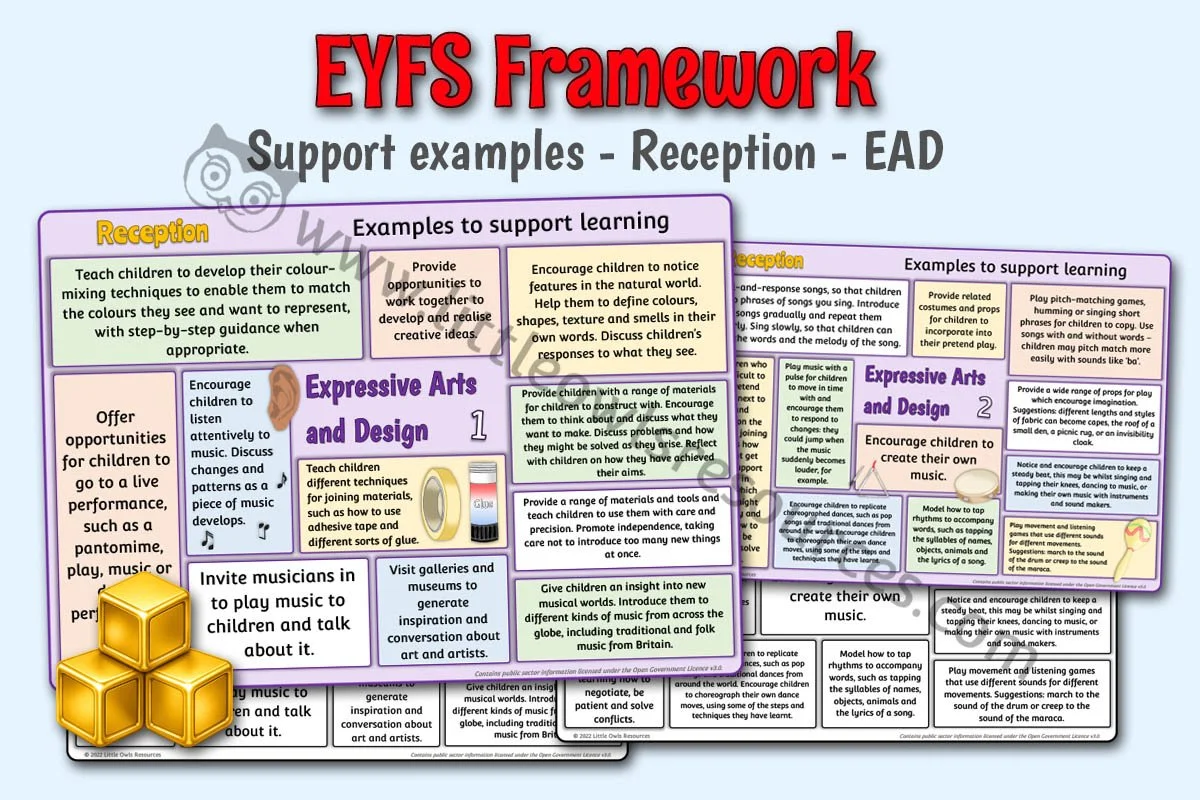
Examples of how to support ‘Expressive Arts and Design’ learning and development for Reception children.
Extracted from Development Matters; non-statutory curriculum guidance for the early years foundation stage.
Includes colour and black and white versions.
Files contain public sector information licensed under the Open Government Licence v3.0.
Original artwork drawn by Sara Murphy and final digital resources created by Stuart Murphy. COPYRIGHT ON ALL OF THE RESOURCES HOUSED ON THIS WEBSITE IS HELD BY ‘LITTLE OWLS RESOURCES’. OUR RESOURCES (INCLUDING THE IMAGES WITHIN THEM), CANNOT BE SHARED OR SOLD COMMERCIALLY.
DOWNLOAD EDITABLE (DOCX)
DOWNLOAD NON-EDITABLE (PDF)
DOWNLOAD NON-EDITABLE (Zipped JPEGs)
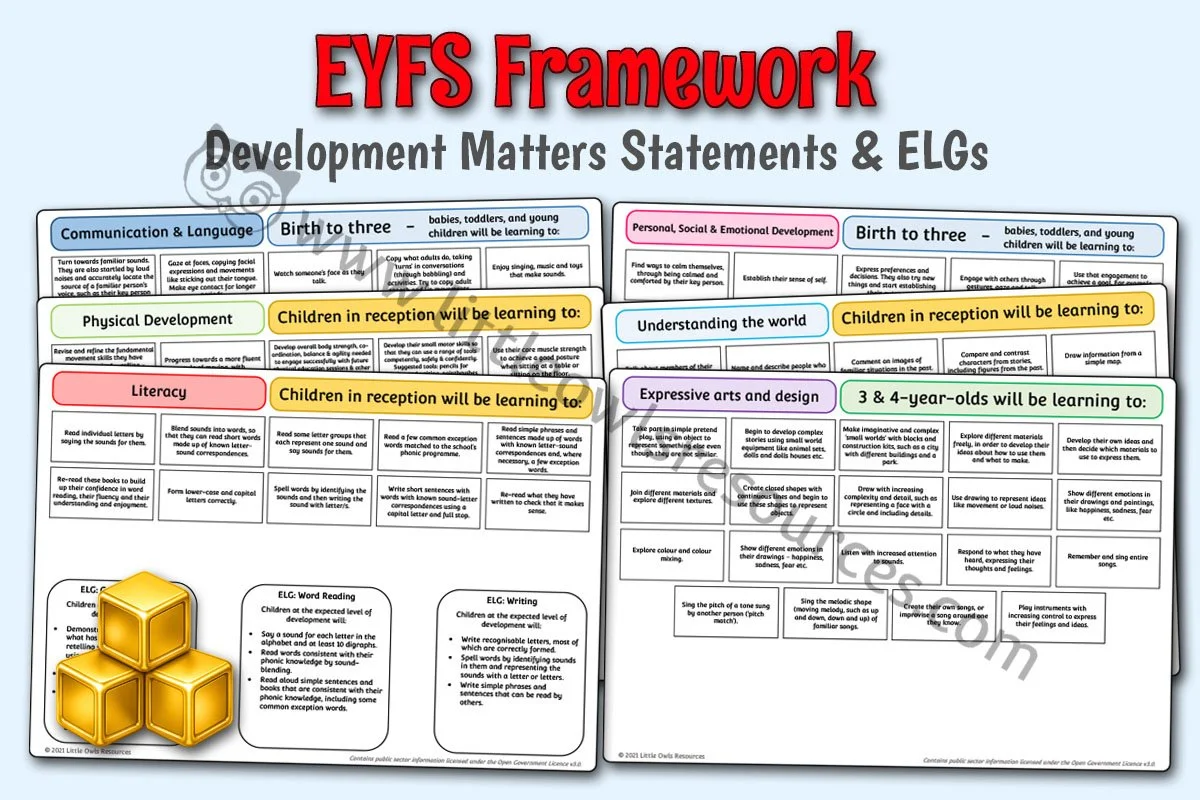
Handy planning and assessment tool. We have placed all of the Development Matters learning statements and ELGs into one document.
Includes 21 pages. The 7 areas of learning are each spread across 3 pages (birth to 3 / 3 & 4 year olds / children in reception).
Files contain public sector information licensed under the Open Government Licence v3.0.
Original artwork drawn by Sara Murphy and final digital resources created by Stuart Murphy. COPYRIGHT ON ALL OF THE RESOURCES HOUSED ON THIS WEBSITE IS HELD BY ‘LITTLE OWLS RESOURCES’. OUR RESOURCES (INCLUDING THE IMAGES WITHIN THEM), CANNOT BE SHARED OR SOLD COMMERCIALLY.
DOWNLOAD EDITABLE (DOCX)
DOWNLOAD NON-EDITABLE (PDF)
DOWNLOAD NON-EDITABLE (Zipped JPEGs)
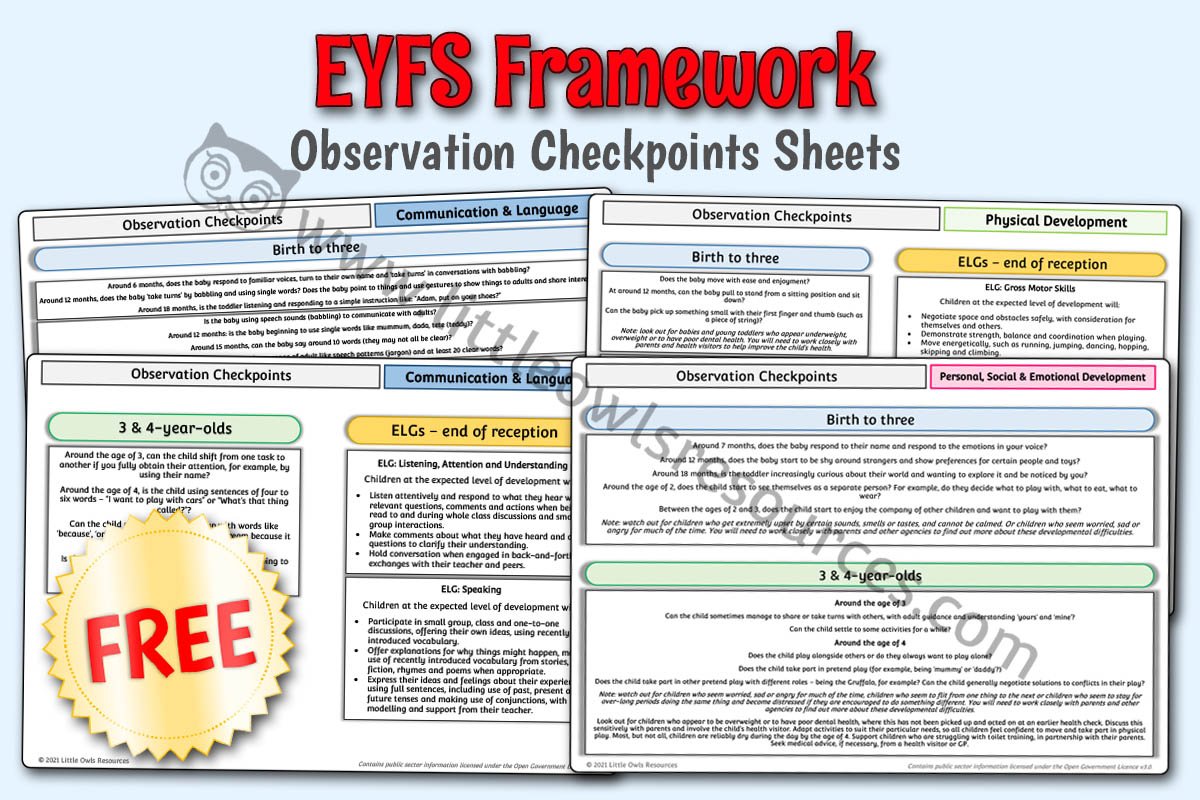
Development Matters incorporates ‘Observation Checkpoints’ for the Prime areas (Communication and Language, Physical Development & Personal, Social and Emotional Development). We have condensed these checkpoints into handy overview sheets. Plus we have included the ELGs from the EYFS Framework for each of these Prime areas.
We hope you find this helpful!
Files contain public sector information licensed under the Open Government Licence v3.0.
Original artwork drawn by Sara Murphy and final digital resources created by Stuart Murphy. COPYRIGHT ON ALL OF THE RESOURCES HOUSED ON THIS WEBSITE IS HELD BY ‘LITTLE OWLS RESOURCES’. OUR RESOURCES (INCLUDING THE IMAGES WITHIN THEM), CANNOT BE SHARED OR SOLD COMMERCIALLY.
DOWNLOAD EDITABLE (DOCX)
DOWNLOAD NON-EDITABLE (PDF)
DOWNLOAD NON-EDITABLE (Zipped JPEGs)
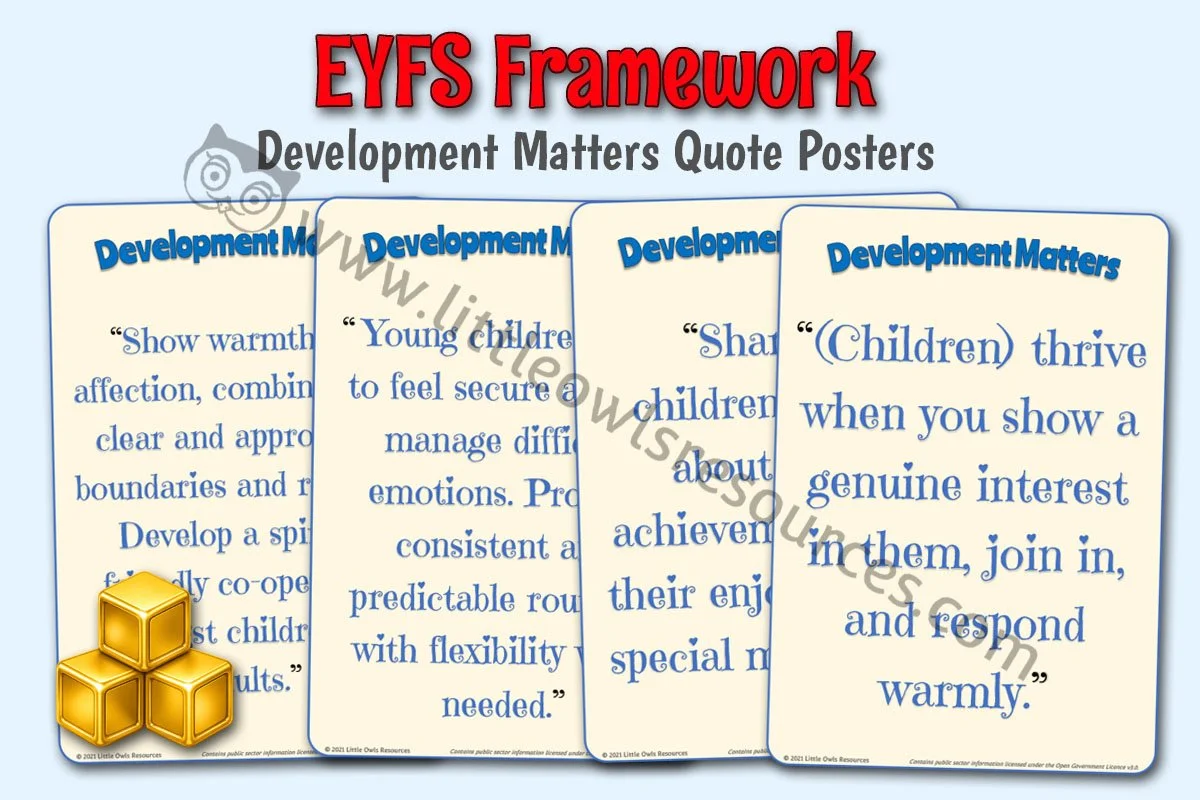
In reading Development Matters, four ethos building quotes stood out for us. We have created a poster for each of them. You may find it useful to display one or all of them within your setting.
We hope you find this helpful!
The above description and files below contain public sector information licensed under the Open Government Licence v3.0.
Original artwork drawn by Sara Murphy and final digital resources created by Stuart Murphy. COPYRIGHT ON ALL OF THE RESOURCES HOUSED ON THIS WEBSITE IS HELD BY ‘LITTLE OWLS RESOURCES’. OUR RESOURCES (INCLUDING THE IMAGES WITHIN THEM), CANNOT BE SHARED OR SOLD COMMERCIALLY.
DOWNLOAD EDITABLE (DOCX)
DOWNLOAD NON-EDITABLE (PDF)
DOWNLOAD NON-EDITABLE (Zipped JPEGs)
<<-BACK TO ‘EYFS FRAMEWORK’ MENU
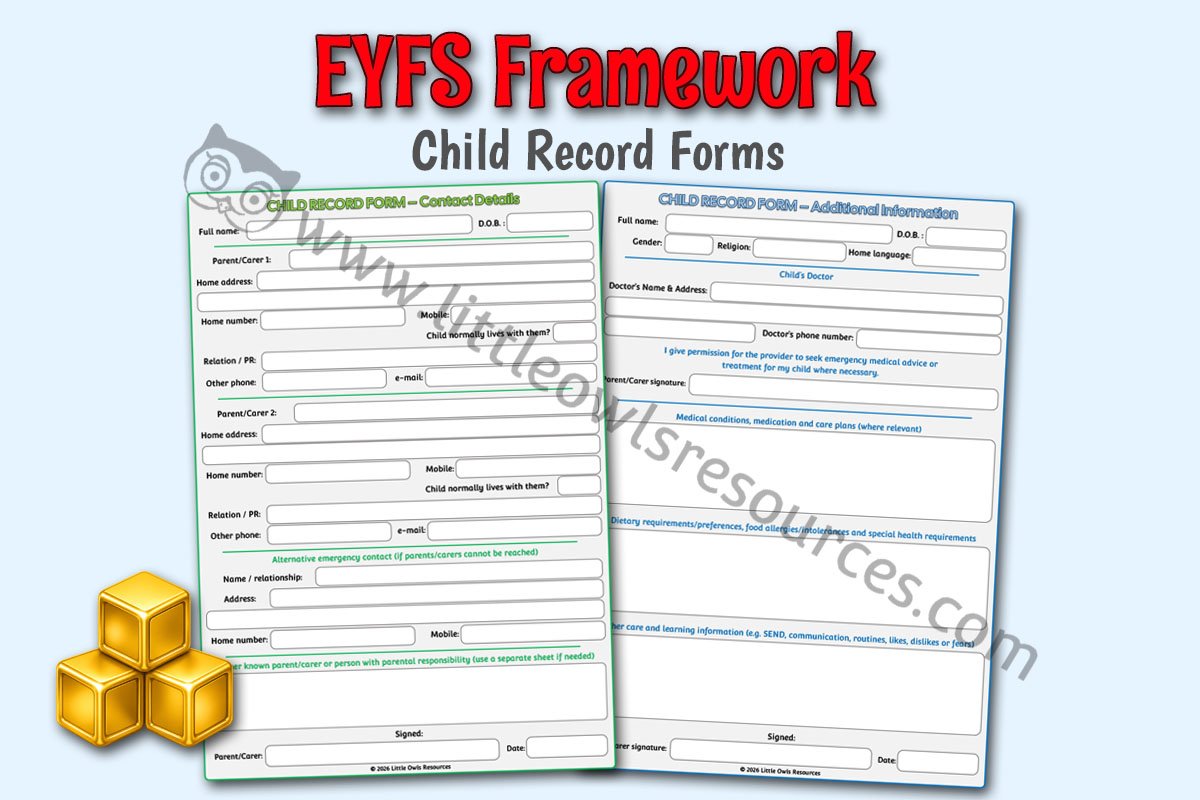
Child record form which comprises 2 A4 pages. The first page covers ‘Contact Details’ and the second ‘Additional Information’. If you would like to adapt the forms, simply choose the editable docx file.
Updated to align with the Early Years Foundation Stage Statutory Framework, effective 1st September 2026.
We hope you find this helpful!
Files contain public sector information licensed under the Open Government Licence v3.0.
Original artwork drawn by Sara Murphy and final digital resources created by Stuart Murphy. COPYRIGHT ON ALL OF THE RESOURCES HOUSED ON THIS WEBSITE IS HELD BY ‘LITTLE OWLS RESOURCES’. OUR RESOURCES (INCLUDING THE IMAGES WITHIN THEM), CANNOT BE SHARED OR SOLD COMMERCIALLY.
DOWNLOAD EDITABLE (DOCX)
DOWNLOAD NON-EDITABLE (PDF)
DOWNLOAD NON-EDITABLE (Zipped JPEGs)
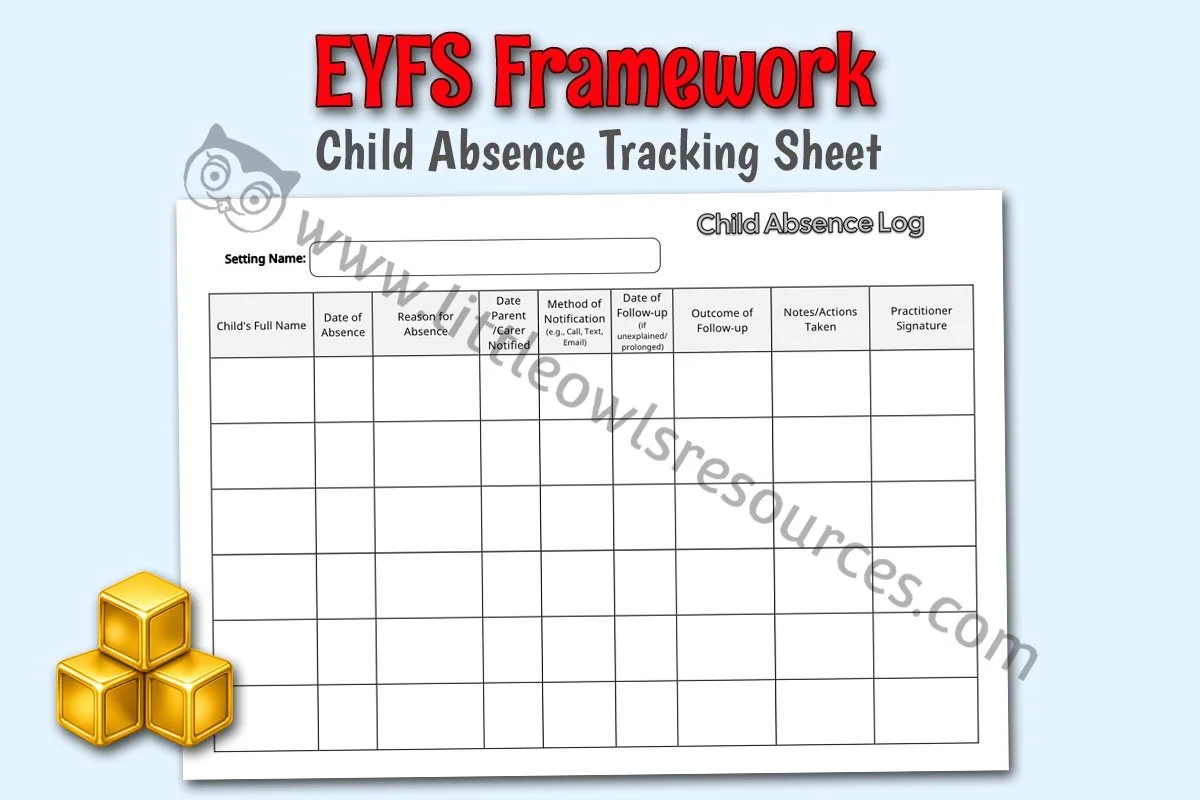
This 'Child Absence Tracking Sheet' is designed to help settings effectively record and monitor children's attendance, particularly focusing on the new EYFS Statutory Framework requirements (effective from September 2025) regarding the follow-up of prolonged or unexplained absences.
Maintaining accurate records is crucial for safeguarding and demonstrating compliance.
Files contain public sector information licensed under the Open Government Licence v3.0.
Original artwork drawn by Sara Murphy and final digital resources created by Stuart Murphy. COPYRIGHT ON ALL OF THE RESOURCES HOUSED ON THIS WEBSITE IS HELD BY ‘LITTLE OWLS RESOURCES’. OUR RESOURCES (INCLUDING THE IMAGES WITHIN THEM), CANNOT BE SHARED OR SOLD COMMERCIALLY.
DOWNLOAD EDITABLE (DOCX)
DOWNLOAD NON-EDITABLE (PDF)
DOWNLOAD NON-EDITABLE (Zipped JPEGs)
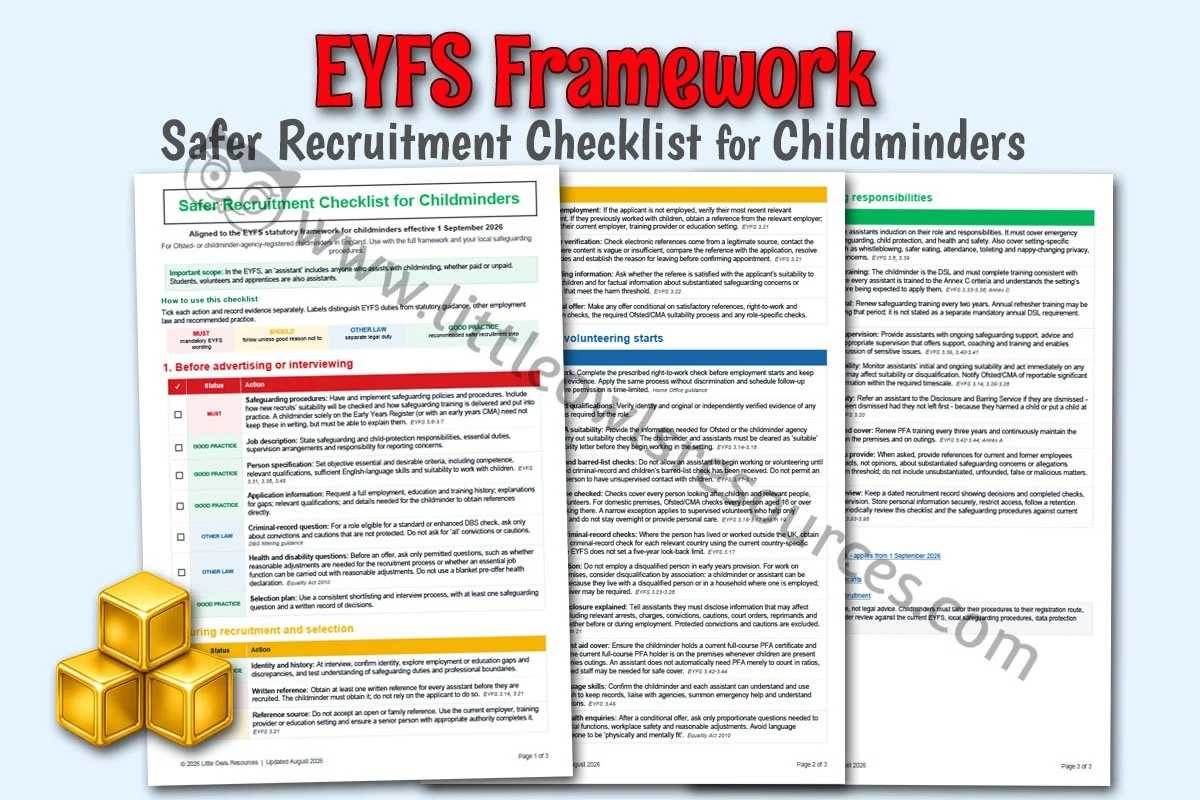
This checklist is designed to assist childminders in aligning their recruitment practices with the updated EYFS Statutory Framework. It should be used in conjunction with the full EYFS Statutory Framework for Childminders (effective from 1st September 2026).
Please note: This checklist is a template for guidance only. Users must tailor it to their specific setting's policies and ensure full compliance with the EYFS Statutory Framework, Data Protection Act 2018, UK GDPR, and all current employment legislation before implementation.
Original artwork drawn by Sara Murphy and final digital resources created by Stuart Murphy. COPYRIGHT ON ALL OF THE RESOURCES HOUSED ON THIS WEBSITE IS HELD BY ‘LITTLE OWLS RESOURCES’. OUR RESOURCES (INCLUDING THE IMAGES WITHIN THEM), CANNOT BE SHARED OR SOLD COMMERCIALLY.
DOWNLOAD EDITABLE (DOCX)
DOWNLOAD NON-EDITABLE (PDF)
DOWNLOAD NON-EDITABLE (Zipped JPEGs)
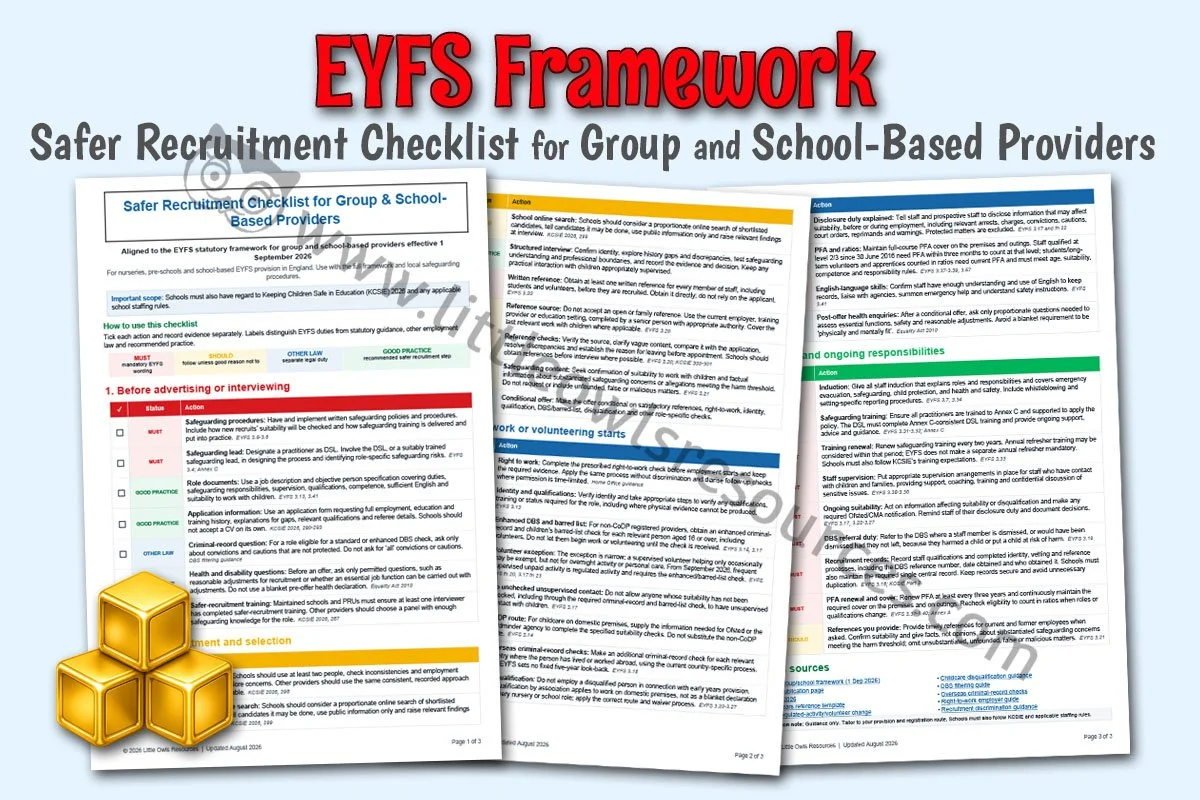
This checklist is designed to assist group and school-based providers in aligning their recruitment practices with the updated EYFS Statutory Framework. It should be used in conjunction with the full EYFS Statutory Framework for Group and School-Based Providers (effective from 1st September 2026).
Please note: This checklist is a template for guidance only. Users must tailor it to their specific setting's policies and ensure full compliance with the EYFS Statutory Framework, Data Protection Act 2018, UK GDPR, and all current employment legislation before implementation.
Original artwork drawn by Sara Murphy and final digital resources created by Stuart Murphy. COPYRIGHT ON ALL OF THE RESOURCES HOUSED ON THIS WEBSITE IS HELD BY ‘LITTLE OWLS RESOURCES’. OUR RESOURCES (INCLUDING THE IMAGES WITHIN THEM), CANNOT BE SHARED OR SOLD COMMERCIALLY.
DOWNLOAD EDITABLE (DOCX)
DOWNLOAD NON-EDITABLE (PDF)
DOWNLOAD NON-EDITABLE (Zipped JPEGs)
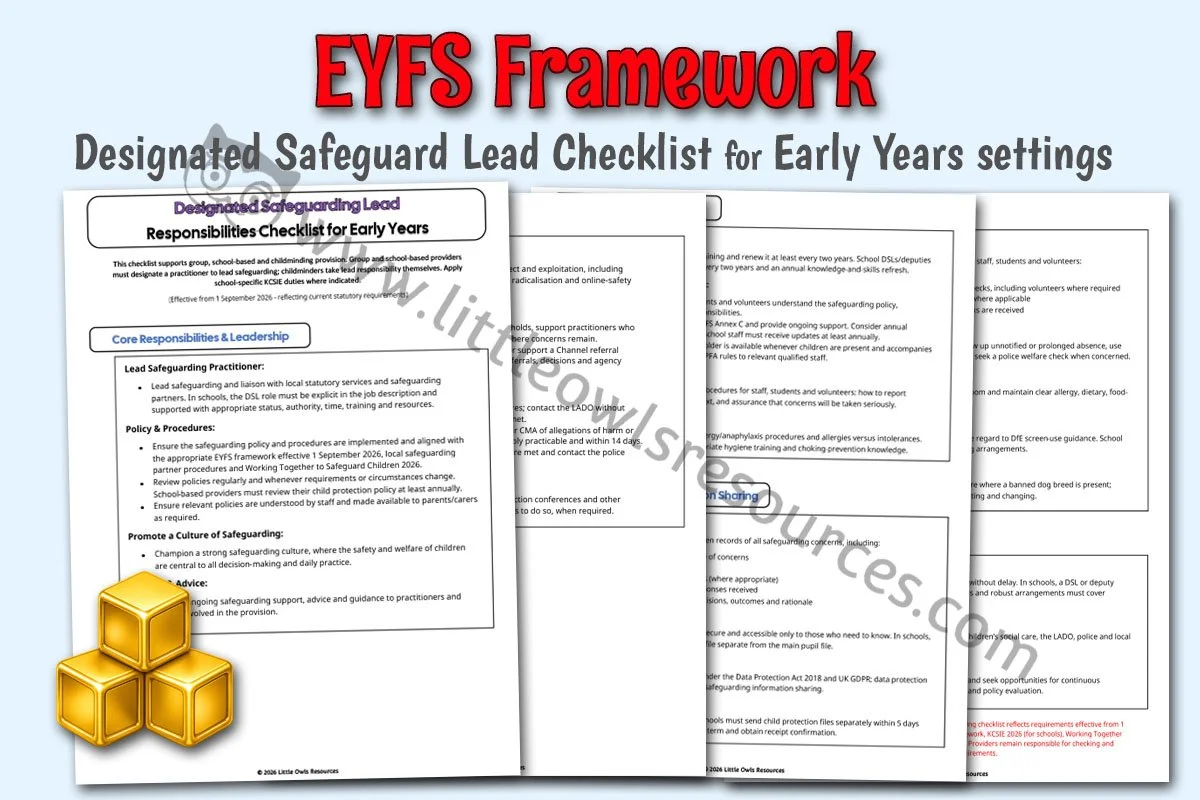
This checklist outlines the core responsibilities of the Designated Safeguarding Lead (DSL) in early years settings, including childminders, nurseries, and school-based providers. It is designed to help you ensure that robust and effective safeguarding practices are consistently embedded in your provision. (Effective from 1st September 2026 – Reflecting New EYFS Requirements)
Please note: This checklist is a template for guidance only. Users must adapt it to their specific setting's safeguarding policy and ensure full compliance with the EYFS Statutory Framework, 'Keeping Children Safe in Education' (where applicable), Data Protection Act 2018, UK GDPR, and all current employment legislation before implementation.
Original artwork drawn by Sara Murphy and final digital resources created by Stuart Murphy. COPYRIGHT ON ALL OF THE RESOURCES HOUSED ON THIS WEBSITE IS HELD BY ‘LITTLE OWLS RESOURCES’. OUR RESOURCES (INCLUDING THE IMAGES WITHIN THEM), CANNOT BE SHARED OR SOLD COMMERCIALLY.
DOWNLOAD EDITABLE (DOCX)
DOWNLOAD NON-EDITABLE (PDF)
DOWNLOAD NON-EDITABLE (Zipped JPEGs)
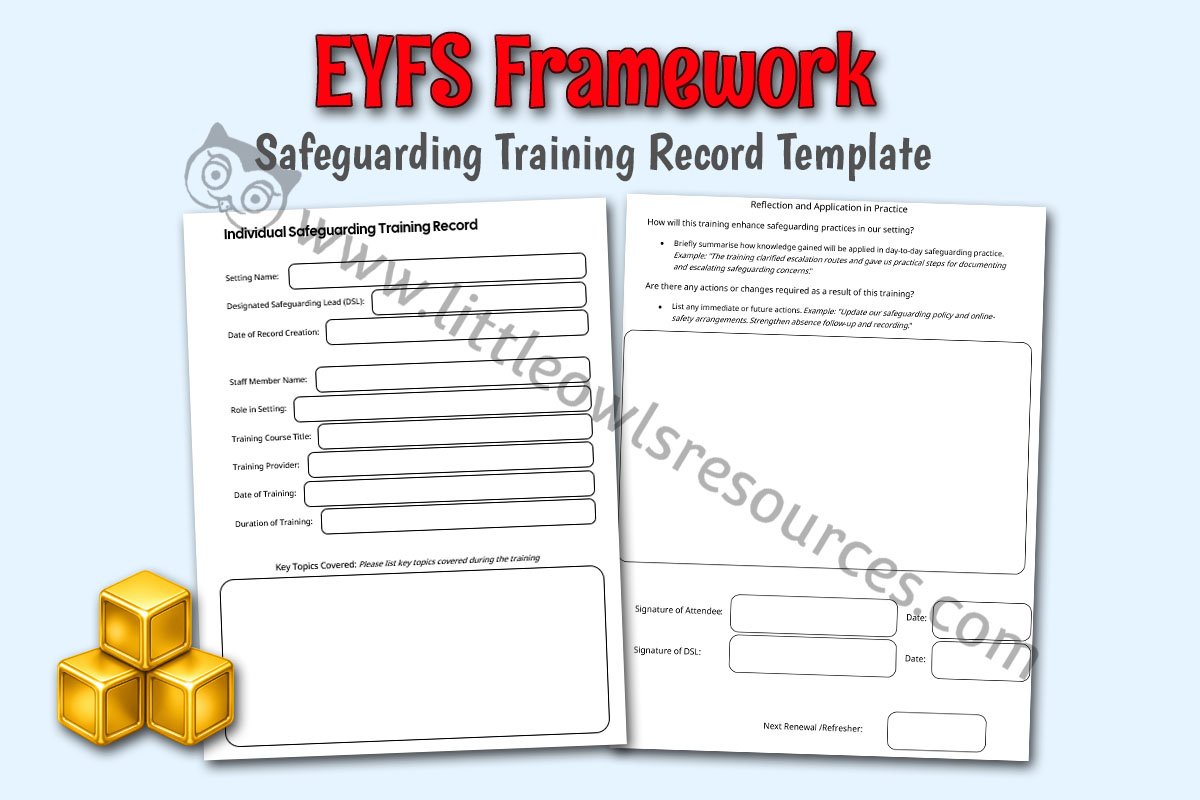
This template is designed to support all early years and educational providers in maintaining clear and up-to-date records of safeguarding training for staff, assistants, volunteers, and students, in line with statutory requirements such as the EYFS framework (effective from September 2026), Keeping Children Safe in Education, and local safeguarding partnership guidance.
Note: This template is intended as a guide and should be used alongside the most current version of the EYFS Statutory Framework, Keeping Children Safe in Education (where applicable), and guidance from your local safeguarding partnership.
Original artwork drawn by Sara Murphy and final digital resources created by Stuart Murphy. COPYRIGHT ON ALL OF THE RESOURCES HOUSED ON THIS WEBSITE IS HELD BY ‘LITTLE OWLS RESOURCES’. OUR RESOURCES (INCLUDING THE IMAGES WITHIN THEM), CANNOT BE SHARED OR SOLD COMMERCIALLY.
DOWNLOAD EDITABLE (DOCX)
DOWNLOAD NON-EDITABLE (PDF)
DOWNLOAD NON-EDITABLE (Zipped JPEGs)
Related resources from within our Premium Printable Resources ‘Planning’ collection.

This pack contains some activity ideas for the Summer topic as well as some blank forms for you to note down your own ideas.
Staring at a blank page when planning can be difficult so we hope that even if you don’t end up using our exact suggestions, they will be a spark of inspiration for your own great ideas when planning for your children.
(For additional ‘Summer’ themed resources visit our ‘SUMMER’ PAGE.)
Original artwork drawn by Sara Murphy and final digital resources created by Stuart Murphy. COPYRIGHT ON ALL OF THE RESOURCES HOUSED ON THIS WEBSITE IS HELD BY ‘LITTLE OWLS RESOURCES’. OUR RESOURCES (INCLUDING THE IMAGES WITHIN THEM), CANNOT BE SHARED OR SOLD COMMERCIALLY.
DOWNLOAD EDITABLE (DOCX)
DOWNLOAD NON-EDITABLE (PDF)
DOWNLOAD NON-EDITABLE (Zipped JPEGs)
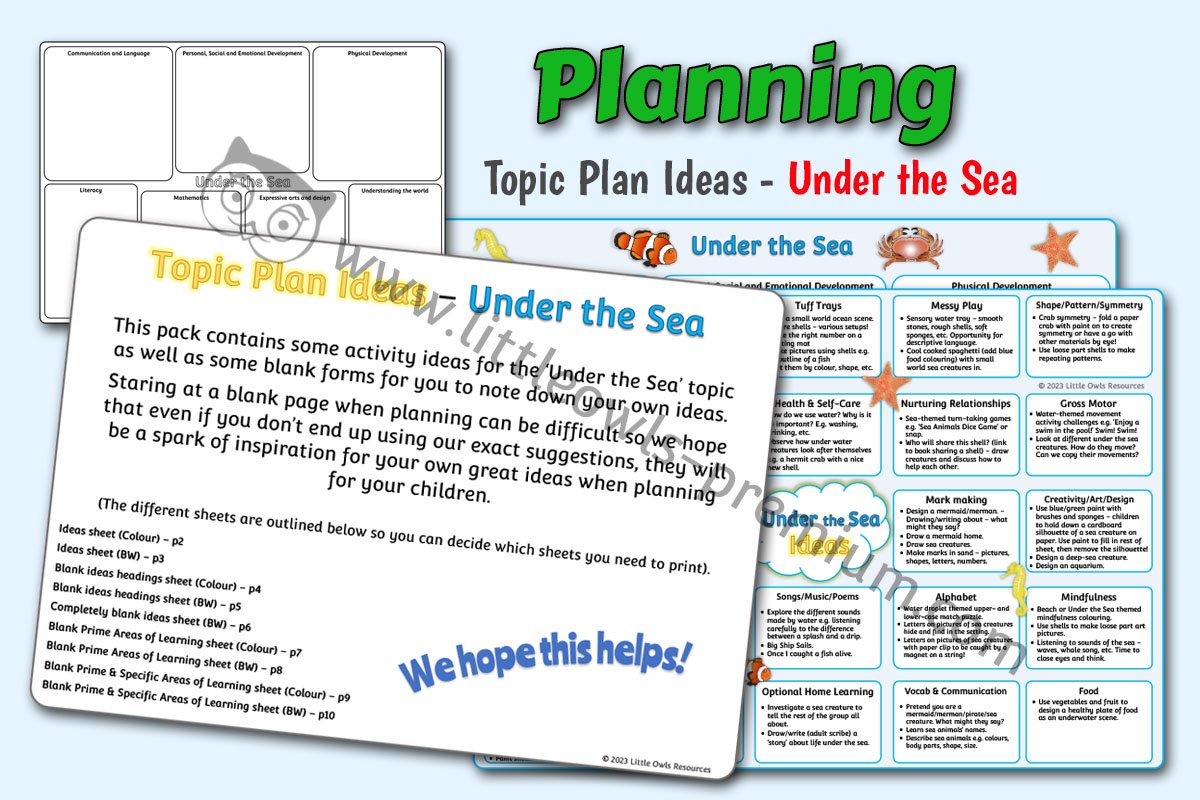
This pack contains some activity ideas for the ‘Under the Sea’ topic as well as some blank forms for you to note down your own ideas.
Staring at a blank page when planning can be difficult so we hope that even if you don’t end up using our exact suggestions, they will be a spark of inspiration for your own great ideas when planning for your children.
(For additional ‘Under the Sea’ themed resources visit our ‘UNDER THE SEA’ PAGE.)
Original artwork drawn by Sara Murphy and final digital resources created by Stuart Murphy. COPYRIGHT ON ALL OF THE RESOURCES HOUSED ON THIS WEBSITE IS HELD BY ‘LITTLE OWLS RESOURCES’. OUR RESOURCES (INCLUDING THE IMAGES WITHIN THEM), CANNOT BE SHARED OR SOLD COMMERCIALLY.
DOWNLOAD EDITABLE (DOCX)
DOWNLOAD NON-EDITABLE (PDF)
DOWNLOAD NON-EDITABLE (Zipped JPEGs)
<<-BACK TO ‘UNDER THE SEA’ MENU
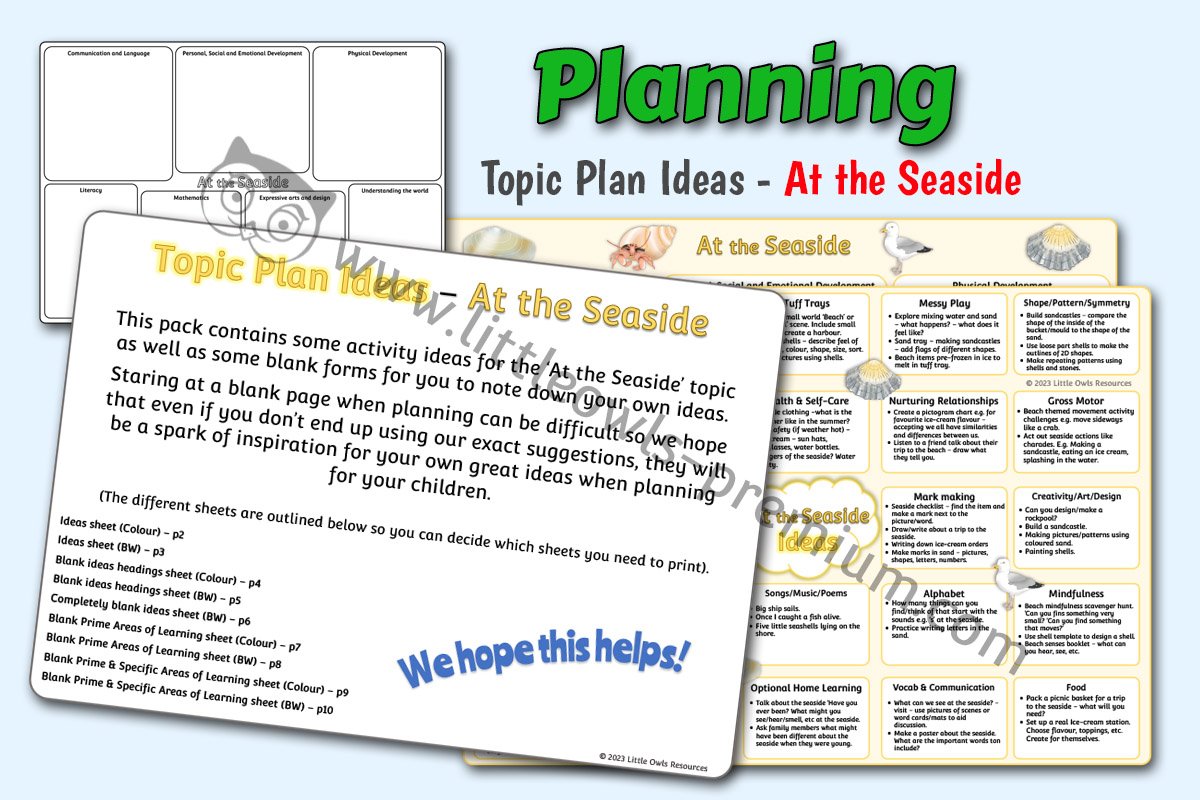
This pack contains some activity ideas for the ‘At the Seaside’ topic as well as some blank forms for you to note down your own ideas.
Staring at a blank page when planning can be difficult so we hope that even if you don’t end up using our exact suggestions, they will be a spark of inspiration for your own great ideas when planning for your children.
(For additional ‘At the Seaside’ themed resources visit our ‘AT THE SEASIDE’ PAGE.)
Original artwork drawn by Sara Murphy and final digital resources created by Stuart Murphy. COPYRIGHT ON ALL OF THE RESOURCES HOUSED ON THIS WEBSITE IS HELD BY ‘LITTLE OWLS RESOURCES’. OUR RESOURCES (INCLUDING THE IMAGES WITHIN THEM), CANNOT BE SHARED OR SOLD COMMERCIALLY.
DOWNLOAD EDITABLE (DOCX)
DOWNLOAD NON-EDITABLE (PDF)
DOWNLOAD NON-EDITABLE (Zipped JPEGs)
<<-BACK TO ‘AT THE SEASIDE’ MENU
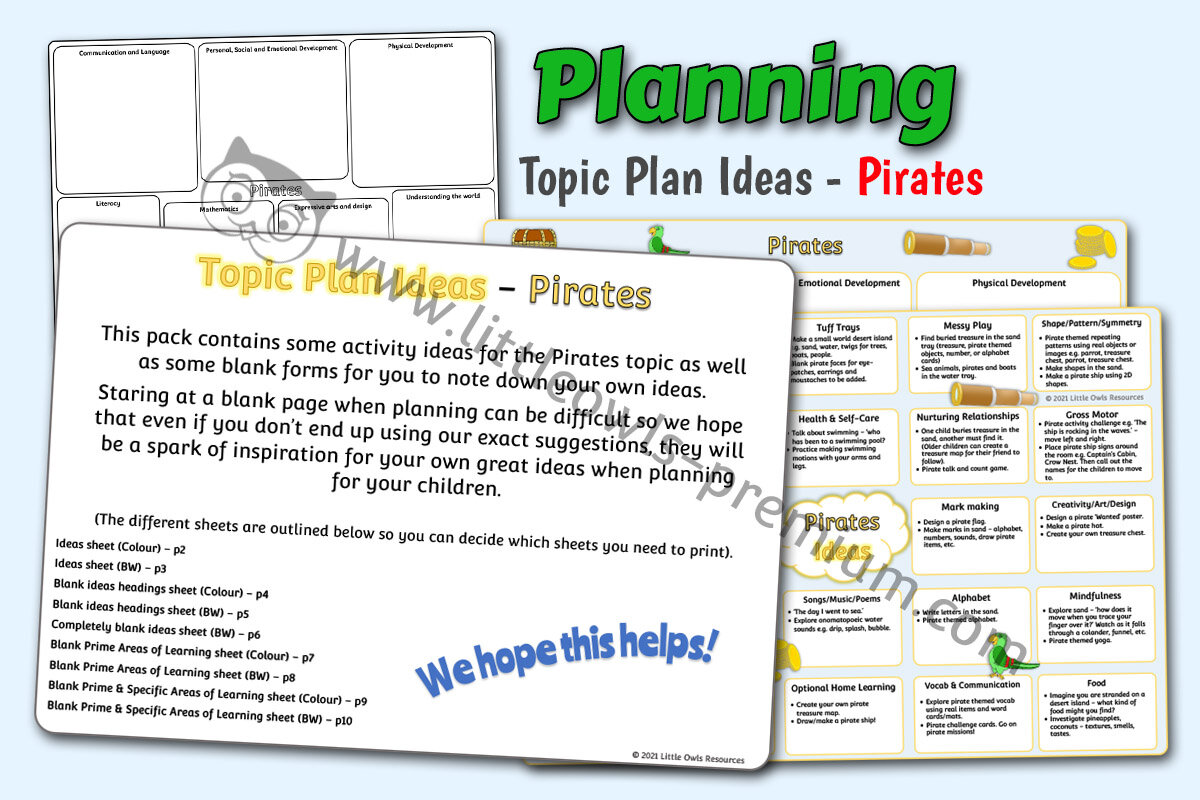
This pack contains some activity ideas for the Pirates topic as well as some blank forms for you to note down your own ideas.
Staring at a blank page when planning can be difficult so we hope that even if you don’t end up using our exact suggestions, they will be a spark of inspiration for your own great ideas when planning for your children.
(For additional ‘Pirates’ themed resources visit our ‘PIRATES’ PAGE.)
Original artwork drawn by Sara Murphy and final digital resources created by Stuart Murphy. COPYRIGHT ON ALL OF THE RESOURCES HOUSED ON THIS WEBSITE IS HELD BY ‘LITTLE OWLS RESOURCES’. OUR RESOURCES (INCLUDING THE IMAGES WITHIN THEM), CANNOT BE SHARED OR SOLD COMMERCIALLY.
DOWNLOAD EDITABLE (DOCX)
DOWNLOAD NON-EDITABLE (PDF)
DOWNLOAD NON-EDITABLE (Zipped JPEGs)

This pack contains some activity ideas for the Minibeasts topic as well as some blank forms for you to note down your own ideas.
Staring at a blank page when planning can be difficult so we hope that even if you don’t end up using our exact suggestions, they will be a spark of inspiration for your own great ideas when planning for your children.
(For additional ‘Minibeasts’ themed resources visit our ‘MINIBEASTS’ PAGE.)
Original artwork drawn by Sara Murphy and final digital resources created by Stuart Murphy. COPYRIGHT ON ALL OF THE RESOURCES HOUSED ON THIS WEBSITE IS HELD BY ‘LITTLE OWLS RESOURCES’. OUR RESOURCES (INCLUDING THE IMAGES WITHIN THEM), CANNOT BE SHARED OR SOLD COMMERCIALLY.
DOWNLOAD EDITABLE (DOCX)
DOWNLOAD NON-EDITABLE (PDF)
DOWNLOAD NON-EDITABLE (Zipped JPEGs)
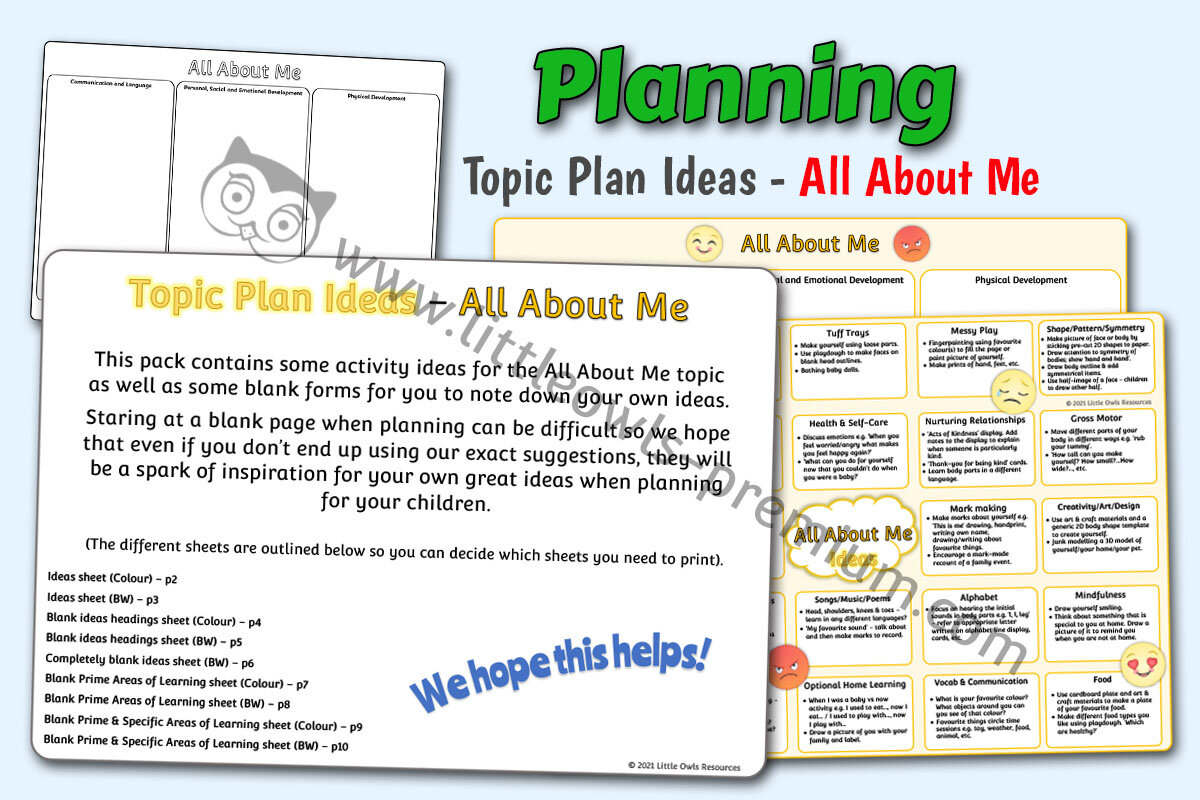
This pack contains some activity ideas for the All About Me topic as well as some blank forms for you to note down your own ideas.
Staring at a blank page when planning can be difficult so we hope that even if you don’t end up using our exact suggestions, they will be a spark of inspiration for your own great ideas when planning for your children.
(For additional ‘All About Me’ themed resources visit our ‘ALL ABOUT ME’ PAGE.)
Original artwork drawn by Sara Murphy and final digital resources created by Stuart Murphy. COPYRIGHT ON ALL OF THE RESOURCES HOUSED ON THIS WEBSITE IS HELD BY ‘LITTLE OWLS RESOURCES’. OUR RESOURCES (INCLUDING THE IMAGES WITHIN THEM), CANNOT BE SHARED OR SOLD COMMERCIALLY.
DOWNLOAD EDITABLE (DOCX)
DOWNLOAD NON-EDITABLE (PDF)
DOWNLOAD NON-EDITABLE (Zipped JPEGs)

This pack contains some activity ideas for the Transport topic as well as some blank forms for you to note down your own ideas.
Staring at a blank page when planning can be difficult so we hope that even if you don’t end up using our exact suggestions, they will be a spark of inspiration for your own great ideas when planning for your children.
(For additional ‘Transport’ themed resources visit our ‘TRANSPORT’ PAGE.)
Original artwork drawn by Sara Murphy and final digital resources created by Stuart Murphy. COPYRIGHT ON ALL OF THE RESOURCES HOUSED ON THIS WEBSITE IS HELD BY ‘LITTLE OWLS RESOURCES’. OUR RESOURCES (INCLUDING THE IMAGES WITHIN THEM), CANNOT BE SHARED OR SOLD COMMERCIALLY.
DOWNLOAD EDITABLE (DOCX)
DOWNLOAD NON-EDITABLE (PDF)
DOWNLOAD NON-EDITABLE (Zipped JPEGs)

This pack contains some activity ideas for learning about ANIMALS as well as some blank forms for you to note down your own ideas.
Staring at a blank page when planning can be difficult so we hope that even if you don’t end up using our exact suggestions, they will be a spark of inspiration for your own great ideas when planning for your children.
(For additional ‘Animals’ themed resources visit our ‘ANIMALS’ PAGE.)
Original artwork drawn by Sara Murphy and final digital resources created by Stuart Murphy. COPYRIGHT ON ALL OF THE RESOURCES HOUSED ON THIS WEBSITE IS HELD BY ‘LITTLE OWLS RESOURCES’. OUR RESOURCES (INCLUDING THE IMAGES WITHIN THEM), CANNOT BE SHARED OR SOLD COMMERCIALLY.
DOWNLOAD EDITABLE (DOCX)
DOWNLOAD NON-EDITABLE (PDF)
DOWNLOAD NON-EDITABLE (Zipped JPEGs)

This pack contains some activity ideas for the Autumn topic as well as some blank forms for you to note down your own ideas.
Staring at a blank page when planning can be difficult so we hope that even if you don’t end up using our exact suggestions, they will be a spark of inspiration for your own great ideas when planning for your children.
(For additional ‘Autumn’ themed resources visit our ‘AUTUMN’ PAGE.)
Original artwork drawn by Sara Murphy and final digital resources created by Stuart Murphy. COPYRIGHT ON ALL OF THE RESOURCES HOUSED ON THIS WEBSITE IS HELD BY ‘LITTLE OWLS RESOURCES’. OUR RESOURCES (INCLUDING THE IMAGES WITHIN THEM), CANNOT BE SHARED OR SOLD COMMERCIALLY.
DOWNLOAD EDITABLE (DOCX)
DOWNLOAD NON-EDITABLE (PDF)
DOWNLOAD NON-EDITABLE (Zipped JPEGs)

This pack contains some activity ideas for the Goldilocks and the Three Bears topic as well as some blank forms for you to note down your own ideas.
Staring at a blank page when planning can be difficult so we hope that even if you don’t end up using our exact suggestions, they will be a spark of inspiration for your own great ideas when planning for your children.
(For additional ‘Goldilocks and the Three Bears’ themed resources visit our ‘GOLDILOCKS’ PAGE.)
Original artwork drawn by Sara Murphy and final digital resources created by Stuart Murphy. COPYRIGHT ON ALL OF THE RESOURCES HOUSED ON THIS WEBSITE IS HELD BY ‘LITTLE OWLS RESOURCES’. OUR RESOURCES (INCLUDING THE IMAGES WITHIN THEM), CANNOT BE SHARED OR SOLD COMMERCIALLY.
DOWNLOAD EDITABLE (DOCX)
DOWNLOAD NON-EDITABLE (PDF)
DOWNLOAD NON-EDITABLE (Zipped JPEGs)
<<-BACK TO ‘GOLDILOCKS AND THE THREE BEARS’ MENU

This pack contains some activity ideas for the In The Woods topic as well as some blank forms for you to note down your own ideas.
Staring at a blank page when planning can be difficult so we hope that even if you don’t end up using our exact suggestions, they will be a spark of inspiration for your own great ideas when planning for your children.
(For additional ‘In the Woods’ themed resources visit our ‘WOODLAND’ or ‘FOREST SCHOOL’ PAGES.)
Original artwork drawn by Sara Murphy and final digital resources created by Stuart Murphy. COPYRIGHT ON ALL OF THE RESOURCES HOUSED ON THIS WEBSITE IS HELD BY ‘LITTLE OWLS RESOURCES’. OUR RESOURCES (INCLUDING THE IMAGES WITHIN THEM), CANNOT BE SHARED OR SOLD COMMERCIALLY.
DOWNLOAD EDITABLE (DOCX)
DOWNLOAD NON-EDITABLE (PDF)
DOWNLOAD NON-EDITABLE (Zipped JPEGs)
<<-BACK TO ‘FOREST SCHOOL’ MENU
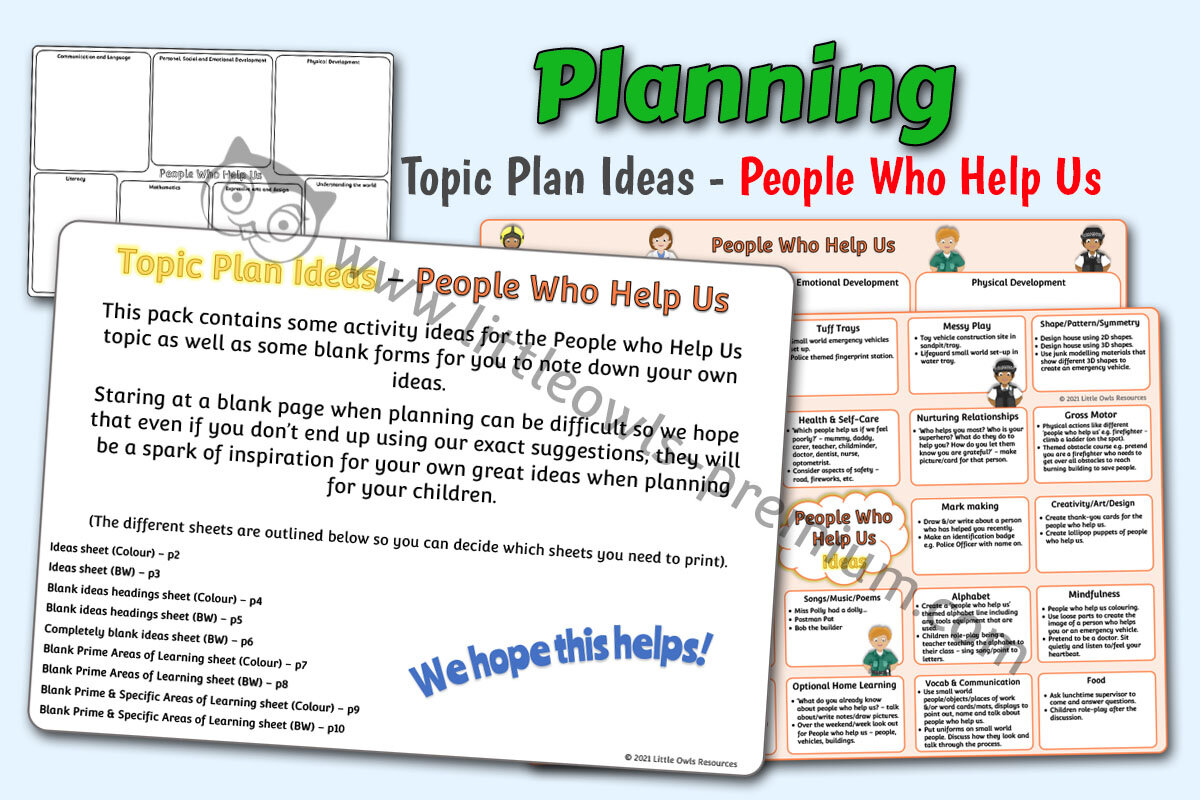
This pack contains some activity ideas for the People Who Help Us/Community Helpers topic as well as some blank forms for you to note down your own ideas.
Staring at a blank page when planning can be difficult so we hope that even if you don’t end up using our exact suggestions, they will be a spark of inspiration for your own great ideas when planning for your children.
(For additional ‘People Who Help Us’ themed resources visit our ‘PEOPLE WHO HELP US’ PAGE.)
Original artwork drawn by Sara Murphy and final digital resources created by Stuart Murphy. COPYRIGHT ON ALL OF THE RESOURCES HOUSED ON THIS WEBSITE IS HELD BY ‘LITTLE OWLS RESOURCES’. OUR RESOURCES (INCLUDING THE IMAGES WITHIN THEM), CANNOT BE SHARED OR SOLD COMMERCIALLY.
DOWNLOAD EDITABLE (DOCX)
DOWNLOAD NON-EDITABLE (PDF)
DOWNLOAD NON-EDITABLE (Zipped JPEGs)
<<-BACK TO ‘PEOPLE WHO HELP US’ MENU
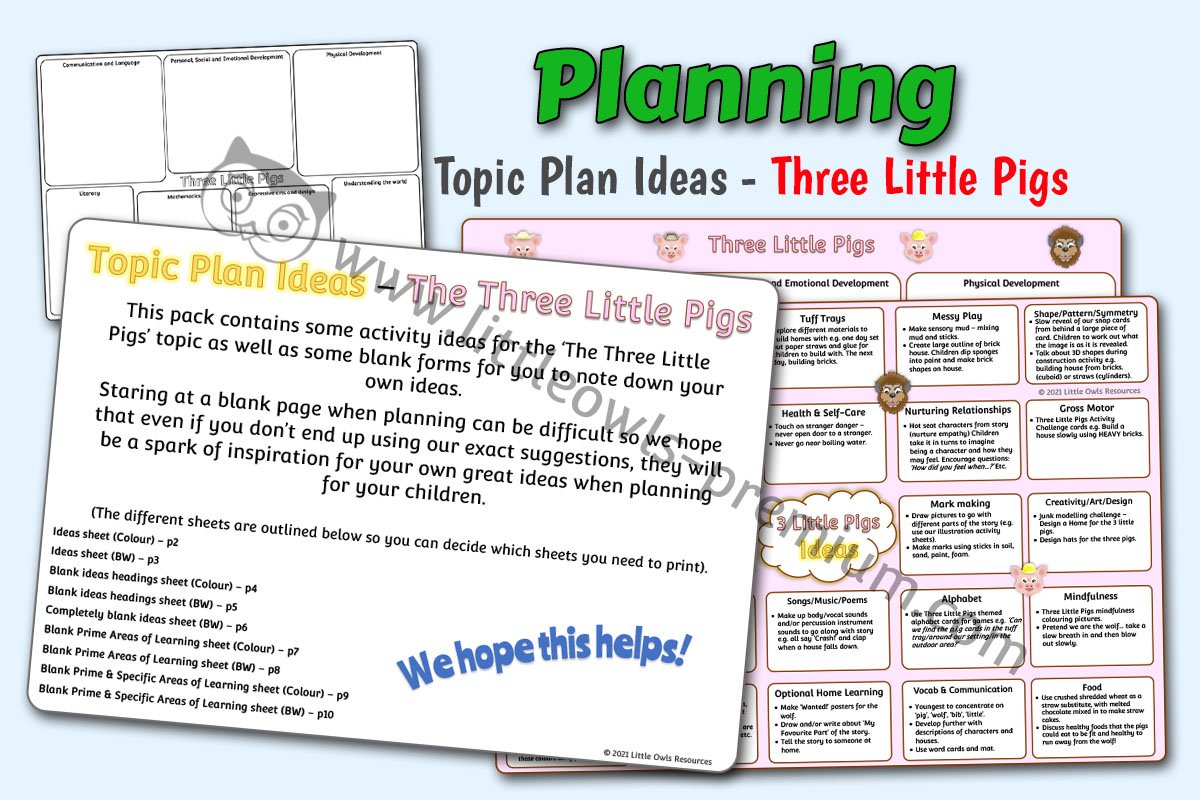
This pack contains some activity ideas for learning about THE THREE LITTLE PIGS as well as some blank forms for you to note down your own ideas.
Staring at a blank page when planning can be difficult so we hope that even if you don’t end up using our exact suggestions, they will be a spark of inspiration for your own great ideas when planning for your children.
(For additional ‘The Three Little Pigs’ themed resources visit our ‘THREE LITTLE PIGS’ PAGE.)
Original artwork drawn by Sara Murphy and final digital resources created by Stuart Murphy. COPYRIGHT ON ALL OF THE RESOURCES HOUSED ON THIS WEBSITE IS HELD BY ‘LITTLE OWLS RESOURCES’. OUR RESOURCES (INCLUDING THE IMAGES WITHIN THEM), CANNOT BE SHARED OR SOLD COMMERCIALLY.
DOWNLOAD EDITABLE (DOCX)
DOWNLOAD NON-EDITABLE (PDF)
DOWNLOAD NON-EDITABLE (Zipped JPEGs)

This pack contains some activity ideas for the Dinosaurs topic as well as some blank forms for you to note down your own ideas.
Staring at a blank page when planning can be difficult so we hope that even if you don’t end up using our exact suggestions, they will be a spark of inspiration for your own great ideas when planning for your children.
(For additional ‘Dinosaurs’ themed resources visit our ‘DINOSAURS’ PAGE.)
Original artwork drawn by Sara Murphy and final digital resources created by Stuart Murphy. COPYRIGHT ON ALL OF THE RESOURCES HOUSED ON THIS WEBSITE IS HELD BY ‘LITTLE OWLS RESOURCES’. OUR RESOURCES (INCLUDING THE IMAGES WITHIN THEM), CANNOT BE SHARED OR SOLD COMMERCIALLY.
DOWNLOAD EDITABLE (DOCX)
DOWNLOAD NON-EDITABLE (PDF)
DOWNLOAD NON-EDITABLE (Zipped JPEGs)

This pack contains some activity ideas for the Halloween topic as well as some blank forms for you to note down your own ideas.
Staring at a blank page when planning can be difficult so we hope that even if you don’t end up using our exact suggestions, they will be a spark of inspiration for your own great ideas when planning for your children.
(For additional ‘Halloween’ themed resources visit our ‘HALLOWEEN’ PAGE.)
Original artwork drawn by Sara Murphy and final digital resources created by Stuart Murphy. COPYRIGHT ON ALL OF THE RESOURCES HOUSED ON THIS WEBSITE IS HELD BY ‘LITTLE OWLS RESOURCES’. OUR RESOURCES (INCLUDING THE IMAGES WITHIN THEM), CANNOT BE SHARED OR SOLD COMMERCIALLY.
DOWNLOAD EDITABLE (DOCX)
DOWNLOAD NON-EDITABLE (PDF)
DOWNLOAD NON-EDITABLE (Zipped JPEGs)
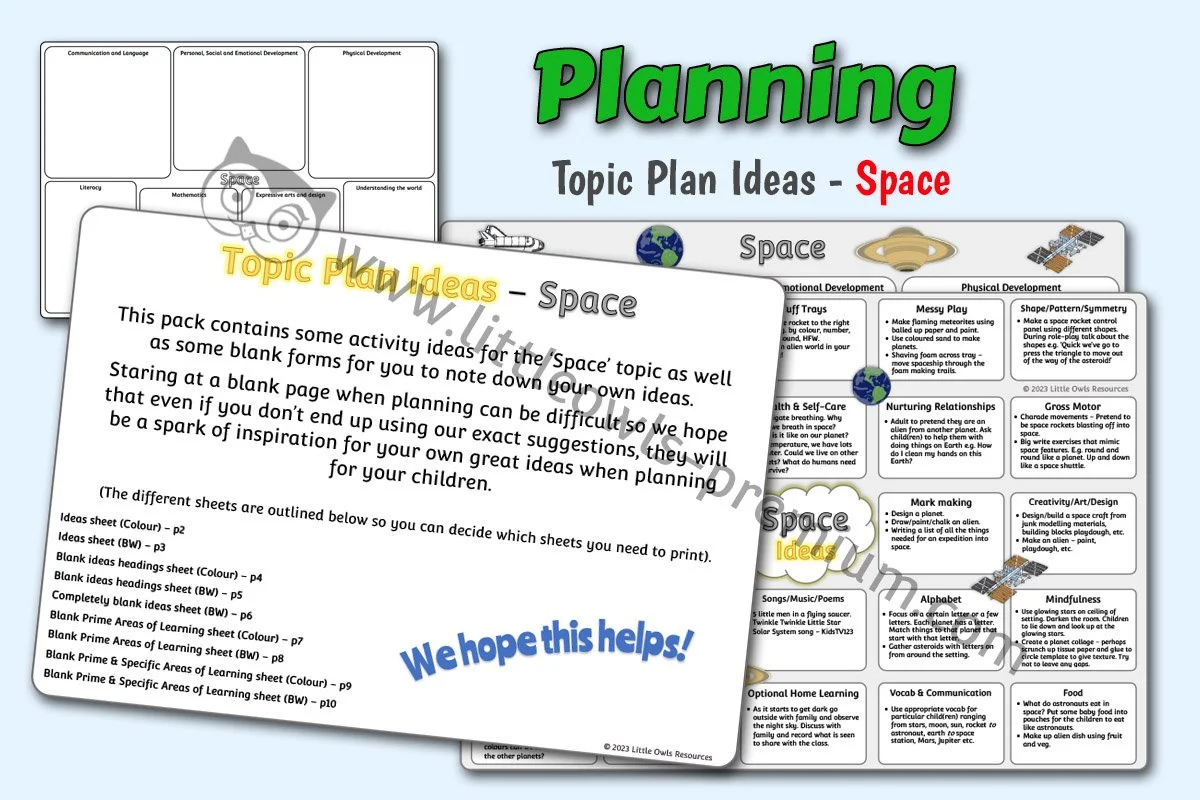
This pack contains some activity ideas for the Space topic as well as some blank forms for you to note down your own ideas.
Staring at a blank page when planning can be difficult so we hope that even if you don’t end up using our exact suggestions, they will be a spark of inspiration for your own great ideas when planning for your children.
(For additional ‘Space’ themed resources visit our ‘SPACE’ PAGE.)
Original artwork drawn by Sara Murphy and final digital resources created by Stuart Murphy. COPYRIGHT ON ALL OF THE RESOURCES HOUSED ON THIS WEBSITE IS HELD BY ‘LITTLE OWLS RESOURCES’. OUR RESOURCES (INCLUDING THE IMAGES WITHIN THEM), CANNOT BE SHARED OR SOLD COMMERCIALLY.
DOWNLOAD EDITABLE (DOCX)
DOWNLOAD NON-EDITABLE (PDF)
DOWNLOAD NON-EDITABLE (Zipped JPEGs)

This pack contains some activity ideas for the Winter topic as well as some blank forms for you to note down your own ideas.
Staring at a blank page when planning can be difficult so we hope that even if you don’t end up using our exact suggestions, they will be a spark of inspiration for your own great ideas when planning for your children.
(For additional ‘Winter’ themed resources visit our ‘WINTER’ PAGE.)
Original artwork drawn by Sara Murphy and final digital resources created by Stuart Murphy. COPYRIGHT ON ALL OF THE RESOURCES HOUSED ON THIS WEBSITE IS HELD BY ‘LITTLE OWLS RESOURCES’. OUR RESOURCES (INCLUDING THE IMAGES WITHIN THEM), CANNOT BE SHARED OR SOLD COMMERCIALLY.
DOWNLOAD EDITABLE (DOCX)
DOWNLOAD NON-EDITABLE (PDF)
DOWNLOAD NON-EDITABLE (Zipped JPEGs)

This pack contains some activity ideas for learning about PETS as well as some blank forms for you to note down your own ideas.
Staring at a blank page when planning can be difficult so we hope that even if you don’t end up using our exact suggestions, they will be a spark of inspiration for your own great ideas when planning for your children.
(For additional ‘Pets’ themed resources visit our ‘PETS’ PAGE.)
Original artwork drawn by Sara Murphy and final digital resources created by Stuart Murphy. COPYRIGHT ON ALL OF THE RESOURCES HOUSED ON THIS WEBSITE IS HELD BY ‘LITTLE OWLS RESOURCES’. OUR RESOURCES (INCLUDING THE IMAGES WITHIN THEM), CANNOT BE SHARED OR SOLD COMMERCIALLY.
DOWNLOAD EDITABLE (DOCX)
DOWNLOAD NON-EDITABLE (PDF)
DOWNLOAD NON-EDITABLE (Zipped JPEGs)

This pack contains some activity ideas for the Spring topic as well as some blank forms for you to note down your own ideas.
Staring at a blank page when planning can be difficult so we hope that even if you don’t end up using our exact suggestions, they will be a spark of inspiration for your own great ideas when planning for your children.
(For additional ‘Spring’ themed resources visit our ‘SPRING’ PAGE.)
Original artwork drawn by Sara Murphy and final digital resources created by Stuart Murphy. COPYRIGHT ON ALL OF THE RESOURCES HOUSED ON THIS WEBSITE IS HELD BY ‘LITTLE OWLS RESOURCES’. OUR RESOURCES (INCLUDING THE IMAGES WITHIN THEM), CANNOT BE SHARED OR SOLD COMMERCIALLY.
DOWNLOAD EDITABLE (DOCX)
DOWNLOAD NON-EDITABLE (PDF)
DOWNLOAD NON-EDITABLE (Zipped JPEGs)

This pack contains some activity ideas for learning about JACK AND THE BEANSTALK as well as some blank forms for you to note down your own ideas.
Staring at a blank page when planning can be difficult so we hope that even if you don’t end up using our exact suggestions, they will be a spark of inspiration for your own great ideas when planning for your children.
(For additional ‘Jack and the Beanstalk’ themed resources visit our ‘JACK AND THE BEANSTALK’ PAGE.)
Original artwork drawn by Sara Murphy and final digital resources created by Stuart Murphy. COPYRIGHT ON ALL OF THE RESOURCES HOUSED ON THIS WEBSITE IS HELD BY ‘LITTLE OWLS RESOURCES’. OUR RESOURCES (INCLUDING THE IMAGES WITHIN THEM), CANNOT BE SHARED OR SOLD COMMERCIALLY.
DOWNLOAD EDITABLE (DOCX)
DOWNLOAD NON-EDITABLE (PDF)
DOWNLOAD NON-EDITABLE (Zipped JPEGs)

These sheets can be used to note down possible ideas for learning and enjoyment related to a topic or interest.
Sometimes, when it is hard to grab and hold the attention of a child, it can be useful to use their own interests, however specific, as a starting point; a way in!
For example if a child/group of children show an interest in ‘Mobile Phones’, these sheets are for jotting down ideas that could use this interest as a starting point for learning through the prime areas. (Separate pack available for Prime and Specific areas.)
Original artwork drawn by Sara Murphy and final digital resources created by Stuart Murphy. COPYRIGHT ON ALL OF THE RESOURCES HOUSED ON THIS WEBSITE IS HELD BY ‘LITTLE OWLS RESOURCES’. OUR RESOURCES (INCLUDING THE IMAGES WITHIN THEM), CANNOT BE SHARED OR SOLD COMMERCIALLY.
DOWNLOAD EDITABLE (DOCX)
DOWNLOAD NON-EDITABLE (PDF)
DOWNLOAD NON-EDITABLE (Zipped JPEGs)

These sheets can be used to note down possible ideas for learning and enjoyment related to a topic or interest.
Sometimes, when it is hard to grab and hold the attention of a child, it can be useful to use their own interests, however specific, as a starting point; a way in!
For example if a child/group of children show an interest in ‘Mobile Phones’, these sheets are for jotting down ideas that could use this interest as a starting point for learning through all the seven areas. (Separate pack available for just Prime areas.)
Original artwork drawn by Sara Murphy and final digital resources created by Stuart Murphy. COPYRIGHT ON ALL OF THE RESOURCES HOUSED ON THIS WEBSITE IS HELD BY ‘LITTLE OWLS RESOURCES’. OUR RESOURCES (INCLUDING THE IMAGES WITHIN THEM), CANNOT BE SHARED OR SOLD COMMERCIALLY.
DOWNLOAD EDITABLE (DOCX)
DOWNLOAD NON-EDITABLE (PDF)
DOWNLOAD NON-EDITABLE (Zipped JPEGs)

These sheets can be used to plan the goals associated with an activity according to the age of the children in your care.
Each sheet has a small section to outline the activity itself followed by boxes to add the main goal for each age group. To the side there are tick boxes for each area of learning covered by the activity.
Lastly there is a space marked with a tick to note positives or what worked well, and a space marked with an arrow to note any next steps or areas for development.
Each page has a different combination of boxes for different settings:
Page 2: Ages 0-1, 2, 3-4 and Reception
Page 3: Ages 0-1 and 2
Page 4: Ages 0-1, 2, 3-4
Page 5: Ages 3-4 and Reception
(Separate pack available where boxes denote individual children rather than age groups.)
Original artwork drawn by Sara Murphy and final digital resources created by Stuart Murphy. COPYRIGHT ON ALL OF THE RESOURCES HOUSED ON THIS WEBSITE IS HELD BY ‘LITTLE OWLS RESOURCES’. OUR RESOURCES (INCLUDING THE IMAGES WITHIN THEM), CANNOT BE SHARED OR SOLD COMMERCIALLY.
DOWNLOAD EDITABLE (DOCX)
DOWNLOAD NON-EDITABLE (PDF)
DOWNLOAD NON-EDITABLE (Zipped JPEGs)

These sheets can be used to plan the goals associated with an activity according to the age of the children in your care.
Each sheet has a small section to outline the activity itself followed by boxes to add the main goal for each age group. To the side there are tick boxes for each area of learning covered by the activity.
Lastly there is a space marked with a tick to note positives or what worked well, and a space marked with an arrow to note any next steps or areas for development.
There are three available sheets with spaces for 4, 3 or 2 children respectively.
(Separate pack available where boxes denote age group goals rather than individual children.)
Original artwork drawn by Sara Murphy and final digital resources created by Stuart Murphy. COPYRIGHT ON ALL OF THE RESOURCES HOUSED ON THIS WEBSITE IS HELD BY ‘LITTLE OWLS RESOURCES’. OUR RESOURCES (INCLUDING THE IMAGES WITHIN THEM), CANNOT BE SHARED OR SOLD COMMERCIALLY.
DOWNLOAD EDITABLE (DOCX)
DOWNLOAD NON-EDITABLE (PDF)
DOWNLOAD NON-EDITABLE (Zipped JPEGs)

These sheets can be used to note down possible ideas for learning and enjoyment related to a topic or interest. Ideas are organised by area of learning.
Two sheets within pack. One which includes all seven areas of learning and another which includes just the prime areas.
Original artwork drawn by Sara Murphy and final digital resources created by Stuart Murphy. COPYRIGHT ON ALL OF THE RESOURCES HOUSED ON THIS WEBSITE IS HELD BY ‘LITTLE OWLS RESOURCES’. OUR RESOURCES (INCLUDING THE IMAGES WITHIN THEM), CANNOT BE SHARED OR SOLD COMMERCIALLY.
DOWNLOAD EDITABLE (DOCX)
DOWNLOAD NON-EDITABLE (PDF)
DOWNLOAD NON-EDITABLE (Zipped JPEGs)

These sheets can be used to note down possible ideas for learning and enjoyment related to a topic or interest. Each ideas box has an inspirational heading in order to help cover key learning experiences within the Early Years curriculum/EYFS. Use the boxes appropriate for your child(ren).
Two sheets within pack. One which includes boxes prefilled with inspirational headings and another with blank boxes for you to select your own headings.
Original artwork drawn by Sara Murphy and final digital resources created by Stuart Murphy. COPYRIGHT ON ALL OF THE RESOURCES HOUSED ON THIS WEBSITE IS HELD BY ‘LITTLE OWLS RESOURCES’. OUR RESOURCES (INCLUDING THE IMAGES WITHIN THEM), CANNOT BE SHARED OR SOLD COMMERCIALLY.
DOWNLOAD EDITABLE (DOCX)
DOWNLOAD NON-EDITABLE (PDF)
DOWNLOAD NON-EDITABLE (Zipped JPEGs)

This form of planning is the most flexible and responsive. It's often referred to as "in the moment", "on-the-spot" or "responsive" planning. It involves observing children's interests and using these to guide and extend their learning.
Intended for use by all types of EYFS practitioners, this flexible pack is ideal for Nurseries, Childminders, Preschools or for Reception Teachers at school.
This comprehensive pack features:
"In the Moment" Responsive Planning Sheet
This is a simple document that can be kept on a clipboard. While in-the-moment planning reduces paperwork, documentation is still a crucial part of the process. Written planning is done retrospectively to record the learning that has already occurred. The goal is to keep it simple and focused.
Vocabulary & Question Banks (age 2-3) (age 4-5)
An invaluable resource list of open-ended questions and high-impact vocabulary to refer to for each Area of Learning. Moving from "What are you doing?" to more effective prompts.
Prompts that promote Metacognitive Awareness
These short prompts are designed to get children thinking about their own thinking!
"Adult's Role" Guidance Sheets
These simple one-page sheets offer a quick reminder of the different roles an adult can take in a child's play.
· The Facilitator: How to set up an enabling environment.
· The Co-Play Partner: How to play alongside the child to model and extend learning.
· The Observer: How to step back and watch the child's independent learning.
Informative posters:
- The Teachable Moment and the Role of the Practitioner
- Documentation and Record-Keeping
- The Enabling Environment
COPYRIGHT ON ALL OF THE IMAGES, FILES & RESOURCES HOUSED ON THIS WEBSITE IS HELD BY ‘LITTLE OWLS RESOURCES’. IN DOWNLOADING ANY OF THESE RESOURCES YOU ARE ISSUED A SINGLE LICENCE FOR YOUR OWN USE AND THE RIGHT TO GRANT A LIMITED LICENCE TO YOUR STUDENTS TO USE THE LICENSED MATERIAL AS PART OF YOUR TEACHING AND THEIR OWN USE.
OUR RESOURCES (including the images within them), CANNOT BE SHARED OR SOLD COMMERCIALLY.
DOWNLOAD EDITABLE(DOCX)
DOWNLOAD NON-EDITABLE (PDF)
DOWNLOAD NON-EDITABLE (Zipped JPEGs)
Disclaimer
The information provided in this glossary is intended to support understanding of terminology commonly used within the Early Years Foundation Stage (EYFS). It does not constitute official guidance and should not be considered a substitute for the EYFS Statutory Framework or other Department for Education publications.
Terminology and interpretations may vary between settings and professional contexts.