

Scroll down to read this web document or download files here: DOCX 📝 | PDF 📄
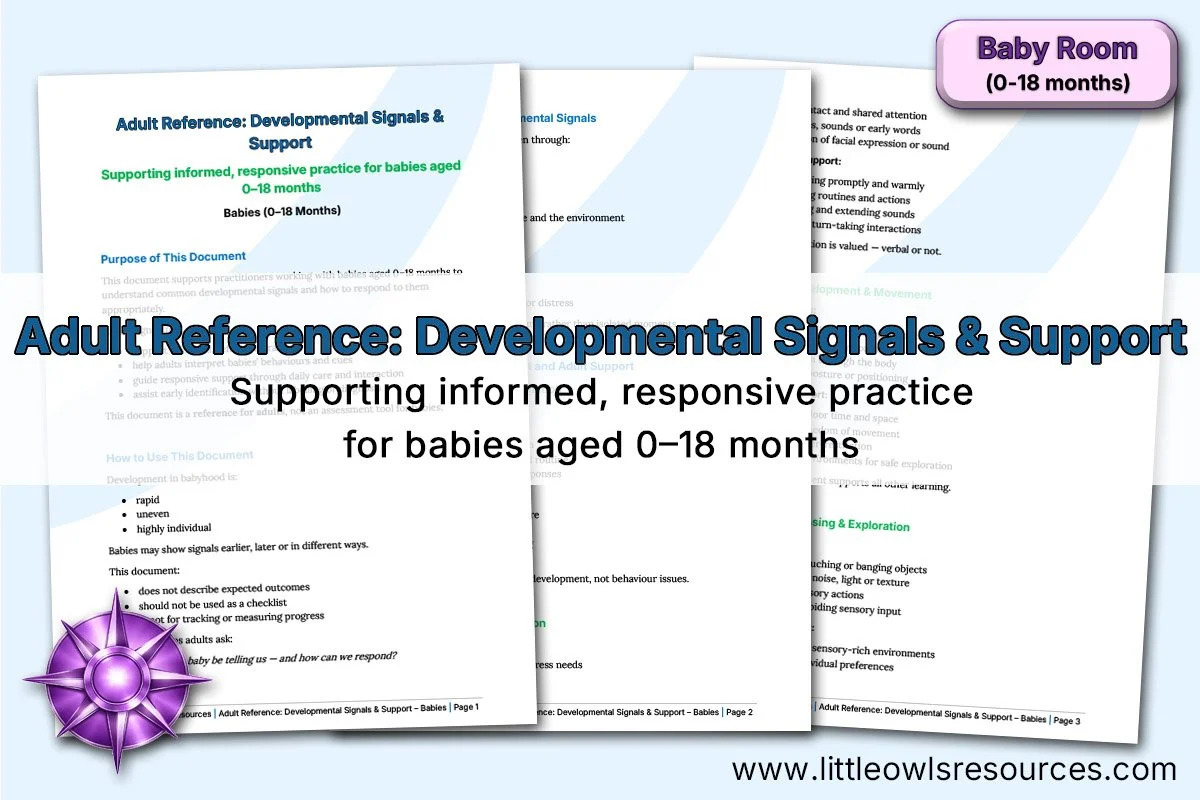
Adult Reference: Developmental Signals & Support
Babies (birth-18 months)
Supporting informed, responsive practice for babies aged 0–18 months
Purpose of This Document
This document supports practitioners working with babies aged 0–18 months to understand common developmental signals and how to respond to them appropriately.
It is designed to:
support informed, reflective practice
help adults interpret babies’ behaviours and cues
guide responsive support through daily care and interaction
assist early identification without labelling or diagnosis
This document is a reference for adults, not an assessment tool for babies.
How to Use This Document
Development in babyhood is:
rapid
uneven
highly individual
Babies may show signals earlier, later or in different ways.
This document:
does not describe expected outcomes
should not be used as a checklist
is not for tracking or measuring progress
Instead, it helps adults ask:
What might this baby be telling us — and how can we respond?
Understanding Developmental Signals
Developmental signals are seen through:
behaviour
movement
communication
emotional responses
engagement with people and the environment
Signals often appear during:
care routines
transitions
floor play
moments of connection or distress
Adults observe patterns over time rather than isolated moments.
Key Areas of Development and Adult Support
Emotional Security & Regulation
Possible signals:
seeking familiar adults
distress during separation
calming with comfort and routine
fluctuating emotional responses
How adults support:
consistent key-person care
predictable routines
calm, responsive soothing
allowing time for settling
These signals reflect emotional development, not behaviour issues.
Communication & Interaction
Possible signals:
crying or vocalising to express needs
eye contact and shared attention
gestures, sounds or early words
imitation of facial expression or sound
How adults support:
responding promptly and warmly
narrating routines and actions
imitating and extending sounds
allowing turn-taking interactions
All communication is valued — verbal or not.
Physical Development & Movement
Possible signals:
rolling, reaching, crawling or walking
repeated movement patterns
exploration through the body
changing posture or positioning
How adults support:
providing floor time and space
allowing freedom of movement
avoiding over-restriction
adapting environments for safe exploration
Physical development supports all other learning.
Sensory Processing & Exploration
Possible signals:
mouthing, touching or banging objects
sensitivity to noise, light or texture
repeated sensory actions
seeking or avoiding sensory input
How adults support:
offering calm, sensory-rich environments
observing individual preferences
adapting routines and spaces
reducing overstimulation
Sensory exploration is how babies make sense of the world.
Social Engagement & Relationships
Possible signals:
watching others
smiling or responding to familiar faces
showing interest in peers
seeking proximity to adults
How adults support:
modelling warm interactions
supporting shared attention
allowing observation before participation
respecting individual temperament
Babies learn socially through relationships, not group activities.
Curiosity, Engagement & Learning Dispositions
Possible signals:
sustained attention
repetition of actions
exploration of cause and effect
showing interest in familiar routines
How adults support:
allowing time for repetition
not interrupting deep engagement
offering simple, open-ended resources
following babies’ interests
Engagement is a key indicator of learning at this stage.
When Signals Raise Questions
Some babies may show signals that prompt reflection, such as:
limited communication
persistent distress
difficulty settling
reduced engagement
atypical responses to sensory input
When this happens, adults:
observe patterns over time
reflect as a team
adapt environments and interactions
discuss sensitively with families
Early support is always:
relational
supportive
non-diagnostic
Linking Observation to Support
Observation helps adults:
understand what babies are communicating
identify what supports regulation and engagement
adjust care routines
strengthen relationships
Support is embedded into:
daily routines
interaction styles
environmental adjustments
Not through targeted tasks or interventions.
Alignment with EYFS and Development Matters
This approach aligns with:
the EYFS focus on prime areas
Development Matters guidance as reference, not expectation
observation-led practice
early identification through everyday interaction
It reflects current UK best practice in baby provision.
In Summary
This reference supports adults to:
notice developmental signals
interpret behaviour as communication
respond thoughtfully and sensitively
support every baby as an individual
Development in babyhood is:
holistic
relational
deeply individual
Adult understanding — not formal assessment — is what enables babies to thrive.
Document Updated: March 2026
Download Document Here:
Recommended next read selection


Additional Documents | Professional Membership Contents (Babies 0-18 months)
Navigate our Curriculum & Pedagogy guidance documents here.
Pedagogical identity:
Relationship-led, care-centred baby practice where routines, interaction and sensory experience are the curriculum.
-
👉 This section protects developmentally appropriate practice.
-
👉 These documents support adult understanding — not expectations for babies.
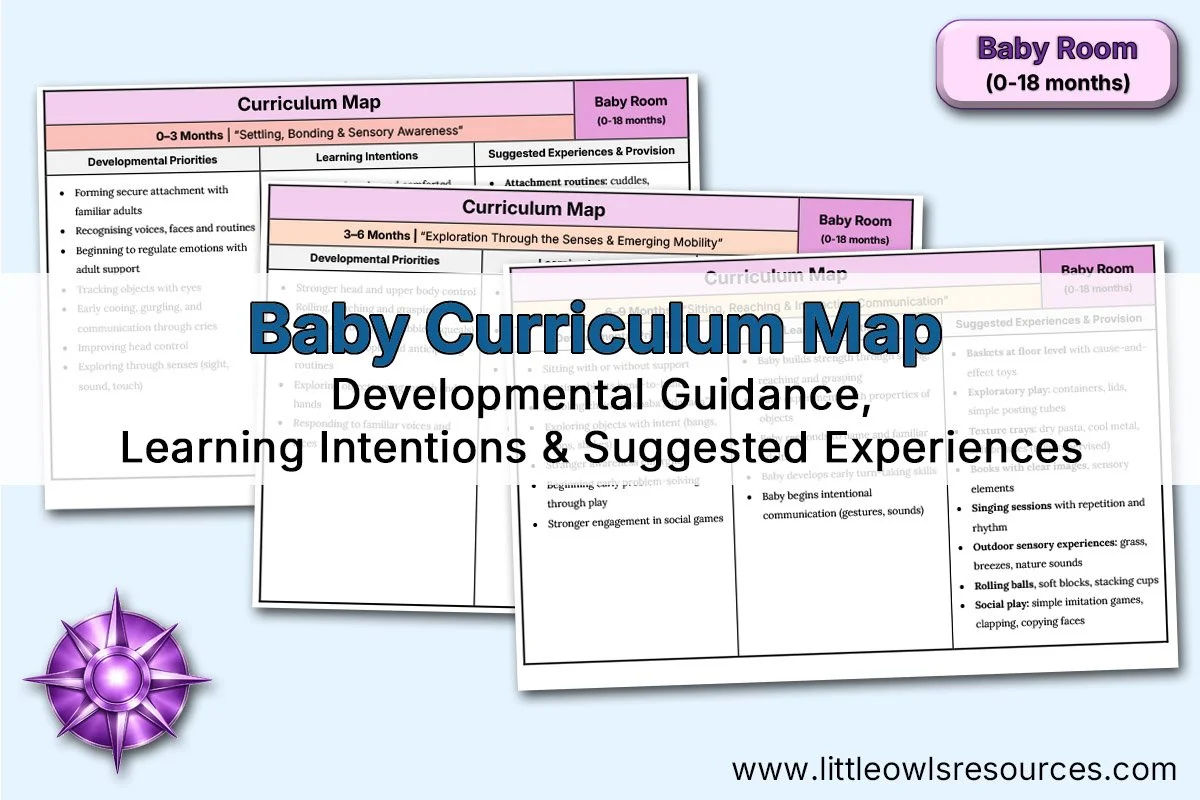
Baby Curriculum Maps - Developmental progression across age bands(0–3 months | 3–6 months | 6-9 months | 9-12 months | 12-18 months)
-
👉 Observation informs interaction, routines and environment.
-
👉 The environment supports exploration, movement and communication.
-
👉 Care routines are central to learning and wellbeing.
Transition & Sleep Routine Record Pack
Daily Transition Record
Individual Sleep Routine Profile
Review Template
-
👉 Language is built through interaction, not instruction.
-
👉 Planning supports adults — it never directs babies.
‘Intent - Implementation - Impact’ Reference Grids(Emotional, Communication, Physical, Sensory, Social, Problem-Solving, Independence)
-
👉 Proportionate, sensitive and statutory practice.
Progress Check at Age 2(looking ahead)
Report Template
Practitioner Guidance
-
👉 Early support is relational, preventative and respectful.
SEND Identification & Next Steps Pack | Babies
What to Look For
What Evidence to Collect
Practical Next Steps
A practical Toolkit for Early Years Practitioners
Inclusion Through Environment & Interaction
-
👉 Strong partnerships support consistency and trust.
-
👉 Transitions are emotional, not academic.
Additional Whole-Setting Guidance | for Professional Members
Explore our whole-setting guidance below, including overarching curriculum and pedagogy documents, early years schemas and EYFS setting policies.
-
-
Early Years Schemas - Practitioner Toolkit | EYFS Birth-5
↪ Schema Cards (definition, behaviours, age-related examples, enabling resources)
↪ Schema Observation & Responsive Provision Planning Template
-
EYFS Group Setting Policies Pack
↪ x 25 Policy Documents
↪ Policy Sign-Off and Confirmation Document
↪ EYFS Setting Policy Folder Contents List
Childminder Setting Policies Pack
↪ x 25 Policy Documents
↪ Childminder Assistant or Volunteer Policy Sign-Off and Confirmation Document
↪ Childminder Policy Folder Contents List
-
↪ Clear, practitioner-friendly explanations of key curriculum and pedagogy terms used throughout our guidance.
Looking for a different age-group pathway?
Select the pathway that best reflects your role or the age group you work with. You do not need to use everything. (Some practitioners may use more than one pathway.)
Latest EYFS Articles & Practical Guides | From Our Blog
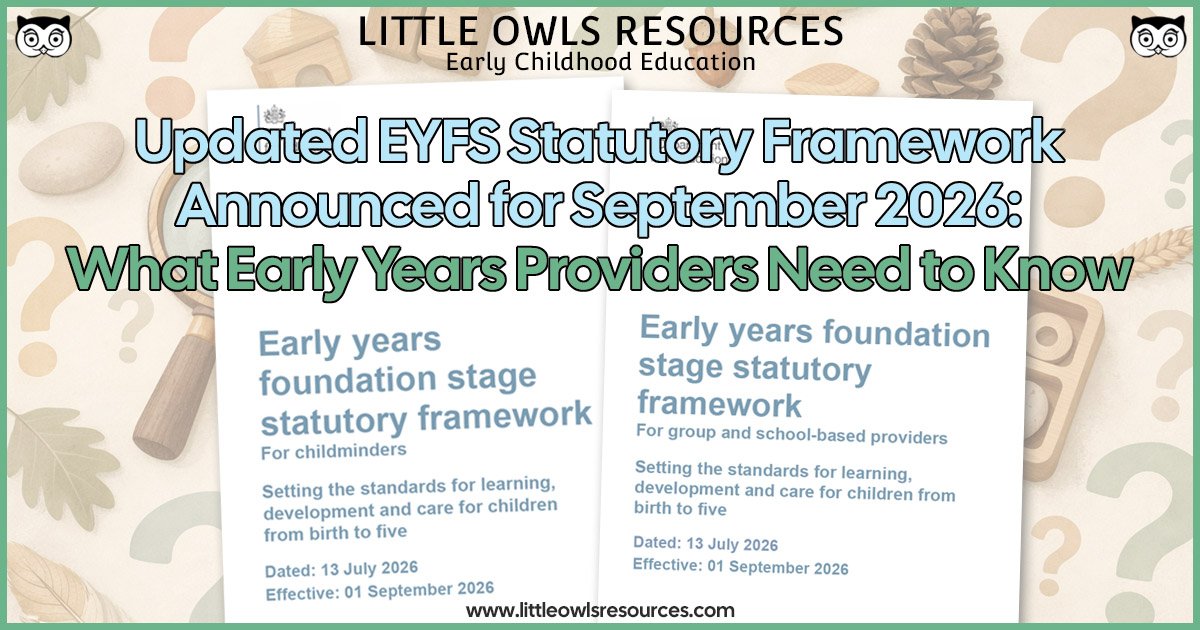
Stay informed, get expert advice, and find inspiration from our collection of articles and useful external resources, tailored specifically for EYFS practitioners. We regularly publish in-depth articles to support you with current best practices, regulatory changes, and fresh ideas.




Are you looking for a specific resource or document for your provision?
Use our 🔍 Search Bar located at the top of every page.
Content within the EYFS Curriculum & Pedagogy Membership is provided as professional guidance and support. It reflects current understanding of the EYFS statutory framework, Development Matters and inspection expectations at the time of writing. Practitioners are responsible for applying professional judgement and ensuring practice aligns with current statutory requirements and their specific context.
Updated: January 2026