

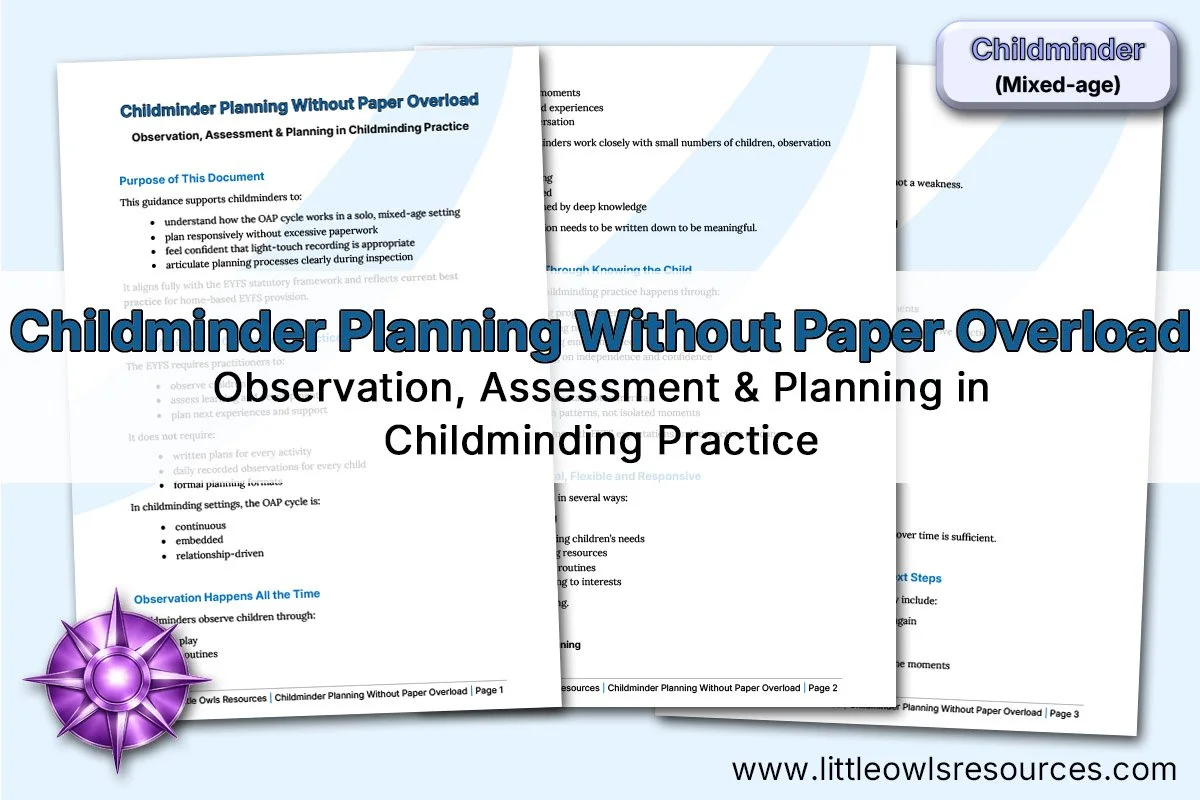
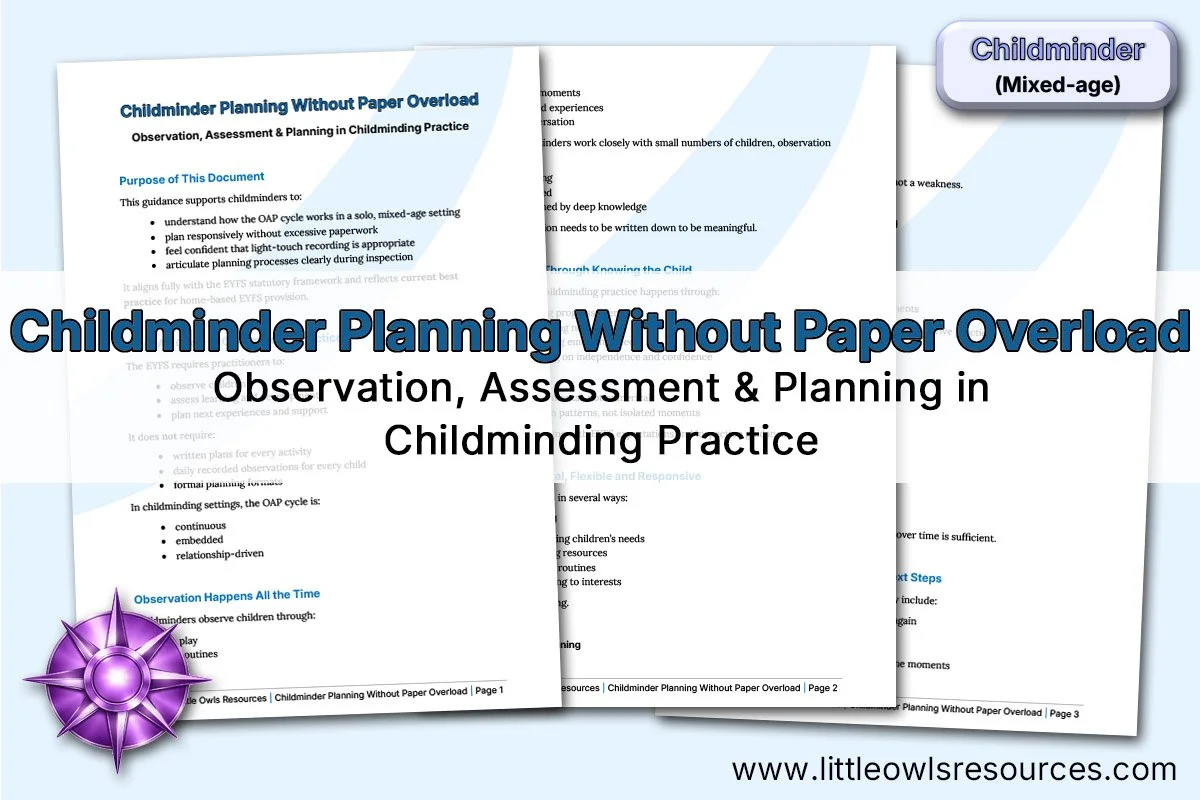
Childminder Planning Without Paper Overload
Observation, Assessment & Planning in Childminding Practice
Read our web document below or download here: DOCX 📝 | PDF 📄
Purpose of This Document
This guidance supports childminders to:
understand how the OAP cycle works in a solo, mixed-age setting
plan responsively without excessive paperwork
feel confident that light-touch recording is appropriate
articulate planning processes clearly during inspection
It aligns fully with the EYFS statutory framework and reflects current best practice for home-based EYFS provision.
The OAP Cycle in Childminding Practice
The EYFS requires practitioners to:
observe children
assess learning and development
plan next experiences and support
It does not require:
written plans for every activity
daily recorded observations for every child
formal planning formats
In childminding settings, the OAP cycle is:
continuous
embedded
relationship-driven
Observation Happens All the Time
Childminders observe children through:
play
routines
care moments
shared experiences
conversation
Because childminders work closely with small numbers of children, observation is:
ongoing
detailed
informed by deep knowledge
Not all observation needs to be written down to be meaningful.
Assessment Through Knowing the Child
Assessment in childminding practice happens through:
noticing progress over time
recognising new skills
identifying emerging needs
reflecting on independence and confidence
Assessment is:
developmental, not numerical
based on patterns, not isolated moments
This approach aligns with EYFS expectations and inspection guidance.
Planning: Mental, Flexible and Responsive
Childminders plan in several ways:
1. Mental Planning
anticipating children’s needs
preparing resources
adapting routines
responding to interests
This is valid planning.
2. Responsive Planning
Plans change as children:
show curiosity
need support
develop new skills
Responsive planning is a strength, not a weakness.
3. Recorded Planning (Light Touch)
Recording may include:
brief notes
photographs
weekly reflections
occasional next-step comments
Recording supports reflection — it does not drive practice.
Recording Without Overload
Effective recording is:
purposeful
manageable
proportionate
Childminders do not need:
long written observations
daily entries for every child
multiple formats
A small number of meaningful records over time is sufficient.
Using Observations to Inform Next Steps
Next steps in childminding settings may include:
offering a similar experience again
adding a new resource
adjusting adult interaction
supporting a skill during routine moments
Next steps are often implemented immediately, not documented in advance.
Mixed-Age Planning in Practice
In mixed-age care:
planning focuses on experiences, not ages
adult support is differentiated
learning outcomes vary naturally
This approach is:
efficient
inclusive
EYFS-aligned
Explaining Planning to Inspectors
Childminders can confidently explain:
“I observe children throughout the day and reflect on their learning.”
“Planning is responsive and shaped by children’s needs and interests.”
“I record key observations to support reflection and communication.”
This demonstrates strong understanding of the OAP cycle.
Key Messages for Childminders
You are planning all the time
Paperwork is not the curriculum
Knowing children deeply is central
Recording supports reflection, not compliance
Your approach is valid and professional
Final Position
Effective planning in childminding settings is:
responsive
flexible
proportionate
rooted in relationships
It supports children’s learning without overwhelming the practitioner.
Document Updated: January 2026
Recommended next read selection

Or read our ‘Little Owls Resources’ Curriculum Intent Statement’
Additional Documents | Professional Contents (Mixed-Age)
Navigate our Curriculum & Pedagogy guidance documents here.
Please note, All Access Membership enables access to all age-specific pathways.
Childminder Pathway Documents
Navigate your way through curriculum, pedagogy, policies, planning and inspection-support documents designed specifically for childminding practice.
Contents reflects the realities of mixed-age care, home-based provision and solo working, while remaining fully aligned with the EYFS statutory framework. The documents below are designed for use alongside our age-specific pathway materials.
-
👉 Establish confidence, language and inspection-ready understanding.
Childminder Pedagogy Position Statement[Free Orienting Sample]
- Our approach to EYFS in home-based, mixed-age settingsThe EYFS Curriculum in Mixed-Age Care
- Birth–5 curriculum guidance for childmindersContinuous Provision in a Childminding Setting
- Practical Guidance for Home-Based EYFS Practice
-
👉 Reduce workload and validate responsive planning.
Planning Without Paper Overload (Childminder OAP Guidance)[Free Orienting Sample]
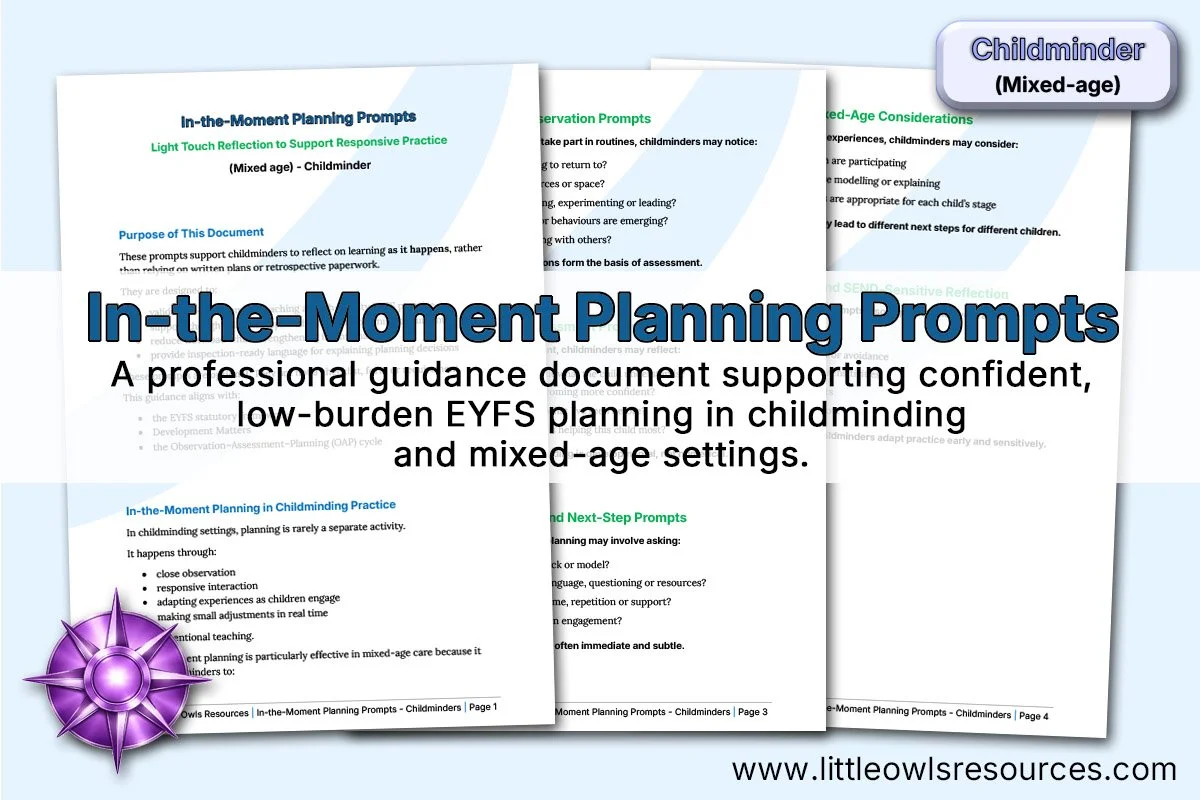
- Observation–Assessment–Planning in childminding practiceIn-the-Moment Planning Prompts
- Light-touch prompts to support reflection and next stepsWeekly Care & Learning Planning Templates
- Optional formats for those who prefer written reflection
-
👉 Support for confident assessment across mixed ages.
Assessment & Progression in Mixed-Age Care
- Recognising development without tracking systemsSEND & Early Identification in Childminding Settings
- Observing patterns, adapting practice, seeking supportProgress Summaries & Transition Records(Guidance)
- Supporting transitions and communication with families and schools
-
👉 Translate EYFS provision into home-based practice.
Continuous Provision in a Childminding Setting
- Practical Guidance for Home-Based EYFS PracticeProvision Rotation & Resource Selection Toolkit
- Keeping provision fresh without overwhelmOutdoor & Community Learning Guidance
- Learning beyond the home environment
-
👉 Build calm, informed inspection readiness.
Inspection Confidence for Childminders
- Explaining curriculum, planning and assessment clearlyEYFS Language for Inspection Conversations
- Key phrases and explanations rooted in practiceSafeguarding & Welfare Overview
- Clarifying expectations and responsibilities
-
👉 Bring pedagogy to life through relatable examples.
A Week in the Life of a Childminder
- Illustrating high-quality EYFS practice across a typical week
-
👉 Support strong relationships with families.
Parent Communication Templates
- Daily updates, transitions and shared informationExplaining EYFS to Families (Childminder Version)
- Helping parents understand learning through play and care
-
👉 Cohesion with age-specific pathways and wider site resources.
Using Tier 3 Professional Membership as a Childminder
- How these documents complement printable resources & our age-specific pathwaysBirth–5 Coherence Overview
- How childminder pedagogy aligns with Baby, Toddler, Preschool & Reception frameworks
-
👉 Overarching practice documents.
Childminder Setting Policies Pack
↪ x 22 Policy Documents
↪ Childminder Assistant or Volunteer Policy Sign-Off and Confirmation Document
↪ Childminder Policy Folder Contents List
Additional Whole-Setting Guidance
Explore our whole-setting guidance below, including overarching curriculum and pedagogy documents, early years schemas and EYFS setting policies.
-
-
Early Years Schemas - Practitioner Toolkit | EYFS Birth-5
↪ Schema Cards (definition, behaviours, age-related examples, enabling resources)
↪ Schema Observation & Responsive Provision Planning Template
-
EYFS Group Setting Policies Pack
↪ x 25 Policy Documents
↪ Policy Sign-Off and Confirmation Document
↪ EYFS Setting Policy Folder Contents List
Childminder Setting Policies Pack
↪ x 25 Policy Documents
↪ Childminder Assistant or Volunteer Policy Sign-Off and Confirmation Document
↪ Childminder Policy Folder Contents List
-
↪ Clear, practitioner-friendly explanations of key curriculum and pedagogy terms used throughout our guidance.
Age-Specific Guidance For Children Within Your Care
All Access Members have access to all of the pathways below. Select the ages relevant for the children you work with.
Childminders can use age-specific documents to:
inform professional understanding of development
support appropriate expectations
reflect on how children are progressing over time
You do not need to use everything.
Select a Pathway below:
Latest EYFS Articles & Practical Guides | From Our Blog
Stay informed, get expert advice, and find inspiration from our collection of articles and useful external resources, tailored specifically for EYFS practitioners. We regularly publish in-depth articles to support you with current best practices, regulatory changes, and fresh ideas.





Are you looking for a specific resource or document for your provision?
Use our 🔍 SEARCH Bar located at the top of every page.
___________________________
Content within the EYFS Curriculum & Pedagogy Membership is provided as professional guidance and support. It reflects current understanding of the EYFS statutory framework, Development Matters and inspection expectations at the time of writing. Practitioners are responsible for applying professional judgement and ensuring practice aligns with current statutory requirements and their specific context. All resources, experiences and environment arrangements must be risk assessed by the setting and used in accordance with individual children’s developmental stages, needs and supervision requirements.
Safeguarding content does not replace a setting’s safeguarding and child protection policy or the statutory role of the Designated Safeguarding Lead (DSL). All concerns must be managed in line with current statutory guidance and local safeguarding procedures.
_____________________________